
Showing 12 items matching "rural pride"
-
 Lakes Entrance Historical Society
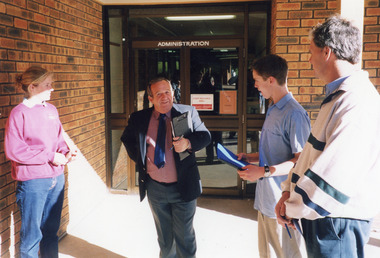
Photograph - Keep Australia Beautiful Rural Pride Selection team Lakes Entrance Secondary School 1999
... Keep Australia Beautiful Rural Pride Selection team Lakes Entrance Secondary School 1999......Rural pride...Colour photograph of visit by Keep Australia Beautiful Rural Pride Selection team to Lakes Entrance Secondary College. ...Schools Rural pride Colour photograph of visit by Keep Australia Beautiful Rural Pride Selection team to Lakes Entrance Secondary College. ...Colour photograph of visit by Keep Australia Beautiful Rural Pride Selection team to Lakes Entrance Secondary College. Lakes Entrance Victoriaschools, rural pride -
 Lakes Entrance Historical Society
Administrative Record - Documents, Tidy Towns - Rural Pride, 1997
... Tidy Towns - Rural Pride...Contains documentation dating back to 1997, printed and hand written information DOCUMENTS Letters Documentation relevant to Lakes Entrance Tidy Towns for the year 2000, in white two ring binder Tidy Towns - Rural Pride Administrative Record Documents ...Contains documentation dating back to 1997, printed and hand written informationDocumentation relevant to Lakes Entrance Tidy Towns for the year 2000, in white two ring binderdocuments, letters -
 Kiewa Valley Historical Society
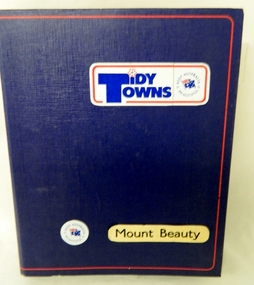
Folder - Tidy Towns, Tidy Towns Mount Beauty, 1984/85
... ...rural town pride...This folder represents the true "Aussie" and the pride felt living in small rural communities. It was present in the period before the 1990's but fell so ever slightly away through the faster pace of the "modern" life evolution into a more "introspective" life style. ...Although the physical isolation of yesteryear may not be so strong as the technology and population growths boost a greater interaction between city and rural folk, the ingrained attitude of comradeship still prevades. community beautification programs rural town pride community pride Adhesive stickers on front cover "Tidy Towns" "Keep Australia Beautiful" below this "Mount Beauty" This large blue coloured lever arch folder (cloth with a red lined border) has 104 plastic pockets each with two sheets of documentation for the appraisal of the decision makers/judges of the "Keep Australia Beautiful Council (Vic), "Tidy Towns" competition. ...This folder represents the true "Aussie" and the pride felt living in small rural communities. It was present in the period before the 1990's but fell so ever slightly away through the faster pace of the "modern" life evolution into a more "introspective" life style. The changes brought on by technology e.g. computers, mobile telephone "texting" and the internet has slowly impinged upon those community "get togethers" of the 1900's. Life in small rural towns and regions however have only slowly moved away from the community self worth attitudes which were so strong when life in rural areas was more insulated through physical and technologically isolation.This Tiny Towns Folder with its content is highly significant to the small town of Mount Beauty and the Kiewa Valley and its region because it represents the "true" value of rural life in the "modern" Australia. The "old" values of "mateship" and looking after the community is still very strong in the rural sector, as compared with living in the cities. The psychological and physical benefits of living in smaller rural centres is clearly demonstrated by the contents of this "Tidy Towns", keep Australia Beautiful, competition. The value of "the true blue, dinky die mateship" is still very much alive in country towns and rural environments. Although the physical isolation of yesteryear may not be so strong as the technology and population growths boost a greater interaction between city and rural folk, the ingrained attitude of comradeship still prevades. This large blue coloured lever arch folder (cloth with a red lined border) has 104 plastic pockets each with two sheets of documentation for the appraisal of the decision makers/judges of the "Keep Australia Beautiful Council (Vic), "Tidy Towns" competition.Adhesive stickers on front cover "Tidy Towns" "Keep Australia Beautiful" below this "Mount Beauty" community beautification programs, rural town pride, community pride -
 Lakes Entrance Historical Society
Photograph - Henrie Ellis - Principal Lakes Entrance Secondary School 1999
... Photograph taken on visit by Keep Australia Beautiful Rural Pride....Photograph taken on visit by Keep Australia Beautiful Rural Pride. Schools Students School teachers Colour photograph of student David Kelly, Henrie Ellis - Principal LESC, David Klemm - KAB committee, in car park on visit to Lakes Entrance Secondary College, Lakes Entrance Victoria Photograph Henrie Ellis - Principal Lakes Entrance Secondary School 1999 ...Photograph taken on visit by Keep Australia Beautiful Rural Pride.Colour photograph of student David Kelly, Henrie Ellis - Principal LESC, David Klemm - KAB committee, in car park on visit to Lakes Entrance Secondary College, Lakes Entrance Victoriaschools, students, school teachers -
 Lakes Entrance Historical Society
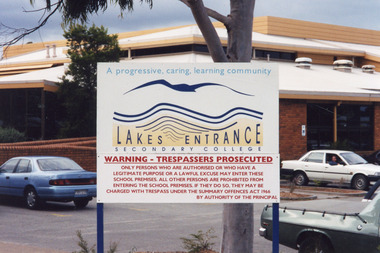
Photograph - Lakes Entrance Secondary College. Lakes Entrance Victoria 1999
... Photographs taken on visit to Lakes Entrance by Keep Australia Beautiful Rural Pride....Photographs taken on visit to Lakes Entrance by Keep Australia Beautiful Rural Pride. Schools Colour photograph front entrance view Lakes Entrance Secondary College. ...Photographs taken on visit to Lakes Entrance by Keep Australia Beautiful Rural Pride.Colour photograph front entrance view Lakes Entrance Secondary College. Lakes Entrance Victoriaschools -
 Sunshine and District Historical Society Incorporated
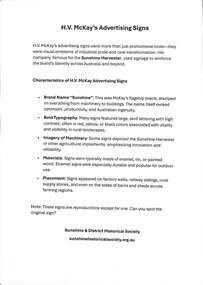
Archive - Sunshine And District Historical Society H.V. McKay's Advertising Signs Exhibition
... McKay’s advertising signs were more than just promotional tools—they were visual emblems of industrial pride and rural transformation. His company, famous for the Sunshine Harvester, used signage to reinforce the brand’s identity across Australia and beyond. ...McKay’s advertising signs were more than just promotional tools—they were visual emblems of industrial pride and rural transformation. His company, famous for the Sunshine Harvester, used signage to reinforce the brand’s identity across Australia and beyond. ...H.V. McKay’s Advertising Signs H.V. McKay’s advertising signs were more than just promotional tools—they were visual emblems of industrial pride and rural transformation. His company, famous for the Sunshine Harvester, used signage to reinforce the brand’s identity across Australia and beyond. Characteristics of H.V. McKay Advertising Signs • Brand Name “Sunshine”: This was McKay’s flagship brand, stamped on everything from machinery to buildings. The name itself evoked optimism, productivity, and Australian ingenuity. • Bold Typography: Many signs featured large, serif lettering with high contrast, often in red, yellow, or black colors associated with vitality and visibility in rural landscapes. • Imagery of Machinery: Some signs depicted the Sunshine Harvester or other agricultural implements, emphasizing innovation and reliability. • Materials: Signs were typically made of enamel, tin, or painted wood. Enamel signs were especially durable and popular for outdoor use. • Placement: Signs appeared on factory walls, railway sidings, rural supply stores, and even on the sides of barns and sheds across farming regions. Sunshine’s Historical Context • The H.V. McKay Pty Ltd, commonly referred to as the Sunshine Harvester Works, in Braybrook Junction (later renamed Sunshine) was located on this site. The factory became a hub of local industrial activity, and signage played a key role in branding the town itself. • By the 1920s, the H.V. McKay Harvester Factory had become the largest manufacturing enterprise in the Southern Hemisphere. • The Sunshine Harvester Works employed thousands of people from both Sunshine and the surrounding suburbs. • In 1930, the company merged with the Australian arm of the Canadian manufacturer Massey Harris, forming H.V. McKay Massey Harris Pty Ltd. • In 1953, Massey-Harris merges with Harry Ferguson Ltd, forming Massey-Harris-Ferguson Ltd and in 1958 renamed to Massey Ferguson Ltd • The Massey Ferguson Factory closed in the 1980’s and the demolition of the site started in 1988. • The site today is the home of the Sunshine Market Place, Brimbank Council Offices, Visy Cares Hub, Sunshine Police Station, Sunshine Magistrates' Court and a number of other shops and offices. • The only building remaining of the original factory is the Bulk Store, now the Visy Cares Hub. Note: These signs are reproductions except for one. Can you spot the original sign? 5684.01 - H.V. McKay's Advertising Signs Exhibition.jpg 5684.02 - H.V. McKay's Advertising Signs Exhibition.jpg 1013.01 - H.V. McKay Advertising Sign.jpg 1013.02 - H.V. McKay Advertising Sign.jpg 1013.03 - H.V. McKay Advertising Sign.jpg 1013.04 - H.V. McKay Advertising Sign.jpg 1013.05 - H.V. McKay Advertising Sign.jpg 2897 - Massey Ferguson Gate Sign.jpg 3041 - Sunshine Farm Machinery and Tractors Sign.jpgh.v. mckay -
 Ringwood and District Historical Society
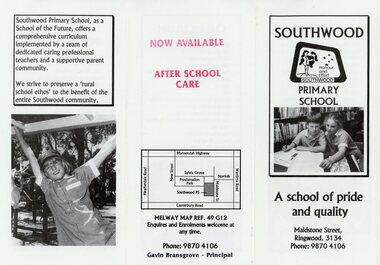
Pamphlet, Southwood Primary School (Ringwood) advertising flyer
... Pride and Quality" advertising Southwood Primary School enrolements. Address - Maidstone St, Ringwood, 3134, PH: 9870 4106 List details of facilities, curriculum, and parental involvement. Advertises after school care. Some B&W photos of students. Descibes Southwood as a School of the Future, striving to 'preserve a rural...Pride and Quality" advertising Southwood Primary School enrolements. Address - Maidstone St, Ringwood, 3134, PH: 9870 4106 List details of facilities, curriculum, and parental involvement. Advertises after school care. Some B&W photos of students. Descibes Southwood as a School of the Future, striving to 'preserve a rural ...Light green coloured, folded A4 paper pamphlet titled "A School of Pride and Quality" advertising Southwood Primary School enrolements. Address - Maidstone St, Ringwood, 3134, PH: 9870 4106 List details of facilities, curriculum, and parental involvement. Advertises after school care. Some B&W photos of students. Descibes Southwood as a School of the Future, striving to 'preserve a rural school ethos' -
 Kiewa Valley Historical Society
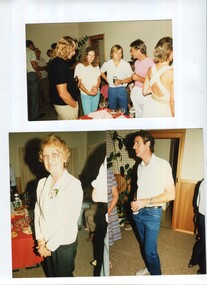
Photos - 1985 Tidy Towns Award - Mt Beauty
... rural and regional Australia. It is an initiative run by Keep Australia Beautiful that celebrated grassroots, community-led environmental action and sustainability. It originally focused on basic litter reduction and civic pride...rural and regional Australia. It is an initiative run by Keep Australia Beautiful that celebrated grassroots, community-led environmental action and sustainability. It originally focused on basic litter reduction and civic pride ...Tidy Towns is a national award celebrating community led environmental action in rural and regional Australia. It is an initiative run by Keep Australia Beautiful that celebrated grassroots, community-led environmental action and sustainability. It originally focused on basic litter reduction and civic pride. It commenced in since 1968 and continues today in 2026 with a wider focus including eg. economic sustainability.Mt Beauty is a small town with an active community who cared for the environment.8 coloured photos 10 cm x 25.5 cm showing people involved including the cutting of the cake. Only 2 photos are labelled 1. "Aileen Moore-Committee" and "Barry O'Brien NEW" and 2 small photos - "1985 / Category A / Positive / Litter Control / Winner / Mt Beauty"rural towns, tidy towns, community beautification programs, sustainability and environment -
 Kiewa Valley Historical Society
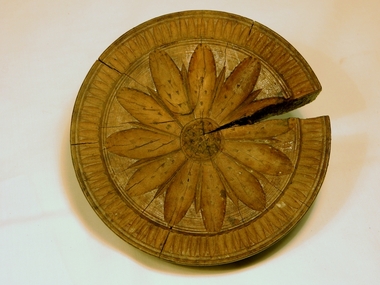
Butter Stamp Block, Circa 1950
... This shortbread / butter stamp was used by a Kiewa Valley dairy and it presents what the domestic butter beautification processes were available during the mid to latter 1900s was. Their was a pride by rural properties in their produce and its by-products. butter stamp domestic butter blocks domestic food preparations. shortbread stamp dairy butter On the dome stamped in black ink "T. & W. ...At the time when this shortbread / butter stamp block was used, rural dairies and larger properties who manufactured their own butter used butter stamps blocks for identifying the source of the butter or for decoration.. The patterns stamped into the warmed butter provided for a range of decorative visual enhancement to the "plain" and "boring" straight leveled normal butter surface. Although the wooden surfaces could be hard to keep clean commercial usage would have been limited and eventually replaced by a non porous and hygienically cleaner material. Greater hygiene controls where introduced. from the late 1940s on. These controls were the result of high infectious illnesses due to contaminated milk and dairy handling methods.This shortbread / butter stamp was used by a Kiewa Valley dairy and it presents what the domestic butter beautification processes were available during the mid to latter 1900s was. Their was a pride by rural properties in their produce and its by-products.This shortbread / butter stamp is made from wood, round and fashioned from a flat bed to a dome top. The top has a round moulded hole with screw indentations for fastening a pressure pole. The pattern on the face of the stamp is of an eleven petalled flower pattern around a small circular flower head. Both the head and petals have indentations which are will produce raised points in the pressed butter. Enclosing the flower pattern is a pattern which when pressed against the butter would produce small ridges radiating outward.On the dome stamped in black ink "T. & W. Davies"butter stamp, domestic butter blocks, domestic food preparations., shortbread, stamp, dairy, butter -
Bendigo Historical Society Inc.
Newspaper - Bendigo Advertiser Collection: Schools Searching for a Future - Mandurang South Primary School 1628, August 13 1993
... The school has a rich history, with its original weatherboard building and a notable stand of century-old trees, making it a model for rural education and a point of local pride. The most likely option discussed was merging with Mandurang Primary, which would be ironic given their historical split over a century ago.Mandurang South's situation serves as a test case for the broader impact of educational 'rationalisation' policies on small rural schools. ...The school has a rich history, with its original weatherboard building and a notable stand of century-old trees, making it a model for rural education and a point of local pride. The most likely option discussed was merging with Mandurang Primary, which would be ironic given their historical split over a century ago.Mandurang South's situation serves as a test case for the broader impact of educational 'rationalisation' policies on small rural schools. ...The document highlights the challenges faced by Mandurang South, a small rural school, in the face of government education reforms and potential closure. Mandurang South was considered an easy target for closure under new government 'quality provision' guidelines. Despite demonstrating a strong curriculum and experienced leadership, the school faced severe staffing reductions: from two teachers plus specialist support to just 1.4 teachers for 32 students. This would require one teacher to manage 31 children across seven grades in a single classroom, raising concerns about educational quality. Parents and teachers collaborated intensively to prepare a submission proving the school's quality, hoping to meet government criteria for survival. Some parents, including former students, expressed willingness to close or merge the school if educational standards could not be maintained, while others wanted to keep it open. The school community was holding a referendum to decide its stance for an upcoming taskforce meeting. Mandurang South and its neighboring school, Mandurang Primary, originated from a split in 1875 due to the distances children had to travel. The school has a rich history, with its original weatherboard building and a notable stand of century-old trees, making it a model for rural education and a point of local pride. The most likely option discussed was merging with Mandurang Primary, which would be ironic given their historical split over a century ago.Mandurang South's situation serves as a test case for the broader impact of educational 'rationalisation' policies on small rural schools. Mr. Balmer was Head Teacher in 1875. Heintervened to stop residents from cutting timber on school grounds, preserving a notable stand of eucalypts and conifers.The school grounds are recognized for their natural beauty, attracting visitors and providing students with daily exposure to native wildlife and nature-based activities. The school offers standard facilities (oval, courts, shelter) and unique curriculum elements like "bush cooking," making learning relevant to its rural setting. Mandurang South School is valued at $50,000–$70,000, but faces closure due to economic constraints and potential staff reductions.There is concern that closure could lead to further school consolidations in the Mandurang valley, as part of a broader government education reform. The possible closure is seen as a loss to the community’s heritage and educational landscape, with uncertainty about the future of other local schools.Schools searching for a Future. Series of photos and information about Mandurang Primary School No. 1628. Pictures by Lisa Honeychurch. Written by Owen Davies. This item contains the following documents: 8091.602a Part of Page 11, the Bendigo Advertiser Friday August 13 1993 8091.602b Part of Page 11, the Bendigo Advertiser Friday August 13 1993 8091.602c Black and White Photo of four kids playing cricket on the oval besides the school - Contact BHS for Details 8091.602d Black and White Photo of Grade Four student Gary Wilkins sitting under a pine tree, possibly reading - Contact BHS for Details 8091.602e Black and White Photo of Grade Four students "Bush Cooking" around a camp fire Left to Right: Travis Singe, Tristian Gillies, Gary Wilkins, Bill Riddell - Contact BHS for Details 8091.602f Black and White Photo Front of Mandurang South School - Contact the BHS for Details 8091.602g Black and White Photo Front of Mandurang South School - Contact the BHS for Details 8091.602h Black and White Photo Two men and three kids in front of the school sign. Left to Right: Brian Murdoch, Brian's daughter Ebony, John's son and daughter, Roger and Erin, and John Murdoch - Contact the BHS for Details 8091.602i Black and White Photo of Mrs Bess Coghill, the former Post Mistress at Mandurang South - Contact the BHS for Details 8091.602j Black and White Photo of the school sign - Contact the BHS for Detailsnewspaper, bendigo advertiser, mandurang south, primary school -
 Whitehorse Historical Society Inc.
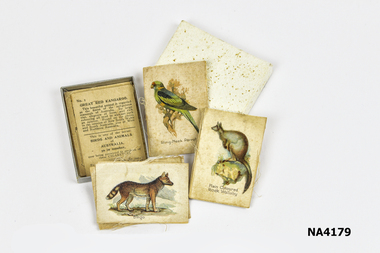
Memorabilia - Box - Cigarette silks, 1911 - 1917
... Turner bush/rural life paintings, which were generally of good quality and became hugely popular and still sought after today. Like thousands of homes in Europe, Britain and U.S.A., many Australia homes had albums of cherished postcards, which were given pride of place for visitors to see and enjoy. ...These type of cigarette silks were included in WD & HO Wills cigarette packets to induce women in particular to take up smoking.|The Word 'Cartophilic?|It is believed that this unusual word was coined in the 1920s by Col. Bagnall, an Englishman, who was the father of the hobby of cigarette card and trade card collecting. It is thought to be a combination of a Latin word, 'carto' meaning 'card and the Greek word 'philic', meaning 'love'.- lover of cards. The term originally related to the collection of the two types mentioned, however, our Society has included postcards in the range of items collected by our members.|The Cigarette Card|The cigarette card began its evolution in the United States of America, in the early 1880s as a plain piece of cardboard used by tobacconists to protect the cigarettes which were sold in that era, not in packets, but loosely. A purchaser would buy his cigarettes then wrap them in paper around the small piece of cardboard, which acted as a stiffener. In fact, for many decades, cigarette cards were known as 'stiffeners' in the USA.|The card depicting 'The Marquis of Lome' is reputed to be the first known cigarette card issued. This is thought to have been in 1879. It did not take long for an enterprising entrepreneur to recognise the advertising potential of the cigarette card, and, very soon, the cards began displaying popular images, often in sets. This had the effect of youngsters, wishing to complete their sets, harassing their fathers to buy a specific brand of cigarettes. The kids who collected cards in the days when they were being issued in the cigarette packets, would hang around outside the local tobacconist's shop, pestering the men who had just bought a packet of cigarette, with the cry: 'can I have the cig can mister?'|It is a proven fact that, here in Australia during the 1930s, at least one set had one card deliberately withheld and issued very sparingly. This card is No. 86 (Mrs Jack Crawford) in the Carreras 'Turf Personality Series'. Thus, in a set of reasonably easy cards to get, this one card is a constant source of frustration for the collector, and as such, commands a premium when it comes to price. It is not hard to imagine the young collector nagging his to Dad to keep buying 'Turf' cigarettes to enable him to finish the set.|From small beginnings the cigarette card soon gave rise to a booming industry in itself. Artists and writers were|employed to produce the cards, which were miniature works of art and served as little encyclopaedia's for the children of the day. By the 1930s cards were being issued in the countless millions. It has been stated, in one book on the history of cards; that 450 million sets of a series produced and issued by the prolific issuer of cards in the United Kingdom, WD & HO Wills. As each set contained 50 cards you would need a calculator with a very long result window to see the answer to how many cards of that series were in circulation.|Australia's involvement would appear to have its beginnings with the English and American firms who shipped their tobacco products here and the cards of American Tobacco Company (ATC) are found in great numbers in early Australian collections; many featuring Australian subjects, e.g. 'Australian Parliament a 1901 issue. Earlier U.S. sets depicting Australians included Goodwin & Co's, so called. 'Australian Series' with cricketers and Australian Rules footballers who were on the sporting scene during the 1880s. The caption of one of theses cards reads:|'W.Hannysee. Captain Port Melbourne Football Club' which enables us to pinpoint the year of issue to either 1889 or 1890.|On the Australian scene the first local manufacturer who issued cards seems to have been The National Cigarette Company of Australia Proprietary Limited, whose 'Tally Ho' packets contained cards from a series of thirteen featuring the touring 'English Cricket Team 1897-8' Of the few Australian manufacturers who issued cards, only two companies issued more the two sets.|Undoubtedly the cards issued by the Melbourne firm Sniders & Abrahams (later Sniders & Abrahams Pty Ltd) are the 'jewels in the crown' of Australian card issues. They issued some thirty-three series, with numerous sub-series and allied issues such as metal badges, metal football shields, celluloid flags etc., which ensured that the hobbyist had a vast range from which to collect. Sporting themes – football, cricket, horse racing – dominate, indicating the Australians' love of sport and the outdoors was as strong in those earlier times as it is today. Military, animals and birds themes were also to the fore, with a touch of culture being provided by 'Shakespeare', 'Dickens', actresses and even classical 'Statuary'. Humour was not forgotten with 'Cartoons and Caricatures', 'Naval and Cricket (double meaning) Terms' and the 'Jokes' series. Art and history were covered by the artist, S.T. Gill's 'Views of Victoria in 1857' while the stereoscopic 'Views of the World' expanded the collectors' knowledge of the world as a whole.|The Sniders & Abrahams series began in 1904 and by 1919 the company was in decline and was eventually taken over by G.G. Goode & Co. Ltd. This company produced one set only, the highly collectable 'Prominent Cricketer Series' issued in 1924. During the early to mid-1920s, J.J. Schuh Tobacco Pty Ltd issued eight series, again containing the popular subjects of sport and war. At least two provincial tobacconists, Lentens of Bendigo and Baillies of Warrnambool, issued private football series. The last series of cards issued by a truly Australian firm was Dudgeon & Arnell's '1934 Australian Cricket Team'.|The Australian market was not neglected by the English companies with WD & HO Wills, Godfrey Phillips and Ogdens all making their contributions. By far the most active issuer was the long-established company Wills, whose 'Cricketers' of 1901 heralded the flood of Australian series, which continued into the mid-thirties.|The onset of the 1939-45 World War sounded the death knell of the cigarette card and very few post-war issues were made, certainly not here in Australia.|The Trade Card|The Trade Card is a non-tobacco item used by manufacturers to promote and advertise their products, in the same way that cigarette cards were. It is uncertain exactly when they were first produced, but in the USA, non-collectable cards were issued by firms in the early 1800s. These were more akin to a latter day 'business card'. It was not until the 1850s, when coloured and pictorial cards were issued to advertise and promote products that the Trade Card|became a collectable item. Many beautiful lithographic cards were produced in this early era and they are very mu sought after by collectors. By the 1870s the issues of Trade Cards became more prolific and it is from this era that more cards are seen.|Again, it is difficult to pinpoint the exact date of the first Australian Trade Card and it may be that the highly collectable and extremely rare 'American Candy Co's' - 'Pure Caramels' Australian Rules football card, issued i 1891, is the earliest series. This confectionery firm was located in Fitzroy, a Melbourne suburb. To date only two subjects have been seen.|Another early set was 'Flags', issued by F.H.Fauldings & Co. It featured testimonials of seven English cricketers who toured Australia with the 1894/5 Test team. Fauldings was an Adelaide based firm which manufactured medicinal toiletries, soaps and oils, using the distinctly Australian eucalyptus oil. During the 20th century a multitude of Australian businesses issued trade cards, with confectionery manufacturers such as Hoadleys, Allens, Sweetacres and Australian Licorice producing the majority of them. Again sporting themes dominated with the ever popular Aussie Rules football cards being the most numerous. Cricket issues ran a close second.|Apart from sporting cards, almost every subject imaginable was covered by the Trade Card, making it the most diverse and interesting branch of cartophilly. In contrast to the Cigarette Card, which had its demise prior to the Second World War, the Trade Card is still alive and well.|We all are aware of the long running 'Birds of Australasia' series put out by Tuck-fields Tea and 1 doubt if there is a kitchen drawer in Australia that has not got one or two of these informative and attractive cards floating about in it. These cards were first produced in the early 1960s and are still being inserted in that company's packets of tea. Such is also the case with Sanitarium Health Foods, manufacturers of the well known Weetbix, who began issuing cards, with a wide range of subjects, in the early 1940s and continue to do so.|The 1940s and 1950s saw the two breakfast food giants, Kornies and Weeties dominating the card scene. Kornies footballers were in production fora decade from 1948 to 1959. Four years later in 1963, we saw the start of four decades of Scanlens bubble-gum card issues, both football and cricket. In the mid 1990s, with the end of the Scanlens/Stimorol cards, the Trading Card came on the scene. These cards do not fit under the umbrella of the Trade Card, having been produced and marketed purely as a 'collectable' with no connection whatsoever to any product, which of course is necessary for an item to be classified as a Trade Card.|The earliest British postcard was issued in 1870 and was designed to send short messages; the stamp was printed on the card, therefore it did not require an envelope. It was considered by many to be lowering the postal standards because the texts were no longer private. However the cards were a great success as on the first day of issue in 1870, half a million passed through the London postal centre.|The first illustrated postcards are said to be those introduced by a French stationer in 1870. He realized that French troops fighting in the Franco-Prussian War needed to be able to send short messages to their families and designed a 'postcard' to suit the purpose. As many of the soldiers were illiterate they decorated their cards with sketches of their many activities at the front rather than writing; thus creating a picture postcard. Private enterprise soon saw the great financial possibilities of this new easy and attractive way of communication by post; also sending a postcard cost less than postage for letters. It was correctly assumed that postcards were likely to overtake letter writing in many instances.|Between 1875 and 1882 every state in Australia introduced official postcards, N.S.W. first and Tasmania last. Each state produced a simple type of postcard with a pre printed stamp allied to that state. The stamp side stated 'The Address Only To Be Written On This Side'; the reverse side sometimes carried a simple illustration or decoration with space fora short message, each state extolling their own state's virtues. In 1901, with the advent of Federation, the new Government became responsible for all postal services in Australia and produced postcards for sale in every state. With several mail deliveries each day in most towns, postcards were used for many purposes. One 1906 postcard, with an illustration of fruit, was sent from Mrs X in the morning to her greengrocer ordering her fruit and vegetables to be delivered that afternoon. Another lady asks her charlady to 'come this afternoon'.|Australian private enterprise also began selling pictorial postcards, most companies using the very experienced German printing works who were the worlds best in the field of lithography and fine detailed colour-printing. Many of these beautiful German cards still exist today, 100 years later. Australia did have a few fine printers but they were in the minority. Black and white postcards printed in Australia in the early 1900s were often of good quality e.g. postcards printed by 'The Bulletin', illustrating the works of 'The Bulletins' top artists.|Between c1903-09 The Melbourne company Osboldstone and Atkins etc. printed coloured reproductions of 46 J.A. Turner bush/rural life paintings, which were generally of good quality and became hugely popular and still sought after today. Like thousands of homes in Europe, Britain and U.S.A., many Australia homes had albums of cherished postcards, which were given pride of place for visitors to see and enjoy.|Postcard collecting remained popular but was changing with the times. About 1912 the Australian photographer George Rose of Melbourne began to produce topographical B/W real photographic postcards covering most of Australia and other photographers began to do likewise. These cards soon found their way into collections as well.|WWI and the horrors of war suddenly changed the world; postcards were still in great demand but the subject matter was far more serious. Thousands of postcards from the trenches in European war zones arrived in Australia to be included in family albums. Propaganda and recruitment messages were produced to encourage enlistment. Australian postcard producers began to create cards decorated with gum leaves, boomerangs, wattle etc., which were designed for sending to Australian troops serving overseas. Very few 'pretty' cards were available, as access to the Gentian printing works was no longer possible and exporting of postcards from Britain was very limited. By the end of WWI people had other more serious problems to contend with and the avid postcard collecting hobby declined, fold greetings took over and topographical photographic postcards became a small but steady income for the producers and newsagents etc. in every town.|Fortunately many of these old postcards still exist and are avidly collected by a new generation or postcard collectors. The Australian Cartophilic Society Inc. is one of four postcard/cigarette card organizations in Australia. They are, N.S.W. Post Card Collectors Society; Queensland Card Collectors' Society Inc. and West Australian Card Collectors|Society, and across the Tasman there is a New Zealand Postcard Society.|References:|Picture Postcards of the Golden Age A Collector's Guide by Toni & Valmai Holt. Picture Postcards in Australia 1898 - 1920 by David CookBox of Cigarette Silks ( 10 ) depicting animal motifs, which were placed in cigarette packets as an incentive for women in particular to smoke.|WD & HO Wills|Produced 1911 - 1917personal effects, smoking accessories, recreations, collections -
 Wangaratta High School
WHS Framed Certificate, 2010
... valuing care, commitment & pride in our community White community inclusion initiative recognition certificate with a watermark of the Rural city of Wangaratta symbol, framed in a black frame with a gold section along the inside of the frame WHS Framed Certificate ...White community inclusion initiative recognition certificate with a watermark of the Rural city of Wangaratta symbol, framed in a black frame with a gold section along the inside of the frameCommunity Pride Awards 2010 Community Inclusion Initiative Presented to 'Youth Homelessness' Tom MeLeod, madison Muir, Sarah Wallis, Jeremy Piper, Danielle Adams, Bridget Lorenz Congratulations! valuing care, commitment & pride in our community
