
Showing 322 items matching "rural towns"
-
 Lakes Entrance Historical Society
Administrative Record - Documents, Tidy Towns - Rural Pride, 1997
... Tidy Towns - Rural Pride...Contains documentation dating back to 1997, printed and hand written information DOCUMENTS Letters Documentation relevant to Lakes Entrance Tidy Towns for the year 2000, in white two ring binder Tidy Towns - Rural Pride Administrative Record Documents ...Contains documentation dating back to 1997, printed and hand written informationDocumentation relevant to Lakes Entrance Tidy Towns for the year 2000, in white two ring binderdocuments, letters -
Dandenong & District Historical Society
Book, When The Clock Strikes
... Growing Up In The Rural Market Town of Dandenong...Growing Up In The Rural Market Town of Dandenong...Growing Up In The Rural Market Town of Dandenong Growing Up In The Rural Market Town of Dandenong When The Clock Strikes Book ...non-fiction -
 Kiewa Valley Historical Society
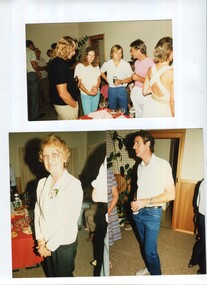
Photos - 1985 Tidy Towns Award - Mt Beauty
... rural towns...Tidy Towns is a national award celebrating community led environmental action in rural and regional Australia. ...Mt Beauty is a small town with an active community who cared for the environment. rural towns Tidy Towns community beautification programs Sustainability and Environment 8 coloured photos 10 cm x 25.5 cm showing people involved including the cutting of the cake. ...Tidy Towns is a national award celebrating community led environmental action in rural and regional Australia. It is an initiative run by Keep Australia Beautiful that celebrated grassroots, community-led environmental action and sustainability. It originally focused on basic litter reduction and civic pride. It commenced in since 1968 and continues today in 2026 with a wider focus including eg. economic sustainability.Mt Beauty is a small town with an active community who cared for the environment.8 coloured photos 10 cm x 25.5 cm showing people involved including the cutting of the cake. Only 2 photos are labelled 1. "Aileen Moore-Committee" and "Barry O'Brien NEW" and 2 small photos - "1985 / Category A / Positive / Litter Control / Winner / Mt Beauty"rural towns, tidy towns, community beautification programs, sustainability and environment -
 Greensborough Historical Society
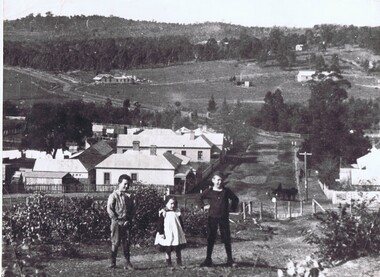
Photograph, Diamond Creek
... Large black and white photograph of a view over a town and rural landscape....This undated view of Diamond Creek shows three children on a hill looking over a small township with open fields and trees in background. diamond creek country life Large black and white photograph of a view over a town and rural landscape. Diamond Creek Photograph Photograph ...This undated view of Diamond Creek shows three children on a hill looking over a small township with open fields and trees in background. Large black and white photograph of a view over a town and rural landscape.diamond creek, country life -
 Wangaratta Historical Society
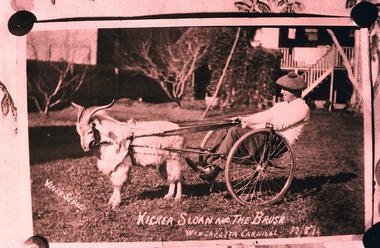
Glass Plate Negatives, 1860 - 1960
... Goat races were common in rural towns as entertainment at agricultural shows, sporting events and other celebrations. ...Goat races were common in rural towns as entertainment at agricultural shows, sporting events and other celebrations. ...WHS Inc were presented with 10,000 glass plate negatives from Thelma & Vine Photographic Studios, Murphy Street Wangaratta from the 1860's - 1950's. The glass plate negatives depict mostly portrait studies of families, weddings and special occasions; there are a few outdoor studies.These studies are invaluable as they provide a record of fashion, family structures, significant people and events, buildings, streetscapes, transportation and landscape of Wangaratta & district from the 1860's - 1950's. These glass plate negatives provide the historical, fashion, cultural anthropological context of society from the time frame they depict.WHS Inc were presented with 10,000 glass plate negatives from Thelma & Vine Photographic Studios, Murphy Street Wangaratta from the 1860's - 1950's. The glass plate negatives depict mostly portrait studies of families, weddings and special occasions; there are a few outdoor studies. An example of a glass plate negative is featured above, this is a goat race from the early 1900's. Goat races were common in rural towns as entertainment at agricultural shows, sporting events and other celebrations. This local jockey is Bob Sloan, who had a Men's Wear business in Wangaratta.glass plate negatives -
 Eltham District Historical Society Inc
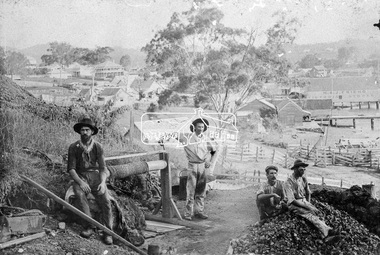
Photograph, Early Goldmine
... In the background is a developed unknown rural town. "H & J Friend Victoria Stores" is written on the side of a building....In the background is a developed unknown rural town. "H & J Friend Victoria Stores" is written on the side of a building. ...Four male gold miners pose for the camera on their mine site on top of a hill. It appears they are using the underground hard-rock method of mining to extract gold encased in rock. There is a rope winch near by and a pile of rubble on top of the mine shaft. In the background is a developed unknown rural town. "H & J Friend Victoria Stores" is written on the side of a building.This photo forms part of a collection of photographs gathered by the Shire of Eltham for their centenary project book, "Pioneers and Painters: 100 years of the Shire of Eltham" by Alan Marshall (1971). The collection of over 500 images is held in partnership between Eltham District Historical Society and Yarra Plenty Regional Library (Eltham Library) and is now formally known as 'The Shire of Eltham Pioneers Photograph Collection.' It is significant in being the first community sourced collection representing the places and people of the Shire's first one hundred years.Digital imagesepp, shire of eltham pioneers photograph collection, other areas, gold mining, gold miners, h & j friend, winch -
Glenelg Shire Council Cultural Collection
Document - Ticket - Charity Ball, Portland Benevolent Asylum and Hospital, n.d
... Benevolent asylums were often associated with hospitals in rural towns; they have evolved into aged care homes and hospitals in larger towns. ...Benevolent asylums were often associated with hospitals in rural towns; they have evolved into aged care homes and hospitals in larger towns. ...Benevolent asylums were places that housed anyone who could not support themselves; these were usually the aged, infirm, disabled and destitute. Benevolent Asylums also served as immigrants' homes, blind asylums, orphanages, lying-in hospitals and lunatic asylums. Benevolent asylums were often associated with hospitals in rural towns; they have evolved into aged care homes and hospitals in larger towns. Portland Benevolent Asylum and Hospital was founded in 1849.Pale blue card ticket, rounded corners, gold edge, black print, and script Charity Ball in aid of the Bazaar Fund on behalf of the Portland benevolent Asylum and hospital Double 7s6dBack: '80' black penasylum, social care, benevolent, charity, fundraising -
Glenelg Shire Council Cultural Collection
Memorabilia - Ball Ticket - Charity Ball, n.d
... Benevolent asylums were often associated with hospitals in rural towns; they have evolved into aged care homes and hospitals in larger towns....Benevolent asylums were often associated with hospitals in rural towns; they have evolved into aged care homes and hospitals in larger towns. ...Portland Benevolent Asylum and Hospital was founded in 1849. Benevolent asylums were places that housed anyone who could not support themselves; these were usually the aged, infirm, disabled and destitute. Benevolent Asylums also served as immigrants' homes, blind asylums, orphanages, lying-in hospitals and lunatic asylums. Benevolent asylums were often associated with hospitals in rural towns; they have evolved into aged care homes and hospitals in larger towns.Variegated card (orange, yellow, green) ticket, gold edge, black print and text. Charity ball in aid of the Bazaar Fund, on behalf of the Portland Benevolent Asylum and hospitalBack: '98' black pen -
Glenelg Shire Council Cultural Collection
Document - Charity Ball Ticket - Portland Benevolent Asylum and Hospital, n.d
... Benevolent asylums were often associated with hospitals in rural towns; they have evolved into aged care homes and hospitals in larger towns. ...Benevolent asylums were often associated with hospitals in rural towns; they have evolved into aged care homes and hospitals in larger towns. ...Benevolent asylums were places that housed anyone who could not support themselves; these were usually the aged, infirm, disabled and destitute. Benevolent Asylums also served as immigrants' homes, blind asylums, orphanages, lying-in hospitals and lunatic asylums. Benevolent asylums were often associated with hospitals in rural towns; they have evolved into aged care homes and hospitals in larger towns. Portland Benevolent Asylum and Hospital was founded in 1849.Pale blue card ticket, rounded corners, gold edge, black print and script Charity ball in aid of the Bazaar fund on behalf of the Portland Benevolent Asylum and hospital. Double ticket 7s. 6dBack: '75' - black penportland benevolent asylum and hospital, social care, welfare -
Glenelg Shire Council Cultural Collection
Document - Ball Ticket - Charity Ball in aid of the Bazaar Fund on behalf of the Portland Benevolent Asylum and hospital, n.d
... Benevolent asylums were often associated with hospitals in rural towns; they have evolved into aged care homes and hospitals in larger towns. ...Benevolent asylums were often associated with hospitals in rural towns; they have evolved into aged care homes and hospitals in larger towns. ...Benevolent asylums were places that housed anyone who could not support themselves; these were usually the aged, infirm, disabled and destitute. Benevolent Asylums also served as immigrants' homes, blind asylums, orphanages, lying-in hospitals and lunatic asylums. Benevolent asylums were often associated with hospitals in rural towns; they have evolved into aged care homes and hospitals in larger towns. Portland Benevolent Asylum and Hospital was founded in 1849Cream card ticket, gold edge, two red and blue stripes diagonally, across ticket, black print and script. Charity Ball in aid of the Bazaar Fund on behalf of the Portland Benevolent Asylum and hospital. Single ticket 55.Back: '67' Black ink -
 Kiewa Valley Historical Society
Decanter Glass, circa mid to late 1900's
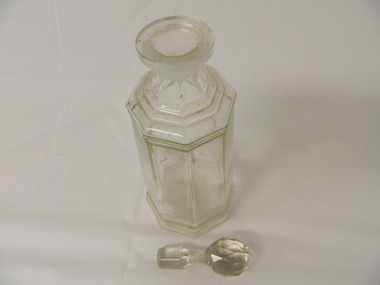
... This "art deco" style of containers were very popular by the "art and trendy" socialites, be they in the city or in rural towns and properties. This style was very popular in the 1940's to 1950's. ...This "art deco" style of containers were very popular by the "art and trendy" socialites, be they in the city or in rural towns and properties. This style was very popular in the 1940's to 1950's. ...This "art deco" style of containers were very popular by the "art and trendy" socialites, be they in the city or in rural towns and properties. This style was very popular in the 1940's to 1950's. The octagonal shape provided the stability of the decanter with its "expensive" contents. Because of its style it blended in well with any lavish meal and socio economic "upper" class environment. It was a part of social atmosphere of elegance and wealth be it in the city or on a rural property. This is very significant to the Kiewa Valley rural "society" environment. At the time of its use the wealth of Australia was "riding on the sheep's back", that is rural income(primary producers), on the whole, was well above that in the cities (industrial). It was in a period where large wealthy property owners could spend lavishly on trendy domestic items.This octagonal glass decanter with its egg shaped stopper is made in an "art deco" style and reflects the 1950's style of bold design. The decanter "stopper" has been cut in a "diamond" cut to reflect the sunlight as does a diamond ring. The stopper is tapered down to permit easy placement and removal. The Stability of the decanter is increased by the broad base and octagonal (8) sides tapering going up the sides.decanter, glass, art deco glass ware, spirits container -
 Kiewa Valley Historical Society
Tin Egg Preservative, from mid 1800's to mid 1900's
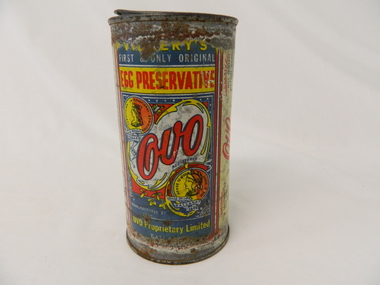
... The egg preservation material offered in this tin was during a period in Australia's history (especially in the rural areas) when the "freshness" of produce was not able to be maintained by refrigeration means. Rural towns did rely on the "Ice Works" providing block ice for prolonging "produce shelf life" however semi remote and smaller communities did not have that facility. ...The egg preservation material offered in this tin was during a period in Australia's history (especially in the rural areas) when the "freshness" of produce was not able to be maintained by refrigeration means. Rural towns did rely on the "Ice Works" providing block ice for prolonging "produce shelf life" however semi remote and smaller communities did not have that facility. ...The egg preservation material offered in this tin was during a period in Australia's history (especially in the rural areas) when the "freshness" of produce was not able to be maintained by refrigeration means. Rural towns did rely on the "Ice Works" providing block ice for prolonging "produce shelf life" however semi remote and smaller communities did not have that facility. It was products such as this egg preserving ability that enabled these smaller rural communities to maintain a constant source of healthy "short life" organic produce.This tin which contained egg preservative powder is very significant to a rural region (Kiewa Valley) in the late 1800's to early 1900's. It details the type of food preservative methods that were available to rural areas which lacked proper refrigeration means at their disposal. Basic foodstuff which required "special" preservation means to extend their "shelf" life were sometimes regarded as luxuries by semi remote communities. Kiewa Valley and its regions were typical of these remote communities in the time frame of this egg preservation product. The ability to keep products that deteriorate due to "normal" outdoor temperature (bacterior prone produce) was a factor of rural living.This round "tubular" tin has a indented lid which fits snugly into the top opening. The lid has a rolled out lip which ensures a degree of "air" tightness. The tin is pressed and folded together and has no synthetic inner cover to protect the egg preservative powder from the raw tin surface. This "raw" method was the typical application for all tins containing dry food stuffs in this period(mid 1900's) of goods manufacture. The outer tin surface has a tightly pressed laminated paper label with product and manufacturer's information (promotional, preservation "tips" and usage details - will preserve sixteen dozen eggs). On the "front" side "EGG PRESERVATIVE" underneath "OVO" ,underneath "REGISTERED" and in a double lined enclosed square "AWARDED TWO GOLD MEDALS" underneath is a sketch of a mixing dish containing fourteen visible eggs. The bottom label has within an oval boundary (white print on a blue background) "FOR HOUSEHOLD USE" underneath "OVO" and underneath "PRESERVES EGGS PERFECTLY WITHOUT MESS OR TROUBLE" On the opposite side of the tin is printed "VICKERY'S FIRST & ONLY ORIGINAL EGG PRESERVATIVE - in red print. Underneath this is a "round stamp" with the figurehead(royalty) and these encircling words" TASMANIAN INTERNATIONAL EXHIBITION" with a scrolled "GOLD MEDAL HOBART 1895" with another medal like "medallion" showing another female face with a "warrior" headdress and these encircling words "HONOR TO WHOM HONOR IS DUE". Below this within a scrollis printed "GOLD MEDAL BALLARAT 1896" underneath this is printed "MANUFACTURED BY OVO PROPRIETARY LIMITED BALLARAT"egg preservation, rural food storage, kitchen preservation facilities -
 Bendigo Historical Society Inc.
Book - "Tarnagulla. Yesterday and Today.", 2014
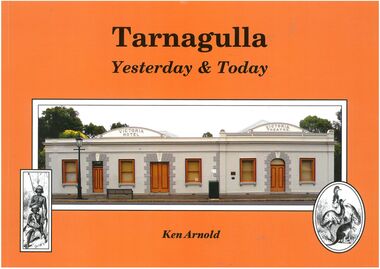
... Tarnagulla is a small rural town situated in the heart of the Golden Triangle, central Victoria, Australia. ...Tarnagulla is a small rural town situated in the heart of the Golden Triangle, central Victoria, Australia. ...Tarnagulla is a small rural town situated in the heart of the Golden Triangle, central Victoria, Australia. It is a town founded on the excitement and hope of the Victorian Gold rush and quickly developed into a thriving community. Many large company gold mines employed scores of miners at their peak and many large gold nuggets were found. It was a town of enormous wealth for some. Over the years as gold became less plentiful many turned to farming and other pursuits. With a colorful history, Tarnagulla today is a quiet town with a population of only a few hundred. "Tarnagulla. Yesterday and Today" written by Ken Arnold. Foreword by Ken Arnold. A collection of both color and black and white photographs, with each photo labelled. Published in Australia by Crown Castleton Publishers in 2014. Orange soft cover book. Color photo on front cover and multiple color photos on back cover. Title printed in black. Book contains forward and a brief history of Sandy Creek on page 3. All other pages contain photographs with little text - just photo identification. 32 pp.tarnagulla, mining -
 Bacchus Marsh & District Historical Society
Photograph, Shop next to Royal Hotel 200A Main Street Bacchus Marsh 1883
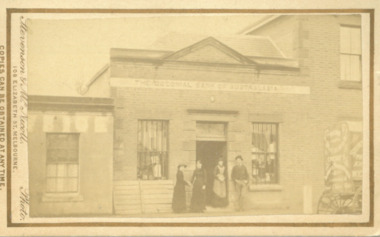
... Letters that can be distinguished suggest that in all probability this is the carriage used by Stevenson and McNicoll, Photographers, on their trips around rural towns and countryside. ...Letters that can be distinguished suggest that in all probability this is the carriage used by Stevenson and McNicoll, Photographers, on their trips around rural towns and countryside. Shop next to Royal Hotel 200A Main Street Bacchus Marsh 1883 Photograph ...The building in this image was built by J. I. Murray for use as a Bank premises. The National Bank of Australasia opened a branch in the building in 1862 and remained there until 1865. The Colonial Bank of Australasia then occupied the building from 1865 until 1872. At the time this image was taken in 1883 the building was in use as a shop, although a sign saying 'National Bank of Australasia' could still be seen on the building. Goods for sale can clearly be seen in the windows and the photographers’ wagon or cart can be partly seen to the right of the picture. At a later stage the building became part of the Royal Hotel which can be seen to the right of the building. The small building to the left of the picture was used as a printing office by the West Bourke and South Grant Guardian newspaper between 1865 and 1872.Small sepia unframed photograph on card with gold border framing photograph. Housed in the album, 'Photographs of Bacchus Marsh and District in 1883 by Stevenson and McNicoll'. The image shows a shop in Main Street Bacchus Marsh in 1883. Goods for sale can be seen in the windows but there is no signage on the building to indicate what type of shop it is. A sign across the upper facade reads 'Colonial Bank of Australasia' but this bank had vacated this location by 1872. Three women and a man can be seen standing in front of the shop. Two of the women appear to be shaking hands. The woman standing in the doorway is wearing an apron and may be the shop owner or assistant. Just visible at the edge of the photo can be seen a buggy with advertisements on the back and side. Letters that can be distinguished suggest that in all probability this is the carriage used by Stevenson and McNicoll, Photographers, on their trips around rural towns and countryside. On the front: Stevenson & McNicoll. Photo. 108 Elizabeth St. Melbourne. COPIES CAN BE OBTAINED AT ANY TIME. On the back: LIGHT & TRUTH inscribed on a banner surmounted by a representation of the rising sun. Copies of this Portrait can be had at any time by sending the Name and Post Office Money Order or Stamps for the amount of order to STEVENSON & McNICOLL LATE BENSON & STEVENSON, Photographers. 108 Elizabeth Street, MELBOURNE. stevenson and mcnicoll 1883 photographs of bacchus marsh and district, shops bacchus marsh vic., banks bacchus marsh vic., commercial vehicles -
 Kiewa Valley Historical Society
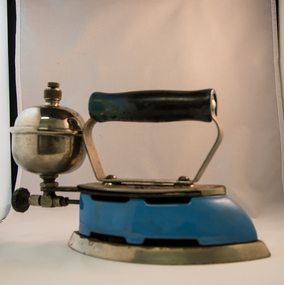
Iron Hand Kerosene, mid to late 1900s
... These irons continued to be in service, even when electricity was available in cities and larger rural towns (domestic electric steam irons were invented in 1938). ...These irons continued to be in service, even when electricity was available in cities and larger rural towns (domestic electric steam irons were invented in 1938). ...The 1950's saw a revolution in small appliances for use in the average household. This hand held self heating(kerosene) iron was introduced as a time saving and more convenient iron for pressing clothes and other cloth fabrics. It replaced irons needing a separate fire source to heat the ironing plate. These irons continued to be in service, even when electricity was available in cities and larger rural towns (domestic electric steam irons were invented in 1938). This item was used before and during the electricity supplies available from the Kiewa Hydro Electricity Scheme. These irons remained in use within regional rural areas that had limited or unreliable electrical reticulation.In the 1950s and later the Kiewa Valley was still a relatively isolated region which was home to rural properties and small settlements. The availability of electricity and or the financial means to afford new types of electric hand irons ensured that older and sometimes less efficient ironing remained for an extended period covering the 1960s to 1970s. Kerosene products, such as this kerosene iron was a cheaper method for farm based domestic and other rural activities requiring a heat source. The use of kerosene as a heat/light source was able to be supplied in bulk and able to be used when floods severed vital roads into this region. The supply of electricity was in summer time subject to interruption from bush fire damaged wooden poles carrying the electrical cables. Self sufficiency by rural populations was the backbone of survival and the ability to store energy sources "on the farm" was a prerequisite of isolated regions, such as the Kiewa Valley, circa 1950s.This Coleman kerosene iron has a solid steel chrome plated(press) base with a painted (blue) wooden handle. The handle is stud fastened onto an oblong shaped rolled steel handle frame and screwed (two screws) onto the base plate. Both the heating plate and the top securing plate are shaped similar to a river boat. The main housing enclosing the heating element is enamel coated(blue in colour) steel and has a half hole for lighting the kerosene at the rear end. Behind the handle and protruding upwards is a stainless steel fully enclosed container (bowl shaped) for the main supply of kerosene to the burner or generator(enclosed within the main body of the iron. The bowl has an air valve and inlet for pressurised air intake (hand pump) On the bottom rear of the fuel bowl there is a screw regulated fuel pump. The fuel heated base plate provides the heat for this advertised "self heating iron(instant lighting). See KVHS 0347B- Instruction sheet; KVHS 0347C- Wrench; and KVHS 0347D Fuel can.Stamped on the base plate of the handle, front region "COLEMAN LAMP & STOVE CO." below this "WICHITA KAN" below this"TORONTO CAN". In the middle of the handle base and in larger print "COLEMAN Instant-Lite" At the rear location in large print "MODEL 4" in smaller print below "MADE IN U.S.A." below this "PAT#1718473"household appliances, alternative non electrical ironing appliances, domestic appliances, kerosene appliances -
 Kiewa Valley Historical Society
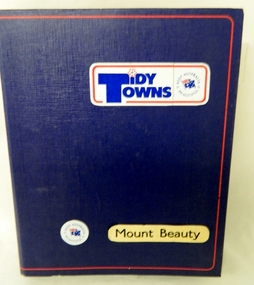
Folder - Tidy Towns, Tidy Towns Mount Beauty, 1984/85
... ...rural town pride...The changes brought on by technology e.g. computers, mobile telephone "texting" and the internet has slowly impinged upon those community "get togethers" of the 1900's. Life in small rural towns and regions however have only slowly moved away from the community self worth attitudes which were so strong when life in rural areas was more insulated through physical and technologically isolation....The changes brought on by technology e.g. computers, mobile telephone "texting" and the internet has slowly impinged upon those community "get togethers" of the 1900's. Life in small rural towns and regions however have only slowly moved away from the community self worth attitudes which were so strong when life in rural areas was more insulated through physical and technologically isolation. ...This folder represents the true "Aussie" and the pride felt living in small rural communities. It was present in the period before the 1990's but fell so ever slightly away through the faster pace of the "modern" life evolution into a more "introspective" life style. The changes brought on by technology e.g. computers, mobile telephone "texting" and the internet has slowly impinged upon those community "get togethers" of the 1900's. Life in small rural towns and regions however have only slowly moved away from the community self worth attitudes which were so strong when life in rural areas was more insulated through physical and technologically isolation.This Tiny Towns Folder with its content is highly significant to the small town of Mount Beauty and the Kiewa Valley and its region because it represents the "true" value of rural life in the "modern" Australia. The "old" values of "mateship" and looking after the community is still very strong in the rural sector, as compared with living in the cities. The psychological and physical benefits of living in smaller rural centres is clearly demonstrated by the contents of this "Tidy Towns", keep Australia Beautiful, competition. The value of "the true blue, dinky die mateship" is still very much alive in country towns and rural environments. Although the physical isolation of yesteryear may not be so strong as the technology and population growths boost a greater interaction between city and rural folk, the ingrained attitude of comradeship still prevades. This large blue coloured lever arch folder (cloth with a red lined border) has 104 plastic pockets each with two sheets of documentation for the appraisal of the decision makers/judges of the "Keep Australia Beautiful Council (Vic), "Tidy Towns" competition.Adhesive stickers on front cover "Tidy Towns" "Keep Australia Beautiful" below this "Mount Beauty" community beautification programs, rural town pride, community pride -
Lakes Entrance Historical Society
Book, Adams John, Path Among the Years - History of Bairnsdale, 1987
... A collection in words and pictures of the events and people that have made the history of the Shire of Bairnsdale, from the Aboriginal, pastoral, settlers to the many aspects of life in the towns and rural areas in 1987...Settlers Schools Religion A collection in words and pictures of the events and people that have made the history of the Shire of Bairnsdale, from the Aboriginal, pastoral, settlers to the many aspects of life in the towns and rural areas in 1987 Path Among the Years - History of Bairnsdale Book Adams John ...A collection in words and pictures of the events and people that have made the history of the Shire of Bairnsdale, from the Aboriginal, pastoral, settlers to the many aspects of life in the towns and rural areas in 1987settlers, schools, religion -
 Kiewa Valley Historical Society
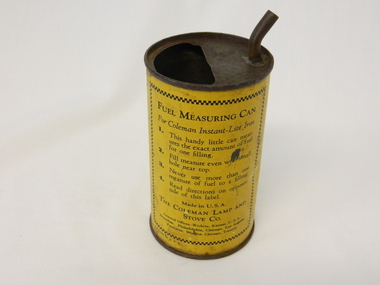
Can Fuel Measuring, circa 1950
... These irons continued to be in service, even when electricity was available in cities and larger rural towns. This item was used before and during the electricity supplies available from the Kiewa Hydro Electricity Scheme. ...These irons continued to be in service, even when electricity was available in cities and larger rural towns. This item was used before and during the electricity supplies available from the Kiewa Hydro Electricity Scheme. ...The 1950's saw a revolution in small appliances for use in the average household. The hand held self heating(kerosene) iron for which this filling can was provided ,was introduced as a time saving and more convenient iron for pressing clothes and other cloth fabrics. It replaced irons needing an external fire source to heat the ironing plate. These irons continued to be in service, even when electricity was available in cities and larger rural towns. This item was used before and during the electricity supplies available from the Kiewa Hydro Electricity Scheme. These irons remained in use within regional rural areas that had limited or unreliable electrical reticulation and the ability to service them from this filling can was an essential part.n the 1950s and later the Kiewa Valley was still a relatively isolated region which was home to rural properties and small settlements. The availability of electricity and or the financial means to afford new types of electric hand irons ensured that older and sometimes less efficient ironing appliances remained for an extended period covering the 1960s to 1970s. Kerosene products, such as the kerosene self heating (KVHS 0347A) iron and this kerosene filling item, was a cheaper method for farm based domestic and other rural activities requiring a heat source. The use of kerosene as a heat/light source was able to be supplied in bulk and able to be used when floods severed vital roads into this region. The supply of electricity was in summer time subject to interruption from bush fire damaged wooden poles carrying the electrical cables. Self sufficiency by rural populations was the backbone of survival and the ability to store energy sources "on the farm" was a prerequisite of isolated regions, such as the Kiewa Valley, circa 1950s.This specially spout fitted can was provided with the Coleman self heating kerosene iron (see KVHS 0347A). On one side of the half enclosed top of the can there is a small spout(for poring the appropriate liquid into the egg shaped fount container) at the rear end of the hand iron. The can is made from tin. See KVHS 0347B- Instruction sheet; KVHS 0347C- Wrench.On one side of the can in black print on yellow background is "FUEL MEASURING CAN" underneath is "For Coleman Instant-Lite Iron" underneath are four numbered paragraphs detailing the use of this can. Below this is the name and places of manufacture. On the other side of the can is printed "BE SURE" with filling and maintenance instructionskerosene can, ironing, domestic appliances, household appliances -
 Kiewa Valley Historical Society
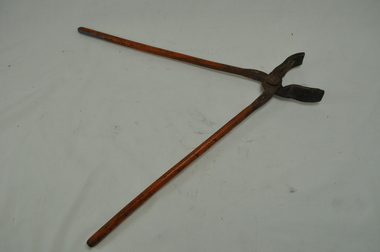
Tongs Blacksmith, circa mid to late 1900's
... The rural store, however was usually very small and many "off" the shelf rural appliances and apparatus available in the larger rural towns were not available to the semi remote rural areas....The rural store, however was usually very small and many "off" the shelf rural appliances and apparatus available in the larger rural towns were not available to the semi remote rural areas. ...These long handled "Blacksmith" tongs were used in the late 1800's to mid 1900's by a blacksmith(or others) within the Kiewa Valley. During these times blacksmiths would regularly visit "remote" rural properties and work on any "hard to manufacture" items. A few properties had either stockmen,farm hands, or owners able to do "minor" blacksmith work. The ability to undertake blacksmith functions was sometimes "by necessity" handled by a local "jack of all trades" person. During this period however demand for rural based blacksmiths was very high. The rural store, however was usually very small and many "off" the shelf rural appliances and apparatus available in the larger rural towns were not available to the semi remote rural areas.This long handled shaped nipper tongs is very significant to the Kiewa Valley because it represents one of the essential mores relating to isolated rural regions as was the Kiewa Valley at this period in time (1800's to mid 1900's). This "ingrained " more was the ability to achieve anything that was required to maintain a living standard or survival in a remote grazing, mining and farming region. The remoteness was due to the small population, poor transport routes and flood prone roads winding through the lower lying flat plains of the Kiewa Valley. Any blacksmith work whilst grazing Cattle on the Bogong High Plains or any part of the Kiewa Valley, had to be done in situ. The part of the "culture" of this regions was that of "self help" either from within the family or from a friendly neighbour.Long handled blacksmith's tongs. The handles are rusted and painted orange. The nippers have one central fixing and are flat edged.tools, blacksmith, horses, trades -
 Kiewa Valley Historical Society
Tongs Blacksmith, circa early 1900s
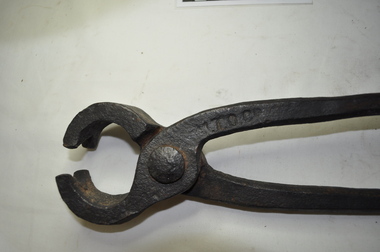
... The rural store, however was usually very small and many "off" the shelf rural appliances and apparatus available in the larger rural towns were not available to the semi remote rural areas....The rural store, however was usually very small and many "off" the shelf rural appliances and apparatus available in the larger rural towns were not available to the semi remote rural areas. ...These long handled "V" shaped tongs were used late 1800's to mid 1900's by a blacksmith within the Kiewa Valley. During these times blacksmiths would regularly visit "remote" rural properties and work on any "hard to manufacture" items. A few properties had either stockmen,farm hands, or owners able to do "minor" blacksmith work. The ability to undertake blacksmith functions was sometimes "by necessity" handled by a local "jack of all trades" person. During this period however demand for rural based blacksmiths was very high. The rural store, however was usually very small and many "off" the shelf rural appliances and apparatus available in the larger rural towns were not available to the semi remote rural areas.This long handled "V" shaped nipper tongs is very significant to the Kiewa Valley because it represents one of the essential mores relating to isolated rural regions as was the Kiewa Valley at this period in time. This "ingrained " more was the ability to achieve anything that was required to maintain a living standard or survival in a remote grazing, mining and farming region. The remoteness was due to the small population, poor transport routes and flood prone roads and lower flat plains of the Kiewa Valley. Any blacksmith work whilst grazing Cattle on the Bogong Plains had to be done in situ.Long handled tongs with "V" shaped ends on the nippers (used by blacksmiths)I.T.O.C.tools, blacksmith, horses, wrought iron tools -
Clunes Museum
Education kit - DOCUMENT, SOIL CONSERVATION AUTHORITY, MCHUGH'S GULLY - A LAND USE AND MANAGEMENT TEACHING RESOURCE KIT, 1982
... BUFF COLOURED LEVER ARCH FILE CONTAINING SECTIONS A TO I WITH A CARDBOARD INSERT OF FRONT COVER WITH SEPIA IMAGES OF RURAL SCENES AND TOWN SHIP PRINTED ON IT. Section A contains documents of land use and management teaching resource kit. ...Records effects of erosion at McHugh's Gully McHughs Gully LAND MANAGEMENT ENVIRONMENTAL IMPACT REPORT ENVIRONMENTAL STUDY OF MCHUGH'S GULLY RECORDED IN THE EARLY 1980'S SINGLE NOTE SEPARATE FROM PUBLICATION : HANDWRITTEN IN BLUE BIRO "from Primary School" BUFF COLOURED LEVER ARCH FILE CONTAINING SECTIONS A TO I WITH A CARDBOARD INSERT OF FRONT COVER WITH SEPIA IMAGES OF RURAL SCENES AND TOWN SHIP PRINTED ON IT. Section A contains documents of land use and management teaching resource kit. ...ENVIRONMENTAL STUDY OF MCHUGH'S GULLY RECORDED IN THE EARLY 1980'SBUFF COLOURED LEVER ARCH FILE CONTAINING SECTIONS A TO I WITH A CARDBOARD INSERT OF FRONT COVER WITH SEPIA IMAGES OF RURAL SCENES AND TOWN SHIP PRINTED ON IT. Section A contains documents of land use and management teaching resource kit. Section I contains slides and transparenciesnon-fictionENVIRONMENTAL STUDY OF MCHUGH'S GULLY RECORDED IN THE EARLY 1980'Smchughs gully, land management, environmental impact report -
 Kiewa Valley Historical Society
Mould Butter, unknown, post 1967
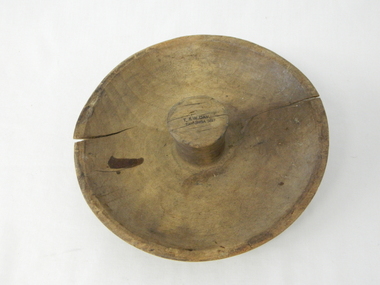
... Shopping for goods required catalogues from stores located in major rural towns and cities and involved lengthy waiting times. ...Shopping for goods required catalogues from stores located in major rural towns and cities and involved lengthy waiting times. ...This butter mould/pat may have been manufactured post 1967(year post codes appeared in Australia) however the post code was only stamped on after it was machined. This type of butter mould was used by rural families to fashion home/farm made butter. This period was in most rural regions a time of self sufficiency where any domestic type implement which could be fashioned by the family would be crafted with skill. Shopping for goods required catalogues from stores located in major rural towns and cities and involved lengthy waiting times. Travelling to and from these specialised stores was not pleasant due to the relatively poor quality of the roads and the lengthy times taken. The small general stores in the Kiewa Valley could not cater for all the needs of the valley. The 1960's was a time when facilities especially goods and services started to improve drastically. The S.E.C. of Victoria with its Kiewa Hydro Electricity Scheme provided not only an improvement of facilities in the valley but also a increase in the population. This increase resulted in a greater demand for local produce. This item is one of many domestic food processing implements used by Kiewa Valley households in the mid 1900s, whether on the farm or in the small towns and hamlets. Self sufficiency was the key to survival during these early times. Where ever possible supplies from within the valley were preferred to that brought in by travelling salesmen or traders. This butter mould and butter pat was commonly used to fashion "home" made butter throughout the valley and in some cases supplied to "outside" regional towns. Although this method of production was phased out by better access to goods from nearby cities the revival of the good organic home grown produce in the 1980s saw a greater demand of this type of farm based produce.This well crafted circular wooden butter mould could also be used as a butter pat.The handle in the middle of the mould was not added after the crafting but has been fashioned from the initial block of wood when the bowl was crafted. The bowl structure has a rim around the edge.The top of the handle has an ink stamp "T. & W. Dav" on the top line and "Tawonga 3697" underneath.domestic food preparation, wooden butter pat, butter mould circular, dairy industry -
 Kiewa Valley Historical Society
Pat Butter Profiler, Circa 1950s
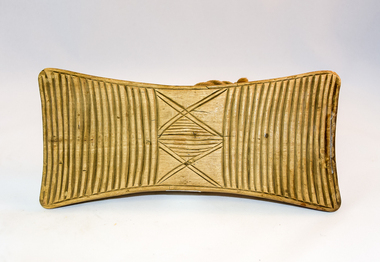
... Shopping for goods required catalogues from stores located in major rural towns and cities and involved lengthy waiting times. ...Shopping for goods required catalogues from stores located in major rural towns and cities and involved lengthy waiting times. ...This butter pat profiler may have been manufactured post 1967(year post codes appeared in Australia) however the post code was only stamped on after it was machined. This type of butter mould was used by rural families to fashion home/farm made butter. This period was in most rural regions a time of self sufficiency where any domestic type implement which could be fashioned by the family would be crafted with skill. Shopping for goods required catalogues from stores located in major rural towns and cities and involved lengthy waiting times. Travelling to and from these specialised stores was not pleasant due to the relatively poor quality of the roads and the lengthy times taken. The small general stores in the Kiewa Valley could not cater for all the needs of the valley. The 1960's was a time when facilities especially goods and services started to improve drastically. The S.E.C. of Victoria with its Kiewa Hydro Electricity Scheme provided not only an improvement of facilities in the valley but also a increase in the population. This increase resulted in a greater demand for local produce.This item is one of many domestic food processing implements used by Kiewa Valley households in the mid 1900s, whether on the farm or in the small towns and hamlets. Self sufficiency was the key to survival during these early times. Where ever possible supplies from within the valley were preferred to that brought in by travelling salesmen or traders. This butter mould and butter pat was commonly used to fashion "home" made butter throughout the valley and in some cases supplied to "outside" regional towns. Although this method of production was phased out by better access to goods from nearby cities the revival of the good organic home grown produce in the 1980s saw a greater demand of this type of farm based produce.This butter Pat/Profiler has on its base two patterns. On each end it has horizontal grooves cut into the wood which produce distinct lines onto the surface of the butter. between these grooves there is a section of two double lines crossing in the middle and separated by eleven horizontal lines The base has an elongated rectangular shape. The upper body has been sanded into a smooth convex shaped form where a wooden circular hand grip has been fashioned.On the top of the hand grip is stamped in black print"T. & W. Davies" and under this"TAWONGA 3697"domestic food preparation, wooden butter pat, butter mould circular, dairy industry -
 Kiewa Valley Historical Society
Pat Butter, Circa 1950
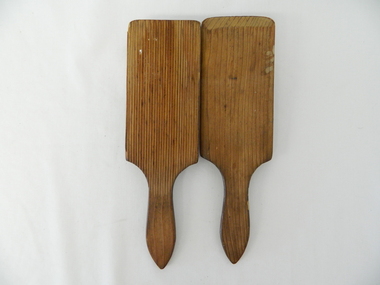
... Shopping for goods required catalogues from stores located in major rural towns and cities and involved lengthy waiting times. ...Shopping for goods required catalogues from stores located in major rural towns and cities and involved lengthy waiting times. ...This butter pat profiler may have been manufactured post 1967 (year post codes appeared in Australia) however the post code was only stamped on after it was machined. This type of butter mould was used by rural families to fashion home/farm made butter. This period was in most rural regions a time of self sufficiency where any domestic type implement which could be fashioned by the family would be crafted with skill. Shopping for goods required catalogues from stores located in major rural towns and cities and involved lengthy waiting times. Travelling to and from these specialised stores was not pleasant due to the relatively poor quality of the roads and the lengthy times taken. The small general stores in the Kiewa Valley could not cater for all the needs of the valley. The 1960's was a time when facilities especially goods and services started to improve drastically. The S.E.C. of Victoria with its Kiewa Hydro Electricity Scheme provided not only an improvement of facilities in the valley but also a increase in the population. This increase resulted in a greater demand for local produce.This item is one of many domestic food processing implements used by Kiewa Valley households in the mid 1900s, whether on the farm or in the small towns and hamlets. Self sufficiency was the key to survival during these early times. Where ever possible supplies from within the valley were preferred to that brought in by travelling salesmen or traders. This butter mould and butter pat was commonly used to fashion "home" made butter throughout the valley and in some cases supplied to "outside" regional towns. Although this method of production was phased out by better access to goods from nearby cities the revival of the good organic home grown produce in the 1980s saw a greater demand of this type of farm based produce.This butter pat is one of two,see KVHS 0071 (B). It has been crafted from wood. One side has grooves running from the handle to the square shaped bottom. These grooves would stop the wet butter from clinging to the pat. The top side of the pat has been bevelled on both sides and the bottom edge. The hand grip is flat and curved to allow for a comfortable hold.domestic food preparation, wooden butter pat, butter mould circular, dairy industry, butter -
 Kiewa Valley Historical Society
Pat Butter Profiler, Circa 1950
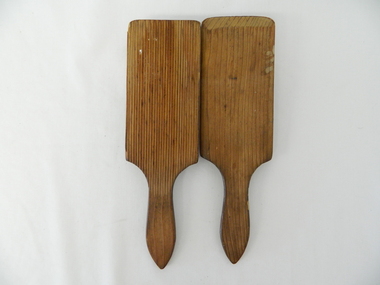
... Shopping for goods required catalogues from stores located in major rural towns and cities and involved lengthy waiting times. ...Shopping for goods required catalogues from stores located in major rural towns and cities and involved lengthy waiting times. ...This butter pat profiler may have been manufactured post 1967(year post codes appeared in Australia) however the post code was only stamped on after it was machined. This type of butter mould was used by rural families to fashion home/farm made butter. This period was in most rural regions a time of self sufficiency where any domestic type implement which could be fashioned by the family would be crafted with skill. Shopping for goods required catalogues from stores located in major rural towns and cities and involved lengthy waiting times. Travelling to and from these specialised stores was not pleasant due to the relatively poor quality of the roads and the lengthy times taken. The small general stores in the Kiewa Valley could not cater for all the needs of the valley. The 1960's was a time when facilities especially goods and services started to improve drastically. The S.E.C. of Victoria with its Kiewa Hydro Electricity Scheme provided not only an improvement of facilities in the valley but also a increase in the population. This increase resulted in a greater demand for local produce.This item is one of many domestic food processing implements used by Kiewa Valley households in the mid 1900s, whether on the farm or in the small towns and hamlets. Self sufficiency was the key to survival during these early times. Where ever possible supplies from within the valley were preferred to that brought in by travelling salesmen or traders. This butter mould and butter pat was commonly used to fashion "home" made butter throughout the valley and in some cases supplied to "outside" regional towns. Although this method of production was phased out by better access to goods from nearby cities the revival of the good organic home grown produce in the 1980s saw a greater demand of this type of farm based produce.This butter pat is one of two,see KVHS 0071 (A). It has been crafted from wood. One side has grooves running from the handle to the square shaped bottom. These grooves would stop the wet butter from clinging to the pat. The top side of the pat has been bevelled on both sides and the bottom edge. The hand grip is flat and curved to allow for a comfortable hold.domestic food preparation, wooden butter pat, butter mould circular, dairy industry -
 Bendigo Historical Society Inc.
Book - 1966 RURAL VICTORIA TELEPHONE DIRECTORY, 1966
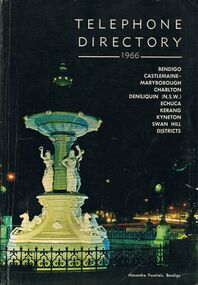
... A 1966 telephone directory for rural Victorian towns such as Bendigo, Castlemaine-Maryborough, Charlton, Denilquin(N.S.W.), Echuca, Kerang, Kyneton, Swan Hill districts. ...TELEPHONE Victoria A 1966 telephone directory for rural Victorian towns such as Bendigo, Castlemaine-Maryborough, Charlton, Denilquin(N.S.W.), Echuca, Kerang, Kyneton, Swan Hill districts. ...A 1966 telephone directory for rural Victorian towns such as Bendigo, Castlemaine-Maryborough, Charlton, Denilquin(N.S.W.), Echuca, Kerang, Kyneton, Swan Hill districts. Front cover is a photograph of the Alexandra Fountain in the center of Bendigo and the back cover has an ad for Peter's Ice Cream with a picture of a cartoon eskimo holding onto a sleigh with a giant icecream with their logo on it. Bottom of the page has their telephone and office location. "ICE CREAM (VIC) PTY LTD. BALLARAT: 1253 Howitt St., Phone Ballarat 9 1396 BENDIGO 745 High St., Kangaroo Flat, Phone Bendigo 7131 KYNETON: Melbourne, Phone 560 0222"telephone, victoria -
 Orbost & District Historical Society
ledger, 1906
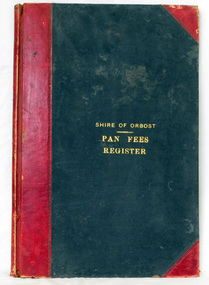
... In Australian suburbs and rural towns where the sewer wasn't connected, people usually had an outside toilet. ...In Australian suburbs and rural towns where the sewer wasn't connected, people usually had an outside toilet. ...This ledger was used by the Shire of Orbost from 1906 to 1910. The item was donated to Orbost & District Historical society from P.R.O.V. as a Place of Deposit (POD) item for safe keeping by a local history group or museum. The shire covered an area of 9,347 square kilometres and existed from 1892 until 1994 when it became part of the East Gippsland Shire Council. Orbost was at first included in the Bairnsdale Shire from 1882 and was later part of the Tambo Shire. Because of travelling distances the Croajingalong Shire was created in 1892 (name changed to Orbost Shire 17.2.1893 with James Cameron as the first Shire President. In 1994 it amalgamated to become part of East Gippsland Shire Council. In Australian suburbs and rural towns where the sewer wasn't connected, people usually had an outside toilet. The toilet seat was made of a plank of wood secured at its ends to the walls of the building with a large round hole in the middle. Underneath was the removable sanitary pan and on a regular basis, usually weekly, the full pan was taken away and replaced with an empty one. This was the job of the sanitary carter. the sanitary depot was in Martins Lane, Orbost Development of the Orbost Wastewater Treatment Facility began in the 1960’s with the construction of four treatment lagoons. Shortly after the construction of the lagoons the sewerage system was installed throughout Orbost.This item is a record of accounting for the local government. The collection of sanitary pans was a necessary service before the Orbost township was had its own wastewater treatment facility.A large register of pan fees for the Shire of Orbost. A black hard cover book with red binding and marbled end pages. Entries are hand-written in black ink.On spine - "PAN FEES REGISTER: in gold lettering. In centre of front cover in gold - "SHIRE OF ORBOST (underlined) PAN FEES REGISTER"orbost-shire-council ledger-pan-fees sewage orbost-township-sanitary-service -
Bendigo Historical Society Inc.
Newspaper - Bendigo Advertiser Collection: Small Town With Big Hearts Article on Raywood, June 23 1993
... Raywood's story highlights the importance of local initiative, adaptability, and strong community ties in maintaining rural town life. Northern United Football Club won four consecutive premierships, but some locals feel these victories were tainted because the club paid high prices to attract top players from Bendigo.When the financial support ended, these players left, leaving the club without a strong foundation or new local talent. ...Raywood's story highlights the importance of local initiative, adaptability, and strong community ties in maintaining rural town life. Northern United Football Club won four consecutive premierships, but some locals feel these victories were tainted because the club paid high prices to attract top players from Bendigo.When the financial support ended, these players left, leaving the club without a strong foundation or new local talent. ...Raywood is portrayed as a close-knit, self-reliant rural community where local businesses and residents play a central role in sustaining town life. Residents take initiative, such as managing the swimming pool access themselves and seeking new financial services after the local bank agency closed. Local businesses adapt to challenges, like the butcher expanding to home deliveries to stay afloat. The butcher's shop, pub, general store, and newsagency are central to daily life and social interaction.Business owners, such as Ron the butcher and Stewie the shopkeeper, are deeply invested in the town's survival and continuity. The closure of the Commonwealth Bank agency was met with community resolve to prove their independence. Young people increasingly spend money outside town, posing a challenge to local commerce. Government costs and changing economic conditions have impacted local employment and services. Residents participate in school councils, volunteer firefighting, and community organizations. The town school remains a focal point, with about 80 pupils and hopes to avoid closure or change. Despite hardships, such as floods and fires, residents like Dennis and Jill O'Gorman (publicans) and the Neate family remain committed to Raywood.Long-term residents, like Stewie, emphasize the importance of keeping both their businesses and the town alive. Raywood's story highlights the importance of local initiative, adaptability, and strong community ties in maintaining rural town life. Northern United Football Club won four consecutive premierships, but some locals feel these victories were tainted because the club paid high prices to attract top players from Bendigo.When the financial support ended, these players left, leaving the club without a strong foundation or new local talent. The club struggled after the departure of paid players, lacking reliable and affordable local players. A drought period followed, with Northern United going two years without a win. The club recently celebrated a rare victory, only its second in two-and-a-half years, which brought great joy to the community. The town now values these hard-earned wins more than the earlier, expensive premierships.Small Towns With Big Hearts Ravenswood. Series of photos and information about Raywood. Pictures by Peter Hyett. Written by Wayne Gregson. This item contains the following documents newspaper articles and black and white photos: 8091.606a Part of Page 22, the Bendigo Advertiser Weds Nov 03 1993 8091.606b Part of Page 22, the Bendigo Advertiser Wednesday Nov 03 1993 8091.606c Black and White Photo of Ron the Butcher - Contact BHS for Details 8091.606d Black and White Photo of Beverley Neale, the Post Mistriss - Contact BHS for Details 8091.606e Black and White Elevated view of Raywood and countryside - Contact BHS for Details 8091.606f Black and White General Store and Town Hall - Contact BHS for Details 8091.606g Black and White Photo of Sign Posts - Contact BHS for Details 8091.606h Black and White Photo of Stewie McGregor Store-keeper - Contact BHS for Details 8091.606i Black and White Photo of Dennis and Jill O'Gorman Publicans of the Raywood Hotel - Contact BHS for Details 8091.606j Black and White Photo of an old cart behind a fence - Contact BHS for Detailsnewspaper, bendigo advertiser, raywood -
 The Beechworth Burke Museum
Photograph, c. 1910
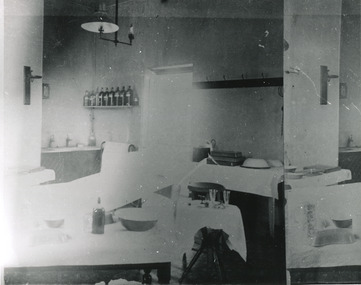
... The positioning of the hospital had a beneficial effect on the rural town and the large volume of people living at the hospital and contributing to this population growth is counted as reason for the survival of Beechworth as a regional township. ...The positioning of the hospital had a beneficial effect on the rural town and the large volume of people living at the hospital and contributing to this population growth is counted as reason for the survival of Beechworth as a regional township. ...Taken approximately 1910, this black and white photograph shows the interior of the surgery and consulting rooms at the Mayday Hills mental hospital known at that time as a lunatic asylum in Beechworth. Mayday Hills Hospital, then known as the Beechworth Lunatic Asylum was constructed between 1864-67 designed by The Public Works Department. The hospital is made up of a number of buildings, landscaping, ha-ha, workshops, laundry, administrative facilities and farmland, it was constructed in 'Italianate' style by a team of up to two hundred and fifty workers (Woods p. 122). The asylum was established in response to the need for the regional shire to locally care for those particularly affected by their time working the Ovens goldfield during the Indigo Shire gold rush era where poor living conditions and isolation were significantly affecting the welfare of a great many people through poverty and lack of resources. The gaol and orphan labour systems were not able to effectively support to give housing, rehabilitation and ongoing care for the mentally ill, and transporting to Melbourne by waggon was a time consuming and counter-productive solution when the metro facilities were already overcrowded. According to Woods (A Titan's Field p. 122), between 1901 and 1911 a large percentage (thirty five percent in 1901 and twenty four in 1911) of the Beechworth population were either patients or inmates of Beechworth institutions, Mayday Hills accounted for some six hundred and seventy four patients in 1901, Beechworth's Mayday Hills was chosen as the site of Victoria's newest asylum, at the time, due to the landscape and altitude. The hilltop atmosphere and the native fauna, it was argued, would assist in the cure of the patients kept at the hospital (Wood 1985, 122). The positioning of the hospital had a beneficial effect on the rural town and the large volume of people living at the hospital and contributing to this population growth is counted as reason for the survival of Beechworth as a regional township. Mayday Hills continued to function as a mental hospital up until 1995 when it was sold to LaTrobe university. The building and grounds are listed on the Victorian Heritage Register under criterion A, B, D, E and F. Although grainy, the image gives a good indication of a functioning interior space of a surgery and consulting room at Mayday Hills in the early 1900's, from which we might interpret (from the types of tools and furniture present), the medical practices being performed at the time.Black and white rectangular photographmedical, asylum, surgery, hospital, beechworth, mayday hills, mayday hills asylum, mayday hills hospital, mental hospital, beechworth lunatic asylum, beechworth institutions, social welfare, public works department, consulting room -
 The Beechworth Burke Museum
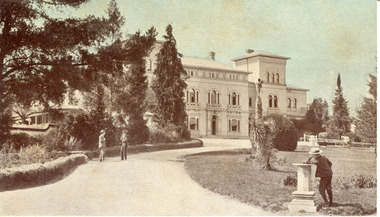
Photograph - Postcard, George Rose, c. 1910
... The positioning of the hospital had a beneficial effect on the rural town and the large volume of people living at the hospital and contributing to this population growth is counted as reason for the survival of Beechworth as a regional township. ...The positioning of the hospital had a beneficial effect on the rural town and the large volume of people living at the hospital and contributing to this population growth is counted as reason for the survival of Beechworth as a regional township. ...Produced c. 1910 by The Rose Stereograph co. This colourised photographic postcard shows the exterior of the administrative buildings at Mayday Hills mental hospital with three young boys in the foreground. This postcard forms part of the extensive Rose Series. (P. 4689) of postcards being produced by the Rose Stereograph co. which depicted landmarks from across Australia. Despite the early date attributed to this image, according to Walsh dates from this series place the postcards being produced typically between 1920-54. Mayday Hills Hospital, then known as the Beechworth Lunatic Asylum was constructed between 1864-67 designed by The Public Works Department. The hospital is made up of a number of buildings, landscaping, ha-ha, workshops, laundry, administrative facilities and farmland, it was constructed in 'Italianate' style by a team of up to two hundred and fifty workers (Woods p. 122). The asylum was established in response to the need for the regional shire to locally care for those particularly affected by their time working the Ovens goldfield during the Indigo Shire gold rush era where poor living conditions and isolation were significantly affecting the welfare of a great many people through poverty and lack of resources. The gaol and orphan labour systems were not able to effectively support to give housing, rehabilitation and ongoing care for the mentally ill, and transporting to Melbourne by waggon was a time consuming and counter-productive solution when the metro facilities were already overcrowded. According to Woods (A Titan's Field p. 122), between 1901 and 1911 a large percentage (thirty five percent in 1901 and twenty four in 1911) of the Beechworth population were either patients or inmates of Beechworth institutions, Mayday Hills accounted for some six hundred and seventy four patients in 1901, Beechworth's Mayday Hills was chosen as the site of Victoria's newest asylum, at the time, due to the landscape and altitude. The hilltop atmosphere and the native fauna, it was argued, would assist in the cure of the patients kept at the hospital (Wood 1985, 122). The positioning of the hospital had a beneficial effect on the rural town and the large volume of people living at the hospital and contributing to this population growth is counted as reason for the survival of Beechworth as a regional township. Mayday Hills continued to function as a mental hospital up until 1995 when it was sold to LaTrobe university. The building and grounds are listed on the Victorian Heritage Register under criterion A, B, D, E and F. Through the colourisation of the photograph and through the unusual choice of the subject matter being used as a postcard, we can get a good indication of aesthetic interests of the time.Rectangular coloured photograph printed as postcardObverse: Beautiful / Beechworth / (Vic.) / 1800 ft. / above / Sea / Level / - / Asylum / for / insane / (Front / View) / Copyright. / F. / Foxcroft / Photo Reverse: 1997.2454 / Postcard / THIS / SPACE / MAY / BE / USED / FOR / CORRESPONDENCE: / THIS / SPACE / FOR / NAME / AND / ADDRESS / STAMPpostcard, rose series, mayday hills hospital, mayday hills, beechworth lunatic asylum, photographic postcard, george rose, the rose stereograph co., social welfare, welfare services, ovens goldfield, lunatic asylum, the public works department, australian landmark, regional shire, indigo shire council, gold rush, beechworth institution, victorian heritage register
