
Showing 3 items matching "s.s. moorabool"
-
 Flagstaff Hill Maritime Museum and Village
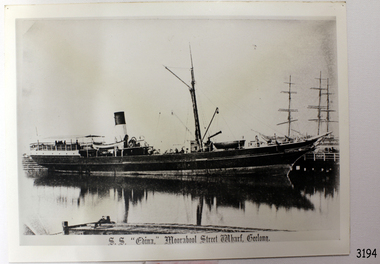
Photograph - Vessel, Steam Ship, S.S. "EDINA," Moorabool Street Wharf, Geelong, c. 1870's - 1930's
... S.S. "EDINA," Moorabool Street Wharf, Geelong...Black and White photograph of S.S Edina at the Moorabool Street Wharf, Geelong in calm water that shows the reflection of the steamer. ...Printed at base of photograph "S.S. "EDINA," Moorabool Street Wharf, Geelong"...There is a title printed along the base of the photograph. c. 1870's to 1930's S.S. "EDINA," Moorabool Street Wharf, Geelong Photograph Vessel, Steam Ship ...This black and white photograph was taken when the SS Edina was as port at the Geelong Wharf in Moorabool Street. The Port of Geelong had many wool sheds alongside the wharf - wool was a major export product. ABOUT THE SS EDINA The three masted iron screw steamer SS Edina was built in Glasgow, Scotland, in 1854 by Barclay and Curle. She was adorned with the figurehead of ‘fair maid of Judea’. The many years of service made SS Edina famous world-wide as the longest serving screw steamer. (The term screw steamer comes from being driven by a single propeller, sometimes called a screw, driven by a steam engine.) SS Edina’s interesting history includes English Chanel runs, serving in the Crimean Ware carrying ammunition, horses and stores to the Black Sea, and further service in the American Civil War and later, serving in the western district of Victoria as well as in Queensland and carried gold, currency and gold prospectors Australia to New Zealand. SS Edina had the privilege of being an escort vessel to H.R.H. the Duke of Edinburgh during his visit to Australia in 1867. In March 1863 SS Edina arrived in Port Phillip Bay, Melbourne and was bought by Stephen Henty, of Portland fame, to work the cargo and passenger run from Melbourne – Warrnambool – Port Fairy - Portland. After a short time of working the run from Australia to New Zealand, with passengers and cargo that included gold and currency, she returned to her Melbourne - Warrnambool – Port Fairy run, with cargo including bales of wool produced in the western district of Victoria. The Warrnambool Steam Packet Company purchased SS Edina in 1867; she was now commanded by Captain John Thompson and Chief Engineer John Davies. She survived several mishaps at sea, had a complete service and overhaul and several changes of commanders. In 1870 SS Edina was in Lady Bay, Warrnambool, when a gale sprung up and caused a collision with the iron screw steamer SS Dandenong. SS Edina’s figurehead was broken into pieces and it was not ever replaced. SS Edina was re-fitted in 1870 then was used as a coastal trader in Queensland for a period. She was then brought to Melbourne to carry cargo and passengers between Melbourne and Geelong and performed this service 1880-1938. During this time (1917) she was again refitted with a new mast, funnel, bridge and promenade deck, altering her appearance. In 1938, after more collisions, SS Edina was taken out of service. However she was later renamed Dinah and used as a ‘lighter’ (a vessel without engine or superstructure) to be towed and carry wool and general cargo between Melbourne and Geelong. In 1957, after 104 years, the SS Edina was broken up at Footscray, Melbourne. Remains of SS Edina’s hull can be found in the Maribyrnong River, Port Phillip Bay. This postcard of the SS Edina is significant for its association with the screw steamer SS Edina and shows her at one of her trading ports on the Melbourne - Warrnambool - Port Fairy - Portland run. The SS Edina is heritage listed on the Victorian Heritage Database VHR S199. She had endeared herself to the people of Port Phillip Bay as a passenger ferry, part of their history and culture. She played a significant role in the Crimean War, the American Civil War and the gold rush in New Zealand. She also served western Victoria for many years in her cargo and passenger runs. The SS Edina is famous for being the longest serving screw steamer in the world. After spending her first nine years overseas she arrived in Melbourne and her work included running the essential service of transporting cargo and passengers between Melbourne and the western Victoria ports of Warrnambool, Port Fairy and Portland. The SS Edina was purchased in the late 1860’s by local Warrnambool business, the Warrnambool Steam Packet Co. and continued trading from there as part of the local business community. The SS Edina’s original ‘fair maid of Judea’ figurehead was broken to pieces in a collision with another vessel (the SS Dandenong) in a gale off Warrnambool, Victoria, in 1870.Black and White photograph of S.S Edina at the Moorabool Street Wharf, Geelong in calm water that shows the reflection of the steamer. Ship has no sails raised. The funnel has a light coloured base with a dark coloured top. There are people on board the steamer. Other ship masts and people are in the background. In the foreground is a jetty with a small boat beside it and a person inside the boat. There is a title printed along the base of the photograph. c. 1870's to 1930'sPrinted at base of photograph "S.S. "EDINA," Moorabool Street Wharf, Geelong"warrnambool, shipwrecked coast, flagstaff hill, flagstaff hill maritime museum, maritime museum, shipwreck coast, flagstaff hill maritime village, shipwrecked artefact, barclay & curle, figurehead 'fair maid of judea', centenary maritime exhibition 1934, a brief review of steam navigation in victoria, pleasure steamer edina, trade and travel late 19th and early 20th century, trade melbourne to geelong, screw steamer edina, coastal trader edina, lighter dinah, cargo carrying for cremean war, cargo carrying for american civil war, passenger and trade in western district of victoria, export gold and currency and gold diggers to new zealand, export vessel to h r h the duke of edinburgh, melbourne - warrnambool - port fairy - portland cargo run, warrnambool steam packet company, stephen henty, captain john thompson, chief engineer john davies, lady bay warrnambool, lighter edina, shipping victoria, port phillip bay steamers, steamship great britain, edina, vhr s199 victorian heritage database, postcard of ss edina 1870's - 1930's -
 Flagstaff Hill Maritime Museum and Village
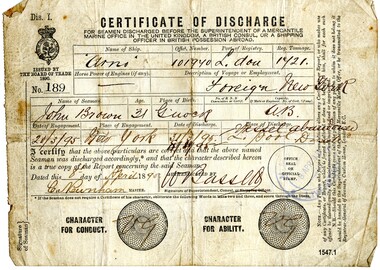
Certificate - Certificates of Discharge, Commonwealth Governments Shipping Offices, 1895 - 1919
... ...S.S. Moorabool...Lady Musgrave S.S. Dawn S.S. Moorabool S.S. Colac S.S. City of Lincoln S.S. ...The following information is taken from the PROV (Public Records Office of Victoria) website - "In Victoria regulation of the engagement and discharge of seamen was initially subject to New South Wales legislation. An Act to amend and consolidate the Laws relating to Seamen in the Merchant Service of the Colony of New South Wales, and for keeping a Register of Seamen belonging to Ships registered in the said Colony (13 Vic., No.28) of 1849 introduced requirements for ships masters to enter into written agreements with seamen engaged by them as crew, specifying wages and provisions, the capacity in which they would serve and the nature of the voyage. It also required masters to issue to seamen certificates of discharge upon their discharge or upon payment of their wages. The 1849 Act applied only to ships registered in the Colony. In 1854 the Imperial Merchant Shipping Act was passed, which had application to all British ships except those registered in the Colony. Consolidation of the separate laws occured with the passing of the Seamen Statute 1865 (28 Vic.,No.245) which adopted Part III of the Merchant Shipping Act 1854 (17 & 18 Vic, C 104) (see Parliamentary Debates, Session 1, 22 February 1865). The Imperial Act, like the New South Wales Act before it, required the master or owner of every British ship, over a certain tonnage, to enter a written agreement for the engagement and discharge of seamen. The Articles of Agreement (VPRS 566) were to be made at the start of a particular voyage, although running agreements were able to be made for a defined period in which short and frequent voyages would be made. At the end of the voyage the discharge and release of the crew was recorded. The date, place and reason for leaving the ship, and the balance of wages paid upon discharge, were recorded in the articles of agreement. Under the Merchant Shipping Act 1854 each seaman discharged was also to be issued with a certificate of discharge (this series) giving particulars of the ship, period of service and the seamans capacity, ability and conduct. No seaman could be engaged to work on a ship unless he delivered to the person engaging him a discharge from his last ship or a permit to sign articles. In the articles of agreement and in the Release Books (VPRS 945) the crew were required to sign their release of the ship, master or owner from any claims to wages or otherwise in respect of the voyage. In the release books the master also signed a release of the crew from all claims. It appears that in Victoria licensed shipping agents were initially able to facilitate the engagement and discharge of seamen. From 1 April 1859, however, the function was to be performed entirely in the Government Shipping Office (Government Gazette, 29 March 1859). In 1869, the names of Shipping Offices were changed to Mercantile Marine Offices and Shipping Masters to Superintendents of Mercantile Marine Offices. The role of the Shipping Office/Mercantile Marine Office was to facilitate and oversee the engagement and discharge of seamen and apprentices to the sea service. The facilities provided were subject to fees payable by ships masters. The Offices were located within the Department of Trade and Customs (VA 606) until 1901 and then within the Chief Secretarys Department (VA 475) to 1922. Responsibility for attesting master and seamen engagements and discharges transferred to the Commonwealth under Parts II and III of the Commonwealth Navigation Act 1912, which became effective on 1 March 1922 when the Navigation (Master and Seamen) Regulations were passed. Seamens Discharge Certificates 1882 to 1922 This series comprises counterfoils (or stubs) of Certificates of Discharge issued to seamen upon their discharge or upon payment of their wages between 1882 and 1922. The Certificates were signed by the Master of the ship and authorised by the Mercantile Marine Office. The counterfoils record details about the ships, the birthplaces and ages of the seamen, the dates of engagement and discharge, and the capacity, conduct and ability of the seamen." This particular set of Certificates of Discharge belonged to a seaman called John F. Brown. Little is known about him but information taken from the cerificates tell us that John F. Brown was born in Greenock, Scotland in about 1868 and that his rank was "Able Bodied Seaman". All of his cerificates describe his conduct and ability as "V. G. (Very Good). During the period from April 1895 to August 1908, he worked on about twenty two different ships - sailing on several Liverpool to New York voyages in 1895 and 1896. In September 1896 he began working on Australian coastal steamers - travelling up and down the coast of Australia (between the ports of Melbourne, Sydney, Newcastle, Adelaide and Brisbane) until August 1908. There is an eleven year gap in his records and his final certificate was issued in September 1919. Some of the ships he worked on include the "Arno", "Melbourne", "Burrumbeet", "Kalgoorlie", "New Guinea", "Buninyong", "Pilbarra", "Oakworth", "Cintra", "Lady Musgrave", "Dawn", "Moorabool", "Colac", "Ramazon", 'Brisbane", "City of Lincoln", "Peregrine" "Mareeba" and "Wear".Theses certificates are significant examples of the legal paperwork generated by the British and Australian governments in the day to day regulation of working seamen in the late 19th and early 20th centuries. They are also significant as they document the career of a working seaman at that time.This is a set of twenty three "Certificates of Discharge" issued to seaman John F. Brown primarily between the years 1895 and 1908 (although the last one is dated 1919). They have been issued by the Shipping Masters at U.K. Mercantile Marine Office (abroad), the Port of Melbourne Victoria, the Port of Sydney N.S.W., the Port of Newcastle N.S.W. and the Port of Brisbane. They are all of a similar size and layout with slight differences in their crests (depending on the port of issue) and the fonts used over the preceding years. They give a good overview into the career of John F. Brown as they list his place and date of birth, his voyages (places of engagement and discharge and the dates of the voyages), the ships he served on (with their tonnage, horsepower, official number and place of registry) plus his ranking, conduct and ability. All certificates are signed by the Master and authenticated by the Shipping Officer. Eight of the certificates have a purple circular stamp on the back with "S. F. 19 SEPT 1908 GLASGOW""CERTIFICATE OF DISCHARGE" "FOR SEAMEN DISCHARGED BEFORE THE SUPERINTENDENT OF A MERCANTILE / MARINE OFFICE IN THE UNITED KINGDOM, A BRITISH CONSUL, OR A SHIPPING/OFFICER IN BRITISH POSSESSION ABROAD" Headings filled out include - "Name of Ship", "Official number", "Reg. Tonnage", "Horse power of Engine (if any)", "Description of Voyage or Employment", "Name of Seaman", "Age", "Place of Birth", "No. of R.N.R. Commission or Certificate", "Capacity. If mate or Engineer. No of certificate (if any)", "Date of Engagement", "Place of Engagement", Date of Discharge", "Place of Discharge", "I certify that the above particulars are correct and that the abovenamed Seaman was discharged accordingly* and that the character described herein is a true copy of the report concerning the said seaman." "Dated this .... day of ... " , "Authenticated by ...." "Character for Conduct" , "Character for Ability".flagstaff hill, warrnambool, shipwrecked-coast, flagstaff-hill, flagstaff-hill-maritime-museum, maritime-museum, shipwreck-coast, flagstaff-hill-maritime-village, certificate of discharge for j.f.brown, certificate of discharge, certificate, discharge, discharge for j.f.brown, john f. brown, arno, s.s. melbourne, s.s. burrumbeet, s.s. kalgooli, s.s. new guinea, s.s. buninyong, s.s. pilbarra, s.s. oakworth, s.s. lady musgrave, s.s. dawn, s.s. moorabool, s.s. colac, s.s. city of lincoln, s.s. mareeba, s.s. wear, s.s. ramazon, s.s. peregrine -
 Federation University Historical Collection
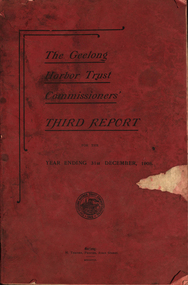
Book - Annual Report, H Thacker, The Geelong Harbor Trust Commissioners' Third Report for the year ending 31st December 1908, 1909
... Hitch, (Assistant Harbor Master, Portarlington.) geelong harbour trust commissioners report finance properties dredging portarlington barwon heads ocean grove shipping engineer's report assets liabilities harbor trust geelong harbor trust grain shipping berthage corio quay cool stores dock accomodation floating plant hopetoun channel moorabool pier shed sparrovale irrigation farm thomas gibson-carmichael Yarra Pier Cargo Seal of the Geelong Harbour Trust Commissioners Red soft covered foolscap report of 101 pages. Includes two photographic reproductions of teh New Cargo Shed on Yarra Pier, and Twin S.S ...In 1908 the Geelong Harbor Trust commissioners were George Frederick Holden, Edward Harewood Lascelles and James Hill. The officers were Walter S. Crowle (Secretary), A.C. McKenzie (Engineer), Captain G.A. Molland (Harbor Master), E.R. Hitch, (Assistant Harbor Master, Portarlington.)Red soft covered foolscap report of 101 pages. Includes two photographic reproductions of teh New Cargo Shed on Yarra Pier, and Twin S.S. "G.F. Holden" (formerly the 'Pelican' (built in 1898 by Fleming & Ferguson, Paisley, England, for the Western Australian Government).Seal of the Geelong Harbour Trust Commissionersgeelong, harbour trust, commissioners, report, finance, properties, dredging, portarlington, barwon heads, ocean grove, shipping, engineer's report, assets, liabilities, harbor trust, geelong harbor trust, grain shipping berthage, corio quay, cool stores, dock accomodation, floating plant, hopetoun channel, moorabool pier shed, sparrovale irrigation farm, thomas gibson-carmichael, yarra pier cargo
