
Showing 63 items matching "safety and protection"
-
 Emerald Museum & Nobelius Heritage Park
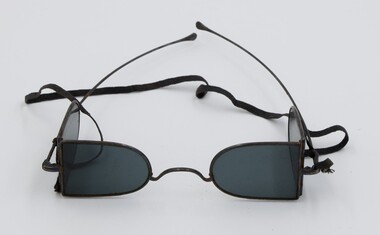
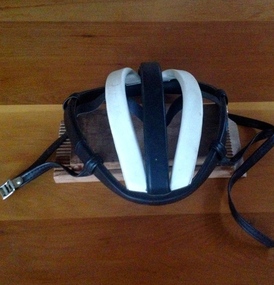
Functional object - Railway safety Glasses & Head strap, Early 20th century
... Pair of late 19th century railway safety glasses with head band and side protection lens...NIna Casement Arthur Ayers Blanche Casement Avonsleigh Carl Axel Nobelius Pair of late 19th century railway safety glasses with head band and side protection lens Functional object Railway safety Glasses & Head strap ...This pair of railway safety glasses belonged to Aurthur Ayers 1887-1964. Arthur and his wife, Nina Ayers (Casement) lived in Avonsleigh 1929-1964. He had served in the first AIF in World War I and was wounded at Passchendaele in 1917. These glasses were passed on to his daughter Frances Ayers who later married the grandson of Carl Axel Nobelius.These safety glasses belonged to a veteran of World War I who, with his family, spent most of the rest of his life in Avonsleigh and became related to the Nobelius family by his daughter's marriage. Pair of late 19th century railway safety glasses with head band and side protection lensnina casement, arthur ayers, blanche casement, avonsleigh, carl axel nobelius -
 Maldon Vintage Machinery Museum Inc
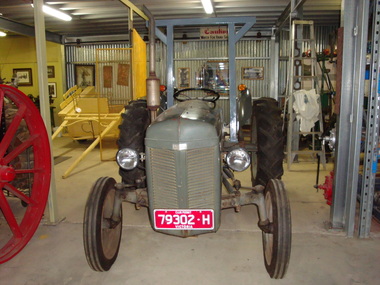
Fergie Tractor
... Grey Ferguson tractor restored to working order with a detachable grader blade. A rollover protection bar has been added to comply with modern regulations for safety. ...Grey Ferguson tractor restored to working order with a detachable grader blade. A rollover protection bar has been added to comply with modern regulations for safety. ...Grey Ferguson tractor restored to working order with a detachable grader blade. A rollover protection bar has been added to comply with modern regulations for safety. Three point linkage and 3 new tyres. Club permit registration. Metal plates on front and sides "Ferguson". Serial No. plate on steering column mount etched No. "533? "........." Henry Ferguson / ........ / TE14 "351?".rural industry - farm machinery; -
 Bendigo Historical Society Inc.
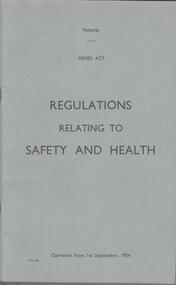
Booklet - Mines Act Regulations relating to Safety and Health, 1954
... Regulations detailed in booklet include preliminary regulations, ventilation, winding and signals, ladders and travelling ways, safety and protection, sanitation and hygiene, explosives, underground locomotives including other tractive equipment, internal combustion engines and electricity in mines. ...Booklet is an extract from the Victorian Government Gazette No 691, 11th August, 1954. goldmining mining ventilation winding and signals ladders and travelling ways safety and protection sanitation and hygiene explosives underground locomotives including other tractive equipment internal combustion engines health and safety safety regulations ' Bendigo Historical Society' purple stamp inside front and back cover Booklet, grey soft cover, fifty-five pages. ...Booklet is an extract from the Victorian Government Gazette No 691, 11th August, 1954.Booklet, grey soft cover, fifty-five pages. On front cover: ' Victoria Mines Act, Regulations Relating to Safety and Health, Operative from 1st September 1954'. Regulations detailed in booklet include preliminary regulations, ventilation, winding and signals, ladders and travelling ways, safety and protection, sanitation and hygiene, explosives, underground locomotives including other tractive equipment, internal combustion engines and electricity in mines. ' Bendigo Historical Society' purple stamp inside front and back covergoldmining, mining, ventilation, winding and signals, ladders and travelling ways, safety and protection, sanitation and hygiene, explosives, underground locomotives including other tractive equipment, internal combustion engines, health and safety, safety regulations -
 Geelong Cycling Club
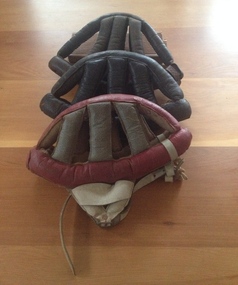
Racing Helmets
... Head protection for cyclists first appeared in the 1920s when the issue of safety became a concern. ...Head protection for cyclists first appeared in the 1920s when the issue of safety became a concern. ...Head protection for cyclists first appeared in the 1920s when the issue of safety became a concern. Since that time head protection has developed more sophistication.This is a particularly good run of examples from the 1930's through to the 1950's, showing efforts to refine the helmut for safety. 3 Leather padded helmets and 1 slim line padded leather/plastic helmut. Item 1 has a head protector and ear flaps c 1930s. Item II has a head protector without ear flaps c 1940s Item III has a head protector with flaps c 1950s. Each of these head protectors are stuffed with capok. "Detto Pietro Milano"helmet; geelong cycling club; detto pietro; milano; -
 Geelong Cycling Club
Helmet
... This head protector seems to have first appeared in the 1920s when the issue of safety became a concern. Since that time, head protection has developed more sophistication....This head protector seems to have first appeared in the 1920s when the issue of safety became a concern. Since that time, head protection has developed more sophistication. ...This head protector seems to have first appeared in the 1920s when the issue of safety became a concern. Since that time, head protection has developed more sophistication.This is a particularly good example of an attempt at safety for cyclists. It also indicates attempts to lighten (in weight) to provide advantage in cycling races.Slim line head protector consisting of a black padded leather head band with three padded leather straps extending over the crown. Leather straps secure the head protector under the chin. "Detto Pietro/Milano/Made in Italy"slimline cycling helmet; detto pietro; 1920; -
 Federation University Historical Collection
Manual - Manual - Fire Protection, VIOSH: Munich Reinsurance Company of Australia Limited; Tertiary Education for Fire Protection
... Victorian Institute of Occupational Safety and Health (VIOSH) Australia is the Asia-Pacific centre for teaching and research in occupational health and safety (OHS) and is known as one of Australia's leaders in the field. ...There are various courses related to Fire Detection, Fire Prevention, Fire Protection and protection Design. Manual has notations supporting and disagreeing with areas that could be incorporated into the programs at Ballarat College of Advanced Education. viosh victorian institute of occupational safety and health ballarat college of advanced education munich reinsurance company of australia tertiary education for fire protection fire detection fire prevention fire protection design derek viner On orange section at bottom: Munich Re of Australia Munich Re Group Symbol Forty A4 pages in glossy card cover. ...Victorian Institute of Occupational Safety and Health (VIOSH) Australia is the Asia-Pacific centre for teaching and research in occupational health and safety (OHS) and is known as one of Australia's leaders in the field. VIOSH has a global reputation for its innovative approach within the field of OHS management. VIOSH had its first intake of students in 1979. At that time the Institution was known as the Ballarat College of Advanced Education. In 1990 it became known as Ballarat University College, then in 1994 as University of Ballarat. It was 2014 that it became Federation University. VIOSH Australia students are safety managers, senior advisors and experienced OHS professionals. They come from all over Australia and industry. Students are taught active research and enquiry; rather than textbook learning and a one-size fits all approach. VIOSH accepts people into the Graduate Diploma of Occupational Hazard Management who have no undergraduate degree - on the basis of extensive work experience and knowledge. Manual was sent to Derek Viner. It has an introductory section telling the development of the program and outside providers. Detailed section on the Proposed Curriculum. There are various courses related to Fire Detection, Fire Prevention, Fire Protection and protection Design. Manual has notations supporting and disagreeing with areas that could be incorporated into the programs at Ballarat College of Advanced Education. Forty A4 pages in glossy card cover. Blue and orange bands at bottomOn orange section at bottom: Munich Re of Australia Munich Re Group Symbol viosh, victorian institute of occupational safety and health, ballarat college of advanced education, munich reinsurance company of australia, tertiary education for fire protection, fire detection, fire prevention, fire protection, design, derek viner -
 Emerald Museum & Nobelius Heritage Park
Headwear - Fire Fighters Helmet, MSA, c.1970s
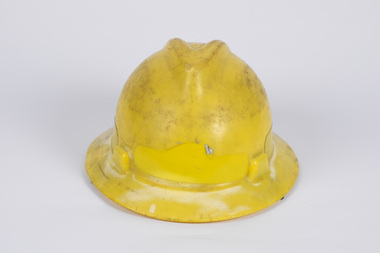
... MSA began as a mine safety company but since expanded into more general worker protection and safety products. ...MSA began as a mine safety company but since expanded into more general worker protection and safety products. ...During the 1960s in Australia, helmets evolved from metal construction to that of polymer and other plastics. This helmet was donated by the Emerald Fire Brigade which was established on 14 March 1941 as the Emerald Bush Brigade. Originally its equipment was stored at Madigan's butcher's shop near the corner of Monbulk Road. The Brigade's first fire station was built around 1945. In 1966, this station was recorded as containing the fire truck and a Land rover pumper, three radio sets, 40 knapsacks, six lengths of hose, helmets, rake hoes and other hand tools. In 2010, the Brigade moved into a new purpose-built building in Monbulk Road. The manufacturer of this helmet, MSA, was founded in 1914 in the USA. MSA began as a mine safety company but since expanded into more general worker protection and safety products. This helmet is an historical artifact worn by members of a crucial volunteer fire fighting service operating in the Emerald district since 1941.Yellow, lightweight, hard plastic or polymer helmet with black leather detachable chin strap with Velcro fastening. inside the helmet is an adjustable head harnessInside helmet on a partly torn label: 'MSA / VGARD / Type 2 ...? / STANDARDS AUSTRALIA' Inside the brim black pen writing EMERALD SPARE 5 EMERALD at one end engraved: 'MSA'' and at the other end: '1801-1881 On the outside of the helmet there is a yellow reflector on each side and at the front and the back there is evidence of labels that have been removed.helmets, fire fighting, msa, emerald fire brigade, cfa -
 Emerald Museum & Nobelius Heritage Park
Headwear - Fire Fighters Helmet, MSA, c.1970s
... It began as a mine safety company but since expanded into more general worker protection and safety products. ...It began as a mine safety company but since expanded into more general worker protection and safety products. ...Helmets protect firefighters from heat, falling objects and cinders. During the 1960s in Australia, helmets evolved from metal construction to that of polymer and other plastics. The manufacturer of this helmet, MSA, was founded in 1914 in the USA. It began as a mine safety company but since expanded into more general worker protection and safety products. The Emerald Fire Brigade was established on 14 March 1941 as the Emerald Bush Brigade. Originally its equipment was stored at Madigan's butcher's shop near the corner of Monbulk Road. The Brigade's first fire station was built around 1945. In 1966, this station was recorded as containing the fire truck and a Land rover pumper, three radio sets, 40 knapsacks, six lengths of hose, helmets, rake hoes and other hand tools. In 2010, the Brigade moved into a new purpose-built building in Monbulk Road.This helmet is an historical artifact worn by members of a crucial volunteer fire fighting service operating in the Emerald district since 1941.Yellow, lightweight, hard plastic or polymer helmet with black leather detachable chin strap with velcro fastening.Inside helmet on a partly torn label: 'MSA / VGARD / Type 2 ...? / STANDARDS AUSTRALIA' Inside the brim at one end engraved: 'MSA'' and at the other end: '1801-1881 / LN70' On front of helmet a label with logo and red lettering: 'CFA' helmets, fire fighting, msa, emerald fire brigade, cfa -
 Wodonga & District Historical Society Inc
Booklet - Hume Dam Remedial Works - Review of Environmental Factors July 1995, Department of Land and Water Conservation, NSW Government, July 1995
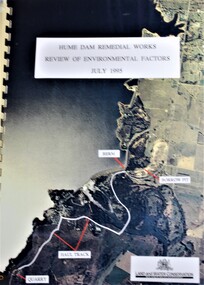
... The work included foundation improvements to enhance earthquake protection and the enlargement and strengthening of the downstream embankment....The enlargement project, which included the construction of a 50-megawatt power station, was finally completed in 1961. Safety reviews led to further works being completed throughout the 1960s, 1970s and 1980s. ...The findings of a review into the environmental impact of remedial works being carried out on the Hume Dam.non-fictionThe findings of a review into the environmental impact of remedial works being carried out on the Hume Dam.hume dam, remedial works dams, environmental impact of dams -
Unions Ballarat
Framework of flesh : Builders' Labourers battle for health and safety, McQueen, Humphrey, 2009
... Every new demand for better physical protection of the workers ensures a great ideal development for a future generation.'"...Framework of flesh : Builders' Labourers battle for health and safety McQueen, Humphrey ...An oral history. "McQueen uses labourers' own words to retell their battles around scaffolding and shithouses, for the safe removal of asbestos, prompt and adequate compensation, and a decent burial. The stories start in convict times and cover the six states and the ACT. The labourers' struggle for health and safety is followed into their dismantling of the framework of fear erected by the Building and Construction Commission. By tracking on-the-job experiences of demolishers, dog-men, hod-carriers and navvies, McQueen confirms the conviction of an early official of the BLF, Ben Mulvogue: "A union constitutes a school for the working class, wherein they learn self-reliance, learn their rights, privileges, opportunities, as well as their possibilities. Every new demand for better physical protection of the workers ensures a great ideal development for a future generation.'"--Publisher's website. Relevant to the history of health and safety in the building industry and the building unions.Paper; book.Front cover: author's name and title.btlc, ballarat trades hall, ballarat trades and labour council, oh&s, occupational health and safety, workers health, building workers, unions, history, oral history -
 National Wool Museum
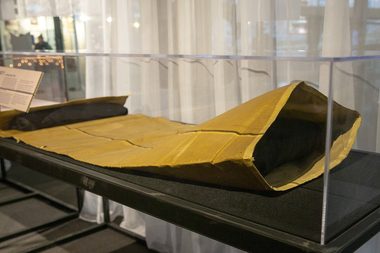
Domestic object - Waterproofed Recycled Paper Sleeping Bag, VISY Board, 1989
... They were designed to provide some protection from the weather and to be portable and disposable. ...They were designed to provide some protection from the weather and to be portable and disposable. ...Developed in the Research and Development Department of VISY Board by Alex Ong and Richard Pratt, this manufactured version of 'making do' philosophy began with a humanitarian outlook. Less than 100 were made in the pilot program and these were distributed to the homeless through welfare agencies around Melbourne. They were designed to provide some protection from the weather and to be portable and disposable. Unfortunately, the project was short lived, as some safety issues were unable to be resolved: ie, someone inside the bag would not be able to escape should the bag be set alight. It was found that people sleeping on the streets preferred sheets of cardboard or paper to avoid this possibility. Lois Densham heard a story on the radio about these sleeping bags and contacted VISY to see if she could acquire one for the Running Stitch collection. She approached the Collingwood office and it is now believed to be one of the last remaining items from this program.Recycled paper sleeping bag made from brown paper and sealed at the 'mouth' with paper tape (masking tape). Approximately six feet long, it would accommodate an adult.visy board running stitch group, running stitch collection, homeless, sleeping bag, pilot program, richard pratt -
 Department of Energy, Environment and Climate Action
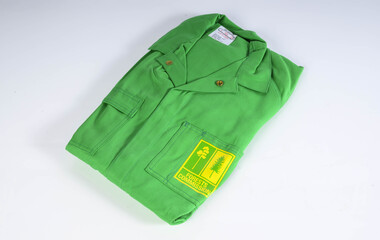
Protective Bushfire overalls
... In about 1980, in a far-sighted corporate move for the time, Alan Threader, who was the Chairman of the FCV, established a departmental safety committee, which he personally chaired. ...In about 1980, in a far-sighted corporate move for the time, Alan Threader, who was the Chairman of the FCV, established a departmental safety committee, which he personally chaired. ...At the time of the 1982-83 bushfire season FCV firefighters wore either navy blue issue overalls or their own clothing, generally a checked flannel shirt and jeans. Uncomfortable safety boots and hardhats were issued. The CFA had switched from white overalls to their distinctive yellow kit by 1983. In about 1980, in a far-sighted corporate move for the time, Alan Threader, who was the Chairman of the FCV, established a departmental safety committee, which he personally chaired. The Committee, among other things, wanted to upgrade fire safety clothing. Alan also initiated a radical colour idea after a work trip to the UK in about 1981 and brought home a small sample swatch. Alan believed that the now distinctive bright yellow-green was a good colour contrast to the Victorian bush which is a blue-green hue. Trevor Brown from Stores Branch scored the task to make the change and letters were sent to the UK seeking information about the pigment. The FCV worked with the Commonwealth Dyers Association and Cushen Clothing to replicate the shade on cotton drill, which presented darker when it was treated with the flame-retardant chemical, Proban. The first of the new Kermit Suits were rolled-out in late 1984, and the stylish colour was initially registered and patented to the Department. But it's also fair to say that the new gaudy shade of apparel wasn’t universally popular with staff. The lime green overalls were an Australian first, and forest agencies in other states followed a few years later. In the early 1990s, armed with a pair of dressmaker’s scissors, the baggy one-piece Kermit boilersuits were tailored by Peter Billing from Fire Protection Branch and Trevor Brown in conjunction with the family-owned business, Top Level Workwear, which saw numerous enhancements and prototypes. The two-piece Kermit suits were available in the late 1990s after many years of argy-bargy and complaints from field firefighters. Protective overalls Two types - early FCV (c 1983) and later CNR (1992) forests commission victoria (fcv), protective clothing, safety equipment -
 Flagstaff Hill Maritime Museum and Village
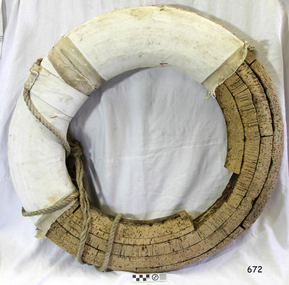
Equipment - Lifebuoy, late 19th to early 20th century
... The lifebuoy is thrown to a person in distress in the water, allowing the rescuer to pull the person to safety. The lifebuoy is a made from a buoyant material such as cork or rubber and is usually covered with canvas for protection and to make it easy to grip. ...The lifebuoy is thrown to a person in distress in the water, allowing the rescuer to pull the person to safety. The lifebuoy is a made from a buoyant material such as cork or rubber and is usually covered with canvas for protection and to make it easy to grip. ...This lifebuoy is part of the lifesaving equipment that would be carried on vessels in the late 19th and early 20th century. The strips of cork wood have been joined together to make the ring shape. A lifebuoy, or life-preserver, is used as a buoyancy device to keep a person afloat in the. It is usually connected by a rope to a person in a safe area such a nearby vessel or on shore. The lifebuoy is thrown to a person in distress in the water, allowing the rescuer to pull the person to safety. The lifebuoy is a made from a buoyant material such as cork or rubber and is usually covered with canvas for protection and to make it easy to grip. The first use of life saving devices in recent centuries was by the Nordic people, who used light weight wood or cork blocks to keep afloat. From the early 20th century Kapok fibre was used as a filling for buoys. Light weight balsa wood was used as a filler after WW1. In 1928 Peter Markus invented and patented the first inflatable life-preserver. By WW2 foam was combined with Kapok. Laws were passed over time that has required aeroplanes and water going-vessels to carry life-preservers on board. The lifebuoy is an example of equipment carried on vessels in the late 19th and early 20th century to help preserve life. There were many lives lost in Australia’s colonial period, particularly along the coast of South West Victoria.Lifebuoy, round cork object covered with white stiffened material wound around it. flagstaff hill, warrnambool, shipwrecked-coast, flagstaff-hill, flagstaff-hill-maritime-museum, maritime-museum, shipwreck-coast, flagstaff-hill-maritime-village, lifebuoy, life rings, safety ring, life-saving buoy, ring buoy, life preserver, personal floating device, floatation device, safety equipment -
 Flagstaff Hill Maritime Museum and Village
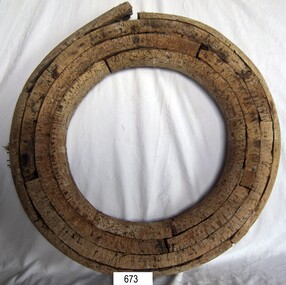
Equipment - Lifebuoy, late 19th to early 20th century
... The lifebuoy is thrown to a person in distress in the water, allowing the rescuer to pull the person to safety. The lifebuoy is a made from a buoyant material such as cork or rubber and is usually covered with canvas for protection and to make it easy to grip. ...The lifebuoy is thrown to a person in distress in the water, allowing the rescuer to pull the person to safety. The lifebuoy is a made from a buoyant material such as cork or rubber and is usually covered with canvas for protection and to make it easy to grip. ...This lifebuoy is part of the lifesaving equipment that would be carried on vessels in the late 19th and early 20th century. The strips of cork wood have been joined together to make the ring shape. A lifebuoy, or life-preserver, is used as a buoyancy device to keep a person afloat in the. It is usually connected by a rope to a person in a safe area such a nearby vessel or on shore. The lifebuoy is thrown to a person in distress in the water, allowing the rescuer to pull the person to safety. The lifebuoy is a made from a buoyant material such as cork or rubber and is usually covered with canvas for protection and to make it easy to grip. The first use of life saving devices in recent centuries was by the Nordic people, who used light weight wood or cork blocks to keep afloat. From the early 20th century Kapok fibre was used as a filling for buoys. Light weight balsa wood was used as a filler after WW1. In 1928 Peter Markus invented and patented the first inflatable life-preserver. By WW2 foam was combined with Kapok. Laws were passed over time that has required aeroplanes and water going-vessels to carry life-preservers on board. The lifebuoy is an example of equipment carried on vessels in the late 19th and early 20th century to help preserve life. There were many lives lost in Australia’s colonial period, particularly along the coast of South West Victoria.Lifebuoy, round cork object with no covering. flagstaff hill, warrnambool, shipwrecked-coast, flagstaff-hill, flagstaff-hill-maritime-museum, maritime-museum, shipwreck-coast, flagstaff-hill-maritime-village, life rings, lifebuoy, safety ring, life-saving buoy, ring buoy, life preserver, personal floating device, floatation device, safety equipment -
 Flagstaff Hill Maritime Museum and Village
Equipment - Lifebuoy, late 19th to early 20th century
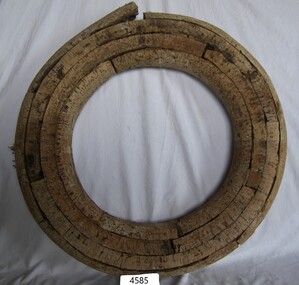
... The lifebuoy is thrown to a person in distress in the water, allowing the rescuer to pull the person to safety. The lifebuoy is a made from a buoyant material such as cork or rubber and is usually covered with canvas for protection and to make it easy to grip. ...The lifebuoy is thrown to a person in distress in the water, allowing the rescuer to pull the person to safety. The lifebuoy is a made from a buoyant material such as cork or rubber and is usually covered with canvas for protection and to make it easy to grip. ...This lifebuoy is part of the lifesaving equipment that would be carried on vessels in the late 19th and early 20th century. The strips of cork wood have been joined together to make the ring shape. A lifebuoy, or life-preserver, is used as a buoyancy device to keep a person afloat in the. It is usually connected by a rope to a person in a safe area such a nearby vessel or on shore. The lifebuoy is thrown to a person in distress in the water, allowing the rescuer to pull the person to safety. The lifebuoy is a made from a buoyant material such as cork or rubber and is usually covered with canvas for protection and to make it easy to grip. The first use of life saving devices in recent centuries was by the Nordic people, who used light weight wood or cork blocks to keep afloat. From the early 20th century Kapok fibre was used as a filling for buoys. Light weight balsa wood was used as a filler after WW1. In 1928 Peter Markus invented and patented the first inflatable life-preserver. By WW2 foam was combined with Kapok. Laws were passed over time that has required aeroplanes and water going-vessels to carry life-preservers on board. The lifebuoy is an example of equipment carried on vessels in the late 19th and early 20th century to help preserve life. There were many lives lost in Australia’s colonial period, particularly along the coast of South West Victoria.Lifebuoy; round, cork filling of lifebuoy. The nails joining the layers are visible. flagstaff hill, warrnambool, shipwrecked-coast, flagstaff-hill, flagstaff-hill-maritime-museum, maritime-museum, shipwreck-coast, flagstaff-hill-maritime-village, life rings, lifebuoy, safety ring, life-saving buoy, ring buoy, life preserver, personal floating device, floatation device, safety equipment -
 Flagstaff Hill Maritime Museum and Village
Equipment - Lifebuoy, late 19th to early 20th century
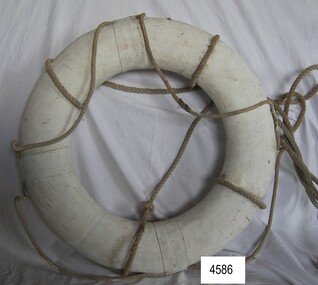
... The lifebuoy is thrown to a person in distress in the water, allowing the rescuer to pull the person to safety. The lifebuoy is a made from a buoyant material such as cork or rubber and is usually covered with canvas for protection and to make it easy to grip. ...The lifebuoy is thrown to a person in distress in the water, allowing the rescuer to pull the person to safety. The lifebuoy is a made from a buoyant material such as cork or rubber and is usually covered with canvas for protection and to make it easy to grip. ...This lifebuoy is part of the lifesaving equipment that would be carried on vessels in the late 19th and early 20th century. The strips of cork wood have been joined together to make the ring shape. A lifebuoy, or life-preserver, is used as a buoyancy device to keep a person afloat in the. It is usually connected by a rope to a person in a safe area such a nearby vessel or on shore. The lifebuoy is thrown to a person in distress in the water, allowing the rescuer to pull the person to safety. The lifebuoy is a made from a buoyant material such as cork or rubber and is usually covered with canvas for protection and to make it easy to grip. The first use of life saving devices in recent centuries was by the Nordic people, who used light weight wood or cork blocks to keep afloat. From the early 20th century Kapok fibre was used as a filling for buoys. Light weight balsa wood was used as a filler after WW1. In 1928 Peter Markus invented and patented the first inflatable life-preserver. By WW2 foam was combined with Kapok. Laws were passed over time that has required aeroplanes and water going-vessels to carry life-preservers on board. The lifebuoy is an example of equipment carried on vessels in the late 19th and early 20th century to help preserve life. There were many lives lost in Australia’s colonial period, particularly along the coast of South West Victoria.Lifebuoy, round cork filling inside white canvas cover with four reinforced bands. Four ropes are attached.flagstaff hill, warrnambool, shipwrecked-coast, flagstaff-hill, flagstaff-hill-maritime-museum, maritime-museum, shipwreck-coast, flagstaff-hill-maritime-village, life rings, lifebuoy, safety ring, life-saving buoy, ring buoy, life preserver, personal floating device, floatation device, safety equipment -
 Bendigo Historical Society Inc.
Mixed media - DONEY COLLECTION: DARKROOM EQUIPMENT
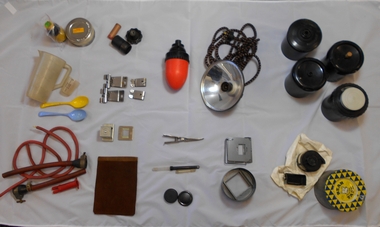
... Allan Doney darkroom collection: 40a dark room equipment collection 40b four film developing cannisters, adapts to adjustable film sizes (35mm, 120mm etc.) 40c spool winder in two parts, stored in scotch tape tin 40d developer lens holder and fil/negative constraint for enlarging photos 40e darkroom light shade with electricity chord 40f red darkroom safety light for developing film with the darkroom 40g three developing items - two lens caps, thermometer caps/containers, & photo developing tongs 40h leather pouch for protection of flat ground glass panes 40i steel slide cover & bracket 40j two sets of steel film weights to hold/hang developed photograph films 40k rubber tubes and syphons 40l two plastic measuring beakers & two (yellow & blue) plastic spoons for developing process 40m KODAK film flow solution (Keogh's Camera Store $1.02) & KODAK plus-X pan film tin container 40n three darkroom miscellaneous items (includes Uniprint equipment knob)...Allan Doney photograph Allan Doney darkroom collection: 40a dark room equipment collection 40b four film developing cannisters, adapts to adjustable film sizes (35mm, 120mm etc.) 40c spool winder in two parts, stored in scotch tape tin 40d developer lens holder and fil/negative constraint for enlarging photos 40e darkroom light shade with electricity chord 40f red darkroom safety light for developing film with the darkroom 40g three developing items - two lens caps, thermometer caps/containers, & photo developing tongs 40h leather pouch for protection of flat ground glass panes 40i steel slide cover & bracket 40j two sets of steel film weights to hold/hang developed photograph films 40k rubber tubes and syphons 40l two plastic measuring beakers & two (yellow & blue) plastic spoons for developing process 40m KODAK film flow solution (Keogh's Camera Store $1.02) & KODAK plus-X pan film tin container 40n three darkroom miscellaneous items (includes Uniprint equipment knob) Mixed media DONEY COLLECTION: DARKROOM EQUIPMENT ...Allan Doney darkroom collection: 40a dark room equipment collection 40b four film developing cannisters, adapts to adjustable film sizes (35mm, 120mm etc.) 40c spool winder in two parts, stored in scotch tape tin 40d developer lens holder and fil/negative constraint for enlarging photos 40e darkroom light shade with electricity chord 40f red darkroom safety light for developing film with the darkroom 40g three developing items - two lens caps, thermometer caps/containers, & photo developing tongs 40h leather pouch for protection of flat ground glass panes 40i steel slide cover & bracket 40j two sets of steel film weights to hold/hang developed photograph films 40k rubber tubes and syphons 40l two plastic measuring beakers & two (yellow & blue) plastic spoons for developing process 40m KODAK film flow solution (Keogh's Camera Store $1.02) & KODAK plus-X pan film tin container 40n three darkroom miscellaneous items (includes Uniprint equipment knob)allan doney, photograph -
 Warrnambool and District Historical Society Inc.
Badge - Badges x 8, Collection of various badges
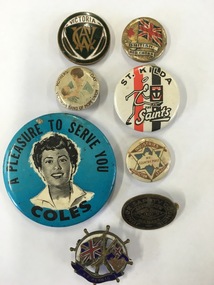
... Text in black. 001048.6 Industries Protection League. Small cream plastic badge with outline of Australia inside a star. ...Text in black. 001048.6 Industries Protection League. Small cream plastic badge with outline of Australia inside a star. ...These badges reflect various aspects of life in Australia and the many allegiance which people have to organisations from the Country Womans Association, to football clubs, with groups such as the Industries Protection league and Temperance groups such as the Band of Hope Union espousing interests and ideas in the early to mid 20th centurySocial significance001048.1 CWA badge Round metal badge with dark green rim surrounding monogrammed shield and gum leaf on either side. Victoria in bronze at top of shield. Stokes **** Melb on rear. 001048.2 British Red Cross. Round tin badge with Union Jack flag and red cross on left with text in banners below flag. 001048.3 Victorian Badge of Hope Union. Small button badge with cream background, brown text around edge with image of mother and child in blue tones in the centre 001048.4 St Kilda Football badge. Round tin plastic coated. White background with image of saint emblem on front on background of club colours. 001048.5 Coles Badge. Large button badge with bright blue background with image of lady in black and white in the centre. Text in black. 001048.6 Industries Protection League. Small cream plastic badge with outline of Australia inside a star. Brown boomerangs top and bottom. 001048.7 Junior safety Council. Oval metal badge. Black with brass text and artwork. 001048.8 S.S. Persis. Three dimensional with ship’s wheel at back in white and Australia and British flags in foreground with S.S. Persic on banner below flags. warrnambool history, industries protection league badge, band of hope union badge, s s persic badge -
 Flagstaff Hill Maritime Museum and Village
Equipment - Lifebuoy
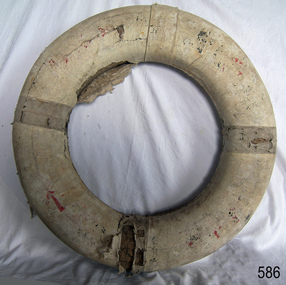
... The lifebuoy is thrown to a person in distress in the water, allowing the rescuer to pull the person to safety. The lifebuoy is a made from a buoyant material such as cork or rubber and is usually covered with canvas for protection and to make it easy to grip. ...The lifebuoy is thrown to a person in distress in the water, allowing the rescuer to pull the person to safety. The lifebuoy is a made from a buoyant material such as cork or rubber and is usually covered with canvas for protection and to make it easy to grip. ...This lifebuoy is part of the lifesaving equipment that would be carried on vessels in the late 19th and early 20th century. The strips of cork wood have been joined together to make the ring shape. The broad arrow symbol indicates that it was once the property of the British or Australian defence force. A lifebuoy, or life-preserver, is used as a buoyancy device to keep a person afloat in the. It is usually connected by a rope to a person in a safe area such a nearby vessel or on shore. The lifebuoy is thrown to a person in distress in the water, allowing the rescuer to pull the person to safety. The lifebuoy is a made from a buoyant material such as cork or rubber and is usually covered with canvas for protection and to make it easy to grip. The first use of life saving devices in recent centuries was by the Nordic people, who used light weight wood or cork blocks to keep afloat. From the early 20th century Kapok fibre was used as a filling for buoys. Light weight balsa wood was used as a filler after WW1. In 1928 Peter Markus invented and patented the first inflatable life-preserver. By WW2 foam was combined with Kapok. Laws were passed over time that has required aeroplanes and water going-vessels to carry life-preservers on board. The lifebuoy is an example of equipment carried on vessels in the late 19th and early 20th century to help preserve life. There were many lives lost in Australia’s colonial period, particularly along the coast of South West Victoria. The lifebuoy was once the property of the British or Australian defence force.Lifebuoy, round cork object with canvas wrapped around it and rope attached to one side. Broad arrow mark and other red marks indecipherable. Painted white.Symbol of broad arrow. indecipherable markings.flagstaff hill, warrnambool, shipwrecked-coast, flagstaff-hill, flagstaff-hill-maritime-museum, maritime-museum, shipwreck-coast, flagstaff-hill-maritime-village, life rings, lifebuoy, safety ring, life-saving buoy, ring buoy, life preserver, personal floating device, floatation device, safety equipment, government lifebuoy, broad arrow -
 Melbourne Tram Museum
Newsletter - Merging of Yarra and M>Tram, Yarra Trams, Yarra Trams, OnTrack, 2004
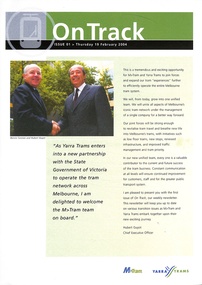
... All issues have both logos on the bottom right hand corner. 1 - 19/2/2004 - two page - welcoming the M>Tram team transition news - Hubert Guyot CEO 2 - 26/2 - two page, tram priority, update, HR team activities 3 - 4/3 - uniforms and business name 4 - 11/3 - four pages - a Q&A about the merger and an organization chart. 5 - 18/3 - two pages - setting up EROC, Employee feedback 6 - 25/3 - four pages - safety and Q&A 7 - 2/4 - four pages - Carnivale, Depot Marketing Coordinators, 8 - 8/4 - two pages - staffing, tram attendants, revenue protection staff, fare evasion 9 - 15/4 - Melbourne all over, completion of merger for 18/4 10 - 22/4 - A3 report on family day - Carnivale, staff training and Melbourne All over promotion. ...All issues have both logos on the bottom right hand corner. 1 - 19/2/2004 - two page - welcoming the M>Tram team transition news - Hubert Guyot CEO 2 - 26/2 - two page, tram priority, update, HR team activities 3 - 4/3 - uniforms and business name 4 - 11/3 - four pages - a Q&A about the merger and an organization chart. 5 - 18/3 - two pages - setting up EROC, Employee feedback 6 - 25/3 - four pages - safety and Q&A 7 - 2/4 - four pages - Carnivale, Depot Marketing Coordinators, 8 - 8/4 - two pages - staffing, tram attendants, revenue protection staff, fare evasion 9 - 15/4 - Melbourne all over, completion of merger for 18/4 10 - 22/4 - A3 report on family day - Carnivale, staff training and Melbourne All over promotion. ...Ten issues of a short-lived weekly newsletter issued by Yarra Trams in 2004, to its staff at the time of the absorption of M>Tram into the Yarra Trams franchise. All issues have both logos on the bottom right hand corner. 1 - 19/2/2004 - two page - welcoming the M>Tram team transition news - Hubert Guyot CEO 2 - 26/2 - two page, tram priority, update, HR team activities 3 - 4/3 - uniforms and business name 4 - 11/3 - four pages - a Q&A about the merger and an organization chart. 5 - 18/3 - two pages - setting up EROC, Employee feedback 6 - 25/3 - four pages - safety and Q&A 7 - 2/4 - four pages - Carnivale, Depot Marketing Coordinators, 8 - 8/4 - two pages - staffing, tram attendants, revenue protection staff, fare evasion 9 - 15/4 - Melbourne all over, completion of merger for 18/4 10 - 22/4 - A3 report on family day - Carnivale, staff training and Melbourne All over promotion. Issue 10 notes that the newsletter name changes to "Yarra Connections"Yields information about the merger of Yarra Trams and National Express M>TramSet of ten newsletters A4 finished size.tramways, operations, newsletter, eroc, m>tram, yarra trams, merger -
 Federation University Historical Collection
Calculator, Burroughs, Calculator (Adding Machine), c1935
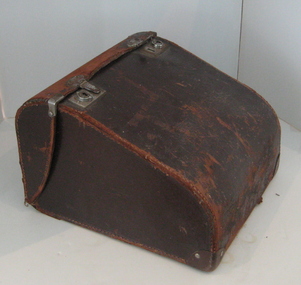
... It was only about two-thirds of the weight of the Felt & Tarrant machine, and had none of the safety features. In particular, there was no protection against incomplete keystrokes in either direction. ...It was only about two-thirds of the weight of the Felt & Tarrant machine, and had none of the safety features. In particular, there was no protection against incomplete keystrokes in either direction. ...The "Burroughs Calculator" was a non-printing key-driven machine introduced in 1912 in response to the success of the Felt & Tarrant "Comptometer". The first Burroughs key-driven machine was very similar to the Comptometer in its external appearance, but was quite different in its internal mechanism, with the register and carry mechanism based on a complex system of planetary gears. It was only about two-thirds of the weight of the Felt & Tarrant machine, and had none of the safety features. In particular, there was no protection against incomplete keystrokes in either direction. The register would simply advance in proportion to the depth of stroke, with no indication of error. However, the price was also about two-thirds of the Comptometer, which made it quite a popular (if dangerous) machine. (http://home.vicnet.net.au/~wolff/calculators/Burroughs/Burroughs.htm) The Burroughs Portable Adding Machine introduced in 1925 became the basic design for the adding machine for many years, until the ten key adder was introduced and started to replace it gradually. The key-driven type machine did not print, and while it was often used as an adding machine, it developed into a special purpose machine in later years. The machine was very fast . The efficient operation of these machines required an experienced operator who often received a high salary. The machine was produced over a very long period because of its unique capabilities and was often used to verify product delivery lists from delivery routes. Later models of the machine, called a duplex design, could hold a running total in a second set of dial wheels while the primary wheels continued to add and subtotal amounts that could be transferred at any time to the running total. A side note, Burroughs copied the Felt design for its first models and was sued for patent infringement by Felt and Tarrant who prevailed in the suit. As a result, Burroughs totally redesigned their machine and went on to compete with the Felt machine for decades. Info from (http://www.burroughsinfo.com/group_d.htm) Black metal low keyboard manual adding machine. The key-driven type machine did not print, and was exceedingly fast and experienced operators could easily outrun an operator on a full keyboard or 10-key adding machine. The adding machine has a brown leather carry case.calculator -
 Puffing Billy Railway
Explosives Wagon, unkown
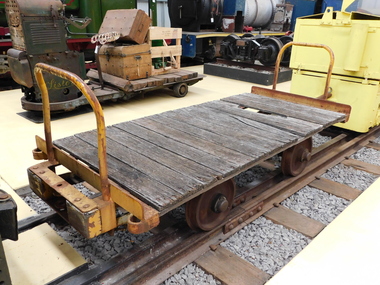
... The factory complex is also of technical significance for the unusual and specialised design of many of the buildings and structures, both in the layout of the works and the individual design of buildings. Blast protection and safety measures such as mounds around the buildings, 'cleanways' and buffer zones between production areas were employed extensively. ...The factory complex is also of technical significance for the unusual and specialised design of many of the buildings and structures, both in the layout of the works and the individual design of buildings. Blast protection and safety measures such as mounds around the buildings, 'cleanways' and buffer zones between production areas were employed extensively. ...This 2 foot 6 inch (762mm) gauge wagon was used for carrying explosives and was used with the Greenbat Battery loco. It was donated to the Walhalla Goldfields Railway on long term loan in 2013 along with a large quantity of narrow gauge trollies and light rail from Orica’s now closed munitions factory in Melbourne’s western suburbs. Orica - Deer Park Munitions factory Orica Deer Park in Melbourne’s west has been used since circa 1875 for various forms of manufacturing and storage of chemicals. Although the site is bounded by Ballarat Road, Station Street, Tilburn Road and the Western Ring Road, the current entry point for industrial operations is situated at Gate 6 of Tilburn Road. Operations include: • a specialty chemicals facility producing products for mining services operations • quarry services • other chemical manufacture activities. The Deer Park factory complex The factory complex is of historical significance for the major role it played in Australia's manufacturing and mining industries through the development of progressively more efficient and safer explosives. It also contributed to wartime production in ammunition, initiators and the development of synthetic ammonia production and construction of the Defence Explosives Annexe No 5 (later the Albion Explosives Factory) during World War Two. The factory complex is also of technical significance for the unusual and specialised design of many of the buildings and structures, both in the layout of the works and the individual design of buildings. Blast protection and safety measures such as mounds around the buildings, 'cleanways' and buffer zones between production areas were employed extensively. A characteristic of many production buildings was the elimination of cavities where explosive compounds could lodge. The combination of concrete barriers and light-weight construction was designed to direct explosion debris away from operators or other buildings. The narrow gauge tramway, which ran through the explosives section, is a rare survivor of nineteenth century materials-handling methods. Historic - Industrial Narrow Gauge Railway - Wagon for carrying Explosives at the Orica - Deer Park Munitions factory, Deer park, Victoria, Australia Wagon for carrying explosives made from Timber and steelwagon for carrying explosives, puffing billy, industrial narrow gauge railway, orica - deer park munitions factory, explosives wagon -
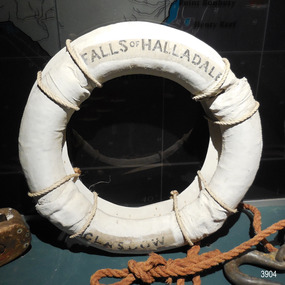 Flagstaff Hill Maritime Museum and Village
Equipment - Lifebuoy
... The lifebuoy is thrown to a person in distress in the water, allowing the rescuer to pull the person to safety. The lifebuoy is a made from a buoyant material such as cork or rubber and is usually covered with canvas for protection and to make it easy to grip. ...The lifebuoy is thrown to a person in distress in the water, allowing the rescuer to pull the person to safety. The lifebuoy is a made from a buoyant material such as cork or rubber and is usually covered with canvas for protection and to make it easy to grip. ...This lifebuoy is part of the lifesaving equipment from the sailing ship the Falls of Halladale. It is filled with cork and covered with canvas and reinforcing bands. The name of the ship and its origin is printed on the lifebuoy. It has been sealed with several coats of white paint. A lifebuoy, or life-preserver, is used as a buoyancy device to keep a person afloat in the. It is usually connected by a rope to a person in a safe area such a nearby vessel or on shore. The lifebuoy is thrown to a person in distress in the water, allowing the rescuer to pull the person to safety. The lifebuoy is a made from a buoyant material such as cork or rubber and is usually covered with canvas for protection and to make it easy to grip. The first use of life saving devices in recent centuries was by the Nordic people, who used light weight wood or cork blocks to keep afloat. From the early 20th century Kapok fibre was used as a filling for buoys. Light weight balsa wood was used as a filler after WW1. In 1928 Peter Markus invented and patented the first inflatable life-preserver. By WW2 foam was combined with Kapok. Laws were passed over time that has required aeroplanes and water going-vessels to carry life-preservers on board. The Falls of Halladale 1886-1908 The vessel ‘Falls of Halladale’ was a four-masted iron-hulled barque, launched in July 1886, by Russell & Co of Greenock, Scotland and owned by the Glasgow Falls Line, which named its ships after Scottish waterfalls. The ship was built for long distance cargo trade. The Falls of Halladale was one of the last windjammers that sailed the Trade Route. The ship was on its way from New York to Melbourne via the Cape of Good Hope when, after 102 days at sea, its journey suddenly ended. During the night of November 14, 1908, in calm seas with some coastal fog, an ocean swell raised the vessel up then let it down on a submerged reef wrecked at Curdies Inlet, Peterborough. The ship was stranded and the Port Campbell Rocket Crew were sent for, to perform a rescue. However by the time they arrived, all on board had already travelled by lifeboat to the nearby beach at the Bay of Islands. The sight of the slowly disintegrating ship on the rocks attracted many sightseers. This lifebuoy is significant for its association with the famous ship the Falls of Halladale. It is significant for its association with lifesaving equipment used on board vessels in the early 20th century. The Falls of Halladale shipwreck is listed on the Victorian Heritage Register (No. S255). She was one of the last ships to sail the Trade Routes. She is one of the first vessels to have fore and aft lifting bridges. She is an example of the remains of an International Cargo Ship and also represents aspects of Victoria’s shipping industry. The wreck is protected as a Historic Shipwreck under the Commonwealth Historic Shipwrecks Act (1976).Lifebuoy; round white canvas ring, joined with hand stitching. Stencil with inscription is printed in black on first and third quadrant. The canvas has been repainted in white but avoiding the inscription in the lifebuoy. A hanging board for display is attached with white rope. Lifesaving equipment from the Falls of Halladale.“FALLS OF HALLADALE” “GLASGOW”flagstaff hill, warrnambool, shipwrecked coast, flagstaff hill maritime museum, maritime museum, shipwreck coast, flagstaff hill maritime village, great ocean road, life rings, lifebuoy, safety ring, life-saving buoy, ring buoy, life preserver, personal floating device, floatation device, safety equipment, falls of halladale, glasgow falls line, rocket crew, lifeboat, peterborough -
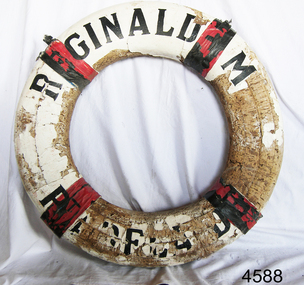 Flagstaff Hill Maritime Museum and Village
Equipment - Lifebuoy, John Murch, 1922
... Sadly, in late 2016, the decision was made to 'decommission' the vessel due to the continuing high cost of maintenance and the risk to public safety. Many of the components of the vessel are held as part of Flagstaff Hill's collection....Sadly, in late 2016, the decision was made to 'decommission' the vessel due to the continuing high cost of maintenance and the risk to public safety. Many of the components of the vessel are held as part of Flagstaff Hill's collection. ...Lifebuoy is from the ketch Reginald M, built in Port Adelaide by John Murch in 1922. Lifebuoys were part of the emergency lifesaving equipment carried on vessels in the late 19th and early 20th century. The ring was made of strips of cork wood joined together to make the ring shape then covered in canvas and sealed usually with white paint. Four evenly spaced canvas reinforcing bands would be added for strength and for a place to thread a rope or line. A lifebuoy, or life-preserver, is used as a buoyancy device often thrown to an endangered or distressed person in the water to keep them afloat while they receive help. It is usually connected by a rope to a person in a safe area such a nearby vessel or on shore. Lifebuoys is a made from a buoyant materials such as cork or foam and ae usually covered with canvas for protection and to make it easy to grip. The first use of life saving devices in recent centuries was by the Nordic people, who used light weight wood or cork blocks to keep afloat. Cork lifebuoys were used from the late 19th to early 20th century. Kapok fibre was then used as a filling for buoys but wasn’t entirely successful. Light weight balsa wood was used as a filler after WW1. In 1928 Peter Markus invented and patented the first inflatable life-preserver. By WW2 foam was combined with Kapok. Laws were passed over time that has required aeroplanes and water going-vessels to carry life-preservers on board. The Reginald M 1922- The two-masted coastal trading ketch Reginald M was built by John (Jack) Murch in Port Adelaide, South Australia, in 1922 and it was launched there in Largs Bay in the same year. It is thought that the keel was hewn from two telegraph poles - its owner was a regular visitor to salvage yards. Its cargo at times included Guano, Barley, Wool, Horses, Cattle, Timber, Explosives, Potatoes, Shell Grit and Gypsum. At one time the vessel was used as a customs boat, renamed 'HMC No. 3, Pt Adelaide'. In 1969 she was used by a mining and railway company as a barge to carry explosives. In 1972 the vessel was renamed 'T.S. Macquarie' and planned to be used for sea cadet training.; this did not eventuate. It was sold again and went to Melbourne to be used for pleasure sailing, and again sold for use as a ferry. Late in 1975 Flagstaff Hill purchased the vessel to be used as an exhibit at the Maritime Village where many visitors enjoyed being able to board and explore a real ship with a long history. Sadly, in late 2016, the decision was made to 'decommission' the vessel due to the continuing high cost of maintenance and the risk to public safety. Many of the components of the vessel are held as part of Flagstaff Hill's collection.The lifebuoy is an example of equipment carried on vessels in the late 19th and early 20th century to help preserve life. There were many lives lost in Australia’s colonial period, particularly along the coast of South West Victoria. The lifebuoy is significant for its connection with the Australian built, 1922 coastal trader, Reginald M. Lifebuoy, round , cork, filled, white canvas cover with four red tabs. Text is printed in black on quarters 1 and 3. This lifebuoy once belonged to the vessel 'Reginald M' , Pt Adelaide. "REGINALD M / Pt ADELAIDE".flagstaff hill, warrnambool, shipwrecked-coast, flagstaff-hill, flagstaff-hill-maritime-museum, maritime-museum, shipwreck-coast, flagstaff-hill-maritime-village, lifebuoy, lifesaving, ship equipment, reginald m, life rings, safety ring, life-saving buoy, ring buoy, life preserver, personal floating device, floatation device, safety equipment, coastal trader, john murch, reg webb -
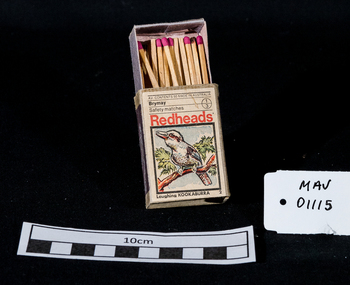 City of Moorabbin Historical Society (Operating the Box Cottage Museum)
Containers, matchbox 'Redhead' with matches, 20thC
... It was heralded by the first Commonwealth Government of newly-federated Australia because the government of the day was anxious to encourage secondary industry and pledged tariff protection of local manufacturers. The building was constructed in 1909 as the Empire Works to a design by prolific Melbourne architect William Pitt and was purchased soon after by British safety match manufacturer Bryant and May, who significantly expanded the building, adding another level and the landmark clock tower. ...It was heralded by the first Commonwealth Government of newly-federated Australia because the government of the day was anxious to encourage secondary industry and pledged tariff protection of local manufacturers. The building was constructed in 1909 as the Empire Works to a design by prolific Melbourne architect William Pitt and was purchased soon after by British safety match manufacturer Bryant and May, who significantly expanded the building, adding another level and the landmark clock tower. ...On 15th December 1909, Bryant & May, Australia’s first match factory at Church Street, Richmond, Victoria. was opened by The Honourable Alfred Deakin, Prime Minister of Australia, and Mrs. Deakin. It was heralded by the first Commonwealth Government of newly-federated Australia because the government of the day was anxious to encourage secondary industry and pledged tariff protection of local manufacturers. The building was constructed in 1909 as the Empire Works to a design by prolific Melbourne architect William Pitt and was purchased soon after by British safety match manufacturer Bryant and May, who significantly expanded the building, adding another level and the landmark clock tower. Bryant and May were unique in that they operated as a model factory, providing workers with conditions and amenities that even today seem generous. These included a dining hall and sports facilities such as a tennis court and bowling green which were constructed in the 1920s. Bryant and May ceased Australian match manufacture in the early 1980s as a result of import competition. Their iconic Redheads matches are now imported from Sweden. The complex has since been converted for use as offices and showrooms but is extremely well preserved. It is listed on the Victorian Heritage Register. Bryant and May was a United Kingdom (UK) company created in the mid-nineteenth century specifically to make matches. Their original Bryant and May Factory was located in Bow, London. They later opened other match factories in the United Kingdom and Australia, such as the Bryant and May Factory, Melbourne; and owned match factories in other parts of the world. Bryant and May survived as an independent company for over seventy years, but went through a series of mergers with other match companies and later with consumer products companies. To protect its position Bryant and May merged with or took over its rivals. In 1971 the Northern Ireland factory, Maguire & Patterson closed down following a terrorist attack.. In the 1980s, factories in Gloucester and Glasgow closed too leaving Liverpool as the last match factory in the UK, until December 1994. . The registered trade name Bryant and May still exists and it is owned by Swedish Match, as are many of the other registered trade names of the other, formerly independent, companies within the Bryant and May group. Two French chemists, Henri Savene and Emile David Cahen, proved in 1898 that the addition of phosphorus sesquisulfide meant that the substance was not poisonous, that it could be used in a "strike-anywhere" match, and that the match heads were not explosive. British company Albright and Wilson, was the first company to produce phosphorus sesquisulfide ( Red Phosphorous) matches commercially. The company developed a safe means of making commercial quantities of phosphorus sesquisulfide in 1899 and started selling it to match manufacturers. Matches were first produced by Bryant & May in Australia in 1909. The Redhead name applies to the red striking heads of the matches which were introduced to Australia in 1946. The logo on the matchbox depicted the head and shoulder of a redheaded woman and has had four major updates since that time with a number of special issues depicting birds, animals and notable persons also produced.The Bryant & May Ltd factory in Church St Richmond is a listed building and has been converted to apartments following the closure of the Company 1980. Bryant & May's Ltd were influential in fighting against the dreadful disease known as Phossy jaw which was caused by white phosphorus used in the manufacture of the early matches. They were also the object of the 'Match Girls Strike' in London 1888, which won important improvements in working conditions and pay for the mostly female workforce working with the dangerous white phosphorus. The public were slow to purchase these safety matches because of the higher price .A box of safety matches with unused matches made by Bryant & May Pty Ltd , Richmond Victoria Australia. The tray containing the matches slides inside the open ended cover.. The striking patch is on both sides of the cover. Av. CONTENTS 50 MADE IN AUSTRALIA / Brymay / 1/3 / Safety Matches / Redheads / a colour picture of a Kookaburra / Laughing KOOKABURRAsafety matches, bryant & may pty ltd, phossy jaw disease, early settlers, moorabbin, bentleigh, cheltenham, lights, lamps, tobacco, white phosphorous, phosphorus sesquisulfide, swedish match pty ltd, pitt william, savens henri, cahen emile david , richmond victoria, -
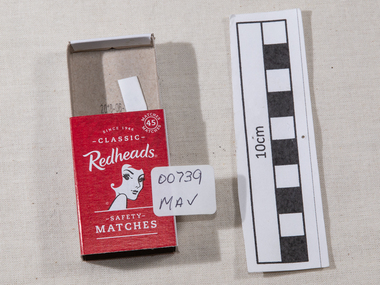 City of Moorabbin Historical Society (Operating the Box Cottage Museum)
Manufactured Objects, safety matches 'Redheads' 2015, c2015
... It was heralded by the first Commonwealth Government of newly-federated Australia because the government of the day was anxious to encourage secondary industry and pledged tariff protection of local manufacturers. The building was constructed in 1909 as the Empire Works to a design by prolific Melbourne architect William Pitt and was purchased soon after by British safety match manufacturer Bryant and May, who significantly expanded the building, adding another level and the landmark clock tower. ...It was heralded by the first Commonwealth Government of newly-federated Australia because the government of the day was anxious to encourage secondary industry and pledged tariff protection of local manufacturers. The building was constructed in 1909 as the Empire Works to a design by prolific Melbourne architect William Pitt and was purchased soon after by British safety match manufacturer Bryant and May, who significantly expanded the building, adding another level and the landmark clock tower. ...This is a current example of the 'Redhead' logo used by Bryant & May Ltd Richmond,Victoria, Australia c 1946 - 1980 On 15th December 1909, Bryant & May, Australia’s first match factory at Church Street, Richmond, Victoria. was opened by The Honourable Alfred Deakin, Prime Minister of Australia, and Mrs. Deakin. It was heralded by the first Commonwealth Government of newly-federated Australia because the government of the day was anxious to encourage secondary industry and pledged tariff protection of local manufacturers. The building was constructed in 1909 as the Empire Works to a design by prolific Melbourne architect William Pitt and was purchased soon after by British safety match manufacturer Bryant and May, who significantly expanded the building, adding another level and the landmark clock tower. Bryant and May were unique in that they operated as a model factory, providing workers with conditions and amenities that even today seem generous. These included a dining hall and sports facilities such as a tennis court and bowling green which were constructed in the 1920s. Bryant and May ceased Australian match manufacture in the early 1980s as a result of import competition. Their iconic Redheads matches are now imported from Sweden. The complex has since been converted for use as offices and showrooms but is extremely well preserved. It is listed on the Victorian Heritage Register. Bryant and May was a United Kingdom (UK) company created in the mid-nineteenth century specifically to make matches. Their original Bryant and May Factory was located in Bow, London. They later opened other match factories in the United Kingdom and Australia, such as the Bryant and May Factory, Melbourne; and owned match factories in other parts of the world. Bryant and May survived as an independent company for over seventy years, but went through a series of mergers with other match companies and later with consumer products companies. To protect its position Bryant and May merged with or took over its rivals. In 1971 the Northern Ireland factory, Maguire & Patterson closed down following a terrorist attack.. In the 1980s, factories in Gloucester and Glasgow closed too leaving Liverpool as the last match factory in the UK, until December 1994. . The registered trade name Bryant and May still exists and it is owned by Swedish Match Industries as are many of the other registered trade names of the other, formerly independent, companies within the Bryant and May group. Two French chemists, Henri Savene and Emile David Cahen, proved in 1898 that the addition of phosphorus sesquisulfide meant that the substance was not poisonous, that it could be used in a "strike-anywhere" match, and that the match heads were not explosive. British company Albright and Wilson, was the first company to produce phosphorus sesquisulfide ( Red Phosphorous) matches commercially. The company developed a safe means of making commercial quantities of phosphorus sesquisulfide in 1899 and started selling it to match manufacturers. Matches were first produced by Bryant & May in Australia in 1909. The Redhead name applies to the red striking heads of the matches which were introduced to Australia in 1946. The logo on the matchbox depicted the head and shoulder of a redheaded woman and has had four major updates since that time with a number of special issues depicting animals, birds and notable persons also producedThe Bryant & May Ltd factory in Church St Richmond is a listed building and has been converted to apartments following the closure of the Company 1980. Bryant & May's Ltd were influential in fighting against the dreadful disease known as Phossy jaw which was caused by white phosphorus used in the manufacture of the early matches. They were also the object of the 'Match Girls Strike' in London 1888, which won important improvements in working conditions and pay for the mostly female workforce working with the dangerous white phosphorus. The public were slow to purchase these safety matches because of the higher price An empty box of 'Redheads' safety matches made in Sweden for ST-Group, Springvale, Victoria, Australia c2015. The tray for the matches slides inside the open ended cover. The striking patch is on both sides of the cover. The matches have been removed. Matches were first produced by Bryant & May in Australia in 1909. The Redhead name applies to the red striking heads of the matches which were introduced to Australia in 1946. The logo on the matchbox depicted the head and shoulder of a redheaded woman and has had four major updates since that time with a number of special issues depicting animals, birds and notable persons also produced. Bryant and May ceased Australian match manufacture in the early 1980s.Top of cover ; Redheads / 45 safety / matches . Logo ; head & shoulders of a female with red hair Base of coverMade in Sweden / Redheads (R) is proudly marketed / by ST- Group Australia. / 718 Princes Highway Springvale Vic. 3171 / .............../ Readheads is a registered trademark / of Swedish Match Industries AB. / Complies ith European / Match Standard EN 1783-1997-SAF/ WARNING; / KEEP OUT OF REACH / OF CHILDREN. STRIKE / GENTLY AWAY FROM BODY . / barcode.redheads safety matches, safety matches, bryant & may pty ltd, phossy jaw disease, early settlers, moorabbin, bentleigh, cheltenham, lights, lamps, tobacco, white phosphorous, phosphorus sesquisulfide, swedish match pty ltd, pitt william, savens henri, cahen emile david , richmond victoria, match girls strike 1888, -
Surrey Hills Historical Society Collection
Work on paper - Vertical File, Kooyong 5
... Health care and disability. Community safety. Consumer protection. Representing you – not a Party. 9. ...Health care and disability. Community safety. Consumer protection. Representing you – not a Party. 9. ...Kooyong Electorate 5 1. The Kooyong Chronicle September 2025 – Kooyong voices go to Canberra 2. The Kooyong Chronicle December 2025 – Kooyong’s year in review 3. Letter to constituent from Dr Monique Ryan asking for vote in 2025 election 4. Applying for a postal vote letter from Dr Monique Ryan. A4 poster 5. Dr Monique Ryan Here for you. Not a party. Let’s keep Kooyong independent. A4 poster. 6. Dr Monique Ryan booklet Representing Kooyong. 2 copies. 7. Dr Monique Ryan “Let’s do politics differently, let’s keep Kooyong independent” A4 poster. 2025. 8. Dr Monique Ryan – Let’s do politics differently. 9 boxes laid out with Cost of living. Housing affordability. Integrity in politics. Economic management. Climate. Health care and disability. Community safety. Consumer protection. Representing you – not a Party. 9. Dr Monique Ryan votes with the Greens. DL cards. 10. Dr Monique Ryan – Don’t risk Labor-Greens-Teals. Minority Government Chaos. Large DL card x 2. 11. The Teals Revealed? Card x 2. A5. 12. Teals Revealed. 77%. Card x 2. A5. 13. The Herald Sun, Wednesday, 25 March 2025 “Teal stays coy over poll poster drama” article by Brandon Demura and Mitch Clarke. 14. Steph Hodgings-May. Keep Dutton out and get Labor to act. Vote 1 Greens. 15. Make sure your vote counts for the climate! Kooyong Climate Scorecard. 16. Kooyong Climate Scorecard. DL size. 17. Monique voted 77% with the Greens. DL card. Tealsrevealed.com. 18. Dr Monique Ryan has noted in Parliament 77% of the time with the Greens. Large DL card. 19. Vote Clive Crosby – Labor for Kooyong. How to vote A4 poster. 20. Vote Teal. Get Greens + Labour. Voting Record. Large DL card x 2. 21. Amelia Hamer – Liberal for Kooyong. Let’s get Australia back on track. Large DL card x 2. 22. Amelia Hamer will fight to deliver for Kooyong brochure. Priorities for our local area brochure. 23. Amelia Hamer Liberal for Kooyong. Large DL card. 24. How to vote A4 poster for Amelia Hamer. 25. Letter to constituent from Amelia Hamer, Liberal for Kooyong. No date. “This election is important because Australia can’t afford to continue its current path.” 26. Letter to constituent from Amelia Hamer, Liberal for Kooyong. “I am standing to be your local voice in Canberra. I’ve lived in Kooyong…..” 27. The Kooyong Chronicle March 2026. “2026 in Full Swing.” kooyong electorate -
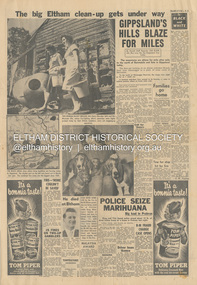 Eltham District Historical Society Inc
Newspaper - News Clipping, Herald, The big Eltham clean-up gets under way, Herald, 4 March, p3, 1965
... Webber said his union had constantly urged one authority for the State with a complete reorganisation of fire protection. On Wednesday the union had repeated its call for an inquiry into fire protection in Victoria to the Chief Secretary, Mr Rylah. ...Webber said his union had constantly urged one authority for the State with a complete reorganisation of fire protection. On Wednesday the union had repeated its call for an inquiry into fire protection in Victoria to the Chief Secretary, Mr Rylah. ...Full page newspaper clipping featuring the March 1965 Victorian bushfires. Items include: Photograph - TWO-WOMAN BUCKET BRIGADE, Mrs Henry Marsden (left) and Mrs Moureen Ellis, whose fire-fighting efforts yesterday were highly praised today by their Eltham neighbours, carry out mopping-up operations Photograph - DOGS MADE HOMELESS by the fire in North Eltham yesterday are being cared for at First-Constable Doug. Mummery's kennels at Eltham and here is kennel maid Helen Oliver, 17, with some of them today. The two basset hounds are owned by Mr Bill Guy who lost about 100 daschund and basset hound puppies and dogs in the fire. Photograph - He died at Eltham [Picture of John Lawrence Coleman] Builder Mr John Lawrence Coleman, 31, of Main Rd., Eltham, one of three men burnt to death yesterday in the fire at North Eltham. The other two were XXXXX, 33 who lives opposite the Colemans and Mr William Elwers, 64 of Batman Rd., Eltham. John Lawrence Coleman (1934-1965) born January 10, was the son of Raymond John Coleman and Hanna May (Gillet) Coleman. He married Margaret Frances Dare in 1955 and was the father of two children. He died whilst attempting to rescue an older man trapped in the bushfire at North Eltham on March 3, 1965 Other news stories of the day: Bushfires rage in Victoria, Snowy: Three dead (1965, March 4). The Canberra Times (ACT : 1926 - 1995), p. 1. Retrieved May 19, 2022, from http://nla.gov.au/nla.news-article131758981 Includes two photos of the fire in North Eltham “Firemen make for safety as fire rages in Upper Glen Park Road, North Eltham, Victoria. The smoke hides a house.” and “A house explodes into flames at North Eltham, Victoria. Firemen said bottled gas went up.” Canberra Times (ACT : 1926 - 1995), Thursday 4 March 1965, page 1 ________________________________________ Firemen make for safety as fire rages in Upper Glen Park Road. North Eltham. Victoria. The smoke hides a house. A house explodes into flames at North Eltham. Victoria. Firemen said bottled gas went up. Bushfires rage in Victoria, Snowy: Three dead MELBOURNE, Wednesday.—Three people died today in a bush» fire which raged through North Eltham, about 15 miles from Melbourne. The victims were three men. A fourth man is feared to be dead. Another bushfire. sparked off by the heatwave sizzling over south-eastern Australia, is burning out of control in the Kosciusko State Park, in the Snowy Mountains. Firefighters fear that if it reaches pine forests up the Yarrangobilly River, they will be powerless to stop it. The three victims of the North Eltbam fire were trapped by flames in a valley. Their bodies were found only a few yards apart. They were named by police tonight as Mr. George Crowe, 78, of North Eltham, William John Ewers, 64, and John Laurence Coleman, 31, both of Eltham. The other two have not been identified. They are believed to be a man aged about 40 and an 18-year-old youth. At least 12 homes were destroyed by the fire, the worst in Victoria since 1962, when eight lives were lost and hundreds of homes burnt down at Warrandyte. At one time the township of Eltham was threatened, but a cool change swept in from the south and held back the wall of flames. More than 100 dogs, worth about £4,000, died when the fire raced through two kennels in Short Street, Eltham. and Upper Glen Park Road, North Eltham. A trickle of water Residents ran into the streets as the blaze raced towards their houses. Others frantically dug firebreaks around their homes. Mrs. Sue Recourt wept when firemen arrived while she was vainly trying to stop the flames with a trickle of water from the garden hose. A stack of firewood was blazing, but the firemen managed to save the house and rescue four goats. Many homes in Eltham were saved after flames had crept to within feet of their fences. Students at North Eltham State School had to be evacuated when the blaze threatened the building. Fire fighters were severely hampered by lack of water and narrow roads. The blaze, which began in above century heat, turned toward Wattle Glen, where two houses were gutted. Then the flames raced towards Hurstbridge to the north. Firemen battling desperately, controlled the fire late this afternoon. Five forest fires were still burning in Victoria tonight. IN VICTORIA THIS WEEK Tragic lack of central fire authority (1965, March 9). The Canberra Times (ACT : 1926 - 1995), p. 2. Retrieved May 19, 2022, from http://nla.gov.au/nla.news-article131759928 Canberra Times (ACT : 1926 - 1995), Tuesday 9 March 1965, page 2 ________________________________________ IN VICTORIA THIS WEEK Tragic lack of central fire authority From Rohan Rivett It was the worst week for Victorian fire fighters since Black Friday 27 years ago. On that day one pilot up in a spotter plane said afterwards: "It seemed at times that half the State was on fire." This time, for three days on end, Gippsland men, women and children had moments of conviction that their towns would have blackened into anonymity before the weekend was out. The week began with horror at Eltham on the North-eastern edge of Melbourne. Eltham today is something of an artists' colony. Oil painters, water colourists, potters and sculptors proliferate. A number of University folk have emulated the example of Professor MacMahon Ball who pioneered the way by moving to Eltham and carving a home out of the bush in the thirties. Innermost Eltham is barely 14 miles from the G.P.O. Farthest Eltham stretches miles beyond. It served to illustrate the tragi-ludicrous truncation of Victoria's fire control. Part of Eltham is under the protection of the Melbourne Fire Brigade. But this responsibility ceases at some invisible and incomprehensible line — apparently determined by the meanderings of the water mains. At this point everybody's property throughout the rest of Eltham is dependent on the Country Fire Authority. Half an hour before midday on Wednesday, a fire suddenly started on the West side of Upper Glen road on the edge of Eltham. Before the fire brigade could arrive, it was burning on a widening front through timber and high grass north of Eltham. Two wind changes in rapid succession saw the fire leaping Diamond Creek. With a freshening wind it struck home after home in three streets. More than one of them exploded suddenly as if hit by an incendiary bomb. There is no piped gas in the Eltham area, hence many housewives use bottle gas. The flames outside caused the bottles to explode. Altogether twelve homes were completely incinerated and four more were badly damaged. Thirty prize dogs perished. About three hours after the fire started it raced suddenly down a gully hillside trapping an elderly man. Two other men apparently raced to the rescue. Flames caught the three men within yards of each other, not 200 yards off the Upper Glen Park Road where safety lay. They were burned to death. Next evening an angry and convincing secretary of the Fire Brigade Union, Mr. W. M. Webber, came on television and appealed to the people of Victoria to end the ridiculous and dangerous dualism in fire-fighting control. The Eltham fire, he said, had precisely illustrated the situation. The Metropolitan Fire Brigade area touched Eltham, but where the fire had gutted and killed, was just outside its area. Mr. Webber said his union had constantly urged one authority for the State with a complete reorganisation of fire protection. On Wednesday the union had repeated its call for an inquiry into fire protection in Victoria to the Chief Secretary, Mr Rylah. "No matter how close the liaison between the two organisations, there are always divided sections of thinking," Mr. Webber told viewers. "I don't know how much tragedy the com-munity can take before it demands that it is properly protected." Rumours that differences in gauge between taps and hose nozzles (as between the two authorities) accentuated the damage were denied by fire chiefs who said that all appliances were now carrying adaptors so that hoses could be linked to mains everywhere. But there is grave concern in the Metropolitan Fire Brigade's higher councils at the action of several Federal authorities with projects in and around Melbourne. They are installing non-standard equipment without reference to the State authorities or any dovetailing of appliances and equipment. Public alarm was not diminished by the publication on Friday and Saturday of a heart tearing letter from the young widow of John Lawrence Coleman, 31 year old father of two, who had died in the flames apparently trying to rescue the old man trapped in the gully. By that time, a Vast area of Gippsland was in flames and the troops had been sent in to back up the overworked and often helpless fire-fighters. By Saturday, the Leader of the Opposition, Mr. Stoneham, who has previously demanded a Royal Commission into fire-fighting arrangements, repeated his demand. To add to the Chief Secretary's worries he was publicly rebuked for allegedly implying on television that lives had been lost at Eltham because people went to the wrong place at the wrong time. In a letter to the Press, Professor MacMahon Ball pointed out that two of the men involved were experienced bushmen who had gone "to help an old man in great danger fully aware of the danger to themselves". As Victoria faced its sixth day of total State-wide fire ban, it looked likely that even official resistance was not going to silence the demand for one central authority to control the fire fiend. At the moment, the 400 square miles where two million Victorians live in Greater Melbourne are divorced from the rest of the State in planning, communications, equipment and control of personnel. No one doubts the whole-hearted co-operation and willingness to back each other up of the M.F.B. and the C.F.A., both at top-level and among the firemen themselves. However, when a city straggles so deeply into the country side, the absence of a single authority, to oversee and analyse the fire threat as a whole, suggests suicidal policy of divide and fuel. Emphasis of the tragic loss of a member of a pioneering family who died whilst helping others in his communitybushfire, cfa, country fire authority, fire brigrade, glen park road, heroes, john lawrence coleman, north eltham, victorian bushfires - 1965, volunteers, william john elwers, fire fighter, frank martin, george john crowe, ken gaston, orchard avenue, doug mummery, helen oliver, mrs henry marsden, mrs moureen ellis -
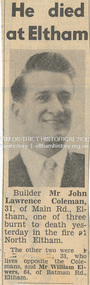 Eltham District Historical Society Inc
Newspaper - News Clipping, Herald, He died at Eltham. Herald, March 4, p3, 4 Mar 1965
... Webber said his union had constantly urged one authority for the State with a complete reorganisation of fire protection. On Wednesday the union had repeated its call for an inquiry into fire protection in Victoria to the Chief Secretary, Mr Rylah. ...Webber said his union had constantly urged one authority for the State with a complete reorganisation of fire protection. On Wednesday the union had repeated its call for an inquiry into fire protection in Victoria to the Chief Secretary, Mr Rylah. ...John Lawrence Coleman (1934-1965) born January 10, was the son of Raymond John Coleman and Hanna May (Gillet) Coleman. He married Margaret Frances Dare in 1955 and was the father of two children. He died whilst attempting to rescue an older man trapped in the bushfire at North Eltham on March 3, 1965 He died at Eltham (Herald, 4 March 1965, p3) [Picture of John Lawrence Coleman] Builder Mr John Lawrence Coleman, 31, of Main Rd., Eltham, one of three men burnt to death yesterday in the fire at North Eltham. The other two were XXXXX, 33 who lives opposite the Colemans and Mr William Elwers, 64 of Batman Rd., Eltham. * * * Frank Martin was a volunteer with the Eltham rural fire brigade at the time of the 1965 bushfires which burnt Eltham North and Research. Frank was asked to assist with the removal of three bodies from the back gully (now Orchard Avenue). They were badly burnt and one was found stuck under a fence as though trying to escape. Volunteers John Coleman Jnr, William Elwers and George Crowe were killed trying to protect Eltham from bushfire – they were local heroes. At the time, John Coleman Jnr was survived by his wife Margaret and two young children – John 11 and Vicky 2. Margaret Coleman lived in the family home until 1992 when she sold it and moved to Tasmania to be close to her son. She died in 1997 aged 65 years. 75 yr old Ken Gaston grew up on Edendale farm, which was originally a poultry farm but is now owned and run by the Shire of Nillumbik as an educational farm for schools and visitors. He was Captain of the Eltham rural fire brigade in 1965 when John Coleman Jnr was burnt to death in the Eltham North bushfires serving as an unofficial volunteer. He was able to draw where the original Wattletree Road was and at the time was verified with the location of some remaining bitumen and a post from the original bridge over the Diamond Creek located near the junction of the Diamond Creek and another small creek which is further down from Research or Christmas Creek as locals refer to it. The original Main Road ran behind Colemans before the railway line was built beyond Eltham in 1912. (Information recorded by Harry Gilham, President EDHS c.2011) * * * Bushfires rage in Victoria, Snowy: Three dead (1965, March 4). The Canberra Times (ACT : 1926 - 1995), p. 1. Retrieved May 19, 2022, from http://nla.gov.au/nla.news-article131758981 Includes two photos of the fire in North Eltham “Firemen make for safety as fire rages in Upper Glen Park Road, North Eltham, Victoria. The smoke hides a house.” and “A house explodes into flames at North Eltham, Victoria. Firemen said bottled gas went up.” Canberra Times (ACT : 1926 - 1995), Thursday 4 March 1965, page 1 ________________________________________ Firemen make for safety as fire rages in Upper Glen Park Road. North Eltham. Victoria. The smoke hides a house. A house explodes into flames at North Eltham. Victoria. Firemen said bottled gas went up. Bushfires rage in Victoria, Snowy: Three dead MELBOURNE, Wednesday.—Three people died today in a bush» fire which raged through North Eltham, about 15 miles from Melbourne. The victims were three men. A fourth man is feared to be dead. Another bushfire. sparked off by the heatwave sizzling over south-eastern Australia, is burning out of control in the Kosciusko State Park, in the Snowy Mountains. Firefighters fear that if it reaches pine forests up the Yarrangobilly River, they will be powerless to stop it. The three victims of the North Eltbam fire were trapped by flames in a valley. Their bodies were found only a few yards apart. They were named by police tonight as Mr. George Crowe, 78, of North Eltham, William John Ewers, 64, and John Laurence Coleman, 31, both of Eltham. The other two have not been identified. They are believed to be a man aged about 40 and an 18-year-old youth. At least 12 homes were destroyed by the fire, the worst in Victoria since 1962, when eight lives were lost and hundreds of homes burnt down at Warrandyte. At one time the township of Eltham was threatened, but a cool change swept in from the south and held back the wall of flames. More than 100 dogs, worth about £4,000, died when the fire raced through two kennels in Short Street, Eltham. and Upper Glen Park Road, North Eltham. A trickle of water Residents ran into the streets as the blaze raced towards their houses. Others frantically dug firebreaks around their homes. Mrs. Sue Recourt wept when firemen arrived while she was vainly trying to stop the flames with a trickle of water from the garden hose. A stack of firewood was blazing, but the firemen managed to save the house and rescue four goats. Many homes in Eltham were saved after flames had crept to within feet of their fences. Students at North Eltham State School had to be evacuated when the blaze threatened the building. Fire fighters were severely hampered by lack of water and narrow roads. The blaze, which began in above century heat, turned toward Wattle Glen, where two houses were gutted. Then the flames raced towards Hurstbridge to the north. Firemen battling desperately, controlled the fire late this afternoon. Five forest fires were still burning in Victoria tonight. IN VICTORIA THIS WEEK Tragic lack of central fire authority (1965, March 9). The Canberra Times (ACT : 1926 - 1995), p. 2. Retrieved May 19, 2022, from http://nla.gov.au/nla.news-article131759928 Canberra Times (ACT : 1926 - 1995), Tuesday 9 March 1965, page 2 ________________________________________ IN VICTORIA THIS WEEK Tragic lack of central fire authority From Rohan Rivett It was the worst week for Victorian fire fighters since Black Friday 27 years ago. On that day one pilot up in a spotter plane said afterwards: "It seemed at times that half the State was on fire." This time, for three days on end, Gippsland men, women and children had moments of conviction that their towns would have blackened into anonymity before the weekend was out. The week began with horror at Eltham on the North-eastern edge of Melbourne. Eltham today is something of an artists' colony. Oil painters, water colourists, potters and sculptors proliferate. A number of University folk have emulated the example of Professor MacMahon Ball who pioneered the way by moving to Eltham and carving a home out of the bush in the thirties. Innermost Eltham is barely 14 miles from the G.P.O. Farthest Eltham stretches miles beyond. It served to illustrate the tragi-ludicrous truncation of Victoria's fire control. Part of Eltham is under the protection of the Melbourne Fire Brigade. But this responsibility ceases at some invisible and incomprehensible line — apparently determined by the meanderings of the water mains. At this point everybody's property throughout the rest of Eltham is dependent on the Country Fire Authority. Half an hour before midday on Wednesday, a fire suddenly started on the West side of Upper Glen road on the edge of Eltham. Before the fire brigade could arrive, it was burning on a widening front through timber and high grass north of Eltham. Two wind changes in rapid succession saw the fire leaping Diamond Creek. With a freshening wind it struck home after home in three streets. More than one of them exploded suddenly as if hit by an incendiary bomb. There is no piped gas in the Eltham area, hence many housewives use bottle gas. The flames outside caused the bottles to explode. Altogether twelve homes were completely incinerated and four more were badly damaged. Thirty prize dogs perished. About three hours after the fire started it raced suddenly down a gully hillside trapping an elderly man. Two other men apparently raced to the rescue. Flames caught the three men within yards of each other, not 200 yards off the Upper Glen Park Road where safety lay. They were burned to death. Next evening an angry and convincing secretary of the Fire Brigade Union, Mr. W. M. Webber, came on television and appealed to the people of Victoria to end the ridiculous and dangerous dualism in fire-fighting control. The Eltham fire, he said, had precisely illustrated the situation. The Metropolitan Fire Brigade area touched Eltham, but where the fire had gutted and killed, was just outside its area. Mr. Webber said his union had constantly urged one authority for the State with a complete reorganisation of fire protection. On Wednesday the union had repeated its call for an inquiry into fire protection in Victoria to the Chief Secretary, Mr Rylah. "No matter how close the liaison between the two organisations, there are always divided sections of thinking," Mr. Webber told viewers. "I don't know how much tragedy the com-munity can take before it demands that it is properly protected." Rumours that differences in gauge between taps and hose nozzles (as between the two authorities) accentuated the damage were denied by fire chiefs who said that all appliances were now carrying adaptors so that hoses could be linked to mains everywhere. But there is grave concern in the Metropolitan Fire Brigade's higher councils at the action of several Federal authorities with projects in and around Melbourne. They are installing non-standard equipment without reference to the State authorities or any dovetailing of appliances and equipment. Public alarm was not diminished by the publication on Friday and Saturday of a heart tearing letter from the young widow of John Lawrence Coleman, 31 year old father of two, who had died in the flames apparently trying to rescue the old man trapped in the gully. By that time, a Vast area of Gippsland was in flames and the troops had been sent in to back up the overworked and often helpless fire-fighters. By Saturday, the Leader of the Opposition, Mr. Stoneham, who has previously demanded a Royal Commission into fire-fighting arrangements, repeated his demand. To add to the Chief Secretary's worries he was publicly rebuked for allegedly implying on television that lives had been lost at Eltham because people went to the wrong place at the wrong time. In a letter to the Press, Professor MacMahon Ball pointed out that two of the men involved were experienced bushmen who had gone "to help an old man in great danger fully aware of the danger to themselves". As Victoria faced its sixth day of total State-wide fire ban, it looked likely that even official resistance was not going to silence the demand for one central authority to control the fire fiend. At the moment, the 400 square miles where two million Victorians live in Greater Melbourne are divorced from the rest of the State in planning, communications, equipment and control of personnel. No one doubts the whole-hearted co-operation and willingness to back each other up of the M.F.B. and the C.F.A., both at top-level and among the firemen themselves. However, when a city straggles so deeply into the country side, the absence of a single authority, to oversee and analyse the fire threat as a whole, suggests suicidal policy of divide and fuel. Emphasis of the tragic loss of a member of a pioneering family who died whilst helping others in his communitybushfire, cfa, country fire authority, fire brigrade, glen park road, heroes, john lawrence coleman, north eltham, victorian bushfires - 1965, volunteers, william john elwers, fire fighter, frank martin, george john crowe, ken gaston, orchard avenue -
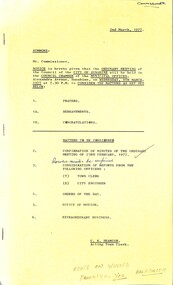 Sunshine and District Historical Society Incorporated
Administrative record - City of Sunshine - Commissioner Mr Alexander Alex George Gillon Collection 1976 - 1982 - Notice of ordinary meeting of the council of the City of Sunshine to be held on 9th March 1977, City of Sunshine, 2nd March 1977
... Notice of Ordinary Meeting of the Council of the City of Sunshine to be held on 9th March 1977 Report of the Acting Town Clerk Acquisition of land bounded by Gooding and Willis Streets and the Railway Line St. Albans Cat Protection Society Audit Fees Lease of Navigational Deacon site in Robinsons Road Deer Park Metropolitan Fire Brigades Board Rates & Sanitary Interest Abandonments for 1976/77 Safety Precautions with Swimming Pools Land Transfer from D.U.L. ...Albans Road Percy Street Ballarat Road Sunshine Tip Geelong Road Old Geelong Road Burgess Road Brooklyn Annunciation Primary School Eames Avenue Heather Avenue Western Avenue Whitehill Avenue Darnley Street Lily Street Braybrook Navigator Street The Esplanade Maribyrnong Cranwell Street Christ the King Primary School Caroline Chisholm Catholic College Churchill Avenue Ashley Street Whittaker Street Pridham Holdings Evans Street Alick Road Benjamin Street Notice of Ordinary Meeting of the Council of the City of Sunshine to be held on 9th March 1977 Report of the Acting Town Clerk Acquisition of land bounded by Gooding and Willis Streets and the Railway Line St. Albans Cat Protection Society Audit Fees Lease of Navigational Deacon site in Robinsons Road Deer Park Metropolitan Fire Brigades Board Rates & Sanitary Interest Abandonments for 1976/77 Safety Precautions with Swimming Pools Land Transfer from D.U.L. ...Notice of Ordinary Meeting of the Council of the City of Sunshine to be held on 9th March 1977 Report of the Acting Town Clerk Acquisition of land bounded by Gooding and Willis Streets and the Railway Line St. Albans Cat Protection Society Audit Fees Lease of Navigational Deacon site in Robinsons Road Deer Park Metropolitan Fire Brigades Board Rates & Sanitary Interest Abandonments for 1976/77 Safety Precautions with Swimming Pools Land Transfer from D.U.L. National Estate Programme Award Matters Variation to the General Award for Building Inspectors Staff Gratuity Scheme Federal Funding for Local Government PRojects Report of the Chief Health Inspector Amusements Parlour Application Woolworths Shop Hampshire Road Corner Devonshire Road Application to Extend an Amusement Parlour 69 McIntyre Road Application for Septic Tank Prosecutions Proceedings Sunshine Magistrates Court Conditions of Flats Application Office & Amenities Block Colyer Fehr Pty Ltd Burke Street Braybrook Authorised Officer for Immunisation Procedures for Housing Orders Infant Welfare Request for Opening Outside Normal Hours Report of the By-Laws Officer Scout Hall Signs on Lamp Poles Various Area Report of the Welfare Officers People Rights Booklets Family Day Care Report of the City Library Extended Hours of Opening Rainbow Workshop Report of the City Engineer Furlong Road Estate Stage 6 Westerngate Estate Stage 1A Plan of Subdivision Tallintyre Road Housing Commission of Victoria Land Use Permit Application Detached House 38 Doherty Street Land Use Permit Application Detached House Lot 497 Leila Street Land Use Permit Application Extension to Flats Lot 50 Oldfield Street Land Use Permit Application Detached House Lot 275 Orama Street Rezoning St. Albans Road and Percy Street St. Albans Glengala Estate Stage 3 Abandonment of Easement Land Use Permit Application Motorcycle Sales and Service 87 - 89 McIntyre Road Land Use Permit Application Sign Magnet Store Ballarat Road Deer Park Exchange of Land Nickson's Subdivision Furlong Road abutting the North West Boundary of the Sunshine Tip. Lots 700 to 407 abuts on to Denton Avenue and came across garbage. Transport Regulation Board Variation to Existing Bus Route 455 Transport Regulation Board Bus Service Glengala Estate Preferred Development Area Deer Park Variation to Contract Glengala Estate Stage 3 Meals on Wheel Van Irrigation of Reserves Employment of Council Plumber Land Use Permit Application Subdivision Geelong Road and Old Geelong Road Geelong Road at Burgess Road Brooklyn Land Use Permit Application Extension of Annunciation Primary School Playground Heather Avenue & Eames Avenue Central Avenue Drain Culvert at Western Avenue Land Use Permit Application Lot 122 Whitehill Avenue Land Use Permit Application Home for the Frail / Aged Darnley Street North West Corner Lily Street Land Use Permit Application Factory 172 McIntyre Road Steers Street Group Part Private Street Scheme Easement Drain under the Health Act Albion Navigator Street North of The Esplanade Proposed 6 Tonne Load Limit Strata Subdivision 1 Fabian Court Cranwell Street Kerb & Channel & Footpath Construction Land Use Permit Additions to Christ the King Primary School & Caroline Chisholm Catholic College Churchill Avenue Plan of Subdivision Ballarat Road South Side between Ashley Street and Whittaker Street Land Use Permit Application Extension of Offices Pridham Holdings Evans Street Alterations to Flat Areas Maribyrnong Opening in Party Walls Lots 24 & 25 Alick Road Brooklyn Undersize Allotment 17 Benjamin Street Installation of Underground Tank Orders of the Day Accounts Submitted for Payment as at 15th February 1977 Confirmation of Loan with Melbounre & Metropolitan Board of Works Plan of Subdivision 36 Market Road city of sunshine, alexander "alex" george gillon, gooding street, willis street, st. albans, navigational beacon, robinsons road, deer park, woolworths, hampshire road, devonshire road, sunshine, mcintyre road, sunshine north, burke street, furlong road, doherty street, leila street, oldfield street, sunshine west, orama street, st. albans road, percy street, ballarat road, sunshine tip, geelong road, old geelong road, burgess road, brooklyn, annunciation primary school, eames avenue, heather avenue, western avenue, whitehill avenue, darnley street, lily street, braybrook, navigator street, the esplanade, maribyrnong, cranwell street, christ the king primary school, caroline chisholm catholic college, churchill avenue, ashley street, whittaker street, pridham holdings, evans street, alick road, benjamin street
