
Showing 15 items matching "salonika"
-
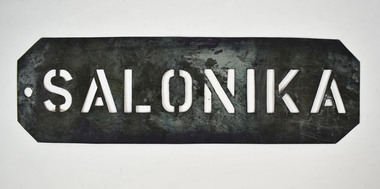 National Wool Museum
Stencil - SALONIKA
... This stencil was used as a location stamp for the transportation of wool bales. Salonika is a city in Greece. Wool bales marked SALONIKA would have been transported to Greece by sea....Wool bale export stencil - SALONIKA...SALONIKA...This stencil was used as a location stamp for the transportation of wool bales. Salonika is a city in Greece. Wool bales marked SALONIKA would have been transported to Greece by sea. wool - transportation wool sales wool class wool classers SALONIKA Wool bale export stencil - SALONIKA Stencil - SALONIKA ...This stencil was used as a location stamp for the transportation of wool bales. Salonika is a city in Greece. Wool bales marked SALONIKA would have been transported to Greece by sea.Wool bale export stencil - SALONIKASALONIKAwool - transportation, wool sales, wool class, wool classers -
![Book, Ian Hay [pseud.], The ship of remembrance, Gallipoli-Salonika, 1926](/media/collectors/60ebece6200ed0291c364310/items/62b95390c6586a3f185c2550/item-media/62b95442c6586a3f185c31ef/item-fit-380x285.jpg?cb=6) Mrs Aeneas Gunn Memorial Library
Mrs Aeneas Gunn Memorial LibraryBook, Ian Hay [pseud.], The ship of remembrance, Gallipoli-Salonika, 1926
... The ship of remembrance, Gallipoli-Salonika...The ship of remembrance, Gallipoli-Salonika Book Ian Hay [pseud.]. Hodder and Stoughton ...A personal account of the Gallipoli campaignIll, maps, p.43.A personal account of the Gallipoli campaign world war 1914-1918 -campaigns - gallipoli, world war 1914-1918 - personal recollections -
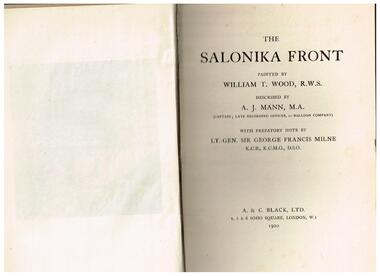 Mrs Aeneas Gunn Memorial Library
Book, A.J. Mann, The Salonika front, 1920
... The Salonika front...World War 1914-1918 - Personal recollections World war 1914-1918 - Salonika An account of the Balkans campaign. ...An account of the Balkans campaign.Index, ill, maps, p.196.non-fictionAn account of the Balkans campaign.world war 1914-1918 - personal recollections, world war 1914-1918 - salonika -
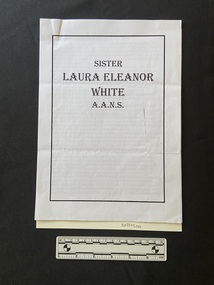 Returned Nurses RSL Sub-branch
Document - Photocopy of a typed biographical history, Sister Laura Eleanor White A.A.N.S, unknown
... ...Salonika...Biographical piece about Sister Laura Eleanor White who enlisted with the Australian Army Nursing Service in 1917 and served as a Staff Nurse in the military hospitals in Salonika. The piece of writing provides interesting information on living conditions in the General Hospitals....Biographical piece about Sister Laura Eleanor White who enlisted with the Australian Army Nursing Service in 1917 and served as a Staff Nurse in the military hospitals in Salonika. The piece of writing provides interesting information on living conditions in the General Hospitals. ...Biographical piece about Sister Laura Eleanor White who enlisted with the Australian Army Nursing Service in 1917 and served as a Staff Nurse in the military hospitals in Salonika. The piece of writing provides interesting information on living conditions in the General Hospitals.Cover page has a solid black line border around the full page and the heading printed in the top centre. The following two pages are a typed biography. The final page is a full page portrait image of Sister White.world war 1914-1918, australian nurses, wwi, ww1, australian army nursing serive, aans, laura eleanor white, salonika -
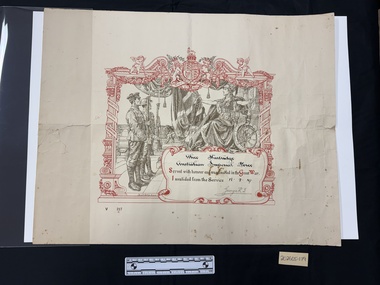 Returned Nurses RSL Sub-branch
Certificate - Kings Certificate of Discharge WWI - Alice Hartridge, Bernard Partridge, [circa 1918]
... ...Salonika...She was invalided out due to a heart condition, that may have been the result of shelling of the hospital she was working at in Salonika in WWI....She was invalided out due to a heart condition, that may have been the result of shelling of the hospital she was working at in Salonika in WWI. Alice Hartridge WWI WW1 World war one Australian Army Nursing Service AANS Salonika Salonica Wounded 'Alice Hartridge / Australian Imperial Force' [Handwritten calligraphy black ink in box in lower right hand corner of certificate] '18 . 2 . 19' [Handwritten calligraphy black ink in box in lower right hand corner of certificate] Large certificate printed on card that is foxed. ...Kings certificate of discharge given to Alice Hartridge who served with the Australian Army Nursing Service (AANS) for just over a year in WWI. She was invalided out due to a heart condition, that may have been the result of shelling of the hospital she was working at in Salonika in WWI.Large certificate printed on card that is foxed. Certificate has red and black printed illustrations with a box of text in the lower right hand corner containing some hand written and printed text in black and red. "Army: red and black, with two soldiers (one Australian) shown presenting arms to a seated Britannia. Either side are two columns around which appears the wording “British Isles, Overseas Dominions, Indian Empire, Colonies, Protectorates.” In the bottom right hand corner is the soldier’s name, number and regiment, followed by “Served with honour and was disabled in the Great War. Honourably discharged on…” with the date of discharge written in ink." (Forces war records website, see References) Certificate has major tears on the left hand side that have been repaired on the reverse with sticky tape. There is a lot of foxing and staining on the card. 'Alice Hartridge / Australian Imperial Force' [Handwritten calligraphy black ink in box in lower right hand corner of certificate] '18 . 2 . 19' [Handwritten calligraphy black ink in box in lower right hand corner of certificate]alice hartridge, wwi, ww1, world war one, australian army nursing service, aans, salonika, salonica, wounded -
 Returned Nurses RSL Sub-branch
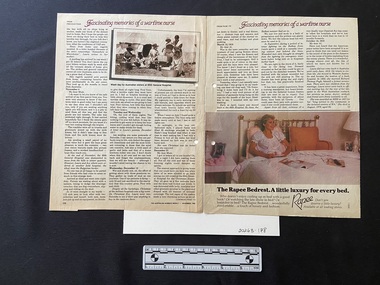
Article - Magazine article, The Australian Women's Weekly, Fascinating memories of a wartime nurse, 1983
... ...Salonika...An account of Laura Grubb's service as an Army Nurse in Salonika during WWI. The article includes parts taken from letters and diaries that have been donated to the Australian War Memorial in Canberra. ...An account of Laura Grubb's service as an Army Nurse in Salonika during WWI. The article includes parts taken from letters and diaries that have been donated to the Australian War Memorial in Canberra. ...An account of Laura Grubb's service as an Army Nurse in Salonika during WWI. The article includes parts taken from letters and diaries that have been donated to the Australian War Memorial in Canberra. It provides a fascinating account of living and work conditions in the field hospitals, the celebrations surrounding Christmas with the patients, and the great value the wounded and sick soldiers placed on the nurses who assisted them in such terrible times.Full double-page spread magazine article that continues overleaf and on to half another page. The title is printed right across the top. There is a panorama picture of a field hospital and right below it a map of Greece. Slightly overlaying the image are a photo of Laura Grubb in uniform, and another more casual photo of her with friends and a donkey. There are three columns of text on each of the four pages.world war 1914-1918, australian nurses, wwi, ww1, australian army nursing serive, aans, salonika, laura grubb, living conditions, rations -
 Frankston RSL Sub Branch
Medallion
... The Reverse side of the medallion is embossed with the words "New Guinea", "Egypt", "Gallipoli", "France", "Palestine", "Salonika" and "Mesopotamia" within an olive wreath. ...The reverse side of the medallion is embossed with the words "New Guinea", "Egypt", "Gallipoli", "France", "Palestine", "Salonika" and "Mesopotamia" within an olive wreath. ...The Reverse side of the medallion is embossed with the words "New Guinea", "Egypt", "Gallipoli", "France", "Palestine", "Salonika" and "Mesopotamia" within an olive wreath. ...The medal was created for sale to the public to raise funds for the provision of troop comforts material.Medallion distributed during World War 1 by the South Australia Division of the Australian Comforts Fund. This medallion was apparently used for fund raising by the ACF to support the welfare of Australian service personnel. The medallion is 52mm diameter by 5mm thick and is made from copper. The medallion has a swivel and a loop at the top for attaching a chain or ribbon. Mintage total not known. The Reverse side of the medallion is embossed with the words "New Guinea", "Egypt", "Gallipoli", "France", "Palestine", "Salonika" and "Mesopotamia" within an olive wreath. The obverse side of the medallion has an embossed image of the head and shoulders of an Australian soldier wearing a slouch hat and carrying a rifle at the high port position. The edge of the medallion is stamped "Australian Comforts Fund SA Division". Medallion has suffered edge damage and has been cleaned extensivelyThe reverse side of the medallion is embossed with the words "New Guinea", "Egypt", "Gallipoli", "France", "Palestine", "Salonika" and "Mesopotamia" within an olive wreath. The obverse side of the medallion has an embossed image of the head and shoulders of an Australian soldier wearing a slouch hat and carrying a rifle at the high port position. The edge of the medallion is stamped "Australian Comforts Fund SA Division". Stokes & Sonsww1, medallion, south australia, acf, australian comforts fund -
 Returned Nurses RSL Sub-branch
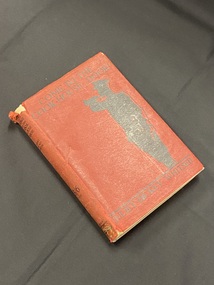
Book - Hardcover book, Juliet De Key Whitsed, Come to the cook-house door!, 1932
... Salonika...Very rare and difficult to obtain book, similar copy has sold for $485+ Salonika Voluntary Aid Detachment Greece World War 1914-1918 "This is the Diary of a V.A.D. ..."This is the Diary of a V.A.D. (Voluntary Aid Detachment) in Salonika (present-day Thessaloniki in Greece) from June, 1917, til the end of the war, and a little beyond. It is a vividly written and entertaining piece of autobiography, enlivened by an attractive sense of humour. We feel the book will interest not only the V.A.D.'s of the Great War, but also the large public which is ever on the look-out for authentic books concerning the war period." - from inside the dust jacket.Small hardcover book with a dark red dustjacket. The spine is torn at the top and bottom and there is an old tape mark on the bottom of the spine. The front has a black silouette of a soldier playing a bugle along the right side edge, beneath him is a solid black line with the author's name printed below across the bottom of the cover. The title is printed in black ink across the top. The title and author are also printed in black text on the top part of the spine, further down it reads '3/6 net' and 'Herbert Joseph'.non-fiction"This is the Diary of a V.A.D. (Voluntary Aid Detachment) in Salonika (present-day Thessaloniki in Greece) from June, 1917, til the end of the war, and a little beyond. It is a vividly written and entertaining piece of autobiography, enlivened by an attractive sense of humour. We feel the book will interest not only the V.A.D.'s of the Great War, but also the large public which is ever on the look-out for authentic books concerning the war period." - from inside the dust jacket. salonika, voluntary aid detachment, greece, world war 1914-1918 -
 Surrey Hills Historical Society Collection
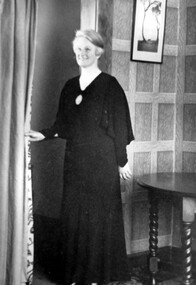
Photograph, Mrs Christine Bonwick, nee Strom
... Her letters written to her family (“Letters from Salonika”) and her WW1 diary are held at the Australian War Memorial. ...Her letters written to her family (“Letters from Salonika”) and her WW1 diary are held at the Australian War Memorial. ...Daughter of Herman Strom, a Swedish sea captain and Mary Edington Rule Pyatt with 2 siblings: Eric Strom and Elsa Rule Strom. Born 1892 in Ascot Vale; died 1984. Christine trained as a nurse at the Royal Women’s Hospital for 4 years and enlisted on 24/5/1917 as an Army Staff nurse. Enlistment papers give her religion as Unitarian. Her letters written to her family (“Letters from Salonika”) and her WW1 diary are held at the Australian War Memorial. After marriage she lived at 12 Lock Street from 1923-1981. Married Walter Hugh Bonwick and had 2 sons William James (Bill) and John Edwin. Pastimes: Joined the Scout Movement and became ‘Akela’ to the cubs of Yooralla, Balwyn; wrote prose and poetry and had a book of verse published; entitled “We came in a Freighter”. A black and white photograph of a lady, wearing a long dark coloured dress. She has short fair hair. There is a table beside her and a picture hanging on the wall behind her.nurses, scouts, mont albert, surrey hills, world war, 1914-1918, writer, loch street, miss christine erica strom, mrs christine erica bonwick, assoc prof william (bill) bonwick, mr john bonwick, walter hugh bonwick -
 Surrey Hills Historical Society Collection
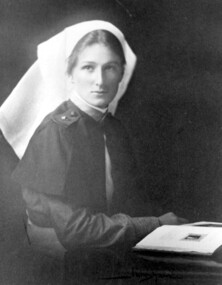
Photograph, Miss Christine Erica Strom
... Her letters written to her family (“Letters from Salonika”) and her WW1 diary are held at the Australian War Memorial. ...Her letters written to her family (“Letters from Salonika”) and her WW1 diary are held at the Australian War Memorial. ...Daughter of Herman Strom, a Swedish sea captain and Mary Edington Rule Pyatt with 2 siblings: Eric Strom and Elsa Rule Strom. Born 1892 in Ascot Vale; died 1984. Christine trained as a nurse at the Royal Women’s Hospital for 4 years and enlisted on 24/5/1917 as an Army Staff nurse. Enlistment papers give her religion as Unitarian. Her letters written to her family (“Letters from Salonika”) and her WW1 diary are held at the Australian War Memorial. After marriage she lived at 12 Lock Street from 1923-1981. Married Walter Hugh Bonwick and had 2 sons William James (Bill) and John Edwin. Pastimes: Joined the Scout Movement and became ‘Akela’ to the cubs of Yooralla, Balwyn; wrote prose and poetry and had a book of verse published; entitled “We came in a Freighter”. A black and white studio photo of a lady in nurse's uniform with a cape and a veil on her head.mr walter bonwick, loch street, mont albert, surrey hills, world war, 1914-1919, nurses, miss christine erica strom, mrs christine erica bonwick -
 St Kilda Historical Society
Photograph, 26/11/1978
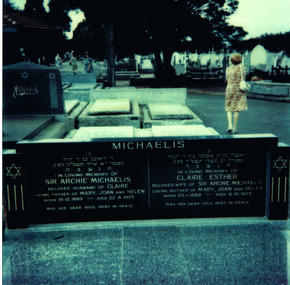
... He also served in the Royal Field Artillery 1914-1919, in Egypt, Aden and Salonika. Other roles included: president of the St. ...He also served in the Royal Field Artillery 1914-1919, in Egypt, Aden and Salonika. Other roles included: president of the St. ...Sir Archie Michaelis was born on 9 December 1889 in St Kilda and died on 22 April 1975. He married Claire Esther Hart on 14 January 1920. They had 3 daughters. He represented the electorate of St Kilda in the Victorian Legislative Assembly from 1 May 1932 to 1 0ctober 1952. He was Speaker of the house from 1950 to 1952. Before entering politics he worked with the family firm Michaelis Hallenstein and Co., leather merchants, from 1909. He also served in the Royal Field Artillery 1914-1919, in Egypt, Aden and Salonika. Other roles included: president of the St. Kilda Hebrew Congregation, a leading Orthodox synagogue in Melbourne; President Vic. branch 1945 and Chairman Patriotic Funds Council 1947-1951; President Vic. Jewish Advisory Board 1939-1940; Vice-president Kipling Society, London, and President Vic. branch; member English Public Schools Association, Vic. Association of Jewish Ex-Servicemen; Vice-president Alfred Hospital 1935-1972; Patron St Kilda Welfare Organisation, Claire Esther Michaelis was born on 20 Jan 1893 and died on 8 October 1973. The photograph was taken on a St Kilda Historical Society tour of St Kilda cemetery, 26 November 1978.Polaroid colour photographBus trip 26/11/78 Michaelis Grave. The headstones read: (At left) In Loving Memory of Sir Archie Michaelis, Beloved Husband of Claire, Loving Father of Mary, Joan and Helen, Born 19.12.1889 - Died 22.4.1975. May his dear soul rest in peace. (At right) In Loving Memory of Claire Esther, Beloved Wife of Sire Archie Michaelis, Loving Mother of Mary, Joan and Helen, Born 20.1.1893 - Died 8.10.1973. May her dear soul rest in peace. sir archie michaelis, claire esther michaelis, st kilda, victorian parliament, st kilda cemetery -
 Melbourne Legacy
Document - Document, report, Report of Captain Thomas White
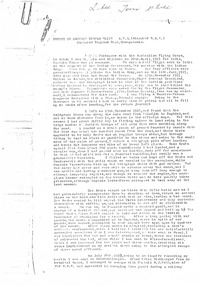
... On 3 November 1918 they boarded a ship for Varna where Brigadier-General Ross met them, motored to Salonika, arriving 10/11/1918, then subsequently sent to Cairo. ...On 3 November 1918 they boarded a ship for Varna where Brigadier-General Ross met them, motored to Salonika, arriving 10/11/1918, then subsequently sent to Cairo. ...An account of the wartime experiences of Legatee Thomas White who served a term as President in 1925. This is the story of the capture and escape of Captain Thomas White, Australian Flying Corps on the Baghdad Road, Mesopotamia (Iraq), 13/11/1915. Captain White had been ordered to cut the telegraph wires behind the Turkish Lines along with his observer Captain F. Yeats-Brown from the 17th Indian Cavalry. Although they achieved their objective, the Maurice-Farman Longhorn aeroplane was damaged on landing and could not be repaired and were subsequently captured by the Arabs and local Gendarmerie. After the Arabs had beaten them up they were taken to Baghdad, escorted by the Turks and imprisoned. On 26 July 1918 Captain White escaped with Captain AJ Bott of the Royal Air Force. After making their way by sea (under very difficult circumstances) they arrived and went ashore at Odessa on the Black Sea. Odessa at the time was occupied by Austria and German troops and the Bolsheviks (the Russian revolution was under way). On 3 November 1918 they boarded a ship for Varna where Brigadier-General Ross met them, motored to Salonika, arriving 10/11/1918, then subsequently sent to Cairo. Tommy White became the third President of Melbourne Legacy in 1925-26 (Melbourne Legacy Bulletin 19/7/1990). He also went on to be the Australian High Commissioner in Britain until 1956. A story of courage, hope and endurance by Captain Thomas White.White A4 paper with black type x 14 pages.Printing ink overlap and other printing stains throughout the document. Ltee Tom White written in black biro, top of page one.past presidents, world war one, thomas white -
 Returned Nurses RSL Sub-branch
Memorabilia - Scrapbook, Beryl Randall Trigellis-Smith (neé Sampson), [various]
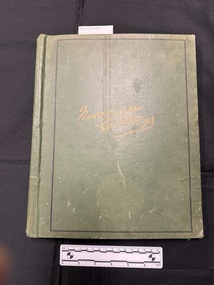
... The White Tower, Salonika (newspaper clipping) - photo and map of area around Aegean Sea [unknown date and publication] 8. ...The White Tower, Salonika (newspaper clipping) - photo and map of area around Aegean Sea [unknown date and publication] 8. ...Scrapbook owned by Beryl Randall Trigellis-Smith (neé Sampson) who served as a nurse in WWI and was an active member of many nursing related organisations include the Returned Nurses Club (Victoria). Contains newspaper & magazine clippings, postcards, poetry, quotes/reflections, pamphlets (Order of services), photocopied correspondence, single page Order of Services/Service announcements, speeches & toasts, booklets, personal stories, contact details, photocopied excerpts, menus, invitations, order of ceremonies, certificates. Titles and (formats) in order: 1. 'A Maori's stirring dawn address : What Anzac has come to mean' (newspaper clipping) - article providing the full address given by Lt. Colonel C M Bennett DSO at the Dawn Parade ceremony in Wellington (NZ) 1957 [publication unknown]. 2. Coat hangers (newspaper clipping) - article about items on display [at a market? date unknown, under handwritten 'Troop Train' heading] 3. 'What's in a name? -just ask the matron' (newspaper clipping) - article providing basic information about Margaret Lang and the Society for the Care of Aged or Incapacitated Nurses by John Hamilton [publication unknown, handwritten note 'August 1973'] 4. 'World War I nurse remembers : Continued from page 41' (magazine clipping) - part of the recollections of WWI nurse Sarah Margaret White (neé Furnifull) [1973, Australian Women's Weekly] 5. Sister Rosina Dawson (newspaper clipping) - brief article and photo on Rosina Dawson becoming Victoria's first construction site nurse at site of Collins Place Twin Towers [unknown publication & date] 6. 'A World War 1 nurse remembers...' (magazine clipping) - beginning of clipping #4 [1973, Australian Women's Weekly] 7. The White Tower, Salonika (newspaper clipping) - photo and map of area around Aegean Sea [unknown date and publication] 8. 'A stern hearted chaperone', 'At the top of Mt. Kotos, Salonica, 1918' and 'Life and mirage' (typed poems) - All by Trigellis-Smith circa 1918. 9. 'Boat drill' (typed poem) - By Trigellis-Smith 10. 'Aged 83, she wears her MBE lightly' (newspaper clipping on separate sheet) - Brief biographical article by Barbara Hooks on Beryl Trigellis-Smith receiving her MBE [1976, publication unknown] 11. Leslie Hill (newspaper clipping on back of separate sheet) - Large black & white photograph with caption of Leslie Hill, the gardener who created the flowerbed celebrating the 80th anniversary of the Royal Australian [Army] Nursing Corps and Beryl Trigellis-Smith. [Handwritten notes publication as Herald, December 28 1982] 12. 6/12/17 (newspaper clipping) - Appears to be printed excerpts from a diary of someone [a nurse] serving in WWI [publication and date unknown] 13. 7/3/18 (newspaper clipping) - Appears to be printed excerpts from a diary of someone [a nurse] serving in WWI [publication and date unknown] 14. 'Description of Anzac Day, April 25th, 1916.' & 'A Description of Anzac Day, from Second World War Sister E. F. Jones' (typed excerpts) - first excerpt by E C Dobson, (probably a sister at Mundros), second author in title. 15. [Postcard?] - black and white photograph on glossy card showing an Australian military band posing for photograph on steps in front of multiple storey walls of sandbags [based on Google image search, on the steps in front of Amiens Cathedral circa August 1918]. 16. 'A most inglorious war' (newspaper clipping) - Review of 'The forgotten war' by L M Field including information on how the Boer war began and how Australians got involved by Patsy Adam-Smith [unknown publication, circa 1979]. 17. 'Order of Divine Service to mark The Commemoration of ANZAC' (pamphlet separate to scrapbook) - took place at Cathedral Church of Saint Paul Melbourne, 22 April, 1979. 18. 'Annual wreath laying service Edith Cavell Memorial' (photocopied typed document) - from 22 April 1979, order of proceedings including an address to be given by Beryl Trigellis-Smith. 19. 'Saturday review' (newspaper clipping) - a captioned black and white illustration of Florence Nightingale in the hospital at Scutari. Reproduced from the 'Illustrated London News' of February 24, 1855. [unknown UK publication and date] 20. 'spirit and pride' (newspaper clipping) - these words clipped from a headline [unknown publication and date]. 21. 'Miss Nightingale' (newspaper headline attached to back of newspaper clipping) - by Richard Gordon. Excerpt from book by same 'The private life of Florence Nightingale' [circa 1978, unknown UK publication]. 22. (photocopied letter with handwritten 'Beryl' in gap in salutation) - photocopy poor and unable to read who author/sender is [maybe Ms P Adam-Smith?] dated 14 December 1978. 23. 'Shrine of Remembrance (Melbourne, Victoria)' (postcard with handwritten caption) - 'Shaft of sunlight at 11am Remembrance Day 11th November', published by Rose Stereograph Co. [unknown year]. 24. 'Annual service of dedication for nurses' (booklet) - Order of service booklett for Wednesday 9th May, 1979, 5:45pm at St Patrick's Cathedral. 25. [No title] (newspaper clipping) - article by Patsy Adam-Smith 'who was at the Anzac Day parade for 'The Age''. [circa 1979] 26. 'Ecumenical service of dedication for nurses' (photocopied service announcement) - St Patrick's Cathedral, Wednesday 9 May 1979, anniversary of the birth of Florence Nightingale. 27. 'Parade of a nation'[sic] (newspaper clipping) - Headline, large black and white photograph by John Lamb with caption of Glen Hickman marching wearing medals [unknown publication, unknown year, circa late 70's]. 28. 'Wreath laying ceremony - Edith Cavell Statue / Sunday Aprill 22nd. 1979 / Address by Mrs. Beryl Trigellis-Smith MBE. Ex A.A.N.S.' (typed pages of speech) - Speech includes general important pioneering dates in Australian nursing from 'South African War 1900' to combining of Royal Trained Nurses Association and Royal College of Nursing in 1933 and a call to current nurses to "regard the heritage of the past - dedication, skill, adaption, understanding of authority, some self-sacrifice, with a dedication to the care of life and death." 29. 'No. 72' (colour photograph postcard) - Underneath handwritten heading in blue ink 'Salonica. 1917'. Image on front of postcard shows two young women in the foreground in traditional clothing, water to their left and two other women walking away from them in the background, buildings on the left of the postcard and in the background on the right the White Tower Thessaloniki. [Postcard more likely from 1950's onwards due to it being a colour photograph and the fashion of the women in the background] 30. (colour postcard) - Torn along one edge, depicts a photograph of what appears to be a print artwork (signature at bottom on right of artwork 3eibe?, on left at bottom Gem 64'. 'Part of a diary found in / Returned Nurse Club in / 1979. Name unknown. / She had experience / in Hospital Ships and / in Salonica. / ?eds up & file.' [written in blue ink on reverse]. 31. 'Rancourt - Bouchavesnes' (colour photograph postcard) - Aerial colour photograph of a church and graveyard surrounded by fields and a forest in the background. Information on reverse of postcard indicates image is of the Chapel of French Remembrance for the Somme offensive in 1916 during WWI. Underneath heading '1978. R.S.L. Pilgrimage to. France.' [handwritten in blue ink]. There is information on the reverse handwritten describing part of a tour by same writer as for 32. 32. 'Le Memorial Australien à Villers-Bretonneux' (colour photograph postcard [potential photochrom]) with printed caption on front indicating Le Souvenir Français welcoming Australian pilgrims to Villers-Bretonneux 11 November 1978 with a quote from Marshal Foch made 12 November 1918 - reverse of postcard had handwritten letter addressed to Beryl Randall Trigellis-Smith (neé Sampson), from Howard V[?] talking about events of the tour on 11 & 12 November. Underneath heading '1978. R.S.L. Pilgrimage to. France.' [handwritten in blue ink]. 33. 'ANZAC Memorial Day 25th April 1919' (colour & black and white souvenir booklet) - published by the Victorian branch of the Returned Sailors' and Soldiers' Imperial League of Australia to mark the fourth national observance. Front cover is in colour, condition is poor with lots of folds, tears and parts missing, also has many dirt/insect marks and foxing. Internally there is black and white photographs depicting various WWI and post scenes with captions and other pages have text, opposite inside back cover is medical photos including tent hospitals, nurses and hospital wards. Back cover is glued to scrapbook. 34. Photocopy of toast proposal given at Royal Australian Army Nursing Corps 75th Anniversary of Australian Army Nursing - toast speech gives some brief chronological information on nursing in Australian Army that the author [assumed to be Beryl Randall Trigellis-Smith (neé Sampson)]. 35. 'Poem for our Returned Nurses Club' (handwritten poem with annotations) - 'J M[?] Bilee' & 'CPL R.L. Harrowfield' [Handwritten names? either side of title, author/s of poem assumed], paper has tear marks on reverse where it has been removed from another piece in the past and some writing obscured by area of attachment into current scrapbook. Poem is '(Dedicated to A.I.F Nurses of World War I 1914-18 War) Bendigo / 1976'. 36. 'Living up to an ideal' (black and white newspaper clipping) - by Kayleen Mort out the 'The Sun' Monday, July 10 1972, p.34. Article includes four black and white photographs. Article is about the Royal Australian Army Nursing Corps having provided nurses in wars for 70 years, even though nurses served prior in the Boer War. Article features a photograph of Irene [Mildred] Woodward (neé Clay) then secretary of the Victorian Returned Nurses' Club. 37-39. 'The A.I.F. were healthy, stealthy and chatty' (photocopied typed short story with handwritten annotations) - 'Section one - True experiences / 1976 Repatriation story writing project' headed, first person story [assumed to be written by Beryl Randall Trigellis-Smith (neé Sampson), however point of view appears to be of a soldier, not a nurse] over three pages, glued in separately. Story is autobiographical and mentions 8th Battalion Pastors Hayden and Paddy O'Shea helping morale there and Padre J J Booth helping the unit the protagonist was attached to. Protagonist speaks of shocking sights and the poetry or history that these brought to the surface as well as different aspects of their experience. 40-45. 'St. Vincent - our Atlantic calling port.' & 'They need our help to-day' (typed poems[?]) - Pieces glued, out of order[?], [author assumed to be Beryl Randall Trigellis-Smith (neé Sampson)]. 46. 'Burial at sea.' (typed poem and information) - [author assumed to be Beryl Randall Trigellis-Smith (neé Sampson)] four stanzas of a poem followed by partial information about the authors experience of a burial at sea, the return to Australia experience and what the author did after. Information is incomplete, cut off mid sentence and not continued on next part. 47-50. 'The order of the Iris', 'The 42nd Unit transferred to Hill 60.' & 'The sunset call at sea.' (typed poetry and brief information) - A poem missing a beginning, followed by first title listed, then second title begun and continued on to second part, completed over page on third part and final poem on last part. [Author assumed to be Beryl Randall Trigellis-Smith (neé Sampson)] 51. 'Life in Salonica, 1918.' & 'Transport in Salonica - 1918' (typed poems) - [Author assumed to be Beryl Randall Trigellis-Smith (neé Sampson)] 52. 'Whatever happened to Macka?' (newspaper clipping) - Advertisement for the Returned Services League [unknown publication & date]. 53. 'Few passengers for free rides' (newspaper clipping) - Article by Bob Millington interviewing Colin Keon-Cohen (then president of Victorian branch of RSL) about the dwindling numbers of WWI veterans, loss of all Boer War vetrans, dinners held for veterans and how popularity in RSL clubs was growing. [unknown publication and date] 54. 'Nurses at war : Reflected in the pages of Nursing Mirror 1888-1978' (newspaper clipping) - Article by Barbara Rogers just prior to the 90th birthday of publication 'Nursing Mirror', describing the "adventurous response made by nurses in wartime". Published in Nursing Mirror, 6 April 1978. 55. 'Names & Addresses cond' (photocopied contact details) - Address and former unit details of people [on a tour?] along with Tour Escort, [tour assumed to be the RSL Pilgrimage to France in 1978]. 56. As for 3, except for handwriting on reverse as entire reverse glued to page. 57. 'The crimes of Germany' ([thermal?] photocopy of excerpts [from a newspaper supplement published after 1915]) - Published in London by The Field & Queen (Horace Cox) Ltd., excerpts include the front cover, pages 99-101 headed 'XVI - Poisoned wells.' & 'XVII - The execution of Miss Edith Cavell.' 58. 'War nurses hold jubilee dinner' (newspaper clipping) - Article on dinner held honouring the conferral of Royal to the Royal Australian Army Nursing Corps that included over 560 guests nursing veterans from 1902 (who formed the Australian Army Nursing Service) through to Korean war nursing veterans, the Governor of Victoria (Sir Dallas Brooks), his wife, a Boer war nurse and others. Nurses mentioned by name: Ida O'Dwyer (Royal Red Cross), H[ilda Therese Redderwold] Samsing, E[mma] A[rgyle] Cuthbert, J[essie] McHardy White [neé Williamson], Jane Bell, Mrs P Sutherland [unable to find full and maiden name], Clara [Louisa] Ross, P[riscilla Isabel] Kirby [neé Wardle], Mrs E Lloyd, E[thel] J[essie] Bowe, E[dith] L[ydia] Shaw, J G [Effie Mary] Fussell [neé Garden], E[lizabeth] F[rancis] Johns, J[eanie] Gray Robertson, A[nnie] M[oran] Sage, Grace [Margaret] Wilson, C[harlotte Joan] G[sic] McRae, [Annie] I[na] Laidlaw, M[argaret Irene] Lang and Kathleen [Annie Louise] Best. Also mentioned Sybil Irving (Voluntary Aid Detachment), Major General [Frank] Kingsley Norris (Army Medical Officer). 59. 'Nursing a secret' (newspaper clipping) - Brief article with some biographical details on the wedding reception of Vivian Bullwinkel to Frank Statham and her soon move to Perth to be with Frank. [Publication unknown, circa 1977] 60. 'An Ecumenical Service of dedication for nurses' (pamphlet) - took place at Cathedral Church of Saint Paul Melbourne on Wednesday 10 May, 1978. 61. 'R.S.L. Victorian Branch : 60th Anniversary Remembrance Day Dinner' (menu pamphlet) - took place Friday 10 November 1978. 62. 'Circular : M/31/78' (invitation) - Distributed through RSL Victorian branch. From Premier of Victoria to "all ex-servicemen and women and their families in Victoria to attend the Remembrance Day Ceremony" 11/11/1978. 63. 'Remembrance Day Ceremony' (order of ceremony booklet) - Arranged by 'The Government of Victoria', took place at the Shrine of Remembrance, Melbourne 11/11/1978. 64. (Original certificate) - From the Australian Comforts Fund, Victorian Division to Miss M Ambler [?] "In grateful recognition of valuable services rendered in a voluntary capacity to the Australian Comforts Fund during World War 1939=1945". 65. (Invitation) - To B[eryl Randall] Trigellis-Smith [(neé Sampson)] from Victorian Government "to attend a Luncheon celebrating the Anzac Landing Diamond Jubilee. Location National Gallery of Victoria, 22 April 1975. 66. (Menu) - from event in 65. Includes eight autographs including E M Fussell [?], Margaret Lang, Linda Douglas [?], Chris E Bonwick [?], G J McWilliams [?], Beryl [Randall] Trigellis-Smith [(neé Sampson)], Carl Klu [?], [?]. 67. (Invitation) - From Florence Nightingale Victorian War Nurses' Trust "Chairman, Air Vice-Marshal E.A. Daley, C.B.E., K.St.J. and trustees invite a representative of Edith Cavell Trust Fund to attend the War Nurses' Memorial Service to be held at the Edith Cavell Statue, Birdwood Avenue, on Sunday, 20th of April, 1975".Green album/scrapbook, covers and spine show wear, water marks and fading. Internally pages have been removed and many items have been put in or attached to the pages. The items inside have degraded but are mostly intact. There is no exact chronology to the scrapbook and some items appear to be out of order either with similar items or date wise. Most of the clippings are not annotated with dates or publications. Contains newspaper & magazine clippings, postcards, poetry, quotes/reflections, pamphlets (Order of services), photocopied correspondence, single page Order of Services/Service announcements, speeches & toasts, booklets, personal stories, contact details, photocopied excerpts, menus, invitations, order of ceremonies, certificates. [Multiple throughout scrapbook often indicating newspaper cutting was from and date]beryl randall trigellis-smith (neé sampson), nursing in warfare, royal australian army nursing corps, australian army nursing service, returned services league (rsl), returned nurses club -
 Returned Nurses RSL Sub-branch
Book - Hardcover book, Marianne Barker, Nightingales in the mud : the Digger Sisters of the Great War 1914-1918, 1989
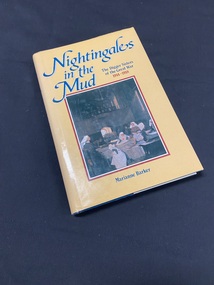
... India -- 9. Serbia and Salonika -- pt. 2. The Western Front -- 10. The Australian base hospitals in France -- 11. ...'Draws on many first-hand and previously unpublished accounts of the work of Australian nurses in the Great War to tell an extraordinary story of courage and companionship under conditions of great hardship - in the mud of Flanders, among the cholera cases in India, on the hospital ships during the Gallipoli campaign, on Afghanistan border, in Vladivostok, in mosquito infested Macedonia, and in the Sinai Desert. - from inside dustjacket. Contents note: pt. 1. The Middle East -- 1. Enlistment -- 2. Egypt -- 3. Hospital ships -- 4. Lemnos -- 5. Malta -- 6. Palestine -- 7. Mesopotamia -- 8. India -- 9. Serbia and Salonika -- pt. 2. The Western Front -- 10. The Australian base hospitals in France -- 11. The casualty clearing stations -- 12. Transport in France -- 13. Home hospitals in England -- 14. Repatriation -- Epilogue -- Appendix: Roll of Nurses. - from Trove record.Blue hardcover book with a yellow dustjacket. The title is printed down the spine in blue text. The front cover shows an image of an oil painting of nurses tending the beds of the wounded, it is surrounded by a dark red border. Above the image the title is printed in blue, with 1914-1918 printed in smaller red print.non-fiction'Draws on many first-hand and previously unpublished accounts of the work of Australian nurses in the Great War to tell an extraordinary story of courage and companionship under conditions of great hardship - in the mud of Flanders, among the cholera cases in India, on the hospital ships during the Gallipoli campaign, on Afghanistan border, in Vladivostok, in mosquito infested Macedonia, and in the Sinai Desert. - from inside dustjacket. Contents note: pt. 1. The Middle East -- 1. Enlistment -- 2. Egypt -- 3. Hospital ships -- 4. Lemnos -- 5. Malta -- 6. Palestine -- 7. Mesopotamia -- 8. India -- 9. Serbia and Salonika -- pt. 2. The Western Front -- 10. The Australian base hospitals in France -- 11. The casualty clearing stations -- 12. Transport in France -- 13. Home hospitals in England -- 14. Repatriation -- Epilogue -- Appendix: Roll of Nurses. - from Trove record.history of nursing, world war one 1914-1918, ww1, wwi, nurses australia, great war nurses -
 Returned Nurses RSL Sub-branch
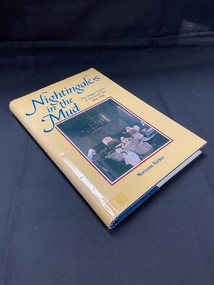
Book - Hardcover book, Marianne Barker, Nightingale in the mud : the Digger Sisters of the Great War 1914-1918, 1989
... India -- 9. Serbia and Salonika -- pt. 2. The Western Front -- 10. The Australian base hospitals in France -- 11. ...'Draws on many first-hand and previously unpublished accounts of the work of Australian nurses in the Great War to tell an extraordinary story of courage and companionship under conditions of great hardship - in the mud of Flanders, among the cholera cases in India, on the hospital ships during the Gallipoli campaign, on Afghanistan border, in Vladivostok, in mosquito infested Macedonia, and in the Sinai Desert. - from inside dustjacket. Contents note: pt. 1. The Middle East -- 1. Enlistment -- 2. Egypt -- 3. Hospital ships -- 4. Lemnos -- 5. Malta -- 6. Palestine -- 7. Mesopotamia -- 8. India -- 9. Serbia and Salonika -- pt. 2. The Western Front -- 10. The Australian base hospitals in France -- 11. The casualty clearing stations -- 12. Transport in France -- 13. Home hospitals in England -- 14. Repatriation -- Epilogue -- Appendix: Roll of Nurses. - from Trove record.Blue hardcover book with a yellow dustjacket. The title is printed down the spine in blue text. The front cover shows an image of an oil painting of nurses tending the beds of the wounded, it is surrounded by a dark red border. Above the image the title is printed in blue, with 1914-1918 printed in smaller red print.non-fiction'Draws on many first-hand and previously unpublished accounts of the work of Australian nurses in the Great War to tell an extraordinary story of courage and companionship under conditions of great hardship - in the mud of Flanders, among the cholera cases in India, on the hospital ships during the Gallipoli campaign, on Afghanistan border, in Vladivostok, in mosquito infested Macedonia, and in the Sinai Desert. - from inside dustjacket. Contents note: pt. 1. The Middle East -- 1. Enlistment -- 2. Egypt -- 3. Hospital ships -- 4. Lemnos -- 5. Malta -- 6. Palestine -- 7. Mesopotamia -- 8. India -- 9. Serbia and Salonika -- pt. 2. The Western Front -- 10. The Australian base hospitals in France -- 11. The casualty clearing stations -- 12. Transport in France -- 13. Home hospitals in England -- 14. Repatriation -- Epilogue -- Appendix: Roll of Nurses. - from Trove record.history of nursing, world war one 1914-1918, ww1, wwi, nurses australia, great war nurses
