
Showing 171 items matching "scales and balances"
-
 Flagstaff Hill Maritime Museum and Village
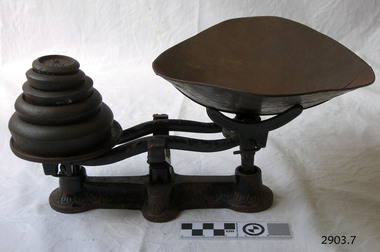
Instrument - Scale, Early 20th century
... The ease of use of spring scales over balance scales. One of the most common types of spring scales was the kitchen scale also known as a family or dial scale. ...Black cast iron, medium weighing scales, with a fulcrum which the beam that balances on, there is as scoop at one end for the material to be weighted and a flat circular disc at the other end that holds the weights. ...This scale does not have any visual markings on the arms to identify a maker or true balance. ...The ease of use of spring scales over balance scales. One of the most common types of spring scales was the kitchen scale also known as a family or dial scale. ...The basic balance scale has been around for thousands of years and its accuracy has improved dramatically over the last several centuries, the principle behind this tool remains unchanged. Its parts include a fulcrum, a beam that balances on it, a pan at the end of the beam to hold the materials to be weighed, and a flat platform at the other for the counter-balancing weights. Balance scales that require equal weights on each side of the fulcrum have been used by everyone from apothecaries and assayers to jewellers and postal workers. Known as an unequal arm balance scale, this variety builds the counterweight into the device. Counter scales used in dry-goods stores and domestic kitchens often featured Japanned or (blackened) cast iron with bronze trims. Made by companies such as Howe and Fairbanks, the footed tin pans of these scales were often oblong, some encircled at one end so bulk items could be easily poured into a bag. Seamless pans were typically stamped from brass and given style names like Snuff (the smallest) and Birmingham (the largest). Some counter scales were designed for measuring spices, others for weighing slices of cake. In the 18th century, spring scales began to appear and would use the resistance of spring to calculate weights, which are read automatically on the scale’s face. The ease of use of spring scales over balance scales. One of the most common types of spring scales was the kitchen scale also known as a family or dial scale. Designed for horizontal surfaces, these vintage kitchen scales used the weight of goods in a pan at the top of the scale to force the spring down rather than the balance system. Such scales were common in early 20th century households and were sold by many companies. Many had flat weighing surfaces but some were topped by shallow pans. Companies such as Salters, Chatillon, and Fairbanks were the most popular brands used. These scales are significant as they identify one of the basic preparation items for the weighing of foodstuff in the family kitchen to prepare everyday meals. This item is significant as it gives a snapshot into domestic life within the average home in Australia around the turn of the twentieth century and is, therefore, an item with social relevance. Black cast iron, medium weighing scales, with a fulcrum which the beam that balances on, there is as scoop at one end for the material to be weighted and a flat circular disc at the other end that holds the weights. Around the cast iron base is an embossed leaf pattern. All the weights have their weight embossed within the casting.There are 5 weights, marked 2 oz, 4 oz,8 oz,1 lb,2 lb, This scale does not have any visual markings on the arms to identify a maker or true balance. It is therefore assumed that these scales were made for domestic use only.flagstaff hill, warrnambool, shipwrecked-coast, flagstaff-hill, flagstaff-hill-maritime-museum, maritime-museum, shipwreck-coast, flagstaff-hill-maritime-village, spring scale, scale -
 Warrnambool and District Historical Society Inc.
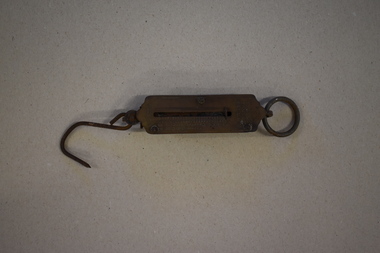
Scales hanging, Hughes, 1930s
... This is a set of spring balance scales. The spring is fixed at one end with a hook attached to hold an object to be weighed. ...‘Hughes Pocket Balance’ ‘Patent’ Scale Markings:- ‘0 to 25’ ...In households it could also be useful for weighing jam fruit, vegetables etc. Spring balances are still in use today. This item is retained as an example of a spring balance manufactured 80 or more years ago. pocket spring balances household items of the past. history of warrnambool ‘Hughes Pocket Balance’ ‘Patent’ Scale Markings:- ‘0 to 25’ This is a set of spring balance scales. ...This is a pocket spring balance. It would have been used last century in our district by market gardeners, hawkers and other itinerant workers and possibly also used in some small businesses. In households it could also be useful for weighing jam fruit, vegetables etc. Spring balances are still in use today.This item is retained as an example of a spring balance manufactured 80 or more years ago.This is a set of spring balance scales. The spring is fixed at one end with a hook attached to hold an object to be weighed. The top end has a ring to hang the scales up. The spring mechanism is enclosed by a steel cover. The front scale face is made of brass and both this face and the rear spring casing are fastened by three rivets. On the front is a spring-loaded blade which has equally spaced scale markings next to it on one side. This item is much rusted. ‘Hughes Pocket Balance’ ‘Patent’ Scale Markings:- ‘0 to 25’ pocket spring balances, household items of the past., history of warrnambool -
 Greensborough Historical Society
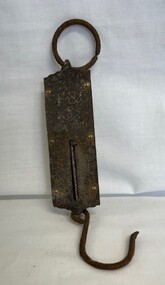
Domestic object - Scales, L.F. & C, Pocket Balance Scales, 1900 c
... Small, very old pocket balance scales 0 L.F. & C. Made in New York. ...Small very old pocket balance scales, front plate is brass. The wording on the scales is Not Legal For Use In Trade,. ...Pocket Balance Scales Domestic object Scales L.F. & C. ...Small, very old pocket balance scales 0 L.F. & C. Made in New York. Possible belonged to and used by the Bishop family 1900s to 1930s. The front plate is brass. The wording on the scales is "Not Legal For Use In Trade". The scales measure up to 25lb.Small very old pocket balance scales, front plate is brass. The wording on the scales is Not Legal For Use In Trade,. Scales measure up to 25lb.scales, kitchenware -
 Greensborough Historical Society
Scales, Kitchen scales, 1900c
... ...scales...Domestic kitchen balance scales used to measure ingredients, made of cast iron, they would have a tray for ingredients and graduated weights....Domestic kitchen balance scales used to measure ingredients, made of cast iron, they would have a tray for ingredients and graduated weights. kitchen scales scales balances Kitchen scales, to weigh 4 lbs, with weights of 1 lb and 4 oz. ...Domestic kitchen balance scales used to measure ingredients, made of cast iron, they would have a tray for ingredients and graduated weights.Kitchen scales, to weigh 4 lbs, with weights of 1 lb and 4 oz.kitchen scales, scales, balances -
 City of Moorabbin Historical Society (Operating the Box Cottage Museum)
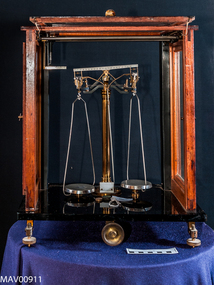
Scales, Gold, Apothecary, Analytical in Glass Case c1880, c1880
... The pan, or each of the pans, of a balance." Its parts include a fulcrum, a beam that balances on it, two pans at the ends of the beam to hold the materials to be weighed, and counter-balancing weights. ...A 2 pan analytical, scientific or pharmaceutical beam balance scale made in Gottingen Germany c 1880. ...Gottingen made fine precision scientific scales for use by assayers, jewellers, chemists, gold buyers rtc. scales balance precision measures gold pharmacy precious metals jewellery gottingen germany sartorious f moorabin bentleigh cheltenham early settlers gold miners pioneers market gardeners ballarat bendigo imperial measure troy weight D.R.PATENT / GOTTINGER PRAZISIONSWAGENFABRIK G.m.b.H. / GOTTINGEN On upright V over GPW A 2 pan analytical, scientific or pharmaceutical beam balance scale made in Gottingen Germany c 1880. ...A pair of scales or dishes in which objects to be weighed and the weights / masses against which to weigh them are placed is an "Apparatus for weighing. The pan, or each of the pans, of a balance." Its parts include a fulcrum, a beam that balances on it, two pans at the ends of the beam to hold the materials to be weighed, and counter-balancing weights. Gottingen made fine precision scientific scales for use by assayers, jewellers, chemists, gold buyers rtc. A 2 pan analytical, scientific or pharmaceutical beam balance scale made in Gottingen Germany c 1880. These scales are encased in a mahogany framed glass cabinet and Graded 0 -9 9-0D.R.PATENT / GOTTINGER PRAZISIONSWAGENFABRIK G.m.b.H. / GOTTINGEN On upright V over GPW scales, balance, precision measures, gold, pharmacy, precious metals, jewellery, gottingen germany, sartorious f, moorabin, bentleigh, cheltenham, early settlers, gold miners, pioneers, market gardeners, ballarat, bendigo, imperial measure, troy weight -
 Kew Historical Society Inc
Functional object - Brass Sovereign Rocker Coin Scale, 1898-1914
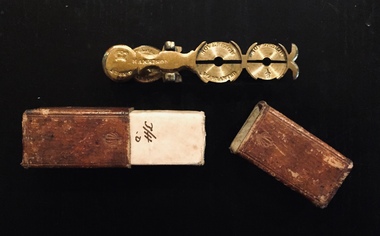
... Balance scales for full and half sovereigns also measured the circumference and the thickness. ...Harrison Brass Sovereign Rocker Coin Scale in original leather container. The balance scale for full and half sovereigns also measured the circumference and the thickness. ...Balance scales for full and half sovereigns also measured the circumference and the thickness. ...The scales were made by Harrison (Birmingham), founded 1898, which went on to become Harrison Drape. Balance scales for full and half sovereigns also measured the circumference and the thickness. As gold is one of the heaviest metals one way to forge a sovereign in brass would be to make it slightly larger to make up the weight. This clever invention put a stop to that.An item from an outstanding and diverse collection of photographs, postcards and artefacts, assembled by members of the Christian and Washfold families of Kew. Harrison Brass Sovereign Rocker Coin Scale in original leather container. The balance scale for full and half sovereigns also measured the circumference and the thickness. It was made from the 1850s to the early 1900s. Scales in perfect condition.cairn scales, sovereign rocker scale, christian-washfold collection -
 City of Moorabbin Historical Society (Operating the Box Cottage Museum)
Scales, Imperial weights & brass bowls, c1900
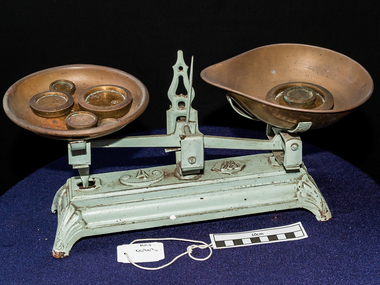
... The pan, or each of the pans, of a balance." These common kitchen / dairy scales would be used by the householder to weigh flour, sugar, cereal, vegetables, fruit, meats, butter, cheese etc. prior to cooking or storing . ...A set of steel weighing scales with a balance beam that holds 2 brass dishes in which are 7 brass weights. ...A set of steel weighing scales with a balance beam that holds 2 brass dishes in which are 7 brass weights. ...A pair of scales or dishes in which objects to be weighed and the weights / masses against which to weigh them are placed is an "Apparatus for weighing. The pan, or each of the pans, of a balance." These common kitchen / dairy scales would be used by the householder to weigh flour, sugar, cereal, vegetables, fruit, meats, butter, cheese etc. prior to cooking or storing . Its parts include a fulcrum, a beam that balances on it, two pans at the ends of the beam to hold the materials to be weighed, and counter-balancing weights.Its parts include a fulcrum, a beam that balances on it, two pans at the ends of the beam to hold the materials to be weighed, and counter-balancing weights.. A set of steel weighing scales with a balance beam that holds 2 brass dishes in which are 7 brass weights. The object/ substance to be weighed is placed in 1 dish and the weights are added to the other dish until the two dishes balance equally on the beam. The base is engraved with '4 lbs' thus indicating that this set will balance up to that weight.scales 4 lbs ( 4 Pounds ) each weight is marked with its weight in Imperial Measure 1 0z = 1 ounce to 4lbmarket gardeners, early settlers, fruit vegetables, farmers, cooking, recipes, scales, weights, measures, brass, balance beam, moorabbin, cheltenham, bentleigh, kitchen scales, dairy products, cereals, wheat flour -
 Flagstaff Hill Maritime Museum and Village
Instrument - Scale, 1900-1930
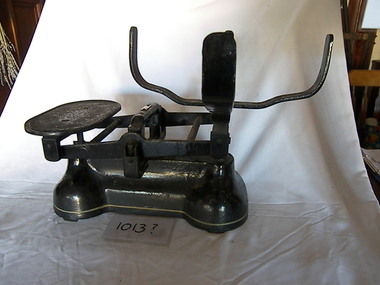
... The ease of use of spring scales over balance scales. ...Black cast iron, medium weighing scales, with a fulcrum which the beam that balances on, there is a scoop or large bowl at one end for the material to be weighted and a flat platform at the other end that holds the weights. ...Known as an unequal arm balance scale, this variety builds the counterweight into the device. ...The basic balance scale has been around for thousands of years and its accuracy has improved dramatically over the last several centuries, the principle behind this tool remains unchanged. Its parts include a fulcrum, a beam that balances on it, a pan at the end of the beam to hold the materials to be weighed, and a flat platform at the other for the counter-balancing weights. Balance scales that require equal weights on each side of the fulcrum have been used by everyone from apothecaries and assayers to jewellers and postal workers. Known as an unequal arm balance scale, this variety builds the counterweight into the device. Counter scales used in dry-goods stores and domestic kitchens often featured Japanned or (blackened) cast iron with bronze trims. Made by companies such as Howe and Fairbanks, the footed tin pans of these scales were often oblong, some encircled at one end so bulk items could be easily poured into a bag. Seamless pans were typically stamped from brass and given style names like Snuff (the smallest) and Birmingham (the largest). Some counter scales were designed for measuring spices, others for weighing slices of cake. In the 18th century, spring scales began to appear and would use the resistance of spring to calculate weights, which are read automatically on the scale’s face. The ease of use of spring scales over balance scales. These scales are significant as they identify one of the basic preparation items for the weighing of foodstuff in the family kitchen to prepare everyday meals. This item is significant as it gives a snapshot into domestic life within the average home in Australia around the turn of the twentieth century and is, therefore, an item with social relevance. Black cast iron, medium weighing scales, with a fulcrum which the beam that balances on, there is a scoop or large bowl at one end for the material to be weighted and a flat platform at the other end that holds the weights. Around the cast iron base is an embossed strip weight and bowl missing.flagstaff hill, warrnambool, shipwrecked-coast, flagstaff-hill, flagstaff-hill-maritime-museum, maritime-museum, shipwreck-coast, flagstaff-hill-maritime-village -
 Flagstaff Hill Maritime Museum and Village
Equipment - Spring Balance Scale, George Salter & Co, 1930s
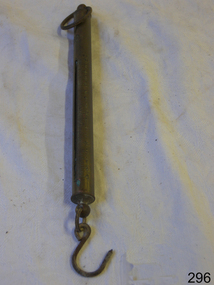
... The firm began life in the late 1760s in the village of Bilston, England when Richard Salter, a spring maker, began making the first spring scales in Britain. He called these scales "pocket steelyards", though they work on a different principle from steelyard balances. ..."Scale Salter's Spring Balance brass cylinder with ring at one end and a hook at the other...Weighs 0 to 4LBS showing ¼lb increments. "Scale Salter's Spring Balance brass cylinder with ring at one end and a hook at the other Equipment Spring Balance Scale England West Midlands West Bromwich George Salter & Co. ...Scales such as the subject item were used in a domestic situation. Salter has been a name long associated with weights and measures especially in the home kitchen. The firm began life in the late 1760s in the village of Bilston, England when Richard Salter, a spring maker, began making the first spring scales in Britain. He called these scales "pocket steelyards", though they work on a different principle from steelyard balances. By 1825 his nephew George had taken over the company, which became known as George Salter & Co. George later established a manufacturing site in the town of West Bromwich, about 4 miles (7 km) from Bilston. West Bromwich Albion football club was formed from workers at this works site. From here the company produced a wide variety of scales including the UK's first bathroom scales. Other items were added to the range, including irons, mincers, potato chippers, coin-operated machines and the first typewriters made in the UK. The business thrived throughout the 1900s, and by 1950 it employed over 2000 people, still in the same area and owned by the same family.Salter is a British housewares brand developing products that span a wide range of core product categories, including scales, electrical, cookware. It is a market leader in kitchen and bathroom scales and one of the UK’s oldest consumer brands. Established in 1760, Salter has been developing precision products for over 260 years. It was acquired by Manchester-based consumer goods giant Ultimate Products in 2021 after they had previously licensed the brand for cookware and kitchen electrical since 2011."Scale Salter's Spring Balance brass cylinder with ring at one end and a hook at the otherSalter trademark stamped on front. Made in England stamped on back. Weighs 0 to 4LBS showing ¼lb increments.flagstaff hill, warrnambool, flagstaff-hill-maritime-museum, maritime-museum, shipwreck-coast, flagstaff-hill-maritime-village, salter balance scale, weight measuring scale, weighing dry goods, domestic object, kitchen scale -
 Mont De Lancey
Tool - Spring Balance Scales, Salters
... ...Scales...A vintage No 2 Class II Salters Improved Spring Balance weigh scale with a weight guage of 0 - 40 lbs. ...Used in the late 19th and early 20th century. Spring balances Scales Balances Weighing instruments 'No 2 Class II Salters Improved Spring Balance weight guage 0 - 40 lbs. ...Used in the late 19th and early 20th century.A vintage No 2 Class II Salters Improved Spring Balance weigh scale with a weight guage of 0 - 40 lbs. It is made of metal with four rivets holding the front measurement panel covering the spring with a ring at the top and a hook at the bottom to hold the item being weighed. It was manufactured in England by Salters and used in the late 19th and early 20th century.'No 2 Class II Salters Improved Spring Balance weight guage 0 - 40 lbs. Manufactured in England by Salters'''spring balances, scales, balances, weighing instruments -
 Flagstaff Hill Maritime Museum and Village
Instrument - Scale, George Salter & Co, Circa 1921
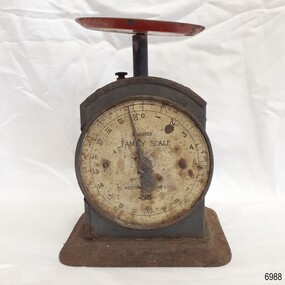
... The Hughes’ Family Scale No. 48 is a spring balance scale. It uses the Imperial measurements of ounces and pounds. ...Scale; a domestic spring balance scale for measuring weight from 0 to 20 pounds. ...The Hughes’ Family Scale No. 48 is a spring balance scale. It uses the Imperial measurements of ounces and pounds. ...The Hughes’ Family Scale No. 48 is a spring balance scale. It uses the Imperial measurements of ounces and pounds. There are 16 ounces (OZ) in one pound (LB), and each pound equals approximately 454 grams in Metric measurements. Scales have been used to measure and compare items for value for centuries. A weight was placed on one side of a balance and the object was placed on the other. Adjustments were made to either the weight or the object until the balance was horizontal, which meant that each side was the same weight. The Salter family business began in 1760 with spring makers, Richard and William Salter. In the late 18th century, Richard Salter invented the spring scale, where the weight of an object on the tray of the scale causes pressure on a spring in the scale. The pressure caused by gravity was then measured to calculate the weight of an object. Spring scales are still used today along with the more recent and accurate digital scales. The company began manufacturing in West Bromwich, England, in 1770. The firm was taken over by William’s sons, John and George. In 1824, after the death of John, the firm became George Salter & Co. The company produced a wide variety of products, including Britain’s first bathroom scale and the first English typewriter. In 1884 the Salter Trademark of a Staffordshire knot pierced by an arrow was registered. After over 100 years of manufacturing, the company was bought out by Staveley Industries, which was bought by Weigh-Tronix, and then that company was bought by HoMedics Company in 2004.This scale was made by Salter, the company that invented the balance scale, the first British bathroom scale and the first English typewriter. The scale represents the domestic equipment used for measuring in food preparation over 100 years ago. Modern kitchen scales are still using the same principal, along with scales used in business and industry.Scale; a domestic spring balance scale for measuring weight from 0 to 20 pounds. The scale’s grey metal case has a round white dial on the front with black markings, an arrow indicator and a round shallow metal bowl on a pedestal at the top. The scale is raised on a rectangular metal base with outward-sloping sides. An adjustable screw is on the dome top. The scale is marked from 0 to 20 pounds, with each pound marked in 1-ounce increments. The scale is named the Hughes Family Scale No. 48 and was made in Britain by Salter.“HUGHES’ / FAMILY SCALE / No. 48” “BRITISH MADE” “TO WEIGH 20 LBS BY 1 OZ” “SALTER” above logo [knotted rope with an arrow through loops]flagstaff hill, warrnambool, maritime museum, maritime village, great ocean road, shipwreck coast, hughes, salter, british made, family scale, no. 48, spring balance, scale, weighing instrument, weights and measures, weighing machine, kitchen utensil, baking accessory, domestic equipment, cookware, bakeware, kitchen scale, kitchen accessory, food preparation, recipes, cooking, measuring -
 Flagstaff Hill Maritime Museum and Village
Equipment - Spring Balance Scale, George Salter & Co, 1920s
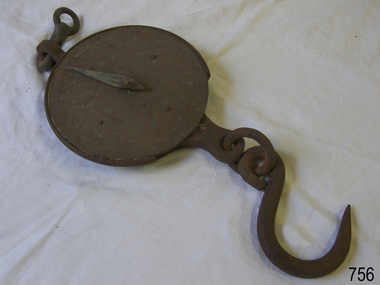
... The firm began life in the late 1760s in the village of Bilston, England when Richard Salter, a spring maker, began making the first spring scales in Britain. He called these scales "pocket steelyards", though they work on a different principle from steelyard balances. ...Balance scale Salters Spring Balance consisting of a circular, bronze face engraved with measurements in pounds, with an iron hand, weighing mechanism and hanging loop. ...Equipment Spring Balance Scale England West Midlands West Bromwich George Salter & Co. ...Scales such as the subject item were used to measure commercial quantities, possibly grains and farm produce for quite large amounts of product. Bags of grain etc would have been hooked up and weighed. Salter has been a name long associated with weights and measures. The firm began life in the late 1760s in the village of Bilston, England when Richard Salter, a spring maker, began making the first spring scales in Britain. He called these scales "pocket steelyards", though they work on a different principle from steelyard balances. By 1825 his nephew George had taken over the company, which became known as George Salter & Co. George later established a manufacturing site in the town of West Bromwich, about 4 miles (7 km) from Bilston. West Bromwich Albion football club was formed from workers at this works site. From here the company produced a wide variety of scales including the UK's first bathroom scales. Other items were added to the range, including irons, mincers, potato chippers, coin-operated machines and the first typewriters made in the UK. The business thrived throughout the 1900s, and by 1950 it employed over 2000 people, still in the same area and owned by the same family.Salter is a British housewares brand developing products that span a wide range of core product categories, including scales, electrical, cookware. It is a market leader in kitchen and bathroom scales and one of the UK’s oldest consumer brands. Established in 1760, Salter has been developing precision products for over 260 years. It was acquired by Manchester-based consumer goods giant Ultimate Products in 2021 after they had previously licensed the brand for cookware and kitchen electrical since 2011.Balance scale Salters Spring Balance consisting of a circular, bronze face engraved with measurements in pounds, with an iron hand, weighing mechanism and hanging loop. Engraved on the face: "Class III Salter's Spring Balance Silvester's Patent To Weigh 300lbs".flagstaff hill, warrnambool, flagstaff-hill-maritime-museum, maritime-museum, shipwreck-coast, flagstaff-hill-maritime-village, salter balance scale, weight measuring scale, weighing dry goods -
 City of Moorabbin Historical Society (Operating the Box Cottage Museum)
Scales, Imperial weights & large bowl, c1900
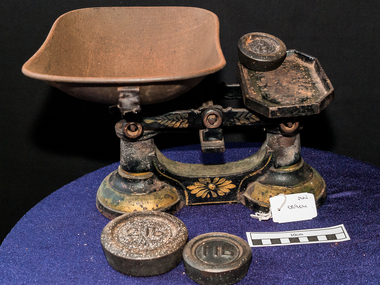
... The pan, or each of the pans, of a balance." These common kitchen / dairy scales would be used by the householder to weigh flour, sugar, cereal, vegetables, fruit, meats, butter, cheese etc. prior to cooking or storing . ...c1900 A set of steel weighing scales with a balance beam that holds 1 large metal dish for the item to be weighed and a smaller tray holding the weights. ...The pan, or each of the pans, of a balance." These common kitchen / dairy scales would be used by the householder to weigh flour, sugar, cereal, vegetables, fruit, meats, butter, cheese etc. prior to cooking or storing . market gardeners early settlers fruit vegetables farmers cooking recipes scales weights measures brass balance beam moorabbin cheltenham bentleigh kitchen scales dairy products cereals wheat flour . ...A pair of scales or dishes in which objects to be weighed and the weights / masses against which to weigh them are placed is an "Apparatus for weighing. The pan, or each of the pans, of a balance." These common kitchen / dairy scales would be used by the householder to weigh flour, sugar, cereal, vegetables, fruit, meats, butter, cheese etc. prior to cooking or storing . c1900 A set of steel weighing scales with a balance beam that holds 1 large metal dish for the item to be weighed and a smaller tray holding the weights. The object/ substance to be weighed is placed in 1 dish and the weights are added to the other dish until the two dishes balance equally on the beam. The base , balance beam and tray are decorated with a floral pattern Its parts include a fulcrum, a beam that balances on it, two pans at the ends of the beam to hold the materials to be weighed, and counter-balancing weights.Each weight is engraved with Imperial Measure = 2lb, 1lb, 6ozmarket gardeners, early settlers, fruit vegetables, farmers, cooking, recipes, scales, weights, measures, brass, balance beam, moorabbin, cheltenham, bentleigh, kitchen scales, dairy products, cereals, wheat flour, . -
 Flagstaff Hill Maritime Museum and Village
Instrument - Letter Scale, 1920s to 1960s
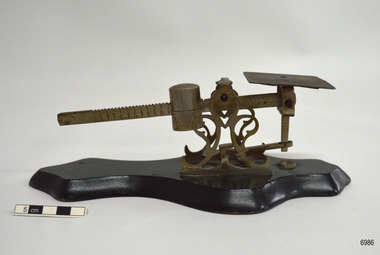
... This is a sliding balance scale. The object to be weighed, such as a letter or a dose of medicine, is placed on the square metal plate and the weight, the slider, is moved along the notched metal arm and adjusted until the arm is horizontal, then reading is recorded of the figure the pointer on the slider is positioned. ...Scale; a small sliding balance letter scale. ...Angus Collection Scale; a small sliding balance letter scale. ...This scale was owned by Dr Angus, whose training and experience included chemistry and pharmacy. This is a sliding balance scale. The object to be weighed, such as a letter or a dose of medicine, is placed on the square metal plate and the weight, the slider, is moved along the notched metal arm and adjusted until the arm is horizontal, then reading is recorded of the figure the pointer on the slider is positioned. This design of small is often referred to as a letter scale. This item was donated to Flagstaff Hill Maritime Village by the family of Doctor William Roy Angus, Surgeon and Oculist. It is part of the “W.R. Angus Collection” that includes historical medical equipment, surgical instruments and material once belonging to Dr Edward Ryan and Dr Thomas Francis Ryan, (both of Nhill, Victoria) as well as Dr Angus’ own belongings. The Collection’s history spans the medical practices of the two Doctors Ryan, from 1885-1926 plus that of Dr Angus, up until 1969.The scale is significant as an example of 20th century measuring and weighing equipment. It is also important for its association with the W.R. Angus Collection, which is significant for still being located at the site it is connected with, Doctor Angus being the last Port Medical Officer in Warrnambool. The collection of medical instruments and other equipment is culturally significant, being a historical example of medicine, administration, household equipment and clothing from the late 19th to the mid-20th centuries. Dr Angus assisted Dr Tom Ryan, a pioneer in the use of X-rays and in ocular surgery. Scale; a small sliding balance letter scale. The scale has a flat metal platform and a toothed metal balance arm with cylindrical brass weight. These are attached to a decorative metal stand that is mounted onto a shaped lacquered black wooden base. The sliding weight causes the arm to pivot on the stand. The arm is marked into equal-length segments from 0 to 8. Each segment is marked into halves. There is no maker’s mark. The scale is part of the W.R. Angus Collection.flagstaff hill, warrnambool, maritime village, maritime museum, shipwreck coast, great ocean road, dr w r angus, letter scale, postal scale, balance scale, single arm scale, chemist scale, pharmacy scale, office equipment, retail equipment, sales equipment, measuring instrument, weighing instrument, technical instrument, medications, w.r. angus collection -
 City of Moorabbin Historical Society (Operating the Box Cottage Museum)
Tool - Brass balance 'Salters', c1900
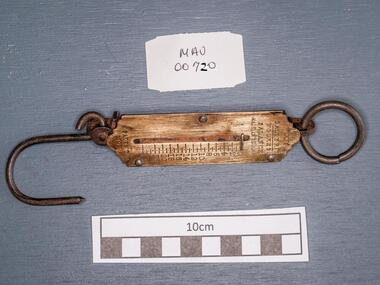
... The ease of use of spring scales over balance scales is what led most post offices to outfit their clerks with spring postal scales. ...A portable, brass balance scale , 'Salters' for weighing items. ...The ease of use of spring scales over balance scales is what led most post offices to outfit their clerks with spring postal scales. ...In the 18th century, spring scales appeared. To produce these scales, a manufacturer would use the resistance of a spring to calculate weights, which could be read automatically on the scale’s face. The ease of use of spring scales over balance scales is what led most post offices to outfit their clerks with spring postal scales. One of the most common types of spring scales was the kitchen scale—also known as a family or dial scale. Designed for horizontal surfaces, these scales used the weight of goods in a pan at the top of the scale to force the spring down. Such scales were common in early-20th-century households and were sold by Sears and Montgomery Ward. Many had flat weighing surfaces but some were topped by shallow pans. Companies such as Salters, Chatillon, and Fairbanks made both. SALTER HOUSEWARES began in the late 1760 in the village of Bilston, England. At this time Richard Salter, a spring maker, began making 'pocket steelyards', a scale similar to the fisherman's scale of today. By 1825 his nephew George had taken over the company, which became known as George Salter & Co. and later established a large, well equipped manufacturing site in the town of West Bromwich. The business thrived throughout the 1900s, and in 1972 the company was purchased by Staveley Industries Plc. In 2002, the management team at Salter Housewares Ltd, backed by Barclays Private Equity, bought the company out from the group, to concentrate on its consumer businesses. In 2004 was sold to the US-based HoMedics company, and in 2006, Salter Housewares USA and Taylor Precision Products Inc (also owned by HoMedics) merged. A portable, brass balance scale , 'Salters' for weighing items. A steel ring holds a brass plate marked with graduations 0 – 26 to which is attached a steel hook. ( rope & arrow TM ) / SALTER / POCKET / BALANCE / MADE IN ENGLAND Graduated 0 – 26 / PATENT / No. 8 Base rope & anchor S (trade mark) pioneers, early settlers, market gardeners, moorabbin, brighton, cheltenham, tools, craftsman, balance, scales, weights, imperial measure,, salter housewares pty ltd, west bromwich, england, salter george, salter richard, bilston england, -
 Flagstaff Hill Maritime Museum and Village
Equipment - Balance Scale, 1850s
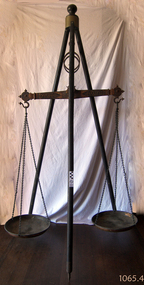
... A Large Rare mid 19th Century Balance Scale (also called a Beam Scale) Made in England by W&T Avery a British manufacturer of weighing machines. ...Beam balance scale suspended from a wooden tripod, with metal trays suspended by three chain lengths. ...Equipment Balance Scale U K Birmingham ...A Large Rare mid 19th Century Balance Scale (also called a Beam Scale) Made in England by W&T Avery a British manufacturer of weighing machines. The company was founded in the early 18th century and took the name W & T Avery in 1818. The undocumented origin of the company goes back to 1730 when James Ford established the business in the town of Digbeth. On Joseph Balden the then company’s owner’s death in 1813 William and Thomas Avery took over his scale making business and in 1818 renamed it W & T Avery. The business rapidly expanded and in 1885 they owned three factories: the Atlas Works in West Bromwich, the Mill Lane Works in Birmingham and the Moat Lane Works in Digbeth. In 1891 the business became a limited company with a board of directors and in 1894 the shares were quoted on the London Stock Exchange. In 1895 the company bought the legendary Soho Foundry in Smethwick, a former steam engine factory owned by James Watt & Co. In 1897 the move was complete and the steam engine business was gradually converted to pure manufacture of weighing machines. The turn of the century was marked by managing director William Hipkins who was determined to broadening the renown of the Avery brand and transforming the business into a specialist manufacture of weighing machines. By 1914 the company occupied an area of 32,000m² and had some 3000 employees. In the inter-war period the growth continued with the addition of specialized shops for cast parts, enamel paints and weighbridge assembly and the product range diversified into counting machines, testing machines, automatic packing machines and petrol pumps. During the second world war the company also produced various types of heavy guns. At that time the site underwent severe damage from parachute mines and incendiary bombs.Then from 1931 to 1973 the company occupied the 18th-century Middlesex Sessions House in Clerkenwell as its headquarters. Changes in weighing machine technology after World War II led to the closure of the foundry, the introduction of electronic weighing with the simultaneous gradual disappearance of purely mechanical devices. The continued expansion was partly achieved through a series of acquisitions of other companies. After almost a century of national and international expansion the company was taken over by GEC in 1979. Keith Hodgkinson, managing director at the time, completed the turn-around from mechanical to electronic weighing with a complete overhaul of the product range of retail scales and industrial platform scales. In 1993 GEC took over the Dutch-based company Berkel and the Avery-Berkel name was introduced. In 2000 the business was in turn acquired by the US-American company Weigh-Tronix, who already owned Salter, and is today operating as Avery Weigh-Tronix. Item made and used possibly around the 1850s by Victorian colonial government to check weights of goods being sold by early shop keepers on the gold fields item is very rare.James McEwan & Co were the retailers of W & T Avery scales in Victoria from 1852. A very rare item used probably to check weights used by merchants during colonial times by government inspectors in Victoria. A similar example exist in a NSW museum, the item is believed to have been made before W & T Avery expansion to the Soho foundry in Birmingham in 1885 and after 1818.Beam balance scale suspended from a wooden tripod, with metal trays suspended by three chain lengths. embossed on the balance beam W T Avery, Birmingham,flagstaff hill, warrnambool, shipwrecked coast, flagstaff hill maritime museum, maritime museum, shipwreck coast, flagstaff hill maritime village, great ocean road, scale, avery -
 Mission to Seafarers Victoria
Functional object - Balance Scale
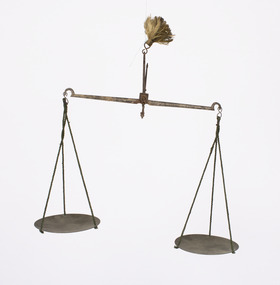
... Small balance scale ...volum collection Small balance scale Functional object Balance Scale ...Small balance scale volum collection -
 University of Melbourne, School of Chemistry
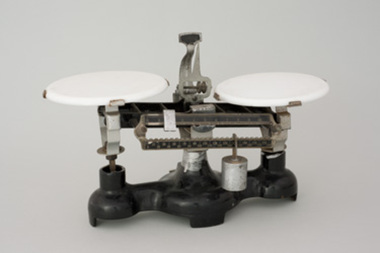
Rough Balance
... Rough Balance (Scales)...Rough Balance (Scales) Rough Balance ...Rough Balance (Scales) -
 Wodonga & District Historical Society Inc
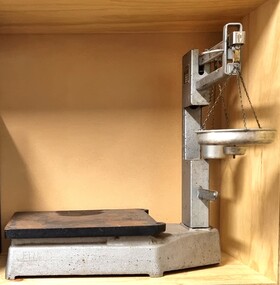
Functional object - Scales - J. Mann & Sons, Mercury Scale Co. Pty. Ltd, c1980
... IN 2023 A&D Weighing is an Australian leader in the supply of electronic weighing scales, balances, metal detectors, checkweighers and weighing systems. ... A set of cast iron scales. The measurement on the balance arm is in kilograms. ...Q. 760253 CAP 101 kg MODEL No. 211 C A set of cast iron scales. The measurement on the balance arm is in kilograms. ...J. Mann and Sons was first established as a farm produce store in 1921. The range of products was extended in the 1930s and included groceries and hardware, as well as the first petrol bowser in Wodonga outside the store. After WWII, the premises were extended and the range of products continued to increase. In the 1960s the Mann Family opened a new supermarket in Wodonga, in addition to the hardware business, providing steel, plumbing and industrial supplies, and they employed over 100 people at one stage. With changes in the retail industry, the Mann Family sold the main hardware business to Bunnings and the steel and rural produce business to the Kelly brothers in 2006. Mercury Scales was founded in Thebarton, South Australia in 1946. The business experienced rapid growth, leading to its joining with A&D’s global organisation and evolving into A&D Mercury. IN 2023 A&D Weighing is an Australian leader in the supply of electronic weighing scales, balances, metal detectors, checkweighers and weighing systems. This model was approved on 13 February 1980. On 25 March 1988 approval to change the business name to A & D Mercury Pty Ltd was granted by the Australian National Standards Commission. A set of cast iron scales. The measurement on the balance arm is in kilograms. There are 2 trays suspended by chains. bas is fitted with a level indicator and four adjustable feet.On Manufacturer's plate: MERCURY SCALE CO. PTY. LTD. SCALE MANUFACTURERS THEBARTON, S. AUST. INSTRUMENT APPROVAL NUMBERS N.S.C 6/9A/109 M/C No. Q. 760253 CAP 101 kg MODEL No. 211 Cj. mann & sons, mercury scales, wodonga businesses -
 Stawell Historical Society Inc
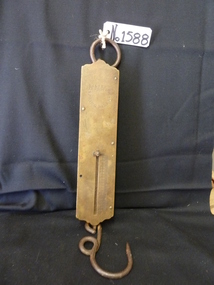
Memorabilia - Realia, 1890-1920
... Salters Improved Spring Balance Scales...Stawell Salters Improved Spring Balance Scales Memorabilia Realia ...Salters Improved Spring Balance Scalesstawell -
 Flagstaff Hill Maritime Museum and Village
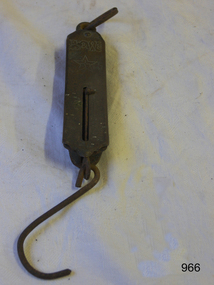
Equipment - Balance Spring Scale, Peck, Stow & Wilcox, 1890-1910
... Spring Balance Scale Weighs 0 to 25LBS....Flagstaff Hill Warrnambool Flagstaff-Hill-Maritime-Museum Maritime-Museum Shipwreck-coast Flagstaff-Hill-Maritime-Village Spring Balance Scales Peck Stow & Wilcox Pocket Balance Scale Weighing Scales Stamped PS&W. ...Peck, Stow & Wilcox was founded in 1870 by the merger of three different industrial tool manufacturers specializing in tin-processing equipment. Their factory complex was at 217 Centre Street in Southington, Connecticut. The company grew rapidly, and was by 1890 producing a diversified array of tools. It was also the town's largest employer. The plant was substantially enlarged in 1912, which is the period when most of the buildings surviving in 1989 were built. By that time, the complex was operated by Ideal Forging. That company went bankrupt in 2003, and the plant was acquired by real estate developers not long afterwards. Demolition of the premises took place in 2015, after hazardous materials were removed from the site.A large American company that exported it’s goods all over the world and was a major producer of balance scales. The company no longer in existence and its products are now regarded as collectors items. The subject item in the Flagstaff Hill collection is significant as the pocket spring balance scale is one of the earliest produced.Spring Balance Scale Weighs 0 to 25LBS.Stamped PS&W. Has a five pointed star stamped on front.flagstaff hill, warrnambool, flagstaff-hill-maritime-museum, maritime-museum, shipwreck-coast, flagstaff-hill-maritime-village, spring balance scales, peck stow & wilcox, pocket balance scale, weighing scales -
 City of Moorabbin Historical Society (Operating the Box Cottage Museum)
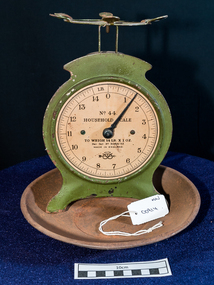
Scales,Spring Balnce Imperial ‘Household’ Salter, 20thC
... The ease of use of spring scales over balance scales is what led most post offices to outfit their clerks with spring postal scales. ...Salter Brand No. 44 Household Spring Balance Kitchen Scales made of green painted metal with a large clock face dial marked in 1oz graduations and with a shallow metal bowl placed on the flat top connected to the mechanism. ...The ease of use of spring scales over balance scales is what led most post offices to outfit their clerks with spring postal scales. ...In the 18th century, spring scales appeared. To produce these scales, a manufacturer would use the resistance of a spring to calculate weights, which could be read automatically on the scale’s face. The ease of use of spring scales over balance scales is what led most post offices to outfit their clerks with spring postal scales. One of the most common types of spring scales was the kitchen scale—also known as a family or dial scale. Designed for horizontal surfaces, these scales used the weight of goods in a pan at the top of the scale to force the spring down. Such scales were common in early-20th-century households and were sold by Sears and Montgomery Ward. Many had flat weighing surfaces but some were topped by shallow pans. Companies such as Salters, Chatillon, and Fairbanks made both. SALTER HOUSEWARES began in the late 1760 in the village of Bilston, England. At this time Richard Salter, a spring maker, began making 'pocket steelyards', a scale similar to the fisherman's scale of today. By 1825 his nephew George had taken over the company, which became known as George Salter & Co. and later established a large, well equipped manufacturing site in the town of West Bromwich. The business thrived throughout the 1900s, and in 1972 the company was purchased by Staveley Industries Plc. In 2002, the management team at Salter Housewares Ltd, backed by Barclays Private Equity, bought the company out from the group, to concentrate on its consumer businesses. In 2004 was sold to the US-based HoMedics company, and in 2006, Salter Housewares USA and Taylor Precision Products Inc (also owned by HoMedics) merged. Salter Brand No. 44 Household Spring Balance Kitchen Scales made of green painted metal with a large clock face dial marked in 1oz graduations and with a shallow metal bowl placed on the flat top connected to the mechanism. An adjustable screw tightened or loosened the spring to bring the pointer to zero, prior to adding the material to be weighed.. A common piece of kitchen equipment as most families used this type of scale when measuring goods for cooking or storing.On Clock face ; NO. 44 / HOUSEHOLD SCALE / TO WEIGH 14LB X 1OZ / Pro. Pat. No. 30819 / 32 / MADE IN ENGLAND / SALTER / S in trademark rope with arrow market gardeners, early settlers, fruit, vegetables, farmers, cooking, recipes, scales, weights, measures, brass, balance beam, moorabbin, cheltenham, bentleigh, kitchen scales, dairy products, cereals, wheat flour, salter housewares pty ltd, west bromwich england -
 Flagstaff Hill Maritime Museum and Village
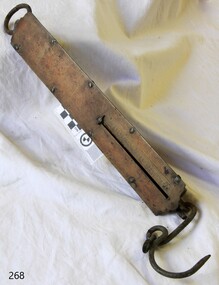
Equipment - Spring Balance Scale, George Salter & Co, 1920s
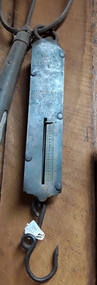
... The firm began life in the late 1760s in the village of Bilston, England when Richard Salter, a spring maker, began making the first spring scales in Britain. He called these scales "pocket steelyards", though they work on a different principle from steelyard balances. ...Scale, Salter's improved spring balance, warranted. ...Weighs 0 to 60LBS. Scale, Salter's improved spring balance, warranted. ...Scales such as the subject item were used to measure commercial quantities, possibly grains and farm produce for quite large amounts of product. Bags of grain etc would have been hooked up and weighed. Salter has been a name long associated with weights and measures. The firm began life in the late 1760s in the village of Bilston, England when Richard Salter, a spring maker, began making the first spring scales in Britain. He called these scales "pocket steelyards", though they work on a different principle from steelyard balances. By 1825 his nephew George had taken over the company, which became known as George Salter & Co. George later established a manufacturing site in the town of West Bromwich, about 4 miles (7 km) from Bilston. West Bromwich Albion football club was formed from workers at this works site. From here the company produced a wide variety of scales including the UK's first bathroom scales. Other items were added to the range, including irons, mincers, potato chippers, coin-operated machines and the first typewriters made in the UK. The business thrived throughout the 1900s, and by 1950 it employed over 2000 people, still in the same area and owned by the same family.Salter is a British housewares brand developing products that span a wide range of core product categories, including scales, electrical, cookware. It is a market leader in kitchen and bathroom scales and one of the UK’s oldest consumer brands. Established in 1760, Salter has been developing precision products for over 260 years. It was acquired by Manchester-based consumer goods giant Ultimate Products in 2021 after they had previously licensed the brand for cookware and kitchen electrical since 2011.Scale, Salter's improved spring balance, warranted. Brass and iron. Weighs 0 to 60LBS. Long rectangular brass instrument with ring attached to top and hook attached below. Centre of rectangle has long vertical slot with short, horizontal bar that slides down the slot when an object is suspended from the hook, showing its weight on the numbered scale beside the slot.Marked ""SALTER'S IMPROVED SPRING BALANCE"" and "WARRANTED". Weighs 0 to 60LBS. flagstaff hill, warrnambool, flagstaff-hill-maritime-museum, maritime-museum, shipwreck-coast, flagstaff-hill-maritime-village, salter balance scale, weight measuring scale, weighing dry goods, domestic object, kitchen scale -
 City of Moorabbin Historical Society (Operating the Box Cottage Museum)
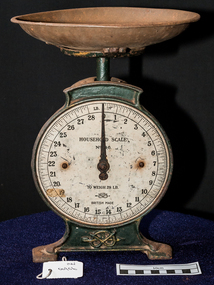
Scales, Imperial, Spring, 'Salter Household Scale’ 28lb, c1920
... The ease of use of spring scales over balance scales is what led most post offices to outfit their clerks with spring postal scales. ...Salter Brand No. 46 Household Spring Balance Kitchen Scales made of green painted metal with a white large clock face dial marked in 1oz graduations and with a shallow metal bowl placed on the flat top connected to the mechanism. ...The ease of use of spring scales over balance scales is what led most post offices to outfit their clerks with spring postal scales. ...In the 18th century, spring scales appeared. To produce these scales, a manufacturer would use the resistance of a spring to calculate weights, which could be read automatically on the scale’s face. The ease of use of spring scales over balance scales is what led most post offices to outfit their clerks with spring postal scales. One of the most common types of spring scales was the kitchen scale—also known as a family or dial scale. Designed for horizontal surfaces, these scales used the weight of goods in a pan at the top of the scale to force the spring down. Such scales were common in early-20th-century households and were sold by Sears and Montgomery Ward. Many had flat weighing surfaces but some were topped by shallow pans. Companies such as Salters, Chatillon, and Fairbanks made both. SALTER HOUSEWARES began in the late 1760 in the village of Bilston, England. At this time Richard Salter, a spring maker, began making 'pocket steelyards', a scale similar to the fisherman's scale of today. By 1825 his nephew George had taken over the company, which became known as George Salter & Co. and later established a large, well equipped manufacturing site in the town of West Bromwich. The business thrived throughout the 1900s, and in 1972 the company was purchased by Staveley Industries Plc. In 2002, the management team at Salter Housewares Ltd, backed by Barclays Private Equity, bought the company out from the group, to concentrate on its consumer businesses. In 2004 was sold to the US-based HoMedics company, and in 2006, Salter Housewares USA and Taylor Precision Products Inc (also owned by HoMedics) merged.Salter Brand No. 46 Household Spring Balance Kitchen Scales made of green painted metal with a white large clock face dial marked in 1oz graduations and with a shallow metal bowl placed on the flat top connected to the mechanism. An adjustable screw tightened or loosened the spring to bring the pointer to zero, prior to adding the material to be weighed.. A common piece of kitchen equipment as most families used this type of scale when measuring goods for cooking or storing. HOUSEHOLD SCALE / NO. 46 / SALTER / TO WEIGH 28 LB / ( rope & arrow TM) BRITISH MADE Base rope & anchor S (trade mark) weights, measures, shops, scales. balances, grocery stores, early settlers, moorabbin, bentleigh, cheltenham, salter housewares pty ltd, west bromwich, england, salter george, salter richard, bilston england -
 Flagstaff Hill Maritime Museum and Village
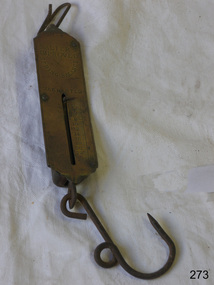
Equipment - Spring Balance Scale, George Salter & Co, 1920s
... The firm began life in the late 1760s in the village of Bilston, England when Richard Salter, a spring maker, began making the first spring scales in Britain. He called these scales "pocket steelyards", though they work on a different principle from steelyard balances. ...Scale, Salter's improved spring balance, warranted. ...Weighs 0 to 25LBS. Scale, Salter's improved spring balance, warranted. ...Scales such as the subject item were used to measure commercial quantities, possibly grains and farm produce for quite large amounts of product, also in a domestic situation. Bags of grain or other dry goods would have been hooked up and weighed. Salter has been a name long associated with weights and measures. The firm began life in the late 1760s in the village of Bilston, England when Richard Salter, a spring maker, began making the first spring scales in Britain. He called these scales "pocket steelyards", though they work on a different principle from steelyard balances. By 1825 his nephew George had taken over the company, which became known as George Salter & Co. George later established a manufacturing site in the town of West Bromwich, about 4 miles (7 km) from Bilston. West Bromwich Albion football club was formed from workers at this works site. From here the company produced a wide variety of scales including the UK's first bathroom scales. Other items were added to the range, including irons, mincers, potato chippers, coin-operated machines and the first typewriters made in the UK. The business thrived throughout the 1900s, and by 1950 it employed over 2000 people, still in the same area and owned by the same family.Salter is a British housewares brand developing products that span a wide range of core product categories, including scales, electrical, cookware. It is a market leader in kitchen and bathroom scales and one of the UK’s oldest consumer brands. Established in 1760, Salter has been developing precision products for over 260 years. It was acquired by Manchester-based consumer goods giant Ultimate Products in 2021 after they had previously licensed the brand for cookware and kitchen electrical since 2011.Scale, Salter's improved spring balance, warranted. Brass and iron. Weighs 0 to 25LBS. Long rectangular brass instrument with ring attached to top and hook attached below. Centre of rectangle has long vertical slot with short, horizontal bar that slides down the slot when an object is suspended from the hook, showing its weight on the numbered scale beside the slot.Marked ""SALTER'S IMPROVED SPRING BALANCE" "Number 2". Weighs 0 to 25LBS. flagstaff hill, warrnambool, flagstaff-hill-maritime-museum, maritime-museum, shipwreck-coast, flagstaff-hill-maritime-village, salter balance scale, weight measuring scale, weighing dry goods, domestic object, kitchen scale, measure, weigh, measure ingredients, food preparation -
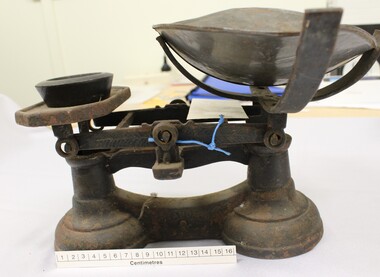 Wodonga & District Historical Society Inc
Functional object - Metal table balance scales, W & T Avery Ltd, 1900
... Metal balance table scales and a set of imperial weights...Weights and measures Australia Domestic scales On weights "AVERY/ B'HAM" Metal balance table scales and a set of imperial weights Metal table balance scales Functional object Metal table balance scales England Birmingham W & T Avery Ltd ...Sets of scales similar to these were very common in households throughout Australia in the 19th and 20th centuries. Avery of Birmingham were a British manufacturer of weighing machines. The company was founded in the early 18th century and took the name W & T Avery in 1818. The company produced a wide range of scales ranging from industrial scales and weighbriges to small scales for domestic use, such as these scales. At the time of the death of the last Avery family member in 1918, it employed over 3,000 people and had businesses all over the world. Today it has evolved to become part of the conglomerate, Avery Weigh-Tronix.Domestic scales such as these were common throughout Australian homes. They are now primarily superceded by plastic items, often electronic.Metal balance table scales and a set of imperial weightsOn weights "AVERY/ B'HAM"weights and measures australia, domestic scales -
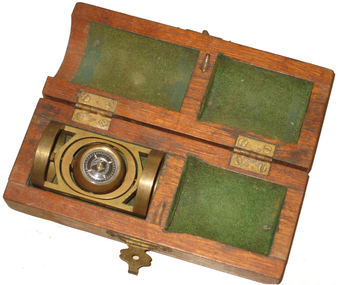 Federation University Historical Collection
Tool, Balance Scales (field set)
... A self-contained demountable balance scale set mounted and housed in a timber box. ...scales balance scientific instrument A self-contained demountable balance scale set mounted and housed in a timber box. ...A self-contained demountable balance scale set mounted and housed in a timber box. Complete with balance weights - scales, balance, scientific instrument -
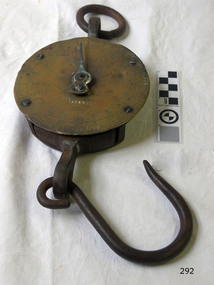 Flagstaff Hill Maritime Museum and Village
Instrument - Scale, George Salter & Co, ca. 1886
... There were at least three 1880s vessels named Lady Loch, all built in Victoria; a river launch (ca 1884 to ca 1916, originally named Lady of the Lake), a steamer ferry (1884 to 1920s), and a government lighthouse tender steamer HMV Lady Loch (1886 to 1962). The spring balance scale was part of the equipment on the HMV Lady Loch. ...Scale; Salter's spring balance mechanical hanging scale, brass and iron. ...Stamped: "SALTER'S / SPRING BALANCE" "SILVESTOR'S / PATENT" Embossed in script: "HMV SS / Lady Loch" Scale; Salter's spring balance mechanical hanging scale, brass and iron. ...There were at least three 1880s vessels named Lady Loch, all built in Victoria; a river launch (ca 1884 to ca 1916, originally named Lady of the Lake), a steamer ferry (1884 to 1920s), and a government lighthouse tender steamer HMV Lady Loch (1886 to 1962). The spring balance scale was part of the equipment on the HMV Lady Loch. The scale was made by the renowned company Salter Weighing Machines in the United Kingdom, to Silvester's patent design. Salter Weighing Machines, Britain, began making spring scales in the 1820s. In 1908 Salter opened up an Australian branch named Salter Scales Pty. Ltd. The scale is marked HMV SS Lady Loch. It would be suspended by its top ring, a basket or other container is hung from the hook, and the items inside the basket are then pulled downwards on the hook, which stretches the springs inside the works. The pulling action moves a rack and gears a calculated distance and the gears turn the pointer on the dial to indicate the weight of the goods. This scale measures up to 200 pounds capacity. The HMV SS Lady Loch was an iron steamship built in Footscray, Melbourne, by Campbell, Sloss and McCain in 1886 for the colonial Victorian government’s Department of Trade and Customs. It was armed with a 6-inch gun and two 1-inch Nordenfelt guns. The Sydney Morning Herald of 27th January 1888 describes the vessel in detail. It even comments on the interior of the Saloon “The wood work … is on a very elaborate scale and is exceedingly neat …”. The HMV Lady Loch performed Customs duties and serviced the lighthouses along the coast. The scale could have measured goods for the Customs Tax, or for measuring out supplies for the lighthouse keepers. The vessel was named after Lady Elizabeth Loch, wife of Sir Henry Loch, Governor of Victoria from 1884 to 1889. In 1932 Lady Loch was converted to a hulk and used in Brisbane, and finally scuttled in 1962 at Moreton Bay, Queensland.The scale has importance due to its connection to the 1886 HMV Lady Loch, a vessel of great significance to Melbourne’s shipbuilding industry. It was the largest auxiliary vessel in the Victorian Colonial Government’s fleet and the first prominent vessel launched by Melbourne’s shipbuilding industry. The scale is also important for its connection with the colonial navy's Custom's work, as the scale was available to weigh goods that could attract taxes and deal out goods for distribution to lighthouse keepers. The HMV Lady Loch was also important part of Victoria's maritime history for its communication and support of the lighthouse keeper's along the coast of Victoria.Scale; Salter's spring balance mechanical hanging scale, brass and iron. Equally spaced marks around the circular dial have values from 0 to 200 in increments of 10, each increment is also divided into 10. An iron ring is attached to a fitted loop on the top of the scale, and an iron hook is attached to the fitted loop onthe bottom of the scale. A moving pointer attached to the centre of the dial has a calibration screw joined to its base. Four screws fix the brass face to the works at the back. There are stamped and embossed inscriptions. Made by Salter in Britain, to Silvester's Patent design. The scale was once equipment carried abourd the steamship HMV SS Lady Loch. Stamped: "SALTER'S / SPRING BALANCE" "SILVESTOR'S / PATENT" Embossed in script: "HMV SS / Lady Loch"warrnambool, shipwreck coast, flagstaff hill, flagstaff hill maritime museum, flagstaff hill maritime village, scale, salter, spring balance, silvester's patent, lady loch, steamship, hmv, colonial navy, victoria, lady elizabeth loch, custom's vessel, lighthouse tender, 1886, government vessel, victorian government, measuring instrument, weight, weighing instrument, mechanical scale, hanging scale, hmv lady loch, weights and measures, silvestor's patent, george salter & co. -
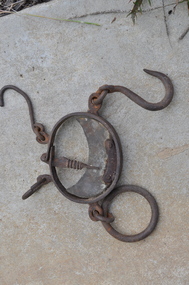 Bendigo Historical Society Inc.
Tool - SCALE BALANCE
... Scale - Balance Brass scale with 05, 10 m 20, 30. on the other side is 20 to 300....Tool SCALE BALANCE ...Scale - Balance Brass scale with 05, 10 m 20, 30. on the other side is 20 to 300.brass balance, mining -
 Royal Australian and New Zealand College of Obstetricians & Gynaecologists (RANZCOG)
Weighing scales used by Dr Mitchell Henry O'Sullivan
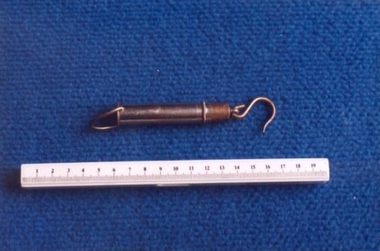
... Set of small, portable spring balance scales. With case/enclosure....Infant care Set of small, portable spring balance scales. With case/enclosure. Weighing scales used by Dr Mitchell Henry O'Sullivan ...Scales like these were used to weigh babies.Dr Mitchell Henry O'Sullivan worked in the Victorian country town of Casterton as a general practitioner from 1919 until his death in 1977. He also practiced obstetrics. His son, Dr David More O'Sullivan donated the obstetric bag and its contents to the College in 1999. The gladstone bag and contents are a unique time capsule of the type of instruments and pharmaceuticals used in the inter-war period. Set of small, portable spring balance scales. With case/enclosure.infant care
