
Showing 43 items matching "scales instruments-weighing"
-
 Orbost & District Historical Society
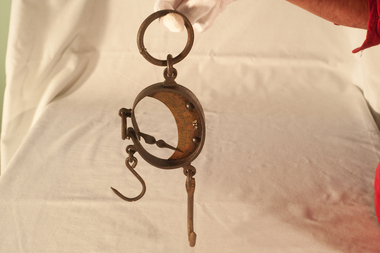
scales, late 19th - first half 20th century
... scales instruments-weighing...This object was likely to have been imported into Australia (possibly German) for use in Victoria, scales instruments-weighing Small round hanging scales. ...William (Billie) Blackmore was born at or near Richmond, Victoria.At age 26 he joined the A.I.F. in WW1 while he was employed at Orbost as a labourer. He served in Egypt and France until following his discharge on December 20th 1916, he transferred to 15th Machine Coy in January 1917. He was severely wounded, repatriated to England until after an operation and further hospitalisation returned home to Orbost .In Orbost he did farm work for George and Elizabeth Trewin, eventually building a small shack on what was Rupert Leatham's property at Brodribb. He fossicked for gold in a nearby creek and the story goes that he buried his coins around the property. He donated these scales to the Orbost & Districet Historical Society. (more details and ref. John Phillips July 2016 Newsletter)This item is typical of those used by gold fossickers in the early 20th century. This object was likely to have been imported into Australia (possibly German) for use in Victoria,Small round hanging scales. At the top is a loop for hanging. There is a brass plate in the centre with measuring scale, in lbs, and needle pointer.scales instruments-weighing -
 Orbost & District Historical Society
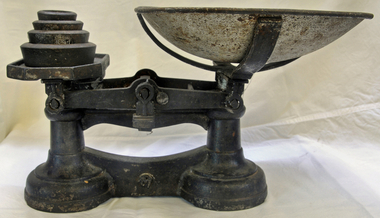
scales, 1930's
... scales instruments-weighing domestic kitchen...This item is an example of a common domestic kitchen appliance no longer in use. scales instruments-weighing domestic kitchen Underneath weights plates - 1lb 14oz Large black kitchen scales with large dish that sits in metal claw. scales ...These cast iron scales were made for domestic use as they are quite basic and not accurate enough for commercial use.This item is an example of a common domestic kitchen appliance no longer in use.Large black kitchen scales with large dish that sits in metal claw.Underneath weights plates - 1lb 14ozscales instruments-weighing domestic kitchen -
 Orbost & District Historical Society
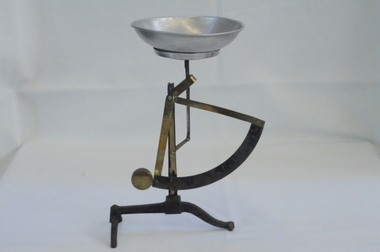
scales
... scales-cream instruments-weighing...scales-cream instruments-weighing A set of cream scales with a metal base and a copper swinging weight. ...A set of cream scales with a metal base and a copper swinging weight. It has an aluminium dish on top.scales-cream instruments-weighing -
 Cheese World Museum
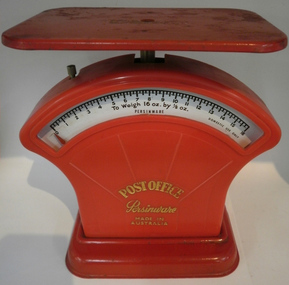
Scales, Persinware, Post Office scales
... Scales...Weighing instruments...These scales were used in the post office which was located at Warrnambool Cheese & Butter Factory. Allansford Warrnambool Cheese & Butter Factory WCB Post offices Scales Weighing instruments No.63 (on base) POST OFFICE/Persinware/Made in Australia Red Post Office wedge-shaped scales with rectangular base and spring-loaded top plate; white dial face marked to 16oz by 1/8 oz increments. ...These scales were used in the post office which was located at Warrnambool Cheese & Butter Factory.Red Post Office wedge-shaped scales with rectangular base and spring-loaded top plate; white dial face marked to 16oz by 1/8 oz increments. Marked Domestic Use Only. Manufacturer's details marked in gold on the front of the scales.No.63 (on base) POST OFFICE/Persinware/Made in Australiaallansford, warrnambool cheese & butter factory, wcb, post offices, scales, weighing instruments -
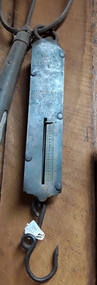 Mont De Lancey
Tool - Spring Balance Scales, Salters
... Scales...Balances...Weighing instruments...Spring balances Scales Balances Weighing instruments 'No 2 Class II Salters Improved Spring Balance weight guage 0 - 40 lbs. ...Used in the late 19th and early 20th century.A vintage No 2 Class II Salters Improved Spring Balance weigh scale with a weight guage of 0 - 40 lbs. It is made of metal with four rivets holding the front measurement panel covering the spring with a ring at the top and a hook at the bottom to hold the item being weighed. It was manufactured in England by Salters and used in the late 19th and early 20th century.'No 2 Class II Salters Improved Spring Balance weight guage 0 - 40 lbs. Manufactured in England by Salters'''spring balances, scales, balances, weighing instruments -
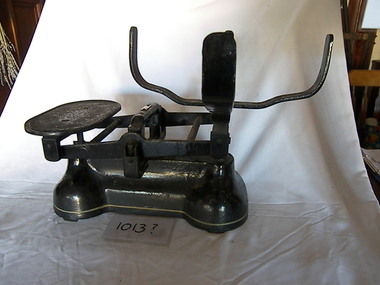 Flagstaff Hill Maritime Museum and Village
Instrument - Scale, 1900-1930
... Black cast iron, medium weighing scales, with a fulcrum which the beam that balances on, there is a scoop or large bowl at one end for the material to be weighted and a flat platform at the other end that holds the weights. Instrument ...The basic balance scale has been around for thousands of years and its accuracy has improved dramatically over the last several centuries, the principle behind this tool remains unchanged. Its parts include a fulcrum, a beam that balances on it, a pan at the end of the beam to hold the materials to be weighed, and a flat platform at the other for the counter-balancing weights. Balance scales that require equal weights on each side of the fulcrum have been used by everyone from apothecaries and assayers to jewellers and postal workers. Known as an unequal arm balance scale, this variety builds the counterweight into the device. Counter scales used in dry-goods stores and domestic kitchens often featured Japanned or (blackened) cast iron with bronze trims. Made by companies such as Howe and Fairbanks, the footed tin pans of these scales were often oblong, some encircled at one end so bulk items could be easily poured into a bag. Seamless pans were typically stamped from brass and given style names like Snuff (the smallest) and Birmingham (the largest). Some counter scales were designed for measuring spices, others for weighing slices of cake. In the 18th century, spring scales began to appear and would use the resistance of spring to calculate weights, which are read automatically on the scale’s face. The ease of use of spring scales over balance scales. These scales are significant as they identify one of the basic preparation items for the weighing of foodstuff in the family kitchen to prepare everyday meals. This item is significant as it gives a snapshot into domestic life within the average home in Australia around the turn of the twentieth century and is, therefore, an item with social relevance. Black cast iron, medium weighing scales, with a fulcrum which the beam that balances on, there is a scoop or large bowl at one end for the material to be weighted and a flat platform at the other end that holds the weights. Around the cast iron base is an embossed strip weight and bowl missing.flagstaff hill, warrnambool, shipwrecked-coast, flagstaff-hill, flagstaff-hill-maritime-museum, maritime-museum, shipwreck-coast, flagstaff-hill-maritime-village -
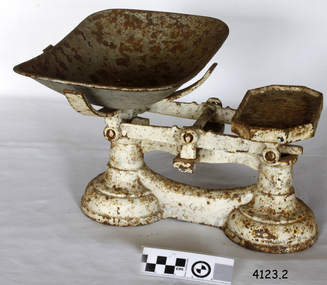 Flagstaff Hill Maritime Museum and Village
Instrument - Scale, F Quiney & Son, 1890-1910
... A balance scale vintage giving a snapshot into mercantile life during the late 19th and early 20th centuries flagstaff hill warrnambool shipwrecked-coast flagstaff-hill flagstaff-hill-maritime-museum maritime-museum shipwreck-coast flagstaff-hill-maritime-village scale weighing equipment None Scale with metal tray. Instrument ...Fredk Quiney & Sons established their company in 1890, council records show that Quiney began working at 4 Ranelagh Place in Leytonstone and from 1908 to 1926 he was at 268 High Road, Leytonstone. The name occurs on brass weights and balance scales dating from the early twentieth 20th century. The company was still producing grocers scales during the 1960s.A balance scale vintage giving a snapshot into mercantile life during the late 19th and early 20th centuries Scale with metal tray.Noneflagstaff hill, warrnambool, shipwrecked-coast, flagstaff-hill, flagstaff-hill-maritime-museum, maritime-museum, shipwreck-coast, flagstaff-hill-maritime-village, scale, weighing equipment -
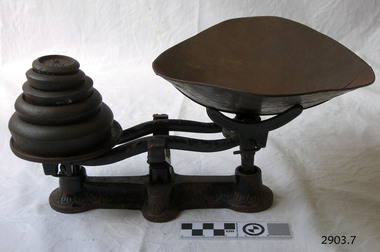 Flagstaff Hill Maritime Museum and Village
Instrument - Scale, Early 20th century
... scales were made for domestic use only. Black cast iron, medium weighing scales, with a fulcrum which the beam that balances on, there is as scoop at one end for the material to be weighted and a flat circular disc at the other end that holds the weights. Around the cast iron base is an embossed leaf pattern. All the weights have their weight embossed within the casting.There are 5 weights, marked 2 oz, 4 oz,8 oz,1 lb,2 lb, Instrument ...The basic balance scale has been around for thousands of years and its accuracy has improved dramatically over the last several centuries, the principle behind this tool remains unchanged. Its parts include a fulcrum, a beam that balances on it, a pan at the end of the beam to hold the materials to be weighed, and a flat platform at the other for the counter-balancing weights. Balance scales that require equal weights on each side of the fulcrum have been used by everyone from apothecaries and assayers to jewellers and postal workers. Known as an unequal arm balance scale, this variety builds the counterweight into the device. Counter scales used in dry-goods stores and domestic kitchens often featured Japanned or (blackened) cast iron with bronze trims. Made by companies such as Howe and Fairbanks, the footed tin pans of these scales were often oblong, some encircled at one end so bulk items could be easily poured into a bag. Seamless pans were typically stamped from brass and given style names like Snuff (the smallest) and Birmingham (the largest). Some counter scales were designed for measuring spices, others for weighing slices of cake. In the 18th century, spring scales began to appear and would use the resistance of spring to calculate weights, which are read automatically on the scale’s face. The ease of use of spring scales over balance scales. One of the most common types of spring scales was the kitchen scale also known as a family or dial scale. Designed for horizontal surfaces, these vintage kitchen scales used the weight of goods in a pan at the top of the scale to force the spring down rather than the balance system. Such scales were common in early 20th century households and were sold by many companies. Many had flat weighing surfaces but some were topped by shallow pans. Companies such as Salters, Chatillon, and Fairbanks were the most popular brands used. These scales are significant as they identify one of the basic preparation items for the weighing of foodstuff in the family kitchen to prepare everyday meals. This item is significant as it gives a snapshot into domestic life within the average home in Australia around the turn of the twentieth century and is, therefore, an item with social relevance. Black cast iron, medium weighing scales, with a fulcrum which the beam that balances on, there is as scoop at one end for the material to be weighted and a flat circular disc at the other end that holds the weights. Around the cast iron base is an embossed leaf pattern. All the weights have their weight embossed within the casting.There are 5 weights, marked 2 oz, 4 oz,8 oz,1 lb,2 lb, This scale does not have any visual markings on the arms to identify a maker or true balance. It is therefore assumed that these scales were made for domestic use only.flagstaff hill, warrnambool, shipwrecked-coast, flagstaff-hill, flagstaff-hill-maritime-museum, maritime-museum, shipwreck-coast, flagstaff-hill-maritime-village, spring scale, scale -
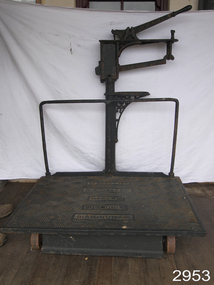 Flagstaff Hill Maritime Museum and Village
Equipment - Platform Scales
... Weigh-Tronix. An item that was used at the turn of the century as train platform scales or for weighing agricultural products. Made by a company that pioneered weighing equipment with offices all over the world. With many examples of this scale in museums throughout the world. flagstaff hill warrnambool shipwrecked-coast flagstaff-hill flagstaff-hill-maritime-museum maritime-museum shipwreck-coast flagstaff-hill-maritime-village measuring scales weighing scales weighing instrument fees for goods fees for luggage ticket office Pressed into cast iron arm on scale, one side "W. & T. ...Large platform scales such as these ones made by W. & T. Avery were used for weighing goods for trading and passengers' luggage. They would be used in places such as railway stations, shipping ports, customs offices and ticketing offices. Often fees would be charged to customers according to the weight of their goods and luggage. Items would be placed onto the large horizontal platform then weights would be added to the weighing bar until the bar leveled to being horizontal. The weights would be added together and the total of the weights would be used for the final figure. These scales were made in Birmingham, England, by the British company, W and T Avery. The company had its origins in the early 1700s but only became known as W and T Avery when the brothers William and Thomas Avery inherited the scale-making business from a relative, Joseph Balden, on his death in 1813. By 1885 they had three factories and In 1895, the company acquired James Watt & Co and two years later had moved to the 25-acre Soho Foundry site in Smethwick, Birmingham where James Watt had manufactured steam engines. When the last Avery family member died in 1918, the company employed over 3,000 people and had businesses all over the world. Following the highly successful introduction of the first digital retail scale in 1971, the company was taken over by the GEC Group in 1979. The business was subsequently acquired by the American company, Weigh-Tronix, in 2000 which had already acquired a competitor, Salter. The Avery name continues today in the company known as Avery Weigh-Tronix.An item that was used at the turn of the century as train platform scales or for weighing agricultural products. Made by a company that pioneered weighing equipment with offices all over the world. With many examples of this scale in museums throughout the world. Platform scales with wheels. Large cast iron, scales painted black, weight capacity to 7 CWT (hundred weight). Weight beam has markers "0. 5. 10. 15. 20. 25". Platform scale loose weight type with relieving handle; cast iron construction, fluted columns with integral weight stand, the two wheels are fitted to base at front of platform; there is a graduated steelyard 0-14bs with pear-shaped poise. Weight carrier is missing.Pressed into cast iron arm on scale, one side "W. & T. AVERY", opposite side "BIRMINGHAM", and into the platform "TO WEIGH 7 CWT, W. & T. AVERY, MAKERS, LONDON & BIRMINGHAM" flagstaff hill, warrnambool, shipwrecked-coast, flagstaff-hill, flagstaff-hill-maritime-museum, maritime-museum, shipwreck-coast, flagstaff-hill-maritime-village, measuring scales, weighing scales, weighing instrument, fees for goods, fees for luggage, ticket office -
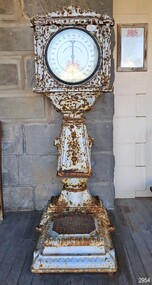 Flagstaff Hill Maritime Museum and Village
Instrument - Scale, Weighing Machine, G. Salter & Co, 1884-1909
... The scale was made by G Salter & Co. of West Bromwich, UK, distributed by the Australasian Automatic Weighing Platform Co., and updated to metric measurements by Eastern Scale Co. Pty Ltd. It was previously installed at the Warrnambool Post Office. Instrument ...This ornate, Victorian-era automatic weighing machine was made in England around 1884-1909, by George Salter and Co. of West Bromwich, UK, makers of scales since 1760. It is protected by Queen Victoria’s Royal Letters Patent, signed in 1900. The scale stood outside the Warrnambool Post Office in Timor Street from around 1909 to 1966, as shown on postcards and photographs held at the State Library of Victoria. The scale is identified by the Serial Number '665', and was installed by the distributors, the Australasian Automatic Weighing Machine Co. Ltd.. The scale’s weight measurements were in Imperial stones and pounds up to 20 stone (127 kg). The scale’s face included charts of average weights, for men, women, boys and girls, by various heights, in feet and inches. The coin slot and its face were converted to metric measurements by the Eastern Scale Company Pty. Ltd; that firm was registered on October 2, 1974. The Australasian Automatic Weighing Machine Co. Ltd was a large supplier of weighing scales in Australia and held the Royal Letters patent for their machines, distributing them in prominent locations. In 1902, the firm was listed under the Import Entries Passed at His Majesty’s Customs, importing into Sydney, NSW, eight cases of scales. In 1911, the company asked permission from the Port Pirie Corporation to install a machine in Alexander Street. In 1913, the company applied to the City of Sydney to install machines around the city, including at the tram depot. One application mentions “… three machines in three places for three pounds per year”. In 1923, the firm tendered for the right to place Automatic Weighing Machines on railway and tram premises throughout New South Wales, subsequently for five-year terms, in return for a fixed payment per machine and a portion of the revenue to the NSW Government. In 1928, the Sydney Harbour Trust gave the firm the right to place the weighing machines on various ferry jetties. The firm was still operating in 1941, advertising for two boys aged 14-16 for the workshop and messages, at the Rialto building, 497 Collins St., Melbourne. On December 21, 1946, the Commonwealth government invited offers to tender for the right to place automatic weighing machines on postal premises throughout the six states; the successful company then made arrangements with the federal Postmaster General's Department to place machines outside post offices across the country. A few years later, on September 11, 1950, the firm's Adelaide branch ceased trading. From 11th July 1950, the Australian and Eastern Engineering Company Pty. Ltd took over at the same premises, at 179 Pirie Street, Adelaide. The Perth branch ceased business in WA on July 6th, 1950. Percival Everitt invented and patented the automatic, coin-operated personal scale design. Everitt was a Norfolk-born engineer and regarded as the father of the coin-operated industry. As a young man in 1877, he invented a hay and corn pitcher, a turnip thinner in 1878 and an Automatic Travelling Anchor in 1880. But his fame came in 1883 with the first postcard-vending machine, over a hundred of which he distributed around London. In 1884, he patented one of his many inventions, the coin-operated scales for use in public places; for many people, it was their first exposure to coin-operated machines. His success prompted the formation of the Weighing Machine Company in 1885. Further inventions followed: a blow tester in 1887, the machine for testing a person's grip in 1888, and in 1889, the dispensing machine for hiring out opera glasses, and a device for shutting down the coin entry slot if the machine was empty. In 1890, he invented a fortune-telling machine. Everitt sadly did not make his fortune; he died suddenly in February 1893, in his late forties, with £71 to his name. George Salter & Co., West Bromwich, England, produced automatic weighing scale machines from Everitt’s patented design, and advertised them as suitable for hotels, pleasure gardens, theatres, exhibition halls, clubs, baths and places of public resort. The company was established in 1760 by brothers Richard and William Salter, and manufactured springs and pocket steelyards (spring balances). After several generations, the company was taken over in 1855 by a nephew, George, and renamed George Salter & Co. In 1884, Salter registered the trademark of a Staffordshire knot pierced by an arrow. The company's expanded range of products included the first coin-operated public weighing machines in the 1880s and, in 1895, the first English-made typewriter. In 1915, Salter became a limited company, Geo. Salter & Co. Ltd. When the last George Salter died in 1917, the company passed into the hands of other relatives, but continued to grow before being bought out by Staveley Industries in 1973. Despite several subsequent mergers, the Salter name continues to be seen on household products such as digital scales. This patented, coin-operated weight machine is significant for its association with Percival Everitt, the inventor of the world’s first slot machine, with the renowned maker of scales, G. Salter & Co., which began operating in 1760, and also with the Australasian Automatic Weighing Scale Co., which imported and widely distributed the scales throughout Australia from the early-to-mid 20th century. It is a rare example of an early vending machine used in public places from the late 19th through to the mid-20th century. These machines were the early step in the evolution of coin-in-the-slot machines, which are still used today. The scales give a glimpse into our history; they became quickly popular with the public, which, until then, had little access to weight scales apart from those at medical services. They also provided inexpensive entertainment for families, especially while waiting for trains or visiting the post office. The machines were also attractive and lucrative to the distributors; once installed, they required very little maintenance, and their low cost to customers kept the money coming in. This automatic weighing machine is also significant for its decades of service to the local and regional community of Warrnambool, for personal and commercial purposes. A public coin-operated weighing scale, also called a penny scale. It is a large, silver-painted cast metal stand with a square top on a pedestal that flares outwards to join a rectangular platform base with posts on the side and corners that may have had fitted wheels. The round, white face on top has red and black measurements and inscriptions. A slim indicator with a point at one end and an arc at the other is attached to the face’s centre. The coin slot is above the face, on the left, and the scale’s identification number is engraved on an oval plate on the right. Moulded motifs decorate the pedestal’s front and are repeated on its sides; they depict a tall, narrow urn with a bowl on top and fancy scrolls on either side. There is a decorative panel across the front top of the stand. The top of the pedestal has a small keyhole. The size of the coin slot fitted a penny coin, and the weight measurements on the face were in Imperial stones and pounds. Quite some time after 1966, when Australia introduced new decimal weights, measurements and currency, the scale was updated; the coin slot size was changed, and a new face with metric measurements was installed. The scale now accepts a $1 coin (one dollar) and the scale measures weight in kilograms and grams, from 0 to 125 kg.. The rear of the scale has a small, rectangular metal plate with printed text. The scale was made by G Salter & Co. of West Bromwich, UK, distributed by the Australasian Automatic Weighing Platform Co., and updated to metric measurements by Eastern Scale Co. Pty Ltd. It was previously installed at the Warrnambool Post Office. Engraved on an oval plate on the right: "665" Top centre of the face, in red: "$1 coin" Top of face: "EASTERN SCALE CO. PTY LTD" Base of face, in red: "[Royal Coat of Arms of Britain]" with words, below in red: "BY ROYAL LETTERS PATENT" Around the face, in black: "[numbers 0 to 125, in increments 5, and makes between the numbers for each 500g]" "kg" Below the face, moulded letters within a shield: "AUSTRALASIAN AUTOMATIC WEIGHING MACHINES CO. LTD." At the back of the weighing platform: "G SALTER & CO. / WEST BROMWICH", remnants of logo “[Staffordshire knot pierced by an arrow]” Plate on rear: THIS SCALE REMAINS THE PROPERTY OF EASTERN SCALE CO. PTY. LTD., 8 GEORGE COURT, GREENSBOROUGH, VIC, 3088. PHONE (03 ) _ 34 _ _ 33” (434 9333 ?_flagstaff hill, warrnambool, maritime village, maritime museum, flagstaff hill maritime museum and village, shipwreck coast, great ocean road, scale, weighing scale, salter, australasian, 1 dollar, $1 coin, 1p, 1 penny coin, penny scale, coin in slot scale, eastern scale co. pty. ltd., british royal coat of arms, royal letters patent, letters patent, health, ending machine, coin-operated machine, percival everett, weighing machine co., george salter & co., g salter & co, west bromwich, vending machine, weights & balances, measurements, slot machine, coin operated machine, penny-in-the-slot, coin fed, coin op scale, weights & measures, australasian automatic weighing machine co. ltd., warrnambool post office, machine 665, no. 665, blalnce technology, scales and weights, weights and measures, penny weight scales, vintage, weighing machine, coin in the slot, coin operated, public scale, public weighing machine, penny-weighing machines, penny weighing machines, penny scales, coin operated weighing machine, scale weighing machine -
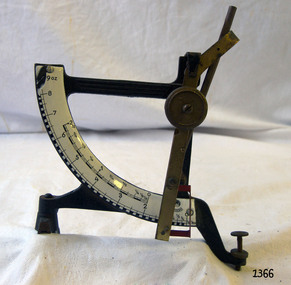 Flagstaff Hill Maritime Museum and Village
Instrument - Letter Scale, Philip Jakob, Maul, 1930s
... It is significant as it is a snapshot into the past and how everyday vintage items were used and interacted within society in the 1930s. flagstaff hill warrnambool shipwrecked-coast flagstaff-hill flagstaff-hill-maritime-museum maritime-museum shipwreck-coast flagstaff-hill-maritime-village scale quadrant scale postal weight 9 oz philip jakob, maul scale manufacturer german industry weighing instrument inclination scale The balance is marked "CONCAV" and graduated in imperial ounces to 9 oz Antique German Jacob Maul "Concav" brass postal or letter scale, quadrant type, with pendulum, measuring up to 9ozs. ...Jakob Maul (1866-1953) founded a metal works factory in 1912 at Zell in Odenwald not far from Frankfurt. He was born the son of a winegrower from the Rheinhessen region of Germany that lies on the left bank of the river Rhine. At the age of 45, he started a metal works factory to produce various types of scales but during the second world war the factory was bombed and production ended. Production for the manufacture of scales resumed in 1948. In 1953 at his death Jakobs son Fritz Scharmann an engineer who had been working with his father since 1923 took over the management of the Maul companies. In 1970 the production responsibilities for Philip J Maul was taken over by Porti Office Equipment who was based in Hamburg. The company has undergone several integrations with subsidiary companies. Today the company has diversified into different areas one of which is manufacturing solar scales. An original postal scale made in Germany before the Second World War and regarded today as a collector's item. It is significant as it is a snapshot into the past and how everyday vintage items were used and interacted within society in the 1930s.Antique German Jacob Maul "Concav" brass postal or letter scale, quadrant type, with pendulum, measuring up to 9ozs. The scale has a level-adjusting screw.The balance is marked "CONCAV" and graduated in imperial ounces to 9 ozflagstaff hill, warrnambool, shipwrecked-coast, flagstaff-hill, flagstaff-hill-maritime-museum, maritime-museum, shipwreck-coast, flagstaff-hill-maritime-village, scale, quadrant scale, postal weight, 9 oz, philip jakob, maul, scale manufacturer, german industry, weighing instrument, inclination scale -
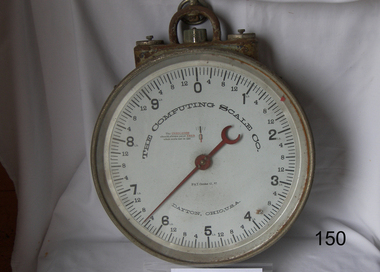 Flagstaff Hill Maritime Museum and Village
Instrument - Scale, Computing Scale Company, 1897-1900
... This company went on to become incorporated with IBM that late became an international computer manufacturer. flagstaff hill warrnambool shipwrecked coast flagstaff hill maritime museum maritime museum shipwreck coast flagstaff hill maritime village great ocean road scale computing scale computing scale company weighing instrument Marked "The Computing Scale Co Dayton Ohio" Scale, patented Oct 12, 1897. ...In 1885 Julius Pitrat of Gallipolis, Ohio, patented the first computing scale. Six years later, Edward Canby and Orange Ozias of Dayton, Ohio, purchased Pitrat's patents and incorporated The Computing Scale Company as the world's first computing scale vendor. And four years after that, The Computing Scale Company introduced the first automatic computing scale In 1911. the Computing Scale Company merged with the International Time Recording Company and Tabulating Machine Company to form the Computing-Tabulating-Recording Company, a business that was renamed IBM in 1924. An early example of a hanging clock face scale patented in October 1897 and made by a company that pioneered the first computing scales used in retail businesses. This company went on to become incorporated with IBM that late became an international computer manufacturer.Scale, patented Oct 12, 1897. Measures in pounds and ounces, up to 10lb. Red indicator needle. Two adjustment screws. Ring on the top for mounting. Marked "The Computing Scale Co Dayton Ohio"Marked "The Computing Scale Co Dayton Ohio"flagstaff hill, warrnambool, shipwrecked coast, flagstaff hill maritime museum, maritime museum, shipwreck coast, flagstaff hill maritime village, great ocean road, scale, computing scale, computing scale company, weighing instrument -
 Flagstaff Hill Maritime Museum and Village
Instrument - Scale, George Salter & Co, ca. 1886
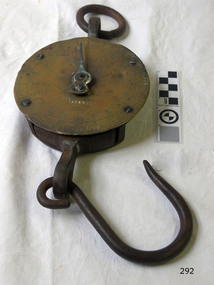
... scale was available to weigh goods that could attract taxes and deal out goods for distribution to lighthouse keepers. The HMV Lady Loch was also important part of Victoria's maritime history for its communication and support of the lighthouse keeper's along the coast of Victoria. Warrnambool Shipwreck Coast Flagstaff Hill Flagstaff Hill Maritime Museum Flagstaff Hill Maritime Village scale Salter Spring Balance Silvester's Patent Lady Loch steamship HMV Colonial Navy Victoria Lady Elizabeth Loch Custom's vessel Lighthouse tender 1886 Government vessel Victorian Government measuring instrument weight weighing instrument mechanical scale hanging scale HMV Lady Loch weights and measures Silvestor's Patent George Salter & Co. ...There were at least three 1880s vessels named Lady Loch, all built in Victoria; a river launch (ca 1884 to ca 1916, originally named Lady of the Lake), a steamer ferry (1884 to 1920s), and a government lighthouse tender steamer HMV Lady Loch (1886 to 1962). The spring balance scale was part of the equipment on the HMV Lady Loch. The scale was made by the renowned company Salter Weighing Machines in the United Kingdom, to Silvester's patent design. Salter Weighing Machines, Britain, began making spring scales in the 1820s. In 1908 Salter opened up an Australian branch named Salter Scales Pty. Ltd. The scale is marked HMV SS Lady Loch. It would be suspended by its top ring, a basket or other container is hung from the hook, and the items inside the basket are then pulled downwards on the hook, which stretches the springs inside the works. The pulling action moves a rack and gears a calculated distance and the gears turn the pointer on the dial to indicate the weight of the goods. This scale measures up to 200 pounds capacity. The HMV SS Lady Loch was an iron steamship built in Footscray, Melbourne, by Campbell, Sloss and McCain in 1886 for the colonial Victorian government’s Department of Trade and Customs. It was armed with a 6-inch gun and two 1-inch Nordenfelt guns. The Sydney Morning Herald of 27th January 1888 describes the vessel in detail. It even comments on the interior of the Saloon “The wood work … is on a very elaborate scale and is exceedingly neat …”. The HMV Lady Loch performed Customs duties and serviced the lighthouses along the coast. The scale could have measured goods for the Customs Tax, or for measuring out supplies for the lighthouse keepers. The vessel was named after Lady Elizabeth Loch, wife of Sir Henry Loch, Governor of Victoria from 1884 to 1889. In 1932 Lady Loch was converted to a hulk and used in Brisbane, and finally scuttled in 1962 at Moreton Bay, Queensland.The scale has importance due to its connection to the 1886 HMV Lady Loch, a vessel of great significance to Melbourne’s shipbuilding industry. It was the largest auxiliary vessel in the Victorian Colonial Government’s fleet and the first prominent vessel launched by Melbourne’s shipbuilding industry. The scale is also important for its connection with the colonial navy's Custom's work, as the scale was available to weigh goods that could attract taxes and deal out goods for distribution to lighthouse keepers. The HMV Lady Loch was also important part of Victoria's maritime history for its communication and support of the lighthouse keeper's along the coast of Victoria.Scale; Salter's spring balance mechanical hanging scale, brass and iron. Equally spaced marks around the circular dial have values from 0 to 200 in increments of 10, each increment is also divided into 10. An iron ring is attached to a fitted loop on the top of the scale, and an iron hook is attached to the fitted loop onthe bottom of the scale. A moving pointer attached to the centre of the dial has a calibration screw joined to its base. Four screws fix the brass face to the works at the back. There are stamped and embossed inscriptions. Made by Salter in Britain, to Silvester's Patent design. The scale was once equipment carried abourd the steamship HMV SS Lady Loch. Stamped: "SALTER'S / SPRING BALANCE" "SILVESTOR'S / PATENT" Embossed in script: "HMV SS / Lady Loch"warrnambool, shipwreck coast, flagstaff hill, flagstaff hill maritime museum, flagstaff hill maritime village, scale, salter, spring balance, silvester's patent, lady loch, steamship, hmv, colonial navy, victoria, lady elizabeth loch, custom's vessel, lighthouse tender, 1886, government vessel, victorian government, measuring instrument, weight, weighing instrument, mechanical scale, hanging scale, hmv lady loch, weights and measures, silvestor's patent, george salter & co. -
 Flagstaff Hill Maritime Museum and Village
Instrument - Spring Scale
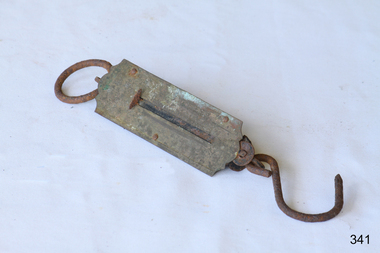
... scales are very popular with recreational fishers. The ability to weigh things reasonably accurately with a small inexpensive apparatus allowed for the exact weight of items to be ascertained. However, it was not accurate enough to weigh small amounts in ounces or grams. Flagstaff Hill Warrnambool Shipwrecked-coast Flagstaff-Hill Flagstaff-Hill-Maritime-Museum Maritime-Museum Shipwreck-coast Flagstaff-Hill-Maritime-Village Scale of pounds weight. Scale. Has ring for hanging, spring and hook device for weighing. Measures in lbs. Instrument ...The first spring balance in Britain was made around 1770 by Richard Salter of Bilston, near Wolverhampton. He and his nephews John & George, founded the firm of George Salter & Co., still notable makers of scales and balances, who in 1838 patented the spring balance. They also applied the same spring balance principle to steam locomotive safety valves, replacing the earlier deadweight valves. https://en.wikipedia.org/wiki/Spring_scale Today, spring scales are very popular with recreational fishers. The ability to weigh things reasonably accurately with a small inexpensive apparatus allowed for the exact weight of items to be ascertained. However, it was not accurate enough to weigh small amounts in ounces or grams.Scale. Has ring for hanging, spring and hook device for weighing. Measures in lbs.Scale of pounds weight.flagstaff hill, warrnambool, shipwrecked-coast, flagstaff-hill, flagstaff-hill-maritime-museum, maritime-museum, shipwreck-coast, flagstaff-hill-maritime-village -
 Flagstaff Hill Maritime Museum and Village
Book - Technical Reference, L Oertling (Ludwig Oertling), Tables for Ascertaining The Strength of Spirits with a Sike's Hydrometer, c. 1922
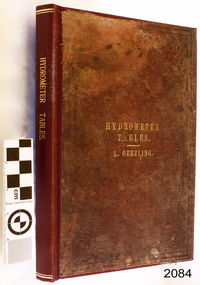
... instruments, particularly its balance scales. In 1865 Ludwig Oertling and business partner Edward Wilds Laad at 27 Moorgate Street London were granted Patent 75 for the invention of improvements in hydrometers. The firm was situated at Turnmill Street, London, in 1922, when it advertised its products including hydrometers, petroleumeters, saccharometers, balances and weights, and automatic coin weighing machines in the British Industries Fair catalogue. ...instruments, particularly its balance scales. In 1865 Ludwig Oertling and business partner Edward Wilds Laad at 27 Moorgate Street London were granted Patent 75 for the invention of improvements in hydrometers. The firm was situated at Turnmill Street, London, in 1922, when it advertised its products including hydrometers, petroleumeters, saccharometers, balances and weights, and automatic coin weighing machines in the British Industries Fair catalogue. ...The book was compiled for the proprietor, L Oertling (Ludwig Oertling), who established his firm of precision scientific instruments in 1849 and went on to become well-known in Britain for its manufacture of precision instruments, particularly its balance scales. In 1865 Ludwig Oertling and business partner Edward Wilds Laad at 27 Moorgate Street London were granted Patent 75 for the invention of improvements in hydrometers. The firm was situated at Turnmill Street, London, in 1922, when it advertised its products including hydrometers, petroleumeters, saccharometers, balances and weights, and automatic coin weighing machines in the British Industries Fair catalogue. In 1925 the firm became part of the Avery group of companies, which acquired Stanton Instruments in 1968 and about two years later Stantons merged into L. Oertling Ltd. Joseph Long has been mentioned by some sources as the author of this book, written for the proprietor of L. Oertling Ltd.The book has been recognised as being culturally important as a basis for our current civilization. It was of great importance to the Board of Revenue for the collectors of taxes and duties Customs Offices, and used in the calculation of alcohol levels in wine and spirits.Reference book, hardcover, burgundy with gold text and lines. Cloth cover with embossed design. Title: Tables for Ascertaining The Strength of Spirits for ascertaining the strengths of spirits with Sike's Hydrometer; Compiled for L. Oetlihg, by appointment, sole manufacturer of Hydrometers & Saccharometers to the Board of Inland Revenue. [some sources say the author is Joseph Long] Published in Turnmill Street, London, near Farringdon Street Station Printer: Printed in London, England by George Berridge and Co, Eastcheap Works, ECflagstaff hill, flagstaff hill maritime museum and village, warrnambool, maritime museum, maritime village, great ocean road, shipwreck coast, l. oertling, ludwig oertling., precision balances, edward wilds ladd, patent 75, improvements in hydrometers, hydrometer, automatic balance for weighing sovereigns, hydrometers, petroleometers, saccharometers, balances and weights, automatic coin-weighing machines, avery group, stanton instruments, l. oertling ltd, testing machine, tables for hydrometers, strength of spirits, alcohol content, alcohol measurement, board of revenue, joseph long -
 Flagstaff Hill Maritime Museum and Village
Equipment - Spring Balance Scale, George Salter & Co, 1920s
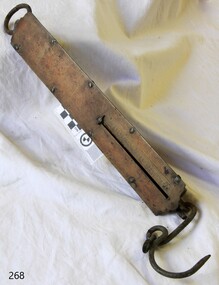
... Scale, Salter's improved spring balance, warranted. Brass and iron. Weighs 0 to 60LBS. Long rectangular brass instrument with ring attached to top and hook attached below. ...Flagstaff Hill Warrnambool Flagstaff-Hill-Maritime-Museum Maritime-Museum Shipwreck-coast Flagstaff-Hill-Maritime-Village Salter Balance Scale Weight Measuring Scale Weighing Dry Goods Domestic Object Kitchen Scale Marked ""SALTER'S IMPROVED SPRING BALANCE"" and "WARRANTED". Weighs 0 to 60LBS. Scale, Salter's improved spring balance, warranted. Brass and iron. Weighs 0 to 60LBS. Long rectangular brass instrument ...Scales such as the subject item were used to measure commercial quantities, possibly grains and farm produce for quite large amounts of product. Bags of grain etc would have been hooked up and weighed. Salter has been a name long associated with weights and measures. The firm began life in the late 1760s in the village of Bilston, England when Richard Salter, a spring maker, began making the first spring scales in Britain. He called these scales "pocket steelyards", though they work on a different principle from steelyard balances. By 1825 his nephew George had taken over the company, which became known as George Salter & Co. George later established a manufacturing site in the town of West Bromwich, about 4 miles (7 km) from Bilston. West Bromwich Albion football club was formed from workers at this works site. From here the company produced a wide variety of scales including the UK's first bathroom scales. Other items were added to the range, including irons, mincers, potato chippers, coin-operated machines and the first typewriters made in the UK. The business thrived throughout the 1900s, and by 1950 it employed over 2000 people, still in the same area and owned by the same family.Salter is a British housewares brand developing products that span a wide range of core product categories, including scales, electrical, cookware. It is a market leader in kitchen and bathroom scales and one of the UK’s oldest consumer brands. Established in 1760, Salter has been developing precision products for over 260 years. It was acquired by Manchester-based consumer goods giant Ultimate Products in 2021 after they had previously licensed the brand for cookware and kitchen electrical since 2011.Scale, Salter's improved spring balance, warranted. Brass and iron. Weighs 0 to 60LBS. Long rectangular brass instrument with ring attached to top and hook attached below. Centre of rectangle has long vertical slot with short, horizontal bar that slides down the slot when an object is suspended from the hook, showing its weight on the numbered scale beside the slot.Marked ""SALTER'S IMPROVED SPRING BALANCE"" and "WARRANTED". Weighs 0 to 60LBS. flagstaff hill, warrnambool, flagstaff-hill-maritime-museum, maritime-museum, shipwreck-coast, flagstaff-hill-maritime-village, salter balance scale, weight measuring scale, weighing dry goods, domestic object, kitchen scale -
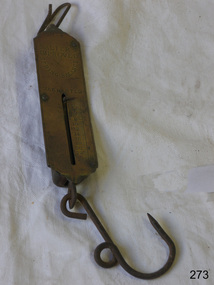 Flagstaff Hill Maritime Museum and Village
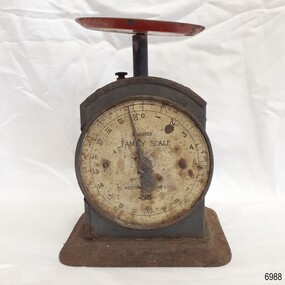
Equipment - Spring Balance Scale, George Salter & Co, 1920s
... Scale, Salter's improved spring balance, warranted. Brass and iron. Weighs 0 to 25LBS. Long rectangular brass instrument with ring attached to top and hook attached below. ...Flagstaff Hill Warrnambool Flagstaff-Hill-Maritime-Museum Maritime-Museum Shipwreck-coast Flagstaff-Hill-Maritime-Village Salter Balance Scale Weight Measuring Scale Weighing Dry Goods Domestic Object Kitchen Scale measure weigh measure ingredients food preparation Marked ""SALTER'S IMPROVED SPRING BALANCE" "Number 2". Weighs 0 to 25LBS. Scale, Salter's improved spring balance, warranted. Brass and iron. Weighs 0 to 25LBS. Long rectangular brass instrument ...Scales such as the subject item were used to measure commercial quantities, possibly grains and farm produce for quite large amounts of product, also in a domestic situation. Bags of grain or other dry goods would have been hooked up and weighed. Salter has been a name long associated with weights and measures. The firm began life in the late 1760s in the village of Bilston, England when Richard Salter, a spring maker, began making the first spring scales in Britain. He called these scales "pocket steelyards", though they work on a different principle from steelyard balances. By 1825 his nephew George had taken over the company, which became known as George Salter & Co. George later established a manufacturing site in the town of West Bromwich, about 4 miles (7 km) from Bilston. West Bromwich Albion football club was formed from workers at this works site. From here the company produced a wide variety of scales including the UK's first bathroom scales. Other items were added to the range, including irons, mincers, potato chippers, coin-operated machines and the first typewriters made in the UK. The business thrived throughout the 1900s, and by 1950 it employed over 2000 people, still in the same area and owned by the same family.Salter is a British housewares brand developing products that span a wide range of core product categories, including scales, electrical, cookware. It is a market leader in kitchen and bathroom scales and one of the UK’s oldest consumer brands. Established in 1760, Salter has been developing precision products for over 260 years. It was acquired by Manchester-based consumer goods giant Ultimate Products in 2021 after they had previously licensed the brand for cookware and kitchen electrical since 2011.Scale, Salter's improved spring balance, warranted. Brass and iron. Weighs 0 to 25LBS. Long rectangular brass instrument with ring attached to top and hook attached below. Centre of rectangle has long vertical slot with short, horizontal bar that slides down the slot when an object is suspended from the hook, showing its weight on the numbered scale beside the slot.Marked ""SALTER'S IMPROVED SPRING BALANCE" "Number 2". Weighs 0 to 25LBS. flagstaff hill, warrnambool, flagstaff-hill-maritime-museum, maritime-museum, shipwreck-coast, flagstaff-hill-maritime-village, salter balance scale, weight measuring scale, weighing dry goods, domestic object, kitchen scale, measure, weigh, measure ingredients, food preparation -
 Flagstaff Hill Maritime Museum and Village
Instrument - Scale, George Salter & Co, Circa 1921
... Weigh-Tronix, and then that company was bought by HoMedics Company in 2004. This scale was made by Salter, the company that invented the balance scale, the first British bathroom scale and the first English typewriter. The scale represents the domestic equipment used for measuring in food preparation over 100 years ago. Modern kitchen scales are still using the same principal, along with scales used in business and industry. Flagstaff Hill Warrnambool Maritime Museum Maritime Village Great Ocean Road Shipwreck Coast Hughes Salter British made Family Scale No. 48 spring balance scale weighing instrument ...The Hughes’ Family Scale No. 48 is a spring balance scale. It uses the Imperial measurements of ounces and pounds. There are 16 ounces (OZ) in one pound (LB), and each pound equals approximately 454 grams in Metric measurements. Scales have been used to measure and compare items for value for centuries. A weight was placed on one side of a balance and the object was placed on the other. Adjustments were made to either the weight or the object until the balance was horizontal, which meant that each side was the same weight. The Salter family business began in 1760 with spring makers, Richard and William Salter. In the late 18th century, Richard Salter invented the spring scale, where the weight of an object on the tray of the scale causes pressure on a spring in the scale. The pressure caused by gravity was then measured to calculate the weight of an object. Spring scales are still used today along with the more recent and accurate digital scales. The company began manufacturing in West Bromwich, England, in 1770. The firm was taken over by William’s sons, John and George. In 1824, after the death of John, the firm became George Salter & Co. The company produced a wide variety of products, including Britain’s first bathroom scale and the first English typewriter. In 1884 the Salter Trademark of a Staffordshire knot pierced by an arrow was registered. After over 100 years of manufacturing, the company was bought out by Staveley Industries, which was bought by Weigh-Tronix, and then that company was bought by HoMedics Company in 2004.This scale was made by Salter, the company that invented the balance scale, the first British bathroom scale and the first English typewriter. The scale represents the domestic equipment used for measuring in food preparation over 100 years ago. Modern kitchen scales are still using the same principal, along with scales used in business and industry.Scale; a domestic spring balance scale for measuring weight from 0 to 20 pounds. The scale’s grey metal case has a round white dial on the front with black markings, an arrow indicator and a round shallow metal bowl on a pedestal at the top. The scale is raised on a rectangular metal base with outward-sloping sides. An adjustable screw is on the dome top. The scale is marked from 0 to 20 pounds, with each pound marked in 1-ounce increments. The scale is named the Hughes Family Scale No. 48 and was made in Britain by Salter.“HUGHES’ / FAMILY SCALE / No. 48” “BRITISH MADE” “TO WEIGH 20 LBS BY 1 OZ” “SALTER” above logo [knotted rope with an arrow through loops]flagstaff hill, warrnambool, maritime museum, maritime village, great ocean road, shipwreck coast, hughes, salter, british made, family scale, no. 48, spring balance, scale, weighing instrument, weights and measures, weighing machine, kitchen utensil, baking accessory, domestic equipment, cookware, bakeware, kitchen scale, kitchen accessory, food preparation, recipes, cooking, measuring -
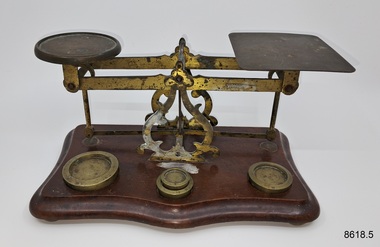 Flagstaff Hill Maritime Museum and Village
Equipment - Postal Scales, Unknown
... Overweight mailings had previously required the items to be weighed but with the introduction of the Uniform Penny Postage act of 1839, the public could mail a letter not exceeding a half-ounce in weight within the United Kingdom for one penny if prepaid, or two pence if paid on delivery. These postal scales belonged to Dr.William Roy Angus, Surgeon and Oculist. They were donated to Flagstaff Hill Maritime Village by his daughter, Bernice McDade. They are part of the “W.R. Angus Collection” that includes historical medical equipment, surgical instruments...Overweight mailings had previously required the items to be weighed but with the introduction of the Uniform Penny Postage act of 1839, the public could mail a letter not exceeding a half-ounce in weight within the United Kingdom for one penny if prepaid, or two pence if paid on delivery. These postal scales belonged to Dr.William Roy Angus, Surgeon and Oculist. They were donated to Flagstaff Hill Maritime Village by his daughter, Bernice McDade. They are part of the “W.R. Angus Collection” that includes historical medical equipment, surgical instruments ...Before 1851, letters sent through the mail were charged by the number of sheets it contained and the distance it travelled. For example, a letter consisting of one sheet of paper was charged the single rate; a double letter, that is two sheets, was charged double the single rate, a treble letter, was charged three times the single rate, and so on. In other words, each additional sheet of paper increased the charge by one rate. In Great Britain. Sealing a letter in an envelope effectively put an end to postal clerks' ability to count the number of sheets in a letter and an alternative method of determining the postage had to be found. Overweight mailings had previously required the items to be weighed but with the introduction of the Uniform Penny Postage act of 1839, the public could mail a letter not exceeding a half-ounce in weight within the United Kingdom for one penny if prepaid, or two pence if paid on delivery. These postal scales belonged to Dr.William Roy Angus, Surgeon and Oculist. They were donated to Flagstaff Hill Maritime Village by his daughter, Bernice McDade. They are part of the “W.R. Angus Collection” that includes historical medical equipment, surgical instruments and material once belonging to Dr Edward Ryan and Dr Thomas Francis Ryan, (both of Nhill, Victoria) as well as Dr Angus’ own belongings. The Collection’s history spans the medical practices of the two Doctors Ryan, from 1885-1926 plus that of Dr Angus, up until 1969. ABOUT THE “W.R.ANGUS COLLECTION” Doctor William Roy Angus M.B., B.S., Adel., 1923, F.R.C.S. Edin.,1928 (also known as Dr Roy Angus) was born in Murrumbeena, Victoria in 1901 and lived until 1970. He qualified as a doctor in 1923 at University of Adelaide, was Resident Medical Officer at the Royal Adelaide Hospital in 1924 and for a period was house surgeon to Sir (then Mr.) Henry Simpson Newland. Dr Angus was briefly an Assistant to Dr Riddell of Kapunda, then commenced private practice at Curramulka, Yorke Peninsula, SA, where he was physician, surgeon and chemist. In 1926, he was appointed as new Medical Assistant to Dr Thomas Francis Ryan (T.F. Ryan, or Tom), in Nhill, Victoria, where his experiences included radiology and pharmacy. In 1927 he was Acting House Surgeon in Dr Tom Ryan’s absence. Dr Angus had become engaged to Gladys Forsyth and they decided he further his studies overseas in the UK in 1927. He studied at London University College Hospital and at Edinburgh Royal Infirmary and in 1928, was awarded FRCS (Fellow from the Royal College of Surgeons), Edinburgh. He worked his passage back to Australia as a Ship’s Surgeon on the on the Australian Commonwealth Line’s T.S.S. Largs Bay. Dr Angus married Gladys in 1929, in Ballarat. (They went on to have one son (Graham 1932, born in SA) and two daughters (Helen (died 12/07/1996) and Berenice (Berry), both born at Mira, Nhill ) According to Berry, her mother Gladys made a lot of their clothes. She was very talented and did some lovely embroidery including lingerie for her trousseau and beautifully handmade baby clothes. Dr Angus was a ‘flying doctor’ for the A.I.M. (Australian Inland Ministry) Aerial Medical Service in 1928 . Its first station was in the remote town of Oodnadatta, where Dr Angus was stationed. He was locum tenens there on North-South Railway at 21 Mile Camp. He took up this ‘flying doctor’ position in response to a call from Dr John Flynn; the organisation was later known as the Flying Doctor Service, then the Royal Flying Doctor Service. A lot of his work during this time involved dental surgery also. Between 1928-1932 he was surgeon at the Curramulka Hospital, Yorke Peninsula, South Australia. In 1933 Dr Angus returned to Nhill and purchased a share of the Nelson Street practice and Mira hospital (a 2 bed ward at the Nelson Street Practice) from Dr Les Middleton one of the Middleton Brothers, the current owners of what previously once Dr Tom Ryan’s practice. Dr Tom and his brother had worked as surgeons included eye surgery. Dr Tom Ryan performed many of his operations in the Mira private hospital on his premises. He had been House Surgeon at the Nhill Hospital 1902-1926. Dr Tom Ryan had one of the only two pieces of radiology equipment in Victoria during his practicing years – The Royal Melbourne Hospital had the other one. Over the years Dr Tom Ryan had gradually set up what was effectively a training school for country general-practitioner-surgeons. Each patient was carefully examined, including using the X-ray machine, and any surgery was discussed and planned with Dr Ryan’s assistants several days in advance. Dr Angus gained experience in using the X-ray machine there during his time as assistant to Dr Ryan. When Dr Angus bought into the Nelson Street premises in Nhill he was also appointed as the Nhill Hospital’s Honorary House Surgeon 1933-1938. His practitioner’s plate from his Nhill surgery is now mounted on the doorway to the Port Medical Office at Flagstaff Hill Maritime Village, Warrnambool. When Dr Angus took up practice in the Dr Edward and Dr Tom Ryan’s old premises he obtained their extensive collection of historical medical equipment and materials spanning 1884-1926. A large part of this collection is now on display at the Port Medical Office at Flagstaff Hill Maritime Village in Warrnambool. In 1939 Dr Angus and his family moved to Warrnambool where he purchased “Birchwood,” the 1852 home and medical practice of Dr John Hunter Henderson, at 214 Koroit Street. (This property was sold in1965 to the State Government and is now the site of the Warrnambool Police Station. and an ALDI sore is on the land that was once their tennis court). The Angus family was able to afford gardeners, cooks and maids; their home was a popular place for visiting dignitaries to stay whilst visiting Warrnambool. Dr Angus had his own silk worm farm at home in a Mulberry tree. His young daughter used his centrifuge for spinning the silk. Dr Angus was appointed on a part-time basis as Port Medical Officer (Health Officer) in Warrnambool and held this position until the 1940’s when the government no longer required the service of a Port Medical Officer in Warrnambool; he was thus Warrnambool’s last serving Port Medical Officer. (Masters of immigrant ships arriving in port reported incidents of diseases, illness and death and the Port Medical Officer made a decision on whether the ship required Quarantine and for how long, in this way preventing contagious illness from spreading from new immigrants to the residents already in the colony.) Dr Angus was a member of the Australian Medical Association, for 35 years and surgeon at the Warrnambool Base Hospital 1939-1942, He served as a Surgeon Captain during WWII1942-45, in Ballarat, Victoria, and in Bonegilla, N.S.W., completing his service just before the end of the war due to suffering from a heart attack. During his convalescence he carved an intricate and ‘most artistic’ chess set from the material that dentures were made from. He then studied ophthalmology at the Royal Melbourne Eye and Ear Hospital and created cosmetically superior artificial eyes by pioneering using the intrascleral cartilage. Angus received accolades from the Ophthalmological Society of Australasia for this work. He returned to Warrnambool to commence practice as an ophthalmologist, pioneering in artificial eye improvements. He was Honorary Consultant Ophthalmologist to Warrnambool Base Hospital for 31 years. He made monthly visits to Portland as a visiting surgeon, to perform eye surgery. He represented the Victorian South-West subdivision of the Australian Medical Association as its secretary between 1949 and 1956 and as chairman from 1956 to 1958. In 1968 Dr Angus was elected member of Spain’s Barraquer Institute of Barcelona after his research work in Intrasclearal cartilage grafting, becoming one of the few Australian ophthalmologists to receive this honour, and in the following year presented his final paper on Living Intrasclearal Cartilage Implants at the Inaugural Meeting of the Australian College of Ophthalmologists in Melbourne In his personal life Dr Angus was a Presbyterian and treated Sunday as a Sabbath, a day of rest. He would visit 3 or 4 country patients on a Sunday, taking his children along ‘for the ride’ and to visit with him. Sunday evenings he would play the pianola and sing Scottish songs to his family. One of Dr Angus’ patients was Margaret MacKenzie, author of a book on local shipwrecks that she’d seen as an eye witness from the late 1880’s in Peterborough, Victoria. In the early 1950’s Dr Angus, painted a picture of a shipwreck for the cover jacket of Margaret’s book, Shipwrecks and More Shipwrecks. She was blind in later life and her daughter wrote the actual book for her. Dr Angus and his wife Gladys were very involved in Warrnambool’s society with a strong interest in civic affairs. He had an interest in people and the community They were both involved in the creation of Flagstaff Hill, including the layout of the gardens. After his death (28th March 1970) his family requested his practitioner’s plate, medical instruments and some personal belongings be displayed in the Port Medical Office surgery at Flagstaff Hill Maritime Village, and be called the “W. R. Angus Collection”. At about the same time that the adhesive postage stamps and envelopes made their appearance, postal administrations began to experiment with strategically placed street letter boxes, known as pillar boxes because of their round, pillar-like shape, that permitted the public to mail letters from a place other than from a post office. For all these reasons, the use of postal scales became the nucleus of every post office. Scales had been in use since ancient Egyptian times so their use for everyday commerce was not unusual in the 1800s. What was new in 1840 was their ubiquitous use throughout the postal system. No post office could function effectively without one. Although the earliest scales used in post offices did not differ markedly from the ones in general use as time went on they were adapted specifically for postal use. For example, a paper sleeve, also known as a weight sticker, was attached that showed the applicable rate of postage for any given weight. This innovation was quite a time saver as postal clerks no longer needed to weigh the item first and then refer to a separate chart to determine the required postage for that particular weight.The W.R. Angus Collection is significant for still being located at the site it is connected with, Doctor Angus being the last Port Medical Officer in Warrnambool. The collection of medical instruments and other items and equipment is culturally significant, being an historical example of medicine from late 19th to mid-20th century. Dr Angus assisted Dr Tom Ryan, a pioneer in the use of X-rays and in ocular surgery.Postal scales with weights,. Balance scale has brass fittings and is mounted on a rectangular wooden stand, with depressions for brass weights. Weights measure 1oz, 2oz, 4oz and 8oz.'Warranteed Accurate'flagstaff hill maritime museum and village, great ocean road, shipwreck coast, scales, post -
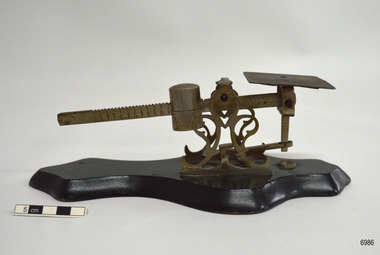 Flagstaff Hill Maritime Museum and Village
Instrument - Letter Scale, 1920s to 1960s
... scale. The object to be weighed, such as a letter or a dose of medicine, is placed on the square metal plate and the weight, the slider, is moved along the notched metal arm and adjusted until the arm is horizontal, then reading is recorded of the figure the pointer on the slider is positioned. This design of small is often referred to as a letter scale. This item was donated to Flagstaff Hill Maritime Village by the family of Doctor William Roy Angus, Surgeon and Oculist. It is part of the “W.R. Angus Collection” that includes historical medical equipment, surgical instruments...Flagstaff Hill Warrnambool Maritime Village Maritime Museum Shipwreck coast Great Ocean Road Dr W R Angus Letter scale postal scale balance scale single arm scale chemist scale pharmacy scale office equipment retail equipment sales equipment measuring instrument weighing instrument technical instrument medications W.R. ...This scale was owned by Dr Angus, whose training and experience included chemistry and pharmacy. This is a sliding balance scale. The object to be weighed, such as a letter or a dose of medicine, is placed on the square metal plate and the weight, the slider, is moved along the notched metal arm and adjusted until the arm is horizontal, then reading is recorded of the figure the pointer on the slider is positioned. This design of small is often referred to as a letter scale. This item was donated to Flagstaff Hill Maritime Village by the family of Doctor William Roy Angus, Surgeon and Oculist. It is part of the “W.R. Angus Collection” that includes historical medical equipment, surgical instruments and material once belonging to Dr Edward Ryan and Dr Thomas Francis Ryan, (both of Nhill, Victoria) as well as Dr Angus’ own belongings. The Collection’s history spans the medical practices of the two Doctors Ryan, from 1885-1926 plus that of Dr Angus, up until 1969.The scale is significant as an example of 20th century measuring and weighing equipment. It is also important for its association with the W.R. Angus Collection, which is significant for still being located at the site it is connected with, Doctor Angus being the last Port Medical Officer in Warrnambool. The collection of medical instruments and other equipment is culturally significant, being a historical example of medicine, administration, household equipment and clothing from the late 19th to the mid-20th centuries. Dr Angus assisted Dr Tom Ryan, a pioneer in the use of X-rays and in ocular surgery. Scale; a small sliding balance letter scale. The scale has a flat metal platform and a toothed metal balance arm with cylindrical brass weight. These are attached to a decorative metal stand that is mounted onto a shaped lacquered black wooden base. The sliding weight causes the arm to pivot on the stand. The arm is marked into equal-length segments from 0 to 8. Each segment is marked into halves. There is no maker’s mark. The scale is part of the W.R. Angus Collection.flagstaff hill, warrnambool, maritime village, maritime museum, shipwreck coast, great ocean road, dr w r angus, letter scale, postal scale, balance scale, single arm scale, chemist scale, pharmacy scale, office equipment, retail equipment, sales equipment, measuring instrument, weighing instrument, technical instrument, medications, w.r. angus collection -
 Flagstaff Hill Maritime Museum and Village
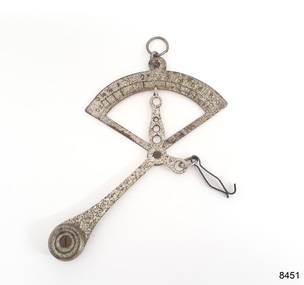
Instrument - Letter Scale, Ca. early 20th century
... scale...weighing instrument...measure weight...postal scale...chemist scale...letter...weigh...scale’s ring and connects the item to be weighed onto the wire clip. The weight of the item causes the pendulum to pivot, and the scale measures the weight of the object, indicated by the arrow. This scale belonged to Dr William Roy Angus and is now part of Flagstaff Hill’s comprehensive W.R. Angus Collection, donated by the family of Dr W R Angus, 1901-1970, surgeon and oculist. The W.R. Angus Collection: - The W.R. Angus Collection includes historical medical equipment, surgical instruments...Letter scale, a handheld quadrant fixed pendulum scale made from silver-plated metal. This small weighing instrument is shaped like a quarter-circle with a metal ring, a fixed pendulum counterweight and a decorative pivoting arrow indicator. ...scale is the only one of its type in our collection. It is an example of objects belonging to Dr. W. R. Angus, 1901-1970, surgeon and oculist. The W.R. Angus Collection is significant for still being located at the site it is connected with, Doctor Angus being the last Port Medical Officer in Warrnambool. The Collection includes historical medical objects that date back to the late 1800s. Flagstaff Hill Warrnambool Maritime Village Maritime Museum Shipwreck coast Great Ocean Road Flagstaff Hill Maritime Museum and Village Dr W R Angus Mira hospital W.R. Angus Collection scale weighing instrument ...This handheld portable pendulum quadrant scale was used to weigh small paper items such as letters and documents, powdered chemicals or metals like gold, and animal fleece samples. This mechanical scale can weigh up to a maximum of 10 ounces, which is about 285 grams or one-and-a-half cups of brown sugar. The operator holds the scale’s ring and connects the item to be weighed onto the wire clip. The weight of the item causes the pendulum to pivot, and the scale measures the weight of the object, indicated by the arrow. This scale belonged to Dr William Roy Angus and is now part of Flagstaff Hill’s comprehensive W.R. Angus Collection, donated by the family of Dr W R Angus, 1901-1970, surgeon and oculist. The W.R. Angus Collection: - The W.R. Angus Collection includes historical medical equipment, surgical instruments and material belonging to Dr Edward Ryan and Dr Thomas Francis Ryan, (both of Nhill, Victoria) and Dr Angus’ own belongings. The Collection’s history spans the medical practices of the two Doctors Ryan, from 1885-1926 plus that of Dr Angus, up until 1969. It includes historical medical and surgical equipment and instruments from the doctors Edward and Thomas Ryan of Nhill, Victoria. Dr Angus married Gladys in 1927 at Ballarat, the nearest big city to Nhill where he began as a Medical Assistant. He was also Acting House surgeon at the Nhill hospital where their two daughters were born. During World War II He served as a Military Doctor in the Australian Defence Force. Dr Angus and his family moved to Warrnambool in 1939, where Dr Angus operated his own medical practice. He later added the part-time Port Medical Officer responsibility and was the last person appointed to that position. Both Dr Angus and his wife were very involved in the local community, including the planning stages of the new Flagstaff Hill and the layout of the gardens there. Dr Angus passed away in March 1970.This letter scale is the only one of its type in our collection. It is an example of objects belonging to Dr. W. R. Angus, 1901-1970, surgeon and oculist. The W.R. Angus Collection is significant for still being located at the site it is connected with, Doctor Angus being the last Port Medical Officer in Warrnambool. The Collection includes historical medical objects that date back to the late 1800s.Letter scale, a handheld quadrant fixed pendulum scale made from silver-plated metal. This small weighing instrument is shaped like a quarter-circle with a metal ring, a fixed pendulum counterweight and a decorative pivoting arrow indicator. A hanger clip is attached to a short arm of the scale. Measurements are embossed on the arc of the circle, labelled in ounces (oz) and ranging from 0 to 10 at unequal distances apart. The scale is part of the W.R. Angus Collection.Scale measurements, "OZ" (ounces), "0 /14 1/2 1 2 3 4 5 6 7 8 9 10 "flagstaff hill, warrnambool, maritime village, maritime museum, shipwreck coast, great ocean road, flagstaff hill maritime museum and village, dr w r angus, mira hospital, w.r. angus collection, scale, weighing instrument, measure weight, postal scale, chemist scale, letter, weigh, post, office, quadrant scale, letter scale, handheld, portable, mechanical scale, pendulum scale, fixed balance scale -
 Orbost & District Historical Society
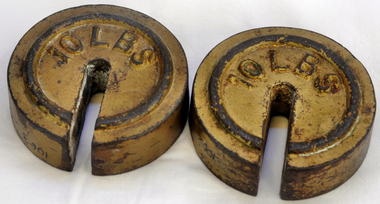
weights, C 1920
... weighed on scales using these weights. Used in early 1930's. The early 20th century saw an emphasis in Australia on the reforming of mothering practices. There was a desire to improve infant mortality rates and produce healthy, well-adjusted citizens.Government organisations, in particular hospitals and baby clinics. encouraged mothers to measure their babies and regulate their feeding patterns. By the 1930s most mothers had been influenced to a greater or less extent by these new approaches to infant care. These weights are representative of that period. weights instruments ...Many Orbost babies were weighed on scales using these weights. Used in early 1930's.The early 20th century saw an emphasis in Australia on the reforming of mothering practices. There was a desire to improve infant mortality rates and produce healthy, well-adjusted citizens.Government organisations, in particular hospitals and baby clinics. encouraged mothers to measure their babies and regulate their feeding patterns. By the 1930s most mothers had been influenced to a greater or less extent by these new approaches to infant care. These weights are representative of that period.Two steel circular 10lb weights used with 106.1 scales used to weigh babies at Orbost Hospital. Gold painted. 10 lbs in relief on top of each weight.weights instruments-weighing orbost-hospital nursing -
 Orbost & District Historical Society
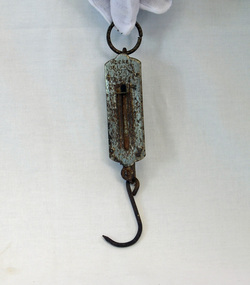
pocket scales, 1920's
... scales were widely used in markets, grocers and farm shops – wherever people needed to be able to verify the weight of goods to be purchased in order to calculate the correct pricing. Because it was portable, and simple to use, the pocket balance was ideal for weighing goods where accuracy was not required. This balance appears to have been used for weighing fish. scales pocket-balance spring-balance measuring-instrument ...The pocket balance was first created in 1770 by Richard Salter in the UK. From the late 18th century onwards these small scales were widely used in markets, grocers and farm shops – wherever people needed to be able to verify the weight of goods to be purchased in order to calculate the correct pricing. Because it was portable, and simple to use, the pocket balance was ideal for weighing goods where accuracy was not required. This balance appears to have been used for weighing fish.Pocket spring scales made of steel. There is a spring fixed at one end with a hook to which an object can be attached at the other. At the top of the scales there. is a metallic ring to fasten the object. This is attached to the main body which on one side has measurements inscribed into the metal surface. Inside the body is a spring loaded mechanism which moves along the scales when weight is added to a hook at the bottom of the shaft.At the top - POCKET BALANCE ARROW and the letters M P inside an oval.scales pocket-balance spring-balance measuring-instrument -
 Bendigo Military Museum
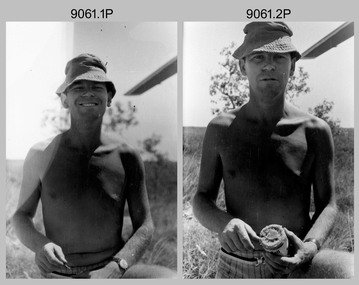
Photograph - RA Svy Project C4 Aerodist Operation, Eastern & Western Arnhem Land, NT, 1967, 1968
... They are part of the Army Survey Regiment’s Collection. .1) to .2) – Photo, black & white, 1968, unidentified soldier with an opened can of food, possibly bully beef. .3) – Photo, black & white, 15 Aug 1968, aerial view of terrain taken from a helicopter in vicinity of MILINGIMBI SIERRA. .4) – Photo, black & white, 1967, aerial view of an island taken from a helicopter. .5) & .6) – Photo, black & white, 1967, unidentified soldier driving a Haflinger 4x4 Light utility vehicle with trailer. .7) – Photo, black & white, 1967, unidentified surveyors taking vertical measurements with a leveling instrument and staff. .8) – Photo, black & white, 1967, Australian Army Sioux Light Observation Helicopter (LOH) with float removed. .9) to .11) – Photo, black & white, 1967, Australian Army Sioux Light Observation Helicopter (LOH) with floats. .12) – Photo, black & white, 1967, civilian Bell 47G-2 helicopter (Australian Army Sioux LOH equivalent) refuelled. .13) – Photo, black & white, 1967, survey station on coastline surrounded by white plastic aerial photographic identification panels lined with rocks. .14) & .15) – Photo, black & white, 1967, soldier (possibly a signaller from RA Sigs) operating a radio. .16) – Photo, black & white, 1967, Central Comd Fd Svy Unit Operations Section tent, Main Base Gove (Nhulunbuy) L to R: SPR Harry Dunn, WO1 Pat Wood BEM. .17) – Photo, black & white, 1967, Central Comd Fd Svy Unit Operations Section tent, Main Base Gove (Nhulunbuy) L to R: unidentified, WO1 Pat Wood BEM. .18) – Photo, black & white, 1967, Central Comd Fd Svy Unit Operations Section, Main Base Gove (Nhulunbuy), unidentified Australian Army Catering Corps cook preparing meals. .19) – Photo, black & white, 1967, Central Comd Fd Svy Unit Operations Section, Main Base Gove (Nhulunbuy) mess tent in readiness for meals. .20) – Photo, black & white, 1967, Bank of batteries in transit boxes undergoing recharging using generators. .21) – Photo, black & white, 1967, A topographic survey identification plaque set in a concrete block being weighed using a set of scales hanging from slaughtering gallows. .22) – Photo, black & white, 1967, CPL (Geoff or Gary) Larkin operating the remote Aerodist MRC2 ground instrument at Veronica Island, located north of Nhulunbuy. .23) – Photo, black & white, 1967, L to R: CPL (Geoff or Gary) Larkin with unidentified surveyor operate the remote Aerodist MRC2 ground instrument at Venica Island, located north of Nhulunbuy. .24) & .25 – Photo, black & white, 1967, The Aerodist MRC2 Remote antenna. .26) – Photo, black & white, 1967, The Aerodist MRC2 Remote antenna....They are part of the Army Survey Regiment’s Collection. .1) to .2) – Photo, black & white, 1968, unidentified soldier with an opened can of food, possibly bully beef. .3) – Photo, black & white, 15 Aug 1968, aerial view of terrain taken from a helicopter in vicinity of MILINGIMBI SIERRA. .4) – Photo, black & white, 1967, aerial view of an island taken from a helicopter. .5) & .6) – Photo, black & white, 1967, unidentified soldier driving a Haflinger 4x4 Light utility vehicle with trailer. .7) – Photo, black & white, 1967, unidentified surveyors taking vertical measurements with a leveling instrument and staff. .8) – Photo, black & white, 1967, Australian Army Sioux Light Observation Helicopter (LOH) with float removed. .9) to .11) – Photo, black & white, 1967, Australian Army Sioux Light Observation Helicopter (LOH) with floats. .12) – Photo, black & white, 1967, civilian Bell 47G-2 helicopter (Australian Army Sioux LOH equivalent) refuelled. .13) – Photo, black & white, 1967, survey station on coastline surrounded by white plastic aerial photographic identification panels lined with rocks. .14) & .15) – Photo, black & white, 1967, soldier (possibly a signaller from RA Sigs) operating a radio. .16) – Photo, black & white, 1967, Central Comd Fd Svy Unit Operations Section tent, Main Base Gove (Nhulunbuy) L to R: SPR Harry Dunn, WO1 Pat Wood BEM. .17) – Photo, black & white, 1967, Central Comd Fd Svy Unit Operations Section tent, Main Base Gove (Nhulunbuy) L to R: unidentified, WO1 Pat Wood BEM. .18) – Photo, black & white, 1967, Central Comd Fd Svy Unit Operations Section, Main Base Gove (Nhulunbuy), unidentified Australian Army Catering Corps cook preparing meals. .19) – Photo, black & white, 1967, Central Comd Fd Svy Unit Operations Section, Main Base Gove (Nhulunbuy) mess tent in readiness for meals. .20) – Photo, black & white, 1967, Bank of batteries in transit boxes undergoing recharging using generators. .21) – Photo, black & white, 1967, A topographic survey identification plaque set in a concrete block being weighed using a set of scales hanging from slaughtering gallows. .22) – Photo, black & white, 1967, CPL (Geoff or Gary) Larkin operating the remote Aerodist MRC2 ground instrument at Veronica Island, located north of Nhulunbuy. .23) – Photo, black & white, 1967, L to R: CPL (Geoff or Gary) Larkin with unidentified surveyor operate the remote Aerodist MRC2 ground instrument at Venica Island, located north of Nhulunbuy. .24) & .25 – Photo, black & white, 1967, The Aerodist MRC2 Remote antenna. .26) – Photo, black & white, 1967, The Aerodist MRC2 Remote antenna. ...This is a set of 26 photographs of Royal Australian Survey Corps (RA Svy) personnel from Central Comd Fd Svy Unit (Adelaide) on Aerodist survey operation - Project C4 in Eastern Arnhem Land, Northern Territory in 1967 (photos .4P to .26P) and in Western Arnhem Land, Northern Territory in 1968 (photos .1P to .3P). Photos of personnel were taken either at the operations base at Numbulwar or the main base at Gove (Nhulunbuy). RA Svy conducted nineteen Aerodist operations for 12 years from 1964 to 1975. Aerodist MRC2 was a tellurometer-based system adapted for aircraft to accurately measure distances between non-intervisible ground survey stations, using the aircraft as an intermediate station. Lower order geodetic results could be achieved by survey network trilateration. The measured distances between stations formed survey networks from which each station’s latitude and longitude was computed. Aerodist MRC2 was RA Svy’s major horizontal control survey tool for mainly medium scale topographic mapping (scale 1:100,000 Class A being spatially accurate to within 50 metres) in PNG, northern NT, north-west WA, Kalimantan Barat (West) Indonesia, Sumatra Indonesia, Gulf of Carpentaria and Cape York, QLD. In 1967, the Aerodist MRC2 Master equipment was installed in the aircraft featured in this set of photos, Executive Air Services’ (Essendon VIC) Grand Aero Commander VH-EXX. It was the same aircraft type and company contracted to Division of National Mapping for Aerodist MRC2 surveys. From July to October 1967 the aircraft was attached to Central Comd Fd Svy Unit (Adelaide - Major Don Ridge) on Project C4 eastern-Arnhem Land NT, where 317 Aerodist lines measuring 17,300 line miles were successfully completed. This was the most productive Aerodist project thus far. The most common helicopter used by RA Svy up to 1972 was the civilian Bell 47G-2 and the Sioux Light Observation Helicopters (LOH), the Australian Army’s equivalent featured in this photo set. These light observation helicopters had a limiting load carrying capacity of up to about 500 pounds. By comparison, one Aerodist team including two people weighed up to 1,500 pounds. In 1968, after completion of the Kimberley Aerodist Operation project, the Aerodist system in VH-EXX was immediately deployed to western-Arnhem Land NT for Central Comd Fd Svy Unit (Adelaide - Major Don Ridge) to complete the mapping control across northern NT from mid-July to October. The Aerodist MRC2 Remote antenna seen in Photos .24P to .26P is mounted on a 20 foot pole tower. The antenna direction was controlled by wires/ropes to the two arms under the dish at right angles. The antenna elevation could be changed to the vertical for aircraft height checks as seen in photo .25P. Source: Royal Australian Survey Corps – Aerodist Years 1964-1975 by Peter Jensen. Refer to Item 6449.30P for more photos taken during these Aerodist survey operations.This is a set of 26 photographs of Royal Australian Survey Corps (RA Svy) personnel on Aerodist survey operations in Eastern Arnhem Land, Northern Territory in 1967 and Western Arnhem Land, Northern Territory in 1968. The photographs are on 35mm negative film and scanned at 96 dpi. They are part of the Army Survey Regiment’s Collection. .1) to .2) – Photo, black & white, 1968, unidentified soldier with an opened can of food, possibly bully beef. .3) – Photo, black & white, 15 Aug 1968, aerial view of terrain taken from a helicopter in vicinity of MILINGIMBI SIERRA. .4) – Photo, black & white, 1967, aerial view of an island taken from a helicopter. .5) & .6) – Photo, black & white, 1967, unidentified soldier driving a Haflinger 4x4 Light utility vehicle with trailer. .7) – Photo, black & white, 1967, unidentified surveyors taking vertical measurements with a leveling instrument and staff. .8) – Photo, black & white, 1967, Australian Army Sioux Light Observation Helicopter (LOH) with float removed. .9) to .11) – Photo, black & white, 1967, Australian Army Sioux Light Observation Helicopter (LOH) with floats. .12) – Photo, black & white, 1967, civilian Bell 47G-2 helicopter (Australian Army Sioux LOH equivalent) refuelled. .13) – Photo, black & white, 1967, survey station on coastline surrounded by white plastic aerial photographic identification panels lined with rocks. .14) & .15) – Photo, black & white, 1967, soldier (possibly a signaller from RA Sigs) operating a radio. .16) – Photo, black & white, 1967, Central Comd Fd Svy Unit Operations Section tent, Main Base Gove (Nhulunbuy) L to R: SPR Harry Dunn, WO1 Pat Wood BEM. .17) – Photo, black & white, 1967, Central Comd Fd Svy Unit Operations Section tent, Main Base Gove (Nhulunbuy) L to R: unidentified, WO1 Pat Wood BEM. .18) – Photo, black & white, 1967, Central Comd Fd Svy Unit Operations Section, Main Base Gove (Nhulunbuy), unidentified Australian Army Catering Corps cook preparing meals. .19) – Photo, black & white, 1967, Central Comd Fd Svy Unit Operations Section, Main Base Gove (Nhulunbuy) mess tent in readiness for meals. .20) – Photo, black & white, 1967, Bank of batteries in transit boxes undergoing recharging using generators. .21) – Photo, black & white, 1967, A topographic survey identification plaque set in a concrete block being weighed using a set of scales hanging from slaughtering gallows. .22) – Photo, black & white, 1967, CPL (Geoff or Gary) Larkin operating the remote Aerodist MRC2 ground instrument at Veronica Island, located north of Nhulunbuy. .23) – Photo, black & white, 1967, L to R: CPL (Geoff or Gary) Larkin with unidentified surveyor operate the remote Aerodist MRC2 ground instrument at Venica Island, located north of Nhulunbuy. .24) & .25 – Photo, black & white, 1967, The Aerodist MRC2 Remote antenna. .26) – Photo, black & white, 1967, The Aerodist MRC2 Remote antenna.The following photos are annotated in black ink on edge of film negative: .3P – ’15 Aug ’68, 2000’, 1-C18 ’68 MILINGIMBI SIERRA’ .4P – ’U462’ .8P – ‘1-C3/67 Float Removed’ .13P – ‘U477 10-C3/67 .20P - ‘2-C3/67 Bank of Chargers’ .21P - ‘3-C3/67 Gallows & Scales’ .22P - ‘0462 VERONICA ISLAND NT, CPL Larkin’ .23P - ‘0462 VERONICA ISLAND NT’ .24P - ‘4-C3/67 20’ Aerodist Tower’ .25P - ‘5-C3/67 20’ Aerodist Tower’ .26P - ‘6-C3/67 20’ Aerodist Tower’royal australian survey corps, rasvy, army survey regiment, army svy regt, fortuna, asr, aerodist, surveying, central comd fd svy unit -
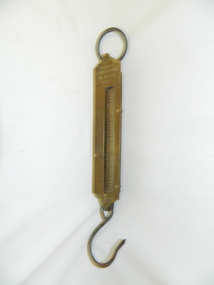 Kiewa Valley Historical Society
Scales Weighing Spring, mid to late 1900's
... scales are very significant for the rural produce within the Kiewa Valley. Rural produce such as hay milk and butter tubs,tobacco bundles could be easily weighed (in relatively smaller packages) for both markets and for use within the valley. weighing instruments spring balances At the front top"SALTER'S SPRING BALANCE 4LB BY 21/2 OZ" underneath "No 1A" At the bottom in smaller print "MADE IN ENGLAND PATENT" This spring scale (! ...This type of mobile spring weighing scales were in high use before legislative Weights and Measure standards where in force throughout Australia. This was in a time when a "mans word and handshake" was his legal document. It was a time, especially in rural areas that the term "she'll be right" was extensively used and these types of scales (the accuracy over time) would produce a near "enough is good enough" measure. These scales are very significant for the rural produce within the Kiewa Valley. Rural produce such as hay milk and butter tubs,tobacco bundles could be easily weighed (in relatively smaller packages) for both markets and for use within the valley.This spring scale (!/2 Once to 4lb) was used as general weight scale. Because it is spring loaded the accuracy would fade over time and by over weighted loads. The spring enclosure is made from cast iron painter black. There is an iron ring at the top (attaching/holding) and an iron hook at the bottom (holding). There is a brass front plate with engraved markings(on the left side) running from top to bottom and a movable pin weight indicator running in the middle indicating the weight of the item being weighed.At the front top"SALTER'S SPRING BALANCE 4LB BY 21/2 OZ" underneath "No 1A" At the bottom in smaller print "MADE IN ENGLAND PATENT"weighing instruments, spring balances -
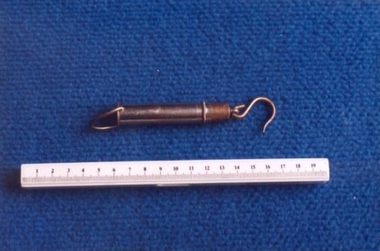 Royal Australian and New Zealand College of Obstetricians & Gynaecologists (RANZCOG)
Weighing scales used by Dr Mitchell Henry O'Sullivan
... Scales like these were used to weigh babies. Dr Mitchell Henry O'Sullivan worked in the Victorian country town of Casterton as a general practitioner from 1919 until his death in 1977. He also practiced obstetrics. His son, Dr David More O'Sullivan donated the obstetric bag and its contents to the College in 1999. The gladstone bag and contents are a unique time capsule of the type of instruments ...Scales like these were used to weigh babies.Dr Mitchell Henry O'Sullivan worked in the Victorian country town of Casterton as a general practitioner from 1919 until his death in 1977. He also practiced obstetrics. His son, Dr David More O'Sullivan donated the obstetric bag and its contents to the College in 1999. The gladstone bag and contents are a unique time capsule of the type of instruments and pharmaceuticals used in the inter-war period. Set of small, portable spring balance scales. With case/enclosure.infant care -
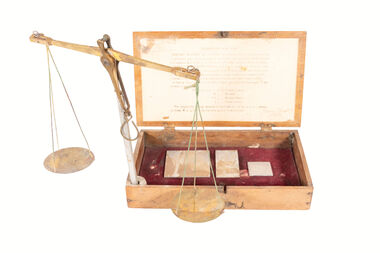 National Wool Museum
Instrument - Scales, 1880-1898
... Scales used for weighing and calculating weight and thread count of textile samples. Originated from Godfrey Hirst Mills in Geelong. Writing describes how to utilise scales. Scales are made from brass, pole for holding scales once brass now replaced with metal pole. Scales held inside wooden box with black text in ink depicting use of scales on paper located inside and outside of box. Instrument ...At the time of sale, the last of the Hirst family to work in the mill located in Geelong gave Donald (donor Bruce's father) Doherty a set of scales that had been used by several generations of Hirsts and adapted by them over time for specific use in their mill. These Scales were saved from waste and being thrown away at the time of sale to remain in use in the industry in the hands of someone who knew how to use them. The scales were used in calculating the weight of cloth and simultaneously calculating the amount of yarn required to weave it following the instructions printed within the box. The box bears the signatures of two Hirst family members, one being Lewis Hirst dated at 1898. The original brass pole has been replaced with a replica metal somewhere throughout the years after the brass pole broke through use. Hirst was brought by McKendrick in the 1960s and these scales sat for 12 months as part of the 12 month "cooling off" period. The scales were then handed to Donald rather than being disposed of.Scales used for weighing and calculating weight and thread count of textile samples. Originated from Godfrey Hirst Mills in Geelong. Writing describes how to utilise scales. Scales are made from brass, pole for holding scales once brass now replaced with metal pole. Scales held inside wooden box with black text in ink depicting use of scales on paper located inside and outside of box.Outside of box. Wording: APPARTUS for TESTING the WEIGHT per YARD of CLOTHS & COUNT of YARN from a small SAMPLE. -------------------------------------------------------------------------------------------------------------------------------------------------- Indispensable to Manufactures, Merchants & handling Woollen, Worsted, Cotton, Linen, Jute, Hemp, Flannel, Felt, Army, Navy, Police, Railway, Sail & other Cloths -------------------------------------------------------------------------------------------------------------------------------------------------- USED IN GOVERNMENT DEPARTMENTS -------------------------------------------------------------------------------------------------------------------------------------------------- The apparatus consists of Scales, Weights, 1, 2 & 4 sq. inch Cutting Templates & Book of Tables --------------------------------------------------------------------------------------------------------------------------------------------------By weighing a small Sample the accurate Weight in Ounces of a yard of Cloth any width from 18 to 64 inches, the Weight per Square Metre in Grams, the Counts* of Warp and Weft, and the approximate length of full & short ends of pieces of fabrics, [without unrolling and measuring for stocktaking & other purposes] can be ascertained without any Calculation --------------------------------------------------------------------------------------------------------------------------------------------------Price in United Kingdom, 25s., Carriage Paid. Price to Canada & U.S.A. $6.75 do. H. Lord. 10, And Place, Bradford, England. --------------------------------------------------------------------------------------------------------------------------------------------------*When ordering, state on what system you base your YARN COUNTS. Inside of box. Wording: DIRECTIONS FOR USE --------------------------------------------------------------------------------------------------------------------------------------------------TESTING WEIGHT OF CLOTHS. Place sample to be tested on a piece of cardboard, put a Cutting Template on it, cut card and cloth round template with scissors and weigh it according to instructions given in Book of Tables. TESTING FOR YARN COUNTS. Cut out 1 square inch of cloth, draw out wrap or weft threads, according to which is being tested, and the number of inches so drawn, that balance respective weight is the approximate Count. The same rule holds good when number of inches are drawn from a bobbin. In testing from the cloth, allowance has to be made for loss or gain in the process of manufacture. Weight marked C is for Cotton Counts " " W " " Worsted " " " WS " " Woollen Skeins " " L " " Linen Counts. The weights for testing samples of cloth are 20, 10, 10, 5, 3, 2, 1, grains in brass & '5, '3, '2, '1 [tenths of a grain] in aluminium. Inside of box. Signtures, handwritten: Bottom right: Lewis Hirst !898 Top Left (Smudge ?) W Hirst !935godfrey hirst, hirst family, textile design, textile creation -
 Tatura Irrigation & Wartime Camps Museum
Equipment - Scales
... Scales used at "Rosella" factory Tatura to weigh mail, to calculate postage before taking to Post Office. Used by Loretta Hooper and presented to her when she retired from Rosella. tatura instruments weighing 1/2 oz, 1 oz, 2 oz, 4 oz, Made in England, Warranted Accurate 1/2 oz, 1 oz, 2 oz, 4 oz Weights; Brass balancing scales set on wooden base Equipment Scales ...Scales used at "Rosella" factory Tatura to weigh mail, to calculate postage before taking to Post Office. Used by Loretta Hooper and presented to her when she retired from Rosella.1/2 oz, 1 oz, 2 oz, 4 oz Weights; Brass balancing scales set on wooden base1/2 oz, 1 oz, 2 oz, 4 oz, Made in England, Warranted Accuratetatura, instruments, weighing -
Clunes Museum
functional object - SPRING BALANCE SCALES, Salter
... Scales Weighing instrument No. 2 Salter Improved spring balance Warranted Spring scale with hook and ring, sliding scale from 0-23 functional object SPRING BALANCE SCALES Salter ...Spring scale with hook and ring, sliding scale from 0-23No. 2 Salter Improved spring balance Warrantedscales, weighing instrument -
Clunes Museum
functional object - SPRING BALANCE SCALES, SALTER
... Scales Weighing instrument No.2 Salter Improved Spring Balance 0-23 THIS IS METAL SPRING BALANCE SCALES WITH A RING ONE ONE END AND A HOOK ON THE OTHER. functional object SPRING BALANCE SCALES SALTER ...THIS IS METAL SPRING BALANCE SCALES WITH A RING ONE ONE END AND A HOOK ON THE OTHER.No.2 Salter Improved Spring Balance 0-23scales, weighing instrument
