
Showing 18 items matching "scenery painter"
-
 Bendigo Historical Society Inc.
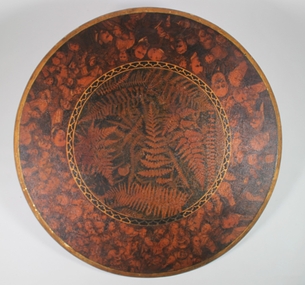
Furniture - Round table top, Frank Fearn, 1890
... ...scenery painter...He spent some time as a scene painter at the Princess Theatre in Melbourne before trying his luck on the goldfield without much success. He then resumed his former profession painting scenery at the Lyceum Theatre, Bendigo. ...(Bendigo Independent (Vic. : 1891 - 1918), Thursday 24 December 1896, p 3) Frank Fearn theatre scenery painter Tarnagully Dunolly Mark Twain Chronicles of the Golden City illuminated address A round wooden tabletop. ...Frank Fearn created the painted pine table top in the early 1890’s. It was displayed in the establishment of Messrs Watts and Glasier, Bath Corner, Bendigo in January 1891, and described in the ‘Bendigo Advertiser’ as being a ‘work of art’ and having ‘a circle in the centre in which some ferns have been very nicely painted’ in an interesting allusion to his surname. ‘Around the circle are likenesses of about a couple of hundred public men representing the clergy, politics, law, sports and leading local residents’. There are also some women in the likenesses, however, not mentioned in the article. The portraits are ‘life-like and considering that they are all worked out in pen and ink only the result is really surprising’ (Bendigo Advertiser, 28th January 1891, p2) Frank Fearn (1836 – 1896) was a well known artist across the goldfield and, particularly, in his work on illuminated addresses ‘he had no superior and he enjoyed a monopoly in this line’. However, his work was not limited to a narrow field; being also known for his expertise in the theatre where he was a scene painter. Frank was born in Devonshire in 1835, migrating to Australia in 1852 on the ‘Henry Gillespie’. He spent some time as a scene painter at the Princess Theatre in Melbourne before trying his luck on the goldfield without much success. He then resumed his former profession painting scenery at the Lyceum Theatre, Bendigo. He was a member of the Bendigo Road Board during that time. He later spent time living at Tarnagulla where he leased the Theatre Royal and founded the ‘Easton and Bussey Troupe’. By 1871 he was in Dunolly, where he was appointed Land Officer for ten years. He founded the Dunolly Free library’ was Secretary of the Dunolly Philharmonic Society and a member of the Borough Council. He then went to St. Arnaud, where he leased the Railway refreshment rooms on the occasion of the opening of the rail line. His final twelve years were spent again in Bendigo. He was a witty and satirical author of articles in the ‘Bendigo Advertiser’, writing amongst other sketches, the ‘Chronicles of the Golden City’. On the occasion of Mark Twain’s (Mr. S.L. Clemens) visit to Bendigo in 1895, Frank Fearn presented him with an illuminated letter of welcome, organised in to a book form. Frank died in December 1896. (Bendigo Independent (Vic. : 1891 - 1918), Thursday 24 December 1896, p 3) A round wooden tabletop. The middle section has brown coloured images of ferns and is surrounded with a gold coloured decorative pattern. The outer section is filled with various sized faces of men and women who appear to be from the late 19th century. The initials F. F. (Frank Fearn) and 1890 are inscribed on the table top. Gold leaf edging surrounds the outer edge of the table. The bottom of the tabletop has a two centimetre diameter and eight centimetre long metal rod with half centimetre wide slot in the centre of the table top, presumable to hold legs. frank fearn, theatre, scenery painter, tarnagully, dunolly, mark twain, chronicles of the golden city, illuminated address -
 Tatura Irrigation & Wartime Camps Museum
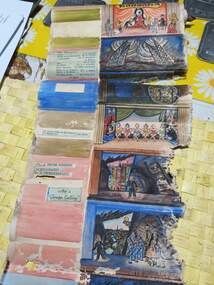
Work on paper - Scroll, Sergeant Snow White
... Myer, or BIM - a well-known Commercial Artist in Melbourne) had made when a member of the team of set designers and scenery painters, for the 8th Employment Company's production of "Sergeant Snow White", which was performed at the Melbourne University Union Theatre, in April 1943! ...Myer, or BIM - a well-known Commercial Artist in Melbourne) had made when a member of the team of set designers and scenery painters, for the 8th Employment Company's production of "Sergeant Snow White", which was performed at the Melbourne University Union Theatre, in April 1943! ...A hand painted paper scroll, which Berthold Irving Meier (Bert. I. Myer, or BIM - a well-known Commercial Artist in Melbourne) had made when a member of the team of set designers and scenery painters, for the 8th Employment Company's production of "Sergeant Snow White", which was performed at the Melbourne University Union Theatre, in April 1943! It was a Sergeant Doc K Sternberg production, the other set designers being L/Corporal Emil Wittenberg, Private Klaus Friedeberger and Private Friedrich (Fritz) Schoenbach. The show incorporated songs and music by Kurt Kohn (pseudonym Ray Martin), with Erich Liffmann cast as Prince Charming. The masks for the ballet "Ghosts of Europe" were designed by Private Erwin Fabian. Others in the cast included Corporal A P Schmitz (ballet soloist), Sergeant Sigismund Lohde, and Sergeant H Mayer. The Production was extremely well-received and was called "a colourful and tuneful revue ......... a fine achievement of writing and direction......scenery and stage décor ingenious and amusing." There were write-ups in both "The Age" and "The Argus" Melbourne newspapers at the time. The scroll was originally housed in a wooden box, with "windows", (since lost) so that when the scroll was wound though, each scene, and the accompanying description from the original programme, could be seen.Two long pieces of paper which originally would have been one and has been rolled into a scroll. The length of paper has been divided into two and then divided into approximately 12 sections. On the left in different colours is bits of information relating to the scene. On the right are different scenes from the play.bert i myer, bim, sergeant snow white, 8th employment company, melbourne university union theatre, doc k sternberg, f schoenbach, kurt kohn, erich liffmann, erwin fabian, a p schmitz, h mayer, kathleen whelan, tatura internment camps, berthold irving meier, klaus friedeberger, emil wittenberg, friedrich (fritz) schoenbach, sigismund lohde -
![Photograph, Bull, Hugh Jones, 1897-1993, [City buildings under demolition]](/media/collectors/68524623ad73480cc6fce59f/items/68f07d2d2b74709eaf6b0def/item-media/68f07d572b74709eaf6b1536/item-fit-380x285.jpg?cb=6) City of Melbourne Libraries
City of Melbourne LibrariesPhotograph, Bull, Hugh Jones, 1897-1993, [City buildings under demolition]
... In November 1890, Arthur Streeton worked there briefly as a scenery painter. By 1909 it was the first “legitimate” theatre in Melbourne to screen films on a semi-permanent basis, while also covering vaudeville, pantomime and its wildly popular final program, “Mickey the Mouse” Revue. ...In November 1890, Arthur Streeton worked there briefly as a scenery painter. By 1909 it was the first “legitimate” theatre in Melbourne to screen films on a semi-permanent basis, while also covering vaudeville, pantomime and its wildly popular final program, “Mickey the Mouse” Revue. ...Published: The Age 4 April 1934 p11 Published title: "DEMOLITION AND BUILDING ACTIVITIES IN THE CITY." Published caption: "Interesting studies in the building activities in the city are afforded by the above three photographs taken yesterday when work ceased owing to the rain. That on the left is a striking picture of the remains of the Palace Hotel buildings, running back from Bourke street to Little Collins street, better known as the Bijou Theatre. This is the largest demolition contract ever undertaken in Melbourne. The view is towards Bourke street, from a vantage point in Little Collins street. In the right centre of the ruins may be seen a large portion of the light frame and lattice work which extended over the once well known arcade. In the background three stories of Melbourne Coffee Palace, on the opposite side of Bourke street rise above the front of the theatre in the photograph, and the Melbourne General Hospital is just discernible through the mist at the top. The steel frame work in the centre picture is readily identifiable as that erected for the extension of the State Savings Bank at the south-west corner of Bourke and Elizabeth streets. The steel skeleton to the right, suggestive of immense strength, is that nearing completion in Collins street for the Bank of New South Wales." Trove article identifier: http://nla.gov.au/nla.news-article203828669 Description: Partial demolition of three-storied and five-storied buildings. One building has a large atrium. View of buildings taken from rear. Building at 225 Bourke Street (between Swanston and Russell, south side) contains Bijou Theatre. Also Victoria Arcade, built 1876, architect Joseph Reed. On other side of Arcade is Gaiety Theatre (formerly known as Oxford Theatre). Cityscape in background. Opposite is Melbourne Coffee Palace, built 1882, demolished c.1970. Featured in "Newsworthy: Melbourne in photographs 1933-1936" exhibition at East Melbourne Library, October to December 2023. Exhibition caption by project volunteer Louise McKenzie: "The largest demolition contract ever undertaken in Melbourne… The building on the left is a striking picture of the remains of the Palace Hotel buildings, running back from Bourke Street to Little Collins Street, better known as the Bijou Theatre. This is the largest demolition contract ever undertaken in Melbourne.” – The Age The Bijou Theatre was erected in 1877 and originally built as part of Victoria Arcade, which was entered through the Bourke Street frontage. The Theatre was “de rigueur with the gallants and belles of the period. Dainty ladies and white gloved, stiff collared dandies thronged the ‘promenade’ which runs under the theatre.” (Herald 5 Feb 1934) However by 1885, after a fire, the building had been rebuilt to include the three level Bijou Theatre. In November 1890, Arthur Streeton worked there briefly as a scenery painter. By 1909 it was the first “legitimate” theatre in Melbourne to screen films on a semi-permanent basis, while also covering vaudeville, pantomime and its wildly popular final program, “Mickey the Mouse” Revue. In this photo, it is being demolished by Whelan the Wrecker. The tiny iron spiral staircases that led to the dressing rooms (and down which more than one unwary actor sometimes fell) were salvaged and built into the fabric of Monsalvat at Eltham. References: https://theatreheritage.org.au/on-stage-magazine/stage-by-stage/item/52-bijou-theatrePhotographer notations on slide: "B20".demolished buildings, 1930-1939, joseph reed, theatres -
 Ballarat Heritage Services
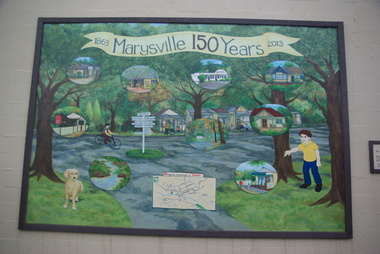
Photograph - Colour, Clare Gervasoni, Marysville Mural, 2014, 01/11/2014
... May it invoke ling held enjoyable memories for residents and visitors, through it's (sic) showcasing of someof Marysville's buildingsand iconic scenery prior to 'Black Saturday' bushfires 2009 Interpreted and painter by muralmaker - Russell Danby Giften by an anonymour benefactor...May it invoke ling held enjoyable memories for residents and visitors, through it's (sic) showcasing of someof Marysville's buildingsand iconic scenery prior to 'Black Saturday' bushfires 2009 Interpreted and painter by muralmaker - Russell Danby Giften by an anonymour benefactor Colour photograph of the Marysville Mural by Russell Danby. ...Colour photograph of the Marysville Mural by Russell Danby.Marysville Mural This mural is dedicated to the people of Marysville past, present and future. May it invoke ling held enjoyable memories for residents and visitors, through it's (sic) showcasing of someof Marysville's buildingsand iconic scenery prior to 'Black Saturday' bushfires 2009 Interpreted and painter by muralmaker - Russell Danby Giften by an anonymour benefactorbushfire, black saturday, marysville, marysville mural, russell danby -
![Fern Terrace, on the River Watt, near Mount Munday / [by] Nicholas Caire, circa 1876](/media/collectors/550653872162f11fb04854aa/items/57775865d0cdd10a5c19a296/item-media/57775986d0cdd10a5c1a3308/item-fit-380x285.jpg?cb=6) Kew Historical Society Inc
Kew Historical Society IncPhotograph, Anglo-Australasian Photographic Company, Fern Terrace, on the River Watt, near Mount Munday, c. 1876
... painters. nicholas caire (1837-1918) landscape photography - victoria printed in ink on support l.c.: FERN TERRACE, ON THE RIVER WATT, NEAR MOUNT MUNDAY. / COPYRIGHT REGISTERED. printed in ink on support reverse c.: VIEWS OF VICTORIA. / (GENERAL SERIES.) / No. 17. / FERN TERRACE, ON THE RIVER WATT, NEAR MOUNT MUNDAY. / Of the various Rivers which exist in the Colony of Victoria, the River Watt (though a small one, and to some / extent unimportant) may be said to contain the most charming as well as the greatest variety of romantic scenery. / The scene of the present issue is perhaps the most unique of its character to be found in any of the Colonies. printed in ink on support reverse l.c.l.: J.W. ...Nicholas Caire was born on Guernsey in the Channel Islands in 1837. He arrived in Adelaide with his parents in about 1860. In 1867, following photographic journeys in Gippsland, he opened a studio in Adelaide. From 1870 to 1876 he lived and worked in Talbot in Central Victoria. In 1876 he purchased T. F. Chuck's studios in the Royal Arcade Melbourne. In 1885, following the introduction of dry plate photography, he began a series of landscape series, which were commercially successful. As a photographer, he travelled extensively through Victoria, photographing places few of his contemporaries had previously seen. He died in 1918. Reference: Jack Cato, 'Caire, Nicholas John (1837–1918)', Australian Dictionary of BiographyAn original, rare photograph from the series 'Views of Victoria: General Series' by the photographer, Nicholas Caire (1837-1918). The series of 60 photographs that comprise the series was issued c. 1876 and reinforced a neo-Romantic view of the Australian landscape to which a growing nationalist movement would respond. Nicholas Caire was active as a photographer in Australia from 1858 until his death in 1918. His vision of the Australian bush and pioneer life had a counterpart in the works of Henry Lawson and other nationalist poets, authors and painters.Albumen silver photograph mounted on boardprinted in ink on support l.c.: FERN TERRACE, ON THE RIVER WATT, NEAR MOUNT MUNDAY. / COPYRIGHT REGISTERED. printed in ink on support reverse c.: VIEWS OF VICTORIA. / (GENERAL SERIES.) / No. 17. / FERN TERRACE, ON THE RIVER WATT, NEAR MOUNT MUNDAY. / Of the various Rivers which exist in the Colony of Victoria, the River Watt (though a small one, and to some / extent unimportant) may be said to contain the most charming as well as the greatest variety of romantic scenery. / The scene of the present issue is perhaps the most unique of its character to be found in any of the Colonies. printed in ink on support reverse l.c.l.: J.W. FORBES, Agent, printed in ink on support reverse l.c.: ANGLO-AUSTRALASIAN PHOTOGRAPHIC COMPANY, MELBOURNE. printed in ink on support reverse l.c.r.: 10 Temple Court, Collins Street West.nicholas caire (1837-1918), landscape photography - victoria -
![Entrance to Fernshawe / [by] Nicholas Caire, circa 1876](/media/collectors/550653872162f11fb04854aa/items/577b462bd0cdd10948c53643/item-media/577b46c2d0cdd10948c58d0c/item-fit-380x285.jpg?cb=6) Kew Historical Society Inc
Kew Historical Society IncPhotograph, Anglo-Australasian Photographic Company, Entrance to Fernshawe, c. 1876
... His vision of the Australian bush and pioneer life had a counterpart in the works of Henry Lawson and other nationalist poets, authors and painters. landscape photography - australia - 19th century nicholas caire Printed inscription on reverse: A fifty-mile drive from Melbourne, via Lilydale, will bring the traveller to the township of Fernshawe. On nearing the entrance to the town, the scenery ...Nicholas Caire was born on Guernsey in the Channel Islands in 1837. He arrived in Adelaide with his parents in about 1860. In 1867, following photographic journeys in Gippsland, he opened a studio in Adelaide. From 1870 to 1876 he lived and worked in Talbot in Central Victoria. In 1876 he purchased T. F. Chuck's studios in the Royal Arcade Melbourne. In 1885, following the introduction of dry plate photography, he began a series of landscape series, which were commercially successful. As a photographer, he travelled extensively through Victoria, photographing places few of his contemporaries had previously seen. He died in 1918. Reference: Jack Cato, 'Caire, Nicholas John (1837–1918)', Australian Dictionary of Biography, National Centre of Biography.An original, rare photograph from the series 'Views of Victoria: General Series' by the photographer, Nicholas Caire (1837-1918). The series of 60 photographs that comprise the series was issued c. 1876 and reinforced a neo-Romantic view of the Australian landscape to which a growing nationalist movement would respond. Nicholas Caire was active as a photographer in Australia from 1858 until his death in 1918. His vision of the Australian bush and pioneer life had a counterpart in the works of Henry Lawson and other nationalist poets, authors and painters.Albumen silver photograph mounted on boardPrinted inscription on reverse: A fifty-mile drive from Melbourne, via Lilydale, will bring the traveller to the township of Fernshawe. On nearing the entrance to the town, the scenery becomes most enchanting. In the distance can be seen the summit of Mount Munday. The ridge of trees in the middleground forms part of the foot of the Black Spur. The building in the foreground is the residence of the only Government Official, who represents the various titles of Post-master, State School Teacher, Registrar, &c.landscape photography - australia - 19th century, nicholas caire -
![Scene Near the Yarra Flats / [by] Nicholas Caire, circa 1876](/media/collectors/550653872162f11fb04854aa/items/577b4ae3d0cdd10948c7f0b6/item-media/577b4b3fd0cdd10948c81c16/item-fit-380x285.jpg?cb=6) Kew Historical Society Inc
Kew Historical Society IncPhotograph, Anglo-Australasian Photographic Company, Scene Near the Yarra Flats, c. 1876
... His vision of the Australian bush and pioneer life had a counterpart in the works of Henry Lawson and other nationalist poets, authors and painters. nicholas caire australia - landscape photography Inscription on reverse: ‘The scenery in the vicinity of the Yarra Flats is of a very varied character. ...Nicholas Caire was born on Guernsey in the Channel Islands in 1837. He arrived in Adelaide with his parents in about 1860. In 1867, following photographic journeys in Gippsland, he opened a studio in Adelaide. From 1870 to 1876 he lived and worked in Talbot in Central Victoria. In 1876 he purchased T. F. Chuck's studios in the Royal Arcade Melbourne. In 1885, following the introduction of dry plate photography, he began a series of landscape series, which were commercially successful. As a photographer, he travelled extensively through Victoria, photographing places few of his contemporaries had previously seen. He died in 1918. Reference: Jack Cato, 'Caire, Nicholas John (1837–1918)', Australian Dictionary of Biography.An original, rare photograph from the series 'Views of Victoria: General Series' by the photographer, Nicholas Caire (1837-1918). The series of 60 photographs that comprise the series was issued c. 1876 and reinforced a neo-Romantic view of the Australian landscape to which a growing nationalist movement would respond. Nicholas Caire was active as a photographer in Australia from 1858 until his death in 1918. His vision of the Australian bush and pioneer life had a counterpart in the works of Henry Lawson and other nationalist poets, authors and painters.Views of Victoria (General Series) No.21 / ‘Scene near the Yarra Flats’ / Albumen silver photograph mounted on board.Inscription on reverse: ‘The scenery in the vicinity of the Yarra Flats is of a very varied character. In some places the River winds its way through flat open country, with scarcely a shrub on its banks; and in others the scenery is of the wildest description. The stream being impeded in its course by fallen timber, is not so rapid here as at other places. The present illustration is a characteristic one of the above place.’nicholas caire, australia - landscape photography -
![Waterfall Scene on the Coliban River, near Elphinstone / [by] Nicholas Caire, circa 1876](/media/collectors/550653872162f11fb04854aa/items/577b4d42d0cdd10948c96acf/item-media/577b4dbfd0cdd10948c9b34f/item-fit-380x285.jpg?cb=6) Kew Historical Society Inc
Kew Historical Society IncPhotograph, Anglo-Australasian Photographic Company, Waterfall Scene on the Coliban River, near Elphinstone, c. 1876
... His vision of the Australian bush and pioneer life had a counterpart in the works of Henry Lawson and other nationalist poets, authors and painters. nicholas caire (1837-1918) australia - landscape photography On reverse: ‘The scene this illustration presents is but one of the many that exist along the course of this shallow River, which, like its parent the Campaspe, abounds with rocky and romantic scenery. ...Nicholas Caire was born on Guernsey in the Channel Islands in 1837. He arrived in Adelaide with his parents in about 1860. In 1867, following photographic journeys in Gippsland, he opened a studio in Adelaide. From 1870 to 1876 he lived and worked in Talbot in Central Victoria. In 1876 he purchased T. F. Chuck's studios in the Royal Arcade Melbourne. In 1885, following the introduction of dry plate photography, he began a series of landscape series, which were commercially successful. As a photographer, he travelled extensively through Victoria, photographing places few of his contemporaries had previously seen. He died in 1918. Reference: Jack Cato, 'Caire, Nicholas John (1837–1918)', Australian Dictionary of Biography.An original, rare photograph from the series 'Views of Victoria: General Series' by the photographer, Nicholas Caire (1837-1918). The series of 60 photographs that comprise the series was issued c. 1876 and reinforced a neo-Romantic view of the Australian landscape to which a growing nationalist movement would respond. Nicholas Caire was active as a photographer in Australia from 1858 until his death in 1918. His vision of the Australian bush and pioneer life had a counterpart in the works of Henry Lawson and other nationalist poets, authors and painters.Views of Victoria (General Series) No.23 / ‘Waterfall scene on the Coliban River, near Elphinstone’ / Albumen silver photograph mounted on boardOn reverse: ‘The scene this illustration presents is but one of the many that exist along the course of this shallow River, which, like its parent the Campaspe, abounds with rocky and romantic scenery. The fall of the River at this place is over one hundred feet, but is broken by a long course of rocks to the lower bed; the actual fall as seen is about forty feet. The Coliban, though only a branch of the Campaspe, derives its name from the fact that its course runs through the Coliban Park. Gold is found in considerable quantities along the banks and in the stream, but at the present time these diggings are worked only by Chinamen.’nicholas caire (1837-1918), australia - landscape photography -
![Scene at Healesville / [by] Nicholas Caire, circa 1876](/media/collectors/550653872162f11fb04854aa/items/577b4f7bd0cdd10948cab12f/item-media/577b4fe9d0cdd10948caef25/item-fit-380x285.jpg?cb=6) Kew Historical Society Inc
Kew Historical Society IncPhotograph, Anglo-Australasian Photographic Company, Scene at Healesville, c. 1876
... His vision of the Australian bush and pioneer life had a counterpart in the works of Henry Lawson and other nationalist poets, authors and painters. nicholas caire (1837-1918) australia - landscape photography On Reverse: ‘After leaving the villages of Lilydale and S. Hubert the scenery ...Nicholas Caire was born on Guernsey in the Channel Islands in 1837. He arrived in Adelaide with his parents in about 1860. In 1867, following photographic journeys in Gippsland, he opened a studio in Adelaide. From 1870 to 1876 he lived and worked in Talbot in Central Victoria. In 1876 he purchased T. F. Chuck's studios in the Royal Arcade Melbourne. In 1885, following the introduction of dry plate photography, he began a series of landscape series, which were commercially successful. As a photographer, he travelled extensively through Victoria, photographing places few of his contemporaries had previously seen. He died in 1918. Reference: Jack Cato, 'Caire, Nicholas John (1837–1918)', Australian Dictionary of Biography.An original, rare photograph from the series 'Views of Victoria: General Series' by the photographer, Nicholas Caire (1837-1918). The series of 60 photographs that comprise the series was issued c. 1876 and reinforced a neo-Romantic view of the Australian landscape to which a growing nationalist movement would respond. Nicholas Caire was active as a photographer in Australia from 1858 until his death in 1918. His vision of the Australian bush and pioneer life had a counterpart in the works of Henry Lawson and other nationalist poets, authors and painters.Views of Victoria (General Series) No.24 / ‘Scene at Healesville’ / Albumen silver photograph mounted on cardOn Reverse: ‘After leaving the villages of Lilydale and S. Hubert the scenery commences to assume a very wild and romantic appearance. The country becomes exceedingly undulatory, and the belts of densely packed scrub, present altogether a very different appearance from the more settled and cultivated districts. Our illustration is taken from one of the many creeks which surround the rising township of Healesville.’nicholas caire (1837-1918), australia - landscape photography -
![Bend of the River Watt / [by] Nicholas Caire, circa 1876](/media/collectors/550653872162f11fb04854aa/items/577b52c2d0cdd10948cc9307/item-media/577b5328d0cdd10948ccc8b6/item-fit-380x285.jpg?cb=6) Kew Historical Society Inc
Kew Historical Society IncPhotograph, Anglo-Australasian Photographic Company, Bend of the River Watt, c.1876
... His vision of the Australian bush and pioneer life had a counterpart in the works of Henry Lawson and other nationalist poets, authors and painters. nicholas caire (1837-1918) australia - landscape photography On Reverse: 'The present illustration represents a scene on the River Watt, and is situated in the valley between Mount Juliet and Mount Monda. The immediate neighbourhood abounds with scenery ...Nicholas Caire was born on Guernsey in the Channel Islands in 1837. He arrived in Adelaide with his parents in about 1860. In 1867, following photographic journeys in Gippsland, he opened a studio in Adelaide. From 1870 to 1876 he lived and worked in Talbot in Central Victoria. In 1876 he purchased T. F. Chuck's studios in the Royal Arcade Melbourne. In 1885, following the introduction of dry plate photography, he began a series of landscape series, which were commercially successful. As a photographer, he travelled extensively through Victoria, photographing places few of his contemporaries had previously seen. He died in 1918. Reference: Jack Cato, 'Caire, Nicholas John (1837–1918)', Australian Dictionary of Biography.An original, rare photograph from the series 'Views of Victoria: General Series' by the photographer, Nicholas Caire (1837-1918). The series of 60 photographs that comprise the series was issued c. 1876 and reinforced a neo-Romantic view of the Australian landscape to which a growing nationalist movement would respond. Nicholas Caire was active as a photographer in Australia from 1858 until his death in 1918. His vision of the Australian bush and pioneer life had a counterpart in the works of Henry Lawson and other nationalist poets, authors and painters.Views of Victoria (General Series) No.26 / 'Bend of the River Watt' / Albumen silver photograph mounted on boardOn Reverse: 'The present illustration represents a scene on the River Watt, and is situated in the valley between Mount Juliet and Mount Monda. The immediate neighbourhood abounds with scenery of the wildest and most romantic character. The River here is as clear as crystal, owing, no doubt, to its bed being composed of rock and pebbles. The banks on either side are studded with foliage so dense as to render access to the neighbourhood almost impracticable.’nicholas caire (1837-1918), australia - landscape photography -
![Scene from the Black Spur / [by] Nicholas Caire, circa 1876](/media/collectors/550653872162f11fb04854aa/items/577b5403d0cdd10948cd5b81/item-media/577b5470d0cdd10948cda270/item-fit-380x285.jpg?cb=6) Kew Historical Society Inc
Kew Historical Society IncPhotograph, Anglo-Australasian Photographic Company, Scene from the Black Spur, c. 1876
... His vision of the Australian bush and pioneer life had a counterpart in the works of Henry Lawson and other nationalist poets, authors and painters. nicholas caire (1837-1918) australia - landscape photography On Reverse: ‘The scene which this illustration represents is taken from one of the slopes of the Black Spur Hill, on the Great Dividing Range of Mountains, and is characteristic of the scenery to be found in most parts of the beautiful and romantic districts of Fernshawe and Healesville.’ ...Nicholas Caire was born on Guernsey in the Channel Islands in 1837. He arrived in Adelaide with his parents in about 1860. In 1867, following photographic journeys in Gippsland, he opened a studio in Adelaide. From 1870 to 1876 he lived and worked in Talbot in Central Victoria. In 1876 he purchased T. F. Chuck's studios in the Royal Arcade Melbourne. In 1885, following the introduction of dry plate photography, he began a series of landscape series, which were commercially successful. As a photographer, he travelled extensively through Victoria, photographing places few of his contemporaries had previously seen. He died in 1918. Reference: Jack Cato, 'Caire, Nicholas John (1837–1918)', Australian Dictionary of Biography.An original, rare photograph from the series 'Views of Victoria: General Series' by the photographer, Nicholas Caire (1837-1918). The series of 60 photographs that comprise the series was issued c. 1876 and reinforced a neo-Romantic view of the Australian landscape to which a growing nationalist movement would respond. Nicholas Caire was active as a photographer in Australia from 1858 until his death in 1918. His vision of the Australian bush and pioneer life had a counterpart in the works of Henry Lawson and other nationalist poets, authors and painters.Views of Victoria (General Series) No.27 / ‘Scene from the Black Spur’ / Albumen silver photograph mounted on boardOn Reverse: ‘The scene which this illustration represents is taken from one of the slopes of the Black Spur Hill, on the Great Dividing Range of Mountains, and is characteristic of the scenery to be found in most parts of the beautiful and romantic districts of Fernshawe and Healesville.’nicholas caire (1837-1918), australia - landscape photography -
![Scene in the Melbourne Botanical Gardens / [by] Nicholas Caire, circa 1876](/media/collectors/550653872162f11fb04854aa/items/577b5a2dd0cdd10948d09d9a/item-media/577b5a96d0cdd10948d0d84a/item-fit-380x285.jpg?cb=6) Kew Historical Society Inc
Kew Historical Society IncPhotograph, Anglo-Australasian Photographic Company, Scene in the Melbourne Botanical Gardens, c. 1876
... painters. nicholas caire (1837-1918) australia - landscape photography On Reverse: ‘The Scene of the present illustration is taken from the Hill on the South Yarra side of the Gardens, shewing in the distance the Government Domain. In the centre of the picture a portion of the Lake may be seen. This Lake is of considerable extent, and being surrounded by hills, the slopes of which contain many beautiful Fern Groves and Vistas of the densest foliage, adds greatly to the beauty and picturesqueness of the surrounding scenery.’ ...Nicholas Caire was born on Guernsey in the Channel Islands in 1837. He arrived in Adelaide with his parents in about 1860. In 1867, following photographic journeys in Gippsland, he opened a studio in Adelaide. From 1870 to 1876 he lived and worked in Talbot in Central Victoria. In 1876 he purchased T. F. Chuck's studios in the Royal Arcade Melbourne. In 1885, following the introduction of dry plate photography, he began a series of landscape series, which were commercially successful. As a photographer, he travelled extensively through Victoria, photographing places few of his contemporaries had previously seen. He died in 1918. Reference: Jack Cato, 'Caire, Nicholas John (1837–1918)', Australian Dictionary of Biography.An original, rare photograph from the series 'Views of Victoria: General Series' by the photographer, Nicholas Caire (1837-1918). The series of 60 photographs that comprise the series was issued c. 1876 and reinforced a neo-Romantic view of the Australian landscape to which a growing nationalist movement would respond. Nicholas Caire was active as a photographer in Australia from 1858 until his death in 1918. His vision of the Australian bush and pioneer life had a counterpart in the works of Henry Lawson and other nationalist poets, authors and painters.Views of Victoria (General Series) No.30 / ‘Scene in the Melbourne Botanical Gardens’ / Albumen silver photograph mounted on boardOn Reverse: ‘The Scene of the present illustration is taken from the Hill on the South Yarra side of the Gardens, shewing in the distance the Government Domain. In the centre of the picture a portion of the Lake may be seen. This Lake is of considerable extent, and being surrounded by hills, the slopes of which contain many beautiful Fern Groves and Vistas of the densest foliage, adds greatly to the beauty and picturesqueness of the surrounding scenery.’nicholas caire (1837-1918), australia - landscape photography -
![Waterfall Scene Near the Buchan River / [by] Nicholas Caire, circa 1876](/media/collectors/550653872162f11fb04854aa/items/57825da5d0cdd1176ce3ed3d/item-media/57825e03d0cdd1176ce418cf/item-fit-380x285.jpg?cb=6) Kew Historical Society Inc
Kew Historical Society IncPhotograph, Anglo-Australasian Photographic Company, Waterfall Scene Near the Buchan River, c. 1876
... His vision of the Australian bush and pioneer life had a counterpart in the works of Henry Lawson and other nationalist poets, authors and painters. nicholas caire (1837-1918) buchan river landscape photography - victoria On Reverse: ‘The Buchan River is a tributary of the great Snowy River, which extends itself from Port Ricardo, on the Gipps Land coast, to considerably beyond Mt. Kosciusko, in New South Wales. It is comparatively but a stream, but, like most of the smaller rivers in Victoria, it contains some beautiful scenery ...Nicholas Caire was born on Guernsey in the Channel Islands in 1837. He arrived in Adelaide with his parents in about 1860. In 1867, following photographic journeys in Gippsland, he opened a studio in Adelaide. From 1870 to 1876 he lived and worked in Talbot in Central Victoria. In 1876 he purchased T. F. Chuck's studios in the Royal Arcade Melbourne. In 1885, following the introduction of dry plate photography, he began a series of landscape series, which were commercially successful. As a photographer, he travelled extensively through Victoria, photographing places few of his contemporaries had previously seen. He died in 1918. Reference: Jack Cato, 'Caire, Nicholas John (1837–1918)', Australian Dictionary of Biography.An original, rare photograph from the series 'Views of Victoria: General Series' by the photographer, Nicholas Caire (1837-1918). The series of 60 photographs that comprise the series was issued c. 1876 and reinforced a neo-Romantic view of the Australian landscape to which a growing nationalist movement would respond. Nicholas Caire was active as a photographer in Australia from 1858 until his death in 1918. His vision of the Australian bush and pioneer life had a counterpart in the works of Henry Lawson and other nationalist poets, authors and painters.‘Waterfall scene near the Buchan River’ : Views of Victoria (General Series), No.39 : Albumen silver photograph | Photo on card with Title and Description on reverse | Mounted 24 x 30 cm; Photo 12 x 17 cm.On Reverse: ‘The Buchan River is a tributary of the great Snowy River, which extends itself from Port Ricardo, on the Gipps Land coast, to considerably beyond Mt. Kosciusko, in New South Wales. It is comparatively but a stream, but, like most of the smaller rivers in Victoria, it contains some beautiful scenery, peculiar to itself. Our present illustration is characteristic of its scenery, and is taken from a creek close to the River.’nicholas caire (1837-1918), buchan river, landscape photography - victoria -
![Scene in the Carlton Gardens / [by] Nicholas Caire, circa 1876](/media/collectors/550653872162f11fb04854aa/items/57825eedd0cdd1176ce4cdaf/item-media/57825f52d0cdd1176ce50427/item-fit-380x285.jpg?cb=6) Kew Historical Society Inc
Kew Historical Society IncPhotograph, Anglo-Australasian Photographic Company, Scene in the Carlton Gardens, c. 1876
... His vision of the Australian bush and pioneer life had a counterpart in the works of Henry Lawson and other nationalist poets, authors and painters. nicholas caire (1837-1918) carton gardens exhibition building landscape photography - victoria On Reverse: ‘The Carlton Gardens are not so extensive as most of the other public gardens around Melbourne, and, being laid out on a flat piece of ground, have not the advantage of possessing much that is romantic in its scenery. ...Nicholas Caire was born on Guernsey in the Channel Islands in 1837. He arrived in Adelaide with his parents in about 1860. In 1867, following photographic journeys in Gippsland, he opened a studio in Adelaide. From 1870 to 1876 he lived and worked in Talbot in Central Victoria. In 1876 he purchased T. F. Chuck's studios in the Royal Arcade Melbourne. In 1885, following the introduction of dry plate photography, he began a series of landscape series, which were commercially successful. As a photographer, he travelled extensively through Victoria, photographing places few of his contemporaries had previously seen. He died in 1918. Reference: Jack Cato, 'Caire, Nicholas John (1837–1918)', Australian Dictionary of Biography.An original, rare photograph from the series 'Views of Victoria: General Series' by the photographer, Nicholas Caire (1837-1918). The series of 60 photographs that comprise the series was issued c. 1876 and reinforced a neo-Romantic view of the Australian landscape to which a growing nationalist movement would respond. Nicholas Caire was active as a photographer in Australia from 1858 until his death in 1918. His vision of the Australian bush and pioneer life had a counterpart in the works of Henry Lawson and other nationalist poets, authors and painters.‘Scene in the Carlton Gardens’ : Views of Victoria (General Series) No.40 : Albumen silver photograph | Photo on card with Title and Description on reverse | Mounted 24 x 30 cm; Photo 12 x 17 cm.On Reverse: ‘The Carlton Gardens are not so extensive as most of the other public gardens around Melbourne, and, being laid out on a flat piece of ground, have not the advantage of possessing much that is romantic in its scenery. The subject of this issue is the only interesting spot within the enclosure, which is the Rustic Fountain, surrounded by a small lake of water, on the banks of which grow some very beautiful specimens of the hanging willow. These Gardens are open to the public at all times.’nicholas caire (1837-1918), carton gardens, exhibition building, landscape photography - victoria -
![Scene near Bright / [by] Nicholas Caire, circa 1876](/media/collectors/550653872162f11fb04854aa/items/578310d1d0cdd1176c462743/item-media/5783113fd0cdd1176c46de2e/item-fit-380x285.jpg?cb=6) Kew Historical Society Inc
Kew Historical Society IncPhotograph, Anglo-Australasian Photographic Company, Scene near Bright, c. 1876
... His vision of the Australian bush and pioneer life had a counterpart in the works of Henry Lawson and other nationalist poets, authors and painters. nicholas caire (1837-1918) bright (vic) landscape photography - victoria On Reverse: ‘The subject of this illustration is taken on the road to Grouber’s, near the township of Bright, in the Beechworth District. The scenery ...Nicholas Caire was born on Guernsey in the Channel Islands in 1837. He arrived in Adelaide with his parents in about 1860. In 1867, following photographic journeys in Gippsland, he opened a studio in Adelaide. From 1870 to 1876 he lived and worked in Talbot in Central Victoria. In 1876 he purchased T. F. Chuck's studios in the Royal Arcade Melbourne. In 1885, following the introduction of dry plate photography, he began a series of landscape series, which were commercially successful. As a photographer, he travelled extensively through Victoria, photographing places few of his contemporaries had previously seen. He died in 1918. Reference: Jack Cato, 'Caire, Nicholas John (1837–1918)', Australian Dictionary of Biography.An original, rare photograph from the series 'Views of Victoria: General Series' by the photographer, Nicholas Caire (1837-1918). The series of 60 photographs that comprise the series was issued c. 1876 and reinforced a neo-Romantic view of the Australian landscape to which a growing nationalist movement would respond. Nicholas Caire was active as a photographer in Australia from 1858 until his death in 1918. His vision of the Australian bush and pioneer life had a counterpart in the works of Henry Lawson and other nationalist poets, authors and painters.‘Scene near Bright’ : Views of Victoria (General Series) No.47 : Albumen silver photograph | Photo on card with Title and Description on reverse | Mounted 24 x 30 cm; Photo 12 x 17 cm.On Reverse: ‘The subject of this illustration is taken on the road to Grouber’s, near the township of Bright, in the Beechworth District. The scenery on the rivers and creeks which surround this township is of a very romantic and picturesque description.’nicholas caire (1837-1918), bright (vic), landscape photography - victoria -
![The Erskine River Waterfall / [by] Nicholas Caire, circa 1876](/media/collectors/550653872162f11fb04854aa/items/57831695d0cdd1176c4f24d8/item-media/57831701d0cdd1176c4f989a/item-fit-380x285.jpg?cb=6) Kew Historical Society Inc
Kew Historical Society IncPhotograph, Anglo-Australasian Photographic Company, The Erskine River Waterfall, c. 1876
... His vision of the Australian bush and pioneer life had a counterpart in the works of Henry Lawson and other nationalist poets, authors and painters. nicholas caire (1837-1918) lorne (vic) erskine river (vic) landscape photography On Reverse: ‘The River Erskine, which empties itself into Loutitt Bay, is noted for the grandeur of its scenery. ...Nicholas Caire was born on Guernsey in the Channel Islands in 1837. He arrived in Adelaide with his parents in about 1860. In 1867, following photographic journeys in Gippsland, he opened a studio in Adelaide. From 1870 to 1876 he lived and worked in Talbot in Central Victoria. In 1876 he purchased T. F. Chuck's studios in the Royal Arcade Melbourne. In 1885, following the introduction of dry plate photography, he began a series of landscape series, which were commercially successful. As a photographer, he travelled extensively through Victoria, photographing places few of his contemporaries had previously seen. He died in 1918. Reference: Jack Cato, 'Caire, Nicholas John (1837–1918)', Australian Dictionary of Biography.An original, rare photograph from the series 'Views of Victoria: General Series' by the photographer, Nicholas Caire (1837-1918). The 60 photographs that comprise the series were issued c. 1876 and reinforced a neo-Romantic view of the Australian landscape to which a growing nationalist movement would respond. Nicholas Caire was active as a photographer in Australia from 1858 until his death in 1918. His vision of the Australian bush and pioneer life had a counterpart in the works of Henry Lawson and other nationalist poets, authors and painters.‘The Erskine River waterfall’ : Views of Victoria (General Series) No.52 : Albumen silver photograph | Photo on card with Title and Description on reverse | Mounted 24 x 30 cm; Photo 12 x 17 cm.On Reverse: ‘The River Erskine, which empties itself into Loutitt Bay, is noted for the grandeur of its scenery. Its sources, owing to the impenetrability of the bush and the mountainous nature of the country, are unknown. They may eventually be traced a long way into the Cape Otway Ranges. An idea of the difficulty with which the present very beautiful illustration was obtained may be gained from the fact that it took our assistants, several days to convey the apparatus a distance of six miles and back. The depth of the fall is 150 feet. The foliage as seen comprises the very rare staghorn tree, the myrtle, the dogwood tree, and ferns.’nicholas caire (1837-1918), lorne (vic), erskine river (vic), landscape photography -
![Crystal Brook, in the Cape Otway Ranges / [by] Nicholas Caire, circa 1876](/media/collectors/550653872162f11fb04854aa/items/578338b0d0cdd1176c64c320/item-media/57833931d0cdd1176c64fa91/item-fit-380x285.jpg?cb=6) Kew Historical Society Inc
Kew Historical Society IncPhotograph, Anglo-Australasian Photographic Company, Crystal Brook, in the Cape Otway Ranges, c. 1876
... His vision of the Australian bush and pioneer life had a counterpart in the works of Henry Lawson and other nationalist poets, authors and painters. nicholas caire (1837-1918) landscape photography On Reverse: 'The subject of the present illustration was discovered by one of our operators exploring the Cape in search of scenery. ...Nicholas Caire was born on Guernsey in the Channel Islands in 1837. He arrived in Adelaide with his parents in about 1860. In 1867, following photographic journeys in Gippsland, he opened a studio in Adelaide. From 1870 to 1876 he lived and worked in Talbot in Central Victoria. In 1876 he purchased T. F. Chuck's studios in the Royal Arcade Melbourne. In 1885, following the introduction of dry plate photography, he began a series of landscape series, which were commercially successful. As a photographer, he travelled extensively through Victoria, photographing places few of his contemporaries had previously seen. He died in 1918. Reference: Jack Cato, 'Caire, Nicholas John (1837–1918)', Australian Dictionary of Biography.An original, rare photograph from the series 'Views of Victoria: General Series' by the photographer, Nicholas Caire (1837-1918). The 60 photographs that comprise the series were issued c. 1876 and reinforced a neo-Romantic view of the Australian landscape to which a growing nationalist movement would respond. Nicholas Caire was active as a photographer in Australia from 1858 until his death in 1918. His vision of the Australian bush and pioneer life had a counterpart in the works of Henry Lawson and other nationalist poets, authors and painters.‘Crystal Brook, in the Cape Otway Ranges’ : Views of Victoria (General Series) No.53 : Albumen silver photograph | Photo on card with Title and Description on reverse | Mounted 24 x 30 cm; Photo 12 x 17 cm.On Reverse: 'The subject of the present illustration was discovered by one of our operators exploring the Cape in search of scenery. It is situated about four miles from the coast, and is surrounded by dense foliage on the one side, and rocky boulders on the other. This spot being unknown to the settlers, the title we have given to it is highly suggestive of such a romantic and secluded spot.'nicholas caire (1837-1918), landscape photography -
![Township of Lorne, and Loutitt Bay / [by] Nicholas Caire, circa 1876](/media/collectors/550653872162f11fb04854aa/items/5783458ad0cdd1176c6f0c78/item-media/578345eed0cdd1176c6f852b/item-fit-380x285.jpg?cb=6) Kew Historical Society Inc
Kew Historical Society IncPhotograph, Anglo-Australasian Photographic Company, Township of Lorne, and Loutitt Bay, c. 1876
... His vision of the Australian bush and pioneer life had a counterpart in the works of Henry Lawson and other nationalist poets, authors and painters. nicholas caire (1837-1918) lorne (vic) duncan's hotel loutitt bay landscape photography - victoria On Reverse: ‘Loutitt Bay is fast becoming one of the most fashionable Watering-places in Victoria, partly from its easy access by Rail, combined with the magnificent scenery to be found in the Cape Otway Ranges, and the very moderate charges of the houses of accommodation. ...Nicholas Caire was born on Guernsey in the Channel Islands in 1837. He arrived in Adelaide with his parents in about 1860. In 1867, following photographic journeys in Gippsland, he opened a studio in Adelaide. From 1870 to 1876 he lived and worked in Talbot in Central Victoria. In 1876 he purchased T. F. Chuck's studios in the Royal Arcade Melbourne. In 1885, following the introduction of dry plate photography, he began a series of landscape series, which were commercially successful. As a photographer, he travelled extensively through Victoria, photographing places few of his contemporaries had previously seen. He died in 1918. Reference: Jack Cato, 'Caire, Nicholas John (1837–1918)', Australian Dictionary of Biography.An original, rare photograph from the series 'Views of Victoria: General Series' by the photographer, Nicholas Caire (1837-1918). The 60 photographs that comprise the series were issued c. 1876 and reinforced a neo-Romantic view of the Australian landscape to which a growing nationalist movement would respond. Nicholas Caire was active as a photographer in Australia from 1858 until his death in 1918. His vision of the Australian bush and pioneer life had a counterpart in the works of Henry Lawson and other nationalist poets, authors and painters.‘Township of Lorne, and Loutitt Bay’ : Views of Victoria (General Series) No.60 : Albumen silver photograph | Photo on card with Title and Description on reverse | Mounted 24 x 30 cm; Photo 12 x 17 cm.On Reverse: ‘Loutitt Bay is fast becoming one of the most fashionable Watering-places in Victoria, partly from its easy access by Rail, combined with the magnificent scenery to be found in the Cape Otway Ranges, and the very moderate charges of the houses of accommodation. The large house near the foreground is that of Mr. Mountjoy, which is a Restaurant. Duncan’s Hotel can be seen in the distance, on the brow of the hill.’nicholas caire (1837-1918), lorne (vic), duncan's hotel, loutitt bay, landscape photography - victoria
