
Showing 9 items matching "school of community and general studies"
-
 Federation University Historical Collection
Document - Document - Proposal, VIOSH : Ballarat College of Advanced Education; Proposal for a Post-Graduate Diploma Course in OHM, 1977
... ...school of community and general studies...The internal working party was Dr E Phillips, Head of School of Applied Science; Derek Woolley, Head of School of Engineering; Tom Norwood, Head of Department of Mechanical Engineering; Max Brooke, School of Business Studies; G Fernandez, School of Business Studies; J Harvey, School of Applied Science; B Rollins, School of Community and General Studies. An External Advisory Panel was also formed was different safety and injury bodies. ...The internal working party was Dr E Phillips, Head of School of Applied Science; Derek Woolley, Head of School of Engineering; Tom Norwood, Head of Department of Mechanical Engineering; Max Brooke, School of Business Studies; G Fernandez, School of Business Studies; J Harvey, School of Applied Science; B Rollins, School of Community and General Studies. An External Advisory Panel was also formed was different safety and injury bodies. ...Victorian Institute of Occupational Safety and Health (VIOSH) Australia is the Asia-Pacific centre for teaching and research in occupational health and safety (OHS) and is known as one of Australia's leaders on the field. VIOSH has a global reputation for its innovative approach within the field of OHS management. VIOSH had its first intake of students in 1979. At that time the Institution was known as the Ballarat College of Advanced Education. In 1990 it became known as Ballarat University College, then in 1994 as University of Ballarat. It was 2014 that it became Federation University. VIOSH Australia students are safety managers, senior advisors and experienced OHS professionals. They come from all over Australia and industry. Students are taught active research and enquiry; rather than textbook learning and a one-size fits all approach. VIOSH accepts people into the Graduate Diploma of Occupational Hazard Management who have no undergraduate degree - on the basis of extensive work experience and knowledge. Documents relate to the planning for the introduction of a Graduate Diploma in Occupational Safety and Health to begin in 1978. It was developed for the Victorian Institute of Colleges 1977-81 Academic Master Plan. The working party submitted a Third Draft in April 1977. The Course Co-ordinator was Derek Viner, Senior Lecturer, School of Engineering. The internal working party was Dr E Phillips, Head of School of Applied Science; Derek Woolley, Head of School of Engineering; Tom Norwood, Head of Department of Mechanical Engineering; Max Brooke, School of Business Studies; G Fernandez, School of Business Studies; J Harvey, School of Applied Science; B Rollins, School of Community and General Studies. An External Advisory Panel was also formed was different safety and injury bodies. Eric Wigglesworth - Injury Research Project became lectured at BCAE when the course began.Typed pages - A4 and foolscapviosh, victorian institute of occupational safety and health, graduate diploma in occupational safety and health, victorian institute of colleges, academic master plan, derek viner, course co-ordinator, school of engineering, dr e phillips, head of applied science, internal working party, derek woolley, head of school of engineering, tom norwood, head of department od mechanical engineering, max brooke, school of business studies, g fernandez, j harvey, school of applied science, b rollins, school of community and general studies, external woking party, s barklay, loss control officer, dr w cooper, medical officer gmh, f davis, risk management consultant, w jinkins, industrial safety advisory council, h jones, f mccabe, c polglaze, sec, w spratt, royal insurance co., f turley, national safety council victoria, eric wigglesworth, royal australian college of surgeons, c willis, loss control consultant -
Federation University Historical Collection
Booklet, Ballarat College of Advanced Education Regional Tertiary Orientation Program Year 12 level, 1978, 1978
... and General Studies), R. Jacobs (Education), B. Lees (Engineering), R. ... and General Studies), R. Jacobs (Education), B. Lees (Engineering), R. ...In 1978 the Ballarat College of Advanced Education continued to moderate the Tertiary Orientation Programs in a number of regional post-primary schools. TOP students were granted exemptions by V.U.S.E.B. Members of the moderating committee for 1978 were Ken Clements (Registrar), P. Smith (Applied Science), Roger Bodenham (Art), Pat Hope (Business), E. Jensen (Community and General Studies), R. Jacobs (Education), B. Lees (Engineering), R. Newitt (Horsham Technical School), D. Wiseman (Maryborough Technical School), G. McDonald (Stawell Technical School), Peter Shiells (Ballarat School of Mines, J. Williams (MIldura Technical School) and T. Seymour (Regional Director Representative).1) 27 page booklet with information including Regional TOP school, moderation committee, 1977 first preference Applications, assessment results, schools teaching Staff (Mildrura TS, Stawell TS, SMB, Maryborough TC, Horsham TS, Ballarat CAE, Subject descriptions. .2) Letter from Ken Clements to Peter Shiells with information regarding a meeting .3) TOP Analysis from Ballarat College of Advanced Educationtertiary orientation program, top, ken clements, p. smith, roger bodenham, pat hope, e. jensen, r. jacobs, b. lees, r. newitt, d. wiseman, g. mcdonald, peter shiells, j. williams, t. seymour, education, assessment through moderation, ballarat college of advanced education, bcae -
 Ruyton Girls' School
Newsletter, Ruyton Reports, 1987
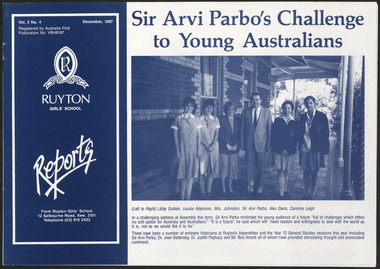
... The Ruyton Reporter (formerly known as Ruyton Reports) captures the essential Ruyton Girls' School experience for the broader school community. It has been produced since 1986. ...The Ruyton Reporter (formerly known as Ruyton Reports) captures the essential Ruyton Girls' School experience for the broader school community. It has been produced since 1986.The record has strong historic significance as it pertains to one of the oldest girls' school in Victoria, Australia. Ruyton was founded in 1878 in the Bulleen Road, Kew, home of newly widowed Mrs Charlotte Anderson (now High Street South). Thus, the record can be used as a reference example for research into Victorian school history. It also gives insight into the types of activities and events undertaken at Ruyton Girls' School during the period of its production. The record's significance is further enhanced by its exceptionally well-documented provenance, having remained the property of Ruyton Girls' School since its production.Black and white newsletter printed on paper with staple binding. 8 pages.Front Page: Vol. 2 No. 2 / Vol. 2 No. 4 December, 1987 / Registered by Australia Post / Publication No. VBH8187 / R / RECTE ET FIDE LITER / RUYTON / GIRLS' SCHOOL / Reports / From Ruyton Girls' School / 12 Selbourne Road, Kew. 3101 / Telephone (03) 819 2422 / Sir Arvi Parbo's Challenge / to Young Australians / (Left to Right) Libby Dobbin, Louise Adamson, Mrs. Johnston, Sir Arvi Parbo, Alex Davis, Caroline Leigh / In a challenging address at Assembly this term, Sir Arvi Parvo reminded his young audience of a future "full of challenges which offers / no soft option for Australia and Australians." "It is a future", he said which will "need realism and willingness to deal with the world as / it is, not as we would like it to be." / There have been a number of eminent Victorians at Ruyton's Assemblies and the Year 12 General Studies sessions this year including / Sir Arvi Parbo, Dr. Jean Battersby, Dr. Judith Paphazy and Mr. Bob Ansett all of whom have provided stimulating thought and provocative / comment. /ruyton girls' school, ruyton, school, students, newsletter, ruyton reports, ruyton news, kew, victoria, melbourne, girls school -
 Northern District School of Nursing. Managed by Bendigo Historical Society Inc.
Administrative record - Northern District School of Nursing Progress Report for Nurse M. C. Dunn and other items pertaining to her exams, 1974
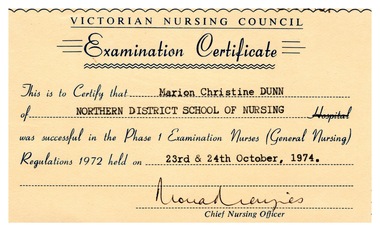
... Bursaries are available for advanced study.Career Prospects: Graduates can pursue roles in administration, teaching, ward and departmental leadership, district and visiting nursing, industrial and school nursing, and more. Opportunities exist both within hospitals and in community or specialized settings.FAQs and Practical Details. ...Managed by a committee including hospital administrators, medical professionals, and nursing leaders from several regional hospitals. Associated with major hospitals in the Northern District, including Bendigo Base, Mildura Base, Castlemaine, Echuca, Swan Hill, St. Arnaud, and Kyneton District Hospitals. Provide high-quality theoretical and practical nursing training. Raise the standard of nursing education in the region. Maintain the highest principles of nursing practice. Applicants must be at least 17 years old and hold a Proficiency Certificate or higher educational qualification. Application involves submitting forms, certificates, an interview, an aptitude test, and a medical examination. A three-month probationary period follows initial acceptance. Preliminary Training School: Four-week introductory course covering basic nursing, anatomy, hygiene, and practical skills. Practical experience in various hospital departments, guided by senior staff. Study Block Plan: Includes several blocks of theoretical and practical instruction throughout the three-year program. Regular school exams and two state exams (First Professional and Final State) are required for progression and graduation. Nurses work a 40-hour week with at least one or two days off per week and three weeks of annual leave. Accommodation is provided in comfortable hostels with good facilities. Uniforms are supplied free; nurses provide their own shoes and stockings. Salaries and allowances are regulated, with deductions for board and free medical care. Additional Information Post-Graduate Opportunities. Senior positions require further experience and additional certificates (e.g., Midwifery, Infant Welfare).Diploma courses available in administration, teaching, and specialized nursing fields. Bursaries are available for advanced study.Career Prospects: Graduates can pursue roles in administration, teaching, ward and departmental leadership, district and visiting nursing, industrial and school nursing, and more. Opportunities exist both within hospitals and in community or specialized settings.FAQs and Practical Details. Minimal training costs (mainly exam fees and personal items).Living out allowances and travel expenses are covered. Four training intakes per year; waiting periods are short if qualifications are met.Northern District School of Nursing Progress Report for Nurse M. C. Dunn and other items pertaining to her exams. This item contains the following six documents: 3791.15a This document is a progress examination report for Nurse M.C. Dunn from the Northern District School of Nursing, summarizing her performance in the Phase 1 Progress Examination held in July 1974. Examination Results Outstanding Performance Passed both Anatomy & Physiology and General Nursing with distinction. Eligible to attend the First Year Study Block and required to sit for the First Professional State Examination in October 1974. Chemistry & Physics will be included in the upcoming examination, with no repeat lectures during the study block. Examiner's General Comments: Anatomy & PhysiologyMost questions were well answered, especially on tissue distribution, limb movement, and muscle functions.Areas needing revision: functions of the skin, diagrams (vertebra, kidney, leaf), function of chordae tendinae, factors maintaining venous return, difference between inspired and expired air, and formation/circulation of cerebrospinal fluid. Some gaps in knowledge about blood volume, urea formation, and water contamination. Generally strong answers on patient care, conversions between measurement systems, and infection prevention.Areas for improvement: dilution of lotions, suitable lotions for skin prep, definitions of pH and specific gravity of urine, and details on sterilization (especially destruction of spores). Good understanding of pressure sore prevention, patient bathing, and care of valuables, though some answers lacked detail or used outdated expressions. 3791.15b This document is a formal acceptance letter addressed to Marion from the Northern District School of Nursing. Marion has been accepted into the Preliminary Training School at the Northern District School of Nursing. Medical and Dental ApprovalHer medical and dental certificates have been reviewed and approved. Marion is scheduled to begin training on 4th February. She is expected to attend on Thursday, 31st January, 1974, prior to the official start. 3791.15c The Victorian Nursing Council's examination instructions for nursing candidates 3791.15d Invitation to a dinner to congratulate the 1973 pilot students in their examination successes 3791.15e Signature of Examiner Card Victorian Nursing Council 3791.15f Examination certificate from the Victorian Nursing Councilnurse training, lister house, marion dunn -
Northern District School of Nursing. Managed by Bendigo Historical Society Inc.
Newsletter - Northern District School of Nursing Graduates Association - Background Information on the School, 27 June 1988
... study blocks to better align practice with theory. The Victorian Nursing Council later required the school to control clinical rotations. Male students were finally admitted to general...study blocks to better align practice with theory. The Victorian Nursing Council later required the school to control clinical rotations. Male students were finally admitted to general ...The Northern District School of Nursing in Victoria, Australia Graduates Association: Historical overview of the Northern District School of Nursing: After World War Two, Australian hospitals, especially in rural areas, faced a severe shortage of nurses due to low interest and challenging working conditions. Nurses endured strict discipline, poor wages, long hours, and restrictive living arrangements. The Hospital & Charities Commission appointed Miss Gwen Williams as the first Executive Officer of Nursing Services, who played a pivotal role in founding the regional training school at 'Lister House' in Bendigo in March 1950. Bendigo was selected for a pilot scheme to improve the correlation between theoretical and practical nurse training. The school staff worked to standardize training across regional hospitals and ensure students gained practical experience after theoretical instruction. A circular training scheme was introduced, allowing students from smaller hospitals to rotate through base hospitals for broader experience. Over time, affiliated hospitals changed as some de-registered and others joined. Founding staff, Miss Nancy Long and Miss Margot Scott, set high educational and professional standards, acting as educators, supervisors, and mentors.Training combined theory with hands-on practice, including procedures, instrument handling, and patient care. In 1973, the school began admitting students not attached to any specific hospital, allocating them to wards after study blocks to better align practice with theory. The Victorian Nursing Council later required the school to control clinical rotations. Male students were finally admitted to general nurse training in the 1960s after several failed attempts.Nurses' Week, started in 1952 by Miss Williams, aimed to promote nursing careers and community awareness. The school was instrumental in raising nursing education standards in the region for nearly forty years. Staff Nurses received additional training in administration after their basic three-year course. There were aspirations for postgraduate opportunities in rural areas, but country students continued to face challenges compared to their metropolitan counterparts.Northern District School of Nursing Graduates Association - Background Information on the School - 2 typed sheets This item contains the following document: 3792.7a Background Information on the School - 2 typed sheetsnurse training, lister house, history -
Northern District School of Nursing. Managed by Bendigo Historical Society Inc.
Administrative record - Northern District School of Nursing Graduates Association - Examination Papers and Feedback, 1965
... Bursaries are available for advanced study.Career Prospects: Graduates can pursue roles in administration, teaching, ward and departmental leadership, district and visiting nursing, industrial and school nursing, and more. Opportunities existed both within hospitals and in community or specialized settings.FAQs and Practical Details. ...The Northern District School of Nursing in Victoria, Australia Graduates Association: History of the School Managed by a committee including hospital administrators, medical professionals, and nursing leaders from several regional hospitals. Associated with major hospitals in the Northern District, including Bendigo Base, Mildura Base, Castlemaine, Echuca, Swan Hill, St. Arnaud, and Kyneton District Hospitals. Provide high-quality theoretical and practical nursing training. Raise the standard of nursing education in the region. Maintain the highest principles of nursing practice. Applicants must be at least 17 years old and hold a Proficiency Certificate or higher educational qualification. Application involves submitting forms, certificates, an interview, an aptitude test, and a medical examination. A three-month probationary period follows initial acceptance. Preliminary Training School: Four-week introductory course covering basic nursing, anatomy, hygiene, and practical skills. Practical experience in various hospital departments, guided by senior staff. Study Block Plan: Includes several blocks of theoretical and practical instruction throughout the three-year program. Regular school exams and two state exams (First Professional and Final State) are required for progression and graduation. Nurses work a 40-hour week with at least one or two days off per week and three weeks of annual leave. Accommodation is provided in comfortable hostels with good facilities. Uniforms are supplied free; nurses provide their own shoes and stockings. Salaries and allowances are regulated, with deductions for board and free medical care. Additional Information Post-Graduate Opportunities. Senior positions require further experience and additional certificates (e.g., Midwifery, Infant Welfare).Diploma courses available in administration, teaching, and specialized nursing fields. Bursaries are available for advanced study.Career Prospects: Graduates can pursue roles in administration, teaching, ward and departmental leadership, district and visiting nursing, industrial and school nursing, and more. Opportunities existed both within hospitals and in community or specialized settings.FAQs and Practical Details. Minimal training costs (mainly exam fees and personal items).Living out allowances and travel expenses are covered. Four training intakes per year; waiting periods are short if qualifications are met.Northern District School of Nursing Graduates Association - Examination Papers and Feedback, 1965 This item contains the following documents: 3794.3a This document provides examiner feedback on the performance of nursing candidates in the 1965 Junior General Nursing Theory examination, one page typed. 3794.3b Copy of above 3794.3c This study guide provides structured advice and topic lists for medical students preparing for their final examinations, focusing on effective study habits and comprehensive subject coverage. Author Mr Hutley Eight pages typed 3794.3d This document is a 1965 final examination paper for general nurse training, focusing on surgical nursing. The key points are structured around major topics and essential nursing competencies. It belonged Joan Howettnurse training, lister house, examinations, mr hutley, joan howett -
Northern District School of Nursing. Managed by Bendigo Historical Society Inc.
Administrative record - Northern District School of Nursing Graduates Association - Examinations and Guides, 1965
... Bursaries are available for advanced study.Career Prospects: Graduates can pursue roles in administration, teaching, ward and departmental leadership, district and visiting nursing, industrial and school nursing, and more. Opportunities existed both within hospitals and in community or specialized settings.FAQs and Practical Details. ...The Northern District School of Nursing in Victoria, Australia Graduates Association: History of the School Managed by a committee including hospital administrators, medical professionals, and nursing leaders from several regional hospitals. Associated with major hospitals in the Northern District, including Bendigo Base, Mildura Base, Castlemaine, Echuca, Swan Hill, St. Arnaud, and Kyneton District Hospitals. Provide high-quality theoretical and practical nursing training. Raise the standard of nursing education in the region. Maintain the highest principles of nursing practice. Applicants must be at least 17 years old and hold a Proficiency Certificate or higher educational qualification. Application involves submitting forms, certificates, an interview, an aptitude test, and a medical examination. A three-month probationary period follows initial acceptance. Preliminary Training School: Four-week introductory course covering basic nursing, anatomy, hygiene, and practical skills. Practical experience in various hospital departments, guided by senior staff. Study Block Plan: Includes several blocks of theoretical and practical instruction throughout the three-year program. Regular school exams and two state exams (First Professional and Final State) are required for progression and graduation. Nurses work a 40-hour week with at least one or two days off per week and three weeks of annual leave. Accommodation is provided in comfortable hostels with good facilities. Uniforms are supplied free; nurses provide their own shoes and stockings. Salaries and allowances are regulated, with deductions for board and free medical care. Additional Information Post-Graduate Opportunities. Senior positions require further experience and additional certificates (e.g., Midwifery, Infant Welfare).Diploma courses available in administration, teaching, and specialized nursing fields. Bursaries are available for advanced study.Career Prospects: Graduates can pursue roles in administration, teaching, ward and departmental leadership, district and visiting nursing, industrial and school nursing, and more. Opportunities existed both within hospitals and in community or specialized settings.FAQs and Practical Details. Minimal training costs (mainly exam fees and personal items).Living out allowances and travel expenses are covered. Four training intakes per year; waiting periods are short if qualifications are met.Northern District School of Nursing Graduates Association - Examination and Guides 1965 This item contains the following documents: 3794.17a This document is a Victorian Nursing Council examination paper for medical nursing, focusing on essential knowledge and practical skills for nurses. July 1965 3794.17b This document is a nursing examination paper focused on surgical and medical care scenarios. July 1965 3794.17c This document is a nursing examination paper from 1965 focused on medical nursing for general nurse training. 3794.17d This document is a first-year nursing theory examination paper from the Northern District School of Nursing, dated May 27, 1965. It covers foundational knowledge and practical skills for junior nurses. 3794.17e This document is a surgical nursing examination paper for general nurse training, focusing on practical and theoretical knowledge required for surgical patient care. 3794.17f This nursing examination paper covers essential topics in patient care, procedures, and medical terminology. 3794.17g This document is a junior general nursing theory examination paper from 1965, focusing on essential nursing procedures and patient care. 3794.17h This document is a professional nursing examination paper covering essential topics in human anatomy, physiology, and medical concepts. Sept 1965 3794.17i This document is a surgical nursing examination paper for general nurse training, focusing on key areas of patient management, operative and post-operative care, and infection prevention. 3794.17j This document is a nursing examination paper from the Northern District School of Nursing, focusing on general nursing practices. 3794.17k This nursing examination paper focuses on essential patient care procedures and clinical knowledge. 3794.17l This document is a nursing examination or study guide covering essential topics in general nursing theory, anatomy, physiology, and ward hygiene. 3794.17m This document is an examination paper for general nurse training, focusing on anatomy, physiology, and hygiene. 3794.17n This nursing examination paper covers essential topics in infection control, vital signs assessment, medication preparation, and ethical responsibilities. 3794.17o This document is a nursing examination paper from December 1965, designed to assess general nurse training. 3794.17p This document is a junior general nursing theory examination paper from 1965, focusing on essential nursing knowledge and practical skills. 3794.17q This nursing examination paper covers foundational topics in patient care and clinical procedures for first-year nursing students. nurse training, lister house, examinations -
Kew Historical Society Inc
Journal, Kewriosity : November 1983
... Study - Area 6 / p1. Kew Council elections / p1. Not an elephant joke [community newspapers] / p2. Kew–Hathorn C.A.B. [Citizens' Advice Bureau] / p3. Family trees [Genealogy] / p3. Little Aths / p3. Kew Hebrew Congregation / p3. Asthma Education / p4. A place of shades [Boroondara General ...High Street/Cotham Road intersection / p1. Traffic Management Study - Area 6 / p1. Kew Council elections / p1. Not an elephant joke [community newspapers] / p2. Kew–Hathorn C.A.B. [Citizens' Advice Bureau] / p3. Family trees [Genealogy] / p3. Little Aths / p3. Kew Hebrew Congregation / p3. Asthma Education / p4. A place of shades [Boroondara General (Kew) Cemetery] / Barbara Giles p4. More than a school [Villa Maria Society; St Paul's School for the Blind and Visually Handicapped] / p5. Who is she? [Community Education Officer - Nancy Nankervis] / p6. Toastmasters - who are they? / p6. Art classes [Donald Cameron] / p6. Fundraising [St Paul's Church Hall] / p6. Kew Cricket underway [Kew Cricket Club] / p7. Kew Baptist Church / p7. Coming events / p8.Kewriosity was a local newsletter combining Kew Council and community news. It was published between November 1983 and June 1994, replacing an earlier Kewriosity [broad] Sheet (1979-84). In producing Kewriosity, Council aimed to provide a range of interesting and informative articles covering its deliberations and decision making, together with items of general interest and importance to the Kew community and information not generally available through daily media outlets.non-fictionHigh Street/Cotham Road intersection / p1. Traffic Management Study - Area 6 / p1. Kew Council elections / p1. Not an elephant joke [community newspapers] / p2. Kew–Hathorn C.A.B. [Citizens' Advice Bureau] / p3. Family trees [Genealogy] / p3. Little Aths / p3. Kew Hebrew Congregation / p3. Asthma Education / p4. A place of shades [Boroondara General (Kew) Cemetery] / Barbara Giles p4. More than a school [Villa Maria Society; St Paul's School for the Blind and Visually Handicapped] / p5. Who is she? [Community Education Officer - Nancy Nankervis] / p6. Toastmasters - who are they? / p6. Art classes [Donald Cameron] / p6. Fundraising [St Paul's Church Hall] / p6. Kew Cricket underway [Kew Cricket Club] / p7. Kew Baptist Church / p7. Coming events / p8. publications -- city of kew (vic.), kewriosity, council newsletters, community newsletters -
 Sunshine and District Historical Society Incorporated
Administrative record - City of Sunshine - Commissioner Mr Alexander Alex George Gillon Collection 1976 - 1982 - Minutes of the ordinary meeting of council held on 9th December 1980, City of Sunshine, 9th December 1980
... Albans Heights Primary School Request for Regular Maintenance Proposed Roundabouts Northumberland Road / Suffolk Road and Northumberland Road / Warwick Road Sunshine North Air Conditioning Municipal Offices Proposed Public Toilet Block Ballarat Road Deer Park Report of the Building Surveyor Underground Tanks 199 Ballarat Road Maidstone Location of Building 63 Westmoreland Road Sunshine North Location of Building 8 Tullaroop Court St. Albans Building Over Easement 11 Jeffrey Close St. Albans Schedule for Authorising of Affixing the Common Seal of the Municipality to Documents Orders of the Day Accounts Submitted for Payment as at 30th November 1980 Extraordinary Business Report of the Chief Health Surveyor Catherine Yeung Community...Albans Heights Primary School Request for Regular Maintenance Proposed Roundabouts Northumberland Road / Suffolk Road and Northumberland Road / Warwick Road Sunshine North Air Conditioning Municipal Offices Proposed Public Toilet Block Ballarat Road Deer Park Report of the Building Surveyor Underground Tanks 199 Ballarat Road Maidstone Location of Building 63 Westmoreland Road Sunshine North Location of Building 8 Tullaroop Court St. Albans Building Over Easement 11 Jeffrey Close St. Albans Schedule for Authorising of Affixing the Common Seal of the Municipality to Documents Orders of the Day Accounts Submitted for Payment as at 30th November 1980 Extraordinary Business Report of the Chief Health Surveyor Catherine Yeung Community ...Minutes of the Ordinary Meeting of Council held on 9th December 1980 Report of the Town Clerk's Department Report of the Town Clerk Kiosk Sunshine Swimming Pool Professional Indemnity Insurance Proposed Technical School for Keilor Rate Recovery Sale Lot 88 Balfour Avenue Sunshine North Deed of Release Advertising Contracts Increase in Ceiling Municipal Association Committees Nomination of Representative Proposed Closure Dobson Crescent Braybrook St. Johns College Report of Rainbow Workshop Supplementary Valuations Land Transfer 88 Station Road Deer Park Sunshine Swimming Pool Learners Pool Heating Golf Course South Side of Maribyrnong River Proposed Link with the Essendon Golf Course Sealing of General Rate Year Ending 30th September 1980 Date of Ordinary Meetings of Council Report of the Co-Ordinator of Welfare Services Purchase of Land Randall Street Maribyrnong Funding for Teenage Holiday Programmes Emergency Foster Care Family Day Care Local Youth Affairs Council's Forum International Year of the Disable Federal Government Funding of Child Care Programmes Victorian Transport Study Lonie Report Sunshine CYSS Report of the Chief Health Surveyor Authorisation of Officers Under Summary Offences Act 1966 Issuing of Septic Tank Approval Notices Application for Septic Tank Systems Subsidies for Infant Welfare Sisters Weights and Measures Practical Experience Health Act Registrations Prosecution Proceedings Sunshine Magistrates Court Health Act Registrations for 1981 Health Act Registration Late Fee Application for Transfer of Proprietorship of Premises Under the Health Act Smorgan Consolidated Industries (Paper Plant) "Black Liquor" Process Refuse By-Law Enforcement Report of the Superintendent Traffic & By-Laws Jumble Sale Albion Rovers Soccer Club Sunshine Commonwealth Offices Devonshire Road Sunshine Dog Act Court Proceedings Parking and Traffic Infringements Dog Act Authority Under Sections 695 (10) of the Local Government Act 1958 Disposal of Derelict Vehicles Proposed Procession St. Pauls Parish Report of the City Librarian Report of the Melton Branch Librarian Corio Street Branch Library National Conference on Multiculturalism and Libraries 8th to 11th November 1980 Report Report of the City Engineer & Planner Industrial Development Code for the City of Sunshine Planning Permit Application Sonley Street Kindergarten Maidstone Planning Permit Ground and First Floor Offices 237 & 239 - 24 Hampshire Road Sunshine Planning Permit Application Service Premises 250 McIntyre Road Sunshine North Planning Permit Application Illuminated Sky Sign Corner Glengala Road and Evelyn Crescent Sunshine West Planning Permit Application Alterations to Existing Shops Highpoint West Shopping Centre Lots 8, 9, 10, 11, 13 and Part 12 Rosamond Road Maribyrnong Planning Permit Application Four Flats 225 Main Road West St. Albans Planning Permit Bank Corner Hampshire Road and Devonshire Road Sunshine Planning Permit Application Transport Depot and Grain Store Francis Street Brooklyn Strata Subdivision 46 Monash Street Sunshine Strata Subdivision 53 Hertford Road Sunshine Plan of Subdivision Denton Avenue, Cavell Close and Maroondah Court St. Albans Prestressed Beam Lawrence Street Ardeer Footbridge Tenders Transfer of Reserves Westerngate Estate Installation of Fire Hydrants Transport Regulation Board Sunshine Bus Lines Pty Ltd Application to Change Route No 450 Sunshine to Ardeer St. Albans Road Footpath (East Side) Albion Station to B.T.M. Tubemakers Request by St. Albans South Progress Association Traffic Engineering Measures Accident Analysis Programme South Road Street Proposed Lighting Scheme by City of Footscray Electricity Supply Department Rochester Street to Darnley Street Braybrook Tariffs Public Lighting Sale of Surplus Equipment Appleby Avenue (Appleby Court) Private Street Scheme Boundary Road reconstruction East of Fitzgerald Road Laverton North St. Albans Heights Primary School Request for Regular Maintenance Proposed Roundabouts Northumberland Road / Suffolk Road and Northumberland Road / Warwick Road Sunshine North Air Conditioning Municipal Offices Proposed Public Toilet Block Ballarat Road Deer Park Report of the Building Surveyor Underground Tanks 199 Ballarat Road Maidstone Location of Building 63 Westmoreland Road Sunshine North Location of Building 8 Tullaroop Court St. Albans Building Over Easement 11 Jeffrey Close St. Albans Schedule for Authorising of Affixing the Common Seal of the Municipality to Documents Orders of the Day Accounts Submitted for Payment as at 30th November 1980 Extraordinary Business Report of the Chief Health Surveyor Catherine Yeung Community Nurse Report of the City Engineer & Planner Planning Permit Application 74 Lot Residential Subdivision Opie Road St. Albans Planning Permit Application 3 Flats Lots 23 & 25 Madden Street Maidstone Planning Permit Application Extensions to School Classrooms Land bounded by Churchill Avenue, Dobson Crescent and Darnley Street Planning Permit Application Restaurant, Service Premises and Associated Signs Red Rooster 204 - 210 Ballarat Road Maidstone Planning Permit Application Enforcement Factory and Petrol Filling Station Lots 13, 14, 15 & 16 North West Corner Ballarat Road and Glencairn Avenue Deer Park Planning Permit Application Two Lot Subdivision Ballarat Road Albion Planning Permit Application Junk Yard Scrap Metal Maida Avenue Sunshine North Planning Permit Application Warehouse Lots 30 & 31 Cromer Avenue Sunshine Planning Permit Application Display Home Centre Furlong Road St. Albans Planning Permit Application Factory Warehouse 4 Arvona Avenue Sunshine North Planning Permit Application Factory Renovation South West Corner Somerville Road and Tottenham Parade Planning Permit Application Bus Depot Lot 1 Emu Road Maidstone Planning Permit Application 4 Flats Lot 31 Bardsley Street Sunshine West Planning Permit Application Grain Storage Depot Stage 2 Francis Street Brooklyn Planning Permit Application Factory Warehouse North West Corner Ballarat Road and Lacy Street Braybrook Planning Permit Application Ground and Forst Floor Offices 239 - 241 Hampshire Road Sunshine Planning Permit Application Factory Lot 30 Frederick Street Brooklyn Planning Permit Application Service Premises Alterations Lot 2 Rosamond Road Maidstone Planning Permit Application 2 Flats 185A Main Road West St. Albans Planning Permit Application Clothing Manufacturer 67 Dumfries Street Deer Park Planning Permit Application Factory Display and Sales Lot 39 Reid Street Ardeer Planning Permit Application Extensions to Secondary School Marian College Glengala Road Sunshine West Planning Permit Application Promotion Panel Sign Lots 1, 6 and 7 Berkshire Road Sunshine North Planning Permit Application Shop Bank and Offices 288 Hampshire Road Sunshine Planning Permit Application Brick Store 75 Wright Street Sunshine Planning Permit Application Erection of New Multiple Sclerosis Residential and Day Attendance Centre Furlong Road St. Albans Planning Permit Application Warehouse Alterations 22 St. Albans Road St. Albans Planning Permit Application Junk Yard Lot 5 McIntyre Road Sunshine North Planning Permit Application Water Purification Plant Press Filter Platform Smorgon Consolidated Industries Meat and Paper Pty Ltd Planning Permit Application Bread and Cake Stall Level 2 Highpoint West Shopping Centre Rosamond Road Maribyrnong Planning Permit Application Hot Bread Kitchen Glengala Road Sunshine West Planning Permit Application Alterations to Service Station Lot 1 Ballarat Road Braybrook Planning Permit Application Market Extensions Level 1 Highpoint West Shopping Centre Rosamond Road Maribyrnong Planning Permit Application Laboratory and Offices Ballarat Road Sunshine Planning Permit Application Petrol Filling Station and Hotel Neale Road Deer Park Report of the Building Surveyor Building Over Easement 3 Droitwich Crescent Deer Park Building Over Easement 20 Hook Street St. Albans Building Over Easement 191 Wright Street Sunshine Building Over Easement 288 Station Road St. Albans Building Over Easement and Location of Building 11 Thwaites Street Sunshine Location of Building Lot 132 Hargreaves Crescent Braybrook Location of Building Lot 1 Station Road Deer Parkbalfour avenue, sunshine north, dobson crescent, sunshine, station road, deer park, sunshine swimming pool, kennedy street, st. johns college, churchill avenue, braybrook, maribyrnong river, essendon golf course, randall street, maribyrnong, smorgan consolidated industries, somerville road, tottenham, albion rovers soccer club, devonshire road, corio street branch library, corio street, sonley street kindergarten, sonley street, maidstone, mcintyre road, glengala road, evelyn crescent, sunshine west, highpoint west shopping centre, rosamond road, main road west, st. albans, francis street, brooklyn, monash street, hertford road, denton avenue, cavell close, maroondah court, lawrence street, lawrence street bridge, ardeer, sunshine bus lines, st. albans road, st. albans south progress association, b.t.m. tubemakers, south road, rochester street, darnley street, appleby avenue, appleby court, boundary road, fitzgerald road, laverton north, st. albans heights primary school, norwich street, northumberland road, suffolk road, warwick road, ballarat road, tullaroop court, jeffrey close, opie road, albanvale, madden street, red rooster, glencairn avenue, maida avenue, cromer avenue, furlong road, arvona avenue, tottenham parade, emu road, bardsley street, lacy street, frederick street, dumfries street, reid street, marian college, berkshire road, wright street, neale road, droitwich crescent, hook street, thwaites street, hargreaves crescent
