
Showing 21 items matching "science industry building"
-
 Federation University Historical Collection
Book, University of Ballarat Annual Report, 2000, 2000
... ...Science Industry Building...David Caro was the Chancellor, David James was the Vice-Chancellor until the end of the year, and Kerry Cox was announced as the next Vice Chancellor. university of ballarat annual report establishment university of ballarat establishment david caro david james 130th anniversary kerry cox centre for rural and regional health john keller honorary doctorate - mary atkinson shenzhen craig hurley jeff kennett felicity kennett barry wemyss kerry Cox appointment david James retirement IBM Global Services Greenhill Enterprise Centre Learning City Initiative Camp Street Precinct Arts Academy Science Industry Building Canadian Wetlands Student Union Building refurbishment W.J. ...Soft covered Annual Report.non-fictionuniversity of ballarat, annual report, establishment, university of ballarat establishment, david caro, david james, 130th anniversary, kerry cox, centre for rural and regional health, john keller, honorary doctorate - mary atkinson, shenzhen, craig hurley, jeff kennett, felicity kennett, barry wemyss, kerry cox appointment, david james retirement, ibm global services, greenhill enterprise centre, learning city initiative, camp street precinct, arts academy, science industry building, canadian wetlands, student union building refurbishment, w.j. gribble building, horsham campus, university brewery, aboriginal education centre, mary atkinson, roy over, woo wai man, william pryor, bill pryor, mary modeen -
 Federation University Historical Collection
Booklet, D. Wixted, Garden at School of Mines and Industries Ballarat: Conservation Analysis, 1988, 07/1988
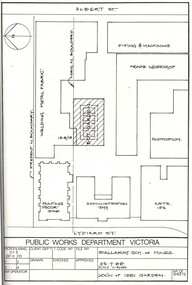
... science society pharmacy alfred mica smith Some words have been highlighted in orange. Yellow covered stapled report of 20 pages. Includes information about the establishment of the Ballarat School of Mines, plans of ground and buildings (1880, 1881, 1903 and 1988), Botany subjects, history of the garden, the garden in 1988. Garden at School of Mines and Industries ...The Ballarat School of Mines Botanical Garden was established in 1879, and was used by students of botany and materia medica. In February 1881 George Porter Day was appointed gardener at a rate of 17 pounds and ten shillings per annum. Yellow covered stapled report of 20 pages. Includes information about the establishment of the Ballarat School of Mines, plans of ground and buildings (1880, 1881, 1903 and 1988), Botany subjects, history of the garden, the garden in 1988.Some words have been highlighted in orange.ballarat school of mines botanical gardens, ballarat school of mines, george day, george porter day, james oddie, baron von mueller, von mueller, ferdinand von mueller, joseph flude, materia medica, botany, system garden, ferdinand krause, field club and science society, pharmacy, alfred mica smith -
 Federation University Historical Collection
Photograph - Photograph - black and white, Ballarat College of Advanced Education: Dinner with special guest, Barry Jones, Labour Member of Parliament; 1977/78
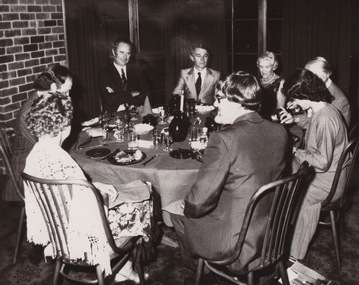
... Building at SMB is named after him. In 1975 he was recognised by the State Government and awarded an MBE. Hon Barry Jones, Member of State Government from 1972 to 1977. He then entered Federal Parliament and was a member from 1977 to 1998. During his time he was Minister for Industry, Science...Building at SMB is named after him. In 1975 he was recognised by the State Government and awarded an MBE. Hon Barry Jones, Member of State Government from 1972 to 1977. He then entered Federal Parliament and was a member from 1977 to 1998. During his time he was Minister for Industry, Science ...Victorian Institute of Occupational Safety and Health (VIOSH) Australia is the Asia-Pacific centre for teaching and research in occupational health and safety (OHS) and is known as one of Australia's leaders on the field. VIOSH has a global reputation for its innovative approach within the field of OHS management. VIOSH had its first intake of students in 1979. At that time the Institution was known as the Ballarat College of Advanced Education. In 1990 it became known as Ballarat University College, then in 1994 as University of Ballarat. It was 2014 that it became Federation University. VIOSH Australia students are safety managers, senior advisors and experienced OHS professionals. They come from all over Australia and industry. Students are taught active research and enquiry; rather than textbook learning and a one-size fits all approach. VIOSH accepts people into the Graduate Diploma of Occupational Hazard Management who have no undergraduate degree - on the basis of extensive work experience and knowledge. Photographs were posted to Ballarat College of Advanced Education from Melbourne. At this time VIOSH was in the planning stage and it was two years later that the first Intake of students started. People known in the photographs are: E.J. Barker, E.J. Tippett, Mr Jim Reid and Barry Jones. E.J. Barker (Jack) was the Principal of SMB from 1964-1976. He then became the Foundation Director of Ballarat Institute/College of Advanced Education from 1976-1987. The Library Building at Mount Helen Campus if named after him. E.J. Tippett was a member of SMB Council from 1934-1960. He was President of the Council from 1940-1960. He was a member of the Interim Council established to plan the development of the Victorian Institute of Colleges. He then became a member of the Council of the Victorian Institute of Colleges. The Library Building at SMB is named after him. In 1975 he was recognised by the State Government and awarded an MBE. Hon Barry Jones, Member of State Government from 1972 to 1977. He then entered Federal Parliament and was a member from 1977 to 1998. During his time he was Minister for Industry, Science and Technology from1983 to 1990. Ann Tippett - wife of E.J. Tippett. Jim Reid - Federal Director of the National Safety Council of Australia.Fourteen black and white photographs taken at a dinner - Ballarat College of Advanced Education.ballarat school of mines, ballarat college of advanced education, e j barker, principal of smb, foundation director of bcae, e j tippett, president of smb council, victorian institute of colleges, hon barry jones, member of state parliament, member of federal parliament, minister for industry science and technology, ann tippett, jim reid, national safety council of australia, federal director -
 Federation University Historical Collection
Document - Document - Report, VIOSH: Fire Protection; Identify exposures to Property Loss and Business Interruption, 1980, 1980
... industry. Students are taught active research and enquiry; rather than textbook learning and a one-size fits all approach. VIOSH accepts people into the Graduate Diploma of Occupational Hazard Management who have no undergraduate degree - on the basis of extensive work experience and knowledge. This report is prepared by Bruce S Webber, M.I.E. Aust. in consultation with Alan Webb, Buildings Officer at Ballarat College of Advanced Education, Gear Avenue, Mount Helen. The College operations include Engineering, Science...industry. Students are taught active research and enquiry; rather than textbook learning and a one-size fits all approach. VIOSH accepts people into the Graduate Diploma of Occupational Hazard Management who have no undergraduate degree - on the basis of extensive work experience and knowledge. This report is prepared by Bruce S Webber, M.I.E. Aust. in consultation with Alan Webb, Buildings Officer at Ballarat College of Advanced Education, Gear Avenue, Mount Helen. The College operations include Engineering, Science ...Victorian Institute of Occupational Safety and Health (VIOSH) Australia is the Asia-Pacific centre for teaching and research in occupational health and safety (OHS) and is known as one of Australia's leaders on the field. VIOSH has a global reputation for its innovative approach within the field of OHS management. VIOSH had its first intake of students in 1979. At that time the Institution was known as the Ballarat College of Advanced Education. In 1990 it became known as Ballarat University College, then in 1994 as University of Ballarat. It was 2014 that it became Federation University. VIOSH Australia students are safety managers, senior advisors and experienced OHS professionals. They come from all over Australia and industry. Students are taught active research and enquiry; rather than textbook learning and a one-size fits all approach. VIOSH accepts people into the Graduate Diploma of Occupational Hazard Management who have no undergraduate degree - on the basis of extensive work experience and knowledge. This report is prepared by Bruce S Webber, M.I.E. Aust. in consultation with Alan Webb, Buildings Officer at Ballarat College of Advanced Education, Gear Avenue, Mount Helen. The College operations include Engineering, Science, Education, Physical Education and School of Arts Facilities. It was opened in 1969 with the completion of the Engineering, Metallurgy and Geology Buildings. This report was made upon observations of the conditions and information provided at the time the College was inspected.Thirty-five A4 sheets, spiral bound. Contents in two sections. Typed.Cover has Logo for Reed Stenhouse at bottomviosh, victorian institute of occupational safety and health, ballarat college of advanced education, fire protection, property loss exposures, engineering, science, physical education, school of arts, metallurgy, geology, reed stenhouse report, alan webb, buildings officer, bruce webber -
 Federation University Historical Collection
Book, Prospectus of the School of Mines and Industries, Bendigo, 1914, 1914
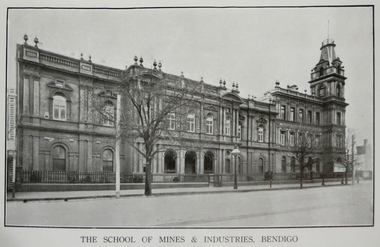
... The Bendigo School of Mines was established in 1872 for the purpose of providing instruction and training in the principles of science with their application to the various industries. bendigo school of mines l. lansell r.h.s. abbott john veale george davey a.e. thorne john quick w.c. vahland o. penfold j.r.v. anderson w.h. walter john e grant woodcarving arthur t. woodward bendigo junior technical school university concessions carola cohn schools of mines pharmacy school of design and applied art geoffrey abbott Brown soft covered book of 62 pages. Contents include: Office Bearers, Art Department, Board and Residence, Certificate Courses, Examination Results, Employment, Graduates, Laboratory Work, Library, Pharmacy, Railway concessions, Rules, Scholarships and Prizes, University Concessions An photographic image of the building ...The Bendigo School of Mines was established in 1872 for the purpose of providing instruction and training in the principles of science with their application to the various industries. Brown soft covered book of 62 pages. Contents include: Office Bearers, Art Department, Board and Residence, Certificate Courses, Examination Results, Employment, Graduates, Laboratory Work, Library, Pharmacy, Railway concessions, Rules, Scholarships and Prizes, University Concessions An photographic image of the building, Turning and Fitting Workshop, Woodwork, and the Science Laboratory are reproduced. bendigo school of mines, l. lansell, r.h.s. abbott, john veale, george davey, a.e. thorne, john quick, w.c. vahland, o. penfold, j.r.v. anderson, w.h. walter, john e grant, woodcarving, arthur t. woodward, bendigo junior technical school, university concessions, carola cohn, schools of mines, pharmacy, school of design and applied art, geoffrey abbott -
Federation University Historical Collection
Booklet, Berry Anderson & Co, The School of Mines and Industries, Calendar, 1914, 1913
... Contents of the Booklet: Associateship, Calendar, Certificate Courses - Science, Certificate Courses - Art, Draughtsman's Courses, Discipline, Discipline Board, Examination Results, Fees, Full Certificates Issued, General Regulations, Introduction, Junior Technical School, Railway Fares, Teaching Staff, Technical Art and Craft School, Subjects of Instruction - Department of Chemistry and Metallurgy, Geological Department, Engineering Department, Electrical and Electrical Engineering Department, Department of Mathematics, Department of Physics, Electrical Wiring, Electrical Engineering for Post Office Mechanics, Turning, Fitting and Blacksmithing, Telegraphy, Art and Applied Art Subjects, Architecture and Building Construction, Engineering Drawing, Carpentry and Manual Training, Dressmaking and Dresscutting, House Decoration and Signwriting, Photography, Plumbing, Sheet Metal Working School of Mines and Industries William Poole Professor A. ...Contents of the Booklet: Associateship, Calendar, Certificate Courses - Science, Certificate Courses - Art, Draughtsman's Courses, Discipline, Discipline Board, Examination Results, Fees, Full Certificates Issued, General Regulations, Introduction, Junior Technical School, Railway Fares, Teaching Staff, Technical Art and Craft School, Subjects of Instruction - Department of Chemistry and Metallurgy, Geological Department, Engineering Department, Electrical and Electrical Engineering Department, Department of Mathematics, Department of Physics, Electrical Wiring, Electrical Engineering for Post Office Mechanics, Turning, Fitting and Blacksmithing, Telegraphy, Art and Applied Art Subjects, Architecture and Building Construction, Engineering Drawing, Carpentry and Manual Training, Dressmaking and Dresscutting, House Decoration and Signwriting, Photography, Plumbing, Sheet Metal Working Blue covered 176 page booklet relating to the School of Mines and Industries in the year 1914. school of mines and industries, william poole, professor a. mica smith, daniel walker, hubert r. murphy, a. e. c. kerr, e. j. a. mcconnon, john m. sutherland, ralph williams, e. gutheil, t. wlliams, herbert h. smith, a. m. lilburne, m. c. young, h. j. hall, d. t. johnson, e. j. cannon, g. clegg, c. e. campbell, w. j. hall, w. h. steane, j. wright, s. h. hodder, w. j. patterson, h. w. malin, r. v. maddison, science department, associate courses, certificate courses, technical art and craft department, associated trade classes, sir redmond barry, judge rogers, r m. serjeant, thomas bath, e. ballhausen, dr stewart, james oddie, associateship and final certificates, mining engineering course, metallurgy course, applied chemistry course, irrigation engineering course, certificate courses, geology course, electrical engineering course, municipal and hydraulic engineering course, chemistry, agricultural chemistry, technical chemistry, engineering chemistry, physical chemistry, metallurgy, assaying, minerology, petrology, engineering and mining department, turning and fitting, mining, electricity, electrical technology, graphical algebra and analytical geometry, physics, mechanics and heat, sound and light, technical, art, craft and trade schools, teachers' certificates, drawing, modelling, ballarat junior technical school, full certificates issued, examination results - 1910, 1911, 1912 -
 Federation University Historical Collection
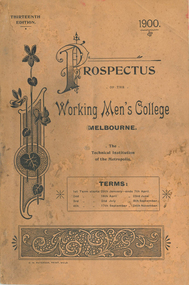
Book - Book - Prospectus, The Working Men's College Melbourne, Prospectus,1900, 1900
... The majority of classes were at night and on Saturdays. working men's college melbourne rmit w.c. kernot w.h. embling ormond statue f. ormond electricity surveying architecture photography assaying dressmaking veterinary science plumbing letterpress printing w. ison h.d. evans library denton hat mills literary and commercial department typewriting department languages telegraphy department of music department of mathematics department of engineering 'department of architecture department of art and applied art department of mining and metallurgy department of chemistry department of household economy department of agriculture and rural industries woodworking carpentry and joinery turning and fitting coachbuilding and carriagedrafting Tan soft covered book of 112 pages. The thirteenth edition of the Working Men's College (later Royal Melbourne Institute of Technology [RMIT]). It inlcudes the following photographic images: Main Building ...The Working Men’s College was founded in 1881 by a prominent grazier and philanthropist, The Hon. Francis Ormond, who donated £5000 towards the establishment of the college. The Council of the Melbourne Trades Hall then matched Ormond's initial donation by rallying its members. On 4 June 1887, the college opened in its purpose-built building on the corners of Bowen Street and La Trobe Street in Melbourne, with a gala ceremony. It became the third official provider of higher education in the new Colony of Victoria (the Melbourne Athenaeum was founded in 1839 and the University of Melbourne in 1853). The college was the predecessor to the current-day Royal Melbourne Institute of Technology (RMIT University). Adjoining the college in the 1890s were the Supreme Court of Victoria (later the Melbourne Magistrates' Court) and the Melbourne Gaol - both which are now part of RMIT today. A list of Scholarship Governors and Life Governors is included. The former have donated 250 Pounds Sterling and upwards, the later have donated 20 Pounds and over but less than 250 Pounds Sterling. The Patron of The Working Men's College was His Excellency The Right Honourable Lord Brassey. The President of the Council was Professor W C Kernot. The majority of classes were at night and on Saturdays. Tan soft covered book of 112 pages. The thirteenth edition of the Working Men's College (later Royal Melbourne Institute of Technology [RMIT]). It inlcudes the following photographic images: Main Building, Assaying, 1899 council (W.C. Kernot, W.H. Embling, Thomas smith, F.H. Bromley, John Reid, R.H. Solly, E. Findley, D. McIvor, James Robb, John Hancock, C.E. Oliver, A.J. Arnot, James Smith, Joseph Nixon, R.L.Jellery. C.S. Paterson), UNveiling the Ormond Statue, Victorian Lead and Shot Works, Francis Ormond, Telegraphy room, Lecture Theatre, photography, painting class, wool sorting, plumbing, Remington typewriter, W. Ison, H.D. Evans, library, Verdon prize, Denton Hat Mills. working men's college melbourne, rmit, w.c. kernot, w.h. embling, ormond statue, f. ormond, electricity, surveying, architecture, photography, assaying, dressmaking, veterinary science, plumbing, letterpress printing, w. ison, h.d. evans, library, denton hat mills, literary and commercial department, typewriting department, languages, telegraphy, department of music, department of mathematics, department of engineering, 'department of architecture, department of art and applied art, department of mining and metallurgy, department of chemistry, department of household economy, department of agriculture and rural industries, woodworking, carpentry and joinery, turning and fitting, coachbuilding and carriagedrafting -
 Federation University Historical Collection
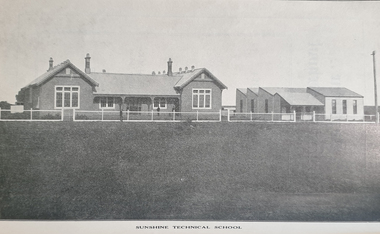
Booklet - Booklet - Prospectus, Exchange Press Pty Ltd, Sunshine Technical School, Prospectus, 1914, 1914
... industries Ballarat As H.V. McKay's Sunshine Harvester business expanded there was a requirement for a school to train the company's apprentices. In 1911, H.V. McKay wrote to the Victoria Cabinet offering 2,000 pounds and 4 1/2 acres of land in Derby Rd for a technical school, On the 7th July 1913, the new Sunshine Technical School opened with a wooded administration building with six class rooms and a large galvanised iron workshop for the trade apprentices. Mr George Baxter was appointed principal with assistant teachers, A.J. Dunlop (Maths & English), W.W. Anderson (Art) & H.B. Ernest (Maths & Science...industries Ballarat As H.V. McKay's Sunshine Harvester business expanded there was a requirement for a school to train the company's apprentices. In 1911, H.V. McKay wrote to the Victoria Cabinet offering 2,000 pounds and 4 1/2 acres of land in Derby Rd for a technical school, On the 7th July 1913, the new Sunshine Technical School opened with a wooded administration building with six class rooms and a large galvanised iron workshop for the trade apprentices. Mr George Baxter was appointed principal with assistant teachers, A.J. Dunlop (Maths & English), W.W. Anderson (Art) & H.B. Ernest (Maths & Science ...Used at School of mines and industries Ballarat As H.V. McKay's Sunshine Harvester business expanded there was a requirement for a school to train the company's apprentices. In 1911, H.V. McKay wrote to the Victoria Cabinet offering 2,000 pounds and 4 1/2 acres of land in Derby Rd for a technical school, On the 7th July 1913, the new Sunshine Technical School opened with a wooded administration building with six class rooms and a large galvanised iron workshop for the trade apprentices. Mr George Baxter was appointed principal with assistant teachers, A.J. Dunlop (Maths & English), W.W. Anderson (Art) & H.B. Ernest (Maths & Science). Seventy students were enrolled in the first year of which 44 were apprentices from the Harvester Works. During the First World War Years (1914 - 1918) there was a difficulties with staffing and enrollments. The school was also used to provide vocational training for wounded returned soldiers. In 1919 during the great influenza epidemic the school was used as a hospital. Light blue soft covered booklet of 60 pages with information about office bearers, staff, objects of the school, prizes and scholarships, examinations, time tables, courses, and subjects. It has photographs and advertising.sunshine, technical school, sunshine technical school, prospectus, hugh victor mckay, r.m. lambert, george mckay, d.b. ferguson, samuel mckay, george bult, ralph mckay, george butlin, george baxter, f.s. midgley, j.b. gray, w. kerr, a.j. dunlop, h. ernst, w.w. anderson, f. cleary, school councillors, staff, blacksmithing, carpentry, fitting and turning, moulding, sheet metal, mathematis, english, science, art, 1914, h v mckay, sunshine harvester, 2000 pounds and land donated, wounded returned soldiers, 1919 ued as hospital, influenza epidemic -
 Federation University Historical Collection
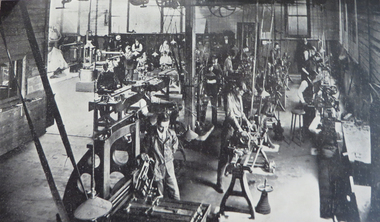
Booklet, Ballarat School of Mines and Industries, Prospectus A, Science and Engineering, 1916-7, c1917
... The Ballarat Technical Art School was part of the Ballarat School of Mines ballarat school of mines ballarat technical art school design modelling figure drawing fashion plate drawing black and white illustration wood carving lettering art metal work retouching architecture architectural diploma draughtsmen's courses art teachers' courses outdoor sketching classes photography building construction architectural drawing ticketwriting signwriting and decorating dressmaking needlework art teachers' certificate. student activities A soft covered book of 58 pages called the Ballarat School of Mines and Industries Prospectus A. Contents includes teaching staff, school hours, curriculum, fee list, Travelling concessions, school library, classification of subjects. scholarships, list of examiners, full science courses Includes images Staff of the Ballarat School of Mines and Students at work in Turning and Fitting Ballarat School of Mines and Industries, Prospectus A, Science and Engineering, 1916-7 Booklet Booklet ...The Ballarat Technical Art School was part of the Ballarat School of MinesA soft covered book of 58 pages called the Ballarat School of Mines and Industries Prospectus A. Contents includes teaching staff, school hours, curriculum, fee list, Travelling concessions, school library, classification of subjects. scholarships, list of examiners, full science courses Includes images Staff of the Ballarat School of Mines and Students at work in Turning and Fittingballarat school of mines, ballarat technical art school, design, modelling, figure drawing, fashion plate drawing, black and white illustration, wood carving, lettering, art metal work, retouching, architecture, architectural diploma, draughtsmen's courses, art teachers' courses, outdoor sketching classes, photography, building construction, architectural drawing, ticketwriting, signwriting and decorating, dressmaking, needlework, art teachers' certificate., student activities -
Federation University Historical Collection
Book - Book - Scrapbook, Ballarat School of MInes: Scrapbook of Newspaper Cuttings, Book 35, April 1988 to July 1988
... science studies building...arbor day at victoria park...smb and local industry...The papers concerned are The Courier, Ballarat, The Australian, The Age over the period of 22 July 1988 to 3 October 1987. teaching positions advertised pre-employment courses courses available enrolment for smb courses aboriginal flag for smb $600000 for science studies building arbor day at victoria park smb and local industry smb's marketing company inskill ltd open learning for maths students pilot business program industry oriented training scheme rob webber new enterprise incentives scheme gerardine christou myra morgan art and craft teacher 1950s new computer software for engineers more adults return to school cuts to special school funding transition program hospitality studies - certificate of catering anne-marie allison christine brady robert reilly sue collins sculptor peter blizzard student andrew burnham ricky hains wins tippett award kandra chapman award winner sheetmetal women's access group smb women's trade and technical program offended girl mechanic hit back mining course at smb kerrie cross council president adult literacy tutors june huggins josie micich hospitality traineeship system launched farm manager computer program course peter quinn peter davis federal grant to john valves special course on stoneware glazes ceramics instructor neville french players find home at smb michael staley winning apprentice ballarat small business centre quality control course at smb calligraphyteacher eddie goodson Book with green cover, front, spiral bound. ...Collection of newspaper articles related to Ballarat School Of Mines.They cover activities and advertisements for staff. The papers concerned are The Courier, Ballarat, The Australian, The Age over the period of 22 July 1988 to 3 October 1987.Book with green cover, front, spiral bound. teaching positions advertised, pre-employment courses, courses available, enrolment for smb courses, aboriginal flag for smb, $600000 for science studies building, arbor day at victoria park, smb and local industry, smb's marketing company inskill ltd, open learning for maths students, pilot business program, industry oriented training scheme, rob webber, new enterprise incentives scheme, gerardine christou, myra morgan art and craft teacher 1950s, new computer software for engineers, more adults return to school, cuts to special school funding, transition program, hospitality studies - certificate of catering, anne-marie allison, christine brady, robert reilly, sue collins, sculptor peter blizzard, student andrew burnham, ricky hains wins tippett award, kandra chapman award winner sheetmetal, women's access group, smb women's trade and technical program, offended girl mechanic hit back, mining course at smb, kerrie cross council president, adult literacy tutors, june huggins, josie micich, hospitality traineeship system launched, farm manager computer program course, peter quinn, peter davis, federal grant to john valves, special course on stoneware glazes, ceramics instructor neville french, players find home at smb, michael staley winning apprentice, ballarat small business centre, quality control course at smb, calligraphyteacher eddie goodson -
 Federation University Historical Collection
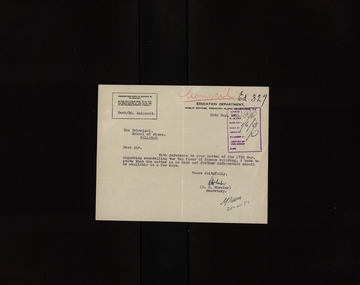
Correspondence - Education Department, Victoria, SMB: Remodelling top floor of Museum Building, 30/05/1951
... The Museum building at Ballarat School of Mines was hoping to be remodelled for student use, domestic sciences. ballarat school of mines and industries education department d h wheeler secretary r w richards museum building Signature of Secretary, D H Wheeler Date 30th May, 1951 Initials of R W Richards Type written letter on Education Department letterhead Stamp indicating received and answered SMB: Remodelling top floor of Museum Building Correspondence - Education Department, Victoria ...The Museum building at Ballarat School of Mines was hoping to be remodelled for student use, domestic sciences.Type written letter on Education Department letterhead Stamp indicating received and answeredSignature of Secretary, D H Wheeler Date 30th May, 1951 Initials of R W Richardsballarat school of mines and industries, education department, d h wheeler, secretary, r w richards, museum building -
Federation University Historical Collection
Booklet, Longman's, Green, and Co, A Select List of Books suitable for use in Science and Technical Schools, September 1904, 1904
... Industries. The book was produced by Longmans, Green and Co. in 1904. The books are divided into sections: 1. Practical Elementary Science Series, 2. Elementary Science Manuals, 3. Advanced Science Manuals, 4. Text-books of Science, 5. Chemistry, 6. Physics, 7. Mechanics, Theoretical and Applied, 8. Optics and Photography, 9, Sound, Light and Heat, 10. Steam, 11. Building...Industries. The book was produced by Longmans, Green and Co. in 1904. The books are divided into sections: 1. Practical Elementary Science Series, 2. Elementary Science Manuals, 3. Advanced Science Manuals, 4. Text-books of Science, 5. Chemistry, 6. Physics, 7. Mechanics, Theoretical and Applied, 8. Optics and Photography, 9, Sound, Light and Heat, 10. Steam, 11. Building ...Used at Ballarat School of Mines and Industries. The book was produced by Longmans, Green and Co. in 1904. The books are divided into sections: 1. Practical Elementary Science Series, 2. Elementary Science Manuals, 3. Advanced Science Manuals, 4. Text-books of Science, 5. Chemistry, 6. Physics, 7. Mechanics, Theoretical and Applied, 8. Optics and Photography, 9, Sound, Light and Heat, 10. Steam, 11. Building and Construction, 12. Magnetism and Electricity, 13. Engineering, Strength of Materials, 14. Machine Construction and Drawing, 15. Navigation, 16. Mineralogy, 17. Metallurgy, Astronomy, 18. Naval Architecture, 19. Principles of Mining, 20. Manufactures, Technology, 21. Geology, Physiography, 22.Hygiene, 23. Zoology, 24. Human Physiology, 25. General Biology, 26. Botany, 27. Principles of Agriculture, 28. Mathematics, 29. Geometry, 30. Trigonometry, Beige coloured soft covered book with 30 pages. Lists books suitable for use in technical and science schools.list of books, science and technical school, longmans, green and co., subject sections of books available -
 Federation University Historical Collection
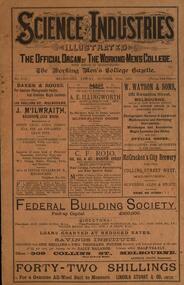
Book - Magazine, Science and Industries Illustrated: The Official Organ of the Working Men's College, 30 October 1891, 30/10/1891
... Watson and Sons; McCracken's City Brewery; Federal Building Society Science and Industries Illustrated: The Official Organ of the Working Men's College, 30 October 1891 Book Magazine ...12 page magazine of the Working Men's College. Includes advertisements for Brooks, Robinson and Co; Australian Mercantile Loan and guarantee Co. Ltd;W. Watson and Sons; McCracken's City Brewery; Federal Building Society working men's college, rmit, brennan torpedo, edward s. prior, planet mars, wood workers' tools, brooks, robinson and co, australian mercantile loan and guarantee co. ltd, w. watson and sons, mccracken's city brewery, federal building society, c.f. rojo, a.e. illingworth, j. mcilwraith, baker and rouse, remington, w. detmold, g. stuckey, walter j. turner, g. james, hammond typewriter, havelock tobacco, tangyes limited, arnall and jackson, h.p. gregory and co, foster's lager beer, james mcewan and co, phoenix spouting, ridging and curving works, joh ndanks and son, walter j. anderson, herbery v. hampton, alcock and co -
NMIT (Northern Melbourne Institute of TAFE)
Book: TAFE Curricula, Syllabi and Accreditation Documents 1994-1998, TAFE Curricula, Syllabi and Accreditation Documents 1994-1998, 1994-1998
... Science (Food Technology) Syllabus Date not clear. [to Archives 1999] Certificate in Food Processing . Revised Core Modules. (Draft report) 1994 Certificate IV in Food Technology, Diploma of Food technology. 2 vols. Food industry Training accreditation board. National Certificate in food processing . Course advice. Core modules. Syllabus framework. Literacy, English language and numeracy. Nov 1993. Associate Diploma of Applied Science (Environmental Waste Management) and Advanced Certificate in Environmental waste management. Part 1 – Accreditation submission. 1988. Certificate III in Environmental Change Management. Submission for accreditation. 1995. Diploma in Natural Resource management. Primary Industries Training accreditation board. 1996. Advanced Building...Science (Food Technology) Syllabus Date not clear. [to Archives 1999] Certificate in Food Processing . Revised Core Modules. (Draft report) 1994 Certificate IV in Food Technology, Diploma of Food technology. 2 vols. Food industry Training accreditation board. National Certificate in food processing . Course advice. Core modules. Syllabus framework. Literacy, English language and numeracy. Nov 1993. Associate Diploma of Applied Science (Environmental Waste Management) and Advanced Certificate in Environmental waste management. Part 1 – Accreditation submission. 1988. Certificate III in Environmental Change Management. Submission for accreditation. 1995. Diploma in Natural Resource management. Primary Industries Training accreditation board. 1996. Advanced Building ...Contents: National Horticulture Curriculum Parts A and B 1997/98 National Horticulture Curriculum Level 4 1997/98 National Horticulture Curriculum Level 5 1997/98 National Horticulture Curriculum Level 6 1997/98 Pharmaceutical Manufacturing. Certificates 1,2,3 Core modules. !997/98 Pharmaceutical Manufacturing. Certificates 1,2,3 Special electives. !997/98 Associate Diploma of Applied Science (Food Technology) Syllabus Date not clear. [to Archives 1999] Certificate in Food Processing . Revised Core Modules. (Draft report) 1994 Certificate IV in Food Technology, Diploma of Food technology. 2 vols. Food industry Training accreditation board. National Certificate in food processing . Course advice. Core modules. Syllabus framework. Literacy, English language and numeracy. Nov 1993. Associate Diploma of Applied Science (Environmental Waste Management) and Advanced Certificate in Environmental waste management. Part 1 – Accreditation submission. 1988. Certificate III in Environmental Change Management. Submission for accreditation. 1995. Diploma in Natural Resource management. Primary Industries Training accreditation board. 1996. Advanced Building Studies. National curriculum module maintenance. 1997. Details of past courses and their accreditation.13 individual books in various bindings. Each details requirements for course accreditation in a variety of TAFE courses.tafe, technical and further education, environmental waste management, environmental change management, food technology, natural resource management, food processing, building studies, pharmaceutical manufacturing, horticulture, nmit, -
Clunes Museum
Document - SCHOOL OF MINES - CLUNES BRANCH, KEN CLEMMENTS
... BUILDING LEASED BY BOROUGH COUNCIL TO ANA . CLUNES SCHOOL OF MINES KEN CLEMMENTS 1890-1893 .1 STICKERS ON FRONT: APPENDIX - CLUNES BRANCH OF SMB - CLUNES SCHOOL OF MINES NO. 24 APPENDIX .1 GREEN FOLDER WITH HANDWRITTEN NOTE INSIDE WITH SOME QUESTIONS ABOUT THE SCHOOL OF MINES 12/8/2003 .2 262 PAGES THE HISTORY OF THE CLUNES BRANCH OF BALLARAT SCHOOL OF MINES, INDUSTRIES AND SCIENCE IN THE UNIVERSITY OF MELBOURNE 1890 T0 1893 .3 OUTLINE OF THE STORY OF CLUNES BRANCH OF SMB Document SCHOOL OF MINES - CLUNES BRANCH KEN CLEMMENTS ...1889 BALLARAT SCHOOL OF MINES ENJOYED HIGH STATUS IN AUSTRALIA AND OVERSEAS. SEVERAL SMB STUDENTS WERE RESIDENTS OF CLUNES. SCHOOLS OF MINES HAD BEEN ESTABLISHED AT SEVERAL OTHER DISTRICT CENTRES INCLUDING MARYBOROUGH AND CRESWICK, OTHERS WERE TO FOLLOW AT ARARAT, STAWELL AND DAYLESFORD 1890 CLUNES BOROUGH COUNCIL WITH MR JOSEPH BRYANT LEADING, APPROACHED THE BALLARAT SCHOOL OF MINES REQUESTING SUPPORT FOR A BRANCH SCHOOL AT CLUNES OFFERING ELEMENTARY CLASSES WITH SMB STAFF AS LECTURERS SMB COUNCIL AGREED TO STAFF THE SUGGESTED CLASSES. SEVERAL PUBLIC LECTURES WERE ARRANGED AT CLUNES TO HELP CREATE INTEREST IN THE NEW CLUNES BRANCH OF SMB. CLASSES SOMMENCED SOME AT THE CLUNES FREE LIBRARY AND SOME AT THE NEW NORTH CLUNES MINE OFFICE/LABORATORY PER FAVOUR OF JOSEPH BRYANT WHO WAS HONORARY DIRECTOR OF THE BRANCH SCHOOL. 1891 LOWER STUDENT NUMBERS CAUSING CONCERN.. EDUCATION DEPARTMENT REGULATIONS FOR SCHOOLS OF MINES AND TECHNICAL SCHOOLS AND CONFLICTING VIEWS OF GOVERMENTMINISTERS RE SUBJECTS THAT COULD BE TAUGHT , CAUSED DIFFICULTIES. ONE LOCATION FOR ALL CLASSES BECAME THE ANTICIPATED SOLUTION TO MOST PROBLEMS. TITLE CLUNES SCHOOL OF MINES NO 24 APPEARED IN MEDIA NOTICES AND REPORTS WEST PARADE SITE FRONTING SERVICE STREET GRANTED BY CLUNE SBOROUGH COUNCIL TO COUNCIL OF CLUNES SCHOOL OF MINES FOR ERECTION OF BUILDING FOR SCHOOL PURPOSES. BUILDING COMMENCED 1892 NEW BUILDING OPENED IN FEBRUARY. ALL CLASSES CONDUCTED IN NEW BUILDING.SEVERE LIMITATION IN FUNDING FOR TECHNICAL EDUCATION AND IN MOST GOVERNMENT ACTIVITIES WAS EVIDENT NEW REGULATIONS FOR TECHNICAL SCHOOLS ANNOUNCED FOR OPERATION IN 1893, THE RQUIREMENTS FOR FUNDINGS WERE MUCH TOUGHER. 1893 STUDENT NUMBERS STILL VERY DISAPPOINTING. INSPECTORS DENNANT AND SIMPSON VISITED AND ADVISED ON BEST POSSIBLE FUNDING PROCURABLE . CLASSES CEASED AT THE END OF SECOND TERM (JULY) EXCEPT ART CLASSES WHICH COULD COVER DIRECT COSTS FROM STUDENT FEES. 1894 BUILDING LEASED BY BOROUGH COUNCIL TO ANA ..1 GREEN FOLDER WITH HANDWRITTEN NOTE INSIDE WITH SOME QUESTIONS ABOUT THE SCHOOL OF MINES 12/8/2003 .2 262 PAGES THE HISTORY OF THE CLUNES BRANCH OF BALLARAT SCHOOL OF MINES, INDUSTRIES AND SCIENCE IN THE UNIVERSITY OF MELBOURNE 1890 T0 1893 .3 OUTLINE OF THE STORY OF CLUNES BRANCH OF SMB.1 STICKERS ON FRONT: APPENDIX - CLUNES BRANCH OF SMB - CLUNES SCHOOL OF MINES NO. 24 APPENDIXclunes school of mines, ken clemments, 1890-1893 -
 Kew Historical Society Inc
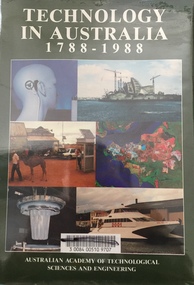
Book - Brown Gouge clothes brush, Australian Academy of Technological Sciences and Engineering, Technology in Australia, 1788-1988 : A condensed history of Australian technological innovation and adaptation during the first two hundred years, 1988
... science and the farmer. Food technology. Water and irrigation. Forestry and forest products. Australian innovation in textile technology. Engineering, construction and building. Transport. Communications and computers. The chemical industry...science and the farmer. Food technology. Water and irrigation. Forestry and forest products. Australian innovation in textile technology. Engineering, construction and building. Transport. Communications and computers. The chemical industry ...This book provides a history of technology in Australia from 1788 to 1988. There are twelve chapters by different authors. These chapters are: Innovation, science and the farmer (D.E. Tribe and L.J. Peel) Food technology (K.T.H. Farrer) Water and irrigation (K.D. Green) Forestry and forest products (W.H. Algar) Australian innovation in textile technology (D.S. Taylor) Engineering construction and building (J. Holland) Transport (B. Inglis) Communications and computers (J.H. Curtis and T. Pearcey) The chemical industry and Australian contributions to chemical technology (J.E. Kolm) The mineral industries (G.B. O'Malley) Energy (R.N. Morse) Manufacturing industry (P.N. Richards) Defence science and technology (J.L. Farrands and J.C. Wisdom) Index, photographs.Melbourne : Australian Academy of Technological Sciences and Engineering, c1988 xxix, 1017 p. : ill., maps, ports., plans, facsims. ; 26 cm. non-fictionThis book provides a history of technology in Australia from 1788 to 1988. There are twelve chapters by different authors. These chapters are: Innovation, science and the farmer (D.E. Tribe and L.J. Peel) Food technology (K.T.H. Farrer) Water and irrigation (K.D. Green) Forestry and forest products (W.H. Algar) Australian innovation in textile technology (D.S. Taylor) Engineering construction and building (J. Holland) Transport (B. Inglis) Communications and computers (J.H. Curtis and T. Pearcey) The chemical industry and Australian contributions to chemical technology (J.E. Kolm) The mineral industries (G.B. O'Malley) Energy (R.N. Morse) Manufacturing industry (P.N. Richards) Defence science and technology (J.L. Farrands and J.C. Wisdom) Index, photographs.technology -- australia -- history., technological innovations -- australia -- history. -
 Wodonga & District Historical Society Inc
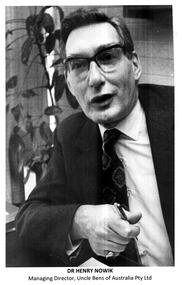
Mixed media - Dr Henry Nowik and Uncle Bens at Wodonga
... Science and Law from American Beirut University before moving to London to teach at the London School of Economics. He then moved into industry occupying a number of senior positions in marketing and market research. In 1964, Dr Nowik, then Market Research Manager for Pedigree Petfoods, the British arm of Mars Inc., came to Australia to research the prospects for establishing a petfood business. Dr Nowik was a passionate believer in the need for decentralisation of Australian industry. In 1965 Uncle Bens of Australia began building...Science and Law from American Beirut University before moving to London to teach at the London School of Economics. He then moved into industry occupying a number of senior positions in marketing and market research. In 1964, Dr Nowik, then Market Research Manager for Pedigree Petfoods, the British arm of Mars Inc., came to Australia to research the prospects for establishing a petfood business. Dr Nowik was a passionate believer in the need for decentralisation of Australian industry. In 1965 Uncle Bens of Australia began building ...Dr Henry Nowik played a critical role in the development of industry in Wodonga, through his management and leadership of Uncle Bens Wodonga from 1965 until 1979. Born in Poznan, Poland in 1917, Henry was studying medicine in Paris when World War II broke out and he enlisted in the Royal Air Force, serving with distinction as a Bomber Pilot. He was imprisoned in Russia when his plane ditched, escaped through Kazakhstan and was eventually evacuated to London where he was appointed RAF Aide-de-Camp to General Charles de Gaulle. He was later awarded the French Croix de Guerre. After the war Dr Nowik received a PhD in Political Science and Law from American Beirut University before moving to London to teach at the London School of Economics. He then moved into industry occupying a number of senior positions in marketing and market research. In 1964, Dr Nowik, then Market Research Manager for Pedigree Petfoods, the British arm of Mars Inc., came to Australia to research the prospects for establishing a petfood business. Dr Nowik was a passionate believer in the need for decentralisation of Australian industry. In 1965 Uncle Bens of Australia began building their first Australian factory in Wodonga, Victoria, from humble beginnings in a small house in Hovell Street. It became fully operational in 1967. Dr Nowik became the Marketing and Sales Director and in 1970 the Managing Director. Dr Nowik's work as a member of the Albury-Wodonga Consultative Committee was recognized in 1975 with the Order of the British Empire and in 1977 he was appointed Chairman of the Commonwealth Government's Decentralisation Advisory Board. He participated in a number of trade missions to Malaysia, China and Japan and was a Member of the Executive Committee of the Trade Development Council and the Victorian Promotion Committee. These contributions were recognised in 1982 when he was made an Officer of the Order of Australia. In 1979, Dr Nowik left Wodonga and moved to the United States to become Vice-President, Marketing for Mars, becoming Global Product Group President in 1980. Following his retirement in 1985 he continued to act as Senior Advisor to a number of Mars' businesses. Albury-Wodonga retained a special place in Dr Nowik's heart and he kept a close interest in Charles Sturt University, sharing his time, experience and expertise with staff and students. The University made him an honorary Doctor of Letters in 1993 when the Henry Nowik Lecture Theatre officially opened at the University's Albury campus. Later the City of Wodonga named a park in his honour. Dr Nowik and his wife returned to Australia in 2004, first living in Brisbane then moving to Maleny in Queensland. Henry Nowik died on 12th March 2015 aged 98. These items are significant because they demonstrate the contribution made to the Wodonga community and the Australian economy by Dr Henry Nowik AO OBE.A collection of items briefly documenting the contribution of Dr Henry Nowik to Wodonga, Victoria. Included are photos of Dr Nowik, newspaper items, a photo of the first office of Uncle Bens in Wodonga and a farewell card from Dr Nowik.dr henry nowik, uncle bens wodonga -
 City of Kingston
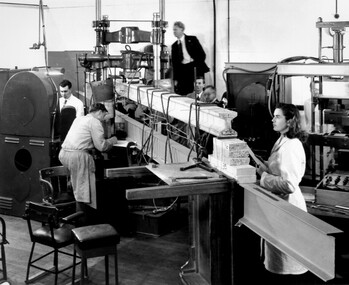
Photograph - Black and white, c. 1950
... Science Highett Workers Industry Small white sticker adhered to reverse of image with printed black text: 206 Handwritten in red ink on reverse of image: 53% Black and white photograph of workers at CSIRO (Commonwealth Scientific and Industrial Research Organisation) complex in Highett. In this image, building ...CSIRO, the Commonwealth Scientific and Industrial Research Organisation, moved into a former RAAF factory in Highett in the post-war years. CSIRO closed down the Highett facility and sold it in 2011.Black and white photograph of workers at CSIRO (Commonwealth Scientific and Industrial Research Organisation) complex in Highett. In this image, building materials are being tested. In the foreground is physicist Valerie Goullet, from CSIRO Division of Building Research. Other names have not been recorded.Small white sticker adhered to reverse of image with printed black text: 206 Handwritten in red ink on reverse of image: 53%science, highett, workers, industry -
 City of Greater Bendigo - Civic Collection
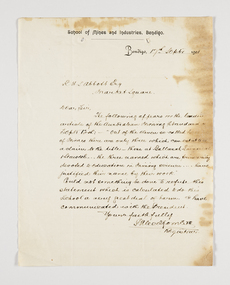
Letter - Correspondence from School of Mines and Industries, Bendigo to R.H. S Abbott, Bendigo School of Mines and Industries, 17th September, 1901
... science to meet the scientific and technical needs of the mining industry on the local gold fields. Initially mining, chemistry, geology, metallurgy and art were taught while a separate school of design was established in c. 1870 but incorporated into the School of Mines around 1883 when it was renamed as the School of Mines and Industry. In 1904 The Mechanics Institute was liquidated and its assets and buildings...science to meet the scientific and technical needs of the mining industry on the local gold fields. Initially mining, chemistry, geology, metallurgy and art were taught while a separate school of design was established in c. 1870 but incorporated into the School of Mines around 1883 when it was renamed as the School of Mines and Industry. In 1904 The Mechanics Institute was liquidated and its assets and buildings ...The Bendigo School of Mines was opened in 1873 following the first report of the Technological Commission in 1869 which recommended the establishment of schools of design and science to meet the scientific and technical needs of the mining industry on the local gold fields. Initially mining, chemistry, geology, metallurgy and art were taught while a separate school of design was established in c. 1870 but incorporated into the School of Mines around 1883 when it was renamed as the School of Mines and Industry. In 1904 The Mechanics Institute was liquidated and its assets and buildings acquired by the School of Mines. Around 1907 a Junior Technical School commenced to operate at the School of Mines and Industry but ceased operating in 1961 with that function being transferred to the White Hills and Kangaroo Flat Technical Schools. The Bendigo School of Mines and Industry became known as the Bendigo Technical College from the 1st July 1959. It operated under that name until February 1967 when it became the Bendigo Institute of Technology (B.I.T.). Construction work commenced in c.1965 which saw the Institute progressively re-locate to new buildings at Flora Hill. (Fn: https://prov.vic.gov.au/archive/VA3091) Richard Hartley Smith Abbott was the step son of Joseph Henry Abbott and continued on in the family tradition of entering into business. He was elected a representative in the Mandurang riding in the Shire of Strathfieldsaye in 1887, served as Mayor of the City of Bendigo from 1917 - 1918 and was Secretary of the Bendigo Art Gallery for over 20 years. His father Joseph Abbot had been a member of the School of Mines Administrative Council and RH Abbott served as President of the School of Mines for two years and was a highly regarded business man within the local community. The School of Mines and Industries would have written to him asking him to intervene to ensure that their reputation remained intact.Handwritten letter by the registrar from the School of Mines to R H S Abbott on lightly lined writing paper.city of greater bendigo education, city of greater bendigo mining, mayor rhs abbott, shire of strathfieldsaye, bendigo art gallery -
 City of Greater Bendigo - Civic Collection
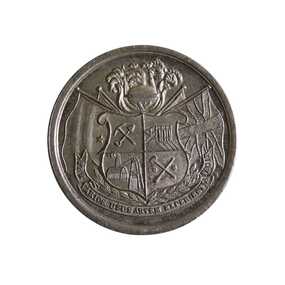
Medal, School of Mines Silver Jubilee 1873 - 1923, 1923
... science to meet the scientific and technical needs of the mining industry on the local gold fields. Initially mining, chemistry, geology, metallurgy and art were taught while a separate school of design was established in c. 1870 but incorporated into the School of Mines around 1883 when it was renamed as the School of Mines and Industry. In 1904 The Mechanics Institute was liquidated and its assets and buildings...science to meet the scientific and technical needs of the mining industry on the local gold fields. Initially mining, chemistry, geology, metallurgy and art were taught while a separate school of design was established in c. 1870 but incorporated into the School of Mines around 1883 when it was renamed as the School of Mines and Industry. In 1904 The Mechanics Institute was liquidated and its assets and buildings ...The Bendigo School of Mines was opened in 1873 following the first report of the Technological Commission in 1869 which recommended the establishment of schools of design and science to meet the scientific and technical needs of the mining industry on the local gold fields. Initially mining, chemistry, geology, metallurgy and art were taught while a separate school of design was established in c. 1870 but incorporated into the School of Mines around 1883 when it was renamed as the School of Mines and Industry. In 1904 The Mechanics Institute was liquidated and its assets and buildings acquired by the School of Mines. Around 1907 a Junior Technical School commenced to operate at the School of Mines and Industry but ceased operating in 1961 with that function being transferred to the White Hills and Kangaroo Flat Technical Schools.Obverse; Ornate relief design made up of a coat of arms with mining icons in each quarter flanked by flags on either side. Per varios usus artem experientia fecit written in scroll underneath. Translation: Practice has brought skill through different exercises. (Manilius) Reverse; Outer wheel Bendigo School of Mines and Industries. Inner; 1873 /Jubilee /1923Obverse; Per varios usus artem experientia fecit Reverse; Outer wheel Bendigo School of Mines and Industries. Inner; 1873 /Jubilee /1923city of greater bendigo education, bendigo school of mines -
 City of Melbourne Libraries
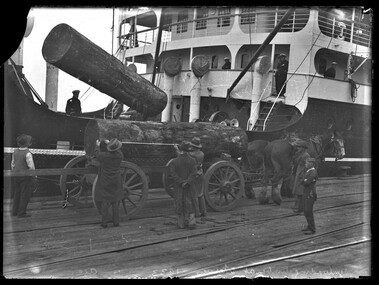
Photograph (item), Bull, Hugh Jones, 1897-1993, Unloading timber at Victoria Dock, 1933
... Retrieved January 30, 2026, from http://nla.gov.au/nla.news-article204377024 Wikipedia, Taiping steamer, https://en.wikipedia.org/wiki/Taiping_(steamer) Wikipedia, Victoria Dock, https://en.wikipedia.org/wiki/Victoria_Dock_(Melbourne) Docklands News, Ashley Smith, 2 Mar 2022, https://www.docklandsnews.com.au/victoria-dock/ Living Histories: Heritage Council of Victoria, Jill Barnard, 2008, Jetties and Piers, https://livinghistories.net.au/wp-content/uploads/2015/11/Jetties-ONL-intro_Part-1.pdf eMelbourne, Wharves and Docks, https://www.emelbourne.net.au/biogs/EM01612b.htm Australian Academy of Technological Sciences – Harvesting Wood, https://www.austehc.unimelb.edu.au/tia/225.html Old Treasury Building, On the Water – The Docks, https://tinyurl.com/3wkbk66m Old Treasury Building, On The Road, https://tinyurl.com/dw44yr3t Port of Melbourne, Victorian Places, https://www.victorianplaces.com.au/port-of-melbourne Docklands Heritage Study - Environmental History, https://mvga-prod-files.s3.ap-southeast-4.amazonaws.com/public/2024-05/docklands-heritage-review-thematic-environmental-history-1991.pdf eMelbourne, Horses, https://www.emelbourne.net.au/biogs/EM00723b.htm Victorian Clydesdale Horse Society, https://www.clydesdalesvic.org.au/history The Crossing, https://letterboxd.com/film/the-crossing-i/ ships shipping timber industry shipwrecks horses docks wharves 1930-1939 wars docklands Photographer notations on slide: "Unloading Timber at Wharves 1933 Age B5" Glass plate negative Unloading timber at Victoria Dock Photograph Bull, Hugh Jones, 1897-1993 The Age (Melbourne, Vic. : 1854 - 1954) ...Photographer notations on slide: "Unloading Timber at Wharves 1933 Age B5" Published: Age (Melbourne, Vic.: 1854- ), Tuesday 15 August 1933 MAHOGANY FROM MANILA. (1933, August 15). The Age (Melbourne, Vic. : 1854 - 1954), p. 11. Retrieved January 16, 2026, from http://nla.gov.au/nla.news-article204377024 Published title: MAHOGANY FROM MANILA Published Caption: Age Tue 15 Aug 1933 Caption: Unloading Mahogany Logs brought from Manila, Philippine Islands, by the steamer Taiping, which berthed yesterday at Victoria Dock. The vessel discharged twenty logs, each weighing three tons, the first shipment of this type of timber landed in Melbourne. Research by Project Volunteer, Louise McKenzie: This photograph in many ways epitomises Melbourne in the 1930s. It is a time of enormous growth, development and change. But before delving into that, the photo itself is very powerful. The huge mahogany logs being unloaded appear to be so heavy that the ship itself seems to list to port as they are craned over the side. They are being levered into a cart to which two large and sturdy Clydesdale horses are hitched. In contrast to the traditional horses, the wharf is crisscrossed with modern railway tracks. Unloading is both mechanical and manual, and the scene is one of intense interest to a young boy bystander. The ship appears to be squat and solid, but the whole image also gives a feeling of movement and intensity. The mahogany being delivered to Melbourne would be intended for high quality furniture. In the 1930s Australia actually had a growing timber industry, but much of the eucalyptus wood was being utilised for mass produced furniture, and much of this furniture would then have had a veneer applied to it. The fact that it was economic to import this timber from the “Philippine Islands” – not a traditional trading market for Australia – reflects a Victorian economy that was strong enough to support a growing demand for good quality furniture Mahogany was described as a classic, strong hardwood, often used for dark opulent furniture. In the 1930s the importation of timber from Manila (Philippines) to Australia was a notable trade, particularly in Philippine Lauan (often referred to as Philippine Mahogany), which was used as a cheaper alternative to other hardwoods. 1930s furniture, dominated by the art deco style, used a mix of luxurious exotic woods like mahogany, macassar and ebony for high-end pieces, often veneered over less expensive woods such as walnut, birch and poplar, and with plywood, chrome and lacquer also popular for more practical, streamlined designs during the Depression era. By the mid 1930s timber mills were being relocated away from the immediate dock area, but the fact that these logs were being transported by horse-drawn cart implies that the load would not have had to be taken too far for milling. 1885 the Melbourne Harbour Trust Commissioners had decided that land in or near the city was far too valuable to be used as timber yards. Furthermore, large stacks of timber posed a fire risk. The Trust asked the Victorian Government to reserve a site on the east side of the Yarra River opposite Yarraville and Spotswood. Here, in 1889, the Trust began building six jetties and a wharf specifically for the landing of timber. Clydesdale horses were initially brought to Victoria from Tasmania in the 1830s, and with the 1850s gold rush they were imported direct from Scotland. Melbourne was from its earliest years an important centre of horse-breeding from both imported and colonial-bred stock, providing the well-built draught horse for pulling heavily loaded wagons, the harness horse for delivery work and drawing coaches, and the saddle-horse used for riding. Stud breeding facilities were advertised from the early 1840s. By the 1870s the horse export trade was thriving, and the Port of Melbourne was the country's busiest exporter of horses to Indian, Asian and New Zealand markets. Kirk's Melbourne Horse and Carriage Bazaar in Bourke Street first advertised for business in 1840, and by the 1850s Bourke Street West was famed for its horse bazaars and saleyards. The Victorian Clydesdale Horse Society reports that Clydesdale working horses were a vital part of Melbourne's infrastructure and agricultural industry in the 1930s, when they reached the peak of their popularity despite the increasing competition from mechanization. Their main roles and usage at this time were: • City Delivery: Clydesdales were a common sight for metropolitan deliveries, particularly for breweries (such as Carlton & United Breweries), milk runs, and bread deliveries. • Industrial Work: They were heavily used for hauling cargo at the docks, in construction, and at specialized sites like the Truganina Explosives Reserve, where they pulled wagons. • Agriculture: In surrounding rural areas, they were the primary power source for ploughing and agricultural machinery. • Specialization: By the 1930s, the Clydesdale was smaller and more compact than the Shire or Percheron breeds, making them ideal for navigation in urban environments. After the 1930s their numbers decreased due to the onset of WWI and mechanisation. Wartime petrol rationing led to a brief revival for the working horse, as suburban tradesmen, now used to motor delivery, took their old jinkers out of mothballs. By 1947, however, only 1.5% of city traffic was horse-drawn. In 1952 the large horse cartage company A. Kellet Pty Ltd sold its 250 horses and converted its Richmond stables to storage. In the 1950s at Station and Princes piers, wharf labourers refused to work with the six draught horses still being used to haul trolleys and which were soon superseded by the fork lift, semi-trailer and mobile crane. Where carefully trained horses had once shunted trains in city goods yards, a few hundred a week were now being killed at the abattoirs for pet and human consumption. The last MCC dray horse was withdrawn from service in 1958, but some of the few remaining working animals are used by the mounted police for crowd control at demonstrations and football games. The death knell had also sounded for the associated trades of farrier, saddler and blacksmith. Our photo, therefore, showing the wharf with both the haulage Clydesdales and the rail lines, is a strong visual summary of the social and economic changes experienced in Victoria in the 1930s and on towards the 1950s. Our photo is located at Victoria Dock (also known as Victoria Harbour) which is still an active component of Melbourne’s port system. In 1892 the West Melbourne Dock (later Victoria Dock) was opened, downstream and immediately west of the Spencer Street railway shunting yards. It contained a swing basin for ships, replacing the one which had been provided on the south side of the river, later to be the Duke and Orr dry dock, west of the Charles Grimes Bridge. Further west was the South Wharf along the river bank. The history of Victoria Dock is extremely well described by Ashley Smith in his 2 March 2022 article in Docklands News, and its accompanying aerial photo of the Dock taken in 1934. He writes: "In the early 1930s Victoria Dock was one of the biggest sites for trade and export in Melbourne. A constant queue of ships sailed in, unloaded their cargo, recharged and reloaded, then left for the next port. Around the time this photo was taken (found in a 1934 photo book), the trapezium-shaped basin had been through some changes since its construction in the 1890s. The 497-metre-long Central Pier, finished in 1919, now featured six sheds to house the ever-increasing volume of cargo. The entrance had also been widened in the 1920s to allow better access. Some of the berths featured three-ton jib electric cranes to help with loading cargo and a rail network connected to the State Railway service. By the time construction was completed, the dock was 39 hectares and hailed as the second-largest dock in the world (behind Cavendish Dock, Barrow-in-Furness). To further save costs, excavations were dug to a more reasonable seven metres below low water, instead of British engineer Sir John Coode’s recommended 8.3 metres. Even then, the costs were still around £900,000. It was envisaged, with the extra wharfage, that around thirty 90-metre ships could berth inside. On March 22, 1892, Victoria Dock was opened by Victoria’s Governor, the Earl of Hopetoun (later Australia’s first Governor-General) who opened the sluice to let the Yarra in. It took six days to fill the basin with The Leader newspaper estimating that it would take another six months to completely fill (March 26, 1892). In the end, it took nearly a year before the first ship was allowed to enter on February 20, 1893, when the steamer Hubbuck sailed in to unload 1200 tonnes of cargo in 15 hours. The Argus (February 23, 1893) reported that the ship’s captain, J. R. Brodie, called the Yarra “better than the Thames”, and compared Victoria Dock favourably to the Albert Dock (Liverpool)." This would be a good time to move our focus on to the Taiping, which is the transporter of these giant mahogany logs. The Taiping was a steel-hulled, single-screw passenger-cargo Chinese steamer, which today has the dubious legacy of being involved in a collision headlined as “The Chinese Titanic”. It was constructed by the Hong Kong and Shampoa Dock Company at its facility in Hong Kong, with completion in 1926 for service under the Australia Oriental Line. Her gross register tonnage measured 4,324 tons, reflecting her design for inter-island and coastal trade routes, accommodating both passengers and freight. She operated routes connecting Australian ports with East Asian destinations. As World War II approached, Taiping continued predominantly working the trade routes between China and Australia, until December 1941, when she evacuated women and children from Hong Kong to Manila just before Japanese forces overran the region. She then safely reached Australia despite enemy air raids. Taiping was then requisitioned by the Royal Navy and repurposed as a victualling stores issuing ship for the Eastern Fleet, supporting logistical needs in the Pacific and Indian oceans. Returned to the Australian Oriental Line in 1947, she underwent refitting and by mid-1948 was chartered to the Shanghai Shipping Company, and modified for greater passenger accommodation – approximately 500 passengers. In 1948/49 the Chinese Civil War took place. The Taiping departed Shanghai on 26 January 1949 as one of the final vessels evacuating civilians from to Keelung Harbour in Taiwan. Reports indicate that the Taiping carried double the rated capacity of passengers i.e. 1000. The ship carried families, military personnel, civilians, carrying personal belongings, gold and valuables in hope of resettlement in Nationalist Taiwan. It also held heavy cargo in the form of silver and gold bullion loaded by the Central Bank of China. Because of the risk of patrols, and to conserve fuel, the Captain took the ship away from the usual open-sea passage, and instead navigated along the coast. He also extinguished navigation lights to avoid detection. Shortly after midnight on 27 January 1949 the Taiping collided with the smaller cargo steamer Chien Yuan in the East China Sea near the Zhoushan Archipelago. The Chien Yuan was also operating in darkness. The subsequent collision was catastrophic. The Chien Yuan sank with in 5 minutes, with the loss of 72 of its 74 crew. The Taiping sustained severe structural compromise from the broadside strike and initially remained afloat, then made a swift descent into the freezing water, with no attempt at an organised evacuation. No formal recovery process was instigated, however a distress signal went out. 32 survivors were picked up by the Australian destroyer HMAS Warramunga (on patrol nearby), a passing US vessel found 2 more, and local Zhoushan fishermen retrieved others. In the end, only 37 people survived. The event is remembered as a poignant moment in the mass migration to Taiwan, with families tragically separated. A memorial to the disaster exists at the Keelung Harbour naval base on Taiwan. With its total of over 1,500 deaths, it constituted one of the worst peacetime maritime losses. It is sometimes referred to as the “Oriental Titanic” because of the similarly large loss of life and speed of demise with the RMS Titanic in 1912. A fictional depiction of this event appears in the John Woo movies “The Crossing (Part 1) (2014), and The Crossing II (2015), known in Chinese as “Taiping Wheel”. The narrative weaves a story around pre-disaster romances and wartime turmoil among passengers, culminating in the ship’s rapid sinking. “The production, a high-budget Sino-Taiwanese-Hong Kong co-effort, portrays the event as a microcosm of the 1940s Sino-Japanese and civil war legacies, though critics noted the melodramatic style prioritizing spectacle over historical precision.” In conclusion, it is nice to return to our photo, and observe the people involved in this moment. The dockworkers are, so typical of the 1930s, dressed in what looks to us like formal clothing – dark suits or coats, white shirts, and black hats. I am particularly drawn to the young boy, bare-headed, arms crossed, and so intent on the unloading process. He too is wearing a white shirt, black trousers and jacket, and black shoes. This is 1933 Melbourne – but the haircut he is sporting is now very “hipster” and modern in 2026 Melbourne. References: MAHOGANY FROM MANILA. (1933, August 15). The Age (Melbourne, Vic. : 1854 - 1954), p. 11. Retrieved January 30, 2026, from http://nla.gov.au/nla.news-article204377024 Wikipedia, Taiping steamer, https://en.wikipedia.org/wiki/Taiping_(steamer) Wikipedia, Victoria Dock, https://en.wikipedia.org/wiki/Victoria_Dock_(Melbourne) Docklands News, Ashley Smith, 2 Mar 2022, https://www.docklandsnews.com.au/victoria-dock/ Living Histories: Heritage Council of Victoria, Jill Barnard, 2008, Jetties and Piers, https://livinghistories.net.au/wp-content/uploads/2015/11/Jetties-ONL-intro_Part-1.pdf eMelbourne, Wharves and Docks, https://www.emelbourne.net.au/biogs/EM01612b.htm Australian Academy of Technological Sciences – Harvesting Wood, https://www.austehc.unimelb.edu.au/tia/225.html Old Treasury Building, On the Water – The Docks, https://tinyurl.com/3wkbk66m Old Treasury Building, On The Road, https://tinyurl.com/dw44yr3t Port of Melbourne, Victorian Places, https://www.victorianplaces.com.au/port-of-melbourne Docklands Heritage Study - Environmental History, https://mvga-prod-files.s3.ap-southeast-4.amazonaws.com/public/2024-05/docklands-heritage-review-thematic-environmental-history-1991.pdf eMelbourne, Horses, https://www.emelbourne.net.au/biogs/EM00723b.htm Victorian Clydesdale Horse Society, https://www.clydesdalesvic.org.au/history The Crossing, https://letterboxd.com/film/the-crossing-i/Photographer notations on slide: "Unloading Timber at Wharves 1933 Age B5"ships, shipping, timber industry, shipwrecks, horses, docks, wharves, 1930-1939, wars, docklands
