
Showing 12 items matching "scientific analysis"
-
 Flagstaff Hill Maritime Museum and Village
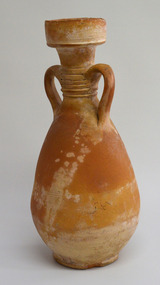
Ceramic - Amphora, mid-to-late 19th century
... ...scientific analysis...Flagstaff Hill Maritime Museum and Village Warrnambool Great Ocean Road Shipwreck Coast amphora jug Mahogany ship ancient wreck Joe O'Keefe Duncan Thermoluminescence North Africa Levy Point pottery storage jar Flagstaff Hill Maritime Museum Maritime Village shipwreck artefact relic Shipwreck Museum pottery jar ancient jar Egyptian water pot Greek jar ceramic jar mystery exotic jar mystery antique historic jug 1934 Joe O’Keefe Marshall Duncan Port Fairy 1935 1985 Marshall McKenzie Duncan Mac Duncan Duncan family 1981 Dan Madden scientific investigation scientific analysis scientific dating North African origin mid-late 19th century Marram grass Levy’s Point Pinhole patterns: [3 holes above 3 holes] opposite [3 holes above 3 holes], 1 hole] [ 1 hole above 2 holes] Amphora or jug; earthenware, orange clay with areas of cream. ...This amphora or jug has a silhouette shaped like a woman with her hands on her hips, wearing a long, flared-out skirt. The design was used in ancient Greece for pottery storage jars, the neck being narrower than the body. According to reports, this amphora was discovered in 1934 by Joe O'Keeffe, in a sand blowout, or sand hummocks, west of Levy's Point, west of Warrnambool, while he was planting marram grass for Mr Duncan. An article in the Warrnambool Standard newspaper of December 21, 1985, states that the amphora may be linked to the wooden sailing ship called the Mahogany Ship (also called the Ancient Wreck). Thermoluminescence testing indicates the relic was made in the mid-to-late 19th century, and experts suggest it was of North African origin. The presence of the amphora in the dunes, and the amphora itself, is still a mystery. The amphora was donated to Flagstaff Hill on a long-term loan by the Duncan family and displayed to the public for the first time on December 21, 1985. The exhibition continued until February 2023, when the objects on display in the Assistant Lighthouse Keepers Cottage (Shipwreck Museum) were returned to storage to rest, and the redevelopment of the Cottage began. A search for members of the Duncan Family was undertaken by Flagstaff Hill and stakeholders to resolve the loan term, but the family at that time was unknown. As such, to properly care for the amphora, it has been registered until ownership can be determined. The amphora is currently on display in the Great Circle Gallery, where members of the Duncan family recognised it and have since made contact with the museum. The amphora's presence in the hummocks remains an intriguing and tantalising mystery, yet to be solved!The amphora is significant for the mystery it holds. Its origin and connection with the local area have led to local speculation since it was discovered in 1934. Amphora or jug; earthenware, orange clay with areas of cream. The vessel has a wide mouth, a deep lip, two opposing handles between the neck and shoulder, and a bulbous body. The curved handles have a design of six bands between them. There are three rings of small dots encircling the body. The underside has concentric circles in the clay, an uneven edge and pinhole markings. The amphora is kindly on loan from the Duncan family.Pinhole patterns: [3 holes above 3 holes] opposite [3 holes above 3 holes], 1 hole] [ 1 hole above 2 holes] flagstaff hill maritime museum and village, warrnambool, great ocean road, shipwreck coast, amphora, jug, mahogany ship, ancient wreck, joe o'keefe, duncan, thermoluminescence, north africa, levy point, pottery, storage jar, flagstaff hill, maritime museum, maritime village, shipwreck artefact, relic, shipwreck museum, pottery jar, ancient jar, egyptian water pot, greek jar, ceramic jar, mystery, exotic jar, mystery antique, historic jug, 1934, joe o’keefe, marshall duncan, port fairy, 1935, 1985, marshall mckenzie duncan, mac duncan, duncan family, 1981, dan madden, scientific investigation, scientific analysis, scientific dating, north african origin, mid-late 19th century, marram grass, levy’s point -
 The Beechworth Burke Museum
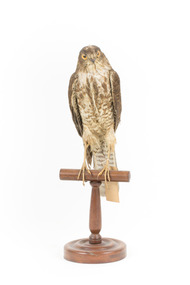
Animal specimen - Brown Goshawk Juvenile, Trustees of the Australian Museum, 1860-1880
... However, the limited material available—consisting of a single historical skin and nine subfossil bones—precludes confirmation through scientific analysis. This specimen was originally identified as a Nankeen Kestral and is catalogued as such in the original Public Library and Burke Museum catalogue. ...However, the limited material available—consisting of a single historical skin and nine subfossil bones—precludes confirmation through scientific analysis. This specimen was originally identified as a Nankeen Kestral and is catalogued as such in the original Public Library and Burke Museum catalogue. ...This specimen is a Brown Goshawk juvenile. The Brown Goshawk is widely distributed across Australia, Wallacea, New Guinea, New Caledonia, Vanuatu, and Fiji. In Australia, it predominantly inhabits eucalypt forests, woodlands, farmland, and urban areas, while in the Pacific, it is primarily associated with rainforest environments. Historically, it was also present on Norfolk Island until around 1790, potentially representing an undescribed subspecies. However, the limited material available—consisting of a single historical skin and nine subfossil bones—precludes confirmation through scientific analysis. This specimen was originally identified as a Nankeen Kestral and is catalogued as such in the original Public Library and Burke Museum catalogue. The specimen is part of a collection of almost 200 animal specimens that were originally acquired as skins from various institutions across Australia, including the Australian Museum in Sydney and the National Museum of Victoria (known as Museums Victoria since 1983), as well as individuals such as amateur anthropologist Reynell Eveleigh Johns between 1860-1880. These skins were then mounted by members of the Burke Museum Committee and put-on display in the formal space of the Museum’s original exhibition hall where they continue to be on display. This display of taxidermy mounts initially served to instruct visitors to the Burke Museum of the natural world around them, today it serves as an insight into the collecting habits of the 19th century.This specimen is part of a significant and rare taxidermy mount collection in the Burke Museum. This collection is scientifically and culturally important for reminding us of how science continues to shape our understanding of the modern world. They demonstrate a capacity to hold evidence of how Australia’s fauna history existed in the past and are potentially important for future environmental research. This collection continues to be on display in the Museum and has become a key part to interpreting the collecting habits of the 19th century.This specimen exhibits distinctive plumage compared to its adult counterparts. It has a streaky appearance, with a buff to pale rufous base color on its underparts adorned with bold, dark brown streaks. The upperparts are brown, with a slightly mottled or scalloped effect due to pale feather edges. Its eyes are yellow and legs are a pale yellow. The wings are broad and rounded, and the tail is long and barred. Identification swing tag with catalogue page number reads: 4. / Nankeen Kestrel - / See Catalogue,/ Page 2. /taxidermy mount, taxidermy, animalia, burke museum, beechworth, australian museum, skin, reynell eveleigh johns, bird, birds of prey, goshawk, ornithological, nankeen kestral -
 Federation University Historical Collection
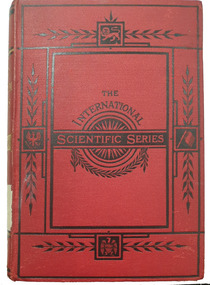
Book, Studies in Spectrum Analysis, 1878
... analysis...spectrum photography...science...science education...international scientific...Relates to historical studies in Spectrum analysis spectrum analysis spectrum photography science science education international scientific series j. norman lockyer alfred mica smith Carmicheal Smith Red hard covered book, with black writing and decoration on front and back cover. 258, 32 p., leaves of plates (2 folded) : ill. (7 col.) ; International scientific series ; v. 23 Studies in Spectrum Analysis Book Book Kegan Paul J. ...Relates to historical studies in Spectrum analysisRed hard covered book, with black writing and decoration on front and back cover. 258, 32 p., leaves of plates (2 folded) : ill. (7 col.) ; International scientific series ; v. 23Carmicheal Smithspectrum analysis, spectrum photography, science, science education, international scientific series, j. norman lockyer, alfred mica smith -
 Federation University Historical Collection
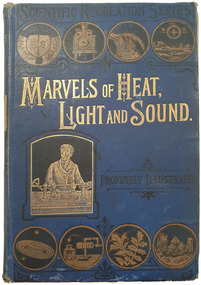
Book, Marvels of Heat, Light and Sound
... Targetted to the general reader of the scientific principles of heat, light and sound topics include heat; light (including reflection and refraction); vision (including vision and optical illusions, the eye, chromatic aberration, spinning tops); optical illusions (including occular estimation, zollner's designs, the thaumatrope, phenakistoscope, zootrope, praxinoscope, the dazzling top); optical illusions cont. (including the talking head, ghost illusions); optical apparatus (including the eye, the streoscope, spectrum analysis...Targetted to the general reader of the scientific principles of heat, light and sound topics include heat; light (including reflection and refraction); vision (including vision and optical illusions, the eye, chromatic aberration, spinning tops); optical illusions (including occular estimation, zollner's designs, the thaumatrope, phenakistoscope, zootrope, praxinoscope, the dazzling top); optical illusions cont. (including the talking head, ghost illusions); optical apparatus (including the eye, the streoscope, spectrum analysis ...Blue hard covered book with gold writing and illustrations on front cover, illustrations, 196 pages. Targetted to the general reader of the scientific principles of heat, light and sound topics include heat; light (including reflection and refraction); vision (including vision and optical illusions, the eye, chromatic aberration, spinning tops); optical illusions (including occular estimation, zollner's designs, the thaumatrope, phenakistoscope, zootrope, praxinoscope, the dazzling top); optical illusions cont. (including the talking head, ghost illusions); optical apparatus (including the eye, the streoscope, spectrum analysis, the spectroscope, the telescope and microscope, photography, dissolving views, luminous paint); spectral illusions (including a spectre, ghosts); acoustics (including the harmonograph); acoustics cont (including the topophone, the megaphone, the autophone, the audiphone, the telephone, the phonograph, the microphone). non-fictionscience, science class, scientific recreation series, light, heat, sound, ballarat ironworkers & polytechnic association -
 Federation University Historical Collection
Scientific Instrument, Orsat Apparatus
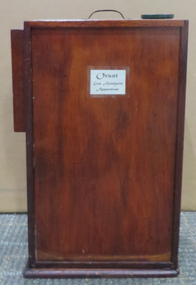
... Gas analysis apparatus Orsat Apparatus Scientific Instrument ...The Orsat was returned to the Historical Collection by Len Taylor, former staff member of SMB. For a period of time it was with Gary Price who rebuilt the Orsat to working order. Gary used a similar apparatus at Sidchrome and Ballarat Heat Treatment Pty. The Orsat apparatus is used to measure volumes of Carbon Dioxide, Oxygen, and Carbon Monoxide within a fixed volume of a sample of gas.Timber box with lift up front revealing a number of valves, pressure measure and glass container of red liquid attached to hose. Gas analysis apparatusorsat, len taylor, gary price, carbon dioxide, oxygen, carbon monoxide, gas, measure, apparatus -
 Federation University Historical Collection
Scientific Instrument, Spectrometer
... analysis to identify materials. The variable measured is most often the light's intensity but could also, for instance, be the polarization state. Often used in astronomy and some branches of chemistry. spectrometer scientific instrument electromagnetic spectrum light's intensity astronomy optical instrument Serial number 108 MCCES 1942 FG Electrostatic spectrometer in wooden box. ...An optical instrument used to measure properties of light over a specific portion of the electromagnetic spectrum, typically used in spectroscopic analysis to identify materials. The variable measured is most often the light's intensity but could also, for instance, be the polarization state. Often used in astronomy and some branches of chemistry.Electrostatic spectrometer in wooden box. Measured in Kilovolts.Serial number 108 MCCES 1942 FGspectrometer, scientific instrument, electromagnetic spectrum, light's intensity, astronomy, optical instrument -
 City of Moorabbin Historical Society (Operating the Box Cottage Museum)
Booklet, Phrenological Chart, Rev,J.J.Brown c1928, Physiological and Phrenological Chart Rev,J.J.Brown c1928, c1928
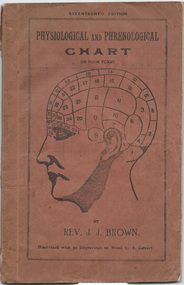
... Brown acknowledges that this printed delineation for self assessment is only approximate and proper analysis would cost time and money for personal consultation. After Charles Darwin, 1809 - 1882, English naturalist whose scientific theory of evolution by natural selection became the foundation of modern evolutionary studies. ...George Reed was a draftsman who lived in Bentleigh , City of Moorabbin in mid 20th C Phrenology is a process that involves observing and/or feeling the skull to determine an individual's psychological attributes. Franz Joseph Gall believed that the brain was made up of 27 individual organs that determined personality, the first 19 of these 'organs' he believed to exist in other animal species. Rev. Brown acknowledges that this printed delineation for self assessment is only approximate and proper analysis would cost time and money for personal consultation.After Charles Darwin, 1809 - 1882, English naturalist whose scientific theory of evolution by natural selection became the foundation of modern evolutionary studies. His nonreligious biology appealed to the rising class of professional scientists and the general public. Phrenology became a popular interest.A paper booklet with diagrams, charts and photos explaining Phrenology in 54 pages by Rev. J.J. Brown Coloured front and back covers have a drawing of a model of the human skull divided into 36 sections Front Cover ; SEVENTEENTH EDITION/ PHYSIOLOGICAL AND PHRENOLOGICAL / CHART / ( IN BOOK FORM) /BY / REV. J.J. BROWN/ Illustrated with 70 Engravingson Wood by S. Calvertgall franz joseph, phrenology, darwin charles, naturalists, jewellers, ezard & clark company moorabbin, early settlers, moorabbin shire, mechanics institute cheltenham, ormond choral society, postworld war 11 settlers,housing estates moorabbin 1950, bentleigh, ormond, moorabbin, cheltenham, drama societies, musical society cheltenham, clark judy, reed gladys, reed george, draftsman, architect, -
 Kiewa Valley Historical Society
Drill Bit Diamond, circa mid to late 1900's
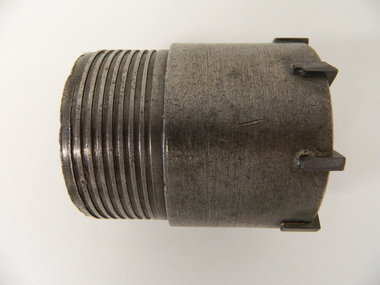
... analysis whether to construct a hydro electrical facility in the Kiewa Valley and the adjoining alpine region. The rock core samples produced were assessed by geologists and structural engineers. It was only after extensive core drilling covering the region that solid scientific ...This hollow core bit has hard cutting inserts for drilling into rock. It was used to drill and recover 50mm diameter (most common size) rock cores. The rock cores were assessed by geologists and engineers to provide information for design of structures such as tunnels, dams and underground power stations (eg. McKay Creek Power Station, West Kiewa Power Station). This type of bit was also used where damage to the surrounding rock had to be minimised. The Diamond Drill Bit,used in the early 1900's, when it was primarily used as a method of sampling rock for ore deposits and oil exploration resulting in a "coring" of rock. The use of "coring" to obtained samples for the SEC Kiewa Hydro Electricity Scheme(1920's onward) was to analyse the core to obtain temperature and rainfall patterns shown by the levels of layered solidified soil(rock). This diamond drill would have been used in the early 1900's to provide a sub strata map of temperature and water patterns (over an long period of time). This was a pre requisite to any decisions about the viability of the region to provide the water needed for a successful hydro electricity scheme.This diamond drill for core sampling was at the forefront of the analysis whether to construct a hydro electrical facility in the Kiewa Valley and the adjoining alpine region. The rock core samples produced were assessed by geologists and structural engineers. It was only after extensive core drilling covering the region that solid scientific evidence could be provided to start the "SEC Vic Hydro Electricity Scheme" within its current boundaries.This "diamond" drill bit has eight "teeth" at its cutting edge. The drill creates an 55mm hole in extremely hard rock material to obtain 50mm core samples.. Three quarters down the shank it has thread screw channels to attach the bit to the drill pipe. The coring pipe attaches via screwing it onto this bit. Core samples are the main objective of this tool.alternate energy supplies, alpine feasibility studies temperature, rainfall, sec, kiewa hydro electric scheme, electricity -
 Kiewa Valley Historical Society
Boots Riding Women's, Circa 1950's
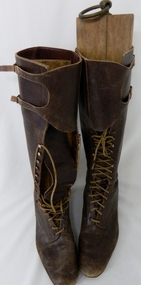
... In 1947 a scientific research project started to provide an impact analysis of any damage to alpine vegetation by cattle grazing in the Alpine regions incorporating the Bogong High Plains area. ...In 1947 a scientific research project started to provide an impact analysis of any damage to alpine vegetation by cattle grazing in the Alpine regions incorporating the Bogong High Plains area. ...This pair of "adjustable" boots came from the 1950's era in which the majority of footwear was either locally manufactured or imported from England or Europe. Quality hard wearing leather was a rural necessity especially for the cattle mustering activity in the Kiewa Valley and the Bogong High Plains region. The late 1900's provided a cheaper made riding boot from Asia, however many rural based riders still prefer an Australian made boot. The better quality (stronger stitching) of Australian boots is the main considerations of "stock horse riders". In 1947 a scientific research project started to provide an impact analysis of any damage to alpine vegetation by cattle grazing in the Alpine regions incorporating the Bogong High Plains area. This monitoring is the longest running ecological study ever undertaken in Australia. From this study, compelling evidence was presented to the Victorian Government to cease cattle grazing in the Alpine regions including the Bogong High Plains. All grazing was banned by the Victorian Government in 2005. Recreational horse riding within the Bogong High Plains is still permitted.These pair of women's riding boots are very significant to the Kiewa Valley as the boots were worn by one of the descendants of a pioneer family living and operating a cattle station before the SEC Hydro Electricity Scheme opened up the semi remote rural location in the 1950's. These boots were worn during the annual six weeks (approx.) mustering of cattle in the Bogong High Plains location (Victorian Alps region). The owner of these boots was Clare Roper, part of the Roper Family who built a "lodging" hut on the "High Plains" for accommodating riders during the periods (up to six weeks) when controlling grazing cattle during the summer muster seasons. It was unusual for women in the early to mid 1900's to go up on the High Plains to join the muster, which Clare Roper often did. These boots have high historical significance and good interpretive capacity.These brown "knee high" lady riding boots, are fastened by long "boot" laces which go from the base of the "fastening" position to a boot height of 22 cm. At the top end of the boot is a leather flap which crosses the front section of the boot and is fastened to the outside leg region by two straps. These provide the wearer with an adjustable tie. The boot has a "tongue" of 22 mm long. The boot has six pairs of metal boot lace "hooks" and eight pairs of boot lace "eyelets".ladies riding boots. cattle mustering footwear. rural footwear. cattlemen. bogong high plains. roper family. horses. -
National Wool Museum
Book, An analysis of the records of the registered Australian merino stud flocks
... "An analysis of the records of the registered Australian merino stud flocks"-B F Short and H B Carter, Council for Scientific and Industrial Research, Bulletin no 276, 1955...."An analysis of the records of the registered Australian merino stud flocks"-B F Short and H B Carter, Council for Scientific and Industrial Research, Bulletin no 276, 1955. ..."An analysis of the records of the registered Australian merino stud flocks"-B F Short and H B Carter, Council for Scientific and Industrial Research, Bulletin no 276, 1955.From the library /of/ Edward Mosig/ Black Rock Victoriasheep breeding merino sheep, council for scientific and industrial research new south wales sheepbreeders' association, sheep breeding, merino sheep -
Unions Ballarat
Power, action and belief: A new sociology of knowledge?, 1986
... Fyfe -- The Politics of schism: routinisation and social control in the International Socialists/Socialist workers' party / Steve Rayner -- The Social preconditions of radical scepticism / Mary Douglas -- The values of quantification / Jean Lave -- 'Interests' in political analysis / Barry Hindess -- Interactive-orientation and argumentation in scientific texts / Steven Yearley -- The Question of ideology: Althusser, Pecheux and Foucault / Mark Cousins and Athar Hussain -- On authority and its relationship to power / Barry Barnes -- Some elements of a sociology of translation: domestication of the scallops and the fishermen of St Brieuc Bay / Michel Callon -- On the methods of long-distance control: vessels, navigation and the Portuguese route to India / John Law -- The Powers of association / Bruno Latour. ...Fyfe -- The Politics of schism: routinisation and social control in the International Socialists/Socialist workers' party / Steve Rayner -- The Social preconditions of radical scepticism / Mary Douglas -- The values of quantification / Jean Lave -- 'Interests' in political analysis / Barry Hindess -- Interactive-orientation and argumentation in scientific texts / Steven Yearley -- The Question of ideology: Althusser, Pecheux and Foucault / Mark Cousins and Athar Hussain -- On authority and its relationship to power / Barry Barnes -- Some elements of a sociology of translation: domestication of the scallops and the fishermen of St Brieuc Bay / Michel Callon -- On the methods of long-distance control: vessels, navigation and the Portuguese route to India / John Law -- The Powers of association / Bruno Latour. ...Sociological text that explores social structure. Marxist and Durkeimian influences. Editor's introduction: Power/knowledge and the dissolution of the sociology of knowledge / John Law -- Art exhibitions and power during the nineteenth century / Gordon J. Fyfe -- The Politics of schism: routinisation and social control in the International Socialists/Socialist workers' party / Steve Rayner -- The Social preconditions of radical scepticism / Mary Douglas -- The values of quantification / Jean Lave -- 'Interests' in political analysis / Barry Hindess -- Interactive-orientation and argumentation in scientific texts / Steven Yearley -- The Question of ideology: Althusser, Pecheux and Foucault / Mark Cousins and Athar Hussain -- On authority and its relationship to power / Barry Barnes -- Some elements of a sociology of translation: domestication of the scallops and the fishermen of St Brieuc Bay / Michel Callon -- On the methods of long-distance control: vessels, navigation and the Portuguese route to India / John Law -- The Powers of association / Bruno Latour. Socially and politically significant. Broad relevance to how societies work.Paperback; white background; blue and black text; price sticker; 280 pages.Back cover: contributors' and editor's bios. Front cover: editor's name and title.btlc, ballarat trades and labour council, ballarat trades hall, power, knowledge, art, socialism, sociology, politics, science, ideology -
 Wodonga & District Historical Society Inc
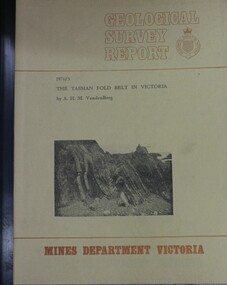
Booklet - The Tasman fold belt system in Victoria : geology and mineralisation of proterozoic to carboniferous rocks, A.H.M. Vanden Berg, 1976
... geology victoria landforms victoria tasman fold belt A scientific analysis of the development of the sequence of geological events and processes which contributed to the building of southeastern Australia landforms as part of the Tasman Fold Belt System. ...A scientific analysis of the development of the sequence of geological events and processes which contributed to the building of southeastern Australia landforms as part of the Tasman Fold Belt System.non-fictionA scientific analysis of the development of the sequence of geological events and processes which contributed to the building of southeastern Australia landforms as part of the Tasman Fold Belt System.geology victoria, landforms victoria, tasman fold belt
