
Showing 16 items matching "scientific investigation"
-
 Moorabbin Air Museum
Magazine - 75 YEARS OF SCIENTIFIC AIR ACCIDENT INVESTIGATION SUPPORT AT THE BEND, AUSTRALIAN GOVERNMENT, 2016
... 75 YEARS OF SCIENTIFIC AIR ACCIDENT INVESTIGATION SUPPORT AT THE BEND...75 YEARS OF SCIENTIFIC AIR ACCIDENT INVESTIGATION SUPPORT AT THE BEND...75 YEARS OF SCIENTIFIC AIR ACCIDENT INVESTIGATION SUPPORT AT THE BEND Magazine 75 YEARS OF SCIENTIFIC AIR ACCIDENT INVESTIGATION SUPPORT AT THE BEND AUSTRALIAN GOVERNMENT ... -
Tatura Irrigation & Wartime Camps Museum
Booklet, The Scientific Investigation of a Carley Float, by John Ashton, 1993
... The Scientific Investigation of a Carley Float, by John Ashton....A photo of HMAS "Sydney" on the cover. The Scientific Investigation of a Carley Float, by John Ashton. ...Donated by John Ashton who spoke to the Tatura Hist. Society on the subject.Soft, grey covered booklet of approx. 45 pages. A photo of HMAS "Sydney" on the cover.books, military -
 Flagstaff Hill Maritime Museum and Village
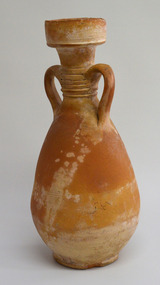
Ceramic - Amphora, mid-to-late 19th century
... ...scientific investigation...Flagstaff Hill Maritime Museum and Village Warrnambool Great Ocean Road Shipwreck Coast amphora jug Mahogany ship ancient wreck Joe O'Keefe Duncan Thermoluminescence North Africa Levy Point pottery storage jar Flagstaff Hill Maritime Museum Maritime Village shipwreck artefact relic Shipwreck Museum pottery jar ancient jar Egyptian water pot Greek jar ceramic jar mystery exotic jar mystery antique historic jug 1934 Joe O’Keefe Marshall Duncan Port Fairy 1935 1985 Marshall McKenzie Duncan Mac Duncan Duncan family 1981 Dan Madden scientific investigation scientific analysis scientific dating North African origin mid-late 19th century Marram grass Levy’s Point Pinhole patterns: [3 holes above 3 holes] opposite [3 holes above 3 holes], 1 hole] [ 1 hole above 2 holes] Amphora or jug; earthenware, orange clay with areas of cream. ...This amphora or jug has a silhouette shaped like a woman with her hands on her hips, wearing a long, flared-out skirt. The design was used in ancient Greece for pottery storage jars, the neck being narrower than the body. According to reports, this amphora was discovered in 1934 by Joe O'Keeffe, in a sand blowout, or sand hummocks, west of Levy's Point, west of Warrnambool, while he was planting marram grass for Mr Duncan. An article in the Warrnambool Standard newspaper of December 21, 1985, states that the amphora may be linked to the wooden sailing ship called the Mahogany Ship (also called the Ancient Wreck). Thermoluminescence testing indicates the relic was made in the mid-to-late 19th century, and experts suggest it was of North African origin. The presence of the amphora in the dunes, and the amphora itself, is still a mystery. The amphora was donated to Flagstaff Hill on a long-term loan by the Duncan family and displayed to the public for the first time on December 21, 1985. The exhibition continued until February 2023, when the objects on display in the Assistant Lighthouse Keepers Cottage (Shipwreck Museum) were returned to storage to rest, and the redevelopment of the Cottage began. A search for members of the Duncan Family was undertaken by Flagstaff Hill and stakeholders to resolve the loan term, but the family at that time was unknown. As such, to properly care for the amphora, it has been registered until ownership can be determined. The amphora is currently on display in the Great Circle Gallery, where members of the Duncan family recognised it and have since made contact with the museum. The amphora's presence in the hummocks remains an intriguing and tantalising mystery, yet to be solved!The amphora is significant for the mystery it holds. Its origin and connection with the local area have led to local speculation since it was discovered in 1934. Amphora or jug; earthenware, orange clay with areas of cream. The vessel has a wide mouth, a deep lip, two opposing handles between the neck and shoulder, and a bulbous body. The curved handles have a design of six bands between them. There are three rings of small dots encircling the body. The underside has concentric circles in the clay, an uneven edge and pinhole markings. The amphora is kindly on loan from the Duncan family.Pinhole patterns: [3 holes above 3 holes] opposite [3 holes above 3 holes], 1 hole] [ 1 hole above 2 holes] flagstaff hill maritime museum and village, warrnambool, great ocean road, shipwreck coast, amphora, jug, mahogany ship, ancient wreck, joe o'keefe, duncan, thermoluminescence, north africa, levy point, pottery, storage jar, flagstaff hill, maritime museum, maritime village, shipwreck artefact, relic, shipwreck museum, pottery jar, ancient jar, egyptian water pot, greek jar, ceramic jar, mystery, exotic jar, mystery antique, historic jug, 1934, joe o’keefe, marshall duncan, port fairy, 1935, 1985, marshall mckenzie duncan, mac duncan, duncan family, 1981, dan madden, scientific investigation, scientific analysis, scientific dating, north african origin, mid-late 19th century, marram grass, levy’s point -
 Parks Victoria - Mount Buffalo Chalet
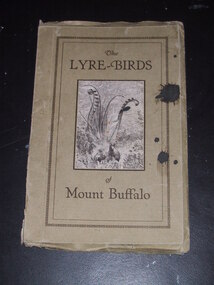
Booklet, "The Lyre-Birds of Mt Buffalo"
... "The Mount Buffalo plateau has been attracting scientific investigation into its unique plants, insects and animals from at least the 1850's. ..."The Mount Buffalo plateau has been attracting scientific investigation into its unique plants, insects and animals from at least the 1850's. ...Information booklet for distribution, collected by Roger Jones. "The Mount Buffalo plateau has been attracting scientific investigation into its unique plants, insects and animals from at least the 1850's. "(Pg. 131. Historica) "In 1924, amateur naturalist and mountain guide, Alice Manfield (1878-1960) popularly known as Guide Alice , released The Lyre-birds of Mount Buffalo, a 23 page booklet detailing her studies into the lyre-birds on Mount Buffalo, the first pictorial record of lyre-birds to be published. It features Mansfield's photography and includes an introduction by Charles Barrett (1879-1959), an Australian naturalist, journalist, author and foundation member of the Ornithologists Union." (Pg. 132) There are very few known copies of this booklet.Listed in Draft Inventory of Significant Collection Items . Appendix A.3. Natural History. (Pg 169. Historica)..1 Smooth olive book cover with stick-on photograph of a male lyre-bird. Framed within a border, ink blotches on right-side of booklet. 16 page booklet A 5 size, illustrations on left side pages, stick-on photographs on right pages except for introduction with illustration on right. Thick rough printed paper. •.2 Same as above with slight ink marks on top right, slight tear on right of image. .1 "The Lyre-Birds of Mt Buffalo" Photographs and notes by 'Guide Alice', Introduction by Charles Barrett CM2s Publisher: Robertson and Mullens Ltd....." •.2 Same as .1. -
 The Beechworth Burke Museum
Geological specimen - Olivine with Chromian diopside (dark green), Unknown
... investigate and chart the geological characteristics of Victoria. The procurement of geological specimens played a vital role in advancing our comprehension of the Earth's scientific composition and was instrumental in supporting research and educational institutions throughout Australia, including the Burke Museum, in their efforts to foster further exploration and study. burke museum beechworth geological geological specimen A solid mineral specimen in shades of green, grey and brown Geological specimen Olivine with Chromian diopside (dark green) ...This specimen was donated in 1868 by Alfred Selwyn. Olivine is typically found in basic and ultra-basic igneous rocks around the world, in a variety of colours including yellowish green, olive green, greenish black and reddish brown with a transparent to translucent diaphaneity. The luster of the specimen is vitreous, the luminescence non-fluorescent and when fractured the mineral is very brittle producing small, conchoidal fragments. Chromian diopside is normally found in small sizes as the larger the size of the mineral the darker the colour is, almost black rather than green. Chromium is the element that gives chromian diopside and emeralds their rich green colour. Diopside is found across the world in multiple colours however gem-quality chromian diopside is mined in Siberia, Russia and prominent within the jewellery industry as a more affordable substitute to emeralds. Chromium-bearing diopside has been located across Australia. Chromium-bearing Diopside is located across the world found in North America, parts of South America, and across Australia, Africa, Europe and Asia. Chromium-bearing Diopside is mined in Siberia, Russia and is sold as a commercial substitute for emeralds. The stone is often turned into jewellery. This item is one of many geological and mineral specimens that constitute a broader collection obtained from various regions across Australia (as well as some international locales) and generously contributed to the Burke Museum between 1868 and 1880. A significant portion of these specimens originated from Victoria and were acquired as a result of the Geological Survey of Victoria, initiated in 1852 during the Gold Rush era. The primary objective of this survey was to investigate and chart the geological characteristics of Victoria. The procurement of geological specimens played a vital role in advancing our comprehension of the Earth's scientific composition and was instrumental in supporting research and educational institutions throughout Australia, including the Burke Museum, in their efforts to foster further exploration and study. A solid mineral specimen in shades of green, grey and brownburke museum, beechworth, geological, geological specimen -
 Federation University Historical Collection
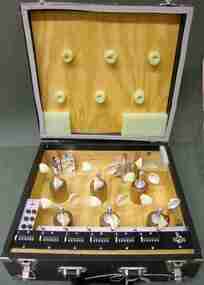
Scientific Instument, Anemometer, 6 Cup Model: Serial No. AM1-6-8875, c1975-1980
... Investigation related to wind energy harnessing projects, including that undertaken by MARS Industries in Ballarat. The 6-cup anemometer had a marked superiority in tests over the 3-cup anemometer and also had lower starting speeds. scientific instrument anemometer len cubitt mechanical engineering energy harnessing projects starting speeds Serial Number AM1-6-8875 Name Plate on lid between clasps. ...An anemometer is intended for determining velocity distribution over an area or in a boundary layer. This item was purchased by Mechanical Engineering upon the request of Dr Len Cubitt, to determine wind speed at various heights above the ground. Investigation related to wind energy harnessing projects, including that undertaken by MARS Industries in Ballarat. The 6-cup anemometer had a marked superiority in tests over the 3-cup anemometer and also had lower starting speeds.Anemometer in a case complete with mounting blocks, but without electric leads for connecting the black finished wood case which also incorporates pulse counters and connections for power supply and for other logging instruments. Serial Number AM1-6-8875 Name Plate on lid between clasps. 'RIMCO" RAUCHFUSS INST & STAFF Pty Ltd 12 Monomeath Drive, Mitcham, Vic. 3132" scientific instrument, anemometer, len cubitt, mechanical engineering, energy harnessing projects, starting speeds -
 Flagstaff Hill Maritime Museum and Village
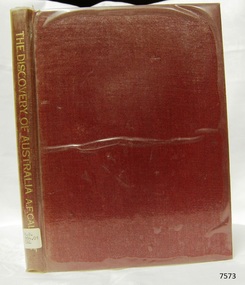
Book - Reference Book/History, Albert Frederick Calvert, The Discovery of Australia, 1893
... investigation with the outlook of a field traveler rather than a detached academic. Calvert was raised partly by his grandfather, a mineralogist who claimed to have found gold in Australia, which helped spark his later obsession with Western Australian mining and exploration. He first visited Australia in 1890, exploring the Murchison region and later discovering a new parakeet called the “spinifex parquet,” though the specimen was lost. Between 1890 and the mid‑1890s he financed and wrote about several Australian expeditions, including the Calvert Scientific...investigation with the outlook of a field traveler rather than a detached academic. Calvert was raised partly by his grandfather, a mineralogist who claimed to have found gold in Australia, which helped spark his later obsession with Western Australian mining and exploration. He first visited Australia in 1890, exploring the Murchison region and later discovering a new parakeet called the “spinifex parquet,” though the specimen was lost. Between 1890 and the mid‑1890s he financed and wrote about several Australian expeditions, including the Calvert Scientific ...Albert Frederick Calvert was an English author, traveler, mining engineer, and entrepreneur who became a prominent booster of Western Australia in the 1890s before shifting focus to Spain and Africa. He was born in London in 1872 and died there in 1946, his life blended exploration, promotion, and prolific, sometimes slapdash writing. His Australian Dictionary of Biography entry notes that he circumnavigated Australia while gathering material for “The Discovery of Australia” in 1893. The book was published in London by George Philip & Son in 1893, and a library record shows a 2nd edition issued in 1902 by Dean, so the work had at least two editions.The Discovery of Australia Author: Albert F Calvert Publisher: George Phillip & Son Date: 1893non-fictionAlbert Frederick Calvert was an English author, traveler, mining engineer, and entrepreneur who became a prominent booster of Western Australia in the 1890s before shifting focus to Spain and Africa. He was born in London in 1872 and died there in 1946, his life blended exploration, promotion, and prolific, sometimes slapdash writing. His Australian Dictionary of Biography entry notes that he circumnavigated Australia while gathering material for “The Discovery of Australia” in 1893. The book was published in London by George Philip & Son in 1893, and a library record shows a 2nd edition issued in 1902 by Dean, so the work had at least two editions. warrnambool, shipwrecked-coast, flagstaff-hill, flagstaff-hill-maritime-museum, maritime-museum, flagstaff-hill-maritime-village, shipwrecked-artefact, book, the discovery of australia, albert f calvert -
 The Cyril Kett Optometry Museum
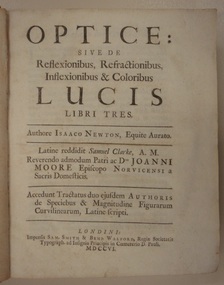
Book, Optice: sive de Reflexionibus, Refractionibus, Inflexionibus & Coloribus Lucis Libri Tres, 1706 (exact)
... investigations of the colours of thin sheets, 'Newton's rings', and diffraction of light. Newton uses a wave theory of light and his corpuscular theory to explain his observations. Sir Isaac Newton (1643-1727) was a great figure in the history of optical science. His classic 'Opticks' was first published in English in 1704. This Latin edition of 1706 was published to satisfy a wider scientific...investigations of the colours of thin sheets, 'Newton's rings', and diffraction of light. Newton uses a wave theory of light and his corpuscular theory to explain his observations. Sir Isaac Newton (1643-1727) was a great figure in the history of optical science. His classic 'Opticks' was first published in English in 1704. This Latin edition of 1706 was published to satisfy a wider scientific ...This 300 year old book deals with the theory of light and colour and with investigations of the colours of thin sheets, 'Newton's rings', and diffraction of light. Newton uses a wave theory of light and his corpuscular theory to explain his observations. Sir Isaac Newton (1643-1727) was a great figure in the history of optical science. His classic 'Opticks' was first published in English in 1704. This Latin edition of 1706 was published to satisfy a wider scientific audience in Europe. Newton was Lucasian Professor at Cambridge 1669-1693 and a fellow of Trinity College. He achieved fame as a creative mathematician and for his law of universal gravitation which explains planetary motions. He retired from research in 1693 to become a government official in London.This book is highly significant as a milestone in the study of optics. Although not a very rare book, only one other copy is listed by WorldCat in an Australian institution.Latin edition of Newton's 'Optics' translated by Samuel Clarke. This copy is bound in full calf leather of the period, 348 pages, with fold-out figures plus a 24 page appendix 'Enumeratio linearum tertii ordinis' and a 43 page appendix 'Tractus de quadratura curvarum'. It is in outstandingly good condition.Inscribed on the fly leaf in pencil is that this is the 2nd edition, the first in Latin, and that Newton gave Clarke 500 pounds for the translation.refraction, optics, newton, reflection -
 Eltham District Historical Society Inc
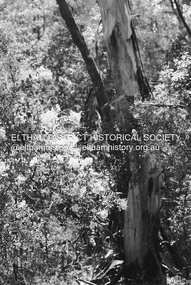
Photograph - Digital Photograph, Alan King, Sweet Bursaria, 2008
... scientifically from Eltham in 1931. But it was only officially named in 1951, by Victoria’s then top butterfly expert, David Crosby.2 However, from 1970, rapid housing development in Eltham destroyed much of the butterfly’s habitat. The discovery of several major colonies in 1987 met with great excitement, and 250 people attended the first local public meeting. The State Government commissioned Crosby to investigate...scientifically from Eltham in 1931. But it was only officially named in 1951, by Victoria’s then top butterfly expert, David Crosby.2 However, from 1970, rapid housing development in Eltham destroyed much of the butterfly’s habitat. The discovery of several major colonies in 1987 met with great excitement, and 250 people attended the first local public meeting. The State Government commissioned Crosby to investigate ...Published: Nillumbik Now and Then / Marguerite Marshall 2008; photographs Alan King with Marguerite Marshall.; p181 The rare Eltham Copper Butterfly, Paralucia pyro-discus, was saved from near extinction by a community campaign in the late 1980s. Thanks to that effort, the butterfly, a form of the Fiery Copper Butterfly, with a wing span of only 2.5cm, can be seen in parts of Eltham and Greensborough from late November to April. As late as 1987 the butterfly was thought to be near extinction. But that year, entomologist, Michael Braby, found several colonies, including two major ones in natural bushland on Diosma Road, Eltham. However these were threatened with destruction, as their habitat was to be destroyed by a development of 71 houses. The colonies were on a 14 hectare subdivision owned by Esanda Finance, an ANZ Bank subsidiary. It would cost around $5 million, to reimburse the bank for the land. The butterfly, which depends on woodland, a stunted form of the Sweet Bursaria bush, and the Notoncus ant, was considered too fragile to relocate. Braby’s discovery led to a sometimes fiery two-year campaign, which even became an election issue. It involved the local community, local and state governments and the developer, before a compromise was reached. The larvae have an intricate relationship with the small black ant, Notoncus. During the day, the larvae shelter in nests made by the ants around the base of the trunk and roots of the Sweet Bursaria (Bursaria spinosa). The ants are thought to protect the larvae from predators and parasites, as they attend them from the nests to feed on the Bursaria leaves at night. In return, the larvae excrete a sugar solution, which the ants love to eat. The butterfly was first recorded in Victoria in 1893, and first collected scientifically from Eltham in 1931. But it was only officially named in 1951, by Victoria’s then top butterfly expert, David Crosby.2 However, from 1970, rapid housing development in Eltham destroyed much of the butterfly’s habitat. The discovery of several major colonies in 1987 met with great excitement, and 250 people attended the first local public meeting. The State Government commissioned Crosby to investigate how to protect the butterfly, and the council froze development for three weeks. Then Esanda agreed to suspend development for several months, until a compromise was reached. Crosby recommended that 62 of the 71 lots be kept to ensure the butterflys’ survival. However this would cost $1 million to $1.5million in compensation to Esanda. Greensborough MP Pauline Toner, launched a $1million fundraising campaign and many artists donated their works to the appeal. Toner offered Clifton Pugh’s painting Eltham Copper Country to millionaire Alan Bond for $1 million, after having heard that he had offered $6 million for the Van Gough painting Sunflowers. However Bond did not accept. The butterfly was considered a ‘hot’ election issue during the by-election, following Pauline Toner’s resignation. Liberal party candidate, Margaret Brown, was accused of falsely saying she had been involved in the butterfly campaign so as to win votes. Sadly, the $1million appeal fell short at $426,000, so a compromise was reached. The State Government donated the Education Department site on Eucalyptus Road, but only nine lots of the Diosma site were bought, and the rest of the development went ahead. On March 3, 1989, Ms Toner died, and the Eucalyptus Road site was named in her honour. Around 2000 the butterfly was further threatened by proposed developments on Pitt Street, facing the Pauline Toner Reserve and between Diosma and Nyora Roads. Fortunately the Friends of the ECB, with the Shire of Nillumbik, ensured that more habitat was made available. The butterfly now survives in seven sites in Eltham and Greensborough, including the main sites at the Pauline Toner Reserve on Eucalyptus Road, the Western and Eastern colonies on Diosma Road, and the Yandell Reserve in Greensborough.The butterfly survives also in Castlemaine and in the Kiata and Salisbury areas. However, it remains endangered.This collection of almost 130 photos about places and people within the Shire of Nillumbik, an urban and rural municipality in Melbourne's north, contributes to an understanding of the history of the Shire. Published in 2008 immediately prior to the Black Saturday bushfires of February 7, 2009, it documents sites that were impacted, and in some cases destroyed by the fires. It includes photographs taken especially for the publication, creating a unique time capsule representing the Shire in the early 21st century. It remains the most recent comprehenesive publication devoted to the Shire's history connecting local residents to the past. nillumbik now and then (marshall-king) collection, eltham copper butterfly, sweet bursaria -
 Eltham District Historical Society Inc
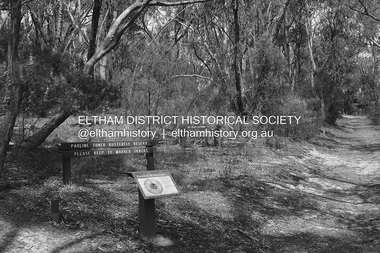
Photograph - Digital Photograph, Alan King, Pauline Toner Butterfly Reserve, 2008
... scientifically from Eltham in 1931. But it was only officially named in 1951, by Victoria’s then top butterfly expert, David Crosby.2 However, from 1970, rapid housing development in Eltham destroyed much of the butterfly’s habitat. The discovery of several major colonies in 1987 met with great excitement, and 250 people attended the first local public meeting. The State Government commissioned Crosby to investigate...scientifically from Eltham in 1931. But it was only officially named in 1951, by Victoria’s then top butterfly expert, David Crosby.2 However, from 1970, rapid housing development in Eltham destroyed much of the butterfly’s habitat. The discovery of several major colonies in 1987 met with great excitement, and 250 people attended the first local public meeting. The State Government commissioned Crosby to investigate ...One of seven sites in Eltham and Greensborough where the butterfly survives. Published: Nillumbik Now and Then / Marguerite Marshall 2008; photographs Alan King with Marguerite Marshall.; p181 The rare Eltham Copper Butterfly, Paralucia pyro-discus, was saved from near extinction by a community campaign in the late 1980s. Thanks to that effort, the butterfly, a form of the Fiery Copper Butterfly, with a wing span of only 2.5cm, can be seen in parts of Eltham and Greensborough from late November to April. As late as 1987 the butterfly was thought to be near extinction. But that year, entomologist, Michael Braby, found several colonies, including two major ones in natural bushland on Diosma Road, Eltham. However these were threatened with destruction, as their habitat was to be destroyed by a development of 71 houses. The colonies were on a 14 hectare subdivision owned by Esanda Finance, an ANZ Bank subsidiary. It would cost around $5 million, to reimburse the bank for the land. The butterfly, which depends on woodland, a stunted form of the Sweet Bursaria bush, and the Notoncus ant, was considered too fragile to relocate. Braby’s discovery led to a sometimes fiery two-year campaign, which even became an election issue. It involved the local community, local and state governments and the developer, before a compromise was reached. The larvae have an intricate relationship with the small black ant, Notoncus. During the day, the larvae shelter in nests made by the ants around the base of the trunk and roots of the Sweet Bursaria (Bursaria spinosa). The ants are thought to protect the larvae from predators and parasites, as they attend them from the nests to feed on the Bursaria leaves at night. In return, the larvae excrete a sugar solution, which the ants love to eat. The butterfly was first recorded in Victoria in 1893, and first collected scientifically from Eltham in 1931. But it was only officially named in 1951, by Victoria’s then top butterfly expert, David Crosby.2 However, from 1970, rapid housing development in Eltham destroyed much of the butterfly’s habitat. The discovery of several major colonies in 1987 met with great excitement, and 250 people attended the first local public meeting. The State Government commissioned Crosby to investigate how to protect the butterfly, and the council froze development for three weeks. Then Esanda agreed to suspend development for several months, until a compromise was reached. Crosby recommended that 62 of the 71 lots be kept to ensure the butterflys’ survival. However this would cost $1 million to $1.5million in compensation to Esanda. Greensborough MP Pauline Toner, launched a $1million fundraising campaign and many artists donated their works to the appeal. Toner offered Clifton Pugh’s painting Eltham Copper Country to millionaire Alan Bond for $1 million, after having heard that he had offered $6 million for the Van Gough painting Sunflowers. However Bond did not accept. The butterfly was considered a ‘hot’ election issue during the by-election, following Pauline Toner’s resignation. Liberal party candidate, Margaret Brown, was accused of falsely saying she had been involved in the butterfly campaign so as to win votes. Sadly, the $1million appeal fell short at $426,000, so a compromise was reached. The State Government donated the Education Department site on Eucalyptus Road, but only nine lots of the Diosma site were bought, and the rest of the development went ahead. On March 3, 1989, Ms Toner died. Thee Eucalyptus Road site was named in her honour. Around 2000 the butterfly was further threatened by proposed developments on Pitt Street, facing the Pauline Toner Reserve and between Diosma and Nyora Roads. Fortunately the Friends of the ECB, with the Shire of Nillumbik, ensured that more habitat was made available. The butterfly now survives in seven sites in Eltham and Greensborough, including the main sites at the Pauline Toner Reserve on Eucalyptus Road, the Western and Eastern colonies on Diosma Road, and the Yandell Reserve in Greensborough.5 The butterfly survives also in Castlemaine and in the Kiata and Salisbury areas. However, it remains endangered.This collection of almost 130 photos about places and people within the Shire of Nillumbik, an urban and rural municipality in Melbourne's north, contributes to an understanding of the history of the Shire. Published in 2008 immediately prior to the Black Saturday bushfires of February 7, 2009, it documents sites that were impacted, and in some cases destroyed by the fires. It includes photographs taken especially for the publication, creating a unique time capsule representing the Shire in the early 21st century. It remains the most recent comprehenesive publication devoted to the Shire's history connecting local residents to the past. nillumbik now and then (marshall-king) collection, eltham copper butterfly, pauline toner butterfly reserve -
 National Wool Museum
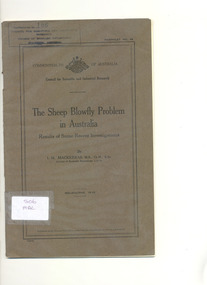
Book, The sheep blowfly problem in Australia: results of some recent investigations
... "The sheep blowfly problem in Australia: results of some recent investigations" - I M Mackerras, Council for Scientific and Industrial Research, Pamphlet no 66,1936...."The sheep blowfly problem in Australia: results of some recent investigations" - I M Mackerras, Council for Scientific and Industrial Research, Pamphlet no 66,1936. ..."The sheep blowfly problem in Australia: results of some recent investigations" - I M Mackerras, Council for Scientific and Industrial Research, Pamphlet no 66,1936.animal health wool - research, council for scientific and industrial research, animal health, wool - research -
 Monash University Museum of Computing History
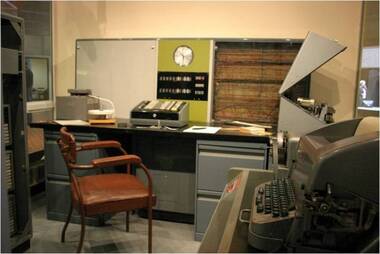
Ferranti Sirius mainframe computer, 1961
... scientific (technological) significance as one of the early transistor digital computers that transitioned computing from first-generation valve computers to second generation commercial installations. This example of the Sirius is of historical significance in its role as a part of the Computer Centre, Clayton campus, Monash University which provided computing facilities in Melbourne in the early 1960s when there were few installations available for academic, administrative and commercial users. Staff and students were able to undertake investigative ...The Ferranti Sirius is an electronic second-generation transistor computer and is one of three remaining examples of this machine left in the world. It was an important addition to the computing facilities at Monash University in the early 1960s and provided access for computer programming and research for many early computer professionals, academics and teachers. The Ferranti Sirius computer was built in a period of rapid growth in computing technology. The first stored program computers appeared in the late 1940s and used individual designs with valve technology. By the mid-1950s valve technology was replaced by transistors and the first mass produced commercial computers became available. The Ferranti Sirius was announced in 1959 and offered a “small” academic computer. It was designed and built by the English company Ferranti Ltd and sold through a local office of the company in Melbourne. The Sirius was manufactured at the Ferranti Ltd.’s West Gorton, England factory from 1959 to 1963 and, in all, the company produced probably 22 installations although only 16 were actually recorded as sold; this included one at Ferranti’s Bureau in London and one at Ferranti’s Melbourne Bureau. Only 7 were exported and 4 of these 7 were located in Melbourne, Australia. All four were associated with computing at Monash University – the Sirius in the MMoCH collection was purchased by Monash University in 1962, a smaller Ferranti Sirius was used on the Caulfield campus (prior to amalgamation with Monash University) from 1963, the Ferranti company had its own Ferranti Sirius initially temporarily installed at Clayton campus in 1962 and then placed in their office in Queens Road, Melbourne. A fourth computer was purchased by ICIANZ (now Orica) in 1962 and was transferred to Clayton campus in 1967. Only two of these Melbourne examples have survived; one in the MMoCH collection and one at Museums Victoria. There is an example of the Ferranti Sirius in the Science Museum Group collection in the UK as well. The Ferranti Sirius in the MMoCH collection was the first computer purchased by Monash University and it was shipped to Australia to be installed by November 1962. The University had a similar model computer on loan from Ferranti Ltd during the first part of the year and it was returned to the office of the company in Queens Road, Melbourne once the University’s own machine was installed. The computer was placed on site at Clayton campus, Monash University. The computer operated from 1962 until 1972 when it was officially decommissioned. The Ferranti Sirius was sold to Mr Paul Stewart in late 1974 and removed from Monash University. Mr Stewart later donated the computer back to the University in 1988 and it was transferred to the collection of the Monash Museum of Computing History after 2001. The Ferranti Sirius is an electronic second-generation transistor computer and is one of three remaining examples of this machine left in the world. It was an important addition to the computing facilities at Monash University in the early 1960s and provided access for computer programming and research for many early computer professionals, academics and teachers. The Ferranti Sirius is of scientific (technological) significance as one of the early transistor digital computers that transitioned computing from first-generation valve computers to second generation commercial installations. This example of the Sirius is of historical significance in its role as a part of the Computer Centre, Clayton campus, Monash University which provided computing facilities in Melbourne in the early 1960s when there were few installations available for academic, administrative and commercial users. Staff and students were able to undertake investigative research and learn programming techniques. The Computer Centre encouraged the use of the computer across all disciplines and this provided the base to establish computer science as a subject offering and, later, a new department in the University. This growth in computer education eventually culminated in the establishment of the Faculty of Information Technology, Monash University. The Ferranti Sirius in the collection at Monash Museum of Computing History has a main unit with a CPU and memory combined with input/output equipment and one extra cabinet of memory. The Central Processing Unit is a floor-standing unit which contains the computer circuits, power supplies and has a decimal digit display panel and a normal clock. A moveable control panel is placed in front of the Unit (Currently set on a recreated desk/filing cabinet support in the display). The Sirius base unit uses acoustic delay line memory with 1000 word store. An additional 3000 word memory cabinet is set adjacent to the CPU and can be connected to increase the memory. The computer is supported by a range of input/output devices. There is a Ferranti Paper tape reader, located on desk in front of CPU. Red label on front “Ferranti tape reader. Type TR 5. Serial No. 477”. Adjacent to the CPU is a set of Simplified tape editing equipment in three pieces which includes a (1) Table unit with switches on front face. Metal tag on reverse reads “Creed & Co. Model No. S4060. Serial No. 1457. Original Customers Marking GRP7 V706”. The table has a numbered internal tag “Table Serial No. 198579. (2)Creed teletype set on table unit. Metal tag on reverse “Creed & Co. Model No. 75RPR K4M4. Serial No. 5897 Made in England”. (3)Creed paper tape reader set on table unit. This set of equipment could read paper tape and print it, or copy paper tape while allowing it to be edited, or allow a programmer or data preparation person to type and punch a new program or data. It has no electrical connection to the computer. Paper tapes were usually torn off and carried across to the computer. There is also another table unit with switches on front face and changeable setting switch on front right side which holds a Ferranti Westrex paper tape punch set. Label on reverse “Teletype Code BRPE11” This was the Computer’s only output device. BRPE-11 is a teletype model number. -
 National Wool Museum
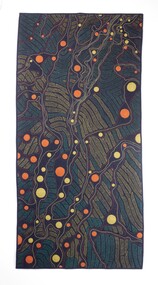
Textile - Everything Flows No.4, Greg Somerville, 2025
... scientific and art commissioning world, becoming a full-time art maker from the mid 1980’s. Much of his work is textile based, but drawing, printing and photography are other passions, each influencing the other. Greg's interests in physics, ecological theory, Buddhist ideology and years of observation, have all contributed to an aesthetic investigation dwelling upon underlying energies, patterns and relationships inherent in this world: the patterns of water drops on leaves, the way water flows over a bush track. ...scientific and art commissioning world, becoming a full-time art maker from the mid 1980’s. Much of his work is textile based, but drawing, printing and photography are other passions, each influencing the other. Greg's interests in physics, ecological theory, Buddhist ideology and years of observation, have all contributed to an aesthetic investigation dwelling upon underlying energies, patterns and relationships inherent in this world: the patterns of water drops on leaves, the way water flows over a bush track. ...Greg’s work has grown out of a Buddhist/ecological perspective. Graduating with a major in Ecology, he worked in the scientific and art commissioning world, becoming a full-time art maker from the mid 1980’s. Much of his work is textile based, but drawing, printing and photography are other passions, each influencing the other. Greg's interests in physics, ecological theory, Buddhist ideology and years of observation, have all contributed to an aesthetic investigation dwelling upon underlying energies, patterns and relationships inherent in this world: the patterns of water drops on leaves, the way water flows over a bush track. The inspiration is endless. Winner of the 2025 Expressions Wool Quilt Acquisitive Prize. Exhibition history includes Tamworth National Fibre Exhibition, Hobart Art Prize, Sorrento Art Prize, National Contemporary Art Prize, Art Quilt Australia, travelling exhibitions (Ararat and Goulburn Regional Galleries), many other Art Prizes and Group shows. Work is held in the Powerhouse and National Wool Museum.Wool quilt featuring circle and line designs in blue, yellow and orange tones.art quilt, expressions: the wool quilt prize, acquisitive award, prize, quilting, wool, greg somerville, textiles, artwork -
 Federation University Art Collection
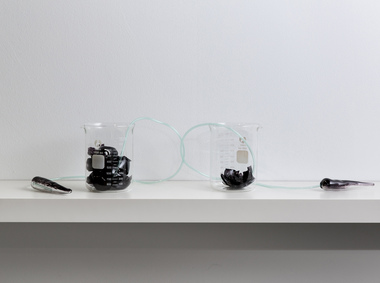
Sculpture - Artwork, 'The More Bones the Better' by Yhonnie Scarce, 2016
... scientific interventions on Indigenous cultures, Scarce also revealed Government sanctioned illegal drug testing of children in orphanages and other dubious medical practices undertaken on indigenous prison inmates. Scarce’s gatherings also reflect the impact of colonisation and the relentless conjuring and litany of abuses suffered by Aboriginal people. The More Bones the Better metaphorically looks at these situations and poses questions of what was undertaken and investigated...scientific interventions on Indigenous cultures, Scarce also revealed Government sanctioned illegal drug testing of children in orphanages and other dubious medical practices undertaken on indigenous prison inmates. Scarce’s gatherings also reflect the impact of colonisation and the relentless conjuring and litany of abuses suffered by Aboriginal people. The More Bones the Better metaphorically looks at these situations and poses questions of what was undertaken and investigated ...Yhonnie SCARCE (1973- ) Born Woomera, South Australia Language group: Kokatha, Southern desert region and Nukunu, Spencer region Yhonnie Scarce works predominantly in glass. She majored in glass withing a Bachelor of Visual Arts (Honours) course at the South Australian School of Art, Adelaide, and holds a Master of Fine Arts from Monash University. One of the first contemporary Australian artists to explore the political and aesthetic power of glass, Scarce describes her work as ‘politically motivated and emotionally driven’. Scarce’s work often references the on-going effects of colonisation on Aboriginal people, In particular her research focus has explored the impact of the removal and relocation of Aboriginal people from their homelands and the forcible removal of Aboriginal children from their families. (https://thisisnofantasy.com/artist/yhonnie-scarce/, accessed 10 September 2018)Artist's Statement 'The More Bones the Better', 2016 Yhonnie Scarce was born in Woomera, SA and belongs to the Kokatha and Nukunu peoples. Scarce embraces a non traditional approach to glass blowing using glass as more than a mere material, acting as a lens and a mirror, Scarce reflects and exposes the tragedies of Australia’s colonisation. She applies the technical rigours of traditional glass blowing techniques in an innovative and unconventional manner. In particular Scarce uses glass to explore the lives and histories of Aboriginal Australians. Hand blown glass is shaped, engraved, painted and smashed to create indigenous fruits and vegetables such as bush bananas, bush plums and long yams symbolic of her peoples culture and traditions. With their elongated, torso-like shapes, they even evoke human bodies. Akin to a gatherer of bush food Scarce creates glass-gatherings of the persecuted. The repetition of brittle ambiguous bodies collected for experimentation and examination conjures the relentless impact of colonisation and the litany of abuses suffered by Aboriginal people. Within her research Scarce encountered a variety of ethnographic studies examining the use of scientific interventions amongst Indigenous cultures. These include Government sanctioned illegal drug testing of children in orphanages and other dubious medical practices amongst indigenous prison inmates. This work metaphorically looks at these situations and poses questions of what might have gone on in such a laboratory. The judge of the 2017 Guirguis New Art Prize (GNAP), Simon Maidment, Senior Curator, Contemporary Art, National Gallery of Victoria said; “The winning work by Yhonnie Scarce captures the sensitivity to materials she displays throughout her artistic practice. The blown and shattered glass elements are a delicate contrast to the shocking and little discussed histories of Aboriginal exploitation and abuse in the name of science in Australia. Engaging this topic, this work is haunting, in the same way those lived and documented experiences continue to haunt the collective unconscious of this country. Yhonnie Scarce’s work, The More Bones the Better 2016, I believe makes an important contribution to the Collection of Federation University Australia and will engage and move diverse audiences with its technical accomplishment, beauty and message. Yhonnie Scarce was born in Woomera SA and belongs to the Kokatha and Nukunu peoples. Scarce embraces a non-traditional approach to glass blowing using her medium as more than a mere material. Applying the technical rigours of traditional glass blowing in an innovative and unconventional manner, Scarce’s glass objects act as a lens and a mirror to reflect and expose the tragedies of Australia’s colonisation and, in particular, explore the lives and histories of Aboriginal Australians. Hand-blown glass is shaped, engraved, painted and smashed to represent indigenous fruits and vegetables such as bush bananas, bush plums and long yams, symbolic of Scarce’s people’s culture and traditions. While these elongated shapes on the one hand represent fruit and vegetables, gathered and grouped as in the gathering of bush food, Scarce’s torso-like bodies and forms are glass ‘gatherings’ representative of the gathering of people. Here, the many brittle bodies act as a metaphor for the collection, experimentation and examinations undertaken by government authorities on Aboriginal communities researched by Scarce. Exposing a variety of ethnographic studies, examining the use of scientific interventions on Indigenous cultures, Scarce also revealed Government sanctioned illegal drug testing of children in orphanages and other dubious medical practices undertaken on indigenous prison inmates. Scarce’s gatherings also reflect the impact of colonisation and the relentless conjuring and litany of abuses suffered by Aboriginal people. The More Bones the Better metaphorically looks at these situations and poses questions of what was undertaken and investigated in these laboratories. guirguis new art prize, yhonnie scarce, glass, aboriginal -
Kew Historical Society Inc
Document, Kew Historical Society Collection : Significance Assessment, 2018
... scientific and social values that an object or collection has for past, present and future generations. The Kew Historical Society received a Community Heritage Grant from the National Library of Australia in 2017 for a significance assessment. The Grant was for three components of the overall collection: the costumes and textiles, the maps, and the pictures. However the assessment also considered the collection as a whole as it provided the context and the companions for these three components. Illustrated 39-page Final Report by Emma Russell and Alannah Croom of History@Work including - Executive Summary / p2. Investigation ...A Significance Assessment is the process of studying and understanding the meanings and values of objects and collections. It identifies the historic, aesthetic, scientific and social values that an object or collection has for past, present and future generations. The Kew Historical Society received a Community Heritage Grant from the National Library of Australia in 2017 for a significance assessment. The Grant was for three components of the overall collection: the costumes and textiles, the maps, and the pictures. However the assessment also considered the collection as a whole as it provided the context and the companions for these three components.Illustrated 39-page Final Report by Emma Russell and Alannah Croom of History@Work including - Executive Summary / p2. Investigation / p5. Assessment / p27. Statement of Significance / p33. Recommendations / p35. References / p36.non-fictionA Significance Assessment is the process of studying and understanding the meanings and values of objects and collections. It identifies the historic, aesthetic, scientific and social values that an object or collection has for past, present and future generations. The Kew Historical Society received a Community Heritage Grant from the National Library of Australia in 2017 for a significance assessment. The Grant was for three components of the overall collection: the costumes and textiles, the maps, and the pictures. However the assessment also considered the collection as a whole as it provided the context and the companions for these three components.significance assessments, historical society collections, kew historical society collection - significance assessment, community heritage grants -
 Port Fairy Historical Society Museum and Archives
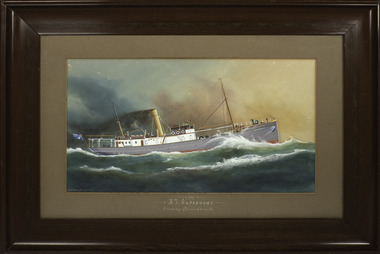
Decorative object - Painting, F. I. Endeavour
... A Painting of a forgotten ship and crew that were forerunners of investigating the reserves of fish in our oceans. ship fishing scientific belfast & koroit steam navigation company endeavour macquarie island hobart harald dannevig Front - The F. ...For many years this painting hung in the offices of the Belfast & Koroit Steam Navigation Company in Port Fairy. It was painted by Arthur Victor Gregory (1867-1957), a water colourist and marine artist. It depicts the Fisheries Investigation Ship Endeavour, a trawler built to the specifications of the Commonwealth Government in 1909 to assist in identifying new fishing grounds in the seas around Australia. The Endeavour was lost in December 1914 between Macquarie Island and Hobart with the loss of all twenty-one men on board, including Harald Dannevig, the Commonwealth Director of Fisheries.A Painting of a forgotten ship and crew that were forerunners of investigating the reserves of fish in our oceans.A painting of the F. I. Endeavour in a wooden frame. Scroll work on frame.Front - The F. I. Endeavour crossing Bass's Straits A. V. Gregory 10 Reverse - Regal Patronage ?.8.1854 Arthur V. Gregory Marine ? Arthur V. Gregoryship, fishing, scientific, belfast & koroit steam navigation company, endeavour, macquarie island, hobart, harald dannevig
