
Showing 187 items matching "sea transport"
-
 Moorabbin Air Museum
Book - Dept of Transport Australia description of Air, Land and Sea transport about Australia, AUSTRALIAN TRANSPORT 1973-74, Department of Transport Australia, AUSTRALIAN TRANSPORT 1973-74, 1974
... Dept of Transport Australia description of Air, Land and Sea transport about Australia, AUSTRALIAN TRANSPORT 1973-74...Dept of Transport Australia description of Air, Land and Sea transport about Australia, AUSTRALIAN TRANSPORT 1973-74...Dept of Transport Australia description of Air, Land and Sea transport about Australia, AUSTRALIAN TRANSPORT 1973-74 Dept of Transport Australia description of Air, Land and Sea transport about Australia, AUSTRALIAN TRANSPORT 1973-74 Embosed symbol of Dept of Transport Australia on a white cover AUSTRALIAN TRANSPORT 1973-74 Book Dept of Transport Australia description of Air, Land and Sea transport about Australia, AUSTRALIAN TRANSPORT 1973-74 Department of Transport Australia ...Dept of Transport Australia description of Air, Land and Sea transport about Australia, AUSTRALIAN TRANSPORT 1973-74Embosed symbol of Dept of Transport Australia on a white covernon-fictionDept of Transport Australia description of Air, Land and Sea transport about Australia, AUSTRALIAN TRANSPORT 1973-74 -
 Flagstaff Hill Maritime Museum and Village
Craft - Ship Model, S.S. Nelson, 1877 - 1984
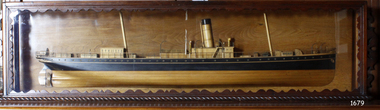
... ...sea transport melbourne to portland...Once the railway came to Warrnambool in 1889, the steam shipping industry began to decline. flagstaff hill warrnambool shipwrecked-coast flagstaff-hill flagstaff-hill-maritime-museum maritime-museum shipwreck-coast flagstaff-hill-maritime-village s.s. nelson steam ship 1877 screw steamer 1877 vessel ship model s.s. nelson blackwood and gordon port glasgow warrnambool steam packet company western steam navigation company south west coast trader sea transport melbourne to portland victorian steam navigation board s.s. julia percey captain john nicholson captain thomas smith captain s drewet captain john thompson captain carrington huddart, parker and co bass strait crossing 1890 sea transport melbourne to launceston porpoise rock tamar river australian alliance insurance company ship model making vessels victorian coastal trader "NELSON" painted on bow Ship model; relief of the S.S. ...This beautifully made ship model is a side relief of the steam ship “S.S. Nelson”, which was launched in 1877. The model’s case stands out because of its ornately carved internal frame. Relief models of ships, sometimes called half models, were often built by the shipbuilders as an exact scale model of the finished ship. The shipbuilders would use the model to ensure that the design was balanced. They would use the model as a point of reference during building. Also, ship models were used to demonstrate the designs to prospective buyers. It is not known whether this model of the “S.S. Nelson” was made for these purposes. HISTORY of the “S.S. Nelson” During the period 1840-1890 shipping was the cheapest and most practical means of carrying produce and goods to and from coastal towns such as Warrnambool. In the 1850s regular domestic steamer services began and by 1870 the passenger trade was booming. Passengers were taken to the ship’s side in small boats called lighters, which took it to ships at anchorage in Lady Bay, then climbed aboard up ladders or gangways. Their fare covered accommodation Saloon/Cabin section (higher class and more expensive) or the Steerage section (lower class and less expensive, below deck level). Produce included livestock such as pigs and fowls, and dairy products, bales of wool, and potatoes. The goods were loaded from the Warrnambool Jetty into the lighters. The S.S. Nelson was built by Messrs Blackwood and Gordon of Port Glasgow for a cost £25,000 in 1877. She was an iron screw steamer with an overall length of 200 feet, beam 25.5 feet and a depth of hold of 19.4 feet, which gave her a gross measurement of 649 tons. Her engines gave her a best speed of 13 knots and a maintainable speed of 12 knots. She was described as a handsome, star decked, efficient steamship, fitted with accommodating for 75 first class passengers in a saloon, and 40 second class passengers in a cabin. The S.S. Nelson arrived in the colony of Victoria on March 9th, 1877. She was first registered in Warrnambool by the Warrnambool Steam Packet Company under the management of Mr William Evans, and employed in the coastal trade of south west Victoria. She was very popular in 1878, registered under the new ownership of the Western Steamship Navigation Company, trading between Melbourne, Warrnambool and Portland. Captained John Nicholson commanded the S.S. Nelson after the previous captain, Thomas Smith, was suspended in 1882 for six months by the Victorian Steam Navigation Board following the collision between the S.S. Nelson and the S.S. Julia Percy. Other Captains include S Drewet and John Thompson. The S.S. Nelson was sold to Messrs. Huddart, Parker and Co. and re-registered in Melbourne on June 23rd, 1890. The new owners intended to use her for their Bass Strait crossing between Melbourne, Victoria and Launceston, Tasmania. On the night of Friday, June 27th 1890, under the command of Captain Carrington, she was on her way to Launceston on her first crossing for her new owners. She had no passengers and very little cargo and was to return to Melbourne with passengers the following morning. She was only 21 hours out of the dock when she struck Porpoise Rock in the Tamar River. All crew of 25 were saved but the bulkheads gave way and she rapidly filled before keeling over and disappearing in approximately 130 feet of water. The new owners had fully insured the almost 14-year-old S.S. Nelson with the Australian Alliance Insurance Company and she had only been in their possession for four days. This ship model of the S.S. Nelson is significant for its connection with the steam screw ship S.S. Nelson, one of a fleet of vessels owned by the Warrnambool Steam Packet Company. The S.S. Nelson was specifically built and purchased for the Victorian coastal trade business of the late 19th century, when shipping was the cheapest and most practical means of transporting goods and passengers between Victoria’s coastal towns and the major port at Melbourne. Once the railway came to Warrnambool in 1889, the steam shipping industry began to decline.Ship model; relief of the S.S. Nelson, showing deck superstructure, ventilators and single funnel. Ship's name is painted on the bow "NELSON". Wood model, varnished finish over natural wood and black painted areas. Timber case with ornate edging and glass front and sides."NELSON" painted on bowflagstaff hill, warrnambool, shipwrecked-coast, flagstaff-hill, flagstaff-hill-maritime-museum, maritime-museum, shipwreck-coast, flagstaff-hill-maritime-village, s.s. nelson steam ship 1877, screw steamer, 1877 vessel, ship model s.s. nelson, blackwood and gordon port glasgow, warrnambool steam packet company, western steam navigation company, south west coast trader, sea transport melbourne to portland, victorian steam navigation board, s.s. julia percey, captain john nicholson, captain thomas smith, captain s drewet, captain john thompson, captain carrington, huddart, parker and co, bass strait crossing 1890, sea transport melbourne to launceston, porpoise rock tamar river, australian alliance insurance company, ship model making, vessels, victorian coastal trader -
 RSL Victoria - Anzac House Reference Library and Memorabilia Collection
Diary of Clarence Russell Softley Thompson - (Item held at Monash Memorial Library), Clarence Russell Softley Thompson, January 1918 to January 1919
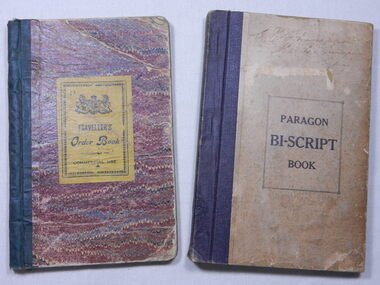
... WW1 diary of Clarence Thompson (19810 - AMC Sea Transport Staff, Section 4)....WW1 diary of Clarence Thompson (19810 - AMC Sea Transport Staff, Section 4). Diary of Clarence Russell Softley Thompson - (Item held at Monash Memorial Library) Clarence Russell Softley Thompson ...Diaries detail two journies made to Europe from Australia during 1918.Two hardcovered notebooks. WW1 diary of Clarence Thompson (19810 - AMC Sea Transport Staff, Section 4). -
 Orbost & District Historical Society
black and white photograph, before 1924
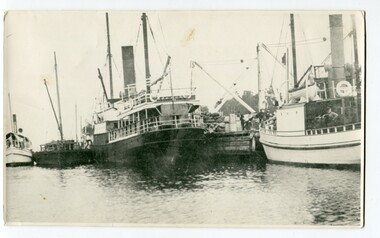
... -wyrallah shipping-east-gippsland harbeck's-wharf-lakes-entrance sea-transport...-wyrallah shipping-east-gippsland harbeck's-wharf-lakes-entrance sea-transport on back - "Jo-Bull", L-R Lady Harriet.........." ...This photograph shows the Lady Harriett, her barge, the Wyrallah and Storm Bird with Captain Jimmy Bills at Harbeck's wharf, Lakes Entrance, The Lady Harriett was a small steamer that serviced the Tambo River and other areas. In 1895 the Lady Harriett was advertised to run between Bairnsdale and Mallacoota on a weekly service. The Lady Harriett and barge did two or three trips up the Tambo per week. She did not carry passengers or run to a timetable and would carry maize and beans as well as fish from Mallacoota where by 1900 the fishing industry was well established' Lady Harriett towed her barge carrying an assortment of goods up the Tambo from 1895 to 1913. The S.S. Wyrallah was a regular Melbourne header for over twenty years. She was run down and sunk by the steamer Dilkera with the loss of six lives at Port Philip Head. (ref. The Argus Friday April 11 1924)This is a pictorial record of a once busy wharf. From Lakes Entrance ocean-going vessels had access to the Gippsland Lakes, the largest navigable inland waterway in Australia.A large black / white photograph of two large ships and two smaller ones at a wharf. There are people on the wharf and on the boats.on back - "Jo-Bull", L-R Lady Harriet.........."lady-harriett s.s.-wyrallah shipping-east-gippsland harbeck's-wharf-lakes-entrance sea-transport -
Phillip Island and District Historical Society Inc.
Photograph
... ...early sea transport...Jetty built 1870 - goods transported by trolly up jetty to shed in background which was built also in 1870. local history photography photographs slides film crowd awaiting the ferry ferries cowes jetty black & white photograph early sea transport Cowes Jetty from sea showing crowd awaiting the arrival of Ferry. ...Part of a collection donated by Jack Jenner. Jetty built 1870 - goods transported by trolly up jetty to shed in background which was built also in 1870.Cowes Jetty from sea showing crowd awaiting the arrival of Ferry. Jetty Shed left top.local history, photography, photographs, slides, film, crowd awaiting the ferry, ferries, cowes jetty, black & white photograph, early sea transport -
 Phillip Island and District Historical Society Inc.
Photograph, Rose Series, Phillip Island Bridge, 1930/40
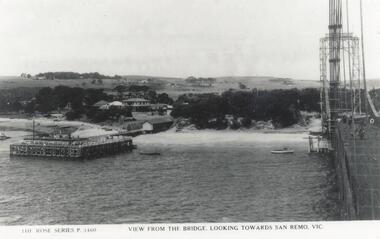
... ...sea transport...From the Jack Jenner Collection. local history photographs civil engineering bridges phillip island bridge sea transport black & white photograph - post card - rose series jack jenner collection phillip island bridges public construction P3460 The Rose Series. ...View of San Remo showing Suspension Bridge - completed in 1940 - demolished in 1970. From the Jack Jenner Collection.Old Suspension Bridge right hand side of photograph. View looking towards San Remo with pier at middle left.P3460 The Rose Series. View from the Bridge looking toward San Remo - Vic.local history, photographs, civil engineering, bridges, phillip island bridge, sea transport, black & white photograph - post card - rose series, jack jenner collection, phillip island bridges, public construction -
 Phillip Island and District Historical Society Inc.
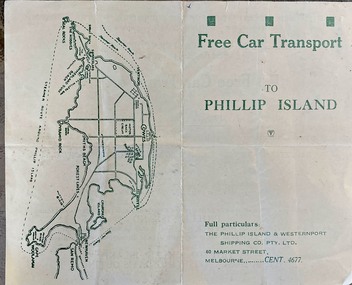
Booklet (item) - Brochure, Free Car Transport to Phillip Island
... ...sea transport...Historical Ferries sea transport Tourism Free transport for Sunday returns between Stony Point & Cowes, for winter months of June, July and August. ...The Phillip Island & District Shipping Company was previously owned by Mr Arthur Keaston Sambell who had offerred concessions for travel to locals.HistoricalFree transport for Sunday returns between Stony Point & Cowes, for winter months of June, July and August. Phillip Island has miles of woodland roads where the friendly Koalas may be seen from the car with the glorious colour effects on a typical winter day with a mild atmosphere and brilliant sunshine. ferries, sea transport, tourism -
 Phillip Island and District Historical Society Inc.
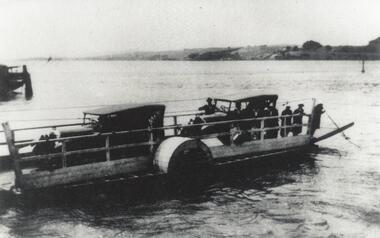
Photograph, Phillip Island Punt
... Shows the sea transport used before the Suspension Bridge was built. ...Shows the sea transport used before the Suspension Bridge was built. ...Shows the sea transport used before the Suspension Bridge was built. Punt ran between Newhaven and San Remo from 1900 - 1940.Close-up of two cars on punt crossing between San Remo and Newhaven, Phillip Islandlocal history, photographs, phillip island punt, black & white photograph, phillip island mainland connections, jack jenner collections, public constructions -
 Returned Nurses RSL Sub-branch
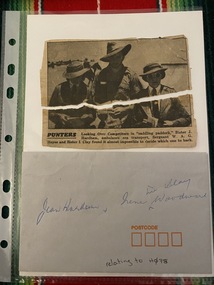
Ephemera - Envelope & two pieces torn newspaper clipping, Punters
... Harham, ambulance sea transport, Sergeant W. A. G. Heyes and Sister I. ...Harham, ambulance sea transport, Sergeant W. A. G. Heyes and Sister I. ...Envelope & newspaper clipping with photograph with caption 'PUNTERS Looking Over Competitors in "saddling paddock," Sister J. Harham, ambulance sea transport, Sergeant W. A. G. Heyes and Sister I. Clay found it almost impossible to decide which one to back.'Small envelope and torn newspaper clipping'Jean Hardham & Irene ^ nee Clay Woodward' 'relating to H078' [on envelope]sister j hardham, sergeant w a g heyes, sister i clay -
 Returned Nurses RSL Sub-branch
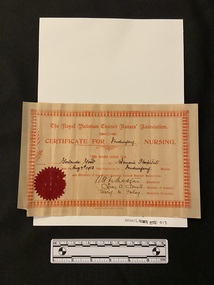
Certificate - Nursing Certificate, The Royal Victorian Trained Nurses' Association, August 7 1913
... Enlisting in 1914, she is primarily known for her dedicated service on hospital ships and sea transport sections bringing sick and wounded Australian troops home'. - Australian War Memorial website...Enlisting in 1914, she is primarily known for her dedicated service on hospital ships and sea transport sections bringing sick and wounded Australian troops home'. - Australian War Memorial website Gertrude Good Royal Victorian Trained Nurses Association Certificates nurse training 1913 Australian Army Nursing Serive 'Midwifery' [Handwritten in black ink on the second line] 'Gertrude Good' and 'Women's Hospital' [Handwritten in black ink on the fourth line] 'Aug 7th 1913' and 'midwifery' [Handwritten in black ink on the fifth line] '?' ...Certificate of Midwifery Nursing for Gertrude Good of the Women's Hospital on August 7th 1913. 'Gertrude Good was an Australian Army Nursing Service (AANS) Matron and Sister who served extensively during World War I. Enlisting in 1914, she is primarily known for her dedicated service on hospital ships and sea transport sections bringing sick and wounded Australian troops home'. - Australian War Memorial websiteCertificate stamped in red ink on pale brown paper, details are handwritten in black ink. There is a burgundy sticker seal in the lower left corner.'Midwifery' [Handwritten in black ink on the second line] 'Gertrude Good' and 'Women's Hospital' [Handwritten in black ink on the fourth line] 'Aug 7th 1913' and 'midwifery' [Handwritten in black ink on the fifth line] '?' [Illegible signature in lighter black ink next to the word 'President'] '? A. Jones' [Signed in lighter black ink next to the words 'Member of Council'] 'Mary M. Finlay' [Signed in lighter vlack ink next to 'Honorary Secretary']gertrude good, royal victorian trained nurses association, certificates, nurse training, 1913, australian army nursing serive -
 Seaworks Maritime Museum
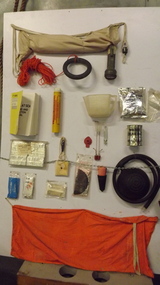
Emergency kit Display board
... Items are canvas, line and floatable, torch, Survival at Sea book (Transport and Communication), Pains-Wessex Flare, 3 1/2 C jug, Seven Oceans Drinking water sachet, plastic bags, Marine Lifesaving rations, whistle, rubber item, table spoon measurement cup, can opener, can of Drinking Water (S-HP Foods LTD), sponge, Emergency Repair kit, two foam cones, pump, Ultraplast elastic adhesive dreessing, Quick WELLS tablets, Fishing tackle, Fluorescent oragne tarp, associated photograph of ten people in a life boat. ...Items are canvas, line and floatable, torch, Survival at Sea book (Transport and Communication), Pains-Wessex Flare, 3 1/2 C jug, Seven Oceans Drinking water sachet, plastic bags, Marine Lifesaving rations, whistle, rubber item, table spoon measurement cup, can opener, can of Drinking Water (S-HP Foods LTD), sponge, Emergency Repair kit, two foam cones, pump, Ultraplast elastic adhesive dreessing, Quick WELLS tablets, Fishing tackle, Fluorescent oragne tarp, associated photograph of ten people in a life boat. ...Board displaying 22 items. Items appear to be related to rescue and may belong together in a kit. Items are canvas, line and floatable, torch, Survival at Sea book (Transport and Communication), Pains-Wessex Flare, 3 1/2 C jug, Seven Oceans Drinking water sachet, plastic bags, Marine Lifesaving rations, whistle, rubber item, table spoon measurement cup, can opener, can of Drinking Water (S-HP Foods LTD), sponge, Emergency Repair kit, two foam cones, pump, Ultraplast elastic adhesive dreessing, Quick WELLS tablets, Fishing tackle, Fluorescent oragne tarp, associated photograph of ten people in a life boat. Many items are screwed onto the board.resuce kit -
 Flagstaff Hill Maritime Museum and Village
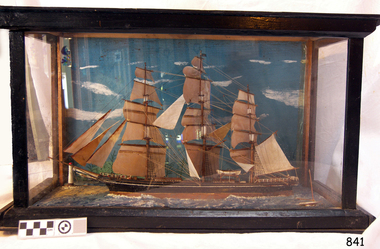
Craft - Ship Model, Cutty Sark
... transport wool from Australia. It became famous for its speed and held the record for the fastest voyage from Australia to Britain for ten years. Later, a Portuguese company bought the ship and renamed it Ferreira. After that, a retired sea...transport wool from Australia. It became famous for its speed and held the record for the fastest voyage from Australia to Britain for ten years. Later, a Portuguese company bought the ship and renamed it Ferreira. After that, a retired sea ...THE CUTTY SARK: - The Cutty Sark was built in Britain in 1869 and was one of the last great sailing ships. At first, it carried tea from China. Later, it was used to transport wool from Australia. It became famous for its speed and held the record for the fastest voyage from Australia to Britain for ten years. Later, a Portuguese company bought the ship and renamed it Ferreira. After that, a retired sea captain purchased it to use as a training ship in Cornwall. When the captain died, the ship was given to a training college in Greenwich in 1938. In 1954, it was placed in dry dock at Greenwich, where it remains on display. The Cutty Sark is a special ship because it carried wool from Australia to other parts of the world. Models like this one help us imagine what sea travel was like before steam-powered ships were common, and they show us how trade, travel and migration changed over time. The Cutty Sark is also famous for being very fast. It set a record for the journey from Australia to Britain and kept that title for ten years. Today, people still recognise its importance because it has been carefully preserved and is on display at the British Maritime Museum in Greenwich. Its story has also made it a favorite subject for people who enjoy building ship models. Ship model: the clipper ship Cutty Sark in full ship rig with raised poop deck, deck house, three boats on deck (one has fallen). It has a two-toned black and tan hull and three jibs. The model is set in a diorama of a blue sea, a lighthouse and another small yacht. It is housed in a glass-sided case with a dark grey painted structure. The bow has an inscription."Cutty Sark"flagstaff hill, warrnambool, flagstaff hill maritime museum, shipwreck coast, flagstaff hill maritime village, maritime museum, great ocean road, cutty sark, historic sailing ship, tea clipper, sail training vessel, cadet training ship, commercial trading vessel, cargo sail vessel, ferreria, 1869, tea cargo, tea trade, china tea, wool export, australian export, australian wool export, cornwall, training ship, greenwich, british museum, ship model, craft, hobby, ship model cutty sark, model making -
 Flagstaff Hill Maritime Museum and Village
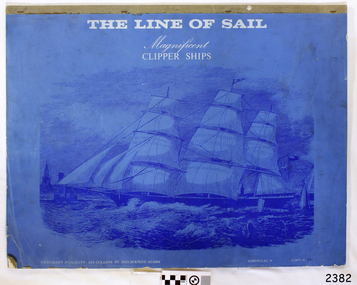
Book - Portfolio, Newcraft Pulicity, The Line of Sail; Magnificent Clipper Ships, 1969
... SEAS” American Clipper The New Iron Clipper Built Ship “TAYLEUR” for Australia H.M. New Frigate “THETIS” The American Clipper Ship “WITCH OF THE WAVE” ABOUT THE PUBLISHER- The Newcraft Publicity was a Melbourne business that operated in the 1960s at 243 Collins Street, Melbourne. This portfolio book of clipper ship prints is historically significant as it shows an important part of Australia's history, It includes some of the shipping lines famous in the 19th century for transporting passengers and goods to Australia. ...These prints include large sailing ships that were also referred to as Clippers and Tall Ships. These ships were used to transport cargo and passengers across the world in the 19th century. They were powered purely by harnessing the wind. It could take three to four months to sail in this manner from England to Australia. On many occasions the ships were wrecked, often close to their destination, through errors of navigation. The method of production of the original images is over a century old. The Melbourne publisher of this portfolio book, Newcraft Publicity, describes the contents as follows-' Magnificent Clipper Ships: Clipper ships in the line of sail make the most romantic and spectacular pictorial chapter of marine history. This collection depicting early clippers and other types of sailing ships were originally fine engravings on wooden printing blocks used in newspapers a century ago. They were taken directly from the original newspaper prints, and reproduced in enamel inks to provide a choice of fine line prints suitable for framing. LIST OF PRINTS- The New Australian Clipper "BLUE JACKET" The Clipper Ship “CHRYSOLIER” The “GAUNTLET” Clipper Ship The New American Clipper “GREAT REPUBLIC” The Clipper Ship “GUIDING STAR” New Emigrant Ship “HESPERIDES” for the South Australian Line Capt. Beatson’s Expedition in search of Sir John Franklin – the “ISABEL” The Black Ball Line Clipper Ship “JAMES BAINES” The “MERCHANT PRINCE” – Australian Clipper The White Star Line Clipper Ship “MORNING LIGHT” The Aberdeen Clipper Built Barque “PHOENICIAN” New Australian Clipper Ship the “ROYAL FAMILY” The “SOVEREIGN OF THE SEAS” American Clipper The New Iron Clipper Built Ship “TAYLEUR” for Australia H.M. New Frigate “THETIS” The American Clipper Ship “WITCH OF THE WAVE” ABOUT THE PUBLISHER- The Newcraft Publicity was a Melbourne business that operated in the 1960s at 243 Collins Street, Melbourne.This portfolio book of clipper ship prints is historically significant as it shows an important part of Australia's history, It includes some of the shipping lines famous in the 19th century for transporting passengers and goods to Australia. The prints are also significant for their origin in the carved wooden blocks used a century ago for creating images for the newspapers of the time. Book is also significant from being one of a limited edition of books produced. There are copes in both the Victorian State Library and the National Library of Australia.The Line of Sail is a portfolio of sixteen fine line, black and white prints on paper. The subject is clipper ships. The covers are paper-covered card, coloured a strong blue with white line images and text. The image side of the pages has a sheen, the back is matt. Each print has a caption. The top of the book is stapled and bound with grey tape. Produced by Newcraft Publicity, Melbourne. Limited Edition - Copy Number 086. Stamped on front cover "086"flagstaff hill, warrnambool, shipwrecked-coast, flagstaff-hill, flagstaff-hill-maritime-museum, maritime-museum, shipwreck-coast, flagstaff-hill-maritime-village, lithographs, newscraft publicity, book, the line of sail, dlipper ships, tall shipos, sailing ships, wood block print, newspaper drawings, newcraft productions, newcraft melbourne, portfolio of clipper ships, limited edition, wooden engravings, magnificent clipper ships -
 Flagstaff Hill Maritime Museum and Village
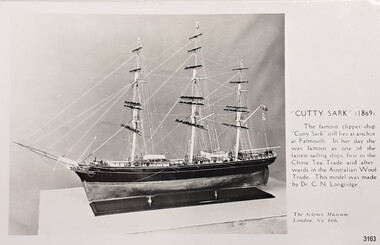
Postcard - Vessel, Sailing Ship, B Matthews (photo printer), Cutty Sark, 20t century
... transport wool from Australia. It became famous for its speed and held the record for the fastest voyage from Australia to Britain for ten years. Later, a Portuguese company bought the ship and renamed it Ferreira. After that, a retired sea...transport wool from Australia. It became famous for its speed and held the record for the fastest voyage from Australia to Britain for ten years. Later, a Portuguese company bought the ship and renamed it Ferreira. After that, a retired sea ...The maker of the ship model on the postcard was Dr C Nelson Longridge (1876–1952), an English surgeon, maritime author, and builder of detailed ship models. Other models include the SS Marioness and the steam yacht Asia. He also wrote the books 'Cutty Sark' and 'The Anatomy of Nelson's Ships'. The postcard was printed by B Matthews, Bradford, England, incorporated in 1970 as B. Matthews (Photo Printers) Limited. Collections of B Matthews' photo prints of famous painted portraits are held at The National Portrait Gallery of London. Copies of B Matthews postcards are today sought after by collectors. THE CUTTY SARK: - The Cutty Sark was built in Britain in 1869 and was one of the last great sailing ships. At first, it carried tea from China. Later, it was used to transport wool from Australia. It became famous for its speed and held the record for the fastest voyage from Australia to Britain for ten years. Later, a Portuguese company bought the ship and renamed it Ferreira. After that, a retired sea captain purchased it to use as a training ship in Cornwall. When the captain died, the ship was given to a training college in Greenwich in 1938. In 1954, it was placed in dry dock at Greenwich, where it remains on display. This postcard features a photograph of a model of the sailing ship Cutty Sark, making it significant because of its connection to this well-known vessel. The famous tea clipper transported wool from Australia to markets around the world. Models such as this one help us understand what sea travel was like before steam-powered ships became widespread, while also illustrating how trade, travel and migration developed over time. Cutty Sark was also celebrated for its speed. It broke records on the voyage from Australia to Britain and held this distinction for ten years. Its importance is still recognised today, as the ship has been carefully preserved and is now displayed at the British Maritime Museum in Greenwich. Its remarkable history has also made it a popular subject for model ship enthusiasts. The postcard is also valuable because it shows a model of Cutty Sark built by the renowned C. N. Longridge, who was not only a respected surgeon but also a skilled model maker and author of detailed maritime works. A further connection is found in the printer, B Matthews, who photographed and printed collections featuring famous people, model ships and maritime scenes, adding another layer of historical interest to the postcard. Postcard, black and white, showing a model of the sailing ship Cutty Sark. Printed details are provided on both the front and back of the postcard. Inscriptions include a brief description of the Cutty Sark, the location and maker of the model, and the printer's contact information. The postcard was printed in Great Britain.FRONT: " "CUTTY SARK" (1869) The famous clipper ship "Cutty Sark" still lies at anchor at Falmouth. In her day, she was famous as one of the fastest sailing ships, first in the China Tea Trade, and afterwards in the Australian Wool Trade. This model was made by Dr C.N. Longridge." "The Science Museum, London. No. 166." REVERSE: "POSTCARD" "COMMUNICATION" "ADDRESS" "Printed by B Matthews, Bradford, England"flagstaff hill, warrnambool, flagstaff hill maritime museum, shipwreck coast, flagstaff hill maritime village, maritime museum, great ocean road, cutty sark, historic sailing ship, tea clipper, sail training vessel, cadet training ship, commercial trading vessel, cargo sail vessel, clipper races, scott and linton of dunbarton scottland, race record, ferreria, 1869, tea cargo, tea trade, china tea, wool export, australian export, australian wool export, china tea trade, cornwall, training ship, greenwich, british museum, ship model, craft, hobby, ship model cutty sark, model making, postcard, c nelson longridge, charles nelson longridge, b matthews, photo printer, b matthews bradford england, b matthews (photo printer ) ltd. -
 Flagstaff Hill Maritime Museum and Village
Postcard - Vessel, Sailing Ship, Jack Spurling (John Robert Charles Spurling), marine artist, circa 19th century
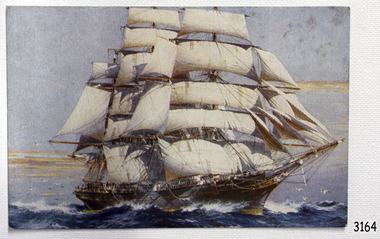
... sea shows in his detailed paintings of ship portraits. THE CUTTY SARK: - The Cutty Sark was built in Britain in 1869 and was one of the last great sailing ships. At first, it carried tea from China. Later, it was used to transport...sea shows in his detailed paintings of ship portraits. THE CUTTY SARK: - The Cutty Sark was built in Britain in 1869 and was one of the last great sailing ships. At first, it carried tea from China. Later, it was used to transport ...The postcard is a copy of a painting by the renowned British maritime artist Jack Spurling (John (Jack) Robert Charles Spurling 1870-1933). Spurling's love for the sea was fulfilled as a teenager when he worked as an apprentice, eventually gaining a Second Mate certificate and going on to join the Blue Anchor Line as a junior officer. His love for the sea shows in his detailed paintings of ship portraits. THE CUTTY SARK: - The Cutty Sark was built in Britain in 1869 and was one of the last great sailing ships. At first, it carried tea from China. Later, it was used to transport wool from Australia. It became famous for its speed and held the record for the fastest voyage from Australia to Britain for ten years. Later, a Portuguese company bought the ship and renamed it Ferreira. After that, a retired sea captain purchased it to use as a training ship in Cornwall. When the captain died, the ship was given to a training college in Greenwich in 1938. In 1954, it was placed in dry dock at Greenwich, where it remains on display. The postcard depicts the clipper, Cutty Sark, which was a special ship because it carried wool from Australia to other parts of the world. Postcards like this one help us imagine what sea travel was like before steam-powered ships became common, and they show us how trade, travel, and migration evolved. The Cutty Sark is also famous for its speed. It set a record for the journey from Australia to Britain and kept that title for ten years. Today, people still recognise its importance because it has been carefully preserved and is on display at the British Maritime Museum in Greenwich. Its story has also made it a favourite subject for people who enjoy building ship models. The picture is a copy of a painting by renowned maritime artist Jack Spurling, who was famous for his ship portraits.Coloured postcard of the Cutty Sark. Photograph of a painting by J Spurling. flagstaff hill, warrnambool, flagstaff hill maritime museum, shipwreck coast, flagstaff hill maritime village, maritime museum, great ocean road, cutty sark, historic sailing ship, tea clipper, sail training vessel, cadet training ship, commercial trading vessel, cargo sail vessel, clipper races, scott and linton of dunbarton scottland, race record, ferreria, 1869, tea cargo, tea trade, china tea, wool export, australian export, australian wool export, china tea trade, cornwall, training ship, greenwich, british museum, postcard, coloured postcard, postcard of a painting, jack spurling, british maritime artist, ship portraits, john 'jack' robert charles spurling -
 Flagstaff Hill Maritime Museum and Village
Postcard - Vessel, Sailing Ship, Cutty Sark in Sydney Harbour, After August 1891
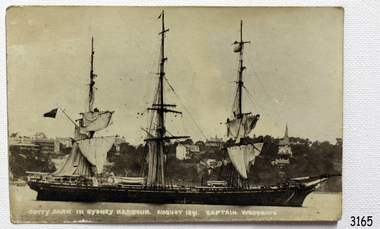
... transport wool from Australia. It became famous for its speed and held the record for the fastest voyage from Australia to Britain for ten years. Later, a Portuguese company bought the ship and renamed it Ferreira. After that, a retired sea...transport wool from Australia. It became famous for its speed and held the record for the fastest voyage from Australia to Britain for ten years. Later, a Portuguese company bought the ship and renamed it Ferreira. After that, a retired sea ...Captain Richard Woodget (1845-1928) was renowned for his successful command of the Cutty Sark. He began his maritime career in 1861 as an apprentice seaman at almost 15 years old and received his Master Certificate in 1871. In 1881, aged 35, he took his first command on the vessel Coldstream. His sailing skill and careful financial management earned him the command of the Cutty Sark for ten of its voyages. For another year, he commanded the Coldingham, then retired from life as a mariner in 1896. The Cutty Sark was built in Britain in 1869 and was one of the last great sailing ships. At first, it carried tea from China. Later, it was used to transport wool from Australia. It became famous for its speed and held the record for the fastest voyage from Australia to Britain for ten years. Later, a Portuguese company bought the ship and renamed it Ferreira. After that, a retired sea captain purchased it to use as a training ship in Cornwall. When the captain died, the ship was given to a training college in Greenwich in 1938. In 1954, it was placed in dry dock at Greenwich, where it remains on display. The postcard is important for is connection with the vessel, Cutty Sark, a special ship because it carried wool from Australia to other parts of the world. Postcards like this one help us imagine what sea travel was like before steam-powered ships were common, and they show us how trade, travel and migration changed over time. The Cutty Sark is also famous for being very fast. It set a record for the journey from Australia to Britain and kept that title for ten years. Today, people still recognise its importance because it has been carefully preserved and is on display at the British Maritime Museum in Greenwich. Its story has also made it a favourite subject for people who enjoy building ship models. The postcard is important to Australian history, as it shows the Cutty Sark at Sydney on one of its voyages, in the command of Captain Richard Woodget, a respected mariner and master of sailing ships.Postcard: Black and white postcard of a photographed image of a 3-masted sailing ship, sails half-lowered. Behind the vessel is a hill with buildings on it. A white handwritten inscription is along the base of the postcard. The vessel is the Cutty Sark in Sydney Harbour in August 1891. Its master was Captain Woodget."CUTTY SARK IN SYDNEY HARBOUR. AUGUST 1891. CAPTAIN WOODGATE."flagstaff hill, warrnambool, flagstaff hill maritime museum, shipwreck coast, flagstaff hill maritime village, maritime museum, great ocean road, cutty sark, historic sailing ship, tea clipper, sail training vessel, cadet training ship, commercial trading vessel, cargo sail vessel, clipper races, scott and linton of dunbarton scottland, race record, transportation, ferreria, 1869, tea cargo, tea trade, china tea, wool export, australian export, australian wool export, china tea trade, cornwall, training ship, greenwich, british museum, captain richard woodget, captain woodget -
 Flagstaff Hill Maritime Museum and Village
Photograph - Vessel, Sailing Ship, Jack Spurling (John Robert Charles Spurling), marine artist, circa 19th century
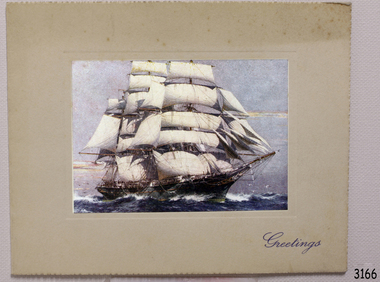
... sea shows in his detailed paintings of ship portraits. THE CUTTY SARK: - The Cutty Sark was built in Britain in 1869 and was one of the last great sailing ships. At first, it carried tea from China. Later, it was used to transport...sea shows in his detailed paintings of ship portraits. THE CUTTY SARK: - The Cutty Sark was built in Britain in 1869 and was one of the last great sailing ships. At first, it carried tea from China. Later, it was used to transport ...The card is a copy of a painting by the renowned British maritime artist Jack Spurling (John (Jack) Robert Charles Spurling 1870-1933). Spurling's love for the sea was fulfilled as a teenager when he worked as an apprentice, eventually gaining a Second Mate certificate and going on to join the Blue Anchor Line as a junior officer. His love for the sea shows in his detailed paintings of ship portraits. THE CUTTY SARK: - The Cutty Sark was built in Britain in 1869 and was one of the last great sailing ships. At first, it carried tea from China. Later, it was used to transport wool from Australia. It became famous for its speed and held the record for the fastest voyage from Australia to Britain for ten years. Later, a Portuguese company bought the ship and renamed it Ferreira. After that, a retired sea captain purchased it to use as a training ship in Cornwall. When the captain died, the ship was given to a training college in Greenwich in 1938. In 1954, it was placed in dry dock at Greenwich, where it remains on display.The card depicts the clipper, Cutty Sark, which was a special ship because it carried wool from Australia to other parts of the world. Cards like this one help us imagine what sea travel was like before steam-powered ships became common, and they show us how trade, travel, and migration evolved. The Cutty Sark is also famous for its speed. It set a record for the journey from Australia to Britain and kept that title for ten years. Today, people still recognise its importance because it has been carefully preserved and is on display at the British Maritime Museum in Greenwich. The picture is a copy of a painting by renowned maritime artist Jack Spurling, who was famous for his ship portraits.Photograph: coloured image of the sailing ship Cutty Sark by artist J Spurling. The image is mounted on a card used as a greeting card. It has a printed inscription. "Greetings"flagstaff hill, warrnambool, flagstaff hill maritime museum, shipwreck coast, flagstaff hill maritime village, maritime museum, great ocean road, cutty sark, historic sailing ship, tea clipper, sail training vessel, cadet training ship, commercial trading vessel, cargo sail vessel, clipper races, scott and linton of dunbarton scottland, race record, ferreria, 1869, tea cargo, tea trade, china tea, wool export, australian export, australian wool export, china tea trade, cornwall, training ship, greenwich, british museum, postcard, coloured postcard, postcard of a painting, jack spurling, british maritime artist, ship portraits, john 'jack' robert charles spurling -
 Flagstaff Hill Maritime Museum and Village
Functional object - Bell, Schomberg 1855, Before 1855
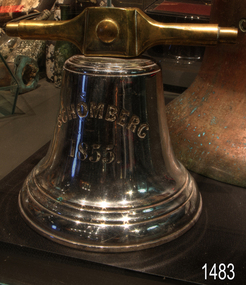
... transported 17,000 letters and 31,800 newspapers. The ship and cargo were insured for $300,000, a considerable sum for the era. Poor winds while crossing the equator delayed Schomberg’s progress. Land was first sighted on Christmas Day at Cape Bridgewater near Portland. Captain Forbes followed the coastline towards Melbourne, but was reportedly playing cards when the third mate, Henry Keen, reported land only three miles away. The ship ran aground on a sand spit near Curdie’s Inlet (approximately 56 km west of Cape Otway) on 26th December 1855, after 78 days at sea...transported 17,000 letters and 31,800 newspapers. The ship and cargo were insured for $300,000, a considerable sum for the era. Poor winds while crossing the equator delayed Schomberg’s progress. Land was first sighted on Christmas Day at Cape Bridgewater near Portland. Captain Forbes followed the coastline towards Melbourne, but was reportedly playing cards when the third mate, Henry Keen, reported land only three miles away. The ship ran aground on a sand spit near Curdie’s Inlet (approximately 56 km west of Cape Otway) on 26th December 1855, after 78 days at sea ...The Rescue and Journey of the Schomberg Bells: This bell was the smaller of two rescued by the crew of the Schomberg following the ship’s wreck in 1855. While the specific purpose of the smaller bell is unknown, it may have served to assemble the crew or signal mealtimes on board. After surviving the shipwreck, the crew carried both bells as they made their way along the coastline. Their journey eventually led them to the home of settler John Manning, located at Hopkins Point near Warrnambool. Manning took possession of the bells and subsequently presented them to two churches in Warrnambool. The smaller bell went to St Joseph’s Catholic Church, while the larger bell went to St John’s Presbyterian Church. After around a year, the small bell at St Joseph’s developed a crack and became unusable. Thomas Manifold imported a replacement bell for the church, and the damaged bell was stored at his farm. Years later, when the property was sold to John Logan, the discarded bell was donated to the old Warrnambool Museum upon its opening in 1886. The Curator, Joseph Archibald, placed the bell on display in the entry. In 1975, it was transferred from the Warrnambool Art Gallery to Flagstaff Hill. The ’Mystery’ of the small bell solved: Despite numerous attempts by the staff at Flagstaff Hill to restore the bell’s lustre, the bell remained dull and tarnished. In October 1986, Director Peter Ronald decided to send the bell for professional advice. The bell was entrusted to Briggs Marine Products, a renowned brass founder established in 1912. Upon examination, the specialists at Briggs discovered the reason behind the bell’s persistent lack of shine: it had originally been silver-plated, but most of the plating had worn away over time. The experts at Briggs then undertook the task of restoring the bell, successfully returning it to a gleaming silver surface. The Sailing Ship Schomberg: Launched in 1855, the Schomberg was regarded as the “Noblest” ship afloat at the time. Owned by the Black Ball Line, it was built for their passenger fleet by Alexander Hall of Aberdeen at a cost of £43,103. The construction featured three skins: one planked fore and aft and two diagonally planked, all fastened with screw-threaded trunnels (wooden rails). The ship’s First Class accommodation was luxurious, boasting velvet pile carpets, large mirrors, rosewood, birds-eye maple and mahogany timbers, satin damask soft furnishings, and an oak-lined library with a piano. Schomberg had a capacity for 1,000 passengers. The ship’s master, Captain James Nicol Forbes—also known as ‘Bully’ Forbes—was only 34 years old at the launch. He had a reputation for setting and breaking speed records on the Black Ball Line’s Marco Polo and Lightning. In 1852, Forbes completed the London to Melbourne journey on the Marco Polo in 68 days, a record at the time, though 53 passengers died during the voyage. In 1854, he sailed the Lightning to Melbourne in 76 days and returned in only 63 days—a record that stood among sailing ships. Forbes was known for driving his ship and crew to their limits, often prioritising speed over passenger comfort. Determined to set new records, he promised to reach Melbourne in sixty days, declaring he would do so “with or without the help of God.” The Maiden Voyage and the Wreck: Schomberg departed Liverpool on 6th October 1855, flying a banner that read “Sixty Days to Melbourne”. The vessel carried 430 passengers and 3,000 tons of cargo, including materials to build the Melbourne to Geelong Railway and a bridge over the Yarra River. Among the cargo were a cow for fresh milk, pens for fowls and pigs, and 90,000 gallons of water for drinking and washing. Additionally, it transported 17,000 letters and 31,800 newspapers. The ship and cargo were insured for $300,000, a considerable sum for the era. Poor winds while crossing the equator delayed Schomberg’s progress. Land was first sighted on Christmas Day at Cape Bridgewater near Portland. Captain Forbes followed the coastline towards Melbourne, but was reportedly playing cards when the third mate, Henry Keen, reported land only three miles away. The ship ran aground on a sand spit near Curdie’s Inlet (approximately 56 km west of Cape Otway) on 26th December 1855, after 78 days at sea. The sand spit and nearby currents were not marked on Forbes’s map. During the night, the crew launched a lifeboat to search for a safe landing spot for the passengers. The scouting party advised Forbes to wait until morning, as rough seas posed a danger to the lifeboats. At dawn, the ship’s Chief Officer spotted the SS Queen and signalled for help. The master of the Queen brought his vessel alongside, and all passengers and crew disembarked safely. The Black Ball Line’s Melbourne agent sent another steamer to collect the passengers’ baggage, and other steamers assisted with cargo salvage until worsening weather forced operations to cease. Notably, a plunderer later recovered a case of Wellington boots, but all were for the left foot. The wreck and its cargo were sold to local merchants Manifold & Bostock, who did not attempt further salvage. They later sold their interest to a Melbourne businessman and two seafarers. In 1864, after two men drowned in their attempt to reach the Schomberg, salvage efforts were abandoned. By 1870, parts of the ship had washed ashore on New Zealand’s South Island. Today, the wreck is about nine metres below the surface. Although most woodwork has disintegrated, the vessel’s shape remains discernible due to the railway irons, girders, and framework. Various goods and materials from the ship are scattered nearby. The bell is particularly significant in that along with other items from the wreck helped in part to having the legislation changed to protect shipwrecks, with far tighter controls being employed to oversee the salvaging of wreck sites. This bell forms part of the Schomberg collection at Flagstaff Hill maritime museum. The collection as a whole is of historical and archaeological significance at a State level. Flagstaff Hill’s collection of artefacts from the Schomberg is also significant for its association with the Victorian Heritage Registered Schomberg shipwreck (VHR S 612). The collection is of additional significance because of the relationship between the objects salvaged, as together they help us to interpret the story of the Schomberg. The collection as a whole is historically significant for representing aspects of Victoria's maritime history and its potential to interpret social and historical themes from society at the time of the wreck. A small ship’s bell. The silver-plated metal bell bears the ship’s name and year of construction on one side and the name and address of the ship’s builders on the other. These details are deeply engraved into the metal and formed in bold, upper-case lettering. The bell has two bell stands: the left and the right. Both stands have an Iron pipe bent into an inverted ‘Y’ shape, with a hole along its length and feet attached to a rectangular metal plate at the other two ends. Feet are bolted to a timber base that has a hole drilled through the centre for mounting. Bell's front; “SCHOMBERG” with “1855” below. Bell's back “HALL & SONS (crack splits letter “N”) / BUILDERS (in italics) / ABERDEEN” (crack splits letter “B”).flagstaff hill, flagstaff hill maritime museum and village, warrnambool, maritime museum, maritime village, great ocean road, shipwreck coast, schomberg, silver plated bell, mess bell, bell stands, captain ‘bully’ forbes, alexander hall and son, james baines and company, liverpool’s black ball line, bell, schomberg bell, ship's bell, small bell, st joseph's church, briggs marine, john manning, john logan, warrnambool museum, briggs foundry, silver bell -
 Flagstaff Hill Maritime Museum and Village
Book - Textbook, Introduction to Modern Geography
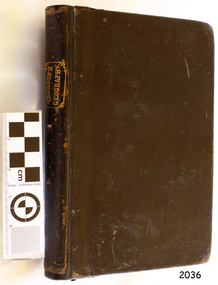
... sea cable. William was part of the firm that became famous as Kelvin & Hughes Ltd., suppliers of radar and echo sounders to the Ministry of Transport and the Ministry of Defence. ...sea cable. William was part of the firm that became famous as Kelvin & Hughes Ltd., suppliers of radar and echo sounders to the Ministry of Transport and the Ministry of Defence. ...This mid-19th century scientific reference book, Introduction to Modern Geography, explains geography and astronomy using the globe of the world as a teaching aid. The inscription connects this book to the Bobinawarrah Public Library but research to date has found no further details about the library. The rural area was settled in 1859, but in 2016 its population was only 87. It is situated about 21 kilometres south of the City of Wangaratta, in Northeast Victoria. In 2024 the local community received a grant for preservation of its almost 100-year-old Bobinawarrah Memorial Hall which displays an honour board of the Pioneers of Bobinawarrah 1859-1959. The donor of the book lived in Warrnambool. ABOUT THE AUTHOR, James Thomson (1786-1849): - James Thomson was a British Irish mathematician. He became Professor of Mathematics at the University of Glasgow. He wrote many school textbooks and reference books, one of which was Introduction to Modern Geography, first published in Belfast in 1827, and revised and published in over 20 more editions. Thomson tutored two of his several children at home. His older son James Thomson (1822-1892) became an engineer and physicist. His younger son William Thomson (1824-1907) became Professor of Natural Philosophy from 1846-1899 at the University of Glasgow, and later the 1st Baron of Kelvin, famous for his designs of nautical instruments such as the navigational compass and sounding equipment used in the transatlantic installation of sea cable. William was part of the firm that became famous as Kelvin & Hughes Ltd., suppliers of radar and echo sounders to the Ministry of Transport and the Ministry of Defence. The name continued on as Kelvin & Hughes. James Thomson (1786-1849) was a renowned British Irish mathematician and Professor of Mathematics at the University of Glasgow. He was a respected author of many important school books and textbooks that were widely used to provide understanding of arithmetic and geography. Thomson encouraged practical education and held extra classes for young ladies to learn mathematics and geography, which were a novelty at that time. Many of his works were known and used worldwide. This work was published in many editions. It is now considered as culturally significant as a basis for knowledge about our civilisation and has been made publicly available in overseas countries, and republished and reproduced in a readable format, including its diagrams and maps. Book; scientific textbook. The book has a black leather cover. The front cover is blank, but the spine has an embossed gold vertical title within a rectangular border boasting fancy corners. The fly page has a detailed title. The author is James Thomson. It is the Eighteenth edition, published in Simms & McIntyre of London and Belfast in 1845. An inscription connects it to the Bobinawarrah Public Library in Victoria.Spine within a gold border: "THOMSON'S GEOGRAPHY" Fly Page: "AN INTRODUCTION TO MODERN GEOGRAPHY, WITH AN APPENDIX, CONTAINING AN OUTLINE OF ASTRONOMY, AND THE USE OF THE GLOBES. BY JAMES THOMSON, LL.D., PROFESSOR OF MATHEMATICS IN THE UNIVERSITY OF GLASGOW." "Eighteenth Edition" "LONDON: SIMMS AND McINTYRE, ALDINE CHAMBERS, PATERSOSTER ROW; AND DONEGALL -STREET, BELFAST.""1845"flagstaff hill, flagstaff hill maritime museum and village, warrnambool, maritime museum, maritime village, great ocean road, shipwreck coast, introduction to geography, james thomson, reference book, professor thomson's introduction to modern geography, bobinawarrah public library, james thomson mathematician, james thomson engineer, 19th century irish mathematician, irish presbyterian, william thomson 1st baron of kelvin, professor of mathematics, glasgow university, william thomson professor of natural philosophy, introduction to modern geography, outline of astronomy, use of the globes, james thomson ll.d., simms and mcintyre, 1843, scientific book, school book, lord kelvin, baron kelvin of langs, nautical instruments, marine instruments, transatlantic cable, kelvin & hughes, thomson’s geography, astronomy, geography, world globe, cartography, pioneers of bobinawarrah, textbook -
 Flagstaff Hill Maritime Museum and Village
Craft - Ship Model, pre 1963
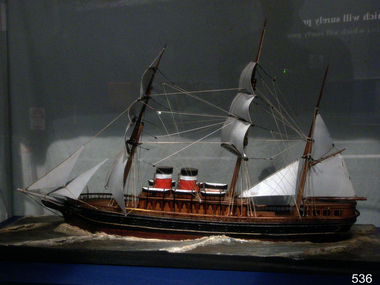
... sea from a distance by other vessels. The Allan Shipping Line was started in 1819, by Captain Alexander Allan of Saltcoats, Ayrshire, trading and transporting between Scotland and Montreal Canada, a route which quickly became synonymous with the Allan Line. ...sea from a distance by other vessels. The Allan Shipping Line was started in 1819, by Captain Alexander Allan of Saltcoats, Ayrshire, trading and transporting between Scotland and Montreal Canada, a route which quickly became synonymous with the Allan Line. ...The funnel colours on the model indicate the ship it represents was one of the early ships of the Allan shipping Line designated as a Royal Mail Carrier. Funnel colours are used to identify a ship's owners while at sea from a distance by other vessels. The Allan Shipping Line was started in 1819, by Captain Alexander Allan of Saltcoats, Ayrshire, trading and transporting between Scotland and Montreal Canada, a route which quickly became synonymous with the Allan Line. By the 1830s the company had offices in Glasgow, Liverpool and Montreal, with all of Captain Allan's five sons actively involved with the business. But his second son, Sir Hugh Allan, spearheaded the second generation. In 1854, Hugh launched the Montreal Ocean Steamship Company as part of the Allan Line, and two years later ousted Samuel Cunard to take control of the Royal Mail contract between Britain and North America. By the 1880s, the Allan Line was the world's largest privately owned shipping concern. In 1891, the company took over the State Line, founded in 1872, and was often referred to as the Allan & State Line. In 1897, Andrew Allan amalgamated the various branches of the Allan shipping empire under one company, Allan Line Steamship Company Ltd., of Glasgow. The company by then had added offices in Boston and London. In 1917, under Sir Montagu Allan, who represented the third generation of the Allan family, the company was purchased by Canadian Pacific Steamships, and by the following year, the Allan name had disappeared from commercial shipping. The Allan Line fleet had evolved for decades, changing as new ships were added, lost at sea, sold, or scrapped. The model in Flagstaff Hill's collection could be the SS Canadian or Indian; both were early Allan steam packets that had helped the Allan company secure the Royal Mail Atlantic contract in 1856.The model is of a Royal Mail steamship, with the probability the original ship was owned by the Allan Shipping Line in the mid-19th century and primarily used for the Atlantic mail run between England and Canada. Given the funnel colours and ship design, the model could be the SS Canadian or the Indian; both were the first ships for the company. The Allen line became the most successful shipping company of the time used for emigration and the transporting of mail.Ship model; steamship and sail vessel in use around the 1860s. Handcrafted model steamship with twin funnels painted black, white and red and three masts with square-rigged sails. The ship model is mounted on a gold-painted board. The ship was donated with a fitted wooden case.warrnambool, shipwreck coast, flagstaff hill, flagstaff hill maritime museum, flagstaff hill maritime village, ship model, steam and sail vessel, handcrafted ship model, steam vessel, model making, handmade, red with narrow white band below black top., red shite and black funnel, allan shipping line, steam and sail ship, two funnels, wooden sailing shipo, three-masted ship -
 Mission to Seafarers Victoria
Souvenir - Cup, Margaret Woodward, 2015
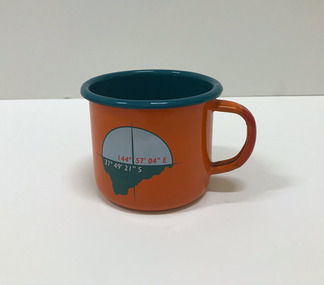
... Artist statement: "The Sea is All Around us is a multi-layered event which creates a memorable experience for those visiting the Dome Gallery and the Mission to Seafarers in Melbourne’s Docklands. The event acknowledges and raises awareness of the often difficult and dangerous working lives and journeys of seafarers by making visible their role in transporting commodities, materials and objects to and from Australia’s shores. ...Artist statement: "The Sea is All Around us is a multi-layered event which creates a memorable experience for those visiting the Dome Gallery and the Mission to Seafarers in Melbourne’s Docklands. The event acknowledges and raises awareness of the often difficult and dangerous working lives and journeys of seafarers by making visible their role in transporting commodities, materials and objects to and from Australia’s shores. ...Margaret Woodward is a an artist and an an associate professor of design at Charles Sturt University. Artist statement: "The Sea is All Around us is a multi-layered event which creates a memorable experience for those visiting the Dome Gallery and the Mission to Seafarers in Melbourne’s Docklands. The event acknowledges and raises awareness of the often difficult and dangerous working lives and journeys of seafarers by making visible their role in transporting commodities, materials and objects to and from Australia’s shores. This installation at the Dome Gallery in the Mission to Seafarers in Melbourne’s Docklands marks the third stage of an ongoing research project which seeks to reveal the ‘social life’ of souvenirs. Beyond their representational role souvenirs also trigger intangible, affective qualities – reminders of journeys and places, new associations with tastes, sounds and people, and thereby becoming objects which focus and hold memories. This installation invites seafarers and visitors to participate in a global project which aims to witness sea journeys and trace the mobile life of seafarers and souvenirs. For a fortnight in May 2015, the Dome Gallery became an architectural large scale compass, with the circular floor marking the intersection of its latitude and longitude (37 º 49'21" S 144º 57'03"E). Over these two weeks the Dome Gallery was inscribed with marks recording journeys made by seafarers, recording destination and departure ports, home lands and waterways, and in doing so making visible a small segment of the global patterns of seafaring. Custom-made souvenirs designed for the installation are given to seafarers as gestures of welcome and a memento of their visit. The souvenirs originating in Poland continue their journey by sea, to destinations beyond the Dome becoming part of the global network of seafaring, with an invitation for seafarers to record their future journeys using QR code scanning technologies. It is hoped that by releasing the 200 limited edition souvenirs accompanying the seafarers the mobile life of souvenirs and seafarers will also become visible. Like messages in bottles they leave our shores, becoming ambassadors, representing the Dome Gallery at the Mission to Seafarers, the waters of Port Phillip Bay, Australia’s red soil and vegetation, and carrying memories of visiting Melbourne." The Mission has always been open to the community and has a tradition of hosting cultural events: shows, concerts, exhibitions, festivals.Orange enamel and teal mug created for the art installation by artist Margaret Woodward at the Mission to Seafarers. On one side it is decorated with a compass and a latitude and longitude; on the opposite side, a leaf, a QR code on the bottom takes you to the website.Written at the bottom of the mug: Please scan to map the journey of this souvenir * www.sensingtheremote.net *2015cultural events, norla dome, mso, 2015, art installation, margaret woodward -
 Mission to Seafarers Victoria
Certificate - Certificate of discharge, photocopy, Ministry of War Transport: continuous certificate of discharge: George Winfield Duncan, 1943
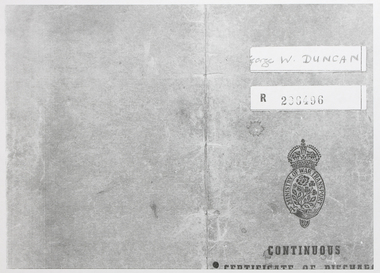
... The memorabilia relates to his career at sea and in particular the role of an engineer, including a handwritten manual of notes and references relating to the mechanical and engineering aspects and areas of responsibility for maintenance. war transport ww2 merchant navy merchant seamen george winfield duncan (1922-2017) g.w. duncan stamped on front cover oval ribbon insignia surrounding roses and surmounted by crown with lettering : Ministry of War Transport Printed at lwr edge: Continuous / certificate of discharge. ...This card together with a log book was a vital record of service for any seaman serving on a Merchant vessel that had been commandeered for War transport work and needed to be validated to ensure eligibility to be taken on as qualified member of the crew. G.W. Duncan appears to have specialised in engine room and mechanical maintenance. He appears to have served aboard a number of vessels including merchant vessels commissioned into wartime service in WW2.Mariner Duncan had a particular regard for the Mission to Seafarers. This plate for display on a commissioned new table at the MTSV chapel acknowledges his bequest and the material donated. Collectively the G W Duncan material includes: photographs, professional data memorabilia and written and commercially printed resources. The memorabilia relates to his career at sea and in particular the role of an engineer, including a handwritten manual of notes and references relating to the mechanical and engineering aspects and areas of responsibility for maintenance. small grey blue printed single fold seaman's photo identity card with printed guidelines and conditions of association / membership.stamped on front cover oval ribbon insignia surrounding roses and surmounted by crown with lettering : Ministry of War Transport Printed at lwr edge: Continuous / certificate of discharge. Inside left cover: seaman photo, name reg number and official stamp with date Inside right page: notes and information.war transport, ww2, merchant navy, merchant seamen, george winfield duncan (1922-2017), g.w. duncan -
 Mission to Seafarers Victoria
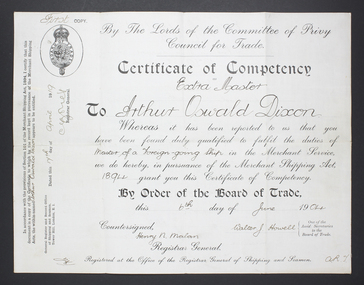
Certificate - Certificate of Competency Extra Master, 1919
... transport for a number of returning servicemen and families. The poem is held in the National Library of Australia. Unusually for the early 20th C. era of Mr Dixon's service at sea two images of Mr Dixon were included in the gift of papers. ...This document one of several papers and objects from the estate of Mr Arthur O. Dixon, an ex-master mariner and later smallhold farmer. Other correspondence and papers gifted to the Mission indicates the year 1919 (post his service in World War 1) was a time of some changes for Mr Dixon, possibly leading to his subsequent re-location to Australia show that he served as a crew member on the Merchant vessel "Hororata" a vessel which is noted in the MTSV records including an image of the crew in the early 1920s. (see VC record ).This vessel is also mentioned in a narrative poem by a de-mobbed Soldier of WW1 as the transport for a number of returning servicemen and families. The poem is held in the National Library of Australia.Unusually for the early 20th C. era of Mr Dixon's service at sea two images of Mr Dixon were included in the gift of papers. Personal objects included an unusual small travel size New Testament (see VC record ) heavily annotated provide further insights into the experience of early 20th C. seafarers. Officially printed document, and official copy of an original certificate of competency issued by the office of the Register General of Shipping and Seamen recognising Arthur Oswald Dixon as an Extra Master. At right angles to the certificate is a small margin at left indication the current document is an approved copy in 1919 of the original certificate issued in 1904. See image for both sides of the document for extensive text.certificate of competency, master, captain, sailor, arthur oswald dixon, seamanship, sailors, seamen, seafarers, officers, 1904 -
 Mission to Seafarers Victoria
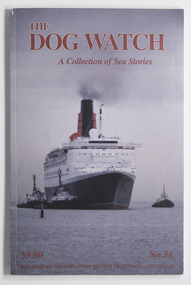
Journal (item) - Periodicals-Annual, Shiplovers' Society of Victoria, The Dog Watch - A Collection of Sea Stories - Issue 54, 1997
... seafaring life shipping transport shiplovers' society of victoria dog watch The Dog Watch - A Collection of Sea Stories - Issue 54 Journal Periodicals-Annual Shiplovers' Society of Victoria ...seafaring life, shipping, transport, shiplovers' society of victoria, dog watch -
 Mission to Seafarers Victoria
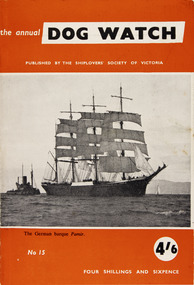
Journal (item) - Periodicals-Annual, Shiplovers' Society of Victoria, The Annual Dog Watch
... Contributes to our knowledge of the importance of shipping and places on record those stories of the sea which would otherwise be lost. sailing ships steamships shipping seafaring life shiplovers' society of victoria dog watch The foreword is written by the Hon. Sir Arthur Warner then Minister for Transport ...This journal provides the reader with glimpses of the adventures and hardships of a seaman's life. Many of the stories are of sailing ships.Contributes to our knowledge of the importance of shipping and places on record those stories of the sea which would otherwise be lost.The foreword is written by the Hon. Sir Arthur Warner then Minister for Transportsailing ships, steamships, shipping, seafaring life, shiplovers' society of victoria, dog watch -
 Lara RSL Sub Branch
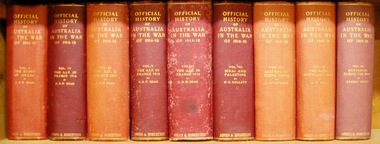
Book, Official History of Australia in the War of 1914-18 - Volume IX - The Royal Australian Navy Author A.W. Jose, 1937 fifth edition
... This volume of the War Histories is concerned with the doings of an infant navy. german colonies samoa nauru western pacific africa dardenelles north atlantic european waters raiders and minefields ran brigade hospital ships transports and dockyards radio-telegraphy suvla bay sinking of the cumberland german cruiser squadron cocos sydney-emden action north sea Official History of Australia in the War of 1914-18 - Volume IX - The Royal Australian Navy Maps and Illustrations Official History of Australia in the War of 1914-18 - Volume IX - The Royal Australian Navy Author A.W. ...Historically depicts the operations of the Royal Australian Navy duty occasioning navy vessels in addition to the drudgery of patrol work and the search for enemy vessels. Working in isolation because of being a vessel that is under their own control.This volume of the War Histories is concerned with the doings of an infant navy.Official History of Australia in the War of 1914-18 - Volume IX - The Royal Australian Navy Maps and Illustrationsgerman colonies, samoa, nauru, western pacific, africa, dardenelles, north atlantic, european waters, raiders and minefields, ran brigade, hospital ships, transports and dockyards, radio-telegraphy, suvla bay, sinking of the cumberland, german cruiser squadron, cocos, sydney-emden action, north sea -
 Flagstaff Hill Maritime Museum and Village
Container - Bottle, 1840s to 1870s
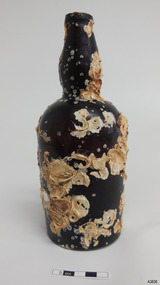
... transporting liquor. It was probably made from 1840s-1870s. The marine barnacles on the bottle support the fact that it was recovered from sea. ...transporting liquor. It was probably made from 1840s-1870s. The marine barnacles on the bottle support the fact that it was recovered from sea. ...This barnacled bottle is typical of those used for storing and transporting liquor. It was probably made from 1840s-1870s. The marine barnacles on the bottle support the fact that it was recovered from sea. The bottle was found at the site of an unidentified shipwreck along the coast of Victoria around 100 years from when it was made. It is part of the John Chance Collection. Black glass is one of the oldest bottle colours and was in use in the early 17th century. In the 1840s to late 1870s black glass bottles were mainly used for liquor and ale. All glass is made from silica, which is found in quartz sand. The naturally occurring sand has impurities, such as iron, that determine the colour of the glass. Residual iron leads to green or amber coloured glass, and carbon in the sand makes that glass appear as ‘black’. A strong light behind the glass will show its colour as dark green or dark amber. This handmade bottle appears to have been made in a dip mould, with the molten glass blown into a seamless shoulder-height mould to give the body a uniform symmetrical shape and size. After the body is blown, the glassblower continues blowing free-form (without the mould) to form the shoulder and neck, then the base is pushed up with a tool, leaving a slightly flared out heel. The dip mould gives the body a slightly textured and sometimes rippled surface, with the free blown shoulders and neck being smoother and shinier. The mouth of this bottle appears to have been left unfinished, with the glass cut off from the glassblower’s pipe. There is a line around the shoulder where the mould of the body meets the shoulder, and a lump or mark in the centre of the base, called a pontil mark, where the push-up tool was removed. Although the bottle is not linked to a particular shipwreck, it is recognised as being historically significant as an example of liquor bottles imported for use in Colonial Victoria in the mid-1800s to late 1800s and discovered in the State’s coastal waters. The bottle is also significant as it was recovered by John Chance, a diver in Victoria’s coastal waters in the late 1960s to early 1970s. Items that come from several wrecks have since been donated to the Flagstaff Hill Maritime Village’s museum collection by his family, illustrating this item’s level of historical value. Bottle; black glass, handmade. Applied square band around cut mouth. Bulbous neck, vague mould line around shoulder. Body surface has horizontal ripples, shape tapers inward to base. Shallow pushed-up base with outward flared heel. Cream and white barnacles on sides, base and in mouth.flagstaff hill, warrnambool, flagstaff hill maritime museum, maritime museum, shipwreck coast, flagstaff hill maritime village, great ocean road, shipwreck artefact, john chance, glass bottle, antique bottle, handmade, dip mould, mouth blown, pontil mark, liquor bottle, ale bottle, 19th century bottle, collectable, black glass, buldge neck, bulbous neck, barnacles -
 Flagstaff Hill Maritime Museum and Village
Animal specimen - Sea Urchin
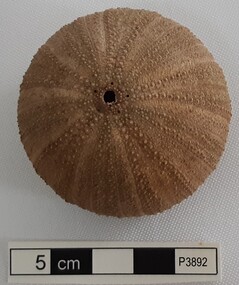
... sea urchin shell is significant as an example of underwater animal life existing in Victoria the 1960s. It was recovered by John Chance, a diver from the wreck of the S.S. Casino in the 1960s-70s. Items that come from several wrecks along Victoria's coast have since been donated to the Flagstaff Hill Maritime Village’s museum collection by his family, illustrating this item’s level of historical value. The urchin is connected with the S.S. Casino, which played an historical role in Western Victoria, providing transport ...This sea urchin shell was recovered from the wreck of the S.S. Casino (1882 – 1932) between the late 1960’s to early 1970’s. It is part of the John Chance Collection. The coastal trader SS Casino (1882–1932) had a run of almost 50 years along the coast of Western Victoria. She traded goods and food as well as carrying passengers from port to port on her many voyages. This vase may have been included in her cargo or could have been amongst the personal luggage of the people on board.The sea urchin shell is significant as an example of underwater animal life existing in Victoria the 1960s. It was recovered by John Chance, a diver from the wreck of the S.S. Casino in the 1960s-70s. Items that come from several wrecks along Victoria's coast have since been donated to the Flagstaff Hill Maritime Village’s museum collection by his family, illustrating this item’s level of historical value. The urchin is connected with the S.S. Casino, which played an historical role in Western Victoria, providing transport, communication and trade along the coast between Melbourne and Portland in the late 19th and the early 20th century, visiting the ports at Apollo Bay, Warrnambool and Belfast (Port Fairy). The S.S. Casino was the only regular trader with normal passenger accommodation along the West Coast and the only Western District steamship that was in service between 1854 and 1939, and to be represented in the Victorian Heritage Shipwreck register, and to have been wrecked in the Western District, and to have the wreck located, and to be accessible to divers. The wreck of the S.S. Casino, and its associated relics, is considered an important part of Victorian and Australian cultural heritage and is now protected as a Historic Shipwreck under State and Commonwealth Law in the Commonwealth Historic Shipwrecks Act (1976). Sea urchin, global shape, beige colour. Urchin has two naturally formed holes, the larger being the mouth. Ten segments radiate from top to bottom, each with a row of small white raised circles.flagstaff hill, warrnambool, flagstaff hill maritime museum, maritime museum, shipwreck coast, flagstaff hill maritime village, great ocean road, s.s. casino, john chance, west coast trader, apollo bay, sea urchin, south west victoria, sea life -
 Flagstaff Hill Maritime Museum and Village
Equipment - Ship's Telegraph section, Chadburn & Sons, 1875-1898
... sea. This type of equipment was still in use in the mid-20th century. It is significant for its association with its maker, Chadburn & Son, of Liverpool, a well-known marine instrument maker whose work was recognised by English Royalty, and whose products were selected to supply similar equipment for use on the RMS Titanic. The ship’s telegraph is also significant for its association with the paddle steamer PS Hygeia, one of three iconic steamers that transported ...The ship’s telegraph section was once part of the navigational equipment of the famous paddle steamer, PS Hygeia, and was later installed on Flagstaff Hill’s exhibit, the steamer Rowitta. This is the Bridge Section of a ship’s telegraph, a Duplex Gong model, made by Chadburn & Son of Liverpool. The gong sounded two signals whenever the navigational commands to change the speed or direction were given by the ship’s pilot. Communication between the ship’s pilot and the engine room in the late 19th to the mid-20th centuries was made with a system called an Engine Order Telegraph (E.O.T.) or ship’s telegraph. The equipment has two parts, the Bridge Section and the Engine Room Section. The Bridge Section was usually mounted onto a pedestal, and the Engine Room Section was attached to a vertical surface. The standard marine commands were printed or stamped around the face of the dial and indicated by a pointer or arrow that was usually moved by a rotating brass section or handle. The ship’s pilot stationed on the Bridge of a vessel sends his Orders for speed and direction to the Engine Room with the E.O.T. He moves the lever or levers, depending on the number of engines the ship has, to change the indicator on the Bridge Section’s dial to point in the new direction and speed of travel. This change causes the Orders to be duplicated on the Engine Room Section’s dial and a bell or bells to signal the change at the same time. The engineer then adjusts the ship’s engines and steering equipment to follow the pilot’s Order. CHADBURN & SON, Liverpool- Chadburn Brothers, William and C.H., were joint inventors and well-established makers of optical and scientific instruments and marine gauges. The firm was granted the Prince Albert Royal Warrant in the late 19th century. In 1870, William Chadburn applied for a patent for his navigational communication device for use on ships. By 1875, Chadburn & Son was producing the brass Engine Order Telegraph in its plant at 71 Lord Street, Liverpool. In 1911, the ship, RMS Titanic, was launched, fitted with Chadburn & Sons E.O.T. The Chadburn Ship Telegraph Company Limited was registered in 1898 to take over Chadburn & Sons. In 1903, a large factory at Bootle, near Liverpool, and its products were being sold overseas. In 1920, electric-powered telegraphs were developed. In 1944, the name changed to Chadburn’s (Liverpool) Limited. In 1968, the company became Chadburn Bloctube Ltd. In 2000, the company, now Bloctube Marine Limited, was still manufacturing ship telegraphs. The P.S. HYGEIA 1890-1932: - This ship’s telegraph was installed on the new paddle steamer, PS Hygeia, one of three iconic pleasure steamers famous for providing regular services in Port Phillip Bay, Victoria, to thousands of passengers between the ports of Queenscliff, Sorrento, Portsea, Dromana, Rosebud, Rye, and Mornington. It joined the Ozone and the Weeroona, all three described as being glamorous, powerful and fast. Its ticket office was on the pier itself. The P.S. Hygeia was built in Yorker, Scotland, in 1890, by Napier, Sharks & Bell. It was registered in Melbourne, Australia, by Hubbart, Parker & Co. in 1891. The steel ship was 92 metres long, able to travel at 22 knots, and licensed to carry over 1600 passengers in luxury, with even a barber shop on board. The regular service between the ports in Port Phillip Bay, Victoria, continued for over 40 years. With the decline in passenger demand, the service wound down. The Hygeia was sold to H.M. Morris in 1931 for demolition and breaking up. Equipment, fittings, and even lifebuoys were sold, with many items purchased by people who had some connection to the Hygeia. On August 25th, 1931, what was left of the vessel departed Port Melbourne and eventually, in June 1932, it was laid to rest at the ships’ graveyard outside Port Phillip Heads. The SS ROWITTA 1909-2015: - The ship’s telegraph was originally installed on the PS Hygeia. It was purchased when the Hygeia was broken up in 1931 and later installed, in 1975, on Flagstaff Hill’s SS Rowitta, an exhibit greatly enjoyed by the public until it was demolished in 2015. The ferry “SS Rowitta” was built in 1909 in Hobart, Tasmania. The timber steam ferry was built using planks of Huon and Karri wood. It was a favourite with sightseeing passengers steaming along Tasmania’s Tamar and Derwent rivers for 30 years. Rowitta was also known as Tarkarri and Sorrento and had worked as a coastal trading vessel between Devonport and Melbourne, and Melbourne, Queenscliff and Sorrento. The vessel had given over 100 years of service and pleasure. This Bridge section of a ship’s Engine Order Telegraph, used with an Engine Room section, represents late-19th-century change and progress in communication and navigation at sea. This type of equipment was still in use in the mid-20th century. It is significant for its association with its maker, Chadburn & Son, of Liverpool, a well-known marine instrument maker whose work was recognised by English Royalty, and whose products were selected to supply similar equipment for use on the RMS Titanic. The ship’s telegraph is also significant for its association with the paddle steamer PS Hygeia, one of three iconic steamers that transported thousands of passengers from port to port within Port Phillip Bay, Victoria, for over 40 years from the 1890s to the 1930s. Queenscliff Borough remembers the Hygeia by naming a road near the pier Hygeia Drive. The Hygeia is registered on the Victorian Heritage Database as a vessel of significance, VHR S329. In 1901, Hygeia had the privilege of carrying their Royal Highnesses, the Duke and Duchess of York, from Mornington to St Kilda Pier, Melbourne, during their Royal visit celebrating the Federation of Australia. The ship’s telegraph is also important for its connection with the Rowitta, a large exhibit on display at Flagstaff Hill Maritime Village, aiding maritime education for over 40 years. It represented the importance of coastal traders to transport, trade and communication along the coast of Victoria, and before the availability of rail and motor vehicles, serving many roles. Bridge section of a Ship’s Telegraph or Engine Order Telegraph (E.O.T.). The round, double-sided, painted glass dial is inside a brass case behind glass. It is fitted onto an outward tapering brass pedestal with a round base. The brass indicator arrows between the handles point simultaneously to both sides of the dial when moved. An oval brass maker’s plate is attached to the top of the case. The dial’s faces have inscriptions that indicate speed and direction, and the front face and plate include the maker’s details. A serial number is stamped on the collar where the dial is fitted to the pedestal. The ship’s telegraph is a Duplex Gong model, made by Chadburn & Son of Liverpool. It was originally part of the navigational fittings on the paddle steamer, PS Hygeia.Dial, maker’s details: “PATENT “DUPLEX GONG” TELEGRAPH / CHADBURN & SON / TELEGRAPH WORKS / PATENTEES & MANUFACTURERS / 11 WATERLOO ROAD / LIVERPOOL” LONDON / 105 FENCHURCH STREET” “NEWCASTLE / 85 QUAY + SIDE” “GLASGOW / 69 ANDERSON QUAY” “PATENT” Dial instructions: “FULL / HALF/ SLOW / FINISHED WITH ENGINES / STOP STAND BY / SLOW / HALF / FULL / ASTERN / AHEAD” Maker’s plate: “CHADBURN / & SON / PATENT / LIVERPOOL” Serial number: “22073”flagstaff hill, warrnambool, maritime village, maritime museum, shipwreck coast, great ocean road, engine order telegraph, e.o.t., navigational instrument, communication device, ship’s telegraph, engine room section, bridge section, rms titanic, chadburn & son, chadburn brothers, william chadburn, chadburn ship telegraph company, chadburns, duplex gong, liverpool, ss rowitta, navigation, marine technology, pilot’s orders, steam power, hobart, tasmania, devonport, tasmanian-built, ferry, steam ferry, steamer, 1909, early 20th century vessel, passenger vessel, tamar trading company, launceston, george town, sorrento, tarkarri, speculant, peter mcgennan, p j mcgennan & co. port phillip ferries pty ltd, melbourne, coastal trader, timber steamer, huon, karri, freighter, supply ship, charter ferry, floating restaurant, prawn boat, lakes entrance, ps hygeia, paddle steamer, pleasure steamer, port phillip bay, queenscliff, portsea, dromana, rosebud, rye, mornington, hubbart parker & co, 1890, 1903, h.m. morris, hygeia -
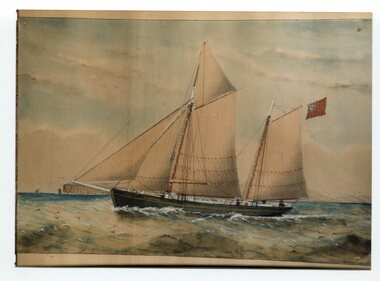 Orbost & District Historical Society
print
... It is for use only at sea and officially never on land, but can be used by private citizens. It was in use in Australia and overseas during the first half of the 20th century. ship transport on back -' Endeavour" A coloured print of a painting of a ship (schooner?) ...There were many vessels named "Endeavour". There are no details attached to this item. The Australian Civil Ensign, or Australian Red Ensign, is simply a red version of the Australian National flag. It is for use only at sea and officially never on land, but can be used by private citizens. It was in use in Australia and overseas during the first half of the 20th century.A coloured print of a painting of a ship (schooner?) in full sail. It is flying a red ensign.on back -' Endeavour"ship transport
