
Showing 286 items matching "seat covers"
-
 Flagstaff Hill Maritime Museum and Village
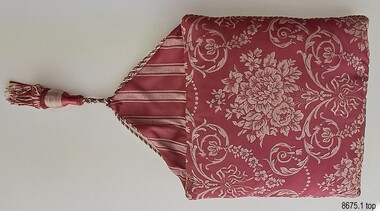
Textile - Seat Squabs, mid-20th century
... ...seat covers...The squabs are also significant for their use in the St Nicholas Missions to Seamen's chapel, Williamstown, as the original building is now listed on the Victorian Heritage Register. flagstaff hill warrnambool shipwrecked-coast flagstaff-hill flagstaff-hill-maritime-museum maritime-museum shipwreck-coast flagstaff-hill-maritime-village st nicholas mission to seamen's church williamstown mission to seamen williamstown mission to seamen victoria st nicholas mission to seamen st nicholas seamen's church religion religious service sailor's rest ladies harbour light guild squab seat covers cushions squabs religious furnishing padded seats seating accessory Squabs or padded seat cushions, a pair of two. ...The term 'seat squabs' is no longer commonly used, but is sometimes referred to in the upholstery and motor vehicle industries. Squabs are padded cushions frequently added to wooden chairs or benches to add comfort to their hard forms. They have been made to an 18th-to-19th-century pattern using beautiful, richly coloured satin fabric and fancy cord tassels. The weighted flap at the rear of the squabs helps to keep them in place on the chair, and could be used on the top of the backrest instead of on the seat. These days, squabs are attached with fabric ties or hook-and-loop tabs. These seat squabs were once used in the St Nicholas Seamen's Church at 139 Nelson Place, Williamstown, Victoria, which was purchased and furnished around 1943. The furniture and furnishings are now part of the St. Nicholas Seamen's Church collection. DETAILED HISTORY of the Missions to Seamen: - The Missions to Seamen is an Anglican (Church of England) charity that has served the world’s seafarers since 1856. It was inspired by the work of Rev. John Ashley, who, 20 years earlier, had pioneered a ministry to seafarers in the Bristol Channel in Great Britain. When Ashley retired, others continued the work, founding the Missions to Seamen. It adopted a Flying Angel as its symbol, inspired by a verse from the Bible in Revelation 14. Today, over 200 world ports have Missions to Seamen centres and chaplains. A Missions to Seamen’s club warmly welcomes sailors of all colours, creeds and races and provides a wide range of facilities. The Missions to Seamen organisation changed its name to the Mission to Seafarers in 2000, continuing to include Missions to Seamen clubs in Victoria’s cities of Melbourne, Portland, Geelong and Hastings. Flagstaff Hill’s St Nicholas’ Seamen’s Church is named after its namesake from Williamstown, Victoria, which began in 1857. Bishop Perry opened the first Sailors’ Church, which was known as ‘Bethel’, on an old hulk floating in Hobson’s Bay, Port of Melbourne. In 1860, a Sailors’ Rest started operating from rented premises in Williamstown. In 1878, the Sailors’ Church moved into an old Wesleyan chapel in Ann Street. By the end of that year, they managed to purchase the building, which they had already refurbished. In 1883, they affiliated with the Victorian Seamen’s Mission. A few years later, in 1906, the building had to be demolished because it was no longer safe. While they raised funds for a new building, the Sailors’ Rest temporarily moved to premises in front of Customs House in Nelson Place. Around this time, in 1906, the Ladies Harbour Lights Guild was formed in Australia to support and raise funds for the Mission to Seamen organisation in Melbourne. Two of the most significant ladies of the Guild were founding members Ethel Godfrey and Alice Sibthorpe. During the Mission's time at Siddeley Street, Melbourne, the activities of the Guild raised funds for the Mission to Seamen's Chapel at their new, and still current, premises in Flinders Street, Melbourne, opened in 1917. The Guild continued its important work until the 1960s. In 1908, the Williamstown Mission had enough money to purchase the former Mascotte skating rink on Thompson Street, Williamstown. In August of that year, they were inaugurated into the Victorian Missions to Seamen. They continued at that venue for a few decades. In 1943, the former ES&A Bank building at 139 Nelson Place, Williamstown, was purchased for the new Mission to Seaman’s Club. The official opening was on May 6th, 1944. It was described as a ‘distinctive little building’. Funds had previously been raised for the building and furnishing of the chapel at the rear. The chapel was named St Nicholas’ Seamen’s Church, after St Nicholas, fourth-century bishop and patron saint of sailors. Services were held on Wednesdays and Sundays. The church was supported by the Williamstown Lightkeepers’ Auxiliary, newly founded by Mrs Ethel Margaret Musther in 1943, as well as the Harbour Lights Guild and the League of Soldiers’ and Sailors’ Friends. The Williamstown Mission to Seamen’s Church operated until 1966, when large international ships no longer used the Port of Williamstown. The Commonwealth Government then leased the premises. In the formative years of Flagstaff Hill Maritime Village, the Advisory Board decided to include a Missions to Seamen Chapel and Recreation Room in its village. The Missions organisation was a significant feature of ports during the late 1800s and early 1900s, the period that the Village represents. They often erected Missions to house social and worshipful activities for seamen. Flagstaff Hill’s curator, Mr Ken Marshman, approached the Melbourne Board of Management of Missions to Seamen regarding the Williamstown branch. Consequently, the Board permitted the furnishings of the Williamstown chapel to be transferred to Flagstaff Hill Maritime Village. A provision of the transfer was that the Victoria Missions to Seamen be recognised, that the items would remain as a collection, and that the chapel would be called St Nicholas Seamen’s Church and conduct Divine services. The donation was approved on 21st May 1979. Flagstaff Hill's St. Nicholas Seamen's Church: - The idea behind Flagstaff Hill’s Missions to Seamen’s Church was partly driven by the offer of Stained Glass Memorial Windows that originated from the Warrnambool and District Base Hospital, which was undergoing multi-storey expansion in the late 1960s and early 1970s. The hospital’s Manager/Secretary was eager to see the historic window installed in a suitable place. The church, or chapel, was designed by a local architectural draftsman in collaboration with the Flagstaff Hill Planning Board and was constructed by Mr Leon Habel. The designers hoped the church would be used for formal worship, such as weddings, funerals, and multi-denominational special services like war commemorations. Its design was inspired by the ‘Missions to Seamen’ buildings in Portland and the Port of Melbourne. The furniture and furnishings were placed as accurately as possible according to photographs of the Williamstown St Nicholas Seamen’s Church and with assistance from local clergy. The Recreation Room was furnished and arranged on advice from experienced members of the Missions to Seamen organisation. A framed document in the building recognises the donor of the furnishings, Victoria Missions to Seamen, and includes the names of some original donors and their donated item/s. The building’s design incorporates local features such as Warrnambool sandstone, which was no longer commercially available but was procured from demolished buildings and uniformly cut to use as a veneer over the stronger Mt. Gambier stone. Also, traditional green American roofing slate was used, sourced from the 1908 local shipwreck “Falls of Halladale” by Flagstaff Hill volunteer divers. The bell tower includes a bell believed to be from a local shipwreck. Additional furnishings were acquired locally, and several items were donated by Warrnambool residents. Light fittings in both rooms were assembled to simulate 19th-century gas light fittings. The stained-glass window at the back of the church is a memorial to Dr Connell, a well-respected member of the Warrnambool community. It was originally installed in 1928 in the main building of Warrnambool Hospital. The St Nicholas’ Seamen’s Church at Flagstaff Hill was officially opened by His Worship the Mayor, Cr. John Lindsay, on Sunday, 11th October 1981. The event included a service of thanksgiving conducted by the Warrnambool Ministers Fraternal. Since then, the Chapel has been the historic venue for many weddings. This pair of seat squabs is historically significant for its origin in the St Nicholas Mission to Seamen's Church in Williamstown, established in 1857 to cater for seafarers’ physical, social, and spiritual needs. The organisation originated in Bristol, England, when a Seamen's Mission was formed in 1837. The squabs are also significant for their use in the St Nicholas Missions to Seamen's chapel, Williamstown, as the original building is now listed on the Victorian Heritage Register. Squabs or padded seat cushions, a pair of two. These 18th to 19th-century design squabs have crimson and cream satin fabric on top and underneath, and weighted tassels are attached to their rear corners. They can be used for comfort on hard seats and benches. The squabs were furnishings from the Missions to Seamen chapel in Williamstown, and they are now part of the St Nicholas Seamen's Church Collection.flagstaff hill, warrnambool, shipwrecked-coast, flagstaff-hill, flagstaff-hill-maritime-museum, maritime-museum, shipwreck-coast, flagstaff-hill-maritime-village, st nicholas mission to seamen's church williamstown, mission to seamen williamstown, mission to seamen victoria, st nicholas mission to seamen, st nicholas seamen's church, religion, religious service, sailor's rest, ladies harbour light guild, squab, seat covers, cushions, squabs, religious furnishing, padded seats, seating, accessory -
 Whitehorse Historical Society Inc.
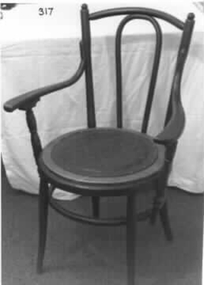
Furniture - Chair
... Wooden chair with arms, leather seat cover quilted design and studded....furniture domestic Wooden chair with arms, leather seat cover quilted design and studded. Furniture Chair ...Wooden chair with arms, leather seat cover quilted design and studded.furniture, domestic -
 Robin Boyd Foundation
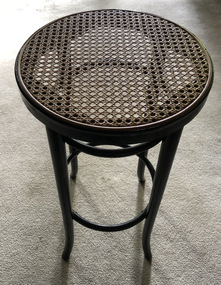
Furniture - Bar stool, Thonet
... Set of two bar stools with black legs and circular seat covered in wicker....Walsh St furnishings robin boyd Set of two bar stools with black legs and circular seat covered in wicker. Furniture Bar stool Thonet ...The two Thonet black bar stools were purchased by Patricia and John Davies at the same time as the new black Thonet dining chairs, to replace the worn blond wood Thonet dining chairs that Patricia and Robin owned. (The wicker seats have been repaired more recently.)Set of two bar stools with black legs and circular seat covered in wicker.walsh st furnishings, robin boyd -
 Mont De Lancey
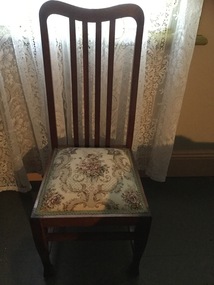
Furniture - Chair
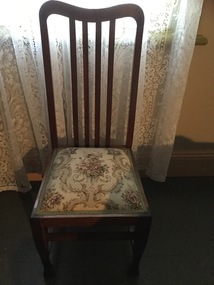
... Brown wooden high backed chair with cloth seat cover of floral design....Seat reupholstered 1992. chairs dining suites furniture Brown wooden high backed chair with cloth seat cover of floral design. Furniture Chair ...Part of a complete dining suite from the home of Mrs. Nell Sebire, 2nd wife of Thomas Sebire. Seat reupholstered 1992.Brown wooden high backed chair with cloth seat cover of floral design.chairs, dining suites, furniture -
 Mont De Lancey
Furniture - Chair
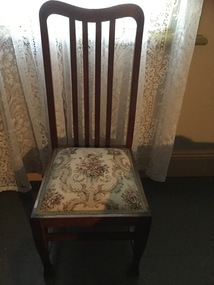
... Brown wooden high backed chair with cloth seat cover of floral design....Seat reupholstered 1992. chairs dining suites furniture Brown wooden high backed chair with cloth seat cover of floral design. Furniture Chair ...Part of a complete dining suite from the home of Mrs. Nell Sebire, 2nd wife of Thomas Sebire. Seat reupholstered 1992.Brown wooden high backed chair with cloth seat cover of floral design.chairs, dining suites, furniture -
 Mont De Lancey
Furniture - Chair
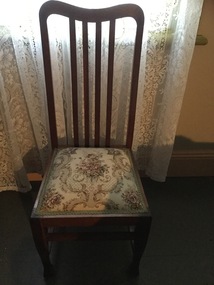
... Brown wooden high backed chair with cloth seat cover of floral design....Seat reupholstered 1992. chairs dining suites furniture Brown wooden high backed chair with cloth seat cover of floral design. Furniture Chair ...Part of a complete dining suite from the home of Mrs. Nell Sebire, 2nd wife of Thomas Sebire. Seat reupholstered 1992.Brown wooden high backed chair with cloth seat cover of floral design.chairs, dining suites, furniture -
 Mont De Lancey
Furniture - Chair
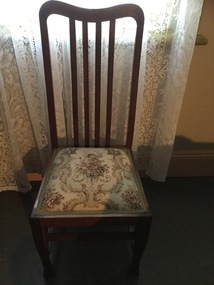
... Brown wooden high backed chair with cloth seat cover of floral design....Seat reupholstered 1992. chairs dining suites furniture Brown wooden high backed chair with cloth seat cover of floral design. Furniture Chair ...Part of a complete dining suite from the home of Mrs. Nell Sebire, 2nd wife of Thomas Sebire. Seat reupholstered 1992.Brown wooden high backed chair with cloth seat cover of floral design.chairs, dining suites, furniture -
 Mont De Lancey
Furniture - Chair
... Brown wooden high backed chair with cloth seat cover of floral design....Seat reupholstered 1992. chairs dining suites furniture Brown wooden high backed chair with cloth seat cover of floral design. Furniture Chair ...Part of a complete dining suite from the home of Mrs. Nell Sebire, 2nd wife of Thomas Sebire. Seat reupholstered 1992.Brown wooden high backed chair with cloth seat cover of floral design.chairs, dining suites, furniture -
 Mont De Lancey
Furniture - Chair
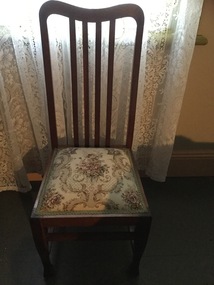
... Brown wooden high backed chair with cloth seat cover of floral design....Seat reupholstered 1992. chairs dining suites furniture Brown wooden high backed chair with cloth seat cover of floral design. Furniture Chair ...Part of a complete dining suite from the home of Mrs. Nell Sebire, 2nd wife of Thomas Sebire. Seat reupholstered 1992.Brown wooden high backed chair with cloth seat cover of floral design.chairs, dining suites, furniture -
 Glenelg Shire Council Cultural Collection
Tool - Saddlers Tool - Wooden Vice, n.d
... Saddler's tool. Seat with leather cover, wooden vice....Saddler's tool. Seat with leather cover, wooden vice. Tool Saddlers Tool - Wooden Vice ...Saddler's tool. Seat with leather cover, wooden vice. -
 Eltham District Historical Society Inc
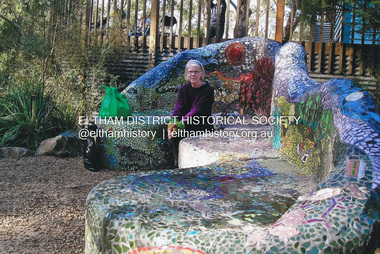
Photograph, Fay Bridge, Fay Bridge with the Lasting Memories Mosaic Seat, St. Andrews Hall, 1 Proctor Street, St. Andrews, n.d
... Following the Black Saturday Bushfire of February 7, 2009, which ravaged St Andrews and surrounding district, a group of bushfire affected women formed the Lasting Memories Mosaic group and created this concrete seat covered in mosaic as part of their healing process. ...Following the Black Saturday Bushfire of February 7, 2009, which ravaged St Andrews and surrounding district, a group of bushfire affected women formed the Lasting Memories Mosaic group and created this concrete seat covered in mosaic as part of their healing process. ...The Lasting Memories Mosaic Group Seat is part of Nillumbik Shire Council's Public Art. Following the Black Saturday Bushfire of February 7, 2009, which ravaged St Andrews and surrounding district, a group of bushfire affected women formed the Lasting Memories Mosaic group and created this concrete seat covered in mosaic as part of their healing process. It was completed in 2012. For more information see Nillumbik Shire Council's link Public Art: Lasting Memories Mosaic GROUP, Lasting Memories Mosaic Seat - https://victoriancollections.net.au/items/58536395d0ce201b746561c6fay bridge collection, fay bridge, mosaics, st andrews, lasting memories mosaic group seat, st andrews hall -
 Bendigo Military Museum
Equipment - SADDLE, c. 1915 to 1930
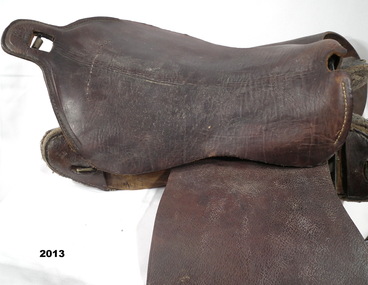
... No stirrups, stirrup leathers or girth. The leather seat covers the frame between the front and rear metal arches and is attached to them using linen webbing slings. ...No stirrups, stirrup leathers or girth. The leather seat covers the frame between the front and rear metal arches and is attached to them using linen webbing slings. ...Standard issue saddle used by the Australian Light Horse, artillery and transport units during WW1 and after (between the wars). The Universal Pattern saddles were designed to have interchangeable parts, making them easy to repair.1912 Universal Pattern steel arch brown leather saddle. Tree is made of wood with shredded cotton waste padding attached. Various brass rings are located on the saddle for attaching sundry equipment. No stirrups, stirrup leathers or girth. The leather seat covers the frame between the front and rear metal arches and is attached to them using linen webbing slings. Leather sweat flaps on each side.Stamped on the rear of the seat: 'S (broad up arrow)'australian light horse, military equipment, saddle, transport -
 Australian Gliding Museum
Machine - Glider, 1974
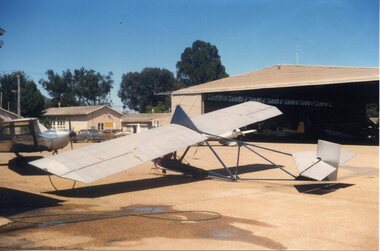
... The glider consists of an open (uncovered) wooden framed fuselage (painted blue) with a brown vinyl covered seat, fabric covered wooden framed wings of constant chord (painted silver) with provision for attachment of semi-circular cane wing skids, and fabric covered wooden framed tailplane, elevators and rudder (painted silver). ...This exhibit is the type of machine that formed the basis of the sport of gliding from 1929 to about 1945. australian gliding glider northrop zogling davies darbyshire feil gliding club of victoria victorian motorless flight group The glider consists of an open (uncovered) wooden framed fuselage (painted blue) with a brown vinyl covered seat, fabric covered wooden framed wings of constant chord (painted silver) with provision for attachment of semi-circular cane wing skids, and fabric covered wooden framed tailplane, elevators and rudder (painted silver). ...The “Northrop” is an American copy of the “Zogling” which was designed in Germany in the 1920s as a training glider. Apparently, the Northrop primary glider takes its name from a Marvin Northrop of Minneapolis who imported a Zogling from Germany and from that glider had plans drawn and published in a magazine called Modern Mechanics in 1930. The Australia Gliding Museum’s Northrop was built over the period of 1970 to 1974. The project was conceived by a pioneer of Australian gliding, Ken Davies, about 1969, as a hobby project and to experience afresh gliding flight of the early years. By that time, few primary gliders, which performed a fundamental role for gliding clubs in the 1930s and 1940s, remained in Australia. Ken began construction and was helped to finish the project by two old time Gliding Club of Victoria members, Dave Darbyshire and Rudi Feil. The glider was test flown on 8 March 1975 at Benalla. The glider was stored at the Gliding Club of Victoria and flown on special occasions in the 1980s. Later it was damaged at the 1996 vintage glider rally at Ararat as a result of a heavy landing. Storage was then provided for the glider by the Victorian Motorless Flight Group at Bacchus Marsh until it was returned to Dave Darbyshire for restoration in 1998. Fully restored, the glider was donated by Iris Davies and Dave Darbyshire to the Australian Gliding Museum in April 2001. This exhibit is the type of machine that formed the basis of the sport of gliding from 1929 to about 1945. The glider consists of an open (uncovered) wooden framed fuselage (painted blue) with a brown vinyl covered seat, fabric covered wooden framed wings of constant chord (painted silver) with provision for attachment of semi-circular cane wing skids, and fabric covered wooden framed tailplane, elevators and rudder (painted silver). When assembled the airframe is wire braced.australian gliding, glider, northrop, zogling, davies, darbyshire, feil, gliding club of victoria, victorian motorless flight group -
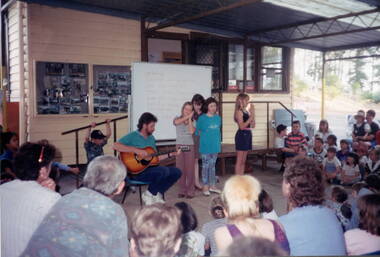 Sunbury Family History and Heritage Society Inc.
Photograph, Musical activities
... A non-digital coloured photograph of a group seated in a covered-in outdoor area watching four children singing to the accompaniment of a man playing a guitar....Musical activities Bulla Primary School A non-digital coloured photograph of a group seated in a covered-in outdoor area watching four children singing to the accompaniment of a man playing a guitar. ...The children at Bulla Primary School were engaged in a variety of entertainment activities which included drama, dancing and musical items. The four children in this photo were singing to the accompaniment of their teacher, who was playing the guitar.A non-digital coloured photograph of a group seated in a covered-in outdoor area watching four children singing to the accompaniment of a man playing a guitar.musical activities, bulla primary school -
Clunes Museum
Functional object - SADDLER'S STOOL
... Wooden stool with canvas covered seat, wooden structure at front of stool to accommodate a saddle. ...SADDLE STOOL TOOL Wooden stool with canvas covered seat, wooden structure at front of stool to accommodate a saddle. ...Wooden stool with canvas covered seat, wooden structure at front of stool to accommodate a saddle. Pedal operated the stool was used during the repairing of saddles.saddle stool, tool -
Clunes Museum
Book, J. & J. BALDWIN, BEEHIVE KNITTING BOOKLETS NO. 9 WOOLCRAFT - A PRACTICAL GUIDE TO KNITTING & CROCHET
... KHAKI COLOURED COVER WITH SEATED LADY IN BLACK AND WHITE KNITTING. ...BRANCH OF PATONS & BALDWINS LIMITED WOOLCRAFT BEEHIVE KNITTING BOOKLETS NO 9 KHAKI COLOURED COVER WITH SEATED LADY IN BLACK AND WHITE KNITTING. ...KNITTING PATTERNS USING BEEHIVE AND WHITE HEATHER KNITTING WOOLS PRODUCED BY J & J BALDWIN, HALIFAX, ENG. BRANCH OF PATONS & BALDWINS LIMITEDKHAKI COLOURED COVER WITH SEATED LADY IN BLACK AND WHITE KNITTING. BLUE BACKGROUND. 63 PAGESnon-fictionKNITTING PATTERNS USING BEEHIVE AND WHITE HEATHER KNITTING WOOLS PRODUCED BY J & J BALDWIN, HALIFAX, ENG. BRANCH OF PATONS & BALDWINS LIMITEDbook, knitting, trembath, perry -
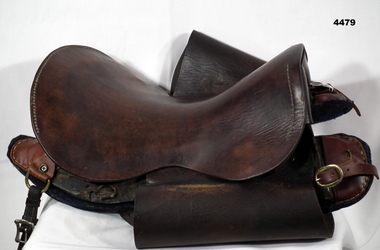 Bendigo Military Museum
Equipment - SADDLE, 1916
... No stirrups, stirrup leathers or girth attached. The leather seat covers the frame of the saddle between the front and rear arches and is connected to them by khaki webbing and leather laces. ...No stirrups, stirrup leathers or girth attached. The leather seat covers the frame of the saddle between the front and rear arches and is connected to them by khaki webbing and leather laces. ...British military saddle as used in WW1. The saddles were designed to have interchangeable parts, making them easy to repair.Military steel arch brown leather saddle. Tree is made of wood with thick blue felt pads and leather attachments. Neither is original. Various brass rings located on the saddle for attaching sundry equipment. Brown leather strap with silver coloured metal buckle attached to the rear right hand side of the tree. No stirrups, stirrup leathers or girth attached. The leather seat covers the frame of the saddle between the front and rear arches and is connected to them by khaki webbing and leather laces. Leather sweat flaps on each side. Leather straps and brass buckles on the front of each pad.Stamped on the front of the seat: '1916, 13'. Stamped on each sweat flap: '1916, 13'.military equipment, saddle, horse equipment, transport -
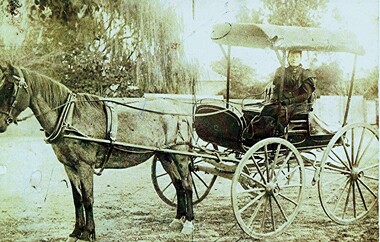 Harcourt Valley Heritage & Tourist Centre
Ann Milford in Buggy, 1896
... Sepia photograph of a woman dressed in Victorian fashion, seated in a covered four wheel buggy.The horse is equipped with light buggy harness and wearing a buggy bridle. ...Sepia photograph of a woman dressed in Victorian fashion, seated in a covered four wheel buggy.The horse is equipped with light buggy harness and wearing a buggy bridle. ...This photo dates from circa 1896. It depicts Mrs Sarah Ann Milford, then aged 65, in a buggy somewhere in Castlemaine. Mrs Milford is holding the reins in gloved hands, having driven five miles into town from her home on the Faraday Road, Harcourt. The journey would have taken about one hour. Mrs. Milford together with her farmer/orchardist husband, worked an extensive orchard/farm, Here she is depicted having delivered apples, butter and vegetables from her family orchard to Castlemaine market. Mrs Milford is wearing a strictly tailored 'must fit snug everywhere' jacket with shoulder cape, very full sleeves, closely buttoned bodice, high neckline and rather severe collar. The skirt was separate , of lined brown twill cotton, pocket at side back. A buggy rug is strapped across her knees. The buggy rug was lined with yellow and black figured damask. Despite the masculine-oriented property laws and society norms many Victorian women were active partners in their family business. The photo is a good record of the fashions, transport and capabilities of this pioneer.Sepia photograph of a woman dressed in Victorian fashion, seated in a covered four wheel buggy.The horse is equipped with light buggy harness and wearing a buggy bridle. -
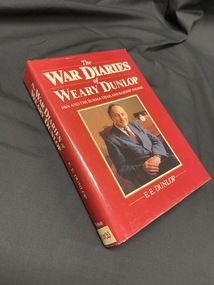 Returned Nurses RSL Sub-branch
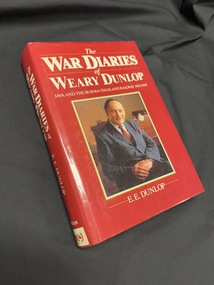
Book, Ernest Edward Dunlop, The war diaries of Weary Dunlop : Java and the Burma-Thailand railway 1942-1945, 1986
... Book with a red dustjacket, had a photograph of a seated older man on cover and white text on cover and spine...and / Ian Rogers / 4.2.91' [on small bit of card glued in top right corner of first page handwritten in blue ink] 'B018b' [handwritten in pencil under above] [Title page torn out] Book with a red dustjacket, had a photograph of a seated older man on cover and white text on cover and spine The war diaries of Weary Dunlop : Java and the Burma-Thailand railway 1942-1945 Book Ernest Edward Dunlop Nelson Publishers ...'More than forty years ago Sir Edward Dunlop, then a lieutenant-colonel, began these diaries at the start of his imprisonment by the Japanese in Java and on the Burma-Thailand Railway. His meticulous observations of prison camp life were concealed all through the war; by the time peace cam in 1945, he carried with him a unique record of the lives of prisoners-of-war. As a commanding officer and a surgeon, 'Weary' became a hero and a legend to thousands of Australian and allied prisoners, whose lives were saved with meagre medical supplies and the instruments the medical officers carried on their backs through Java and Thai jungles. He says himself: 'Of some 22,000 who entered captivity, more than 7,000 died or were killed. Of their sufferings... only those who were present can fully comprehend the seeming hopelessness of it all as their bodies wasted and their friends died.' Sir Edward describes how the cmps were organised; he records deaths, cholera epidemics, operations, and torture; his own - rare - despair; the movement of prisoners up and down the line; and his constant struggle to protect the sick from being drafted into Japanese work parties. From February 1942 he was in the following Japanese prison camps; Bandoeng, Tjimahi, Makasura, Changi, Konyu, Hintok, Tarsau, Chungkai and Nakom Patom.' [From inside front dust jacket]Book with a red dustjacket, had a photograph of a seated older man on cover and white text on cover and spinenon-fiction'More than forty years ago Sir Edward Dunlop, then a lieutenant-colonel, began these diaries at the start of his imprisonment by the Japanese in Java and on the Burma-Thailand Railway. His meticulous observations of prison camp life were concealed all through the war; by the time peace cam in 1945, he carried with him a unique record of the lives of prisoners-of-war. As a commanding officer and a surgeon, 'Weary' became a hero and a legend to thousands of Australian and allied prisoners, whose lives were saved with meagre medical supplies and the instruments the medical officers carried on their backs through Java and Thai jungles. He says himself: 'Of some 22,000 who entered captivity, more than 7,000 died or were killed. Of their sufferings... only those who were present can fully comprehend the seeming hopelessness of it all as their bodies wasted and their friends died.' Sir Edward describes how the cmps were organised; he records deaths, cholera epidemics, operations, and torture; his own - rare - despair; the movement of prisoners up and down the line; and his constant struggle to protect the sick from being drafted into Japanese work parties. From February 1942 he was in the following Japanese prison camps; Bandoeng, Tjimahi, Makasura, Changi, Konyu, Hintok, Tarsau, Chungkai and Nakom Patom.' [From inside front dust jacket]australian nurses, world war two, wwii, ww2, prisoner of war, japan -
 Returned Nurses RSL Sub-branch
Book, Ernest Edward Dunlop, The war diaries of Weary Dunlop : Java and the Burma-Thailand railway 1942-1945, 1986
... Book with a red dustjacket, had a photograph of a seated older man on cover and white text on cover and spine.... / 1994' [Handwritten with blue ink on title page] Book with a red dustjacket, had a photograph of a seated older man on cover and white text on cover and spine The war diaries of Weary Dunlop : Java and the Burma-Thailand railway 1942-1945 Book Ernest Edward Dunlop Nelson Publishers ...'More than forty years ago Sir Edward Dunlop, then a lieutenant-colonel, began these diaries at the start of his imprisonment by the Japanese in Java and on the Burma-Thailand Railway. His meticulous observations of prison camp life were concealed all through the war; by the time peace cam in 1945, he carried with him a unique record of the lives of prisoners-of-war. As a commanding officer and a surgeon, 'Weary' became a hero and a legend to thousands of Australian and allied prisoners, whose lives were saved with meagre medical supplies and the instruments the medical officers carried on their backs through Java and Thai jungles. He says himself: 'Of some 22,000 who entered captivity, more than 7,000 died or were killed. Of their sufferings... only those who were present can fully comprehend the seeming hopelessness of it all as their bodies wasted and their friends died.' Sir Edward describes how the cmps were organised; he records deaths, cholera epidemics, operations, and torture; his own - rare - despair; the movement of prisoners up and down the line; and his constant struggle to protect the sick from being drafted into Japanese work parties. From February 1942 he was in the following Japanese prison camps; Bandoeng, Tjimahi, Makasura, Changi, Konyu, Hintok, Tarsau, Chungkai and Nakom Patom.' [From inside front dust jacket]Book with a red dustjacket, had a photograph of a seated older man on cover and white text on cover and spinenon-fiction'More than forty years ago Sir Edward Dunlop, then a lieutenant-colonel, began these diaries at the start of his imprisonment by the Japanese in Java and on the Burma-Thailand Railway. His meticulous observations of prison camp life were concealed all through the war; by the time peace cam in 1945, he carried with him a unique record of the lives of prisoners-of-war. As a commanding officer and a surgeon, 'Weary' became a hero and a legend to thousands of Australian and allied prisoners, whose lives were saved with meagre medical supplies and the instruments the medical officers carried on their backs through Java and Thai jungles. He says himself: 'Of some 22,000 who entered captivity, more than 7,000 died or were killed. Of their sufferings... only those who were present can fully comprehend the seeming hopelessness of it all as their bodies wasted and their friends died.' Sir Edward describes how the cmps were organised; he records deaths, cholera epidemics, operations, and torture; his own - rare - despair; the movement of prisoners up and down the line; and his constant struggle to protect the sick from being drafted into Japanese work parties. From February 1942 he was in the following Japanese prison camps; Bandoeng, Tjimahi, Makasura, Changi, Konyu, Hintok, Tarsau, Chungkai and Nakom Patom.' [From inside front dust jacket]australian nurses, world war two, wwii, ww2, prisoner of war, japan -
 Phillip Island and District Historical Society Inc.
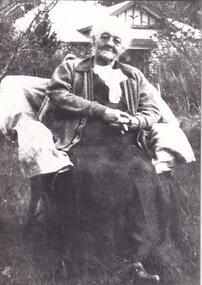
Photograph, Anderson Family, 1938
... Wilhelmena Young seated in cane chair, covered with shawl. Home Glen Isla in background, shortly before her death....Married James Young, became first Sewing Mistress at the Phillip Island School. died 20/09/1938. local history photography photographs slides film wilhelmena young nee anderson black & white photograph mrs emma anderson jacobs Wilhelmena Young seated in cane chair, covered with shawl. Home Glen Isla in background, shortly before her death. ...Wilhelmena, born 1856 on the ship "Wilhelmena" en route to Australia. Parents Robert and Margaret Anderson. Glen Isla was built in 1868 (added to in 1887-88) to become a Boarding House, run by Wilhelmena. Married James Young, became first Sewing Mistress at the Phillip Island School. died 20/09/1938.Wilhelmena Young seated in cane chair, covered with shawl. Home Glen Isla in background, shortly before her death.local history, photography, photographs, slides, film, wilhelmena young nee anderson, black & white photograph, mrs emma anderson jacobs -
 Lakes Entrance Historical Society
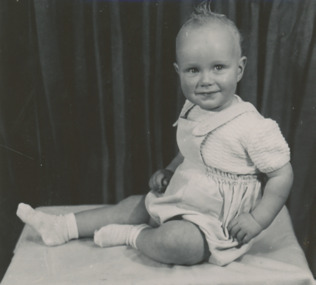
Photograph - Fashion, Bulmer, 1955 c
... Black and white photographic proof of a baby boy seated on a rug covered bench wearing a romper suit short sleeved shirt and white socks Lakes Entrance Victoria...Fashion Children studios on back Mrs Jones 1 10 x 8 2 PC sepia Black and white photographic proof of a baby boy seated on a rug covered bench wearing a romper suit short sleeved shirt and white socks Lakes Entrance Victoria Photograph Fashion Bulmer ...Black and white photographic proof of a baby boy seated on a rug covered bench wearing a romper suit short sleeved shirt and white socks Lakes Entrance Victoriaon back Mrs Jones 1 10 x 8 2 PC sepiafashion, children, studios -
 Flagstaff Hill Maritime Museum and Village
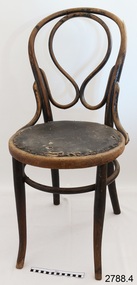
Chair, 1907-1914
... Bentwood chair (4 of 4), painted black, inner back is curled loop, seat has leather cover attached with studs, ventilation holes under seat, legs are splayed and have a bracing ring. ...Bentwood chair (4 of 4), painted black, inner back is curled loop, seat has leather cover attached with studs, ventilation holes under seat, legs are splayed and have a bracing ring. ...The design of this set of four lightweight chairs is based on Thonet’s bentwood designs, which are still some of the best-selling designs for café and restaurant owners. It is elegant, sophisticated and durable. Some of these chairs still have their original seat, under which the letters “TH” or “RSL” are hand written. Flagstaff Hill has several bentwood chairs with these letters on them, in either chalk, black paint, or both. It is believed that the chairs were used in the original Warrnambool Town Hall, and later the RSL. The Town Hall was completed in 1891, built on the corners of Timor and Liebig Streets. (In 1977 the Town Hall was declared unsafe and was later replaced by the Warrnambool Performing Arts Centre.) Some of the chairs have marks, paper labels and symbols on them that show that the maker was Josef Jaworek, who had a small furniture factory in east Sinensia, which was at that time in Austria, from 1907 - 1914. Bentwood chairs are made by a process of wetting wood in water, bending it into curved shapes, then allowing it to dry so that the shape becomes permanent. This process originated by Michael Thonet, who had been given the right to bend wood into desired curves by the Austrian Courts in 1842. In 1856 he was granted a 13 year patent to manufacture chairs and table legs of bent wood treated by steam or boiling water. In 1859 his company Gebruder Thonet produced his original design. Thonet’s early designs also featured hand carved or laminated wooden seats. His Model No. 14 was produced in the 1850’s and his most popular design. After Michael’s death in 1871 the family went on designing and producing chairs. These bentwood chairs are believed to be associated with the original Warrnambool Town Hall. The Warrnambool Town Hall played a significant role in the both the local government and the social events of local and district areas. It was a place for Council meetings, community events and entertainment, theatrical and musical.Bentwood chair (4 of 4), painted black, inner back is curled loop, seat has leather cover attached with studs, ventilation holes under seat, legs are splayed and have a bracing ring. Marks: under seat, handwritten and stamped into wood.Marked with handwritten "TH", in both black paint & white chalk. Under rim is label printed "65" Stamped into wood on rim under chair "95".flagstaff hill, warrnambool, shipwrecked-coast, flagstaff-hill, flagstaff-hill-maritime-museum, maritime-museum, shipwreck-coast, flagstaff-hill-maritime-village, bentwood chair, café chair, restaurant chair, josef jaworek, austrian chairs, furniture -
Glenelg Shire Council Cultural Collection
Craft - Lifeboat, Portland Lifeboat, n.d
... Blue gun-whales and rowers' seats, canvas buoyancy covers, white hull, grey below water line, white top sides. ...Blue gun-whales and rowers' seats, canvas buoyancy covers, white hull, grey below water line, white top sides. ...Port of Portland Collection. Cradle reduced in width when moved to Maritime Discovery Centre October 98 Portland LifeboatWooden lifeboat resting on cradle. Blue gun-whales and rowers' seats, canvas buoyancy covers, white hull, grey below water line, white top sides. Boat supported by chine stringer port, starboard held by 4 steel props, keel rests on cradle. -
 National Wool Museum
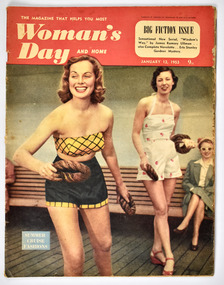
Magazine - Women’s Day, January 12 1953, Women's Day, January 12, 1953
... The front cover shows a colour photograph of three women, two are holding quoits dressed in swim wear and one is seated. ...The front cover shows a colour photograph of three women, two are holding quoits dressed in swim wear and one is seated. ...Forty page colour magazine with printed text, coloured and black and white graphics and photographs. The front cover shows a colour photograph of three women, two are holding quoits dressed in swim wear and one is seated. The back cover features two colour illustrations of men playing golf. front: [printed] THE MAGAZINE THAT HELPS YOU MOST / Women’s Day / AND HOME / SUMMER CRUISE FASHIONS / Registered in Australia for transmission by post as a periodical. / BIG FICTION ISSUE / Sensational New Serial, “Windom’s / Way,” by James Ramsey Ullman . . / also Complete Novelette . . Erle Stanley / Gardner Mystery. / JANUARY 12, 1953 9D.women's day, fashion, women, magazine, serials, novelette -
 Ballarat Tramway Museum
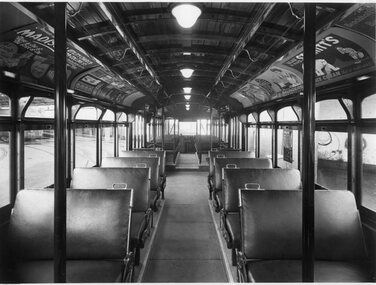
Photograph - Y1 class tram interior, Sutcliffe Pty Ltd, early 1930's
... Shows arrangements of seats, lights with covers and roof ads. A number of roof ads and window posters in the tram - of tram in service. ...Shows arrangements of seats, lights with covers and roof ads. A number of roof ads and window posters in the tram - of tram in service. ...Black and white photograph of the interior a Y1 class tram car, photographed at Camberwell Depot. Shows arrangements of seats, lights with covers and roof ads. A number of roof ads and window posters in the tram - of tram in service. Part of tram 550 in background. On rear is Sutcliffe stamp, and Gordon and Gotch stamp with date July 10. Has "Sutcliffe Pty. Ltd. Photographers Cromwell buildings 366a Bourke St. Melbourne" stamp in purple on back of photo. Destination City, 4th Edition and 5th edition.Yields information about the interior of a Y1 class tramcar.Black and white photograph with details on rear.On rear in pencil is "Return to F. Shennen" with arrow pointing to Gordon and Gotch stamp. "Interior Y1". The Sutcliffe stamp has two pencil crosses through it.trams, tramways, mmtb, y1 class, interiors -
 Flagstaff Hill Maritime Museum and Village
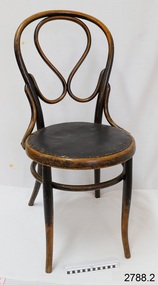
Furniture - Chair, 1900-1914
... Bentwood chair (2 of 4), painted black, inner back is curled loop. Seat has leather cover, attached with studs. Ventilation holes under seat in star pattern. ...Text of label "MOBEL-FABRIKEN / von / JOSEF JAWOREK / Teschen, osterr, Schlesien" Bentwood chair (2 of 4), painted black, inner back is curled loop. Seat has leather cover, attached with studs. Ventilation holes under seat in star pattern. ...Bentwood furniture is a type of furniture made by bending wooden rods into the required shape after they have been heated with steam. Mundus bentwood chairs are among the most successful examples of early mass-produced furniture. The inventor of manufacturing chairs using this method was Gebrüder Thonet. The subject item was made at Josef Jaworek small factory that produced bentwood chairs and was the only Polish member associated with the Mundus furniture company of Vienna. This company was founded in 1907 and Mundus went on to merge with J & J Kohn in August of 1914. Mundus furniture was a significant manufacturing company, active in several places in the Austro Hungarian Empire, at the end of the 19th century and early 20th century. Factories seem to have existed in multiple locations including Poland. Their products carry diverse labels, such as "Budapest", "Borlova", "Czechoslovakia", etc, some of the furniture was co-signed with "Jacob and Josef Kohn". Mundus also merged with Gebrüder Thonet in 1922 the inventor of the bentwood chair.The subject item is believed to be associated with the original Warrnambool Town Hall and would have been part of the buildings furnishings. The town Hall played a significant role in both local government and social events of local and district areas. It was not only a place for Council meetings but community events and social events. The item is significant as it is an early example of mass-produced manufactured furniture from a company in Austria that pioneered this type of furniture around the turn of the late 19th and early 20th centuries. This item is now regarded as a collector's piece giving it additional significance and interest.Bentwood chair (2 of 4), painted black, inner back is curled loop. Seat has leather cover, attached with studs. Ventilation holes under seat in star pattern. Splayed legs with bracing ring. Marks: pressed into some legs, under seat, paper label on rim under seat says the chair is made in Austrla.Marks: "3" is pressed into some legs, chalk letters under seat "RS", makers label, cream with dark print; on either side are 2 coins, top left coin has bust of a man, top right has an emblem with 1885 under it. Text of label "MOBEL-FABRIKEN / von / JOSEF JAWOREK / Teschen, osterr, Schlesien"flagstaff hill, warrnambool, flagstaff hill maritime museum, maritime museum, shipwreck coast, flagstaff hill maritime village, great ocean road, bentwood chair, café chair, restaurant chair, josef jaworek, austrian chairs, furniture, gebrüder thonet -
 Royal Australian and New Zealand College of Obstetricians & Gynaecologists (RANZCOG)
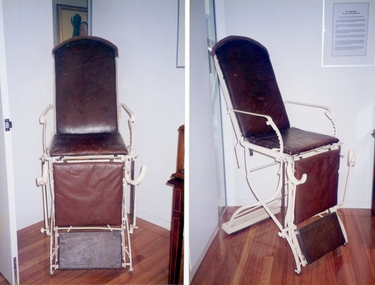
Examination chair associated with the Faculty of Anaesthetists, Royal Australian College of Surgeons, c1900
... The seat and seat extension are covered in brown leather. It has two folding sections with metal leg rests, and a base on castors. ...The seat and seat extension are covered in brown leather. It has two folding sections with metal leg rests, and a base on castors. ...Likely to be a German designed operating chair. Very similar to operating chair shown in [Aesculap] Aktiengesellschaft fur Feinmechanik vormals Jetter & Sheerer, "Illustriertes Musterbuch", 1904, Tuttlingen, South Germany, p. 720, no. 34, 412 Fig 1 & 2. Early twentieth century examination chair constructed of metal and leather. The structure is metal and painted with cream enamel. The seat and seat extension are covered in brown leather. It has two folding sections with metal leg rests, and a base on castors. There are three holes in each arm rest, possibly indicating missing attachments. The chair is adjustable to horizontal.examination, furniture, royal australian college of surgeons -
Glenelg Shire Council Cultural Collection
Functional object - Portland Lifeboat, n.d
... Blue gunwales, rowers seats, and canvas buoyancy covers, white hull, grey under water line. ...Blue gunwales, rowers seats, and canvas buoyancy covers, white hull, grey under water line. ...City of Portland. The Portland Lifeboat was used in the rescue of survivors from the Admella shipwreck. It is also unique in its design having been based on a winning design from the RNLI in the UK and then adapted for Australian conditions. The Lifeboat is registered on the Victorian State Heritage Register.Wooden boat and cradle. Blue gunwales, rowers seats, and canvas buoyancy covers, white hull, grey under water line. White topsides. Boat supported by chine stringer port and starboard held by 4 steel props. Keel rests on cradle.Front: - Back: -portland lifeboat, admella, victorian state heritage register -
 Linton and District Historical Society Inc
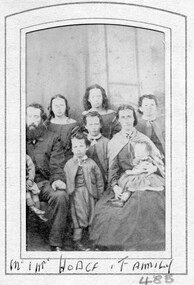
Photograph, Mr and Mrs Hodge and family
... Sepia photograph of a bearded gentleman wearing suit, seated with a young child sitting on his right knee, hand on left knee, two girls standing at back, two children standing between man and woman wearing long outfit, cape and head cover, seated supporting a child on her lap, with another child standing behind her left shoulder....Sepia photograph of a bearded gentleman wearing suit, seated with a young child sitting on his right knee, hand on left knee, two girls standing at back, two children standing between man and woman wearing long outfit, cape and head cover, seated supporting a child on her lap, with another child standing behind her left shoulder. ...Part of S E Surman collection (album) page 10 top left.Sepia photograph of a bearded gentleman wearing suit, seated with a young child sitting on his right knee, hand on left knee, two girls standing at back, two children standing between man and woman wearing long outfit, cape and head cover, seated supporting a child on her lap, with another child standing behind her left shoulder."Mr and Mrs Hodge and family".mrs hodge, mr hodge, hodge family, surman collection
