
Showing 22 items matching "security door"
-
 Sunbury Family History and Heritage Society Inc.
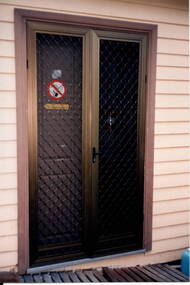
Photograph, School improvements, 1994
... ...Security Door... The installation of a new security door was another of the improvements tat were done at the Bulla Primary School in 1994....A non-digital coloured photograph of the new security door....Bulla Primary School school improvements Security Door A non-digital coloured photograph of the new security door. ...The installation of a new security door was another of the improvements tat were done at the Bulla Primary School in 1994.A non-digital coloured photograph of the new security door.bulla primary school, school improvements, security door -
 Royal District Nursing Service (now known as Bolton Clarke)
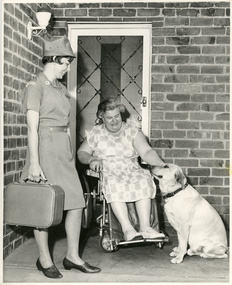
Photograph - Photograph, black and white, 1967
... Lata is in front of her security door which has a white door frame. The house has a white lantern shaped light attached to the wall on the left hand side of the photograph...Lata is in front of her security door which has a white door frame. The house has a white lantern shaped light attached to the wall on the left hand side of the photograph Photograph Photograph, black and white Laurie Levy Photographer, Laurie Levy Photographer, ...Royal District Nursing Service (RDNS), Sister Meisser is visiting Mrs. Lata to attend to the nursing care she requires in her home. She is greeting Mrs. Lata on her veranda and is observing her interaction with her dog. Sr. Meisser is wearing her RDNS uniform of a grey cotton short sleeve frock with a small white arched material logo with 'Royal District Nursing Service' in blue capital letters emblazoned on it, attached to the upper sleeve. She is wearing her grey peaked hat. This had a metal RDNS logo attached to the centre front. Sister Meisser worked from the RDNS Moorabbin centre.From its earliest years when the Trained nurses of the Melbourne District Nursing Society (MDNS) began to wear uniforms, the chosen colour was grey, though the style changed throughout the years as fashions changed from the late 1800s through to the 1970s. Their Trained nurses (Nurses) firstly wore long grey frocks and a white cap with a long white tail hanging from the centre back. When bicycles were introduced the headgear changed to a white pith helmet adorned with a red Maltese cross in the centre front. This was held on with a veil going over the hat and tied under the chin. Over the years there were complaints that the veils became wet in the rain and they asked for a change of uniform, but this did not happen until 1921. Later the Nurses complained their skirts became wet when riding their bicycles in the rain and asked, when raining, to be able to wear breeches and gaiters. This was granted provided they wore aprons when attending patients. It was not long before the uniform changed to a shorter length grey frock, red cardigan, grey coat and grey brimmed hat; later changed to a peaked grey hat. This uniform was used when MDNS was granted Royal patronage in 1966 and worn until 1971 when the uniform changed to a blue V necked frock over a short sleeve white blouse in summer and a blue/grey skivvie under a blue/grey herringbone V neck tunic style frock made of winter material in the cooler weather. Black and white photograph of Royal District Nursing Service (RDNS), Sister Meisser, of Moorabbin Centre. She is standing on the left of the photograph; has short dark hair and is wearing her grey uniform with peaked hat and black shoes, and is holding her rectangular nursing case. She is standing on the veranda of Mrs. Lata's brick home, and is smiling as she observes, to her right, Mrs. Lata, who has grey curly hair and is wearing a light coloured floral frock. Mrs. Lata is sitting in her wheelchair and with her left hand is patting her pale coloured Labrador dog who has a dark collar and is sitting to her right. Mrs. Lata is in front of her security door which has a white door frame. The house has a white lantern shaped light attached to the wall on the left hand side of the photographPhotographer's stamp and the word 'Publicity'royal district nursing service, rdns, rdns uniform, moorabbin centre, mrs lata, sister m. meisser -
 Bendigo Historical Society Inc.
Document - HARRY BIGGS COLLECTION: OLD POLICE BARRACKS, 29/6/70
... He hopes a letter of proposal can be put forward to the Government concerning the restoration & usage of the building soon but in the meantime allows the Society to go ahead & erect a fence around the Barracks & put wire mesh over the windows & doors for security....He hopes a letter of proposal can be put forward to the Government concerning the restoration & usage of the building soon but in the meantime allows the Society to go ahead & erect a fence around the Barracks & put wire mesh over the windows & doors for security. Document HARRY BIGGS COLLECTION: OLD POLICE BARRACKS ...Document. Harry Biggs Collection. A letter from G Serpell Director General. Written on Public Works Dept. Victoria letterhead & dated 29/6/70 to Mr H Biggs Treasurer of Bendigo Historical Society. He hopes a letter of proposal can be put forward to the Government concerning the restoration & usage of the building soon but in the meantime allows the Society to go ahead & erect a fence around the Barracks & put wire mesh over the windows & doors for security.organization, club/society, community, harry biggs collection, old police barracks -
 Eltham District Historical Society Inc
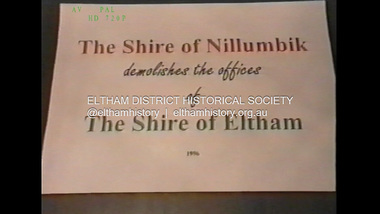
Film - Video (VHS), Jenni Mitchell, Demolition of the Shire of Eltham Offices, 1996
... Scenes of people looking through chain link fence and security guard checking front door. John Graves being filmed that someone informed him the Shire was offering the building to the Community Health Centre for $2.3 million and that if they had been offered a price of $1.1 for what it apparently was sold for they would have snapped it up. ...Scenes of people looking through chain link fence and security guard checking front door. John Graves being filmed that someone informed him the Shire was offering the building to the Community Health Centre for $2.3 million and that if they had been offered a price of $1.1 for what it apparently was sold for they would have snapped it up. ...Poor video quality (noise and interference), edited raw footage with music and some commentary by Merv Hanna. A video documenting the demolition of the Shire of Eltham offices at 895 Main Road Eltham under the direction of the Commissioners appointed for the new Shire of Nillumbik and some of the communities activities surrounding the event. The building was demolished exactly 25 years after the southern wing housing Engineering and Planning on the upper level and the Eltham Library on the ground level was opened in celebration of the Shire of Eltham's centenary. Video has lots of distortion and noise, and sections of clips dubbed over. Immediate initial footage of Jenni Mitchell talking about asbestos claims in the Shire Offices (Sigmund Jorgensen standing behind her) advising Council did a review of the building several years previously and had been cleared of health problems. Cuts to group of people standing outside front door of offices but possibly voice dub over not related ? Then the date 27 Jul 1996 on a scene flashes on screen immediately followed by an edited clip intro of title and credits with classical music track. It then opens with Jenni Mitchell driving to the Shire Offices on Saturday 27 July 1996 at 11.00am. Footage of Main Road past Pitt Street, Alistair Knox Park then entering Shire Office driveway which is fenced off and contractor signs hanging up. Scenes at rear of building showing some internal demolition has commenced. View of the Administration wing. More clips of road driving, Alistair Knox Park, Eltham Library and visitor car park for Shire Offices. Cuts to a group of people standing in access to visitor carpark with new Eltham Library in background, one being immediate former Shire of Eltham President, John Graves. Scenes of people looking through chain link fence and security guard checking front door. John Graves being filmed that someone informed him the Shire was offering the building to the Community Health Centre for $2.3 million and that if they had been offered a price of $1.1 for what it apparently was sold for they would have snapped it up. View of truck loaded with brick rubble literally struggling to ascend the hill of Library Place to exit into Main Road. Cuts to a scene looking at Eltham War memorial Hall through the Memorial Gate, then the Shillinglaw trees and large banner sign ‘Delta Demolitions’ hanging on office façade. Views of front door, old library and bluestone wall. Scene (31 Jul 1996) filmed at night of several white crosses with “RIP Community” and “RIP Democracy”. Scene (1 August 1996) again driving along Main Road towards the Shire Offices then scenes of the offices showing substantially more demolition to exterior, groups of people standing on footpath outside watching, Delta heavy demolition machines, woman holding sign “Democracy where have you gone …”, the odd person in full protection gear and breathing apparatus hand carrying materials out to place on rubbish pile in front of people standing on footpath watching (with no protection) and then stamping on it to break it creating dust, security person in hard hat (no other protection) wandering around, many groups standing around watching, news film crew, person standing on roadside edge holding signs facing traffic stating “Pirate Planning” and “ Grant us your ears” also sign on back of parked car “Elthams High Jacks”, another sign “Community Democracy”, views of crosses in Main Road median strip “RIP Community”, groups of people on footpaths and reporters conducting interviews, footage of unknown person standing with Jenni Mitchell and Sigmund Jorgensen advising people have the right to protest, Jenni Mitchell urging people to ask questions of local MP and Council and Sigmund Jorgensen referring to the three historic Shillinglaw trees with demolition machinery operating in background, Jenni Mitchell and others installing more crosses in median strip; demolition machines operating inside and outside the building, more views of onlookers including Sigmund Jorgensen then Police approaching on footpath, workers and machinery continuing to operate, views of the old library being demolished, the former Community Services department, security personnel. Scene (2 August 1996) more heavy demolition machinery in operation smashing building up, people standing around southern wing watching, view overlooking Eltham Library of train pulling in to Eltham station. Scene (7 August 1996) more heavy demolition and people wandering around with only hard hat protection, no dust protection, comments from one operator dumping a bin of material stating “wait till there’s a Hungry Jack’s here, you’ll be laughing, fuel, videos, hamburgers. You’ll be up with the rest of the world soon, you’ll have electricity and everything here, ha ha ha ha”, more heavy machinery demolition and breaking up of materials, view of Hitachi train going by and Administration wing, view inside the front door opening of the staircase leading to upper level, person walking around operating heavy machinery with a hose spraying rubble (no protective gear other than hard hat interspersed with edit cuts of meeting of Commissioners and independent observers on panel as well as members of the community in public gallery. Nillumbik Shire CEO Barry Rochford addressing the meeting., Chief Commissioner Don Cordell directly addressing Jenni Mitchell with respect to permission to take photographs, Barry Rochford continues to address the question asked of Council about the valuation of the former Shire of Eltham Office building/site, public gallery calling out asking why was building demolished, what was the urgency. Scene (14 August 1996) views of southern wing, previous single demolition operator again mocking people filming, operators working in and around building, Shillinglaw trees and largely demolished front, heavy demolition equipment at work, piles of building rubble, hose spraying water over rubble, large trucks arriving for rubble removal and loading of truck. Scene (21 August) more of the same, building virtually down, Shillinglaw trees standing tall and alone, water spraying on rubble and wattle in bloom. Cuts to Council meeting with public onlookers. Barry Rochford walks out, Wayne Phillips addresses meeting explaining one or two people shouting, members of the community challenging Council (Commissioners) about why due process appear to have been subverted. Former Shire President Robert Marshall in public audience, cuts back to Shire office carpark entrance site and sign hung on fence in front of library “Think Again!” and people standing around observing awaiting a protest demonstration erecting a large sign on stilts stating “Shell No!”, people singing a revised version of God Save the Queen (God Save Us All), Sigmund Jorgensen in attendance, Jenni Mitchell, Sigmund Jorgenson and others address the protest crowd, followed by people mingling, music being played then people standing around the cleared site circumference all with arms linked (video very broken up with noise) then chants “Save the Gateway” and “No Shell for Eltham” and more music and singing “Put up a parking lot”. The crowd then proceeds to walk along the footpath of Main Road. Scene (15 Sep 1996) meeting at Montsalvat in Great Hall addressed by Sigmund Jorgensen discussing a recently published list of the Commissioner’s to senior Council Officers of banned Nillumbik people, others encouraging people to view proposed plans for the site and lodge objections. Specific issues regarding asbestos claims are also addressed. Harry Gilham addresses the meeting on the subject of the Eltham War Memorial and Memorial Gardens and how Council believe a roundabout in the vicinity is of greater importance. Views of various artworks on display (for auction) and music performance in the Barn Gallery. Meeting addressed by Sigmund Jorgensen discussing an appeal against Council granting a permit to Dallas Howgate to develop the site and that the Minister has called the matter in to be decided by the governing council. This is followed by an auction of paintings.Hi-Tech Ultra High Grade Video Cassette E-180 VHS dubbing of (poor quality) edited raw footage with some music from Star Wars and commentary by Merv Hannan Converted to MP4 file format 0:30:26, 2.6GBOn label " Merv's Demolition tape No. 2 Copy"video recording, 895 main road, alistair knox park, artworks, auction, barn gallery, barry rochford, community health centre, dallas howgate, delta demolitions, demolition, don cordell, eltham, eltham library, eltham shire office, eltham war memorial, eltham war memorial gate, eltham war memorial hall, great hall, harry gilham, jenni mitchell, john graves, library place, main road, memorial gardens, mervyn hannan, montsalvat, pitt street, protest, robert marshall, roundabout, shell oil, shillinglaw trees, sigmund jorgensen, sign, wayne phillips -
 Eltham District Historical Society Inc
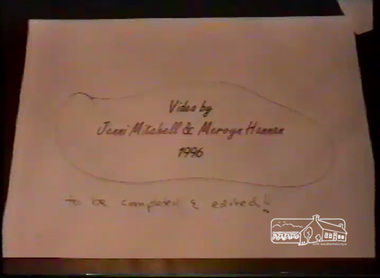
Film - Video (VHS), Jenni Mitchell, Demolition of the Shire of Eltham Offices, 1996
... Scenes of people looking through chain link fence and security guard checking front door. John Graves being filmed that someone informed him the Shire was offering the building to the Community Health Centre for $2.3 million and that if they had been offered a price of $1.1 for what it apparently was sold for they would have snapped it up. ...Scenes of people looking through chain link fence and security guard checking front door. John Graves being filmed that someone informed him the Shire was offering the building to the Community Health Centre for $2.3 million and that if they had been offered a price of $1.1 for what it apparently was sold for they would have snapped it up. ...Poor video quality (noise and interference), incomplete and unedited raw footage. A video documenting the demolition of the Shire of Eltham offices at 895 Main Road Eltham under the direction of the Commissioners appointed for the new Shire of Nillumbik and some of the communities activities surrounding the event. The building was demolished exactly 25 years after the southern wing housing Engineering and Planning on the upper level and the Eltham Library on the ground level was opened in celebration of the Shire of Eltham's centenary. Video has lots of distortion and noise, and sections of clips dubbed over. Immediate initial footage of Jenni Mitchell talking about asbestos claims in the Shire Offices (Sigmund Jorgensen standing behind her) advising Council did a review of the building several years previously and had been cleared of health problems. Cuts to group of people standing outside front door of offices but possibly voice dub over not related ? Then the date 27 Jul 1996 on a scene flashes on screen immediately followed by an edited clip intro of title and credits with classical music track. It then opens with Jenni Mitchell driving to the Shire Offices on Saturday 27 July 1996 at 11.00am. Footage of Main Road past Pitt Street, Alistair Knox Park then entering Shire Office driveway which is fenced off and contractor signs hanging up. Scenes at rear of building showing some internal demolition has commenced. View of the Administration wing. More clips of road driving, Alistair Knox Park, Eltham Library and visitor car park for Shire Offices. Cuts to a group of people standing in access to visitor carpark with new Eltham Library in background, one being immediate former Shire of Eltham President, John Graves. Scenes of people looking through chain link fence and security guard checking front door. John Graves being filmed that someone informed him the Shire was offering the building to the Community Health Centre for $2.3 million and that if they had been offered a price of $1.1 for what it apparently was sold for they would have snapped it up. View of truck loaded with brick rubble literally struggling to ascend the hill of Library Place to exit into Main Road. Cuts to a scene looking at Eltham War memorial Hall through the Memorial Gate, then the Shillinglaw trees and large banner sign ‘Delta Demolitions’ hanging on office façade. Views of front door, old library and bluestone wall. Scene (31 Jul 1996) filmed at night of several white crosses with “RIP Community” and “RIP Democracy”. Scene (1 August 1996) again driving along Main Road towards the Shire Offices then scenes of the offices showing substantially more demolition to exterior, groups of people standing on footpath outside watching, Delta heavy demolition machines, woman holding sign “Democracy where have you gone …”, the odd person in full protection gear and breathing apparatus hand carrying materials out to place on rubbish pile in front of people standing on footpath watching (with no protection) and then stamping on it to break it creating dust, security person in hard hat (no other protection) wandering around, many groups standing around watching, news film crew, person standing on roadside edge holding signs facing traffic stating “Pirate Planning” and “ Grant us your ears” also sign on back of parked car “Elthams High Jacks”, another sign “Community Democracy”, views of crosses in Main Road median strip “RIP Community”, groups of people on footpaths and reporters conducting interviews, footage of unknown person standing with Jenni Mitchell and Sigmund Jorgensen advising people have the right to protest, Jenni Mitchell urging people to ask questions of local MP and Council and Sigmund Jorgensen referring to the three historic Shillinglaw trees with demolition machinery operating in background, Jenni Mitchell and others installing more crosses in median strip; demolition machines operating inside and outside the building, more views of onlookers including Sigmund Jorgensen then Police approaching on footpath, workers and machinery continuing to operate, views of the old library being demolished, the former Community Services department, security personnel. Scene (2 August 1996) more heavy demolition machinery in operation smashing building up, people standing around southern wing watching, view overlooking Eltham Library of train pulling in to Eltham station. Scene (7 August 1996) more heavy demolition and people wandering around with only hard hat protection, no dust protection, comments from one operator dumping a bin of material stating “wait till there’s a Hungry Jack’s here, you’ll be laughing, fuel, videos, hamburgers. You’ll be up with the rest of the world soon, you’ll have electricity and everything here, ha ha ha ha”, more heavy machinery demolition and breaking up of materials, view of Hitachi train going by and Administration wing, view inside the front door opening of the staircase leading to upper level, person walking around operating heavy machinery with a hose spraying rubble (no protective gear other than hard hat interspersed with edit cuts of meeting of Commissioners and independent observers on panel as well as members of the community in public gallery. Nillumbik Shire CEO Barry Rochford addressing the meeting., Chief Commissioner Don Cordell directly addressing Jenni Mitchell with respect to permission to take photographs, Barry Rochford continues to address the question asked of Council about the valuation of the former Shire of Eltham Office building/site, public gallery calling out asking why was building demolished, what was the urgency. Scene (14 August 1996) views of southern wing, previous single demolition operator again mocking people filming, operators working in and around building, Shillinglaw trees and largely demolished front, heavy demolition equipment at work, piles of building rubble, hose spraying water over rubble, large trucks arriving for rubble removal and loading of truck. Scene (21 August) more of the same, building virtually down, Shillinglaw trees standing tall and alone, water spraying on rubble and wattle in bloom. Cuts to Council meeting with public onlookers. Barry Rochford walks out, Wayne Phillips addresses meeting explaining one or two people shouting, members of the community challenging Council (Commissioners) about why due process appear to have been subverted. Former Shire President Robert Marshall in public audience, cuts back to Shire office carpark entrance site and sign hung on fence in front of library “Think Again!” and people standing around observing awaiting a protest demonstration erecting a large sign on stilts stating “Shell No!”, people singing a revised version of God Save the Queen (God Save Us All), Sigmund Jorgensen in attendance, Jenni Mitchell, Sigmund Jorgenson and others address the protest crowd, followed by people mingling, music being played then people standing around the cleared site circumference all with arms linked (video very broken up with noise) then chants “Save the Gateway” and “No Shell for Eltham” and more music and singing “Put up a parking lot”. The crowd then proceeds to walk along the footpath of Main Road. Scene (15 Sep 1996) meeting at Montsalvat in Great Hall addressed by Sigmund Jorgensen discussing a recently published list of the Commissioner’s to senior Council Officers of banned Nillumbik people, others encouraging people to view proposed plans for the site and lodge objections. Specific issues regarding asbestos claims are also addressed. Harry Gilham addresses the meeting on the subject of the Eltham War Memorial and Memorial Gardens and how Council believe a roundabout in the vicinity is of greater importance. Views of various artworks on display (for auction) and music performance in the Barn Gallery. Meeting addressed by Sigmund Jorgensen discussing an appeal against Council granting a permit to Dallas Howgate to develop the site and that the Minister has called the matter in to be decided by the governing council. This is followed by an auction of paintings. 0.05 - Jenni Mitchel, Sigmund Jorgensen and Peter Doughtery in background. 0.18 - Jock Kyme in front of building – David Essex, Marg Johnson on his left-hand side. 5.34 - John Graves – ex Shire of Eltham Councillor and President. 9.02 - Unknown person being interviewed. 9.30 - Jenni Mitchell, unknown person, Mark Burns, community activist. 10.04 - Sigmund Jorgenson, Jenni Mitchell. 12.04 - Police members 21.33 - Nillumbik Council offices 7 August 1996 Barry Rochford CEO, Vin Heffernan Commissioner, Don Cordell Chief Commissioner, Kevin Abbott Commissioner, unknown person. 28.00 - Barry Rochford CEO 28.05 - Kahn Frankie - in commissioner’s seat after commissioners and council staff have vacated the council chamber. 28.26 - Wayne Phillips, State Liberal member for Eltham, addressing community in response to questions. 28.36 - Mark Burns, community activist addressing gallery. 28.48 - Ken Hines, ex Shire of Eltham Councillor and President. 29.34 - Ken Hines, ex Shire of Eltham Councillor and President standing, Robert Marshall, ex Shire of Eltham Councillor and President seated in front. 29.41 - Karen Gerhards, community activist. 30.06 - Marg Johnson with loud hailer, next to Jock Kyme, community activist. 31.32 - Marg Johnson with possibly Frank Burgoyne?, Sigmund Jorgensen, Jock Kyme. 35.35 - Harry Gilham at meeting at Montsalvat on 15 September 1996. 35.43 - Sigmund Jorgenson at lectern. 36.42 - Marg Jennings. 37.47 - Mark McDonald, Jim Connor, ex Shire of Eltham Councillor in background. 36.28 - John Cohen, ex Shire of Eltham Councillor and President. 38.56 - Ken Hines, ex Shire of Eltham Councillor and President. 41.11 - Harry Gilham, president of the Eltham District Historical Society. 43.55 - Sigmund Jorgensen in Long Gallery at Montsalvat, at start of the art auction to raise funds for community action. 45.50 - Unknown person conducting art auction. VHS Video cassette (poor quality) Converted to MP4 file format 45:01, 535MBvideo recording, 895 main road, alistair knox park, artworks, auction, barn gallery, barry rochford, community health centre, dallas howgate, delta demolitions, demolition, don cordell, eltham, eltham library, eltham shire office, eltham war memorial, eltham war memorial gate, eltham war memorial hall, great hall, harry gilham, jenni mitchell, john graves, library place, main road, memorial gardens, mervyn hannan, montsalvat, pitt street, protest, robert marshall, roundabout, shell oil, shillinglaw trees, sigmund jorgensen, sign, wayne phillips -
 Flagstaff Hill Maritime Museum and Village
Functional object - Safe, W. Marr, Circa 1855
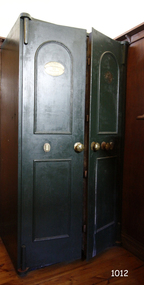
... The bank was an integral part of the establishment and growth of commerce in Colonial Victoria. flagstaff hill warrnambool shipwreck coast flagstaff hill maritime museum flagstaff hill maritime village maritime museum great ocean road shipwreck artefact safe bank safe vault security finances anz bank portland bank w marr william w marr financial institution savings gold exchange loans investments safety safe maker lock maker iron box strong-room Text embossed on plaque: "W. MARR / PATENTEE & MANUFACTURER / 52 / /CHEAPSIDE / LONDON" Safe; heavy metal bank safe, painted green. Double doors ...This strong, heavy bank safe was made by W. Marr in London. It was formerly owned by the ANZ Bank in Portland, Victoria. Portland’s ANZ Bank was originally a branch of the Bank of Australasia, which first came to Australia in 1835, opening in Sydney. Portland’s Bank of Australasia began in a bluestone building built on the north corner of Julia and Bentinck Streets by stonemason William Robb in 1855, around the time of Australia’s Gold Rush. Eventually, in 1951, the Bank of Australasia merged with the Union Bank to become the Australia & New Zealand Bank, known as the ANZ. Portland’s branch of the Bank of Australasia then moved into the old Union Bank building at 44 Percy Streets; both bank buildings were built around the same. The maker of this safe, W. (William) Marr, obtained a patent in 1834 for what is believed to be the first fire-retarding patent, building this into the lining of strong boxes. Others made further design improvements such as hardening the metal plates used to make the boxes. In about 1840 Thomas Milner, a Sheffield tinsmith, made the earliest safes that could safely protect their contents from a surrounding fire. This was achieved by including tubes of a substance between the inner and outer walls of the safe that would react to the heat and the contents would put the fire out. In 1851 an Exhibition at London’s Crystal Palace included fire-proof safes from different vendors. William Marr was listed under Fireproof Box Makers in the 1842 London Trades Directory, at 33 Broad Street, and 52 Cheapside. William Marr & Son were appointed to supply Her Majesty’s National Debt Office and other departments in 1860, with the address 9 Walbrook, Vulcan Safe Works, Skin Yard, Bankside, Southwark, London. 1n 1870 the address for William Marr listed under Safe Makers and Agents in the London Trades Directory was 67 Cannon Street. The manufacturer, W Marr, is significant as an inventor of a way to make a strong box fireproof, then patented his secure safe. This invention indicates that security of money was of great importance in the mid-1800s as it continues to be today. The secure safe would have given much comfort to those with investments and savings, as well as to the bank itself, the custodian of other people's money. This safe was made in London and exported to colonial Australia, giving significance to the safe as an item that was high in the list of the needs of the early Australians and their businesses. The safe has local historical significance as it was used by the original Bank of Australasia in Portland, which was built in 1855 and went on to become the ANZ Bank, still in operation today. The bank was an integral part of the establishment and growth of commerce in Colonial Victoria.Safe; heavy metal bank safe, painted green. Double doors each have top and bottom external hinges, and two front panels; the top panels are arched. The thick doors have five sliding locks. Inside is a fixed metal compartment with a locked sliding metal drawer, and several fitted shelves plus some temporary removable shelving. Both doors have a decorative brass knob near the centre opening. Left door has an oval artificial keyhole and a space where another fitting has been attached. The right door has a second brass knob and an oval keyhole. The top panels of the left door has an oval plaque with an inscription; the right door has evidence that there was an oval attachment. Made by W. Marr, London.Text embossed on plaque: "W. MARR / PATENTEE & MANUFACTURER / 52 / /CHEAPSIDE / LONDON" flagstaff hill, warrnambool, shipwreck coast, flagstaff hill maritime museum, flagstaff hill maritime village, maritime museum, great ocean road, shipwreck artefact, safe, bank safe, vault, security, finances, anz bank, portland bank, w marr, william w marr, financial institution, savings, gold exchange, loans, investments, safety, safe maker, lock maker, iron box, strong-room -
 Flagstaff Hill Maritime Museum and Village
Functional object - Wall Clock
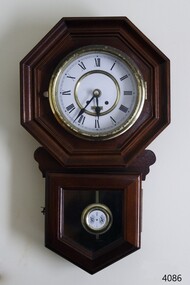
... Security". Inside case "Made in Japan" Clock, wall type, octagonal shape wood case, glass face, pendulum, Roman numerals, hinged door, battery operated. ...This clock is of modern manufacture, replicating the design of early 20th century kitchen clocks.The kitchen wall clock is displayed as an example of an early 20th-century clock. It is used to demonstrate the progression of clock design over the past century. Clock, wall type, octagonal shape wood case, glass face, pendulum, Roman numerals, hinged door, battery operated. Inscription on dial and inside battery compartment. Japanese manufacture.On dial :"Security". Inside case "Made in Japan"flagstaff hill, warrnambool, shipwrecked-coast, flagstaff-hill-maritime-museum, maritime-museum, shipwreck-coast, flagstaff-hill-maritime-village, wall clock, replica, japan, kitchen clock, security, horology, time keeping, roman numerals -
 Flagstaff Hill Maritime Museum and Village
Machine - Dioptric Apparatus, mid 19th century
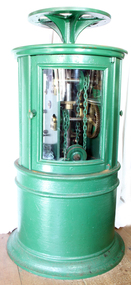
... Nothing else speaks of safety and security in the face of adversity and challenge quite the way a lighthouse does. shipwrecked-coast flagstaff-hill flagstaff-hill-maritime-museum flagstaff hill maritime-museum shipwreck-coast warrnambool flagstaff-hill-maritime-village revolving dioptric mechanism dioptric mechanism for lighthouse lighthouse clockwork timing mechanism acetylene lighthouse light mechanism 19th century lighthouse mechanism kerosene light fresnel lenses colza oil chance brothers One door has the name "Adams Mare" in metallic dots similar to "Braille" to the inside edge of door frame. ...Before the introduction of electricity, lighthouses had a clockwork mechanism that caused the lens to rotate with a light source inside that was either powered by Kerosene or Colza oil. The mechanism consisted of a large weight attached by a cable through the centre of the lighthouse to the top where the cable wrapped around a barrel, drum or wheels that controlled the speed of the lights rotation by a clockwork mechanism. The keeper would crank the clockwork mechanism, which would lift the weight ready for the next cycle similar to an old grandfather clock mechanism. Once the weight lifted to its apex at the bottom of the first landing, the keeper would let it fall, which would pull on the cable, which would, in turn, operate a series of gears activating the rotation of the Fresnel optical lens, which would then rotate to create the lighthouse’s unique light speed of rotation characteristic. Creating a specific characteristic required a way to regulate the speed of the rotation, and was important as sailors could identify a particular light by its speed and time between flashes. The weight had to fall at a certain rate to create the proper rotation speed of the lens and a regulator within the mechanism accomplished this. History: From 1851, Chance Brothers became a major lighthouse engineering company, producing optical components, machinery, and other equipment for lighthouses around the world. James Timmins Chance pioneered placing lighthouse lamps inside a cage surrounded by Fresnel lenses to increase the available light output these cages, are known as optics and they revolutionised lighthouse design. Another important innovation from Chance Brothers was the introduction of rotating optics, allowing adjacent lighthouses to be distinguished from each other by the number of times per revolution the light flashes. The noted English physicist and engineer, John Hopkins invented this system while employed at Chance Brothers. Chance Brothers and Company was a glass works and originally based in Spon Lane, Smethwick, West Midlands England. The company became a leading glass manufacturer and a pioneer of British glass making technology. The Chance family originated in Bromsgrove as farmers and craftsmen before setting up a business in Smethwick near Birmingham in 1824. They took advantage of the skilled workers, canals and many other industrial advances taking place in the West Midlands at the time. Robert Lucas Chance (1782–1865), known as 'Lucas', bought the British Crown Glass Company's works in Spon Lane in 1824. The company specialised in making crown window glass, the company ran into difficulty and its survival was guaranteed in 1832 by investment from Chance's brother, William (1788 – 1856). William owned an iron factoring business in Great Charles Street, Birmingham. After a previous partnership that Lucas had dissolved in 1836, Lucas and William Chance became partners in the business which was renamed, Chance Brothers and Company. Chance Brothers invented many innovative processes and became known as the greatest glass manufacturer in Britain. In 1848 under the supervision of Georges Bontemps, a French glass maker from Choosy-le-Roi, a new plant was set up to manufacture crown and flint glass for lighthouse optics, telescopes and cameras. Bontemps agreed to share his processes that up to then had been secret with the Chance Brothers and stayed in England to collaborate with them for six years. In 1900 a baronetcy was created for James Timmins Chance (1814–1902), a grandson of William Chance, who had started the family business in 1771 with his brother Robert. Roberts grandson, James became head of Chance Brothers until his retirement in 1889 when the company became a public company and its name changed to Chance Brothers & Co. Ltd. Additional information: Lighthouses are equipped with unique light characteristic or flashing pattern that sailors can use to identify specific lighthouses during the night. Lighthouses can achieve distinctive light characteristics in a few different ways. A lighthouse can flash, which is when brief periods of light interrupt longer moments of darkness. The light can occult, which is when brief periods of darkness interrupt longer moments of light. The light can be fixed, which is when the light never goes dark. A lighthouse can use a combination of flashing, oscillating, or being fixed in a variety of combinations and intervals to create individual light characteristics. It is a common misconception that a lighthouse's light source changes the intensity to create a light characteristic. The light source remains constant and the rotating Fresnel lens creates the various changes in appearance. Some Fresnel lenses have "bulls-eye" panels create beams of light that, when rotated between the light and the observer, make the light appear to flash. Conversely, some lenses have metal panels that, when rotated between the light and the observer, make the light appear to go dark. This Dioptric clockwork apparatus used to turn a lighthouse optical lens is very significant as it is integral to a lighthouses operation, we can also look at the social aspect of lighthouses as being traditionally rich with symbolism and conceptual meanings. Lighthouses illustrate social concepts such as danger, risk, adversity, challenge and vigilance but they also offers guidance, salvation and safety. The glowing lamp reminds sailors that security and home are well within reach, they also symbolize the way forward and help in navigating our way through rough waters not just on the oceans of the world but in our personal lives be it financial, personal, business or spiritual in nature. Nothing else speaks of safety and security in the face of adversity and challenge quite the way a lighthouse does. Revolving dioptric clockwork apparatus used to turn a Fresnel optical lighthouse lens. A cylindrical cast metal pillar and cabinet painted green with 3 glass doors enclosing the top section. Inside the pillar/cabinet is a large clockwork mechanism used to turn and regulate a lighthouse light by means of weights and a chain attached to same. One door has the name "Adams Mare" in metallic dots similar to "Braille" to the inside edge of door frame.shipwrecked-coast, flagstaff-hill, flagstaff-hill-maritime-museum, flagstaff hill, maritime-museum, shipwreck-coast, warrnambool, flagstaff-hill-maritime-village, revolving dioptric mechanism, dioptric mechanism for lighthouse, lighthouse clockwork timing mechanism, acetylene lighthouse light mechanism, 19th century lighthouse mechanism, kerosene light, fresnel lenses, colza oil, chance brothers -
 Flagstaff Hill Maritime Museum and Village
Functional object - Lock, 1800s to early 1900s
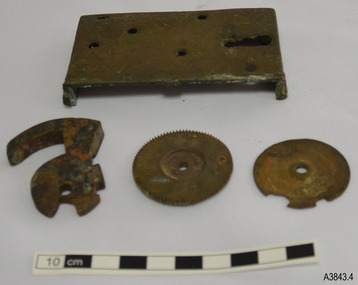
... door fitting...ship’s fitting...furniture fitting...security...Items that come from several wrecks have since been donated to the Flagstaff Hill Maritime Village’s museum collection by his family, illustrating this item’s level of historical value. flagstaff hill warrnambool flagstaff hill maritime museum maritime museum shipwreck coast flagstaff hill maritime village great ocean road john chance hardware door fitting ship’s fitting furniture fitting security 19th century lock cabinetry brass lock Lock, brass, with separated moving parts. ...This lock was recovered from an unknown shipwreck in the coastal waters of Victoria in the late 1960s to early 1970s. It is part of the John Chance Collection. The small size of the lock indicates that it was possibly used for cabinetry such as a cupboard, desk or wardrobe. It may have been part of the ship’s fittings or perhaps luggage or cargo. The blue-green patina on the metal is caused by a reaction from its exposure to external elements such as the sea water. The lock is likely to have been in the water for over 100 years, as the more widely known shipwrecks along Victoria’s Shipwreck Coast date from 1837 to 1940. Although the lock is not linked to a particular shipwreck, it is recognised as being historically significant as an example of hardware either as part of the ship’s fittings or imported for use in Colonial Victoria in the 19th to early 20th century. The lock is also significant as it was recovered by John Chance, a diver in Victoria’s coastal waters in the late 1960s to early 1970s. Items that come from several wrecks have since been donated to the Flagstaff Hill Maritime Village’s museum collection by his family, illustrating this item’s level of historical value. Lock, brass, with separated moving parts. Rectangular plate with keyhole, plus two cogs and a latch.flagstaff hill, warrnambool, flagstaff hill maritime museum, maritime museum, shipwreck coast, flagstaff hill maritime village, great ocean road, john chance, hardware, door fitting, ship’s fitting, furniture fitting, security, 19th century lock, cabinetry, brass lock -
Moorabbin Air Museum
Manual - Fokker F28 Fellowship, F28 Pilot Course Notes
... Fokker F28 Fellowship Dimensions Interior layout Ground handling Emergency equipment Servicing Doors Windows Security locks Overview of Fokker F28 for pilots F28 Pilot Course Notes Manual Fokker F28 Fellowship ...Overview of Fokker F28 for pilotsnon-fictionOverview of Fokker F28 for pilots dimensions, interior layout, ground handling, emergency equipment, servicing, doors, windows, security locks -
 Bendigo Historical Society Inc.
Photograph - CASTLEMAINE GAS COMPANY COLLECTION: PHOTO ABEL STREET DEPOT
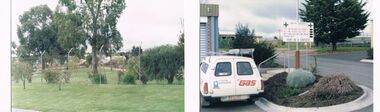
... One photo gives view from the street of the security fence surrounding the property, and the grounds within, Semi trailer with large gas tank is partially visible in the background. Second photo shows a white panel van with identification of advertising on rear doors, and ladder on roof, to the right an access road can be seen....One photo gives view from the street of the security fence surrounding the property, and the grounds within, Semi trailer with large gas tank is partially visible in the background. Second photo shows a white panel van with identification of advertising on rear doors, and ladder on roof, to the right an access road can be seen. ...2 photos of the Abel street depot Bendigo. One photo gives view from the street of the security fence surrounding the property, and the grounds within, Semi trailer with large gas tank is partially visible in the background. Second photo shows a white panel van with identification of advertising on rear doors, and ladder on roof, to the right an access road can be seen.bendigo, industry, gas and fuel depot -
 Ballarat Tramway Museum
Functional Object - Square Key
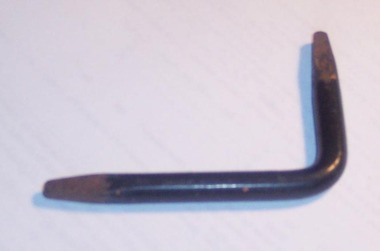
... Trams tramways Tramcars Doors Locks Security Piece of painted, mild steel rod bent at 90 degrees and shaped at longer end to give a square shape for use in external doors on SECV Ballarat Trams - known as a square key. ...Has a strong association with Theo Dunstan Inspector in Ballarat; would have been issued to crews in order operate the tram car doors.Piece of painted, mild steel rod bent at 90 degrees and shaped at longer end to give a square shape for use in external doors on SECV Ballarat Trams - known as a square key. Was used to secure doors in both open and closed positions. Has been painted black.trams, tramways, tramcars, doors, locks, security -
 Ballarat Tramway Museum
Functional Object - Square Key
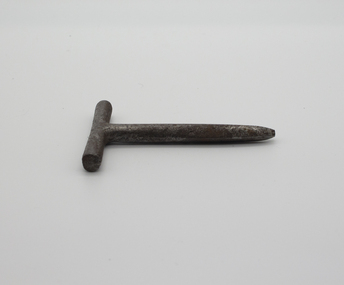
... Trams tramways Tramcars Doors Locks Security T-shaped steel piece, fashioned from rod and welded at the top, with a round top piece or handle with a rod that has been ground to give a tapered square shape for use in external doors on SECV Ballarat Trams - known as a square key. ...Demonstrates an item that all SEC Ballarat tram crews carried, a simple key to open/close the doors and has a strong association with a SEC Ballarat tram crew member.T-shaped steel piece, fashioned from rod and welded at the top, with a round top piece or handle with a rod that has been ground to give a tapered square shape for use in external doors on SECV Ballarat Trams - known as a square key. Was used to secure doors in both open and closed positions. See Reg Item 3663 for similar items. Was used by SEC Ballarat driver John "Jock" Menzies.trams, tramways, tramcars, doors, locks, security -
 Sunshine and District Historical Society Incorporated
Photograph - Massey Ferguson Gates Devonshire Road Sunshine 1989 Photographs, Sharon Cavanagh, 7th February 1991
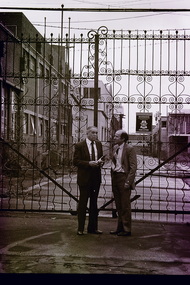
... The gates were the ceremonial and security entrance to one of the most important industrial sites in Melbourne’s west, the Sunshine Harvester Factory. They were not just gates; they were the symbolic front door to the Sunshine Harvester Works Factory and carried Sunshine’s industrial identity into the second half of the 20th century. ...The gates were the ceremonial and security entrance to one of the most important industrial sites in Melbourne’s west, the Sunshine Harvester Factory. They were not just gates; they were the symbolic front door to the Sunshine Harvester Works Factory and carried Sunshine’s industrial identity into the second half of the 20th century. ...The Massey Ferguson Gates are better known as the H.V. McKay Gates. The gates were the ceremonial and security entrance to one of the most important industrial sites in Melbourne’s west, the Sunshine Harvester Factory. They were not just gates; they were the symbolic front door to the Sunshine Harvester Works Factory and carried Sunshine’s industrial identity into the second half of the 20th century. The gates were made by the factory's own blacksmith, Charlie Pippett, a Glasgow‑born blacksmith who migrated to Australia in 1912 and worked at the Harvester Works until 1947.The Massey Ferguson gates are historically significant because they represent Sunshine’s transition from Harvester Works to global tractor manufacturing, mid‑century industrial architecture, the daily rhythm of factory life, the identity of a working‑class suburb and the final chapter of Sunshine’s manufacturing golden age. Today, they are one of Sunshine’s most important landmarks.Don McKay & Peter Westmore At Old Massey Ferguson Factorydon mckay, peter westmore, massey ferguson, devonshire road, sunshine, h.v. mckays, h.v. mays massey harris, charlie pippett -
 Ballarat Tramway Museum
Functional Object - Square Key
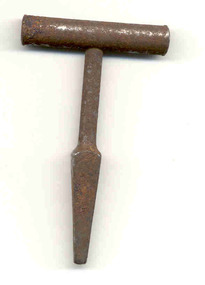
... Trams tramways Tramcars Doors Locks Security T shaped steel piece, with a round top piece or handle with a rod that has been forged at the lower end to give a tapered square shape for use possibly in external doors on SECV Ballarat Trams - known as a square key. ...Has a strong association with tram crews, possibly inspector (Dave Kellett?) in Ballarat, would have been issued to crews in order operate the tram car doors. Normally a L shaped key.T shaped steel piece, with a round top piece or handle with a rod that has been forged at the lower end to give a tapered square shape for use possibly in external doors on SECV Ballarat Trams - known as a square key. Was used to secure doors in both open and closed positions. Was probably chrome plated at the time of manufacture. .1 - square key fashioned from rod and welded at the top.trams, tramways, tramcars, doors, locks, security -
 Whitehorse Historical Society Inc.
Functional object - Lock
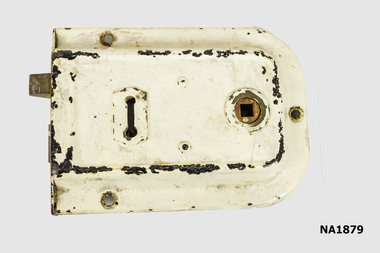
... SECURITY - Locks Large cream painted door lock. Space for key (fairly large). ...Large cream painted door lock. Space for key (fairly large).security - locks -
 Whitehorse Historical Society Inc.
Container - Lock
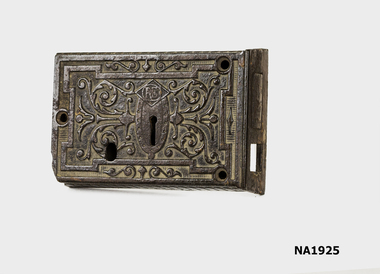
... Used for back doors of terrace houses in Carlton. SECURITY - Locks Highly decorated with three screw holes and key hole. ...Know as Russell Rimlock. Used for back doors of terrace houses in Carlton.Large metal case for lock.Highly decorated with three screw holes and key hole.security - locks -
 Trafalgar Holden Museum
Vehicle - VP model "Executive" sedan, September 1991 - July 1993
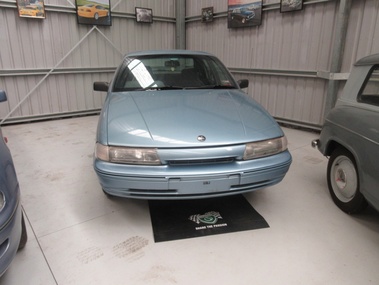
... Additional security features were introduced across the range, including an ignition-disabling device and a driver's door deadlock. ...Additional security features were introduced across the range, including an ignition-disabling device and a driver's door deadlock. ...The VP series was released in September 1991 with mainly cosmetic and feature changes to the outgoing VN Series Commodore. The 3.8 litre V6 and 5.0 litre V8 engines from the VN were carried over, but the V6 engine received various revisions that improved its refinement and noise. Semi-trailing arm IRS became standard on Calais and Commodore SS models and became an optional extra on lower-end models. This new suspension drastically improving ride and handling over that offered by the live rear axle. ABS brakes were also introduced in the VP range as an option on Series 1 Calais and Commodore SS models, and on most models with IRS for Series II versions. Additional security features were introduced across the range, including an ignition-disabling device and a driver's door deadlock. Power mirrors were also a standard feature across the model range. The VP Calais was also sold in Thailand, with 3.8 V6 version, later it used an Opel 2.6-litre C26NE inline-six Dual Ram engine.1991 model VP Holden commodore sedanLion and Stone badge on bonnet , Holden badge left hand side boot , Lion and Stone badge on boot centre, Commodore executive on boot right hand sidevp holden, vehicle, car -
 Wodonga & District Historical Society Inc
Photograph - Hut 97 Bonegilla Migrant Experience
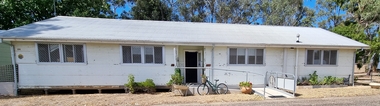
... security and catering services. From 1949 until 1965 the Bonegilla Reception and Training Centre operated without a military presence. Bonegilla Migrant Reception and Training Centre was made up of 24 blocks. It had its own churches, banks, sporting fields, cinema, hospital, police station and railway platform. It became the largest and longest operating reception centre in the post-war era. More than 300,000 migrants passed through its doors...security and catering services. From 1949 until 1965 the Bonegilla Reception and Training Centre operated without a military presence. Bonegilla Migrant Reception and Training Centre was made up of 24 blocks. It had its own churches, banks, sporting fields, cinema, hospital, police station and railway platform. It became the largest and longest operating reception centre in the post-war era. More than 300,000 migrants passed through its doors ...Bonegilla Army Base and Migrant Reception Centre began when funds were allocated to build Bonegilla Army Camp in June 1940. Builders began to erect about 600 huts prior to the Army moving in during September of that year. Between 1942 - 1943 it was enlarged to 848 buildings. In 1947 Bonegilla Reception and Training Centre began operating with the Army providing transport, security and catering services. From 1949 until 1965 the Bonegilla Reception and Training Centre operated without a military presence. Bonegilla Migrant Reception and Training Centre was made up of 24 blocks. It had its own churches, banks, sporting fields, cinema, hospital, police station and railway platform. It became the largest and longest operating reception centre in the post-war era. More than 300,000 migrants passed through its doors between 1947 and 1971, with most of those originating from non-English speaking European countries. From1965 with the increased Australian commitment to the Vietnam War and the need to find accommodation to train National Servicemen for Vietnam, the Army negotiated with the Department of Immigration to take over several blocks at Bonegilla. In 1971 the Reception Centre closed and the site reverted to the Army. After 1971 the Army undertook a major site redevelopment with the construction of Latchford Barracks as the Army Apprentice School. Later Latchford Barracks was redeveloped into part of the Army Logistic Training Centre. Between 1978 and 1982, nearly all of the centre was demolished in a major redevelopment. The new replacement buildings were formally opened as Latchford Barracks in 1983. Demolition of the buildings prompted calls for recognition of the site and the role it had played in Australia’s post-World War II Immigration program. After much discussion between the Department of Army and Heritage and local groups about the significance of the site, the Australian Heritage Commission proceeded with its listing on the Register of the National Estate. A Conservation Management Plan was prepared for Block 19 in 1996. The Army transferred Block 19 to the Victorian Government. In 2002 Heritage Victoria listed Block 19 on the State Heritage Register, giving attention to both the migrant and army connections with the site. Hut 97 at Bonegilla Migrant Experience is the home of the Wodonga & District Historical Society Inc.This image is significant because it records a building which is part of the Bonegilla Migrant Reception Centre which played a critical role as the largest and longest operating Migrant Reception Centre in Australia.A colour photo of Hut 97 at Block 19, Bonegilla Migrant Experience, now the home of Wodonga & District Historical Society Inc.hut 97 bonegilla migrant experience, wodonga & district historical society, immigration australia -
 Melbourne Tram Museum
Photograph - Set of 2 Black & White Photograph/s, Ray Jackson, c1971
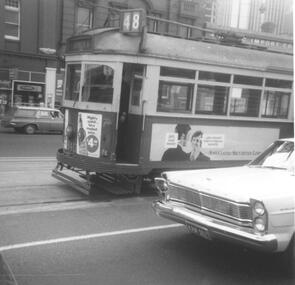
... Securities Limited advertisement on the side of the tram. Tram has run number K5, route 48 and destination of Spencer St. Photo taken post August 1971 as the tram is fitted with Marker lights .1 - view of tram and a motor vehicle (Ford Galaxy) with a damaged front right headlight and minor damage to the tram front of the door post. ...Securities Limited advertisement on the side of the tram. Tram has run number K5, route 48 and destination of Spencer St. Photo taken post August 1971 as the tram is fitted with Marker lights .1 - view of tram and a motor vehicle (Ford Galaxy) with a damaged front right headlight and minor damage to the tram front of the door post. ...Set of two Black and White photographs of the front section of tram SW5 840 in Flinders Melbourne, tram has a Associated Securities Limited advertisement on the side of the tram. Tram has run number K5, route 48 and destination of Spencer St. Photo taken post August 1971 as the tram is fitted with Marker lights .1 - view of tram and a motor vehicle (Ford Galaxy) with a damaged front right headlight and minor damage to the tram front of the door post. Also note the damaged bumper bar on the car. .2 - photo of the tram crew looking at the front of the tram - Opps more paperwork.trams, tramways, flinders st, accidents, crews, route 48, motor vehicles, sw5 class, tram 840 -
Melbourne Tram Museum
Document, The Met, "W class tram modification working party", 2/1989
... door. Gives topics to be considered. Includes a paper dated 17/11/1988 outlining the design changes to be considered, drivers cab, destination boxes, equipment, bumper bars, security, windows, interior lighting, seating, floor coverings, pantographs, external appearance, and noise reduction. ...door. Gives topics to be considered. Includes a paper dated 17/11/1988 outlining the design changes to be considered, drivers cab, destination boxes, equipment, bumper bars, security, windows, interior lighting, seating, floor coverings, pantographs, external appearance, and noise reduction. ...Document titled "W class tram modification working party" for a meeting of 27/2/1989 to discuss modifications to the W class tram to provide a front entry door. Gives topics to be considered. Includes a paper dated 17/11/1988 outlining the design changes to be considered, drivers cab, destination boxes, equipment, bumper bars, security, windows, interior lighting, seating, floor coverings, pantographs, external appearance, and noise reduction. A second paper by Howard Smith as well dated 12/8/1988 considers or comments on the possible improvements to the W class trams, comparisons with Z and A class trams, costs, cleaning, electrical and braking systems, and seating.Yields information about the proposed 1989 modifications to trams for the W8 class - this did not proceed.Nine A4 photocopied sheets, stapled in the top left hand corner.tramways, trams, w class, overhauls, preston workshops, w8 class, drivers -
 Ballarat Tramway Museum
Functional object - Square Key
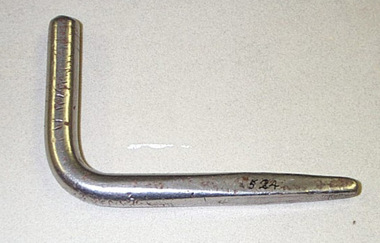
... Trams tramways Tramcars Doors Locks Security "67" Piece of chrome plated steel rod bent at 90 degrees and shaped at longer end to give a square shape for use in external doors on SECV Ballarat Trams - known as a square key. ...Has a strong association with Dave Kellett, motorman and inspector in Ballarat; would have been issued to crews in order operate the tram car doors. Has been stamped for Dave Kellett's traffic number.Piece of chrome plated steel rod bent at 90 degrees and shaped at longer end to give a square shape for use in external doors on SECV Ballarat Trams - known as a square key. Was used to secure doors in both open and closed positions. Has been stamped 67 on one side at short end. See also Reg Items 6552 and 8317 for similar items."67"trams, tramways, tramcars, doors, locks, security
