
Showing 16 items matching "serving utensils"
-
 Geoffrey Kaye Museum of Anaesthetic History
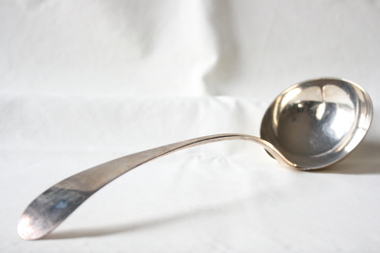
Functional object - Soup ladle
... ...serving utensils...George III English sterling silver ladle soup ladle kitchen utensils serving utensils utensils Inscription on reverse. ...An English style silver George III soup ladle. There are five small designs stamped into the reverse of the handle, along with a stylised inscription "JJM".Inscription on reverse. "JJM".george iii, english, sterling silver, ladle, soup ladle, kitchen utensils, serving utensils, utensils -
 Geoffrey Kaye Museum of Anaesthetic History
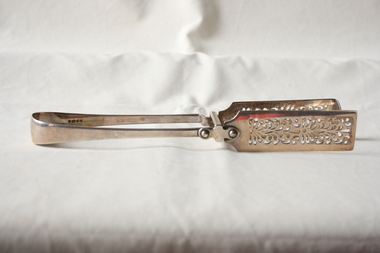
Functional object - Asparagus tongs
... ...serving utensils...utensils serving utensils kitchen utensils asparagus sterling silver tongs A pair of sterling silver asparagus tongs with decorative cut blades and clips to hold the tongs closed. ...A pair of sterling silver asparagus tongs with decorative cut blades and clips to hold the tongs closed. The bottom blade has a raised end to stop asparagus from slipping off.utensils, serving utensils, kitchen utensils, asparagus, sterling silver, tongs -
 Geoffrey Kaye Museum of Anaesthetic History
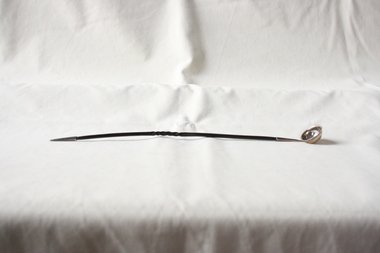
Functional object - Toddy ladle
... ...serving utensils...ladle serving utensils kitchen utensils utensils entertaining punch ladle toddy ladle A sterling silver and whalebone toddy ladle. ...A sterling silver and whalebone toddy ladle. The ladle bowl is very small and is designed to scoop up punch and pour it into glasses. The long handle is made of whalebone which is decorated with a small section of twisting and a silver tip on the top end.ladle, serving utensils, kitchen utensils, utensils, entertaining, punch ladle, toddy ladle -
 Geoffrey Kaye Museum of Anaesthetic History
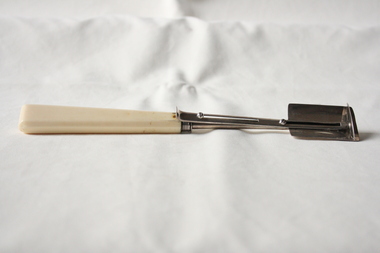
Functional object - Cheese scoop
... ...serving utensils...cheese scoop utensils kitchen utensils serving utensils charcuterie cheese cheese serving entertaining A sterling silver and ivory cheese scoop with a moveable arm designed to shift cheese off the curved scoop or cutter. ...A sterling silver and ivory cheese scoop with a moveable arm designed to shift cheese off the curved scoop or cutter.cheese scoop, utensils, kitchen utensils, serving utensils, charcuterie, cheese, cheese serving, entertaining -
 Geoffrey Kaye Museum of Anaesthetic History
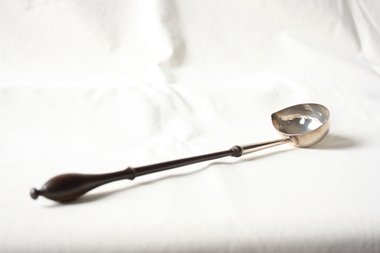
Functional object - Punch ladle
... serving utensils...serving utensils utensils sterling silver punch spoon Letters stamped into spoon head. ...A sterling silver and wood George II punch ladle. Two thirds of the handle is made of simple turned dark wood with a bulbous top. The rest of the handle is made of sterling silver attached to the small, spouted spoon.Letters stamped into spoon head. "P / R / E".serving utensils, utensils, sterling silver, punch spoon -
 Geoffrey Kaye Museum of Anaesthetic History
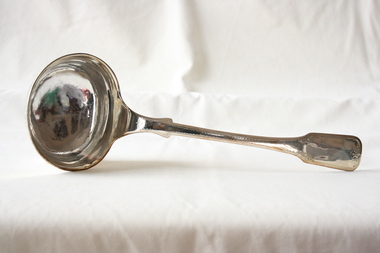
Functional object - Soup ladle
... ...serving utensils...soup ladle ladle sterling silver kitchen utensils utensils serving utensils Inscription on reverse of handle. ...A large, sterling silver Austrian Hungarian soup ladle with delicate, floral etching along the obverse side of the handle.Inscription on reverse of handle. "ZS 12".soup ladle, ladle, sterling silver, kitchen utensils, utensils, serving utensils -
 Geoffrey Kaye Museum of Anaesthetic History
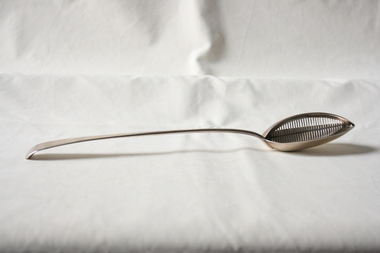
Functional object - Gravy spoon
... serving utensils...serving utensils kitchen utensils utensils sterling silver spoon gravy spoon A long-handled sterling silver George III spoon with no decorations. ...A long-handled sterling silver George III spoon with no decorations. The spoon has a vertical double-tiered serrated wall running in the middle, designed to catch and sieve large pieces within gravy.serving utensils, kitchen utensils, utensils, sterling silver, spoon, gravy spoon -
 Flagstaff Hill Maritime Museum and Village
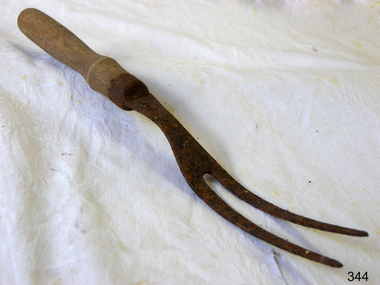
Domestic object - Fork
... Bone forks had been found on the burial site of the Bronze Age Qijia culture (2400–1900 BC) as well as later Chinese dynasties’ tombs.The Ancient Greeks used the fork as a serving utensil. Read also: Steven Spielberg to Remake the Classic Musical ‘West Side Story’ In the Roman Empire, bronze and silver forks were used. ...Bone forks had been found on the burial site of the Bronze Age Qijia culture (2400–1900 BC) as well as later Chinese dynasties’ tombs.The Ancient Greeks used the fork as a serving utensil. Read also: Steven Spielberg to Remake the Classic Musical ‘West Side Story’ In the Roman Empire, bronze and silver forks were used. ...Naturally, we tend to take commonplace objects for granted, because they have always been there. Yet how many of you actually have thought “hey, where do forks come from?” Well, it takes one trip to China and a 3-year-old laughing at your face because of your desperate attempt to eat with chopsticks to finally appreciate something so ordinary such as a fork. So, where do forks come from? The early history of the fork is obscure. As a kitchen and dining utensil, it is believed to have originated in the Roman Empire, as proved by archaeological evidence. The personal table fork most likely originated in the Eastern Roman (or Byzantine) Empire. Its use spread to what is now the Middle East during the first millennium AD and then spread into Southern Europe during the second millennium. It did not become common in northern Europe until the 18th century and was not common in North America until the 19th century. Carving fork from 1640. Source: Wikipedia/Public Domain Carving Fork from 1640. Source: Wikipedia/Public Domain Some of the earliest known uses of forks with food occurred in Ancient Egypt, where large forks were used as cooking utensils. Bone forks had been found on the burial site of the Bronze Age Qijia culture (2400–1900 BC) as well as later Chinese dynasties’ tombs.The Ancient Greeks used the fork as a serving utensil. Read also: Steven Spielberg to Remake the Classic Musical ‘West Side Story’ In the Roman Empire, bronze and silver forks were used. The use varied according to local customs, social class and the nature of food, but forks of the earlier periods were mostly used as cooking and serving utensils. The personal table fork was most likely invented in the Eastern Roman (Byzantine) Empire, where they were in everyday use by the 4th century (its origin may even go back to Ancient Greece, before the Roman period). Records show that by the 9th century a similar utensil known as a barjyn was in limited use in Persia within some elite circles. By the 10th century, the table fork was in common use throughout the Middle East. Bronze forks made in Persia during the 8th or 9th century.Source: Wikipedia/Public Domain Bronze forks made in Persia during the 8th or 9th century.Source: Wikipedia/Public Domain The first recorded introduction of the fork to Western Europe, as recorded by the theologian and Cardinal Peter Damian, was by Theophano Sklereina the Byzantine wife of Holy Roman Emperor Otto II, who nonchalantly wielded one at an Imperial banquet in 972, astonishing her Western hosts.By the 11th century, the table fork had become increasingly prevalent in the Italian peninsula. It gained a following in Italy before any other Western European region because of historical ties with Byzantium and continued to get popularity due to the increasing presence of pasta in the Italian diet. At first, pasta was consumed using a long wooden spike, but this eventually evolved into three spikes, design better suited to gathering the noodles. In Italy, it became commonplace by the 14th century and was almost universally used by the merchant and upper classes by 1600. It was proper for a guest to arrive with his fork and spoon enclosed in a box called a cadena; this usage was introduced to the French court with Catherine de’ Medici’s entourage. In Portugal, forks were first used at the time of Infanta Beatrice, Duchess of Viseu, King Manuel I of Portugal’s mother around 1450. However, forks were not commonly used in Western Europe until the 16th century when they became part of Italian etiquette. The utensil had also gained some currency in Spain by this time, and its use gradually spread to France. Nevertheless, most of Europe did not adopt the use of the fork until the 18th century. Read also: The 8 Most Famous ‘Functioning Alcoholics’ in History Long after the personal table fork had become commonplace in France, at the supper celebrating the marriage of the Duc de Chartres to Louis XIV’s natural daughter in 1692, the seating was described in the court memoirs of Saint-Simon: “King James having his Queen on his right hand and the King on his left, and each with their cadenas.” In Perrault’s contemporaneous fairy tale of La Belle au bois dormant (1697), each of the fairies invited for the christening is presented with a splendid “fork holder”. The fork’s adoption in northern Europe was slower. Its use was first described in English by Thomas Coryat in a volume of writings on his Italian travels (1611), but for many years it was viewed as an unmanly Italian affectation. Some writers of the Roman Catholic Church expressly disapproved of its use, St. Peter Damian seeing it as “excessive delicacy.” It was not until the 18th century that the fork became commonly used in Great Britain, although some sources say that forks were common in France, England, and Sweden already by the early 17th century. Spaghetti fork By Lady alys - Own work, CC BY-SA 3.0, https://commons.wikimedia.org/w/index.php?curid=6414948 Spaghetti Fork By Lady alys – Own work, CC BY-SA 3.0, The fork did not become popular in North America until near the time of the American Revolution. The curved fork used in most parts of the world today was developed in Germany in the mid 18th century while the standard four-tine design became current in the early 19th century. The fork was important in Germany because they believed that eating with the fingers was rude and disrespectful. The fork led to family dinners and sit-down meals, which are important features of German culture. https://www.thevintagenews.com/2016/08/31/priority-fork-came-italy-european-country-pasta/?chrome=1Serving fork, two prongs, with a shaped wooden handle. Badly rusted.None.flagstaff hill, warrnambool, shipwrecked-coast, flagstaff-hill, flagstaff-hill-maritime-museum, maritime-museum, shipwreck-coast, flagstaff-hill-maritime-village, food, meat, carving -
 Federation University Art Collection
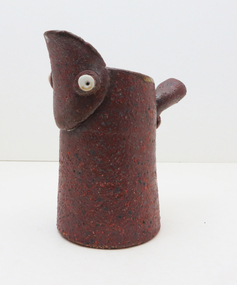
Ceramic, 'Shino Milk Jug' by Bridget Bodenham, 2007
... She works full time making ceramic serving ware, tableware, utensils and jewellery as well as planter pots and flower vases. ...She works full time making ceramic serving ware, tableware, utensils and jewellery as well as planter pots and flower vases. ...Bridget BODENHAM Bridget Bodenham has a Diploma of Arts (Ceramics) from the University of Ballarat (now Federation University. In 2006 she received an Emerging Artist grant from the Australia Council for the Arts and was also part of Craft’s annual graduate survey exhibition, Fresh!. She works full time making ceramic serving ware, tableware, utensils and jewellery as well as planter pots and flower vases. The majority of her work is designed to be used and enjoyed. Bridget feels a connection to her surrounding bushland landscape and interprets the tones and textures in her work. She takes great care in creating each piece by hand and firing them up to three times in her large gas kiln. Each firing is totally unique resulting in one off pieces. Bridget Bodenham was a finalist in the Bombay Sapphire Design Discovery Award (2008) for a series of ceramic mortars and pestles, and received an Honourable Mention in the Mino International Ceramic Award, Japan. Bridget aims to create a sense of curiosity and reflection in form and function. She hopes her work delights and engages the owners hands and heart into everyday activities. The Federation University Art Collection features over 2000 works and was listed as a 'Ballarat Treasure' in 2007.Small, thrown ceramic vessel / jug with handle and lip. art, artwork, bridget bodenham, ceramics, alumni -
 Federation University Art Collection
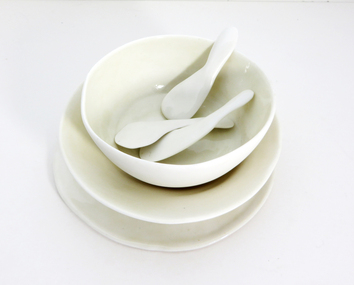
Ceramic - Artwork - Ceramics, Bridget Bodenham, [Dining Setting] by Bridget Bodenham, 2006
... She works full time making ceramic serving ware, tableware, utensils and jewellery as well as planter pots and flower vases. ...She works full time making ceramic serving ware, tableware, utensils and jewellery as well as planter pots and flower vases. ...Bridget BODENHAM Bridget Bodenham has a Diploma of Arts (Ceramics) from the University of Ballarat (now Federation University. In 2006 she received an Emerging Artist grant from the Australia Council for the Arts and was also part of Craft’s annual graduate survey exhibition, Fresh!. She works full time making ceramic serving ware, tableware, utensils and jewellery as well as planter pots and flower vases. The majority of her work is designed to be used and enjoyed. Bridget feels a connection to her surrounding bushland landscape and interprets the tones and textures in her work. She takes great care in creating each piece by hand and firing them up to three times in her large gas kiln. Each firing is totally unique resulting in one off pieces. Bridget Bodenham was a finalist in the Bombay Sapphire Design Discovery Award (2008) for a series of ceramic mortars and pestles, and received an Honourable Mention in the Mino International Ceramic Award, Japan. Bridget aims to create a sense of curiosity and reflection in form and function. She hopes her work delights and engages the owners hands and heart into everyday activities. This piece won the SMB DVC Visual Arts Acquisition Award, 2006Mould made dining setting consisting of plate, two bowls and three eating utensils. Makers mark on versoceramics, bridget bodenham, artwork, alumni, dvc aquisition award -
 Flagstaff Hill Maritime Museum and Village
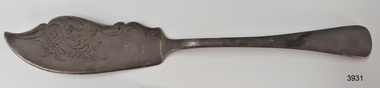
Domestic object - Butter Knife, Barker Brothers, Ca. 1885-1895
... Flagstaff Hill Warrnambool Maritime Village Maritime Museum Flagstaff Hill Maritime Museum & Village Shipwreck coast Great Ocean Road butter knife cheese knife electroplate electro plate nickel silver nickel alloy alloy composition copper nickel zinc German silver EPNS Barker Brothers Birmingham London silversmiths Victorian era 19th century A1 BB crown inside square Broad Arrow flatware tableware cutlery cutler dining utensils eating utensils superior quality pseudo hallmark Stirling silver silver-white metal Mary Barker Barker & Creed William Barker Matthias Barker Barker Brothers Silversmiths Barker Ellis Silver Co Ellis & Co Barker Ellis Ellis Barker Britanoid Unity Plate the Hygenia British colonial government use defence department use naval use knife serving knife Stamps: “”- A1 inside diamond “[BB]” – BB inside lozenge “[crown symbol]”- crown inside square with cut corners “[EP/NS]” - EP over NS inside shield, on its side “’←” - Broad Arrow on its side Butter knife, or cheese knife, electroplated nickel silver (EPNS). ... This butter or cheese knife is a decorative example of electroplated cutlery that had become an affordable alternative to more expensive silver cutlery in the late 1800s to early 1900s. The knife has stamp marks in the back of its handle that are a combination of letters and symbols used by British silversmiths to identify their workmanship. The design and type of this knife was not normally used by everyday people but rather those of a higher social class with time and money to have a particular decorative knife to serve butter or cheese. The marks on the handle tell that it was made of nickel silver, and electroplated with superior quality Stirling silver. The Barker Brothers of Birmingham made the knife between 1885 and 1907, but most likely before 1895. It was made for the British, or British colonial, people, connected with a government department such as the navy or defence. This story may be slightly inaccurate, as some silversmiths added extra ‘pseudo marks’ to their wares to disguise the quality. THE MARKS and their meaning – - ‘A1’ The silver used in electroplating this knife was the highest level, ‘superior quality’, measured in grams of silver per table spoon or table fork, with ‘A1’ being 2 2/3 grams, and ‘D’ being 0 1/2 grams of silver. - ‘BB’ The Baker Brothers used these initials from 1885 to 1907. - ‘[crown symbol]’ – This symbol is used for Sterling silver but this knife is a metal alloy. The crown is also the town mark of Sheffield (appointed by the Sheffield Assay Office) but this knife was made in Birmingham, which has the town mark of an anchor. The Barker Brothers may have added the crown mark to this electroplated silverware as a ‘pseudo hallmark’, leading the buyer to think that it was actual Sterling silver. The use of pseudo hallmarks by electroplaters of the Victorian era was common practice but it was illegal. In 1895 the unlawful practice was seen as imitating the Sheffield Silver Mark and the law was firmly applied to eradicate the deception, so items with this mark probably date before 1895. - [EPNS] Electro Plated Nickel Silver, called nickel silver or German silver, is a metal alloy that usually combines copper, nickel and zinc (60 percent copper, 20 percent nickel, 20 percent zinc). It has a silver-white appearance and is sometimes referred to as ‘white ware’. It does not contain any silver but is often used as a base for electroplating, when the item is covered with a thin layer of silver to give it the polished appearance of pure silver. It became popular in the late 19th and early 20th century as an affordable substitute for sterling silver. - Broad Arrow - an official stamp that indicates it was once the property of Britain government, either in Britain or one of its colonies, and used in the defence force. In Great Britain, from an 1875 government act, it was, and still, is a crime to forge or wrongfully use, the broad arrow symbol. The BARKER BROTHERS of Birmingham - Barker Brothers were one of the earlies firms of Birmingham silversmiths, established in 1801 by Mary Barker. They became Barker & Creed, then William and Matthias Barker, then from 1885 they were the Barker Brothers. They were operating in Paradise Street in 1871 until in 1903 they moved to Unity Works, Constitution Hill, in Birmingham. The firm also had a showroom at 292 High Holborn, London, from the early 1900s to the 1980s. In 1907 the firm became Barker Brothers Silversmiths Ltd, then in the 1960s they merged with Ellis & Co, becoming Barker Ellis Silver Co. Ltd. In 1979 they were registered in USA as Ellis & Co., Barker Ellis, and Ellis Barker. The business went into administration in 1992, after almost 200 years of production. The firm advertised as specialists in electroplating, and used the trademarks BRITANOID, UNITY PLATE and THE HYGENIA.This knife is historically significant, dated from 1885 to 1907 but most likely pre-1895, and made by the longstanding Birmingham silversmiths, the Barker Brothers, established in 1801. The knife is an example of decorative flatware used by people of ’class’. It also has the broad arrow stamp, connecting it to the British government, in particular the ordinance department. The stamp also connects it to other items in our collection with that stamp. It may have been connected to pre-Federation government organisations and officials such as the army Garrison, government naval vessel, police, lighthouse keepers, harbour masters. The knife is the only example of its kind in our collection, being a decorative silver butter or cheese knife, made by the Barker Brothers of Birmingham. Butter knife, or cheese knife, electroplated nickel silver (EPNS). Upper blade edge has decorative shape and engraved motifs, lower blade edge is bevelled to a cutting edge, and narrow plain handle flares out to a wide, rounded end. Maker’s marks are stamped on the reverse. Made by Barker Brothers of Birmingham in the late-19th century. Stamps: “flagstaff hill, warrnambool, maritime village, maritime museum, flagstaff hill maritime museum & village, shipwreck coast, great ocean road, butter knife, cheese knife, electroplate, electro plate, nickel silver, nickel alloy, alloy composition, copper nickel zinc, german silver, epns, barker brothers, birmingham, london, silversmiths, victorian era, 19th century, a1, bb, crown inside square, broad arrow, flatware, tableware, cutlery, cutler, dining utensils, eating utensils, superior quality, pseudo hallmark, stirling silver, silver-white metal, mary barker, barker & creed, william barker, matthias barker, barker brothers silversmiths, barker ellis silver co, ellis & co, barker ellis, ellis barker, britanoid, unity plate, the hygenia, british, colonial, government use, defence department use, naval use, knife, serving knife -
 Chiltern Athenaeum Trust
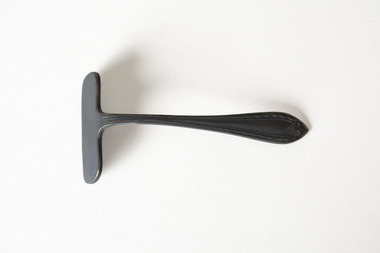
Domestic object - Child's food pusher, J. Biggin & Co, Unknown
... utensil in Victorian and early twentieth-century households. They were used to help children too young to use knives learn to eat politely at the table - the blunt blade was used to push food onto the fork. Pushers could also be used to pull food from a serving...utensil in Victorian and early twentieth-century households. They were used to help children too young to use knives learn to eat politely at the table - the blunt blade was used to push food onto the fork. Pushers could also be used to pull food from a serving ...This children's eating utensil is believed to belong to the household of Chiltern writer and historian, W.C. Busse. The level of tarnish and the mark 'EPNS' may indicate it is electroplated. The blade also contains the maker's mark 'APEX', which was used by John Biggin & Co, Sheffield, United Kingdom. Pushers such as these were a common utensil in Victorian and early twentieth-century households. They were used to help children too young to use knives learn to eat politely at the table - the blunt blade was used to push food onto the fork. Pushers could also be used to pull food from a serving platter onto an individual plate. Wilfred Clarence Busse was born in Chiltern in 1898. He went to school at Wesley College in Melbourne, studied law at the University of Melbourne and became a barrister. Additionally, after spending time on a Victorian station in his early twenties, he wrote two historical novels about bush life. His first novel was 'The Blue Beyond: a Romance of the Early Days in South Eastern Australia', written in 1928 and published in 1930. Busse's second novel was titled 'The Golden Plague: A Romance of the Early Fifties'. The judges of the Henry Lawson Society's T.E. Rofe competition to advance Australian literature unanimously awarded it the Gold Medal in 1931 for the best historical novel of 1930. Newspaper articles about the award mention the writer's meticulous documentary and oral history research regarding life on the Gold Fields in the 1850s. It became a best-seller. Busse also wrote a series of articles about local history for "The Federal Standard" newspaper in Chiltern. He was a member of the Chiltern Athenaeum. He died in 1960.This child's eating utensil is significant for the detail it conveys of ordinary domestic life in the household of a significant Victorian writer with special reference to Chiltern and the surrounding region. It may also be significant in understanding the customs and practices of English-speaking nations in the early Twentieth Century. The object is a metal food pusher, a child's eating utensil with a blunt lozenge at right angles to the handle. The metal is tarnished, indicating that it may be silver or silverplated. APEX EPNS AI w.c. busse, wilfred clarence busse, chiltern, indigo shire, north-east victoria, gold fields, gold mining, gold rush, table manners, etiquette, children, childhood, john biggin & co, sheffield, golden plague, blue beyond, historical fiction, 1930s, 1850s, t.e. rofe, henry lawson society, electroplate, tableware, cutlery -
 Whitehorse Historical Society Inc.
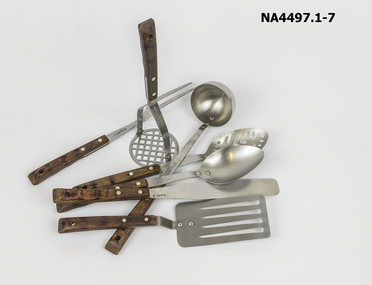
Domestic object - Kitchen Utensils, 1962
... utensils. Brown timber handles. Stainless steel implements. 1. Carving Fork 2. Egg lifter 3. Large serving...utensils. Brown timber handles. Stainless steel implements. 1. Carving Fork 2. Egg lifter 3. Large serving spoon 4. ...Utensils given to donor as a wedding present in 1962. Used by her until 2012.Set of seven kitchen utensils. Brown timber handles. Stainless steel implements. 1. Carving Fork 2. Egg lifter 3. Large serving spoon 4. Soup ladle 5. Potato masher 6. Lifter 7. Slotted spoon'Prestige'domestic items, food preparation -
 Wodonga & District Historical Society Inc
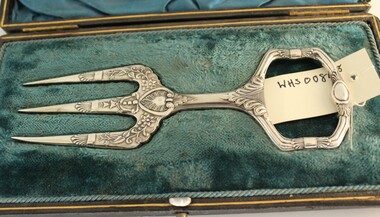
Domestic object - SIlver cake serving fork in original case
... Jean Raper. sillverware domestic utensils floral design A 3 pronged silver serving fork with a looped handle. ...This silver embossed fork is part of a collection donated by Mrs. Jean Raper of Wodonga.This item is from Raper Collection donated to the Wodonga Historical Society by Mrs. Jean Raper. A 3 pronged silver serving fork with a looped handle. The tines and handle are decorated with an embossed floral design on both sides. It includes a satin and velvet lined case. floral designsillverware, domestic utensils -
 Wodonga & District Historical Society Inc
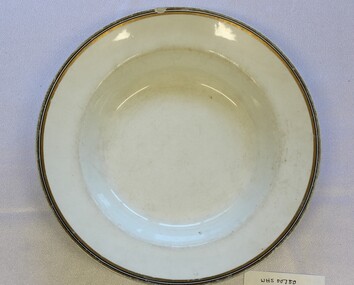
Domestic object - Shallow Vegetable Serving bowl, Johnson Brothers England, 1913 - 1942
... Johnson Brothers ceramics domestic utensils kitchenware On under side of bowl, beneath a green crown "Johnson Bros/England" A shallow white bowl with gold trim, probably used for serving vegetables at the table. ...Johnson Bros. was founded by two brothers named Alfred and Frederick who purchased a pottery factory in Hanley, England, in 1883. They were grandsons of a renowned English potter, Alfred Meakin. They were later joined in the business by their brothers Henry and Robert. Their business grew rapidly, as they were one of the world's largest pottery factories by the turn of the 20th century. By 1970, Johnson Bros. obtained the Royal Charter to become the official provider of china for Her Majesty Queen Elizabeth II. More than 1,300 patterns have been created throughout Johnson Brothers' history. Due to their growing success, manufacturing plants were established overseas including the establishment of a tableware factory, Johnson Brothers Australia in 1957 in Croydon, Victoria operated through a company known as Sovereign Pottery Ltd. Due to rising competition, Johnson Brothers became part of the Wedgewood Group in 1968. In 2015, following the acquisition of Wedgewood by Finnish company Fiskars, the Johnson Brothers branding was discontinued. The trademark on this bowl was used by Johnson Brothers between 1913 and 1942. An item which reflects the changing market for tableware that was reasonably priced and serviceable. Their innovation of the pottery line called semi-porcelain changed the industry. This development allowed potteries to produce fashionable pottery items that were affordable to all social classes of the time. Their use became widespread in Australia, especially following their establishment of a tableware factory in Melbourne, Victoria. A shallow white bowl with gold trim, probably used for serving vegetables at the table. The underside of the bowl bears the mark of Johnson Bros England. The mark is composed of a green crown above the words "Johnson Bros England" also in green.On under side of bowl, beneath a green crown "Johnson Bros/England"johnson brothers ceramics, domestic utensils, kitchenware -
 Emerald Museum & Nobelius Heritage Park
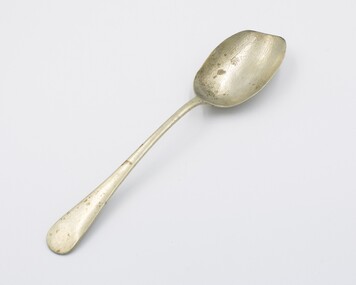
Domestic object - Serving Spoon ("Grosvenor"), G. & E. Rodd, c. 1920-50s
... This plain serving spoon is larger than most everyday utensils as it was likely used to serve smaller portions of a communal meal. ...This plain serving spoon is larger than most everyday utensils as it was likely used to serve smaller portions of a communal meal. ...George Rodd and his brother Ernest established G. & E. Rodd as a manufacturer of silver goods in the 1920s. Initially, they produced popular small accessories such as collar pins and bangles before expanding in the mid-1920s to create more complex items such as rings, broaches, and cufflinks. In the 1930s, they began to produce ornate silverware, predominantly flatware which capitalised on the High Tea elegance of the time, and children's silverware. Much of their silverware was EPNS—or electroplated nickel silver—and identified with various embossed markings. They steadily expanded over the next decades, with a slight dip in production during WWII, and merged with Platers Pty Ltd. in 1949, gaining them access to the 'Hecworth' name. This plain serving spoon is larger than most everyday utensils as it was likely used to serve smaller portions of a communal meal. The spoon's bowl is worn away at the top-left edge, indicating that it may have been used as leverage to frequently to open sealed jars or tins. It is also missing several of the markers which would easily identify it as Rodd silverware, such as the APEX mark, or an A1 label.This item is significant as it is an example of a well-loved and regularly-used utensil from an everyday home. Its wear is indicative of the way it was used on a regular basis, and how similar utensils may have been used in other homes around the area.This silver spoon has a deep, slightly misshapen bowl that is tarnished by a great deal of scratches and marks. The bowl's edges are also slightly bent and warped. The handle extends slightly over the bottom of the bowl, narrowing at the neck before widening at the base of the handle. There is a small engraving on its underside.Rear, base of handle: "GROSVENOR PLATE EPNS" Rear, base of handle, sideways: "A"20th century, domestic life
