
Showing 4 items matching "shamrock hotel echuca"
-
 Federation University Historical Collection
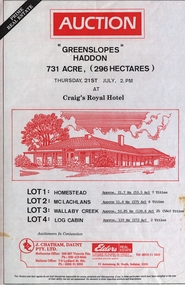
Document - Real Estate Flyers, J. Chatham, Daunt Pty. Ltd, Various years
... ...shamrock hotel echuca...[Jane Dyer (nee Chatham).16 June 2024] j chatham daunt auction "greenslopes" haddon "mindai park" cape clear kingston district the mill restaurant malmsbury "emu downs" beaufort "wattlw grove" mount mercer "rowan lodge" centennial hotel kensington "ben nevis estate" elmhurst "paddlesteamer lodge" wodonga place albury "woodlands" ararat lake wallace hotel, edenhope cremorne hotel newtown geelong terang hotel avoca hotel woori yallock hotel ballarat tram family restaurant victoria hotel woodend patersons siding restaurant and bar, ballarat the coorrabin motor inn, stawell clifton hill hotel, clifton hill albion hotel, kyabram "stag hotel" learmonth "osborne" rokewood shamrock hotel echuca willaura hotel, willaura "boggy creek pub" curdie vale shamrock hotel, dennington "mt elephant hotel/motel" derrinallum narmbool, ballarat brighton inn hotel khyat's posters real estate Hotels. ...The Ballarat-based firm, J Chatham and Co, serviced the Hotel Industry in Victoria, particularly Victoria’s Wimmera and Western Districts. Established by Jack { John} Chatham in 1956, The business was based at 7 Lydiard St South, Ballarat. As a regional hotel and motel broking specialist, Jack worked closely with other Ballarat businesses, including the Ballarat Brewery. On Jack's death in 1967, the business was taken over by his son, Philip, and renamed J Chatham Pty Ltd. The business continued to grow. Chatham House, the building the business operated from, and subsequently purchased and named, at 7 Lydiard St South, Ballarat still stands today. It was renamed by new owners in 2025 In the 1970's Philip opened a Melbourne branch in Dudley St, Nth Melbourne, The Melbourne branch, J Chatham and Daunt Pty Ltd, operated from 205 Victoria Parade, Fitzroy, a few blocks west of the Carlton United Brewery in the 1980s. In the late 1980s Philip's son, Andrew, joined the business, then called J Chatham, Daunt and Foley Pty Ltd. The business at this time operated from a terrace house [?Bouverie Street] Carlton near Grattan St. By 2005, the Daunt and Foley partnership had dissolved. In 2001 Philip predeceased his wife, Elizabeth Chatham (nee Holmes), a Director of the Company. His share of the business was inherited by Andrew. Elizabeth died in 2005. The business was sold in 2006. [Jane Dyer (nee Chatham).16 June 2024]Thirty-one real estate flyers j chatham, daunt, auction, "greenslopes" haddon, "mindai park" cape clear, kingston district, the mill restaurant malmsbury, "emu downs" beaufort, "wattlw grove" mount mercer, "rowan lodge", centennial hotel kensington, "ben nevis estate" elmhurst, "paddlesteamer lodge" wodonga place albury, "woodlands" ararat, lake wallace hotel, edenhope, cremorne hotel newtown geelong, terang hotel, avoca hotel, woori yallock hotel, ballarat tram family restaurant, victoria hotel woodend, patersons siding restaurant and bar, ballarat, the coorrabin motor inn, stawell, clifton hill hotel, clifton hill, albion hotel, kyabram, "stag hotel" learmonth, "osborne" rokewood, shamrock hotel echuca, willaura hotel, willaura, "boggy creek pub" curdie vale, shamrock hotel, dennington, "mt elephant hotel/motel" derrinallum, narmbool, ballarat, brighton inn hotel, khyat's, posters, real estate, hotels., restaurants -
 Bendigo Historical Society Inc.
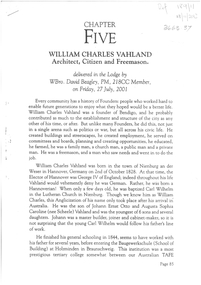
Document - William Charles Vahland, 2014, 2018
... Vahland and his firm designed and directed the building of many of Bendigo′s finest buildings, including the Town Hall, the Shamrock Hotel, the Bendigo Hospital, the Bendigo Benevolent Asylum, the School of Mines, the Mechanics Institute, the Princess Theatre, the Bendigo Masonic Temple, the Cascades in Rosalind Park, the Alexandra Fountain, the Sandhurst Club, the Commercial, National and Colonial Banks, the grandstand at Canterbury Park, Eaglehawk, as well as churches, commercial buildings, and private homes. The firm also opened an office in Echuca...Vahland and his firm designed and directed the building of many of Bendigo′s finest buildings, including the Town Hall, the Shamrock Hotel, the Bendigo Hospital, the Bendigo Benevolent Asylum, the School of Mines, the Mechanics Institute, the Princess Theatre, the Bendigo Masonic Temple, the Cascades in Rosalind Park, the Alexandra Fountain, the Sandhurst Club, the Commercial, National and Colonial Banks, the grandstand at Canterbury Park, Eaglehawk, as well as churches, commercial buildings, and private homes. The firm also opened an office in Echuca ...William Charles Vahland (born Carl Wilhelm Vahland; 2 October 1828 – 21 July 1915) was a German born and trained Australian architect who, after migrating to Bendigo in 1854 and becoming an Australian citizen on 20 July 1857, became known as the "premier architect of the Victorian goldfields". Vahland designed over 200 buildings in North Central Victoria, including many of Bendigo's largest public and private buildings. By encouraging other European artisans and artists to emigrate to Bendigo, Vahland's aim was to realise a vision of the city as the "Vienna of the South". Vahland and his firm designed and directed the building of many of Bendigo′s finest buildings, including the Town Hall, the Shamrock Hotel, the Bendigo Hospital, the Bendigo Benevolent Asylum, the School of Mines, the Mechanics Institute, the Princess Theatre, the Bendigo Masonic Temple, the Cascades in Rosalind Park, the Alexandra Fountain, the Sandhurst Club, the Commercial, National and Colonial Banks, the grandstand at Canterbury Park, Eaglehawk, as well as churches, commercial buildings, and private homes. The firm also opened an office in Echuca, and erected buildings in Hay, Deniliquin, Lorne, Lancefield, Rochester, Rushworth, Swan Hill, Yarrawonga and Benalla.. Fifteen page copy of paper on William Charles Vahland delivered in the Lodge by WBro David Beagley, on Friday 27th July 2001. Letter attached to the paper, addressed to Trevor Parsons, Secretary, Bendigo Historical Society, from Peter E. Hamilton, stating that the paper on Vahland 'was produced in the "Lodge of Research 2001'.sandhurst, bendigo, william charles vahland -
 Bendigo Historical Society Inc.
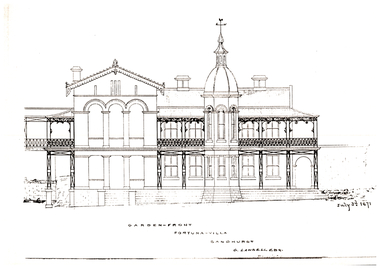
Plan - Fortuna Article - Plans of the Villa, July 3rd 1871
... He Designed many of Bendigo’s most prominent buildings, including the Town Hall, Shamrock Hotel, Bendigo Hospital, Benevolent Asylum, School of Mines, Mechanics Institute, Princess Theatre, Masonic Temple, Alexandra Fountain, and several banks and churches. His firm also worked in other Victorian towns and opened an office in Echuca...He Designed many of Bendigo’s most prominent buildings, including the Town Hall, Shamrock Hotel, Bendigo Hospital, Benevolent Asylum, School of Mines, Mechanics Institute, Princess Theatre, Masonic Temple, Alexandra Fountain, and several banks and churches. His firm also worked in other Victorian towns and opened an office in Echuca ...Architect of Fortuna Villa Carl William Vahland was born in 1828 in Nienburg an der Weser, Germany. He trained at the prestigious Polytechnic Baugewerkschule in Holzminden, excelling in building and architecture. Emigrated to Melbourne in 1854, motivated by political unrest in Germany and the lure of the goldfields. Quickly he moved to Bendigo, joining other German migrants who contributed significantly to the region. Early Initially worked as a carpenter, then established himself as an architect in Bendigo by 1856. He Formed partnerships with other German architects, notably Robert Getzschmann and later his son Henry.Major. He Designed many of Bendigo’s most prominent buildings, including the Town Hall, Shamrock Hotel, Bendigo Hospital, Benevolent Asylum, School of Mines, Mechanics Institute, Princess Theatre, Masonic Temple, Alexandra Fountain, and several banks and churches. His firm also worked in other Victorian towns and opened an office in Echuca. Favored French Renaissance and Hellenistic Greek styles, influenced by German architectural trends. He Married Jane Barrow in 1859; they had ten children, though three died young. Became a naturalized Australian and anglicized his name to William Vahland. He Owned and developed the Charterhouse estate and vineyard at Runnymede, exporting award-winning wine to Europe. Justice of the Peace for over 40 years, city councillor, and mayor of Bendigo. Held leadership roles in the fire brigade, German Association, Bendigo Mutual Permanent Land and Building Society, and other local organizations. Active Freemason and published a book on freemasonry in Bendigo. Retired in 1900, briefly returned to the firm after his son’s death, and finally retired in 1912. Died in 1915 at age 87; his funeral was attended by many prominent citizens, and flags were flown at half-mast in his honor. William Vahland’s legacy is seen in Bendigo’s architectural heritage and his broad contributions to the city’s civic, cultural, and economic life.Fortuna Article - Plans of the Villa 1871 This item contains the following documents: 11217.81a Plan Garden Front for G. Lansell Esq. - 1 A4 Sheet 11217.81b Plan Facade 2 - 1 A4 Sheet 11217.81c Plan Facade 6 - 1 A4 Sheet 11217.81d Plan Garden Elevation and plan of Ground Floor and Second Floor with Section on line xx - 1 A4 Sheet 11217.81e Plan Basement and ground floor- 1 A4 Sheet 11217.81f Plan Basement and ground floor - 1 A3 Sheet - stamped with William C Vahland Architect Sandhurstnon-fictionbendigo, fortuna, george lansell, william vahland -
 Port of Echuca
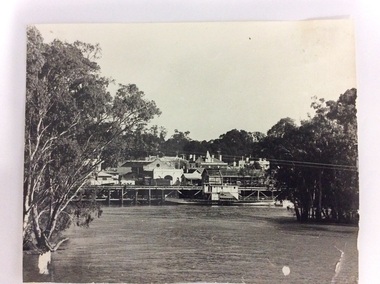
Black and white photograph, 1973 or 1974
... Echuca Wharf every day. (Ref. Parsons, R. "Ships of the Inland Rivers. P. 116.) This photograph is significant because it shows the wharf in 1973, being converted into a Tourist precinct. The roof of the cargo shed is being repaired. The P.S Pevensey is tied up to the wharf and looks as if it needs more repairs. The buildings in the background are still used as business venues. The Shamrock Hotel ...The P.S Pevensey was built in 1910 in Moama by the Permewan Wright Co. Initially she was a barge, called the Mascotte, but by May 1911 she had been converted into the P.S.Pevensey. Initially the P.S.Pevensey was used as for transporting wool from the Murrumbidgee River Stations. In 1932 the P.S Pevensey carried the largest load of wool ever from the Murrumbidgee River. This record was 2600 bales of wool. She was destroyed by fire at Koraleigh Landing later in 1932, but was soon rebuilt.By 1939 she was running a regular service between Morgan and Mildura. By 1958 it was reported that she was moored above Renmark and not working. In 1967 she was sunk by vandals. In 1968 she was bought by Bill and Norm Collins. They refloated her, restored her and moored her at Mildura. The City of Echuca bought the P.S. Pevensey from the Collins Family in 1973, for $20,000. The P.S. Pevensey came to Echuca Wharf in July 1973 along with Kevin Hutchinson OA., a shipwright who stayed with the P.S. Pevensey for the rest of his life. The P.S Pevensey currently works as a Tourist paddle steamer taking cruises from the Echuca Wharf every day. (Ref. Parsons, R. "Ships of the Inland Rivers. P. 116.)This photograph is significant because it shows the wharf in 1973, being converted into a Tourist precinct. The roof of the cargo shed is being repaired. The P.S Pevensey is tied up to the wharf and looks as if it needs more repairs. The buildings in the background are still used as business venues. The Shamrock Hotel can be seen in High Street. A train can also be seen parked on the wharf.A black and white rectangular photograph of the P.S Pevensey tied up at Echuca Wharf during a high river probably taken in 1973 or 1974.On the Bond Store in Murray Esplanade can be seen the words SHACKELL. On the front of the building can be seen the words "Panel & Paint."p.s pevensey, echuca wharf, hutchinson, kevin, collins, norm, collins, bill, city of echuca
