
Showing 30 items matching "shanghai china"
-
 Eltham District Historical Society Inc
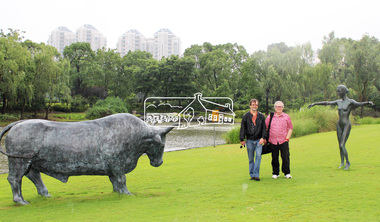
Piers Bateman and Michael Wilson at Fudan University, Shanghai, China
... Piers Bateman and Michael Wilson at Fudan University, Shanghai, China...china...fudan university...michael wilson...piers bateman...piers maxwell dudley bateman...shanghai...In March 2010 he was appointed Artist in Residence as an Honoray Professor for painting at the Shanghai Institute of Visual Art under Fudan University in Shanghai, China. He died along with his brother-in-law in a boating mishap whilst sailing from Broken Bay to North Arm Cove in NSW, September 4, 2015...In March 2010 he was appointed Artist in Residence as an Honoray Professor for painting at the Shanghai Institute of Visual Art under Fudan University in Shanghai, China. He died along with his brother-in-law in a boating mishap whilst sailing from Broken Bay to North Arm Cove in NSW, September 4, 2015 china fudan university michael wilson piers bateman piers maxwell dudley bateman shanghai Born digital Piers Bateman and Michael Wilson at Fudan University, Shanghai, China ...Piers Bateman (1947 – 2015) was an Australian landscape painter. He was a member of The Antipodeans, a group of Melbourne painters that also included Arthur Boyd, David Boyd, Charles Blackman, John Brack, Robert Dickerson, John Perceval and Clifton Pugh. In March 2010 he was appointed Artist in Residence as an Honoray Professor for painting at the Shanghai Institute of Visual Art under Fudan University in Shanghai, China. He died along with his brother-in-law in a boating mishap whilst sailing from Broken Bay to North Arm Cove in NSW, September 4, 2015china, fudan university, michael wilson, piers bateman, piers maxwell dudley bateman, shanghai -
 Sunshine and District Historical Society Incorporated
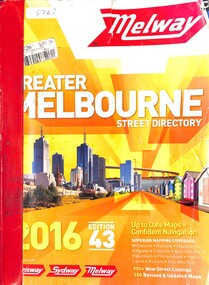
Book - Melway Greater Melbourne Street Directory 2016, Melway Publishing Pty Ltd, 2016
... Toppan Leefung (Shanghai) Co Ltd Shanghai, China...Melway Greater Melbourne Street Directory 2016 Edition 43 Paper back book Melway Greater Melbourne Street Directory 2016 Book Melway Greater Melbourne Street Directory 2016 Melway Publishing Pty Ltd Crimson Fox Creative Studios Toppan Leefung (Shanghai) Co Ltd Shanghai, China ...The series of Melway Directories provides the most comprehensive maps of Great Melbourne area. In this Melway the coverage extends from Wallan, Whittlesea and Kinglake in the North to Mornington Peninsula in the South, Warburton and Tynong in the East to Bacchus Marsh and Geelong in the West. Regional areas of Kilmore, Macedon, Gisborne, Riddells Creek, Bannockburn, Torquay, Anglesea, Lorne, Phillip Island and Koo Wee Rup are also included. Past editions can provide invaluable material for researchers and historians.Paper back booknon-fictionThe series of Melway Directories provides the most comprehensive maps of Great Melbourne area. In this Melway the coverage extends from Wallan, Whittlesea and Kinglake in the North to Mornington Peninsula in the South, Warburton and Tynong in the East to Bacchus Marsh and Geelong in the West. Regional areas of Kilmore, Macedon, Gisborne, Riddells Creek, Bannockburn, Torquay, Anglesea, Lorne, Phillip Island and Koo Wee Rup are also included. Past editions can provide invaluable material for researchers and historians. -
 Sunshine and District Historical Society Incorporated
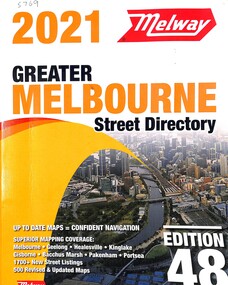
Book - Melway Greater Melbourne Street Directory 2021, Melway Publishing Pty Ltd, 2021
... Toppan Leefung (Shanghai) Co Ltd Shanghai, China...Melway Greater Melbourne Street Directory 2021 Edition 48 Paper back book Melway Greater Melbourne Street Directory 2021 Book Melway Greater Melbourne Street Directory 2021 Melway Publishing Pty Ltd Toppan Leefung (Shanghai) Co Ltd Shanghai, China ...The series of Melway Directories provides the most comprehensive maps of Great Melbourne area. In this Melway the coverage extends from Wallan, Whittlesea and Kinglake in the North to Mornington Peninsula in the South, Warburton and Tynong in the East to Bacchus Marsh and Geelong in the West. Regional areas of Kilmore, Macedon, Gisborne, Riddells Creek, Bannockburn, Torquay, Anglesea, Lorne, Phillip Island and Koo Wee Rup are also included. Past editions of the Melway can provide invaluable material for researchers and historians.Paper back booknon-fictionThe series of Melway Directories provides the most comprehensive maps of Great Melbourne area. In this Melway the coverage extends from Wallan, Whittlesea and Kinglake in the North to Mornington Peninsula in the South, Warburton and Tynong in the East to Bacchus Marsh and Geelong in the West. Regional areas of Kilmore, Macedon, Gisborne, Riddells Creek, Bannockburn, Torquay, Anglesea, Lorne, Phillip Island and Koo Wee Rup are also included. Past editions of the Melway can provide invaluable material for researchers and historians. -
 Geoffrey Kaye Museum of Anaesthetic History
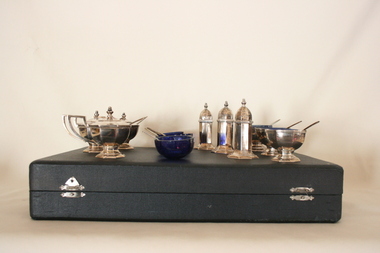
Domestic object - Muffineer Set with Tray, Nanking Store, 1900c
... The muffineer set was presented in a custom made box bearing the manufacturer's mark 'Nanking Store', active in Shanghai, China from the late 19th century until early 20th century. ...[printed in gold lettering on beige fabric inside lid cover] Chinese name of manufacturer in Chinese characters / NANKING STORE / GOLD AND SILVER SMITHS / 444 SZECHUEN ROAD / SHANGHAI / markers mark and Chinese characters [hallmarks on condiments dishes] NKSTERLING / SILVER / character of rooster [hallmarks on muffineer] NANKING / SILVER / character of rooster [hallmarks on spoons - 6 only] NANKING / character of rooster [hallmarks on tray reverse] 19722 number scratched into surface....SHANGHAI , China...The muffineer set was presented in a custom made box bearing the manufacturer's mark 'Nanking Store', active in Shanghai, China from the late 19th century until early 20th century. ...The donor of this gift, Professor John Gibbs, has played an important role in the history of ANZCA as a board member of the first ANZCA Council. In the late 1980s Professor Gibbs was President of the New Zealand Society of Anaesthetists and in 2004 received the ANZCA medal for his major contributions to the status of anaesthesia. The muffineer set was presented in a custom made box bearing the manufacturer's mark 'Nanking Store', active in Shanghai, China from the late 19th century until early 20th century. Each item in the set is stamped with the makers mark and character of a rooster. It is unknown as to the symbolism of the rooster, however, it may have represented the Chinese year of the rooster. It is possible this is a Chinese export silver piece, as a result of increased export trade to the West in the early 20th century. Chinese export silver were made in foreign taste for export, in particular common items such as tea and coffee sets. A Muffineer is a small container with a pierced top for sprinkling sugar, salt, spice, or other powder. It gained its name from its early use for sprinkling sugar or salt on muffins and were part of the Victorian tableware. After the First World War and the change of life style, this was later referred to as sugar shakers.A sterling silver muffineer set of Queen Anne revival with tray. Muffiner set contains 3 silver shakers (muffineer), 6 silver condiment dishes on stand 3 with lid and handle, 10 small, rounded spoons, 10 blue, glass inserts for condiment dishes. The set comes with a custom made presentation box, lined with beige silk. The box proper is lined in dark blue velour with individual sections cut out to sit each set piece. Each piece is hallmarked except four spoons. Large heavy oval shaped silver tray with extended loop rope designed handle on either side decorated with a very ornate fern leaf pattern design etched into the entire base of the tray. [printed in gold lettering on beige fabric inside lid cover] Chinese name of manufacturer in Chinese characters / NANKING STORE / GOLD AND SILVER SMITHS / 444 SZECHUEN ROAD / SHANGHAI / markers mark and Chinese characters [hallmarks on condiments dishes] NKSTERLING / SILVER / character of rooster [hallmarks on muffineer] NANKING / SILVER / character of rooster [hallmarks on spoons - 6 only] NANKING / character of rooster [hallmarks on tray reverse] 19722 number scratched into surface.professor john gibbs, nanking store, chinese export silver, muffineer, sterling silver -
 Orbost & District Historical Society
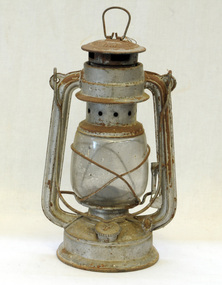
lantern, Kwang Hwa, first half 20th century
... Shanghai, China ...This item is an example of a lighting device commonly used before electricity was widely available for domestic use.A hurricane lamp with a rounded tank and small carry handle (a larger handle is possibly missing). It has a lever to open the glass tank. It has a metal base which is filled with kerosene. On top is a metal hood with vents.Around base : Chinese characters. On top : "Made in China KWANG HWA"lighting lantern kerosene-lamp hurricane -lamp -
 City of Moorabbin Historical Society (Operating the Box Cottage Museum)
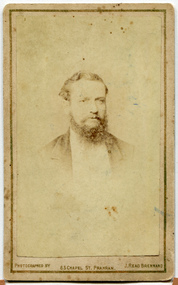
Photograph, B&W, John Box 1841 - 1913, c1900
... ...shanghai china...Rebecca Anne b 1863 was in the first party from Australia to go to the China Inland Mission in 1890 and was known as 'Faith' because of her evangelical zeal. The Mission Post was invaded by the Boxers during the Rebellion 1900-01and she was moved to the safety of Shanghai by Nicholas Viloudakia, a Greek silk merchant whom she later married. ...A B Leigh box william box elizabeth box george box john sheldrake martha box alonzo box mary box rebecca rushall eleanor moorabbin bentleigh brighton ormond market gardeners pioneers early settlers withyham sussex england boxer rebellion 1900 methodist chinese missionary methodist china inland mission shanghai china silk merchants mary box wedding dress Photographed by J. ...John Box 1841 - 1914, the 4th son of George and Mary Box, was born in Withyham, Sussex England and came to Australia in 1856 with his parents. He lived and worked on his fathers market garden in East Brighton ( now Bentleigh) for several years and then rented a property in Tucker Road in 1862. John married Martha Sheldrake and they had 10children. Rebecca Anne b 1863 was in the first party from Australia to go to the China Inland Mission in 1890 and was known as 'Faith' because of her evangelical zeal. The Mission Post was invaded by the Boxers during the Rebellion 1900-01and she was moved to the safety of Shanghai by Nicholas Viloudakia, a Greek silk merchant whom she later married. Rebecca sent the bolt of hand embroidered silk material to her brother Alonzo for his marriage to Mary Closter. Mary Box nee Closter's Wedding Dress is on display at Box Cottage Museum . Martha Sheldrake died 1895 and John married Eleanor Rushall b1866 and they had 3 children. John was well respected in the community and was a Methodist lay preacher. John Box is the brother of William Box who, with his wife Elizabeth Box, lived in Box Cottage . John Box was a pioneer market gardener in East Brighton now Bentleigh. He married Martha Sheldrake and they had 10 children. The eldest daughter Rebecca was a Methodist Missionary in China and Alonzo, their 9th child, served in the Army WW1 at Gallipoli, France and Flanders. Rebecca sent the hand embroidered Chinese silk material for the Wedding Dress worn by Mary Closter at her marriage to Alonzo Box 1918. After Martha died he married Eleanor Rushall and they had 3 children. John was well respected by the community and also a Methodist lay preacher. Box Cottage Museum, a reconstruction of an early settler hut, is named after the Box family who resided there 1865 -1913 . William Box who, with his wife Elizabeth Avis Box and 13 children, lived and farmed on the block of land in Jasper Road, East Brighton ( now McKinnon / Ormond) that was part of the Henry Dendy Special Survey 1841. Inscribed in Album “ The early photos in this album were found by Mr (Laurie) Lewis when he was demolishing the Old Box Cottage. He gave them to Mrs Avis Box Eldridge who in turn gave them to me. They were not identified. I believe they rightly belong in the Cottage. I have attempted to identify them and present them in a way they can be preserved as a historical record of the era.” A B Leigh A black and white professional photograph of John Box c1880Photographed by J. Read Brennand / 83 Chapel St. Prahranbox william, box elizabeth, box george, box john, sheldrake martha, box alonzo, box mary, box rebecca, rushall eleanor, moorabbin, bentleigh, brighton, ormond, market gardeners, pioneers, early settlers, withyham sussex england, boxer rebellion 1900, methodist chinese missionary, methodist china inland mission, shanghai china, silk merchants, mary box wedding dress -
 City of Moorabbin Historical Society (Operating the Box Cottage Museum)
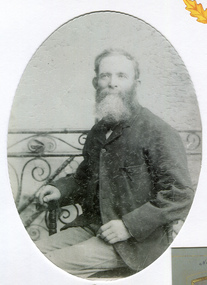
Photograph, B&W oval John Box 1841 -1913, c1900
... box william, box elizabeth, box george, box john, sheldrake martha, box alonzo, box mary, box rebecca, rushall eleanor, moorabbin, bentleigh, brighton, ormond, market gardeners, pioneers, early settlers, withyham sussex england, boxer rebellion 1900, methodist chinese missionary, methodist china inland mission, shanghai china, silk merchants, mary box wedding dress...Rebecca Anne b 1863 was in the first party from Australia to go to the China Inland Mission in 1890 and was known as 'Faith' because of her evangelical zeal. The Mission Post was invaded by the Boxers during the Rebellion 1900-01and she was moved to the safety of Shanghai by Nicholas Viloudakia, a Greek silk merchant whom she later married. ...William Box who, with his wife Elizabeth Avis Box and 13 children, lived and farmed on the block of land in Jasper Road, East Brighton ( now McKinnon / Ormond) that was part of the Henry Dendy Special Survey 1841. box william, box elizabeth, box george, box john, sheldrake martha, box alonzo, box mary, box rebecca, rushall eleanor, moorabbin, bentleigh, brighton, ormond, market gardeners, pioneers, early settlers, withyham sussex england, boxer rebellion 1900, methodist chinese missionary, methodist china inland mission, shanghai china, silk merchants, mary box wedding dress nil An oval shaped black and white photograph of John Box 1841 - 1913 Photograph, B&W oval John Box 1841 -1913 J. ...John Box 1841 - 1914, the 4th son of George and Mary Box, was born in Withyham, Sussex England and came to Australia in 1856 with his parents. He lived and worked on his fathers market garden in East Brighton ( now Bentleigh) for several years and then rented a property in Tucker Road in 1862. John married Martha Sheldrake and they had 10children. Rebecca Anne b 1863 was in the first party from Australia to go to the China Inland Mission in 1890 and was known as 'Faith' because of her evangelical zeal. The Mission Post was invaded by the Boxers during the Rebellion 1900-01and she was moved to the safety of Shanghai by Nicholas Viloudakia, a Greek silk merchant whom she later married. Rebecca sent the bolt of hand embroidered silk material to her brother Alonzo for his marriage to Mary Closter. Mary Box nee Closter's Wedding Dress is on display at Box Cottage Museum . Martha Sheldrake died 1895 and John married Eleanor Rushall b1866 and they had 3 children. John was well respected in the community and was a Methodist lay preacher.John Box is the brother of William Box who, with his wife Elizabeth Box, lived in Box Cottage . John Box was a pioneer market gardener in East Brighton now Bentleigh. He married Martha Sheldrake and they had 10 children. The eldest daughter Rebecca was a Methodist Missionary in China and Alonzo, their 9th child, served in the Army WW1 at Gallipoli, France and Flanders. Rebecca sent the hand embroidered Chinese silk material for the Wedding Dress worn by Mary Closter at her marriage to Alonzo Box 1918. After Martha died he married Eleanor Rushall and they had 3 children. John was well respected by the community and also a Methodist lay preacher. Box Cottage Museum, a reconstruction of an early settler hut, is named after the Box family who resided there 1865 -1913 . William Box who, with his wife Elizabeth Avis Box and 13 children, lived and farmed on the block of land in Jasper Road, East Brighton ( now McKinnon / Ormond) that was part of the Henry Dendy Special Survey 1841. An oval shaped black and white photograph of John Box 1841 - 1913nilbox william, box elizabeth, box george, box john, sheldrake martha, box alonzo, box mary, box rebecca, rushall eleanor, moorabbin, bentleigh, brighton, ormond, market gardeners, pioneers, early settlers, withyham sussex england, boxer rebellion 1900, methodist chinese missionary, methodist china inland mission, shanghai china, silk merchants, mary box wedding dress -
 City of Moorabbin Historical Society (Operating the Box Cottage Museum)
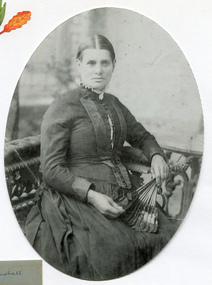
Photograph, B&W oval, Martha Sheldrake 1st wife of John Box, 1880
... box william, box elizabeth, box george, box john, sheldrake martha, box alonzo, box mary, box rebecca, rushall eleanor, moorabbin, bentleigh, brighton, ormond, market gardeners, pioneers, early settlers, withyham sussex england, boxer rebellion 1900, methodist chinese missionary, methodist china inland mission, shanghai china, silk merchants, mary box wedding dress...Rebecca Anne b 1863 was in the first party from Australia to go to the China Inland Mission in 1890 and was known as 'Faith' because of her evangelical zeal. The Mission Post was invaded by the Boxers during the Rebellion 1900-01and she was moved to the safety of Shanghai by Nicholas Viloudakia, a Greek silk merchant whom she later married. ...William Box who, with his wife Elizabeth Avis Box and 13 children, lived and farmed on the block of land in Jasper Road, East Brighton ( now McKinnon / Ormond) that was part of the Henry Dendy Special Survey 1841. box william, box elizabeth, box george, box john, sheldrake martha, box alonzo, box mary, box rebecca, rushall eleanor, moorabbin, bentleigh, brighton, ormond, market gardeners, pioneers, early settlers, withyham sussex england, boxer rebellion 1900, methodist chinese missionary, methodist china inland mission, shanghai china, silk merchants, mary box wedding dress nil An oval black and white photograph of Martha Sheldrake the 1st wife of John Box 1841 -1913 Photograph, B&W oval, Martha Sheldrake 1st wife of John Box Unrecorded ...John Box 1841 - 1913, the 4th son of George and Mary Box, was born in Withyham, Sussex England and came to Australia in 1856 with his parents. He lived and worked on his fathers market garden in East Brighton ( now Bentleigh) for several years and then rented a property in Tucker Road in 1862. John married Martha Sheldrake and they had 10children. Rebecca Anne b 1863 was in the first party from Australia to go to the China Inland Mission in 1890 and was known as 'Faith' because of her evangelical zeal. The Mission Post was invaded by the Boxers during the Rebellion 1900-01and she was moved to the safety of Shanghai by Nicholas Viloudakia, a Greek silk merchant whom she later married. Rebecca sent the bolt of hand embroidered silk material to her brother Alonzo for his marriage to Mary Closter. Mary Box nee Closter's Wedding Dress is on display at Box Cottage Museum . Martha Sheldrake died 1895 and John married Eleanor Rushall b1866 and they had 3 children. John was well respected in the community and was a Methodist lay preacher. John Box is the brother of William Box who, with his wife Elizabeth Box, lived in Box Cottage . John Box was a pioneer market gardener in East Brighton now Bentleigh. He married Martha Sheldrake and they had 10 children. The eldest daughter Rebecca was a Methodist Missionary in China and Alonzo, their 9th child, served in the Army WW1 at Gallipoli, France and Flanders. Rebecca sent the hand embroidered Chinese silk material for the Wedding Dress worn by Mary Closter at her marriage to Alonzo Box 1918. After Martha died he married Eleanor Rushall and they had 3 children. John was well respected by the community and also a Methodist lay preacher. Box Cottage Museum, a reconstruction of an early settler hut, is named after the Box family who resided there 1865 -1913 . William Box who, with his wife Elizabeth Avis Box and 13 children, lived and farmed on the block of land in Jasper Road, East Brighton ( now McKinnon / Ormond) that was part of the Henry Dendy Special Survey 1841. An oval black and white photograph of Martha Sheldrake the 1st wife of John Box 1841 -1913nilbox william, box elizabeth, box george, box john, sheldrake martha, box alonzo, box mary, box rebecca, rushall eleanor, moorabbin, bentleigh, brighton, ormond, market gardeners, pioneers, early settlers, withyham sussex england, boxer rebellion 1900, methodist chinese missionary, methodist china inland mission, shanghai china, silk merchants, mary box wedding dress -
 Federation University Historical Collection
Book, Godfrey W. Himus, The Elements of Fuel Technology, 1947, 1947
... Author Godfrey Himus was assistant professor in fuel technology at teh Imperial College of Science and technology, London, Formerly Chief Chemist to teh Municipal Electricity Department, Shanghai, China...Author Godfrey Himus was assistant professor in fuel technology at teh Imperial College of Science and technology, London, Formerly Chief Chemist to teh Municipal Electricity Department, Shanghai, China adrian weeks fuel technology godfrey w. himus Signed inside front "Adrian Weeks" Green hardcovered book of 506 pages. ...Author Godfrey Himus was assistant professor in fuel technology at teh Imperial College of Science and technology, London, Formerly Chief Chemist to teh Municipal Electricity Department, Shanghai, ChinaGreen hardcovered book of 506 pages. Includes line illustrations. Signed inside front "Adrian Weeks"adrian weeks, fuel technology, godfrey w. himus -
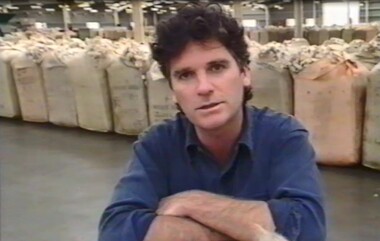 National Wool Museum
Film - Promotional Films, Australian Wool Corporation, 26 April 1991
... Film includes colour footage and audio. 00:01 - titles 00:21 - scenes herding sheep 01:18 - titles 'Wool Testing' 01:34 - Hugh Beggs, Chairman of Australian Wool Corporation, speaking about history of wool marketing and measuring of wool in Australia 02:29 - wool bales on truck 02:35 - interior of factory showing process of wool sampling, measuring and testing 04:04 - AWTA Ltd building exterior, and interior scenes of workers testing and measuring wool samples 11:41 - scenes at wool auction 12:14 - factory interior showing wool processing 13:05 - Beggs speaking about wool industry 13:13 - fashion runways 13:52 - end titles 14:17 - end 14:22 - titles 'Contaminants in Wool Processing' 14:42 - fashion runway 14:52 - man speaking on location at a sheep farm 15:04 - Mark Kent, Vice-President Kent Manufacturing, speaking about contamination of wool and Australia's reputation 15:25 - interior scenes of G H Michell & Sons wool mill in South Australia 16:22 - Judy Turk, in office at G H Michell & Sons speaking about problems of contamination 16:36 - interior factory scenes 17:46 - John McIntosh, Aweave Textile Corporation, talking about contaminants 20:02 - scenes in shearing shed 20:42 - Chip Sawers, President Wool Council, talking about contamination 28:46 - end credits 29:04 - end 29:13 - Bill Peach exits car on sheep property, introduces a story about wool 29:46 - titles 'Working for Wool' 30:04 - farm scenes 32:12 - shearing shed scenes, interior 34:28 - Wool Testing Authority labratory, interior scenes 36:44 - wool store interior 38:20 - Australian Wool Corporation office interior and exterior, Parkville, Melbourne 43:26 - end credits 44:00 - end 44:05 - wool advertisement featuring man and woman in car 44:34 - end 44:41 - titles 'Fleece Clean' 44:42 - various scenes, fashion, factories 45:14 - titles 45:15 - fashion runways 45:43 - farm scenes 51:02 - titles 51:10 - scenes of China, including Great Wall 53:44 - textile factories in China, interior scenes 57:46 - fashion runways, Shanghai China 01:00:31 - rural scenes of China 01:02:03 - end 01:02:13 - titles 'Wool Top Making' 01:02:19 - scenes of Williamstown, Victoria 01:02:27 - Port Phillip Mills, interior scenes 01:06:33 - end credits 01:07:08 - end 01:07:11 - titles 'Shearer Fitness' 01:07:21 - shearing shed, interior 01:09:54 - shearers talking about health and fitness 01:19:28 - end credits 01:19:48 - end 01:19:50 - titles 'Shearing Training' 01:19:51 - shearing scenes 01:26:24 - end credits 01:26:45 - end 01:26:50 - titles 'Wool Press Duties' 01:26:58 - wool pressing scenes 01:34:29 - end credits 01:34:51 - end 01:34:54 - woollen carpet advertisement, including carpet scenes and farm scenes 01:35:38 end...Film includes colour footage and audio. 00:01 - titles 00:21 - scenes herding sheep 01:18 - titles 'Wool Testing' 01:34 - Hugh Beggs, Chairman of Australian Wool Corporation, speaking about history of wool marketing and measuring of wool in Australia 02:29 - wool bales on truck 02:35 - interior of factory showing process of wool sampling, measuring and testing 04:04 - AWTA Ltd building exterior, and interior scenes of workers testing and measuring wool samples 11:41 - scenes at wool auction 12:14 - factory interior showing wool processing 13:05 - Beggs speaking about wool industry 13:13 - fashion runways 13:52 - end titles 14:17 - end 14:22 - titles 'Contaminants in Wool Processing' 14:42 - fashion runway 14:52 - man speaking on location at a sheep farm 15:04 - Mark Kent, Vice-President Kent Manufacturing, speaking about contamination of wool and Australia's reputation 15:25 - interior scenes of G H Michell & Sons wool mill in South Australia 16:22 - Judy Turk, in office at G H Michell & Sons speaking about problems of contamination 16:36 - interior factory scenes 17:46 - John McIntosh, Aweave Textile Corporation, talking about contaminants 20:02 - scenes in shearing shed 20:42 - Chip Sawers, President Wool Council, talking about contamination 28:46 - end credits 29:04 - end 29:13 - Bill Peach exits car on sheep property, introduces a story about wool 29:46 - titles 'Working for Wool' 30:04 - farm scenes 32:12 - shearing shed scenes, interior 34:28 - Wool Testing Authority labratory, interior scenes 36:44 - wool store interior 38:20 - Australian Wool Corporation office interior and exterior, Parkville, Melbourne 43:26 - end credits 44:00 - end 44:05 - wool advertisement featuring man and woman in car 44:34 - end 44:41 - titles 'Fleece Clean' 44:42 - various scenes, fashion, factories 45:14 - titles 45:15 - fashion runways 45:43 - farm scenes 51:02 - titles 51:10 - scenes of China, including Great Wall 53:44 - textile factories in China, interior scenes 57:46 - fashion runways, Shanghai China 01:00:31 - rural scenes of China 01:02:03 - end 01:02:13 - titles 'Wool Top Making' 01:02:19 - scenes of Williamstown, Victoria 01:02:27 - Port Phillip Mills, interior scenes 01:06:33 - end credits 01:07:08 - end 01:07:11 - titles 'Shearer Fitness' 01:07:21 - shearing shed, interior 01:09:54 - shearers talking about health and fitness 01:19:28 - end credits 01:19:48 - end 01:19:50 - titles 'Shearing Training' 01:19:51 - shearing scenes 01:26:24 - end credits 01:26:45 - end 01:26:50 - titles 'Wool Press Duties' 01:26:58 - wool pressing scenes 01:34:29 - end credits 01:34:51 - end 01:34:54 - woollen carpet advertisement, including carpet scenes and farm scenes 01:35:38 end Film Promotional Films Australian Wool Corporation ...Tape contains ten separate short films created by the Australian Wool Corporation, including promotional videos, advertisements and industry news.Black VHS tape with white and orange stickers and printed text. Tape is housed in a black plastic case. Film includes colour footage and audio. 00:01 - titles 00:21 - scenes herding sheep 01:18 - titles 'Wool Testing' 01:34 - Hugh Beggs, Chairman of Australian Wool Corporation, speaking about history of wool marketing and measuring of wool in Australia 02:29 - wool bales on truck 02:35 - interior of factory showing process of wool sampling, measuring and testing 04:04 - AWTA Ltd building exterior, and interior scenes of workers testing and measuring wool samples 11:41 - scenes at wool auction 12:14 - factory interior showing wool processing 13:05 - Beggs speaking about wool industry 13:13 - fashion runways 13:52 - end titles 14:17 - end 14:22 - titles 'Contaminants in Wool Processing' 14:42 - fashion runway 14:52 - man speaking on location at a sheep farm 15:04 - Mark Kent, Vice-President Kent Manufacturing, speaking about contamination of wool and Australia's reputation 15:25 - interior scenes of G H Michell & Sons wool mill in South Australia 16:22 - Judy Turk, in office at G H Michell & Sons speaking about problems of contamination 16:36 - interior factory scenes 17:46 - John McIntosh, Aweave Textile Corporation, talking about contaminants 20:02 - scenes in shearing shed 20:42 - Chip Sawers, President Wool Council, talking about contamination 28:46 - end credits 29:04 - end 29:13 - Bill Peach exits car on sheep property, introduces a story about wool 29:46 - titles 'Working for Wool' 30:04 - farm scenes 32:12 - shearing shed scenes, interior 34:28 - Wool Testing Authority labratory, interior scenes 36:44 - wool store interior 38:20 - Australian Wool Corporation office interior and exterior, Parkville, Melbourne 43:26 - end credits 44:00 - end 44:05 - wool advertisement featuring man and woman in car 44:34 - end 44:41 - titles 'Fleece Clean' 44:42 - various scenes, fashion, factories 45:14 - titles 45:15 - fashion runways 45:43 - farm scenes 51:02 - titles 51:10 - scenes of China, including Great Wall 53:44 - textile factories in China, interior scenes 57:46 - fashion runways, Shanghai China 01:00:31 - rural scenes of China 01:02:03 - end 01:02:13 - titles 'Wool Top Making' 01:02:19 - scenes of Williamstown, Victoria 01:02:27 - Port Phillip Mills, interior scenes 01:06:33 - end credits 01:07:08 - end 01:07:11 - titles 'Shearer Fitness' 01:07:21 - shearing shed, interior 01:09:54 - shearers talking about health and fitness 01:19:28 - end credits 01:19:48 - end 01:19:50 - titles 'Shearing Training' 01:19:51 - shearing scenes 01:26:24 - end credits 01:26:45 - end 01:26:50 - titles 'Wool Press Duties' 01:26:58 - wool pressing scenes 01:34:29 - end credits 01:34:51 - end 01:34:54 - woollen carpet advertisement, including carpet scenes and farm scenes 01:35:38 endLabel on tape: Australian Wool Corporation / TITLE AWC VIDEOS TAPE 2 / PLAYING TIME / TAPING DATE 26/4/91 / PRODUCTION DATE / SYSTEM / WOOL HOUSE 369 Royal Parade, PARKVILLE, VIC, 3052victoria, film, working life, factory, textile industry, farming, sheep, australian wool corporation, hugh beggs, wool testing, wool measuring, awta, g h michell & sons, fashion, runway, contaminants, mark kent, wool mills, judy turk, john mcintosh, aweave textile corporation, chip sawers, bill peach, advertisements, china, top making, shearing sheds, shearing, health, training, wool pressers, carpet -
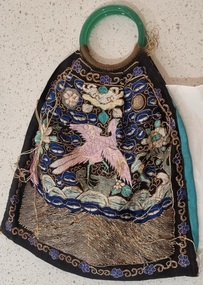 Embroiderers Guild, Victoria
Functional object - Qing Dynasty Chinese Rank Badge Bag, 19 th C
... During the late 19th and early 20th century, the badges were prized collector items for wives of western diplomats stationed in Peking or Shanghai, and missionaries throughout China. The western collectors in old China not only framed the beautiful badges and hung them on walls, thus preserving them for future generations, but made evening purses of them. ...During the late 19th and early 20th century, the badges were prized collector items for wives of western diplomats stationed in Peking or Shanghai, and missionaries throughout China. The western collectors in old China not only framed the beautiful badges and hung them on walls, thus preserving them for future generations, but made evening purses of them. ...During the late 19th and early 20th century, the badges were prized collector items for wives of western diplomats stationed in Peking or Shanghai, and missionaries throughout China. The western collectors in old China not only framed the beautiful badges and hung them on walls, thus preserving them for future generations, but made evening purses of them. They put them under glass-covered serving trays, made decorative boxes adorned by them, and other imaginative items. They were most innovative with the regal badges that had been displayed with great pride by mandarin on the black silk surcoats worn over the colorful dragon robes on all official occasions in the court of the last emperors and empresses of China. Two groups of men achieved badges, civil and military. Each category had nine ranks. The civil rank badges feature birds for identification, and the military utilize animals, both real and mythological. The first civil examination was generally taken at approximately age 18. Those who passed were awarded the Flower of Talent or Hsiu-ts’ai title and were entitled to wear the ninth rank badge, the Paradise Flycatcher. This would be equivalent to receiving our Bachelor of Arts degree.Silk embroidery on silk fabric. Originally a Chinese Civil Rank Badge, repurposed into a bag. Satin stitch and metallic thread couching. Embroidery in pale mauve, aqua, blue and cream. Central panel has a bird with wings outstretched. Metal thread is used to attach to green Peking glass handles. Internal lining is degraded teal silk. -
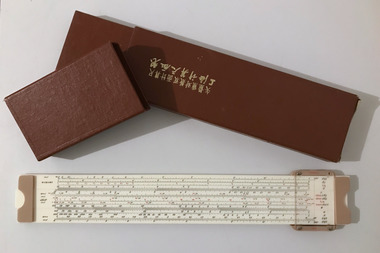 Mission to Seafarers Victoria
Instrument - Slide Rule in box, Shanghai Slide Rule Factory, 1978
... He served on these ships: SS Corinda SS Macumba SS Mildura SS Nellor SS Ormiston SS Reynella anne rennie collection wal harbord merchant navy seamen seafarers ww2 battle of the atlantic walter harbord nautical instrument navigation slide rule flying fish 1017 Inscription in Chinese on the box Sextant in wooden box Instrument Slide Rule in box Shanghai Slide Rule Factory ...Sextant belonging to Walter Harbord (Wal or Wally) (b.1923 in Brisbane-d.), master mariner in the Merchant Navy on British Phosphate Commission ships. According to the website SLide Rule Museum this is the Flying Fish 1017 Chemical V2 Walter was interviewed by the Australian at War Film Archive in 2003. He served on these ships: SS Corinda SS Macumba SS Mildura SS Nellor SS Ormiston SS ReynellaSextant in wooden boxInscription in Chinese on the boxanne rennie collection, wal harbord, merchant navy, seamen, seafarers, ww2, battle of the atlantic, walter harbord, nautical instrument, navigation, slide rule, flying fish 1017 -
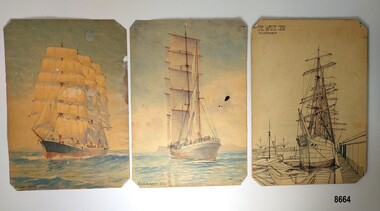 Flagstaff Hill Maritime Museum and Village
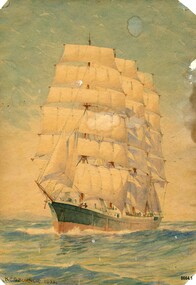
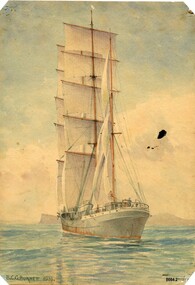
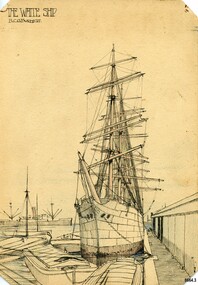
Painting - Paintings - set of three, Beni Carr Glyn Burnett, 1933
... When he was 15 years old he began training as an architect with a firm in Shanghai. He worked in Singapore, Japan and China before moving to Australia around 1933. ...When he was 15 years old he began training as an architect with a firm in Shanghai. He worked in Singapore, Japan and China before moving to Australia around 1933. ...Beni Carr Glyn Burnett (also known as B. C. G. Burnett or Beni Burnett) was born in 1889 to missionary parents in Mongolia. When he was 15 years old he began training as an architect with a firm in Shanghai. He worked in Singapore, Japan and China before moving to Australia around 1933. In 1937 he was appointed as the Commonwealth principal architect in the Northern Territory. He went on to design a series of houses for senior public servants and military personnel which became very popular as they were specifically designed for the tropics - incorporating louvres, high ceilings and good ventilation. When Darwin was bombed in February 1942, he was evacuated to Alice Springs where he continued to work as an architect. He also became a Magistrate and Coroner in Alice Springs. In later life he was well known for sketching clientele in public bars. He died in 1955. Beni Burnett was living in Sydney in 1933 when he produced these three artworks. There were several photography firms operating in Sydney at this time who specialised in photographing ships and the shipping trade (e.g. Samuel J. Hood and William James Hall) and whose photographs were used by artists to produce ship portraits. Both of these photographers took photographs of the two ships in B. C. G. Burnett's watercolours. The "Magdalene Vinnen" was photographed by Samuel J Hood in a series of photos taken in March 1933. It was a 4 masted steel barque, built in 1921 in Kiel, Germany and for almost 80 years was the largest traditional sailing ship in operation. It was used extensively as a cargo ship. It sailed into Sydney Harbour on 27th Feb 1933, loaded with almost 16,000 bales of wool destined for Falmouth, England. In March 1933 (whilst in Sydney) the German Republic flag (on orders from Adolph Hitler) was lowered and replaced with the old monarchist flag which was then to be the official flag and beside it the Nazi flag was to be flown on all ceremonial occasions. It visited Australia again in 1935 with its cargo being wheat from Port Broughton, S. A. In 1936 it was renamed "Kommodore Johnsen" and in 1945 (after WW2) the ship was awarded to the Soviet Union as war compensation and renamed "STS Sedov". The "Winterhude" (originally called "Mabel Rickmers) was a three masted Finnish barque built in 1898 by Rickers - Werft Bremerhaven for use on the East India rice trade and later the South American nitrate trade. After WW1 it came under French control as war compensation. It was also sold several times and at one stage was called "Selma Hemsoth" but in 1925 it was bought by Gustaf Erikson who restored the name "Winterhude" and the vessel became a regular transport in the Australian wheat trade. In 1944 it was sold to the German navy before being taken over by the British at the end of WW2. It was photographed in Sydney by William James Hall in 1931 on its way to Port Lincoln, South Australia to load wheat for Europe. The third ship depicted by B. C. G. Burnett is a pen and wash sketch labelled "The White Ship" and exactly matches a photograph pasted into his personal scrapbook which is in the "Library and Archives N. T.". The name of the ship is unknown and B. C. G. Burnett may have taken some artistic licence with the colouring as in the original photograph, the ship had a dark hull.This set of three small artworks is significant as examples of shipping (particularly the use of sailing ships) that were still being used as late as the 1930's in Australia. They are also important because their creator (B. C. G. Burnett) went on to become a well-known public figure in the Northern Territory in the late 1930's due to his innovative approach to designing homes for the tropical climate.A set of three artworks by B. C. G. Burnett of sailing ships in Sydney Harbour. They are all on rectangular watercolour paper with small diagonal edges at each corner. Painting 1 is a watercolour painting of a sailing ship called "Magdalene Vinnen". It shows a 4 masted barque with a blue and red steel hull in full sail heading towards the viewer. The painter's name (B. C. G. Burnett) and date (1933) are written on the bottom left-hand corner of the painting. Painting 2 is a watercolour painting of a sailing ship called "Winterhude". It shows a 3-masted barque with a blue and red steel hull in full sail heading away from the viewer. A small figure can be seen at the wheel at the rear of the ship. The painter's name (B. C. G. Burnett) and date (1933) are written on the bottom left-hand corner of the painting. Sketch 3 is an ink sketch of an unknown sailing ship moored to a dock. There are several small boats tied up near the sailing ship and a large steel freighter can be seen in the background. There is a faint wash of colour on parts of the sketch - the bottom of the ship, the masts and booms and the water at the end of the pier. The title (The White Ship) and the artist's name (B. C. G. Burnett) are written in ink in the top left corner. 1 (front) - "B. C. G. BURNETT. 1933 2 (front) - "B. C. G. BURNETT. 1933" 3 (front) - "THE WHITE SHIP / B. C. G. BURNETT"flagstaff hill maritime museum and village, warrnambool, great ocean road, sailing ships, ships, barque, magdalene vinnen, winterhude, beni carr glyn burnett, b. c. g. burnett, beni burnett, painting, watercolour painting, sketch, ink sketch, sydney harbour, architect, darwin, burnett house, photography, samuel j. hood, william james hall, sedov, kommodore johnsen, mabel rickmers -
 Flagstaff Hill Maritime Museum and Village
Painting - Watercolour painting, Beni Carr Glyn Burnett, Magdalene Vinnen, 1933
... When he was 15 years old he began training as an architect with a firm in Shanghai. He worked in Singapore, Japan and China before moving to Australia around 1933. ...When he was 15 years old he began training as an architect with a firm in Shanghai. He worked in Singapore, Japan and China before moving to Australia around 1933. ...Beni Carr Glyn Burnett (also known as B. C. G. Burnett or Beni Burnett) was born in 1889 to missionary parents in Mongolia. When he was 15 years old he began training as an architect with a firm in Shanghai. He worked in Singapore, Japan and China before moving to Australia around 1933. In 1937 he was appointed as the Commonwealth principal architect in the Northern Territory. He went on to design a series of houses for senior public servants and military personnel which became very popular as they were specifically designed for the tropics - incorporating louvres, high ceilings and good ventilation. When Darwin was bombed in February 1942, he was evacuated to Alice Springs where he continued to work as an architect. He also became a Magistrate and Coroner in Alice Springs. In later life he was well known for sketching clientele in public bars. He died in 1955. Beni Burnett was living in Sydney in 1933 when he produced these three artworks. There were several photography firms operating in Sydney at this time who specialised in photographing ships and the shipping trade (e.g. Samuel J. Hood and William James Hall) and whose photographs were used by artists to produce ship portraits. Both of these photographers took photographs of the two ships in B. C. G. Burnett's watercolours. The "Magdalene Vinnen" was photographed by Samuel J Hood in a series of photos taken in March 1933. It was a 4 masted steel barque, built in 1921 in Kiel, Germany and for almost 80 years was the largest traditional sailing ship in operation. She was used extensively as a cargo ship. She sailed into Sydney Harbour on 27th Feb 1933, loaded with almost 16,000 bales of wool destined for Falmouth, England. In March 1933 (whilst in Sydney) the German Republic flag (on orders from Adolph Hitler) was lowered and replaced with the old monarchist flag which was then to be the official flag and beside it the Nazi flag was to be flown on all ceremonial occasions. It visited Australia again in 1935 with its cargo being wheat from Port Broughton, S. A. In 1936 it was renamed "Kommodore Johnsen" and in 1945 (after WW2) the ship was awarded to the Soviet Union as war compensation and renamed "STS Sedov". This painting (one of a set of 3 small artworks) is significant as an example of shipping (particularly the use of sailing ships) that were still being used as late as the 1930's in Australia. It is also important because its creator (B. C. G. Burnett) went on to become a well-known public figure in the Northern Territory in the late 1930's due to his innovative approach to designing homes for the tropical climate. A watercolour painting of a sailing ship called "Magdalene Vinnen". It shows a 4 masted barque with a blue and red steel hull in full sail heading towards the viewer. The painter's name (B. C. G. Burnett) and date (1933) are written on the bottom left-hand corner of the painting. The location and name of the ship is written in ink on the back of the painting.front - "B. C. G. BURNETT. 1933 back - "off Sydney" / "Magdalene Vinnen"flagstaff hill maritime museum and village, warrnambool, great ocean road, sailing ships, ships, barque, magdalene vinnen, beni carr glyn burnett, b. c. g. burnett, beni burnett, painting, watercolour painting, sketch, sydney harbour, architect, darwin, burnett house, photography, samuel j. hood, william james hall, sedov, kommodore johnsen -
 Flagstaff Hill Maritime Museum and Village
Painting - Watercolour Painting, Beni Carr Glyn Burnett, The Winterhude, 1933
... When he was 15 years old he began training as an architect with a firm in Shanghai. He worked in Singapore, Japan and China before moving to Australia around 1933. ...When he was 15 years old he began training as an architect with a firm in Shanghai. He worked in Singapore, Japan and China before moving to Australia around 1933. ...Beni Carr Glyn Burnett (also known as B. C. G. Burnett or Beni Burnett) was born in 1889 to missionary parents in Mongolia. When he was 15 years old he began training as an architect with a firm in Shanghai. He worked in Singapore, Japan and China before moving to Australia around 1933. In 1937 he was appointed as the Commonwealth principal architect in the Northern Territory. He went on to design a series of houses for senior public servants and military personnel which became very popular as they were specifically designed for the tropics - incorporating louvres, high ceilings and good ventilation. When Darwin was bombed in February 1942, he was evacuated to Alice Springs where he continued to work as an architect. He also became a Magistrate and Coroner in Alice Springs. In later life he was well known for sketching clientele in public bars. He died in 1955. Beni Burnett was living in Sydney in 1933 when he produced these three artworks. There were several photography firms operating in Sydney at this time who specialised in photographing ships and the shipping trade (e.g. Samuel J. Hood and William James Hall) and whose photographs were used by artists to produce ship portraits. Both of these photographers took photographs of the two ships in B. C. G. Burnett's watercolours. The "Winterhude" (originally called "Mabel Rickmers) was a three masted Finnish barque built in 1898 by Rickers - Werft Bremerhaven for use on the East India rice trade and later the South American nitrate trade. After WW1 it came under French control as war compensation. It was also sold several times and at one stage was called "Selma Hemsoth" but in 1925 it was bought by Gustaf Erikson who restored the name "Winterhude" and the vessel became a regular transport in the Australian wheat trade. In 1944 it was sold to the German navy before being taken over by the British at the end of WW2. It was photographed in Sydney by William James Hall in1931 on its way to Port Lincoln, South Australia to load wheat for Europe.This painting (one of a set of three small artworks) is significant as an example of shipping (particularly the use of sailing ships) that were still being used as late as the 1930's in Australia. It is also important because its creator (B. C. G. Burnett) went on to become a well-known public figure in the Northern Territory in the late 1930's due to his innovative approach to designing homes for the tropical climate.A watercolour painting of a sailing ship called "Winterhude". It shows a 3 masted barque with a blue and red steel hull in full sail heading away from the viewer. A small figure can be seen at the wheel at the rear of the ship. The painter's name (B. C. G. Burnett) and date (1933) are written on the bottom left-hand corner of the painting. The name of the ship is written in faded pencil on the back of the painting.front - "B. C. G. BURNETT. 1933" back - in faded pencil - "the Winterhude"flagstaff hill maritime museum and village, warrnambool, great ocean road, sailing ships, ships, barque, winterhude, beni carr glyn burnett, b. c. g. burnett, beni burnett, painting, watercolour painting, sketch, ink sketch, sydney harbour, architect, darwin, burnett house, photography, samuel j. hood, william james hall, mabel rickmers -
 Flagstaff Hill Maritime Museum and Village
Artwork, other - Pen and Wash Painting, Beni Carr Glyn Burnett, The White Ship, circa 1933
... When he was 15 years old he began training as an architect with a firm in Shanghai. He worked in Singapore, Japan and China before moving to Australia around 1933. ...When he was 15 years old he began training as an architect with a firm in Shanghai. He worked in Singapore, Japan and China before moving to Australia around 1933. ...Beni Carr Glyn Burnett (also known as B. C. G. Burnett or Beni Burnett) was born in 1889 to missionary parents in Mongolia. When he was 15 years old he began training as an architect with a firm in Shanghai. He worked in Singapore, Japan and China before moving to Australia around 1933. In 1937 he was appointed as the Commonwealth principal architect in the Northern Territory. He went on to design a series of houses for senior public servants and military personnel which became very popular as they were specifically designed for the tropics - incorporating louvres, high ceilings and good ventilation. When Darwin was bombed in February 1942, he was evacuated to Alice Springs where he continued to work as an architect. He also became a Magistrate and Coroner in Alice Springs. In later life he was well known for sketching clientele in public bars. He died in 1955. Beni Burnett was living in Sydney in 1933 when he produced these three artworks. There were several photography firms operating in Sydney at this time who specialised in photographing ships and the shipping trade (e.g. Samuel J. Hood and William James Hall) and whose photographs were used by artists to produce ship portraits. Both of these photographers took photographs of the two ships in B. C. G. Burnett's watercolours This ship depicted by B. C. G. Burnett in his pen and wash sketch labelled "The White Ship" exactly matches a photograph pasted into his personal scrapbook which is in the "Library and Archives N. T.". The name of the ship is unknown and B. C. G. Burnett may have taken some artistic licence with the colouring as in the original photograph, the ship had a dark hull.This artwork (one of a set of three small artworks) is significant as an example of shipping (particularly the use of sailing ships) that were still being used as late as the 1930's in Australia. It is also important as its creator (B. C. G. Burnett) went on to become a well-known public figure in the Northern Territory in the late 1930's due to his innovative approach to designing homes for the tropical climate.An ink sketch of an unknown sailing ship moored to a dock. There are several small boats tied up near the sailing ship and a large steel freighter can be seen in the background. There is a faint wash of colour on parts of the sketch - the bottom of the ship, the masts and booms and the water at the end of the pier. The title (The White Ship) and the artist's name (B. C. G. Burnett) are written in ink in the top left corner. The back of the sketch is black card with faint pencil marks (overwritten in red ink) that appear to read "1842 A". A page from an album belonging to Beni Burnett displays five black and white photos including three photographs of ships. The photograph on the bottom right is an exact match for the pen and wash drawing. front - "THE WHITE SHIP / B. C. G. BURNETT" back - difficult to read "1842 A"flagstaff hill maritime museum and village, warrnambool, great ocean road, sailing ships, ships, barque, magdalene vinnen, winterhude, beni carr glyn burnett, b. c. g. burnett, beni burnett, painting, watercolour painting, sketch, ink sketch, sydney harbour, architect, darwin, burnett house, photography, samuel j. hood, william james hall -
 Flagstaff Hill Maritime Museum and Village
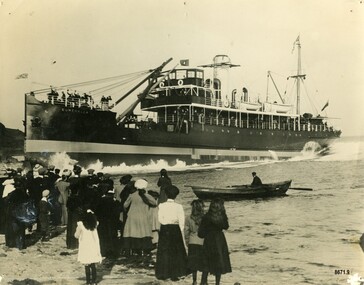
Photograph - Photograph of S. S. Eumeralla launch, 1908
... Between 1928 and 1935 the Eumeralla was laid up in Hobson's Bay before being sold to a Chinese firm to be used on the short coastal run between Shanghai and Wen Chow. ...Between 1928 and 1935 the Eumeralla was laid up in Hobson's Bay before being sold to a Chinese firm to be used on the short coastal run between Shanghai and Wen Chow. ...This photograph was one of ten photographs donated to Flagstaff Hill Maritime Museum and Village by Fred Trewartha. Frederick John Fox Trewartha (Fred) was a well-known Warrnambool businessman. He was born in Beeac near Geelong in 1920 and came to Warrnambool with his family as a very young child. He was apprenticed to his father John, as a saddler and later opened his own shop on Raglan Parade. He then moved into working with tarpaulins and canvases for the trucking industry. Fred was keenly interested in photography (and was a member of the Warrnambool Cine Club), yachting and boat building. He kept his yacht moored at Port Fairy for many years and participated in sailing events locally and interstate. He also built boats with his sons. He had the opportunity to meet many older sailors and it's thought this photo (and others in the set) may have been given to him by one of these men. Fred Trewartha died in 2016 in Warrnambool. The Eumeralla (sometimes spelt Eumerella) was built in 1908 in Scotland by Messrs. Scott of Kinghorn on the Firth of Forth. It was a steel screw steamer and had been designed to meet the growing demand for a thoroughly up to date passenger and cargo steamer for the Melbourne to Portland service for John McIlwraith and Company in partnership with the Belfast, Koroit Steam Navigation Company and Howard Smith Company Ltd. This photograph appeared in the Leader (Melbourne) on Saturday 28th November 1908 with the headline "Launching the Eumeralla" and shows the ship being launched on October 10th, 1908, in Scotland. It was described as "Length, 190 feet; breadth, 30 feet; depth 15 feet". It went on to say it had a speed guaranteed at 11 knots and was expected in Melbourne by the following January. It could accommodate sixty saloon passengers and thirty in steerage and had electric light fitted throughout. While on the Melbourne to Portland service the Eumeralla had several mishaps. In 1909 it crashed into the breakwater at Portarlington, splintering the woodwork and leaving a gap of about 12 feet. On Saturday 9th August 1913, as it was leaving Warrnambool, it encountered heavy seas and a passenger (Frederick Mahoney) sustained fatal injuries after hitting his head on the bulwark - and the second mate was found dead after the water poured off the deck. Several other passengers were also injured. Between 1912 and 1913 it was used to carry passengers between Brisbane, Maryborough and Rockhampton before being sent back to Melbourne for an overhaul. In 1915 it was selected for the Winter service to run daily trips between Melbourne and Geelong. In 1925 it nearly sank in the Yarra (at Queens Wharf) when it developed a list and water entered the engine room. Firemen from the Eastern Hill Station, crew and wharf workers were able to stop it from sinking. Between 1928 and 1935 the Eumeralla was laid up in Hobson's Bay before being sold to a Chinese firm to be used on the short coastal run between Shanghai and Wen Chow. It was renamed "Mel Lee (Mow Lee) Number 2". It arrived on July 12th, 1935, at Tanghai (a small Chinese port to the south of Shanghai) with 400 local passengers. The population of the town turned out to welcome the new ship with a fireworks display which caused the passengers to rush across to the side of the ship nearest the scene. The steamer immediately listed to one side and sank.This photograph is significant because of its association with the coastal trader S.S. Eumeralla and its important contribution to trade along Victoria's West Coast in the early 20th century.Black and white photograph showing a crowd of people standing on a shore watching a steamer (the Eumeralla) being launched. The crew of the steamer are standing in the bow, waving at the crowd. A single oarsman is in a small rowboat nearby. On the back of the photograph, the name, address and telephone number of the donor is written in black, ballpoint pen. More writing, in cursive script (in blue ink) gives a brief description of the ship and the events depicted in the photograph.Name of donor, address and telephone number "S. S. Eumeralla / Built in Scotland / being launched/ in Scotland/ 1904"warrnambool, flagstaff hill maritime museum and village, great ocean road, portland, port fairy, eumeralla, s. s. eumeralla, eumerella, steamer eumeralla, john mcilwraith and company, belfast and koroit steam navigation company, howard smith ltd, portarlington, geelong, melbourne, mel lee no. 2, mow lee no. 2, tanghai, steamship, steamer, fred trewartha, frederick john fox trewartha -
 Flagstaff Hill Maritime Museum and Village
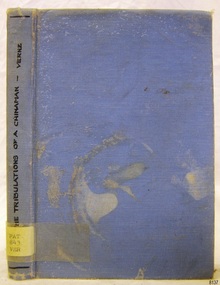
Book - A Fictional Story, Jules Verne et al, The Tribulations of A Chinaman, 1885
... (For more information on the Pattison Collection see item 3678 Flagstaff Hill collections) https://victoriancollections.net.au/items/5580c7e72162f114d8b758db warrnambool shipwrecked-coast flagstaff-hill flagstaff-hill-maritime-museum maritime-museum flagstaff-hill-maritime-village shipwrecked-artefact book warrnambool mechanics’ institute pattison collection warrnambool library corangamite regional library service warrnambool city librarian mechanics’ institute library victorian library board warrnambool books and records warrnambool children’s library Ralph Eric Pattison Jules Verne Voyages Extraordinaire series L’École des Robinson's The novel follows Kin-Fo, an extremely wealthy Chinese man in Shanghai who is bored with life. After hearing false news that his U.S. bank investment has gone bankrupt, he decides to commit suicide but first takes out a $200,000 life insurance policy that covers suicide with his mentor Wang and fiancee as beneficiaries. ...The novel follows Kin-Fo, an extremely wealthy Chinese man in Shanghai who is bored with life. After hearing false news that his U.S. bank investment has gone bankrupt, he decides to commit suicide but first takes out a $200,000 life insurance policy that covers suicide with his mentor Wang and fiancee as beneficiaries. Since he can't bring himself to kill his own self, he hires Wang to murder him before the insurance expires. However the bank was not bankrupt and Wang has disappeared after receiving the contract, Kin-Fo must now travel across China with two insurance company bodyguards and his lazy servant Soun to escape being killed by Wang. The story ends with the revelation that Wang staged everything to teach Kin-Fo the value of life. Kin-Fo marries his fiancee and lives happily.Hard cover book, The Tribulations of A Chinaman. Author: Jules Verne Publisher: Sampson Low, Marston, Searle & Rivington, London Date: 1885. Light blue hardcover with the title on the spine having lettering to spine in black hand written text pen. fictionThe novel follows Kin-Fo, an extremely wealthy Chinese man in Shanghai who is bored with life. After hearing false news that his U.S. bank investment has gone bankrupt, he decides to commit suicide but first takes out a $200,000 life insurance policy that covers suicide with his mentor Wang and fiancee as beneficiaries. Since he can't bring himself to kill his own self, he hires Wang to murder him before the insurance expires. However the bank was not bankrupt and Wang has disappeared after receiving the contract, Kin-Fo must now travel across China with two insurance company bodyguards and his lazy servant Soun to escape being killed by Wang. The story ends with the revelation that Wang staged everything to teach Kin-Fo the value of life. Kin-Fo marries his fiancee and lives happily.warrnambool, shipwrecked-coast, flagstaff-hill, flagstaff-hill-maritime-museum, maritime-museum, flagstaff-hill-maritime-village, shipwrecked-artefact, book, warrnambool mechanics’ institute, pattison collection, warrnambool library, corangamite regional library service, warrnambool city librarian, mechanics’ institute library, victorian library board, warrnambool books and records, warrnambool children’s library, ralph eric pattison, jules verne, voyages extraordinaire series, l’école des robinson's -
 City of Moorabbin Historical Society (Operating the Box Cottage Museum)
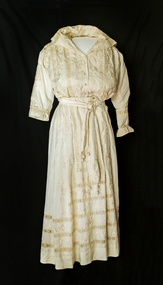
Clothing - Wedding Dress, Mary Box (nee Closter), circa 1918
... China Inland Mission in 1890. During the Boxer Uprising 1900-1901 her Mission outpost was attacked but she escaped and was taken to Shanghai. ...China Inland Mission in 1890. During the Boxer Uprising 1900-1901 her Mission outpost was attacked but she escaped and was taken to Shanghai. ...Alonzo Box, of Oakleigh ,a nephew of William and Elizabeth Box who resided in 'Box Cottage' 1865 - 1914, married Mary Closter (Kloster), of Oakleigh, on June 12th 1918. Alozo's elder sister, Rebecca, sent a bolt of Chinese hand-embroidered silk from which this wedding dress was made. Rebecca Viloudakia, nee Box, was a missionary in China, and married to a Greek Silk Merchant. Alonzo Box, the 9th child of John and Martha Sheldrake Box , enlisted in the Army and landed at Gallipoli 25/4/1918. He was evacuated to Egypt and then sent to the battlefields of France and Flanders before returning home to Melbourne in February 1918. Rebecca Box, the eldest child of John and Martha Sheldrake Box, was in the first party of Methodist Missionaries to leave Australia for the China Inland Mission in 1890. During the Boxer Uprising 1900-1901 her Mission outpost was attacked but she escaped and was taken to Shanghai. She later married one of the rescue party Nicholas Viloudakia a Greek silk merchant .Australian Dress Register ID 573 12/5/2015 Following Henry Dendy's Special Survey 1841 pioneer settlers bought allotments of land in the area of Moorabbin Parish. Alonzo Box was the nephew of William and Elizabeth Box who bought the cottage on the 30acre allotment from an unknown pioneer settler in 1868 and resided there until Elizabeth's death in 1914. Alonzo Box served in the Army World War 1 1914- 1918 at Gallipoli, France and Flanders. Rebecca Box -Viloudakia was in the first party of Methodist Missionaries to leave Australia for the China Inland Mission in 1890 and was rescued during the Boxer Rebellion 1900-1901 and taken to Shanghai by her future husband.A cream two piece wedding dress made from a bolt of hand embroidered Chinese silk for the marriage of Mary Closter and Alonzo Box on June 12th, 1918. The bolt of Chinese silk was sent by Alonzo’s older sister, Mrs Rebecca Viloudakia, a missionary in China, who was married to a Greek silk merchant. The machine sewn dress was made by a dressmaker in Dandenong, Victoria. The jacket is blouson, with a front opening and is gathered at the waist by a band enclosing a drawstring. The collar is a sailor style that forms a slight / high V-shape front neckline. Four vertical roses are separated by three bands of lacework. The back of the jacket is plain silk. The right front of the jacket has a panel of embroidered roses, band of lacework and a facing fold that encloses 4 fastening presses. There are crocheted bobbles on the front representing buttons. The left jacket front also has the panel of embroidered roses, lacework and matching fold for the 4 fastening studs. The full length inset sleeves are gathered to a cuff that fastens with silk covered buttons. The sleeves have floral embroidery down the outside centre line. The left sleeve has an extra detachable cuff with embroidery on the flounce that matches the bottom panel of the skirt. It is held in position around the wrist by 4 white metal press studs. The skirt sits above the ankle. It consists of 5 panels slightly gathered at the back waistline with a left side placket 21cm with hooks and eyes and press studs. The waistband is lined with petersham and has 6 whalebone inserts. The front of the skirt has small pleats to fit the 3 decorated panels to the waistline. The front has 3 bands of lacework around the lower part. 3 panels form the centre front each embroidered with a different floral pattern. The back of the skirt is plain with 3 bands of lacework rising from the hem, which is sewn with spoke work stitch. The long waist sash/belt is plain silk with embroidered ends and 3 silk balls with crocheted caps suspended on 3 crocheted silk chains. It has a rose knot with 2 metal press stud fasteners. There are a variety of floral designs embroidered on the material including ‘corner motifs’ on the 2nd inner front panel of skirt. brighton, moorabbin, silk, box william, box elizabeth, box alonzo, box mary, kloster mary, closter mary, oakleigh, dandenong, chinese silk merchant, boxer rebellion 1900-1901, box rebecca, methodist china inland mission, viloudakia nichols, anzac landings, world war 1, gallipoli -
 City of Moorabbin Historical Society (Operating the Box Cottage Museum)
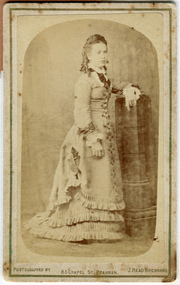
Photograph, B&W, Martha Sheldrake 1st wife of John Box, c1880
... China Inland Mission in 1890. During the Boxer Rebellion 1900-1901 Rebecca was rescued from her inland mission post by a group of traders from Shanghai. ...China Inland Mission in 1890. During the Boxer Rebellion 1900-1901 Rebecca was rescued from her inland mission post by a group of traders from Shanghai. ...John Box 1841 - 1914, the 4th son of George and Mary Box, was born in Withyham, Sussex England and came to Australia in 1856 with his parents. He lived and worked on his fathers market garden in East Brighton ( now Bentleigh) for several years and then rented a property in Tucker Road in 1862. John married Martha Sheldrake and they had 10 children who were all born in East Brighton ( now Ormond ). Their eldest daughter Rebecca 'Faith' Box 1863 -1950 was a member of the 1st Australian party to go to China with the Methodist Church China Inland Mission in 1890. During the Boxer Rebellion 1900-1901 Rebecca was rescued from her inland mission post by a group of traders from Shanghai. She later married Nicolas Viloudaki, a Greek Silk merchant , who was a member of the rescue party. Rebecca sent a bolt of chinese hand embroidered cream silk to Mary Closter for her wedding dress at her marriage to Alonzo Box, who was Rebecca's younger brother. This Dress has been published on the Australian Dress Register in 2015 and is on display at Box Cottage Museum Ormond. John Box is the brother of William Box who, with his wife Elizabeth Box, lived in Box Cottage . John Box was a pioneer market gardener in North Road, East Brighton now Bentleigh. He married Martha Louise Sheldrake and they had 10 children. The eldest daughter Rebecca was a Methodist Missionary in China and Alonzo, their 9th child, served in the Army WW1 at Gallipoli, France and Flanders. Rebecca sent the hand embroidered Chinese silk material for the Wedding Dress worn by Mary Closter at her marriage to Alonzo Box 1918. After Martha died John Box married Eleanor Rushall c 1900 and they had 3 children. John was well respected by the community and also a Methodist lay preacher. Box Cottage Museum, a reconstruction of an early settler hut, is named after the Box family who resided there 1865 -1913 . William Box who, with his wife Elizabeth Avis Box and 13 children, lived and farmed on the block of land in Jasper Road, East Brighton ( now McKinnon / Ormond) that was part of the Henry Dendy Special Survey 1841. Inscribed in Album “ The early photos in this album were found by Mr (Laurie) Lewis when he was demolishing the Old Box Cottage. He gave them to Mrs Avis Box Eldridge who in turn gave them to me. They were not identified. I believe they rightly belong in the Cottage. I have attempted to identify them and present them in a way they can be preserved as a historical record of the era.” A B Leigh A black and white photograph of Martha Sheldrake d1895 the 1st wife of John Box 1841-1914Photographed by J Read Brennand / 83 Chapel St. Prahran -
 Mission to Seafarers Victoria
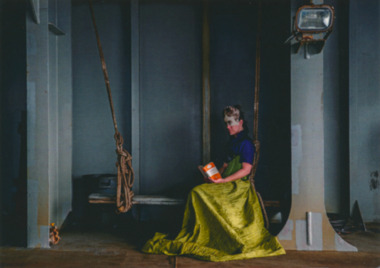
Flyer, Clare McCracken, The Place Between, 2018
... China mirroring her great-great-grandmother's journey from Australia to Asia in 1874. Artist statement from the back of the flyer: "In 1874, my great-great-grandmother, Elizabeth Amy Cathcart Payne, sailed unaccompanied from Australia to Asia, writing a detailed journal of her experiences. This exhibition weaves together sections of her diary with my own voyage from Australia to the world's busiest port, Shanghai...China mirroring her great-great-grandmother's journey from Australia to Asia in 1874. Artist statement from the back of the flyer: "In 1874, my great-great-grandmother, Elizabeth Amy Cathcart Payne, sailed unaccompanied from Australia to Asia, writing a detailed journal of her experiences. This exhibition weaves together sections of her diary with my own voyage from Australia to the world's busiest port, Shanghai ...On the 21st of July 2018, Clare McCracken boarded the ANL Wahroonga container ship to travel to China mirroring her great-great-grandmother's journey from Australia to Asia in 1874. Artist statement from the back of the flyer: "In 1874, my great-great-grandmother, Elizabeth Amy Cathcart Payne, sailed unaccompanied from Australia to Asia, writing a detailed journal of her experiences. This exhibition weaves together sections of her diary with my own voyage from Australia to the world's busiest port, Shanghai. In doing so, The Place Between, is a meditation upon the social and political nature of international trade, the mobility and the place between Australia and the rest of the world in the 19th and 21st century." The Mission has always been open to the community and has a tradition of hosting cultural events: shows, concerts, exhibitions, festivals.Postcard size flyer advertising for an exhibitionthe place between, clare mccracken, cultural events, sea voyage, andrew ferris, arun munoz, video installation -
 Bendigo Historical Society Inc.
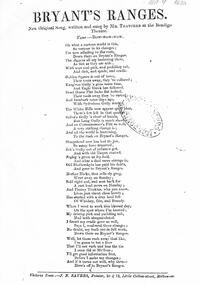
Document - AUSTIN COLLECTION: 'BRYANT'S RANGES' WORDS OF SONG
... He travelled to China, Japan and India sourcing stock for his business and on one such trip he contracted cholera and died in Shanghai. ...He travelled to China, Japan and India sourcing stock for his business and on one such trip he contracted cholera and died in Shanghai. ...Bryant's Ranges: Bryant's Ranges is a location near Tarrangower, Victoria. See: https://nla.gov.au/nla.obj-133763991/view - pen, pencil and watercolour, 'Allen and Jesper's store, Bryant's Ranges, Tarrengower, Bendigo, Victoria, 1853 / R.W. Jesper' It is also a location in the South Island, New Zealand. Charles Robert Thatcher (1831-1878) trained in England as a flautist before travelling to the Bendigo goldfields in 1853. He was unsuited and unsuccessful as a miner so decided to rely on his music to make his fortune. He was considered a 'comic vocalist' who wrote many songs about the observations he made on the goldfields. These songs were often satirical and were published in newspapers as poems. He travelled extensively around the Victorian goldfields and also toured New Zealand. In 1861 he married widowed singer Anna Vitellie who performed with him, singing sentimental ballads. In 1870 the family returned to England where Charles became an importer of curios, following in his father's footsteps. He travelled to China, Japan and India sourcing stock for his business and on one such trip he contracted cholera and died in Shanghai. Copy of song written by Charles Thatcher, 'Bryant's Ranges'. Written under title of song: 'New original song, written and sung by Mr Thatcher at the Bendigo Theatre, tune Bow-wow-wow. Song mentions Bendigo reefs and the gold seekers success or otherwise, then they were off to 'Bryant's Ranges'.bendigo, mining, song by charles thatcher -
 Bendigo Historical Society Inc.
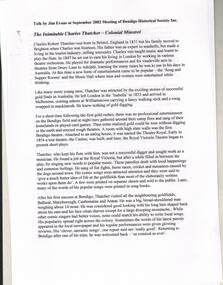
Document - RESEARCH PAPERS: THE INIMITABLE CHARLES THATCHER, 2002
... He travelled to China, Japan and India sourcing stock for his business and on one such trip he contracted cholera and died in Shanghai. ...He travelled to China, Japan and India sourcing stock for his business and on one such trip he contracted cholera and died in Shanghai. ...Charles Robert Thatcher (1831-1878) trained in England as a flautist before travelling to the Bendigo goldfields in 1853. He was unsuited and unsuccessful as a miner so decided to rely on his music to make his fortune. He was considered a 'comic vocalist' who wrote many songs about the observations he made on the goldfields. These songs were often satirical and were published in newspapers as poems. He travelled extensively around the Victorian goldfields and also toured New Zealand. In 1861 he married widowed singer Anna Vitellie who performed with him, singing sentimental ballads. In 1870 the family returned to England where Charles became an importer of curios, following in his father's footsteps. He travelled to China, Japan and India sourcing stock for his business and on one such trip he contracted cholera and died in Shanghai. His wife returned to Australia and taught singing in Moonee Ponds.3786.12 A talk written by Jim Evans for the Bendigo Historical Society in September 2002 regarding the gold field entertainer Charles Robert Thatcher and his many chaotic adventures and performances across Bendigo and Australia. 3786.12a Newspaper article written by David G. Horsfall. "Poet reflected on goldfield days". Published in a Bendigo Advertiser Special Supplement on the 116th Anniversary of the death of Charles Thatcher. - a comic singer who performed on the Goldfields.charles robert thatcher, jim evans, goldfields -
Moorabbin Air Museum
Mixed media (Item) - Thales Air Traffic Control System Advertising Disc, China, Air Traffic Control System Images: Beijing, Shanghai & Guangzhou
... China. Single CD in a plastic case. Air Traffic Control System Images: Beijing, Shanghai & Guangzhou Mixed media Thales Air Traffic Control System Advertising Disc, China ...Contains photos of Thales Air Traffic Control systems in China. -
 Federation University Art Collection
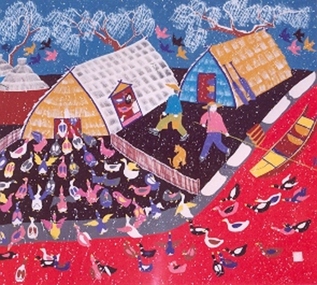
Work on paper - Printmaking, Returning Ducks, 1999
... Yang Deliang was from the Jinshan Peasant Painting Academy where Chinese folk art of southeastern Yangtze River area of Shanghai is undertaken. ...Yang Deliang was from the Jinshan Peasant Painting Academy where Chinese folk art of southeastern Yangtze River area of Shanghai is undertaken. ...Yang Deliang was from the Jinshan Peasant Painting Academy where Chinese folk art of southeastern Yangtze River area of Shanghai is undertaken. The paintings integrate the folk arts of printing and dyeing, embroidery, paper cutting, wood carving, and cook stove painting, and depict the peasant's colorful customs and daily life. This style of folk art was born in 1972, under the guidance of a professional painter Wu Tongzhang. Jinshan Peasant Painting made its international debut in the Expo 1980 in Brussels, Belgium. This item is part of the Federation University Art Collection. The Art Collection features over 1000 works and was listed as a 'Ballarat Treasure' in 2007.Framed silkcreen An artist's 'chop' is evident on the lower right cornerart, artwork, yang deliang, chinese, silkscreen, jinshan peasant painting academy, j -
Tramways/East Melbourne RSL Sub Branch - RSL Victoria Listing id: 27511
Book, Peter Thompson et al, SHANGHAI FURY (Australian Heroes of Revolutionary China)
... SHANGHAI FURY (Australian Heroes of Revolutionary China)...951.04 Historical ISBN: 978 1 86471 1837 SHANGHAI FURY (Australian Heroes of Revolutionary China) Book Peter Thompson William Heinemann Australia ...951.04, historical, isbn: 978 1 86471 1837 -
 Linton and District Historical Society Inc
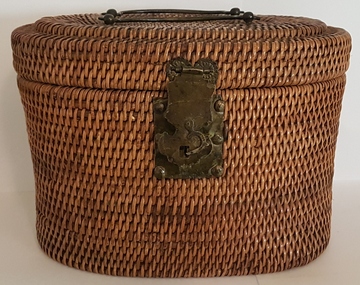
Tea set, Chinese tea set
... Shanghai where this basket and contents were purchased. Lewers family Tea sets Teapots Wicker basket with metal hinges, handles and clasp. Oval shape, lined with fabric. Contains china ...The Lewers family of Linton travelled to Shanghai where this basket and contents were purchased.Wicker basket with metal hinges, handles and clasp. Oval shape, lined with fabric. Contains china tea-pot decorated with flowers, birds and fruit. It has metal handles covered with red jute. With it are two china tea cups, decorated with birds, fruit and flowers.lewers family, tea sets, teapots -
 Wodonga & District Historical Society Inc
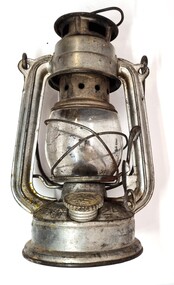
Domestic object - Kerosene Lantern
... The Chinese characters around the base translate to "Shanghai Guanghuaheng"....The Chinese characters around the base translate to "Shanghai Guanghuaheng". ...During the Victorian goldrushes of the 1850s thousands of Chinese migrants arrived to seek their fortunes. At that time many came to the lucrative gold fields of Northeast Victoria. After the Gold rush, many Chinese migrants returned home. However, a number settled in the area as merchants, hawkers and market gardeners in surrounding towns including Wodonga, the Ovens, King, Buffalo River and Kiewa Valleys. They also rented lands and established themselves in the hops and tobacco farming industries. Items of Chinese origin made their way into many households. Importation of Chinese mass produced items such as this lantern continued well into the 20th century and were common domestic items across Australia before households were connected to electricity.This item is representation of kerosene / paraffin lamps used throughout Australia to provide lighting inside and outdoors prior to the widespread availability of electricity.A small hurricane lamp with a rounded tank and small carry handle attached to the top. A larger handle is also attached at the top of the frame. It has a lever to open the glass tank. It has a metal base which is filled with kerosene. It has a screw knob to open the kerosene receptacle. The metal hood also has vents. The Chinese characters around the base translate to "Shanghai Guanghuaheng".Around base : Chinese characters. On top : "Made in China KWANG HWA"kerosene lamp, domestic appliances, chinese artefacts -
 Hymettus Cottage & Garden Ballarat
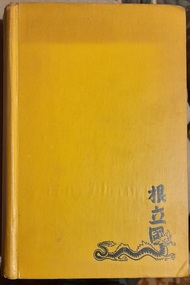
Work on paper - Book, Sky High to Shanghai
... Frank Clune China Nathan Spielvogel Travel Australian writers Inscribed on title page 'To Nathan Speilvogel with the authors compliments, Frank Clune Vaucluse 1/9/39' Sky High to Shanghai Work on paper Book ...non-fictionfrank clune, china, nathan spielvogel, travel, australian writers -
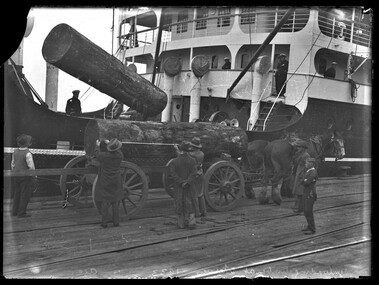 City of Melbourne Libraries
Photograph (item), Bull, Hugh Jones, 1897-1993, Unloading timber at Victoria Dock, 1933
... In 1948/49 the Chinese Civil War took place. The Taiping departed Shanghai on 26 January 1949 as one of the final vessels evacuating civilians from to Keelung Harbour in Taiwan. ...In 1948/49 the Chinese Civil War took place. The Taiping departed Shanghai on 26 January 1949 as one of the final vessels evacuating civilians from to Keelung Harbour in Taiwan. ...Photographer notations on slide: "Unloading Timber at Wharves 1933 Age B5" Published: Age (Melbourne, Vic.: 1854- ), Tuesday 15 August 1933 MAHOGANY FROM MANILA. (1933, August 15). The Age (Melbourne, Vic. : 1854 - 1954), p. 11. Retrieved January 16, 2026, from http://nla.gov.au/nla.news-article204377024 Published title: MAHOGANY FROM MANILA Published Caption: Age Tue 15 Aug 1933 Caption: Unloading Mahogany Logs brought from Manila, Philippine Islands, by the steamer Taiping, which berthed yesterday at Victoria Dock. The vessel discharged twenty logs, each weighing three tons, the first shipment of this type of timber landed in Melbourne. Research by Project Volunteer, Louise McKenzie: This photograph in many ways epitomises Melbourne in the 1930s. It is a time of enormous growth, development and change. But before delving into that, the photo itself is very powerful. The huge mahogany logs being unloaded appear to be so heavy that the ship itself seems to list to port as they are craned over the side. They are being levered into a cart to which two large and sturdy Clydesdale horses are hitched. In contrast to the traditional horses, the wharf is crisscrossed with modern railway tracks. Unloading is both mechanical and manual, and the scene is one of intense interest to a young boy bystander. The ship appears to be squat and solid, but the whole image also gives a feeling of movement and intensity. The mahogany being delivered to Melbourne would be intended for high quality furniture. In the 1930s Australia actually had a growing timber industry, but much of the eucalyptus wood was being utilised for mass produced furniture, and much of this furniture would then have had a veneer applied to it. The fact that it was economic to import this timber from the “Philippine Islands” – not a traditional trading market for Australia – reflects a Victorian economy that was strong enough to support a growing demand for good quality furniture Mahogany was described as a classic, strong hardwood, often used for dark opulent furniture. In the 1930s the importation of timber from Manila (Philippines) to Australia was a notable trade, particularly in Philippine Lauan (often referred to as Philippine Mahogany), which was used as a cheaper alternative to other hardwoods. 1930s furniture, dominated by the art deco style, used a mix of luxurious exotic woods like mahogany, macassar and ebony for high-end pieces, often veneered over less expensive woods such as walnut, birch and poplar, and with plywood, chrome and lacquer also popular for more practical, streamlined designs during the Depression era. By the mid 1930s timber mills were being relocated away from the immediate dock area, but the fact that these logs were being transported by horse-drawn cart implies that the load would not have had to be taken too far for milling. 1885 the Melbourne Harbour Trust Commissioners had decided that land in or near the city was far too valuable to be used as timber yards. Furthermore, large stacks of timber posed a fire risk. The Trust asked the Victorian Government to reserve a site on the east side of the Yarra River opposite Yarraville and Spotswood. Here, in 1889, the Trust began building six jetties and a wharf specifically for the landing of timber. Clydesdale horses were initially brought to Victoria from Tasmania in the 1830s, and with the 1850s gold rush they were imported direct from Scotland. Melbourne was from its earliest years an important centre of horse-breeding from both imported and colonial-bred stock, providing the well-built draught horse for pulling heavily loaded wagons, the harness horse for delivery work and drawing coaches, and the saddle-horse used for riding. Stud breeding facilities were advertised from the early 1840s. By the 1870s the horse export trade was thriving, and the Port of Melbourne was the country's busiest exporter of horses to Indian, Asian and New Zealand markets. Kirk's Melbourne Horse and Carriage Bazaar in Bourke Street first advertised for business in 1840, and by the 1850s Bourke Street West was famed for its horse bazaars and saleyards. The Victorian Clydesdale Horse Society reports that Clydesdale working horses were a vital part of Melbourne's infrastructure and agricultural industry in the 1930s, when they reached the peak of their popularity despite the increasing competition from mechanization. Their main roles and usage at this time were: • City Delivery: Clydesdales were a common sight for metropolitan deliveries, particularly for breweries (such as Carlton & United Breweries), milk runs, and bread deliveries. • Industrial Work: They were heavily used for hauling cargo at the docks, in construction, and at specialized sites like the Truganina Explosives Reserve, where they pulled wagons. • Agriculture: In surrounding rural areas, they were the primary power source for ploughing and agricultural machinery. • Specialization: By the 1930s, the Clydesdale was smaller and more compact than the Shire or Percheron breeds, making them ideal for navigation in urban environments. After the 1930s their numbers decreased due to the onset of WWI and mechanisation. Wartime petrol rationing led to a brief revival for the working horse, as suburban tradesmen, now used to motor delivery, took their old jinkers out of mothballs. By 1947, however, only 1.5% of city traffic was horse-drawn. In 1952 the large horse cartage company A. Kellet Pty Ltd sold its 250 horses and converted its Richmond stables to storage. In the 1950s at Station and Princes piers, wharf labourers refused to work with the six draught horses still being used to haul trolleys and which were soon superseded by the fork lift, semi-trailer and mobile crane. Where carefully trained horses had once shunted trains in city goods yards, a few hundred a week were now being killed at the abattoirs for pet and human consumption. The last MCC dray horse was withdrawn from service in 1958, but some of the few remaining working animals are used by the mounted police for crowd control at demonstrations and football games. The death knell had also sounded for the associated trades of farrier, saddler and blacksmith. Our photo, therefore, showing the wharf with both the haulage Clydesdales and the rail lines, is a strong visual summary of the social and economic changes experienced in Victoria in the 1930s and on towards the 1950s. Our photo is located at Victoria Dock (also known as Victoria Harbour) which is still an active component of Melbourne’s port system. In 1892 the West Melbourne Dock (later Victoria Dock) was opened, downstream and immediately west of the Spencer Street railway shunting yards. It contained a swing basin for ships, replacing the one which had been provided on the south side of the river, later to be the Duke and Orr dry dock, west of the Charles Grimes Bridge. Further west was the South Wharf along the river bank. The history of Victoria Dock is extremely well described by Ashley Smith in his 2 March 2022 article in Docklands News, and its accompanying aerial photo of the Dock taken in 1934. He writes: "In the early 1930s Victoria Dock was one of the biggest sites for trade and export in Melbourne. A constant queue of ships sailed in, unloaded their cargo, recharged and reloaded, then left for the next port. Around the time this photo was taken (found in a 1934 photo book), the trapezium-shaped basin had been through some changes since its construction in the 1890s. The 497-metre-long Central Pier, finished in 1919, now featured six sheds to house the ever-increasing volume of cargo. The entrance had also been widened in the 1920s to allow better access. Some of the berths featured three-ton jib electric cranes to help with loading cargo and a rail network connected to the State Railway service. By the time construction was completed, the dock was 39 hectares and hailed as the second-largest dock in the world (behind Cavendish Dock, Barrow-in-Furness). To further save costs, excavations were dug to a more reasonable seven metres below low water, instead of British engineer Sir John Coode’s recommended 8.3 metres. Even then, the costs were still around £900,000. It was envisaged, with the extra wharfage, that around thirty 90-metre ships could berth inside. On March 22, 1892, Victoria Dock was opened by Victoria’s Governor, the Earl of Hopetoun (later Australia’s first Governor-General) who opened the sluice to let the Yarra in. It took six days to fill the basin with The Leader newspaper estimating that it would take another six months to completely fill (March 26, 1892). In the end, it took nearly a year before the first ship was allowed to enter on February 20, 1893, when the steamer Hubbuck sailed in to unload 1200 tonnes of cargo in 15 hours. The Argus (February 23, 1893) reported that the ship’s captain, J. R. Brodie, called the Yarra “better than the Thames”, and compared Victoria Dock favourably to the Albert Dock (Liverpool)." This would be a good time to move our focus on to the Taiping, which is the transporter of these giant mahogany logs. The Taiping was a steel-hulled, single-screw passenger-cargo Chinese steamer, which today has the dubious legacy of being involved in a collision headlined as “The Chinese Titanic”. It was constructed by the Hong Kong and Shampoa Dock Company at its facility in Hong Kong, with completion in 1926 for service under the Australia Oriental Line. Her gross register tonnage measured 4,324 tons, reflecting her design for inter-island and coastal trade routes, accommodating both passengers and freight. She operated routes connecting Australian ports with East Asian destinations. As World War II approached, Taiping continued predominantly working the trade routes between China and Australia, until December 1941, when she evacuated women and children from Hong Kong to Manila just before Japanese forces overran the region. She then safely reached Australia despite enemy air raids. Taiping was then requisitioned by the Royal Navy and repurposed as a victualling stores issuing ship for the Eastern Fleet, supporting logistical needs in the Pacific and Indian oceans. Returned to the Australian Oriental Line in 1947, she underwent refitting and by mid-1948 was chartered to the Shanghai Shipping Company, and modified for greater passenger accommodation – approximately 500 passengers. In 1948/49 the Chinese Civil War took place. The Taiping departed Shanghai on 26 January 1949 as one of the final vessels evacuating civilians from to Keelung Harbour in Taiwan. Reports indicate that the Taiping carried double the rated capacity of passengers i.e. 1000. The ship carried families, military personnel, civilians, carrying personal belongings, gold and valuables in hope of resettlement in Nationalist Taiwan. It also held heavy cargo in the form of silver and gold bullion loaded by the Central Bank of China. Because of the risk of patrols, and to conserve fuel, the Captain took the ship away from the usual open-sea passage, and instead navigated along the coast. He also extinguished navigation lights to avoid detection. Shortly after midnight on 27 January 1949 the Taiping collided with the smaller cargo steamer Chien Yuan in the East China Sea near the Zhoushan Archipelago. The Chien Yuan was also operating in darkness. The subsequent collision was catastrophic. The Chien Yuan sank with in 5 minutes, with the loss of 72 of its 74 crew. The Taiping sustained severe structural compromise from the broadside strike and initially remained afloat, then made a swift descent into the freezing water, with no attempt at an organised evacuation. No formal recovery process was instigated, however a distress signal went out. 32 survivors were picked up by the Australian destroyer HMAS Warramunga (on patrol nearby), a passing US vessel found 2 more, and local Zhoushan fishermen retrieved others. In the end, only 37 people survived. The event is remembered as a poignant moment in the mass migration to Taiwan, with families tragically separated. A memorial to the disaster exists at the Keelung Harbour naval base on Taiwan. With its total of over 1,500 deaths, it constituted one of the worst peacetime maritime losses. It is sometimes referred to as the “Oriental Titanic” because of the similarly large loss of life and speed of demise with the RMS Titanic in 1912. A fictional depiction of this event appears in the John Woo movies “The Crossing (Part 1) (2014), and The Crossing II (2015), known in Chinese as “Taiping Wheel”. The narrative weaves a story around pre-disaster romances and wartime turmoil among passengers, culminating in the ship’s rapid sinking. “The production, a high-budget Sino-Taiwanese-Hong Kong co-effort, portrays the event as a microcosm of the 1940s Sino-Japanese and civil war legacies, though critics noted the melodramatic style prioritizing spectacle over historical precision.” In conclusion, it is nice to return to our photo, and observe the people involved in this moment. The dockworkers are, so typical of the 1930s, dressed in what looks to us like formal clothing – dark suits or coats, white shirts, and black hats. I am particularly drawn to the young boy, bare-headed, arms crossed, and so intent on the unloading process. He too is wearing a white shirt, black trousers and jacket, and black shoes. This is 1933 Melbourne – but the haircut he is sporting is now very “hipster” and modern in 2026 Melbourne. References: MAHOGANY FROM MANILA. (1933, August 15). The Age (Melbourne, Vic. : 1854 - 1954), p. 11. Retrieved January 30, 2026, from http://nla.gov.au/nla.news-article204377024 Wikipedia, Taiping steamer, https://en.wikipedia.org/wiki/Taiping_(steamer) Wikipedia, Victoria Dock, https://en.wikipedia.org/wiki/Victoria_Dock_(Melbourne) Docklands News, Ashley Smith, 2 Mar 2022, https://www.docklandsnews.com.au/victoria-dock/ Living Histories: Heritage Council of Victoria, Jill Barnard, 2008, Jetties and Piers, https://livinghistories.net.au/wp-content/uploads/2015/11/Jetties-ONL-intro_Part-1.pdf eMelbourne, Wharves and Docks, https://www.emelbourne.net.au/biogs/EM01612b.htm Australian Academy of Technological Sciences – Harvesting Wood, https://www.austehc.unimelb.edu.au/tia/225.html Old Treasury Building, On the Water – The Docks, https://tinyurl.com/3wkbk66m Old Treasury Building, On The Road, https://tinyurl.com/dw44yr3t Port of Melbourne, Victorian Places, https://www.victorianplaces.com.au/port-of-melbourne Docklands Heritage Study - Environmental History, https://mvga-prod-files.s3.ap-southeast-4.amazonaws.com/public/2024-05/docklands-heritage-review-thematic-environmental-history-1991.pdf eMelbourne, Horses, https://www.emelbourne.net.au/biogs/EM00723b.htm Victorian Clydesdale Horse Society, https://www.clydesdalesvic.org.au/history The Crossing, https://letterboxd.com/film/the-crossing-i/Photographer notations on slide: "Unloading Timber at Wharves 1933 Age B5"ships, shipping, timber industry, shipwrecks, horses, docks, wharves, 1930-1939, wars, docklands
