
Showing 55 items matching "ship’s band"
-
 Flagstaff Hill Maritime Museum and Village
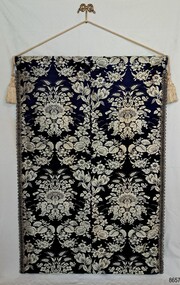
Textile - Wall Hanging, curtain, 1854-1855
... ship...migrant...emigrant...Liverpool to Australia...Captain James Nicol Forbes...James Forbes...Captain Forbes...Bully Forbes...James Baines & Co...James Baines...Cape Otway...Aberdeen...Prince of Waterloo...Wakefield...Cleopatra...Maria...Thomas Mackay...Black Ball line...Marco Polo...sailing record...Lightning...Isabella Jaffray Nocol...Blakiston Robinson...Alexander Hall...steamer Queen...Captain Helpman...James Lawrence...steamer Burra Burra...steamer jane Elizabeth...water police...customs agents...Lloyds agent...ship’s band...ship on the 30th due to rough and unsafe conditions. The officials and Captain Forbes voyaged to Melbourne, while the seamen remained behind awaiting rescue. Evacuation by sea became too risky, so on January 2, 1856, while the first Mate and Steward remained at the wreck site, the rest of the crew began the 70-mile march to Warrnambool, led by the band. ...ship on the 30th due to rough and unsafe conditions. The officials and Captain Forbes voyaged to Melbourne, while the seamen remained behind awaiting rescue. Evacuation by sea became too risky, so on January 2, 1856, while the first Mate and Steward remained at the wreck site, the rest of the crew began the 70-mile march to Warrnambool, led by the band. ...The striking fabric of this wall hanging was recovered from the sinking Schomberg. It was originally one of the many curtains adorning the captain’s cabin and ladies’ saloons that attracted first-class passengers to this luxury vessel, built for comfort and speed. The clipper ship was on its maiden voyage, full of passengers emigrating to Australia in 1855. Its commander was Captain James Nicol Forbes, who had been selected by James Baine & Co for his navigation skills, experience, and reputation for breaking sailing records. However, on December 26th, 1855, the vessel became stranded and sank west of Cape Otway, not quite reaching its destination of Melbourne. A reporter explored the Schomberg before its journey; the following detailed description is an excerpt of his article published in a newspaper after the disastrous voyage was announced. “ … descending by a flight of stairs, covered with carpet of a very rich pattern, we came to the saloon passengers’ cabin. This is a noble place, and all that refined taste would suggest has been done to make each berth a miniature palace. The bedding is of the very best material, and the fittings are replete with every convenience. The carpets are of various coloured velvet pile, and the curtains are of satin damask, lined with white satin … The fronts of the berths are highly decorated, and festoons of flowers are painted on the panels … No two berths are furnished with the same-coloured material … the visitor is, therefore, much pleased with the variety which he has to inspect….” (Trove: Shipping Gazette and Sydney General Trade, 31 Dec 1955, p. 283) The curtain material, ‘folded into a single piece and parcelled for protection’, has been passed down through generations of Captain Forbes’ relatives, starting with his half-sister Isabella Jeffrey Nicol. The curtain has remained with the family, although some transition details are incomplete. About a century later, Isabella and Blakiston Robinson’s great-grandson and his wife had the fabric professionally mounted as a wall hanging to showcase the beauty of the woven brocade. Eventually, the custodianship of the curtain was transferred to the donor, who is also a great-grandson of Isabella and Blakiston. He and his wife hung the curtain on the wall of a high-ceilinged room in their home, away from direct light, making it visible for all to appreciate its beauty and significance. In 2024, they donated the curtain for inclusion among the collection of artefacts that help tell the story of the Schomberg and those who sailed on its first and last voyage. The donor’s aunt was highly involved in the family’s history. She had collected and recorded information that dates back to pre-1341. A footnote included in a handwritten letter dated April 20, 1959, from the late Arthur William Rudd, OBE, MA, LLB, husband of another of the donor’s aunts, states, “The curtains you mentioned came from the Schomberg. AWR.” CAPTAIN JAMES NICOL FORBES (1821-1874) and the donor’s family: - Captain Forbes was born in Aberdeen. In his late teens, he moved to Liverpool, a hub for international trade and an emigration port. By the age of 25, he was master of the Prince of Waterloo and later, the Wakefield. He then commanded the Cleopatra for the James Baines Co., which, two years later, transferred him to command the Maria, providing fast and lucrative passage to the gold fields in Ballarat, Australia. James Baines Co. and shipbuilder Thomas Mackay formed the Black Ball Line of clipper ships in 1852. Forbes was appointed master of the largest ship in the fleet, the marvellous Marco Polo. He broke the record time for the passage to Australia, taking only 68 days at sea, and the return journey in only 76 days, a total of 5 months and 21 days. On his second voyage to Melbourne in the Marco Polo the following year, he took 75 days, and 95 days on the return trip. His accomplishment made him famous. James Baines reported that the Marco Polo was the only ship, sail or steam, to do the round trip within 6 months, and it had done it twice. Captain Forbes then took command of the American-built clipper Lightning, one of four built for the Black Ball line. His 19-year-old half-sister, Isabella Jaffray Nicol, was also onboard when he sailed for Melbourne in 1854. During the 77-day voyage, Isabella met Blakiston Robinson, and not long after the ship arrived in Melbourne on July 31, the couple married, with James Nicol Forbes as a witness, on August 16. When Forbes returned to Liverpool, he took a record-breaking 63 days, which has never been bettered. James Baines Co. ordered a new luxury emigrant ship from Alexander Hall of Aberdeen; the Schomberg was the largest sailing ship ever built in Britain. On October 6, 1855, the vessel departed Liverpool commanded by Captain Forbes, with 430 passengers on board, 54 of whom were First Class. It had almost completed its voyage to Melbourne when, on the night of December 26, it ran aground west of Cape Otway. Captain Doran, master of the steamer Queen, responded to the distress signal while on its way to Portland and, with the agreement of his passengers, rescued as many as possible from the Schomberg and returned to Melbourne with them. Captain Helpman, master of the steamer Champion, rescued most of the remaining Schomberg passengers on December 27. On Friday, 28th, Captain James Lawrence was on his way to Adelaide in the steamer Burra Burra, and called past the Schomberg. He reported that the remaining crew were all doing their duties, but the Schomberg was deteriorating on a sand spit and had about 16 feet of water in its hold. That same day, the schooner Jane Elizabeth collected 220 packages of passengers’ luggage to deliver to Melbourne on the 29th. Two steamers also arrived on the 29th with 20 men to collect passengers’ luggage and valuable ship’s cargo items. They were accompanied by water police, customs agents, company representatives and a Lloyds agent. The decision was made to abandon ship on the 30th due to rough and unsafe conditions. The officials and Captain Forbes voyaged to Melbourne, while the seamen remained behind awaiting rescue. Evacuation by sea became too risky, so on January 2, 1856, while the first Mate and Steward remained at the wreck site, the rest of the crew began the 70-mile march to Warrnambool, led by the band. They arrived on January 5th and left for Melbourne on the steamer Champion on January 10th. Parts of the Schomberg wreck ended up in New Zealand. The curtain is important for its connection to the Schomberg, which was unique for being designed and built in Aberdeen, and commanded by an Aberdonian who was the most celebrated clipper captain of the age. The ship was the largest sailing ship ever built in Britain, and reported as the largest vessel that sailed to Australia. The curtain is an example of the rich decorative furnishings available in 1855. The preservation and respect the donor and his family have shown towards the curtain over many decades reflect its important role in telling the family’s history; the journey, the romantic attachment, the family connection to the sea, and travel in gold rush times. The curtain is significant for its connection to James Nocol Forbes, a famous sailing ship commander who broke several sailing records, one of which has never been bettered. This wall hanging, also known as the Schomberg Curtain, was created from a curtain recovered from the stranded luxury ship Schomberg in December 1855. The woven satin damask fabric in blue and cream has been meticulously joined to blend the intricate pattern. The reverse features a soft cream lining. The hems at the top and bottom of the fabric hold wooden rods. The side edges feature decorative braid that has been hand-stitched in place. On the reverse, the bottom hem includes the same braid, which remains unseen from the front, and the centre of the top hem has a hand-worked, unused buttonhole. Each of the hems varies in depth. The curtain was tastefully mounted later to highlight the beauty of the original saloon curtain. A decorative twisted cord of cream silk threads, accented with gold highlights and decorative tassels, was coiled and attached to the ends of the top rod. The elegant display was completed with an ornate gold hook, chosen to complement the wall hanging.flagstaff hill maritime museum and village, great ocean road, shipwreck coast, shipwreck artefact, memorabilia, curtain, saloon curtain, schomberg, wall hanging, decorative object, domestic item, warrnambool, flagstaff hill, maritime museum, maritime village, maritime history, shipwreck, stranding, schomberg curtain, schomberg wall hanging, luxury ship, 1855, damask, silk damask, blue and cream, captain’s cabin, ladies’ saloon, clipper ship, migrant, emigrant, liverpool to australia, captain james nicol forbes, james forbes, captain forbes, bully forbes, james baines & co, james baines, cape otway, aberdeen, prince of waterloo, wakefield, cleopatra, maria, thomas mackay, black ball line, marco polo, sailing record, lightning, isabella jaffray nocol, blakiston robinson, alexander hall, steamer queen, captain helpman, james lawrence, steamer burra burra, steamer jane elizabeth, water police, customs agents, lloyds agent, ship’s band, walk to warrnambool, march to warrnambool, steamer champion, agnes nicol robinson, arthur william rudd obe ma llb -
 National Vietnam Veterans Museum (NVVM)
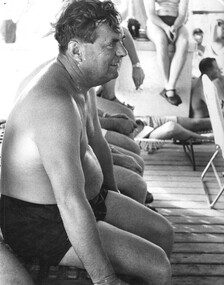
Photograph, Gibbons, Denis, Capt Nobby Clarke
... A black and white photograph of the Captain of the Vung Tau Ferry, HMAS Sydney, Capt "Nobby" Clarke enjoys a jazz concert given by the ship' band as the Sydney makes its way towards Vietnam, carryng the Royal Australian Regiments' youngest Battalion, 9RAR for Woodside, South Australia....Photograph Vung Tau Ferry HMAS Sydney Capt Nobby Clarke 9 RAR Gibbons Collection Catalogue Entertainment Jazz Concert Royal Australian Regiment Denis Gibbons A black and white photograph of the Captain of the Vung Tau Ferry, HMAS Sydney, Capt "Nobby" Clarke enjoys a jazz concert given by the ship' band as the Sydney makes its way towards Vietnam, carryng the Royal Australian Regiments' youngest Battalion, 9RAR for Woodside, South Australia. ....Denis Gibbons (1937 – 2011) Trained with the Australian Army, before travelling to Vietnam in January 1966, Denis stayed with the 1st Australian Task Force in Nui Dat working as a photographer. For almost five years Gibbons toured with nine Australian infantry battalions, posting compelling war images from within many combat zones before being flown out in late November 1970 after sustaining injuries. The images held within the National Vietnam Veterans Museum make up the Gibbons Collection. A black and white photograph of the Captain of the Vung Tau Ferry, HMAS Sydney, Capt "Nobby" Clarke enjoys a jazz concert given by the ship' band as the Sydney makes its way towards Vietnam, carryng the Royal Australian Regiments' youngest Battalion, 9RAR for Woodside, South Australia.photograph, vung tau ferry, hmas sydney, capt nobby clarke, 9 rar, gibbons collection catalogue, entertainment, jazz concert, royal australian regiment, denis gibbons -
 Dandenong/Cranbourne RSL Sub Branch
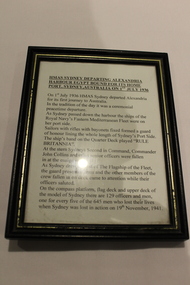
Document - Framed Information Sheet
... Sailors with rifles and bayonets formed a guard of honour, while the ships band played "Rule Britannia'....Sailors with rifles and bayonets formed a guard of honour, while the ships band played "Rule Britannia'. Framed information sheet on H.M.A.S Sydney from 1936. ...The information sheet describes the departure of H.M.A.S Sydney from Alexandria Harbour bound for it's home Port, Sydney, Australia on 1st July 1936. Sailors with rifles and bayonets formed a guard of honour, while the ships band played "Rule Britannia'.Framed information sheet on H.M.A.S Sydney from 1936. Black and Gold frame. -
 Warrnambool and District Historical Society Inc.
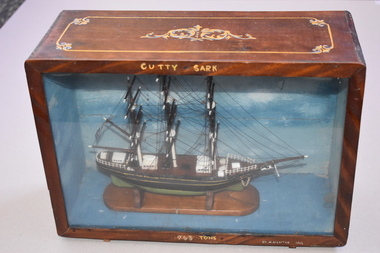
Model Boat, H. Richter, Cutty Sark, 1964
... This is the model of a three-masted ship with a hull painted in green and black with gold bands. The ship is mounted on a wooden stand and enclosed in a wooden box with a glass front. ...Richter Family, Warrnambool Model Boat Building ‘Cutty Sark 963Tons by H Richter 1964’ This is the model of a three-masted ship with a hull painted in green and black with gold bands. The ship is mounted on a wooden stand and enclosed in a wooden box with a glass front. ...The Cutty Sark sailing ship was a popular model-making ship. It was a British clipper ship built originally for the China- England tea trade and was one of the last and fastest tea clippers. From 1883 to 1895 it was used to carry wool from Australia to England and held many records for speed during that time. Since 1954 the ship has been on display at Greenwich, England. The model has an etched inscription indicating that it was made by Herman Richter and so it is presumed that he was the maker of this model. A model of the Cutty Sark was made by his father, Edward Richter using wood from the Enterprise wrecked in Lady Bay and that model was in the old Warrnambool Museum. This information was in a newspaper article at the time of Edward Richter’s death. This Herman Richter model may be a copy of his father’s model. The Richters have been prominent in Warrnambool’s history, beginning with Henry Richter who came to Warrambool in the 1850s and worked in the Western Brewery and was licensee of the Royal Archer Hotel. His son Edward who died in 1937 was a prominent Warrnambool resident for 78 years. Herman, the son of Susan and Edward Richter was well-known as a model boat maker and maker of model boats in bottles.This model boat is of great interest because the ‘Cutty Sark’ was a well-known sailing ship and was important in Australia’s maritime history as a carrier to London of Australian wool in the 1880s and 90s. It is also of interest as it was made by a member of the Richter family, a prominent one in Warrnambool’s history with both Edward and his son Herman Richter producing many artefacts connected to Warrnambool’s history – model ships, violin-making, maritime paintings etc. This is the model of a three-masted ship with a hull painted in green and black with gold bands. The ship is mounted on a wooden stand and enclosed in a wooden box with a glass front. The box is varnished and has ornamental patterns in gold and blue on the top and sides. The inside of the box is painted blue and white to represent the sea and the sky.‘Cutty Sark 963Tons by H Richter 1964’richter family, warrnambool, model boat building -
 Flagstaff Hill Maritime Museum and Village
Container - Barrel, 19th to early 20th centuries
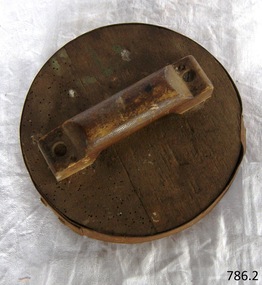
... bands. Only the top and base remain. Barrels with outward tapering bases are balanced and stable. Barrels contain a wide range of contents, both liquid and dry, from wines and spirits to cement. Ships...bands. Only the top and base remain. Barrels with outward tapering bases are balanced and stable. Barrels contain a wide range of contents, both liquid and dry, from wines and spirits to cement. Ships ...The original barrel was tapered outwards from top to base. It had three iron bands. Only the top and base remain. Barrels with outward tapering bases are balanced and stable. Barrels contain a wide range of contents, both liquid and dry, from wines and spirits to cement. Ships have used barrels as shipping containers for cargo. Specially made rope slings were used to move the barrels to and from the ships by rope blocks and cranes. A huge quantity of cement was brought to Warrnambool in barrels to construct the Breakwater, which was completed in 1890.This parts of a wooden barrel represent the containers used for cargo imported from England into Australia in the 19th and early 20th centuries. As an example, the vessel Edinburgh Castle was wrecked in Lady Bay, Warrnambool, in 1888. The cargo onboard was a consignment of casks, or barrels of cement for the construction of Warrnambool’s new Breakwater, which was completed in 1890. Barrel; remnants of a tapered wooden barrel that once had three iron bands and removable top with heavy wooden handle. Only the lid remains. flagstaff hill, warrnambool, maritime museum, maritime village, great ocean road, shipwreck coas, barrel, cask, cooper, cargo, coopering, storage -
 Flagstaff Hill Maritime Museum and Village
Container - Barrel, 19th century
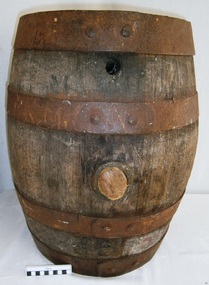
... Ships transported bulk liquor in their cargo, stored in wooden barrels. The barrels' round shape allowed them to be easily moved by rolling them into place. The body's shape gave the barrels added strength and the iron bands...Ships transported bulk liquor in their cargo, stored in wooden barrels. The barrels' round shape allowed them to be easily moved by rolling them into place. The body's shape gave the barrels added strength and the iron bands ...This small barrel looks well used. Unfortunately, the inscription on the barrel is indecipherable so its story is a mystery. However, the bungholes on the side are a clue that it was once used for storing liquid, likely to have been liquor. Barrels have been used over many centuries for transporting and storing a wide range of dry and liquid goods. They are made by tradesmen called coopers, who use heat and steam to bend and shape the wood to suit the work in hand. They add metal reinforcing, handles, spouts and suchlike, to complete they process. Their produce also includes buckets, casks and tubs. Ships transported bulk liquor in their cargo, stored in wooden barrels. The barrels' round shape allowed them to be easily moved by rolling them into place. The body's shape gave the barrels added strength and the iron bands helped the wooden sheaves stay in place. The tops and bottoms allowed for easy grip. The bungholes gave access to government representatives, who would sample the contents, measure the alcohol percentage, and charge the appropriate duty or tax; the process was called Ullaging and the instrument they used was a Hydrometer. Hundreds of barrels of cement were imported into Warrnambool in the late 19th century for the construction of the Warrnambool Breakwater. Barrel-shaped concrete blocks are still visible at shipwreck sites such as on the LOCH ARD wreck, which carried cement among its cargo.This small barrel is representative of 19th century containers used for transportation and storage of liquid such as liquor. It is a historic shape that is still used in modern times.Barrel; wooden barrel, cylindrical shape with metal bands or ribs for reinforcement. The side has two bungholes; one has a bung or stopper. Inscription on top (indecipherable). (indecipherable)flagstaff hill, warrnambool, shipwrecked-coast, flagstaff-hill, flagstaff-hill-maritime-museum, maritime-museum, shipwreck-coast, flagstaff-hill-maritime-village, barrel, cask, small barrel, trade, coopering, cooper, casket, transport, storage, bunghole -
 Flagstaff Hill Maritime Museum and Village
Equipment - Lifebuoy, Loch Ness, 1869-1909
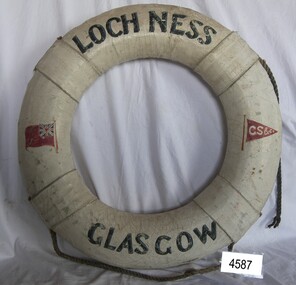
... ship (the red flag with the Union Jack on it). Lifebuoys were part of the emergency lifesaving equipment carried on vessels in the late 19th and early 20th century. The ring was made of strips of cork wood joined together to make the ring shape then covered in canvas and sealed usually with white paint. Four evenly spaced canvas reinforcing bands...ship (the red flag with the Union Jack on it). Lifebuoys were part of the emergency lifesaving equipment carried on vessels in the late 19th and early 20th century. The ring was made of strips of cork wood joined together to make the ring shape then covered in canvas and sealed usually with white paint. Four evenly spaced canvas reinforcing bands ...This lifebuoy bears the name of the ship, its origin, the shipping company and the red ensign. These details mean that the lifebuoy was part of the lifesaving equipment on the sailing ship the Loch Ness, part of the Glasgow Shipping Company’s Loch Line (G.S.C. on the red pennant) and a British-registered ship (the red flag with the Union Jack on it). Lifebuoys were part of the emergency lifesaving equipment carried on vessels in the late 19th and early 20th century. The ring was made of strips of cork wood joined together to make the ring shape then covered in canvas and sealed usually with white paint. Four evenly spaced canvas reinforcing bands would be added for strength and for a place to thread a rope or line. A lifebuoy, or life-preserver, is used as a buoyancy device often thrown to an endangered or distressed person in the water to keep them afloat while they receive help. It is usually connected by a rope to a person in a safe area such a nearby vessel or on shore. Lifebuoys is a made from a buoyant materials such as cork or foam and ae usually covered with canvas for protection and to make it easy to grip. The first use of life saving devices in recent centuries was by the Nordic people, who used light weight wood or cork blocks to keep afloat. Cork lifebuoys were used from the late 19th to early 20th century. Kapok fibre was then used as a filling for buoys but wasn’t entirely successful. Light weight balsa wood was used as a filler after WW1. In 1928 Peter Markus invented and patented the first inflatable life-preserver. By WW2 foam was combined with Kapok. Laws were passed over time that has required aeroplanes and water going-vessels to carry life-preservers on board. The ship LOCH NESS 1869-1922 … The ship Loch Ness, of Glasgow, was the same ship what William Carmichael sailed on to Australia when he laid the commemoration stone on behalf of his sister Eva and himself, dedicated to their parents, brothers and sisters. The family members lost their lives on June 1, 1878, when their ship, the Loch Ard, was wrecked at Mutton Bird Island in south west Victoria. Eva Carmichael was one of the two survivors from that shipwreck, the other 52 tragically lost their lives. The ship Loch Ness was a three-masted sailing ship built in 1869 for the Loch Line owned by the Glasgow Shipping Company. The line transported cargo and passengers from Glasgow, Scotland, to Australian ports. The Loch Ness was sold in 1908 to Stevedore & Shipping Co, Sydney for use as a coal hulk. In 1914 the Australian Government took over the ship for naval defence purposeless. In 1926 the ship was sunk during gunfire practice by the 1922 built, light cruiser HMAS Melbourne, near Fremantle, Western Australia. The lifebuoy is an example of equipment carried on vessels in the late 19th and early 20th century to help preserve life. There were many lives lost in Australia’s colonial period, particularly along the coast of South West Victoria. The lifebuoy is significant for its connection to the ship Loch Ness on which William Carmichael, brother of Eva Carmichael, travelled to lay a memorial to their parents and all of their other siblings who lost their lives in the Loch Ard disaster of 1878 near Peterborough, Victoria. Lifebuoy, round, cork filling inside canvas cover, painted white, with rope attached. Lifebuoy has printed name of vessel Loch Ness, Glasgow. Symbols of red flag with white initials G S Co. There is also a red ensign."LOCH NESS", "GLASGOW" "G S Co"flagstaff hill, warrnambool, shipwrecked-coast, flagstaff-hill, flagstaff-hill-maritime-museum, maritime-museum, shipwreck-coast, flagstaff-hill-maritime-village, loch ness, loch ard, william carmichael, eva carmichael, lifebuoy, glasgow sailing ship, loch ness of glasgow, life rings, safety ring, life-saving buoy, ring buoy, life preserver, personal floating device, floatation device, safety equipment, g s c, glasgow shipping company, hmas melbourne, cruiser melbourne -
 Federation University Historical Collection
Photograph - Black and White, Frank Wright stands beside a ships wheel
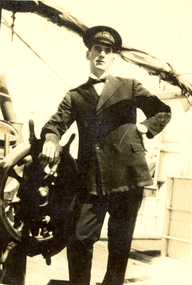
... Band Championships around Europe, in Australia, including South Street and in New Zealand. The Frank Wright Medal at the Royal South Street competition is awarded to an individual recognized as making an outstanding contribution to brass music in Australia. frank wright A black and white photo of a man in a suit, cap and bow tie leaning on a ship's wheel. ...Frank Wright was a renown resident of Smeaton, where he was born. He lived at Laura Villa, and attended Smeaton State School. His father William was a gold miner and his mother's name was Sarah. Their family won many singing and instrumental awards. Frank was tutored by Percy Code and was awarded a gold medal for the highest marks in the ALCM examinations in the British Colonies at the age of seventeen years. He became the Australian Open Cornet Champion by the age of eighteen. A year later, Frank conducted the City of Ballarat Band, and later the Ballarat Soldiers’ Memorial Band. He formed the Frank Wright Frisco Band and Frank Wright and his Coliseum Orchestra. These bands won many South Street awards, and Frank as conductor won many awards in the Australian Band Championship contest. In 1933 Frank Wright sailed to England to conduct the famous St Hilda’s Band and was later appointed Musical Director of the London County Council, where he organized many amazing concerts in parks, in and around the London district. He was made Professor of Brass and Military Band Scoring and conducted at the Guildhall of Music and Drama. Frank was often invited to adjudicate Brass Band Championships around Europe, in Australia, including South Street and in New Zealand. The Frank Wright Medal at the Royal South Street competition is awarded to an individual recognized as making an outstanding contribution to brass music in Australia.A black and white photo of a man in a suit, cap and bow tie leaning on a ship's wheel. The man is Frank Wright.frank wright -
 Federation University Historical Collection
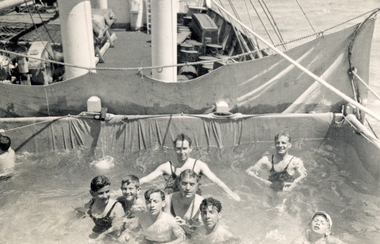
Photograph - Black and White, Swimming Bath on 'Remo', Red Sea, 1940, Jan 1940
... Band Championships around Europe, in Australia, including South Street and in New Zealand. The Frank Wright Medal at the Royal South Street competition is awarded to an individual recognized as making an outstanding contribution to brass music in Australia. frank wright ship named remo red sea swimming bath swimming pool conductor Written in pencil on the back - Swimming bath on 'Remo' Red Sea, Jan 1940, F.W. in centre Black and white photograph of a group of people swimming in a canvas pool on board a ship. ...Frank Wright was a renown resident of Smeaton, where he was born. He lived at Laura Villa, and attended Smeaton State School. His father William was a gold miner and his mother's name was Sarah. Their family won many singing and instrumental awards. Frank was tutored by Percy Code and was awarded a gold medal for the highest marks in the ALCM examinations in the British Colonies at the age of seventeen years. He became the Australian Open Cornet Champion by the age of eighteen. A year later, Frank conducted the City of Ballarat Band, and later the Ballarat Soldiers’ Memorial Band. He formed the Frank Wright Frisco Band and Frank Wright and his Coliseum Orchestra. These bands won many South Street awards, and Frank as conductor won many awards in the Australian Band Championship contest. In 1933 Frank Wright sailed to England to conduct the famous St Hilda’s Band and was later appointed Musical Director of the London County Council, where he organized many amazing concerts in parks, in and around the London district. He was made Professor of Brass and Military Band Scoring and conducted at the Guildhall of Music and Drama. Frank was often invited to adjudicate Brass Band Championships around Europe, in Australia, including South Street and in New Zealand. The Frank Wright Medal at the Royal South Street competition is awarded to an individual recognized as making an outstanding contribution to brass music in Australia.Black and white photograph of a group of people swimming in a canvas pool on board a ship. Behind the pool can be seen part of the ship and water to the right. The ship is the Remo, the place is the Red Sea and the man in the middle of the group is Frank Wright.Written in pencil on the back - Swimming bath on 'Remo' Red Sea, Jan 1940, F.W. in centrefrank wright, ship named remo, red sea, swimming bath, swimming pool, conductor -
 Federation University Historical Collection
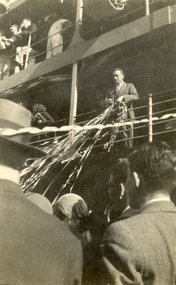
Photograph - Photograph - Black and White, Herald, Frank Wright departing Australia, 1933, 5/8/1933
... The Frank Wright Medal at the Royal South Street competition is awarded to an individual recognized as making an outstanding contribution to brass music in Australia. frank wright cornet conductor ballarat st hilda's band herald balranald port melbourne .1) Printed on back - Post Card, Kodak Handwritten in pencil on back - Frank Wright, Taken by Herald photographer when boat ("Balranald") was leaving Port Melbourne for London, Aug 5th 1933 Stamped on back - An indistinct "Copyright Herald ..." stamp .1) Black and white photograph of the torso of a man wearing a suit, leaning against ship's railing and holding streamers. ...Frank Wright was a renown resident of Smeaton, where he was born. He lived at Laura Villa, and attended Smeaton State School. His father William was a gold miner and his mother's name was Sarah. Their family won many singing and instrumental awards. Frank was tutored by Percy Code and was awarded a gold medal for the highest marks in the ALCM examinations in the British Colonies at the age of seventeen years. He became the Australian Open Cornet Champion by the age of eighteen. A year later, Frank conducted the City of Ballarat Band, and later the Ballarat Soldiers’ Memorial Band. He formed the Frank Wright Frisco Band and Frank Wright and his Coliseum Orchestra. These bands won many South Street awards, and Frank as conductor won many awards in the Australian Band Championship contest. In 1933 Frank Wright sailed to England to conduct the famous St Hilda’s Band and was later appointed Musical Director of the London County Council, where he organized many amazing concerts in parks, in and around the London district. He was made Professor of Brass and Military Band Scoring and conducted at the Guildhall of Music and Drama. Frank was often invited to adjudicate Brass Band Championships around Europe, in Australia, including South Street and in New Zealand. The Frank Wright Medal at the Royal South Street competition is awarded to an individual recognized as making an outstanding contribution to brass music in Australia..1) Black and white photograph of the torso of a man wearing a suit, leaning against ship's railing and holding streamers. The man is Frank Wright and the ship is 'Balranald'. .2) Black and white photograph of two levels of the side of a ship with passengers standing at the railings. In the middle distance is a man leaning against the railing, holding streamers and in the foreground are the backs of a crowd of men. The man is Frank Wright and the ship is 'Balranald'..1) Printed on back - Post Card, Kodak Handwritten in pencil on back - Frank Wright, Taken by Herald photographer when boat ("Balranald") was leaving Port Melbourne for London, Aug 5th 1933 Stamped on back - An indistinct "Copyright Herald ..." stampfrank wright, cornet, conductor, ballarat, st hilda's band, herald, balranald, port melbourne -
 Flagstaff Hill Maritime Museum and Village
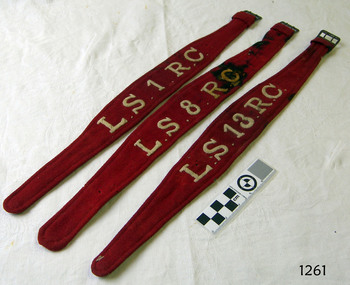
Uniform - Arm Bands, c. 1860s
... ship...rocket apparatus rescue...stranded vessel...line throwing mortar...mortar...rocket rescue apparatus...line thrower...line throwing...Lifeboat Warrnambool...Arm band...Flagstaff Hill Maritime Museum and Village Flagstaff Hill Maritime Museum Maritime Village Warrnambool Great Ocean Road Lady Bay Warrnambool Harbour Port of Warrnambool Tramway Jetty Breakwater shipwreck life-saving lifesaving rescue crew rescue rocket rescue rocket crew lifeboat men beach rescue line rescue rescue equipment rocket firing equipment rocket rescue equipment maritime accidents shipwreck victim rocket equipment Marine technology rescue boat lifeboat volunteer lifesavers volunteer crew life saving rescue crew lifesaving rescue crew rocket apparatus rocket rescue method shore to ship rocket apparatus rescue stranded vessel line throwing mortar mortar rocket rescue apparatus line thrower line throwing Lifeboat Warrnambool Arm band armband scarlet arm band L.S.R.C. ...Members of the Life Saving Rescue Crew would wear scarlet arm bands such as these as part of their uniform, with each member having a different number. The crew would work as a team to haul in the victims of the shipwreck. The leader of the crew would call out one or several member's numbers to give them a break during the rescue, while other members took their place. All members would then be relieved at some time during the rescue. Saving lives in Warrnambool – The coastline of South West Victoria is the site of over 600 shipwrecks and many lost lives; even in Warrnambool’s Lady Bay there were around 16 known shipwrecks between 1850 and 1905, with eight lives lost. Victoria’s Government responded to the need for lifesaving equipment and, in 1858, the provision of rocket and mortar apparatus was approved for the lifeboat stations. In 1859 the first Government-built lifeboat arrived at Warrnambool Harbour and a shed was soon built for it on the Tramway Jetty, followed by a rocket house in 1864 to safely store the rocket rescue equipment. In 1878 the buildings were moved to the Breakwater (constructed from 1874-1890), and in 1910 the new Lifeboat Warrnambool arrived with its ‘self-righting’ design. For almost a hundred years the lifesaving and rescue crews, mostly local volunteers, trained regularly to rehearse and maintain their rescue skills. They were summoned when needed by alarms, gunshots, ringing bells and foghorns. In July 1873 a brass bell was erected at Flagstaff Hill specifically to call the rescue crew upon news of a shipwreck. Some crew members became local heroes but all served an important role. Rocket apparatus was used as recently as the 1950s. Rocket Rescue Method - Rocket rescue became the preferred lifesaving method of the rescue crews, being much safer that using a lifeboat in rough seas and poor conditions. The Government of Victoria adopted lifesaving methods based on Her Majesty’s Coast Guard in Great Britain. It authorised the first line-throwing rescue system in 1858. Captain Manby’s mortar powered a projectile connected to rope, invented in 1808. The equipment was updated to John Dennett’s 8-foot shaft and rocket method that had a longer range of about 250 yards. From the 1860s the breeches buoy and traveller block rocket rescue apparatus was in use. It was suspended on a hawser line and manually pulled to and from the distressed vessel carrying passengers and items. In the early 1870s Colonel Boxer’s rocket rescue method became the standard in Victoria. His two-stage rockets, charged by a gunpowder composition, could fire the line up to 500-600 yards, although 1000 yards range was possible. Boxer’s rocket carried the light line, which was faked, or coiled, in a particular way between pegs in a faking box to prevent twists and tangles when fired. The angle of firing the rocket to the vessel in distress was measured by a quadrant-type instrument on the side of the rocket machine. Decades later, in about 1920, Schermuly invented the line-throwing pistol that used a small cartridge to fire the rocket. . The British Board of Trade regularly published instructions for both the beach rescue crew and ship’s crew. It involved setting up the rocket launcher on shore at a particular angle, determined by the Head of the crew and measured by the quadrant, inserting a rocket that had a light-weight line threaded through its shaft, and then firing it across the stranded vessel, the line issuing freely from the faking board. A continuous whip line was then sent out to the ship’s crew, who hauled it in then followed the instructions – in four languages - on the attached tally board. The survivors would haul on the line to bring out the heavier, continuous whip line with a tail block connected to it. They then secured the block to the mast or other strong part the ship. The rescue crew on shore then hauled out a stronger hawser line, which the survivors fixed above the whip’s tail block. The hawser was then tightened by the crew pulling on it, or by using the hooked block on the shore end of the whip and attaching it to a sand anchor. The breeches buoy was attached to the traveller block on the hawser, and the shore crew then used the whip line to haul the breeches buoy to and from the vessel, rescuing the stranded crew one at a time. The rescue crew wore scarlet, numbered armbands and worked on a numerical rotation system, swapping members out to rest them. This set of scarlet arm bands is significant for its connection with local history, maritime history and marine technology. Lifesaving has been an important part of the services performed from Warrnambool's very early days, supported by State and Local Government, and based on the methods and experience of Great Britain. Hundreds of shipwrecks along the coast are evidence of the rough weather and rugged coastline. Ordinary citizens, the Harbour employees, and the volunteer boat and rescue crew, saved lives in adverse circumstances. Some were recognised as heroes, others went unrecognised. In Lady Bay, Warrnambool, there were around 16 known shipwrecks between 1850 and 1905. Many lives were saved but tragically, eight lives were lost.Arm bands; three scarlet flannel arm bands with black cotton backing and a metal buckle on one end. White cotton embroidery forms letters and numbers, with each arm band having a different number. Part of the uniform of the Life Saving and Rescue Crew.Embroidered on front "L.S. 1 R.C." "L.S. 8 R.C." "L.S. 13 R.C." flagstaff hill maritime museum and village, flagstaff hill, maritime museum, maritime village, warrnambool, great ocean road, lady bay, warrnambool harbour, port of warrnambool, tramway jetty, breakwater, shipwreck, life-saving, lifesaving, rescue crew, rescue, rocket rescue, rocket crew, lifeboat men, beach rescue, line rescue, rescue equipment, rocket firing equipment, rocket rescue equipment, maritime accidents, shipwreck victim, rocket equipment, marine technology, rescue boat, lifeboat, volunteer lifesavers, volunteer crew, life saving rescue crew, lifesaving rescue crew, rocket apparatus, rocket rescue method, shore to ship, rocket apparatus rescue, stranded vessel, line throwing mortar, mortar, rocket rescue apparatus, line thrower, line throwing, lifeboat warrnambool, arm band, armband, scarlet arm band, l.s.r.c., lsrc, red arm band -
 Flagstaff Hill Maritime Museum and Village
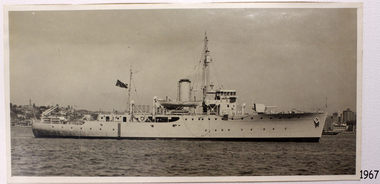
Photograph - Vessel, Steam Ship, H.M.A.S. Warrnambool J202, 1941-1947
... Lifeboat suspended above deck in centre of ship. Top of funnel has a black band. ...Lifeboat suspended above deck in centre of ship. Top of funnel has a black band. H.M.A.S. Warrnambool J202 Photograph Vessel, Steam Ship Australia Queensland ...This photograph is connected to the first HMAS Warrnambool J202, which was commissioned by the Royal Australian Navy for use as a minesweeper during World War II. The Bathurst Class Corvette, fitted out with a range of armaments, was launched in Sydney 1941. The ship began service in Bass Strait in 1941. At the end of the year it called into its namesake city, Warrnambool, where the crew paraded for the public marching eastwards along Timor Street. A gift of books for the ship’s personnel and a plaque bearing the City of Warrnambool’s Coat of Arms were presented to the ship. The ship was involved in evacuating a family of nine from the Dutch East Indies that was later successful in its challenge of Australia’s Immigration Restriction Act (White Australia Polity). The ship had many other appointments around Australia. On 13th September 1947 HMAS Warrnambool was leading a flotilla of minesweepers in northern Queensland’s coastal waters, clearing mines previously laid to defend Australia. The ship hit a mine, which exploded and very quickly sunk the ship. Boats from the nearby ships rescued most of the seamen although one was killed at the time. The survivors were taken by the HMAS Swan II to Darwin, and they went from there to hospitals in Brisbane and Sydney. Three of these men later died from their injuries. A number of items were recovered by Navy divers in 1948 including the ship’s bell and a plaque with Warrnambool’s Coat of Arms. In 1972-75 the wreck was sold and other items were salvaged. In 1995 a memorial plaque was erected in Warrnambool near the RSL. NOTE: The RAN built a second HMAS Warrnambool FCPB204, launched in 1981 and decommissioned in 2005. There was also a steam ship SS Warrnambool built in London 1892 and broken up in 1926. [A more detailed history can be found in our Collection Record 3477.] This photograph is significant for its association with Royal Australian Navy and its vessel, HMAS Warrnambool (j202). The HMAS Warrnambool played a nationally significant role in overturning Australia’s Immigration Restriction Act 1901 (colloquially known as the White Australia policy). The ship rescued, and brought to Australia, Samuel and Annie Jacob and their family after they evacuated Dutch East India. The family was threatened with deportation and made the first successful appeal to High Court regarding that Act. The HMAS Warrnambool has - Local significance for being the namesake of the City of Warrnambool - Local significance, having docked in Warrnambool Harbour - Local significance, the crew having paraded in Timor Street, Warrnambool - State significance for its first patrol being in Bass Strait. - National significance, being present in Timor at the Japanese surrender - National significance as part of Australia’s defence force history, being one of only four Bathurst class corvettes lost while in Australian service, the only Bathurst class corvette lost after World War II, the only RAN vessel to be sunk by a mine, and associated with the last four Navy deaths of WWIIPhotograph, black and white, HMAS Warrnambool J202 in water with land and buildings in background. Ship is flying a dark flag with Union Jack in corner and star below it. Lifeboat suspended above deck in centre of ship. Top of funnel has a black band. flagstaff hill, warrnambool, shipwrecked-coast, flagstaff-hill, flagstaff-hill-maritime-museum, maritime-museum, shipwreck-coast, flagstaff-hill-maritime-village, maritime village, maritime museum, shipwreck coast, mort's dock & engineering co ltd, h.m.a.s. warrnambool, hmas warrnambool, hmas warrnambool i, hmas warrnambool j202, hmas swan ii, j202, world war ii, bathurst class corvette, royal australian navy, ran, sydney built ship, bass strait patrol, sea mine patrol, mine sweeper, mine clearance, navy divers, great barrier reef, cockburn reef, southern cross diving and salvage, warrnambool city council, cr j r astbury, mayor j r astbury, warrnambool patriotic fund, seal, coat of arms, ship’s bell, hmas warrnambool 1941, shipwreck by sea mine 1947, sinking ship, sunk ship, sea rescue, life saving, lifesaving, minesweeper -
 Flagstaff Hill Maritime Museum and Village
Accessory - Diamond ring, about 1855
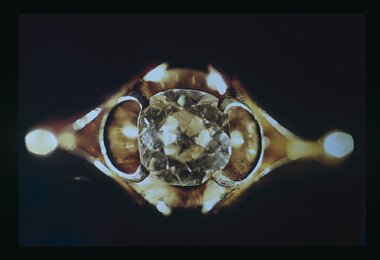
... band emerged. Further treatment exposed a 'large faceted stone in an intricate gold setting. Weeks later a detailed examination estimated the value of the ring, known as the Schomberg Diamond, to be $7000. When the Schomberg was launched in 1855, she was considered the "Noblest” ship...band emerged. Further treatment exposed a 'large faceted stone in an intricate gold setting. Weeks later a detailed examination estimated the value of the ring, known as the Schomberg Diamond, to be $7000. When the Schomberg was launched in 1855, she was considered the "Noblest” ship ...In 1975, 120 years after the sailing ship Schomberg was wrecked, Flagstaff Hill divers (Peter Ronald, Colin Goodall and Gary Hayden) found an ornate communion set amongst the wreckage. The set comprised a jug, ciborium, lid, chalice and plate. The items, apart from the lid, were then displayed at Flagstaff Hill Maritime Village. The lid had etchings that did not match the chalice and sat in storage for several years. Then in 1978, while the marine concretion inside the lid was being examined, a surface layer came loose and revealed a glint of gold that was assumed to be a piece of brass. The layers of concretion were carefully removed and a ring-like band emerged. Further treatment exposed a 'large faceted stone in an intricate gold setting. Weeks later a detailed examination estimated the value of the ring, known as the Schomberg Diamond, to be $7000. When the Schomberg was launched in 1855, she was considered the "Noblest” ship that ever floated on the water. Schomberg's owners, the Black Ball Line had commissioned the ship for their fleet of passenger liners. She was built by Alexander Hall of Aberdeen at a cost of £43,103 and constructed with 3 skins. One planked fore and aft and two diagonally planked, fastened together with screw-threaded trunnels (wooden rails). Her First Class accommodation was simply luxurious with velvet pile carpets, large mirrors, rosewood, birds-eye maple and mahogany timbers throughout, soft furnishings of satin damask, an oak-lined library with a piano. Overall she had accommodation for 1000 passengers. At the launch, the Schomberg's 34-year-old master, Captain 'Bully' Forbes, had promised to reach Melbourne in sixty days stating, "with or without the help of God." Captain James Nicol Forbes was born in Aberdeen in 1821 and rose to fame with his record-breaking voyages on the famous Black Ball Line ships; Marco Polo and Lightning. In 1852 in the Marco Polo, he made the record passage from London to Melbourne in 68 days. Unfortunately there were 53 deaths on the voyage, but the great news was off the record passage by Captain Forbes. In 1854 he took the clipper “Lighting” to Melbourne in 76 days and back in 63 days, this record was never beaten by a sailing ship. He often drove his crew and ship to breaking point to beat his previous records. He cared little for the comfort of the passengers. On this, the Schomberg's maiden voyage, he was determined to break existing records. Schomberg departed Liverpool on her maiden voyage on 6th October 1855 flying a sign that read "Sixty Days to Melbourne". She departed with 430 passengers and 3000 tons cargo including iron rails and equipment intended to build the Melbourne to Geelong Railway and a bridge over the Yarra from Melbourne to Hawthorn. She also carried a cow for fresh milk, pens for fowls and pigs, 90,000 gallons of water for washing and drinking. She also carried 17,000 letters and 31,800 newspapers. The ship and cargo were insured for $300,000 a fortune for the time. The winds were poor as she sailed across the equator, slowing Schomberg's journey considerably. Land was first sighted on Christmas Day, at Cape Bridgewater near Portland, Captain Forbes followed the coastline towards Melbourne. Forbes was said to be playing cards when called by the third mate Henry Keen, who reported land about 3 miles off. Due in large part to the captain's regarding a card game as more important than his ship, it eventually ran aground on a sand spit near Curdie's Inlet (about 56 km west of Cape Otway) on 26th December 1855, 78 days after leaving Liverpool. The sand spit and the currents were not marked on Forbes's map. Overnight, the crew launched a lifeboat to find a safe place to land the ship’s passengers. The scouting party returned to Schomberg and advised Forbes that it was best to wait until morning because the rough seas could easily overturn the small lifeboats. The ship’s Chief Officer spotted the SS Queen at dawn and signaled the steamer. The master of the Queen approached the stranded vessel and all of Schomberg’s passengers and crew disembarked safely. The Black Ball Line's Melbourne agent sent a steamer to retrieve the passengers' baggage from the Schomberg. Other steamers helped unload her cargo until the weather changed and prevented the salvage teams from accessing the ship. Later one plunderer found a case of Wellington boots, but alas, all were for the left foot. Local merchants Manifold & Bostock bought the wreck and cargo but did not attempt to salvage the cargo still on board the ship. They eventually sold it on to a Melbourne businessman and two seafarers. In 1864 after two of the men drowned when they tried to reach Schomberg, salvage efforts were abandoned. In 1870, nearly 15 years after the wreck parts of the Schomberg had washed ashore on the south island of New Zealand. The wreck now lies in almost 9 meters of water and although the woodwork is mostly disintegrated the shape of the ship can still be determined due to the remaining railway irons, girders and the ship’s frame. A variety of goods and materials can be seen scattered about nearby. The actual lid in which the ring was found has not yet been completely identified and could belong to a coffee pot, sugar bowl or maybe a jug or something similar. Although all survived the wreck no-one came forward to claim the valuable diamond. The Schomberg Diamond is currently on display in the Great Circle Gallery. Flagstaff Hill Maritime Village along with the rest of the communion set. Other artefacts salvaged from the wreck include ship fittings and equipment, personal effects, a lithograph, tickets and photographs from the Schomberg. One of the Schomberg bells is in the Warrnambool Library.The Schomberg Diamond is particularly significant in that it played a crucial part in having the legislation changed to protect shipwrecks, with far tighter control over the salvaging of items from wreck sites. This ring is registered as Artefact S/105 in the Schomberg collection, the Schomberg collection as a whole is of historical and archaeological significance at a State level. Flagstaff Hill’s collection of artefacts from the Schomberg is also significant for its association with the Victorian Heritage Registered shipwreck (VHR S 612). The collection is of prime significant because of the relationship between the objects salvaged, as together they help us to interpret the story of the Schomberg. The collection as a whole is historically significant for representing aspects of Victoria's maritime history and its potential to interpret social and historical themes. A mid-Victorian gentleman's solitaire diamond dress ring with a Brazilian cut diamond (cushion cut), one and one-third carat set within an 18 carat yellow gold ring consisting of four claws within an open scroll setting and a divided scroll shank. Colour is classified as 'J', clarity SII. The setting is handmade. warrnambool, shipwrecked-coast, flagstaff-hill, flagstaff-hill-maritime-museum, maritime-museum, shipwreck-coast, flagstaff-hill-maritime-village, schomberg, shipwrecked-artefact, clipper ship, black ball line, 1855 shipwreck, aberdeen clipper ship, captain forbes, peterborough shipwreck, ss queen, ciborium, ring, schomberg-diamond, schomberg-ring, gentleman's ring, dress ring -
 Flagstaff Hill Maritime Museum and Village
Craft - Ship Model, pre 1963
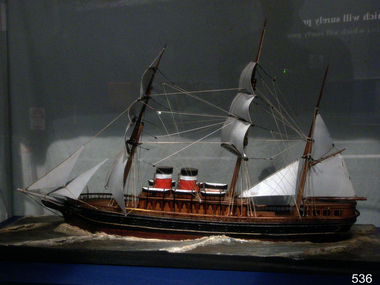
... ship model...steam vessel...model making...handmade...Red with narrow white band...Warrnambool Shipwreck Coast Flagstaff Hill Flagstaff Hill Maritime Museum Flagstaff Hill Maritime Village ship model steam and sail vessel handcrafted ship model steam vessel model making handmade Red with narrow white band below black top. red shite and black funnel Allan Shipping Line steam and sail ship two funnels wooden sailing shipo three-masted ship Ship model; steamship and sail vessel in use around the 1860s. ...The funnel colours on the model indicate the ship it represents was one of the early ships of the Allan shipping Line designated as a Royal Mail Carrier. Funnel colours are used to identify a ship's owners while at sea from a distance by other vessels. The Allan Shipping Line was started in 1819, by Captain Alexander Allan of Saltcoats, Ayrshire, trading and transporting between Scotland and Montreal Canada, a route which quickly became synonymous with the Allan Line. By the 1830s the company had offices in Glasgow, Liverpool and Montreal, with all of Captain Allan's five sons actively involved with the business. But his second son, Sir Hugh Allan, spearheaded the second generation. In 1854, Hugh launched the Montreal Ocean Steamship Company as part of the Allan Line, and two years later ousted Samuel Cunard to take control of the Royal Mail contract between Britain and North America. By the 1880s, the Allan Line was the world's largest privately owned shipping concern. In 1891, the company took over the State Line, founded in 1872, and was often referred to as the Allan & State Line. In 1897, Andrew Allan amalgamated the various branches of the Allan shipping empire under one company, Allan Line Steamship Company Ltd., of Glasgow. The company by then had added offices in Boston and London. In 1917, under Sir Montagu Allan, who represented the third generation of the Allan family, the company was purchased by Canadian Pacific Steamships, and by the following year, the Allan name had disappeared from commercial shipping. The Allan Line fleet had evolved for decades, changing as new ships were added, lost at sea, sold, or scrapped. The model in Flagstaff Hill's collection could be the SS Canadian or Indian; both were early Allan steam packets that had helped the Allan company secure the Royal Mail Atlantic contract in 1856.The model is of a Royal Mail steamship, with the probability the original ship was owned by the Allan Shipping Line in the mid-19th century and primarily used for the Atlantic mail run between England and Canada. Given the funnel colours and ship design, the model could be the SS Canadian or the Indian; both were the first ships for the company. The Allen line became the most successful shipping company of the time used for emigration and the transporting of mail.Ship model; steamship and sail vessel in use around the 1860s. Handcrafted model steamship with twin funnels painted black, white and red and three masts with square-rigged sails. The ship model is mounted on a gold-painted board. The ship was donated with a fitted wooden case.warrnambool, shipwreck coast, flagstaff hill, flagstaff hill maritime museum, flagstaff hill maritime village, ship model, steam and sail vessel, handcrafted ship model, steam vessel, model making, handmade, red with narrow white band below black top., red shite and black funnel, allan shipping line, steam and sail ship, two funnels, wooden sailing shipo, three-masted ship -
 Mission to Seafarers Victoria
Plaque - Memorial plaque, Graham Stewart Martin, 1983
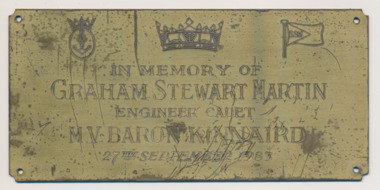
... band. After completion of his school education, Graham was accepted as an apprentice engineering officer by the Scottish Ship Management who ran a fleet of bulk carriers. ...band. After completion of his school education, Graham was accepted as an apprentice engineering officer by the Scottish Ship Management who ran a fleet of bulk carriers. ...Graham was born in 1962 in Glasgow, Scotland. He grew up in the south side of Glasgow and became an active member of the Boys Brigade, progressing through the different sections to eventually gain the organisation's highest award, the Queens Badge. During these years Graham became a proficient bugler and trumpeter, taking part in many nationwide competitions as part of the company band. After completion of his school education, Graham was accepted as an apprentice engineering officer by the Scottish Ship Management who ran a fleet of bulk carriers. After training at the Glasgow Nautical College he then went to sea, firstly on the MV Baron Napier and subsequently the MV Baron Kinnaird, the ship he was on when he travelled to Australia. On the 27th November 1983, there were parties throughout Australia to celebrate the winning of The Americas Cup yacht race, Melbourne was no exception and Graham and several colleagues went ashore to join in. During the celebrations, Graham climbed up some scaffolding to get a better view but a girder became disloged and he fell to the ground and was struck by the falling girder. He died shortly after despite the best efforts of the ambulance crews. Graham's body was returned home to Glasgow and a cremation service took place in the Linn Crematorium near where he lived and grew up. Money was donated by the ship's crew and officer and sent to the Mission (Reverend Chin) to purchase an engraved plaque in his memory. The plaque was mounted on a bench used as coffee table. In January 2025, Alain, his former girlfriend visited the Mission to view the plaque.The Mission is a place of memorial for seafarers.Rectangular brass plaque, on top 3 logos: Merchant Navy, Merchant Navy crown and flag of the SSM (Scottish Ship Management)Engraved: In Memory of / Graham Stewart Martin / Engineer Cadet / MV Baron Kinnaird / 27th September 1983graham stewart martin, engineer cadet, m.v. baron kinnaird, scottish ship management, ssm, 1983, america's cup, bench -
 Mission to Seafarers Victoria
Booklet - Music Score, The 'M.N.' Ships Get Through, 1942
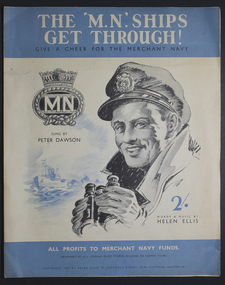
... Front cover with blue band at top and lower edge features the Merchant Navy insignia at top left with depiction in half tone blue of a Merchant ship convoy and at right a sketched depiction of head and shoulders of a Merchant Navy officer with binoculars in hand. ...Front cover with blue band at top and lower edge features the Merchant Navy insignia at top left with depiction in half tone blue of a Merchant ship convoy and at right a sketched depiction of head and shoulders of a Merchant Navy officer with binoculars in hand. ...A song composition by Helen Ellis, of Kew, first known to have been performed in 1942 at the BBC for the 'Shipmates Ashore Programme it was then published 1943. A copy of this song and one other composition the composer Helen Ellis is held by the National Library of Australia. Promotional text also indicates that the song was performed by the notable Australian singer Peter Dawson. The song "The M.N. ships get through" carries an important acknowledgement of the oft forgotten vital role of the Merchant Navy as carrier of goods and supplies, and especially so in wartime. The publication is of special significance to the MTSV as an example of the many skilled and creative women who have supported the Missions to seafarers.Commercially printed single fold music score for a 2 verse song and chorus. Front cover with blue band at top and lower edge features the Merchant Navy insignia at top left with depiction in half tone blue of a Merchant ship convoy and at right a sketched depiction of head and shoulders of a Merchant Navy officer with binoculars in hand. Music score and full text printed on p.2 and 3. The back cover features text of chorus and a handwritten notation in blue ink with reference to performance of the song on a BBC programme, 'Shipmates Ashore'.Back cover-handwritten notation in blue ink: "Sung by Raymond ?(indecipherable) in the B.B.C. London / 'Shipmates Ashore' programme,1942." This inscription is found after the printed sample of chorus words accredited to Helen Ellis, Central Club, Victoria, Mission to Seamen. See images for design and printing.peter dawson, music, sheet-music, composers australia, merchant navy, mn, helen ellis, ww2, shipmates ashore, bbc, 1942 -
 Mission to Seafarers Victoria
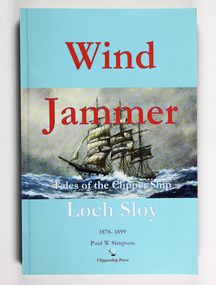
Book, Paul W. Simpson, Wind jammer : tales of the clipper ship Loch Soy : 1878 - 1899, 2016
... bands above and below the picture. Back covers is portion of a period photograph of the Loch Soy. Wind jammer : tales of the clipper ship Loch Soy : 1878 - 1899 Book Book Paul W. ...“The Loch Soy was built for Aitken, Liburn & Co of Glasgow. She sailed between Britain and Australia for more than twenty years. In that time she established a reputation as a crack wool clipper. … The clipper lasted twenty one years before coming to grief on the jagged shore of Kangaroo Island during the predawn hours of April 24th 1899 ...”--Back cover. Contains biographical information. Includes bibliographical references (pages 407-420) and index.Softcover Book, 442 Pages, Apps 1-9, Bibliography and Index, by Paul W Simpson. Front cover depicts the vessel in question in rough seas (oil painting), wide blue horizontal bands above and below the picture. Back covers is portion of a period photograph of the Loch Soy.non-fiction“The Loch Soy was built for Aitken, Liburn & Co of Glasgow. She sailed between Britain and Australia for more than twenty years. In that time she established a reputation as a crack wool clipper. … The clipper lasted twenty one years before coming to grief on the jagged shore of Kangaroo Island during the predawn hours of April 24th 1899 ...”--Back cover. Contains biographical information. Includes bibliographical references (pages 407-420) and index.clipper, loch, jammer, shipwreck, simpson, kangaroo island, loch sloy ship, wool, transportation -
 Flagstaff Hill Maritime Museum and Village
Equipment - Lifebuoy
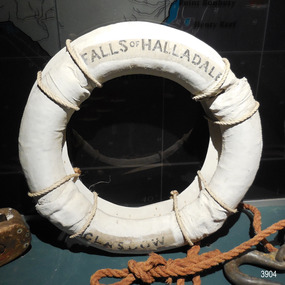
... This lifebuoy is part of the lifesaving equipment from the sailing ship the Falls of Halladale. It is filled with cork and covered with canvas and reinforcing bands. ...This lifebuoy is part of the lifesaving equipment from the sailing ship the Falls of Halladale. It is filled with cork and covered with canvas and reinforcing bands. ...This lifebuoy is part of the lifesaving equipment from the sailing ship the Falls of Halladale. It is filled with cork and covered with canvas and reinforcing bands. The name of the ship and its origin is printed on the lifebuoy. It has been sealed with several coats of white paint. A lifebuoy, or life-preserver, is used as a buoyancy device to keep a person afloat in the. It is usually connected by a rope to a person in a safe area such a nearby vessel or on shore. The lifebuoy is thrown to a person in distress in the water, allowing the rescuer to pull the person to safety. The lifebuoy is a made from a buoyant material such as cork or rubber and is usually covered with canvas for protection and to make it easy to grip. The first use of life saving devices in recent centuries was by the Nordic people, who used light weight wood or cork blocks to keep afloat. From the early 20th century Kapok fibre was used as a filling for buoys. Light weight balsa wood was used as a filler after WW1. In 1928 Peter Markus invented and patented the first inflatable life-preserver. By WW2 foam was combined with Kapok. Laws were passed over time that has required aeroplanes and water going-vessels to carry life-preservers on board. The Falls of Halladale 1886-1908 The vessel ‘Falls of Halladale’ was a four-masted iron-hulled barque, launched in July 1886, by Russell & Co of Greenock, Scotland and owned by the Glasgow Falls Line, which named its ships after Scottish waterfalls. The ship was built for long distance cargo trade. The Falls of Halladale was one of the last windjammers that sailed the Trade Route. The ship was on its way from New York to Melbourne via the Cape of Good Hope when, after 102 days at sea, its journey suddenly ended. During the night of November 14, 1908, in calm seas with some coastal fog, an ocean swell raised the vessel up then let it down on a submerged reef wrecked at Curdies Inlet, Peterborough. The ship was stranded and the Port Campbell Rocket Crew were sent for, to perform a rescue. However by the time they arrived, all on board had already travelled by lifeboat to the nearby beach at the Bay of Islands. The sight of the slowly disintegrating ship on the rocks attracted many sightseers. This lifebuoy is significant for its association with the famous ship the Falls of Halladale. It is significant for its association with lifesaving equipment used on board vessels in the early 20th century. The Falls of Halladale shipwreck is listed on the Victorian Heritage Register (No. S255). She was one of the last ships to sail the Trade Routes. She is one of the first vessels to have fore and aft lifting bridges. She is an example of the remains of an International Cargo Ship and also represents aspects of Victoria’s shipping industry. The wreck is protected as a Historic Shipwreck under the Commonwealth Historic Shipwrecks Act (1976).Lifebuoy; round white canvas ring, joined with hand stitching. Stencil with inscription is printed in black on first and third quadrant. The canvas has been repainted in white but avoiding the inscription in the lifebuoy. A hanging board for display is attached with white rope. Lifesaving equipment from the Falls of Halladale.“FALLS OF HALLADALE” “GLASGOW”flagstaff hill, warrnambool, shipwrecked coast, flagstaff hill maritime museum, maritime museum, shipwreck coast, flagstaff hill maritime village, great ocean road, life rings, lifebuoy, safety ring, life-saving buoy, ring buoy, life preserver, personal floating device, floatation device, safety equipment, falls of halladale, glasgow falls line, rocket crew, lifeboat, peterborough -
 Flagstaff Hill Maritime Museum and Village
Functional object - Ship's Wheel
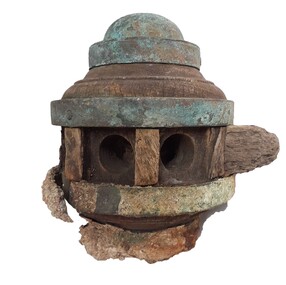
... ship's wheel. It once had eight spokes but only portions of four spokes remain. The outer centres of the hub and the reinforcing bands around the hub are brass. ...ship's wheel. It once had eight spokes but only portions of four spokes remain. The outer centres of the hub and the reinforcing bands around the hub are brass. ...This wooden ship's wheel originally had eight spokes but four are no longer in their sockets. One of the spokes has been shaped. Both sides of the wheel have a brass cap over the centre of the hub, covering the wooden hub. The wood is split and cracked, and parts of it have small holes, a sign of being affected by the sea worm. Thick encrustations are on parts of the wheel, showing that it has been on the sea bed for quite some time. The donor is a Warrnambool resident. Years ago he was cray fishing at King Island, which is in Bass Strait, northwest of Tasmania. His craypot got stuck in a reef so a diver helped him by retrieving the craypot for him. While the diver was underwater he also stumbled across the ship's wheel, which he gave to the donor. The Bass Strait is a very narrow route that was difficult and dangerous to navigate in the early 19th century, before good maps, communications and lighthouses were installed. The area, including King Island, is the graveyard of many ships that almost made it to their destination of Melbourne along Australia's treacherous coastline. Around King Island alone, many ships and lives were lost. There is no information about the history of this ship's wheel. Its condition shows that the item has been under the water for a long time. However, there is no evidence that it came from a shipwreck. It could even have been an old ship that could have been scuttled or destroyed as it was no longer useful. The wheel is significant as a sign of shipping around King Island. It is part of the island's history, and of maritime history. It is an example of an item manufactured by hand.Ship's wheel; segment of a wooden ship's wheel. It once had eight spokes but only portions of four spokes remain. The outer centres of the hub and the reinforcing bands around the hub are brass. The wheel is heavily encrusted in parts. It was recovered from an unknown shipwreck in the waters of King Island.great ocean road, warrnambool, shipwreck artefact, artefact, ship's wheel, ship's wheel segment, portion of a ship's wheel, flagstaff hill, maritime museum, maritime village, flagstaff hill divers, marine technology, navigation, steering wheel, eight spoke wheel, king island, craypot, diver -
 Flagstaff Hill Maritime Museum and Village
Equipment - Ship's Bell, Loch Ard
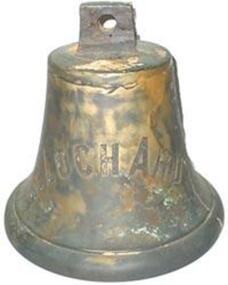
... Ship's bell: a cast bell of metal alloy - lead, bronze and copper. It has a square flat head with a central hole, a flat head, a band at the shoulder and waist, and a rounded sound bow. ...Flagstaff Hill Maritime Museum and Village Great Ocean Road Shipwreck Coast flagstaff hill warrnambool maritime museum loch ard loch ard gorge victorian heritage register ship bell ship's bell Loch Ard bell marine equipment signal alarm marinter's watch shipwreck artefact shipwreck discovery "LOCH ARD" Ship's bell: a cast bell of metal alloy - lead, bronze and copper. It has a square flat head with a central hole, a flat head, a band at the shoulder and waist, and a rounded sound bow. ...This Loch Ard ship's bell was kindly loaned by Heritage Victoria. The Loch Ard was an 85-metre, three-masted square-rigged iron clipper that sank in bad weather after hitting Mutton Bird Island, near Port Campbell, on June 1, 1878, just days after completing its three-month journey from Britain. Loch Ard carried some of the finest items that 19th-century Europe had to offer, intended for display at Melbourne’s International Exhibition in 1880. Before the modern age, a ship’s bell was one of the most important functional objects on a ship, used to regulate the daily routine of life, sound the time, and to signal watches and emergencies to everyone on board. The Loch Ard Bell is made of lead, bronze and copper alloy, and weighs 33 kg. It is missing its clapper. The bell disappeared after being recovered from the wreck in the 1960s, and reappeared in November 2003 when it was soon returned to Heritage Victoria staff. Ship bells are used for time-keeping, with codes to signify every half-hour and the fourth hour, to mark the time to change the watch or shift. They are also used in emergencies, to warn of fire and other danger, and to alert nearby vessels of their presence, especially in poor weather. Ship bells are usually cast or engraved with the ship’s name and often its launch date. If time allowed during an imminent disaster, seamen would save the ship’s bell, but if the ship sank, its bell would be searched for by those who discovered the wreck, as proof of the ship’s identification. Some ships, such as the famous luxury sailing ship Schomberg, had two bells: the main deck bell and a small bell used in the pilot house. The location of another bell from the Loch Ard is currently unknown. Sometime after the initial salvaging of the wreckage of the Loch Ard, a ship's bell for the Loch Ard was washed up. It was used for several years to summon men to meals at Glenample homestead, where part-owner Hugh Gibson and his family had previously sheltered the Loch Ard survivors, Tom Pearce and Eva Carmichael, as they recovered. Gibson's business partner, Peter McArthur, purchased Gibson's share of the property in 1887. In 1942, the Princetown A.R.P. (Air Raid Precautions, part of the World War 2 Air Raid Warden Service) and Observation group accepted the offer of the Loch Ard Bell from Mrs R.E. McArthur of Glenample homestead, for sounding an air raid alarm. Mrs McArthur was the daughter-in-law of Peter McArthur, and the mother of Colin McArthur, who had then inherited Glenample. Since then, the bell's whereabouts is unclear.Ship's bell: a cast bell of metal alloy - lead, bronze and copper. It has a square flat head with a central hole, a flat head, a band at the shoulder and waist, and a rounded sound bow. It no longer has its clapper. The surface is uneven and discoloured, and a vertical split has been mended at some stage. This ship's name has been cast into the bell's body. The bell was recovered from the wreck of the sailing ship Loch Ard in 1967, and is on loan from Heritage Victoria. "LOCH ARD"flagstaff hill maritime museum and village, great ocean road, shipwreck coast, flagstaff hill, warrnambool, maritime museum, loch ard, loch ard gorge, victorian heritage register, ship bell, ship's bell, loch ard bell, marine equipment, signal, alarm, marinter's watch, shipwreck artefact, shipwreck discovery -
 Glenelg Shire Council Cultural Collection
Costume - Ships Painters Goggles, c. 1890
... Pair of wire mesh ships painters goggles with cloth band (c.1890's)...Pair of wire mesh ships painters goggles with cloth band (c.1890's) Costume Ships Painters Goggles ...National Trust of W.A.Pair of wire mesh ships painters goggles with cloth band (c.1890's) -
Glenelg Shire Council Cultural Collection
Plan - Ship Plan / Mould, n.d
... band, for top of mast. Two cylinders attached to one another, bottom cylinder has 6 short spokes, evenly placed around circumference. Painted orange, white base. Plan Ship ...Wooden pattern for mould for boat fitting. Spider band, for top of mast. Two cylinders attached to one another, bottom cylinder has 6 short spokes, evenly placed around circumference. Painted orange, white base. -
 Orbost & District Historical Society
ticket, 1880's
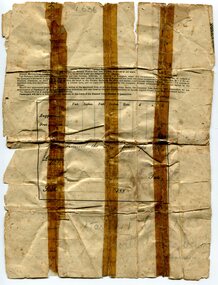
... He was also a member of the first municipal band. lynn-samuel potosi-steamship front - signed "Samuel Lynn" A paper passenger's contract ticket for Samuel Lynn on the Steam Ship Potosi from Royal Albert Dock, Liverpool, United Kingdom to Melbourne, Australia. ...The Potosi was built in Scotland in 1873 by John Elder and Co.It was a cargo/passenger iron screw steamer and sailed from 1880-1887 under the Orient Line Australia service. Samuel James Lynn was born in 1865 in Coleraine, Northern Ireland. Sam left his home in Coleraine in 1883 at the age of 17. (More information in O.D.H.S. newsletter No. 91 September, 2012 by Margaret Hollands) Samuel Lynn was a well-known Orbost pioneer. Ho owned much property throughout the district , bred Clydesdale horses and fattened about 600 cattle. He was in great demand as a judge of both cattle and horses at agricultural shows in Victoria and interstate. He was a shire councillor for 30 years and president several times. He took a great interest in the sporting clubs of the town and played cricket until late in life. He was goal umpire for the local football team for many years, judged for the Orbost Racing Club and was the first president of the Orbost Bowls Club. He was also a member of the first municipal band. A paper passenger's contract ticket for Samuel Lynn on the Steam Ship Potosi from Royal Albert Dock, Liverpool, United Kingdom to Melbourne, Australia. It is white with black print and hand-written details.front - signed "Samuel Lynn"lynn-samuel potosi-steamship -
 Flagstaff Hill Maritime Museum and Village
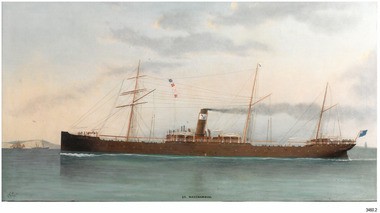
Photograph - Vessel, Sail and Steam Ship, S.S. Warrnambool
... Ship Building Company for the Lund Line of London, founded by William Lund in 1869, and registered in London. It efficiently carried passengers and cargo worldwide, including Australia, under its master, Captain Joshua Edward Ilbery, who had many years of experience with the Lund’s Blue Anchor Line, or BAL, which owned a fleet of sail and steamships. The funnels its steamships were painted black, with a white band...Ship Building Company for the Lund Line of London, founded by William Lund in 1869, and registered in London. It efficiently carried passengers and cargo worldwide, including Australia, under its master, Captain Joshua Edward Ilbery, who had many years of experience with the Lund’s Blue Anchor Line, or BAL, which owned a fleet of sail and steamships. The funnels its steamships were painted black, with a white band ...This photograph and a matching earlier photograph are images of a 1989 oil-on-canvas painting owned by the donor. They show the British sail and steam ship SS Warrnambool at Dover Strait in the English Channel. Each photograph was accompanied by a letter, one written in 2001 and the other in 2003, confirming that the artist of the painting was by Charles Keith Miller, signed with his initials “CKM” and dated “1893”. The images show the ship’s home flag with a diagonal blue anchor flying from the masthead. The same symbol is painted on the ship’s black funnel. The signal flags on the foremast display ‘M’ ‘R’ ‘V’ ‘B’, with each flag signalling a meaning in the International Code of Signals. While the SS Warrnambool was visiting Melbourne on its maiden voyage on December 1, 1892, a painting of that Lind Line ship by marine artist C.K. Miller was presented to the Town Council of Warrnambool by Mr. William Lund of London, owner of the Lind Line, or Blue Anchor Line. At that time, the Ladies of Warrnambool presented the ship with a ‘house’ flag bearing the Blue Anchor Line’s symbol, made by them especially for the occasion during the preceding moth. On December 6, the homeward bound ship anchored for a short time off the Port of Warrnambool, and a boat was launched from Lady Bay to take a group of friends to the ship with a delivery of gifts. After three cheers each for the ship and its Captain the SS Warrnambool continued its journey towards Britain via Adelaide. Although the painting was gifted in December 1892, it is post-dated “1893”. The reason for the discrepancy is unclear but whatever the reason, the provenance of the painting was confirmed at auctions of this painting and other works by the same artist. CHARLES KEITH MILLER 1836-1907:- Captain Charles Miller left his home in Scotland at the age of 15 years for a life at sea. He earned his Master’s Certificate ten years later. After being the captain of sailing ships, he moved to the steamships because they were faster. He married in 1866 and settled in Glasgow. Over the following eleven years, he and his wife had five children, then sadly, his wife passed away. Captain Miller returned to the sea for a while, but in 1888, he gave up his sea life to spend his time as a marine artist. His understanding of seafaring life and vessels, combined with his artistic skills, enabled him to produce fine art, and several galleries and museums have collections of his sought-after works. S.S. WARRNAMBOOL 1892-1925:- The sail and steamship SS Warrnambool was built in 1892 by the Sunderland Ship Building Company for the Lund Line of London, founded by William Lund in 1869, and registered in London. It efficiently carried passengers and cargo worldwide, including Australia, under its master, Captain Joshua Edward Ilbery, who had many years of experience with the Lund’s Blue Anchor Line, or BAL, which owned a fleet of sail and steamships. The funnels its steamships were painted black, with a white band around the top bearing a diagonal blue anchor and chain, also shown on the company’s house flag. The Lund Line ships were given Australian place names beginning with the letter “W”. Master Mariner, Captain Joshua Ilbery, was lost at sea without a trace in 1909, along with the ship SS Waratah. The ‘no frills’ service carried passengers and cargo to and from Europe around the Cape of Good Hope, stopping at various ports. The ship was involved in bringing home returned soldiers in 1895. At one time, it carried a doctor from Victoria, Australia, to assist at the war front in South Africa. The ship had a very good reputation for its cargo arriving almost always in excellent condition. Exported goods from Australia included iron safes, flour, wool, apples, frozen rabbits, butter, cheese, pork, cattle, poultry and sheep. One remarkable delivery contained Ostriches for Queen Victoria, and they survived the journey well. The SS Warrnambool was sold in 1900 to the British and South American Steam Navigation Co. Ltd of Liverpool and was renamed ‘Harmodius’. R.P. Houston & Company of London managed the company, and its Houston Line funnels were red with a black top. The Harmodius was sold in 1919 to K.S.S. Co. Ltd, managed by Kaye Son & Co. Ltd. of Liverpool, and was renamed ‘Kut’. The line had black funnels with a white ‘K’ in a diamond or between white stripes. In 1926, it was purchased by T.W. Ward Ltd. and broken up. NOTE- other vessels named “Warrnambool” Two other vessels carried the name “Warrnambool” (1)- HMAS Warrnambool J202 (1941-1947), a Bathurst-class corvette vessel owned by the Royal Australian Navy, was destroyed by a mine. (2)- HMAS Warrnambool FCPB204 (1980-2005), a Fremantle Class Patrol Boat of the RAN. The photograph is significant for its association with the painting "SS Warrnambool" by renowned marine artist Charles Keith Miller, whose paintings are well valued. The painting by C K Miller, the photograph, both bear the name Warrnambool, and the house flag of the Lind Line, are connected through the gifts exchanged between the ship company owner, the Town of Warrnambool and the Ladies of Warrnambool. The images connect the SS Warrnambool to the international trade of cargo and passengers. Coloured photograph of a painting depicting the Blue Anchor Line’s 1892 steamship S.S. Warrnambool. The three-masted ship in calm water. Its sails are lowered, and smoke is rising from its funnel. It displays four raised signal flags, a house flag and a blue ensign on the ship. The funnel also bears the house flag's symbol. There are figures on deck. The signature of the painting's artist, CKM (Charles Keith Miller), and a title on the lower edge of the photograph.House flag symbol, [diagonal blue anchor on white background] Text "CKM" and "1893" Text "S. S. WARRNAMBOOL."flagstaff hill, warrnambool, photograph, steam ship warrnambool, flagstaff hill maritime village, shipwreck coast, ss warrnambool, captain, charles keith miller, ckm, 1893, william lund, warrnambool town council, blue anchor line, lund line, ladies of warrnambool, house flag, diagonal blue anchor, captain miller, sunderland ship building company, migrant ship, 1892 ship, home flag, bal, australian export, s.s.warrnambool, dover strait, english chanel, port of warrnambool, lady bay, mrvb, captain charles miller, captain joshua edward iibery, ostriches, queen victoria, british and south american steam navigation co., harmodius, r.p. houston & company, houston line, k.s.s. co. ltd, kaye son & co. ltd, kut, t.w. ward ltd -
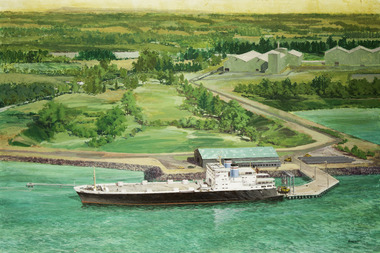 Mission to Seafarers Victoria
Painting - Painting, Acrylic, Ramon Honisett, Untitled, 1990-2000
... ship. The funnel colours suggest the Australian National Line. The frame incorporates a beige fabric slip with gilt edge the actual dark wood frame also with inset banded gilt edge. ...ship. The funnel colours suggest the Australian National Line. The frame incorporates a beige fabric slip with gilt edge the actual dark wood frame also with inset banded gilt edge. ...Ramon (Ray) Francis Honisett (11.04.1931 - 30.08.2019), Fellow RMIT and medallist specialised in philatelic design, marine and military aircraft painting art and was active in the 1960s - 1990s. Ray Honisett used to live in Rye, in the Mornington Peninsula. According to Gavin Fry's book: The painting likely depicts the Lysaght Endeavour loading at Hastings. "The Lysaght Endeavour and its sister ship Lysaght Entreprise were built in Newcastle in 1973 specifically to serve the regional steel industry on the route Port Kembla - Westernport - Adelaide. Even after being lengthened by 17 metres, the two ships had remarkably short working lines, with both being broken up by 1988."Maritime artLarge framed unglazed landscape format painting predominantly green depicting in foreground a merchant vessel, a roll-on roll-off cargo ship moored at a single quayside on a river or river mouth. The middle ground shows a moderate solid jetty leading to large storage sheds at right. The background appears primarily rural with fields and hills in the distance. The location is probably Hastings Western Port in Victoria - notice the forklifts loading rolls of steel produced at the nearby steel rolling mill - the buildings in the distance. You can see the rolls of steel lined up on the hard stand to the right of the ship. The funnel colours suggest the Australian National Line. The frame incorporates a beige fabric slip with gilt edge the actual dark wood frame also with inset banded gilt edge. The back of the painting is covered with brown paper in places damaged. Hangs on a cotton cord threaded between two screw in eyelet hooks.at lower right corner single uc word in black paint : "HONISETT"tankers, marine painting, maritime art, ramon honisett, ray honisett, anl maritime art prize, acta maritime art prize, hastings, western port, victoria, steel, roll on roll off, forklift, mornington peninsula, artwork-paintings -
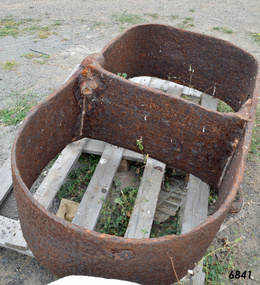 Flagstaff Hill Maritime Museum and Village
Mast Collar, c. 1886
... ship rigging 1908 russell & co. Mast collar, steel, salvaged from the shipwreck FALLS OF HALLADALE, wrecked off the coast of Peterborough, South West Victoria. Oval shaped a band ...The husband of the donor of this mast collar chanced to be staying a night at a motel in Peterborough, along the Great Ocean Road in Victoria. He had a keen interest in maritime items and recognise the mast collar at the motel’s back fence line. The motel owner told his guest the story of a customer, a doctor, who had organised and paid for divers to raise the mast collar from a local shipwreck, the Falls of Halladale. Shortly afterwards the doctor passed away, so the mast collar had remained at the motel site. The owner was leaving the motel the following week and wasn’t at all interested in the artefact. He was very happy for his guest to remove it. It took five men to load the mast collar up for the trip to the new owner’s two storey shed in Ballarat. It stayed there undercover, in the company of his collection of 5 buggies, for the next 40 or so years until the property was for sale. A friend, who realised the significance of the mast collar, suggested that it be donated to Flagstaff Hill Maritime Village where other artefacts from the Falls of Halladale, such as the slate tiles, were on display. This mast collar, or masthead, from the Falls of Halladale would have been used to join two sections of one of the tall masts. As sailing ships became larger there was a need for taller masts or spars, which became difficult or impossible to find. To overcome this problem mast was divided into sections; lower and top or upper mast (on some of the ‘tall ships’ a mast could be divided into three or even four sections). The Falls of Halladale was a four-masted British barque built-in 1886. On what turned out to be her fatal journey, she had left New York for Melbourne in late 1908. She ran aground on a reef close to the shore west of Peterborough, South West Victoria, on November 14th. All 29 crew eventually landed safely onshore. The wrecked ship stayed on the reef for several months as locals watched the sails slowly deteriorate. The salvaged cargo included slate tiles, as mentioned above, and many of these have been used on the roof of buildings at the Flagstaff Hill Maritime Village. The iron-hulled, four-masted barque, the Falls of Halladale, was a bulk carrier of general cargo. She left New York in August 1908 on her way to Melbourne and Sydney. In her hold, along with 56,763 tiles of unusual beautiful green American slates (roofing tiles), 5,673 coils of barbed wire, 600 stoves, 500 sewing machines, 6500 gallons of oil, 14400 gallons of benzene, and many other manufactured items, were 117 cases of crockery and glassware. Three months later and close to her destination, a navigational error caused the Falls of Halladale to be wrecked on a reef off the Peterborough headland at 3 am on the morning of the 15th of November, 1908. The captain and 29 crew members all survived, but her valuable cargo was largely lost, despite two salvage attempts in 1908-09 and 1910. ABOUT THE ‘FALLS OF HALLADALE’ (1886 - 1908) Built: in1886 by Russell & Co., Greenock shipyards, River Clyde, Scotland, UK. The company was founded in 1870 (or 1873) as a partnership between Joseph Russell (1834-1917), Anderson Rodger and William Todd Lithgow. During the period 1882-92 Russell & Co., standardised designs, which sped up their building process so much that they were able to build 271 ships over that time. In 1886 they introduced a 3000 ton class of sailing vessel with auxiliary engines and brace halyard winches. In 1890 they broke the world output record. Owner: Falls Line, Wright, Breakenridge & Co, 111 Union Street, Glasgow, Scotland. Configuration: Four masted sailing ship; iron-hulled barque; iron masts, wire rigging, fore & aft lifting bridges. Size: Length 83.87m x Breadth 12.6m x Depth 7.23m, Gross tonnage 2085 ton Wrecked: the night of 14th November 1908, Curdies Inlet, Peterborough south west Victoria Crew: 29 The Falls of Halladale was a four-masted sailing ship built-in 1886 in Glasgow, Scotland, for the long-distance cargo trade and was mostly used for Pacific grain trade. She was owned by Wright, Breakenridge & Co of Glasgow and was one of several Falls Line ships, all of which were named after waterfalls in Scotland. The lines flag was of red, blue and white vertical stripes. The Falls of Halladale had a sturdy construction built to carry maximum cargo and able to maintain full sail in heavy gales, one of the last of the ‘windjammers’ that sailed the Trade Route. She and her sister ship, the Falls of Garry, were the first ships in the world to include fore and aft lifting bridges. Previous to this, heavily loaded vessels could have heavy seas break along the full length of the deck, causing serious injury or even death to those on deck. The new, raised catwalk-type decking allowed the crew to move above the deck stormy conditions. This idea is still used today on the most modern tankers and cargo vessels and has proved to be an important step forward in the safety of men at sea. On 4th August 1908, with new sails, 29 crew, and 2800 tons of cargo, the Falls of Halladale left New York, bound for Melbourne and Sydney via the Cape of Good Hope. The cargo on board was valued at £35,000 and included 56,763 tiles of American slate roofing tiles (roof slates), 5,673 coils of barbed wire, 600 stoves, 500 sewing machines, 6,500 gallons of oil, 14,400 gallons of benzene, plumbing iron, 117 cases of crockery and glassware and many other manufactured items. The Falls of Halladale had been at sail for 102 days when, at 3 am on the night of 14th November 1908, under full sail in calm seas with a six knots breeze behind and misleading fog along the coast, the great vessel rose upon an ocean swell and settled on top of a submerged reef near Peterborough on the south-west Victoria’s coast. The ship was jammed on the rocks and began filling with water. The crew launched the two lifeboats and all 29 crew landed safely on the beach over 4 miles away at the Bay of Islands. The postmistress at Peterborough, who kept a watch for vessels in distress, saw the stranding and sent out an alert to the local people. A rescue party went to the aid of the sailors and the Port Campbell rocket crew was dispatched, but the crew had all managed to reach shore safely by the time help arrived. The ship stayed in full sail on the rocky shelf for nearly two months, attracting hundreds of sightseers who watched her slowly disintegrate until the pounding seas and dynamiting by salvagers finally broke her back, and her remains disappeared back into deeper water. The valuable cargo was largely lost, despite two salvage attempts in 1908-09 and 1910. Further salvage operations were made from 1974-1986, during which time 22,000 slate tiles were recovered with the help of 14 oil drums to float them, plus personal artefacts, ship fittings, reams of paper and other items. The Court of Marine Inquiry in Melbourne ruled that the foundering of the ship was entirely due to Captain David Wood Thomson’s navigational error, not too technical failure of the Clyde-built ship. The shipwreck is a popular site for divers, about 300m offshore and in 3 – 15m of water. Some of the original cargo can be seen at the site, including pieces of roof slate and coils of barbed wire. This mast collar is significant due to its association with the ship FALLS OF HALLADALE, which is listed on the Victorian Heritage Register, VHR S255 The Falls of Halladale shipwreck is listed on the Victorian Heritage Register (No. S255). She was one of the last ships to sail the Trade Routes. She is one of the first vessels to have fore and aft lifting bridges. She is an example of the remains of an International Cargo Ship and also represents aspects of Victoria’s shipping industry. The wreck is protected as a Historic Shipwreck under the Commonwealth Historic Shipwrecks Act (1976). Mast collar, steel, salvaged from the shipwreck FALLS OF HALLADALE, wrecked off the coast of Peterborough, South West Victoria. Oval shaped a band of metal with a straight band of same heights attached between the long sides. Two metal loops are attached to the outside of the oval shape, next to the crossing band. flagstaff hill, warrnambool, shipwrecked coast, flagstaff hill maritime museum, maritime museum, shipwreck coast, flagstaff hill maritime village, great ocean road, falls of halladale, shipwreck peterborough vic, sailing ship mast collar, masthead of sailing ship, falls of halladale mast collar, masthead, mast collar, ship rigging 1908, russell & co. -
 Phillip Island and District Historical Society Inc.
Photographs, 1988 Bicentennial Parade, Cowes, 1988
... 23 coloured photos of the 1988 Bicentennial Parade in Cowes including the floats, bands, scouts, Senior Citizens and fire brigade and 3 coloured photos of views of ships in the Bay. ...Parade began in Thompson Ave, then along the Esplanade to the football ground. cowes phillip island, bicentennial 1988 parades fire brigade, phillip island bands ships 23 coloured photos of the 1988 Bicentennial Parade in Cowes including the floats, bands, scouts, Senior Citizens and fire brigade and 3 coloured photos of views of ships in the Bay. ...Parade began in Thompson Ave, then along the Esplanade to the football ground.23 coloured photos of the 1988 Bicentennial Parade in Cowes including the floats, bands, scouts, Senior Citizens and fire brigade and 3 coloured photos of views of ships in the Bay. Warship and possibly the Britannia.cowes phillip island,, bicentennial 1988, parades, fire brigade, phillip island, bands, ships -
 Flagstaff Hill Maritime Museum and Village
Award - Medal, Nelson Johnson, November 1880
... Ship / “Eric the Red.” “M” on obverse, truncation of the portrait This medal was awarded to Nelson Johnson by the U.S. President for bravery in the rescue of the Eric the Red crew. The obverse of the round, solid silver medal has an inscription around the rim. In the centre of the medal is the head of Liberty to the left, hair in a bun, with a sprig of leaves in the top left of a band ...This medal for bravery, for rescue of the crew from the shipwreck “Eric the Red” on 4th September 1880, was awarded to one of the crew of the steamer S.S. Dawn by the President of the United States in July 1881. The medal is engraved with the name “Nelson Johnson” (the anglicised version of his Swedish name Neils Frederick Yohnson). It was donated to Flagstaff Hill Maritime Village in 2013 by Nelson’s granddaughter. Nelson had migrated from Sweden to Sydney in 1879. The next year in 1880, aged 24, he was a seaman on the steamship Dawn and involved in the rescue of the survivors of the Eric the Red. Nelson Johnson was a crew member of the S.S. Dawn and was one of the rescue team in the dinghy in the early morning of September 4th 1880. Medals were awarded to the Captain and crew of the S.S. Dawn by the President of the United States, through the Consul-general (Mr Oliver M. Spencer), in July 1881 “ … in recognition of their humane efforts in rescuing the 23 survivors of the American built wooden sailing ship, the Eric the Red, on 4th September 1880.” The men were also presented with substantial monetary rewards and gifts. The city of Warrnambool’s care of the survivors was also mentioned by the President at the presentation, saying that “the city hosted and supported the crew ‘most graciously’. Previously, a week after the shipwreck, the Australian Government had also conveyed its thanks to the Captain and crew of the S.S. Dawn “Captain Griffith Jones, S.S. Dawn, The Hon. Mr Clark desires that the thanks of the Government should be conveyed to you for the prompt, persevering and seamanlike qualities displayed by you, your officers and crew in saving the number of lives you did on the occasion referred to. The hon. The Commissioner has also been pleased to award you a souvenir in commemoration of the occasion, and a sum of 65 pounds to be awarded to your officers and crew according to annexed scale. I am, &c, W Collins Rees, for and in the absence of the Chief Harbour Master.” The Awards are as follows: - Crew of DAWN'S lifeboat-Chief Officer, Mr G. Peat, 15 pounds; boat's crew-G. Sterge, A.B., 5 pounds; T. Hammond, A.B., 5 pounds; J. Black, A.B., 5 pounds; H. Edwards, A.B., 5 pounds. Dinghy's Crew-Second Officer, Mr Christie, 10 pounds; boat's crew -F. Lafer, A.B., 5 pounds; W. Johnstone, A.B., 5 pounds; Mr Lear, provedore, 5 pounds; Mr Dove, purser, 5 pounds. Captain Jones receives a piece of plate. (from “Wreck of the ship Eric the Red” by Jack Loney) The medal’s history, according to the Editor of ‘E-Sylum’ (the newsletter of The Numismatic Bibliomania Society “… appears to be an example of an 1880 State Department medal, catalogued as LS-3 (page 322 of R. W. Julian's book, Medals of the United States Mint: The First Century 1792-1892). The reverse is mostly blank for engraving, surrounded by a thin wreath. It was designed by George Morgan, chief engraver for the Philadelphia Mint, and struck in gold, silver and bronze. The one pictured here (in The Standard newspaper, 2nd July 2013) appears to be silver.” The following is an account of the events which led to the awarding of this medal. The American ship Eric the Red was a wooden, three-masted clipper ship. She had 1,580 tons register and was the largest full-rigged ship built at Bath, Maine, USA in 1871. She was built and registered by Arthur Sewall, later to become the partnership E. & A. Sewall, the 51st ship built by this company. The annually-published List of Merchant Vessels of the U.S. shows Bath was still the home port of Eric the Red in 1880. The vessel was named after the Viking discoverer, Eric ‘the Red-haired’ Thorvaldsson, who was the first European to reach the shores of North America (in 980AD). The ship Eric the Red at first traded in coal between America and Britain, and later traded in guano nitrates from South America. In 1879 she was re-metalled and was in first-class condition. On 10th June 1880 (some records say 12th June) Eric the Red departed New York for Melbourne and then Sydney. She had been commissioned by American trade representatives to carry a special cargo of 500 exhibits (1400 tons) – about a quarter to a third of America’s total exhibits - for the U.S.A. pavilion at Melbourne’s first International Exhibition. The exhibits included furniture, ironmongery, wines, chemicals, dental and surgical instruments, paper, cages, bronze lamp trimmings, axles, stamped ware, astronomical and time globes, samples of corn and the choicest of leaf tobacco. Other general cargo included merchandise such as cases of kerosene and turpentine, brooms, Bristol's Sarsaparilla, Wheeler and Wilson sewing machines, Wheeler’s thresher machine, axe handles and tools, cases of silver plate, toys, pianos and organs, carriages and Yankee notions. The Eric the Red left New York under the command of Captain Zaccheus Allen (or some records say Captain Jacques Allen) and 24 other crew including the owner’s son third mate Ned Sewall. There were also 2 saloon passengers on board. The ship had been sailing for an uneventful 85 days and the voyage was almost at its end. As Eric the Red approached Cape Otway there was a moderate north-west wind and a hazy and overcast atmosphere. On 4th September 1880 at about 1:30 am Captain Allen sighted the Cape Otway light and was keeping the ship 5-6 miles offshore to stay clear of the hazardous Otway Reef. However, he had badly misjudged his position. The ship hit the Otway Reef about 2 miles out to sea, southwest of the Cape Otway light station. Captain Allen ordered the wheel to be put ‘hard up’ thinking that she might float off the reef. The sea knocked the helmsman away from the wheel, broke the wheel ropes and carried away the rudder. The lifeboats were swamped, the mizzenmast fell, with all of its riggings, then the mainmast also fell and the ship broke in two. Some said that the passenger Vaughan, who was travelling for his health and not very strong, was washed overboard and never seen again. The ship started breaking up. The forward house came adrift with three of the crew on it as well as a longboat, which the men succeeded in launching and keeping afloat by continually bailing with their sea boots. The captain, the third mate (the owner’s son) and others clung to the mizzenmast in the sea. Then the owner’s son was washed away off the mast. Within 10 minutes the rest of the ship was in pieces, completely wrecked, with cargo and wreckage floating in the sea. The captain encouraged the second mate to swim with him to the deckhouse where there were other crew but the second mate wouldn’t go with him. Eventually, the Captain made it to the deckhouse and the men pulled him up. At about 4:30 am the group of men on the deckhouse saw the lights of a steamer and called for help. At the same time, they noticed the second mate and the other man had drifted nearby, still on the spur, and pulled them both onto the wreck. The coastal steamer SS Dawn was returning to Warrnambool from Melbourne, and its sailing time was different to its usual schedule. She was built in 1876 and bought by the Portland and Belfast Steam Navigation Co. in 1877. At the time of this journey, she was commanded by Captain Jones and was sailing between Melbourne and Portland via Warrnambool. The provedore the Dawn, Benjamin Lear, heard cries of distress coming through the portholes of the saloon. He gave the alarm and the engines were stopped. Cries could be heard clearly, coming from the land. Captain Jones sent out crew in two boats and fired off rockets and blue lights to illuminate the area. They picked up the three survivors who were in the long boat from Eric the Red. Two men were picked up out of the water, one being the owner’s son who was clinging to floating kerosene boxes. At daylight, the Dawn then rescued the 18 men from the floating portion of the deckhouse, which had drifted about 4 miles from where they’d struck the reef. Shortly after the rescue the deckhouse drifted onto breakers and was thrown onto rocks at Point Franklin, about 2 miles east of Cape Otway. Captain Jones had signalled to Cape Otway lighthouse the number of the Eric the Red and later signalled that there was a wreck at Otway Reef but there was no response from the lighthouse. The captain and crew of the Dawn spent several more hours searching unsuccessfully for more survivors, even going back as far as Apollo Bay. On board the Dawn the exhausted men received care and attention to their needs and wants, including much-needed clothing. Captain Allen was amongst the 23 battered and injured men who were rescued and later taken to Warrnambool for care. Warrnambool’s mayor and town clerk offered them all hospitality, the three badly injured men going to the hospital for care and others to the Olive Branch Hotel, then on to Melbourne. Captain Allen’s leg injury prevented him from going ashore so he and three other men travelled on the Dawn to Portland. They were met by the mayor who also treated them all with great kindness. Captain Allen took the train back to Melbourne then returned to America. Those saved were Captain Zaccheus Allen (or Jacques Allen), J. Darcy chief mate, James F. Lawrence second mate, Ned Sewall third mate and owner’s son, John French the cook, C. Nelson sail maker, Clarence W. New passenger, and able seamen Dickenson, J. Black, Denis White, C. Herbert, C. Thompson, A. Brooks, D. Wilson, J. Ellis, Q. Thompson, C. Newman, W. Paul, J. Davis, M. Horenleng, J. Ogduff, T. W. Drew, R. Richardson. Four men had lost their lives; three of them were crew (Gus Dahlgreen ship’s carpenter, H. Ackman steward, who drowned in his cabin, and George Silver seaman) and one a passenger (J. B. Vaughan). The body of one of them had been found washed up at Cape Otway and was later buried in the lighthouse cemetery; another body was seen on an inaccessible ledge. Twelve months later the second mate James F. Lawrence, from Nova Scotia passed away in the Warrnambool district; an obituary was displayed in the local paper. Neither the ship nor its cargo was insured. The ship was worth about £15,000 and the cargo was reportedly worth £40,000; only about £2,000 worth had been recovered. Cargo and wreckage washed up at Apollo Bay, Peterborough, Port Campbell, Western Port and according to some reports, even as far away as the beaches of New Zealand. The day after the wreck the government steamship Pharos was sent from Queenscliff to clear the shipping lanes of debris that could be a danger to ships. The large midship deckhouse of the ship was found floating in a calm sea near Henty Reef. Items such as an American chair, a ladder and a nest of boxes were all on top of the deckhouse. As it was so large and could cause danger to passing ships, Captain Payne had the deckhouse towed towards the shore just beyond Apollo Bay. Between Apollo Bay and Blanket Bay, the captain and crew of Pharos collected Wheeler and Wilson sewing machines, nests of boxes, bottles of Bristol’s sarsaparilla, pieces of common American chairs, axe handles, a Wheelers’ Patent thresher and a sailor’s trunk with the words “A. James” on the front. A ship’s flag-board bearing the words “Eric the Red” was found on the deckhouse; finally, those on board the Pharos had the name of the wrecked vessel. During this operation, Pharos came across the government steamer Victoria and also a steamer S.S. Otway, both of which were picking up flotsam and wreckage. A whole side of the hull and three large pieces of the other side of the hull, with some of the copper sheathing stripped off, had floated onto Point Franklin. Some of the vessels' yards and portions of her masts were on shore. The pieces of canvas attached to the yards and masts confirmed that the vessel had been under sail. The beach there was piled with debris several feet high. There were many cases of Diamond Oil kerosene, labelled R. W. Cameron and Company, New York. There were also many large planks of red pine, portions of a small white boat and a large, well-used oar. Other items found ashore included sewing machines (some consigned to ‘Long and Co.”) and notions, axe and scythe handles, hay forks, wooden pegs, rolls of wire (some branded “T.S” and Co, Melbourne”), kegs of nails branded “A.T. and Co.” from the factory of A. Field and Son, Taunton, Massachusetts, croquet balls and mallets, buggy fittings, rat traps, perfumery, cutlery and Douay Bibles, clocks, bicycles, chairs, a fly wheel, a cooking stove, timber, boxes, pianos, organs and a ladder. (Wooden clothes pegs drifted in for many years). There seemed to be no personal luggage or clothing. The Pharos encountered a long line, about one and a half miles, of f locating wreckage about 10 miles off land, southeast of Cape Otway, and in some places about 40 feet wide. It seemed that more than half of it was from Eric the Red. The ship’s crew rescued 3 cases that were for the Melbourne Exhibition and other items from amongst the debris. There were also chairs, doors, musical instruments, washing boards, nests of trunks and flycatchers floating in the sea. Most of the goods were saturated and smelt of kerosene. A section of the hull lies buried in the sand at Parker River Beach. An anchor with a chain is embedded in the rocks east of Point Franklin and a second anchor, thought to be from Eric the Red, is on display at the Cape Otway light station. (There is a photograph of a life belt on the verandah of Rivernook Guest House in Princetown with the words “ERIC THE RED / BOSTON”. This is rather a mystery as the ship was registered in Bath, Maine, USA.) Parts of the ship are on display at Bimbi Park Caravan Park and at Apollo Bay Museum. Flagstaff Hill Maritime Village also has part of the helm (steering wheel), a carved wooden sword (said to be the only remaining portion of the ship’s figurehead; further research is currently being carried out), a door, a metal rod, samples of wood and this medal awarded for the rescue of the crew. Much of the wreckage was recovered by the local residents before police and other authorities arrived at the scene. Looters went to great effort to salvage goods, being lowered down the high cliff faces to areas with little or no beach to collect items from the wreckage, their mates above watching out for dangerous waves. A Tasmanian newspaper reports on a court case in Stawell, Victoria, noting a man who was caught 2 months later selling tobacco from the wreckage of Eric the Red. Some of the silverware is still treasured by descendants of Mr Mackenzie who was given these items by officials for his help in securing the cargo. The gifts included silver coffee and teapots, half a dozen silver serviette rings and two sewing machines. A Mr G.W. Black has in his possession a medal and a purse that was awarded to his father, another Dawn crew member who was part of the rescue team. The medal is similarly inscribed and named “To John Black ….” (from “Shipwrecks” by Margaret E. Mackenzie, 3rd edition, published 1964). The wreck and cargo were sold to a Melbourne man who salvaged a quantity of high-quality tobacco and dental and surgical instruments. Timbers from the ship were salvaged and used in the construction of houses and shed around Apollo Bay, including a guest house, Milford House (since burnt down in bushfires), which had furniture, fittings and timber on the dining room floor from the ship. A 39.7-foot-long trading ketch, the Apollo, was also built from its timbers by Mr Burgess in 1883 and subsequently used in Tasmanian waters. It was the first attempt at shipbuilding in Apollo Bay. In 1881 a red light was installed about 300 feet above sea level at the base of the Cape Otway lighthouse to warn ships when they were too close to shore; It would not be visible unless a ship came within 3 miles from it. This has proved to be an effective warning. Nelson Johnson married Elizabeth Howard in 1881 and they had 10 children, the father of the medal’s donor being the youngest. They lived in 13 Tichbourne Place, South Melbourne, Victoria. Nelson died in 1922 in Fitzroy Victoria, age 66. In 1895 the owners of the S.S. Dawn, the Portland and Belfast Steam Navigation Co., wound up and sold out to the Belfast Company who took over the Dawn for one year before selling her to Howard Smith. She was condemned and sunk in Suva in 1928. The State Library of Victoria has a lithograph in its collection depicting the steamer Dawn and the shipwrecked men, titled. "Wreck of the ship Eric the Red, Cape Otway: rescue of the crew by the Dawn". The medal for bravery is associated with the ship the “The Eric the Red which is historically significant as one of Victoria's major 19th century shipwrecks. (Heritage Victoria Eric the Red; HV ID 239) The wreck led to the provision of an additional warning light placed below the Cape Otway lighthouse to alert mariners to the location of Otway Reef. The site is archaeologically significant for its remains of a large and varied cargo and ship's fittings being scattered over a wide area. The site is recreationally and aesthetically significant as it is one of the few sites along this coast where tourists can visit identifiable remains of a large wooden shipwreck, and for its location set against the background of Cape Otway, Bass Strait, and the Cape Otway lighthouse.“ (Victorian Heritage Database Registration Number S239, Official Number 8745 USA) This medal was awarded to Nelson Johnson by the U.S. President for bravery in the rescue of the Eric the Red crew. The obverse of the round, solid silver medal has an inscription around the rim. In the centre of the medal is the head of Liberty to the left, hair in a bun, with a sprig of leaves in the top left of a band around her head. There is a 6-pointed star below the portrait, between the start and end of the inscription. There are two raised areas on the rim, horizontally opposite each other, from the edge to just below the lettering and coinciding with the holes drilled in the edge. Slightly right of the top is a round indentation in the rim. The reverse has a wreath of leaves as a border, joined at the bottom by a ribbon bow. In the centre of the medal is an inscription, decorated with 3-pronged design and dots. The edge is plain with 2 small, rough and uneven holes horizontally opposite to each other, as though they had been used for mounting the medal at some stage. The medal has a matte finish on both sides and is slightly pitted and scratched.“PRESENTED BY THE PRESIDENT OF THE UNITED STATES” around the perimeter of the obverse of the medal. “TO / Nelson Johnson, / seaman of the British, / str “Dawn”, for bravery, / at risk of life, / in / rescuing the crew of / the American Ship / “Eric the Red.” “M” on obverse, truncation of the portraitwarrnambool, flagstaff hill, flagstaff hill maritime village, maritime museum, shipwreck coast, great ocean road, shipwreck artefact, eric the red, zaccheus allen, sewall, 1880, melbourne exhibition, cape otway, otway reef, victorian shipwreck, medal, nelson johnson, neils frederick yohnson, s.s. dawn, george morgan, hero -
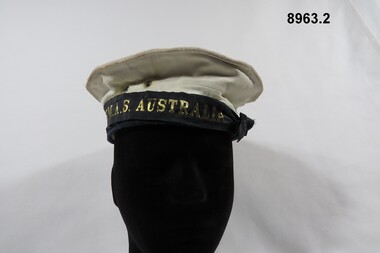 Bendigo Military Museum
Headwear - SAILORS CAP, Unknown
... HMAS Tally band used during war time so the identity of a particular ship was not known....HMAS Tally band used during war time so the identity of a particular ship was not known. ...2. HMAS Tally band used during war time so the identity of a particular ship was not known.1. Sailors cap with HMAS AUSTRALIA Tally band. 2. Tally band with “HMAS”1. ”HMAS AUSTRALIA ON CAP” 2. “HMAS” passchendaele barracks trust, pbt21, headwear -
 Bendigo Military Museum
Photograph - PHOTOGRAPHS WW1, c.1915
... Four x black & white photos presumable taken by Bert HEWSTON during his war experience. .1) Group of Kaffir women & children. .2) Band playing onboard the ship Wandilla, conveying Bert to Europe. .3) Band playing on Avon River, Durrington. .4) 2 x uniformed soldiers. ...Part of the HEWSTON collection re WW1 & WW2. photography-photographs military history - army Four x black & white photos presumable taken by Bert HEWSTON during his war experience. .1) Group of Kaffir women & children. .2) Band playing onboard the ship Wandilla, conveying Bert to Europe. .3) Band playing on Avon River, Durrington. .4) 2 x uniformed soldiers. ...Bert HEWSTON, refer Cat No 2759.2 for his service history. Part of the HEWSTON collection re WW1 & WW2.Four x black & white photos presumable taken by Bert HEWSTON during his war experience. .1) Group of Kaffir women & children. .2) Band playing onboard the ship Wandilla, conveying Bert to Europe. .3) Band playing on Avon River, Durrington. .4) 2 x uniformed soldiers. All different sizes.photography-photographs, military history - army
