
Showing 15 items matching "shoe brush"
-
 Emerald Museum & Nobelius Heritage Park
Domestic object - Shoe brush, late 1940s-early 1950s
... Shoe brush......shoe brush...This shoe brush was used by Karen Alexander's family when she was a child - she was born in 1948 and grew up in the Dandenongs. ...Shoe brush. Oval wooden brush with black bristles and metal handle....Domestic object Shoe brush ...This shoe brush was used by Karen Alexander's family when she was a child - she was born in 1948 and grew up in the Dandenongs. As part of the shoe-cleaning process, polish would be applied to the shoes and the brush would be used after the polish had dried. Karen has donated a range of objects from her childhood and from the family-owned farm at Emerald.Shoe brush. Oval wooden brush with black bristles and metal handle.Possibly '1262' on the top of the handle but this is unclear.alexander, shoe brush, shoe cleaning -
 Ballarat Tramway Museum
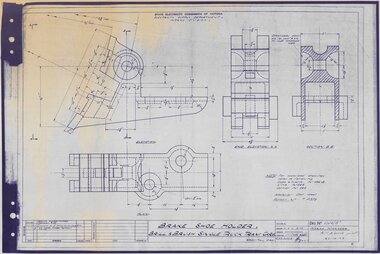
Drawing - VW4/13A, State Electricity Commission of Victoria (SECV), Brake Shoe Holder, Brill & Brush Single Truck Tram Cars, 15/10/1953
... Brake Shoe Holder, Brill & Brush Single Truck Tram Cars....SEC drawing number VW4/13A, "Brake Shoe Holder, Brill & Brush Single Truck Tram Cars.". Drawn 15/10/1953. ...SEC drawing number VW4/13A, "Brake Shoe Holder, Brill & Brush Single Truck Tram Cars.". Drawn 15/10/1953. ...Produced by the SECV to document the Brake Shoe Holder.Yields information regarding the dimensions of the Brake Shoe Holder, Brill & Brush Single Truck Tram Cars.SEC drawing number VW4/13A, "Brake Shoe Holder, Brill & Brush Single Truck Tram Cars.". Drawn 15/10/1953. Beige paper copy of original dyeline print. Copy of original.electricity supply department, secv, works division, provincial tramways, tramways, brakes, tram brakes, brake shoe -
 Flagstaff Hill Maritime Museum and Village
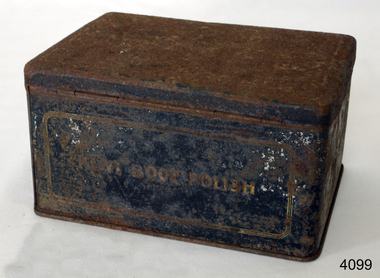
Container - Tin, Kiwi Shoe Polish Manufacture, 1940s
... In Malaysia and Singapore, Kiwi has become such a household brand for a shoe polish that the word "kiwi" has been genericized into a verb in the Malay language, meaning "to polish one's shoes". flagstaff hill warrnambool shipwrecked-coast flagstaff-hill flagstaff-hill-maritime-museum maritime-museum shipwreck-coast flagstaff-hill-maritime-village Kiwi Boot Polish to front of container Metal cleaning outfit of Kiwi boot polish brush, scraper, & polish missing Container Tin Kiwi Shoe Polish Manufacture ...The polish was developed in Australia by William Ramsay who named it Kiwi after the flightless bird endemic to New Zealand, the home country of his wife, Annie Elizabeth Meek Ramsay. Its success in Australia expanded overseas when it was adopted by both the British and American armies in World War I. In the UK, Kiwi was for many years manufactured at its British headquarters in Ealing (Brumwell Road, London W5 1DT). From here the factory manufactured for the UK market and exported the Kiwi brand too much of Europe and the Middle East. In the mid-1970s, as part of a major streamlining, the UK factory was closed with production switched to France. The UK operation moved to Surrey at Yately becoming, effectively, a sales and marketing office, with distribution contracted to a third party. In 1980, production for the UK market moved back to the UK and was housed in a factory near Huddersfield. The UK head office was relocated to Maidstone, Kent, where Kiwi had other product interests. Following the global merger with Nicholas Laboratories, the UK head office was again relocated to Slough at the Nicholas building on Bath Road.A significant product as Kiwi is an Australian brand name of shoe polish, first launched and sold in Australia in 1906 and as of 2005 sold in almost 180 countries. Previously owned by the Sara Lee Corporation since 1984, it was sold in 2011 to S. C. Johnson. It is the dominant shoe polish in some countries, including the United Kingdom and the United States, where it has about two thirds of the market. In Malaysia and Singapore, Kiwi has become such a household brand for a shoe polish that the word "kiwi" has been genericized into a verb in the Malay language, meaning "to polish one's shoes".Metal cleaning outfit of Kiwi boot polish brush, scraper, & polish missingKiwi Boot Polish to front of containerflagstaff hill, warrnambool, shipwrecked-coast, flagstaff-hill, flagstaff-hill-maritime-museum, maritime-museum, shipwreck-coast, flagstaff-hill-maritime-village -
 Flagstaff Hill Maritime Museum and Village
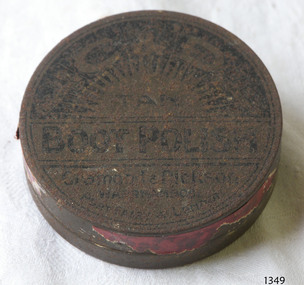
Container - Boot Polish Tin, Cramond and Dickson, 1855-1974
... Flagstaff Hill Maritime Museum and Village Flagstaff Hill Maritime Village Maritime Museum Shipwreck Coast Great Ocean Road Warrnambool boot polish shoe cleaning grooming Cramond and Dickson Warrnambool business department store commerce Timor Street Liebig Street Port Fairy business metal craft tinware "C and D Tan Boot Polish" and "Cramond and Dickson, Warrnambool, Port Fairy & London" and "For best results, remove all dust and apply a little C and D Dressing, Brush Briskly" "Weight when packed 1 1/2 ozs net" Container: a tin of boot polish, with a small amount of light tan polish inside. ...This tin of boot polish was a product sold be Cramond and Dickson store, which traded in Warrnambool from 1855 - 1974. John Glass Cramond and James Dickson migrated from Scotland to Melbourne, where they opened a Cramond and Dickson store in St Kilda. They were inspired by the growth in Warrnambool after a visit and opened a second store there in 1855. The Cramond and Dickson store, grocers – drapery – ironmongery - chemist, was located on the corner of Liebig and Timor Streets, Warrnambool. Both Cramond and Dickson were involved in the business and social aspects of Warrnambool’s community. Cramond and Dickson closed in 1974. An advertisement placed by Cramond and Dickson in The Camperdown Chronicle, Saturday 6th April 1895, states them “showing the latest novelties for the coming winter season” … “import directly from English and Continental manufacturers” … “representatives in London … always in touch with the Newest Continental Fashions” ... “having been established for so many years we know the requirements of the Western District”… “allow 5 percent discount on goods paid for at the time of purchase”.The tin of boot polish is an example of the goods sold in Warrnambool in the 19th and early 20th century. It s significant for its association with Cramond and Dickson, a large retail store established in Warrnambool and operating from 1855 to 1974. Both partners were prominent figures in the community.Container: a tin of boot polish, with a small amount of light tan polish inside. Inscribed for the makers, Cramond and Dickson, Warrnambool, Port Fairy & Londo. Labelling is partly obscured by corrosion. Instructions for use are on the base of the tin. "C and D Tan Boot Polish" and "Cramond and Dickson, Warrnambool, Port Fairy & London" and "For best results, remove all dust and apply a little C and D Dressing, Brush Briskly" "Weight when packed 1 1/2 ozs net"flagstaff hill maritime museum and village, flagstaff hill, maritime village, maritime museum, shipwreck coast, great ocean road, warrnambool, boot polish, shoe cleaning, grooming, cramond and dickson, warrnambool business, department store, commerce, timor street, liebig street, port fairy business, metal craft, tinware -
 Flagstaff Hill Maritime Museum and Village
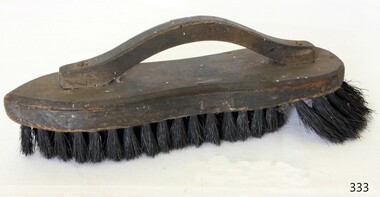
Domestic object - Scrubbing Brush, Early 20th century
... Brushes such as this one have been used for scrubbing, cleaning and polishing household equipment, shoes, leather items and various other uses....Brushes such as this one have been used for scrubbing, cleaning and polishing household equipment, shoes, leather items and various other uses. ...Brushes such as this one have been used for scrubbing, cleaning and polishing household equipment, shoes, leather items and various other uses.The scrubbing brush is an example of an early 20th-century domestic object that is still in use today.Scrubbing brush with wooden spine and a raised wooden handle. Bristle length is longer at one end. The opposite end has a pointed shaped on the spine.flagstaff hill, flagstaff hill maritime museum and village, warrnambool, maritime museum, maritime village, great ocean road, shipwreck coast, scrubbing brush, brush, cleaning equipment -
 Bendigo Historical Society Inc.
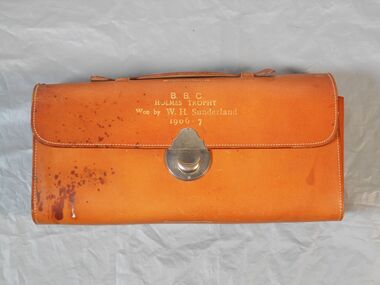
Award - B.B.C Trophy Holmes Trophy Men's Toiletry Set
... These include; a comb, a mirror, a clothing brush, a glass cylinder with metal lid, a small metal tin, a razor strop, a shoe hook and a soap case. ...These include; a comb, a mirror, a clothing brush, a glass cylinder with metal lid, a small metal tin, a razor strop, a shoe hook and a soap case. ...The Club known today as the Bendigo Bowls Club originated from the Sandhurst Bowling Club in 1870/71 changing its name to Bendigo in 1872. It is located in central Bendigo just a short walk through the picturesque Rosalind Park from Bendigo’s central business district. https://bendigobowlsclub.com.au/history/ William Henry Sunderland was a Bendigo investor, member of the Bendigo Stock Exchange and director of many mining companies. His father, George, had been a mounted trooper assigned as a gold escort between Melbourne and Bendigo. William became the President of the Bendigo Bowling Club in 1916.Leather satchel with gold embossed text. Text reads B.B.C Holmes Trophy. Won by W. H. Sunderland. 1906-7. Inside the satchel are eight items pertaining to a men's toiletry set. These include; a comb, a mirror, a clothing brush, a glass cylinder with metal lid, a small metal tin, a razor strop, a shoe hook and a soap case. Four items appear to be missing from the set. The satchel has a leather carry handle.B.B.C Holmes Trophy Won by W.H.Sunderland 1906-7bendigo bowling club, men's toiletry set -
 Bendigo Historical Society Inc.
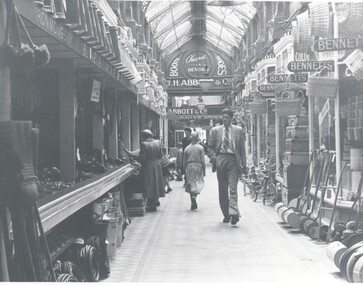
Photograph - HARRY BIGGS COLLECTION: BENDIGO ARCADE / BENNETTS WALK, c1940's
... Many products are displayed in front of the shops - brooms, hoses, bins, lawn mowers, cases, baskets, brushes etc. Trade signs are Abbott & Co., Boots Shoes, Cheapest in Bendigo. ...Shoes. Abbott & Co. Photograph. Harry Biggs Collection. Very detailed photo of Bendigo Arcade / Bennetts Arcade c1940's. Many products are displayed in front of the shops - brooms, hoses, bins, lawn mowers, cases, baskets, brushes etc. ...Photograph. Harry Biggs Collection. Very detailed photo of Bendigo Arcade / Bennetts Arcade c1940's. Many products are displayed in front of the shops - brooms, hoses, bins, lawn mowers, cases, baskets, brushes etc. Trade signs are Abbott & Co., Boots Shoes, Cheapest in Bendigo. Bennetts, ironmongery. On the left is a woman in a long winter coat shopping. There are three people walking through the Arcade. The roof is very ornate & the top is clear so it is well lit with the light coming through. See Research field and 2400.104.1.pdf (attached) for further information.place, building, commercial, harry biggs collection. bendigo arcade. bennetts arcade. boots shoes. abbott & co. -
 Anglesea and District Historical Society
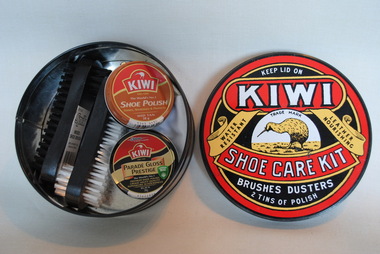
Shoe Care Kit, Silver Crane Company, Estimated 1960's
... Circular tin containing two brushes, one tin shoe polish, one polishing cloth....shoes cleaning Kiwi Keep lid on. Made in England under licence Kiwi Polish Co. Pty. Ltd. Distributed by Silver Crane Co. Crane Logo. Circular tin containing two brushes ...Circular tin containing two brushes, one tin shoe polish, one polishing cloth.Keep lid on. Made in England under licence Kiwi Polish Co. Pty. Ltd. Distributed by Silver Crane Co. Crane Logo.shoes, cleaning, kiwi -
 Ballarat Tramway Museum
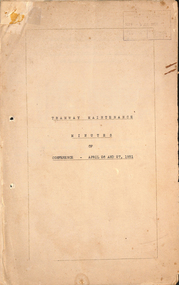
Administrative Record - Meeting Minutes, State Electricity Commission of Victoria (SECV), "Tramway Maintenance Minutes of Conference - April 26 and 27 1951", 1951
... Topics covered - tyres and wheel centres, truck maintenance, suspension bearings, bearing metal (white metal), motor armatures, carbon brushes, air receivers, overhead equipment, tracks, car renovation - painting, gold lining, roof, floor treatment and covering, trolley wheels, purchase requisitions, spare parts, supplies, brake shoes, timber, castings, tramway drawings, patterns and a summary of action. ...Topics covered - tyres and wheel centres, truck maintenance, suspension bearings, bearing metal (white metal), motor armatures, carbon brushes, air receivers, overhead equipment, tracks, car renovation - painting, gold lining, roof, floor treatment and covering, trolley wheels, purchase requisitions, spare parts, supplies, brake shoes, timber, castings, tramway drawings, patterns and a summary of action. ...Document titled "Tramway Maintenance Minutes of Conference - April 26 and 27 1951", attended by SEC Head Office Officers, representatives from Bendigo and Geelong. Opening note on page 2 - that the discussions should be based on the SEC operating the tramways indefinitely. Topics covered - tyres and wheel centres, truck maintenance, suspension bearings, bearing metal (white metal), motor armatures, carbon brushes, air receivers, overhead equipment, tracks, car renovation - painting, gold lining, roof, floor treatment and covering, trolley wheels, purchase requisitions, spare parts, supplies, brake shoes, timber, castings, tramway drawings, patterns and a summary of action. Has a list of attendees.Yields information and demonstrates SEC Meeting minutes about discussions between the three Provincial operators about tramcars and operations.Minutes - 26 duplicated foolscap sheets pinned (was stapled poorly) in the left hand corner.trams, tramways, minutes, sec, geelong, ballarat, bendigo, tramcar equipment, maintenance, trackwork, overhead, painting, trolley wheels, brakes, motors -
Ballarat Tramway Museum
Administrative Record - Meeting Minutes, State Electricity Commission of Victoria (SECV), "Tramway Maintenance Minutes of Conference - May 1 and May 2, 1952", 1952
... Topics covered - tyres and wheel centres, truck maintenance, suspension bearings, bearing metal (white metal), motor armatures, carbon brushes, air receivers, overhead equipment, tracks, car renovation - painting, gold lining, roof, floor treatment and covering, trolley wheels, purchase requisitions, spare parts, supplies, brake shoes, timber, castings, tramway drawings, patterns and a summary of action. ...Topics covered - tyres and wheel centres, truck maintenance, suspension bearings, bearing metal (white metal), motor armatures, carbon brushes, air receivers, overhead equipment, tracks, car renovation - painting, gold lining, roof, floor treatment and covering, trolley wheels, purchase requisitions, spare parts, supplies, brake shoes, timber, castings, tramway drawings, patterns and a summary of action. ...Document titled "Tramway Maintenance Minutes of Conference - May 1 and May 2", attended by SEC Head Office Officers, representatives from Bendigo and Geelong. Topics covered - tyres and wheel centres, truck maintenance, suspension bearings, bearing metal (white metal), motor armatures, carbon brushes, air receivers, overhead equipment, tracks, car renovation - painting, gold lining, roof, floor treatment and covering, trolley wheels, purchase requisitions, spare parts, supplies, brake shoes, timber, castings, tramway drawings, patterns and a summary of action. Also includes notes on tramway statistics, employee's duties, one man operation, track drains, interchange of ideas and experiences and discussions of a general nature and notes on scrapping trams in badly damaged condition. Each item where relevant looks back at the actions from the previous conference. Has a list of attendees.Yields information and demonstrates SEC Meeting minutes about discussions between the three Provincial operators about tramcars and operations.Minutes - 53 duplicated foolscap sheets pinned with a folding clip in top left hand corner.trams, tramways, minutes, sec, geelong, ballarat, bendigo, tramcar equipment, maintenance, trackwork, overhead, painting, trolley wheels, brakes, motors, one man trams, scrapped trams, employees, rules -
Clunes Museum
Domestic object - BOOT POLISH TIN
... .1 Kiwi Boot Polish Outfit Tin, .2 Brush with wooden handle and black bristles .3 Round black "Nugget" shoe polish tin .4 Navy blue velvet polishing pad...personal grooming boot polish kiwi The Kiwi Outfit .1 Kiwi Boot Polish Outfit Tin, .2 Brush with wooden handle and black bristles .3 Round black "Nugget" shoe polish tin .4 Navy blue velvet polishing pad Domestic object BOOT POLISH TIN ....1 Kiwi Boot Polish Outfit Tin, .2 Brush with wooden handle and black bristles .3 Round black "Nugget" shoe polish tin .4 Navy blue velvet polishing padThe Kiwi Outfitpersonal grooming, boot polish, kiwi -
 Southern Sherbrooke Historical Society Inc.
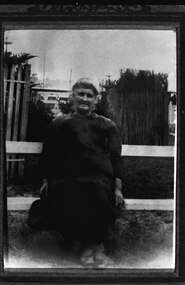
Photograph - Mrs William Hermon Snr, nee Alice Mackay
... shoes. Her hair appears grey and seems to be pulled back into a bun or similar on the crown of her head. Behind her on the left is a paling fence and on the right is a brush-type fence. ...shoes. Her hair appears grey and seems to be pulled back into a bun or similar on the crown of her head. Behind her on the left is a paling fence and on the right is a brush-type fence. ...B&W photo of Mrs William Hermon Snr, Alice nee Mackay, mother of Bill Hermon. She looks to be about 60yo. She is seated on a long wooden bench. She is wearing a dark long-sleeved top and a darker skirt, and mary jane-style shoes. Her hair appears grey and seems to be pulled back into a bun or similar on the crown of her head. Behind her on the left is a paling fence and on the right is a brush-type fence. In the background is a building and a few parked vehicles. There are power lines. -
 Friends of Westgarthtown
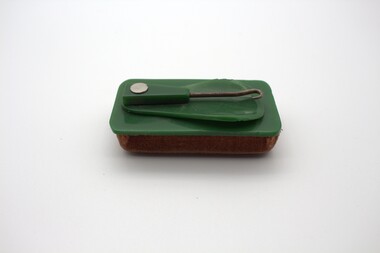
Footwear - Shoe Cleaner
... Dark green plastic shoe-cleaning device with felt pad underside and metal button hook. Incorporates a brush, shoehorn and button hook for cleaning footwear and assisting with fastening the small buttons commonly found on boots and shoes in the late nineteenth and early twentieth centuries....Dark green plastic shoe-cleaning device with felt pad underside and metal button hook. Incorporates a brush, shoehorn and button hook for cleaning footwear and assisting with fastening the small buttons commonly found on boots and shoes in the late nineteenth and early twentieth centuries. ...Dark green plastic shoe-cleaning device with felt pad underside and metal button hook. Incorporates a brush, shoehorn and button hook for cleaning footwear and assisting with fastening the small buttons commonly found on boots and shoes in the late nineteenth and early twentieth centuries. -
 Melbourne Tram Museum
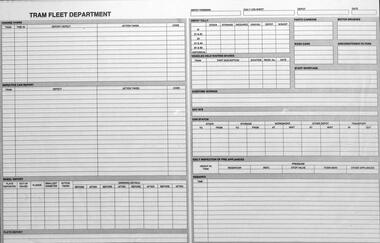
Document - Forms, Public Transport Corporation (PTC), "Tram Fleet Department" - Daily Log Book, c1990's
... Has space for entries of date, depot, change over details, defective cars, flats, brake shoe, leading hand inspections, day in cars, number of cars, transport of vehicles, staff shortages, overtime worked, wheels inspected and remarks, depot tally by class, pantographs, motor brushes overtime works, car status, daily inspection of fire appliances and general remarks. ...Has space for entries of date, depot, change over details, defective cars, flats, brake shoe, leading hand inspections, day in cars, number of cars, transport of vehicles, staff shortages, overtime worked, wheels inspected and remarks, depot tally by class, pantographs, motor brushes overtime works, car status, daily inspection of fire appliances and general remarks. ...Has space for entries of date, depot, change over details, defective cars, flats, brake shoe, leading hand inspections, day in cars, number of cars, transport of vehicles, staff shortages, overtime worked, wheels inspected and remarks, depot tally by class, pantographs, motor brushes overtime works, car status, daily inspection of fire appliances and general remarks. See Reg Item 3611 for an earlier version. Includes B1 and B2 class trams. Sampled from a large book of forms.Demonstrates tramcar maintenance forms.Form, titled - "Tram Fleet Department" - Daily Log Book comprising original sheet and copy sheet (carbon paper not required - NCR)trams, tramways, forms, tramcars, tramcar maintenance, ptc -
 City of Melbourne Libraries
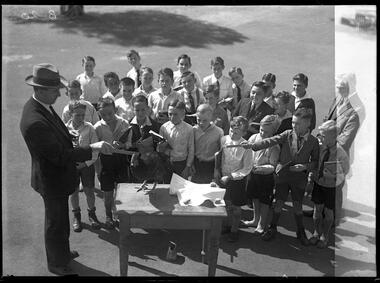
Photograph, Bull, Hugh Jones, 1897-1993, Poultry Club, Wales Street School, Northcote
... Mostly they wear shoes or boots and socks, although one has bare feet. Some wear a jacket, some wear ties; one has braces. Their hair has been freshly brushed. ...Mostly they wear shoes or boots and socks, although one has bare feet. Some wear a jacket, some wear ties; one has braces. Their hair has been freshly brushed. ...Wales Street State School poultry club lesson “Fresh eggs for breakfast will be available now in many Northcote homes. Mr Taylor of the Wales Street School, is explaining the points of a good hen to the members of the school poultry club.” Mr Taylor of Ballarat was founder of the largest Young Farmers’ Club in Western Victoria. He was also in charge of Grade 6 at Northcote’s Wales Street State School No. 3139 and president of their poultry club. The chook under inspection is the Australorp, an Australian breed developed from the UK Black Orpington and the US Rhode Island Red. It achieved world-wide popularity in the 1920s for its laying ability: in a 1922/23 world record, six hens laid an average of 309.5 eggs per hen during a 365 consecutive day trial. MCK 059 Published: The Age 16 March 1934 Featured in "Newsworthy: Melbourne in photographs 1933-1936" exhibition at East Melbourne Library, October to December 2023. Exhibition caption by project volunteer, Louise McKenzie. Photographer notations on slide: "B20" Published: 16 March 1934 The Age p3 Published title: SUBURBAN BOYS' POULTRY CLUB Published caption: Fresh eggs for breakfast will be available now in many Northcote homes. Mr. Taylor, of the Wales-street school, is explaining the points of a good hen to the members of the school poultry club. Trove article identifier: http://nla.gov.au/nla.news-article203841415 Description: The scene is outside in a school playground. 25 schoolboys and one teacher stand around a wooden table on which a large live chicken is standing. An instructor stands beside the chicken, holding a ruler, which rests lightly on the chicken’s neck. The boys wear shorts and shirts. Mostly they wear shoes or boots and socks, although one has bare feet. Some wear a jacket, some wear ties; one has braces. Their hair has been freshly brushed. One boy stands out from the group: he appears older than the others and wears a tie, shirt and blazer, with two badges on the lapel. The young teacher wears a slightly scruffy short suit with shirt and tie; the instructor wears a dark suit with tie and hat. The boys are carrying exercise books. They look to be around 10 years of age. Research by project volunteer, Louise McKenzie: From the text of the newspaper article we know this is the Wales Street Primary School, in Northcote. It opened in 1891 when it was known as the Prince of Wales Park State School. As a result of economic depression it closed in 1892, but reopened in 1900, and in 1920 reached its peak with 1232 pupils. The instructing teacher is Mr James Taylor, who was leader of the school’s Poultry Club. He wrote articles for the Age explaining that “since 1927 when the Young Farmers Clubs were first established in Victorian State schools, poultry keeping as a school project and a hobby has become extremely popular.” He encouraged girls and boys to become involved for profit and pleasure. White Leghorn and Australorp breeds were good egg producers, but most important were, “the 4 G’s of poultry farming:— grains, greens, grit and gumption — the latter being extremely important. One might be excused also for asking that the word "grit" be read with a double meaning. Brain sees through a thing, but grit sees it through. The successful person in poultry keeping is he or she who continues to work well with the birds long after the novelty has died off.” According to a visitor to the Poultry Club, expert farmer Mr Buscomb of NUPHA, the key features of a good bird were that it should be "as wide as possible across the saddle, have a clean face, close feathers, bayonet shaped legs, and fine textured combs and wattles." The Australorp is a chicken breed of Australian origin, developed out of Black Orpington (UK) and Rhode Island Red birds. White Leghorn, Langshan and Minorca elements were also added, resulting in a very utilitarian bird known as the Australian Black Orpington (Austral-orp). It achieved world-wide popularity in the 1920s for its laying ability. In 1922-23 a team of six hens set a world record by laying 1857 eggs for an average of 309.5 eggs per hen during a 365 consecutive day trial. In Australia the Australorp is recognised in black, white and blue colouring. The Weekly Times of Saturday 24 February 1934 reported that Mr James Taylor of Ballarat, founder of the largest Young Farmers’ club in Victoria (at Murtoa) was now in charge of Grade 6 at the Wales Street State School No. 3139 and was president of their poultry club. This feature followed in The Age of 16 March 1934, with another in 28 December 1934. The topic is again featured in the Weekly Times of April 1935 – Mr Taylor was making quite an impact! References: SUBURBAN BOYS' POULTRY CLUB--PREMIERSHIP CRICKET TEAM--AROUND THE SUN DIAL--"EYES LEFT !" (1934, March 16). The Age (Melbourne, Vic. : 1854 - 1954), p. 3. Retrieved September 19, 2023, from http://nla.gov.au/nla.news-article203841415 Poultry at Northcote (1935, April 27). Weekly Times (Melbourne, Vic. : 1869 - 1954), p. 47. Retrieved September 19, 2023, from http://nla.gov.au/nla.news-article223353807 POCKET MONEY FROM POULTRY. (1934, December 28). The Age (Melbourne, Vic. : 1854 - 1954), p. 14. Retrieved September 19, 2023, from http://nla.gov.au/nla.news-article205074190 A City Club (1934, February 24). Weekly Times (Melbourne, Vic. : 1869 - 1954), p. 49. Retrieved September 19, 2023, from http://nla.gov.au/nla.news-article223202561 Australorp, Wikipedia, https://en.wikipedia.org/wiki/AustralorpPhotographer notations on slide: "B20".schools, poultry, clubs, 1930-1939
