Williamstown Historical Society Inc
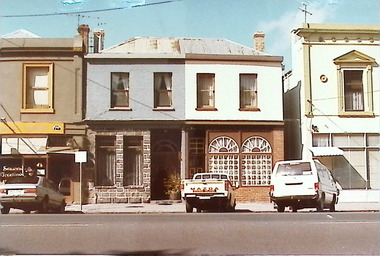
Photograph - Nelson Place, No. 151-153
... After this he took up storekeeping
and auctioneering but gave up the shopkeeping in 1858. He was a member of the first Williamstown Council and its chairman no less than four times (1856, 1860, 1862, 1864). ...After this he took up storekeeping
and auctioneering but gave up the shopkeeping in 1858. He was a member of the first Williamstown Council and its chairman no less than four times (1856, 1860, 1862, 1864). ...
No. 151-153 Nelson Place was designed by Michael Egan and constructed in 1860.
The buildings are recorded in the Hobsons Bay Heritage Study Amended 2017 (Heritage Overlay No. HO219) and notes the following:
Historically, they are among the oldest shops in Nelson Place and illustrate the early development of the street during the most prosperous period of the Port. They are also important for their associations with Thomas Mason. Thomas Mason, who owned these two shops, each of stone, brick and four rooms until c1880, was one of the most significant men in the early history of Williamstown. In 1858 he ran the two shops jointly with Benjamin Culley, a draper and clothier (Refer to 55 Cecil Street). Culley and Mason's partnership dissolved and after a brief period as the Ship Inn, in 1859, the two shops were now
leased to various other businessmen, some of the longest standing being Matthew Suffren, a watchmaker; Edward Bailey, a chemist; a stationer, George Divers; Henry Douglas a plumber and
Henry Linton, a boot maker (Refer to 22 James St, 46-48 and 50 Stevedore Street). In 1880 Mrs. Mason had assumed ownership which she retained until the shops were retaken by the executors of
Sutton's estate (1890). Given the property's description in the period 1857-59 as a store of wood and stone and in 1860, as two shops of brick and stone, it is probable in that year that the whole premises was rebuilt.
Thomas Mason, originally a Londoner, arrived in the colony in 1841. On 24 August 1844 he took charge of the signal station, and subsequently the light- house (then a lamp in a wooden tower), for
a further five years. In `Port of Many Prows', Wilson Evans recounts a tale which indicates that Mason may not have been entirely conscientious in this role. After this he took up storekeeping
and auctioneering but gave up the shopkeeping in 1858. He was a member of the first Williamstown Council and its chairman no less than four times (1856, 1860, 1862, 1864). He represented
Williamstown in the Legislative Assembly in 1860-61 (6). Andrew Rider's photograph of Nelson Place, taken c1866 shows these shops as the most substantial in the block and adorned with a
slender timber verandah. nelson place, 151-157 nelson place, thomas mason

 Creswick Museum
 Williamstown Historical Society Inc