
Showing 458 items matching "short road"
-
 Port Melbourne Historical & Preservation Society
Document - Short Road Ferry ticket, c.1974
... Short Road Ferry ticket......Short Road Ferry...From the collection of Warren DOUBLEDAY. The Short Road ferry ran between the end of Williamstown Road in Port Melbourne across the narrowest section of the Yarra River to the bottom of the Strand in Williamstown. ...A single trip 15 cent ticket for crossing the Yarra River from Williamstown on the Short Road Ferry. The off white ticket has two diagonal blue stripes and the number P016322 printed on the side. ...Transport - Ferries Short Road Ferry Williamstown Transport - Motor Vehicles A single trip 15 cent ticket for crossing the Yarra River from Williamstown on the Short Road Ferry. ...From the collection of Warren DOUBLEDAY. The Short Road ferry ran between the end of Williamstown Road in Port Melbourne across the narrowest section of the Yarra River to the bottom of the Strand in Williamstown. The name came from it being the 'short road' between the two places. There was a type of ferry service in operation from around 1873 which was modernised in the 20th century to take cars and trucks across the river. It was operated by two heavy chains which sank to the river bed to allow ships to pass.A single trip 15 cent ticket for crossing the Yarra River from Williamstown on the Short Road Ferry. The off white ticket has two diagonal blue stripes and the number P016322 printed on the side. transport - ferries, short road ferry, williamstown, transport - motor vehicles -
Port Melbourne Historical & Preservation Society
Document - Short Road Ferry ticket 1974, 7 Jan1974
... Short Road Ferry ticket 1974......Short Road Ferry...From the collection of Warren DOUBLEDAY. The Short Road ferry ran between the end of Williamstown Road in Port Melbourne across the narrowest section of the Yarra River to the bottom of the Strand in Williamstown. ...A single trip 20 cent ticket for crossing the Yarra River from Williamstown on the Short Road Ferry. The off white ticket has two diagonal blue stripes and the number C049655 printed on the side. ...Transport - Ferries Short Road Ferry Williamstown Transport - Motor Vehicles On reverse side of ticket -" 8.25 pm trip. 7-1-74 (last East bound for day'" A single trip 20 cent ticket for crossing the Yarra River from Williamstown on the Short Road Ferry. ...From the collection of Warren DOUBLEDAY. The Short Road ferry ran between the end of Williamstown Road in Port Melbourne across the narrowest section of the Yarra River to the bottom of the Strand in Williamstown. The name came from it being the 'short road' between the two places. There was a type of ferry service in operation from around 1873 which was modernised in the 20th century to take cars and trucks across the river. It was operated by two heavy chains which sank to the river bed to allow ships to pass.A single trip 20 cent ticket for crossing the Yarra River from Williamstown on the Short Road Ferry. The off white ticket has two diagonal blue stripes and the number C049655 printed on the side. On reverse side of ticket -" 8.25 pm trip. 7-1-74 (last East bound for day'"transport - ferries, short road ferry, williamstown, transport - motor vehicles -
Port Melbourne Historical & Preservation Society
Document - Short Road Ferry ticket, c.1974
... Short Road Ferry ticket......Short Road Ferry...From the collection of Warren DOUBLEDAY. The short Road ferry ran between the end of Williamstown Road in Port Melbourne across the narrowest section of the Yarra River to the bottom of the Strand in Williamstown. ...A single trip 15 cent ticket for crossing the Yarra River from Williamstown on the Short Road Ferry. The off white ticket has two diagonal blue stripes and the number F 048261 printed on the side. ...Transport - Ferries Short Road Ferry Williamstown Transport - Motor Vehicles A single trip 15 cent ticket for crossing the Yarra River from Williamstown on the Short Road Ferry. ...From the collection of Warren DOUBLEDAY. The short Road ferry ran between the end of Williamstown Road in Port Melbourne across the narrowest section of the Yarra River to the bottom of the Strand in Williamstown. The name came from it being the 'short road' between the two places. There was a type of ferry service in operation from around 1873 which was modernised in the 20th century to take cars and trucks across the river. It was operated by two heavy chains which sank to the river bed to allow ships to pass.A single trip 15 cent ticket for crossing the Yarra River from Williamstown on the Short Road Ferry. The off white ticket has two diagonal blue stripes and the number F 048261 printed on the side. transport - ferries, short road ferry, williamstown, transport - motor vehicles -
 Port Melbourne Historical & Preservation Society
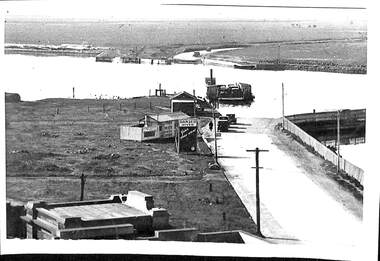
Photograph - Short Road ferry crossing Yarra from west side, 1930
... Short Road ferry crossing Yarra from west side ......short road ferry...Black and white photograph of Short Road ferry crossing the Yarra, taken from the west side. ...piers and wharves short road ferry williamstown road Black and white photograph of Short Road ferry crossing the Yarra, taken from the west side. ...Black and white photograph of Short Road ferry crossing the Yarra, taken from the west side. Roads on both sides with cars. Buildings on west side.piers and wharves, short road ferry, williamstown road -
Port Melbourne Historical & Preservation Society
Legal record - Contract, fencing, Williamstown Short Road, Port Melbourne, 2 Apr 1897
... Contract, fencing, Williamstown Short Road, Port Melbourne...Contract for fencing grass reserve, Williamstown Short Road....local government - town of port melbourne james pickett m g harrison Town of Port Melbourne & Town of Williamstown Contract for fencing grass reserve, Williamstown Short Road. Legal record Contract, fencing, Williamstown Short Road, Port Melbourne ...Contract for fencing grass reserve, Williamstown Short Road.Town of Port Melbourne & Town of Williamstownlocal government - town of port melbourne, james pickett, m g harrison -
Port Melbourne Historical & Preservation Society
Legal record - Contract, construction of Williamstown Short Road, Port Melbourne, 13 Nov 1896
... Contract, construction of Williamstown Short Road, Port Melbourne...Contract for the construction of Williamstown Short Road and part of Graham Street...Engineering - Roads Streets Lanes and Footpaths Rumpt Bros & Ebeling Local Government - Town of Port Melbourne Local Government - Town of Williamstown Contract for the construction of Williamstown Short Road and part of Graham Street Legal record Contract, construction of Williamstown Short Road, Port Melbourne ...Contract for the construction of Williamstown Short Road and part of Graham Streetengineering - roads streets lanes and footpaths, rumpt bros & ebeling, local government - town of port melbourne, local government - town of williamstown -
Port Melbourne Historical & Preservation Society
Book - Minutes, Port Melbourne Council, Williamstown Short Road Committee, 1896
... Minutes, Port Melbourne Council, Williamstown Short Road Committee...Red bound book of minutes for the Williamstown Short Road Committee 1896...local government - town of port melbourne Red bound book of minutes for the Williamstown Short Road Committee 1896 Book Minutes, Port Melbourne Council, Williamstown Short Road Committee ...Red bound book of minutes for the Williamstown Short Road Committee 1896local government - town of port melbourne -
Port Melbourne Historical & Preservation Society
Photograph - Williamstown 'Short Road' ferry (punt) crossing the Yarra River, 1950s
... Williamstown 'Short Road' ferry (punt) crossing the Yarra River...Laser copy of photograph of the Williamstown 'Short Road' ferry (punt) crossing the Yarra River from Newport to Port Melbourne's Williamstown Road....Photograph Williamstown 'Short Road' ferry (punt) crossing the Yarra River ...copied from a photograph held by the City of Port PhillipLaser copy of photograph of the Williamstown 'Short Road' ferry (punt) crossing the Yarra River from Newport to Port Melbourne's Williamstown Road.transport - ferries -
 Port Melbourne Historical & Preservation Society
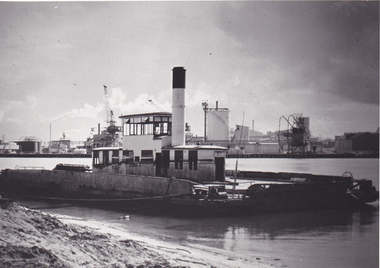
Photograph - Williamstown 'Short' Road ferry, laying at south side of the Yarra prior to being broken up, 1970s
... Williamstown 'Short' Road ferry, laying at south side of the Yarra prior to being broken up...Black and white photographic copy from slide of Short Road Ferry laying at south side of Yarra, prior to being broken up...transport - ferries Black and white photographic copy from slide of Short Road Ferry laying at south side of Yarra, prior to being broken up Photograph Williamstown 'Short' Road ferry, laying at south side of the Yarra prior to being broken up ...Black and white photographic copy from slide of Short Road Ferry laying at south side of Yarra, prior to being broken uptransport - ferries -
 Port Melbourne Historical & Preservation Society
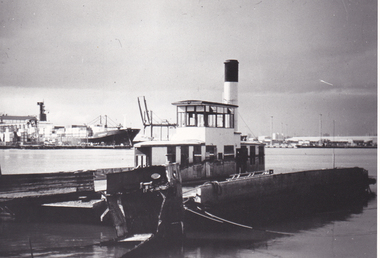
Photograph - Williamstown 'Short' Road ferry, laying at south side of the Yarra prior to being broken up, 1970s
... Williamstown 'Short' Road ferry, laying at south side of the Yarra prior to being broken up...Black and white photographic copy from slide of Short Road Ferry laying at south side of Yarra, prior to being broken up...transport - ferries Black and white photographic copy from slide of Short Road Ferry laying at south side of Yarra, prior to being broken up Photograph Williamstown 'Short' Road ferry, laying at south side of the Yarra prior to being broken up ...Black and white photographic copy from slide of Short Road Ferry laying at south side of Yarra, prior to being broken uptransport - ferries -
 Port Melbourne Historical & Preservation Society
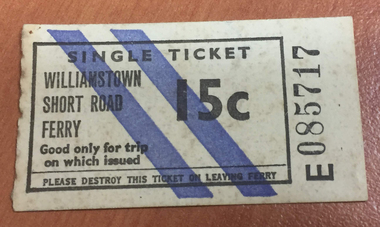
Document - Ferry Ticket, Williamstown Short Road Ferry, 1970s
... Ferry Ticket, Williamstown Short Road Ferry...Single ticket for the Williamstown Short Road Ferry (the 'Punt') 15c - oatmeal coloured with two diagonal purple stripes. ...(Instructions read 'Please destroy this ticket on leaving ferry') Document Ferry Ticket, Williamstown Short Road Ferry ...Kept by Les Pont, donated to Society in August 1998Single ticket for the Williamstown Short Road Ferry (the 'Punt') 15c - oatmeal coloured with two diagonal purple stripes. (Instructions read 'Please destroy this ticket on leaving ferry')transport - ferries, williamstown -
Port Melbourne Historical & Preservation Society
Document - Notice, Date of deputation to Minister of Lands re sale of lands along Williamstown Short Road, 23 Jan 1880
... Notice, Date of deputation to Minister of Lands re sale of lands along Williamstown Short Road...Clark, notifying date of deputation to Minister of Lands, re sale of lands along Williamstown Short Road...Clark, notifying date of deputation to Minister of Lands, re sale of lands along Williamstown Short Road Document Notice, Date of deputation to Minister of Lands re sale of lands along Williamstown Short Road ...Pinned with item 600.01Small (4pg) letter from Town Clerk Williamstown to E.C. Clark, notifying date of deputation to Minister of Lands, re sale of lands along Williamstown Short RoadE.C. Clark address is in black (rest of letter in mauve ink)town planning, edward clark, town clerks, george f smith, land sales -
Port Melbourne Historical & Preservation Society
Document - Memo, Department of Public Works re Williamstwon Short Road, 12 Sep 1887
... Memo, Department of Public Works re Williamstwon Short Road...Foolscap, printed single page copy of Dept of Public Works memo re Williamstown Short Road, dated 12 Sept 1887; original memo dated 19.8.1887. ...Document Memo, Department of Public Works re Williamstwon Short Road ...Items 598.01-.04 originally pinned togetherFoolscap, printed single page copy of Dept of Public Works memo re Williamstown Short Road, dated 12 Sept 1887; original memo dated 19.8.1887. Includes costs of grading road.engineering - roads streets lanes and footpaths, edward clark, town clerks, william thwaites -
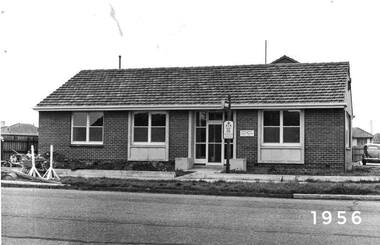 Sunshine and District Historical Society Incorporated
Photograph - Maidstone Police Station Ballarat Road Cnr Short Street 1956 Photographs
... Maidstone Police Station Ballarat Road Cnr Short Street 1956 Photographs...Both the Ballarat Road and Short Street police station buildings are now private residences...5358.01 - Maidstone Police Station Ballarat Road Cnr Short Street 1956 Photo 01.jpg 5358.02 - Maidstone Police Station Ballarat Road Cnr Short Street 1956 Photo 01.jpg...Maidstone Police Station Ballarat Road Maidstone 5358.01 - Maidstone Police Station Ballarat Road Cnr Short Street 1956 Photo 01.jpg 5358.02 - Maidstone Police Station Ballarat Road Cnr Short Street 1956 Photo 01.jpg Digital black & white photographs Photograph Maidstone Police Station Ballarat Road Cnr Short Street 1956 Photographs ...The earliest Maidstone Police Station operated on Ballarat Road, address later confirmed as 130 Ballarat Road. Heritage discussions note that the station moved around the corner into Short Street in 1956. It is possible the Ballarat Road building was extended at the rear, facing Short Street, and the operational entrance shifted. The station served Maidstone and Braybrook during the peak years of public housing expansion. Both the Ballarat Road and Short Street police station buildings are now private residencesLocals recall it as the place where many residents obtained their driver’s licences in the 1960s–1970s.5358.01 - Maidstone Police Station Ballarat Road Cnr Short Street 1956 Photo 01.jpg 5358.02 - Maidstone Police Station Ballarat Road Cnr Short Street 1956 Photo 01.jpgmaidstone police station, ballarat road, maidstone -
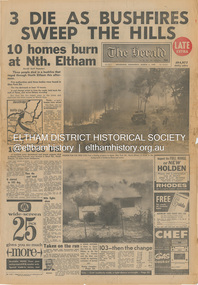 Eltham District Historical Society Inc
Newspaper - Newspaper articles, The Herald, 3 Die as Bushfires Sweep the Hill: 10 homes burn at Nth. Eltham, The Herald, Wednesday, March 3, p1, 1965
... ...Short Road....) • 10-mile front out of control; Gippsland area ablaze, p3 • Trapped, but saved by wind, p3 Tom Fielding Collection Victorian Bushfires - 1965 Victorian Bushfires – 1965 Eltham North Bert Rodda Glen Park Road Short Road Research (Vic.) Wattle Glen Diamond Creek Warrandyte Eltham Gippsland Mrs G. ...Various news articles pertaining to the January 1965 Victorian bushfires specifically with a focus on fires at Eltham North. Specific Eltham Shire districts mentioned include Eltham North and veteran Herald staff photographer Bert Rodda on page 1 • 3 Die as Bushfires Sweep the Hill: 10 homes burn at Nth. Eltham, p1 (Illust.) • 100 dogs die, p1 • Taken on the run, p1 (Illust.) • Fire runs wild at Eltham, p3 (Illust.) • 10-mile front out of control; Gippsland area ablaze, p3 • Trapped, but saved by wind, p3 tom fielding collection, victorian bushfires - 1965, victorian bushfires – 1965, eltham north, bert rodda, glen park road, short road, research (vic.), wattle glen, diamond creek, warrandyte, eltham, gippsland, mrs g. maher, bill dancy, eltham north store, bushfire damage - buildings -
Port Melbourne Historical & Preservation Society
Document - Notice, Attendance at deputation to Public Work re Williamstown Road grant, Edward Clark, Town Clerk, 27 Jan 1880
... Small (4pg) notice inviting attendance at deputation to Minister of Lands, 28 January 1880 re sale of lands along Williamstown Short Road...Pinned with item 600.02 Town Planning Edward CLARK Town Clerks George F SMITH Land Sales '(Copy)' Small (4pg) notice inviting attendance at deputation to Minister of Lands, 28 January 1880 re sale of lands along Williamstown Short Road Document Notice, Attendance at deputation to Public Work re Williamstown Road grant Edward Clark, Town Clerk ...Pinned with item 600.02Small (4pg) notice inviting attendance at deputation to Minister of Lands, 28 January 1880 re sale of lands along Williamstown Short Road'(Copy)'town planning, edward clark, town clerks, george f smith, land sales -
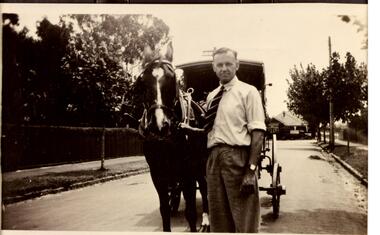 Glen Eira Historical Society
Document - Dairies
... Road... Short Archibald...P Murray in 26/05/1977 from Miss IV Anderson/ 2/Typed pages from Sands & McDougalls, 1911, 1913, 1942 editions dairy entries. 3/Four separate receipts, one photocopied of local dairies, various dates. 4/Two black-and-white photographs of Archibald Short, proprietor of Shorts Dairy in Carlingford Street, and resided in College Street, Elsternwick. 5/Printed document taken from Purchase Agreement between Clara Benzley and Thomas Jenner, on the purchase of a dairy at 43 Woornack Road. ...Carnegie Neerim Road Parton’s Dairy Hawthorn Road Short Archibald Carlingford Street South Caulfield College Street Elsternwick Milk Cart Dairying Dairies Land Sales Real Estate Architectural Woornack Road Auctions Document Dairies ...This file contains six items: 1/Handwritten information from 1874 Sands & McDougalls sent to Mr. P Murray in 26/05/1977 from Miss IV Anderson/ 2/Typed pages from Sands & McDougalls, 1911, 1913, 1942 editions dairy entries. 3/Four separate receipts, one photocopied of local dairies, various dates. 4/Two black-and-white photographs of Archibald Short, proprietor of Shorts Dairy in Carlingford Street, and resided in College Street, Elsternwick. 5/Printed document taken from Purchase Agreement between Clara Benzley and Thomas Jenner, on the purchase of a dairy at 43 Woornack Road. Carnegie 13/08/1926. Gives the items included in contract of sale, including 2 horses. 6/Caulfield Glen Eira Leader newspaper article dated is May, 2014, showing upcoming sale of 43 Woornack Road, Carnegie. The property was Clara Benzley’s (granddaughter Claire Barton) dairy in 1926.burlington model dairy, glen huntly road, caulfield, hall mr., carinya dairy, orrong crescent, bradin, rice l. i., dairyman, green r., queens ave., carnegie, neerim road, parton’s dairy, hawthorn road, short archibald, carlingford street, south caulfield, college street, elsternwick, milk cart, dairying, dairies, land sales, real estate, architectural, woornack road, auctions -
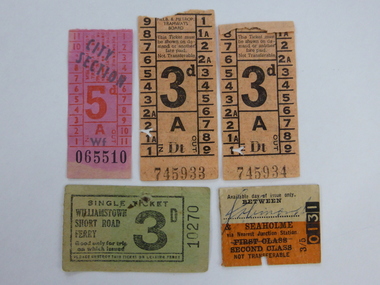 Warrnambool and District Historical Society Inc.
Tickets, Old Transport Tickets x5, 1950
... The Williamstown Short Road Ferry operated from 1931 to 1974 from Port Melbourne to Williamstown and was replaced by the West Gate Bridge which opened in 1978. ...The Williamstown Short Road Ferry operated from 1931 to 1974 from Port Melbourne to Williamstown and was replaced by the West Gate Bridge which opened in 1978. ...These tram tickets were issued by the Melbourne and Metropolitan Tramways Board which operated from 1919 to 1983 and the train ticket was issued by the Victorian Railways. The Williamstown Short Road Ferry operated from 1931 to 1974 from Port Melbourne to Williamstown and was replaced by the West Gate Bridge which opened in 1978. This was the third ferry service in this area, with the first one commencing in 1873. These tickets have social significance as examples of the tickets used by Melbourne transport in the 1950s. They will be useful for display.These are five paper transport tickets (Melbourne tram & train and Williamstown ferry). The tram tickets are coloured orange and pink, the ferry ticket is green and the train ticket (made of light cardboard) is orange and yellow. The two orange tram tickets, (cost threepence) have an advertisement for Stamina Trousers on the back. They were purchased on the same day. The other tram ticket is a City Section ticket costing fivepence. The ferry ticket cost threepence and the train ticket for travel between Jolimont and Seaholme cost three shillings and fivepence. The tram tickets except for the City Section tram one have been punched with the characteristic punch of the conductor during those journeys. ‘Ask for Stamina self-supporting trousers, Thought for the Month, We become like those we habitually admire’. melbourne tram, train and ferry tickets., warrnambool -
 Ringwood and District Historical Society
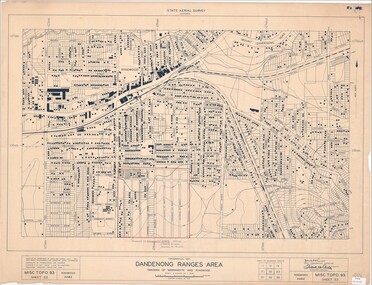
Map - State Aerial Survey, Dandenong Ranges Area, Parishes of Warrandyte and Ringwood - 1956
... Ballyduffy Estate streets include City Road, West Prussia Road, Duffy Street, Ireland Street, Evans Street, Victoria Street, Regina Street, Short Road, Prussia Road, Duffy Street East, Ireland Street East, Evans Street East, Chapman Street. ...Ballyduffy Estate streets include City Road, West Prussia Road, Duffy Street, Ireland Street, Evans Street, Victoria Street, Regina Street, Short Road, Prussia Road, Duffy Street East, Ireland Street East, Evans Street East, Chapman Street. ...Map of central and southern areas of Ringwood and part of Ringwood East and Heathmont compiled by Dept of Lands and Survey, July 1956, from aerial photographs and Cadastral Survey information. Subsequent hand-drawn addition of streets showing layout of "Township of Ballyduffy Estate 1858-60", an earlier proposed subdivision that did not eventuate. (See attached 5009b Ballyshanassy_ Melbourne’s lost suburb.pdf for Ballyduffy historical naming relevance). Ballyduffy Estate streets include City Road, West Prussia Road, Duffy Street, Ireland Street, Evans Street, Victoria Street, Regina Street, Short Road, Prussia Road, Duffy Street East, Ireland Street East, Evans Street East, Chapman Street. Misc Topo 93 Sheet 22, Ringwood A4B2. Scale: 4 chains to 1 inch. Contour interval 20 feet. -
 Greensborough Historical Society
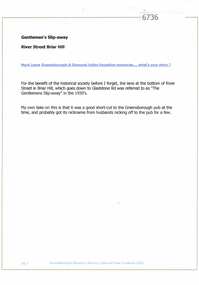
Article and Photograph, Gentlemen's slip away, 2016_
... Explanation of the term "gentlemen's slip-away", said to refer to the lane at the bottom of River Street Briar Hill which goes to Gladstone Road - a short cut to the Greensborough Hotel?...Explanation of the term "gentlemen's slip-away", said to refer to the lane at the bottom of River Street Briar Hill which goes to Gladstone Road - a short cut to the Greensborough Hotel? This photograph and text was copied from a Facebook site. ...Explanation of the term "gentlemen's slip-away", said to refer to the lane at the bottom of River Street Briar Hill which goes to Gladstone Road - a short cut to the Greensborough Hotel?This photograph and text was copied from a Facebook site. Members are people who lived in the Greensborough area and share their reminiscences of the area with others. The site is administered by a GHS member but is not officially affiliated with the Society. Any information is the opinion of the contributor. Article and photograph sourced from social media.river street briar hill, gladstone road briar hill, greensborough hotel -
 Whitehorse Historical Society Inc.
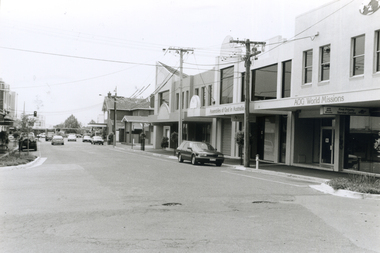
Photograph, Corner Station & Colombo Streets, Mitcham, 2000
... Note above ground electricity cables that stop short of Whitehorse Road....Note above ground electricity cables that stop short of Whitehorse Road. Corner Station & Colombo Streets, Mitcham Photograph Photograph ...Produced as one of a series of 24 prints commissioned by Nunawading & District Historical Society -|Theme: Intersections of Mitcham and Nunawading 2000/2001.|See also Series by P. Simmenauer on the same theme.Black and white photograph - print and negative of Corner of Station and Colombo Street, Mitcham, looking North from Mitcham Station. From L:R: Mitcham Post Office; Pru$hka Debt Recovery Agency; Assemblies of God in Australia' ; AOG World Missions. Note above ground electricity cables that stop short of Whitehorse Road.mitcham post office, pru$hka debt recovery agency, assemblies of god in australia, aog world missions, electricity supply -
 Mt Dandenong & District Historical Society Inc.
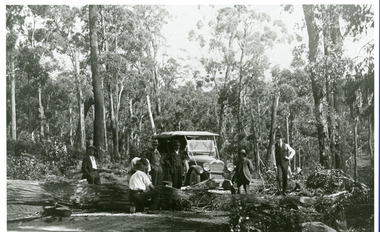
Photograph, Car On New Road Blocked By Tree
... Dandenong Tourist Road a short distance past present Silvandale Store (Kalorama Post Office now). ...Dandenong Tourist Road a short distance past present Silvandale Store (Kalorama Post Office now). ...Site said to be the new Mt. Dandenong Tourist Road a short distance past present Silvandale Store (Kalorama Post Office now). Early model vehicle and passengers delayed by tree across road. Not much progress being made with axe.kalorama, mt. dandenong tourist road, silvandale store -
 Ringwood and District Historical Society
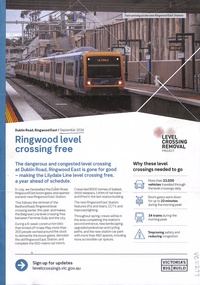
Pamphlet, Level Crossing Removal Newsletter Sep 2024 - Ringwood level crossing free (Dublin Road, Ringwood East) and new Ringwood East Station. (Big Build Project)
... Full colour A4 Community Update on the Big Build Level Crossing Removal Project, covering the Dublin Road level crossing removal and new Ringwood East Station. Includes progress photos. Also short articles on Bedford Road crossing removal, and the Turtle Guardian sculpture by local artist Katie Stackhouse. ...Published by Victorian Government Full colour A4 Community Update on the Big Build Level Crossing Removal Project, covering the Dublin Road level crossing removal and new Ringwood East Station. Includes progress photos. Also short articles on Bedford Road crossing removal, and the Turtle Guardian sculpture by local artist Katie Stackhouse. ...Full colour A4 Community Update on the Big Build Level Crossing Removal Project, covering the Dublin Road level crossing removal and new Ringwood East Station. Includes progress photos. Also short articles on Bedford Road crossing removal, and the Turtle Guardian sculpture by local artist Katie Stackhouse. Published by Victorian Government -
 Ballarat Tramway Museum
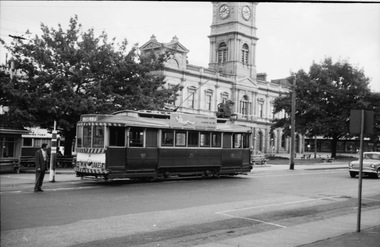
Photograph - Digital image Set of 2 - tram 21, Graham Parry, 1971
... In the background is another tram on the other side of the road, the short tram stop pole and the Town Hall. .2 - ditto taken from the Post Office steps....In the background is another tram on the other side of the road, the short tram stop pole and the Town Hall. .2 - ditto taken from the Post Office steps. ...Photographed inn Ballarat during 1971 prior to closure of the system by Graham Parry. All images from the scanned negative. .1 - tram 21 at the city terminus, Sturt St, with a Lydiard St North destination and a Twin Lakes sign. In the background is another tram on the other side of the road, the short tram stop pole and the Town Hall. .2 - ditto taken from the Post Office steps.Yields information about the Mt Pleasant terminus and tram operations in 1971.Set of two digital images of photograph of tramstrams, tramways, sturt st, lydiard st north, town hall, tram 21 -
 Bendigo Historical Society Inc.
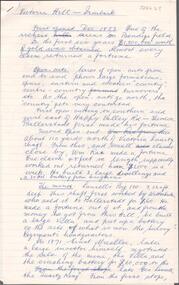
Document - ALBERT RICHARDSON COLLECTION: VICTORIA HILL IRONBARK
... This hill reached by a short and excellent access road gives a magnificent view of Bendigo and Golden Square, and a very good view of another tourist attraction, Lansells 'Fortuna' now Survey Regiment's headquarters. ...This hill reached by a short and excellent access road gives a magnificent view of Bendigo and Golden Square, and a very good view of another tourist attraction, Lansells 'Fortuna' now Survey Regiment's headquarters. ...Three page document hand written by Albert Richardson, on the history of Victoria Hill, Ironbark. 'one of the richest areas on Bendigo field. In the first six years, £1,200,000 worth of gold was obtained. Almost every claim returned a fortune.' Page three title: Other features on Victoria Hill. 'Adjacent to Central Nell Gwynne area as the mining museum. Adjacent to the New Chum Hill on direct south side of the Calder Highway. This hill reached by a short and excellent access road gives a magnificent view of Bendigo and Golden Square, and a very good view of another tourist attraction, Lansells 'Fortuna' now Survey Regiment's headquarters. This hill is the centre of another rich area. The Lazarus mine 3,360 feet deep with 24 saddle reefs in 2,200 feet. The New Chum United, Lansell's 222with its 120 ft high poppet legs. BCV 8, John Brown Knitwear factory, Esposito's Gold Mines Hotel, Central Nell Gwynne and Manchester tram loops are mentioned.Albert Richardsonbendigo, mining, victoria hill -
 Flagstaff Hill Maritime Museum and Village
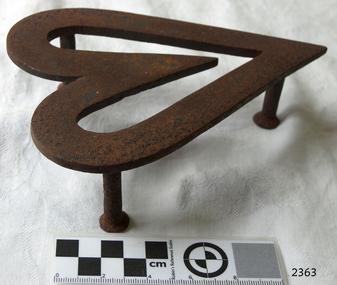
Domestic object - Stand
... short feet, used on a table to support a hot dish. Trivets have been used since the invention of iron and are essential for placing hot items on surfaces. This trivet is an example of a trivet used in the late 19th and early 20th centuries. Flagstaff Hill Flagstaff Hill Maritime Museum and Village Warrnambool Maritime Museum Maritime Village Great Ocean Road ...A stand or support for utensils near or on the fire. Usually made of wrought iron, the most common variety, from the 17th century, stands on three legs and has a circular plate with perforated decoration, often in the form of a date. Another early type, short-legged, stood in the fire to support a cast-iron pot. Later, in the second half of the 18th century, trivets designed to be hung from fire bars were made. These were of two types: an oblong, standing trivet with a handle at one end and projections to fit over the fire bars at the other, and a plate that could be attached to the fire bar. Some of the latter were hung inside the grate supporting a vessel over the fire. Large quantities of cast-brass fender trivets were manufactured at Birmingham, in England, in the last quarter of the 18th century; these were suspended from the top rails of the fender as muffin and kettle stands. Four-legged trivets that stood under the spit holding the dripping pan were made in the 18th and 19th centuries. The cat, an entirely different type of plate stand that was made in the 18th century, consisted of six spokes, three at the top and three at the bottom; it could be used either way up. The term trivet is also used in reference to a metal stand with short feet, used on a table to support a hot dish.Trivets have been used since the invention of iron and are essential for placing hot items on surfaces. This trivet is an example of a trivet used in the late 19th and early 20th centuries.Metal stand, heart-shaped, with three metal feet or supports. Made to rest and sppport hot items such as pots or irons. The wrought iron stand is painted black.flagstaff hill, flagstaff hill maritime museum and village, warrnambool, maritime museum, maritime village, great ocean road, shipwreck coast, wrought iron, pot stand, trivet, stand, kitchenalia, iron stand, heart shape, heart shaped trivet, cooking, ironing -
 Flagstaff Hill Maritime Museum and Village
Ceremonial object - Font, 1940s
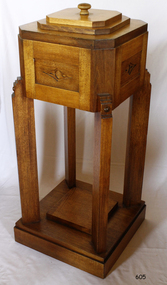
... Kerr Johnston, a Church of England clergyman, and operated from a hulk moored in Hobson’s Bay; later, the Mission occupied buildings in Williamstown and Port Melbourne. flagstaff hill warrnambool shipwrecked-coast flagstaff-hill flagstaff-hill-maritime-museum maritime-museum shipwreck-coast flagstaff-hill-maritime-village font baptisimal font church furniture religious ceremony copper ewet religious furniture christening font religion religious service sailors rest bethel sailors’ church bethel floating church ladies harbour light guild missions to seamen victoria mission to seafarers st nicholas seaman’s church williamstown st nicholas mission to seamen church williamstown mission to seamen williamstown st nicholas seamen’s church flagstaff hill 139 nelson place williamstown anglican church flying angel club copper ewer copper bowl Flagstaff Hill Maritime Museum and Village Maritime Museum Maritime Village Shipwreck Coast Great Ocean Road religious worship worship service St Nicholas Seamen’s Church Williamstown St Nicholas Missions to Seamen’s Church Williamstown Missions to Seamen St Nicholas Missions to Seamen’s Church Flagstaff Hill baptism christening ceremony tradition hand-beaten copper ewer Baptismal font: four-legged, varnished oak wood pedestal supporting a wooden box with a hand-beaten, rolled edge, copper ewer, bowl or basin insert. The box has a removable cover that has a round wooden knob. The sides of the box section have a decorative, diamond-shaped motif. The box and lid are octagonal, with four short ...This font is a piece of church furniture used in a baptism or christening service. It was originally installed in the St Nicholas Seamen's Church at 139 Nelson Place, Williamstown, Victoria. The church was a branch of the Victoria Missions to Seamen. THE MISSIONS TO SEAMEN (Brief History): - The Missions to Seamen was an Anglican charity that has served seafarers of the world since 1856 in Great Britain. Its symbol is a Flying Angel, inspired by a Bible verse. Today, there are centres in over 200 ports worldwide where seamen of all backgrounds are offered a warm welcome and provided with a wide range of facilities. In Victoria, the organisation began in Williamstown in 1857 as a Sailors’ Church, also known as ‘Bethel’ or the ‘Floating Church’ in an old hulk floating in Hobson’s Bay, Port of Melbourne. It soon became part of the Missions to Seamen, Victoria. In the year 2000, the organisation, now named Mission to Seafarers, still operated locally in Melbourne, Portland, Geelong and Hastings. The Ladies’ Harbour Lights Guild was formed in 1906 to support the Missions to Seamen in Melbourne and other centres, such as Williamstown. Two of the most significant ladies of the Guild were founder Ethel Augusta Godfrey and foundation member Alice Sibthorpe Tracy (who established a branch of the Guild in Warrnambool in 1920). The Guild continued its work until the 1960s. In 1943, a former Williamstown bank was purchased for the Missions to Seaman Club. The chapel was named St Nicholas’ Seamen’s Church and was supported by the Ladies’ Harbour Lights Guild, the Williamstown Lightkeepers’ Auxiliary and the League of Soldiers’ and Sailors’ Friends. It ceased operation in 1966. A Missions to Seamen Chapel and Recreation Room was a significant feature of ports during the late 1800s and into the 1900s. It seemed appropriate for Flagstaff Hill to include such a representation within the new Maritime Village, so the Melbourne Board of Management of Missions to Seamen Victoria gave its permission on 21st May 1979 for the entire furnishings of the Williamstown chapel to be transferred to Flagstaff Hill. The St Nicholas Seamen’s Church was officially opened on October 11, 1981, and closely resembles the Williamstown chapel. This font is significant through its association with the St Nicholas' Mission to Seamen Church in Williamstown, Melbourne, established in 1857. The collection of items from the Missions to Seamen in Williamstown, Victoria, has historical and social significance. They show that people of the 1800s and 1900s cared about the seafarers’ religious, moral, and social welfare, no matter what their religion, social status or nationality. It had its origins in Bristol, England, when a Seamen's Mission was formed in 1837. The first Australian branch was started in 1856 by the Rev. Kerr Johnston, a Church of England clergyman, and operated from a hulk moored in Hobson’s Bay; later, the Mission occupied buildings in Williamstown and Port Melbourne. Baptismal font: four-legged, varnished oak wood pedestal supporting a wooden box with a hand-beaten, rolled edge, copper ewer, bowl or basin insert. The box has a removable cover that has a round wooden knob. The sides of the box section have a decorative, diamond-shaped motif. The box and lid are octagonal, with four short sides and four long sides. The tops of the legs have an ornamental design. This is one of the original items in our St Nicholas Seamen's Church Williamstown Collection.flagstaff hill, warrnambool, shipwrecked-coast, flagstaff-hill, flagstaff-hill-maritime-museum, maritime-museum, shipwreck-coast, flagstaff-hill-maritime-village, font, baptisimal font, church furniture, religious ceremony, copper ewet, religious furniture, christening font, religion, religious service, sailors rest, bethel sailors’ church, bethel floating church, ladies harbour light guild, missions to seamen victoria, mission to seafarers, st nicholas seaman’s church williamstown, st nicholas mission to seamen church williamstown, mission to seamen williamstown, st nicholas seamen’s church flagstaff hill, 139 nelson place williamstown, anglican church, flying angel club, copper ewer, copper bowl, flagstaff hill maritime museum and village, maritime museum, maritime village, shipwreck coast, great ocean road, religious worship, worship service, st nicholas seamen’s church, williamstown, st nicholas missions to seamen’s church williamstown, missions to seamen, st nicholas missions to seamen’s church flagstaff hill, baptism, christening, ceremony, tradition, hand-beaten copper ewer -
 Flagstaff Hill Maritime Museum and Village
Equipment - Bosun's Chair, ca. mid-20th century
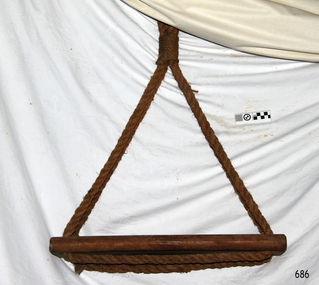
... short plank, or even a canvas sling. The bosun's chair is significant for its association with maritime equipment carried on board a vessel in the late 19th and early 20th century for maintenance and safety purposes. It was occasionally used to save lives. The bosun's chair is also significant as an early version of equipment still used today. Since its invention there have been many safety features added in certain industries such as window cleaning and painting. Flagstaff Hill Warrnambool Maritime Village Maritime Museum Flagstaff Hill Maritime Museum & Village Shipwreck coast Great Ocean Road ...The bosun’s chair is a typical piece of equipment included on board a vessel in the late 19th and early 20th century. The nautical word 'bosun' is an abbreviation of the word 'boatswain' who is the person responsible for the repair and maintenance of the vessel. It could be used when rigging the sails and for rescue at sea, along with a thick rope anchored on shore or a rope between ships. It could also be used to move passengers to and from a ship as well as cargo on, to and from the vessel. A bosun's chair is a simple piece of equipment made from a short plank of wood and a sturdy piece of rope. It looks a little like a child's swing but usually has a pulley system that allows the user to adjust the length of the hanging piece of rope, and in so-doing adjusts the height above the floor or ground or sea. In modern times a harness would also be worn by the bosun’s chair user for safety reasons. Bosun's chairs are also used by window cleaners, construction workers and painters. The bosun’s chair is sometimes just a short plank, or even a canvas sling. The bosun's chair is significant for its association with maritime equipment carried on board a vessel in the late 19th and early 20th century for maintenance and safety purposes. It was occasionally used to save lives. The bosun's chair is also significant as an early version of equipment still used today. Since its invention there have been many safety features added in certain industries such as window cleaning and painting.Bosuns chair; flat smooth rectangular piece of wood, with rope passing through two holes at each end of plank and looped together above plank to form a suspended seat swing. Loops a are joined with knot work and ends are spliced together under the seat.flagstaff hill, warrnambool, maritime village, maritime museum, flagstaff hill maritime museum & village, shipwreck coast, great ocean road, bosun's chair, bosuns chair, boatswains chair, rigging, maritime equipment, bosun's seat, life saving, marine technology, ship rigging -
 Flagstaff Hill Maritime Museum and Village
Leisure object - Toy Soldier, circa 1878
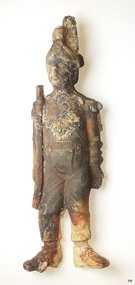
... Through is associated with the worst and best-known shipwreck in Victoria's history. flagstaff hill warrnambool flagstaff hill maritime museum shipwreck coast flagstaff hill maritime village great ocean road loch ard toy soldier napoleonic uniforms military toy moulded soldier An unpainted, cream-coloured toy soldier, recovered from the Loch Ard. The figure wears a Napoleonic Wars-era uniform, a plumed helmet, a short jacket with tails, bib-front trousers with button closure, straps crossed at the front and back, and epaulettes. ...The toy soldier is a relic from the shipwreck of the LOCH ARD in 1878. It has a companion piece in the Flagstaff Hill collection. The toy soldier is unpainted, but the style of uniform, and the weapons carried (a musket and a basket-handled cutlass), indicate it is a representation of the Napoleonic Wars period from the beginning of the nineteenth century. Mass-produced toy soldiers made of cast metal (lead or tin) became popular during the 1800s. Heyde of Germany manufactured silhouette-shaped flat toy soldiers early in the century. Mignot of France released three-dimensional solid figures and later around 1893 W. Britain, a toy company became known for its die-cast lead toy soldiers. These innovations were designed to make sets of toy soldiers more affordable for middle and lower-class children, extending the market beyond the intricately made and hand-crafted replicas that were the preserve of the rich in the eighteenth century. Wooden military figures, specially carved and unpainted ones, were therefore not particularly common at the time when the Loch Ard foundered on Victoria’s southwest coast. Mignot was the first to sell unpainted soldiers, leaving their customers to fill in the colours according to their own patriotic preferences. It is, therefore, possible the two figures in the Flagstaff Hill collection were part of a new set intended for sale, rather than part of a passenger’s existing collection. Loch Ard History: The Loch Ard got its name from ”Loch Ard” a loch that lies to the west of Aberfoyle, and the east of Loch Lomond. It means "high lake" in Scottish Gaelic. The vessel belonged to the famous Loch Line which sailed many vessels from England to Australia. The Loch Ard was built in Glasgow by Barclay, Curle & Co. in 1873, the vessel was a three-masted square-rigged iron sailing ship that measured 79.87 meters in length, 11.58 m in width, and 7 m in depth with a gross tonnage of 1693 tons with a mainmast that measured a massive 45.7 m in height. Loch Ard made three trips to Australia and one trip to Calcutta before its fateful voyage. Loch Ard left England on March 2, 1878, under the command of 29-year-old Captain Gibbs, who was newly married. The ship was bound for Melbourne with a crew of 37, plus 17 passengers. The general cargo reflected the affluence of Melbourne at the time. Onboard were straw hats, umbrellas, perfumes, clay pipes, pianos, clocks, confectionery, linen and candles, as well as a heavier load of railway irons, cement, lead and copper. There were other items included that were intended for display in the Melbourne International Exhibition of 1880. The voyage to Port Phillip was long but uneventful. Then at 3 am on June 1, 1878, Captain Gibbs was expecting to see land. But the Loch Ard was running into a fog which greatly reduced visibility. Captain Gibbs was becoming anxious as there was no sign of land or the Cape Otway lighthouse. At 4 am the fog lifted and a lookout aloft announced that he could see breakers. The sheer cliffs of Victoria's west coast came into view, and Captain Gibbs realised that the ship was much closer to them than expected. He ordered as much sail to be set as time would permit and then attempted to steer the vessel out to sea. On coming head-on into the wind, the ship lost momentum, the sails fell limp and Loch Ard's bow swung back towards land. Gibbs then ordered the anchors to be released in an attempt to hold their position. The anchors sank some 50 fathoms - but did not hold. By this time the ship was among the breakers and the tall cliffs of Mutton Bird Island rose behind. Just half a mile from the coast, the ship's bow was suddenly pulled around by the anchor. The captain tried to tack out to sea, but the ship struck a reef at the base of Mutton Bird Island, near Port Campbell. Waves subsequently broke over the ship and the top deck became loosened from the hull. The masts and rigging came crashing down knocking passengers and crew overboard. When a lifeboat was finally launched, it crashed into the side of Loch Ard and capsized. Tom Pearce, who had launched the boat, managed to cling to its overturned hull and shelter beneath it. He drifted out to sea and then on the flood tide came into what is now known as Lochard Gorge. He swam to shore, bruised and dazed, and found a cave in which to shelter. Some of the crew stayed below deck to shelter from the falling rigging but drowned when the ship slipped off the reef into deeper water. Eva Carmichael a passenger had raced onto the deck to find out what was happening only to be confronted by towering cliffs looming above the stricken ship. In all the chaos, Captain Gibbs grabbed Eva and said, "If you are saved Eva, let my dear wife know that I died like a sailor". That was the last Eva Carmichael saw of the captain. She was swept off the ship by a huge wave. Eva saw Tom Pearce on a small rocky beach and yelled to attract his attention. He dived in and swam to the exhausted woman and dragged her to shore. He took her to the cave and broke the open case of brandy which had washed up on the beach. He opened a bottle to revive the unconscious woman. A few hours later Tom scaled a cliff in search of help. He followed hoof prints and came by chance upon two men from nearby Glenample Station three and a half miles away. In a complete state of exhaustion, he told the men of the tragedy. Tom then returned to the gorge while the two men rode back to the station to get help. By the time they reached Loch Ard Gorge, it was cold and dark. The two shipwreck survivors were taken to Glenample Station to recover. Eva stayed at the station for six weeks before returning to Ireland by steamship. In Melbourne, Tom Pearce received a hero's welcome. He was presented with the first gold medal of the Royal Humane Society of Victoria and a £1000 cheque from the Victorian Government. Concerts were performed to honour the young man's bravery and to raise money for those who lost family in the disaster. Of the 54 crew members and passengers on board, only two survived: the apprentice, Tom Pearce and the young woman passenger, Eva Carmichael, who lost her family in the tragedy. Ten days after the Lochard tragedy, salvage rights to the wreck were sold at auction for £2,120. Cargo valued at £3,000 was salvaged and placed on the beach, but most washed back into the sea when another storm developed. The wreck of Lochard still lies at the base of Mutton Bird Island. Much of the cargo has now been salvaged and some items were washed up into Lochard Gorge. Cargo and artefacts have also been illegally salvaged over many years before protective legislation was introduced in March 1982. One of the most unlikely pieces of cargo to have survived the shipwreck was a Minton majolica peacock- one of only nine in the world. The peacock was destined for the Melbourne 1880 International Exhibition. It had been well packed, which gave it adequate protection during the violent storm. Today the Minton peacock can be seen at the Flagstaff Hill Maritime Museum in Warrnambool. From Australia's most dramatic shipwreck, it has now become Australia's most valuable shipwreck artifact and is one of very few 'objects' on the Victorian State Heritage Register.The toy soldier represents a 19th-century child's interest in military history. The item is one of two toy soldiers recovered from the Loch Ard in Flagstaff Hill's collection. The shipwreck of the Loch Ard is of significance for Victoria and is registered on the Victorian Heritage Register ( S 417). Flagstaff Hill has a varied collection of artefacts from Loch Ard and its collection is significant for being one of the largest accumulations of artefacts from this notable Victorian shipwreck of which the subject items are a small part. The collections of objects give us a snapshot of how we can interpret the story of this tragic event. The collection is also archaeologically significant as it represents aspects of Victoria's shipping history, allowing us to interpret Victoria's social and historical themes. Through is associated with the worst and best-known shipwreck in Victoria's history.An unpainted, cream-coloured toy soldier, recovered from the Loch Ard. The figure wears a Napoleonic Wars-era uniform, a plumed helmet, a short jacket with tails, bib-front trousers with button closure, straps crossed at the front and back, and epaulettes. The figure is in marching posture with one foot extended forward, and is bearing a musket at the slope-arms position, with a sabre or cutlass slung behind. It is unable to stand on its own. There are reddish-brown and orange-brown stains on the head and body. The body has seams along both sides that are uneven at the lower leg. There is a hole in the back and the inside is hollow. The material has a rough texture.flagstaff hill, warrnambool, flagstaff hill maritime museum, shipwreck coast, flagstaff hill maritime village, great ocean road, loch ard, toy soldier, napoleonic uniforms, military toy, moulded soldier -
 Flagstaff Hill Maritime Museum and Village
Instrument - Barometer, Early 20th century
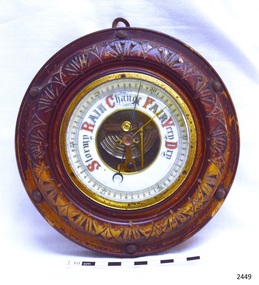
... short-lived meteorological network among scientists in other Italian cities, gathering observations of pressure, temperature, humidity, wind direction, and state of the sky. Theis barometer is an example of a household item from the early 20th century, used to determine the day's weather. The barometer is significant as an aid to human social, material and scientific development. flagstaff hill warrnambool shipwrecked coast flagstaff hill maritime museum maritime museum shipwreck coast flagstaff hill maritime village great ocean road barometer scientific instrument weather forcasting instrument weather gauge Barometer, round, brass housing inset into carved wooden casing (lacquer mostly worn off). ...A barometer is an instrument used for measuring atmosphere pressure thus determining weather changes.The first apparatus generally accepted as a barometer was that set up in Florence in 1644 by Evangelista Torricelli (1608–1647), a mathematician and physicist. Torricelli filled a glass tube with mercury, sealed it at one end, and inverted it with its open end in a dish of mercury. The level always fell a short way down the tube, then settled at a height of about thirty inches. He concluded correctly that the mercury column was sustained by the weight of the air pressing on the open surface of mercury, and further experiments convinced him that the space above the mercury in the tube was a vacuum. He noted that the level rose and fell with changing temperature, but he was unable to use his apparatus to measure variations in the weight of the atmosphere because he had not foreseen that temperature would affect the level of the mercury. News of this experiment circulated quickly among European scientists, who hastened to replicate the experiment. Torricelli's conclusions were not universally accepted because some disputed whether the air had weight, while both Aristotle and the Catholic Church denied the possibility of a vacuum. In France, the philosopher René Descartes (1596–1650) seems to have been the first person, probably in 1647, to attach a graduated scale to the tube so that he could record any changes attributable to the weather. At around this time Duke Ferdinand II of Tuscany organized the first short-lived meteorological network among scientists in other Italian cities, gathering observations of pressure, temperature, humidity, wind direction, and state of the sky.Theis barometer is an example of a household item from the early 20th century, used to determine the day's weather. The barometer is significant as an aid to human social, material and scientific development.Barometer, round, brass housing inset into carved wooden casing (lacquer mostly worn off). Decorative lettering for weather conditions "Stormy, Rain, Change, Fair, Very Dry". Workings are visible through opening in centre of dial. Indicator needle and another adjustable needle . Hook screwed into back of case.flagstaff hill, warrnambool, shipwrecked coast, flagstaff hill maritime museum, maritime museum, shipwreck coast, flagstaff hill maritime village, great ocean road, barometer, scientific instrument, weather forcasting instrument, weather gauge
