
Showing 18 items matching "shrapnel wound"
-
 National Vietnam Veterans Museum (NVVM)
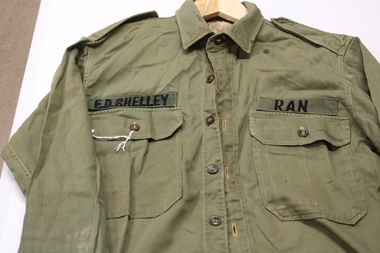
Uniform - Shirt with blood
... ...Shrapnel wound...SEE PHOTOS FOR THE STORY IN ERROL'S WORDS Shelley Ed Shelley Shrapnel wound blood stained wounded RAN HFV Bearcat E D Shelley in black thread on RHS RAN in black thread on LHS Signatures on back in ink Khaki long-sleeved shirt with button-down front, two pockets with embroidered name on right side and service name on other. ...Shirt worn by Leading Air Mechanic Airframes Engines, Errol Desmond Shelley No:R59338 when he was hit by shrapnel. He was driving a motor pool truck back to US Bearcat Base near Bien Hoa on 22 December 1969, after a trip to Vung Tau to send flowers to the wife of a fellow serviceman to celebrate the birth of a child. An enemy rocket propelled grenade (RPG) landed 20 metres to the right of the vehicle Errol was driving, and while the passengers were able to duck for cover, as driver, Errol could not. So, when a second RPG landed behind them, Errol was hit by two pieces of shrapnel. Errol served on the HMAS Melbourne from May - Jun 1965, and then with RAN Helicopter Flight Vietnam from Sept 1969 - Oct 1970. SEE PHOTOS FOR THE STORY IN ERROL'S WORDSKhaki long-sleeved shirt with button-down front, two pockets with embroidered name on right side and service name on other. Handwritten names and signatures on the back. Holes near collar at back and blood stains.E D Shelley in black thread on RHS RAN in black thread on LHS Signatures on back in inkshelley, ed shelley, shrapnel wound, blood stained, wounded, ran, hfv, bearcat -
 Bendigo Military Museum
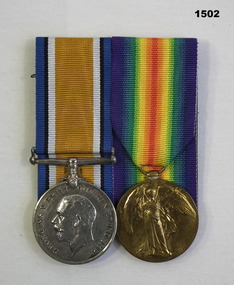
Award - MEDAL SET WW1, post 1919
... WIA 4.2.17 GSW to face. WIA 11.8.18 shrapnel wound to groin severe. To hospital at sea with Influenza 6.2.19. ...WIA 4.2.17 GSW to face. WIA 11.8.18 shrapnel wound to groin severe. To hospital at sea with Influenza 6.2.19. ...Hughy Pippin (born Euston, enlisted Mildura) No 1895 C Coy 38th Batt AIF. Hughy enlisted in the 2nd reinforcements to the Batt on 3.4.16. Embarked 16.8.16. WIA 4.2.17 GSW to face. WIA 11.8.18 shrapnel wound to groin severe. To hospital at sea with Influenza 6.2.19. Discharged from the AIF on 25.5.19. Medal set, court mounted, set of 2 re H Pippin. 1. War Medal 1914-18 2. Victory medal 1914 - 1919."1895 L Cpl H Pippin 38th Bn AIF"medals, campaign, military -
 8th/13th Victorian Mounted Rifles Regimental Collection
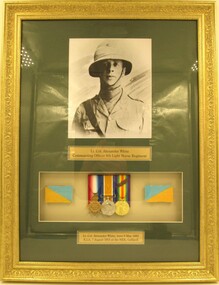
Mixed media - Lt Col AH White, April 2024
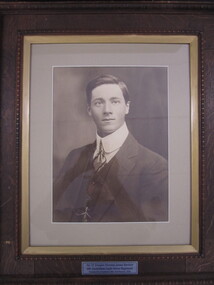
... Lieutenant Colonel received a shrapnel wound to the scalp 27June, was treated at the Casualty Clearing Station, and returned to duty 4 July. ...Lieutenant Colonel received a shrapnel wound to the scalp 27June, was treated at the Casualty Clearing Station, and returned to duty 4 July. ...Alexander Henry White, born 9 May 1882 was educated at Greenville College Ballarat. He enlisted in the Victorian Mounted rifles in 1899 and continued to serve in the Light Horse followinh Federation. Following the outbreak of World War One he applied for a commission in the AIF 19 November 1914 and was appointed as Commanding Officer 8th Light Horse regiment. He was 32 yers of age, married with one child. He sailed with the regiment to Egypt in December 1914, and in May 1915 landed at Gallipoli. Lieutenant Colonel received a shrapnel wound to the scalp 27June, was treated at the Casualty Clearing Station, and returned to duty 4 July. In the Charge at the Nek, 7 August, White chose to lead the first wave of the 8th Light Horse. He was killed in action and his body never identified. His name is recorded on Lone Pine Memorial, Gallipoli Peninsula. He was posthumously mentioned in dispatches for his leadership in commanding the 8th Light Horse. Framed case containing portrait of Lieutenant Colonel Alexander Henry White, together with his medals (replica) and colour patches of 8th Light Horse.On plaque under portrait 'Lt Col Alexander White / Commanding Officer 8 Light Horse Regiment' and under medals 'Lt. Col. Alexander White borne 9 May 1882 / K.I.A. 7 August 1915 at the NEK Gallipoli'gallipoli, white, wwi, 8lh, ballarat -
 Eltham District Historical Society Inc
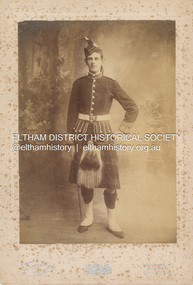
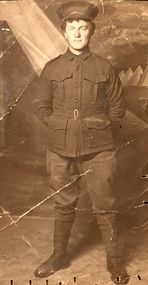
Photograph, Tesla Studios, George Alfred Williams, c.1914
... Williams of Belle Vue, Eltham Promoted to Corporal 15 March 1916 and transferred to 6th Field Ambulance Transferred to 13th Field Ambulance 9.2.17 Made temporary Sergeant from 27 April to 26 May 1918 whilst his unit awaited a replacement Sergeant at which point he reverted to Corporal. Died of shrapnel wounds to his left side and face received in action with the 4th Australian Field Ambulance in France, 17 Sep. 1918 His mother, Mary Ann Williams (nee Kidd) gave written permission for him to enlist In his Will he left all his effects to his mother.. ...Williams of Belle Vue, Eltham Promoted to Corporal 15 March 1916 and transferred to 6th Field Ambulance Transferred to 13th Field Ambulance 9.2.17 Made temporary Sergeant from 27 April to 26 May 1918 whilst his unit awaited a replacement Sergeant at which point he reverted to Corporal. Died of shrapnel wounds to his left side and face received in action with the 4th Australian Field Ambulance in France, 17 Sep. 1918 His mother, Mary Ann Williams (nee Kidd) gave written permission for him to enlist In his Will he left all his effects to his mother.. ...Private George Alfred Williams Service number 70 Final Rank Private Unit 13 Fld.Amb. Conflict/Operation First World War, 1914-1918 Rolls First World War Nominal Roll: Unit 13 Fld.Amb. Conflict First World War, 1914-1918 Rank Private Timeline Date of enlistment 22 September 1914 Date of fate 17 September 1918 Father W.A. Williams of Belle Vue, Eltham Promoted to Corporal 15 March 1916 and transferred to 6th Field Ambulance Transferred to 13th Field Ambulance 9.2.17 Made temporary Sergeant from 27 April to 26 May 1918 whilst his unit awaited a replacement Sergeant at which point he reverted to Corporal. Died of shrapnel wounds to his left side and face received in action with the 4th Australian Field Ambulance in France, 17 Sep. 1918 His mother, Mary Ann Williams (nee Kidd) gave written permission for him to enlist In his Will he left all his effects to his mother.. Williams George Alfred : SERN 70 : POB Heidleberg VIC : POE Broadmeadows VIC : NOK F Williams W A https://recordsearch.naa.gov.au/SearchNRetrieve/Interface/DetailsReports/ItemDetail.aspx?Barcode=1807628&isAv=Nmarg ball collection, 1914, george alfred williams, tesla studios photographer 244 chapel st prahran -
 Eltham District Historical Society Inc
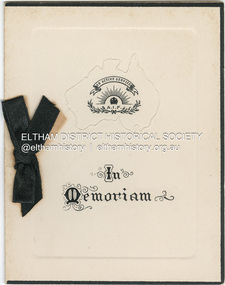
Booklet, In Memoriam: George Alfred Williams, On Active Service, A.I.F, 1918
... Williams of Belle Vue, Eltham Promoted to Corporal 15 March 1916 and transferred to 6th Field Ambulance Transferred to 13th Field Ambulance 9.2.17 Made temporary Sergeant from 27 April to 26 May 1918 whilst his unit awaited a replacement Sergeant at which point he reverted to Corporal. Died of shrapnel wounds to his left side and face received in action with the 4th Australian Field Ambulance in France, 17 Sep. 1918 His mother, Mary Ann Williams (nee Kidd) gave written permission for him to enlist In his Will he left all his effects to his mother.. ...Williams of Belle Vue, Eltham Promoted to Corporal 15 March 1916 and transferred to 6th Field Ambulance Transferred to 13th Field Ambulance 9.2.17 Made temporary Sergeant from 27 April to 26 May 1918 whilst his unit awaited a replacement Sergeant at which point he reverted to Corporal. Died of shrapnel wounds to his left side and face received in action with the 4th Australian Field Ambulance in France, 17 Sep. 1918 His mother, Mary Ann Williams (nee Kidd) gave written permission for him to enlist In his Will he left all his effects to his mother.. ...Private George Alfred Williams Service number 70 Final Rank Private Unit 13 Fld.Amb. Conflict/Operation First World War, 1914-1918 Rolls First World War Nominal Roll: Unit 13 Fld.Amb. Conflict First World War, 1914-1918 Rank Private Timeline Date of enlistment 22 September 1914 Date of fate 17 September 1918 Father W.A. Williams of Belle Vue, Eltham Promoted to Corporal 15 March 1916 and transferred to 6th Field Ambulance Transferred to 13th Field Ambulance 9.2.17 Made temporary Sergeant from 27 April to 26 May 1918 whilst his unit awaited a replacement Sergeant at which point he reverted to Corporal. Died of shrapnel wounds to his left side and face received in action with the 4th Australian Field Ambulance in France, 17 Sep. 1918 His mother, Mary Ann Williams (nee Kidd) gave written permission for him to enlist In his Will he left all his effects to his mother.. Williams George Alfred : SERN 70 : POB Heidleberg VIC : POE Broadmeadows VIC : NOK F Williams W A https://recordsearch.naa.gov.au/SearchNRetrieve/Interface/DetailsReports/ItemDetail.aspx?Barcode=1807628&isAv=Nmarg ball collection, george alfred williams, 1918, aif, first world war, honour roll -
 Ballarat Heritage Services
Photograph, Henry William Frisch, c1915
... On 16 October 1917 Henry Frisch was wounded in the field with shrapnel wounds to the back and neck and multiple shrapnel wounds penetrating the abdomen. ...On 16 October 1917 Henry Frisch was wounded in the field with shrapnel wounds to the back and neck and multiple shrapnel wounds penetrating the abdomen. ...Henry William Frisch was born at Warrnambool to H.W. and Sarah Frisch. He iniitally served with the 8th Battallion, was transferred to the 59th Battalion on 26 February 1916, then to the 58th Battalion on 15 May 1916 served with the 59th Battalion during World War One. He had the regimental number 3054. At the time of his enlistment on 8 June 1915 he had worked as a butter box maker at MvcGennan's of Warrmabool. On 26 February 1916 he was at Tel-el-Kebir, Egypt. On 17 June 1916 he embarked on the H.T. Translyvania from Alexandria and disembarked at Marseilles on 23 June 1916. On 14 September 1917 he was furloughed to England, rejoining his battalion on 05 October 1917. On 16 October 1917 Henry Frisch was wounded in the field with shrapnel wounds to the back and neck and multiple shrapnel wounds penetrating the abdomen. He died of wounds received on 17 October 1917 aged 23 yeard. He was buried at Lyssenthoek Military Cemetery (Plot 21. Row H. Grave 19A). The ceetery is south west Poperinghe, Begium. "IN MEMORIAM. ON ACTIVE SERVICE. FRISCH —In loving memory of our dear, son, Private H. W. Frisch, who died of wounds on 17th Oct., 1917, at the 17th Casualty Clearing, Station, France. No one knows how much we miss him, Friends may think the wound is healed; But they cannot see the sorrow, Deep within our hearts concealed. Just when life was brightest, Just when his hopes were best; His country called—he answered, Nows in God's home he rests. (Inserted by his loving parents, West Reserve, Warrnambool, his sisters and Stanley). FRISCH—In loving memory of my dear brother, Pte. H. W. Frisch, who died of wounds on 17th Oct., 1917, at the 17th Casualty Clear-ng Station, France. My hero brother. Sadly a sister is thinking, Of her soldier brother, so brave; Who fought for the cause of freedom, Who lies in a hero's grave. I seem, to see your face, dear Henry, Through a mist of anxious tears; And a sister's heart is broken, For many and many a year. One of Australia's dearest and best. Sadly missed by all. (Inserted by his loving sister, Ethel, East Melbourne). FRISCH—In loving memory of our dear brother, Henry William, who died of wounds in France, on 17th October, 1917. Not for the love of battle, Did he leave his dear homeland; He heard the call of duty, And responded like a man. —(Inserted by his loving sister and brother-in-law, France and Steve Ferrier) . FRISCH—In fond and loving memory of Private Henry Frisch, who died of wounds on active service 17th Oct., 1917. —(Fondly remembered by Mrs. Henry and family). (Warrnambool Standard, Thursday 17 October 1918.)Cut down photographic post card of Henry Wiliam Frisch. The photographer was located at 175 Collins St, Melbourne. Verso "Keith's uncle Henry Frisch killed WW1"world war one, henry frisch, belgium, warrnambool -
 Bendigo Military Museum
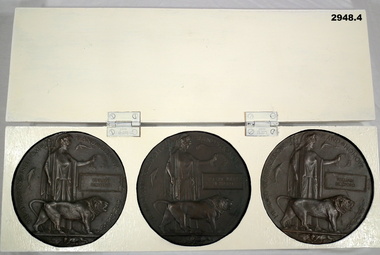
Memorabilia - MEMORIAL PLAQUES, Bickford Family, Plaques post WW1
... Embark for Egypt 22.12.1914, embarked for Gallipoli, WIA 4.6.1915 shrapnel wound left arm, returned to Australia for discharge stating Stiffness of the Arm15.8.1915, return to Egypt in the 14th reinforcements and rejoin the 14th Batt 2.4.1916, embark for France 1.6.1916, promoted L/Cpl 1.9.1916, promoted Cpl 24.3.1917, reported MIA 11.4.1917, Court of Inquiry found he was KIA 11.4.1917 at Bullecourt. ...Embark for Egypt 22.12.1914, embarked for Gallipoli, WIA 4.6.1915 shrapnel wound left arm, returned to Australia for discharge stating Stiffness of the Arm15.8.1915, return to Egypt in the 14th reinforcements and rejoin the 14th Batt 2.4.1916, embark for France 1.6.1916, promoted L/Cpl 1.9.1916, promoted Cpl 24.3.1917, reported MIA 11.4.1917, Court of Inquiry found he was KIA 11.4.1917 at Bullecourt. ...Edward Bickford No 1519 enlisted in the AIF in the 1st reinforcements 21st Batt on 8.4.1915 age 25 years. Embarked for for Egypt 28.6.1915, embark for Gallipoli 29.8.1915, embark for France 19.3.1916, reported MIA 26.8.1916, a Court of inquiry dated 20.7.1917 found that he was KIA 26.8.1916 at Moquet Farm. Robert John Bickford No 1518 enlisted in the AIF in the 1st reinforcements 21st Batt on 8.4.1915 age 30 years 11 months. Embark for Egypt 8.4.1915, embark for Gallipoli 29.8.1915, hospital with Mumpa 20.1.1916, rejoin unit 7.3.1916, embark for France 19.3.1916, awarded the Military Medal (MM) as a Lewis Gunner and Gallantry under fire since March 1916, promoted CPL 1.9.1916, hospital with Odema of the feet 8.11.1916, rejoin unit 22.11.1916, WIA 12.1.1917 SW’s to Groin and Abdomen, DOW;s Flers 12.1.1917. William Bickmore No 815 enlisted in G Coy 14th Batt on 12.9.1914 age 21 years 11 months. Embark for Egypt 22.12.1914, embarked for Gallipoli, WIA 4.6.1915 shrapnel wound left arm, returned to Australia for discharge stating Stiffness of the Arm15.8.1915, return to Egypt in the 14th reinforcements and rejoin the 14th Batt 2.4.1916, embark for France 1.6.1916, promoted L/Cpl 1.9.1916, promoted Cpl 24.3.1917, reported MIA 11.4.1917, Court of Inquiry found he was KIA 11.4.1917 at Bullecourt. Refer 2949P, 2950P, 2991P for their photos.Bickford Family Set of WWI Commemorative Plaques: .1) Bronze Death Plaque, British pattern showing a helmeted female (Brittanica) in classic style dress holding a trident in right hand, wreath in the other & a lion at her side. In the rectangular box, embossed is the name Edward Bickford. .2) As above description though in the rectangular box is the name Robert John Bickford. .3) Descriptions as above though in the rectangular box is the name William Bickford. .4) Heavy wooden display case painted cream colour, 2 hinges on the side, no lock or catch. Inside are 3 recessed circular holes to hold the plaques.Written on rear of box is: “A.T.B. 94”military history, memorial, plaques -
 National Vietnam Veterans Museum (NVVM)
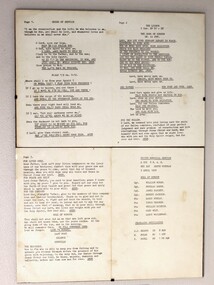
Ephemera - Order of Service, framed
... It was issued to the donor, National Serviceman G G Ravenscroft, who was serving in 1 Platoon, A Company 8RAR during Operation Hammersley, and received a minor shrapnel wound on Black Saturday. This was donated by Cpl (Temp) Geoffrey Grant Ravenscroft (3795037) who was a National Serviceman with the Royal Australian Infantry Corps and served in Vietnam with the 8th Battalion The Royal Australian Regiment from November 1969 to July 1970...It was issued to the donor, National Serviceman G G Ravenscroft, who was serving in 1 Platoon, A Company 8RAR during Operation Hammersley, and received a minor shrapnel wound on Black Saturday. This was donated by Cpl (Temp) Geoffrey Grant Ravenscroft (3795037) who was a National Serviceman with the Royal Australian Infantry Corps and served in Vietnam with the 8th Battalion The Royal Australian Regiment from November 1969 to July 1970 8RAR Long Hai Long Hai Hills Black Saturday 1970 Operation Hammersley Ravenscroft Geoff Ravenscroft memorial service C Company 8th Battalion The Royal Australian Regiment APC 3 Cavalry Regiment 1 Armoured Regiment Sappers Royal Australian Engineers 17 Construction Squadron Viet Cong Viet Cong Troops Nui Dat Australian National Serviceman 1 Platoon A Company Cpl (Temp) Geoffrey Grant Ravenscroft 3795037 Two typed A-4 pages that have been folded into booklet, now flattened and framed. ...Operation Hammersley , 10 February until 9 March 1970, was undertaken by a combined force of: C Company, 8th Battalion, the Royal Australian Regiment (8RAR); armoured personnel carriers from 3 Cavalry Regiment; tanks from 1 Armoured Regiment; sappers from the Royal Australian Engineers; a mortar section from 8RAR’s Support Company; air support, and even a Navy destroyer off-shore to provide gunfire support. The operation aimed to protect 17 Construction Squadron, Royal Australian Engineers, at a quarry in the western foothills of the Long Hai hills. The Long Hai hills were a stronghold for the Viet Cong, who used the caves there as a bunker complex and had planted many landmines and booby traps in the area. Over two fierce weeks, 8 RAR carried out patrols and conducted ambushes, engaging VC troops and eventually capturing the bunker system. However, it was a costly campaign. In total, over 70 Australians were killed or wounded during the operation. The worst day for mine casualties in Australia's war in Vietnam occurred on 28 February 1970. It became known as 'Black Saturday". Nine members of 8RAR were killed and 29 wounded. This item is the Order of Service from the memorial service held at Nui Dat on 3 April 1970 to honour those killed at Long Hai. It was issued to the donor, National Serviceman G G Ravenscroft, who was serving in 1 Platoon, A Company 8RAR during Operation Hammersley, and received a minor shrapnel wound on Black Saturday. This was donated by Cpl (Temp) Geoffrey Grant Ravenscroft (3795037) who was a National Serviceman with the Royal Australian Infantry Corps and served in Vietnam with the 8th Battalion The Royal Australian Regiment from November 1969 to July 1970Two typed A-4 pages that have been folded into booklet, now flattened and framed. Listed are the prayers, Bible readings and sermon given, along with the names of the 8 fallen soldiers, and the chaplains who officiated. See media for more information.8rar, long hai, long hai hills, black saturday, 1970, operation hammersley, ravenscroft, geoff ravenscroft, memorial service, c company, 8th battalion, the royal australian regiment, apc, 3 cavalry regiment, 1 armoured regiment, sappers, royal australian engineers, 17 construction squadron, viet cong, viet cong troops, nui dat, australian national serviceman, 1 platoon, a company, cpl (temp) geoffrey grant ravenscroft, 3795037 -
 Waverley RSL Sub Branch
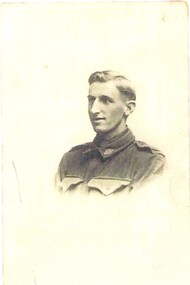
Photographs, Fredrick Charles Dix
... Unit embarked from Adelaide, South Australia, on board HMAT A30 Borda on 11 January 1916.He served in France and was wounded by shrapnel in the eye socket but eventually returned to active duty on the front.He returned to Australia 6 September 1919...Unit embarked from Adelaide, South Australia, on board HMAT A30 Borda on 11 January 1916.He served in France and was wounded by shrapnel in the eye socket but eventually returned to active duty on the front.He returned to Australia 6 September 1919 Sgt. ...Fredrick Charles Dix enlisted 8th July 1915 at Castlemaine (at the time he was living with his Mother and stepfather in Fryers Town) after serving in the Senior Cadets. He was taken on by the 9th Light horse and sent to Egypt for further training. Unit embarked from Adelaide, South Australia, on board HMAT A30 Borda on 11 January 1916.He served in France and was wounded by shrapnel in the eye socket but eventually returned to active duty on the front.He returned to Australia 6 September 1919 Sgt. F. C. Dix 1790 9th light horse 13th reinforcement 13 Field Artillery Brigade where he (several times) attained the rank of Sergeant. He also served during WWII at Nowra as a driver. Photos of Fred. were taken after enlistment, and the photo of ? 13 F.A.B. is thought to have been taken in Egypt 1916 3 Black and white photographs from WWIWritten on reverse of the image of the soldiers in front of tent "Fred's Mates"f dix, fredrick dix, 13th f.a.b., 9th light horse, castlemaine, wwi, egypt, photographs, photos, postcards france wwi -
 National Vietnam Veterans Museum (NVVM)
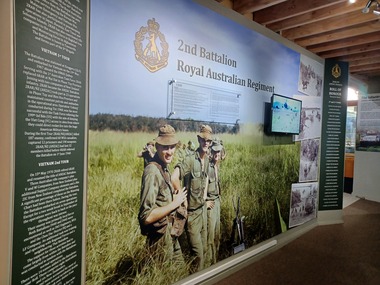
Poster - Poster, Information Board, 2nd Battalion Royal Australian Regiment
... Harry Leggett who received shrapnel wounds, and Stan Radomi who was killed outright. ...Harry Leggett who received shrapnel wounds, and Stan Radomi who was killed outright. ...A large information board describing the 1st and 2nd tours of 2RAR. A large coloured image in the centre of the board, shows seven soldiers in a field. To the right of the board are four black and white images. To the right of the board is the Roll of Honour to the many soldiers who lost their lives in Vietnam.2 RAR: This photo was taken by Elvon King of Delta Company in September of 1967. This photo was chosen without the knowledge of the historical significance of the shot, which proved to be very momentous. For within a very short time (about 30 seconds) of the photo being taken a wayward rocket from a U.S. gunship landed amongst this group of men in the photo, resulting in three of them being killed and fourteen being wounded. Elvon King was one of the wounded. The three men in the photo are left to right Dennis (Dave) Enright who lost a foot in the incident. Harry Leggett who received shrapnel wounds, and Stan Radomi who was killed outright. A very poignant moment in time. these thoughts about the incident from Wally Musgrave was one of those severely wounded at the time. What could have been a sunny afternoon at a Newcastle or Bondi Hotel or beer Garden..... After what could have been a week of patrolling, it was back inside the wire to scrub up and top up on fluids. Next morning, at 9.00, we went out side of the wire for a fire power, demonstration to satisfy a visiting General. The sun was shining, no seating, grass wasn't cut but we were young and so we thought bullet proof. then someone asked for the old Iroquois gun ship which had been firing rockets at a dead tree to be swung around to fire rockets over our heads. Why?? I haven't given "why" that much thought, but the 1 metre long port side rocket tumbled down amongst us and I'm sure everyone who was there can close their eyes and still see it today. This tumbling rocket landed where these three mates were standing amongst 11 and 12 platoon's young soldiers, chatting in the sun, then we were sailing through the air. I didn't see the devastation myself. I was under bodies. As first Dust-off priority we were off to 36 Evacuation Hospital at Vung Tau. There were two do's, one to the Morgue and one at the Hospital. Lucky me, I went through the hospital door. Eight major operations at once. Three dead, fourteen wounded and nothing on record!! Yeah it was a lovely Sunny Day at Nui Dat., we'll leave it at that! We can't change yesterday. I'm just another Nasho.poster, information board, 2 rar, elvon king -
 Federation University Historical Collection
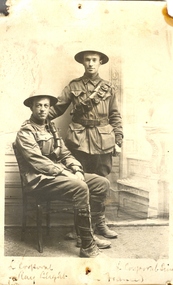
Postcard - Postcard - Black and white, Two World War One Soldiers, 1916, 28/08/1916
... Sim, of Ballarat, we are wearing steel helmuts weight about 4lbs they are protection against shrapnel and steel splinters. We are doing well here, Les Coulter was wounded just near here but did not see him. ...wounded on 1 June 1918. world war one world war 1 james sim ballarat school of mines blight james blight sim les sim coulter les coulter world war walker wwi great world war france .1) Verso: " France 25/8/16. Dear Mr Walker, Just a line in sending a photo we had taken in a small photographers, in a town within range of the evenings guns, the other boy is L/Corp Sim, one time an old SMB and son of R. Sim, of Ballarat, we are wearing steel helmuts weight about 4lbs they are protection against shrapnel ...John Raymond (Ray) Blight enlisted on 19 July 1915. He was an electrical engineer, having studied at the Ballarat School of Mines. On 23 June 1916 Ray Blight disembarked at Marseilles. 3 February 1917 he was hospitalised with scabies. Ray Blight's next of kin was his mother, Mary Jane Blight of 116 Lyons Street South, Ballarat. James Leslie Sim enlisted on 13 July 1915, at which time he was an accountant. His next of kin was his father, Charles Robert Sim of Drummond Street North, Ballarat. On 23 June 1916 James Sim disembarked at Marseilles. A year later he received leave to the United Kingdom returning to France 2 weeks later. He received leave to Paris from 18 march 1918 to 4 April 1918. Sim was wounded on 1 June 1918.Two World War One soldiers in military uniform pose for a photograph. The two men are Lance Corporal Ray Blight and Lance Corporal Sim (both of Ballarat). On the back is a personal letter to Ballarat School of Mines Lecturer Daniel Walker. The pin holes in the postcard suggest it was displayed at the Ballarat School of Mines. .1) Verso: " France 25/8/16. Dear Mr Walker, Just a line in sending a photo we had taken in a small photographers, in a town within range of the evenings guns, the other boy is L/Corp Sim, one time an old SMB and son of R. Sim, of Ballarat, we are wearing steel helmuts weight about 4lbs they are protection against shrapnel and steel splinters. We are doing well here, Les Coulter was wounded just near here but did not see him. Best wishes to all. Ray Blight. .2) Verso: Sitting, Ray Blight, from Ballarat, you will know his sister, she helps Miss Brazena a lot with the parcels. Standing, Les Sim, of Sim and co. wood merchants, Ballarat.world war one, world war 1, james sim, ballarat school of mines, blight, james blight, sim, les sim, coulter, les coulter, world war, walker, wwi, great world war, france -
 Red Cliffs Military Museum
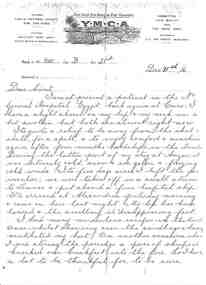
Letter, Letter from 815 Cpl William Carroll to his Aunt, 31/12/1916 (exact)
... shrapnel/ knocked over our breakfast into the fire. So I have/ a lot to be thankful for to be sure./Many of my comrades have gone and are buried in the/ churchyard in Shrapnell gully & more are away sick/ and wounded. ...shrapnel/ knocked over our breakfast into the fire. So I have/ a lot to be thankful for to be sure./Many of my comrades have gone and are buried in the/ churchyard in Shrapnell gully & more are away sick/ and wounded. ...This is part of a collection belonging to Sgt, William E. CarrollThis is a copy of a letter written by 815 Cpl William Carroll to his Aunt while he was hospitalised in Cairo. It is written on YMCA letterhead.Top Left hand Corner: Patron/ YMCA National Council/ H.M. The King/ Patron /Military Camp Dept./ H.R.H. Duke of Connaught. Centre top: For God, For King & For Country/ YMCA Logo/ with the/ Mediterranean Expeditionary Force. (written through the logo)/ Right hand top corner: Committee/ for Egypt/and/the Near East./ Chairman/ H.E. Sir Henry McMahon Lower down page: Reply to No. 815 Coy D Bat 21st/ Dec 31st '16/ Stationed at/ Dear Aunt,/ I am at present a patient in the (??)/ General Hospital, Egypt, back again at Cairo. I/have a slight abcess on my lip and my neck was a/ bit swollen, but both are almost right now./ It's quite a relief to be away from the shot &/ shell, for a spell & to enjoy comfort and sunshine/ again after four months hardships in the trenches./ During the latter part of my stay at ANZAC, it/ was intensely cold, snow & ice galore & freezing/ cold winds. It's five days since I left the pen/insular; we were taken off in a small steamer/ to Lemnos & put aboard a fine hospital ship./ We arrived at Alexandria yesterday morning/ & came on here last night. My lip has been/ lanced & the swelling is disappearing fast./ I had many miraculuous escapes in the trench./ Once whilst observing over the sandbags a barage/ ventilated my hat. On another occasion when/ I was stiring the porridge a piece of shrapnel/ knocked over our breakfast into the fire. So I have/ a lot to be thankful for to be sure./Many of my comrades have gone and are buried in the/ churchyard in Shrapnell gully & more are away sick/ and wounded. I intended to cable to you for some money but I think I'll be able to make do/ of it, & we have all our wants attended to here./ Do you remembr Willy O'Leary of Mansfield?- He/ was killed near us in an attack some time ago./ Young Sgt. Roberts, my chum of Dookie & Broadmeadows/ was also sniped a few days before I left./ The war doesn't appear to be going too well, but/ I am sure time will tell, & we will eventually/ give the Germans a good belting. Just address/ my letters as usual, as I don't think I'll be here/ for long & if I am my mates will send them/ on. I gave them permission to keep any parcel/ you might forward on whilst I am away. It was/ awfully good of you to send the other thing along./ Hoping all are quite well./ I am/ Your Affectionate Nephew/ William E. Carroll. Cpl/ww1, battalion, aif, 815, sgt, carroll, e, 21st, 6th, brigade, 1st, dcm, wiiliam -
 4th/19th Prince of Wales's Light Horse Regiment Unit History Room
Photograph - Framed Photograph, Trooper Norman Bartlett 4th Australian Light Horse, abt 1915
... At 8:00 pm Trooper Bartlett was struck in the stomach by either shrapnel or gunfire. His wounds were dressed and he was evacuated. ...Tpr Bartlett was the first casualty of the 4th Light Horse Regiment at Gallipoli. Tpr Bartlett enlisted on 18 August 1914 at Broadmeadows Vic and was posted to A Squadron 4th Australian Light Horse Regiment. He embarked for Egypt on HMAT Wiltshire on 19 Oct 1914 then going ashore on Gallipoli on 21 May 1915. At 8:00 pm Trooper Bartlett was struck in the stomach by either shrapnel or gunfire. His wounds were dressed and he was evacuated. He died of wounds and was buried at sea on 24 May 1915. The 4th Australian Light Horse Regiment is an ancestor unit of the modern day 4th/19th Prince of Wales's Light Horse Regiment. The Unit History Room is the custodian of its history. This memento of the first casualty of the 4th Light Horse Regiment at Gallipoli is both significant and poignantFramed portrait photo of No 72 Tpr Norman James Bartlett, 4th Australian Light Horse Regiment. In glass fronted wooden frame No 72 Trooper Norman James Bartlett, 4th Australian Light Horse Regiment Donated by Frankston RSL Sub-Branch 2016framed portrait photo of no 72 tpr norman james bartlett, 4th australian light horse regiment. in glass fronted wooden frame -
 National Vietnam Veterans Museum (NVVM)
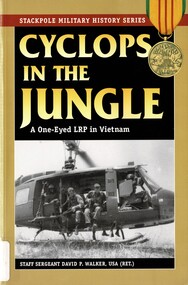
Book, Walker, David P. Staff Sergeant, Cyclops In The jungle: A One-Eyed LRP in Vietnam (Copy 2)
... Trained for long rang patrol (LRP) operations, he received a debilitating shrapnel wound to his eye barely a month after arring in Vietnam. ...Dave Walker enlisted in the U.S. Army at seventeen, full of patriotism and eager to play his part in Vietnam. Trained for long rang patrol (LRP) operations, he received a debilitating shrapnel wound to his eye barely a month after arring in Vietnam.Dave Walker enlisted in the U.S. Army at seventeen, full of patriotism and eager to play his part in Vietnam. Trained for long rang patrol (LRP) operations, he received a debilitating shrapnel wound to his eye barely a month after arring in Vietnam.vietnam war, 1961 - 1975, personal narratives, u.s. army, david walker, lrp operations -
 National Vietnam Veterans Museum (NVVM)
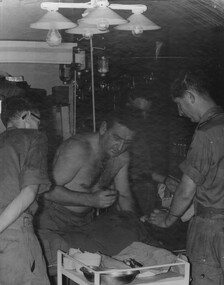
Photograph, Gibbons, Denis, Shrapnel Removal
... Photograph Capt Jack (The Quack) Blomley 2 Field ambulance Nui Dat Gibbons Collection Catalogue SAS Digger Wounded Serviceman Denis Gibbons A black and white photograph of Capt Jack Bromley, 2 Field Ambulance Hospital, Nui Dat removes shrapnel from the neck of an SAS Digger Shrapnel Removal Photograph Gibbons, Denis ...Denis Gibbons (1937 – 2011) Trained with the Australian Army, before travelling to Vietnam in January 1966, Denis stayed with the 1st Australian Task Force in Nui Dat working as a photographer. For almost five years Gibbons toured with nine Australian infantry battalions, posting compelling war images from within many combat zones before being flown out in late November 1970 after sustaining injuries. The images held within the National Vietnam Veterans Museum make up the Gibbons Collection. A black and white photograph of Capt Jack Bromley, 2 Field Ambulance Hospital, Nui Dat removes shrapnel from the neck of an SAS Digger photograph, capt jack (the quack) blomley, 2 field ambulance, nui dat, gibbons collection catalogue, sas, digger, wounded serviceman, denis gibbons -
 National Vietnam Veterans Museum (NVVM)
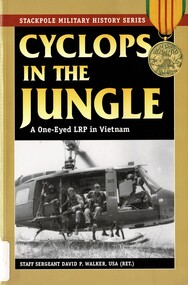
Book, Cyclops In The Jungle: A One-Eyed LRP in Vietnam (Copy 1)
... Trained for long rang patrol (LRP) operations, he received a debilitating shrapnel wound to his eye barely a month after arring in Vietnam. ...Dave Walker enlisted in the U.S. Army at seventeen, full of patriotism and eager to play his part in Vietnam. Trained for long rang patrol (LRP) operations, he received a debilitating shrapnel wound to his eye barely a month after arring in Vietnam.Dave Walker enlisted in the U.S. Army at seventeen, full of patriotism and eager to play his part in Vietnam. Trained for long rang patrol (LRP) operations, he received a debilitating shrapnel wound to his eye barely a month after arring in Vietnam.vietnam war, 1961 - 1975, personal narratives, dave walker, lrp operations, u.s. army -
 Bendigo Historical Society Inc.
Book - "The Impact of WW1 on Bendigo Health: Our nurses, Doctors and Community.", 1914
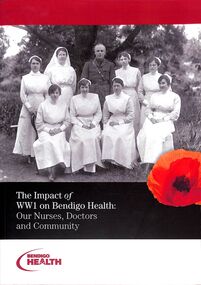
... wounds were the result of flying metal. During their service, many of the 331,781 AIF troops and medical staff were injured more than once: over 50% were hit by shell fragments or shrapnel bullets from artillery fire 40% were hit by high-velocity bullets from rifles or machine guns 12% were affected by chlorine or mustard gas 2% were hit by bombs or grenades only 0.3% suffered bayonet wounds Many health risks also developed into large-scale problems on the front. ...wounds were the result of flying metal. During their service, many of the 331,781 AIF troops and medical staff were injured more than once: over 50% were hit by shell fragments or shrapnel bullets from artillery fire 40% were hit by high-velocity bullets from rifles or machine guns 12% were affected by chlorine or mustard gas 2% were hit by bombs or grenades only 0.3% suffered bayonet wounds Many health risks also developed into large-scale problems on the front. ...Over 4000 Bendigo residents enlisted to serve in W.W. 1. Much is known about their contributions to the war effort, but less is known about the contributions made by the medical staff who provided care at the front lines or otherwise supported care. People enlisted for many reasons - patriotism, duty and adventure being just a few. Over 416,000 persons enlisted to serve in World War One out of a population of 5 million. The Australian Government recorded 215,585 casualties during the war. Over 80% of those casualties occurred on the Western Front, in Belgium and France. The weapons used in trench warfare created horrendous injuries for both sides in the war. In the Australian Imperial Force (AIF), for example, most wounds were the result of flying metal. During their service, many of the 331,781 AIF troops and medical staff were injured more than once: over 50% were hit by shell fragments or shrapnel bullets from artillery fire 40% were hit by high-velocity bullets from rifles or machine guns 12% were affected by chlorine or mustard gas 2% were hit by bombs or grenades only 0.3% suffered bayonet wounds Many health risks also developed into large-scale problems on the front. Those who served lived and work in crowded spaces, which helped to spread bacterial, viral and parasitic infections. Unhealthy living conditions for soldiers (and sailors) included: poor diet lack of sleep exposure to cold contact with mice, rats, fleas, lice and other parasites. Soft cover. 41pp. Black and white image of nurses on front cover, along with red poppy. Tile written in white to bottom third of front cover on black background. Bendigo Health logo to bottom of front cover. Back cover has image of signage for the 'Old Mortuary' of Bendigo Hospital, with burgundy, black and white stipes above and below image. Contains black and white and color images. soldiers, world war one, british empire, doctors, nurses, bendigo hospital -
 City of Melbourne Libraries
Photograph, Bull, Hugh Jones, 1897-1993, Lord Mayor's Dinner, Melbourne Town Hall
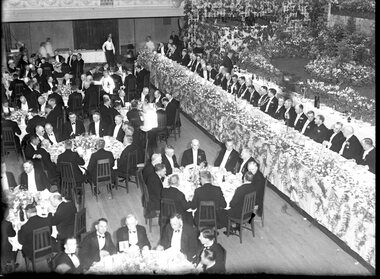
... After just three weeks of bearing wounded soldiers across Shrapnel Gully on the back of his donkey, Simpson was killed by shrapnel fire. ...After just three weeks of bearing wounded soldiers across Shrapnel Gully on the back of his donkey, Simpson was killed by shrapnel fire. ...Photographer notations on slide: "General View Of Lord Mayor's Dinner At Town Hall Nov 1936 B112" Published: The Age, Tuesday 10 November 1936, page 13 Published title: LORD MAYOR'S BANQUET Published caption: The brilliant scene inside the Melbourne Town Hall last night during the Lord Mayor’s banquet. Trove article identifier: http://nla.gov.au/nla.news-article205939431 Description: 700 guests (all men) are seated around numerous tables in the Melbourne Town Hall for the Lord Mayor's dinner in November 1936. Before the stage is a top table of 35 men, all dressed smartly in black dinner suits, with either a black or white bow tie. Many are wearing their medals. The Lord Mayor has on his Mayoral chains, and to his right is the Governor of Victoria, Lord Huntingfield. The stage is heavily decorated with fresh flowers. Research by project volunteer, Louise McKenzie: This image takes up one quarter of the photographic space on page 13 of The Age on 10 November 1936, reflecting the importance of the event and also the sheer dramatics of the image: 700 guests (all men), a top table of 35, and all dressed smartly in black dinner suits, with either a black or white bow tie. Many are wearing their medals. The Lord Mayor has on his Mayoral chains, and to his right is the Governor of Victoria, Lord Huntingfield. Further to his right is a man with an impressive sash across his chest. It is a very animated, and rather informal, moment. Banks of fresh flowers smother the stage, which is decorated in the manner of a terrace at an English stately home. Tables are laden with food, drink and decorations, and the wait staff (men and women) are also formally dressed, in the manner of Downton Abbey. It is spectacular, dramatic, and luxurious, and perpetuates the proud descriptor of “Marvellous Melbourne” as conferred by London Journalist George Augustus Sala when he visited the city in 1885. During its 1880s boom, Melbourne was the second-largest city in the British Empire, after London, and reputedly the richest city in the world. At times the expression was used with some irony, but "...in Victoria’s centenary year, 1934, with the city mired in another depression, a publisher bravely entitled a book of souvenir photographs Marvellous Melbourne, claiming that the subject ‘still finds apt expression in the happy one-time sobriquet’.” This photo seems to reflect an ongoing pride in Melbourne and a desire for it to live up to its descriptor and celebrate its post-centenary era in style. So it is no surprise to find that on page 11 of The Age on the same day, a second photo is to be found – a cropped view of one table – along with a very detailed description of the night, its purpose, and a surprise announcement. But, who was the Lord Mayor in whose honour the dinner was held? In 1934, the Lord Mayor of Melbourne was Cr. Alexander George Wales, (born Richmond, 11 October 1885, died Elsterwick, 31 May 1962). His father was a contractor and quarry-owner, but was blinded in an industrial accident in 1899. Consequently Alexander, then aged 14, left Brunswick State School to become a railway labourer working at a quarry, and in 1903 joined the Commonwealth public service as a clerk and began studying at night school, determined to improve himself. In 1907 he was appointed secretary of the Albion Quarrying Co. (in which the family had an interest), then its managing director and chairman. As the Australian Dictionary of Biography notes, he was instrumental in expanding the company’s interests, "...becoming director of the Hardware Co. of Australia Pty Ltd, the Twentieth Century Building and Investment Society, the Albion Sand Co. and the Geelong Brick Co.”. His public career began in 1914 when he was elected to the Brunswick council. He was mayor 1917-18, and in 1925 progressed to the Melbourne City Council where he remained for 29 years, being a member of most council committees. He served three successive terms as lord mayor (1934-37), was Chairman of the council’s decorations committee for Melbourne’s centenary, president of the Metropolitan Fire Brigades Board (1936), and Chairman of the Public Works Committee (1937-39). In 1936 he was elected to the Legislative Council with United Australia Party support, but later resigned over possible State government contract tender irregularities. Wales received "the customary reward” of a knighthood and was invested at Buckingham Palace by King George VI whose coronation he attended in 1937. He was an early director of what is now Ampol, and helped the development of the petroleum industry in Australia after visiting the USA in 1943 and 1946. He was impressed by that country’s wartime shipbuilding efforts and supported closer ties with the USA. “While president (1947-48) of the Melbourne Chamber of Commerce, Wales was a vocal critic of the Federal Labor Government, ...a staunch anti-socialist ... and a focus for conservative opposition to the Curtin and Chifley governments...” He is described as “a natural leader in business and civic politics,... a powerful force in the Melbourne City Council... opposing democratic reforms such as the creation of a Greater Melbourne Council and the abolition of plural voting, but advocat[ing] the redevelopment of city-owned property like the Eastern and Western markets...” So, this Lord Mayor’s dinner marks the third successive term in office for Governor Cr. A G Wales. The room is filled with powerful and influential men, and provided a platform for the Premier of Victoria, Albert Dunstan (1882-1950, United Country party) to announce that if the City Council would bear half the cost the State Government would build a bridge at Punt Road “at once”. He announced that the Government proposed to have the bridge built by the Country Roads Board, and allow the City Council to pay its share on convenient terms, and further, it would investigate the shared provision of more Yarra bridges. The proposal for the Punt Road Bridge was met with applause as the Yarra River constituted a serious traffic barrier. On 12 November 1936, two days after the Lord Mayor’s dinner, The Age published an article, “Building without a Plan”. It questions the appropriateness of the next Yarra bridge being the one at Punt Road, and encourages a “proper procedure” to look at the provision of additional Yarra bridges as a whole. But in fact this topic had been canvassed back in August when Melbourne City Council’s public works committee had recommended the replacement of the footbridge at Punt Road with a bridge, and if the Country Roads Board would declare this portion of Punt Road, including the river crossing, a State Highway, this could give the Board authority to construct the bridge and allocate the cost. Hence the reference at the dinner to a shared expense. Still an integral part of traffic management today, the Hoddle Bridge carries Punt Road over the Yarra River between Richmond and South Yarra in Melbourne. It is a five-lane road bridge with narrow footpaths on either side. It is of continuous reinforced concrete T-beam construction with five segmental arched spans, supported on transverse piers, and linked by concrete cross-beams. “The piers terminate in a series of tapered concrete pillars with Art Deco-styled steamlined decoration. Each pillar supports a Victorian-style lamp. The infill railings are geometric-patterned painted metal. Construction began in late 1937, and it was opened by Premier Albert Dunstan on 22 December 1938. It replaced an earlier footbridge, which in turn had replaced a punt service. The bridge (originally referred to as Punt Road Bridge) was named after Robert Hoddle, who planned central Melbourne’s Hoddle Grid, the grid of streets which form Melbourne’s central business district. Hoddle arrived in Australia from the UK in 1823 and went on to carry out surveys in NSW and Queensland before arriving in Melbourne in 1837. He designed layouts for both Melbourne and Williamstown, and later Geelong and other Victorian country areas. He was keen that major streets be at least 30 metres wide. ”With remarkable foresight he provided for wide boulevards from the city to the suburbs, but the subdivisions of early speculators in inner suburbs created the bottle-necks of today. After the separation of the colony in 1851, he became Victoria’s first surveyor-general... and advocated the provision of three-chain (60 m) roads and the widening of all existing main roads from one (20 m) to three chains." However, he was met with constant opposition and in 1853, was eased out of office. As a small and interesting aside: Hoddle was appointed auctioneer for the first sale of crown land in Melbourne on 1 June 1837. His commission was 57 pounds 12s 7d. and he bought two allotments for himself at a cost of 54 pounds. After he died his second wife married Richard Buckhurst Buxton, a member of the family which in 1860s Melbourne established the Australian property dynasty of Buxton Real Estate, Becton, MAB Corporation etc. Returning to the dinner and The Age article of 10 November 1836: Another topic of the after-dinner speeches was a reference to the upcoming Armistice Day. “The Minister of Customs (Mr White) said the proximity of Armistice day reminded us that eighteen years ago we had high hopes of prolonged peace.” The term “Armistice Day” was coined after WWI: “At 11 am on 11 November 1918, the guns on the Western Front fell silent after more than four years of continuous warfare. The Germans called for an armistice (suspension of fighting) in order to secure a peace settlement. They accepted the allied terms on unconditional surrender. Therefore on the 11th hour of the 11th day of the 11th month, a minute’s silence is observed and dedicated to those soldiers who died fighting to protect the nation. Originally known as Armistice Day, it was renamed Remembrance Day after World War Two to commemorate those who were killed in both World Wars. Today it refers to the loss of Australian lives from all wars and conflicts, accompanied by the words, "We will remember them, Lest we forget"." There was comment at the dinner about the need to remain firm in supporting the “democratic government in the British Empire to avoid a “plunge into savagery”. There was a grave responsibility on the British people to keep democracy alive, and that could not be done without adequate defence forces... Many weak governments in non-British countries had been swept aside by strong-fisted dictators, who now were the real threat to peace”. With the benefit of hindsight these were very pertinent comments and tragically prophetic. The Melbourne Shrine of Remembrance had only been dedicated two years earlier, at a ceremony attended by the Duke of Gloucester, son of King George V. Over 300,000 citizens attended: one third of the population of Melbourne. It became the location for the Anzac Day Dawn Service. Originally the march travelled from the Shrine into the city, however, in 1936, this was reversed, and the Shrine became the termination point for Anzac Day Marches. Also significant in 1936, was the installation of a statue in the west forecourt of the Shrine: “The Man with the Donkey” (aka 'Private John Simpson and his Little Donkey'). The work is said to represent the “valour and compassion of the Australian soldier”. Its full citation, according to the City of Melbourne City Collection is: West Side of Base: "The / Man with his Donkey / Gallipoli, April 25 to May 19 / in Commemoration / of the valour and compassion / of the Australian Soldier" AFTER LANDING AT GALLIPOLI, SIMPSON, WITH HIS LITTLE DONKEY, WORKED ALONE, DAY AND NIGHT TAKING WATER TO THE FRONT LINE AND CARRYING THE WOUNDED BACK TO THE DRESSING STATIONS. HE AND HIS DONKEY WERE KILLED BY A SHRAPNEL SHELL ON THE 19TH MAY, 1915. SIMPSON WAS MENTIONED IN DISPATCHES BY SIR IAN HAMILTON, COMMANDER-IN-CHIEF OF THE MEDITERRANEAN EXPEDITIONARY FORCE. / Erected by Public Subscription under auspices of the / Red Cross Society. East Side of Base: Private John Simpson." Their summary in background states: "A bronze figure of Simpson and his donkey with a wounded man on the donkey's back on a granite pedestal. Private John Simpson Kirkpatrick’s intrepid and short-lived exploits during the Gallipoli campaign have made him a popular figure of World War One. He has been mythologised to represent the lauded values of the digger, and he symbolises all those who went into battle unarmed. Born in England in 1892, he came to Australia in 1910. He enlisted to make his way back to England, but as a member of the 3rd Field Ambulance AIA was sent to Gallipoli. After just three weeks of bearing wounded soldiers across Shrapnel Gully on the back of his donkey, Simpson was killed by shrapnel fire. Simpson’s story became a powerful propaganda tool for enlistment in Australia, but following the war he was quickly forgotten. With the Shrine of Remembrance nearing completion in 1933, the memory of Simpson was rekindled to commemorate all who gave their lives to help others during the war. One plaque reads: ‘The / Man with his donkey / Gallipoli … / In commemoration / of the valour and compassion / of the Australian soldier’. In 1935, Wallace Anderson’s design for the memorial was selected though a competition organised by the Australian Red Cross. Anderson had served during the war and worked at the Australian War Memorial after his return. His Man with the Donkey was cast in Italy, and after some debate was sited near the shrine. Unveiled 20th June, 1936." The sculptor, Victorian-born William Wallace Anderson (1888-1975), served in France during WWI and afterwards produced a number of bronze war memorials and memorial portraits, predominantly in Victoria. “His most famous work is that of Simpson and his Donkey (1935), which he completed after winning a competition conducted by the Victorian Division of the Australian Red Cross. Anderson’s fee was 350 pounds; the cast, made by the Chiurazzi Foundry, Naples, Italy, cost 40 pounds. The work... has become well known as a symbol of the Anzac tradition.” A debate as to the siting of the statue arose from a strong view expressed by General Sir John Monash that no representation of individual members of the Australian Defence Force be located on the Shrine itself. Hence its location off to the northwest of the forecourt, in a garden of rosemary. And finally we return to the photo of the grand Lord Mayor’s dinner! An article in The Argus of 4 November 1936 refers to “Brilliant Scene at Lord Mayor’s Ball – Hall Becomes a Garden”. So now it becomes clear why the Town Hall, location of the Lord Mayor’s Dinner on 10 November 1934, only 6 days later, is so lavishly decorated. The floral decorations from the Ball are still in place - an early example of “recycling”, which is gratifying to note at a time of Depression. The reporter has captured the scene with enthusiasm: “Hundreds of tiny rose lights, hidden among pink roses, transformed the Melbourne Town Hall into a magical garden last night, when the Lord Mayor and Lady Mayoress (Councillor A. C. Wales, M.L.C., and Mrs. Wales) entertained about 3,500 guests at a ball. His Excellency the Governor (Lord Huntingfield) and Lady Huntingfield were present, while Rear-Admiral and Mrs. Lane Poole and officers from the visiting squadron were among the special guests. The balconies all round the hall were hidden by a white trellis, covered with pink blossoms and greenery. Rosy flowers were issued up every pillar, and great golden lamps, hanging from the door, were seated in greenery and trails of sweet peas. The organ gallery was converted into a terrace garden with stone steps leading to banks of pink azaleas, pink pelargoniums, masses of calceolarias, and the lovely deep mauve and blue of cinerarias. Slender Japanese maples and poplar trees grew from the higher slopes amid thickets of hostas, while a fascinating illusion was created by the lofty conservatory windows, which formed the background, and which were tinted cerulean blue to simulate the sky seen through glass. Large fern baskets hung from the conservatory roof, and the whole scene was enclosed in trellises of blossom. In the entrance palm green shrubs stood like sentinels round the passed floor, and flowers bloomed in misty golds. The long corridor upstairs leading to the council chamber was lined with an avenue of poplar trees in tubs. In the Lower Town Hall great banks of calceolarias and azaleas decked the upper dais, and each supper table was adorned with a different coloured flower with sprays of roses and Japanese maple laid on the snowy cloths. The adjoining supper-rooms were fragrant with the scent of huge bowls of stock in mauve, purple, and pink, while the white walls were covered with palm leaves and flowers. The roof garden below the clock tower was enclosed as a buffet with rose wreathed walls, and flowers were arranged attractively in the Lady Mayoress's rooms." References: LORD MAYOR'S BANQUET. CENTURY MAKERS AT THE M.C.G. BEFORE THE CHANGE. (1936, November 10). The Age (Melbourne, Vic. : 1854 - 1954), p. 13. Retrieved September 4, 2024, from http://nla.gov.au/nla.news-article205939431 'Portrait of Sir George Wales (Lord Mayor 1934-1937)', City Collection, City of Melbourne, https://citycollection.melbourne.vic.gov.au/portrait-of-sir-george-wales-lord-mayor-1934-37/ Graeme Davison, 'Marvellous Melbourne', eMelbourne, https://www.emelbourne.net.au/biogs/EM00906b.htm THE LORD MAYOR'S BANQUET. (1936, November 10). The Age (Melbourne, Vic. : 1854 - 1954), p. 11. Retrieved September 26, 2024, from http://nla.gov.au/nla.news-article205939643 BRILLIANT SCENE AT LORD MAYOR'S BALL Hall Becomes a Garden (1936, November 4). The Argus (Melbourne, Vic. : 1848 - 1957), p. 14. Retrieved September 26, 2024, from http://nla.gov.au/nla.news-article11932746 'Hoddle Bridge', Wikipedia, https://en.wikipedia.org/wiki/Hoddle_Bridge 'Hoddle Bridge', Victorian Heritage Database Report, Victorian Heritage Council, https://vhd.heritagecouncil.vic.gov.au/places/195689/download-report David Dunstan, 'Wales, Sir Alexander George (1885–1962)', Australian Dictionary of Biography, National Centre of Biography, Australian National University, https://adb.anu.edu.au/biography/wales-sir-alexander-george-8951/text15737, published first in hardcopy 1990, accessed online 26 September 2024. Marjorie J. Tipping, 'Hoddle, Robert (1794–1881)', Australian Dictionary of Biography, National Centre of Biography, Australian National University, https://adb.anu.edu.au/biography/hoddle-robert-2190/text2823, published first in hardcopy 1966, accessed online 26 September 2024. BUILDING WITHOUT A PLAN. (1936, November 12). The Age (Melbourne, Vic. : 1854 - 1954), p. 8. Retrieved September 26, 2024, from http://nla.gov.au/nla.news-article205949762 NEW BRIDGE AT PUNT ROAD (1936, August 12). The Argus (Melbourne, Vic. : 1848 - 1957), p. 10. Retrieved September 26, 2024, from http://nla.gov.au/nla.news-article11902131 'The Shrine of Remembrance', Beaconsfield’s Soldiers: https://beaconsfield.org.au/digitalmemorial/shrine-introduction/ 'Shrine of Remembrance', Wikipedia, https://en.wikipedia.org/wiki/Shrine_of_Remembrance Ken Scarlett, 'Anderson, William Wallace (1888–1975)', Australian Dictionary of Biography, National Centre of Biography, Australian National University, https://adb.anu.edu.au/biography/anderson-william-wallace-9362/text16441, published first in hardcopy 1993, accessed online 26 September 2024. 'Man with the Donkey', City Collection, City of Melbourne, https://citycollection.melbourne.vic.gov.au/man-with-the-donkey-aka-private-john-simpson-and-his-little-donkey/ 'Remembrance Day', Australian Army, https://www.army.gov.au/about-us/history-and-research/traditions/remembrance-day Photographer notations on slide: "General View Of Lord Mayor's Dinner At Town Hall Nov 1936 B112".melbourne town hall, mayors, lord mayors, centenaries, bridges, dinners, clothing and dress, festive decorations, dances and balls, eating and drinking, shrine of remembrance, governors, monuments and memorials, 1930-1939, plants
