
Showing 4 items matching "sigmund freud"
-
 Tatura Irrigation & Wartime Camps Museum
Book, Freud's War, 2009
... sigmund freud...Primarily focuses on the experiences of one line of the Freud family, that of Sigmund Freud's eldest son Martin and his son Walter Freud who was sent to Australia on the Dunera in 1940....Primarily focuses on the experiences of one line of the Freud family, that of Sigmund Freud's eldest son Martin and his son Walter Freud who was sent to Australia on the Dunera in 1940. sigmund freud martin freud walter freud dunera internees sent to australia freud family history Dust covered book. ...Primarily focuses on the experiences of one line of the Freud family, that of Sigmund Freud's eldest son Martin and his son Walter Freud who was sent to Australia on the Dunera in 1940.Dust covered book. White text. 3 men with a swastika and 3 cars full of officers and crowd of people. Navy blue hard cover.sigmund freud, martin freud, walter freud, dunera, internees sent to australia, freud family history -
 Duldig Studio museum + sculpture garden
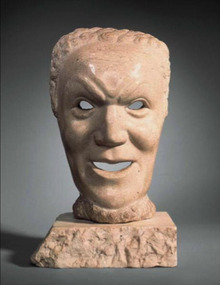
Sculpture, Karl Duldig, Mask by Karl Duldig 1921, 1921
... Duldig would have been familiar with the psychological investigations of the neurologist and founder of psychoanalysis Sigmund Freud, who established his practice in Vienna. ...Duldig would have been familiar with the psychological investigations of the neurologist and founder of psychoanalysis Sigmund Freud, who established his practice in Vienna. ...Karl Duldig carved this marble sculpture of a mask in the Vienna Kunstgewerbeschule (School of Applied Arts) in 1921. His teacher, Anton Hanak, the Professor of Sculpture at the School, encouraged him to carve directly into the stone. It was an accomplished work for the 19 year-old student and was selected by Hanak to represent the students of the School at the Deutschen Gewerbeschau (German Applied Art exhibition) in Munich in 1922, an early accolade for the young artist. The sculpture and another Kneeling Nude were reproduced in the journal Deustche Kunst and Dekoration in 1923-24 in an article on the Hanak-Klasse. In 2011 Mask was exhibited in the National Gallery of Victoria exhibition Vienna: Art and Design. The sculpture is one of ten substantial sculptures in marble and stone, and a larger group terracotta sculptures and masks, portrait busts and small stone sculptures created by Karl Duldig in Vienna that are held in the Museum collection. These art works are complemented by an archive of contemporary documents including letters, photographs, documents and ephemera. In 1938 Duldig’s Viennese sculptures were sent to Paris in 1938 for a proposed exhibition, and were hidden in Paris by Slawa Duldig’s sister Rella, throughout the Second World War, and arrived in Australia post-war over 5 decades. Karl Duldig was a student of the Kunstgewerbeschule from 1921 until 1925, and then attended the Akademie Der Bildenden Künste (Academy of Fine Arts) from 1929 until 1933. He was accepted into the Professor Josef Mullner’s “Meisterschule” at the Academy of Fine Arts from 1929 until 1933. His teacher at the Kunstgwerebeschule was Austria’s foremost contemporary sculptor Anton Hanak, and he was a formative influence on Duldig’s work. Hanak had been a member of Viennese Secession, and worked with Josef Hoffman on architectural commissions prior to the First World War. Hanak shared both his love of the expressive quality of materials and a humanist vision with his students. Various writers have written about Duldig’s interest in masks. His interest may have been stimulated by his classical education, the Greek and Roman antiquities in the Kunsthistoriches Museum in Vienna, or the ethnological collections in Vienna’s Museum of Ethnology (now known as the Weltmuseum). The mask was a motif explored by expressionist and cubist artists whose work was exhibited at the Vienna Secession. Duldig would have been familiar with the psychological investigations of the neurologist and founder of psychoanalysis Sigmund Freud, who established his practice in Vienna. In the Duldig Studio library, Duldig’s keen interest in the arts of a myriad of visual cultures is apparent. Of particular note are two well-thumbed copies Rudolf Utzinger’s, Masken, published by Ernst Wasmuth in Berlin in 1923, depicting masks from around the world. It is likely that a multitude of influences were at play. Slawa Duldig also worked with this motif, and also carved a smaller mask in Salzburg marble as well as a remarkable mask in clay, and these are held in the collection. Ann Carew 2016The Mask has national and international aesthetic significance. It is one of the earliest works by Karl Duldig in the Studio collection, and is a subject that he would continue to explore throughout his working life. The sculpture demonstrates a high degree of technical skill and mastery at an early age. It is evidence of Duldig’s engagement with the art of his peers during this period – the mask is a motif that inspired contemporary expressionist and cubist artists. It also demonstrates his interests in portraiture, human psychology, and the creation of identity and transformation of personalities. The Mask also provides an important link to the studio practice in the Vienna Kunstgwerbeschule, the teaching of Anton Hanak, and the program of international art exhibitions in Europe during the period. It is also of historical significance: the story of its survival and eventual recovery provides a counterpoint to the story of the Nazis’ confiscation of art during the Second World War. Ann Carew 2016Carving in Salzburg Marble. Holes for eyes and mouth cut through the block. Highly polished finish at front contrasting with rough finish at back and stylised curled hair. Marble base separate (75 x 275 x 198, wt 9000) and added later by artist. Karl Duldig 1921 incised on back -
 Flagstaff Hill Maritime Museum and Village
Book - Fictional Story, Brentano’s Ltd et al, Gentlemen Prefer Blondes, 1926
... He drew many of the leading cultural figures of the day, including Charlie Chaplin, Sigmund Freud, Pablo Picasso and Lillian Gish, and his fluid, elegant line style is now widely seen as visually defining the Jazz Age. ...He drew many of the leading cultural figures of the day, including Charlie Chaplin, Sigmund Freud, Pablo Picasso and Lillian Gish, and his fluid, elegant line style is now widely seen as visually defining the Jazz Age. ...Gentlemen Prefer Blondes is the Illuminating Diary of a Professional Lady that follows Lorelei Lee, a self-absorbed, gold-digging blonde flapper from Arkansas, as she journals her romantic and financial conquests travelling from New York to Europe (Paris, London) with her more sensible friend Dorothy, collecting rich admirers, diamonds and comic misadventures along the way. It was published the same year as F. Scott Fitzgerald's The Great Gatsby and Carl Van Vechten's Firecrackers, and is considered one of several notable 1925 American novels focused on the carefree hedonism of the Jazz Age. The London/Brentano's edition you're describing (1926) came out shortly after the original 1925 American edition, illustrated throughout in Art Deco style by caricaturist Ralph Barton.Hard cover book. Gentlemen Prefer Blondes Author: Anita Loos Publisher: Brentanos Ltd Illustrator: Ralph Barton Date: 1926 Further Information: Plain blue Cloth hardcover with lettering and patterning to spine in black. The spine has a Library label with an inscription. fictionGentlemen Prefer Blondes is the Illuminating Diary of a Professional Lady that follows Lorelei Lee, a self-absorbed, gold-digging blonde flapper from Arkansas, as she journals her romantic and financial conquests travelling from New York to Europe (Paris, London) with her more sensible friend Dorothy, collecting rich admirers, diamonds and comic misadventures along the way. It was published the same year as F. Scott Fitzgerald's The Great Gatsby and Carl Van Vechten's Firecrackers, and is considered one of several notable 1925 American novels focused on the carefree hedonism of the Jazz Age. The London/Brentano's edition you're describing (1926) came out shortly after the original 1925 American edition, illustrated throughout in Art Deco style by caricaturist Ralph Barton.shipwrecked-coast, flagstaff-hill, flagstaff-hill-maritime-museum, warrnambool, maritime-museum, shipwreck-coast, flagstaff-hill-maritime-village, shipwrecked-artefact, book, pattison collection, warrnambool library, warrnambool mechanics’ institute, ralph eric pattison, corangamite regional library service, warrnambool city librarian, mechanics’ institute library, victorian library board, warrnambool books and records, warrnambool children’s library, gentlemen prefer blondes, anita loos -
 Monbulk RSL Sub Branch
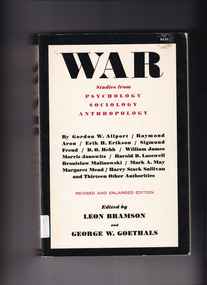
Book, Leon Bramson, War: Studies from psychology, sociology, anthropology, 1968
... Thompson Psychoanalytic perspectives Why war? / Sigmund Freud Personal aggressiveness and war / E.F.M. ...Part I: Studies from psychology Introduction Instinct theories and comparative psychology The moral equivalent of war / William James The instinct of pugnacity / William McDougall Emotion and society / D.O. Hebb & W.R. Thompson Psychoanalytic perspectives Why war? / Sigmund Freud Personal aggressiveness and war / E.F.M. Durbin & John Bowlby Toward a psychiatry of peoples / Harry Stack Sullivan Wholeness and totality / Erik H. Erikson Authoritarian personality and foreign policy / Daniel J. Levinson Social learning and intergroup relations War, peace, and social learning / Mark A. May Drives toward war / Edward C. Tolman The role of expectancy / Gordon W. Allport Part II: Studies from sociology and anthropology War / William Graham Sumner The social function of war / Robert E. Park An anthropological analysis of war / Bronislaw Malinowski Warfare is only an invention not a biological necessity / Margaret Mead Primitive warfare: a methodological note / Joseph Schneider Part III: War, liberal democracy, and industrial society The military and the industrial society / Herbert Spencer The garrison state / Harold D. Lasswell On war, society, and the military / Alexis de Tocqueville Military elites and the study of war / Morris Janowitz War and industrial society / Raymond Aron.Index, bib, p.438.non-fictionPart I: Studies from psychology Introduction Instinct theories and comparative psychology The moral equivalent of war / William James The instinct of pugnacity / William McDougall Emotion and society / D.O. Hebb & W.R. Thompson Psychoanalytic perspectives Why war? / Sigmund Freud Personal aggressiveness and war / E.F.M. Durbin & John Bowlby Toward a psychiatry of peoples / Harry Stack Sullivan Wholeness and totality / Erik H. Erikson Authoritarian personality and foreign policy / Daniel J. Levinson Social learning and intergroup relations War, peace, and social learning / Mark A. May Drives toward war / Edward C. Tolman The role of expectancy / Gordon W. Allport Part II: Studies from sociology and anthropology War / William Graham Sumner The social function of war / Robert E. Park An anthropological analysis of war / Bronislaw Malinowski Warfare is only an invention not a biological necessity / Margaret Mead Primitive warfare: a methodological note / Joseph Schneider Part III: War, liberal democracy, and industrial society The military and the industrial society / Herbert Spencer The garrison state / Harold D. Lasswell On war, society, and the military / Alexis de Tocqueville Military elites and the study of war / Morris Janowitz War and industrial society / Raymond Aron.armed conflict - history and teaching, conflict - history
