
Showing 122 items matching "signal tower"
-
 Queenscliffe Maritime Museum
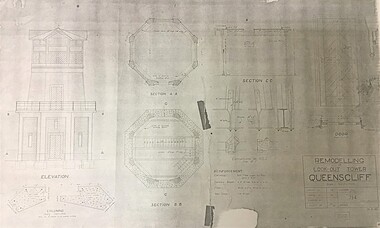
Plan - Plan for a Signal Station Look-out Tower Queenscliff
... Plan for a Signal Station Look-out Tower Queenscliff......signal station...look out tower...Queenscliffe Maritime Museum 2 Wharf St Queenscliff geelong-and-the-bellarine-peninsula A plan for the remodelling of the look-out tower at Queenscliff dated 26 April1938 plan queenscliff signal station look out tower Plan for the the remodelling of the look-out tower at Queenscliff dated 1938 Plan Plan for a Signal Station Look-out Tower Queenscliff ...A plan for the remodelling of the look-out tower at Queenscliff dated 26 April1938Plan for the the remodelling of the look-out tower at Queenscliff dated 1938plan, queenscliff, signal station, look out tower -
 Queenscliffe Maritime Museum
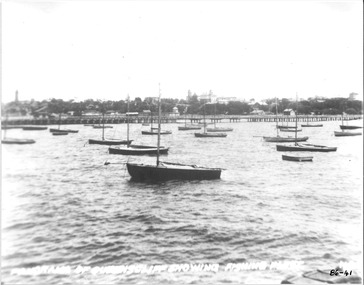
Photograph, Photographer unknown, c1926
... ...signal tower...Queenscliffe Maritime Museum 2 Wharf St Queenscliff geelong-and-the-bellarine-peninsula Queenscliffe fishing fleet and panorama Queenscliffe fishing fleet signal tower .Reverse: "signal station Q'cliffe built 1886 - photo before it was raised on brick base in 1936 - c1926?" ...Queenscliffe fishing fleet and panoramaRealismBlack & white photograph of the landward view of moored Couta boats with Queenscliffe beyond c1926.Reverse: "signal station Q'cliffe built 1886 - photo before it was raised on brick base in 1936 - c1926?"queenscliffe, fishing fleet, signal tower -
 Sunbury Family History and Heritage Society Inc.
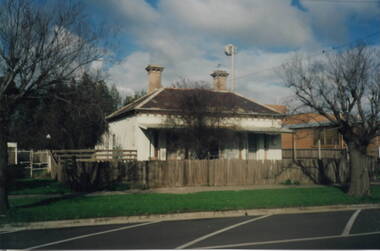
Photograph, 13 Evans Street, Sunbury
... A cream brick structure with a signal tower is on the RHS of the photograph and a large bare elm tree is growing on the nature-strip. ...A cream brick structure with a signal tower is on the RHS of the photograph and a large bare elm tree is growing on the nature-strip. 13 Evans Street, Sunbury Photograph ...The cottage in the photograph was situated at 13 Evans Street in Sunbury and was one of the last houses to be demolished along the business precinct of Evans Street between Brook and Macedon Streets. The cream brick building on the RHS of the house is a Telstra complex. The cottage was demolished in the early 2000s and a fast-food outlet now occupies the site. The cottage was one of a group of small attractive buildings erected along the northern end of Evans Street in the second half of the nineteenth century.A non-digital coloured photograph of a small double fronted Victorian cottage with a slate roof and a verandah across the front of the house. A cream brick structure with a signal tower is on the RHS of the photograph and a large bare elm tree is growing on the nature-strip. 13 evans street, victorian cottages, evans street, telstra -
 Cheese World Museum
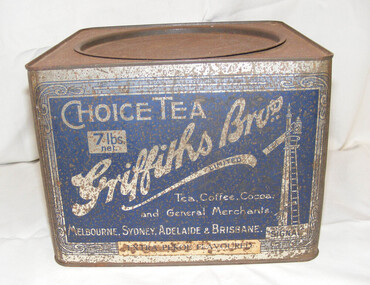
Tin, Griffith's tea tin 7lb
... CHOICE TEA 7LB net/GRIFFITH'S BROS LTD/Tea, coffee, cocoa & General Merchants/MELBOURNE, SYDNEY, ADELAIDE & BRISBANE/ Trade mark 'SIGNAL' [includes sketch of signal tower]; EXTRA PEKOE FLAVOURD [label on base] Uebergang No.A16.1...Uebergang catalogue No.A16.1 CHOICE TEA 7LB net/GRIFFITH'S BROS LTD/Tea, coffee, cocoa & General Merchants/MELBOURNE, SYDNEY, ADELAIDE & BRISBANE/ Trade mark 'SIGNAL' [includes sketch of signal tower]; EXTRA PEKOE FLAVOURD [label on base] Uebergang No.A16.1 Squat square base Griffith's tea tin. ...The Percy Uebergang family lived at Tooram Park, Allansford from 1912 until 1992. Percy and Myrtle Uebergang's children were twins, Ray and Joyce born in 1926 who lived at Tooram Park until their deaths, Ray in 1986 and Joyce in 1992. Neither Ray nor Joyce married and following the death of her brother Joyce set up the Ray and Joyce Uebergang Foundation which supports the local community. This tea tin is part of the collection of items given into the care of the Cheese World Museum. Uebergang catalogue No.A16.1 Squat square base Griffith's tea tin. The front has a label printed with a dark blue background and silver writing. A small label is affixed at the bottom. Remnants of a white stick-on label at the bottom. A round push-on lid with lip is on top. Full of pink dairy rubbers.CHOICE TEA 7LB net/GRIFFITH'S BROS LTD/Tea, coffee, cocoa & General Merchants/MELBOURNE, SYDNEY, ADELAIDE & BRISBANE/ Trade mark 'SIGNAL' [includes sketch of signal tower]; EXTRA PEKOE FLAVOURD [label on base] Uebergang No.A16.1 -
 Queenscliffe Maritime Museum
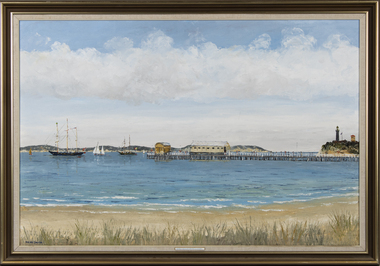
Painting - Oil Painting, Dacre Smyth, 1. 'Queenscliffe' in open shed. 2. 1988 Tall Ships at Queenscliff; Leeuwin, Asgard
... The Queenscliff pier with the old lifeboat shed and the Blacklight (Queenscliffe's High Light) alongside the old signal tower are also depicted. Port Phillip Heads in the disctance. ...The Queenscliff pier with the old lifeboat shed and the Blacklight (Queenscliffe's High Light) alongside the old signal tower are also depicted. Port Phillip Heads in the disctance. ...Tall Ships at Queenscliff; 'The sail training barquentine "Leeuwin" from West Australia and the Republic of Ireland brigantine "Asgard II" at anchor off Queenscliff prior to the "Arrival Convoy" in Melbourne of a number of the Tall Ships, all bound eventually for Sydney via Hobart for Australia's 1988 bicentenary. The Queenscliff pier with the old lifeboat shed and the Blacklight (Queenscliffe's High Light) alongside the old signal tower are also depicted. Port Phillip Heads in the disctance. By Dacre Smyth 29 Dec 1987.A barquentine or schooner barque is a sailing vessel with three or more masts; with a square rigged foremast and fore-and-aft rigged main, mizzen and any other masts. A brigantine is a two-masted sailing vessel with a fully square-rigged foremast and at least two sails on the main mast: a square topsail and a gaff sail mainsail (behind the mast). The main mast is the second and taller of the two masts.Oil painting in frame of the Leeuwin and Asgard tall ships in Queenscliff 1988.On front: Tall Ships at Queenscliff (LEEUWIN and ASGARD). Hand written on back: Tall Ships at Queenscliff; 'The sail training barquentine "Leeuwin" from West Australia and the Republic of Ireland brigantine "Asgard II" at anchor off Queenscliff prior to the "Arrival Convoy" in Melbourne of a number of the Tall Ships, all bound eventually for Sydney via Hobart for Australia's 1988 bicentenary. The Queenscliff pier with the old lifeboat shed and the Blacklight (Queenscliffe's High Light) alongside the old signal tower are also depicted. Port Phillip Heads in the disctance. By Dacre Smyth 29 Dec 1987'.leeuwin, barquentine, queenscliff, dacre smyth, brigantine -
 Lakes Entrance Historical Society
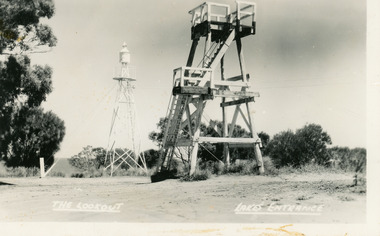
Postcard - Lookout tower Jemmy's Point, Bulmer H D, 1950
... Black and white postcard of the timber lookout on Jemmy's Point, with the signal beacon on steel tower nearby. Lakes Entrance Victoria,...Lakes Entrance Historical Society 4 Marine Parade Lakes Entrance gippsland Historic Sites Navigation The Lookout, Lakes Entrance Black and white postcard of the timber lookout on Jemmy's Point, with the signal beacon on steel tower nearby. Lakes Entrance Victoria, Postcard Lookout tower Jemmy's Point Bulmer H D ...Black and white postcard of the timber lookout on Jemmy's Point, with the signal beacon on steel tower nearby. Lakes Entrance Victoria,The Lookout, Lakes Entrancehistoric sites, navigation -
 Lakes Entrance Historical Society
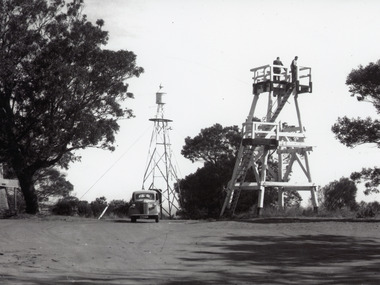
Photograph - Lookout tower Jemmy's Point, 1960
... Black and white photograph of the timber lookout on Jemmy's Point, steel tower with signal beacon in background, base of old lookout tree visible on left of image. ...Historic Sites Navigation Black and white photograph of the timber lookout on Jemmy's Point, steel tower with signal beacon in background, base of old lookout tree visible on left of image. ...Also one other photograh similar showing steps, landing, and Carpenters Chev car parked.Black and white photograph of the timber lookout on Jemmy's Point, steel tower with signal beacon in background, base of old lookout tree visible on left of image. Lakes Entrance, Victoria.historic sites, navigation -
 Lakes Entrance Historical Society
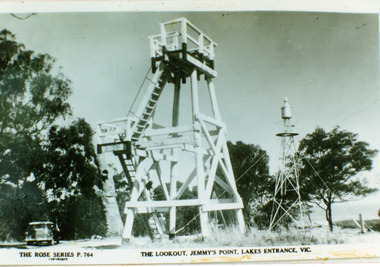
Photograph - Lookout tower Jemmy's Point, The Rose Series, 1950
... Black and white photograph copied from a postcard showing timber lookout tower and signal beacon on Jemmy's Point. Old lookout tree in background appears to have some of the top missing. ...Lakes Entrance Historical Society 4 Marine Parade Lakes Entrance gippsland Identical copy 10 x 15 Historic Sites Navigation The Lookout Jemmy's Point Lakes Entrance Black and white photograph copied from a postcard showing timber lookout tower and signal beacon on Jemmy's Point. Old lookout tree in background appears to have some of the top missing. ...Identical copy 10 x 15Black and white photograph copied from a postcard showing timber lookout tower and signal beacon on Jemmy's Point. Old lookout tree in background appears to have some of the top missing. Lakes Entrance Victoria.The Lookout Jemmy's Point Lakes Entrancehistoric sites, navigation -
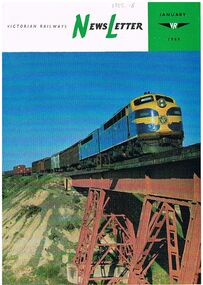 Bendigo Historical Society Inc.
Magazine - BADHAM COLLECTION: VICTORIAN RAILWAYS NEWSLETTER JANUARY 1969
... The contents include photos of Melbourne's West Tower signal box also a related article, Powelltown in 1919, horse train on Sanderson's line at turn of the century. ...The contents include photos of Melbourne's West Tower signal box also a related article, Powelltown in 1919, horse train on Sanderson's line at turn of the century. ...Victorian Railways Newsletter January 1969. Newsletter printed in glossy paper with colour photos on front. The contents include photos of Melbourne's West Tower signal box also a related article, Powelltown in 1919, horse train on Sanderson's line at turn of the century. Printed at the Victorian railways printing works Laurens St North Melbourne.magazine, government, victorian railways -
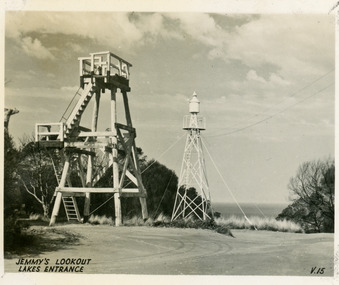 Lakes Entrance Historical Society
Postcard - Lookout tower Jemmy's Point, Valentine Series, 1940
... Black and white small format postcard of the timber observation lookout at Jemmy's Point, Lakes Entrance, Victoria, showing the timber tower with observation deck, signal beacon on steel tower nearby. ...Lakes Entrance Historical Society 4 Marine Parade Lakes Entrance gippsland Historic Sites Navigation Jemmys Lookout Lakes Entrance Black and white small format postcard of the timber observation lookout at Jemmy's Point, Lakes Entrance, Victoria, showing the timber tower with observation deck, signal beacon on steel tower nearby. ...Black and white small format postcard of the timber observation lookout at Jemmy's Point, Lakes Entrance, Victoria, showing the timber tower with observation deck, signal beacon on steel tower nearby. Top of old standing lookout tree just visible.Jemmys Lookout Lakes Entrancehistoric sites, navigation -
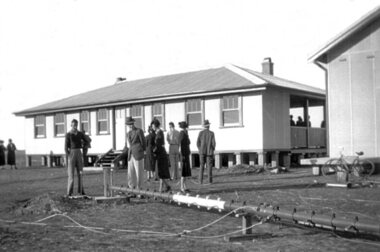 Nhill Aviation Heritage Centre
Black and white photograph, Local photograph. Original of this scan held by Nhill Historical Society, Aeradio Building c1937
... The building and its equipment were part of a comprehensive system of radio towers, signalling and meteorology equipment aimed at providing safer navigation for aircraft travelling throughout Australia. ...The building and its equipment were part of a comprehensive system of radio towers lights and signalling equipment aimed at providing safer navigation for aircraft travelling throughout Australia. ...The building and its equipment were part of a comprehensive system of radio towers, signalling and meteorology equipment aimed at providing safer navigation for aircraft travelling throughout Australia. ...This building is still intact at the Nhill Aerodrome. Some of the infrastructure is also in place or can be evidenced by its foundations.The Aeradio building was built on the present aerodrome in 1937. This was one of only sixteen buildings of this type built across Australia and it housed radio communications and guidance equipment. The building and its equipment were part of a comprehensive system of radio towers, signalling and meteorology equipment aimed at providing safer navigation for aircraft travelling throughout Australia. The facility closed in the 1960sThis photo is significant due to it having been taken soon after the building was constructed. It is the earliest known photograph taken on an open to the public day before the receiver aerials were erected.The Aeradio building was built on the present (2012) aerodrome in 1937 or 1938. This was one of only fifteen buildings of this type built across Australia and it housed radio communications and guidance equipment. The building and its equipment were part of a comprehensive system of radio towers lights and signalling equipment aimed at providing safer navigation for aircraft travelling throughout Australia. The facility closed in the 1960sphoto, aeradio, early, civil aviation, dca, dept of civil aviation -
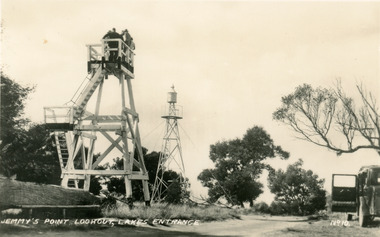 Lakes Entrance Historical Society
Postcard - Lookout tower Jemmy's Point, 1940
... Old log and seat still nearby, signal beacon on steel tower a short distance away....Old log and seat still nearby, signal beacon on steel tower a short distance away. Postcard Lookout tower Jemmy's Point ...Black and white small format postcard of the timber observation lookout at Jemmy's Point, Lakes Entrance, Victoria, showing the updated and safer steps from ground to observation deck, with fenced landing at halfway point. Old log and seat still nearby, signal beacon on steel tower a short distance away.historic sites, navigation, fences -
 Nhill Aviation Heritage Centre
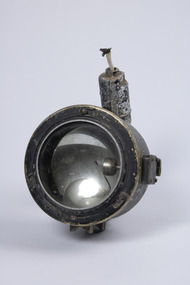
Memorabilia - Signalling lamp
... Nhill Aviation Heritage Centre 1 Aerodrome Road Nhill grampians Type used on the RAAF Base by air crew and control tower operators. signal lamp lantern communication signals RAAF Ref No SA/760 Lantern portable signalling. ...Type used on the RAAF Base by air crew and control tower operators. Electric signalling lamp in grey metal casing, and hand grip with trigger at rear. Mount on top for sighting attachmentRAAF Ref No SA/760 Lantern portable signalling. Admiralty Pattern No 5110D. Serial No. 3901 Year 1942 Amalgamated Wireless A/SIA LTD signal lamp, lantern, communication, signals -
 The Beechworth Burke Museum
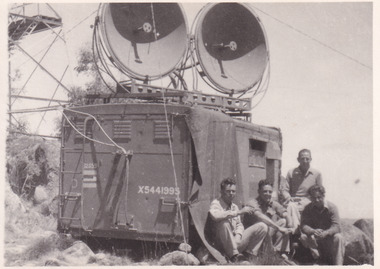
Photograph, 1944
... tower in the background. Four unidentified young men are in the foreground on the right hand side. A secret experimental micro-wave radio station was established and tested at this site by the Army Signal Detachment Unit during World War II. ...tower in the background. Four unidentified young men are in the foreground on the right hand side. A secret experimental micro-wave radio station was established and tested at this site by the Army Signal Detachment Unit during World War II. ...Taken in 1944, the photograph depicts a van with two large, round satellite dishes installed on the roof stationed near Mt. Stanley, Victoria. There is a transmission tower in the background. Four unidentified young men are in the foreground on the right hand side. A secret experimental micro-wave radio station was established and tested at this site by the Army Signal Detachment Unit during World War II. It was part of an experimental Ultra High Frequency (UHF) link between Melbourne and Sydney. At the time, it was highly classified. It intended to enquire into the hitherto unexplored transmission of micro-waves; that is, a radio signal which could only be transmitted by line of sight, and thus required hill-top to hill-top location.The photograph is historically significant as it pertains to World War II; the largest global conflict in history. This significance is enhanced by Australia's prominent involvement in campaigns across the Pacific, particularly on land in New Guinea and across the Huon Peninsula. It was also the first time that the Australian mainland came under direct attack by the Axis, with Japanese forces targeting north-west Australia and Sydney Harbour. These battles became Australia's largest and most complex offensives during the war. The record is also historically significant as it relates to the Royal Australian Corps of Signals, or "RA Sigs". This significance is strengthened by Australia's unique distinction of having the first established signal unit under the British Empire. This unit provides electronic warfare. They enable commanders to implement highly dynamic battle control against opposing forces by using a number of methods including radio, fibre optic, micro-wave, information systems and satellite links. The record has strong research potential. This is due to the ongoing scholarly and public interest in war, military history, the ANZAC legend, and the continuing existence of the RA Sigs. The historic context of this record can provide insight into Australia's history, military, technological innovation and advancements, as well as national economic, defence and foreign policies after 1945.Black and white rectangular photograph printed on matte photographic paper.Reverse: BMM5095.10 / Our station set-up / in operation beside / the old Fire Watchers / Tower / 32 / It was man-handled / the last 50m. to the top /military album, army album, wwii, world war ii, army signal detachment unit, royal australia corps of signals, military, war, australian army, mt. stanley, victoria, beechworth -
 Bendigo Historical Society Inc.
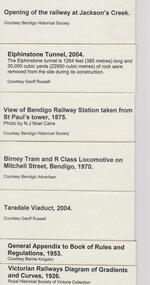
Document - BADHAM COLLECTION: EXHIBITION LABELS X 15 - CARDBOARDS
... Copy of 1887 Map of Railway Post Offices - Courtesy Edna Westhead Taken in 1921, Bendigo railway men celebrating 50 years since first train arrived in Bendigo in 1862 - Courtesy Bendigo Historical Society Book of Signals, 1949 - Courtesy Bernie Kingdon Book of Instruction Rolling Stock 1921, 1943 - Courtesy Bernie Kingdon Lost Property Book, 1886 - Courtesy Ross Rowley View of Bendigo Railway Station taken from St. Paul's tower...Copy of 1887 Map of Railway Post Offices - Courtesy Edna Westhead Taken in 1921, Bendigo railway men celebrating 50 years since first train arrived in Bendigo in 1862 - Courtesy Bendigo Historical Society Book of Signals, 1949 - Courtesy Bernie Kingdon Book of Instruction Rolling Stock 1921, 1943 - Courtesy Bernie Kingdon Lost Property Book, 1886 - Courtesy Ross Rowley View of Bendigo Railway Station taken from St. Paul's tower ...Exhibition labels x 15 - cardboards Railway Post Office stamps, 1865, and book 1951 - Courtesy Edna Westhead. Copy of 1887 Map of Railway Post Offices - Courtesy Edna Westhead Taken in 1921, Bendigo railway men celebrating 50 years since first train arrived in Bendigo in 1862 - Courtesy Bendigo Historical Society Book of Signals, 1949 - Courtesy Bernie Kingdon Book of Instruction Rolling Stock 1921, 1943 - Courtesy Bernie Kingdon Lost Property Book, 1886 - Courtesy Ross Rowley View of Bendigo Railway Station taken from St. Paul's tower, 1875 - Courtesy Bendigo Historical Society...document, memo, railway -
 Ringwood and District Historical Society
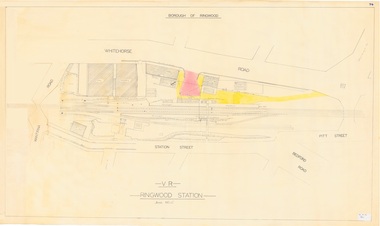
Plan, Borough of Ringwood - VR Ringwood Station - Circa 1930s
... Technical drawing of Ringwood Railway Station features, surrounding streets and buildings including Cool Stores, Packing Shed, Coke Bin, Coal Box, Dam, Garage, Shops, ES&A Bank, Station Master's Residence, Drill Hall, Goods Shed, Signal Box, Passenger Platform, Footbridge, and Clock Tower at Warrandyte Road. ...Ringwood and District Historical Society 125A Warrandyte Road Ringwood North melbourne Scale: 1"=40' Technical drawing of Ringwood Railway Station features, surrounding streets and buildings including Cool Stores, Packing Shed, Coke Bin, Coal Box, Dam, Garage, Shops, ES&A Bank, Station Master's Residence, Drill Hall, Goods Shed, Signal Box, Passenger Platform, Footbridge, and Clock Tower at Warrandyte Road. ...Technical drawing of Ringwood Railway Station features, surrounding streets and buildings including Cool Stores, Packing Shed, Coke Bin, Coal Box, Dam, Garage, Shops, ES&A Bank, Station Master's Residence, Drill Hall, Goods Shed, Signal Box, Passenger Platform, Footbridge, and Clock Tower at Warrandyte Road. Station entrance and traffic access areas shaded red and yellow.Scale: 1"=40' -
 Ballarat Tramway Museum
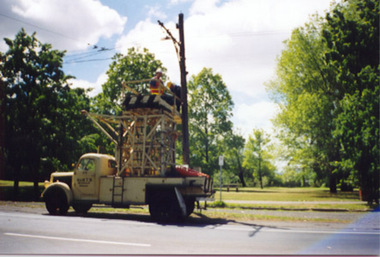
Photograph - Colour Photograph/s, Clare Johnson, 31/10/1999 12:00:00 AM
... Colour photograph of Mark McKay and Warren Doubleday dismantling tramway signalling equipment signal boxes along Wendouree Parade during 31 Oct. 1999 using the Tower Truck, 1 pole to the north of Depot Junction. ...Ballarat Tramway Museum South Gardens Reserve Wendouree Parade Ballarat Ballarat goldfields BTM Forest City Signals Signals Wendouree Parade Colour photograph of Mark McKay and Warren Doubleday dismantling tramway signalling equipment signal boxes along Wendouree Parade during 31 Oct. 1999 using the Tower Truck, 1 pole to the north of Depot Junction. ...Colour photograph of Mark McKay and Warren Doubleday dismantling tramway signalling equipment signal boxes along Wendouree Parade during 31 Oct. 1999 using the Tower Truck, 1 pole to the north of Depot Junction. Photo by Clare Johnson. On Konica Long Life 100 photo paper.btm, forest city signals, signals, wendouree parade -
 Ballarat Tramway Museum
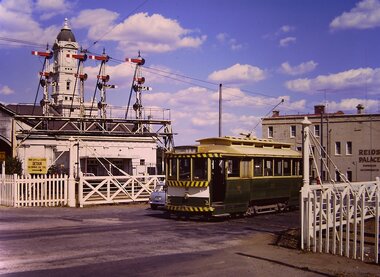
Photograph - Digital image, Chris Phillips, c1970
... In the background is the station building, clock tower and the signal gantry. On the right hand side is Reids Coffee Palace....In the background is the station building, clock tower and the signal gantry. On the right hand side is Reids Coffee Palace. ...Yields information about the tram operations at the Lydiard St level crossing and the Ballarat Railway Station.Digital image of No. 32 crossing the Lydiard St North level crossing at Ballarat Railway Station . Tram has the destination Lydiard St North. In the background is the station building, clock tower and the signal gantry. On the right hand side is Reids Coffee Palace.trams, tramways, lydiard st north, level crossings, ballarat railway station, tram 32 -
 Ballarat Tramway Museum
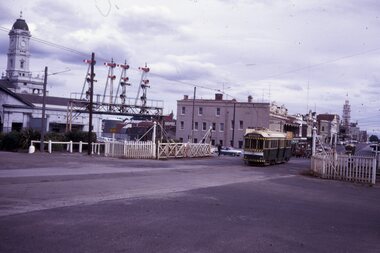
Slide - 35mm slide/s - set of 2, Peter Moses, Jan. 1969
... Photo shows the Ballarat Railway station clock tower, part of the train shed and the signals on the station side of the gates and another bogie tram waiting at the end of the double track in Lydiard St. for No. 41 to pass. 2059.2 - ditto, but with the two trams passing each other. ...Photo shows the Ballarat Railway station clock tower, part of the train shed and the signals on the station side of the gates and another bogie tram waiting at the end of the double track in Lydiard St. for No. 41 to pass. 2059.2 - ditto, but with the two trams passing each other. ...2059.1 - Photo of SEC Ballarat No.41 passing through the railway gates at Ballarat Railway Station, Lydiard St. North, with the destination of "Sebastopol". Tram has a SEC "Everything's under control in my all electric kitchen". Reid's Coffee Palace is the background. Photo shows the Ballarat Railway station clock tower, part of the train shed and the signals on the station side of the gates and another bogie tram waiting at the end of the double track in Lydiard St. for No. 41 to pass. 2059.2 - ditto, but with the two trams passing each other. The Provincial Hotel is also in the photograph. Kodak cardboard mount slide, taken by Peter Moses assumed Jan. 1969, dated only "Jan", but date lines up with Bendigo slides and type of numbering. Could be 1970.On the rear of the slides in black ink "P. Moses" along bottom left hand corner in black ink.tramways, trams, railway crossing, lydiard st, railway station, reid's coffee palace, provincial hotel, tram 41 -
 Ballarat Tramway Museum
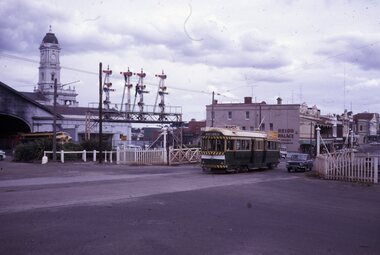
Slide - 35mm slide/s, Peter Moses, Jan. 1969
... Photo shows the Ballarat Railway Station clock tower, part of the train shed and the signals on the station side of the gates. ...Photo shows the Ballarat Railway Station clock tower, part of the train shed and the signals on the station side of the gates. ...Photo of SEC Ballarat No.41 passing through the railway gates at Ballarat Railway Station, Lydiard St. North, with the destination of "Lydiard St Nth". Tram has a SEC "Everything's under control in my all-electric kitchen". Reid's Coffee Palace is in the background. Photo shows the Ballarat Railway Station clock tower, part of the train shed and the signals on the station side of the gates. A "B" class locomotive on a passenger train is standing in platform 1 of the station. Kodak cardboard mount slide, taken by Peter Moses assumed Jan. 1969, dated only "Jan", but date lines up with Bendigo slides and type of numbering. Could be 1970.On the rear of the slides in black ink "P. Moses" along bottom left hand corner in black ink.tramways, trams, railway crossing, lydiard st, railway station, reid's coffee palace, tram 41 -
 Williamstown Historical Society Inc
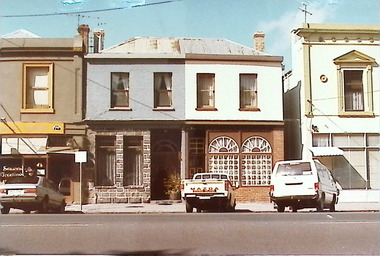
Photograph - Nelson Place, No. 151-153
... On 24 August 1844 he took charge of the signal station, and subsequently the light- house (then a lamp in a wooden tower), for a further five years. ...On 24 August 1844 he took charge of the signal station, and subsequently the light- house (then a lamp in a wooden tower), for a further five years. ...No. 151-153 Nelson Place was designed by Michael Egan and constructed in 1860. The buildings are recorded in the Hobsons Bay Heritage Study Amended 2017 (Heritage Overlay No. HO219) and notes the following: Historically, they are among the oldest shops in Nelson Place and illustrate the early development of the street during the most prosperous period of the Port. They are also important for their associations with Thomas Mason. Thomas Mason, who owned these two shops, each of stone, brick and four rooms until c1880, was one of the most significant men in the early history of Williamstown. In 1858 he ran the two shops jointly with Benjamin Culley, a draper and clothier (Refer to 55 Cecil Street). Culley and Mason's partnership dissolved and after a brief period as the Ship Inn, in 1859, the two shops were now leased to various other businessmen, some of the longest standing being Matthew Suffren, a watchmaker; Edward Bailey, a chemist; a stationer, George Divers; Henry Douglas a plumber and Henry Linton, a boot maker (Refer to 22 James St, 46-48 and 50 Stevedore Street). In 1880 Mrs. Mason had assumed ownership which she retained until the shops were retaken by the executors of Sutton's estate (1890). Given the property's description in the period 1857-59 as a store of wood and stone and in 1860, as two shops of brick and stone, it is probable in that year that the whole premises was rebuilt. Thomas Mason, originally a Londoner, arrived in the colony in 1841. On 24 August 1844 he took charge of the signal station, and subsequently the light- house (then a lamp in a wooden tower), for a further five years. In `Port of Many Prows', Wilson Evans recounts a tale which indicates that Mason may not have been entirely conscientious in this role. After this he took up storekeeping and auctioneering but gave up the shopkeeping in 1858. He was a member of the first Williamstown Council and its chairman no less than four times (1856, 1860, 1862, 1864). He represented Williamstown in the Legislative Assembly in 1860-61 (6). Andrew Rider's photograph of Nelson Place, taken c1866 shows these shops as the most substantial in the block and adorned with a slender timber verandah. nelson place, 151-157 nelson place, thomas mason -
 Marysville & District Historical Society
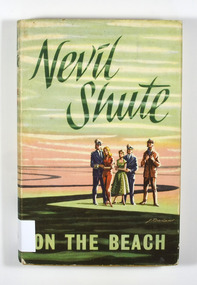
Book, Nevil Shute, On The Beach, 1958
... When the survivors receive a strange signal from San Diego, Cmdr. Dwight Towers must undertake a mission with Lt. ...After World War III, Australia is the only remaining haven for mankind. However, wind currents carrying lingering radiation all but condemn those on the continent to the same fate suffered by the rest of the world. When the survivors receive a strange signal from San Diego, Cmdr. Dwight Towers must undertake a mission with Lt. Peter Holmes to see if there is hope for humanity -- leaving behind Moira and Mary, the women they love.Dust cover is a painted illustration of the characters from the book.fictionAfter World War III, Australia is the only remaining haven for mankind. However, wind currents carrying lingering radiation all but condemn those on the continent to the same fate suffered by the rest of the world. When the survivors receive a strange signal from San Diego, Cmdr. Dwight Towers must undertake a mission with Lt. Peter Holmes to see if there is hope for humanity -- leaving behind Moira and Mary, the women they love.science fiction, end of the world, australia -
 Ballarat Tramway Museum
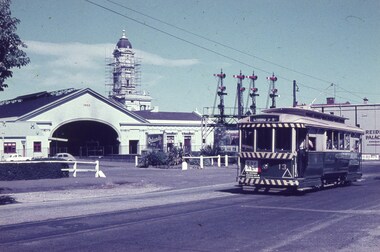
Slide - 35mm slide/s, Keith Caldwell, 12/03/1962 12:00:00 AM
... tower has scaffolding around it. An Orlando wine advertisement is visible on the platform along with signal gantry. ...tower has scaffolding around it. An Orlando wine advertisement is visible on the platform along with signal gantry. ...Yields information about the nature of tram services and trams in Lydiard St North and the Railway Station.Agfa colour slide, white cardboard mount, photo by Keith Caldwell on 12/3/1962 of: Tram 13 northbound in Lydiard St North, with the railway station and Reid's Coffee Palace in the background. The station clock tower has scaffolding around it. An Orlando wine advertisement is visible on the platform along with signal gantry. The Tram has an Age advertisement.In ink "Ballarat 12.3.62"tramways, trams, railway station, lydiard st north, tram 13 -
 Lakes Entrance Historical Society
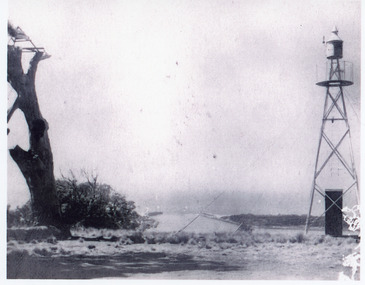
Photograph - Jemmys Point Lookout Tower, 1925
... signal light. Lakes Entrance Victoria Photograph Jemmys Point Lookout Tower ...Plus 1 x black and white small format photograph 6.5 x 6.5 taken from lookout, has signal light only|Plus 3 x small format postcards 6.5 x 8.5 taken from lookout, signal light quite distinct, with inscription Lookout Lakes EntranceBlack and white photograph of the entrance, taken from Jemmys Point between the old lookout tree and the signal light. Lakes Entrance Victoria coast, navigation, waterways -
 Lakes Entrance Historical Society
Photograph - Lookout tower Jemmy's Point, Price Wendy, 2008
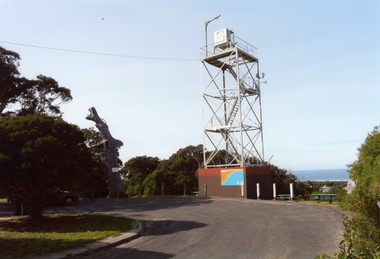
... Historic Sites Navigation Colour photograph lookout tree and steel signal light tow on Jemmys Point. Lakes Entrance Victoria. Photograph Lookout tower Jemmy's Point Price Wendy ...This is the 'after' paired photograph used in the 150 year Lakes Entrance 1858-2008 display. The 'before' paired photograph is number 02269. Also one 12 x 16 framed photograph used in room display.Colour photograph lookout tree and steel signal light tow on Jemmys Point. Lakes Entrance Victoria.historic sites, navigation -
 RMIT Design Archives
Diazotypes, Robin Boyd's Sketch for combined project 60-64 Clarendon St + corner site, 1968
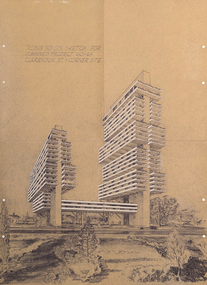
... Robin Boyd’s unbuilt scheme for two residential towers for Carnich Pty Ltd in East Melbourne is one of his most striking late projects – remarkable for its daring scale, its indebtedness to the megastructural polemics of Paul Rudolph and Japanese Metabolism, and its prescience – a high-rise apartment building now sits on the same site. The drawing is spectacular: trays of space are held aloft on angled concrete props that branch off trunk-like vertical slabs. With balconies and spandrels highlighted in white, the scheme’s dynamism echoes El Lissitzky’s mad Wolkenbugel (‘Skyhooks’) while also signalling...RMIT Design Archives RMIt University, Building 100 154 Victoria Street Carlton melbourne Robin Boyd’s unbuilt scheme for two residential towers for Carnich Pty Ltd in East Melbourne is one of his most striking late projects – remarkable for its daring scale, its indebtedness to the megastructural polemics of Paul Rudolph and Japanese Metabolism, and its prescience – a high-rise apartment building now sits on the same site. The drawing is spectacular: trays of space are held aloft on angled concrete props that branch off trunk-like vertical slabs. With balconies and spandrels highlighted in white, the scheme’s dynamism echoes El Lissitzky’s mad Wolkenbugel (‘Skyhooks’) while also signalling ...Robin Boyd’s unbuilt scheme for two residential towers for Carnich Pty Ltd in East Melbourne is one of his most striking late projects – remarkable for its daring scale, its indebtedness to the megastructural polemics of Paul Rudolph and Japanese Metabolism, and its prescience – a high-rise apartment building now sits on the same site. The drawing is spectacular: trays of space are held aloft on angled concrete props that branch off trunk-like vertical slabs. With balconies and spandrels highlighted in white, the scheme’s dynamism echoes El Lissitzky’s mad Wolkenbugel (‘Skyhooks’) while also signalling a tragic last hurrah before Boyd’s 1971 death. Philip GoadIncludes sketch of two structures and surrounding flora.Inscribed upper left of recto, "ROBIN BOYD'S SKETCH FOR / COMBINED PROJECT 60-64 / CLARENDON ST. + CORNER SITE"architecture, mid-century modern, emigre, rmit design archives -
 Ballarat Heritage Services
Photograph - Colour, Clare Gervasoni, Headstone of J.H. Fitzgerald, 2019, 03/01/2019
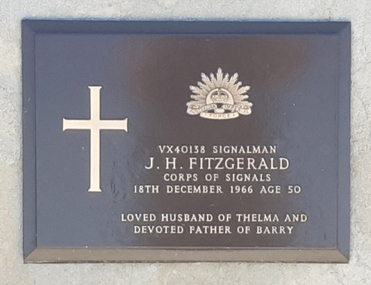
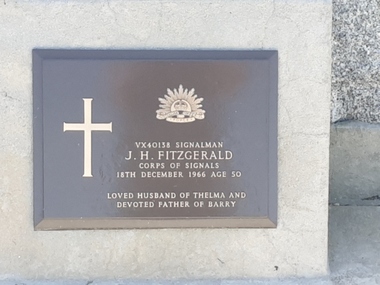
... His niece remembered he was always laboured in his breathing. tower hill cemetery world war two j.h. fitzgerald thelma fitzgerald barry fitzgerald VX40138 Signalman J.H. Fitzgerald Corps of Signals ...Herbert (Bert) Hulm was gassed during World War One. He served with the 46 Battalion. His niece remembered he was always laboured in his breathing.Colour photograph of the memorial plaque for J.H. Fitzgerald in the Tower Hill Cemetery.VX40138 Signalman J.H. Fitzgerald Corps of Signals 18th December 1966 Age 50 Loved husband of Thelma and devoted father of Barry.tower hill cemetery, world war two, j.h. fitzgerald, thelma fitzgerald, barry fitzgerald -
 University of Melbourne, Burnley Campus Archives
Photograph - Black and white print, Administration Building, 1949
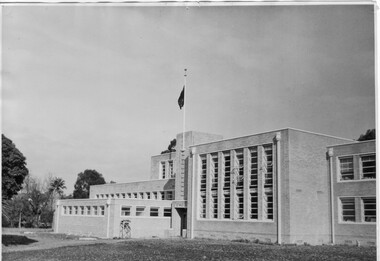
... tower." Until occupation of the building in 1949 the bell was used to signal lecture & work periods (on the hour.)" ...tower." Until occupation of the building in 1949 the bell was used to signal lecture & work periods (on the hour.)" ...Note by T.H. Kneen 20 February 1991, "Probably 1949 not long after occupation. Note frame housing bell from old Pavilion. It was later placed on building next to flag "tower." Until occupation of the building in 1949 the bell was used to signal lecture & work periods (on the hour.)" NB bell stolen in 2014.Black and white photograph. Newly constructed Administration Building. No planting around it.Main Building Burnleypavilion, bell, administration building, main building -
 Ballarat Heritage Services
Photograph - Colour, Clare Gervasoni, Headstone of J.H. Fitzgerald in the Tower Hill Cemetery, 2019, 03/01/2019
... Ballarat Heritage Services PO Box 2209 Bakery Hill Post Office goldfields tower hill cemetery j.h. fitzgerald thelma fitzgerald barry fitzgerald VX40138 Signalman J.H. Fitzgerald Corps of Signals 18th December 1966 age 50 Loved husband of Thelma and Devoted father of Barry Colour photograph of the headstone of J.H. ...Colour photograph of the headstone of J.H. Fitzgerald in the Tower Hill Cemetery.VX40138 Signalman J.H. Fitzgerald Corps of Signals 18th December 1966 age 50 Loved husband of Thelma and Devoted father of Barrytower hill cemetery, j.h. fitzgerald, thelma fitzgerald, barry fitzgerald -
 Melbourne Tram Museum
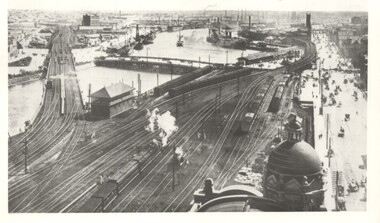
Photograph - Yarra River from Flinders St Station clock tower, Town and Country Journal, 1909
... Yields information about Yarra River, Flinders St railway station yards and shipping, bridges Flinders St Station Yarra River wharves railways signal boxes Queens Bridge shipping On rear of both prints in ink: 1 – Melbourne - West from clock tower on Flinders St station - “Town and Country Journal 21/7/1909” Copy neg Mark Plummer collections ex late John Alfred collection. .2 - Melbourne, Looking west along Flinders St from clocktower of Flinders St station. ...Photos show the Yarra river and the shipping turning basin that was used prior to the construction of the Spencer St bridge. In the view are are steam hauled suburban trains, Flinders St A signal box, Queensbridge, and the wharves on either side of the river. The viaduct was expanded to four tracks in 1915. Yields information about Yarra River, Flinders St railway station yards and shipping,Set of two photographs looking west from the Flinders St Station clocktower. over the Yarra River and station yards.On rear of both prints in ink: 1 – Melbourne - West from clock tower on Flinders St station - “Town and Country Journal 21/7/1909” Copy neg Mark Plummer collections ex late John Alfred collection. .2 - Melbourne, Looking west along Flinders St from clocktower of Flinders St station. Copy neg Mark Plummer collections ex late John Alfred collection. Has “T&C 20/12/09” in pencil on rear. bridges, flinders st station, yarra river, wharves, railways, signal boxes, queens bridge, shipping
