
Showing 7 items matching "silver plated bell"
-
 Flagstaff Hill Maritime Museum and Village
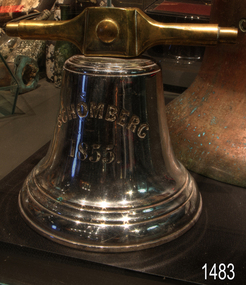
Functional object - Bell, Schomberg 1855, Before 1855
... ...silver plated bell...Upon examination, the specialists at Briggs discovered the reason behind the bell’s persistent lack of shine: it had originally been silver-plated, but most of the plating had worn away over time. ...A small ship’s bell. The silver-plated metal bell bears the ship’s name and year of construction on one side and the name and address of the ship’s builders on the other. ...A small ship’s bell. The silver-plated metal bell bears the ship’s name and year of construction on one side and the name and address of the ship’s builders on the other. ...The Rescue and Journey of the Schomberg Bells: This bell was the smaller of two rescued by the crew of the Schomberg following the ship’s wreck in 1855. While the specific purpose of the smaller bell is unknown, it may have served to assemble the crew or signal mealtimes on board. After surviving the shipwreck, the crew carried both bells as they made their way along the coastline. Their journey eventually led them to the home of settler John Manning, located at Hopkins Point near Warrnambool. Manning took possession of the bells and subsequently presented them to two churches in Warrnambool. The smaller bell went to St Joseph’s Catholic Church, while the larger bell went to St John’s Presbyterian Church. After around a year, the small bell at St Joseph’s developed a crack and became unusable. Thomas Manifold imported a replacement bell for the church, and the damaged bell was stored at his farm. Years later, when the property was sold to John Logan, the discarded bell was donated to the old Warrnambool Museum upon its opening in 1886. The Curator, Joseph Archibald, placed the bell on display in the entry. In 1975, it was transferred from the Warrnambool Art Gallery to Flagstaff Hill. The ’Mystery’ of the small bell solved: Despite numerous attempts by the staff at Flagstaff Hill to restore the bell’s lustre, the bell remained dull and tarnished. In October 1986, Director Peter Ronald decided to send the bell for professional advice. The bell was entrusted to Briggs Marine Products, a renowned brass founder established in 1912. Upon examination, the specialists at Briggs discovered the reason behind the bell’s persistent lack of shine: it had originally been silver-plated, but most of the plating had worn away over time. The experts at Briggs then undertook the task of restoring the bell, successfully returning it to a gleaming silver surface. The Sailing Ship Schomberg: Launched in 1855, the Schomberg was regarded as the “Noblest” ship afloat at the time. Owned by the Black Ball Line, it was built for their passenger fleet by Alexander Hall of Aberdeen at a cost of £43,103. The construction featured three skins: one planked fore and aft and two diagonally planked, all fastened with screw-threaded trunnels (wooden rails). The ship’s First Class accommodation was luxurious, boasting velvet pile carpets, large mirrors, rosewood, birds-eye maple and mahogany timbers, satin damask soft furnishings, and an oak-lined library with a piano. Schomberg had a capacity for 1,000 passengers. The ship’s master, Captain James Nicol Forbes—also known as ‘Bully’ Forbes—was only 34 years old at the launch. He had a reputation for setting and breaking speed records on the Black Ball Line’s Marco Polo and Lightning. In 1852, Forbes completed the London to Melbourne journey on the Marco Polo in 68 days, a record at the time, though 53 passengers died during the voyage. In 1854, he sailed the Lightning to Melbourne in 76 days and returned in only 63 days—a record that stood among sailing ships. Forbes was known for driving his ship and crew to their limits, often prioritising speed over passenger comfort. Determined to set new records, he promised to reach Melbourne in sixty days, declaring he would do so “with or without the help of God.” The Maiden Voyage and the Wreck: Schomberg departed Liverpool on 6th October 1855, flying a banner that read “Sixty Days to Melbourne”. The vessel carried 430 passengers and 3,000 tons of cargo, including materials to build the Melbourne to Geelong Railway and a bridge over the Yarra River. Among the cargo were a cow for fresh milk, pens for fowls and pigs, and 90,000 gallons of water for drinking and washing. Additionally, it transported 17,000 letters and 31,800 newspapers. The ship and cargo were insured for $300,000, a considerable sum for the era. Poor winds while crossing the equator delayed Schomberg’s progress. Land was first sighted on Christmas Day at Cape Bridgewater near Portland. Captain Forbes followed the coastline towards Melbourne, but was reportedly playing cards when the third mate, Henry Keen, reported land only three miles away. The ship ran aground on a sand spit near Curdie’s Inlet (approximately 56 km west of Cape Otway) on 26th December 1855, after 78 days at sea. The sand spit and nearby currents were not marked on Forbes’s map. During the night, the crew launched a lifeboat to search for a safe landing spot for the passengers. The scouting party advised Forbes to wait until morning, as rough seas posed a danger to the lifeboats. At dawn, the ship’s Chief Officer spotted the SS Queen and signalled for help. The master of the Queen brought his vessel alongside, and all passengers and crew disembarked safely. The Black Ball Line’s Melbourne agent sent another steamer to collect the passengers’ baggage, and other steamers assisted with cargo salvage until worsening weather forced operations to cease. Notably, a plunderer later recovered a case of Wellington boots, but all were for the left foot. The wreck and its cargo were sold to local merchants Manifold & Bostock, who did not attempt further salvage. They later sold their interest to a Melbourne businessman and two seafarers. In 1864, after two men drowned in their attempt to reach the Schomberg, salvage efforts were abandoned. By 1870, parts of the ship had washed ashore on New Zealand’s South Island. Today, the wreck is about nine metres below the surface. Although most woodwork has disintegrated, the vessel’s shape remains discernible due to the railway irons, girders, and framework. Various goods and materials from the ship are scattered nearby. The bell is particularly significant in that along with other items from the wreck helped in part to having the legislation changed to protect shipwrecks, with far tighter controls being employed to oversee the salvaging of wreck sites. This bell forms part of the Schomberg collection at Flagstaff Hill maritime museum. The collection as a whole is of historical and archaeological significance at a State level. Flagstaff Hill’s collection of artefacts from the Schomberg is also significant for its association with the Victorian Heritage Registered Schomberg shipwreck (VHR S 612). The collection is of additional significance because of the relationship between the objects salvaged, as together they help us to interpret the story of the Schomberg. The collection as a whole is historically significant for representing aspects of Victoria's maritime history and its potential to interpret social and historical themes from society at the time of the wreck. A small ship’s bell. The silver-plated metal bell bears the ship’s name and year of construction on one side and the name and address of the ship’s builders on the other. These details are deeply engraved into the metal and formed in bold, upper-case lettering. The bell has two bell stands: the left and the right. Both stands have an Iron pipe bent into an inverted ‘Y’ shape, with a hole along its length and feet attached to a rectangular metal plate at the other two ends. Feet are bolted to a timber base that has a hole drilled through the centre for mounting. Bell's front; “SCHOMBERG” with “1855” below. Bell's back “HALL & SONS (crack splits letter “N”) / BUILDERS (in italics) / ABERDEEN” (crack splits letter “B”).flagstaff hill, flagstaff hill maritime museum and village, warrnambool, maritime museum, maritime village, great ocean road, shipwreck coast, schomberg, silver plated bell, mess bell, bell stands, captain ‘bully’ forbes, alexander hall and son, james baines and company, liverpool’s black ball line, bell, schomberg bell, ship's bell, small bell, st joseph's church, briggs marine, john manning, john logan, warrnambool museum, briggs foundry, silver bell -
 The Beechworth Burke Museum
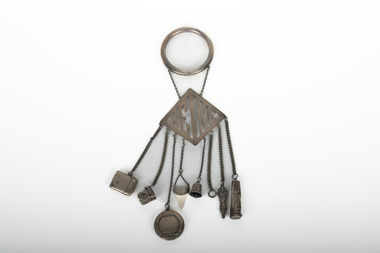
Accessory - Chatelaine, C. 1890
... A decorative silver belt hook with small household object attached by chains to a suspended name plate. There are 8 chains and 7 objects; a vesta case, scent bottle lid, compact, shark tooth, bell, button hook handle, container....plate] CHERRY./ from/ LEO/ May 12th 1899/ [inscription on vesta case] L??S/ Anchor symbol/ x symbol/ lion symbol/ [Hallmark on scent bottle lid] R/ HM/ Anchor symbol/ Lion symbol/ m symbol/ [Hallmark on back of the compact] SYDNEY/ [inscription on shark tooth] Proclaim liberty throughout all the land unto all inhabitants thereof/ By order of the Assembly of the Province of Pensylvania for the State House in Philada/ [inscription on bell] A01176/ A decorative silver belt hook with small household object attached by chains to a suspended name plate. ...The exact creation date of this chatelaine is unknown, however the hallmarks and engravings on some of the attached objects indicate that this chatelaine was made in the late 1890s. The shark tooth and the liberty bell attached to the chatelaine suggest that the item once belonged to an Australian who had connections to America. The compact, scent bottle lid, and feminine design of the other objects suggest that this wasowned by a woman. The name on the plate indicates that this object may have belonged to someone with the surname Heine. The hallmarks on the scent bottle lid and the compact indicate that they were made in Birmingham, England in the late 1890s, and that the compact was made by H. Matthews. Chatelaines where used by both men and women, usually fastened to a belt or pocket, and small household objects were attached to the main body of the chatelaine by chains. They were only worn by the heads of the household as a display of position and power.The social history objects held in the Burke Museum's collection help to tell the stories of Beechworth's past by showing the social, cultural, and economic aspects of the town's history.A decorative silver belt hook with small household object attached by chains to a suspended name plate. There are 8 chains and 7 objects; a vesta case, scent bottle lid, compact, shark tooth, bell, button hook handle, container.HEINE/ [plate] CHERRY./ from/ LEO/ May 12th 1899/ [inscription on vesta case] L??S/ Anchor symbol/ x symbol/ lion symbol/ [Hallmark on scent bottle lid] R/ HM/ Anchor symbol/ Lion symbol/ m symbol/ [Hallmark on back of the compact] SYDNEY/ [inscription on shark tooth] Proclaim liberty throughout all the land unto all inhabitants thereof/ By order of the Assembly of the Province of Pensylvania for the State House in Philada/ [inscription on bell] A01176/ burke museum, silverware, social history, heine -
 Federation University Historical Collection
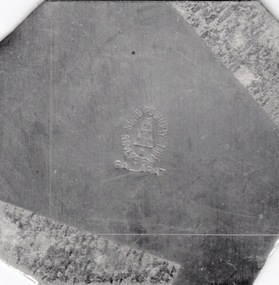
Article - Article - Metal plate, ZILLES COLLECTION: Metal plate stamped with Soho Foundry Sovereign Hill Ballarat with symbol
... Bell Street Ballarat. Small metal plate with the name stamped into it. It is Soho Foundry, Sovereign Hill Ballarat. zilles foundry soho ballarat metal plate Symbol with writing around it - SOHO FOUNDRY SOVEREIGN HILL BALLARAT Small square silver colour metal plate. ...Zilles Printers was begun by Lewis Zilles in the early 1930s. It was in McKenzie Street Ballarat. His son Jeffrey also became a printer - letterpress, offset and screen printer. The business became Zilles Printers/Graphics and was in Armstrong Street and later Bell Street Ballarat. Small metal plate with the name stamped into it. It is Soho Foundry, Sovereign Hill Ballarat.Small square silver colour metal plate. Corners cut and two sections show residue of sticking tape.Symbol with writing around it - SOHO FOUNDRY SOVEREIGN HILL BALLARATzilles, foundry, soho, ballarat, metal plate -
 Federation University Historical Collection
Book, W. & R. Chambers, Silver Bells, 1952
... Mary Egan who died on April 4th, 1981, spent 23 years as a greatly-respected lecturer in English curriculum at the Ballarat Teachers College, State College of Victoria and Ballarat College of Advanced Education. mary egan ballarat teachers college state college of victoria ballarat college of advanced education education department victoria a. stamp t.c. collocott l.m dufty w & r chambers t and a. constable Book Plate, M.Egan on sticker on front cover that some one has tried to remove. Orange and blue covered 48 page book of poems for use in the teaching of reading Silver Bells Book A.Stamp and T.C. ...Mary Egan who died on April 4th, 1981, spent 23 years as a greatly-respected lecturer in English curriculum at the Ballarat Teachers College, State College of Victoria and Ballarat College of Advanced Education. Orange and blue covered 48 page book of poems for use in the teaching of reading Book Plate, M.Egan on sticker on front cover that some one has tried to remove.mary egan, ballarat teachers college, state college of victoria, ballarat college of advanced education, education department victoria, a. stamp, t.c. collocott, l.m dufty, w & r chambers, t and a. constable -
 4th/19th Prince of Wales's Light Horse Regiment Unit History Room
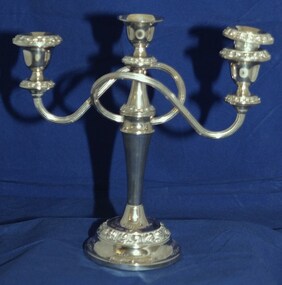
Domestic object - Silver Candelabra, 3 Stem
... Presented to 4/19 PWLH Sergeants Mess by Mrs G Swan Mrs Perkins Mrs M Tuskin Miss S D'Atri Mrs M Baker Mrs J Douglas Mrs M D'Atri Mrs M Bullock Mrs C Summers Mrs J Axten (sic) Mrs M Bell Mrs G Burke Mrs L Hibberd Mrs J Arnott Silver plated by Ianthe of England...candelabra silverware sergeants' mess Presented to 4/19 PWLH Sergeants Mess by Mrs G Swan Mrs Perkins Mrs M Tuskin Miss S D'Atri Mrs M Baker Mrs J Douglas Mrs M D'Atri Mrs M Bullock Mrs C Summers Mrs J Axten (sic) Mrs M Bell Mrs G Burke Mrs L Hibberd Mrs J Arnott Silver plated by Ianthe of England Set of 5 with catalogue no 0455, 0534, 0535, 0536. 3 stem, silver EPNS candelabra. 3 Stem Domestic object Silver Candelabra Ianthe ...Set of 5 with catalogue no 0455, 0534, 0535, 0536. 3 stem, silver EPNS candelabra.Presented to 4/19 PWLH Sergeants Mess by Mrs G Swan Mrs Perkins Mrs M Tuskin Miss S D'Atri Mrs M Baker Mrs J Douglas Mrs M D'Atri Mrs M Bullock Mrs C Summers Mrs J Axten (sic) Mrs M Bell Mrs G Burke Mrs L Hibberd Mrs J Arnott Silver plated by Ianthe of Englandcandelabra, silverware, sergeants' mess -
 Geoffrey Kaye Museum of Anaesthetic History
Memorabilia - Silver Tray, c. 1964
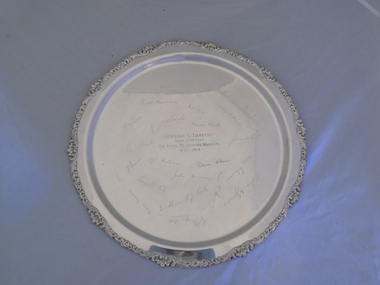
... Bell, James Cass, Noel Newman, Herbert Nathan, Alf Spinks, Betty Russell, Irene Cole, Russell Houseman, Helen Webb, Arthur Edwards, N. Inscribed in centre of plate "Lennard G Travers, Anaesthetist, The Royal Melbourne Hospital, 1946 - 1964" •Inscribed around the central inscription are 24 signatures of anaesthetists and surgeons of the Royal Melbourne Hospital •Inscribed on back of tray "Old Sheffield Reproduction, Strachan" Silver plate tray, presented to Dr Lennard Travers on his retirement from Royal Melbourne Hospital, 1964. ...Object was gifted to Dr Lennard Travers upon his retirement from the Royal Melbourne Hospital, 1964. It was later donated to ANZCA. Lennard Travers, born in Melbourne in 1906, completed his MBBS at the University of Melbourne in 1930. After working for a brief period at the Royal Melbourne Hospital, Travers travelled to the United Kingdom achieving his Fellowship at the Royal College of Surgeons in Edinburgh. He returned to Australia prior to the outbreak of World War II serving as the honorary anaesthetist at the Royal Melbourne Hospital. In 1950, Travers joined the Australian Society of Anaesthetists overseeing the development of the Faculty of Anaesthetists, Royal Australasian College of Surgeons. He was appointed Dean of the Faculty in 1959. Silver plate tray, presented to Dr Lennard Travers on his retirement from Royal Melbourne Hospital, 1964. Embellishments and decorations around the edge of the tray also in silver. The middle of the tray has an inscription confirming the tray was presented to Dr Travers. Around the middle inscription are the signatures of other employees at the Royal Melbourne Hospital. Manufacturer's mark on the reverse of the tray. No other distinguishing features. Inscribed in centre of plate "Lennard G Travers, Anaesthetist, The Royal Melbourne Hospital, 1946 - 1964" •Inscribed around the central inscription are 24 signatures of anaesthetists and surgeons of the Royal Melbourne Hospital •Inscribed on back of tray "Old Sheffield Reproduction, Strachan"travers, lennard, royal melbourne hospital, wilson, patricia, bell, james, cass, noel, newman, herbert, nathan, alf, spinks, betty, russell, irene, cole, russell, houseman, helen, webb, arthur, edwards, n. -
 Vision Australia
Photograph - Image, Stokes, Annual Physical Education Award
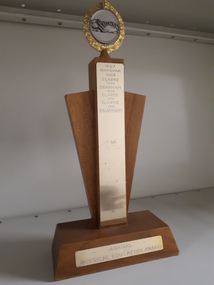
... At the top of the column is a golden wreath sitting on a golden bell, and inside the wreath two hands are clasped in silver. The front of the column has golden coloured plate with the winners inscribed: 1967 Brabham, 1968 Clarke, 1969 Brabham, 1970 Clarke, 1971 Clarke, 1972 Brabham. ...At the top of the column is a golden wreath sitting on a golden bell, and inside the wreath two hands are clasped in silver. The front of the column has golden coloured plate with the winners inscribed: 1967 Brabham, 1968 Clarke, 1969 Brabham, 1970 Clarke, 1971 Clarke, 1972 Brabham. ...Rectangular wooden column with wooden wings either side, set on a wooden base. At the top of the column is a golden wreath sitting on a golden bell, and inside the wreath two hands are clasped in silver. The front of the column has golden coloured plate with the winners inscribed: 1967 Brabham, 1968 Clarke, 1969 Brabham, 1970 Clarke, 1971 Clarke, 1972 Brabham. On the base, is another golden coloured plate with 'Annual Physical Education Award' inscribed.Wooden award with gold coloured plates and two hands clasped amongst laurels at toprvib burwood school, brabham, clarke, awards
