
Showing 12 items matching "silver serving spoon"
-
 Flagstaff Hill Maritime Museum and Village
Spoons
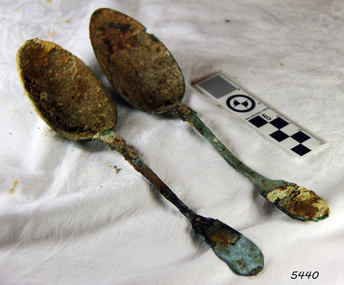
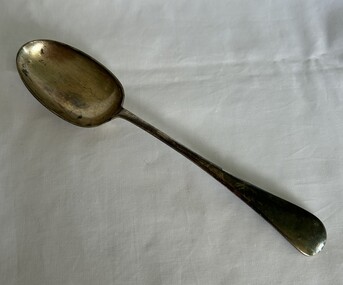
... ...silver serving spoon...2 silver serving spoons, with encrustations, one with a bent shank. ...Flagstaff Hill Warrnambool Shipwrecked coast Flagstaff Hill Maritime Museum Maritime Museum Shipwreck coast Flagstaff Hill Maritime Village Great Ocean Road Loch Line LOCH ARD Captain Gibbs Eva Carmichael Tom Pearce Glenample Station Mutton Bird Island LOCH ARD Gorge silver serving spoon silver spoon spoon 2 silver serving spoons, with encrustations, one with a bent shank. ...HISTORY OF THE LOCH ARD The LOCH ARD belonged to the famous Loch Line which sailed many ships from England to Australia. Built in Glasgow by Barclay, Curdle and Co. in 1873, the LOCH ARD was a three-masted square rigged iron sailing ship. The ship measured 262ft 7" (79.87m) in length, 38ft (11.58m) in width, 23ft (7m) in depth and had a gross tonnage of 1693 tons. The LOCH ARD's main mast measured a massive 150ft (45.7m) in height. LOCH ARD made three trips to Australia and one trip to Calcutta before its final voyage. LOCH ARD left England on March 2, 1878, under the command of Captain Gibbs, a newly married, 29 year old. She was bound for Melbourne with a crew of 37, plus 17 passengers and a load of cargo. The general cargo reflected the affluence of Melbourne at the time. On board were straw hats, umbrella, perfumes, clay pipes, pianos, clocks, confectionary, linen and candles, as well as a heavier load of railway irons, cement, lead and copper. There were items included that intended for display in the Melbourne International Exhibition in 1880. The voyage to Port Phillip was long but uneventful. At 3am on June 1, 1878, Captain Gibbs was expecting to see land and the passengers were becoming excited as they prepared to view their new homeland in the early morning. But LOCH ARD was running into a fog which greatly reduced visibility. Captain Gibbs was becoming anxious as there was no sign of land or the Cape Otway lighthouse. At 4am the fog lifted. A man aloft announced that he could see breakers. The sheer cliffs of Victoria's west coast came into view, and Captain Gibbs realised that the ship was much closer to them than expected. He ordered as much sail to be set as time would permit and then attempted to steer the vessel out to sea. On coming head on into the wind, the ship lost momentum, the sails fell limp and LOCH ARD's bow swung back. Gibbs then ordered the anchors to be released in an attempt to hold its position. The anchors sank some 50 fathoms - but did not hold. By this time LOCH ARD was among the breakers and the tall cliffs of Mutton Bird Island rose behind the ship. Just half a mile from the coast, the ship's bow was suddenly pulled around by the anchor. The captain tried to tack out to sea, but the ship struck a reef at the base of Mutton Bird Island, near Port Campbell. Waves broke over the ship and the top deck was loosened from the hull. The masts and rigging came crashing down knocking passengers and crew overboard. When a lifeboat was finally launched, it crashed into the side of LOCH ARD and capsized. Tom Pearce, who had launched the boat, managed to cling to its overturned hull and shelter beneath it. He drifted out to sea and then on the flood tide came into what is now known as LOCH ARD Gorge. He swam to shore, bruised and dazed, and found a cave in which to shelter. Some of the crew stayed below deck to shelter from the falling rigging but drowned when the ship slipped off the reef into deeper water. Eva Carmichael had raced onto deck to find out what was happening only to be confronted by towering cliffs looming above the stricken ship. In all the chaos, Captain Gibbs grabbed Eva and said, "If you are saved Eva, let my dear wife know that I died like a sailor". That was the last Eva Carmichael saw of the captain. She was swept off the ship by a huge wave. Eva saw Tom Pearce on a small rocky beach and yelled to attract his attention. He dived in and swam to the exhausted woman and dragged her to shore. He took her to the cave and broke open case of brandy which had washed up on the beach. He opened a bottle to revive the unconscious woman. A few hours later Tom scaled a cliff in search of help. He followed hoof prints and came by chance upon two men from nearby Glenample Station three and a half miles away. In a state of exhaustion, he told the men of the tragedy. Tom returned to the gorge while the two men rode back to the station to get help. By the time they reached LOCH ARD Gorge, it was cold and dark. The two shipwreck survivors were taken to Glenample Station to recover. Eva stayed at the station for six weeks before returning to Ireland, this time by steamship. In Melbourne, Tom Pearce received a hero's welcome. He was presented with the first gold medal of the Royal Humane Society of Victoria and a £1000 cheque from the Victorian Government. Concerts were performed to honour the young man's bravery and to raise money for those who lost family in the LOCH ARD disaster. Of the 54 crew members and passengers on board, only two survived: the apprentice, Tom Pearce and the young woman passenger, Eva Carmichael, who lost all of her family in the tragedy. Ten days after the LOCH ARD tragedy, salvage rights to the wreck were sold at auction for £2,120. Cargo valued at £3,000 was salvaged and placed on the beach, but most washed back into the sea when another storm developed. The wreck of LOCH ARD still lies at the base of Mutton Bird Island. Much of the cargo has now been salvaged and some was washed up into what is now known as LOCH ARD Gorge. Cargo and artefacts have also been illegally salvaged over many years before protective legislation was introduced. One of the most unlikely pieces of cargo to have survived the shipwreck was a Minton porcelain peacock - one of only nine in the world. The peacock was destined for the Melbourne International Exhibition in 1880. It had been well packed, which gave it adequate protection during the violent storm. Today, the Minton peacock can be seen at the Flagstaff Hill Maritime Museum in Warrnambool. From Australia's most dramatic shipwreck it has now become Australia's most valuable shipwreck artefact and is one of very few 'objects' on the Victorian State Heritage Register. Flagstaff Hill’s collection of artefacts from LOCH ARD is significant for being one of the largest collections of artefacts from this shipwreck in Victoria. It is significant for its association with the shipwreck, which is on the Victorian Heritage Register (VHR S417). The collection is significant because of the relationship between the objects, as together they have a high potential to interpret the story of the LOCH ARD. The LOCH ARD collection is archaeologically significant as the remains of a large international passenger and cargo ship. The LOCH ARD collection is historically significant for representing aspects of Victoria’s shipping history and its potential to interpret sub-theme 1.5 of Victoria’s Framework of Historical Themes (living with natural processes). The collection is also historically significant for its association with the LOCH ARD, which was one of the worst and best known shipwrecks in Victoria’s history. 2 silver serving spoons, with encrustations, one with a bent shank. Recovered from the wreck of the Loch Ard.flagstaff hill, warrnambool, shipwrecked coast, flagstaff hill maritime museum, maritime museum, shipwreck coast, flagstaff hill maritime village, great ocean road, loch line, loch ard, captain gibbs, eva carmichael, tom pearce, glenample station, mutton bird island, loch ard gorge, silver serving spoon, silver spoon, spoon -
 Dutch Australian Heritage Centre Victoria
Silver Serving Spoon and Fork (Zilver Servies)
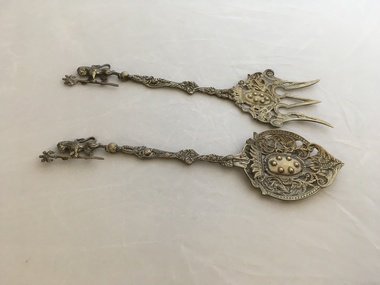
... Silver Serving Spoon and Fork (Zilver Servies)...spoon (1) and fork(2) are beautifully crafted in silver. They are meant as decorative items rather than for practical use. The handles of both items finish with shapes of a lion rampant holding a staff with fleur-de-lys. Silver Serving ...Both the spoon (1) and fork(2) are beautifully crafted in silver. They are meant as decorative items rather than for practical use. The handles of both items finish with shapes of a lion rampant holding a staff with fleur-de-lys. Both itmes have been much polished and the markings are illegible. -
 Orbost & District Historical Society
spoon, first half 20th century
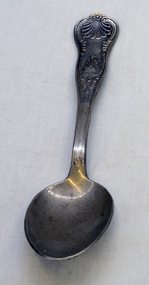
... cutlery silver-plate spoon-serving...A large silver plated serving spoon with an ornate handle....This spoon has aesthetic significance as an example of silver plate cutlery used in the early 20th century. cutlery silver-plate spoon-serving A large silver plated serving spoon with an ornate handle. spoon ...This spoon has aesthetic significance as an example of silver plate cutlery used in the early 20th century.A large silver plated serving spoon with an ornate handle.cutlery silver-plate spoon-serving -
 Whitehorse Historical Society Inc.
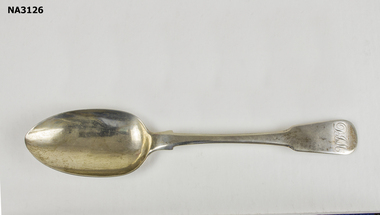
Domestic object - Sterling Silver Spoon, c1830
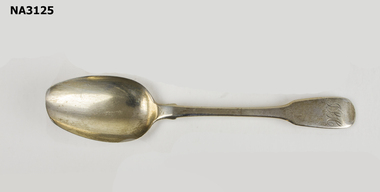
... Sterling silver serving spoon, initialled on handle in script J S H William 1V, 1830. ...Sally Button has dated it to 1830 William 1V domestic items cutlery R B Sterling silver serving spoon, initialled on handle in script J S H William 1V, 1830. ...Donated by Margaret Scarlett. Sally Button has dated it to 1830 William 1VSterling silver serving spoon, initialled on handle in script J S H William 1V, 1830. Maker RB - not listed as a major silversmith. (see also NA3126)R Bdomestic items, cutlery -
 Greensborough Historical Society
Functional object - Cutlery, Serving spoon, 1950s
... Silver or silver plate serving spoon...Serving spoon, possibly silver or silver plate. No manufacturers marks....Silver or silver plate serving spoon cutlery spoons Serving spoon, possibly silver or silver plate. ...Silver or silver plate serving spoonServing spoon, possibly silver or silver plate. No manufacturers marks.cutlery, spoons -
 Whitehorse Historical Society Inc.
Domestic object - Silver Plated Spoon
... A silver plated serving spoon with initials of D J M engraved, hallmarks not of a silversmith, but probably a plater. ...domestic items cutlery 1L A silver plated serving spoon with initials of D J M engraved, hallmarks not of a silversmith, but probably a plater. ...A silver plated serving spoon with initials of D J M engraved, hallmarks not of a silversmith, but probably a plater. Plain style. Marks 1L and three symbols resembling trees. Style of spoon is same as silver spoon (see NA3125) dated 1830 William 1V. Maker R.B. also donated by Margaret Scarlett.1Ldomestic items, cutlery -
 Emerald Museum & Nobelius Heritage Park
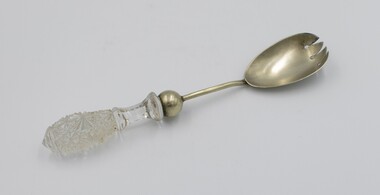
Domestic object - Salad serving fork, c.1900s
... This silver-plated salad serving fork would have originally had a matching spoon. This type of decorative cutlery became popular in the late 19th and early 20th centuries....A silver four-pronged serving spoon with a large bowl connected to a thin neck which becomes bulbous at its base. ...This salad serving fork speaks to the value placed on decorative table settings during the late 19th and early 20th centuries. Engraved, back of handle: "E.P.N.S" Engraved, side of glass handle: "R°17[65?]" A silver four-pronged serving spoon ...This silver-plated salad serving fork would have originally had a matching spoon. This type of decorative cutlery became popular in the late 19th and early 20th centuries.This salad serving fork speaks to the value placed on decorative table settings during the late 19th and early 20th centuries.A silver four-pronged serving spoon with a large bowl connected to a thin neck which becomes bulbous at its base. The base of the neck is attached to a glass handle which is engraved with a geometric pattern and ends in a small point. There are small engravings on the metal neck and glass handle.Engraved, back of handle: "E.P.N.S" Engraved, side of glass handle: "R°17[65?]" -
 Whitehorse Historical Society Inc.
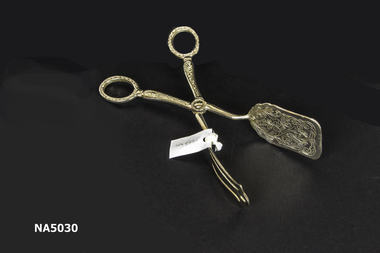
Domestic object - Silver plate cake server, 1934
... Owned by donor Pat Richardson's mother Vera McDowell(nee Edwards) of Forest Hill. food serving table cutlery Silver plated cake server. Scissor action, flat spoon with three pronged top piece. ...Owned by donor Pat Richardson's mother Vera McDowell(nee Edwards) of Forest Hill.Silver plated cake server. Scissor action, flat spoon with three pronged top piece. Fine engraving.food serving, table cutlery -
 Mont De Lancey
Functional object - Cutlery
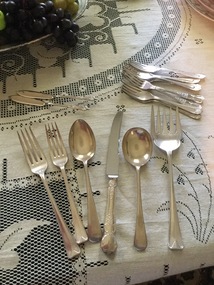
... silver cutlery EPSN plated. There are 15 large forks, 12 small forks, 6 knives, 15 soup spoons, 14 dessert spoons, 8 cake forks, 2 butter knives, 2 large serving spoons and 1 set of salad servers. ...silver cutlery EPSN plated. There are 15 large forks, 12 small forks, 6 knives, 15 soup spoons, 14 dessert spoons, 8 cake forks, 2 butter knives, 2 large serving spoons and 1 set of salad servers. ...A collection of miscellaneous silver cutlery EPSN plated. There are 15 large forks, 12 small forks, 6 knives, 15 soup spoons, 14 dessert spoons, 8 cake forks, 2 butter knives, 2 large serving spoons and 1 set of salad servers. Some have a triangular shape on the handle at the bottom, some are plain and others are decorative. tableware, cutlery -
 Geoffrey Kaye Museum of Anaesthetic History
Functional object - Punch ladle
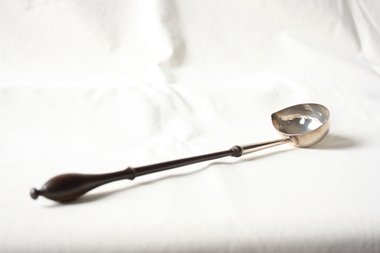
... serving utensils...utensils...sterling silver...punch spoon...serving utensils utensils sterling silver punch spoon Letters stamped into spoon head. ...A sterling silver and wood George II punch ladle. Two thirds of the handle is made of simple turned dark wood with a bulbous top. The rest of the handle is made of sterling silver attached to the small, spouted spoon.Letters stamped into spoon head. "P / R / E".serving utensils, utensils, sterling silver, punch spoon -
 Geoffrey Kaye Museum of Anaesthetic History
Functional object - Gravy spoon
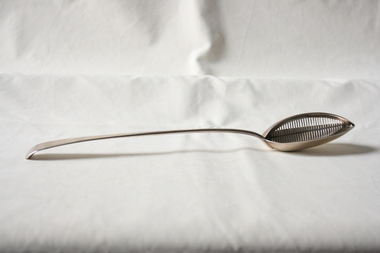
... serving utensils...kitchen utensils...utensils...sterling silver...spoon...serving utensils kitchen utensils utensils sterling silver spoon gravy spoon A long-handled sterling silver George III spoon with no decorations. ...A long-handled sterling silver George III spoon with no decorations. The spoon has a vertical double-tiered serrated wall running in the middle, designed to catch and sieve large pieces within gravy.serving utensils, kitchen utensils, utensils, sterling silver, spoon, gravy spoon -
 Emerald Museum & Nobelius Heritage Park
Domestic object - Serving Spoon ("Grosvenor"), G. & E. Rodd, c. 1920-50s
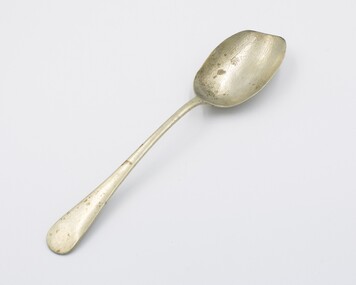
... silver—and identified with various embossed markings. They steadily expanded over the next decades, with a slight dip in production during WWII, and merged with Platers Pty Ltd. in 1949, gaining them access to the 'Hecworth' name. This plain serving spoon...silver spoon has a deep, slightly misshapen bowl that is tarnished by a great deal of scratches and marks. The bowl's edges are also slightly bent and warped. The handle extends slightly over the bottom of the bowl, narrowing at the neck before widening at the base of the handle. There is a small engraving on its underside. Domestic object Serving ...George Rodd and his brother Ernest established G. & E. Rodd as a manufacturer of silver goods in the 1920s. Initially, they produced popular small accessories such as collar pins and bangles before expanding in the mid-1920s to create more complex items such as rings, broaches, and cufflinks. In the 1930s, they began to produce ornate silverware, predominantly flatware which capitalised on the High Tea elegance of the time, and children's silverware. Much of their silverware was EPNS—or electroplated nickel silver—and identified with various embossed markings. They steadily expanded over the next decades, with a slight dip in production during WWII, and merged with Platers Pty Ltd. in 1949, gaining them access to the 'Hecworth' name. This plain serving spoon is larger than most everyday utensils as it was likely used to serve smaller portions of a communal meal. The spoon's bowl is worn away at the top-left edge, indicating that it may have been used as leverage to frequently to open sealed jars or tins. It is also missing several of the markers which would easily identify it as Rodd silverware, such as the APEX mark, or an A1 label.This item is significant as it is an example of a well-loved and regularly-used utensil from an everyday home. Its wear is indicative of the way it was used on a regular basis, and how similar utensils may have been used in other homes around the area.This silver spoon has a deep, slightly misshapen bowl that is tarnished by a great deal of scratches and marks. The bowl's edges are also slightly bent and warped. The handle extends slightly over the bottom of the bowl, narrowing at the neck before widening at the base of the handle. There is a small engraving on its underside.Rear, base of handle: "GROSVENOR PLATE EPNS" Rear, base of handle, sideways: "A"20th century, domestic life
