
Showing 401 items matching "sink"
-
 Ballarat Heritage Services
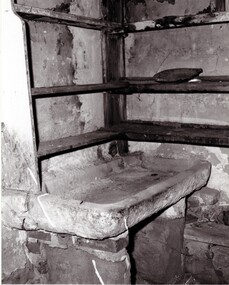
Photograph, Hand Hewn Stone Sink from the Gervasoni Homestead, c1988
... Hand Hewn Stone Sink from the Gervasoni Homestead ...Black and White photograph of a hand hewn stone sink from the Gervasoni Homestead. It was stolen c1990s....Hand Hewn Stone sink Gervasoni HOmestead Yandoit Creek Black and White photograph of a hand hewn stone sink from the Gervasoni Homestead. ...Black and White photograph of a hand hewn stone sink from the Gervasoni Homestead. It was stolen c1990s.hand hewn, stone sink, gervasoni homestead, yandoit creek -
 Ringwood and District Historical Society
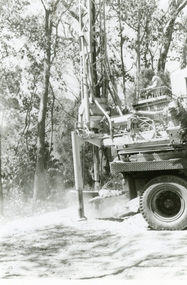
Photographs, 1979-80 MMBW pipe line project at Hubbard Reserve, North Ringwood � Truck-mounted posthole digger that tried to sink shafts on MMBW sewer line behind 29-39 Burlock Avenue
... 1979-80 MMBW pipe line project at Hubbard Reserve, North Ringwood � Truck-mounted posthole digger that tried to sink shafts on MMBW sewer line behind 29-39 Burlock Avenue...E560 N32 Feb 1980 A43 Truck-mounted posthole digger that tried to sink shafts on MMBW sewer line behind 29-39 Burlock Avenue. ...E560 N32 Feb 1980 A43 Truck-mounted posthole digger that tried to sink shafts on MMBW sewer line behind 29-39 Burlock Avenue. ...Part of a 43-photo record of the MMBW�s engineering feat in drilling a 12 inch pipe line up to 40 feet deep through rock hardened by volcanic action associated with geological fault that occurs along the line. The work took place from October 1979 to May 1980 on the southern boundary of Hubbard Reserve, North Ringwood. The collection was presented to the Ringwood Historical Research Group by J Clarke on 9th June 1980.E560 N32 Feb 1980 A43 Truck-mounted posthole digger that tried to sink shafts on MMBW sewer line behind 29-39 Burlock Avenue. Four feet wide, the auger could only go down one metre and was nearly useless. -
 Queenscliffe Maritime Museum
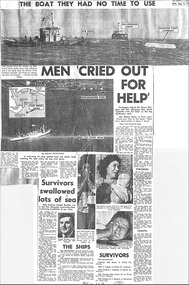
Newspaper - News articles re the sinking of the tug MELBOURNE in 1972, Tug MELBOURNE sinking, 1972
... Tugboat sinking in Port Phillip...newspaper articles about the tugboat MELBOURNE sinking...Tugboat sinking in Port Phillip Tethering accident historical references Reverse - " N/A " newspaper articles about the tugboat MELBOURNE sinking Tug MELBOURNE sinking Newspaper News articles re the sinking of the tug MELBOURNE in 1972 ...Tugboat sinking in Port PhillipTethering accidentnewspaper articles about the tugboat MELBOURNE sinkingReverse - " N/A "historical references -
 Robin Boyd Foundation
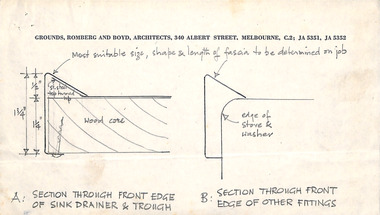
Document, Robin Boyd
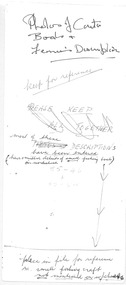
... Robin Boyd has drawn a variation on the sink and trough for Walsh Street construction. ...Robin Boyd sketch of variation to the kitchen sink....Robin Boyd has drawn a variation on the sink and trough for Walsh Street construction. ...Robin Boyd has drawn a variation on the sink and trough for Walsh Street construction. This documents are owned by the Murphy family and were provided to the Robin Boyd Foundation for digitisation.Robin Boyd sketch of variation to the kitchen sink.walsh st construction, john murphy -
 Phillip Island and District Historical Society Inc.
Newspaper clippings
... Sinking of Harbour Trust Dredge "George Kermode" to form artificial reef a mile south-east of Pyramid Rock...Article on sinking of Harbour Trust Dredge "George Kermode" to form a reef...Sinking of Harbour Trust Dredge "George Kermode" to form artificial reef a mile south-east of Pyramid Rock Local History DOCUMENTS Newspapers Newspaper Clipping Dredges Black & White Newspaper Clipping Harbour Trust Dredge "George Kermode" Article on sinking of Harbour Trust Dredge "George Kermode" to form a reef Newspaper clippings ...Sinking of Harbour Trust Dredge "George Kermode" to form artificial reef a mile south-east of Pyramid RockArticle on sinking of Harbour Trust Dredge "George Kermode" to form a reeflocal history, documents, newspapers, newspaper clipping, dredges, black & white newspaper clipping, harbour trust dredge "george kermode" -
Phillip Island and District Historical Society Inc.
Newspaper clippings
... Photographs of sinking of Harbour Trust Dredge "George Kermode" to form an artificial reef a mile south-east of Pyramid Rock....Photographs of sinking of Harbour Trust Dredge "George Kermode" to form a reef...Photographs of sinking of Harbour Trust Dredge "George Kermode" to form an artificial reef a mile south-east of Pyramid Rock. ...Photographs of sinking of Harbour Trust Dredge "George Kermode" to form an artificial reef a mile south-east of Pyramid Rock.Photographs of sinking of Harbour Trust Dredge "George Kermode" to form a reeflocal history, documents, newspapers, newspaper clipping, dredges, black & white newspaper clipping, harbour trust dredge "george kermode" -
 Phillip Island and District Historical Society Inc.
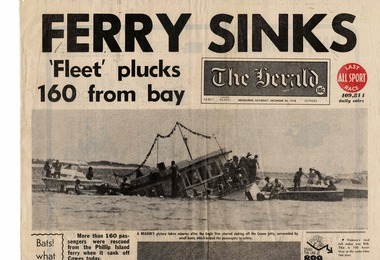
Newspaper, Eagle star ferry sinks, 30 December 1978
... Broadsheet front page from The Herald Saturday, December 30 1978.Headline is "Ferry sinks."Fleet" plucks 160 from bay" Large black and white photo showing half submerged ferry and three smaller motor boats pulling people from the water. other people are standing on the front of the ferry....Headline is "Ferry sinks."Fleet" plucks 160 from bay" ...Historical ferries Eagle Star transport Cowes Yacht Club Headline is "Ferry sinks."Fleet" plucks 160 from bay" Broadsheet front page from The Herald Saturday, December 30 1978.Headline is "Ferry sinks." ...The Eagle Star left from Stony Point to take in Tankerton on the way to Cowes. It carried about 160 passengers of all ages, many of whom were probably planning to celebrate New Year’s Eve or start their holidays on the Island. The 48-year-old ferry had only recently been bought by a co-operative of French Island residents. Fortunately no one was drowned, and only two people were hurt.HistoricalBroadsheet front page from The Herald Saturday, December 30 1978.Headline is "Ferry sinks."Fleet" plucks 160 from bay" Large black and white photo showing half submerged ferry and three smaller motor boats pulling people from the water. other people are standing on the front of the ferry.Headline is "Ferry sinks."Fleet" plucks 160 from bay" ferries, eagle star, transport, cowes yacht club -
Clunes Museum
Print - TWO FRAMES PRINTS, S.T. GILL, 1 KAPUNDA MINE. 2 DEEP SINKING, BALLARAT
... GILL .1 APRIL - KAPUNDA MINE 1845 .2 MARCH - DEEP SINKING, BALLARAT 1855....1 ANNOTATION ON REAR RE HISTORY OF COPPER MINES, KAPUNDA .2 ANNOTATION ON REAR RE HISTORY OF DEEP SINKING...GILL .1 APRIL - KAPUNDA MINE 1845 .2 MARCH - DEEP SINKING, BALLARAT 1855 .1 KAPUNDA MINE. 2 DEEP SINKING, BALLARAT Print TWO FRAMES PRINTS S.T. ...FRAMED PRINTS REPRODUCED FOR NATIONAL BANK CALENDAR 1970 - LITHOGRAPHS BY S.T. GILL .1 APRIL - KAPUNDA MINE 1845 .2 MARCH - DEEP SINKING, BALLARAT 1855.1 ANNOTATION ON REAR RE HISTORY OF COPPER MINES, KAPUNDA .2 ANNOTATION ON REAR RE HISTORY OF DEEP SINKINGmining, calendar, lithograph, 1970, kapunda -
 Bendigo Historical Society Inc.
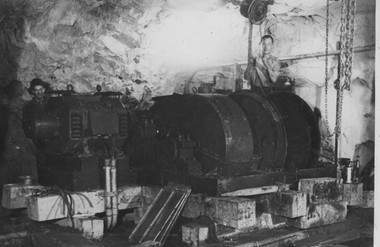
Photograph - Napoleon Sinking Winch, 1936
... Black and white photograph: sinking winch machinery supported on concrete block, underground at the Napoleon (BML) gold mine. ...Written in pencil on back of photograph : '....(illegible) sinking winch No. 10 plat Napoleon 15/9/36''...Photograph Napoleon Sinking Winch ...Significant to mining history of Bendigo.Black and white photograph: sinking winch machinery supported on concrete block, underground at the Napoleon (BML) gold mine. Two men, one standing at back of machinery left hand side, and one standing on concrete platform operating a pulley.Written in pencil on back of photograph : '....(illegible) sinking winch No. 10 plat Napoleon 15/9/36''napoleon gold mine, sinking winch, plat -
Tatura Irrigation & Wartime Camps Museum
Literary work - Folder, Hitler's Indian Ocean Grey Wolves
... Tells the stories behind the sinking of U-boats during WW2 and their Captains....Plastic sleeve containing copy of article on Hitler's Indian Ocean Grey Wolves, U-boat Captains and their sinking of enemy ships....Tells the stories behind the sinking of U-boats during WW2 and their Captains. ...Tells the stories behind the sinking of U-boats during WW2 and their Captains.Plastic sleeve containing copy of article on Hitler's Indian Ocean Grey Wolves, U-boat Captains and their sinking of enemy ships.admiral donitz, helmut pich, fritz julius lemp, georg wenzel, hans baenge, hans feiertag, heinz niemann, german u-boats -
 Warrnambool RSL Sub Branch
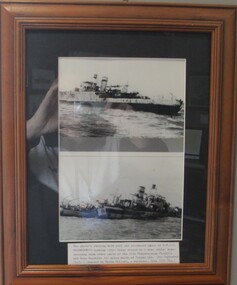
Photograph - 2 photos showing both port and starboard sides of HMAS Warrnambool sinking
... 2 photos in a wooden frame showing both port and starboard sides of HMAS Warrnambool sinking after being struck by a mine on 3 September 1947...2 photos in a wooden frame showing both port and starboard sides of HMAS Warrnambool sinking after being struck by a mine on 3 September 1947.Donated by Kevin Dollard, a survivor from Sale Vic....2 photos in a wooden frame showing both port and starboard sides of HMAS Warrnambool sinking after being struck by a mine on 3 September 1947.Donated by Kevin Dollard, a survivor from Sale Vic. 2 photos in a wooden frame showing both port and starboard sides of HMAS Warrnambool sinking after being struck by a mine on 3 September 1947 2 photos showing both port and starboard sides of HMAS Warrnambool sinking Photograph 2 photos showing both port and starboard sides of HMAS Warrnambool sinking ...2 photos in a wooden frame showing both port and starboard sides of HMAS Warrnambool sinking after being struck by a mine on 3 September 19472 photos in a wooden frame showing both port and starboard sides of HMAS Warrnambool sinking after being struck by a mine on 3 September 1947.Donated by Kevin Dollard, a survivor from Sale Vic. -
 Australian National Surfing Museum
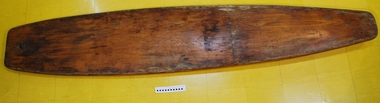
Surfboard, 1/1/1959 (estimated)
... The surfboard is made from marine ply, ureal/resorcinal glue, marine varnish, copper nails, the skeg (fin) is Huon Pine made from an old kitchen sink drain board....Skeg made from old kitchen sink (Huon Pine)....Skeg made from old kitchen sink (Huon Pine). Hollow Wooden Plywood Surfboard. ...This Ockanui Hollow Plywood Surfboard was shaped by Peter Watson and his father at their family home in Murrumbeena in 1959 (Peter was aged 16 at the time). The surfboard was based on a series of full size plans purchased from the USA. The surfboard is made from marine ply, ureal/resorcinal glue, marine varnish, copper nails, the skeg (fin) is Huon Pine made from an old kitchen sink drain board.This surfboard is an excellent example of the type of hollow wooden surfboards being made in the USA and Australia in 1959. Hollow Wooden Plywood Surfboard. Hand made Ockanui, single fin. 9' 11" x 21 1/2" x 4 1/2" Nose 17 3/4" Tail 13" Fin 4 3/4" Base 1 3/4"No distinct inscriptions or markings. Skeg made from old kitchen sink (Huon Pine).ockanui, peter watson, hollow wooden surfboard, -
 Musculoskeletal Health Australia (now held by the Glen Eira Historical Society)
Photograph - Solo photo, Circa November 1989
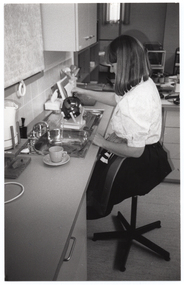
... She is sitting on a swivel chair on castors, at the kitchen sink. A similar photo appears in the Vol 3 No 1, Autumn 1990 issue of the Arthritis Foundation of Victoria's quarterly magazine, Arthritis Update. ...B&W photo of a woman sitting on a swivel chair on castors, at a kitchen sink. She is pouring water from a kettle into the sink. ...B&W photo of a woman sitting on a swivel chair on castors, at a kitchen sink. She is pouring water from a kettle into the sink. ...Through its quarterly newsletters, the Arthritis Foundation of Victoria (AFV), formerly the Rheumatism and Arthritis Association of Victoria (RAAV), was able to inform its members about the latest arthritis-friendly kitchen appliances and aids, and how to use them. In this photo, a woman demonstrates how to use a kettle pourer. She is sitting on a swivel chair on castors, at the kitchen sink. A similar photo appears in the Vol 3 No 1, Autumn 1990 issue of the Arthritis Foundation of Victoria's quarterly magazine, Arthritis Update. The photo in the magazine is captioned: " 'Sit-Stand Chair' in use at a pull-out workbench. It's [sic] adjustable height makes it a useful piece of household equipment." In the published photo, the woman is depicted sitting on the sit-stand chair, about to cut an apple on a small chopping board. The photo accompanies an article titled, 'Living with Arthritis', with the subtitle 'Independent Living Centre', 'A service of the Yooralla Society of Victoria'. According to an earlier article appearing on page 3 of the No 33, August 1984 edition of RAAV's quarterly newsletter, News Review, the Independent Living Centre was the venue for the launch of Arthritis Week in May 1984.B&W photo of a woman sitting on a swivel chair on castors, at a kitchen sink. She is pouring water from a kettle into the sink. The kettle is sitting on a device which enables her to pour from the kettle without having to lift it. The sink is recessed into an L-shaped kitchen bench, upon which a cup and saucer can be seen sitting near the edge of the sink. There are several miscellaneous kitchen appliances on the bench. There are cupboards and drawers beneath the bench, and one set of cupboards above the sink.[On a yellow sticky note, in blue ink] November - December, 1989 Independent Living Centre?arthritis foundation of victoria, afv, rheumatism and arthritis association of victoria, raav, independent living centre, demonstration kitchen, arthritic aids, kitchen aids, kitchen gadgets, kitchen appliances, kitchen sink, kettle pourer, tea, coffee, hot drinks, swivel chair, sit-stand chair, pull-out workbench, retractable bench top, sliding bench top, adaptive kitchens, accessible kitchens, disability-friendly kitchens, modified kitchens, yooralla society of victoria, living with arthritis, pain management, 1989, arthritis update, 1990, news review, 1984 -
 Port Melbourne Historical & Preservation Society
Document - Sink-hole, Liardet Street, Port Melbourne, 17 Dec 2014
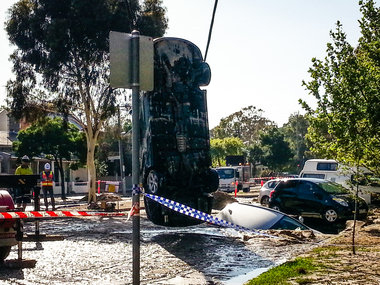
... In the early hours of Tuesday 16 December, 2014 a water main burst in Liardet St. The resulting sink-hole swallowed two cars and left a massive hole which took 8 days to repair and re-open the road. ...Photos taken of the damage and vehicle recoveries when a sink-hole opened up on Liardet Street on Tuesday 16 December 2014....Document Sink-hole, Liardet Street, Port Melbourne ...In the early hours of Tuesday 16 December, 2014 a water main burst in Liardet St. The resulting sink-hole swallowed two cars and left a massive hole which took 8 days to repair and re-open the road. Several houses on the city side of Liardet St suffered water damage and water also entered the underground car park of the apartment block on the beach side.Photos taken of the damage and vehicle recoveries when a sink-hole opened up on Liardet Street on Tuesday 16 December 2014.built environment - domestic, engineering - roads streets lanes and footpaths, engineering - canals and drainage, liardet street, water supply, fran egan -
 Queenscliffe Maritime Museum
Photograph - Sinking of the Ports & Harbour launch "Flinders", Photographer unknown, Photographs
... Photos of the Ports & Harbour launch "Flinders' at anchor prior to sinking....Newspaper clippings relating to the sinking...Newspaper clippings relating to the sinking Photographs Photograph Sinking of the Ports & Harbour launch "Flinders" Photographer unknown ...Photos of the Ports & Harbour launch "Flinders' at anchor prior to sinking.Realism, historical1. Envelope of Notes 2. Page 1 of 3 Notes re Photos 46 to 54. 3. Page 2 of 3 Notes re Photos 46 to 54. 4. Page 3 of 3 Notes re Photos 46 to 54. 5. 5 x 35mm photos of The Flinders at anchor. 6. Enlarged photo with notes of The Flinders at anchor. 7. Newspaper clippings relating to the sinkingOn the reverse - " N/A" -
 Flagstaff Hill Maritime Museum and Village
Photograph - Shipwreck rescue, Royal Australian Navy (RAN), 13-09-1947
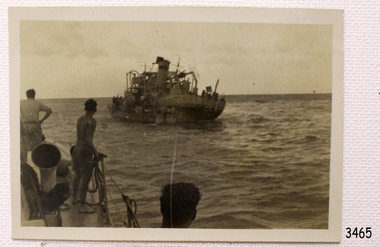
... The photographer has captured the ship as it sinks at sea. The photograph is taken from a nearby vessel, likely to be the HMAS Swan II, which took the survivors onboard. ...Photograph of the sinking of the ship HMAS Warrnambool, sunk on 13-09-1947. ...The photographer has captured the ship as it sinks at sea. The photograph is taken from a nearby vessel, likely to be the HMAS Swan II, which took the survivors onboard. ...This photograph was taken at the scene of the wreck of the HMAS Warrnambool J202 on September 13th 1947. The photographer has captured the ship as it sinks at sea. The photograph is taken from a nearby vessel, likely to be the HMAS Swan II, which took the survivors onboard. The HMAS Warrnambool J202 was commissioned by the Royal Australian Navy for use as a minesweeper during World War II. The Bathurst Class Corvette, fitted out with a range of armaments, was launched in Sydney in 1941. The ship began service in Bass Strait in 1941. At the end of the year it called into its namesake city, Warrnambool, where the crew paraded for the public marching eastwards along Timor Street. A gift of books for the ship’s personnel and a plaque bearing the City of Warrnambool’s Coat of Arms were presented to the ship. The ship was involved in evacuating a family of nine from the Dutch East Indies that was later successful in its challenge of Australia’s Immigration Restriction Act (White Australia Polity). The ship had many other appointments around Australia. On 13th September 1947 HMAS Warrnambool was leading a flotilla of minesweepers in northern Queensland’s coastal waters, clearing mines previously laid to defend Australia. The ship hit a mine, which exploded and very quickly sunk the ship. Boats from the nearby ships rescued most of the seamen although one was killed at the time. The survivors were taken by the HMAS Swan II to Darwin, and they went from there to hospitals in Brisbane and Sydney. Three of these men later died from their injuries. A number of items were recovered by Navy divers in 1948 including the ship’s bell and a plaque with Warrnambool’s Coat of Arms. In 1972-75 the wreck was sold and other items were salvaged. In 1995 a memorial plaque was erected in Warrnambool near the RSL. NOTE: The RAN built a second HMAS Warrnambool FCPB204, launched in 1981 and decommissioned in 2005. There was also a steam ship SS Warrnambool built in London 1892 and broken up in 1926. [A more detailed history can be found in our Collection Record 3477.] This photograph is significant for its association with the lifesaving rescue of the crew and the sinking Royal Australian Navy vessel, HMAS Warrnambool (J202). The HMAS Warrnambool played a nationally significant role in overturning Australia’s Immigration Restriction Act 1901 (colloquially known as the White Australia policy). The ship rescued, and brought to Australia, Samuel and Annie Jacob and their family after they evacuated Dutch East India. The family was threatened with deportation and made the first successful appeal to High Court regarding that Act. The HMAS Warrnambool has - Local significance for being the namesake of the City of Warrnambool - Local significance, having docked in Warrnambool Harbour - Local significance, the crew having paraded in Timor Street, Warrnambool - State significance for its first patrol being in Bass Strait. - National significance, being present in Timor at the Japanese surrender - National significance, shown by the significance of the ship’s bell being curated as Military Heritage and Technology at the Australian War Memorial. - National significance as part of Australia’s defence force history, being one of only four Bathurst class corvettes lost while in Australian service, the only Bathurst class corvette lost after World War II, the only RAN vessel to be sunk by a mine, and associated with the last four Navy deaths of WWII Photograph of the sinking of the ship HMAS Warrnambool, sunk on 13-09-1947. Figures onboard a vessel are looking towards figures on the sinking vessel. This black and white photograph is one of a series of photographs taken at the time.flagstaff hill, maritime village, maritime museum, warrnambool, shipwreck coast, mort's dock & engineering co ltd, h.m.a.s. warrnambool, hmas warrnambool, hmas warrnambool i, hmas warrnambool j202, hmas swan ii, j202, world war ii, bathurst class corvette, royal australian navy, ran, sydney built ship, bass strait patrol, sea mine patrol, mine sweeper, mine clearance, navy divers, great barrier reef, cockburn reef, southern cross diving and salvage, warrnambool city council, cr j r astbury, mayor j r astbury, warrnambool patriotic fund, seal, coat of arms, dedicatory plaque, hmas warrnambool 1941, shipwreck by sea mine 1947, sinking ship, sunk ship, sea rescue, life saving, lifesaving, minesweeper -
Glenelg Shire Council Cultural Collection
Souvenir - Sink Plug, n.d
... White rubber sink plug, blue lettering....Front: 'Wannon Water EVERY DROP COUNTS' Back: Diameter 8cm x 4cm White rubber sink plug, blue lettering. Souvenir Sink Plug ...White rubber sink plug, blue lettering.Front: 'Wannon Water EVERY DROP COUNTS' Back: Diameter 8cm x 4cm -
 Lara RSL Sub Branch
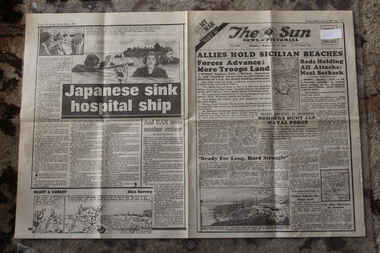
Newspaper - The Sun Newspaper dated 12/7/1943 - Special My War Part 35= Allies Hold Sicilian Beaches - Japanese Sink Hospital Ship (2 off), Local Nespaper Dated 12/7/1943 - Special - My War Part 35 (2 off)
... Allies Hold Sicilian Beaches - Japanese Sink Hospital Ship...Local Newspaper Dated 12/7/1943 reporting on World War 2 Events - Special- My War Part 35 Local Newspaper dated 12/7/1943 report on Events of World War 2 - Special - My War Part 35 (2 off) local newspaper dated 12/7/1943 world war 2 allies hold sicilian beaches Allies Hold Sicilian Beaches - Japanese Sink Hospital Ship Local Newspaper Dated 12/7/1943 - Special- My War Part 35 - (2 off) Local Nespaper Dated 12/7/1943 - Special - My War Part 35 (2 off) Newspaper The Sun Newspaper dated 12/7/1943 - Special My War Part 35= Allies Hold Sicilian Beaches - Japanese Sink Hospital Ship (2 off) ...Local Newspaper Dated 12/7/1943 reporting on World War 2 Events - Special- My War Part 35Local Newspaper dated 12/7/1943 report on Events of World War 2 - Special - My War Part 35 (2 off)Local Newspaper Dated 12/7/1943 - Special- My War Part 35 - (2 off) Allies Hold Sicilian Beaches - Japanese Sink Hospital Shiplocal newspaper dated 12/7/1943, world war 2, allies hold sicilian beaches -
Lara RSL Sub Branch
Book, The 50th Anniversary of the Sinking of the Centaur - 14th May 1993
... The 50th Anniversary of the Sinking of the Centaur - 14th May 1993...The 50th Anniversary of the Sinking of the Centaur - 14th May 1993 The 50th Anniversary of the Sinking of the Centaur - 14th May 1993 Book ...The 50th Anniversary of the Sinking of the Centaur - 14th May 1993 -
 Flagstaff Hill Maritime Museum and Village
Document
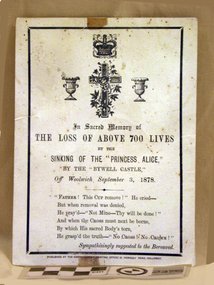
... Written memorial to the 700 lives lost in the sinking of the "Princess Alice" 1878...flagstaff hill warrnambool shipwrecked-coast flagstaff-hill flagstaff-hill-maritime-museum maritime-museum shipwreck-coast flagstaff-hill-maritime-village memorial Princess Alice Written memorial to the 700 lives lost in the sinking of the "Princess Alice" 1878 Document ...Written memorial to the 700 lives lost in the sinking of the "Princess Alice" 1878flagstaff hill, warrnambool, shipwrecked-coast, flagstaff-hill, flagstaff-hill-maritime-museum, maritime-museum, shipwreck-coast, flagstaff-hill-maritime-village, memorial, princess alice -
 Tatura Irrigation & Wartime Camps Museum
Sketch, Georg Rosenkranz, Sinking of HSK Pinguin, 1941/2
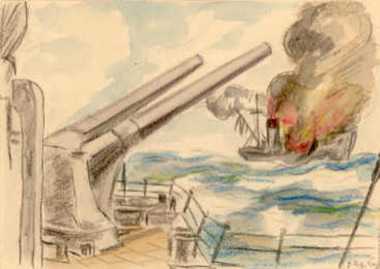
... Sketch of naval guns. The sinking of the "HSK Pinguin" by the British cruiser 'Cornwall"...Cornwall rescued 60 crew members and 22 prisoners who had been taken from the 28 merchant ships the raider had sunk or captured. graytown pow camp georg rosenkranz illustrations sketch HSK Pinguin Cornwall Sketch of naval guns. The sinking of the "HSK Pinguin" by the British cruiser 'Cornwall" Sinking of HSK Pinguin Sketch Georg Rosenkranz ...Sketched by Georg Rosenkranz of HSK Pinguin a German auxiliary cruiser active during World War II. HSK Pinguin was sunk on 8 May 1941 by the British heavy cruiser HMS Cornwall. She was the first auxiliary cruiser of the Kriegsmarine to suffer this fate. Pinguin exploded when the mines stored on board were hit and detonated; 332 members of the crew and about 200 of the prisoners were killed. Cornwall rescued 60 crew members and 22 prisoners who had been taken from the 28 merchant ships the raider had sunk or captured.Sketch of naval guns. The sinking of the "HSK Pinguin" by the British cruiser 'Cornwall"graytown pow camp, georg rosenkranz, illustrations, sketch, hsk pinguin, cornwall -
Tatura Irrigation & Wartime Camps Museum
Archive Box (reports), Inquiry into the circumstances of the sinking of the HMAS Sydney, 1998
... Government report into the sinking of the HMAS Sydney compiled by Government Joint Standing Committee in 1998/99...Government report into the sinking of the HMAS Sydney|28 volumes consisting of:|Joint Standing Committee Transcript of 27th March 1998|Joint Standing Committee Transcript of 16th April 1998|Joint Standing Committee Transcript of 17th April 1998|Joint Standing Committee Transcript of 1st May 1998|Joint Standing Committee Transcript of 22nd May 1998|Joint Standing Committee Transcript of 29th May 1998|Index to Submissions and Transcripts of Evidence|Submissions volumes 1 - 19.|2 copies of completed report on the Loss of the HMAS Sydney dated March 1999....Inquiry into the circumstances of the sinking of the HMAS Sydney Archive Box (reports) ...Government report into the sinking of the HMAS Sydney compiled by Government Joint Standing Committee in 1998/9926 stapled booklets of paper with yellow card covers and 2 bound books of completed report with white cardboard cover with photo of HMAS Sydney. Government report into the sinking of the HMAS Sydney|28 volumes consisting of:|Joint Standing Committee Transcript of 27th March 1998|Joint Standing Committee Transcript of 16th April 1998|Joint Standing Committee Transcript of 17th April 1998|Joint Standing Committee Transcript of 1st May 1998|Joint Standing Committee Transcript of 22nd May 1998|Joint Standing Committee Transcript of 29th May 1998|Index to Submissions and Transcripts of Evidence|Submissions volumes 1 - 19.|2 copies of completed report on the Loss of the HMAS Sydney dated March 1999.hmas sydney, hsk kormoran, documents, reports -
 Ballarat RSL Sub-Branch Inc.
Newspaper Articles x 2 (re HMAS Ballarat)
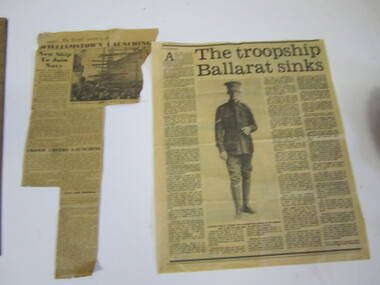
... "The Herald" Tuesday, December 10, 1940" - Launch of HMAS 'Ballarat' "The troopship Ballarat sinks"...Literature Ballarat RSL Ballarat "The Herald" Tuesday, December 10, 1940" - Launch of HMAS 'Ballarat' "The troopship Ballarat sinks" Newspaper Articles x 2 (re HMAS Ballarat) ..."The Herald" Tuesday, December 10, 1940" - Launch of HMAS 'Ballarat' "The troopship Ballarat sinks"literature, ballarat rsl, ballarat -
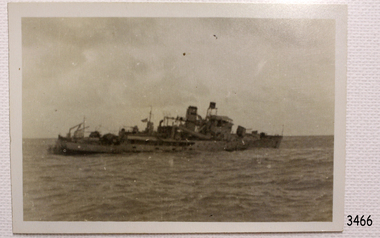 Flagstaff Hill Maritime Museum and Village
Photograph - Shipwreck rescue, Royal Australian Navy (RAN), HMAS Warrnambool J202, 13-09-1947
... The photographer has captured the ship as it sinks at sea. The HMAS Warrnambool J202 was commissioned by the Royal Australian Navy for use as a minesweeper during World War II. ...Photograph of the starboard side of the sinking ship HMAS Warrnambool, sunk on 13-09-1947. ...The photographer has captured the ship as it sinks at sea. The HMAS Warrnambool J202 was commissioned by the Royal Australian Navy for use as a minesweeper during World War II. ...This photograph was taken at the scene of the wreck of the HMAS Warrnambool J202 on September 13th 1947. The photographer has captured the ship as it sinks at sea. The HMAS Warrnambool J202 was commissioned by the Royal Australian Navy for use as a minesweeper during World War II. The Bathurst Class Corvette, fitted out with a range of armaments, was launched in Sydney in 1941. The ship began service in Bass Strait in 1941. At the end of the year it called into its namesake city, Warrnambool, where the crew paraded for the public marching eastwards along Timor Street. A gift of books for the ship’s personnel and a plaque bearing the City of Warrnambool’s Coat of Arms were presented to the ship. The ship was involved in evacuating a family of nine from the Dutch East Indies that was later successful in its challenge of Australia’s Immigration Restriction Act (White Australia Polity). The ship had many other appointments around Australia. On 13th September 1947 HMAS Warrnambool was leading a flotilla of minesweepers in northern Queensland’s coastal waters, clearing mines previously laid to defend Australia. The ship hit a mine, which exploded and very quickly sunk the ship. Boats from the nearby ships rescued most of the seamen although one was killed at the time. The survivors were taken by the HMAS Swan II to Darwin, and they went from there to hospitals in Brisbane and Sydney. Three of these men later died from their injuries. A number of items were recovered by Navy divers in 1948 including the ship’s bell and a plaque with Warrnambool’s Coat of Arms. In 1972-75 the wreck was sold and other items were salvaged. In 1995 a memorial plaque was erected in Warrnambool near the RSL. NOTE: The RAN built a second HMAS Warrnambool FCPB204, launched in 1981 and decommissioned in 2005. There was also a steam ship SS Warrnambool built in London 1892 and broken up in 1926. [A more detailed history can be found in our Collection Record 3477.] This photograph is significant for its association with the lifesaving rescue of the crew and the sinking Royal Australian Navy vessel, HMAS Warrnambool (J202). The HMAS Warrnambool played a nationally significant role in overturning Australia’s Immigration Restriction Act 1901 (colloquially known as the White Australia policy). The ship rescued, and brought to Australia, Samuel and Annie Jacob and their family after they evacuated Dutch East India. The family was threatened with deportation and made the first successful appeal to High Court regarding that Act. The HMAS Warrnambool has - Local significance for being the namesake of the City of Warrnambool - Local significance, having docked in Warrnambool Harbour - Local significance, the crew having paraded in Timor Street, Warrnambool - State significance for its first patrol being in Bass Strait. - National significance, being present in Timor at the Japanese surrender - National significance, shown by the significance of the ship’s bell being curated as Military Heritage and Technology at the Australian War Memorial. - National significance as part of Australia’s defence force history, being one of only four Bathurst class corvettes lost while in Australian service, the only Bathurst class corvette lost after World War II, the only RAN vessel to be sunk by a mine, and associated with the last four Navy deaths of WWII Photograph of the starboard side of the sinking ship HMAS Warrnambool, sunk on 13-09-1947. This black and white photograph is one of a series of photographs taken at the time.flagstaff hill, maritime village, maritime museum, warrnambool, shipwreck coast, mort's dock & engineering co ltd, h.m.a.s. warrnambool, hmas warrnambool, hmas warrnambool i, hmas warrnambool j202, hmas swan ii, j202, world war ii, bathurst class corvette, royal australian navy, ran, sydney built ship, bass strait patrol, sea mine patrol, mine sweeper, mine clearance, navy divers, great barrier reef, cockburn reef, southern cross diving and salvage, warrnambool city council, cr j r astbury, mayor j r astbury, warrnambool patriotic fund, seal, coat of arms, dedicatory plaque, hmas warrnambool 1941, shipwreck by sea mine 1947, sinking ship, sunk ship, sea rescue, life saving, lifesaving, minesweeper -
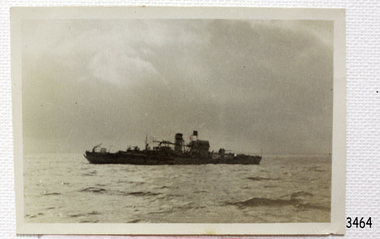 Flagstaff Hill Maritime Museum and Village
Photograph - Shipwreck rescue, Royal Australian Navy (RAN), 13-09-1947
... The photographer has captured the ship as it sinks at sea. The HMAS Warrnambool J202 was commissioned by the Royal Australian Navy for use as a minesweeper during World War II. ...Photograph of the sinking of the ship HMAS Warrnambool, sunk on 13-09-1947. ...The photographer has captured the ship as it sinks at sea. The HMAS Warrnambool J202 was commissioned by the Royal Australian Navy for use as a minesweeper during World War II. ...This photograph was taken at the scene of the wreck of the HMAS Warrnambool J202 on September 13th 1947. The photographer has captured the ship as it sinks at sea. The HMAS Warrnambool J202 was commissioned by the Royal Australian Navy for use as a minesweeper during World War II. The Bathurst Class Corvette, fitted out with a range of armaments, was launched in Sydney in 1941. The ship began service in Bass Strait in 1941. At the end of the year it called into its namesake city, Warrnambool, where the crew paraded for the public marching eastwards along Timor Street. A gift of books for the ship’s personnel and a plaque bearing the City of Warrnambool’s Coat of Arms were presented to the ship. The ship was involved in evacuating a family of nine from the Dutch East Indies that was later successful in its challenge of Australia’s Immigration Restriction Act (White Australia Polity). The ship had many other appointments around Australia. On 13th September 1947 HMAS Warrnambool was leading a flotilla of minesweepers in northern Queensland’s coastal waters, clearing mines previously laid to defend Australia. The ship hit a mine, which exploded and very quickly sunk the ship. Boats from the nearby ships rescued most of the seamen although one was killed at the time. The survivors were taken by the HMAS Swan II to Darwin, and they went from there to hospitals in Brisbane and Sydney. Three of these men later died from their injuries. A number of items were recovered by Navy divers in 1948 including the ship’s bell and a plaque with Warrnambool’s Coat of Arms. In 1972-75 the wreck was sold and other items were salvaged. In 1995 a memorial plaque was erected in Warrnambool near the RSL. NOTE: The RAN built a second HMAS Warrnambool FCPB204, launched in 1981 and decommissioned in 2005. There was also a steam ship SS Warrnambool built in London 1892 and broken up in 1926. [A more detailed history can be found in our Collection Record 3477.] This photograph is significant for its association with the lifesaving rescue of the crew and the sinking Royal Australian Navy vessel, HMAS Warrnambool (J202). The HMAS Warrnambool played a nationally significant role in overturning Australia’s Immigration Restriction Act 1901 (colloquially known as the White Australia policy). The ship rescued, and brought to Australia, Samuel and Annie Jacob and their family after they evacuated Dutch East India. The family was threatened with deportation and made the first successful appeal to High Court regarding that Act. The HMAS Warrnambool has - Local significance for being the namesake of the City of Warrnambool - Local significance, having docked in Warrnambool Harbour - Local significance, the crew having paraded in Timor Street, Warrnambool - State significance for its first patrol being in Bass Strait. - National significance, being present in Timor at the Japanese surrender - National significance, shown by the significance of the ship’s bell being curated as Military Heritage and Technology at the Australian War Memorial. - National significance as part of Australia’s defence force history, being one of only four Bathurst class corvettes lost while in Australian service, the only Bathurst class corvette lost after World War II, the only RAN vessel to be sunk by a mine, and associated with the last four Navy deaths of WWII Photograph of the sinking of the ship HMAS Warrnambool, sunk on 13-09-1947. This black and white photograph showing the vessel at sea is one of a series of photographs taken at the time.flagstaff hill, maritime village, maritime museum, warrnambool, shipwreck coast, mort's dock & engineering co ltd, h.m.a.s. warrnambool, hmas warrnambool, hmas warrnambool i, hmas warrnambool j202, hmas swan ii, j202, world war ii, bathurst class corvette, royal australian navy, ran, sydney built ship, bass strait patrol, sea mine patrol, mine sweeper, mine clearance, navy divers, great barrier reef, cockburn reef, southern cross diving and salvage, warrnambool city council, cr j r astbury, mayor j r astbury, warrnambool patriotic fund, seal, coat of arms, dedicatory plaque, hmas warrnambool 1941, shipwreck by sea mine 1947, sinking ship, sunk ship, minesweeper -
Glenelg Shire Council Cultural Collection
Photograph - Photograph - Portland Library, Victoria, n.d
... Portland Library. View of sink and tea making facilities, staff room....Portland Library. View of sink and tea making facilities, staff room. ...Coloured photo. Portland Library. View of sink and tea making facilities, staff room. -
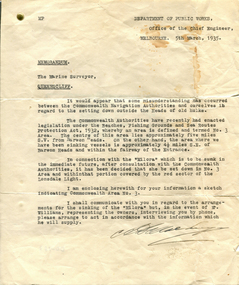 Queenscliffe Maritime Museum
Letter - Sinking of the 'Milora'
... A memorandum dated 5 March 1935 regarding arrangements for the sinking o fhte 'Milora...Diving Scuba Diving Ship Wrecks Milora A memorandum dated 5 March 1935 regarding arrangements for the sinking o fhte 'Milora Letter Sinking of the 'Milora' ...The Milora was scuttled in 1934 after running aground in Port Phillip near Queenscliff. She is the largest wreck in the ships graveyard at 101Meters.The Milora ran ashore at Barwon Heads on 21 September 1934, and then scuttled in the 'Ships Graveyard' off Barwon Heads in Bass Strait on the 8 March 1935.A memorandum dated 5 March 1935 regarding arrangements for the sinking o fhte 'Miloradiving, scuba diving, ship wrecks, milora -
Port Melbourne Historical & Preservation Society
Book, "Settlers under sail", 1978
... "Settlers Under Sail" A History of early sail and the sinking of the Loch Ard, by Don Charwood...transport - shipping don charlwood "Settlers Under Sail" A History of early sail and the sinking of the Loch Ard, by Don Charwood "Settlers under sail" Book ..."Settlers Under Sail" A History of early sail and the sinking of the Loch Ard, by Don Charwoodtransport - shipping, don charlwood -
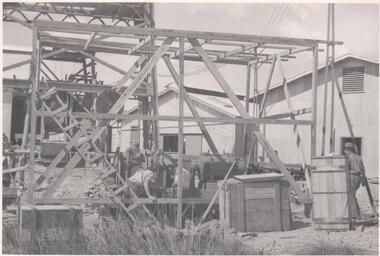 Bendigo Historical Society Inc.
Photograph - Nell Gwynne Mine Site, 1934
... Written in pencil on back of photograph in pencil:' Erecting Nell Gwynne Sinking Winch 16/2/35'...Nell Gwynne Gold Mine SHAFT gold mining sinking winch headframe Written in pencil on back of photograph in pencil:' Erecting Nell Gwynne Sinking Winch 16/2/35' Black and white photograph of Nell Gwynne mine site. ...Significant to mining history of Bendigo.Black and white photograph of Nell Gwynne mine site. Bottom level of metal headframe on left hand side of image, three men working on wooden construction immediately in front of headframe.Written in pencil on back of photograph in pencil:' Erecting Nell Gwynne Sinking Winch 16/2/35'nell gwynne gold mine, shaft, gold mining, sinking winch, headframe -
 Bendigo Historical Society Inc.
Photograph - Nell Gwynne Mine Site, 1935
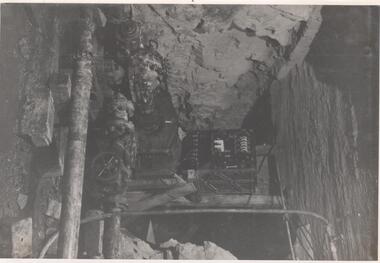
... Written in pencil on back of photograph in pencil:' Erecting Nell Gwynne Sinking Winch 16/2/35'...Nell Gwynne Gold Mine SHAFT Written in pencil on back of photograph in pencil:' Erecting Nell Gwynne Sinking Winch 16/2/35' Black and white photograph of Nell Gwynne shaft showing the installation of a temporary pump at No. 3 level on 17.9.1935. ...Significant to mining history of Bendigo.Black and white photograph of Nell Gwynne shaft showing the installation of a temporary pump at No. 3 level on 17.9.1935. Pump is supported by a metal framing.Written in pencil on back of photograph in pencil:' Erecting Nell Gwynne Sinking Winch 16/2/35'nell gwynne gold mine, shaft
