
Showing 7 items matching "skating carnivals"
-
 The Beechworth Burke Museum
Photograph
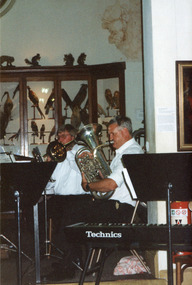
... ...skating carnivals...Marching bands, choirs, processions, circus acts, theatrical performances, races, fancy dress and roller skating carnivals, were among the vibrant and diverse entertainments offered in Beechworth during the gold rush period. ...Marching bands, choirs, processions, circus acts, theatrical performances, races, fancy dress and roller skating carnivals, were among the vibrant and diverse entertainments offered in Beechworth during the gold rush period. ...This photograph depicts two members of the Beechworth Band at a 'Liedertafel' concert in the main hall at the Burke Museum in 1999. The concert related to an exhibition titled, 'From the Liedertafel to the Skating Rink: Entertainment in Beechworth 1852 - early 1900s', which celebrated the rich and diverse entertainments that were a part of Beechworth life in the nineteenth and early twentieth centuries. 'Liedertafel' is a German tradition that accompanied European settlers to Australia. It refers to a friendly society of men united by an enthusiasm for singing. The Beechworth Liedertafel was established 14 March 1894 at the London Tavern, Camp Street, Beechworth, by president, Mr. A.A. Billson, and a visiting conductor, Mr. H. Fielder. The Beechworth Brass Band was formed by Mr. H. Vandenberg in 1887. Marching bands, choirs, processions, circus acts, theatrical performances, races, fancy dress and roller skating carnivals, were among the vibrant and diverse entertainments offered in Beechworth during the gold rush period. Race meetings were revived with a gala atmosphere at Baarmutha on New Year's Day and Easter Monday in the early 1880s. 'Spiller's Skating Rink', which premiered at St. Georges Hall in August 1869, was accompanied by the 'Beechworth Fire and Drum band'. In 1888, Beechworth had two skating rinks in operation, the Columbia Elite at Oddfellow's Hall, and the Beechworth Skating Rink, corner Camp and Last Streets, Beechworth. Vandenberg's Beechworth Brass Band was reported to have provided musical entertainment for patrons at both venues.This photograph of the Beechworth Band playing at the Burke Museum is historically significant for the information it conveys about an exhibition at the Burke Museum between September and November 1999. The use of the contemporary Beechworth Band in a 'Liedertafel' performance provides insight into curatorial approaches at the turn of the twenty-first century and improves our understanding of how exhibitions use objects in the Burke Museum's Collection to tell stories about the past in the present. The story of Liedertafel's and Beechworth Brass Band is historically and socially significant for understanding the role played by German immigrants in building Victorian communities. In settler communities, cultural associations centred on artistic, recreational and sporting activities not only provided a popular means of entertainment, but fostered social cohesion among settlers from diverse ethnic backgrounds.Rectangular colour photograph printed on matte photographic paper. Obverse (On keyboard): Technics / Reverse: 7028 / Label: Liedertafel / exh. / Beechworth / Band / 1999/2000 /liedertafel, beechworth band, burke museum, from the liedertafel to the skating rink, entertainment in beechworth 1852 - early 1900s, gold rush, immigration, beechworth's german heritage, london tavern beechworth, beechworth's first brick tavern, spiller's skating rink, vandenberg's beechworth brass band, protestantism, teetotallism, skating carnivals, beechworth german association, yma's, beechworth skating rink, progress societies, billson's brewery, german-australians, roller skating history -
 The Beechworth Burke Museum
Photograph, 1999
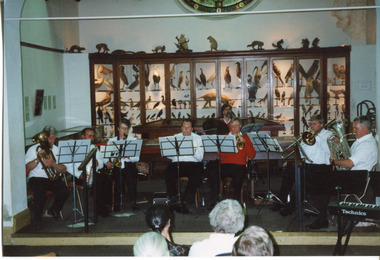
... ...skating carnivals...The image is historically and socially significant for attesting to the enduring appeal of local musical associations, which were a popular means of entertainment that fostered social connections among settlers from diverse ethnic backgrounds. liedertafel beechworth band burke museum from the liedertafel to the skating rink entertainment in beechworth 1852 - early 1900s gold rush immigration beechworth's german heritage london tavern beechworth beechworth's first brick tavern spiller's skating rink vandenberg's beechworth brass band protestantism teetotallism skating carnivals beechworth german association YMA's beechworth skating rink progress societies billson's brewery German-Australians beechworth progess association lodges freemasonry colonial australia Reverse: 7029 / Label: 7029 / Source / Burke Museum / Beechworth / Band / 1999/2000 / Rectangular colour photograph printed on matte photographic paper. ...This photograph depicts members of the Beechworth Band at a 'Liedertafel' concert in the main hall at the Burke Museum in 1999. The concert was associated with an exhibition titled, 'From the Liedertafel to the Skating Rink: Entertainment in Beechworth 1852 - early 1900s', which celebrated the rich and diverse entertainments that were a part of Beechworth life in the nineteenth and early twentieth centuries. Marching bands, choirs, circus acts, theatrical performances, races, and seasonal activities, such as Mr. Spiller's roller skating rink, founded in the late 1860s, were among the attractions on offer. 'Liedertafel' is a tradition that accompanied German settlers to Australia. It refers to a friendly society of men united by an enthusiasm for singing. The Beechworth Brass Band was formed by Mr. H. Vandenberg in 1887. The Beechworth Liedertafel was established 14 March 1894 at the London Tavern, Camp Street, Beechworth, by Mr. A.A. Billson, and a visiting conductor, Mr. H. Fielder. German clubs, complete with marching bands, athletics associations and Liedertafel choirs, were centres of social activity attracting wide audiences not limited to members of their own ethnicity. Alfred Arthur Billson was the youngest son of Mr. George Billson, who served as Beechworth’s mayor between 1869-1871. In 1872, George purchased the Oven’s Brewery in Last Street, which became Billson’s Brewery, one of the oldest continuing beverage manufacturers in Australia. An active member of Beechworth’s cultural, business and political life around the turn of the century, A.A. Billson served on Beechworth Shire Council from 1884 to 1893, and from 1895 to 1910, with three terms as president (1888–89, 1899–1901, 1908–09). He founded the Beechworth Progress Association in 1891 and produced an ‘Illustrated Guide to Beechworth and Vicinity’ to develop tourism potential. This photograph of the Beechworth Band playing at the Burke Museum is historically significant for the information it conveys about an exhibition at the Burke Museum between September and November 1999. The use of the contemporary Beechworth Band in a 'Liedertafel' performance provides insight into curatorial approaches at the turn of the twenty-first century and improves our understanding of how exhibitions use objects in the Burke Museum's Collection to tell stories about the past in the present. The image is historically and socially significant for attesting to the enduring appeal of local musical associations, which were a popular means of entertainment that fostered social connections among settlers from diverse ethnic backgrounds. Rectangular colour photograph printed on matte photographic paper. Reverse: 7029 / Label: 7029 / Source / Burke Museum / Beechworth / Band / 1999/2000 /liedertafel, beechworth band, burke museum, from the liedertafel to the skating rink, entertainment in beechworth 1852 - early 1900s, gold rush, immigration, beechworth's german heritage, london tavern beechworth, beechworth's first brick tavern, spiller's skating rink, vandenberg's beechworth brass band, protestantism, teetotallism, skating carnivals, beechworth german association, yma's, beechworth skating rink, progress societies, billson's brewery, german-australians, beechworth progess association, lodges, freemasonry, colonial australia -
 The Beechworth Burke Museum
Photograph, c1999/2000
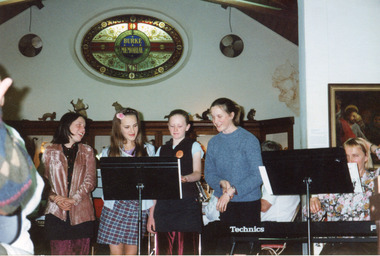
... ...skating carnivals...Liedertafel choirs were originally male-only, therefore, the presence of female singers at the 1999 exhibition reflects progressive social and community values with regard to gender and inclusion. liedertafel beechworth band burke museum exhibition 1999 from the liedertafel to the skating rink entertainment in beechworth 1852 - early 1900s past exhibitions performances at the burke museum european settlers german community german choral societies brass bands male choir colonial passtimes colonial entertainments cultural traditions gold rush immigration beechworth's german heritage london tavern beechworth camp st beechworth beechworth historic district beechworth's first brick tavern spiller's skating rink vandenberg's beechworth brass band benevolent societies intellectual societies protestantism billson brewery beechworth teetotallism fancy dress carnivals skating carnivals fundraising societies german musicians crimean war beechworth german association freemasonry YMA's beechworth athenaeum beechworth skating rink Reverse: 7030 / Label: Burke Museum / Liedertafel Exh / Emily Messen, Luetta / Schier, Hannah / Routledge, Sarah / McKinley 2000 (?) ...This photograph depicts female singers accompanied by members of the Beechworth Band at a 'Liedertafel' concert in the main hall at the Burke Museum in 1999. The concert related to an exhibition titled, 'From the Liedertafel to the Skating Rink: Entertainment in Beechworth 1852 - early 1900s', which celebrated the rich and diverse entertainments that were part of Beechworth life in the nineteenth and early twentieth centuries. 'Liedertafel' is a German tradition that accompanied European settlers to Australia. It refers to a friendly society of men united by an enthusiasm for singing. The Beechworth Liedertafel was established 14 March 1894 at the London Tavern, Camp Street, Beechworth, by president, Mr. A.A. Billson, and a visiting conductor, Mr. H. Fielder. The Beechworth Brass Band was formed by Mr. H. Vandenberg in 1887. Marching bands, choirs, circus acts, theatrical performances, races, and seasonal activities, such as Mr. Spiller's roller skating rink, which was founded in the late 1860s, were among the entertainments on offer in Beechworth.This photograph of the Beechworth Band playing at the Burke Museum is historically significant for the information it conveys about an exhibition at the Burke Museum between September and November 1999. The use of the contemporary Beechworth Band in a 'Liedertafel' performance provides insight into curatorial approaches at the turn of the twenty-first century and improves our understanding of how exhibitions use objects in the Burke Museum's Collection to tell stories about the past in the present. The image is historically and socially significant for attesting to the enduring appeal of local musical associations, which were a popular means of entertainment that fostered social connections among settlers from diverse ethnic backgrounds. Liedertafel choirs were originally male-only, therefore, the presence of female singers at the 1999 exhibition reflects progressive social and community values with regard to gender and inclusion.Rectangular colour photograph printed on matte photographic paper.Reverse: 7030 / Label: Burke Museum / Liedertafel Exh / Emily Messen, Luetta / Schier, Hannah / Routledge, Sarah / McKinley 2000 (?) / 2000 (?) / liedertafel, beechworth band, burke museum, exhibition 1999, from the liedertafel to the skating rink, entertainment in beechworth 1852 - early 1900s, past exhibitions, performances at the burke museum, european settlers, german community, german choral societies, brass bands, male choir, colonial passtimes, colonial entertainments, cultural traditions, gold rush, immigration, beechworth's german heritage, london tavern beechworth, camp st beechworth, beechworth historic district, beechworth's first brick tavern, spiller's skating rink, vandenberg's beechworth brass band, benevolent societies, intellectual societies, protestantism, billson brewery beechworth, teetotallism, fancy dress carnivals, skating carnivals, fundraising societies, german musicians, crimean war, beechworth german association, freemasonry, yma's, beechworth athenaeum, beechworth skating rink -
 St Kilda Historical Society
Ephemera - Poster, Monster Double-Roller Skating Carnival, 1932
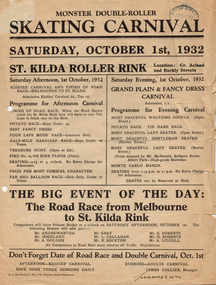
... Poster advertising a skating carnival at St Kilda Roller Rink, on the corner of Acland and Barkly Streets, on 1 October 1932. ...St Kilda Roller Rink White paper, discoloured with age, printed on one side in black Monster Double-Roller Skating Carnival Ephemera Poster ...Poster advertising a skating carnival at St Kilda Roller Rink, on the corner of Acland and Barkly Streets, on 1 October 1932. The program included a Kiddies Carnival, Adults Carnival and Road Race from Princes Bridge to the rink.White paper, discoloured with age, printed on one side in blackst kilda roller rink -
 City of Moorabbin Historical Society (Operating the Box Cottage Museum)
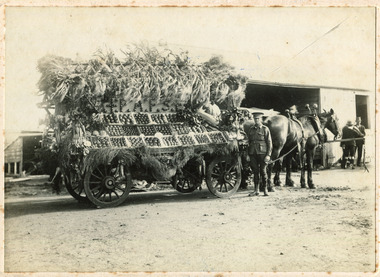
Photograph, Black & White, Fruit & Vegetable display Float Easter Parade c1917, c1916
... The Carnival gave prizes for sports events on the Mentone Oval and a concert was held at night at the Mentone Ice Skating Rink....The Carnival gave prizes for sports events on the Mentone Oval and a concert was held at night at the Mentone Ice Skating Rink. ...The Friendly Societies Carnival at Mentone 1916 during WW1 was arranged to showcase the local activities and raise funds for the 'Discharged Wounded Soldiers Fund' = £140 was raised. As elsewhere in Australia most of the local young men had enlisted in the AIF and some were coming home wounded - many were killed on overseas battlefields. This Parade was led by the Cheltenham Brass Band with the following Friendly Societies AOF, IOR, HACBS, PAFS, and ANA. The PAFS - Protestant Alliance Friendly Society - had 2 entries 'Fruit & Vegetable Display' and 'The Murder of Nurse Edith Cavell' both floats won their category. The Carnival gave prizes for sports events on the Mentone Oval and a concert was held at night at the Mentone Ice Skating Rink.World War 1 1914-1918 had a devastating impact on many early settler families whose sons had volunteered to serve in AIF. 1916 many of these young men were returning injured or had been killed overseas The Community rallied around to support these men and their families by holding fund raising events like the CarnivalBlack & White photograph of a horse drawn wagon displaying Fruit and Vegetables for a procession c 1916Handwritten ; Decorated wagon possibly part of a procession of market gardeners cartsfriendly societies cheltenham 1916, nurse edith cavell, cheltenham brass band 1916, ww1 1914-1918, wounded soldiers fund, allnutt ella, smith j l; smith mary ann, stanley helen, smith vic, chaff cutter, horse drawn carts, toll gates brighton, motor cars 1900, steam engines, early settlers, bentleigh, mckinnon, parish of moorabbin, city of moorabbin, county of bourke, moorabbin roads board, shire of moorabbin, henry dendy's special survey 1841, were j.b.; bent thomas, o'shannassy john, king richard, charman stephen, highett william, ormond francis, maynard dennis, market gardeners, vineyards, orchards -
 City of Moorabbin Historical Society (Operating the Box Cottage Museum)
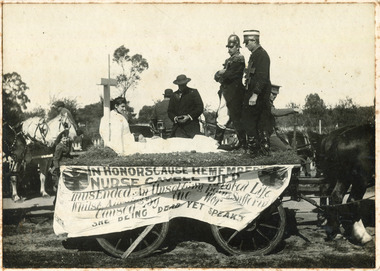
Photograph - 'Edith Cavell Tableau' Easter Parade Cheltenham 1916, 1916
... The Carnival gave prizes for sports events on the Mentone Oval and a concert was held at night at the Mentone Ice Skating Rink. ...The Carnival gave prizes for sports events on the Mentone Oval and a concert was held at night at the Mentone Ice Skating Rink. ...The Friendly Societies Carnival at Mentone on Easter Monday, 1916 during WW1 was arranged to showcase the local activities and raise funds for the 'Discharged Wounded Soldiers Fund' = £140 was raised. As elsewhere in Australia most of the local young men had enlisted in the AIF and some were coming home wounded - many were killed on overseas battlefields. This Parade was led by the Cheltenham Brass Band, followed by the Friendly Societies AOF, IOR, HACBS, PAFS, and ANA. The PAFS - Protestant Alliance Friendly Society - had 2 entries 'Fruit & Vegetable Display' and 'The Murder of Nurse Edith Cavell' both floats won their category. Ella Allnutt portrayed Nurse Cavell. The Carnival gave prizes for sports events on the Mentone Oval and a concert was held at night at the Mentone Ice Skating Rink. "The Cheltenham P.A.F.S. had, as their tableaux, the murder of Nurse Cavell, in which Miss E. Allnutt took the roll of the nurse and other participants were Miss V. Rose and Messrs. A. Clark, F. Robinson, E. Hutchins, S. Butler and A. Biehl." 1916 'MOORABBIN'S PATRIOTIC CARNIVAL.', Brighton Southern Cross, 29 April, p. 2. World War 1 1914-1918 had a devastating impact on many early settler families whose sons had volunteered to serve in AIF. 1916 many of these young men were returning injured or had been killed overseas The Community rallied around to support these men and their families by holding fund raising events like the CarnivalBlack & White photograph of a decorated float with a Tableau ' The Murder of Nurse Edith Cavell' in the Friendly Societies Carnival Cheltenham 1916Front Handwritten ; Procession ( part of ) to honour Sister Edith Cavell an English nurse executed by the Germans in Brussels (BELG.) in 1914 (1st World War)cheltenham brass band 1916, ww1 1914-1918, cavell edith, friendly societies, protestant alliance friendly society, moorabbin, cheltenham, dendy henry, dendy's special survey 1841, assisted emigrants early settlers, pioneers, market gardeners, marigold flowers, pharmacy, charman stephen, gettens mary, charman harriet, methodist church, primitive methodists, box william, box elizabeth, state schools, education, moorabbin shire, moorabbin roads board, city of moorabbin, kingston city council, cheltenham brass band 1916, ww1 1914-1918, cavell edith, friendly societies, protestant alliance friendly society, moorabbin, cheltenham, dendy henry, dendy's special survey 1841, assisted emigrants early settlers, pioneers, market gardeners, marigold flowers, pharmacy, charman stephen, gettens mary, charman harriet, methodist church, primitive methodists, box william, box elizabeth, state schools, education, moorabbin shire, moorabbin roads board, city of moorabbin, kingston city council -
 City of Melbourne Libraries
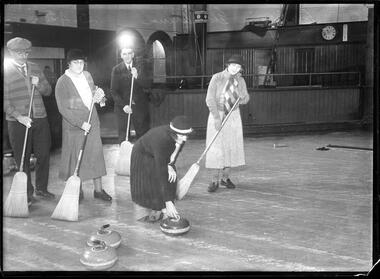
Photograph, Bull, Hugh Jones, 1897-1993, Curling at the Glaciarium, South Melbourne
... skates. Up to 5000 people could attend hockey matches and ice sports carnivals at any one time. ...skates. Up to 5000 people could attend hockey matches and ice sports carnivals at any one time. ...Curling at the Glaciarium Mr A G Outhwaite, Mrs Lorna Moffatt-Pender and others, play a game of curling at Melbourne’s Glaciarium, c1933. “Game for Women who are “getting on”!” ran The Herald headline reporting that, “Mrs Moffatt-Pender finds curling a delightful game for the woman who is not quite as young as she was and wants something livelier than croquet. “There is no reason why women should not play up to 50 years of age. And there is always the domestic appeal of the broom which accompanies the curler on ice. Accuracy is the great thing in the game.” Arthur Grenby Outhwaite co-wrote popular “fairy” books, illustrated by his wife, Ida Rentoul Outhwaite. Featured in "Newsworthy: Melbourne in photographs 1933-1936" exhibition at East Melbourne Library, October to December 2023. Exhibition caption by project volunteer, Fiona Collyer. Photographer notations on slide: "Curling - Glaciarium B42" Description: Mr A G Outhwaite, Mrs Lorna Moffatt-Pender, Mrs S J Allen and two unidentified people play a game of curling at Melbourne Glaciarium. Research by project volunteer, Fiona Collyer: Mr Arthur Grenby Outhwaite was married to Ida Rentoul Outhwaite, who was regarded as Australia’s greatest children’s book illustrator and they, along with Ida’s sister Annie, collaborated on many books about fairies, elves and koalas. Ida designed four beautiful stained glass windows at St Marks Fitzroy, which are still there. Mrs Lorna Moffatt-Pender née Smith was married to Captain Iain Moffatt-Pender, a former Scottish Rugby Union international player and Seaforth Highlander in WWI, before he emigrated to Australia and became a wealthy sheep farmer. They were both keen curlers and participated in the NZ v Australia bonspiels at Melbourne Glaciarium in 1935. According to The Herald 9/4/1934, Mrs Moffatt-Pender wore fur-lined suede moccasins on the ice and found curling to be "a delightful game for the woman who is not quite as young as she was and wants something livelier than croquet. “There is no reason why women should not play up to 50 years of age. And there is always the domestic appeal of the broom which accompanies the curler on ice. There is a good sprinkling of women among curlers overseas. Accuracy is the great thing in the game.”" The Curling Club of Australia was formed in Melbourne in 1933 with Wimbledon Singles Champion 1907 and 1914, Sir Norman Brookes, the inaugural president. It disbanded in 1939. Curling was invented in Scotland in 1541, where the tradition is that the laird and the crofter are the same on the ice and after bonspiels (curling tournaments) everybody adjourn for a meal of beef and greens. Rocks of granite are sourced from the Scottish island of Ailsa Craig and weigh 20 kg each. Curling is similar to lawn bowls, but on ice. Two teams of four people each take turns to slide granite stones towards a target known as a house. The team with the most rocks closest to the centre of the house, scores points. Curling stones are delivered with a pre-determent rotation so that they curl as they travel – hence “curling”. Opposition teams can throw guards to block the house or take out the opponent’s stone. The sweeping is to gently warm the surface of the ice where the stone will glide, to extend the path of the stone. In 1934, an Australian team which included the Moffatt-Penders, travelled to New Zealand to compete in a bonspiel on frozen Idaburn Dam near Oturehua, Central Otago. New Zealand won. In June 1935, for the Melbourne Centenary, the New Zealand team came to Melbourne to compete for the Silver Fern Trophy. They voyaged on the M.S. Wanganella and the crew nicknamed the curlers the “Ladies Hairdressers”. Australia won two tests and the third test was a draw. At the conclusion of the bonspiel, a secret, centuries old initiation was held at a “curlers’ court” at Anzac House with seven Australian curlers initiated. Afterwards, a dinner was held at the Occidental Hotel (corner of Exhibition and Collins streets, demolished 1950s), where the haggis was carried in under an archway of curling brooms. The “Ode to the Haggis” was recited by “My Lord of the Court”, Captain Moffatt-Pender before he presented each New Zealand team member with a miniature curling stone as a souvenir of their visit. The Melbourne Glaciarium (also known as "The Glaci" or "The Glassy") opened in 1906 at 16 City Road, South Melbourne and was the third largest ice rink in the world at the time. There was seating for 2000 people which was heated with hot water pipes, and they could hire out 1500 pairs of skates. Up to 5000 people could attend hockey matches and ice sports carnivals at any one time. Patrons could watch films in summer or dance to the Glaciarium’s own orchestra conducted by Frank Bladen, who had played with the Pavlova and the Gilbert and Sullivan orchestras. In 1911 John Sousa, creator of the Sousaphone, and his band played a season of concerts. In 1924, the Glaciarium was turned into a makeshift film studio for filming of the interior scenes of "Jewelled Nights", starring Australian actress Louise Lovely, who had achieved success in Hollywood. The basketball and gymnastic competitions for the 1956 Melbourne Olympic Games were held there. Public skating sessions always finished with “Till we Meet Again”, a popular WWI song about the parting of a soldier and his sweetheart, written by Richard A Whiting and Raymond B Egan. The Glaciarium closed in 1959 and was demolished after a fire in 1963. References: WOMAN CURLER RETURNS (1934, April 9). The Herald (Melbourne, Vic. : 1861 - 1954), p. 14. Retrieved September 14, 2023, from http://nla.gov.au/nla.news-article243253779 CURLERS INITIATED (1935, June 24). The Argus (Melbourne, Vic. : 1848 - 1957), p. 4. Retrieved February 2, 2024, from http://nla.gov.au/nla.news-article12251790 Melbourne Glaciarium, Only Melbourne, https://www.onlymelbourne.com.au/melbourne-glaciarium Melbourne Glaciarium, Legends of Australian Ice, https://icelegendsaustralia.com/glaciariums.htmlPhotographer notations on slide: "Curling - Glaciarium B42".curling, 1930-1939, glaciarium, fires
