
Showing 13 items matching "sleeper bolt"
-
 Anglesea and District Historical Society
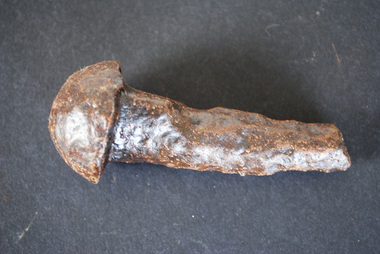
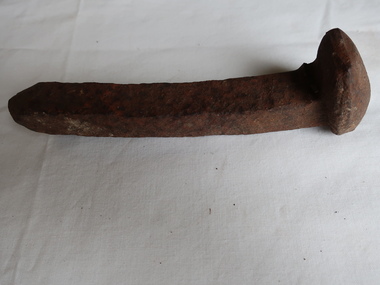
Railway Bolt, Estimated 1890-1948
... ...sleeper bolt...Cast iron railway bolt used to fasten the railway track to the wooden sleepers below....railway bolt wensleydale railway sleeper bolt rail track fastener None Cast iron railway bolt used to fasten the railway track to the wooden sleepers below. ...Cast iron railway bolt used to fasten the railway track to the wooden sleepers below.Nonerailway bolt, wensleydale railway, sleeper bolt, rail track fastener -
 Glenelg Shire Council Cultural Collection
Photograph - Photograph - Timber Structure, n.d
... inside corner, round poles and sleepers bolted together holding up walls of slats and vertical boards. 7295...inside corner, round poles and sleepers bolted together holding up walls of slats and vertical boards. 7295 Photograph Photograph - Timber Structure ...Sourced from Casterton Town Hall (former Shire of Glenelg)Coloured photograph. Same structure as 7295. ?inside corner, round poles and sleepers bolted together holding up walls of slats and vertical boards. 7295 -
 Dandenong/Cranbourne RSL Sub Branch
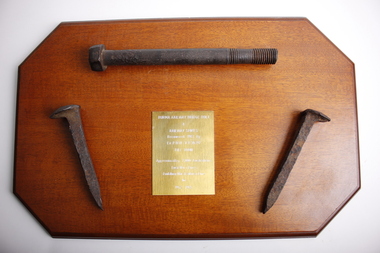
Souvenir - Burma Rail Bridge Bolt & Railway Spikes.On wooden plaque
... bolt and 2 metal railway line spikes. Spikes have lip on top to hold rail lines down with chisel shaped ends to be driven into sleepers. ...bolt and 2 metal railway line spikes. Spikes have lip on top to hold rail lines down with chisel shaped ends to be driven into sleepers. ...Plaque with metal railway bridge bolt and 2 metal railway line spikes. Spikes have lip on top to hold rail lines down with chisel shaped ends to be driven into sleepers. Metal bolt used to hold railway sleepers to bridgesNo markings on spikes or bolt. Plaque brass plate engraved-: BURMA RAILWAY BRIDGE BOLT & RAILWAY SPIKES Recovered 1987 By Ex P.O.W V.X. 30397 BILL TOON Approximatly 7,000 Australians Lost Their Lives Building This Railway Line 1942-1945. -
 Melbourne Tram Museum
Photograph - Set of 8 Black & White Photograph/s, Melbourne & Metropolitan Tramways Board (MMTB), 1966
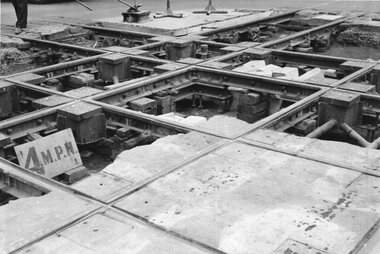
... Series of 8 black and white photographs of the trackwork used at H crossings (where two tracks cross another two tracks at right angles.) .1 - H crossing being renewed. .2 - New H crossing laide out in a yard .3 - H crossing being completed at Queensway / Chapel and Dandenong Road, early 1968 with the All Saints church in the background. .4 - being renewed .5 - ditto .6 - ditto with a tram crossing. .7 - as for .4 .8 - showing extensive fish plating on a wooden longitudinal sleepers, plates bolted to the wood or timbers....Trams tramways Trackwork Rails Track Materials Track Repairs Sleepers Equipment Queensway Chapel St Dandenong Road Series of 8 black and white photographs of the trackwork used at H crossings (where two tracks cross another two tracks at right angles.) .1 - H crossing being renewed. .2 - New H crossing laide out in a yard .3 - H crossing being completed at Queensway / Chapel and Dandenong Road, early 1968 with the All Saints church in the background. .4 - being renewed .5 - ditto .6 - ditto with a tram crossing. .7 - as for .4 .8 - showing extensive fish plating on a wooden longitudinal sleepers, plates bolted to the wood or timbers. Photograph Set of 8 Black & White Photograph/s Melbourne & Metropolitan Tramways Board (MMTB) ...Series of 8 black and white photographs of the trackwork used at H crossings (where two tracks cross another two tracks at right angles.) .1 - H crossing being renewed. .2 - New H crossing laide out in a yard .3 - H crossing being completed at Queensway / Chapel and Dandenong Road, early 1968 with the All Saints church in the background. .4 - being renewed .5 - ditto .6 - ditto with a tram crossing. .7 - as for .4 .8 - showing extensive fish plating on a wooden longitudinal sleepers, plates bolted to the wood or timbers.trams, tramways, trackwork, rails, track materials, track repairs, sleepers, equipment, queensway, chapel st, dandenong road -
 Melbourne Tram Museum
Negative - Set of 2, Possibly Geoff Grant, c1950
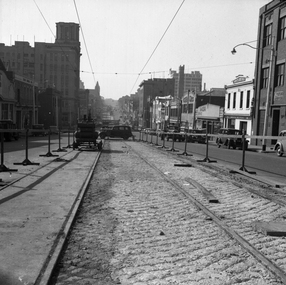
... Photo shoes the method of track construction - timber sleepers with the rail bolted to the sleeper. Pending concerting. ...Photo shoes the method of track construction - timber sleepers with the rail bolted to the sleeper. Pending concerting. ...Set of two Black and white negatives of track construction in La Trobe St during 1950. .1 - Looking east from Queen St. Has the Argus building in the view. Both tracks have been constructed and the concrete foundation poured pending the top asphalt layer, a building selling Skoda cars, .2 - Looking west from Queen St with a tram crossing in the background in William St. Photo shoes the method of track construction - timber sleepers with the rail bolted to the sleeper. Pending concerting. In the background is The Mint and terrace houses on the left. There is a billboard for 1949 movie, "The Bribe". Photo not in Wal Jack Melbourne album.trams, tramways, la trobe st, track construction, trackwork, queen st -
 Kiewa Valley Historical Society
Bridge Spike
... Railway sleeper spike spike bridge spike 15cm steel bolt-like with a square shaft. ...This spike is designed for the purpose of securing wooden planks, beams, or railroad ties to create sturdy and durable bridges.This spike was used to secure wooden railway sleepers on the railways created for the Kiewa Hydro Electric Scheme.15cm steel bolt-like with a square shaft. Sharp at one end and enlarged steel head at the other end.railway sleeper spike, spike, bridge spike -
 Warrnambool and District Historical Society Inc.
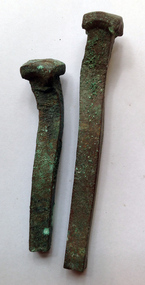
Functional object - Trade Item - Nails x 2
... These bolts have no known history but may have been used for attachment to railway sleepers or parts of a ship or used in roofing....These bolts have no known history but may have been used for attachment to railway sleepers or parts of a ship or used in roofing. ...These bolts have no known history but may have been used for attachment to railway sleepers or parts of a ship or used in roofing.These bolts are of interest only as antiquarian objects showing the types of nails or bolts used in a previous time. They may be useful for display.These are two large nails or bolts made of iron with a square knob on the top. There is some oxidisation and both bolts are slightly bent out of shape.bolts, nails -
 Otway Districts Historical Society
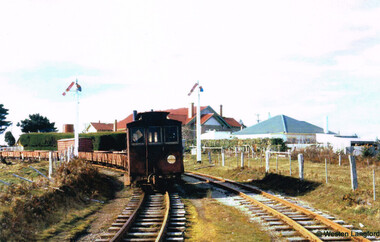
Photograph, Langford, Weston, Goods train arriving at Beech Forest, 1961, 9 August 1961
... The issue of second-hand sleepers stopped entirely and the two track gangs only patrolled the track and tightened loose bolts. ...The issue of second-hand sleepers stopped entirely and the two track gangs only patrolled the track and tightened loose bolts. ...From late in 1960 VR took what were the first definite steps to close the Colac-Beech Forest line. 1,101 tonnes of freight per year flowed from Colac to Beech Forest because of increasing competition from the roads. From 1 July 1960 onwards, when pulpwood (hardwood) stopped being shipped from Beech Forest, a maximum of only 7,000 tonnes/year would be shipped to Colac. Including special trips passenger revenue earned a little more than $200 per annum. The issue of second-hand sleepers stopped entirely and the two track gangs only patrolled the track and tightened loose bolts. The line did not earn its way and on 4 November 1960 it was recommended that services over the narrow gauge line be discontinued.The rear of a goods train from Colac arrives at Beech Forest on 9 August 1961. The other line is the former Crowes line truncated at Weeaproinah in January 1955. In the background is the Beech Forest Hall and Shire of Otway offices. Colour.colac; beech forest; railway; -
 Ballarat Tramway Museum
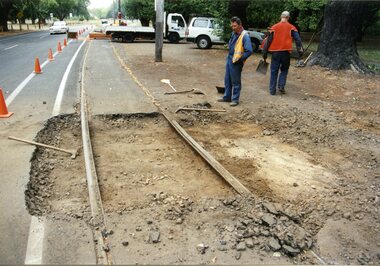
Photograph - Colour Print/s - set of 13, Warren Doubleday, 15/03/2003 12:00:00 AM
... Photos taken on 15 and 16/3/2003, printed on AGFA paper. 2555.1 - Gary Wood, Oedf Byslma looking at the excavated area, with sleeper cutting going on in the background. 2555.2 - Gary Wood and Alan Snowball, cleaning rails and the area, shows status, which was tight to gauge. 2555.3 - Removing sleepers. 2555.4 - First sleeper installed. 2555.5 - Cutting sleepers to length - Rolf Jinks and Andrew Mitchell. 2555.6 - Installing sleepers. 2555.7 - All 4 new ones positioned. 2555.8 - Cutting bolts from old plate. 2555.9 - Bending the rail. 2555.10 - Tram 33 at the temporary terminus. 2555.11 - Rail repositioned. 2555.12 - Installing the screw spikes - Gary Wood, Alastair Reither, Andrew Mitchell and Alan Snowball. 2555.13 - Welding the plates etc - 16/3/2003 - Alan Snowball....Photos taken on 15 and 16/3/2003, printed on AGFA paper. 2555.1 - Gary Wood, Oedf Byslma looking at the excavated area, with sleeper cutting going on in the background. 2555.2 - Gary Wood and Alan Snowball, cleaning rails and the area, shows status, which was tight to gauge. 2555.3 - Removing sleepers. 2555.4 - First sleeper installed. 2555.5 - Cutting sleepers to length - Rolf Jinks and Andrew Mitchell. 2555.6 - Installing sleepers. 2555.7 - All 4 new ones positioned. 2555.8 - Cutting bolts from old plate. 2555.9 - Bending the rail. 2555.10 - Tram 33 at the temporary terminus. 2555.11 - Rail repositioned. 2555.12 - Installing the screw spikes - Gary Wood, Alastair Reither, Andrew Mitchell and Alan Snowball. 2555.13 - Welding the plates etc - 16/3/2003 - Alan Snowball. ...Set of thirteen colour photographs of the repair of the broken joint in Wendouree Parade as part of the track works in the area. Photos taken on 15 and 16/3/2003, printed on AGFA paper. 2555.1 - Gary Wood, Oedf Byslma looking at the excavated area, with sleeper cutting going on in the background. 2555.2 - Gary Wood and Alan Snowball, cleaning rails and the area, shows status, which was tight to gauge. 2555.3 - Removing sleepers. 2555.4 - First sleeper installed. 2555.5 - Cutting sleepers to length - Rolf Jinks and Andrew Mitchell. 2555.6 - Installing sleepers. 2555.7 - All 4 new ones positioned. 2555.8 - Cutting bolts from old plate. 2555.9 - Bending the rail. 2555.10 - Tram 33 at the temporary terminus. 2555.11 - Rail repositioned. 2555.12 - Installing the screw spikes - Gary Wood, Alastair Reither, Andrew Mitchell and Alan Snowball. 2555.13 - Welding the plates etc - 16/3/2003 - Alan Snowball.trackwork, wendouree parade, track, tram 33 -
 Puffing Billy Railway
Double Headed Rail, circa 1872 - 1883
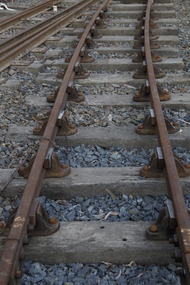
... sleepers. The double-headed rail demonstrates an important stage in the evolution of British rail technology in the 1830s. The old fish plates, square headed bolts...sleepers. The double-headed rail demonstrates an important stage in the evolution of British rail technology in the 1830s. The old fish plates, square headed bolts ...Double Headed Rail from Ravenswood Station Siding which was dismantled circa 1987 the two rails were stored for a time at Maldon before being donated to Puffing Billy Museum Bearing makers marks of Wilson & Cammell - Dronfield- Steel works Wilson & Cammell made Steel rails at their Dronfield Steel Works, in Dronfield, North East Derbyshire, England from 1872 - 1883 Double-headed rail In late 1830s Britain, railway lines had a vast range of different patterns. One of the earliest lines to use double-headed rail was the London and Birmingham Railway, which had offered a prize for the best design. This rail was supported by chairs and the head and foot of the rail had the same profile. The supposed advantage was that, when the head became worn, the rail could be turned over and re-used. In practice, this form of recycling was not very successful as the chair caused dents in the lower surface, and double-headed rail evolved into bullhead rail in which the head was more substantial than the foot. Info from Wikipedia - Rail Profile https://en.wikipedia.org/wiki/Rail_profile The first records of double headed rail being used In Victoria by Victorian Railways was in 1859, the rails, chairs, oak and trenails were imported from UK. After the 1870’s the Victorian Railways went over to using flat bottom rails, but they still needed replacement double headed rail for lines already laid and this continued up to at least 1883 Wilson & Cammell - Dronfield- Steel works Wilson & Cammell made Steel rails at their Dronfield Steel Works, in Dronfield England from 1872 - 1883 Mount Alexander & Murray River Railway The Melbourne, Mount Alexander & Murray River Railway Company received parliamentary assent in February 1853 to build Victoria's first inland railway from Melbourne to Williamstown, and Melbourne to Bendigo and Echuca. Construction commenced in January 1854 with work on a pier at Williamstown but lack of funds slowed progress, eventually prompting the company to sell out to the government. The 100-mile (162 km) section to Bendigo opened in October 1862. Its cost of £35,000 per mile made it the most expensive railway ever built in Australia. In 1864, the line was extended to Echuca, tapping into the booming Murray-Darling paddlesteamer trade. info from Museums Victoria - Victorian Railways https://museumsvictoria.com.au/railways/theme.aspx?lvl=3&IRN=450&gall=456 1863 Ravenswood Station open on the 1st Feb 1863 Victorian Railways - purchased and imported the Rail and Chairs from Raleigh, Dalgleish, White and Co. London Importation of railway plant : abstract of a return to an order of the Legislative Assembly dated 27th June 1860 for - Copies of the advertisements calling for tenders, the names of the tenderers and the accounts and correspondence with Mr Brunel relating thereto GP V 1859/60 no. C 15 http://www.parliament.vic.gov.au/papers/govpub/VPARL1859-60NoC15.pdf Report from the Select Committee upon the Importation of Railway Plant : together with proceedings of the Committee, minutes of evidence and appendix GP V 1859/60 no. D 38 (2.9 MB) http://www.parliament.vic.gov.au/papers/govpub/VPARL1859-60NoD38.pdf Ravenswood Siding When the Victorian Railways were established in 1856 they adopted one of the popular British permanent way standards - heavy 80lb (36.3kg) double-headed rail held up right in cast iron chairs attached to transverse timber sleepers by wooden pegs called trenails. The Ravenswood Railway siding was constructed in 1862 with 12 feet wrought iron double-head rail held in cast iron chairs with Ransom and May patent compressed keys. Trenails held the chairs to the sleepers and the joints were secured in joint chairs. Joints were subsequently joined using fish plates. It formed part of the Melbourne to Echuca rail line, initially known as the Melbourne, Mt Alexander and Murray River Railway. George Christian Derbyshire, the first Engineer-in-Chair of the Victorian Railways was responsible for the design and construction of the works. No new lines were built in Victoria using double-headed rail after 1870. The siding was disconnected from the main line in 1988. The Ravenswood Railway Siding demonstrates the original 1856 philosophy of the Victorian Railways to adopt British permanent way technology. The siding demonstrates significant aspects in the development of permanent way technology in England and Victoria over the period from the 1830's to the 1880's. The chairs in the Ravenswood siding are physical evidence of early railway technology rendered obsolete 120 years ago, namely joint chairs at rail joints and trenails to secure the chairs to the sleepers. The double-headed rail demonstrates an important stage in the evolution of British rail technology in the 1830s. The old fish plates, square headed bolts and square nuts demonstrate the success of fishing the rail joins. The Ravenswood siding demonstrates the earliest form of rail joint technology developed in England, and existing in Australia, the joint chair. In part of the siding the sequence of joint and intermediate chairs is consistent with the 1856 specifications, that sequence is rare with the joints secured in joint chairs. The survival of chairs in this sequence is rare and almost certainly demonstrates that they remained in continuous use at the same location from 1862 to 1988. This remnant of the Ravenswood siding has survived 126 years. The siding has proved to be the most significant of extant remnant double-headed sidings in Victoria, containing a rare combination of early permanent way technologies. Construction dates 1862, Info from Ravenswood Railway Siding Victorian Heritage Database Report http://vhd.heritagecouncil.vic.gov.au/places/4693/download-report The remaining section of this siding is significant at the State and National levels in that it demonstrates the use of chaired rail by the Victorian Railways Department for the Trunk Lines and, more particularly, the following stages in the evolution of this long obsolete method of permanent way construction: a) The use of joint chairs and intermediate chairs at regular intervals inferring that the original wrought iron rail lengths were 12 feet, as is known through documentary sources to have been the case. The survival of chairs in this sequence is unique and almost certainly demonstrates that they have remained in continuous use at the same location and in the same sequence from 1862 to 1988 . b) The use of joint chairs and intermediate chairs designed for use with trenails. c) The use of later intermediate chairs designed for use with steel pins and the use of fished joints with steel double head chaired rail, representing a second method of constructing the permanent way using chaired rail technology. info from Ravenswood Siding - Melbourne/Echuca Railway Line - Victorian Heritage Database Report http://vhd.heritagecouncil.vic.gov.au/places/70103/download-report Addition to Citation for Melbourne to EchucaRailway Line 1/10/1990 Double Head Rail The surviving lengths of double head rail with chairs on this railway compare with one surviving similar remnant on the Geelong to Ballarat railway and are representative of permanent way construction techniques applied exclusively to the two trunk railways of the 1860's. In this respect they are rare survivors and may be unique at the national level and of technical importance at the international level to the extent that they enhance contemporary understanding of early railway building technology. Surviving lengths of chaired double head rail survive at Kyneton, Ravenswood and Bendigo on this railway and include a number of different types of cast iron intermediate and joint chairs with hardwood keys and metal pins. The Ravenswood siding is of special significance for the diversity of chair types and for the sequence of chairs recalling rail lengths known to be associated with construction of the line in 1862. Construction of the Railway Tenders closed on 24 March 1858 with no less than 133 tenders being received. A contract was let to Cornish and Bruce for £3,356,937 to commence work on 1 June 1858 and complete the line by 31 July 1861. Cornish and Bruce made quick early progress with the Melbourne to Sunbury section being officially opened on 13 January 1859. The line was officially opened to Bendigo (Sandhurst) on 20 October 1862 by the Governor of Victoria, Sir Henry Barkly. A great banquet was held for 800 guests and this was followed by a grand ball. The extension of the line to Echuca was a relatively simple matter as that part of the line was across plain country without any significant engineering challenges. Tenders were called for the work in 1863 and the work was completed in 1864 by contractors Collier and Barry Apart from the line contractors, other firms directly involved were J Shire law and Co (sleepers), R Fulton, Langlands Brothers and Co, William Crossley (water supply), B Moreland, Langlands Brothers and Co (platelayers lorries), E Chambers (iron pins, traversers), Miller and McQuinstan (luggage vans and steam engines) and various contractors for building works. Info from Engineers Australia Engineering Heritage Victoria Nomination for Recognition under the Engineering Heritage Australia Heritage Recognition Program for the Goldfields Railways - Melbourne , Bendigo & Echuca Railway Page 25 - .2.9.2 Statement from National Trust of Australia (Victoria) Listing number B5323 for Mt Alexander/Murray Valley Rail Line: Page 69 - Theme 3 https://www.engineersaustralia.org.au/portal/system/files/engineering-heritage-australia/nomination-title/Melbourne_%20Bendigo_Echuca%20Railway%20Nomination.pdf The Melbourne, Mount Alexander and Murray River Railway Company was a railway company in Victoria, Australia. It was established on 8 February 1853 to build a railway from Melbourne to Echuca on the Victorian-NSW border and a branch railway to Williamstown. The company struggled to make any progress and on 23 May 1856, the colonial Government took over the Company and it became part of the newly established Department of Railways, part of the Board of Land and Works. The Department of Railways became Victorian Railways in 1859. Construction of the Bendigo line commenced in 1858, but this private consortium also met with financial difficulties when it was unable to raise sufficient funds, and was bought out by the Victorian colonial government. The design work was then taken over by Captain Andrew Clarke, R. E., Surveyor-General of Victoria, with bridge designs completed by Bryson and O'Hara The contract for the first stage of the line from Footscray to Sandhurst (now Bendigo), was let to Cornish and Bruce for £3,356,937.2s.2d ($6.714 million) with work commencing on 1 June 1858. Completion of the permanent way was to be by 31 July 1861 https://en.wikipedia.org/wiki/Melbourne,_Mount_Alexander_and_Murray_River_Railway_Company Victorian Railways - purchased and imported the Rail and Chairs from Raleigh, Dalgleish, White and Co. London Importation of railway plant : abstract of a return to an order of the Legislative Assembly dated 27th June 1860 for - Copies of the advertisements calling for tenders, the names of the tenderers and the accounts and correspondence with Mr Brunel relating thereto GP V 1859/60 no. C 15 http://www.parliament.vic.gov.au/papers/govpub/VPARL1859-60NoC15.pdf Report from the Select Committee upon the Importation of Railway Plant : together with proceedings of the Committee, minutes of evidence and appendix GP V 1859/60 no. D 38 (2.9 MB) http://www.parliament.vic.gov.au/papers/govpub/VPARL1859-60NoD38.pdf Victorian Railways : report of the Board of Land and Works November 1862 GP V 1862/63 no. 21 (2.8 MB) https://www.parliament.vic.gov.au/papers/govpub/VPARL1862-63No21.pdfHistoric - Victorian Railways - Double Headed rail Ravenswood Railway Station and Siding Victorian Heritage Database Reports Victorian Heritage Register VHR H1100 Victorian Heritage Register VHR H1786 National Trust VHR H1100 Mount Alexander and Murray River Rail way Line National Trust2 rail lengths of Double Headed Rail made of Iron makers marks : Wilson & Cammell - Dronfield - Steel and 20 joint chairs with metal rail pins Makers mark Wilson & Cammell - Dronfield - Steel (possible date 187? very hard to read ) puffing billy, double headed rail, wilson & cammell - dronfield - steel works, ravenswood station siding, melbourne to echuca rail line, initially known as the melbourne, mt alexander and murray river railway. -
 Melbourne Tram Museum
Photograph - Track laying Swanston St, 1/1926
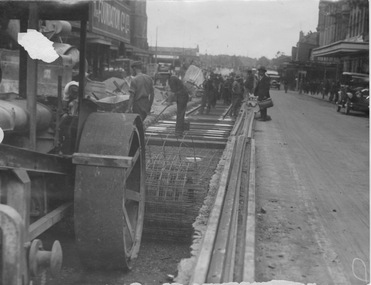
... sleepers and rails in place. A large steam powered roller is partially shown at left carrying the name of a popular construction company, The Foundation Coy. Ltd., that was contracted for many of the cable-to-electric tram conversions in the 1920s. Note that the rails being positioned are railway rails that required a check plate to be bolted...sleepers and rails in place. A large steam powered roller is partially shown at left carrying the name of a popular construction company, The Foundation Coy. Ltd., that was contracted for many of the cable-to-electric tram conversions in the 1920s. Note that the rails being positioned are railway rails that required a check plate to be bolted ...The photograph shows part of the track laying process in Swanston Street between Collins Street. and Flinders Lane with pedestrians, onlookers and motor cars. Wire mesh is being laid on the road base with some wooden sleepers and rails in place. A large steam powered roller is partially shown at left carrying the name of a popular construction company, The Foundation Coy. Ltd., that was contracted for many of the cable-to-electric tram conversions in the 1920s. Note that the rails being positioned are railway rails that required a check plate to be bolted to each rail to create a flangeway in the road surface. These plates can be seen stacked at the right of the track bed with pre-drilled holes. Work commenced on the conversion of the cable tram track in Swanston Street in December 1925 and proceed in a northerly direction towards Lonsdale Street. Yields information about the cable tram conversions in 1925-26 in Swanston Street.Sepia toned photograph with note on rear. Written in ink on rear of photograph is "Red Frame 10 of 10" wire mesh, wooden sleepers, rails, steam powered roller, tramways, swanston street, cable tram conversion, railway rail, check plate, flangeway, collins street, flinders lane, tha foundation coy. ltd. -
 Mont De Lancey
Tool - 'Jigger' Railway Sleeper Drill, Unknown
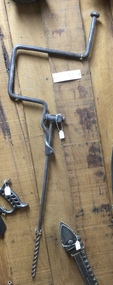
... sleepers around the early 20th Century. The 50cm drill piece can be detached and replaced and it has a handle with a knob on top to turn the drill. The drill is attached by a bolt...sleepers around the early 20th Century. The 50cm drill piece can be detached and replaced and it has a handle with a knob on top to turn the drill. The drill is attached by a bolt ...Used to drill railway sleepers in the early 20th Century.'Jigger" - an antique steel large two piece drill used to drill railway sleepers around the early 20th Century. The 50cm drill piece can be detached and replaced and it has a handle with a knob on top to turn the drill. The drill is attached by a bolt and screw.steel, metal, tool, drills -
 Melbourne Tram Museum
Photograph - Set of 15 Black & White Photograph/s, Melbourne & Metropolitan Tramways Board (MMTB), 1950's
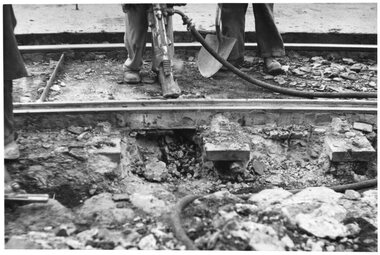
... Series of 15 black and white photographs of the track works to reconstruct tram lines showing various methods and works during the 1960's. .1 - Jackhammers concrete out around wooden sleepers - the rails have been bolted to them. .2 - Excavated track or temporary track next to newly relaid track - Hawthorn Road by Caulfield Park? ...Series of 15 black and white photographs of the track works to reconstruct tram lines showing various methods and works during the 1960's. .1 - Jackhammers concrete out around wooden sleepers - the rails have been bolted to them. .2 - Excavated track or temporary track next to newly relaid track - Hawthorn Road by Caulfield Park? ...Series of 15 black and white photographs of the track works to reconstruct tram lines showing various methods and works during the 1960's. .1 - Jackhammers concrete out around wooden sleepers - the rails have been bolted to them. .2 - Excavated track or temporary track next to newly relaid track - Hawthorn Road by Caulfield Park? .3 - Partly completed work - nearest track relaid, second track still has wood blocks? and then a temporary track. .4 - Excavated previously concreted and bolted track. Appears to be new rail. .5 - Compacting a new track bed with work laying track in the background. .6 - Rail being craned into position onto small concrete blocks - Nicholson St North Fitzroy at Church St - the church is now Melbourne City Mission Palliative care centre. 1955/56 - construction of the replacement track. Note the Hail bus stop sign on the corner. .7 - Thermite welding being set up. .8 - after a Thermite welding joint completed. .9 - track reading for pouting concrete, with a rebuilt track alongside and temporary track on the other side. .10 - ditto .11 - Concrete being poured .12 - ditto - could be Maribyrnong Road bridge replacement. .13 - Screeding off the concrete - possibly Nicholson St North Fitzroy .14 - completed surface - location as above .15 - completed surface with cloth covers to assist the concrete being cured. Has a MMTB hut and two worker amenity buses alongside. - location as above.Some photos have pencil marks on rear.trams, tramways, trackwork, rails, track materials, track repairs, sleepers, equipment, concrete, welding, nicholson st, new tramway, buses
