
Showing 14 items matching "sleeping tent"
-
 National Vietnam Veterans Museum (NVVM)
Equipment - Mosquito netting
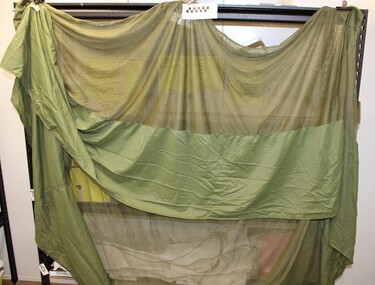
... ...sleeping tent...Vietnam Lewis Net netting protection mosquito net sleeping tent tent insect protection Conlans /Australia /1969 /(broad arrow )/8465 / 66/ 012/ 1390 Rectangular mosquito net of green nylon and nylon mesh, with corners of the net reinforced by triangular nylon patches. ...Standard issue item as used by Australian servicemen during the conflict in Vietnam. From a collection of items that were issued to National Serviceman Barry James Lewis, Service # 4721403, who served in the Australian Army Catering Corps, Detachment, 5th Australian Services Canteen Organisation, in Vietnam from 10 Nov 1970 until 21 Oct 1971.Rectangular mosquito net of green nylon and nylon mesh, with corners of the net reinforced by triangular nylon patches. Sewn into the corners and the upper seams of the mosquito net are lengths of nylon cord. This could be tied to a tree or line to suspend the mosquito net over a sleeping area. A nylon skirt around the edges is designed to be tucked under the soldier to make a floor.Conlans /Australia /1969 /(broad arrow )/8465 / 66/ 012/ 1390vietnam, lewis, net, netting, protection, mosquito net, sleeping tent, tent, insect protection -
 National Vietnam Veterans Museum (NVVM)
Equipment - Sleeping sheet
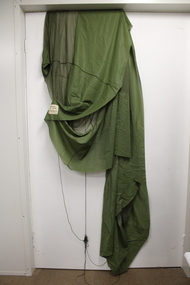
... ...sleeping tent...Mosquito net net camping equipment insect protection army sleeping tent tent Conway Brothes P/L/ S.A. 1969/ 8465-66-012-1390 Rectangular mosquito net of green nylon and nylon mesh, with corners of the net reinforced by triangular nylon patches. ...Standard issue item as used by Australian servicemen during the conflict in Vietnam.Rectangular mosquito net of green nylon and nylon mesh, with corners of the net reinforced by triangular nylon patches. Sewn into the corners and the upper seams of the mosquito net are lengths of nylon cord. This could be tied to a tree or line to suspend the mosquito net over a sleeping area. A nylon skirt around the edges is designed to be tucked under the soldier to make a floor.Conway Brothes P/L/ S.A. 1969/ 8465-66-012-1390mosquito net, net, camping equipment, insect protection, army, sleeping tent, tent -
 Southern Sherbrooke Historical Society Inc.
Photograph - Finlay Currie and dog at tent
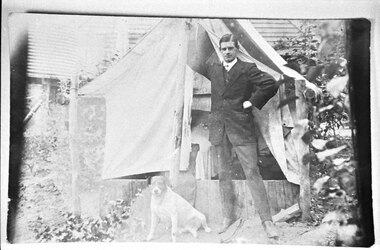
... A tiled roof house is in the background. The sleeping tent may have been erected for its health-giving benefits. ...A tiled roof house is in the background. The sleeping tent may have been erected for its health-giving benefits. ...Finlay Currie and dog at tent. Finlay appears to be in his 20s. He is wearing a three piece suit with high collared shirt. The tent has wooden logs for support and short planks at ground height. There appears to be a bed inside. The tent sides appears to be partially netting. A tiled roof house is in the background. The sleeping tent may have been erected for its health-giving benefits. -
 Tatura Irrigation & Wartime Camps Museum
Photograph, Camp 13 View, 1940
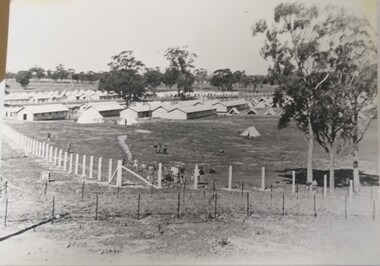
... It would seem tents the sleeping quarters of the guards....It would seem tents the sleeping quarters of the guards. Camp 13 View Photograph Photograph ...Photograph donated to Museum by Fred Ruddy who was one of the guards at Camp 13.Black and white photograph. General view from corner perimeter of Camp 13. Huts and tents particularly. It would seem tents the sleeping quarters of the guards.camp 13, fred ruddy, camp 13 sleeping quarters -
 Hume City Civic Collection
Photograph, 1/01/1972
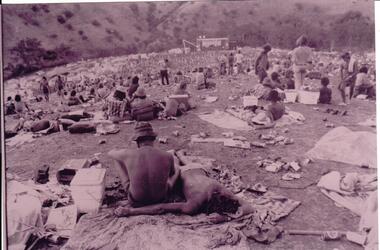
... The area is litterred with cans, eskies, blankets, sleeping bags and tents. A stage is in the background....The area is litterred with cans, eskies, blankets, sleeping bags and tents. A stage is in the background. sunbury pop festival jacksons creek duncan george george evans collection A photograph of the 1972 Sunbury Pop Festival. ...Three pop festivals were staged in Sunbury. One in 1972 and a further ones in 1974 and 1975 . The 1972 festival was the most famous and followed on in the Woodstock tradition. The festivals were staged on a property on the banks of the Jacksons Creek, owned by the Duncan family. A crowd of partly clad people sitting or lying on the ground in a wide valley listening to a performance can be seen in the image. The area is litterred with cans, eskies, blankets, sleeping bags and tents. A stage is in the background.A photograph of the 1972 Sunbury Pop Festival.sunbury pop festival, jacksons creek, duncan, george, george evans collection -
 Bendigo Historical Society Inc.
Slide - DIGGERS & MINING: THE DIGGINGS - THE DIGGERS
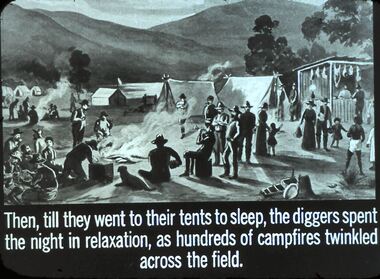
... Caption reads; Then, till they went to their tents to sleep, the diggers spent the night relaxing, as himdreds of campfires twinkled across the field. ...Caption reads; Then, till they went to their tents to sleep, the diggers spent the night relaxing, as himdreds of campfires twinkled across the field. ...Diggers & Mining: The Digging - The Diggers. Slide depicts a township of tents a butchers stall. Families sitting around camp fires, it appears that families with children are now on the goldfields not just the men. Caption reads; Then, till they went to their tents to sleep, the diggers spent the night relaxing, as himdreds of campfires twinkled across the field. Black and white side, picture is of higher quality than others. Markings: 34 994.LIF:6. Used as a teaching aid.hanimounteducation, tertiary, mining -
 Orbost & District Historical Society
black and white photograph, first half 20th century
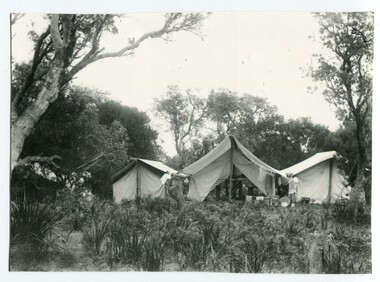
... The middle tent is open and set up as a kitchen and the outer two appear to be sleeping quarters. ...The middle tent is open and set up as a kitchen and the outer two appear to be sleeping quarters. ...This photograph is linked with photograph 1168. Orbost locals have been taking camping holidays at East Cape since at least the early 20th century. From the mid-1940s about a dozen huts were located there, mostly by locals from the Orbost area, to establish what was known as the 'Conran Settlement' or 'Conran Community'. These huts were subject to permissive occupancy laws which were invoked by the State Labor Government to force their removal in 1986. (Wikipedia)Orbost locals have been camping at Cape Conran since at least the early 20th century. This campsite is from a time before Cape Conran Coastal Park a 11,700 hectare area was declared a coastal park under the National Parks Act in 1997 and camping areas were formalised.A black / white photograph showing three large tents side by side in a bush setting. The middle tent is open and set up as a kitchen and the outer two appear to be sleeping quarters. There is fishing equipment against the middle tent - nets and tin tubs.on back - " Camping at C. Conran"cape-conran recreation-camping -
 Bendigo Historical Society Inc.
Document - Gair's Melbourne Canvas Goods Catalogue, October 1933
... Price List from Gair's Melbourne Canvas Goods Manufacturers 36 Pages: All types of canvas bags and buckets; saddle bags; tents and flys; grass catchers; umbrellas; dust covers; blinds, curtains and awnings; wagon and lorry covers; tennis nets; capenters' aprons; hoses; hammocks; swings; chairs; quoits; sleeping bags; pennants; flags; etc....The business continued trading under the name J H Abbott & Co. history bendigo abbott collection gair's melbourne canvas manufacturers Price List from Gair's Melbourne Canvas Goods Manufacturers 36 Pages: All types of canvas bags and buckets; saddle bags; tents and flys; grass catchers; umbrellas; dust covers; blinds, curtains and awnings; wagon and lorry covers; tennis nets; capenters' aprons; hoses; hammocks; swings; chairs; quoits; sleeping bags; pennants; flags; etc. ...Joseph Henry Abbott founded the business in 1853 with a store that supplied everyday essential items to those seeking their fortune on the goldfields. The timing and choice of store ensured that he would become a prominent part of the Bendigo business scene. Abbott's next venture was to establish the New Times Boot Market & Factory in Pall Mall, Sandhurst. In 1867, his wife took over running the shop which was located next to the Bendigo Arcade near Williamson Street. In 1876, the leather business of T Baulderstone was purchased, and operations were further expanded later by the acquisition of the Edinburgh Tannery at Sheepwash Creek, and The Edinburgh Leather & Grindery warehouse in Bull Street, Sandhurst. In 1889, Joseph Abbott passed all interests in the business to his son, who shared the same name, in partnership with an adopted son, Richard Hartley Smith Abbott. The business continued trading under the name J H Abbott & Co.Price List from Gair's Melbourne Canvas Goods Manufacturers 36 Pages: All types of canvas bags and buckets; saddle bags; tents and flys; grass catchers; umbrellas; dust covers; blinds, curtains and awnings; wagon and lorry covers; tennis nets; capenters' aprons; hoses; hammocks; swings; chairs; quoits; sleeping bags; pennants; flags; etc.history, bendigo, abbott collection, gair's melbourne canvas manufacturers -
 Bendigo Historical Society Inc.
Document - PETER ELLIS COLLECTION: PETER ELLIS OBITUARY
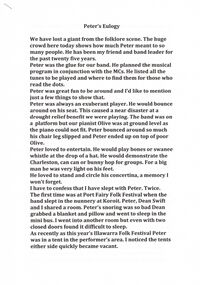
... sleep. As recently as this year's Illawarra Folk Festival Peter was in a tent in the performer's area. ...sleep. As recently as this year's Illawarra Folk Festival Peter was in a tent in the performer's area. ...3 A4 pages stapled together. Peter's Eulogy. We have lost a giant from the folklore scene. The huge crowd here today shows how much Peter meant to so many people. He has been my friend and band leader for the past twenty five years. Peter was the glue for our band. He planned the musical program in conjunction with the MCs. He listed all the tunes to be played and where to find them for those who read the dots. Peter was great fun to be around and I'd like to mention just a few things to show that. Peter was always an exuberant player. He would bounce around on his seat. This caused a near disaster at a drought relief benefit we were playing. The band was on a platform but our pianist Olive was at ground level as the piano could not fit. Peter bounced around so much his chair leg slipped and Peter ended up on top of poor Olive. Peter loved to entertain. He would play bones or swanee whistle at the drop of a hat. He would demonstrate the Charleston, can can or bunny hop for groups. For a big man he was very light on his feet. He loved to stand and circle his concertina, a memory I won't forget. I have to confess I have slept with Peter. Twice. The first time was at Port Fairy Folk Festival when the band slept in the nunnery at Koroit. Peter, Dean Swift and I shared a room. Peter's snoring was so bad Dean grabbed a blanket and a pillow and went to sleep in the mini bus. I went into another room but even with two closed doors found it difficult to sleep. As recently as this year's Illawarra Folk Festival Peter was in a tent in the performer's area. I noticed the tents either side quickly became vacant. The next time was in Canberra when Peter and I were at one end of a caravan and Mary Smith was at the other. I don't think poor Mary got much sleep that night. On another occasion in Canberra Peter was Half asleep in his van when another well known female performer (not from the band) came in and stripped off. She realised she was in the wrong van and grabbed her stuff and took off. She returned very red faced the next morning to collect her shoes. Peter maintained he saw nothing. One freezing cold night in Canberra Peter ad I had been at a terrific session in the bar. We had to support each other across the oval towards our caravan. Peter tried to straddle the fence and got stuck. There was a real Canberra frost on the fence and a sensitive part of Peter's anatomy was in grave danger of frost bite. Peter took an eternity to extricate himself. I couldn’t help him as I was laughing so much. We'll never forget making Harry McQueen's bull boar sausages at Nariel. Peter had already organised the meat and intestine casings from the butcher in Corryong. He was such an organiser and the sausages were brilliant. Peter was quirky. He always made a morning cuppa complete with tea cosy. It even left Martin Pearson speechless in the breakfast tent at Illawarra this year. Another example was when he sold his beloved FJ which is parked out the front today. As the new buyer drove off down the road Peter stood there playing 'Now is the hour' and 'wish me luck as you wave me goodbye' on his concertina. Peter loved a joke. He knew Shirley Andrews loathed the tune Danny boy so he played it in her hearing any chance he go. He even gave her a cd with a dozen different performers doing their versions of the song. We once played at the Rifle Brigade Oktoberfest and Peter was just a bit under the weather after being there for two days (the band got free drinks). The late night crowd was getting restless so Peter tried to shut them up by holding his finger up. They got more restless. Peter couldn’t understand it. 'it worked for Grummy Ross,' he wailed. It was the only time we ever over rode him and started playing without him. He wasn’t happy but disaster was averted. The dance club once had a reverse deb ball. Peter shave his beard, got his sister Robyn to make up his face and came to the ball in a lovely gown. It took ages for people to realise who it was.Margaret Hogan said the other night 'Peter let me see and do things I never would have done otherwise.' I think that is true of all of us in the band. We performed in major festivals regularly, travelled widely and had experiences such as playing at the opening of Melbourne Museum or State Parliament. Experience we'd never have had without Peter. I'm glad Peter didn’t suffer. He told me last Monday morning on my last visit he was in no pain. For that I am grateful. He passed away that night. He was taken far too young and has left a huge hole in all our lives. Personally I have lost a great mate, but then we can all say that. We'll miss you Dirty Pierre. John Williams.person, individual, peter ellis oam -
 Bendigo Historical Society Inc.
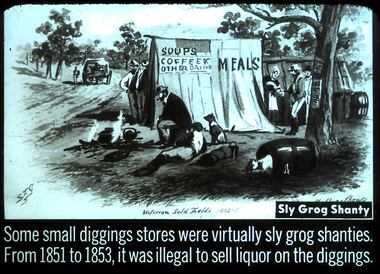
Slide - DIGGERS & MINING. STORES AT THE DIGGINGS, c1853
... Slide shows tent selling 'SOUPS COFFEE and other drinks, Meals'. Slide shows people being served, a dog sleeping in a barrel, a fire in front of the tent with miners and a dog. ...Slide shows tent selling 'SOUPS COFFEE and other drinks, Meals'. Slide shows people being served, a dog sleeping in a barrel, a fire in front of the tent with miners and a dog. ...Diggers & Mining. Stores at the diggings. STG Victorian Gold Fields 1852-3 ?? Shanty. Sly Grog Shanty. Some small diggings stores were virtually sly grog shanties. From 1851 to 1853, it was illegal to sell liquor on the diggings. Slide shows tent selling 'SOUPS COFFEE and other drinks, Meals'. Slide shows people being served, a dog sleeping in a barrel, a fire in front of the tent with miners and a dog. A tree to the right being used as a billboard. Markings: 31 994.LIF. 5. Used as a teaching aid.hanimounteducation, tertiary, goldfields -
 Otway Districts Historical Society
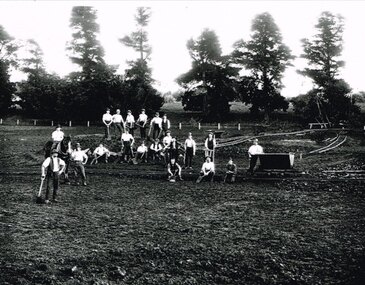
Photograph, Narrow gauge construction camp near Colac, c.1900
... They all lived in tents that consisted of a wooden floor around which the canvas cover was built. A calico partition divided the eating and sleeping quarters, and all cooking was done in camp ovens or at open fires....They all lived in tents that consisted of a wooden floor around which the canvas cover was built. A calico partition divided the eating and sleeping quarters, and all cooking was done in camp ovens or at open fires. construction camp; railways; colac; B/W. 158mm x 203mm. ...Construction of the Colac-Beech Forest railway line commenced in 1900 and the first activities were the work gangs and their camps. About 100 men were engaged in laying and ballasting the track while others formed the earthworks and the building of culverts and bridges. The first camp was established eight kilometres from Colac, the second 12 km south, and the remainder spaced at similar distances as the work progressed. The camps were served by butchers and bakers from Colac that visited them as many times each week to satisfy the mens' requirements. Many of the men had their families with them. They all lived in tents that consisted of a wooden floor around which the canvas cover was built. A calico partition divided the eating and sleeping quarters, and all cooking was done in camp ovens or at open fires.B/W. 158mm x 203mm. Near Colac, a narrow gauge construction camp comprising 21 workmen, a horse, and two tipping trays.construction camp; railways; colac; -
Port Melbourne Historical & Preservation Society
Newspaper - Newspaper clipping, Advertisment for Electrine Candles, 10 Jan 1917
... Advertising paper clipping for Electrine Candles with "Sleeping-out-Safety" as the slogan. Drawings include a candle and tent. Pasted onto blue card and dated 10 January 1917....Advertising paper clipping for Electrine Candles with "Sleeping-out-Safety" as the slogan. Drawings include a candle and tent. Pasted onto blue card and dated 10 January 1917. ...From J Kitchen and Sons Pty Ltd. Advertising paper clipping for Electrine Candles with "Sleeping-out-Safety" as the slogan. Drawings include a candle and tent. Pasted onto blue card and dated 10 January 1917.industry - manufacturing, business and traders - soaps/candles, war - world war i, health, domestic life, j kitchen & sons pty ltd, electrine candles, witch soap, rexona, s r simpson - private -
 National Wool Museum
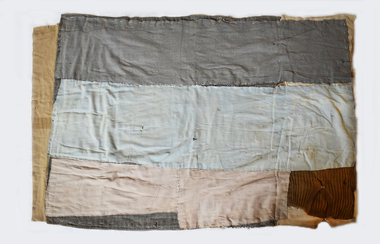
Textile - Quilt, Mrs Eileen Pattle, Old Harry's Wagga, 1942-50
... tent and the wagga were theirs. The wagga saw many more camping trips until the arrival of Bev’s “lovely new lightweight and down filled sleeping bag”. ...tent and the wagga were theirs. The wagga saw many more camping trips until the arrival of Bev’s “lovely new lightweight and down filled sleeping bag”. ...This traditional wagga blanket was made by Mrs Eileen Pattle between 1942 and 1950. The wagga was used as everyday bedding, as Eileen and her husband had very few possessions. They boarded with a man who they called “Old Harry” in Footscray. Old Harry had recently lost his wife and looked after the young couple well. They could stay with him and use his house as their own, and all that Old Harry asked for in return was for Eileen to cook him one good meal a day. The blanket was given to Mrs Beverley (Bev) Maguire, the daughter of Eileen, when she and her husband went camping one winter. Her husband was a “mad” fisherman and on one trip on which Bev joined him, her father offered the couple his old tent, that had a wall missing, and the wagga. The wagga was much appreciated as when the couple woke in the countryside, it was freezing, and they could see snow through the missing tent wall. From then on, the tent and the wagga were theirs. The wagga saw many more camping trips until the arrival of Bev’s “lovely new lightweight and down filled sleeping bag”. The wagga was made with a “make do, waste not, want not” attitude. The wagga started as an army issued blanket. The front layer has clothing and panels of mismatched material which has been added to over time. This includes an overcoat, two knitted garments, a panel from a skirt, and a panel from Old Harry’s Trousers. It also includes a man’s sleeveless knitted vest, and a knitted pram blanket. This is all stitched together with string, and the odd button. Bev said she would love to unpick the quilt to see what else is hiding inside but has resisted the urge to do so. All these layers have made the blanket incredibly warm, and heavy. The wagga has been within Bev’s family since creation and comes into the National Wool Museum Collection after serving the family well. It was used to keep everyone warm when not camping over many a winter’s night. Beverley is now getting on in years and donated the Wagga to the National Wool Museum in 2021. Her family referred to the wagga as a “collection of rags”, indicating to her that they did not wish to inherit the blanket. The wagga started as an army issue blanket. It has been made by stitching the khaki army blanket onto a hessian rear. The front layer has clothing and panels of mismatched material. This includes an overcoat, two knitted garments, a panel from a skirt, and a panel from Old Harry’s Trousers. It also includes a man’s sleeveless knitted vest, and a knitted pram blanket. This is all stitched together with string, and the odd button. It is thought that other materials are hiding within the layers of this wagga, however, uncovering these layers would involve unpicking the quilt. The wagga is 1360 x 1880mm, sized to suit a double bed. It is a heavy blanket, originating from all its panels of mismatched reused clothing. The wagga is well worn but has lasted almost 80 years. It has holes that have been lovingly re-stitched.wagga, quilt, upcycle -
 Lakes Entrance Historical Society
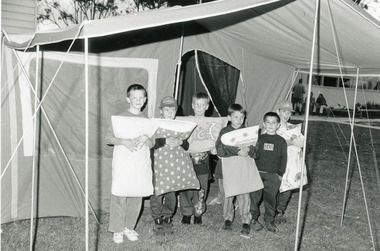
Photograph - Toorloo Arm School sleep-over 1996, Lakes Post Newspaper
... Black and white photograph six students from Toorloo Arm Primary School, standing under veranda of tent, with pillows in hand, in readiness for a sleep-over at school. ...Schools Students activities Black and white photograph six students from Toorloo Arm Primary School, standing under veranda of tent, with pillows in hand, in readiness for a sleep-over at school. ...Students identified as Jarrod Jones, Tim Brennan, Danny Page, Matt Oglesby, ? and Trevor Lancaster.Black and white photograph six students from Toorloo Arm Primary School, standing under veranda of tent, with pillows in hand, in readiness for a sleep-over at school. Toorloo Arm Victoriaschools, students, activities
