
Showing 6 items matching "small corder foot"
-
 Flagstaff Hill Maritime Museum and Village
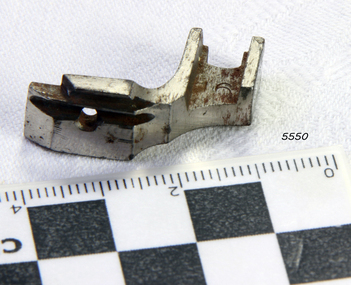
Accessory - Small Corder Foot, ca. 1891
... Small Corder Foot......small corder foot...Small corder foot for a Wertheim sewing machine. ...Circa 1891 Accessory Small Corder Foot Joseph Wertheim ...This sewing machine accessory was donated with our collection's Wertheim sewing machine accessory box. The box contains twelve accessories, the instruction book and the receipt for the purchase of a Wertheim sewing machine. The receipt was written on July 23rd 1891 by the Wertheim distributor in Melbourne, Hugo Wertheim. His business was the Wertheim Sewing Machine and Hapsburg Piano Depot, trading at 173 Williams Street, Melbourne. The purchaser was Mrs Burrowes from Burrumbeet, Victoria, a district northwest of Ballarat. She paid £6-6 (six pounds and six shillings) in cash. The receipt was signed by H. Wertheim and the other signatory looks like John A. Cherry. Hugo Wertheim (1854-1919) was an agent for his father’s cousin Joseph Wertheim, a well-established sewing machine manufacturer in Germany. He was born in Lispenhausen, Germany, and migrated to Melbourne in October 1875, where he opened a merchandising business at 39 Flinders Lane East. He returned to Germany in 1885 to marry Joseph Wertheim's daughter Sophie Emilie. The couple came back to Melbourne, and Hugo quickly established a substantial business selling sewing machines, bicycles, pianos and other mechanical devices, under brands such as Wertheim, Electra, Planet, Griffin and Hapsburg. He exhibited at agricultural shows and in 1901 at the Pan American Exposition, Buffalo, United States of America. One of his staff was O. C. Beale, who later set up his own piano business in New South Wales. Hugo continued to own 25 per cent of one of Beale's companies, which became Wertheim's Queensland business. In 1908 Hugo Wertheim opened a piano factory in Richmond, Melbourne, aiming to produce 2000 pianos and player pianos a year, predominantly using Australian materials. In laying the foundation stone, Prime Minister Alfred Deakin observed that “few men with such opportunities for a life of ease would have embarked on such an enterprise” Hugo died of chronic hepatitis in 1919 at his home in South Yarra. His eldest son, Herbert Joseph (1886-1972), continued the business. The piano factory closed in 1935, becoming a Heinz food processing plant and in 1955, GTV Channel 9 studios and offices. The Wertheim Sewing Machine Company – Joseph Wertheim (1804–1899) founded the company in 1868 in Frankfurt, Germany. At this time Joseph was the Frankfurt city delegate for the Democratic Party. At its height, the Wertheim factory employed approximately 650 workers. The company used a trademark of a dwarf holding a hammer which is known to have been used until at least 1925, however in 1909 a Star of David was also registered. In 1870 a Wertheim subsidiary was formed in Barcelona, Spain. The business imported and sold complete machines, including the English Jones machine. Locals began calling the sewing machines “las rapidas”, and the business became known as “las casa de las rapidas”. In 1915 production began of a totally manufactured Spanish Wertheim machine. Wertheim in Germany continued manufacturing machines until 1932 when the Wertheim family fled to Spain. Despite converting to Christianity from Judaism, they feared the political unrest in Germany during that time. Wertheim Spain became Rapida SA and was then the sole manufacturer of the Wertheim machines. The factory was managed by Karl Wertheim under the alias Carlos Vallin.The sewing machine accessory is part of a donation that connected to domestic life in 1891 during the Victorian era. It is significant for connecting the Melbourne distributor of Wertheim sewing machines, Hugo Wertheim, to Victoria’s northwest district where the purchaser lived. It is also significant for connecting the Melbourne distributor to the importing of goods from the well-known German manufacturer of early domestic sewing machines, Joseph Wertheim. Small corder foot for a Wertheim sewing machine. Joseph Wertheim manufacturer, Germany, distributed by Hugo Wertheim William Street Melbourne. Circa 1891flagstaff hill, flagstaff hill maritime museum and village, warrnambool, maritime museum, maritime village, great ocean road, shipwreck coast, wertheim, sewing machine, victorian era, sewing machine accessory, wertheim sewing machine and hapsburg piano depot, wertheim sewing machines, sewing machine foot, small corder foot, domestic machines, dressmaking, home industry, fashion -
 Kiewa Valley Historical Society
Polisher Floor, Hoover Appliances, Meadowbank
... A small (350mm) red coloured foot switch protrudes from the back of the motor to release the the upright handle from the storage position to the action position.There are two fork shaped brackets on the rear of the handle, for securing the 6.5 metre long electrical cord and plug. ...A small (350mm) red coloured foot switch protrudes from the back of the motor to release the the upright handle from the storage position to the action position.There are two fork shaped brackets on the rear of the handle, for securing the 6.5 metre long electrical cord and plug. ...This appliance was a time saving method of cleaning floors. It appeared at a time (after World War II) when the domestic pressures faced by mothers and domestic staff was on the increase. The necessary "working parents" was through necessity becoming part of the "typical" family environment. It was the start of the ever increasing demand, from an economical reason, for both parents to work outside their property. Historically the period of the 1950s was one of extreme changes. It was an era where established role models were under pressure from an ever increasing demand for new and advancing consumerism. Communication levels via radio, newspapers and television was expanding at an ever increasing rate. Relatively isolated rural areas were opening up (post war) to foreign ideologies of consumerism. The basic restraints of "this will be alright mate, she'll do" was under a slow but effective take over. "I can get this done faster by this new whiz bang gadget that I saw on the TV last night!" was the new way to live by.This item is very significant in that it demonstrates the new consumerism at its infant stage of the social changes occurring due to greater communication levels between the rural Australian communities and other advancing communities world wide. The Kiewa Valley residents (mainly from the intermingling of rural and post World War II refugees working at the construction of the Victorian Hydro electricity installations, resulted in this rural area becoming integrated to new ways of living (both socially and economically). Once the attitude of "we have always done it this way mate!" was challenged and overcome, the acceptance of new time saving "gadgets" which started to pour in from foreign markets, the relative isolation of the Kiewa Valley (being mainly psychological entrenched), was over.This hoover electric floor scrubber and polisher has a main base containing two brushes (can be replaced with polishing pads). The two brushes/pads are fastened or removed from the base unit by pulling/pushing the heads from the small hexagonal shaft on the bottom of the machine motor. A pressure sensitive wire is inlaid at the brush/pad end to hold the brush/pad unit onto the shaft. The discs body and main body covering the electric motor are made from sturdy plastic. The rest of the appliance materials i.e. upright handle and the u framed attaching arm are made from lightweight powder coated steel. A small (350mm) red coloured foot switch protrudes from the back of the motor to release the the upright handle from the storage position to the action position.There are two fork shaped brackets on the rear of the handle, for securing the 6.5 metre long electrical cord and plug. There is no on/off switch on the appliance. A small stainless steel "u" framed clip (for hanging the appliance in the vertical position) for cupboard storage. Within the circle of the cleaning brush is stamped "1 above S.A.B.351" and on the opposite side P/No: 5023792". On the main plastic head of the brush discs are "TO CLEAN" and under this "USE ONLY WARM(underlined) WATER AND SOAP" on the opposite side, and within a circle is the Hoover Trademark. On the front of the blue coloured plastic dome covering the electric motor is (on a raised domed shaped plaque (on a red background) Hoover in slanted print from left to right(in a diagonal level)domestic appliances, floor cleaning, electric floor scrubbers and polishers -
Hume City Civic Collection
Machine - Dictaphone
... This is a cream coloured electric dicta phone in a small brown case with plastic handle and two locks. It also has a hand held microphone, a grey metal foot pedal, an electrical cord and ear phones included in the case. ...Shire of Bulla Office equipment Stenorette This is a cream coloured electric dicta phone in a small brown case with plastic handle and two locks. It also has a hand held microphone, a grey metal foot pedal, an electrical cord and ear phones included in the case. ...This dicta phone was used by the Shire of Bulla Engineering Department for the recording of letters or other information that would then be typed up by an office person.This is a cream coloured electric dicta phone in a small brown case with plastic handle and two locks. It also has a hand held microphone, a grey metal foot pedal, an electrical cord and ear phones included in the case. This item is quite heavy.Stenoretteshire of bulla, office equipment -
 Whitehorse Historical Society Inc.
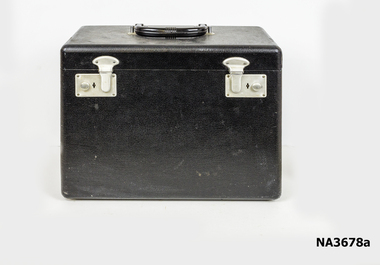
Machine - Sewing machine, 1962-63
... Foot control contained in lid of case and attached by electrical cord. Small black sewing machine. ...Foot control contained in lid of case and attached by electrical cord. Small black sewing machine. ...Singer electrical sewing machine in case. 'Featherweight' convertible Model 222K. Serial No. EL184522. Foot control contained in lid of case and attached by electrical cord. Small black sewing machine. Attachments contained in green cardboard box with 'Singer' in red on top. Black metal box with 17 attachments including owners' manual. A total of 21 items make up the setdomestic items, sewing, textile machinery -
 Mont De Lancey
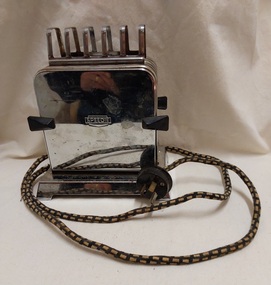
Domestic object - Toaster, Speedie Manufacturing Co, 1930's - 1960's
... footed base. It has two side-loading flip-down doors on either side with small black plastic or bakelite handles. The bread is placed inside the door, then closed to toast. When it is toasted, the door is opened and the toast flips to toast the other side. It has attached, a black and tan patterned cotton thread covered electrical cord...footed base. It has two side-loading flip-down doors on either side with small black plastic or bakelite handles. The bread is placed inside the door, then closed to toast. When it is toasted, the door is opened and the toast flips to toast the other side. It has attached, a black and tan patterned cotton thread covered electrical cord ...The vintage Speedie toaster is an iconic piece of Australian mid-century kitchenware. Manufactured by the Speedie Manufacturing Co. in Melbourne, these chrome-plated steel toasters were produced from the 1940s through the 1960s. They are renowned for their Art Deco design, "side-loading" flip-down doors, and lasting durability.design, "side-loading" flip-down doors, and lasting durability. Elmaco was an established Australian manufacturer of bakelite plugs, sockets, and electrical accessories. It has an authentic brown bakelite ELMACO plug (rated typically for 10A at 250V) Made in Australia.A vintage Art Deco silhouette style Speedie chrome plated steel two slice electric toaster on a footed base. It has two side-loading flip-down doors on either side with small black plastic or bakelite handles. The bread is placed inside the door, then closed to toast. When it is toasted, the door is opened and the toast flips to toast the other side. It has attached, a black and tan patterned cotton thread covered electrical cord which has three prongs on a black plug. On the top is a five rack stand to hold the cooked toast to keep it warm. There are four vents on each side of the body. The glowing heating element inside is called the nichrome wire which is typically wrapped back and forth across thin, flat sheets of mica, a naturally occurring heat-resistant mineral that serves as an electrical insulator.On the base of the toaster: 'V/Ac/T 5 F 240 volts 550 watts Cat No T 5F B' On the plug: 'ELMACO Made in Australia 24V 10 Amp'kitchen appliances, toasters, kitchenware, kitchen equipment -
 Mont De Lancey
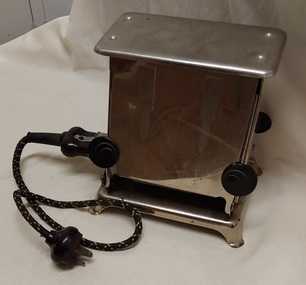
Domestic object - Toaster, Hecla Electrics Pty Ltd, 1920's - 1970's
... footed base. It has two side-loading flip-down doors on either side with two small round black bakelite handles. There is a lined pattern on each door. The top is flat with no toast rack. The bread is placed inside the door, then closed to toast. When toasted on one side the door is opened and the toast is manually flipped to toast the other side. It has a black and tan patterned cotton thread covered removable electrical cord...footed base. It has two side-loading flip-down doors on either side with two small round black bakelite handles. There is a lined pattern on each door. The top is flat with no toast rack. The bread is placed inside the door, then closed to toast. When toasted on one side the door is opened and the toast is manually flipped to toast the other side. It has a black and tan patterned cotton thread covered removable electrical cord ...The vintage Hecla toaster is an iconic piece of Australian kitchen manufacturing history. Produced by Hecla Electrics Pty Ltd—founded in Melbourne in the early 1900s—these toasters were renowned for their durable, utilitarian design. The bread is placed inside the door, then closed to toast. Because the bread required a manual flip, they are widely remembered for demanding constant supervision to prevent burning. Unlike modern disposable appliances, vintage Heclas were engineered to last. They utilized easily replaceable Nichrome wire elements on mica sheets, allowing users to buy parts from local stores and fix them at home.A vintage Hecla chrome plated steel two slice electric toaster on a footed base. It has two side-loading flip-down doors on either side with two small round black bakelite handles. There is a lined pattern on each door. The top is flat with no toast rack. The bread is placed inside the door, then closed to toast. When toasted on one side the door is opened and the toast is manually flipped to toast the other side. It has a black and tan patterned cotton thread covered removable electrical cord which has three prongs on a black plug. On one side of the toaster is a metal protruding plug for the two pronged cord to attach to. The glowing heating element inside is called the Nichrome wire which is typically wrapped back and forth across thin, flat sheets of mica, a naturally occurring heat-resistant mineral that serves as an electrical insulator.'Volts Hecla Watts 230 Cat No. 14690. Submitted to Electrical Approvals Board Reference "AJ/Ao/01 SECV Manufactured in Australia Connection inscription - 'E. H. Dixon Cat. Earth. 5 Amps. 250V'. Three prong plug inscription - ' 53. 250V. 10A. On top 'RC' letters intertwined as a symbol.kitchen appliances, toasters, kitchenware, kitchen equipment
