
Showing 36 items matching "smoker's pipe"
-
 Flagstaff Hill Maritime Museum and Village
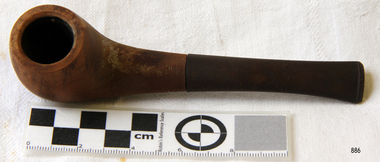
Leisure object - Tobacco Pipe, Early 20th century
... ...smoker's pipe...Smoker's tobacco pipe; a round brown wooden pipe bowl joined to a dark brown mouthpiece. ...Warrnambool Shipwreck Coast Flagstaff Hill Flagstaff Hill Maritime Museum Flagstaff Hill Maritime Village smoker's pipe tobacco pipe briar wood pipe wooden pipe smoking French pipe Bakelite smoker's equipment "French Briar Pipe" Smoker's tobacco pipe; a round brown wooden pipe bowl joined to a dark brown mouthpiece. ...People in ancient civilisations smoked pipes during various healing and religious ceremonies. By the end of the 15th century, after tobacco was discovered in America, smoking had become a common pastime for everyday people. From that time, tobacco pipes were fashioned from many materials ranging from gold and silver to corn cobs and clay. A popular material was meerschaum, an expensive, soft, white stone from Turkey. In the 1820s, French craftsmen carved pipes out of the wood from the growth on the root of a Mediterranean White Heath. This material became increasingly popular due to its durable, heat-resistant qualities. The growth was called ‘bruyere’, now anglicised to ‘briar’ wood. Bakelite was the first plastic made from synthetic components. It was developed by Leo Baekeland of New York in 1907. The material was heat-resistant and could be moulded into any shape and hardened to keep its shape. This invention greatly impacted the industrial world and the products available to the domestic market, making more objects available at reduced cost.This smoker's tobacco pipe symbolises one of the leisure activities of the early 20th century that has continued into modern times. The shape and materials of the pipe represent a point in time in the evolution of tobacco pipes, including the revolutionary impact that the 1900s invention of Bakelite had on objects available in the domestic and industrial markets.Smoker's tobacco pipe; a round brown wooden pipe bowl joined to a dark brown mouthpiece. The French pipe's bowl is made from briar wood, and its mouthpiece is Bakelite. There is an inscription on the pipe."French Briar Pipe"warrnambool, shipwreck coast, flagstaff hill, flagstaff hill maritime museum, flagstaff hill maritime village, smoker's pipe, tobacco pipe, briar wood pipe, wooden pipe, smoking, french pipe, bakelite, smoker's equipment -
 Flagstaff Hill Maritime Museum and Village
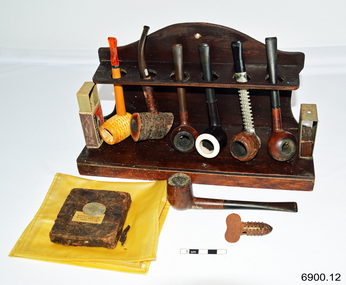
Leisure object - Pipe Stand, c. 1930's
... ...bushman's smoker's pipe brand rope...Timber smoker's pipe stand set, including 7 pipes and a pouch of cut tobacco, Part of the W.R. ...Dr Angus assisted Dr Tom Ryan, a pioneer in the use of X-rays and in ocular surgery. flagstaff hill warrnambool shipwrecked coast flagstaff hill maritime museum maritime museum shipwreck coast flagstaff hill maritime village great ocean road dr w r angu pipe stand pipe rack pipe collection smokers' pipes smoker's accessories matchbox holder pipe reamer pipe cleaner bushman's smoker's pipe brand rope bakelite smoker's pipe phoenix reg app, made in london smoker's pipe tunflow pat. pat pe nd tobacco pouch havelock tobacco tobacco the british-ambassador tobacco co. ppty. ltd, sydney, australia Etched into bushman's pipe "ROPE" Bakelite pipe is stamped "PHOENIX REG APP / MADE IN LONDON" Another Bakelite pipe is stamped "TUNFLOW PAT. ...This pipe stand or rack, together with pipes, tobacco and match box holder, was donated to Flagstaff Hill Maritime Village by the family of Doctor William Roy Angus, Surgeon and Oculist. It is part of the “W.R. Angus Collection” includes historical medical equipment, surgical instruments and material once belonging to Dr Edward Ryan and Dr Thomas Francis Ryan, (both of Nhill, Victoria) as well as Dr Angus’ own belongings. The Collection’s history spans the medical practices of the two Doctors Ryan, from 1885-1926 plus that of Dr Angus, up until 1969. ABOUT THE “W.R.ANGUS COLLECTION” Doctor William Roy Angus M.B., B.S., Adel., 1923, F.R.C.S. Edin.,1928 (also known as Dr Roy Angus) was born in Murrumbeena, Victoria in 1901 and lived until 1970. He qualified as a doctor in 1923 at University of Adelaide, was Resident Medical Officer at the Royal Adelaide Hospital in 1924 and for a period was house surgeon to Sir (then Mr.) Henry Simpson Newland. Dr Angus was briefly an Assistant to Dr Riddell of Kapunda, then commenced private practice at Curramulka, Yorke Peninsula, SA, where he was physician, surgeon and chemist. In 1926, he was appointed as new Medical Assistant to Dr Thomas Francis Ryan (T.F. Ryan, or Tom), in Nhill, Victoria, where his experiences included radiology and pharmacy. In 1927 he was Acting House Surgeon in Dr Tom Ryan’s absence. Dr Angus had become engaged to Gladys Forsyth and they decided he further his studies overseas in the UK in 1927. He studied at London University College Hospital and at Edinburgh Royal Infirmary and in 1928, was awarded FRCS (Fellow from the Royal College of Surgeons), Edinburgh. He worked his passage back to Australia as a Ship’s Surgeon on the on the Australian Commonwealth Line’s T.S.S. Largs Bay. Dr Angus married Gladys in 1929, in Ballarat. (They went on to have one son (Graham 1932, born in SA) and two daughters (Helen (died 12/07/1996) and Berenice (Berry), both born at Mira, Nhill ) According to Berry, her mother Gladys made a lot of their clothes. She was very talented and did some lovely embroidery including lingerie for her trousseau and beautifully handmade baby clothes. Dr Angus was a ‘flying doctor’ for the A.I.M. (Australian Inland Ministry) Aerial Medical Service in 1928 . Its first station was in the remote town of Oodnadatta, where Dr Angus was stationed. He was locum tenens there on North-South Railway at 21 Mile Camp. He took up this ‘flying doctor’ position in response to a call from Dr John Flynn; the organisation was later known as the Flying Doctor Service, then the Royal Flying Doctor Service. A lot of his work during this time involved dental surgery also. Between 1928-1932 he was surgeon at the Curramulka Hospital, Yorke Peninsula, South Australia. In 1933 Dr Angus returned to Nhill and purchased a share of the Nelson Street practice and Mira hospital (a 2 bed ward at the Nelson Street Practice) from Dr Les Middleton one of the Middleton Brothers, the current owners of what previously once Dr Tom Ryan’s practice. Dr Tom and his brother had worked as surgeons included eye surgery. Dr Tom Ryan performed many of his operations in the Mira private hospital on his premises. He had been House Surgeon at the Nhill Hospital 1902-1926. Dr Tom Ryan had one of the only two pieces of radiology equipment in Victoria during his practicing years – The Royal Melbourne Hospital had the other one. Over the years Dr Tom Ryan had gradually set up what was effectively a training school for country general-practitioner-surgeons. Each patient was carefully examined, including using the X-ray machine, and any surgery was discussed and planned with Dr Ryan’s assistants several days in advance. Dr Angus gained experience in using the X-ray machine there during his time as assistant to Dr Ryan. When Dr Angus bought into the Nelson Street premises in Nhill he was also appointed as the Nhill Hospital’s Honorary House Surgeon 1933-1938. His practitioner’s plate from his Nhill surgery is now mounted on the doorway to the Port Medical Office at Flagstaff Hill Maritime Village, Warrnambool. When Dr Angus took up practice in the Dr Edward and Dr Tom Ryan’s old premises he obtained their extensive collection of historical medical equipment and materials spanning 1884-1926. A large part of this collection is now on display at the Port Medical Office at Flagstaff Hill Maritime Village in Warrnambool. In 1939 Dr Angus and his family moved to Warrnambool where he purchased “Birchwood,” the 1852 home and medical practice of Dr John Hunter Henderson, at 214 Koroit Street. (This property was sold in1965 to the State Government and is now the site of the Warrnambool Police Station. and an ALDI sore is on the land that was once their tennis court). The Angus family was able to afford gardeners, cooks and maids; their home was a popular place for visiting dignitaries to stay whilst visiting Warrnambool. Dr Angus had his own silk worm farm at home in a Mulberry tree. His young daughter used his centrifuge for spinning the silk. Dr Angus was appointed on a part-time basis as Port Medical Officer (Health Officer) in Warrnambool and held this position until the 1940’s when the government no longer required the service of a Port Medical Officer in Warrnambool; he was thus Warrnambool’s last serving Port Medical Officer. (Masters of immigrant ships arriving in port reported incidents of diseases, illness and death and the Port Medical Officer made a decision on whether the ship required Quarantine and for how long, in this way preventing contagious illness from spreading from new immigrants to the residents already in the colony.) Dr Angus was a member of the Australian Medical Association, for 35 years and surgeon at the Warrnambool Base Hospital 1939-1942, He served as a Surgeon Captain during WWII1942-45, in Ballarat, Victoria, and in Bonegilla, N.S.W., completing his service just before the end of the war due to suffering from a heart attack. During his convalescence he carved an intricate and ‘most artistic’ chess set from the material that dentures were made from. He then studied ophthalmology at the Royal Melbourne Eye and Ear Hospital and created cosmetically superior artificial eyes by pioneering using the intrascleral cartilage. Angus received accolades from the Ophthalmological Society of Australasia for this work. He returned to Warrnambool to commence practice as an ophthalmologist, pioneering in artificial eye improvements. He was Honorary Consultant Ophthalmologist to Warrnambool Base Hospital for 31 years. He made monthly visits to Portland as a visiting surgeon, to perform eye surgery. He represented the Victorian South-West subdivision of the Australian Medical Association as its secretary between 1949 and 1956 and as chairman from 1956 to 1958. In 1968 Dr Angus was elected member of Spain’s Barraquer Institute of Barcelona after his research work in Intrasclearal cartilage grafting, becoming one of the few Australian ophthalmologists to receive this honour, and in the following year presented his final paper on Living Intrasclearal Cartilage Implants at the Inaugural Meeting of the Australian College of Ophthalmologists in Melbourne In his personal life Dr Angus was a Presbyterian and treated Sunday as a Sabbath, a day of rest. He would visit 3 or 4 country patients on a Sunday, taking his children along ‘for the ride’ and to visit with him. Sunday evenings he would play the pianola and sing Scottish songs to his family. One of Dr Angus’ patients was Margaret MacKenzie, author of a book on local shipwrecks that she’d seen as an eye witness from the late 1880’s in Peterborough, Victoria. In the early 1950’s Dr Angus, painted a picture of a shipwreck for the cover jacket of Margaret’s book, Shipwrecks and More Shipwrecks. She was blind in later life and her daughter wrote the actual book for her. Dr Angus and his wife Gladys were very involved in Warrnambool’s society with a strong interest in civic affairs. He had an interest in people and the community They were both involved in the creation of Flagstaff Hill, including the layout of the gardens. After his death (28th March 1970) his family requested his practitioner’s plate, medical instruments and some personal belongings be displayed in the Port Medical Office surgery at Flagstaff Hill Maritime Village, and be called the “W. R. Angus Collection”. The W.R. Angus Collection is significant for still being located at the site it is connected with, Doctor Angus being the last Port Medical Officer in Warrnambool. The collection of medical instruments and other equipment is culturally significant, being an historical example of medicine from late 19th to mid-20th century. Dr Angus assisted Dr Tom Ryan, a pioneer in the use of X-rays and in ocular surgery. Timber smoker's pipe stand set, including 7 pipes and a pouch of cut tobacco, Part of the W.R. Angus Collection. Stand holds 6 pipes upright in the rack, with metal matchbox holder on end. Stand has hanging hole in top back. Smoker's pipes: (1) corn cob pipe, orange mouthpiece (2) 'bushman's pipe', bowl carved from branch, etched in stem "ROPE" (3,4) 2x wooden bowl, Bakelite mouthpiece (5) Dark Bakelite with white rim on bowl, stamped "PHOENIX REG APP / MADE IN LONDON" (6) Bakelite mouthpiece, metal stem, wooden bowl "TUNFLOW PAT. PAT PE ND" (7) Bakelite mouthpiece and stem, wooden bowl (bowl is split). Plus metal pipe reamer/cleaner and plug of tobacco in paque tobacco pouch. Note inside pouch - “from Old Mr Bant, Panmure. He always cut a pipe full for Dr. A. when he visited him.” Pouch is stamped "O P L" (each letter in a diamond symbol). Tobacco has metal disc stamped "HAVELOCK TOBACCO" and label "The British-Ambassador Tobacco Co. Ppty. Ltd, Sydney, Australia" , "2 [above] 4 in circle" Etched into bushman's pipe "ROPE" Bakelite pipe is stamped "PHOENIX REG APP / MADE IN LONDON" Another Bakelite pipe is stamped "TUNFLOW PAT. PAT PE ND" Pouch is stamped "O P L" Tobacco has metal disc stamped "HAVELOCK TOBACCO" and label "The British-Ambassador Tobacco Co. Ppty. Ltd, Sydney, Australia" , "2 [above] 4 in circle" flagstaff hill, warrnambool, shipwrecked coast, flagstaff hill maritime museum, maritime museum, shipwreck coast, flagstaff hill maritime village, great ocean road, dr w r angu, pipe stand, pipe rack, pipe collection, smokers' pipes, smoker's accessories, matchbox holder, pipe reamer, pipe cleaner, bushman's smoker's pipe brand rope, bakelite smoker's pipe phoenix reg app, made in london, smoker's pipe tunflow pat. pat pe nd, tobacco pouch havelock tobacco, tobacco the british-ambassador tobacco co. ppty. ltd, sydney, australia -
 Flagstaff Hill Maritime Museum and Village
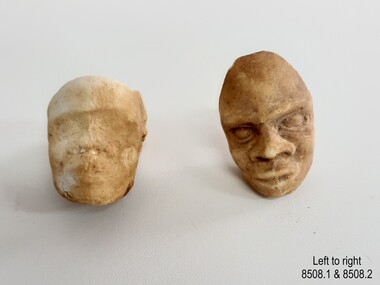
Leisure object - Tobacco Pipe Heads, circa 1869
... ...smoker’s pipe...Pipe bowls are each decorated with the image of a Negro slave head moulded into it and facing away from the smoker. ...Pipe bowls are each decorated with the image of a Negro slave head moulded into it and facing away from the smoker. ...These tobacco pipe heads are one of a group of artefacts in the McCulloch Collection that were recovered from the shipwreck Victoria Tower and were donated together. The pipe heads could have been from the ship's cargo or amongst a passenger’s personal belongings. The stems of the clay pipes would have been easily broken during the 100 or so years they were under the sea. Other tobacco pipes in our collection were recovered from the Victoria Tower and the Loch Ard. The object is now one of the shipwreck artefacts in Flagstaff Hill’s Mc Culloch Collection, which includes items recovered from the wrecks of the Victoria Tower (wrecked in 1869) and Loch Ard (wrecked in 1878). They were salvaged by a diver in the early 1970s from the southwest coast of Victoria. Advanced marine technology had enabled divers to explore the depths of the ocean and gather its treasures before the Government introduced protective legislation. The artefacts were donated to the Queensland Department of Environment and Heritage Protection (EHP) by a passionate shipwreck lover. Bruce McCulloch verified their locations. In 2017, the Department repatriated them to Flagstaff Hill, where they joined our vast collection of artefacts from Victoria’s Shipwreck Coast. The Victoria Tower: - The three-masted iron clipper ship was built in 1869 in Liverpool, England, as a passenger and cargo ship for the Australian trade. It was named after one of the two towers of the British Houses of Parliament and owned by the White Star line. The Victoria Tower sailed under the command of Captain Kerr from Liverpool towards Melbourne on its maiden voyage with 4 passengers and 16 crew plus a general cargo including bottled beer, slates, iron pipes and hardware. It was almost at her destination when, on 17th October 1869, it was wrecked at Point Impossible, west of Thompsons Creek, Breamlea, near Torquay. The shipwreck is a very popular dive site. The artefact is an example of cargo or personal items on board a ship in 1869. It provides a reference point for classifying and dating similar items. This artefact is significant for its association with the British-built, iron clipper ship Victoria Tower, a commercial and immigrant sailing ship constructed to carry cargo and passengers to colonial Australia. The vessel is recorded on the Victoria Heritage Database, VHR S698. Tobacco pipe heads, two(2); bowls of white unglased clay tobacco pipes. Pipe bowls are each decorated with the image of a Negro slave head moulded into it and facing away from the smoker. The pipe heads have no stems. Both have a vertical line down the centre of the face, broad nostrils, sunken eyes, and recessed hair. 8508.1 - features are worn, but the ear is distinct, forehead bare, eyes sunken. The bowl is complete. 8508.2 - features are distinct, eyes closed, thick, broad lips. The back section of the bowl is missing. The items were recovered from the wreck of the ship Victoria Tower.white star line, victorian heritage register, clipper ship, victoria tower, captain kerr, shipwreck victoria tower, migrant ship 1869, cargo ship 1869, iron clipper, british clipper ship, 1869, cargo imported to australia, pipe heads, clay pipe fragments, pipe, ceramic pipe, clay pipe, smoker’s pipe, smoking accessory, tobacco pipe, smoker's pipe, personal effects, tobacco, smoking pipe, smoking tool, smoking habit, smoker, tobacco smoker, tobacco pipe heads, flagstaff hill maritime museum and village, warrnambool, great ocean road, maritime museum, shipwreck artefact, southwest coast victoria, shipwreck coast, torquay, diver, bruce mcculloch, evans, liverpool, sailing ship, iron hull, migrant ship, cargo ship, 1869 shipwreck -
 Clunes Museum
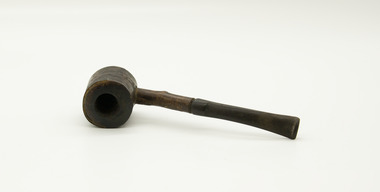
Functional object - PIPE
... SMOKERS PIPE WITH BROWN BOWL AND BLACK CURVED STEM...local history personal effects smoking accessories ROBB JUNIOR MADE IN FRANCE SMOKERS PIPE WITH BROWN BOWL AND BLACK CURVED STEM Functional object PIPE ...SMOKERS PIPE WITH BROWN BOWL AND BLACK CURVED STEMROBB JUNIOR MADE IN FRANCElocal history, personal effects, smoking accessories -
 Clunes Museum
Leisure object - PIPE
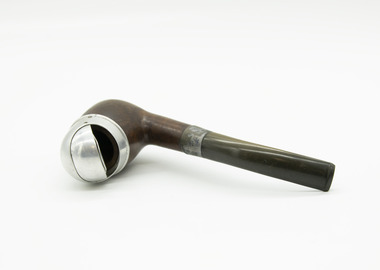
... SMOKER'S PIPE, BROWN BOWL & BLACK STEM, WITH A WIND SHIELD ATTACHED....CLEAR LONDON MADE PAT.NO 18198/10 MOTOR 26 LONDON MADE SMOKER'S PIPE, BROWN BOWL & BLACK STEM, WITH A WIND SHIELD ATTACHED. ...SMOKER'S PIPE, BROWN BOWL & BLACK STEM, WITH A WIND SHIELD ATTACHED. ON METAL WIND SHIELD: ALBEC PAT.NO 16395/11 ST. CLEAR LONDON MADE PAT.NO 18198/10 MOTOR 26 LONDON MADElocal history, personal effects, smoking accessories -
 Flagstaff Hill Maritime Museum and Village
Equipment - Smoker's Circles, R J Reynolds, Unknown
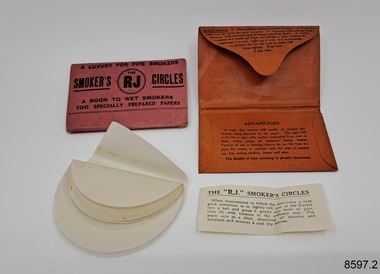
... ' Smoker's The R J (in circle) Circles'. 'A Luxury for Pipe Smokers. A Boon to Wet Smokers. 100 Specially Prepared Papers.' ...Flagstaff Hill Maritime Museum and Village Great Ocean Road Shipwreck Coast Pipes Smoking R J Reynolds ' Smoker's The R J (in circle) Circles'. 'A Luxury for Pipe Smokers. A Boon to Wet Smokers. 100 Specially Prepared Papers.' ...These Smoker's Circles, used by Dr.William Roy Angus, Surgeon and Oculist, were donated to Flagstaff Hill Maritime Village by his daughter, Bernice McDade. It is part of the “W.R. Angus Collection” that includes historical medical equipment, surgical instruments and material once belonging to Dr Edward Ryan and Dr Thomas Francis Ryan, (both of Nhill, Victoria) as well as Dr Angus’ own belongings. The Collection’s history spans the medical practices of the two Doctors Ryan, from 1885-1926 plus that of Dr Angus, up until 1969. ABOUT THE “W.R.ANGUS COLLECTION” Doctor William Roy Angus M.B., B.S., Adel., 1923, F.R.C.S. Edin.,1928 (also known as Dr Roy Angus) was born in Murrumbeena, Victoria in 1901 and lived until 1970. He qualified as a doctor in 1923 at University of Adelaide, was Resident Medical Officer at the Royal Adelaide Hospital in 1924 and for a period was house surgeon to Sir (then Mr.) Henry Simpson Newland. Dr Angus was briefly an Assistant to Dr Riddell of Kapunda, then commenced private practice at Curramulka, Yorke Peninsula, SA, where he was physician, surgeon and chemist. In 1926, he was appointed as new Medical Assistant to Dr Thomas Francis Ryan (T.F. Ryan, or Tom), in Nhill, Victoria, where his experiences included radiology and pharmacy. In 1927 he was Acting House Surgeon in Dr Tom Ryan’s absence. Dr Angus had become engaged to Gladys Forsyth and they decided he would take time to further his studies overseas in the UK in 1927. He studied at London University College Hospital and at Edinburgh Royal Infirmary and in 1928, was awarded FRCS (Fellow from the Royal College of Surgeons), Edinburgh. He worked his passage back to Australia as a Ship’s Surgeon on the on the Australian Commonwealth Line’s T.S.S. Largs Bay. Dr Angus married Gladys in 1929, in Ballarat. (They went on to have one son (Graham 1932, born in SA) and two daughters (Helen (died 12/07/1996) and Berenice (Berry), both born at Mira, Nhill ) Dr Angus was a ‘flying doctor’ for the A.I.M. (Australian Inland Ministry) Aerial Medical Service in 1928 . The organisation began in South Australia through the Presbyterian Church in that year, with its first station being in the remote town of Oodnadatta, where Dr Angus was stationed. He was locum tenens there on North-South Railway at 21 Mile Camp. He took up this ‘flying doctor’ position in response to a call from Dr John Flynn; the organisation was later known as the Flying Doctor Service, then the Royal Flying Doctor Service. A lot of his work during this time involved dental surgery also. Between 1928-1932 he was surgeon at the Curramulka Hospital, Yorke Peninsula, South Australia. In 1933 Dr Angus returned to Nhill where he’d previously worked as Medical Assistant and purchased a share of the Nelson Street practice and Mira hospital from Dr Les Middleton one of the Middleton Brothers, the current owners of what was once Dr Tom Ryan’s practice. Dr L Middleton was House Surgeon to the Nhill Hospital 1926-1933, when he resigned. [Dr Tom Ryan’s practice had originally belonged to his older brother Dr Edward Ryan, who came to Nhill in 1885. Dr Edward saw patients at his rooms, firstly in Victoria Street and in 1886 in Nelson Street, until 1901. The Nelson Street practice also had a 2 bed ward, called Mira Private Hospital ). Dr Edward Ryan was House Surgeon at the Nhill Hospital 1884-1902 . He also had occasions where he successfully performed veterinary surgery for the local farmers too. Dr Tom Ryan then purchased the practice from his brother in 1901. Both Dr Edward and Dr Tom Ryan work as surgeons included eye surgery. Dr Tom Ryan performed many of his operations in the Mira private hospital on his premises. He too was House Surgeon at the Nhill Hospital 1902-1926. Dr Tom Ryan had one of the only two pieces of radiology equipment in Victoria during his practicing years – The Royal Melbourne Hospital had the other one. Over the years Dr Tom Ryan gradually set up what was effectively a training school for country general-practitioner-surgeons. Each patient was carefully examined, including using the X-ray machine, and any surgery was discussed and planned with Dr Ryan’s assistants several days in advance. Dr Angus gained experience in using the X-ray machine there during his time as assistant to Dr Ryan. Dr Tom Ryan moved from Nhill in 1926. He became a Fellow of the Royal Australasian College of Surgeons in 1927, soon after its formation, a rare accolade for a doctor outside any of the major cities. He remained a bachelor and died suddenly on 7th Dec 1955, aged 91, at his home in Ararat. Scholarships and prizes are still awarded to medical students in the honour of Dr T.F. Ryan and his father, Dr Michael Ryan, and brother, John Patrick Ryan. ] When Dr Angus bought into the Nelson Street premises in Nhill he was also appointed as the Nhill Hospital’s Honorary House Surgeon 1933-1938. His practitioner’s plate from his Nhill surgery states “HOURS Daily, except Tuesdays, Fridays and Saturday afternoons, 9-10am, 2-4pm, 7-8pm. Sundays by appointment”. This plate is now mounted on the doorway to the Port Medical Office at Flagstaff Hill Maritime Village, Warrnambool. Dr Edward Ryan and Dr Tom Ryan had an extensive collection of historical medical equipment and materials spanning 1884-1926 and when Dr Angus took up practice in their old premises he obtained this collection, a large part of which is now on display at the Port Medical Office at Flagstaff Hill Maritime Village in Warrnambool. During his time in Nhill Dr Angus was involved in the merging of the Mira Hospital and Nhill Public Hospital into one public hospital and the property titles passed on to Nhill Hospital in 1939. In 1939 Dr Angus and his family moved to Warrnambool where he purchased “Birchwood,” the 1852 home and medical practice of Dr John Hunter Henderson, at 214 Koroit Street. (This property was sold in1965 to the State Government and is now the site of the Warrnambool Police Station. ). The Angus family was able to afford gardeners, cooks and maids; their home was a popular place for visiting dignitaries to stay whilst visiting Warrnambool. Dr Angus had his own silk worm farm at home in a Mulberry tree. His young daughter used his centrifuge for spinning the silk. Dr Angus was appointed on a part-time basis as Port Medical Officer (Health Officer) in Warrnambool and held this position until the 1940’s when the government no longer required the service of a Port Medical Officer in Warrnambool; he was thus Warrnambool’s last serving Port Medical Officer. (The duties of a Port Medical Officer were outlined by the Colonial Secretary on 21st June, 1839 under the terms of the Quarantine Act. Masters of immigrant ships arriving in port reported incidents of diseases, illness and death and the Port Medical Officer made a decision on whether the ship required Quarantine and for how long, in this way preventing contagious illness from spreading from new immigrants to the residents already in the colony.) Dr Angus was a member of the Australian Medical Association, for 35 years and surgeon at the Warrnambool Base Hospital 1939-1942, He served as a Surgeon Captain during WWII1942-45, in Ballarat, Victoria, and in Bonegilla, N.S.W., completing his service just before the end of the war due to suffering from a heart attack. During his convalescence he carved an intricate and ‘most artistic’ chess set from the material that dentures were made from. He then studied ophthalmology at the Royal Melbourne Eye and Ear Hospital and created cosmetically superior artificial eyes by pioneering using the intrascleral cartilage. Angus received accolades from the Ophthalmological Society of Australasia for this work. He returned to Warrnambool to commence practice as an ophthalmologist, pioneering in artificial eye improvements. He was Honorary Consultant Ophthalmologist to Warrnambool Base Hospital for 31 years. He made monthly visits to Portland as a visiting surgeon, to perform eye surgery. He represented the Victorian South-West subdivision of the Australian Medical Association as its secretary between 1949 and 1956 and as chairman from 1956 to 1958. In 1968 Dr Angus was elected member of Spain’s Barraquer Institute of Barcelona after his research work in Intrasclearal cartilage grafting, becoming one of the few Australian ophthalmologists to receive this honour, and in the following year presented his final paper on Living Intrasclearal Cartilage Implants at the Inaugural Meeting of the Australian College of Ophthalmologists in Melbourne In his personal life Dr Angus was a Presbyterian and treated Sunday as a Sabbath, a day of rest. He would visit 3 or 4 country patients on a Sunday, taking his children along ‘for the ride’ and to visit with him. Sunday evenings he would play the pianola and sing Scottish songs to his family. One of Dr Angus’ patients was Margaret MacKenzie, author of a book on local shipwrecks that she’d seen as an eye witness from the late 1880’s in Peterborough, Victoria. In the early 1950’s Dr Angus, painted a picture of a shipwreck for the cover jacket of Margaret’s book, Shipwrecks and More Shipwrecks. She was blind in later life and her daughter wrote the actual book for her. Dr Angus and his wife Gladys were very involved in Warrnambool’s society with a strong interest in civic affairs. Their interests included organisations such as Red Cross, Rostrum, Warrnambool and District Historical Society (founding members), Wine and Food Society, Steering Committee for Tertiary Education in Warrnambool, Local National Trust, Good Neighbour Council, Housing Commission Advisory Board, United Services Institute, Legion of Ex-Servicemen, Olympic Pool Committee, Food for Britain Organisation, Warrnambool Hospital, Anti-Cancer Council, Boys’ Club, Charitable Council, National Fitness Council and Air Raid Precautions Group. He was also a member of the Steam Preservation Society and derived much pleasure from a steam traction engine on his farm. He had an interest in people and the community He and his wife Gladys were both involved in the creation of Flagstaff Hill, including the layout of the gardens. After his death (28th March 1970) his family requested his practitioner’s plate, medical instruments and some personal belongings be displayed in the Port Medical Office surgery at Flagstaff Hill Maritime Village, and be called the “W. R. Angus Collection”.The W.R. Angus Collection is significant for still being located at the site it is connected with, Doctor Angus being the last Port Medical Officer in Warrnambool. The collection of medical instruments and other items and equipment is culturally significant, being an historical example of medicine from late 19th to mid-20th century. Dr Angus assisted Dr Tom Ryan, a pioneer in the use of X-rays and in ocular surgery.'Two packets of Smoker's Circles.'' Smoker's The R J (in circle) Circles'. 'A Luxury for Pipe Smokers. A Boon to Wet Smokers. 100 Specially Prepared Papers.' (Directions for use are printed in detail on the back of each pack.)flagstaff hill maritime museum and village, great ocean road, shipwreck coast, pipes, smoking, r j reynolds -
 J. Ward Museum Complex
Functional object - Cutter - Tobacco, 1900 - 1950
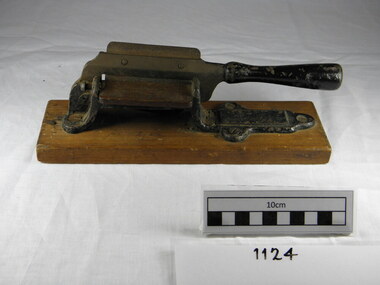
... Tobacco cutters were important tools for pipe smokers until self-made or manufactured cigarettes began to dominate the tobacco sales market from the 1920s. ...Tobacco cutters were important tools for pipe smokers until self-made or manufactured cigarettes began to dominate the tobacco sales market from the 1920s. ...Tobacco cutters were important tools for pipe smokers until self-made or manufactured cigarettes began to dominate the tobacco sales market from the 1920s. This item is a link to a previously common means of consuming tobacco.Tobacco cutters were used at both J Ward and the Aradale complex in Ararat. They were used to cut tobacco, which was then apportioned out to patients for their consumption.Metal tobacco cutter (guillotine style), mounted on wooden base, with wooden striker plate.A. McMILLAN inscribed on striker plate.tobacco, cutter -
 Bendigo Historical Society Inc.
Functional object - Tobacco Cutter
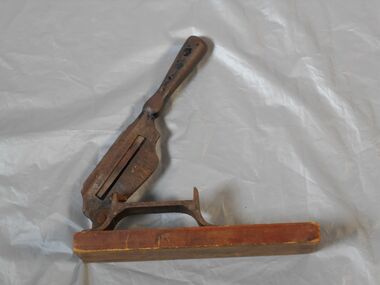
... Tobacco cutters were used to cut solid blocks of tobacco ( plugs) into finer pieces for smoking before the advent of tailormade cigarettes and particularly for pipe smokers. Wholesalers often included a cutter with bulk tobacco orders....Tobacco cutters were used to cut solid blocks of tobacco ( plugs) into finer pieces for smoking before the advent of tailormade cigarettes and particularly for pipe smokers. Wholesalers often included a cutter with bulk tobacco orders. tobacco cutter smoking instrument Metal tobacco cutter with a detachable blade on a wooden base. ...Tobacco cutters were used to cut solid blocks of tobacco ( plugs) into finer pieces for smoking before the advent of tailormade cigarettes and particularly for pipe smokers. Wholesalers often included a cutter with bulk tobacco orders.Metal tobacco cutter with a detachable blade on a wooden base.tobacco cutter, smoking instrument -
 City of Melbourne Libraries
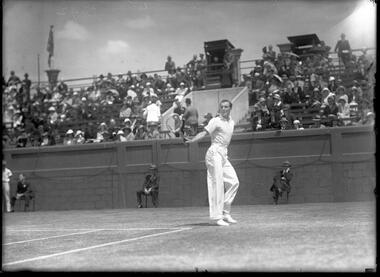
Photograph, Bull, Hugh Jones, 1897-1993, Tennis player Fred Perry, Kooyong
... Fred was an enthusiastic pipe smoker and wanted a pipe to be the logo, however he was persuaded that it wouldn’t appeal to women. ...Fred was an enthusiastic pipe smoker and wanted a pipe to be the logo, however he was persuaded that it wouldn’t appeal to women. ...Tennis champion Fred Perry backhands the ball at Kooyong, 1934 “I didn’t aspire to be a good sport, “champion” was good enough for me.” Fred Perry (1909-1995) was an English tennis champion who won eight Grand Slam titles including Wimbledon in 1934, 1935, 1936 and the Australian Open in 1934. Australian sports journalist Alan Trengove remarked, “When Perry walked out to play in his crisp white flannels and matching white blazer, thousands of female hearts missed a beat!” In 1935, Fred and Dorothy defeated Harry and Nell Hopman in the Wimbledon mixed doubles, and in 1936 they won against America. Fred started a successful sportswear brand in 1952, which continues today. Fred initially wanted a smoking pipe as the emblem as he was an enthusiastic smoker, but was talked out of it because it wouldn’t appeal to women. The familiar laurel was used instead. Featured in "Newsworthy: Melbourne in photographs 1933-1936" exhibition at East Melbourne Library, October to December 2023. Exhibition caption by project volunteer Fiona Collyer. Photographer notations on slide: "F. Perry 1934 Action B42" Photograph taken at Kooyong, Melbourne, but used in article about Wimbledon 1934. Published: The Age 7 July 1934 p 13 Published title: "THE FINAL STAGE." Published caption: F. J. Perry (England) Trove article identifier: http://nla.gov.au/nla.news-article205525840 Research by project volunteer Fiona Collyer: Frederick John Perry, 18 May 1909 to 2 Feb 1995 Fred Perry was an English tennis and table-tennis champion. He won eight Grand Slam titles – Wimbledon Gentlemen’s Singles, US Open three times, Australian Open and French Open once each. Fred had natural hand-to eye co-ordination, solid strokes and a devastating forehand that he used soon after the ball bounced. His fierce competitiveness and unabashed confidence gave him the winning edge. Fred was born in Stockport, Cheshire in 1909. His father, Samuel, a committed socialist, was a cotton spinner who became Secretary of the Co-Operative Party and later a Labour and Co-Operative Party M.P. When Fred was nine years old the family moved to Ealing, London. In 1929, at the age of 19, Fred became the World Champion at table-tennis – a new international sport at the time. He then decided to switch from table-tennis to tennis after his father told him to stop spending so much time in the smoke-filled halls that held table-tennis events. “You look like death warmed up.” he said. In the tennis world, Fred was regarded as an upstart intruder, and was the victim of snobbery and prejudice for his working class background. Fred trained with Arsenal Football Club in defiance of the LTA (Lawn Tennis Association) which had a dim view of extra-curricular exercise. His sarcastic toff-baiting call of “very clevah” when an opponent played a good shot and his habit of vaulting over the net whenever he won a match made Fred compelling to watch. Fred’s prize for winning Wimbledon was a £25 shopping voucher and a replica trophy. There was no on-court presentation; instead it was the custom to offer congratulations in the dressing rooms. One of the defining moments of Fred’s career came on the day he won Wimbledon for the first time in 1934. He was in the bathtub after the match when he over-heard former tennis player Brame Hillyard, a committee member of the All-England Club talking to Australian runner-up Jack Crawford. “This was the one day when the best man didn’t win.” Hillyard had brought a bottle of champagne and an All-England neck-tie, which was official recognition of Fred now being a member of one of the sporting world’s most elite clubs. Instead of a formal presentation to Fred, Hillyard draped the tie unceremoniously over his seat in the dressing room, handed Jack the bottle of champagne, and left. “Instead of Fred Perry the Champ, I felt like J. Fred Muggs the Chimp!” he said. When Fred finally went professional, an official at LTA told him he would never wear the club sweater again. Fred said “I made sure he wouldn’t have to worry about that, I sent a sleeve to him as a present!” In 1935, RKO offered Fred a contract for two movies at $50,000 each, but he had to turn down the offer as it would be in breach of LTA rules and he would lose his amateur status. In 1935, Fred married American film actress Helen Vinson in Harrison, New York, waking up a registrar at five minutes to midnight to avoid being married on Friday the thirteenth – “To be on the safe side” they said. In 1936, having been world number one tennis player for three years, Fred quit amateur tennis and moved to America. He joined tennis players Ellsworth Vines and Don Budge on a professional tennis circuit, travelling around US cities and receiving a share of the gate receipts. The All-England Club removed his honorary membership and the tie that went with it – “After all the trouble they’d gone to presenting it to me.” he quipped acidly. Despite being a three-time Wimbledon champion, Fred was barred from playing on LTA affiliated courts, so when he held his pro-tour through the UK in 1937, the matches had to be played on a portable wooden court, transported around by truck to football grounds. Fred was co-owner of the Beverley Hills Tennis Club. The exclusive membership consisted of Hollywood actors, directors, writers and studio heads. At the launch of the re-branded club in 1937, Fred played a doubles match with Charlie Chaplin, Groucho Marx and Ellsworth Vines, which he won with Charlie. Watching on was a Who’s Who of Hollywood actors including Barbara Stanwyck, Joan Crawford, the Marx Brothers, Errol Flynn, and Ronald Coleman to name a few. Fred was romantically linked to Hollywood actresses Marlene Dietrich, Jean Harlow, and Bette Davis, and was engaged to British actress Mary Lawson. In 1939, he became a US citizen and in 1942 enlisted in the US Air Force. Fred wore medical gauze around his right wrist while playing to stop sweat from flowing onto the handle of his racket and to wipe sweat from his brow. He paired up with former footballer Austrian Tibby Wegner to develop an anti-perspirant device. The prototype towelling sweatbands were given free to players at tournaments and proved popular. In 1952, Fred Perry Sportswear began and the trademark slimfit white polo shirt with embroidered laurel wreath on the left breast was born. The laurel wreath was inspired by Wimbledon’s original emblem and is the ancient symbol for triumph and victory. Fred was an enthusiastic pipe smoker and wanted a pipe to be the logo, however he was persuaded that it wouldn’t appeal to women. Years after the brand started, French tennis champion and sportswear designer Rene Lacoste and Fred were interviewed together for TV. Lacoste said ”I made the shirt and you made me a great compliment doing the same thing.” Fred responded “You made the back of it longer than the front – so between us we revolutionised it, didn’t we?” After Fred retired from competition tennis in 1956, he worked as a BBC tennis commentator for TV and radio and wrote columns for British newspapers. He also coached at Beca Raton Club in Florida and was director of golf at Runaway Bay in Jamaica. In 1984, 50 years after his first title, Wimbledon erected a statue of Fred. “I never thought I’d live to see the day when a statue was put up to the son of a Labour M.P. inside the manicured grounds of Wimbledon,” he said. Fred married four times, firstly to Texan actress Helen Vinson. His final marriage to Barbara Riese in 1952 lasted until his death. They had two children, Penny and David. Fred died in the Epworth Hospital, Richmond, Melbourne after falling in his hotel bathroom while visiting for the Australian Open. His ashes are in an urn near his statue at Wimbledon. - In 1975, Fred was inducted into the International Tennis Hall of Fame. - In 2002, the Fred Perry 23 km walking route was opened in Stockport. - An English Heritage blue plaque was attached to his Ealing house where he lived in from 1919-1935. A letter to The Times… In 1932, Dr Daniel Prenn and Gottfried Von Cramm of Germany beat the formally dominant Great Britain team of Fred Perry and Bunny Austin in the Davis Cup. Prenn was not selected for the 1933 Davis Cup Team after Chancellor Adolf Hitler announced his “Aryan only” agenda for Germany’s sporting bodies. Dr Prenn, a Jew, was born in Vilnius (then part of Russia), and in 1920 his family fled to Berlin as refugees after the pogroms. On 15 April 1933, Fred Perry and Bunny Austin (a member at the Oxford Group, a Christian anti-war movement), wrote a letter of protest to the London Times: "Sir, We have read with considerable dismay the official statement which has appeared in the Press that Dr D.D. Prenn is not to represent Germany in the Davis Cup on the grounds that he is of Jewish origin. We cannot but recall the scene when, less than twelve months ago, Dr Prenn before a large crowd at Berlin won for Germany against Great Britain the semi-final round of the European Zone of the Davis Cup, and was carried from the arena amidst spontaneous and tremendous enthusiasm. We have always valued our participation in international sport, because we believed it to be a great opportunity for the promotion of better international understanding and because it was a human activity that countenanced no distinction of race, class or creed. For this reason, if for none other, we view with great misgivings any action which may well undermine all that is most valuable in international competitions. Yours faithfully, H.W. Austin, Fred Perry.” Daniel Prenn emigrated to Britain in 1935. References: Fred Perry: British tennis legend, Kevin Jefferys, Pitch Publishing, 2017 'Fred Perry: The hero from the wrong side of the tramlines', Paul Newman, tennis correspondent, The Independent, 21 November 2015 https://www.independent.co.uk/sport/tennis/fred-perry-the-hero-from-the-wrong-side-of-the-tramlines-a6743721.html. 'Fred Perry: the radical of Wimbledon', Bob Holman, Socialist Worker, 26 June 2009 https://socialistworker.co.uk/comment/fred-perry-the-radical-of-wimbledon/ 'Daniel Prenn (1904-1991) – A little-known Jewish German tennis player', newmark401, Tennis Warehouse forums, 12 May 2011 http://tt.tennis-warehouse.com/index.php?threads/daniel-prenn-1904-1991-–-a-little-known-jewish-german-tennis-player.379780/Photographer notations on slide: "F. Perry 1934 Action B42".tennis, 1930-1939 -
 Flagstaff Hill Maritime Museum and Village
Furniture - Chair, Late 19th to early 20th century
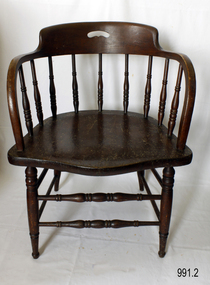
... Its name of the "Smoker’s Bow Chair" because the sweeping armrests were the perfect height to support a smokers arm when smoking a pipe....Its name of the "Smoker’s Bow Chair" because the sweeping armrests were the perfect height to support a smokers arm when smoking a pipe. A significant piece of furniture from the late 19th century designed for a specific purpose, smoking. ...Originally the Bow Chair started off life with the name of the ‘Smoker’s Bow Chair’ where originally, it wasn’t designed for grandeur like many chairs of the time, but instead was designed for practicality and comfort. The original Smoker’s Bow Chair was a simple chunkier version of the Windsor Chair design which first appeared in the 1820’s. Although it lacked the high back found on any Windsor Chair of the time, it maintained a heavier, sturdier appearance. The main feature was a hoop or bow which was fashioned from steamed wood. This was then curved to make both the back support and arms. The chair also consisted of a wide seat, supported by 4 splayed, spindle legs. In its original form it was found in many country kitchens of the day as well as in many inns and public houses throughout the United Kingdom. Its name of the "Smoker’s Bow Chair" because the sweeping armrests were the perfect height to support a smokers arm when smoking a pipe.A significant piece of furniture from the late 19th century designed for a specific purpose, smoking. These chairs are now highly collectable and valuable today and avidly sought by collectors of antique furniture.Chair wooden dark brown "Smoker's Bow" chair, with wide and deep seat with broad arms, turned spindles and thick turned legs joined by a double stretcher.Noneflagstaff hill, warrnambool, shipwrecked-coast, flagstaff-hill-maritime-museum, maritime-museum, shipwreck-coast, flagstaff-hill-maritime-village, chair, furniture, captains chair -
 Flagstaff Hill Maritime Museum and Village
Furniture - Chair, Late 19th to early 20th century
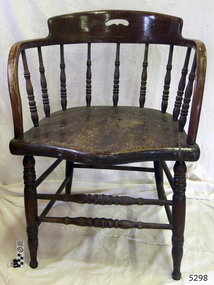
... Its name of the "Smoker’s Bow Chair" because the sweeping armrests were the perfect height to support a smokers arm when smoking a pipe....Its name of the "Smoker’s Bow Chair" because the sweeping armrests were the perfect height to support a smokers arm when smoking a pipe. A significant piece of furniture from the late 19th century designed for a specific purpose, smoking. ...Originally the Bow Chair started off life with the name of the ‘Smoker’s Bow Chair’ where originally, it wasn’t designed for grandeur like many chairs of the time, but instead was designed for practicality and comfort. The original Smoker’s Bow Chair was a simple chunkier version of the Windsor Chair design which first appeared in the 1820’s. Although it lacked the high back found on any Windsor Chair of the time, it maintained a heavier, sturdier appearance. The main feature was a hoop or bow which was fashioned from steamed wood. This was then curved to make both the back support and arms. The chair also consisted of a wide seat, supported by 4 splayed, spindle legs. In its original form it was found in many country kitchens of the day as well as in many inns and public houses throughout the United Kingdom. Its name of the "Smoker’s Bow Chair" because the sweeping armrests were the perfect height to support a smokers arm when smoking a pipe.A significant piece of furniture from the late 19th century designed for a specific purpose, smoking. These chairs are now highly collectable and valuable today and avidly sought by collectors of antique furniture.Chair wooden dark brown "Smoker's Bow" chair, with wide and deep seat with broad arms, turned spindles and thick turned legs joined by a double stretcher.Noneflagstaff hill, warrnambool, shipwrecked-coast, flagstaff-hill-maritime-museum, maritime-museum, shipwreck-coast, flagstaff-hill-maritime-village, chair, furniture, smokers chair, bow chair -
 Flagstaff Hill Maritime Museum and Village
Leisure object - Tobacco Pipes, circa 1869
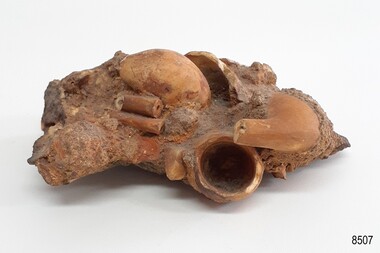
... Flagstaff Hill Warrnambool Maritime Village Maritime Museum Flagstaff Hill Maritime Museum and Village Shipwreck coast Great Ocean Road Shipwreck artefact wreck dive McCulloch Collection Bruce McCulloch White Star Line Victorian Heritage Register clipper ship Victoria Tower Captain Kerr shipwreck Victoria Tower migrant ship 1869 cargo ship 1869 iron clipper British clipper ship 1869 cargo imported to Australia pipe cluster concretion of pipes pipe ceramic pipes tobacco pipes smoker's pipes southwest coast Victoria Torquay diver Evans Liverpool sailing ship iron hull migrant ship cargo ship 1869 shipwreck Concretion of clay tobacco pipes. ...This concretion of tobacco pipes is one of a group of artefacts in the McCulloch Collection. It was recovered from the shipwreck of the Victoria Tower. The pipes may have been amongst the ship's cargo, but could have been included in a passenger’s personal effects. The object is now one of the shipwreck artefacts in Flagstaff Hill’s Mc Culloch Collection, which includes items recovered from the wrecks of the Victoria Tower (wrecked in 1869) and Loch Ard (wrecked in 1878). They were salvaged by a diver in the early 1970s from the southwest coast of Victoria. Advanced marine technology had enabled divers to explore the depths of the ocean and gather its treasures before the Government introduced protective legislation. The artefacts were donated to the Queensland Department of Environment and Heritage Protection (EHP) by a passionate shipwreck lover. Bruce McCulloch verified their locations. In 2017, the Department repatriated them to Flagstaff Hill, where they joined our vast collection of artefacts from Victoria’s Shipwreck Coast. The Victoria Tower: - The three-masted iron clipper ship was built in 1869 in Liverpool, England, as a passenger and cargo ship for the Australian trade. It was named after one of the two towers of the British Houses of Parliament and owned by the White Star line. The Victoria Tower sailed under the command of Captain Kerr from Liverpool towards Melbourne on its maiden voyage with 4 passengers and 16 crew plus a general cargo including bottled beer, slates, iron pipes and hardware. It was almost at her destination when, on 17th October, 1869, it was wrecked at Point Impossible, west of Thompsons Creek, Breamlea, near Torquay. The shipwreck is a very popular dive site.The artefact is an example of cargo or personal items on board a ship in 1869. It provides a reference point for classifying and dating similar items. This artefact is significant for its association with the British-built, iron clipper ship Victoria Tower, a commercial and immigrant sailing ship constructed to carry cargo and passengers to colonial Australia. The vessel is recorded on the Victoria Heritage Database, VHR S698.Concretion of clay tobacco pipes. Bowls and stems of several broken orange tobacco pipes are joined together in ac irregularly shaped clump of concretion from the sea. The concretion also contains stones, shells, sand and particles of seaweed. It was recovered wreck of the ship Victoria Tower.flagstaff hill, warrnambool, maritime village, maritime museum, flagstaff hill maritime museum and village, shipwreck coast, great ocean road, shipwreck artefact, wreck dive, mcculloch collection, bruce mcculloch, white star line, victorian heritage register, clipper ship, victoria tower, captain kerr, shipwreck victoria tower, migrant ship 1869, cargo ship 1869, iron clipper, british clipper ship, 1869, cargo imported to australia, pipe cluster, concretion of pipes, pipe, ceramic pipes, tobacco pipes, smoker's pipes, southwest coast victoria, torquay, diver, evans, liverpool, sailing ship, iron hull, migrant ship, cargo ship, 1869 shipwreck -
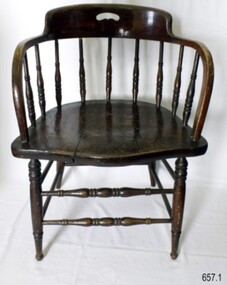 Flagstaff Hill Maritime Museum and Village
Furniture - Chair, Late 19th to early 20th century
... Its name of the "Smoker’s Bow Chair" because the sweeping armrests were the perfect height to support a smokers arm when smoking a pipe....Its name of the "Smoker’s Bow Chair" because the sweeping armrests were the perfect height to support a smokers arm when smoking a pipe. A significant piece of furniture from the late 19th century designed for a specific purpose, smoking. ...Originally the Bow Chair started off life with the name of the ‘Smoker’s Bow Chair’ where originally, it wasn’t designed for grandeur like many chairs of the time, but instead was designed for practicality and comfort. The original Smoker’s Bow Chair was a simple chunkier version of the Windsor Chair design which first appeared in the 1820’s. Although it lacked the high back found on any Windsor Chair of the time, it maintained a heavier, sturdier appearance. The main feature was a hoop or bow which was fashioned from steamed wood. This was then curved to make both the back support and arms. The chair also consisted of a wide seat, supported by 4 splayed, spindle legs. In its original form it was found in many country kitchens of the day as well as in many inns and public houses throughout the United Kingdom. Its name of the "Smoker’s Bow Chair" because the sweeping armrests were the perfect height to support a smokers arm when smoking a pipe.A significant piece of furniture from the late 19th century designed for a specific purpose, smoking. These chairs are now highly collectable and valuable today and avidly sought by collectors of antique furniture.Chair wooden dark brown "Smoker's Bow" chair, with wide and deep seat with broad arms, turned spindles and thick turned legs joined by a double stretcher.Noneflagstaff hill, warrnambool, shipwrecked-coast, flagstaff-hill-maritime-museum, maritime-museum, shipwreck-coast, flagstaff-hill-maritime-village, chair, furniture, smokers chair, bow chair -
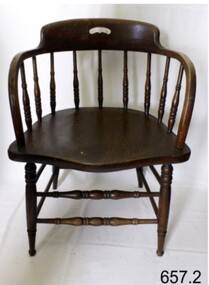 Flagstaff Hill Maritime Museum and Village
Furniture - Chair, Late 19th to early 20th century
... Its name of the "Smoker’s Bow Chair" because the sweeping armrests were the perfect height to support a smokers arm when smoking a pipe....Its name of the "Smoker’s Bow Chair" because the sweeping armrests were the perfect height to support a smokers arm when smoking a pipe. A significant piece of furniture from the late 19th century designed for a specific purpose, smoking. ...Originally the Bow Chair started off life with the name of the ‘Smoker’s Bow Chair’ where originally, it wasn’t designed for grandeur like many chairs of the time, but instead was designed for practicality and comfort. The original Smoker’s Bow Chair was a simple chunkier version of the Windsor Chair design which first appeared in the 1820’s. Although it lacked the high back found on any Windsor Chair of the time, it maintained a heavier, sturdier appearance. The main feature was a hoop or bow which was fashioned from steamed wood. This was then curved to make both the back support and arms. The chair also consisted of a wide seat, supported by 4 splayed, spindle legs. In its original form it was found in many country kitchens of the day as well as in many inns and public houses throughout the United Kingdom. Its name of the "Smoker’s Bow Chair" because the sweeping armrests were the perfect height to support a smokers arm when smoking a pipe.A significant piece of furniture from the late 19th century designed for a specific purpose, smoking. These chairs are now highly collectable and valuable today and avidly sought by collectors of antique furniture.Chair wooden dark brown "Smoker's Bow" chair, with wide and deep seat with broad arms, turned spindles and thick turned legs joined by a double stretcher.Noneflagstaff hill, warrnambool, shipwrecked-coast, flagstaff-hill-maritime-museum, maritime-museum, shipwreck-coast, flagstaff-hill-maritime-village, chair, furniture, smokers chair, bow chair -
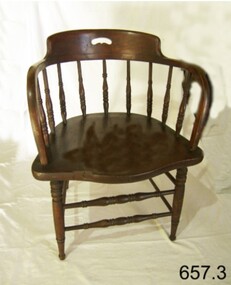 Flagstaff Hill Maritime Museum and Village
Furniture - Chair, Late 19th to early 20th century
... Its name of the "Smoker’s Bow Chair" because the sweeping armrests were the perfect height to support a smokers arm when smoking a pipe....Its name of the "Smoker’s Bow Chair" because the sweeping armrests were the perfect height to support a smokers arm when smoking a pipe. A significant piece of furniture from the late 19th century designed for a specific purpose, smoking. ...Originally the Bow Chair started off life with the name of the ‘Smoker’s Bow Chair’ where originally, it wasn’t designed for grandeur like many chairs of the time, but instead was designed for practicality and comfort. The original Smoker’s Bow Chair was a simple chunkier version of the Windsor Chair design which first appeared in the 1820’s. Although it lacked the high back found on any Windsor Chair of the time, it maintained a heavier, sturdier appearance. The main feature was a hoop or bow which was fashioned from steamed wood. This was then curved to make both the back support and arms. The chair also consisted of a wide seat, supported by 4 splayed, spindle legs. In its original form it was found in many country kitchens of the day as well as in many inns and public houses throughout the United Kingdom. Its name of the "Smoker’s Bow Chair" because the sweeping armrests were the perfect height to support a smokers arm when smoking a pipe.A significant piece of furniture from the late 19th century designed for a specific purpose, smoking. These chairs are now highly collectable and valuable today and avidly sought by collectors of antique furniture.Chair wooden dark brown "Smoker's Bow" chair, with wide and deep seat with broad arms, turned spindles and thick turned legs joined by a double stretcher.Noneflagstaff hill, warrnambool, shipwrecked-coast, flagstaff-hill-maritime-museum, maritime-museum, shipwreck-coast, flagstaff-hill-maritime-village, chair, furniture, smokers chair, bow chair -
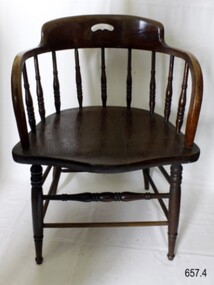 Flagstaff Hill Maritime Museum and Village
Furniture - Chair, Late 19th to early 20th century
... Its name of the "Smoker’s Bow Chair" because the sweeping armrests were the perfect height to support a smokers arm when smoking a pipe....Its name of the "Smoker’s Bow Chair" because the sweeping armrests were the perfect height to support a smokers arm when smoking a pipe. A significant piece of furniture from the late 19th century designed for a specific purpose, smoking. ...Originally the Bow Chair started off life with the name of the ‘Smoker’s Bow Chair’ where originally, it wasn’t designed for grandeur like many chairs of the time, but instead was designed for practicality and comfort. The original Smoker’s Bow Chair was a simple chunkier version of the Windsor Chair design which first appeared in the 1820’s. Although it lacked the high back found on any Windsor Chair of the time, it maintained a heavier, sturdier appearance. The main feature was a hoop or bow which was fashioned from steamed wood. This was then curved to make both the back support and arms. The chair also consisted of a wide seat, supported by 4 splayed, spindle legs. In its original form it was found in many country kitchens of the day as well as in many inns and public houses throughout the United Kingdom. Its name of the "Smoker’s Bow Chair" because the sweeping armrests were the perfect height to support a smokers arm when smoking a pipe.A significant piece of furniture from the late 19th century designed for a specific purpose, smoking. These chairs are now highly collectable and valuable today and avidly sought by collectors of antique furniture.Chair wooden dark brown "Smoker's Bow" chair, with wide and deep seat with broad arms, turned spindles and thick turned legs joined by a double stretcher.Noneflagstaff hill, warrnambool, shipwrecked-coast, flagstaff-hill-maritime-museum, maritime-museum, shipwreck-coast, flagstaff-hill-maritime-village, chair, furniture, smokers chair, bow chair -
 Orbost & District Historical Society
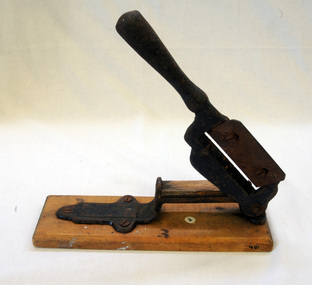
tobacco cutter, c. mid 19th century
... Tobacco cutters were important tools for pipe smokers until self-made or manufactured cigarettes began to dominate the tobacco sales market from the 1920s. ...Used to cut tobacco leaf or plugs into finer and more useable samples which could then be put into a pipe or made into a cigar or cigarette.Tobacco cutters were important tools for pipe smokers until self-made or manufactured cigarettes began to dominate the tobacco sales market from the 1920s. This item is a link to a previously common means of consuming tobacco.A metal blade cutter set onto a wooden base. The blade is rusty. tobacco-cutter tobacco-smoking -
 Orbost & District Historical Society
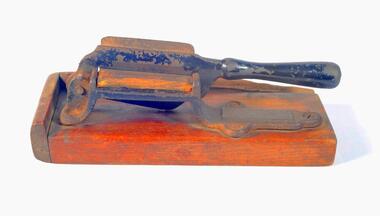
tobacco cutter, early 20th century
... Tobacco cutters were important tools for pipe smokers until self-made or manufactured cigarettes began to dominate the tobacco sales market from the 1920s. ...This McMillan Tobacco Cutter was used to cut plugs of tobacco suitable for pipes.Tobacco cutters were important tools for pipe smokers until self-made or manufactured cigarettes began to dominate the tobacco sales market from the 1920s. This item is a link to a previously common means of consuming tobacco.Large wooden block inset with metal tobacco cutter. It has a metal handle and is painted black.tobacco-cutter smoking-accessories personal-effects -
 Glenelg Shire Council Cultural Collection
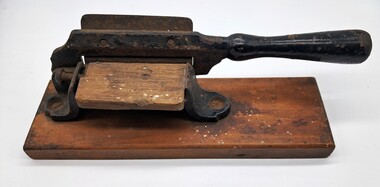
Functional object - Tobacco Cutter, McMillan, 1900-1940
... smokers until ready made cigarettes became more widely available. Tobacco cutters were regularly in use before pre-made cigarettes became more readily available. Smoking Tobacco McMillan Portland Glenelg Shire Cigarette Pipe ...This type of tobacco cutter was used to cut plugs of tobacco suitable for pipes. It was an important piece of equipment for smokers until ready made cigarettes became more widely available.Tobacco cutters were regularly in use before pre-made cigarettes became more readily available.A timber and cast iron guillotine style tobacco cutter. A rectangular timber base on which sites a cast iron stand and cutter. The cutter has a timber board (striking plate)for cutting the tobacco on. The wooden base has evidence of non-active bora. The striking plate for cutting seems to have the name of a manufacturer on it.McMillansmoking, tobacco, mcmillan, portland, glenelg shire, cigarette, pipe -
 Montmorency–Eltham RSL Sub Branch
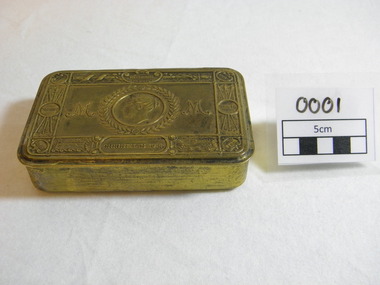
Souvenir - Princess Mary 1914 Christmas Gift Tin, Princess Mary’s 1914 Christmas Gift Tin, November/December 1914
... The contents varied considerably; officers and men on active service afloat or at the front received a box containing a combinationof pipe, lighter, tobacco and 20 cigarettes and wrappers. Non smokers received a bullet pencil and a packet of sweets instead. ...The contents varied considerably; officers and men on active service afloat or at the front received a box containing a combinationof pipe, lighter, tobacco and 20 cigarettes and wrappers. Non smokers received a bullet pencil and a packet of sweets instead. ...In November 1914, an advertisement was placed in the British national press inviting monetary contributions to a 'Sailors and Soldiers Christmas Fund' which had been created by Princess Mary, the 17 year old daughter of King George V and Queen Mary. The purpose was to provide everyone wearing the King's uniform and serving overseas on Christmas Day with a 'gift from the nation'. The response was overwhelming, and it was decided to spend the money on an embossed brass box, based on a design by Messrs Adshead and Ramsay. The contents varied considerably; officers and men on active service afloat or at the front received a box containing a combinationof pipe, lighter, tobacco and 20 cigarettes and wrappers. Non smokers received a bullet pencil and a packet of sweets instead. Indian troops often got sweets and spices, and nurses were given chocolate.This box is on loan from the grandson of the soldier who it was given to.This box is on loan from Terry Phillips. It belonged to his Grandfather who served at Gallipoli.Princess Mary 1914 Christmas Gift tin. Decorative brass with Princess Mary's profile surrounded by a laurel wreath engraved in the the centre of the lid, with the letter 'M' on both sides. The names of the allied nations are engraved in the corners and on the sides. A sword and scabbard decorate the top side. The lower side is decorated with battleships..At the top a decorative cartouche contains the words "Imperium Britannicum" and one on the lower edge contains the words "Christmas 1914". In small roundels on the corners appear the names "Belgium", "Japan", "Montenegro" and "Servia". "France and "Russia" are written on the short sides.world war one, box, brass box, princess mary 1914 christmas gift, decorative box, anzac, 1914, christmas, gift, princess, mary, russia, belgium, japan, montenegro, servia, france -
 Orbost & District Historical Society
tobacco cutter, late 19th -early 20th century
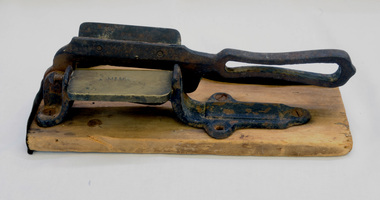
... Tobacco cutters were important tools for pipe smokers until self-made or manufactured cigarettes began to dominate the tobacco sales market from the 1920s. ...This McMillan Tobacco Cutter was used to cut plugs of tobacco suitable for pipes.Tobacco cutters were important tools for pipe smokers until self-made or manufactured cigarettes began to dominate the tobacco sales market from the 1920s. This item is a link to a previously common means of consuming tobacco.Metal tobacco cutter (guillotine style), mounted on wooden base, with brass striker plate.Inscription "McMillan" appears on the striker plate.smoking tobacco-cutter -
 Kiewa Valley Historical Society
Pipe Tobacco Smoking, Mid to late 1900s
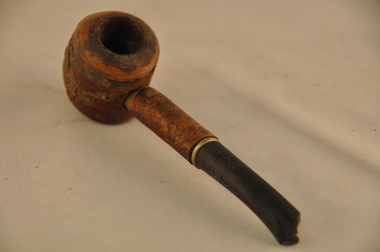
... Pipe smoking has been in vogue for centuries, and in Australia it was a symbol of the "discerning smoker" such as the landed gentry or men of professional status. ...Pipe smoking has been in vogue for centuries, and in Australia it was a symbol of the "discerning smoker" such as the landed gentry or men of professional status. ...Pipe smoking has been in vogue for centuries, and in Australia it was a symbol of the "discerning smoker" such as the landed gentry or men of professional status. This pipe, of the cherrywood style, would have suited the young professional of the mid and late 1900s. It is the type of pipe well suited to the rural backdrop. In the late 1900s, with the health related restrictions placed on public smoking these tobacco pipes were not immune from the legislation, and even though the pipe smoke was not as offensive as cigarette smoke it still came under the umbrella of smoking. Pipes were also used in the process of inhaling illicit drugs i.e. marijuana, but this use was limited to a very few. Smoking in the second millennium is being phased out as a social habit in Australia but may affect the few "private" smoker and has, as the United States prohibition era (alcoholic drinks) did, spawn an illicit trade in cheap contraband tobacco.This type of pipe lends itself well to the rural setting of the Kiewa Valley and although it is a bit bulky in shape its wooden barrel blends into the environment. The Kiewa Valley region was up until the late 1900s part of the Australian Tobacco Industry and the levels of men smoking pipes was enhanced by the readily supply of, "off the fields", tobacco leaves.This pipe has a bent stem and its style is cherrywood. The pipe has a permanent filter and a narrow tin band. The bowl is well pronounced (curved both top and bottom). The stem screws into the bowl , mid way up the bowl (similar to KVHS 0424 and KVHS.0425) and the stem is also made from bakelite (dark brown in colour). tobacco, pipe smoking, smoking accessories -
 Kiewa Valley Historical Society
Pipe Tobacco Smoking, mid to late 1990s
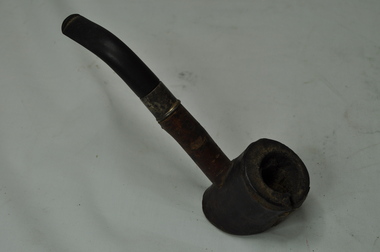
... Pipe smoking has been in vogue for centuries, and in Australia it was a symbol of the "discerning smoker" such as the landed gentry or men of professional status. ...Pipe smoking has been in vogue for centuries, and in Australia it was a symbol of the "discerning smoker" such as the landed gentry or men of professional status. ...Pipe smoking has been in vogue for centuries, and in Australia it was a symbol of the "discerning smoker" such as the landed gentry or men of professional status. This pipe, of the cherrywood style, would have suited the young professional of the mid and late 1900s. It is the type of pipe well suited to the rural backdrop. In the late 1900s, with the health related restrictions placed on public smoking, these tobacco pipes were not immune from the legislation, and even though the pipe smoke was not as offensive as cigarette smoke it still came under the umbrella of smoking. Pipes were also used in the process of inhaling illicit drugs i.e. marijuana, but this use was limited to a very few. Smoking in the second millennium is being phased out as a social habit in Australia but may affect the few "private" smoker and has, as the United States prohibition era (alcoholic drinks) did, spawn an illicit trade in cheap contraband tobacco.This type of pipe lends itself well to the rural setting of the Kiewa Valley and although it is a bit more bulky in shape its wooden barrel blends into the environment. The Kiewa Valley region was up until the late 1900s part of the Australian Tobacco Industry and the levels of men smoking pipes was enhanced by the readily supply from "off the fields", of tobacco leaves.This pipe has a bent stem and its style is cherrywood. The pipe has a permanent filter and a narrow tin band. The bowl is well pronounced (curved both top and bottom). The stem screws into the bowl , mid way up the bowl (similar to KVHS 0423 and KVHS.0425 and the stem is also made from bakelite (dark brown in colour). This stem is the same length as KVHS 0425 but the bit (mouth piece) has a gentler curve.tobacco, pipe smoking, smoking accessories -
 Kiewa Valley Historical Society
Pipe Tobacco Smoking, Circa 1900s
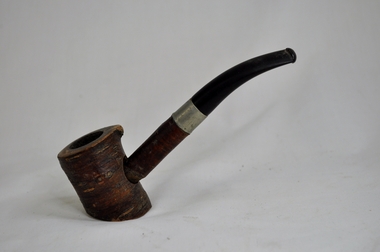
... Pipe smoking has been in vogue for centuries, and in Australia it was a symbol of the "discerning smoker" such as the landed gentry or men of professional status. ...Pipe smoking has been in vogue for centuries, and in Australia it was a symbol of the "discerning smoker" such as the landed gentry or men of professional status. ...Pipe smoking has been in vogue for centuries, and in Australia it was a symbol of the "discerning smoker" such as the landed gentry or men of professional status. This pipe, of the cherrywood style, would have suited the young professional of the mid and late 1900s. It is the type of pipe well suited to the rural backdrop. In the late 1900s, with the health related restrictions placed on public smoking these tobacco pipes were not immune from the legislation, and even though the pipe smoke was not as offensive as cigarette smoke it still came under the umbrella of smoking. Pipes were also used in the process of inhaling illicit drugs i.e. marijuana, but this use was limited to a very few. Smoking in the second millennium is being phased out as a social habit in Australia but may affect the few "private" smoker and has, as the United States prohibition era (alcoholic drinks) did, spawn an illicit trade in cheap contraband tobacco.his type of pipe lends itself well to the rural setting of the Kiewa Valley and although it is a bit more bulky in shape its wooden barrel blends into the environment. The Kiewa Valley region was up until the late 1900s part of the Australian Tobacco Industry and the levels of men smoking pipes was enhanced by the ready supply, "off the fields", of tobacco leaves and the attitude to city based smoking restrictions was one of resentment.. This pipe has a bent stem and its style is cherrywood. The pipe has a permanent filter and a narrow tin band. The bowl is well pronounced (curved both top and bottom). The stem screws into the bowl , mid way up the bowl (similar to KVHS 0423 and KVHS.0424) and the stem is also made from bakelite (dark brown in colour). This stem is the same length as KVHS 0055.001 but the bit (mouth piece) has a gentler curve.tobacco, pipe smoking, smoking accessories -
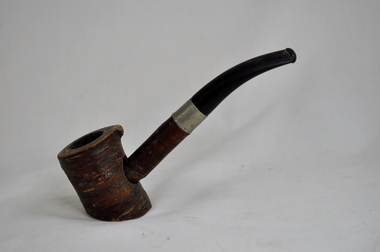 Kiewa Valley Historical Society
Pipe Tobacco Smoking, Circa 1900s
... Pipe smoking has been in vogue for centuries, and in Australia it was a symbol of the "discerning smoker" such as the landed gentry, men of professional status or student. ...Pipe smoking has been in vogue for centuries, and in Australia it was a symbol of the "discerning smoker" such as the landed gentry, men of professional status or student. ...Pipe smoking has been in vogue for centuries, and in Australia it was a symbol of the "discerning smoker" such as the landed gentry, men of professional status or student. This pipe, however,of the "corncob" style, would have suited the younger professional or student/undergraduate(male or female) of the mid and late 1900s because it was relatively inexpensive to purchase and was regarded as a "beginners pipe". It is the type of pipe well suited to the rural backdrop. In the late 1900s, with the health related restrictions placed on public smoking these tobacco pipes were not immune from the legislation, and even though the pipe smoke was not as offensive as cigarette smoke it still came under the umbrella of smoking. Pipes were also used in the process of inhaling illicit drugs i.e. marijuana, but this use was limited to a very few. Smoking in the second millennium is being phased out as a social habit in Australia but may affect the few "private" smoker and has, as the United States prohibition era (alcoholic drinks) did, spawn an illicit trade in cheap contraband tobacco.This type of pipe lends itself well to the rural setting of the Kiewa Valley and although it is a bit rough in appearance its corncob barrel blended into the environment. The Kiewa Valley region was up until the late 1900s part of the Australian Tobacco Industry and the levels of men smoking pipes was enhanced by the ready supply, "off the fields", of tobacco leaves and the attitude to city based smoking restrictions was one of resentment.This pipe has a straight stem and its "style" is corncob. Originally made from corn cobs the pipe was light in weight and easy to hold in the mouth. The pipe has a permanent filter and a black coloured tin band at the stem/shank junction. The stem fits into the wooden shank which is fastened into the bowl. The stem is made from clear plastic (orange in colour). This stem is longer(70mm) than the shank(45mm). Both are horizontal and extrude 7mm from the bottom of the bowl.tobacco, pipe smoking, smoking accessories -
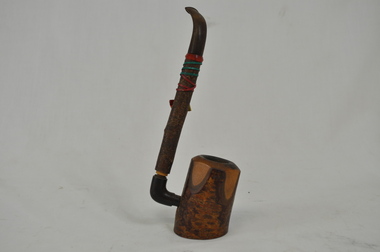 Kiewa Valley Historical Society
Pipe Tobacco Smoking, Circa 1900s
... Pipe smoking has been in vogue for centuries, and in Australia it was a symbol of the "discerning smoker" such as the landed gentry or men of professional status. ...Pipe smoking has been in vogue for centuries, and in Australia it was a symbol of the "discerning smoker" such as the landed gentry or men of professional status. ...Pipe smoking has been in vogue for centuries, and in Australia it was a symbol of the "discerning smoker" such as the landed gentry or men of professional status. This pipe, of the cherrywood style, would have suited the young professional of the mid and late 1900s. It is the type of pipe well suited to the rural backdrop. In the late 1900s, with the health related restrictions placed on public smoking these tobacco pipes were not immune from the legislation, and even though the pipe smoke was not as offensive as cigarette smoke it still came under the umbrella of smoking. Pipes were also used in the process of inhaling illicit drugs i.e. marijuana, but this use was limited to a very few. Smoking in the second millennium is being phased out as a social habit in Australia but may affect the few "private" smoker and has, as the United States prohibition era (alcoholic drinks) did, spawnThis type of pipe lends itself well to the rural setting of the Kiewa Valley and although it is a bit more bulky in shape its wooden barrel blends into the environment. The Kiewa Valley region was up until the late 1900s part of the Australian Tobacco Industry and the levels of men smoking pipes was enhanced by the ready supply, "off the fields" of tobacco leaves. It was used in a time when a good pipe was a precursor for a good relaxation activity. This method of smoking required at least one hand free to hold the pipe (especially the heavier ones) and therefore was used more by the "landed gentry, squire or academic) than by the labourer.This pipe (a ROPP brand) has a full bent vertical stem and its style is cherrywood. The pipe has a permanent filter and a orange coloured band at the stem /shank connection. The stem screws into the bowl and the shank 110mm is made from cherrywood (dark brown in colour). The bit (mouth piece) is 40mm long and in an 80 degree curviture. It has red and green coloured leather ties at the mortise/tenon location.tobacco, pipe smoking, smoking accessories -
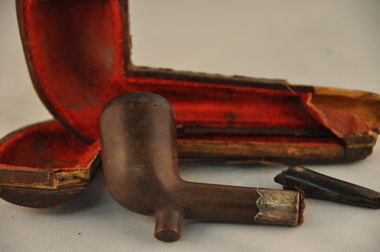 Kiewa Valley Historical Society
Pipe Tobacco Smoking, Circa 1889
... Pipe smoking has been in vogue for centuries, and in Australia it was a symbol of the "discerning smoker" such as the landed gentry or men of professional status. ...Pipe smoking has been in vogue for centuries, and in Australia it was a symbol of the "discerning smoker" such as the landed gentry or men of professional status. ...Pipe smoking has been in vogue for centuries, and in Australia it was a symbol of the "discerning smoker" such as the landed gentry or men of professional status. This pipe, of the Standard Canadian style, would have emigrated to Australia with its owner, a reasonable young professional or executive of the Hudson Bay Tobacco Company in the late 1800s or early 1900s. It is the type of pipe well suited to a harsh rural backdrop and with its owner found the Kiewa Valley a more relaxed environment than the Canadian Indian locations. The value of this pipe to the original owner, who would have sealed many trade contracts during the Canadian Indian smoke rituals In the late 1800s, is indicated by the long voyage to Australia and the Kiewa Valley. However with the health related restrictions placed on public smoking in the early 2000s, these tobacco pipes were not immune from the legislation, and even though the pipe smoke was not as offensive as cigarette smoke it still came under the umbrella of smoking. Pipes were also used in the process of inhaling illicit drugs i.e. marijuana, but this use was limited to a very few and not with this pipe. Smoking in the second millennium is being phased out as a social habit in Australia but may affect the few "private" smoker and has, as the United States prohibition era (alcoholic drinks) did, spawn an illicit trade in cheap contraband tobacco. Pipes such as this item show that smoking was not only part of the lifestyle of the era but also that it was part of a ritual (especially to the Indians of the Canada Hudson Bay region) that sealed a brotherhood not only socially but also politically and economically.This type of pipe lends itself well to the rural setting of the Kiewa Valley and although it is a very exclusive pipe it blended into the tobacco industrial environment of the Kiewa Valley and its surrounding districts. The Kiewa Valley region was up until the late 1900s part of the Australian Tobacco industry and the levels of men smoking pipes was enhanced by the readily supply, "off the fields", of tobacco leaves and the attitude to city based smoking restrictions was one of resentment.This pipe has a straight shank and stem and its style is 'standard Canadian'. The pipe has a permanent filter and a stainless steel band with the initials of the Hudson Bay Tobacco Company and its seals stamped on it.. The bowl and shank are one piece of appropriate shaped wood. The bit and bore are made from bakelite (dark brown in colour). The pipe is fashioned in the form of the clay pipes used by trappers, in the late 1800s early 1900s. It has a "rest" lug at the bottom of the bowl similar to clay pipes. This pipe has its own pipe case with wood reinforcement running the entire pipe shaped contour.On the stainless steel at the mortise and tenon junction is stamped "HP" and below that are stamped symbols of a ship's anchor, a lion and a tobacco leaf.tobacco, pipe smoking, smoking accessories -
 4th/19th Prince of Wales's Light Horse Regiment Unit History Room
Princess Mary Gift Tin, 1914
... The contents varied considerably; officers and men on active service afloat or at the front received a box containing a combination of pipe, lighter, 1 oz of tobacco and twenty cigarettes in distinctive yellow monogrammed wrappers. Non-smokers...The contents varied considerably; officers and men on active service afloat or at the front received a box containing a combination of pipe, lighter, 1 oz of tobacco and twenty cigarettes in distinctive yellow monogrammed wrappers. Non-smokers ...In November 1914, an advertisement was placed in the national press inviting monetary contributions to a 'Sailors & Soldiers Christmas Fund' which had been created by Princess Mary, the seventeen year old daughter of King George V and Queen Mary. The purpose was to provide everyone wearing the King's uniform and serving overseas on Christmas Day 1914 with a 'gift from the nation'. The response was truly overwhelming, and it was decided to spend the money on an embossed brass box, based on a design by Messrs Adshead and Ramsey. The contents varied considerably; officers and men on active service afloat or at the front received a box containing a combination of pipe, lighter, 1 oz of tobacco and twenty cigarettes in distinctive yellow monogrammed wrappers. Non-smokers and boys received a bullet pencil and a packet of sweets instead. Indian troops often got sweets and spices, and nurses were treated to chocolate. Many of these items were despatched separately from the tins themselves, as once the standard issue of tobacco and cigarettes was placed in the tin there was little room for much else apart from the greeting card All boxes, irrespective of recipient, contained a Christmas card and a picture of the Princess. Those which were not distributed until after Christmas were sent out with a card wishing the recipient a 'victorious new year'. The wounded on leave or in hospital, nurses, and the widows or parents of those killed were also entitled to the gift. Prisoners of war at the time had theirs reserved until they were repatriated. Great efforts were made to distribute the gifts in time for Christmas, and huge demands were made on an already stretched postal service. More than 355,000 were successfully delivered by the deadline. As time pressed on, a shortage of brass meant that many entitled personnel did not receive their gift until as late as the summer of 1916, and in January 1919 it was reported that 'considerable' numbers had still not been distributed. Orders for brass strip were placed with the USA, who were not yet involved in the war, and a large consignment was lost with the ship 'Lusitania'. As so much brass was being consumed in the production of weapons and munitions, the quality of the boxes which were manufactured late on was poor, being of a plated inferior alloy, when compared with the earlier pure brass examples. When the fund finally closed in 1920, almost £200,000 had been donated for the provision of more than two and a half million boxes with contents. The 'tin' is approximately 5" long by 3¼" wide by 1¼" deep with a double-skinned, hinged, lid. The surface of the lid depicts the head of Princess Mary in the centre, surrounded by a laurel wreath and flanked on either side by the 'M' monogram. At the top, a decorative cartouche contains the words 'Imperium Britannicum' with a sword and scabbard either side. On the lower edge, another cartouche contains the words 'Christmas 1914', which is flanked by the bows of battleships forging through a heavy sea. In the corners, small roundels house the names of the Allies: Belgium, Japan, Montenegro and Servia; France and Russia are at the edges, each superimposed on three furled flags or standards. -
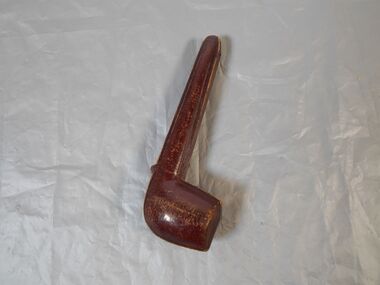 Bendigo Historical Society Inc.
Accessory - Pipe and Pipe cover
... Tools smokers acoutrement Dark brown pipe cover in shape of pipe, leather exterior and textured cream fabric interior, with hinge at smoke exit end of pipe and small metal latch at bottom of pipe tube. ...By 1904 Mr E R McMartin was the manager and licensee of the Shamrock Hotel including the Shamrock Tobacconist that had previously been owned and run by Mr Karl Van Damme.Dark brown pipe cover in shape of pipe, leather exterior and textured cream fabric interior, with hinge at smoke exit end of pipe and small metal latch at bottom of pipe tube. Red sticker on inside of cover reads "Shamrock tobacco Store E.R. McMartir Bendigo" in black ink Pipe made of plastic mouthpiece joined halfway along tube to wooden tube and smoke outlet by a fancy metal (Hallmarked as silver in Chester, England 1912)surround. Ash contained in smoke outlet/exit. Top of smoke outlet has an approximately 1.5cm crack.tools, smokers acoutrement -
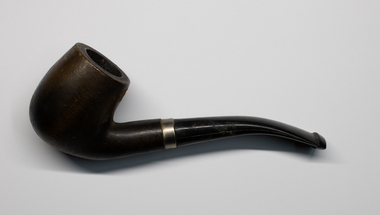 Charlton Golden Grains Museum Inc
Domestic object - Smokers Pipe
... Dark Brown wooden pipe, comprises a chamber or bowl for tobacco from which a thin hollow stem(shank) emerges ending in a mouthpiece, silver ring covers join of timber to mouthpiece Domestic object Smokers Pipe ...Dark Brown wooden pipe, comprises a chamber or bowl for tobacco from which a thin hollow stem(shank) emerges ending in a mouthpiece, silver ring covers join of timber to mouthpiece
