
Showing 22 items matching "social freedom"
-
 City of Stonnington
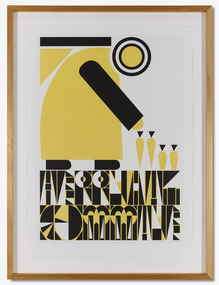
Emily Floyd, Herrnhut Commune, 2012
... ...Social freedom...Stonnington contemporary art collection Printmaking Lithograph Geometric Typography Emily Floyd Social freedom Work on paper Herrnhut Commune Herrnhut Commune Emily Floyd ...Herrnhutt Commune imagines a study group devoted to Australia’s first commune. Founded in 1852 and located near Hamilton in Victoria, the commune was run as an intentional community until the end of the nineteenth century. The orange and yellow graphic shows a woman harvesting carrots and pays homage to the daily communal practices of cultivating, preserving and cooking on the commune. Each of the four works comprising Emily Floyd’s suite of prints All Day Workshops is a proposal for a workshop exploring ideas of social freedom, co-operative learning and open communication. These large-scale posters combine stylised illustrations with the artist’s geometric typography. Each work in All Day Workshops extends Floyd’s investigation into learning and play as a form of expanded sculpture. In 2012, to celebrate the Australian Print Workshop 30th anniversary six Australian artists including Emily Floyd were commissioned to create a suite of works for a series of exhibitions under the title ‘Catalyst’. Floyd’s works are three colour plate lithographs, printed from three photo-litho plates. Printed at the Australian Print Workshop in an edition of 20 plus proofs in collaboration with APW Senior Printer Martin King and assisted by APW Trainee Printer Eliza Turnbull. stonnington contemporary art collection, printmaking, lithograph, geometric, typography, emily floyd, social freedom, work on paper, herrnhut commune -
 Unions Ballarat
Introducing Chomsky, Mayer, John et al, 1999
... Chomsky also critiques power institutions and provides commentary on social freedoms. Explores how learning and language influences intellect, education and thinking....Chomsky also critiques power institutions and provides commentary on social freedoms. Explores how learning and language influences intellect, education and thinking. ...Linguistics textbook. Chomsky also critiques power institutions and provides commentary on social freedoms. Explores how learning and language influences intellect, education and thinking.Relevant to linguistics and languages. Social and educational interest.Paper; book. Front cover: background is a red and black photo of Chomsky; white and black lettering.Front cover: authors' & editor's names and title.ballarat trades and labour council, linguistics, language, education, society, chomsky, noam -
Unions Ballarat
Of labour and liberty: distributism in Victoria 1891-1966, 2017
... Mathews writes about the future of work, social freedom and employment - reshaping of economics to authentically serve the interests of the community. ...Mathews writes about the future of work, social freedom and employment - reshaping of economics to authentically serve the interests of the community. ...Mathews writes about the future of work, social freedom and employment - reshaping of economics to authentically serve the interests of the community. Includes discourse about citizenship and attitudes towards politics and politicians, and history of Catholic social thinkers and activists in Australia. Race Mathews (author) has held many political roles and elected positions at federal and local levels.Political, social and economic relevance.Book; paper. Cover: blue background; white and orange lettering.btlc, ballarat trades hall, ballarat trades and labour council, mathews, race, distributism, economics, citizenship, catholicism, politics and government -
4th/19th Prince of Wales's Light Horse Regiment Unit History Room
Regimental Scrap Book: 1980-1989, 2009
... Contents include: Training, ceremonial and social activities. Freedom of City of Sale March 1982 and 1985. ...bairnsdale ceremonial training history 4 19 prince of wales s light horse regiment freedom of city traralgon sale boyce Archival quality A3 loose leaf slip case containing memorabilia documents, cuttings and photos about the Regiment for the period 1980-1989. Contents include: Training, ceremonial and social ...Archival quality A3 loose leaf slip case containing memorabilia documents, cuttings and photos about the Regiment for the period 1980-1989. Contents include: Training, ceremonial and social activities. Freedom of City of Sale March 1982 and 1985. Freedom of City of Bairnsdale 15 March 1986. Freedom of City of Traralgon July 1988. Wedding of Commanding Officer Lt Col John Boyce 1988. bairnsdale, ceremonial, training, history 4 19 prince of wales s light horse regiment, freedom of city, traralgon, sale, boyce -
4th/19th Prince of Wales's Light Horse Regiment Unit History Room
Regimental Scrap Book: 1970-1979, 2009
... Contents include: Training, ceremonial and social activities. Vale Lt Col John Dixon. Freedom of City of Traralgon 29 Nov 1970. ...melbourne kyneton training history 4 19 prince of wales s light horse regiment ceremonial west gate bridge freedom of city traralgon Archival quality A3 loose leaf slip case containing memorabilia documents, cuttings and photos about the Regiment for the period 1970- 1979. Contents include: Training, ceremonial and social ...Archival quality A3 loose leaf slip case containing memorabilia documents, cuttings and photos about the Regiment for the period 1970- 1979. Contents include: Training, ceremonial and social activities. Vale Lt Col John Dixon. Freedom of City of Traralgon 29 Nov 1970. Freedom of City of Melbourne March 1977. Freedom of City of Kyneton September 1978. Opening of West Gate Bridge Nov 1975.melbourne, kyneton, training, history 4 19 prince of wales s light horse regiment, ceremonial west gate bridge, freedom of city, traralgon -
4th/19th Prince of Wales's Light Horse Regiment Unit History Room
Regimental Scrap Book: 1990-1999, 2009
... social activities. Hansard 18 Oct 1990 re future of the Regiment. Threats to the Regiment. Chief of General Staff Commendation to A Squadron 4/19 PWLH for assistance with flood emergency in Gippsland April 1990. Meritorious Unit Commendation to Prince of Wales Light Horse Troop while attached to 173 US Airborne Brigade, South Vietnam 1965/66. Freedom...ceremonial training vietnam war history 4 19 prince of wales s light horse freedom of city melbourne freedom of city traralgon traralgon army depot commendations gippsland floods Archival quality A3 loose leaf slip case containing memorabilia documents, cuttings and photos about the Regiment for the period 1990-1999. Contents include:Training, Ceremonial, social ...Archival quality A3 loose leaf slip case containing memorabilia documents, cuttings and photos about the Regiment for the period 1990-1999. Contents include:Training, Ceremonial, social activities. Hansard 18 Oct 1990 re future of the Regiment. Threats to the Regiment. Chief of General Staff Commendation to A Squadron 4/19 PWLH for assistance with flood emergency in Gippsland April 1990. Meritorious Unit Commendation to Prince of Wales Light Horse Troop while attached to 173 US Airborne Brigade, South Vietnam 1965/66. Freedom of City of Melbourne May 1992. 50th Birthday of Regiment. Closure of Traralgon Depot 1998.ceremonial, training, vietnam war, history 4 19 prince of wales s light horse, freedom of city melbourne, freedom of city traralgon, traralgon army depot, commendations, gippsland floods -
 Warrnambool and District Historical Society Inc.
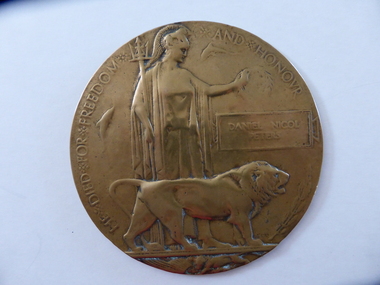
Medallion, Dead Man's Penny Daniel Nicol Peters, C 1919
... It therefore has historical and social significance dead man's penny daniel nicol peters He died for freedom and honour. ...The dead man's penny is a commemorative medallion which was presented to the family of soldier s who were killed in the First World War. The images of Brittania the dolphins and the lion represent Brittain and the eagle represents Germany. The name of the soldier is presented without rank to signify the equality of all sacrifice. This medallion was to commemorate Daniel Nicol Peters who came from Scotland but enlisted in the AIF in Blackboy Hill Western Australia. His regimental number was 3200. he was Killed in Action on 26 August 1918. His father was John Peters of Greenside Fifeshire Scotland. From a country with a population of approximately 5 million people, there were more than 60000 soldiers killed. This object represents but one of these soldiers. It therefore has historical and social significanceCircluar brass plaque with figure of Brittania and a lion in low relief. There are two dolphins around the figure of Brittania and and image of a defeated eagle below the lion.To the right of the figure is a small rectangle with the name of the soldier. Text around the edge.He died for freedom and honour. Daniel Nicol Petersdead man's penny, daniel nicol peters -
 Monbulk RSL Sub Branch
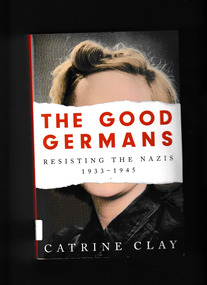
Book, Weidenfeld and Nicholson, The good germans: Resisting the Nazis 1933-1945, 2020
... freedom? What would we have done in their place? Many ordinary Germans found the courage to resist, in the full knowledge that they could be sentenced to indefinite incarceration, torture or outright execution. Catrine Clay argues that it was a much greater number than was ever formally recorded: teachers, lawyers, factory and dock workers, housewives, shopkeepers, church members, trade unionists, army officers, aristocrats, Social Democrats, Socialists and Communists. ...After 1933, as the brutal terror regime took hold, most of the two-thirds of Germans who had never voted for the Nazis - some 20 million people - tried to keep their heads down and protect their families. They moved to the country, or pretended to support the regime to avoid being denounced by neighbours, and tried to work out what was really happening in the Reich, surrounded as they were by Nazi propaganda and fake news. They lived in fear. Might they lose their jobs? Their homes? Their freedom? What would we have done in their place? Many ordinary Germans found the courage to resist, in the full knowledge that they could be sentenced to indefinite incarceration, torture or outright execution. Catrine Clay argues that it was a much greater number than was ever formally recorded: teachers, lawyers, factory and dock workers, housewives, shopkeepers, church members, trade unionists, army officers, aristocrats, Social Democrats, Socialists and Communists.Index, bibliography, notes, ill, p.361.non-fictionAfter 1933, as the brutal terror regime took hold, most of the two-thirds of Germans who had never voted for the Nazis - some 20 million people - tried to keep their heads down and protect their families. They moved to the country, or pretended to support the regime to avoid being denounced by neighbours, and tried to work out what was really happening in the Reich, surrounded as they were by Nazi propaganda and fake news. They lived in fear. Might they lose their jobs? Their homes? Their freedom? What would we have done in their place? Many ordinary Germans found the courage to resist, in the full knowledge that they could be sentenced to indefinite incarceration, torture or outright execution. Catrine Clay argues that it was a much greater number than was ever formally recorded: teachers, lawyers, factory and dock workers, housewives, shopkeepers, church members, trade unionists, army officers, aristocrats, Social Democrats, Socialists and Communists. germany - politics and government - 1933-1945, germany - anti nazi movements -
 Wangaratta Historical Society
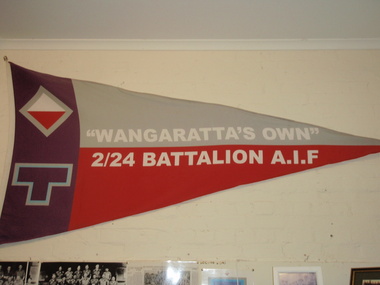
2nd 24th Battalion Wangaratta's Own, 01/07/1940
... On 28th September 1990, the 50th anniversary of the Battalion leaving Wangaratta, (retired) Alan MacFarlane, President of the 2nd 24th Battalion Association were presented the Freedom of the City and represented with the Battalion pennant by Wangaratta Mayor, Cr Kevin Gleeson & Cr Val Gleeson, Cr Thomas Nolan's son in law & daughter. This was an Army Battalion formed in Wangaratta. The young men interacted with the businesses, sporting & social ..."Wangaratta's Own", the 2nd 24th Battalion was formed in Wangaratta on 1st July 1940, during World War Two. They camped at the Wangaratta Showgrounds, where they trained until they marched out of Wangaratta on 28th September 1940. Before they marched out Alan MacFarlane and the Battalion were presented with the Battalion pennant by Wangaratta Mayor, Cr Thomas Nolan. They fought in . On 28th September 1990, the 50th anniversary of the Battalion leaving Wangaratta, (retired) Alan MacFarlane, President of the 2nd 24th Battalion Association were presented the Freedom of the City and represented with the Battalion pennant by Wangaratta Mayor, Cr Kevin Gleeson & Cr Val Gleeson, Cr Thomas Nolan's son in law & daughter. This was an Army Battalion formed in Wangaratta. The young men interacted with the businesses, sporting & social societies & families of Wangaratta in the early 1940's. Lifelong friendships were made."Wangaratta's Own", the 2nd 24th Battalion was formed in Wangaratta on 1st July 1940, during World War Two. They camped at the Wangaratta Showgrounds, where they trained until they marched out of Wangaratta on 28th September 1940. Before they marched out Alan MacFarlane and the Battalion were presented with the Battalion pennant by Wangaratta Mayor, Cr Thomas Nolan. They fought in . On 28th September 1990, the 50th anniversary of the Battalion leaving Wangaratta, (retired) Alan MacFarlane, President of the 2nd 24th Battalion Association were presented the Freedom of the City and represented with the Battalion pennant by Wangaratta Mayor, Cr Kevin Gleeson & Cr Val Gleeson, Cr Thomas Nolan's son in law & daughter. army battalion wangaratta's own world war two -
 Victorian Aboriginal Corporation for Languages
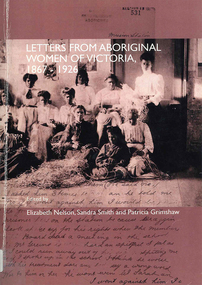
Book, Elizabeth Nelson, Letters from Aboriginal women of Victoria, 1867-1926, 2002
... social change. In particular the letters are valuable for the insight they offer into the impact on Aboriginal communities of government legislation and mission policies and the women's assertion of their entitlement to freedom and agency. ...social change. In particular the letters are valuable for the insight they offer into the impact on Aboriginal communities of government legislation and mission policies and the women's assertion of their entitlement to freedom and agency. ...This edited collection of women's correspondence constitutes an important historical record of the experiences of Aboriginal women during a crucial period of social change. In particular the letters are valuable for the insight they offer into the impact on Aboriginal communities of government legislation and mission policies and the women's assertion of their entitlement to freedom and agency. Written by 81 different women, the letters cover such issues as children, family, religion, land, housing and material assistance.maps, b&w photographsvictorian aboriginal women, correspondence, government policy -
 Uniting Church Archives - Synod of Victoria
BW photo, Undated
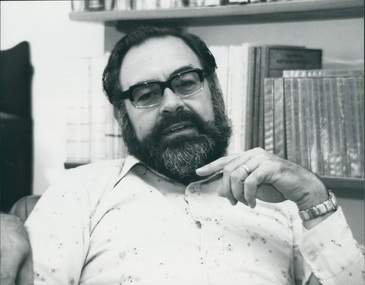
... Freedom, and for his last seventeen years as founding leader of the House of the Gentle Bunyip linked with the Clifton Hill Baptist Church, which later became known as the Community Church of St Mark. The House of the Gentle Bunyip came into being in 1975 during the Anzac Day weekend when Athol was teaching on "Discipleship" from the Gospel of St Mark. He announced he was commencing a Christian community to explore and expound the meaning of discipleship. 35 people, mainly young and single, agreed to join him. Athol was a provocative advocate for the poor and for social...Freedom, and for his last seventeen years as founding leader of the House of the Gentle Bunyip linked with the Clifton Hill Baptist Church, which later became known as the Community Church of St Mark. The House of the Gentle Bunyip came into being in 1975 during the Anzac Day weekend when Athol was teaching on "Discipleship" from the Gospel of St Mark. He announced he was commencing a Christian community to explore and expound the meaning of discipleship. 35 people, mainly young and single, agreed to join him. Athol was a provocative advocate for the poor and for social ...Athol Gill was born in Wauchope, NSW, on 5th September 1937. On 25th April 1959 he married Judith Prior. In 1960 he enrolled to become a Baptist minister studying at the Baptist Theological College of NSW. A strong call to higher studies took him to London where he obtained his BD (Hons) and later to Zurich where he attained his Masters and a Doctorate of Theology. Athol lectured in Biblical Studies in both Baptist and Methodist Theological Colleges in Brisbane, moved to Melbourne in 1974 to become Dean of Whitley College, then in 1979 was appointed Professor of New Testament where he continued until his death. He was widely respected for his academic work but also for his remarkable commitment to living the faith he taught. Athol lived, with his family, in Christian Community for nearly all his adult life - in Brisbane at the House of Freedom, and for his last seventeen years as founding leader of the House of the Gentle Bunyip linked with the Clifton Hill Baptist Church, which later became known as the Community Church of St Mark. The House of the Gentle Bunyip came into being in 1975 during the Anzac Day weekend when Athol was teaching on "Discipleship" from the Gospel of St Mark. He announced he was commencing a Christian community to explore and expound the meaning of discipleship. 35 people, mainly young and single, agreed to join him. Athol was a provocative advocate for the poor and for social justice. He campaigned relentlessly for the Church to reflect the teachings of Jesus and for a peaceful and just society. This was evident in his simple lifestyle and through his practical engagement in mission with the poor and marginalised. Honoured in Australia and internationally as a brilliant theologian, teacher and author, Athol is also remembered for his love of sport, especially for the Carlton Football Club, his unique sense of humour and his warm humanity. He died suddenly on 9th March 1992. Head and shoulders of Athol Gill seated in front of bookcaseDr Athol Gill says that the Christians in Yugoslavia are not hoping for a change to Western democracy, but greater human rights under a Communist government. dr athol gill; house of the gentle bunyip -
 Broadmeadows Historical Society & Museum
Photograph - Group Photograph, Hilltop Moments, 1990
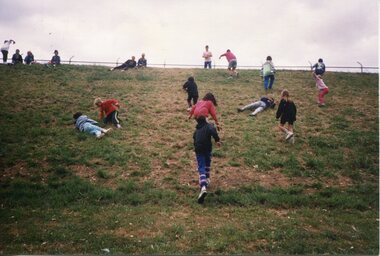
... social cohesion and community identity in Melbourne’s outer suburbs during a period of rapid urban development. It also serves as a visual reminder of the value placed on outdoor learning and intergenerational connection in the school’s traditions. This photograph, taken during the 1990 Jacana Primary School Christmas picnic, is a significant visual record of childhood experience and community life in Melbourne’s outer northern suburbs. It captures students engaging in unstructured outdoor play on a grassy hill—likely within Greenvale Reservoir Park—highlighting the school’s emphasis on freedom ...This photograph, taken during the 1990 Jacana Primary School Christmas picnic, shows children playing freely on a grassy hill—likely within Greenvale Reservoir Park, a popular location for school and family outings in Melbourne’s northern suburbs. The image captures a relaxed and spontaneous moment of outdoor play, with students climbing, sitting, and lying on the hillside while others observe from the fence line above. Jacana Primary School, founded in 1959, was a key educational and social institution in the Jacana community until its closure in the early 2000s. Annual events like the Christmas picnic were central to the school’s culture, offering students opportunities to celebrate the end of the school year in a natural, open-air setting. These gatherings fostered a sense of belonging and community among students, families, and staff. The choice of Greenvale Reservoir Park reflects the school’s emphasis on accessible, inclusive experiences and its connection to local landscapes. The park’s open spaces provided a safe and engaging environment for children to explore, play, and interact beyond the classroom. This photograph is historically significant as it illustrates the role of public education in promoting social cohesion and community identity in Melbourne’s outer suburbs during a period of rapid urban development. It also serves as a visual reminder of the value placed on outdoor learning and intergenerational connection in the school’s traditions.This photograph, taken during the 1990 Jacana Primary School Christmas picnic, is a significant visual record of childhood experience and community life in Melbourne’s outer northern suburbs. It captures students engaging in unstructured outdoor play on a grassy hill—likely within Greenvale Reservoir Park—highlighting the school’s emphasis on freedom, exploration, and connection to the natural environment. Jacana Primary School, established in 1959 and closed in the early 2000s, was a vital institution in the Jacana community. Events like the annual Christmas picnic were central to the school’s culture, offering students opportunities to celebrate the end of the school year in a relaxed, inclusive setting. The choice of Greenvale Reservoir Park reflects the school’s commitment to accessible, local spaces that supported both learning and play. The image is historically significant as it illustrates the broader role of public education in fostering social cohesion, community identity, and intergenerational connection during a period of suburban growth and change. It also serves as a testament to the enduring value of outdoor experiences in shaping childhood memories and school traditions.Photograph on glossy paper of a group children in the park.PH18289 (crossed out) PH-4209 (crossed out) PH-4868jacana primary school, christmas picnic, 1990, jacana, christmas party -
 Broadmeadows Historical Society & Museum
Photograph - Picnic Photograph, Moments in Midair, 1990
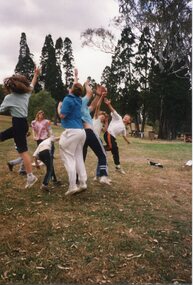
... social interaction, and connection to nature were seen as essential components of a well-rounded schooling experience. This photograph is a culturally and historically significant record of Jacana Primary School’s community life in the late 20th century. Captured during the 1990 Christmas picnic—likely held at Greenvale Reservoir—it depicts a group of children mid-jump in a moment of spontaneous outdoor play. The image embodies the spirit of joy, freedom ...This photograph, likely taken during Jacana Primary School’s 1990 Christmas picnic at Greenvale Reservoir, captures a dynamic moment of childhood play and joy. A group of children is seen mid-jump in a grassy park surrounded by tall trees, their movement and energy reflecting the carefree spirit of the occasion. The image offers a vivid snapshot of outdoor recreational activities that were central to the school’s end-of-year celebrations. Jacana Primary School, established in 1959 and closed in the early 2000s, was a vital institution in Melbourne’s northern suburbs. Known for its strong emphasis on both academic and social development, the school fostered a culture of inclusivity and community engagement. Events like the annual Christmas picnic were more than festive gatherings—they were opportunities for students, staff, and families to connect, celebrate, and reinforce the school’s values in a relaxed, natural setting. This photograph is historically significant as it documents the lived experiences of students during a period when outdoor play and communal events were integral to primary education. It reflects broader educational practices of the time, where physical activity, social interaction, and connection to nature were seen as essential components of a well-rounded schooling experience.This photograph is a culturally and historically significant record of Jacana Primary School’s community life in the late 20th century. Captured during the 1990 Christmas picnic—likely held at Greenvale Reservoir—it depicts a group of children mid-jump in a moment of spontaneous outdoor play. The image embodies the spirit of joy, freedom, and social connection that characterised the school’s end-of-year celebrations. Jacana Primary School, which operated from 1959 until the early 2000s, was a cornerstone of Melbourne’s northern suburbs, known for its commitment to inclusive education and community engagement. Events such as the annual picnic were integral to the school’s ethos, reinforcing bonds between students, staff, and families in informal, nature-based settings. The photograph is significant not only as a visual document of a specific event but also as a broader representation of educational values of the time—emphasising physical activity, social development, and the importance of shared experiences. It contributes to the historical narrative of public schooling in Victoria and preserves the memory of a school community that played a formative role in the lives of many local families.Colour Photograph on glossy paper in portrait formatPH18289 (crossed out) PH-4209 (crossed out) PH-4868/this paper/manufactured/by Kodakjacana primary school, christmas party, 1990, jacana -
 Kew Historical Society Inc
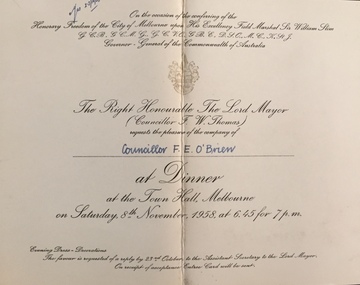
Document (item) - Invitation, City of Melbourne, Dinner on the Occasion of Conferring of Honorary Freedom of the City of Melbourne Upon His Excellency Field Marshall Sir William Slim, 1958
... social and cultural history of the district. As a continuous record, ranging across most decades of the Twentieth Century, they reveal changing tastes in design, values and relationships in the history of local government in Victoria. civic invitations -- kew (vic) city of melbourne field marshall slim.-- governor general of australia ON THE OCCASION OF THE CONFERRING OF THE / FREEDOM OF THE CITY OF MELBOURNE UPON HIS EXCELLENCY FIELD MARSHALL SIR WILLIAM SLIM / GCB, GCMG, GCVC, GBE, DSO, MC, KStJ, / GOVERNOR GENERAL OF THE COMMONWEALTH OF AUSTRALIA / THE RIGHT HONOURABLE THE LORD MAYOR / (CR F W THOMAS) / REQUESTS THE PLEASURE OF THE COMPANY OF / Councillor F E O'Brien / AT DINNER / AT THE TOWN HALL, MELBOURNE / ON SATURDAY, 8TH NOVEMBER, 1958, AT 6.45 FOR 7 PM / EVENING DRESS - DECORATIONS / THE FAVOUR IS REQUESTED OF A REPLY BY 23RD OCTOBER, TO THE ASSISTANT SECRETARY TO THE LORD MAYOR / ON RECEIPT OF ACCEPTANCE ENTREE CARD WILL BE SENT Single-sided invitation to Cr F E O'Brien (Mayor of Kew) to attend formal dinner on the Occasion of Conferring of Honorary Freedom of the City of Melbourne Upon Field Marshall Sir William Slim in 1958. ...The Municipality of Kew (1860-1863), the Borough of Kew (1863-1910), the Town of Kew (1910-1921) and the City of Kew (1921-1994) were local government instrumentalities in the State of Victoria. In 1994, the City of Kew was amalgamated, together with the former Cities of Camberwell and Hawthorn, into the new City of Boroondara (1994- ). Like other local government entities of the period, Kew was administered by town clerks. The two notable town clerks in Kew's history were H. H. (Henry Hirst) Harrison (1868-1955) and W. D. (William Dickie) Birrell (1899-1974). Harrison was appointed to the position in 1901 and retired in 1938 after 37 years. Birrell, appointed Acting Town Clerk in 1921, became Town Clerk in 1938, following Harrison's retirement. He continued in this role until his retirement in 1966.This card is part of an historically significant civic collection, containing hundreds of separate invitations, documents, greeting cards, programmes and tickets issued and/or collected by successive town clerks. Items in the collection illuminate the political, social and cultural history of the district. As a continuous record, ranging across most decades of the Twentieth Century, they reveal changing tastes in design, values and relationships in the history of local government in Victoria.ON THE OCCASION OF THE CONFERRING OF THE / FREEDOM OF THE CITY OF MELBOURNE UPON HIS EXCELLENCY FIELD MARSHALL SIR WILLIAM SLIM / GCB, GCMG, GCVC, GBE, DSO, MC, KStJ, / GOVERNOR GENERAL OF THE COMMONWEALTH OF AUSTRALIA / THE RIGHT HONOURABLE THE LORD MAYOR / (CR F W THOMAS) / REQUESTS THE PLEASURE OF THE COMPANY OF / Councillor F E O'Brien / AT DINNER / AT THE TOWN HALL, MELBOURNE / ON SATURDAY, 8TH NOVEMBER, 1958, AT 6.45 FOR 7 PM / EVENING DRESS - DECORATIONS / THE FAVOUR IS REQUESTED OF A REPLY BY 23RD OCTOBER, TO THE ASSISTANT SECRETARY TO THE LORD MAYOR / ON RECEIPT OF ACCEPTANCE ENTREE CARD WILL BE SENTcivic invitations -- kew (vic), city of melbourne, field marshall slim.-- governor general of australia -
 Kew Historical Society Inc
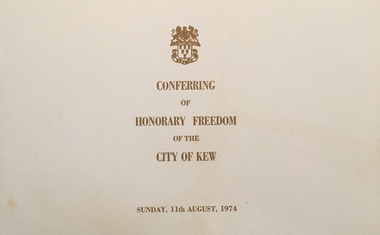
Document - Programme, City of Kew, Conferring of Honorary Freedom of the City of Kew, 1974
... social and cultural history of the district. As a continuous record, ranging across most decades of the Twentieth Century, they reveal changing tastes in design, values and relationships in the history of local government in Victoria. civic invitations -- kew (vic) kew municipal library w d vaughan Multi-page programme given to attendees at the ceremony conferring the honorary freedom of the City of Kew on the Rt Hon R G Menzies Conferring of Honorary Freedom of the City of Kew Document Programme City of Kew ...The Municipality of Kew (1860-1863), the Borough of Kew (1863-1910), the Town of Kew (1910-1921) and the City of Kew (1921-1994) were local government instrumentalities in the State of Victoria. In 1994, the City of Kew was amalgamated, together with the former Cities of Camberwell and Hawthorn, into the new City of Boroondara (1994- ). Like other local government entities of the period, Kew was administered by town clerks. The two notable town clerks in Kew's history were H. H. (Henry Hirst) Harrison (1868-1955) and W. D. (William Dickie) Birrell (1899-1974). Harrison was appointed to the position in 1901 and retired in 1938 after 37 years. Birrell, appointed Acting Town Clerk in 1921, became Town Clerk in 1938, following Harrison's retirement. He continued in this role until his retirement in 1966.This card is part of an historically significant civic collection, containing hundreds of separate invitations, documents, greeting cards, programmes and tickets issued and/or collected by successive town clerks. Items in the collection illuminate the political, social and cultural history of the district. As a continuous record, ranging across most decades of the Twentieth Century, they reveal changing tastes in design, values and relationships in the history of local government in Victoria.Multi-page programme given to attendees at the ceremony conferring the honorary freedom of the City of Kew on the Rt Hon R G Menziescivic invitations -- kew (vic), kew municipal library, w d vaughan -
 Kew Historical Society Inc
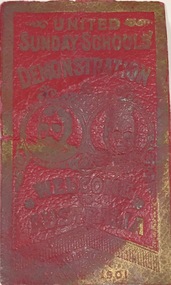
Souvenir, United Sunday schools, Red Leather Bookmark, United Sunday Schools' Demonstration, Melbourne, 6 May 1901, 1901
... freedom of youth, made perhaps as pretty a feature of the pageant as could be found anywhere in the whole route of the procession." (The Age, Tues 7 May 1901, p.6) This tiny battered piece of ephemera recording the United Sunday School Demonstration of 1901 must once have been exceedingly common, however in the context of the growing collection that the Society has relating to the opening of the first Commonwealth Parliament in Melbourne it has historic and social significance. opening of the first commonwealth parliament - 1901 sunday schools - victoria federation events - victoria - 1901 ephemera "United Sunday Schools Demonstration, Melbourne Australia, Melbourne May 6 1901" Embossed red leather bookmark commemorating the 'United Sunday Schools Demonstration' in St Kilda Road in 1901 to welcome the Prince and Princess of Wales to open the first Commonwealth Parliament in the Royal Exhibition Building. ...SUNDAY SCHOOL DEMONSTRATION. With three times three we coo-ee, The Prince we meet again; Our Princess May we welcome, With heart and voice amain. This was the welcome of the children of the Melbourne Sunday schools. The greeting came from over 30,000 youthful voices to the accompaniment of as many waving flags of diminutive size, held by the children. Probably not one of those who sang so lustily had witnessed the previous visit of his Royal Highness; or knew anything of it except as a traditional event, but the sentiment was a good and proper one all the same. The children were massed on the rising ground in the Domain, and apparently the long wait was not at all wearying. It was to most of them a huge picnic. They lunched on the grass, and filled in the intervening lime with games such as the juvenile heart delights in. At intervals something approaching order, was observed, and then songs, which have been in rehearsal for some weeks past, were sung under the baton of Mr. D. R. Davies, musical director, and to the lead of a united brass band of over a hundred instrumentalists under Bandmaster E; T. Code. A solo was also sung by Mr. H. J. Floyd. At all times the scene was an exceedingly animated one. Most of the children were attired in light costumes, and those in whose dress there was some color provided the necessary variety to make up a most picturesque scene. Probably there were nearly 35,000 adults and children at this spot. They occupied the frontage to St. Kilda-road, from Government House gates to the intersecting thoroughfare beyond. As the children were confined to the high ground, there was a green strip in front of them, and the dark green of the fir trees at the top of the slope made a most suitable background. Between these two lines of even coloring the children, with the easy freedom of youth, made perhaps as pretty a feature of the pageant as could be found anywhere in the whole route of the procession." (The Age, Tues 7 May 1901, p.6)This tiny battered piece of ephemera recording the United Sunday School Demonstration of 1901 must once have been exceedingly common, however in the context of the growing collection that the Society has relating to the opening of the first Commonwealth Parliament in Melbourne it has historic and social significance.Embossed red leather bookmark commemorating the 'United Sunday Schools Demonstration' in St Kilda Road in 1901 to welcome the Prince and Princess of Wales to open the first Commonwealth Parliament in the Royal Exhibition Building."United Sunday Schools Demonstration, Melbourne Australia, Melbourne May 6 1901"opening of the first commonwealth parliament - 1901, sunday schools - victoria, federation events - victoria - 1901, ephemera -
Old Colonists' Association of Ballarat Inc.
Ceremonial object - Trowel, William Bennett, Silver Trowel, c1887
... freedom and constitutional liberty in 1883. Their object was, further, to gather together within one fold those who survive those stirring times, to meet occasionally in friendly and social intercourse; to relieve their brethren who were overtaken by sickness or affliction; to provide the shelter of a home for those Pioneers of the goldfields whom the reverses of fortune had deprived of the means of procuring the comforts of life in their declining years; to assist the widow and succor the orphan; to mutually cheer and support each other in their temporary troubles and vicissitudes as they journeyed onward to the grave; and lastly, to tender a tribute of respect to the memory of a departed brother, by following his remains to their final resting place. ...freedom and constitutional liberty in 1883. Their object was, further, to gather together within one fold those who survive those stirring times, to meet occasionally in friendly and social intercourse; to relieve their brethren who were overtaken by sickness or affliction; to provide the shelter of a home for those Pioneers of the goldfields whom the reverses of fortune had deprived of the means of procuring the comforts of life in their declining years; to assist the widow and succor the orphan; to mutually cheer and support each other in their temporary troubles and vicissitudes as they journeyed onward to the grave; and lastly, to tender a tribute of respect to the memory of a departed brother, by following his remains to their final resting place. ...The silver trowel was used for the laying of the foundation stone of the Ballarat Old Colonists' Hall. It was donated to the Old Colonists' Associaiton in 1906. The Old Colonists' Association minutes noted 'Mrs Murray handed to the Secretary the silver trowel presented to the late President on the occasion of the laying of the foundation stone of the Hall.' The silver trowel was used for the laying of the foundation stone of the Ballarat Old Colonists' Hall. It was donated to the Old Colonists' Associaiton in 1906. The Old Colonists' Association minutes noted 'Mrs Murray handed to the Secretary the silver trowel presented to the late President on the occasion of the laying of the foundation stone of the Hall.' "THE OLD COLONISTS' HALL. The foundation-stone of the building to be erected by the Old Identities’ Association, in Lydiard street, was next laid with the usual ceremonies. This was immediately adjoining the foundation-stone of the Mining Exchange building. Mr J. Graham presented Mr Murray with a silver trowel, bearing the following inscription:—“ Queen Victoria’s Jubilee. Presented to J. P. Murray, Esq., president of the Old Colonists’ Association, on the occasion of his laying the foundation stone of their new hall, Ballarat, 21st June, 1887.” Mr Graham said he thought the pioneers of such a city were quite right in erecting a building that would be a home for them while they lived, and a memorial of them when they were no more. Mr J. Fraser, secretary, read the followin'- report:— “Mr Chairman, ladies, and gentlemen,—The bottle about to be deposited under this foundation contains documents in which are written particulars of the founding of the Old Colonists' Association at Ballarat; its financial and numerical position at the present time, the names of its officers and committee of management for the current term: a complete list of the names of its members, a copy of the rules and regulations of the association: copies of The Star, Evening Star, Courier, and Ballarat Advertiser newspapers, programme of to-day's proceedings as far as they relate to the laying of the foundation-stone, together with a brief summary of the aims and objects of this philanthropic institution. That the nature of these objects are considered worthy of encouragement and support is amply proved when we see on the Association's roll of membership the names of so many of our most prominent citizens and public men, "and from the fact that the Government of the colony have recognised the just claim of the old colonists'of Ballarat to be placed in possession of this valuable and central site, upon which to erect a building that will, be a credit to them and an ornament to the city, and which will enable them to still further extend the sphere of their benevolence and usefulness iu this district. The following is a copy of the signed and sealed memorial document:—*The foundation-stone of the hall of the Old Colonists’ Association of Ballarat; was laid on Her Majesty Queen Victoria's Jubilee Day,- Tuesday, 21st June, 1887, by John Paul Murray, Esq., J.P., president of the association. Under the foundation stone is deposited a copy of the constitution and rules of the association, the names of the officers, and a complete list of the names of ail the members to date; also a copy each of The Star, Courier, Evening Post, and the Advertiser, local newspapers. At this date the association numbers 319 members—accumulated funds, £203 10s 3d. The land upon which the hall is to he erected was granted by the Government to the association for that, purpose. (Signed) John P. Murray, President; W. B. Perry, Samuel Delpratt, Vice-presidents; Daniel Fern, Treasurer; John Fraser, Secretary. Committee—J. W. Graham, J. W. Lee, James M'Merkin, Andrew Lister, James Ward. Trustees—J. W. Graham, Wm. Irwin, John M'Cafferty ” Mr Murray said he was proud to lay the foundation stone of this building. The association was started in I883, and he might say they were a purely philanthropic institution. They formed an association whose creed was to assist one another in every shape and form. They had now 319 members, and were daily increasing in number.-. They were very fairly off as regarded their financial position. With respect to the objects of the association, they were to form a bond of brotherhood among those whose past experience in commercial or in mining pursuits so intimately associated them with the early history of the goldfields; men, to whose indomitable energy and perseverance Ballarat and other mining centres in the colony were so largely indebted for their development and commercial prosperity. Some of whose names were also closely identified with the memorable and sanguinary struggle 'for freedom and constitutional liberty in 1883. Their object was, further, to gather together within one fold those who survive those stirring times, to meet occasionally in friendly and social intercourse; to relieve their brethren who were overtaken by sickness or affliction; to provide the shelter of a home for those Pioneers of the goldfields whom the reverses of fortune had deprived of the means of procuring the comforts of life in their declining years; to assist the widow and succor the orphan; to mutually cheer and support each other in their temporary troubles and vicissitudes as they journeyed onward to the grave; and lastly, to tender a tribute of respect to the memory of a departed brother, by following his remains to their final resting place. Such were some of the principal objects of the “ Old Colonists' Association.” It was an institution for the good of their fellow man, and he hoped it would be successful, he hoped that the young people who came after them would appreciate what the Old Colonists had left them. He hoped they would all assist in making the institution one that would he worthy of the place. He would hand a small donation to the secretary, and hoped others would do the same. (Cheers.) The secretary, amid cheering, announced that the cheque handed over by Mr Murray was for £2O. Archdeacon Julius, who was asked to speak, said nothing could have been more fitting than the laying of the foundation-stone of the Old Identities’ Association on the Queen's Jubilee. They were a link between the past of 50 years gone by and today. Many of them remembered well enough perhaps the time when it took a man five and twenty minutes to light his pipe with tinder and steel, and when the small boys went, up the chimneys to sweep them. (Laughter.) They were building something now that people would look upon in years to come, and speak of in connection with the Old Colonists, if the young men were' half as good as their fathers they would be uncommon good fellows, and he did not think they would be. (Laughter, and interjection.) ''An old fellow said it was very true, and he knew it. (Laughter.) The Old Identities would agree with him to a man. (Laughter.) If the young men walked in their steps Ballarat in another 50 years would be 50 percent, better than it was now. There was not a man there that wished that more strongly, than 'he’ did. The Old Identities were laying this stone on the jubilee day of Her Majesty, and there never sat on the throne a worthier or nobler Queen than she who held her jubilee that day. There was not a man present, whatever his views of government may be, who did not say “God bless our Queen.” (Cheers.) The proceedings closed with the singing of the National Anthem and cheers for the Queen. (Ballarat Star, 23 June 1887)Silver trowel used during the laying of a foundation Stone for the Ballarat Old Colonists' Association building in Lydiard Street North, Ballarat.ballarat old colonists' association, ballarat old colonists' club, trowel, silver trowel, foundation stone, mrs j. murray, william bennett, j. fraser, john murray, w. lee, william irwin, john m'cafferty, john mccafferty -
Unions Ballarat
Our inheritance: Speeches and addresses (Don Woodward Collection), Baldwin, Stanley, 1928
... social, political and other topics. Contents (copied from the Victorian State Library website): Harrow School War Memorial: Address delivered at the unveiling ceremony at Harrow, 3rd June 1926 -- Freedom: Speech delivered at Kingsway Hall at the 30th anniversary of the Junior Imperial League, 19th June 1926 -- The British Merchant Service: Speech delivered at the dinner of the Chamber of Shipping of the United Kingdom, 16th February 1927 -- Westminster Abbey: Appeal for funds, 1st July 1927 -- Democracy and its task: Speech delivered at the dinner of the Cambridge University Conservative Association, 4th March 1927 -- Scotland: Address delivered on the occasion of receiving the Freedom of Edinburgh, 7th June 1926 -- The romance of Edinburgh: Speech delivered at the luncheon given on the occasion of receiving the Freedom of Edinburgh, 7th June 1926 -- Wales: Speech delivered at the St. ...social, political and other topics. Contents (copied from the Victorian State Library website): Harrow School War Memorial: Address delivered at the unveiling ceremony at Harrow, 3rd June 1926 -- Freedom: Speech delivered at Kingsway Hall at the 30th anniversary of the Junior Imperial League, 19th June 1926 -- The British Merchant Service: Speech delivered at the dinner of the Chamber of Shipping of the United Kingdom, 16th February 1927 -- Westminster Abbey: Appeal for funds, 1st July 1927 -- Democracy and its task: Speech delivered at the dinner of the Cambridge University Conservative Association, 4th March 1927 -- Scotland: Address delivered on the occasion of receiving the Freedom of Edinburgh, 7th June 1926 -- The romance of Edinburgh: Speech delivered at the luncheon given on the occasion of receiving the Freedom of Edinburgh, 7th June 1926 -- Wales: Speech delivered at the St. ...A selection of speeches and addresses on social, political and other topics. Contents (copied from the Victorian State Library website): Harrow School War Memorial: Address delivered at the unveiling ceremony at Harrow, 3rd June 1926 -- Freedom: Speech delivered at Kingsway Hall at the 30th anniversary of the Junior Imperial League, 19th June 1926 -- The British Merchant Service: Speech delivered at the dinner of the Chamber of Shipping of the United Kingdom, 16th February 1927 -- Westminster Abbey: Appeal for funds, 1st July 1927 -- Democracy and its task: Speech delivered at the dinner of the Cambridge University Conservative Association, 4th March 1927 -- Scotland: Address delivered on the occasion of receiving the Freedom of Edinburgh, 7th June 1926 -- The romance of Edinburgh: Speech delivered at the luncheon given on the occasion of receiving the Freedom of Edinburgh, 7th June 1926 -- Wales: Speech delivered at the St. David's Day Banquet at Cardiff, 1st March 1927 -- The Earl of Oxford and Asquith: Speech delivered in the House of Commons, 16th February 1928 -- Earl Haig of Bemersyde: Speech delivered in the House of Commons, 8th February 1928 -- Among sculptors: Speech delivered at the Dinner of the Royal Society of British Sculptors, 25th February 1926 -- Among historians: Address of welcome delivered to the members of the Anglo-American Conference of Historians, 13th July 1926 -- Among archaeologists: Speech delivered at the Annual Meeting of the British School at Athens, in London, 2nd November 1926 -- Among doctors: Speech delivered at the annual dinner of the Royal Society of Medicine, 18th November 1926 -- Lister: Speech delivered on the occasion of the Lister Centenary Celebrations, 5th April 1927 -- Among scientists: Speech delivered at the dinner of the Royal Society, 30th November 1947 -- Worcestershire: Speech delivered at the inaugural banquet of the Worcestershire Association, 22nd February 1927 -- Books: Speech delivered at the dinner of the English Association, 28th October 1927 -- Cricket: Speech delivered at the luncheon given to the Australian Cricket Team, 20th April 1926 -- Lord's: The Eton and Harrow match: Introduction to Sir Home Gordon's book, "Eton v. Harrow at Lord's" -- Fly fishing : Speech delivered at the annual dinner of the Fly Fishers' Club, 24th February 1927 -- The loneliest job: Speech delivered at Worcester, 8th January 1927.Historical, political and social - United Kingdom.Book; 309 pages. Cover: blue background; white lettering; author's name and title.In black ink: To dear papa with love Doreen. Christmas 1929.politics and government, social commentary, art and history, sporting life, btlc, ballarat trades hall, ballarat trades and labour council, political speeches, speeches - various -
 Wodonga & District Historical Society Inc
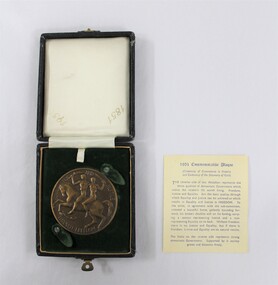
Medal - Commemorative Plaque 1851-1951, Andor Mészáros, Centenary of Government in Victoria and Centenary of the Discovery of Gold 1951
... It also has aesthetic and social significance as an example of a limited edition bronze medal designed by the prominent sculptor Andor Mészáros, who is known for his work depicting the history, culture and sporting life of Australia. medals australian commemorative medals centenary of victoria numismatics shire of wodonga wodonga centenaries gold andor mészáros Obverse: "EQUALITY AND JUSTICE / THROUGH FREEDOM" in raised letters around the edge. ...The bronze medal commemorates the centenary of the government of Victoria from 1851 to 1951, as well as the centenary of the discovery of gold and was presented to the Shire of Wodonga in 1951. It was commissioned by the Victorian Government in 1951 to commemorate 100 years of the separation of Victoria from the colony of New South Wales in 1851. The medal was designed by the sculptor Andor Mészáros (1900-1972) and minted by K.G. Luke in Melbourne. The bronze medal has local, state and national significance, as it commemorates the centenary of 100 years of government in Vctoria. It also has aesthetic and social significance as an example of a limited edition bronze medal designed by the prominent sculptor Andor Mészáros, who is known for his work depicting the history, culture and sporting life of Australia.Bronze medal commemorating the centenary of the government of the State of Victoria from 1851 to 1951, and the centenary of the discovery of gold. Obverse: In the centre of the medal, a man and a woman riding a horse and the inscription "EQUALITY AND JUSTICE / THROUGH FREEDOM" in raised letters around the edge. The man is holding a torch representing equality and the woman is blindfolded holding a sword representing justice. The horse has broken free of its shackles representing freedom. Reverse: A stake surrounded by Australian floral motifs in the lower part of the medal; the inscription "CENTENARY OF THE GOVERNMENT OF VICTORIA 1851-1951" in raised letters around the top edge, and "Preseneted to / The Shire of / Wodonga / 1951" in engraved letters in the centre. The medal is in a small presentation box with dark green velvet lining an insert for the medal in the lower part and a light coloured textile printed with the dates 1851 and 1951 printed in the lid. A piece of paper with a text about the meaning of the inscriptions accompanies the medal and fits inside the lid of the small presentation case.Obverse: "EQUALITY AND JUSTICE / THROUGH FREEDOM" in raised letters around the edge. Reverse: "CENTENARY OF THE GOVERNMENT OF VICTORIA 1851-1951" in raised letters around the top edge, and "Presented to / The Shire of / Wodonga / 1951" in engraved letters in the centre of the medal. medals, australian commemorative medals, centenary of victoria, numismatics, shire of wodonga, wodonga, centenaries, gold, andor mészáros -
 Kew Historical Society Inc
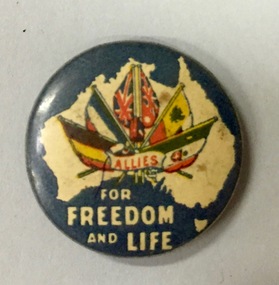
Badge - Fundraising Button, Allies For Freedom and Life, c. 1914-1917
... socially significant artefacts, revealing much about the attitudes and values of the period in which they were produced. Their widespread distribution means that they are frequently significant at a local, state, national and international level. patriotic buttons first world war (1914-18) "Allies For Freedom and Life" A small circular pressed metal badge with a white outline of Australia against a dark blue background. ...Frances Rigg was a local business identity in Kew, at one stage managing the local branch of the English, Scottish and Australian (ES&A) Bank at 175 High Street from c. 1920 until the 1940s. After Francis Rigg’s death, the collection of buttons and medallions was inherited by his son, Ken Rigg (1922-2014). The collection was subsequently donated to the Kew Historical Society in 2015 by Francis' grandson, Adrian Rigg, at the time of the Gallipoli & Beyond Commemoration in 2015. The collection covers a period of almost 40 years. The majority of the buttons are patriotic buttons, issued and sold during and immediately after the First World World War (1914-1918) to raise funds for national and overseas causes. The collection also includes a number of locally significant sporting event buttons and sporting club medallions, issued in the 1920s and 1930s.Patriotic and other pressed tin buttons and badges were produced in large numbers in the first decades of the twentieth century. By nature, insubstantial and ephemeral, they have not always survived. The collections of badges, buttons and medallions in the Kew Historical Society collection is homogenous and yet diverse, ranging from buttons sold to raise funds for the war efforts in 1914-18 and 1939-45, to those used at festivals and sporting events. Because of the manufacturing process, many surviving buttons and badges have been affected by inadequate storage, suffering from oxidisation and physical damage. These survivors are now historically and socially significant artefacts, revealing much about the attitudes and values of the period in which they were produced. Their widespread distribution means that they are frequently significant at a local, state, national and international level.A small circular pressed metal badge with a white outline of Australia against a dark blue background. Flags of Australia’s World War I allies are depicted within the Australian outline, including that of Imperial Russia."Allies For Freedom and Life"patriotic buttons, first world war (1914-18) -
 The Beechworth Burke Museum
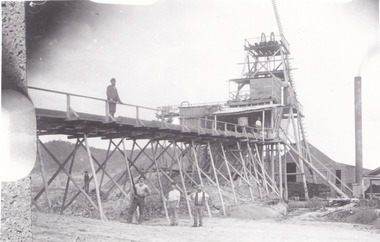
Photograph, 1857
... People of all backgrounds were drawn to the gold fields by the prospect of riches and adventure, but they also learned self-sufficiency and found freedom of expression. Industry boomed, new practices were adopted and social norms were upended. ...People of all backgrounds were drawn to the gold fields by the prospect of riches and adventure, but they also learned self-sufficiency and found freedom of expression. Industry boomed, new practices were adopted and social norms were upended. ...This photograph is of old mine workings on the site of the Spring Creek diggings. Spring Creek is a contact zone for granite pluton and siltstones, shales and standstones; which has, over time, encouraged natural springs to form. Enriched with gold washed out of the surrounding granite, these alluvial deposits achieved fame from 1852 onwards as the Spring Creek Diggings sprang to life (not realised as geographically important until 1871). In Spring Creek that runs behind the main street of Beechworth, near the foot of Newtown Hill a pint pot of gold was discovered on one of these expeditions in 1852 by prospectors Baker and Strickland and the gold rush town of Spring Creek was formed. Australian gold rushes have always created a sense of independence and freedom; as do-it-yourself, off-grid, low-tech adventures. People of all backgrounds were drawn to the gold fields by the prospect of riches and adventure, but they also learned self-sufficiency and found freedom of expression. Industry boomed, new practices were adopted and social norms were upended. This image is of historical significance as it informs on the history of Australian gold mining. It represents the innovation that accompanied the mining industry and the importance of gold mining in town building and regional histories. Black and white rectangular photograph on unmounted board.gold mining, spring creek, mining, geography, geology -
 Flagstaff Hill Maritime Museum and Village
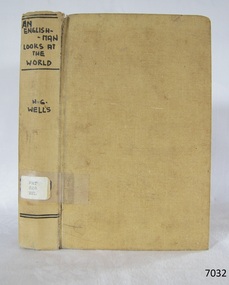
Book - A Collection of Essays, H G Wells, An Englishman Looks At the World, 1914
... social commentary, politics, history, popular science, satire, and autobiography, and is often called 'the father of science fiction.' The publisher Cassell was founded in London in 1848 by John Cassell (1817–1865), growing rapidly through the late nineteenth century into an international publishing group by the 1890s. John Cassell himself was a fervent Christian and temperance campaigner who used his publications to bring learning and culture within reach of the working class. Cassell's first publication was the weekly newspaper The Standard of Freedom...social commentary, politics, history, popular science, satire, and autobiography, and is often called 'the father of science fiction.' The publisher Cassell was founded in London in 1848 by John Cassell (1817–1865), growing rapidly through the late nineteenth century into an international publishing group by the 1890s. John Cassell himself was a fervent Christian and temperance campaigner who used his publications to bring learning and culture within reach of the working class. Cassell's first publication was the weekly newspaper The Standard of Freedom ...Published in 1914, this is a collection of essays by H.G. Wells consisting of journalistic pieces written between 1909 and 1914, spanning twenty-six pieces ranging from five to sixty-two pages in length. Roughly half of the essays were originally printed in the Daily Mail between 1904 and 1913, with ten more appearing in nearly as many weekly and monthly papers, and three others having had prior publication in volume form. The subjects range widely flight and aviation with the opening with Blériot's Channel crossing, the monarchy, imperialism, labour and socialism, modern warfare, sociology, divorce, education, motherhood, the future of civilisation, and more. It's essentially Wells thinking aloud in print opinionated, topical journalism rather than fiction, reflecting a period when he was consciously stepping back from novel-writing to comment directly on contemporary affairs. A companion American edition was published the same year by Harper and Brothers under the different title Social Forces in England and America.Hard Cover Book. An English Man Looks At The World Author: HG Wells Publisher: Cassell & Co Date: 1914 Further Information: Yellow Cloth hardcover with lettering and patterning to spine in black. The spine has a Library label with an inscription.fictionPublished in 1914, this is a collection of essays by H.G. Wells consisting of journalistic pieces written between 1909 and 1914, spanning twenty-six pieces ranging from five to sixty-two pages in length. Roughly half of the essays were originally printed in the Daily Mail between 1904 and 1913, with ten more appearing in nearly as many weekly and monthly papers, and three others having had prior publication in volume form. The subjects range widely flight and aviation with the opening with Blériot's Channel crossing, the monarchy, imperialism, labour and socialism, modern warfare, sociology, divorce, education, motherhood, the future of civilisation, and more. It's essentially Wells thinking aloud in print opinionated, topical journalism rather than fiction, reflecting a period when he was consciously stepping back from novel-writing to comment directly on contemporary affairs. A companion American edition was published the same year by Harper and Brothers under the different title Social Forces in England and America.warrnambool, shipwrecked-coast, flagstaff-hill, flagstaff-hill-maritime-museum, maritime-museum, shipwreck-coast, flagstaff-hill-maritime-village, shipwrecked-artefact, book, an englishman looks at the world, h g wells, warrnambool mechanics’ institute, pattison collection, warrnambool library, ralph eric pattison, corangamite regional library service, warrnambool city librarian, mechanics’ institute library, victorian library board, warrnambool books and records, warrnambool children’s library
