
Showing 66 items matching "social problems"
-
 Bendigo Historical Society Inc.
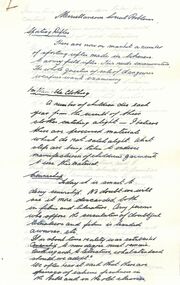
Document - Miscellaneous Social Problems
... Miscellaneous Social Problems......social problems...Six pages handwritten notes on "Miscellaneous Social Problems" by John Ellison. Subheadings are: legalized abortion, sporting rifles, inflammable clothes, censorship, and hanging. ...Document Miscellaneous Social Problems ...Six pages handwritten notes on "Miscellaneous Social Problems" by John Ellison. Subheadings are: legalized abortion, sporting rifles, inflammable clothes, censorship, and hanging. Notes for discussion at Country Party meetings. Part of the Aileen and John Ellison collection.country party, social problems, legalized abortion, sporting rifles, hanging -
 Glen Eira Historical Society
Newsletter - Southwick, David
... ... Social Problems...This file contains one item A newsletter on the activities of David Southwick MP for Caulfield dated Autumn 2011 Southwick David Caulfield Parliamentary Representative Members of Parliament Politicians Government offices Medical Sciences Political Roles Health Medical Sciences Public Transport Transport Violence Parks and Reserves Crime Social Problems Youth Glover Jesse Caulfield Park Bowls Club Pizze Vini Spuntini Molino’s Schools Educational Institutions Ride2School Day St Josephs Primary School Caulfield Junior College Clean Up Australia Day McDonalds Elsternwick Paice Kelly Voluntary Workers World’s Greatest Shave Leukaemia Foundation Caulfield Primary School Bowls Clubs Elsternwick Carre Street Elsternwick Glen Huntly Road Caulfield South Parliament Recreation Government Environment Coalition Newsletter Southwick, David ...This file contains one item A newsletter on the activities of David Southwick MP for Caulfield dated Autumn 2011southwick david, caulfield, parliamentary representative, members of parliament politicians, government offices medical sciences, political roles, health, medical sciences, public transport, transport, violence, parks and reserves, crime, social problems, youth, glover jesse, caulfield park bowls club, pizze vini spuntini, molino’s, schools, educational institutions, ride2school day, st josephs primary school, caulfield junior college, clean up australia day, mcdonalds elsternwick, paice kelly, voluntary workers, world’s greatest shave, leukaemia foundation, caulfield primary school, bowls clubs, elsternwick, carre street elsternwick, glen huntly road caulfield south, parliament, recreation, government, environment, coalition -
Glen Eira Historical Society
Article - Rosstown Railway
... ... Social Problems...Murray Ross Murray Sugar Beet Mills Mills Elsternwick Land Transport Railways Railway Lines Railway Routes Carnegie Neville Street Carnegie Miller Street Factories Market Gardens Horticulture Peat Soils Land Forms Topography Geology Civic Issues Cone Sugar Industry Elsternwick Plaza Elsternwick Glenhuntly Road Parks and Reserves EE Gunn Reserve Caulfield Racecourse Sportsgrounds Caulfield Carnegie Riddell Parade Clarence Street Aileen Avenue Princes Park Dover Street Marara Road Oakleigh Road Rosanna Street Murrumbeena Crescent North Road Kooyong Road Hawthorn Road Booran Road Koornang Road Poath Road Warragul Road Railway Platforms Railway Buildings Bambra Road Swamps Landforms Landfill Council Landfill Railway Bridges Bridges Railway Underpasses Sporting Clubs Tennis Clubs Bowls Clubs Rosstown Railway Rosanna Street Reserve Maps Railway Maps LIVING IN GLEN EIRA Weickhardt Ian Jowett Des Caulfield South Curraweena Road Oakleigh Caulfield Technical School RETURN TO ROSSTOWN Beet Sugar Industry Crops Land Booms Land Development and Subdivisions Bent Thomas Fink Benjamin Sugar Works Rosstown Hotel Oamdenong Road ROSSTOWN DRY CLEANERS Shops Rosstown Road Rosstown Plate People by Circumstance Migrants Accountants Occupations Professionals THE GRANGE Real Estate Grange Road Financial Agents Judges ROSSTOWN ESTATE Financial Trouble Rabbit Preserving Breweries Political Debates Political Issues Political Electorates Politics Political Science Debt Financial Loans Court Procedures Court Cases Legal Events and Activities MALLESON AND RIGGALL Widowers SEABEACH RAILWAY Economics Economic Deadline Depression 1890s Economic Crash Mortgages Divorce Social Problems Poverty Ross Claude Ross Roderick World War 1914-1918 Wars Military History Servicemen AUSTRALIAN FLYING CORPS Engineers Caulfield Council Swagmen Homelessness Glenhuntly Road Glenhuntly Road Tram Woornack Road Leila Road Wild Cherry Road Melten Avenue Illustrations Steam Trains Trains Horse and Cart Horse-drawn Transport Railway Stations Article Rosstown Railway ...This file contains three items: 1/A review of the ROSSTOWN RAIL TRAIL from LIVING IN GLEN EIRA, vol. 11, 2004, Issue 4, no. 25, date and author unknown. The review explains the purpose of the Rail Trail with a brief narrative of the history behind Rosstown Sugar Mill Railway line. Concluding with information on the location of the Trail and the expected time required to walk the entire track included in the review is a map of the Rail Trail, which marks significant sites along the trail with historic pictures. 2/A newspaper article from THE AGE, dated Tuesday 21/10/1980 and written by Iola Matthews, reporting on the circumstances that led to the publication of the book RETURN TO ROSSTOWN written by Des Jowett and Ian Weickhardt. The article begins with a brief biography of the authors before moving into details of the book’s content, providing a further biography of W. Murray Ross which includes information on his financial ventures – particularly the Rosstown Rail – his marriage and children. The article includes a black and white photograph of Weickhardt and Jowett walking along the route of the railway line, an illustration of the Rosstown sugar works and a map of the area surrounding the site of the mill. 3/Three photocopies of a black and white illustration of the Rosstown sugar works from the east, undated and artist unknown.rosstown rail trail, rosstown, ross william, ross w. murray, ross murray, sugar beet mills, mills, elsternwick, land transport, railways, railway lines, railway routes, carnegie neville street, carnegie miller street, factories, market gardens, horticulture, peat, soils, land forms, topography, geology, civic issues, cone sugar industry, elsternwick plaza, elsternwick, glenhuntly road, parks and reserves, ee gunn reserve, caulfield racecourse, sportsgrounds, caulfield, carnegie, riddell parade, clarence street, aileen avenue, princes park, dover street, marara road, oakleigh road, rosanna street, murrumbeena crescent, north road, kooyong road, hawthorn road, booran road, koornang road, poath road, warragul road, railway platforms, railway buildings, bambra road, swamps, landforms, landfill, council landfill, railway bridges, bridges, railway underpasses, sporting clubs, tennis clubs, bowls clubs, rosstown railway, rosanna street reserve, maps, railway maps, living in glen eira, weickhardt ian, jowett des, caulfield south, curraweena road, oakleigh, caulfield technical school, return to rosstown, beet sugar industry, crops, land booms, land development and subdivisions, bent thomas, fink benjamin, sugar works, rosstown hotel, oamdenong road, rosstown dry cleaners, shops, rosstown road, rosstown plate, people by circumstance, migrants, accountants, occupations, professionals, the grange, real estate, grange road, financial agents, judges, rosstown estate, financial trouble, rabbit preserving, breweries, political debates, political issues, political electorates, politics, political science, debt, financial loans, court procedures, court cases, legal events and activities, malleson and riggall, widowers, seabeach railway, economics, economic deadline, depression 1890s, economic crash, mortgages, divorce, social problems, poverty, ross claude, ross roderick, world war 1914-1918, wars, military history, servicemen, australian flying corps, engineers, caulfield council, swagmen, homelessness, glenhuntly road, glenhuntly road tram, woornack road, leila road, wild cherry road, melten avenue, illustrations, steam trains, trains, horse and cart, horse-drawn transport, railway stations -
Glen Eira Historical Society
Letter - Rosstown Railway
... ... Social Problems...RETURN TO ROSSTOWN: RAILWAYS LAND SALES AND SUGAR BEET VENTURES IN CAULFIELD Land Sales Walking Trails Ross William Murray Transport Objects Locomotion Walking Cycling Driving Sports Country Mansions People Caulfield John Builders Construction and Demolition Workers Occupations Careers Professionals Topography Geology Landforms Horticulture Market Gardens Primary Industry Workers City of Caulfield MOOD KEE Pennington Harold Annual General Meetings Caulfield Town Hall Glen Eira City Council Carnegie Carnegie Station Rosstown Station People by Circumstance Migrants Sugar Beet Sugar Beet Mill Sugar Beet Industry Mills Factories SEA BEACH LINES Bent Thomas Parliamentary Representatives Neville Street Miller Street Lemann’s Swamp Reserve Koornang Park Cane Sugar Industry Breweries Rabbit Processing Plants Health Establishments Hospitals Food Production Establishments Abattoirs Thieves Social Problems Vagrants Theft Squatting Financial Economics Debt Finance Industry Insurance Companies Company Managers Bentleigh Ross Leila THE GRANGE Leila Road Wild Cherry Road Financial Trouble Mortgages Gisborne Street Archibald Street Riddell Parade VICTORIA RAILWAYS Glen Huntly Road Clarence Street College Street Gladstone Parade Parrell Street Aileen Avenue Seaview Street Land Subdivisions Dover Street Sussex Street Landfill Marara Road Booran Road Woodville Avenue Dorothy Avenue Ormond Park Royal Avenue Ormond Railway Station Oakleigh Road Melten Avenue Miller Street Munro Avenue Lord Reserve Neerim Road Toolambool Road The Rosstown Hotel Rosanna Street Murrumbeena Crescent Commercial Establishments The National Bank Rosstown Road Kangaroo Road Poath Road Freda Street Hughesdale Kindergarten Oakleigh Council Hughesdale Community Centre Civic Establishments Galbally Reserve Plaques Warrigal Road OUT AND ABOUT BROCHURES Orion Estate Letter Rosstown Railway ...This file contains four items: 1/A black and white photocopy of a letter dated either 07/08/1889 or 09/08/1889, from Robert Lundon to an unidentified recipient discussing an agreement reached between the author – on behalf of the recipient – and Soon Hang Hi in regard, in regards to the allotment known as Webber’s. The agreement is outlined in the letter in what appears to be Chinese characters, and includes the marks of Robert Lundon and Soon Hang Hi. File note from Joy Wu states that the calligraphy is not Mandarin or traditional Chinese. 2/Three sheets of hand-written working notes with information taken from the Victorian Government Gazette on THE ROSSTOWN AND MURRUMBEENA LAND COMPANY LIMITED, THE ROSSTOWN JUNCTION RAILWAY AND PROSPERITY COMPANY LIOMITED, and THE ROSSTOWN JUNCTION, ELSTERNWICK, AND OAKLEIGH RAILWAY COMPANY LIMITED, covering dates between 1887 and 1894. The notes concern meetings and creditors claims relevant to the companies, with reference numbers for the information source. Date and author of the notes are not recorded. 3/A black and white photocopy of the a partial map of the Rosstown Railway and surrounding area, undated. The map includes the names of landholders in the areas of Brighton, Garden Vale and Elsternwick, as well as other railway lines present in the region. 4/A fold-out map and guide of the Rosstown Rail Trail, including a brief general history of Caulfield as well as a more extensive biography of William Murray Ross and the Rosstown Railway. The map marks and describes significant sites along the trail, including photographs of some of these sites, provided by DF Jowett.documents, correspondence, webber’s, lundon robert, chinese characters, ethnic communities, signatures, text, settlements, taxes, fraser john grieves, lovell r.h., price davies, meetings, communication activities, soon hang hi, commercial events and activities, the rosstown and murrumbeena land company limited, victorian government gazette, bulmer richard, parry john, osment henry, shareholders, creditors claims, the rosstown junction railway and property company limited, finch and best, lawyers, the rosstown junction elsternwick and oakleigh railway company limited, cameron w.c., phillips p.d., garden vale, elsternwick, elsternwick railway station, rosstown, rosstown railway, thomas street, bay street, kooyong road, melbourne and brighton railway, hawthorn road, bambra road, caulfield and frankston railway, booran road, grange road, koornang road, murrumbeena road, north road, north road railway station, east brighton railway station, south road, railway routes, railway lines, railways, land transport, murphy j., caulfield, hamilton t.f., dane p., holloway, webb, ailee john, payne t.b., brodie chas, dane john, o’neil h., mccombie john, mcmillane a., smyth c.d., cooper, ebden, landholders, jeffrey j.d., gill j., balcombe a.e., cooper h., mcnab j., white j., sutherland j., greeves a.f.a., newton m.c., chamley f.b., fowler j., inglis p., grant t., stooke j., swanson g., cochrane c., adams e.b., mccombie thas, keyes robert, brighton cemetery, burials grounds and graveyards, war-ein road, were j.b., holland j., mcmahon c., winter t.l.m., dendy henry, mitchell w., jackson s., were j.e., wickham francis dawe, bryant jane, east brighton railway station, railway stations, maps, allotments, land titles, roads and streets, rosstown rail trail, city of glen eira, tourism, trains, tourism information bureaus, tours, pamphlets, elsternwick railway park, oakleigh junction, princes park, ee gunn reserve, packer park, sites, jowett d.f., weickhardt i.g., return to rosstown: railways land sales and sugar beet ventures in caulfield, land sales, walking trails, ross william murray, transport objects, locomotion, walking, cycling, driving, sports, country mansions, people, caulfield john, builders, construction and demolition workers, occupations, careers, professionals, topography, geology, landforms, horticulture, market gardens, primary industry workers, city of caulfield, mood kee, pennington harold, annual general meetings, caulfield town hall, glen eira city council, carnegie, carnegie station, rosstown station, people by circumstance, migrants, sugar beet, sugar beet mill, sugar beet industry, mills, factories, sea beach lines, bent thomas, parliamentary representatives, neville street, miller street, lemann’s swamp reserve, koornang park, cane sugar industry, breweries, rabbit processing plants, health establishments, hospitals, food production establishments, abattoirs, thieves, social problems, vagrants, theft, squatting, financial economics, debt, finance industry, insurance companies, company managers, bentleigh, ross leila, the grange, leila road, wild cherry road, financial trouble, mortgages, gisborne street, archibald street, riddell parade, victoria railways, glen huntly road, clarence street, college street, gladstone parade, parrell street, aileen avenue, seaview street, land subdivisions, dover street, sussex street, landfill, marara road, booran road, woodville avenue, dorothy avenue, ormond park, royal avenue, ormond railway station, oakleigh road, melten avenue, miller street, munro avenue, lord reserve, neerim road, toolambool road, the rosstown hotel, rosanna street, murrumbeena crescent, commercial establishments, the national bank, rosstown road, kangaroo road, poath road, freda street, hughesdale kindergarten, oakleigh council, hughesdale community centre, civic establishments, galbally reserve, plaques, warrigal road, out and about brochures, orion estate -
Glen Eira Historical Society
Document - Alcoholics
... Social Problems...The notes include the address of the Sanatorium and a small map of the location, as well as details of references to the sanatorium in various directories. Social Problems Alcohol and Drugs Caulfield Hospitals Caulfield Hall Caulfield Institute for Alcoholics Directories Orang Road Alma Road St. ...This file contains one page of handwritten notes on the Caulfield Institute for Alcoholics, undated and author unknown. The notes include the address of the Sanatorium and a small map of the location, as well as details of references to the sanatorium in various directories.social problems, alcohol and drugs, caulfield, hospitals, caulfield hall, caulfield institute for alcoholics, directories, orang road, alma road, st. aubins avenue, hotham street, east st. kilda -
Glen Eira Historical Society
Article - CRIME
... ... Social problems...Caulfield Lord Street Crime Social problems Police Article CRIME ...This file contains one item. 1/A short article from the Sun News Pictorial dated 23011933 about an attempted criminal assault on a young woman in Caulfield. The article itself has been outlined in pencil by hand.caulfield, lord street, crime, social problems, police -
Glen Eira Historical Society
Document - CAULFIELD COMBINED PENSIONERS ASSOCIATION INC
... ... social problems...Caulfield Meaney Street Elsternwick Morton Alma Caulfield Combined Pensioners community services people by circumstance parliamentary representatives social problems clubs and associations Document CAULFIELD COMBINED PENSIONERS ASSOCIATION INC. ...This file contains 3 items about pensioner issues: 1/Original copy of typed document titled ‘Pensioners are People with the right to live as every Australian’, written by the President of the above mentioned association. It discusses how Pension payment increases are delayed long after they are announced which results in pensioners living below the poverty line. 2/Copy of newspaper article dated to 24/07/1982. The article is titled ‘Aged burden a myth: professor’ by Philip McIntosh. The professor of social and preventative medicine at Monash, Professor Lou Opit, was speaking at a seminar about the rising welfare payments for the aged and their cost to the taxpayer. The article also shows a table of countries rated in order from highest to lowest for welfare spending and Australia is 17th out of 19 countries. 3/Original copy of typed document titled ‘Facts about Pensioners’ authorised by the President of Caulfield Combined Pensioners Associations. Document talks about claims that welfare payments (social security) are not in fact a burden on taxpayers but the real cost to the country is caused by tax evasion and overspending in other areas. Statistics also show a decline in the rate of pension increases.caulfield, meaney street, elsternwick, morton alma, caulfield combined pensioners, community services, people by circumstance, parliamentary representatives, social problems, clubs and associations -
Glen Eira Historical Society
Letter - Yeshivah & Beth Rivkah College
... ... Social Problems... – a personal visit to the minister by Mrs Elbaum – Written material concerning family policies, child protection and the rights of the handicapped provided by Mrs Elbaum – a submission for funding by the school School State Government Community Services Independent School Minister For Community Welfare Social Problems Yeshivah College Jona Walter Disabled People Elbaum Emmy Minister Grants Saint Kilda East Borthwick W.A Hon Hotham Street 92 Letter Yeshivah & Beth Rivkah College ...This file contains correspondence from the Minister for Community Welfare Services, Walter Jona, dated 10th July 1980 to Mrs Emmy Elbaum in response 6. – a personal visit to the minister by Mrs Elbaum – Written material concerning family policies, child protection and the rights of the handicapped provided by Mrs Elbaum – a submission for funding by the schoolschool, state government, community services, independent school, minister for community welfare, social problems, yeshivah college, jona walter, disabled people, elbaum emmy, minister, grants, saint kilda east, borthwick w.a hon, hotham street 92 -
Whitehorse Historical Society Inc.
Newspaper - Article, Victims of a private war, 27/11/1991
... Social Problems...Social Problems Martin Heather (Rev) Amos Anne (Rev) Article in Nunawading Post, 1991, on domestic violence in Police F & G District which includes Nunawading in the 12 months to June 30 1991. ...Article in Nunawading Post, 1991, on domestic violence in Police F & G District which includes Nunawading in the 12 months to June 30 1991.social problems, martin, heather (rev), amos, anne (rev) -
 Whitehorse Historical Society Inc.
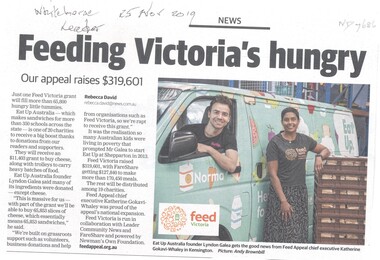
Article, Eat Up Australia, 25/11/2019
... ...Social Problems...The "Eat up Australia" organisation has received a grant from Feed Appeal Eat up Australia Social Problems Eat Up Australia founder Lyndon Galea receives the good news of a grant from Feed Appeal. ...Eat Up Australia founder Lyndon Galea receives the good news of a grant from Feed Appeal.Eat Up Australia founder Lyndon Galea receives the good news of a grant from Feed Appeal.Eat Up Australia founder Lyndon Galea receives the good news of a grant from Feed Appeal.eat up australia, social problems -
 Mrs Aeneas Gunn Memorial Library
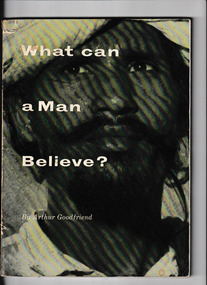
Book, Farrar, Straus and Young, What can a man believe?, 1952
... ...Social problems...Political science Social problems An illustrated exploration of social and political problems Ill, p.127. ...An illustrated exploration of social and political problemsIll, p.127.non-fictionAn illustrated exploration of social and political problemspolitical science, social problems -
 Orbost & District Historical Society
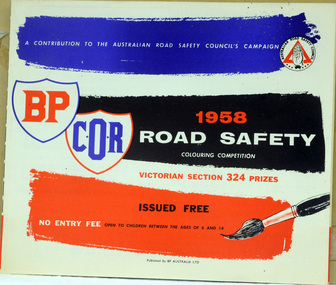
booklet, 1958 Road Safety Colouring Competition, second half 1950's
... Between the 1950s and 1970s, road safety was redefined as a medical and social problem, rather than a moral and legal one. ...Between the 1950s and 1970s, road safety was redefined as a medical and social problem, rather than a moral and legal one. ...Between the 1950s and 1970s, road safety was redefined as a medical and social problem, rather than a moral and legal one. This was a time before seat belts. The Road Safety Colouring Competition was a free colouring competition for children, organised by Commonwealth Oil Refineries Ltd., started in August 1954 with the , aims of teaching road safety. There were 1,000 prizes, valued at £1,200. The winner would receive a £100 bursary and a free plane trip with one parent to Canberra to receive the prize from the Federal Minister for Transport, Senator.G. McLeay. This booklet is the one used by the children in Orbost in 1958. This booklet was designed to promote road safety awareness, with messages and activities specifically considered for children. Its aim was to teach road safety in a fun, but educational way. This item was an important educational tool. A booklet of competitions - Road Safety- Victorian Section for Children It was issued by the Australian Road Safety Council. The front cover is blue, red, black and white. It contains crosswords, colouring competitions with entry forms.road-safety competitions-colouring -
 Sunshine and District Historical Society Incorporated
Document - Crime And Punishment In Port Phillip 1836 - 1838, Public Record Office Victoria, 1981
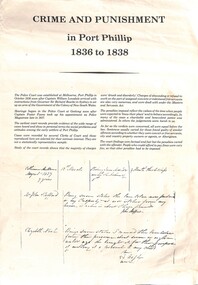
... The earliest court records provide evidence of the wide range of cases heard and show impersonal terms the social problems and attitudes among the early settlers of Port Phillip. ...The earliest court records provide evidence of the wide range of cases heard and show impersonal terms the social problems and attitudes among the early settlers of Port Phillip. ...The Police Court was established at Melbourne, Port Phillip in October 1836 soon after Captain William Lonsdale arrived with instructions from Governor Sir Richard Bourke in Sydney to set up an arm of the Government of the Colony of New South Wales. Hearings began in the Police Court at Geelong soon after Captain Foster Fyans took up his appointment as Police Magistrate late in 1837. The earliest court records provide evidence of the wide range of cases heard and show impersonal terms the social problems and attitudes among the early settlers of Port Phillip. Study of the court records shows that the majority of charges were `drunk and disorderly: Charges of absconding or refusal to work on the part of assigned convicts or indentured free servants are also very numerous and were dealt with under the Masters and Servants Act. The penalties imposed reflect the values of the time when people were expected to `know their place' and to behave accordingly. In many of the cases a charitable and benevolent justice was administered. In others the judgements seem harsh to us. As far as the verdicts were concerned, all were equal before the law. Sentences usually varied for those found guilty of similar offences according to whether they were convict or free servants, city and country property owners or agents, or aborigines. The court findings were factual and fair, but the penalties varied with the offender. People who could afford to pay fines were very few, so that other penalties had to be imposed. Cases recorded in this document were by several Clerks of Court and those reproduced here are selected for their intrinsic interest. They are not a statistically representative sample.Crime And Punishment in Port Phillip 1836 to 1838police court, port phillip, captain william lonsdale, governor sir richard bourke, james lawrence, alfred boucher, michael malony, george frederick reid, joseph suthlerland -
 The Beechworth Burke Museum
Animal specimen - Common Starling, Trustees of the Australian Museum, 1860-1880
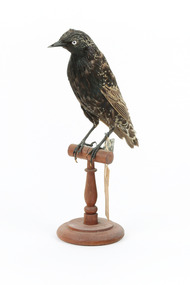
... It was introduced to Victoria in 1861, and has since become abundant, whose sheer numbers cause many problems. These birds are a social species, which can mass in very large flocks (murmations), and show spectacular synchronised aerobatic displays. ...It was introduced to Victoria in 1861, and has since become abundant, whose sheer numbers cause many problems. These birds are a social species, which can mass in very large flocks (murmations), and show spectacular synchronised aerobatic displays. ...The Common Starling is an introduced species to Australia (as well as widely throughout the world), and is considered a pest due to its attacks on fruits and seedlings, as well as competing with the native bird population. It was introduced to Victoria in 1861, and has since become abundant, whose sheer numbers cause many problems. These birds are a social species, which can mass in very large flocks (murmations), and show spectacular synchronised aerobatic displays. This species has a distinctive plumage, with glossy black bodies, white spots on their backs and wings, and a purple and green tinge to their underparts and wings. This species, when moving across the ground, has a distinctive 'walk' or 'run' rather than the traditional hopping of many other bird species. This bird is a noisy species, often becoming a nuisance to people. Starlings prefer to nest in holes in trees or buildings, yet there are at least two recorded cases of this species nesting on the backs of living sheep. This specimen is a good and intact example of this species. As the white spots are large and visible, as well as the purple and green shine, this specimen likely died close to Autumn and the breeding season, when these birds get their new bright plumage. This specimen is part of a collection of almost 200 animal specimens that were originally acquired as skins from various institutions across Australia, including the Australian Museum in Sydney and the National Museum of Victoria (known as Museums Victoria since 1983), as well as individuals such as amateur anthropologist Reynell Eveleigh Johns between 1860-1880. These skins were then mounted by members of the Burke Museum Committee and put-on display in the formal space of the Museum’s original exhibition hall where they continue to be on display. This display of taxidermy mounts initially served to instruct visitors to the Burke Museum of the natural world around them, today it serves as an insight into the collecting habits of the 19th century. This specimen is part of a significant and rare taxidermy mount collection in the Burke Museum. This collection is scientifically and culturally important for reminding us of how science continues to shape our understanding of the modern world. They demonstrate a capacity to hold evidence of how Australia’s fauna history existed in the past and are potentially important for future environmental research. This collection continues to be on display in the Museum and has become a key part to interpreting the collecting habits of the 19th century.This adult Common Starling has glossy-black plumage with a metallic sheen, and white speckles throughout. The plumage has a purple and green shine. The irises are white. Its beak is black and pointed. This specimen appears to be male, with less white spots on its underparts. This specimen stands upon a wooden platform and has an identification tag tied around its leg, and a metal tag tied around its foot.Swing-tag: 139a. / Starling / Catalogue Page, 59 / Metal-tag: 1250 (?)taxidermy mount, taxidermy, animalia, burke museum, beechworth, australian museum, skin, reynell eveleigh johns, bird, sheep, common starling, starling, murmations, pest, australian bird -
 Federation University Historical Collection
Document - Document - Presentation, VIOSH: Social History; Introduction to Sociology of Work and Technology Presentation, post 1997
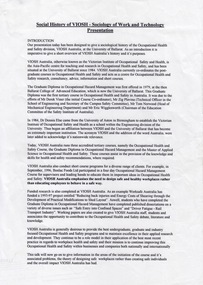
... Following the introductory speech, the talk gave information on the development, problems and theory of designing safe workplaces. viosh victorian institute of occupational safety and health social history sociology derek viner course co-ordinator tom norwood head of mechanical engineering eric wigglesworth chairman education committee of the safety institute of australia zig plavina technical officer school of engineering campus safety committee university of aston dennis else One A4 page typed. ...Victorian Institute of Occupational Safety and Health (VIOSH) Australia is the Asia-Pacific centre for teaching and research in occupational health and safety (OHS) and is known as one of Australia's leaders on the field. VIOSH has a global reputation for its innovative approach within the field of OHS management. VIOSH had its first intake of students in 1979. At that time the Institution was known as the Ballarat College of Advanced Education. In 1990 it became known as Ballarat University College, then in 1994 as University of Ballarat. It was 2014 that it became Federation University. VIOSH Australia students are safety managers, senior advisors and experienced OHS professionals. They come from all over Australia and industry. Students are taught active research and enquiry; rather than textbook learning and a one-size fits all approach. VIOSH accepts people into the Graduate Diploma of Occupational Hazard Management who have no undergraduate degree - on the basis of extensive work experience and knowledge. Brief outline of the history of the development of VIOSH, and those responsible. They were Derek Viner (the initial Course Co-ordinator), Mr Tom Norwood (Head of the Mechanical Engineering Department), Mr Eric Wigglesworth (Chairman of the Education Committee of the Safety Institute of Australia) and Mr Zig Plavina (Technical Officer in the School of Engineering and Secretary of the Campus Safety Committee). Dr Dennis Else from the University of Aston, Birmingham arrived to establish the Victorian Institute of Occupational Safety and Health within the Engineering division of the University. Following the introductory speech, the talk gave information on the development, problems and theory of designing safe workplaces.One A4 page typed.viosh, victorian institute of occupational safety and health, social history, sociology, derek viner, course co-ordinator, tom norwood, head of mechanical engineering, eric wigglesworth, chairman, education committee of the safety institute of australia, zig plavina, technical officer, school of engineering, campus safety committee, university of aston, dennis else -
Federation University Historical Collection
Document - Document - Letter, Ballarat Junior Technical School: Letter from The Metropolitan Technical Men's Branch of the V.T.U. re class sizes, 1952
... Letter from the Secretary of the Metropolitan Technical Men's Branch of the Victorian Teachers' Union, Findlay Masson, outlining the problem of class sizes in Technical Schools. Classes of 48 students are regular in English, Mathematics and Social Studies. ...Letter from the Secretary of the Metropolitan Technical Men's Branch of the Victorian Teachers' Union, Findlay Masson, outlining the problem of class sizes in Technical Schools. Classes of 48 students are regular in English, Mathematics and Social Studies. ...Letter from the Secretary of the Metropolitan Technical Men's Branch of the Victorian Teachers' Union, Findlay Masson, outlining the problem of class sizes in Technical Schools. Classes of 48 students are regular in English, Mathematics and Social Studies. In practical classes the size has been set. Asking Technical Schools to submit details of extra accommodation required to allow for reduction of class size to 40 students or less. These needs to be incorporated into a proposed plan to be submitted to the Education Department through the V.T.U. Cream sheet of paper, typed Headmaster Ballarat Junior hand written in red pen Answered 23/10 in pencil Signature of Findlay C Masson, Secretary in red penballarat junior technical school, headmaster, l garner, victorian teachers' union, v.t.u., findlay masson, secretary, metropolitan technical men's branch, class sizes, reduction in number, extra accommodation, proposed plan, education department -
 Flagstaff Hill Maritime Museum and Village
Book - A Fictional Story, Charles Dickens, The Posthumous Papers of The Pickwick Club (Pickwick Papers), 1910-1912
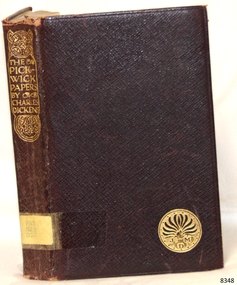
... social satire, and sympathy for ordinary people. The book is especially known for its funny episodes, but beneath the comedy it criticizes real Victorian problems such as debt, the legal system, and social pretension. ...Charles Dickens (1812–1870) was one of the great English novelists of the Victorian era, famous for vivid characters, social criticism, and stories that were first published in serial form. He began as a journalist, rose to enormous popularity during his lifetime, and wrote major works such as Oliver Twist, David Copperfield, and Great Expectations. The “Pickwick Papers” is a comic novel about Samuel Pickwick and the members of his club as they travel around England, recording amusing adventures, misunderstandings, lawsuits, and mishaps.The theme gradually becomes a story about friendship, folly, and social life in early Victorian England. It is significant because it was Dickens’s first novel that helped establish his reputation, and is widely praised for its lively characters, satire, and its strong focus on the absurdities of the legal system.The Posthumous Papers of The Pickwick Club. Author: Charles Dickens. Publisher: J M Dent & Sons Ltd, London. Date: 1910-1912. (See note section this document for more information on Edition). Brown leather hardcover with title and a design on spine in gold lettering, Front has round publishers logo in gold embossing. The spine has a Library label and no Volume information.fictionCharles Dickens (1812–1870) was one of the great English novelists of the Victorian era, famous for vivid characters, social criticism, and stories that were first published in serial form. He began as a journalist, rose to enormous popularity during his lifetime, and wrote major works such as Oliver Twist, David Copperfield, and Great Expectations. The “Pickwick Papers” is a comic novel about Samuel Pickwick and the members of his club as they travel around England, recording amusing adventures, misunderstandings, lawsuits, and mishaps.The theme gradually becomes a story about friendship, folly, and social life in early Victorian England. It is significant because it was Dickens’s first novel that helped establish his reputation, and is widely praised for its lively characters, satire, and its strong focus on the absurdities of the legal system.book, the old curiosity shop, charles dickens, shipwrecked-coast, flagstaff-hill, flagstaff-hill-maritime-museum, warrnambool, maritime-museum, flagstaff-hill-maritime-village, pattison collection, warrnambool library, warrnambool mechanics’ institute, ralph eric pattison, corangamite regional library service, warrnambool city librarian, mechanics’ institute library, victorian library board, warrnambool books and records, warrnambool children’s library, great ocean road -
Warrnambool and District Historical Society Inc.
Document - correspondence
... These letters etc are of considerable importance as they give an historical overview of the problems of dog registration, stray dogs and the killing of these dogs in the local pounds during the period early to mid 20th century in Warrnambool. They form a valuable social ...These are original documents and contain historical material in relation to dogs and dog registration in Warrnambool Town/City Council from the period 1909 to 1941. Many of the letters relate to stray dog nuisances in the area, the humane killing of unclaimed and unwanted dogs and the Warrnambool Council response.These letters etc are of considerable importance as they give an historical overview of the problems of dog registration, stray dogs and the killing of these dogs in the local pounds during the period early to mid 20th century in Warrnambool. They form a valuable social history of the times. These are 43 items of correspondence on sheets of paper, some white and some pink. One item is a receipt. Some of the sheets have letterheads and some are annotated with Council numbering. Twenty-eight of the sheets contain typed material and fifteen contain handwritten material in pencil and ink. correspondence -
 Eltham District Historical Society Inc
Photograph - Digital Photograph, Alan King, Eltham Railway Trestle Bridge, 28 December 2007
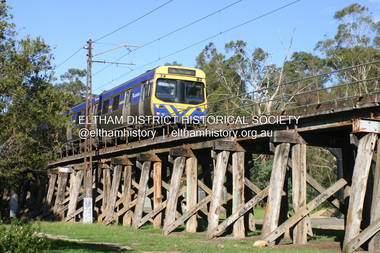
... socially significant at state level. But this has not always been recognised, and in 1977, locals fought to save it from destruction. The Victorian Railways proposed to replace the bridge with an earth embankment and large culverts to avoid maintenance problems and fire. ...socially significant at state level. But this has not always been recognised, and in 1977, locals fought to save it from destruction. The Victorian Railways proposed to replace the bridge with an earth embankment and large culverts to avoid maintenance problems and fire. ...Covered under National Trust of Australia (Victoria) State Significance and Heritage Overlay, Nillumbik Planning Scheme. Published: Nillumbik Now and Then / Marguerite Marshall 2008; photographs Alan King with Marguerite Marshall.; p103 The Eltham railway trestle bridge is the only one of its kind still regularly used in Melbourne’s metropolitan railway network. Opened in 1902, it is also one of Victoria’s very few timber rail bridges that still carries trains.1 The bridge is part of the railway line extension from Heidelberg - extended to Hurstbridge in 1912. This extension resulted in one of the greatest social changes experienced in Eltham Shire, as it considerably lessened its isolation attracting tourists, artists and suburban commuters particularly after World War Two.2 The bridge has been classified by the National Trust as historically, scientifically, aesthetically and socially significant at state level. But this has not always been recognised, and in 1977, locals fought to save it from destruction. The Victorian Railways proposed to replace the bridge with an earth embankment and large culverts to avoid maintenance problems and fire. This was rejected by the Eltham Council who protested that the bridge helped maintain the area’s rural character, historic link and beauty, as well as avoiding possible serious flooding on the flood plain if a culvert was blocked. The bridge stands as part of a National Trust classified landscape which includes the Alistair Knox Park, named after the local conservationist and architect who helped to make Eltham famous for its mud-brick houses. The landscape includes tall and spreading manna gums and candlebarks, and the historic Shillinglaw Cottage. Artist Walter Withers, one of the Heidelberg School of painters, painted the bridge early in the 20th century. The 38 span single-track railway bridge over creek and road has 34 timber-beam spans and four steel-joist spans, supported by four-pile timber piers and timber abutments. It has almost 200m of timber deck. All of the timbers have been replaced over the years, but the only change to the bridge’s character was the addition of pylons and wiring for electric trains in 1923. A petition for a railway to the shire was first made in 1883. A large deputation of local citizens to the Commissioner of Railways proposed a route passing through Alphington to midway between Greensborough and Eltham up the Diamond Creek valley towards Queenstown and Kinglake. As a result the Princes Bridge-Heidelberg Railway was opened in 1888. From 1888 locals demanded a railway extension. Kangaroo Ground farmers in particular, led by Shire Councillor and Member for Evelyn, Ewen Cameron, said it would assist local farmers and orchardists send their produce to the Melbourne market. In 1890, before the severe economic Depression, an extension of the line to Hurst’s Bridge (now Hurstbridge) was included in a new Railways Bill. The parliamentary delegations were regaled with a banquet at Hurst’s barn and entertained by the Diamond Creek Brass Band, but the extension was abandoned when the Depression struck in 1892-1893. The extension of the railway to Eltham, completed in 1902, was one of the few built in those hard times. That is why the Eltham timber-trestle railway bridge is a rare example of a broad-gauge rail bridge constructed between 1893 and 1910. At the opening, despite persistent drizzle, 300 children waving flags and banners were among the large crowd welcoming the first train, carrying official dignitaries, to Eltham. It had taken 24 years to bring the railway to Eltham. From then Eltham became a popular destination for outings. Mr Orford of Eltham recalled that after the railway came to Eltham ‘the craze for picnics on weekends and holidays began…. During the wattle season, wattle trains came to Eltham frequently. The visitors roamed the creek pulling great armfuls of wattle blossom to take back with them to Melbourne’.3 In 1926 the railway line was electrified as part of the metropolitan rail network. But the Victorian Railways decided not to complete the formerly planned Diamond Valley Railway to Queenstown (now St Andrews) and Kinglake.This collection of almost 130 photos about places and people within the Shire of Nillumbik, an urban and rural municipality in Melbourne's north, contributes to an understanding of the history of the Shire. Published in 2008 immediately prior to the Black Saturday bushfires of February 7, 2009, it documents sites that were impacted, and in some cases destroyed by the fires. It includes photographs taken especially for the publication, creating a unique time capsule representing the Shire in the early 21st century. It remains the most recent comprehenesive publication devoted to the Shire's history connecting local residents to the past. nillumbik now and then (marshall-king) collection, eltham railway trestle bridge, eltham trestle bridge -
 Kiewa Valley Historical Society
Plug Tobacco, Circa 1900s
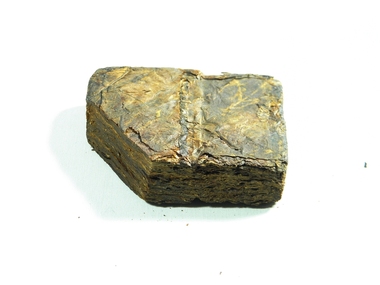
... This item was used at a time when it was socially acceptable to chew tobacco (1800s to early 1900s). The associated health problems (lung and other related cancers including emphysema) eventually became the social and political incentive to curb the tobacco industry in the Kiewa Valley. ...This item (tobacco plug, as it was referred to) was used as a smokeless digestion of nicotine from the tobacco leaf. It was harvested by the tobacco growers before tailor made cigarettes became available. It was mainly regarded as more of a male item as it required to expectorate unwanted mouth juices. Ladies rarely used chewing tobacco. Most hotels and drinking rooms (men only in this era) had special spittoons to catch the waste.This item was used at a time when it was socially acceptable to chew tobacco (1800s to early 1900s). The associated health problems (lung and other related cancers including emphysema) eventually became the social and political incentive to curb the tobacco industry in the Kiewa Valley. Harvesting tobacco also had extreme risks such as "Green Tobacco " sickness. In Victoria the economical viability of the tobacco industry was extinguished in 2006. The tobacco drying sheds are still standing in the Kiewa Valley and in nearby regions. This item was also used by miners underground retrieving gold.This work environment was strictly a non smoke one.Square (small corner cut off) of compressed tobacco leaves, brown in colour and dried. Known at the time of use as a Plug.tobacco, chewing, plug, nicotine, smokeless, rural industry -
 Kiewa Valley Historical Society
Book - Reference Countryside, The Australian Countryside in Pictures, circa 1950s
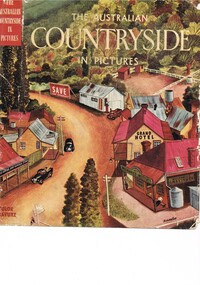
... The effects of the war, and later the push for women's emancipation and equality in both family, social, workplace and political areas of life, since this book was published, is now finally resolved. However there are still some sections of the recent migrate population where this male dominance is causing a few problems....The effects of the war, and later the push for women's emancipation and equality in both family, social, workplace and political areas of life, since this book was published, is now finally resolved. However there are still some sections of the recent migrate population where this male dominance is causing a few problems. ...This book is a "snapshot" in time (1950s) detailing life in Australia covering a time when a "man's word and handshake" were his moral and quasi legal bond, and the now relative defunct saying "smoko" (having a "time out" from work for a cigarette and tea or coffee). The book spans an era where the male was still the "head" of the family even though for a majority of families the women took on the many "male only" roles during the World War II period. This shift in the leadership of the family hierarchy is mentioned, so ever slightly, (not to offend the still predominant macho male image) in both rural and city environments. The effects of the war, and later the push for women's emancipation and equality in both family, social, workplace and political areas of life, since this book was published, is now finally resolved. However there are still some sections of the recent migrate population where this male dominance is causing a few problems.The significance of this book is not only because it was donated by Mrs C. Roper ( from the Roper Family, a pioneer Kiewa Valley and surrounding Region family - originally beef cattle graziers) but also a Kiewa Valley resident and family, experiencing the shift in the social and economical life of post World War II rural Australia. The strong heritage link to this region of many families still residing within its boundaries, is a clear affirmation of the bond that the Kiewa Valley and its Regions have upon family unity. This unity within the rural environment is something that is attracting more and more families from sometimes alienating city life.This printed coloured sketched, or painted paper sleeve of the book is freely wrapped over a dark red hard cover. Into the front of the cover is pressed a standing pose of a farmer with long sleeves rolled up over his elbows. Behind him and to the right are what appears to be three sacks of wheat and next to him is a merino sheep. To the left and down are two dogs one with a fox in its jaws. The book contains 240 pages, 300 illustrations in gravure and 25 pictures in full colour. The inside fly leaf is a colour photograph of a rural scene with dirt road running in the centre and to the left a farm house and a five bay open storage barnOn the tittle page is a signature "C Roper"country life, australian "outback", rural industries, life on the land, swag-man of the bush -
 Kiewa Valley Historical Society
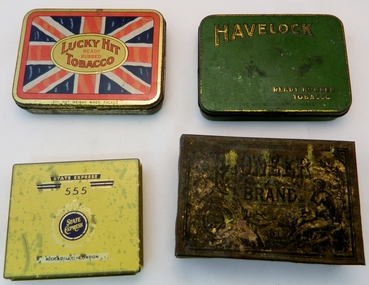
Tins - Tobacco (Lucky Hit) x4, Mid to late 1900s Possibly c1910
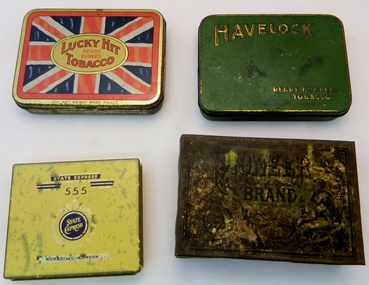
... Cigarette smoking before the 1900s was seen as rough and uncouth (socially frowned upon), however after the introduction of overseas films (U.K. and U.S.A.) and film stars presenting smoking as socially acceptable the rise of smoking cigarettes, especially roll you own (American western movies) in rural areas was an accepted way of life. Things however started to change in the mid 1900s when medical evidence pointed to the health problems of regular smokers. ...Cigarette smoking before the 1900s was seen as rough and uncouth (socially frowned upon), however after the introduction of overseas films (U.K. and U.S.A.) and film stars presenting smoking as socially acceptable the rise of smoking cigarettes, especially roll you own (American western movies) in rural areas was an accepted way of life. Things however started to change in the mid 1900s when medical evidence pointed to the health problems of regular smokers. ...The British Australasian Tobacco Co. (based in Melbourne and Sydney. The parent company was founded in England, circa 1902). This item "Lucky Hit" was the fore runner of the "Lucky Strike" brand name. The ready rubbed tobacco held within the tin was mainly used by those smokers who rolled their own cigarettes. These smokers would have mainly used their palm and formed a cup then placing their choice of the amount of tobacco to be rolled. This would then be placed on the fine cigarette paper and rolled and sealed (using saliva in the mouth) into the required shape. There were mechanical "roll you own" gadgets on the market but most rural users, especially males used their palms. The quantity of tobacco used to make up the cigarette was up to the individual user. The thinner that the cigarette was rolled the longer and more economical did the supply last. The by -products of this method were nicotine stained fingers and hands. "Chain" smokers were easily identified and could therefore be discriminated against obtaining smoke sensitive employment. The two world wars (1914-18 and1939-45) produced a significant rise in the consumption of cigarette use by men and the eventual overflow to women. Cigarette smoking before the 1900s was seen as rough and uncouth (socially frowned upon), however after the introduction of overseas films (U.K. and U.S.A.) and film stars presenting smoking as socially acceptable the rise of smoking cigarettes, especially roll you own (American western movies) in rural areas was an accepted way of life. Things however started to change in the mid 1900s when medical evidence pointed to the health problems of regular smokers. Governments were now implementing non smoking education material. Restrictions on where and when smoking was permitted and acceptable started to creep into all areas of society whether city or rural. This was the era that highlighted the use of roll your own cigarettes, especially when the costs of "tailor made" cigarettes were taxed at an increasing amount. Roll your own cigarettes also provided an avenue for the consumption of illicit drug use.The significance of this ready rubbed tobacco tin to this rural region is, stems from how much influence that the Western novels and overseas films (portraying rural lifestyles) played in shaping the rural social and working mores of the Kiewa Valley. The post war depression (financially) resulted in more smokers turning away from expensive machine (tailor) made cigarettes to the roll your own, using ready rubbed tobacco. This tobacco tin relays a long ago era, when personal contact, and not something that has been written down by some "unknown", was valued as the true appraisal of a member of the community. This was especially relevant in a small regional area such as the Kiewa Valley. Although social networking was not as fast then as the internet provides now, appearances, manners, fashion and etiquette with first impressions high on the order of evaluating someone in the community. Pointer such as the brand of tobacco smoked was part of the rural assessment method. Up until the demise of the Australian Tobacco Industry, circa 2004, the Kiewa Valley and surrounding district was part of a vibrant producer of tobacco leaves. The remnants of this industry still remain today but the drying sheds (for tobacco leaves) are now used to store hay for the valley's dairy and beef cattle industries. Tins 2,3 and 4 were found (in 2009) at Wallace's Hut on the Bogong High Plains. This tobacco tin is constructed from tin plated thin rolled steel. The lid is attached by two pressed and formed (from the main frame) hinges using the nip and tuck construction method. The lid and outside frame have been gold & silver anodised. Tins 2,3 and 4 have the Union Jack on the front lid. One is too rusty to read. The other two have "A blend containing choice selected Australian grown leaf" in white across the bottom on the red border and above the "2oz net weight when packed". In the centre and on the outside of the lid and surrounded by a reproduction of the "Union Jack" is stamped, "Lucky Hit Tobacco" within these words are also stamped "Ready Rubbed". The bottom of the lid is stamped (in smaller script) "2oz NET WEIGHT WHEN PACKED" and underneath this and on the rim of the lid is "THE BRITISH AUSTRALASIAN TOBACCO CO. PTY. LTD. MELBOURNE" on the inside of the lid and stamped in black print on a gold anodised lid is " NOTICE "(underlined) "Every tin of genuine "Lucky Hit has the name of the Manufacturing Company printed on wax paper lining; also on the band or wrapper with which the tin is sealed. THE BRITISH-AUSTRALIAN TOBACCO CO. PTY. LTD., MELBOURNE" and underneath this and underlined is " None genuine without the band or wrapper" On the hinge side of the lid is "LUCKY HIT READY RUBBED TOBACCO" Tins 2,3 and 4 Vary to the above inscription.roll your own, cigarette tins, smoking accessories, personal effects, tobacco containers, tobacco -
 Kiewa Valley Historical Society
Tin Tobacco, Mid to late 1900s
... Cigarette smoking before the 1900s was seen as rough and uncouth (socially frowned upon), however after the introduction of overseas films (U.K. and U.S.A.) and film stars presenting smoking as socially acceptable, the rise of smoking cigarettes, especially roll you own (American western movies) in rural areas was an accepted way of life. Things however started to change in the mid 1900s when medical evidence pointed to the health problems of regular smokers. ...Cigarette smoking before the 1900s was seen as rough and uncouth (socially frowned upon), however after the introduction of overseas films (U.K. and U.S.A.) and film stars presenting smoking as socially acceptable, the rise of smoking cigarettes, especially roll you own (American western movies) in rural areas was an accepted way of life. Things however started to change in the mid 1900s when medical evidence pointed to the health problems of regular smokers. ...The British Australasian Tobacco Co. (based in Melbourne and Sydney. The parent company was founded in England, circa 1902). This item "HAVELOCK" is one of many ready rubbed tobacco tins produced by the British Australasian Tobacco Company.The ready rubbed tobacco held within the tin was mainly used by those smokers who rolled their own cigarettes. These smokers would have mainly used their palm and formed a cup then placing their choice of the amount of tobacco to be rolled. This would then be placed on the fine cigarette paper and rolled and sealed (using saliva in the mouth) into the required shape. There were mechanical "roll you own" gadgets on the market but most rural users, especially males used their palms. The quantity of tobacco used to make up the cigarette was up to the individual user. The thinner that the cigarette was rolled the longer and more economical did the supply last. The by -products of this method were nicotine stained fingers and hands. "Chain" smokers were easily identified and could therefore be discriminated against obtaining smoke sensitive employment. The two world wars (1914-18 and1939-45) produced a significant rise in the consumption of cigarette use by men and the eventual overflow to women. Cigarette smoking before the 1900s was seen as rough and uncouth (socially frowned upon), however after the introduction of overseas films (U.K. and U.S.A.) and film stars presenting smoking as socially acceptable, the rise of smoking cigarettes, especially roll you own (American western movies) in rural areas was an accepted way of life. Things however started to change in the mid 1900s when medical evidence pointed to the health problems of regular smokers. Governments were now implementing non smoking education material. Restrictions on where and when smoking was permitted and acceptable started to creep into all areas of society whether city or rural. This was the era that highlighted the use of roll your own cigarettes, especially when the costs of "tailor made" cigarettes were taxed at an increasing amount. Roll your own cigarettes also provided an avenue for the consumption of illicit drug use.The significance of this ready rubbed tobacco tin to this rural region is, stems from how much influence that the Western novels and overseas films (portraying rural lifestyles) played in shaping the rural social and working mores of the Kiewa Valley. The post war depression (financially) resulted in more smokers turning away from expensive machine (tailor) made cigarettes to the roll your own, using ready rubbed tobacco. This tobacco tin relays a long ago era, when personal contact, and not something that has been written down by some "unknown", was valued as the true appraisal of a member of the community. This was especially relevant in a small regional area such as the Kiewa Valley. Although social networking was not as fast then as the internet provides now, appearances, manners, fashion and etiquette with first impressions high on the order of evaluating someone in the community. Pointer such as the brand of tobacco smoked was part of the rural assessment method. Up until the demise of the Australian Tobacco Industry, circa 2004, the Kiewa Valley and surrounding district was part of a vibrant producer of tobacco leaves. The remnants of this industry still remain today but the drying sheds (for tobacco leaves) are now used to store hay for the valley's dairy and beef cattle industries.This tobacco tin is constructed from tin plated thin rolled steel. The lid is attached by two pressed and formed (from the main frame) hinges using the nip and tuck construction method.The lid and outside frame have had a green "weave" pattern anodised to the metal.On the outside of the lid and at the top left is stamped, in gold coloured letters "HAVELOCK". The bottom of the lid is stamped (in smaller script) "READY RUBBED TOBACCO" and below this in smaller lettering "2oz NET WEIGHT WHEN PACKED". On the rim of the lid is "THE BRITISH AUSTRALASIAN TOBACCO CO. PTY. LTD." Inside of the lid and stamped in black print on a gold anodised lid is "Every tin of genuine HAVELOCK Ready Rubbed Tobacco has the mane Havelock printed on the paper lining, and also on the band or wrapping sealing the tin. On the hinge side of the lid is "HAVELOCK READY RUBBED"roll your own, cigarette tins, smoking accessories, personal effects, tobacco containers -
 Warrnambool and District Historical Society Inc.
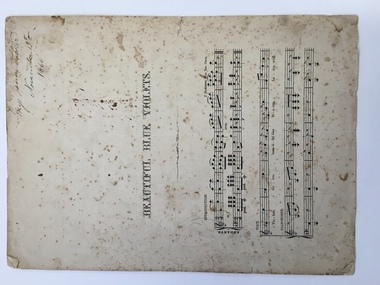
Leisure object - Sheet music, Beautiful blue violets, c. 1864
... problem as no information has been found on this person. This is a most significant item because of the date, 1866, and the name, ‘Jessie Webster’. But it is not known if the music has any local provenance. The item also has social ...This piece of music was composed by Joseph Summers (1839-1917). The date of the composition is between 1863 and 1866. The brother of Charles Summers, the sculptor, Joseph Summers was born in England and came to Australia in 1865. He was an organist and composer, an Inspector of Music in schools and in charge of music examinations conducted through Trinity College, London. In 1897 he moved to Perth. The signature of ‘Miss Jessie Webster’ presents a problem as no information has been found on this person. This is a most significant item because of the date, 1866, and the name, ‘Jessie Webster’. But it is not known if the music has any local provenance. The item also has social significance as an example of the type of music played in mid-Victorian drawing rooms. This is a piece of music of four printed pages of musical notation. The cover of this music is missing. The paper is white with black printing and all the pages are much mottled and stained. The edges of the pages are ragged and torn. There is some pencil scribble on the first page. A name and a date are written in black ink on the first page. ‘Miys (Miss) Jessie Webster, November 13th 1866’jessie webster, joseph summers, warrnambool -
 Bendigo Historical Society Inc.
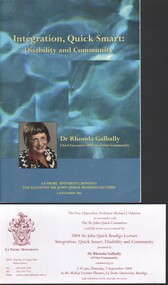
Booklet - Michele Matthews Collection - 2004 Sir John Quick Bendigo Lecture - "Integration, Quick Smart: Disability and Community", 04/02/2025
... All our social systems tend to work on the basis of a "medical model" of disablement, where problems are an individual matter based on the consequences of disease or trauma. ...All our social systems tend to work on the basis of a "medical model" of disablement, where problems are an individual matter based on the consequences of disease or trauma. ...La Trobe University, Sir John Quick annual lectureMichele Matthews Collection - 2004 Sir John Quick Bendigo Lecture - "Integration, Quick Smart: Disability and Community". presented by Dr Rhonda Galbally at 5:45 PM on Thursday 2 September 2004 in the McKay Lecture Theatre, La Trobe University, Bendigo. Invitation, agenda and lecture notes provided. All our social systems tend to work on the basis of a "medical model" of disablement, where problems are an individual matter based on the consequences of disease or trauma. The "social model", in contrast, sees disablement not as an attribute of the individual but a collection of conditions, many of them created by the social environment. A social justice model provides the opportunity to bring people with disabilities back from the margins and to integrate their needs on an equal footing. Our approach to disablement must be founded on the principles that: * everyone is equal * everyone is entitled to respect and personal autonomy * everyone is entitled to have his or her basic needs met. sir john quick annual lecture, disability, rhonda galbally -
 Monbulk RSL Sub Branch
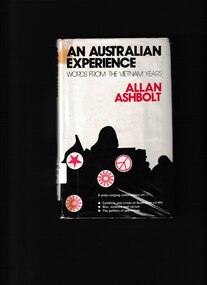
Book, Allan Ashbolt, An Australian experience: Words from the Vietnam years, 1974
... This book is essential for understanding the problems and conflicts building up in Australia today. australia - social conditions 1965-1972 vietnam war - 1965-1975 The Australian experience covers the period of the 1960s and early 1970s when Allan Ashbolt was a leading activist in the Australian anti - war movement. p.398. ...The Australian experience covers the period of the 1960s and early 1970s when Allan Ashbolt was a leading activist in the Australian anti - war movement.p.398.non-fictionThe Australian experience covers the period of the 1960s and early 1970s when Allan Ashbolt was a leading activist in the Australian anti - war movement.australia - social conditions 1965-1972, vietnam war - 1965-1975 -
 Bendigo Historical Society Inc.
Document - MERLE HALL COLLECTION: ''COMMUNITY ARTS CENTRE DEPUTATION NOTES''
... Cannon with the names of six supportive speakers; handwritten Notes from Public Meeting 25th June 1975 (two pages); handwritten ''Notes from Public Meeting 36 June 75'' (meeting to hear address from Federal Department of Tourism and Recreation (with newspaper advertisements of meeting); Loddon Campaspe Regional Council for Social Development Interim Committee questionnaire for seminar on nine aspects - housing, educational facilities, medical and welfare services, municipal and other public services, transport and communication, conservation features, active and passive recreation, employment, shopping; handwritten notes for Public Meeting 25th June ; handwritten notes re the Plaza theatre being up for sale, letter to The Editor re the recent reported announcement by the City Council of its intention to seek Federal finance to assist in the purchase of the Plaze theatre; two-paged document (letter??) re the problems...Cannon with the names of six supportive speakers; handwritten Notes from Public Meeting 25th June 1975 (two pages); handwritten ''Notes from Public Meeting 36 June 75'' (meeting to hear address from Federal Department of Tourism and Recreation (with newspaper advertisements of meeting); Loddon Campaspe Regional Council for Social Development Interim Committee questionnaire for seminar on nine aspects - housing, educational facilities, medical and welfare services, municipal and other public services, transport and communication, conservation features, active and passive recreation, employment, shopping; handwritten notes for Public Meeting 25th June ; handwritten notes re the Plaza theatre being up for sale, letter to The Editor re the recent reported announcement by the City Council of its intention to seek Federal finance to assist in the purchase of the Plaze theatre; two-paged document (letter??) re the problems ...On front cover is: ''Community Arts Centre - Deputation Notes''. Within this stapled collection are the following: typed notes for presentation at a Public Meeting at Bendigo Municipal Offices (25/6/1975) re the ''establishment of a cultural centre in Bendigo''. J. Cannon with the names of six supportive speakers; handwritten Notes from Public Meeting 25th June 1975 (two pages); handwritten ''Notes from Public Meeting 36 June 75'' (meeting to hear address from Federal Department of Tourism and Recreation (with newspaper advertisements of meeting); Loddon Campaspe Regional Council for Social Development Interim Committee questionnaire for seminar on nine aspects - housing, educational facilities, medical and welfare services, municipal and other public services, transport and communication, conservation features, active and passive recreation, employment, shopping; handwritten notes for Public Meeting 25th June ; handwritten notes re the Plaza theatre being up for sale, letter to The Editor re the recent reported announcement by the City Council of its intention to seek Federal finance to assist in the purchase of the Plaze theatre; two-paged document (letter??) re the problems of keeping the Plaza theatre and, instead, promoting a ''fine modern facility'' of the Bendigo Arts Council (no named author); ; handwritten notes of Sub-committee - Arts Centre Building (Report - J. Cannon); handwritten notes from the ''Tours Officer'' for comments on the past year's activities; handwritten list of 30-40 local people with 'ticks'' for their (potential) interest and time??community arts center, merle hall collection -
 Bendigo Historical Society Inc.
Document - AGOS INFO, BENDIGO, April 1987
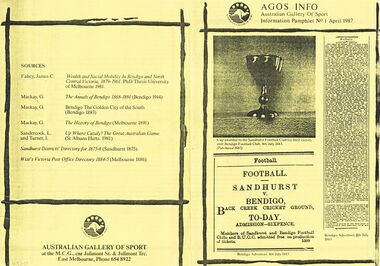
... Complaints rough play poor losers problems posed children. a blight 1883. offender ''Drop-Kick'' Sheldon ancestor Ken Sheldon of St Kilda...Bendigo club was in dispute Bendgio Union Cricket Club control of the Back Creek Ground. refused as it was feared association forced to disband. negotiations resolved dispute..values of society.. conflicts power control resources. 2000 turned out. crowd cheered players exhibited similar excitement captains. Edward Cordner. Cordner family Melbourne Football Clubs. Shane Cahill. Sources: Fahey James C. Wealth and Social ...AGOS INFO, Bendigo. Australian Gallery of Sport. Information Pamphlet No. 1 April 1987. Photo of cup awarded to the Sanhurst Football Club for their victory over Bendigo Football Club, 4th July 1883. (Purchased 1987). Extract from Bendigo Advertiser, 4th July 1883 advertising Match between Sandhurst and Bendigo. Admission - Sixpence. Members of Sanhurst & Bendigo Football Clubs and BUCC admitted free on production of tickets. Extract of Bendigo Advertiser, 5th July 1883, FOOTBALL Sandhurst v. Bendigo. (remainder of print too small to read. Sandhurst. Bendigo July 4th 1883 The match played between Sandhurst and Bendigo provides a rare insight into the Australian game at a crucial stage of its development.. . Trophy presented by local jeweler, Mr Joseph Moody. .. Football was relatively weaker in Bendigo than in the comparable city of Ballarat. This can be explained by the high migrant proportion of the Bendigo population, its economic difficulties in the 1880s and by its distance from Melbourne. .. Football overtook cricket by the end of the decade as the most popular sport. .. A regular Saturday competition was played, with matches also played on Wednesdays. These matches were a legacy of the earliest ''scratch'' matches, suggesting a relatively strong union movement which had won concessions for weekend work. Matches started at 3pm. ..The best player on the ground was a contractor and the captain an accountant. .. Transition. The predominance of the ''little mark'' the participation of sometimes frightened junior teams against adults and the division of the game into halves rather than quarters represents an era that has disappeared. Complaints of rough play, poor losers, the problems posed by children. .. An issue, was seen as a blight on the game in 1883. The greatest offender, alleged by ''Drop-Kick'' in The Bendigo Advertiser, was Sheldon of Sandhurst, an ancestor of current day player Ken Sheldon of St Kilda. .. Fundamental issue about the place of sport in society. .. The reason for this is that the Bendigo club was in dispute with the Bendgio Union Cricket Club over control of the Back Creek Ground. If they had been refused the ground, as it was feared, then the whole association would have been forced to disband. Only last minute negotiations resolved the dispute. .. Reflects the values of society, .. Broader conflicts about power and the control of resources within that society. 2000 turned out. The crowd cheered lustily and the players exhibited similar excitement and were urged on by their captains to play up and kick the ball. In the eventual Sanhurst victory, amongst the best players was Edward Cordner, a forerunner of the renowned Cordner family of the Melbourne Football Clubs. Shane Cahill. Sources: Fahey, James C. Wealth and Social Mobility In Bendigo and North Central Victoria, 1868-1891. Mackay, G. The Annals of Bendigo 1868-1891 (Bendigo 1914). Mackay, G. Bendigo The Golden City of the South (Bendigo 1893) Mackay, G. The History of Bendigo (Melbourne 1891). Sandercock, L.. And Turner, I. Up Where Cazaly? The Great Australian Game (St Albans Herts. 1981) Sanhurst Districts' Directory for 1875-6 (Sandhurst 1875) Wise's Victoria Post Office Directory 1884-5 (Melbourne 1886). Australian Gallery Of Sport at the MCG, cnr Joliment St. & Joliment Trc. East Melbourne, Phone 654 8922.clubs and associations, football, agos, agos info, bendigo. australian gallery of sport. information pamphlet no. 1 april 1987. photo cup awarded sanhurst football club for victory bendigo football club, 4th july 1883. (purchased 1987). advertiser, 4th july 1883 match between sandhurst v. bendigo. admission - sixpence. members sanhurst & bendigo football clubs and bucc free. extract, 5th july 1883, football sandhurst v. bendigo. sandhurst. bendigo july 4th 1883 sandhurst and bendigo provides insight into the australian stage development.. . trophy local jeweler, mr joseph moody. .. football weaker in bendigo than in ballarat. explained by the migrant proportion bendigo population, its economic difficulties 1880s distance from melbourne.. football overtook cricket by end decade the popular sport.. saturday competition played, matches also wednesdays. legacy of the earliest ''scratch'' matches, strong union movement concessions for weekend work. matches started at 3pm.. best player on the ground a contractor the captain accountant. .. transition. predominance ''little mark'' participation frightened junior teams adults game halves rather than quarters represents an era disappeared. complaints rough play, poor losers, problems posed children., a blight 1883. offender, ''drop-kick'', sheldon, ancestor ken sheldon of st kilda...bendigo club was in dispute bendgio union cricket club control of the back creek ground. refused, as it was feared, association forced to disband. negotiations resolved dispute..values of society.. conflicts power control resources. 2000 turned out. crowd cheered players exhibited similar excitement captains. edward cordner. cordner family melbourne football clubs. shane cahill. sources: fahey, james c. wealth and social mobility in bendigo and north central victoria, 1868-1891. mackay, g. the annals of bendigo 1868-1891 (bendigo 1914). mackay, g. bendigo the golden city of the south (bendigo 1893) mackay, g. the history of bendigo (melbourne 1891). sandercock, l.. and turner, i. up where cazaly? the great australian game (st albans herts. 1981) sanhurst districts' directory for 1875-6 (sandhurst 1875) wise's victoria post office directory 1884-5 (melbourne 1886). australian gallery of sport at the mcg, cnr joliment st. & joliment trc. east melbourne, phone 654 8922. -
 Bendigo Historical Society Inc.
Book - AILEEN AND JOHN ELLISON COLLECTION: BOOKLET - TELL YOUR CHILD THE TRUTH
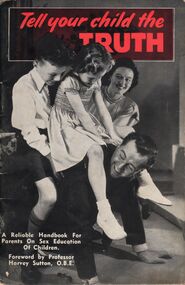
... problems of this stage. Part 4: Puberty and adolescence - Puberty and its changes, the changing feelings of youth, masturbation, some moral and social factors. ...problems of this stage. Part 4: Puberty and adolescence - Puberty and its changes, the changing feelings of youth, masturbation, some moral and social factors. ...Small booklet (44 pages) "Tell your child the truth" A reliable handbook for parents on sex education of children. Foreword by Professor Harvey Sutton O.B.E. The booklet was published by the father and son welfare movement of Australia in January, 1959. This is the fourth edition. Contents: Foreword - Introduction - Part 1: Sex education and the parent - the need for sex education, sex education what does it mean? Part 2: The nursery years - The home atmosphere, early interest, the first questions. Part 3: The primary school years - Explaining father's part, preparing the family for the new arrival, a period of dormancy, problems of this stage. Part 4: Puberty and adolescence - Puberty and its changes, the changing feelings of youth, masturbation, some moral and social factors. Conclusion - Glossary - Reliable graded books.books, school, sex education -
 Ithacan Historical Society
Photograph, Honouring Loula Rodopoulos, 2015
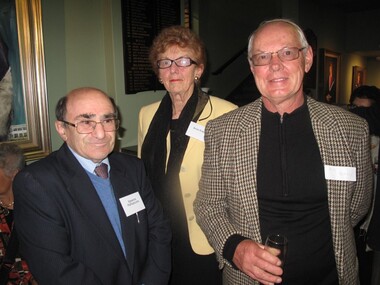
... Loula was one of the first fully qualified social workers from an 'ethnic' background and was instrumental in the establishment of the Womens’ Trust, which has a sub fund in her name to sponsor young women writers and to help women recovering from mental health problems. ...Loula was one of the first fully qualified social workers from an 'ethnic' background and was instrumental in the establishment of the Womens’ Trust, which has a sub fund in her name to sponsor young women writers and to help women recovering from mental health problems. ...Spearos Raftopoulos pictured with two friends, Anne and Avis Kupeis, at a function held to honour his late sister, Loula Rodopoulos. Loula was one of the first fully qualified social workers from an 'ethnic' background and was instrumental in the establishment of the Womens’ Trust, which has a sub fund in her name to sponsor young women writers and to help women recovering from mental health problems. Both areas were of very great interest to Loula during her lifetime. Loula's and Spearos' parents were Peter (Panoyiannis) and Evgenia Raftopoulos. Peter migrated from Ithaca in the 1930s and was secretary of the Ithacan Philanthropic Society 1938-1949 and 1953. Evgenia was born in Melbourne in 1923, the daughter of Katina Dracoulis and Spearos Raftopulos (Balatsikos) who were married in Melbourne 1921. A coloured photograph of a lady and two men standing in a gallery at a function.
