
Showing 10 items matching "soldier settlements - victoria - history"
-
 Monbulk RSL Sub Branch
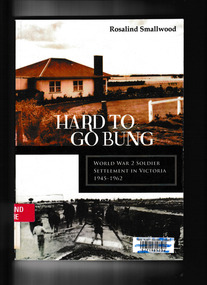
Book, Australian Scholarly, Hard to go bung : World War two soldiers settlement in Victoria 1945-1962, 2011
... Soldier settlements - Victoria - History...Soldier settlements - Victoria - History Land settlement - Victoria - History This book contains the story of Australia's most successful scheme for settling returned soldiers on their own farms. ...This book contains the story of Australia's most successful scheme for settling returned soldiers on their own farms. The book includes the recollections of many of the 6000 families who gained a livelihood on farms across the state.Index, notes, ill, maps, p.258.non-fictionThis book contains the story of Australia's most successful scheme for settling returned soldiers on their own farms. The book includes the recollections of many of the 6000 families who gained a livelihood on farms across the state.soldier settlements - victoria - history, land settlement - victoria - history -
 Lara RSL Sub Branch
Postcards, France
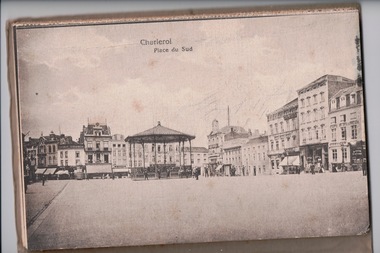
... soldier settlement block in Lara in 1937. He was a founding member of Lara RSL and is its longest serving member. John died in 1990. This letter was written by John and sent to his mother in 1918 on his journey through Belgium. The McIntyre family were early pioneers in the Lara district, and the brothers were founding members of the Lara RSL. This letter represents a significant link to the history of the town and sub-branch. mother letter postcard first world war wwi world war one belgium lara Envelope: O.A.S. Tower of London. Miss J McIntyre. Elcho Lara lake, Australia, Victoria ...John Lachlan McIntyre was born at Beeac, Victoria in December 1890. He enlisted in the 1st AIF in July 1915. John fought on the Western Front, taking part in the battles of Fromelles and the 2nd Battle of the Somme. He was severely wounded at Fromelles and spent 12 months in hospital in England before returning to the front. John returned home in 1919 and was granted a soldier settlement block in Lara in 1937. He was a founding member of Lara RSL and is its longest serving member. John died in 1990. This letter was written by John and sent to his mother in 1918 on his journey through Belgium. The McIntyre family were early pioneers in the Lara district, and the brothers were founding members of the Lara RSL. This letter represents a significant link to the history of the town and sub-branch.A brown envelope addressed to Miss J McIntyre. Within the envelope is a pack of 12 illustrated souvenir post cards. Envelope: O.A.S. Tower of London. Miss J McIntyre. Elcho Lara lake, Australia, Victoria. Rear of postcard pack: London December 27th 18 Dear Mother, I arrived here yesterday. Spent Xmas day travelling across France. The trip took the best part of four days. We are up near Belgium. Had to go into Belgium to get a train. Will write when I get settled. Hoping you are all well. With best wishes for a happy new year. Jack. Edition Martinetty Charleroi Front of pack: J. L. McIntyre Xmas 1918 Souvenir de Charleroi-Belgium 12 cartes postales 12 En Photochrommother, letter, postcard, first world war, wwi, world war one, belgium, lara -
 Warrnambool and District Historical Society Inc.
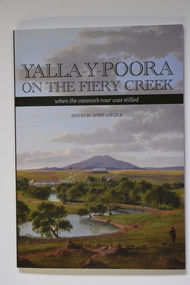
Book - Yalla-Y-Poora On The Fiery Creek, James Affleck, Yalla-Y-Poora On The Fiery Creek when the cannon's roar was stilled, 2023
... history of the Yalla-y-Poora Soldier Settlement Estate and surrounding district including information and photographs of each of the 24 settler's and their families. This book is of considerable importance as it is a comprehensive record of the history of the post World War Two Soldier Settlement in the Yalla-y-Poora area. It will be very useful for local researchers. soldier settlement yalla-y-poora Number Six in James Affleck's series of book on Soldier Settlements in Western Victoria ...Number Six in James Affleck's series of book on Soldier Settlements in Western Victoria. An edited compilation of settler families' own stories, combined with a reincorporation of a previously published history of the area, profiles of local people and organisations illustrated with maps, photographs and poetry136 page softcover book. Front cover has the Title: "Yalla-Y-Poora On The Fiery Creek when the cannon's roar was stilled" printed over a coloured print of Eugene von Guerard's painting of Yalla-y-Poora; Back cover: Three colour photographs soldier settlement farming family descendants, soldier settler house and tractor. Yalla-Y-Poora On The Fiery Creek printed on spine.non-fictionNumber Six in James Affleck's series of book on Soldier Settlements in Western Victoria. An edited compilation of settler families' own stories, combined with a reincorporation of a previously published history of the area, profiles of local people and organisations illustrated with maps, photographs and poetrysoldier settlement, yalla-y-poora -
 Heytesbury District Historical Society Inc.
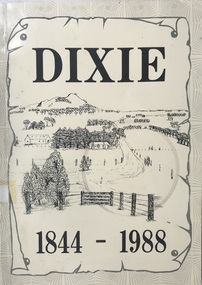
Book, Dixie 1844-1988
... An account of the settlement of the area known as Dixie in the County of Heytesbury, including pioneers, soldier settlers, the school, churches, sports club etc. during the period from 1844 to 1988. Heytesbury Shire - History Early Settlement - South West Victoria ...Paperback with black and white photographs, large map of County of Heytesbury inside back cover. An account of the settlement of the area known as Dixie in the County of Heytesbury, including pioneers, soldier settlers, the school, churches, sports club etc. during the period from 1844 to 1988. heytesbury shire - history, early settlement - south west victoria, dixie -
 Warrnambool and District Historical Society Inc.
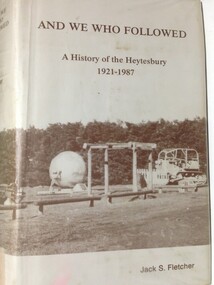
Book, And We Who Followed, 1988
... history of the Heytesbury region from 1840 to 1920. The Heytesbury area in the Western District of Victoria was named after the village of Heytesbury in England and the first Baron Heytesbury, Sir William A Court, who purchased the village in 1828 and was a distinguished public figure in Great Britain at the time. The area, largely forested, was cleared in 1960 to establish the Heytesbury Soldier Settlement...history of the Heytesbury region from 1840 to 1920. The Heytesbury area in the Western District of Victoria was named after the village of Heytesbury in England and the first Baron Heytesbury, Sir William A Court, who purchased the village in 1828 and was a distinguished public figure in Great Britain at the time. The area, largely forested, was cleared in 1960 to establish the Heytesbury Soldier Settlement ...This book contains a history of the Shire of Heytesbury from 1921 to 1987. It is written by Jack Fletcher and follows on from his book ‘The Infiltrators’ which is the history of the Heytesbury region from 1840 to 1920. The Heytesbury area in the Western District of Victoria was named after the village of Heytesbury in England and the first Baron Heytesbury, Sir William A Court, who purchased the village in 1828 and was a distinguished public figure in Great Britain at the time. The area, largely forested, was cleared in 1960 to establish the Heytesbury Soldier Settlement Scheme and is today an important dairying area centred around the town of Simpson.This book is of some interest as it details a history of an area adjoining the Warrnambool district. The Heytesbury Settlement farmers are predominantly dairy producers, similar to those in other districts around WarrnamboolThis is a hard cover buff-coloured book with a dust cover sealed down onto the hard cover. The front and back covers have a sepia coloured photograph of the Heytesbury Settlement Park.Front of dust cover – ‘And We Who Followed - A History of the Heytesbury 1921-1987-Jack S. Fletcher Spine – as above (plus a library classification) heytesbury region, victoria, heytesbury soldier settlement -
 Bendigo Historical Society Inc.
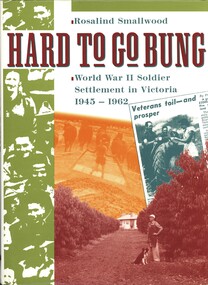
Book - HARD TO GO BUNG, 1992
... HISTORY...Australian...soldier settlement scheme victoria....HISTORY Australian soldier settlement scheme victoria. Rosalind Smallwood. ...Hard To Go Bung.World War II Soldier Settlement in Victoria, 1945 - 1962. This is the story of Australia's most successful soldier settlement scheme.Rosalind Smallwood.history, australian, soldier settlement scheme victoria. -
 Warrnambool and District Historical Society Inc.
Document, Wollaston sale, 1919
... Settlement Board of Victoria acquired Wollaston and 17 lots were sold to returned soldiers for farming purposes. By 1930 there were only five soldier settlers remaining. In 2009 further subdivision took place with lots sold for residential purposes. The homestead allotments were sold separately in 1919 with various owners of the homestead itself recorded since that time. This poster is of interest as it shows the areas of the Wollaston Estate which were sold in 1919. The history ...This is a poster advertising the sale of part of the Wollaston Estate in Warrnambool in 1919. The sections for sale were Allotments 1, 18 and 19 which included the Wollaston Homestead. The original Wollaston property of 679 acres was selected by Thomas Manifold in the late 1840s. This land, on the northern side of the Merri River, near the Woodford Road was three kilometres from the Warrnambool town. The first farmer we know who leased the property was William Simpson. Walter Manifold inherited the property and he took it over in 1884. The swing bridge he built in 1890 still stands today. In 1919 the Closer Settlement Board of Victoria acquired Wollaston and 17 lots were sold to returned soldiers for farming purposes. By 1930 there were only five soldier settlers remaining. In 2009 further subdivision took place with lots sold for residential purposes. The homestead allotments were sold separately in 1919 with various owners of the homestead itself recorded since that time. This poster is of interest as it shows the areas of the Wollaston Estate which were sold in 1919. The history of this estate is well-documented and of importance in the history of Warrnambool. This is a sheet of paper with red and black printing and a map of the Wollaston Estate which is photo-lithographed. The sheet has been folded three times. It has some small tears at the top of the page. wollaston, history of warrnambool, walter manifold -
 Warrnambool and District Historical Society Inc.
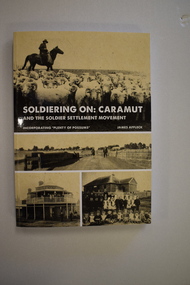
Book, StarPrinting Service Pty ltd, Soldiering On – Caramut and the Soldier Settler Movement, 2018
... Soldier Settlements in Victoria were established by the State Government to provide farming opportunities for returned soldiers. Some of the land allocated was Crown Land and some was obtained by sub-dividing larger estates. Caramut is a town in Western Victoria in the Shire of Moyne on the Hamilton Highway, 55 kilometres north of Warrnambool. The book incorporates a reprint of the booklet, ‘Plenty of Possums’ produced in 1988 by the Caramut Bicentennial Group. The author, James Affleck, has produced several books dealing with local history...history of the post World War Two Soldier Settlement in the Caramut area. It will be very useful for local researchers. James Affleck, Peterborough Soldier Settlement, Caramut History of Warrnambool soldier settlement caramut This book records the history of the post World War Two soldier settlement farms in the Caramut area. Number two in a series of books on Soldier Settlements in Western Victoria ...This book records the history of the post World War Two soldier settlement farms in the Caramut area. Number two in a series of books on Soldier Settlements in Western Victoria.This is a soft cover book of 315 pages. It has a buff-coloured cover with black and white photographs and white printing on the front cover and black printing on the spine. The book includes printed material, black and white photographs, maps and plans. non-fiction This book records the history of the post World War Two soldier settlement farms in the Caramut area. Number two in a series of books on Soldier Settlements in Western Victoria.james affleck, peterborough, soldier settlement, caramut, history of warrnambool, soldier settlement, caramut -
Warrnambool and District Historical Society Inc.
Correspondence (Rose Park), 1940s
... This correspondence is of interest as an example of the establishment of Soldier Settlement farms in Victoria post World War Two and the difficulties faced by some property owners opposed to the acquisition of their land. These items will be useful for research. Baulch Family, Western District, Victoria History ...These are four letters and a document regarding the proposal in the 1940s by the Victorian Department of Lands and Survey to acquire sections of the property, Rose Park, to establish several Soldier Settlement farms. Rose Park, near Willatook, was owned by Stan Baulch (1897-1980), the son of Samuel and Eliza Baulch. Samuel Baulch had acquired the property of Dunmore, between Macarthur and Hawkesdale, in 1893 and Stan had inherited portion of this property after his father’s death. He named his portion Rose Park. The Soldier Settlement Commission wanted to acquire 1500 acres of Rose Park but Stan Baulch argued successfully that the management of his farm could not withstand the loss of so much land and eventually 300 acres of Rose Park land was sold for closer settlement. Stan Baulch was a prominent member of the Warrnambool and District Historical Society for many years and contributed many articles and booklets on local historical matters. This correspondence is of interest as an example of the establishment of Soldier Settlement farms in Victoria post World War Two and the difficulties faced by some property owners opposed to the acquisition of their land. These items will be useful for research. .1 A six-page letter written in pencil .2 A two page letter in black typing ( contents as in .1 above) .3 A one page letter, typed, with a handwritten signature .4 A sheet of paper containing a statement re purchase of land with some inserted handwritten material .5 A two page letter with handwritten material baulch family, western district, victoria, history of warrnambool -
 Warrnambool and District Historical Society Inc.
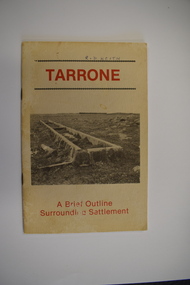
Booklet, Tarrone, 1983
... This booklet gives details of the history of the Tarrone Estate in the Western District of Victoria from its establishment in 1840 to 1983. The estate is 16 kilometres from Koroit and was divided into 48 farms as a post World War Two Soldier Settlement project. ...This booklet gives details of the history of the Tarrone Estate in the Western District of Victoria from its establishment in 1840 to 1983. The estate is 16 kilometres from Koroit and was divided into 48 farms as a post World War Two Soldier Settlement project. ...A brief outline of the history of the Tarrone estateThis is a booklet of 20 pages. It has a buff-coloured cover with two black and white photographs and red print. The pages contain black and white photographs, printed text, maps and illustrations. The booklet is stapled non-fictionA brief outline of the history of the Tarrone estatesoldier settlements post world war two, tarrone estate
