
Showing 66 items matching "soldiers on the shrine"
-
 Surrey Hills Historical Society Collection
Work on paper - Vertical File, World War I - Folder 1
... ...Soldiers on the Shrine... (2 pages) 4. Soldiers of the Shrine – research notes re names recorded on the Shrine in the Surrey Gardens. ...WWI World War I World War 1 Soldiers on the Shrine ANZAC WWI – Local Information (folder 1) 1. ...WWI – Local Information (folder 1) 1. Copy of Hawthorn & Camberwell Advertiser, Friday, 15 November 1918 notification of Surrey Hills Market Fair 2. Notification of Market Fair at Surrey Hills from newspaper dated 22 November 1918. 3. Leslie Stuart McBeath biography. (2 pages) 4. Soldiers of the Shrine – research notes re names recorded on the Shrine in the Surrey Gardens. WC Rayment. E Corin, Norman Pettigrew, WVB Wyatt, H Legg, Horace Pell, Charles Patrick Smart, George William Smart, Robert John Smart, William Stanley Smart 5. Soldiers of the Shrine – research notes re names recorded on the Shrine in the Surrey Gardens. Donald Bruce Amery, John Campbell Blogg, William Stanely Paull, Albert James Dunster, Harold Deuch, William Charles Rayment. 6. Photocopy of page 34 of Patchwork. August 1916. Courtesy PLC Archives. 7. Large DL sized brochure for ANZAC DAY, Thursday, 25 April 2013. 8. Our ANZAC Girl Sister Veir Scott by Lisa Cooper Profile Mildura Living. A4 double sided 9. Soldier On, WWI Soldier Settler Stories Transcript of soldier Settlement Letters from the Exhibition. A5 Booklet. 3 pages double sided. 10. Boroondara Remembers – Traffic Signal Box Painting Project supported by The Australian Government’s ANZAC Centenary Local Grants Program, November 2015. A4 book 5 pages double sided. 11. ANZAC Commemorating 100 years of ANZAC Spirit. A Commemorative Newsletter The Hon Josh Frydenberg MP. 12. Postcard “Gallipoli & Beyond 2015” Boroondara City 13. Australia Calls Heritage Week 10-17 September 2015. Whitehorse City Council. 14. ANZAC DAY brochure 25 April 2016 The Hon Josh Frydenberg 15. Large DL sized brochure for ANZAC DAY. (2 copies) 16. “Bowled and the beautiful.” Boroondara Review Local 13 March 2013 17. ANZAC Day brochure Monday, 25 April 2022, the Hon Josh Frydenberg. 18. ANZAC Day brochure Monday, 25 April 2019, the Hon Josh Frydenberg. 19. Surrey Hills Methodist Sunday School Canterbury Road, “The Great War 1914-1915” Certificate to Joy Hill, 5th Class to certify that Joy has accepted the certificate instead of a reward to allow the prize to go to destitute Belgian children. 20. ANZAC Day brochure Monday, 25 April 2020, the Hon Josh Frydenberg. 21. ANZAC Day Dawn Service. SHNN No. 219 April/May 2019 22. Lest We Forget article by Yvonne Bowyer. SHNN No. 238. June/July 2022. 23. Bus Tour ‘Touchstones to WWI in Balwyn, Camberwell, Canterbury and Surrey Hills’ booklet. Friday, 24 April 2015. 24. “Remembering Surrey Hills War Heroes” by Robyn Doble. The Genealogist June 1998, page 77. 25. DL card ANZAC Day The Hon Shaun Leane MP and Paul Hamer MP. (No year listed.) wwi, world war i, world war 1, soldiers on the shrine, anzac -
 Melbourne Legacy
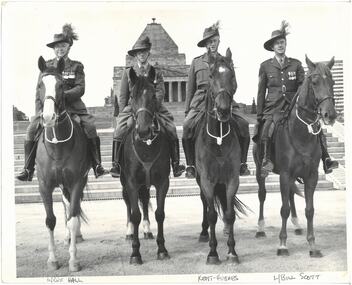
Photograph, Light Horse Men, 1967?
... Four soldiers mounted on horses in the forecourt of the Shrine of Remembrance. ...Black and white photo of 4 soldiers on horseback at the Shrine....Handwritten "Property of Melbourne Legacy / Melbourne Shrine of Remembrance / L/tee J. R. Hall / 1967" in black ink. Black and white photo of 4 soldiers on horseback at the Shrine. ...Four soldiers mounted on horses in the forecourt of the Shrine of Remembrance. Three of the four that are named are Legatee Rex Hall, Billy Kent-Hughes and Legatee Bill Scott. The other rider's name and date unknown. An article in The Herald on 19 April 1975 mentions that Rex Hall, Jim Holland and Bill Scott would wear their Light Horse uniforms and lead the Anzac Day parade to the Shrine mounted on police horses (see 01023). Though the date on the back of the photo is 1967. It is believed these legatees rode in at least 13 Anzac Day marches. Wilfred Kent-Hughes, known as Billy, served in both World Wars, was a prisoner of the Japanese, an Olympic athlete (hurdles, Antwerp 1920) and a State and Federal politician and was awarded a Knighthood. His niece, Jane, is a Legatee in the South Gippsland Group. From another article found Colonel Rex Hall was a member of the 5th Light Horse Brigade in World War 1. The image of the newspaper article and black and white photo is from an album stored separately at 00209 - at that march the men were: Max Armstrong, Legatee Rex Hall, Legatee Harry Burton and Warren Hardy.A record of a Legatees riding horses to the Shrine in Light Horse uniform.Black and white photo of 4 soldiers on horseback at the Shrine.Front of photo has " L/Rex Hall ; Kent-Hughes ; L/Bill Scott" in black pen. The back is stamped Copyright Herald and Weekly Times in blue ink. Handwritten "Property of Melbourne Legacy / Melbourne Shrine of Remembrance / L/tee J. R. Hall / 1967" in black ink.anzac day, horses, light horse, rex hall, bill scott, billy kent-hughes -
Surrey Hills Historical Society Collection
Work on paper - Vertical File, Surrey Gardens
... /March, 2020 (1 page). 22. ‘Soldiers of the Shrine in Surrey Gardens’, SHNN No. 163, Dec. 2009/Jan./2010 (1 page). .../March, 2020 (1 page). 22. ‘Soldiers of the Shrine in Surrey Gardens’, SHNN No. 163, Dec. 2009/Jan./2010 (1 page). ...SURREY GARDENS 1. The shrine, Surrey Gardens, Surrey Hills, Melbourne. 10 pockets including photos, and written material on the honor (sic) roll, John Kendrick Blogg, opening ceremony article from the Box Hill Reporter 12.4.1918, after the war and re-dedication. 2. Name on roll : George Lauchlan (undated) (1 page). 3. ‘All ready to make memorial service one to remember’, Progress Press, 24.2.1993 (1 page). 4. Invitation to Camberwell City sub-branch RSL 18.4.1993 (1 page). 5. RSL re-dedication of Shrine program 18.4.1993 (1 page). 6. ‘The honored dead: tribute at Surrey Hills’, The Reporter, 18.9.1921 (2 pages). 7. Monument survey – Camberwell, memorial cross, by Libby Cavanagh, undated (2 pages). 8. Letter from Major R.S. Billett to Mr. J. Disken re cannons, 22.6.1999; AND ‘Cannons in Surrey Gardens ‘3 extracts: 1 from book ‘Halfway up the hill’, and 2 from B.H. Reporter, various dates (2 sheets, 3 sides). 9. Letter from Jim Disken to Jocelyn Hall, 19.2.2001, and reply 22.2.2002 (1 page). 10. Letters between John Rogers (Cerberus) and Susan Barnett, September, 2012 re canons (sic). 11. Canon (sic) and Nelson information, and photo of 3 children on a cannon, undated (2 pages). 12. Surrey Gardens canons (sic), notes by Sue Barnett, undated (1 page). 13. Monument survey – Camberwell, by Libby Cavanagh, undated (1 page). 14. ‘Looking after our gardens’, SHNN No. 19, Nov./Dec. 1985-Jan. 1986 (1 page). 15. ‘Soldiers of the Shrine in Surrey Gardens’, SHNN No. 163, Dec. 2009-Jan. 2010 (1 page). 16. ‘Rebuild the rotunda’, Ken Duxbury, letter to editor of Boroondara Local Review, 14.11.2012 (1 page). 17. Copies of photos of honour roll 16 panels (8 pages). 18. Copy of honour roll handwritten lists of names (8 sheets, 15 sides). 19. Note to Sue Barnett from Bill Pritchard c. 2014 & her notes, (1 page). 20. ‘Permanently enshrined’, Progress Leader, 15.5.2018 (1 page). 21. ‘Coming soon!’, SHNN No. 224, Feb./March, 2020 (1 page). 22. ‘Soldiers of the Shrine in Surrey Gardens’, SHNN No. 163, Dec. 2009/Jan./2010 (1 page). -
Surrey Hills Historical Society Collection
Work on paper - Vertical File, World War 1 - Folder 2
... Shrine. 5 April 1918 – copy of. 2. Reporter Box Hill, Friday, 27 October 1916. 2 pages. 3. Mapping our ANZACS list of people taken from National Archives of Australia. 4. Australian Imperial Force Attestation Paper of Persons Enlisted for Service Abroad for Herbert Gordan Smith. 5. Letter from Sue Barnett to Bernie Nitschke re: Soldiers...Shrine. 5 April 1918 – copy of. 2. Reporter Box Hill, Friday, 27 October 1916. 2 pages. 3. Mapping our ANZACS list of people taken from National Archives of Australia. 4. Australian Imperial Force Attestation Paper of Persons Enlisted for Service Abroad for Herbert Gordan Smith. 5. Letter from Sue Barnett to Bernie Nitschke re: Soldiers ...WWI – Local Information (folder 2) 1. Surrey Honor Roll. Opening of the Shrine. 5 April 1918 – copy of. 2. Reporter Box Hill, Friday, 27 October 1916. 2 pages. 3. Mapping our ANZACS list of people taken from National Archives of Australia. 4. Australian Imperial Force Attestation Paper of Persons Enlisted for Service Abroad for Herbert Gordan Smith. 5. Letter from Sue Barnett to Bernie Nitschke re: Soldiers of the Surrey Hills Shrine. (no date). Letters to Ms Sue Barnett from Burnie Nitschke, Deputy Principal and History teacher, Luther College, dated 17 February 1999,17 August 1999, 24 August 1999 and two lists of people killed. 6. Photocopy of Australian Army Nursing Service Seniority List, July 1918. (9 pages single sided) 7. A4 photocopy of G. Jackson 8. John Robert Gray listing from Australian Commonwealth Military Forces 9. Boroondara Remembers Traffic Signal Box Painting Project November 2015 A4 book. 12 pages double sided. 10. ANZAC Day brochure Monday, 25 April 2018, the Hon Josh Frydenberg. 11. DL sized brochure ANZAC Day, 25 April 2021 12. ANZAC Day in Boroondara article. Boroondara Bulletin April 2022. 13. A4 poster for Surrey Hills ANZAC DAY service Thursday, 25 April 2019. 14. DL sized brochure for ANZAC DAY, Monday 25 April 2022 15. Black and white photo of John Stevens Gawler, wife Ruth Miller and children Ruth Stevens Galer, Dorothy Lina Gawler 16. Frederick William Mawson – SERN 3073 (1983 – 1917) biography. 17. Bus Tour ‘Touchstones to WWI in Balwyn, Camberwell, Canterbury and Surrey Hills’ booklet. Friday, 24 April 2015. 18. Investigation into the Mont Albert Avenue of Honour by Helen Doxford Harris OAM, Master of Arts (History). 5 pages single sided. 19. Record of Military Service and identifying information for Fawcett Dinsdale Head, Gordon Alick Head, Rowland Henry Jack Head, William Walter James Head taken from People of the Shrine by Sandra Dexter. 20. “Digging in on avenue” newspaper article. The Herald Sun 4 February 2023. wwi, ww1, world war 1, anzac -
 City of Melbourne Libraries
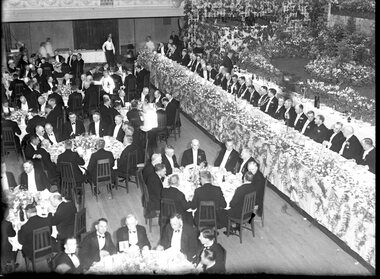
Photograph, Bull, Hugh Jones, 1897-1993, Lord Mayor's Dinner, Melbourne Town Hall
... Retrieved September 26, 2024, from http://nla.gov.au/nla.news-article11902131 'The Shrine of Remembrance', Beaconsfield’s Soldiers: https://beaconsfield.org.au/digitalmemorial/shrine-introduction/ 'Shrine of Remembrance', Wikipedia, https://en.wikipedia.org/wiki/Shrine_of_Remembrance Ken Scarlett, 'Anderson, William Wallace (1888–1975)', Australian Dictionary of Biography, National Centre of Biography, Australian National University, https://adb.anu.edu.au/biography/anderson-william-wallace-9362/text16441, published first in hardcopy 1993, accessed online 26 September 2024. ...Retrieved September 26, 2024, from http://nla.gov.au/nla.news-article11902131 'The Shrine of Remembrance', Beaconsfield’s Soldiers: https://beaconsfield.org.au/digitalmemorial/shrine-introduction/ 'Shrine of Remembrance', Wikipedia, https://en.wikipedia.org/wiki/Shrine_of_Remembrance Ken Scarlett, 'Anderson, William Wallace (1888–1975)', Australian Dictionary of Biography, National Centre of Biography, Australian National University, https://adb.anu.edu.au/biography/anderson-william-wallace-9362/text16441, published first in hardcopy 1993, accessed online 26 September 2024. ...Photographer notations on slide: "General View Of Lord Mayor's Dinner At Town Hall Nov 1936 B112" Published: The Age, Tuesday 10 November 1936, page 13 Published title: LORD MAYOR'S BANQUET Published caption: The brilliant scene inside the Melbourne Town Hall last night during the Lord Mayor’s banquet. Trove article identifier: http://nla.gov.au/nla.news-article205939431 Description: 700 guests (all men) are seated around numerous tables in the Melbourne Town Hall for the Lord Mayor's dinner in November 1936. Before the stage is a top table of 35 men, all dressed smartly in black dinner suits, with either a black or white bow tie. Many are wearing their medals. The Lord Mayor has on his Mayoral chains, and to his right is the Governor of Victoria, Lord Huntingfield. The stage is heavily decorated with fresh flowers. Research by project volunteer, Louise McKenzie: This image takes up one quarter of the photographic space on page 13 of The Age on 10 November 1936, reflecting the importance of the event and also the sheer dramatics of the image: 700 guests (all men), a top table of 35, and all dressed smartly in black dinner suits, with either a black or white bow tie. Many are wearing their medals. The Lord Mayor has on his Mayoral chains, and to his right is the Governor of Victoria, Lord Huntingfield. Further to his right is a man with an impressive sash across his chest. It is a very animated, and rather informal, moment. Banks of fresh flowers smother the stage, which is decorated in the manner of a terrace at an English stately home. Tables are laden with food, drink and decorations, and the wait staff (men and women) are also formally dressed, in the manner of Downton Abbey. It is spectacular, dramatic, and luxurious, and perpetuates the proud descriptor of “Marvellous Melbourne” as conferred by London Journalist George Augustus Sala when he visited the city in 1885. During its 1880s boom, Melbourne was the second-largest city in the British Empire, after London, and reputedly the richest city in the world. At times the expression was used with some irony, but "...in Victoria’s centenary year, 1934, with the city mired in another depression, a publisher bravely entitled a book of souvenir photographs Marvellous Melbourne, claiming that the subject ‘still finds apt expression in the happy one-time sobriquet’.” This photo seems to reflect an ongoing pride in Melbourne and a desire for it to live up to its descriptor and celebrate its post-centenary era in style. So it is no surprise to find that on page 11 of The Age on the same day, a second photo is to be found – a cropped view of one table – along with a very detailed description of the night, its purpose, and a surprise announcement. But, who was the Lord Mayor in whose honour the dinner was held? In 1934, the Lord Mayor of Melbourne was Cr. Alexander George Wales, (born Richmond, 11 October 1885, died Elsterwick, 31 May 1962). His father was a contractor and quarry-owner, but was blinded in an industrial accident in 1899. Consequently Alexander, then aged 14, left Brunswick State School to become a railway labourer working at a quarry, and in 1903 joined the Commonwealth public service as a clerk and began studying at night school, determined to improve himself. In 1907 he was appointed secretary of the Albion Quarrying Co. (in which the family had an interest), then its managing director and chairman. As the Australian Dictionary of Biography notes, he was instrumental in expanding the company’s interests, "...becoming director of the Hardware Co. of Australia Pty Ltd, the Twentieth Century Building and Investment Society, the Albion Sand Co. and the Geelong Brick Co.”. His public career began in 1914 when he was elected to the Brunswick council. He was mayor 1917-18, and in 1925 progressed to the Melbourne City Council where he remained for 29 years, being a member of most council committees. He served three successive terms as lord mayor (1934-37), was Chairman of the council’s decorations committee for Melbourne’s centenary, president of the Metropolitan Fire Brigades Board (1936), and Chairman of the Public Works Committee (1937-39). In 1936 he was elected to the Legislative Council with United Australia Party support, but later resigned over possible State government contract tender irregularities. Wales received "the customary reward” of a knighthood and was invested at Buckingham Palace by King George VI whose coronation he attended in 1937. He was an early director of what is now Ampol, and helped the development of the petroleum industry in Australia after visiting the USA in 1943 and 1946. He was impressed by that country’s wartime shipbuilding efforts and supported closer ties with the USA. “While president (1947-48) of the Melbourne Chamber of Commerce, Wales was a vocal critic of the Federal Labor Government, ...a staunch anti-socialist ... and a focus for conservative opposition to the Curtin and Chifley governments...” He is described as “a natural leader in business and civic politics,... a powerful force in the Melbourne City Council... opposing democratic reforms such as the creation of a Greater Melbourne Council and the abolition of plural voting, but advocat[ing] the redevelopment of city-owned property like the Eastern and Western markets...” So, this Lord Mayor’s dinner marks the third successive term in office for Governor Cr. A G Wales. The room is filled with powerful and influential men, and provided a platform for the Premier of Victoria, Albert Dunstan (1882-1950, United Country party) to announce that if the City Council would bear half the cost the State Government would build a bridge at Punt Road “at once”. He announced that the Government proposed to have the bridge built by the Country Roads Board, and allow the City Council to pay its share on convenient terms, and further, it would investigate the shared provision of more Yarra bridges. The proposal for the Punt Road Bridge was met with applause as the Yarra River constituted a serious traffic barrier. On 12 November 1936, two days after the Lord Mayor’s dinner, The Age published an article, “Building without a Plan”. It questions the appropriateness of the next Yarra bridge being the one at Punt Road, and encourages a “proper procedure” to look at the provision of additional Yarra bridges as a whole. But in fact this topic had been canvassed back in August when Melbourne City Council’s public works committee had recommended the replacement of the footbridge at Punt Road with a bridge, and if the Country Roads Board would declare this portion of Punt Road, including the river crossing, a State Highway, this could give the Board authority to construct the bridge and allocate the cost. Hence the reference at the dinner to a shared expense. Still an integral part of traffic management today, the Hoddle Bridge carries Punt Road over the Yarra River between Richmond and South Yarra in Melbourne. It is a five-lane road bridge with narrow footpaths on either side. It is of continuous reinforced concrete T-beam construction with five segmental arched spans, supported on transverse piers, and linked by concrete cross-beams. “The piers terminate in a series of tapered concrete pillars with Art Deco-styled steamlined decoration. Each pillar supports a Victorian-style lamp. The infill railings are geometric-patterned painted metal. Construction began in late 1937, and it was opened by Premier Albert Dunstan on 22 December 1938. It replaced an earlier footbridge, which in turn had replaced a punt service. The bridge (originally referred to as Punt Road Bridge) was named after Robert Hoddle, who planned central Melbourne’s Hoddle Grid, the grid of streets which form Melbourne’s central business district. Hoddle arrived in Australia from the UK in 1823 and went on to carry out surveys in NSW and Queensland before arriving in Melbourne in 1837. He designed layouts for both Melbourne and Williamstown, and later Geelong and other Victorian country areas. He was keen that major streets be at least 30 metres wide. ”With remarkable foresight he provided for wide boulevards from the city to the suburbs, but the subdivisions of early speculators in inner suburbs created the bottle-necks of today. After the separation of the colony in 1851, he became Victoria’s first surveyor-general... and advocated the provision of three-chain (60 m) roads and the widening of all existing main roads from one (20 m) to three chains." However, he was met with constant opposition and in 1853, was eased out of office. As a small and interesting aside: Hoddle was appointed auctioneer for the first sale of crown land in Melbourne on 1 June 1837. His commission was 57 pounds 12s 7d. and he bought two allotments for himself at a cost of 54 pounds. After he died his second wife married Richard Buckhurst Buxton, a member of the family which in 1860s Melbourne established the Australian property dynasty of Buxton Real Estate, Becton, MAB Corporation etc. Returning to the dinner and The Age article of 10 November 1836: Another topic of the after-dinner speeches was a reference to the upcoming Armistice Day. “The Minister of Customs (Mr White) said the proximity of Armistice day reminded us that eighteen years ago we had high hopes of prolonged peace.” The term “Armistice Day” was coined after WWI: “At 11 am on 11 November 1918, the guns on the Western Front fell silent after more than four years of continuous warfare. The Germans called for an armistice (suspension of fighting) in order to secure a peace settlement. They accepted the allied terms on unconditional surrender. Therefore on the 11th hour of the 11th day of the 11th month, a minute’s silence is observed and dedicated to those soldiers who died fighting to protect the nation. Originally known as Armistice Day, it was renamed Remembrance Day after World War Two to commemorate those who were killed in both World Wars. Today it refers to the loss of Australian lives from all wars and conflicts, accompanied by the words, "We will remember them, Lest we forget"." There was comment at the dinner about the need to remain firm in supporting the “democratic government in the British Empire to avoid a “plunge into savagery”. There was a grave responsibility on the British people to keep democracy alive, and that could not be done without adequate defence forces... Many weak governments in non-British countries had been swept aside by strong-fisted dictators, who now were the real threat to peace”. With the benefit of hindsight these were very pertinent comments and tragically prophetic. The Melbourne Shrine of Remembrance had only been dedicated two years earlier, at a ceremony attended by the Duke of Gloucester, son of King George V. Over 300,000 citizens attended: one third of the population of Melbourne. It became the location for the Anzac Day Dawn Service. Originally the march travelled from the Shrine into the city, however, in 1936, this was reversed, and the Shrine became the termination point for Anzac Day Marches. Also significant in 1936, was the installation of a statue in the west forecourt of the Shrine: “The Man with the Donkey” (aka 'Private John Simpson and his Little Donkey'). The work is said to represent the “valour and compassion of the Australian soldier”. Its full citation, according to the City of Melbourne City Collection is: West Side of Base: "The / Man with his Donkey / Gallipoli, April 25 to May 19 / in Commemoration / of the valour and compassion / of the Australian Soldier" AFTER LANDING AT GALLIPOLI, SIMPSON, WITH HIS LITTLE DONKEY, WORKED ALONE, DAY AND NIGHT TAKING WATER TO THE FRONT LINE AND CARRYING THE WOUNDED BACK TO THE DRESSING STATIONS. HE AND HIS DONKEY WERE KILLED BY A SHRAPNEL SHELL ON THE 19TH MAY, 1915. SIMPSON WAS MENTIONED IN DISPATCHES BY SIR IAN HAMILTON, COMMANDER-IN-CHIEF OF THE MEDITERRANEAN EXPEDITIONARY FORCE. / Erected by Public Subscription under auspices of the / Red Cross Society. East Side of Base: Private John Simpson." Their summary in background states: "A bronze figure of Simpson and his donkey with a wounded man on the donkey's back on a granite pedestal. Private John Simpson Kirkpatrick’s intrepid and short-lived exploits during the Gallipoli campaign have made him a popular figure of World War One. He has been mythologised to represent the lauded values of the digger, and he symbolises all those who went into battle unarmed. Born in England in 1892, he came to Australia in 1910. He enlisted to make his way back to England, but as a member of the 3rd Field Ambulance AIA was sent to Gallipoli. After just three weeks of bearing wounded soldiers across Shrapnel Gully on the back of his donkey, Simpson was killed by shrapnel fire. Simpson’s story became a powerful propaganda tool for enlistment in Australia, but following the war he was quickly forgotten. With the Shrine of Remembrance nearing completion in 1933, the memory of Simpson was rekindled to commemorate all who gave their lives to help others during the war. One plaque reads: ‘The / Man with his donkey / Gallipoli … / In commemoration / of the valour and compassion / of the Australian soldier’. In 1935, Wallace Anderson’s design for the memorial was selected though a competition organised by the Australian Red Cross. Anderson had served during the war and worked at the Australian War Memorial after his return. His Man with the Donkey was cast in Italy, and after some debate was sited near the shrine. Unveiled 20th June, 1936." The sculptor, Victorian-born William Wallace Anderson (1888-1975), served in France during WWI and afterwards produced a number of bronze war memorials and memorial portraits, predominantly in Victoria. “His most famous work is that of Simpson and his Donkey (1935), which he completed after winning a competition conducted by the Victorian Division of the Australian Red Cross. Anderson’s fee was 350 pounds; the cast, made by the Chiurazzi Foundry, Naples, Italy, cost 40 pounds. The work... has become well known as a symbol of the Anzac tradition.” A debate as to the siting of the statue arose from a strong view expressed by General Sir John Monash that no representation of individual members of the Australian Defence Force be located on the Shrine itself. Hence its location off to the northwest of the forecourt, in a garden of rosemary. And finally we return to the photo of the grand Lord Mayor’s dinner! An article in The Argus of 4 November 1936 refers to “Brilliant Scene at Lord Mayor’s Ball – Hall Becomes a Garden”. So now it becomes clear why the Town Hall, location of the Lord Mayor’s Dinner on 10 November 1934, only 6 days later, is so lavishly decorated. The floral decorations from the Ball are still in place - an early example of “recycling”, which is gratifying to note at a time of Depression. The reporter has captured the scene with enthusiasm: “Hundreds of tiny rose lights, hidden among pink roses, transformed the Melbourne Town Hall into a magical garden last night, when the Lord Mayor and Lady Mayoress (Councillor A. C. Wales, M.L.C., and Mrs. Wales) entertained about 3,500 guests at a ball. His Excellency the Governor (Lord Huntingfield) and Lady Huntingfield were present, while Rear-Admiral and Mrs. Lane Poole and officers from the visiting squadron were among the special guests. The balconies all round the hall were hidden by a white trellis, covered with pink blossoms and greenery. Rosy flowers were issued up every pillar, and great golden lamps, hanging from the door, were seated in greenery and trails of sweet peas. The organ gallery was converted into a terrace garden with stone steps leading to banks of pink azaleas, pink pelargoniums, masses of calceolarias, and the lovely deep mauve and blue of cinerarias. Slender Japanese maples and poplar trees grew from the higher slopes amid thickets of hostas, while a fascinating illusion was created by the lofty conservatory windows, which formed the background, and which were tinted cerulean blue to simulate the sky seen through glass. Large fern baskets hung from the conservatory roof, and the whole scene was enclosed in trellises of blossom. In the entrance palm green shrubs stood like sentinels round the passed floor, and flowers bloomed in misty golds. The long corridor upstairs leading to the council chamber was lined with an avenue of poplar trees in tubs. In the Lower Town Hall great banks of calceolarias and azaleas decked the upper dais, and each supper table was adorned with a different coloured flower with sprays of roses and Japanese maple laid on the snowy cloths. The adjoining supper-rooms were fragrant with the scent of huge bowls of stock in mauve, purple, and pink, while the white walls were covered with palm leaves and flowers. The roof garden below the clock tower was enclosed as a buffet with rose wreathed walls, and flowers were arranged attractively in the Lady Mayoress's rooms." References: LORD MAYOR'S BANQUET. CENTURY MAKERS AT THE M.C.G. BEFORE THE CHANGE. (1936, November 10). The Age (Melbourne, Vic. : 1854 - 1954), p. 13. Retrieved September 4, 2024, from http://nla.gov.au/nla.news-article205939431 'Portrait of Sir George Wales (Lord Mayor 1934-1937)', City Collection, City of Melbourne, https://citycollection.melbourne.vic.gov.au/portrait-of-sir-george-wales-lord-mayor-1934-37/ Graeme Davison, 'Marvellous Melbourne', eMelbourne, https://www.emelbourne.net.au/biogs/EM00906b.htm THE LORD MAYOR'S BANQUET. (1936, November 10). The Age (Melbourne, Vic. : 1854 - 1954), p. 11. Retrieved September 26, 2024, from http://nla.gov.au/nla.news-article205939643 BRILLIANT SCENE AT LORD MAYOR'S BALL Hall Becomes a Garden (1936, November 4). The Argus (Melbourne, Vic. : 1848 - 1957), p. 14. Retrieved September 26, 2024, from http://nla.gov.au/nla.news-article11932746 'Hoddle Bridge', Wikipedia, https://en.wikipedia.org/wiki/Hoddle_Bridge 'Hoddle Bridge', Victorian Heritage Database Report, Victorian Heritage Council, https://vhd.heritagecouncil.vic.gov.au/places/195689/download-report David Dunstan, 'Wales, Sir Alexander George (1885–1962)', Australian Dictionary of Biography, National Centre of Biography, Australian National University, https://adb.anu.edu.au/biography/wales-sir-alexander-george-8951/text15737, published first in hardcopy 1990, accessed online 26 September 2024. Marjorie J. Tipping, 'Hoddle, Robert (1794–1881)', Australian Dictionary of Biography, National Centre of Biography, Australian National University, https://adb.anu.edu.au/biography/hoddle-robert-2190/text2823, published first in hardcopy 1966, accessed online 26 September 2024. BUILDING WITHOUT A PLAN. (1936, November 12). The Age (Melbourne, Vic. : 1854 - 1954), p. 8. Retrieved September 26, 2024, from http://nla.gov.au/nla.news-article205949762 NEW BRIDGE AT PUNT ROAD (1936, August 12). The Argus (Melbourne, Vic. : 1848 - 1957), p. 10. Retrieved September 26, 2024, from http://nla.gov.au/nla.news-article11902131 'The Shrine of Remembrance', Beaconsfield’s Soldiers: https://beaconsfield.org.au/digitalmemorial/shrine-introduction/ 'Shrine of Remembrance', Wikipedia, https://en.wikipedia.org/wiki/Shrine_of_Remembrance Ken Scarlett, 'Anderson, William Wallace (1888–1975)', Australian Dictionary of Biography, National Centre of Biography, Australian National University, https://adb.anu.edu.au/biography/anderson-william-wallace-9362/text16441, published first in hardcopy 1993, accessed online 26 September 2024. 'Man with the Donkey', City Collection, City of Melbourne, https://citycollection.melbourne.vic.gov.au/man-with-the-donkey-aka-private-john-simpson-and-his-little-donkey/ 'Remembrance Day', Australian Army, https://www.army.gov.au/about-us/history-and-research/traditions/remembrance-day Photographer notations on slide: "General View Of Lord Mayor's Dinner At Town Hall Nov 1936 B112".melbourne town hall, mayors, lord mayors, centenaries, bridges, dinners, clothing and dress, festive decorations, dances and balls, eating and drinking, shrine of remembrance, governors, monuments and memorials, 1930-1939, plants -
 Mission to Seafarers Victoria
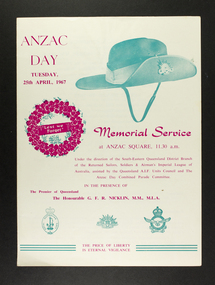
programme, Anzac Day Tuesday 25th April 1967, 1967
... The back features a photo of the Brisbane Shrine of Remembrance and the poem 'The Glory of the Soldier' by Joyce Kilmer....The back features a photo of the Brisbane Shrine of Remembrance and the poem 'The Glory of the Soldier' by Joyce Kilmer. ...Several items were given by a seafarer, Mr Nicholas Garlick (1926-2009) into the care of Father Brady who retired from St Pauls Cathedral, Melbourne in 2018. Father Brady later donated the collection of; objects, documents and an extensive collection of cruise ship menus (1937-end of 20thC) to the Mission via the intermediary William Hastie, volunteer at the Mission for Seafarers.Possibly a pamphlet printed for VIP guests and families attending the ceremony.Two page Anzac Day memorial service pamphlet/leaflet. Smooth/shiny paper, two ink colours (magenta and bluish green), picture of slouch hat at top right corner, and the insignia of each Australian armed force (navy, army, airforce) along the bottom of the pamphlet. The order of ceremony is printed in red ink on the two inner pages. The back features a photo of the Brisbane Shrine of Remembrance and the poem 'The Glory of the Soldier' by Joyce Kilmer.1967, anzac day, brisbane, shrine of remembrance, brisbane, joyce kilmer, poetry, war memorials, william hastie, nicholas garlick, father brady -
 Lara RSL Sub Branch
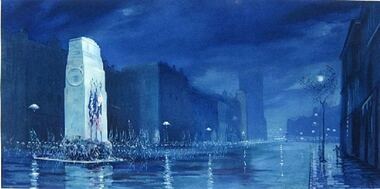
Print, The Immortal Shrine by Captain Will Longstaff, Painting made in 1928
... Longstaff's 'Immortal shrine', also known as 'Eternal silence', depicts endless columns of ghostly soldiers marching past the Cenotaph on a rainy Remembrance Day in 1928. ...Longstaff's 'Immortal shrine', also known as 'Eternal silence', depicts endless columns of ghostly soldiers marching past the Cenotaph on a rainy Remembrance Day in 1928. ...Longstaff's 'Immortal shrine', also known as 'Eternal silence', depicts endless columns of ghostly soldiers marching past the Cenotaph on a rainy Remembrance Day in 1928. The Cenotaph itself has a surreal presence, gauntly white in front of the sombre blue-back buildings that dissolve into the background. Like its well-known predecessor 'Menin Gate at midnight', this painting has undeniable power and is just as hypnotic and evocative.Print of the painting The Immortal Shrine by Will Longstaff - the original is in the Australian War Memorial (ART14196). The frame is made from wood retrieved from the HMAS Sydney and a certificate of authenticity is on the back (refer to image supplied) Article from Trove is also suppliedThe Immortal Shrine Colour Print in Wood and Glass FrameThe Immortal Shrine by Will Long Staff -
 Mortlake and District Historical Society
Lone Pine
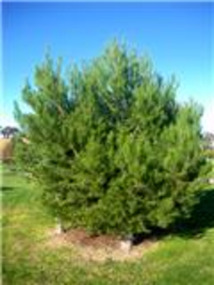
... soldiers first brought home pine cones direct from that fateful battlefield. . One was Sgt. Keith McDowell of the 24th Btn. His aunt, Mrs. Emma Gray of Grassmere (Vic.) planted the seeds c. 1928 and four seedlings resulted. One was planted in Wattle Park, Melbourne, one at the Shrine...soldiers first brought home pine cones direct from that fateful battlefield. . One was Sgt. Keith McDowell of the 24th Btn. His aunt, Mrs. Emma Gray of Grassmere (Vic.) planted the seeds c. 1928 and four seedlings resulted. One was planted in Wattle Park, Melbourne, one at the Shrine ...This pine tree (Allepo Pine, Pinus halepensis) a native of the Gallipoli Peninisula (Gelibolu, Turkey), was grown from a cutting obtained from the War Memorial Canberra and planted in the Mortlake Botanic Gardens in 2002. It replaces the original which grew outside the Mortlake RSL Hall which blew down in a storm c.2000. That tree (Allepo brutius)came from 'the original on Gallipoli' and was planted to commemorate 'fallen comrades' in 'the Jubilee year 1965.' However, two soldiers first brought home pine cones direct from that fateful battlefield. . One was Sgt. Keith McDowell of the 24th Btn. His aunt, Mrs. Emma Gray of Grassmere (Vic.) planted the seeds c. 1928 and four seedlings resulted. One was planted in Wattle Park, Melbourne, one at the Shrine of Remembrance, one at the Soldier's Memorial Hall at The Sisters (c.15 km. south of Mortlake) and one at the Warrnambool Botanic Gardens. The First World War (or 'Great War') and in particular the battle for the Gallipoli Peninsula is of immense national significance. Lone Pine or Plateau 400 was the scene of a major offensive on August 6th 1915. All the trees on the ridge at this point were cut down but one, which was dominated by the 'Lone Pine'. In three days of fighting more than 2,000 Australians lost their lives and seven Victoria Crosses were won. Two Australian soldiers souvenired pine cones - one was brought back to Victoria (see above). Many young men from Mortlake and district volunteered to fight in the Great War and the presence of this tree in our Gardens reminds us all of the local as well as the national sacrifice.l pine tree Small plaque on railing western side. gallipoli, lone pine first world war great war mcdowell, keith -
 Monbulk RSL Sub Branch
Book, Wandin & District Historical Museum Society Inc, Great courage and initiative' : the heroic life of George Ingram VC, MM, 2025
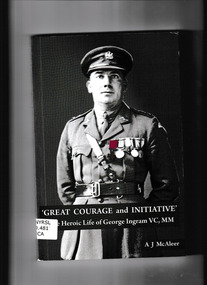
... After the war he became a soldier settler, an original Shrine Guard and during World War Two he served with the Royal Australian Engineers. ...The biography of Capt George Ingram VC, MM, the last Australian VC recipient of the First World War. From country childhood in Bagshot and Seville to a gunner with the Australian Garrison Artillery and the Tropical Force's Matupi Battery. He then served with the 24th Battalion AIF on the Western Front where he was awarded the Military Medal and the Victoria Cross. After the war he became a soldier settler, an original Shrine Guard and during World War Two he served with the Royal Australian Engineers. Throughout his life he carried the physical and mental scars of his service in the war.Index, bibliography, ill, maps, p.187.non-fictionThe biography of Capt George Ingram VC, MM, the last Australian VC recipient of the First World War. From country childhood in Bagshot and Seville to a gunner with the Australian Garrison Artillery and the Tropical Force's Matupi Battery. He then served with the 24th Battalion AIF on the Western Front where he was awarded the Military Medal and the Victoria Cross. After the war he became a soldier settler, an original Shrine Guard and during World War Two he served with the Royal Australian Engineers. Throughout his life he carried the physical and mental scars of his service in the war.soldiers - victoria - biography, george ingram - biography -
 Ithacan Historical Society
Photograph, Greek Return Soldiers, Victoria, 16 May 1945
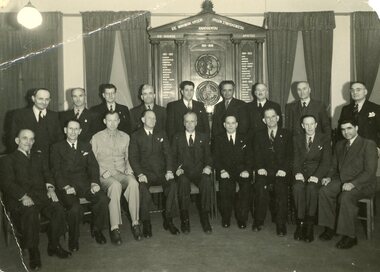
... Shrine of Remembrance in Melbourne, at which the IPS participates. A black and white photograph of eighteen men seated and standing in front of an honour board, which has curtains on either side of it. Greek Return Soldiers ...The eighteen men are assembled at the Greek Returned Servicemen's League hall which was located in Russell Street, Melbourne. The honour board, erected in memory of Greek soldiers, features battle fields where the Greek army participated from 1821, the beginning of Greek War of Independence against the Ottoman Empire, through to World War 2 and the Italian and German occupation of Greece. The man seated in front in an army uniform is an American serviceman. Seated fourth from the left is Spiros E. Raftopoulos who was president of the organisation from 1944 - 1968. Today the Hellenic RSL sub-Branch of Victoria represents and supports the Greek Australian veteran community. In 1978 the organisation joined the Returned and Services League of Australia. The Hellenic RSL sub-Branch commemorates all the Greek and Australian national days each year and proudly marches on Anzac Day in Melbourne, alongside veterans from the wars of Korea, Vietnam, and Afghanistan and earlier wars. On Anzac Day 2013 members of the IPS took part in the Anzac Day march for the first time. Greek national days are commemorated with wreath-laying ceremonies inside the Shrine of Remembrance in Melbourne, at which the IPS participates.A black and white photograph of eighteen men seated and standing in front of an honour board, which has curtains on either side of it. -
 Warrnambool and District Historical Society Inc.
Book, Remember Them, 2009
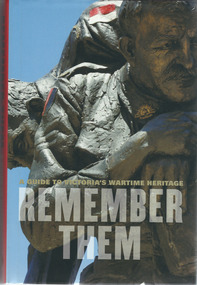
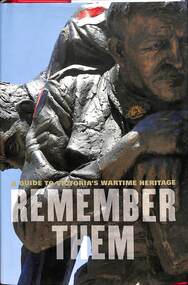
... It will be useful for research melbourne shrine of rememberance war history warrnambool Cover – A Guide to Victoria’s Wartime Heritage – Remember Them This is a hard cover book with a multi-coloured paper dust jacket with an image of a soldier on the front and yellow and white lettering. ...This book gives details of the Melbourne Shrine of Remembrance, war memorials and monuments in suburbs and towns and cities around Victoria and descriptions of the lives of some Victoria war heroes of the Boer War, World Wars One and Two, the Korean War and the Vietnam War.This book is of some local interest as it contains information on war memorials and war heroes in Warrnambool and other district localities. It will be useful for research This is a hard cover book with a multi-coloured paper dust jacket with an image of a soldier on the front and yellow and white lettering. The book is red-coloured with white lettering on the spine. Cover – A Guide to Victoria’s Wartime Heritage – Remember Themmelbourne shrine of rememberance, war history, warrnambool -
 Sunshine and District Historical Society Incorporated
Book - Remember Them. A Guide to Victoria's War Time Heritage, Hardie Grant Books, 2009
... Boer War 1899 - 1902 First World War 1914 - 1918 Second World War 1939 - 1945 Vietnam War 1955 - 1975 War memorial Shrine of Remembrance Jacka Monash Blamey Truscott Pompey Elliot Dunlop Higgins Sandy War Horse Randall Street Maribyrnong This book shares personal stories of individuals honoured in 250 of Victoria's key war memorials in Melbourne and regional Victoria. Remember Them. A Guide to Victoria's War Time Heritage A well-illustrated hard cover book. Striking picture of a soldier ...This book shares personal stories of individuals honoured in 250 of Victoria's key war memorials in Melbourne and regional Victoria.A well-illustrated hard cover book. Striking picture of a soldier on dust jacket.non-fictionThis book shares personal stories of individuals honoured in 250 of Victoria's key war memorials in Melbourne and regional Victoria.boer war 1899 - 1902, first world war 1914 - 1918, second world war 1939 - 1945, vietnam war 1955 - 1975, war memorial, shrine of remembrance, jacka, monash, blamey, truscott, pompey, elliot, dunlop, higgins, sandy war horse, randall street, maribyrnong -
 Wangaratta RSL Sub Branch
Photograph, c1940
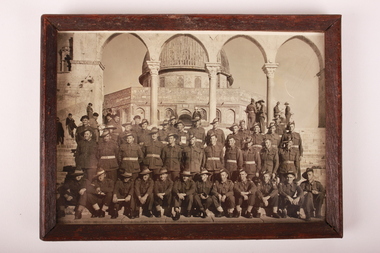
... Australian soldiers photographed in front of the "Dome of the Rock" shrine in Jerusalem. ...Australian soldiers photographed in front of the "Dome of the Rock" shrine in Jerusalem. ...Australian soldiers photographed in front of the "Dome of the Rock" shrine in Jerusalem. During the Second World War, Palestine was under a British mandate and Australian and New Zealand soldiers were back helping the British army to stop the Germans from capturing Egypt and the Suez Canal. They fought alongside several Palestinian brigades enlisted into the British Army under The Palestine Regiment. World famous "Dome of the Rock", site of the ancient temple of Solomon and now a Muslim shrine. During the 7th century it served as a testament to the power of the new faith of Islam. The Dome of the Rock is one of the earliest surviving buildings from the Islamic world. This remarkable building is not a mosque, as is commonly assumed and scholars still debate its original function and meaning.Black and white photograph of Australian Soldiers in front of arched columns with large dome building in background.domeof the rock, jerusalem, ww2 -
 Wangaratta RSL Sub Branch
Photograph, c1941
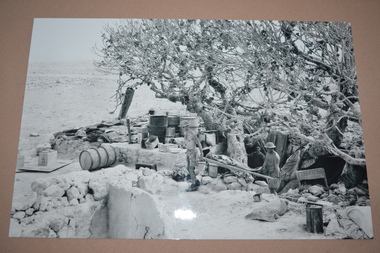
... soldiers could be stabilized before being transferred to the Australian General Hospital. The Fig Tree was the only feature in an otherwise barren desert and an easy target for German artillery who heavily shelled the site for several hours per day. A cutting from the tree was brought back to Australia and planted at Melbourne's Shrine...soldiers could be stabilized before being transferred to the Australian General Hospital. The Fig Tree was the only feature in an otherwise barren desert and an easy target for German artillery who heavily shelled the site for several hours per day. A cutting from the tree was brought back to Australia and planted at Melbourne's Shrine ...The famous Tobruk Fig Tree was named because it marked the entrance to a network of underground caves used to treat wounded soldiers. It became known as the Fig Tree Hospital. The caves became a place where wounded soldiers could be stabilized before being transferred to the Australian General Hospital. The Fig Tree was the only feature in an otherwise barren desert and an easy target for German artillery who heavily shelled the site for several hours per day. A cutting from the tree was brought back to Australia and planted at Melbourne's Shrine of Remembrance.The 2/24th Battalion was an infantry battalion of the Australian Army, which served during World War II .A unit of all-volunteers, it was formed in July 1940 from primarily Victorian volunteers and was known as "Wangaratta's Own" because of the time the battalion spent in the town during its formative period prior to deployment overseas. It served in North Africa in 1941–1942 as part of the 26th Brigade, which was assigned to the 7th Division, before being reassigned to the 9th Division. In early 1943, the battalion returned to Australia and later took part in campaigns against the Japanese in New Guinea in 1943–1944 and Borneo in 1945, before being disbanded in 1946. The 2/24th suffered the highest number of casualties of any 2nd AIF infantry battalion. The Unit was granted the Freedom of the City by the Rural City of Wangaratta in 1996 and one of the first, if not the first, to receive this type of honour. Reproduced black and white photograph of four soldiers under large tree - one soldier in dugout under tree watching two stretcher bearers carry out wounded soldierHandwritten on rear - Fig Tree Tobruk 2/24th battalion, fig tree, tobruk -
 Wangaratta RSL Sub Branch
Photograph, c1942
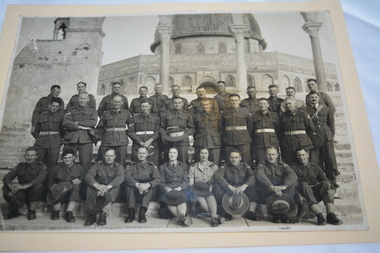
... A group of Australian soldiers photographed outside "The Dome of the Rock" shrine in Jerusalem. ...A group of Australian soldiers photographed outside "The Dome of the Rock" shrine in Jerusalem. ...A group of Australian soldiers photographed outside "The Dome of the Rock" shrine in Jerusalem. During the Second World War, Palestine was under a British mandate and Australian and New Zealand soldiers were back helping the British army to stop the Germans from capturing Egypt and the Suez Canal. They fought alongside several Palestinian brigades enlisted into the British Army under The Palestine Regiment. The soldier sitting second from right is Sergeant Stanley Swainson BEDFORD VX79894 2/24 Battalion. Bedford was born 30/12/1907 and enlisted at Caulfield on 18/5/1942 aged 34 years. He served in the Middle East between August 1942 and February 1942 and Milne Bay New Guinea between August 1943 and March 1944 prior to his discharge on 9/6/1945. He was the Battalion Tailor and is mentioned on page 251 of the book 2/24 - A history of the 2/24 Australian Infantry Battalion edited by R.P. Serle. World famous "Dome of the Rock", site of the ancient temple of Solomon and now a Muslim shrine. During the 7th century it served as a testament to the power of the new faith of Islam. The Dome of the Rock is one of the earliest surviving buildings from the Islamic world. This remarkable building is not a mosque, as is commonly assumed and scholars still debate its original function and meaning. With the exception of the two uniformed females, presumably nurses, one soldier if not all identified as serving with the 2/24th Battalion known as Wangaratta's Own.Original black and white photograph of soldiers standing in two rows and a row of soldiers and two females in uniform seated on step with ancient building in background.dome of rock, jerusalem, stanley swainson bedford -
 Surrey Hills Historical Society Collection
Photograph, City of Camberwell Council, Surrey Gardens, looking east from Union Road, 1933
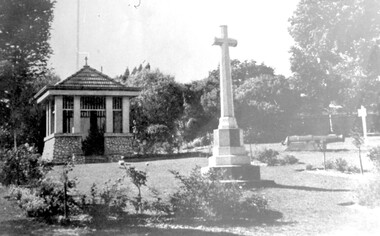
... Mrs Charles H D Steele (MS: Sarah Margaret Russell), president of the local Patriotic League, is credited with the idea of building The Shrine as a fitting memorial to the soldiers of the district. ...Mrs Charles H D Steele (MS: Sarah Margaret Russell), president of the local Patriotic League, is credited with the idea of building The Shrine as a fitting memorial to the soldiers of the district. ...The Honor Roll and Shrine in the Surrey Gardens were opened on Sunday 7 April 1918, prior to the cessation of fighting. Mrs Charles H D Steele (MS: Sarah Margaret Russell), president of the local Patriotic League, is credited with the idea of building The Shrine as a fitting memorial to the soldiers of the district. The Surrey Hills Progress Association coordinated raising funds from local residents. John Kendrick Blogg carved the beautiful honor roll in Indian teak and Australian white mahogany and the design of The Shrine was by architectural firm Gawler & Drummond. John Stevens Gawler was a partner in the firm, lived locally and also enlisted. Although he may have been overseas during some of the design process he is often credited with the design. Both men donated their services. The 2 cannons in the gardens were acquired by Mr Arthur Brookes in 1901 to commemorate the end of the Boer War. He was popularly known as 'Empire Brooks' and the cannons as 'Brooks' Babies'. They were originally placed in the grounds of the Guildford Road Recreation Oval. Arthur Brooks was an active community member and one of the founding members of the Surrey Hills Progress Association. Original photo was contained in a booklet printed by Camberwell Council in 1933.This is one of the earliest known photos of 3 elements important in designating the Surrey Gardens as one of the City of Boroondara's heritage gardens, now protected by a heritage overlay. The Shrine was one of the first WW1 memorials to be built in Australia and possibly the first in Victoria. It was unveiled prior to the end of hostilities and was built entirely through local community effort. The design of The Shrine, reflective of domestic architecture, is unusual. Its Honor Roll is also a noted example of sculptor John Kendrick Blogg's work and valued especially for its incorporation of Australian motifs, wattle blossom and gum leaves. The boomerang over the full width of the monument was said to be symbolic of both those who did and did not return. Black and white photo of part of the Surrey Gardens, located between Union Road and Norfolk Road, Surrey Hills. It shows The Shrine, the cannons installed to commemorate the end of the Boer War and the Memorial Cross. Taken from within the park looking east. surrey gardens, shrine of remembrance, monuments and memorials, boer war, cannons, mr john gawler, john kendrick blogg, arthur brooks, mrs charles steele, mrs sarah steele, miss sarah margaret russell -
 Surrey Hills Historical Society Collection
Photograph, John Kendrick Blogg, John Kendrick Blogg carving, Soldiers' Honour Board, Shrine in the Surrey Gardens
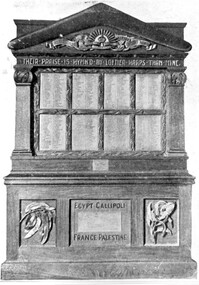
... Black and white photo of the Soldiers' Memorial Honour Board housed in The Shrine in the Surrey Gardens. ...John Kendrick Blogg carving, Soldiers' Honour Board, Shrine in the Surrey Gardens Photograph Photograph John Kendrick Blogg Ken Hall John Kendrick Blogg ...John Kendrick Blogg was born in Canada and migrated to Victoria in 1877. In 1884 he established a successful industrial chemistry business, which included extracting perfume from Australian native trees and plants.liquid ammonia for refrigeration, acetic acid, perfumes, shoe polish, baking powder and non-alcoholic drinks. Other products were He lived at 'Balmoral' in Albany Crescent, Surrey Hills; his woodwork was produced here. Family oral history has that he took up woodcarving after his 1st wife, Annie, died in 1893. His earliest known piece is a music cabinet of 1901; the latest is a panel of 1932 when Blogg was 81 years of age. He was a member of the Victorian Artists Society and exhibited there between 1920 and 1924. Much of his work incorporates motifs of Australian flora, particularly gum leaves. John and his family were members of St Stephen's Presbyterian Church, Surrey Hills. The present church building was dedicated in December 1910 and J K Blogg's contribution to the new building was the Hogg Memorial pulpit which is comprised of 13 panels. Blogg carved more than 300 pieces for churches, schools, royalty, family and friends. Many of J K Blogg's pieces remain with family members, but he is represented in municipal (City of Whitehorse), state and national collections. In addition to work in the St Stephen's Presbyterian Church within the Surrey Hills area his work was produced for Surrey Hills Primary School, Surrey Hills Bowling Club and Surrey Hills Methodist Church, however perhaps his most famous local work is the honour board at the Shrine in the Surrey Gardens. Blogg was also a poet. Ref: Legacy in Sculptured Wood - An appreciation of the work of John Kendrick Blogg, 1851-1936 by Marjorie Morgan, 1993. The images derives from an early brochure. The number of panels has been increased having been updated on at least 2 occasions. Whereas the date 1914 is at one end of the boomerang, the other end is not dated reflecting that the dedication of The Shrine before the war ended.Black and white photo of the Soldiers' Memorial Honour Board housed in The Shrine in the Surrey Gardens. The wooden part of the board was carved by John Kendrick Blogg. A large boomerang forms part of the apex underneath which is an emblem with the rising sun. Under this are 8 panels on which are the names of service personnel. The supporting timber is carved with designs including varied flora. At the base are 2 larger carved panels; on the LHS a sprig of eucalyptus leaves and on the RHS a sprig of wattle. surrey gardens, world war, 1914-1918, woodcarving, monuments and memorials, surrey shrine, john blogg, john kendrick blogg -
 Melbourne Legacy
Photograph - Photo, Anzac commemoration for students 1990, 1990
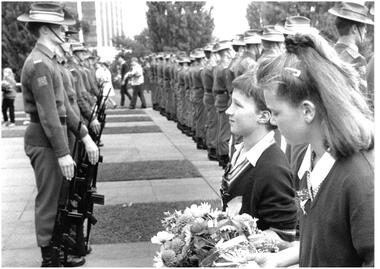
... Shrine 11.4.1990. From L/T J P Norton". Black and white photo of two children with wreaths processing past soldiers in formation. ...A Legacy ceremony at the Shrine of Remembrance in April 1990. One of the annual "Anzac Commemoration Ceremony for Students" events, usually held just prior to ANZAC Day. The ceremony provides a valuable opportunity for students to gain an appreciation of the Anzac spirit, the significance of the Shrine and the meaning of Anzac Day. The photos shows a pair of students with wreaths walking past defence force personnel in formation on the forecourt of the Shrine. The photo was used The Answer in May 1991 to promote the Anzac Commemoration Service with an article 'Not everything that counts can be counted'.A record of a ceremony for school students at the Shrine.Black and white photo of two children with wreaths processing past soldiers in formation.In blue pen on reverse: "Children's Commemoration Service at the Shrine 11.4.1990. From L/T J P Norton". anzac commemoration for students, wreath laying ceremony, answer -
 Diamond Valley Vietnam Veterans Sub-Branch
Craft - White Cross, Kirby, 18/7/2016
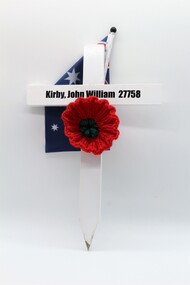
... One of 521 crosses placed in lawns of The Shrine, Melbourne, on 18th August 2016, as part of VVAA (Vic)'s 50th Anniversary of the Battle of Long Tan - each cross carries the name of an Australian soldier killed in the Vietnam war and a red poppy made by wife of Vietnam veteran....One of 521 crosses placed in lawns of The Shrine, Melbourne, on 18th August 2016, as part of VVAA (Vic)'s 50th Anniversary of the Battle of Long Tan - each cross carries the name of an Australian soldier killed in the Vietnam war and a red poppy made by wife of Vietnam veteran. ...One of 521 crosses placed in lawns of The Shrine, Melbourne, on 18th August 2016, as part of VVAA (Vic)'s 50th Anniversary of the Battle of Long Tan - each cross carries the name of an Australian soldier killed in the Vietnam war and a red poppy made by wife of Vietnam veteran.A poignant reflection of a life lost whilst in Service in Vietnam.White cross with name and service number printed; red poppy attached. John William Kirby, Service No. 27758vietnam, vietnam war, diamond valley vietnam veterans sub branch -
 Diamond Valley Vietnam Veterans Sub-Branch
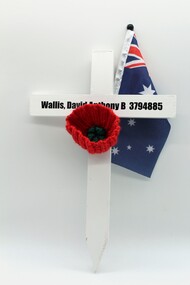
Craft - White Cross, Wallis, 18/8/2016
... One of 521 crosses placed in lawns of The Shrine, Melbourne, on 18th August 2016 as part of Victoria's 50th Anniversary of the Battle of Long Tan - each cross carries the name of an Australian soldier killed in the Vietnam war and a red poppy made by the wife of a Vietnam Veteran....One of 521 crosses placed in lawns of The Shrine, Melbourne, on 18th August 2016 as part of Victoria's 50th Anniversary of the Battle of Long Tan - each cross carries the name of an Australian soldier killed in the Vietnam war and a red poppy made by the wife of a Vietnam Veteran. ...One of 521 crosses placed in lawns of The Shrine, Melbourne, on 18th August 2016 as part of Victoria's 50th Anniversary of the Battle of Long Tan - each cross carries the name of an Australian soldier killed in the Vietnam war and a red poppy made by the wife of a Vietnam Veteran.A poignant reflection of a life lost whilst in Service in Vietnam.White Cross with name and service number printed; red poppy attached.David Anthony B Wallis, Service No. 3794885vietnam, vietnam war, diamond valley vietnam veterans sub branch -
 Diamond Valley Vietnam Veterans Sub-Branch
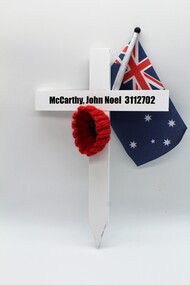
Craft - White Cross, McCarthy, July 2016
... One of 521 crosses placed in lawns of The Shrine, Melbourne, on 18th August 2016 as part of Victoria's 50th Anniversary of the Battle of Long Tan - each cross carries the name of an Australian soldier killed in the Vietnam war and a red poppy made by the wife of a Vietnam veteran....One of 521 crosses placed in lawns of The Shrine, Melbourne, on 18th August 2016 as part of Victoria's 50th Anniversary of the Battle of Long Tan - each cross carries the name of an Australian soldier killed in the Vietnam war and a red poppy made by the wife of a Vietnam veteran. ...One of 521 crosses placed in lawns of The Shrine, Melbourne, on 18th August 2016 as part of Victoria's 50th Anniversary of the Battle of Long Tan - each cross carries the name of an Australian soldier killed in the Vietnam war and a red poppy made by the wife of a Vietnam veteran.A poignant reflection of a life lost whilst in Service in Vietnam.White cross with name and service number with a red poppy attached.John Noel McCarthy, Service No. 3112702vietnam, vietnam war, diamond valley vietnam veterans sub branch -
 Diamond Valley Vietnam Veterans Sub-Branch
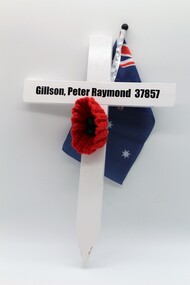
Craft - White Cross, Gillson, July 2016
... One of 521 crosses placed in lawns of The Shrine, Melbourne, on 18th August 2016 as part of Victoria's 50th Anniversary of the Battle of Long Tan - each cross carries the name of an Australian soldier killed in the Vietnam war and a red poppy made by the wife of a Vietnam veteran.....One of 521 crosses placed in lawns of The Shrine, Melbourne, on 18th August 2016 as part of Victoria's 50th Anniversary of the Battle of Long Tan - each cross carries the name of an Australian soldier killed in the Vietnam war and a red poppy made by the wife of a Vietnam veteran.. ...One of 521 crosses placed in lawns of The Shrine, Melbourne, on 18th August 2016 as part of Victoria's 50th Anniversary of the Battle of Long Tan - each cross carries the name of an Australian soldier killed in the Vietnam war and a red poppy made by the wife of a Vietnam veteran..A poignant reflection of a life lost whilst in Service in Vietnam.White cross with name and service number printed; red poppy attached.Peter Raymond Gillson, Service No. 37857vietnam, vietnam war, diamond valley vietnam veterans sub branch -
 Diamond Valley Vietnam Veterans Sub-Branch
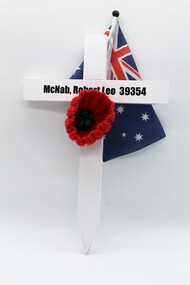
Craft - White Cross, McNab, July 2016
... One of 521 crosses placed in lawns of The Shrine, Melbourne, on 18th August 2016 as part of Victoria's 50th Anniversary of the Battle of Long Tan - each cross carries the name of an Australian soldier killed in the Vietnam war and a red poppy made by the wife of a Vietnam Veteran....One of 521 crosses placed in lawns of The Shrine, Melbourne, on 18th August 2016 as part of Victoria's 50th Anniversary of the Battle of Long Tan - each cross carries the name of an Australian soldier killed in the Vietnam war and a red poppy made by the wife of a Vietnam Veteran. ...One of 521 crosses placed in lawns of The Shrine, Melbourne, on 18th August 2016 as part of Victoria's 50th Anniversary of the Battle of Long Tan - each cross carries the name of an Australian soldier killed in the Vietnam war and a red poppy made by the wife of a Vietnam Veteran.A poignant reflection of a life lost whilst in Service in Vietnam.White cross with name and service number printed; red poppy attached.Robert Leo McNab, Service No. 39354vietnam, vietnam war, diamond valley vietnam veterans sub branch -
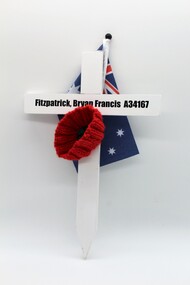 Diamond Valley Vietnam Veterans Sub-Branch
Craft - White Cross, Fitzpatrick, July 2016
... One of 521 crosses placed in lawns of The Shrine, Melbourne, on 18th August 2016 as part of Victoria's 50th Anniversary of the Battle of Long Tan - each cross carries the name of an Australian soldier killed in the Vietnam war and a red poppy made by the wife of a Vietnam veteran....One of 521 crosses placed in lawns of The Shrine, Melbourne, on 18th August 2016 as part of Victoria's 50th Anniversary of the Battle of Long Tan - each cross carries the name of an Australian soldier killed in the Vietnam war and a red poppy made by the wife of a Vietnam veteran. ...One of 521 crosses placed in lawns of The Shrine, Melbourne, on 18th August 2016 as part of Victoria's 50th Anniversary of the Battle of Long Tan - each cross carries the name of an Australian soldier killed in the Vietnam war and a red poppy made by the wife of a Vietnam veteran.A poignant reflection of a life lost whilst in Service in Vietnam.White cross with name and service number printed; red poppy attached.Bryan Francis Fitzpatrick, Service No. A34167vietnam, vietnam war, diamond valley vietnam veterans sub branch -
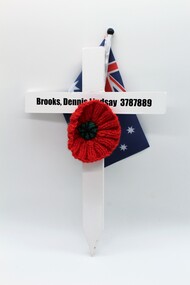 Diamond Valley Vietnam Veterans Sub-Branch
Craft - White Cross, Brooks, July 2016
... One of 521 crosses placed in lawns of The Shrine, Melbourne, on 18th August 2016 as part of Victoria's 50th Anniversary of the Battle of Long Tan - each cross carries the name of an Australian soldier killed in the Vietnam war and a red poppy made by the wife of a Vietnam veteran....One of 521 crosses placed in lawns of The Shrine, Melbourne, on 18th August 2016 as part of Victoria's 50th Anniversary of the Battle of Long Tan - each cross carries the name of an Australian soldier killed in the Vietnam war and a red poppy made by the wife of a Vietnam veteran. ...One of 521 crosses placed in lawns of The Shrine, Melbourne, on 18th August 2016 as part of Victoria's 50th Anniversary of the Battle of Long Tan - each cross carries the name of an Australian soldier killed in the Vietnam war and a red poppy made by the wife of a Vietnam veteran.A poignant reflection of a life lost whilst in Service in Vietnam.White cross with name and service number printed; red poppy attached.Dennis Lindsay Brooks, Service No. 3787889vietnam, vietnam war, diamond valley vietnam veterans sub branch -
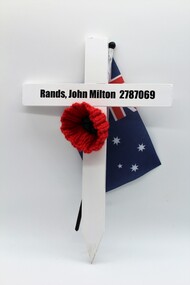 Diamond Valley Vietnam Veterans Sub-Branch
Craft - White Cross, Rands, July 2016
... One of 521 crosses placed in lawns of The Shrine, Melbourne, on 18th August 2016 as part of Victoria's 50th Anniversary of the Battle of Long Tan - each cross carries the name of an Australian soldier killed in the Vietnam war and a red poppy made by the wife of a Vietnam veteran....One of 521 crosses placed in lawns of The Shrine, Melbourne, on 18th August 2016 as part of Victoria's 50th Anniversary of the Battle of Long Tan - each cross carries the name of an Australian soldier killed in the Vietnam war and a red poppy made by the wife of a Vietnam veteran. ...One of 521 crosses placed in lawns of The Shrine, Melbourne, on 18th August 2016 as part of Victoria's 50th Anniversary of the Battle of Long Tan - each cross carries the name of an Australian soldier killed in the Vietnam war and a red poppy made by the wife of a Vietnam veteran.A poignant reflection of a life lost whilst in Service in Vietnam.White cross with name and service number printed; red poppy attached.John Milton Rands, Service No. 2787069.vietnam, vietnam war, diamond valley vietnam veterans sub branch -
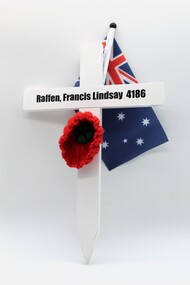 Diamond Valley Vietnam Veterans Sub-Branch
Craft - White Cross, Raffen, July 2016
... One of 521 crosses placed in lawns of The Shrine, Melbourne, on 18th August 2016 as part of Victoria's 50th Anniversary of the Battle of Long Tan - each cross carries the name of an Australian soldier killed in the Vietnam war and a red poppy made by the wife of a Vietnam veteran ....One of 521 crosses placed in lawns of The Shrine, Melbourne, on 18th August 2016 as part of Victoria's 50th Anniversary of the Battle of Long Tan - each cross carries the name of an Australian soldier killed in the Vietnam war and a red poppy made by the wife of a Vietnam veteran . ...One of 521 crosses placed in lawns of The Shrine, Melbourne, on 18th August 2016 as part of Victoria's 50th Anniversary of the Battle of Long Tan - each cross carries the name of an Australian soldier killed in the Vietnam war and a red poppy made by the wife of a Vietnam veteran .A poignant reflection of a life lost whilst in Service in Vietnam.White cross with name and service number printed; red poppy attached.Francis Lindsay Raffen, Service No. 4186vietnam, vietnam war, diamond valley vietnam veterans sub branch -
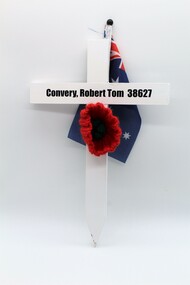 Diamond Valley Vietnam Veterans Sub-Branch
Craft - White Cross, Convery, July 2016
... One of 521 crosses placed in lawns of The Shrine, Melbourne, on 18th August 2016 as part of Victoria's 50th Anniversary of the Battle of Long Tan - each cross carries the name of an Australian soldier killed in the Vietnam war and a red poppy made by the wife of a Vietnam veteran....One of 521 crosses placed in lawns of The Shrine, Melbourne, on 18th August 2016 as part of Victoria's 50th Anniversary of the Battle of Long Tan - each cross carries the name of an Australian soldier killed in the Vietnam war and a red poppy made by the wife of a Vietnam veteran. ...One of 521 crosses placed in lawns of The Shrine, Melbourne, on 18th August 2016 as part of Victoria's 50th Anniversary of the Battle of Long Tan - each cross carries the name of an Australian soldier killed in the Vietnam war and a red poppy made by the wife of a Vietnam veteran.A poignant reflection of a life lost whilst in Service in Vietnam.White cross with name and service number printed; red poppy attached.Robert Tom Convery, Service No. 38627.vietnam, vietnam war, diamond valley vietnam veterans sub branch -
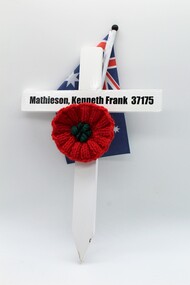 Diamond Valley Vietnam Veterans Sub-Branch
Craft - White Cross, Mathieson, July 2016
... One of 521 crosses placed in lawns of The Shrine, Melbourne, on 18th August 2016 as part of Victoria's 50th Anniversary of the Battle of Long Tan - each cross carries the name of an Australian soldier killed in the Vietnam war and a red poppy made by the wife of a Vietnam veteran....One of 521 crosses placed in lawns of The Shrine, Melbourne, on 18th August 2016 as part of Victoria's 50th Anniversary of the Battle of Long Tan - each cross carries the name of an Australian soldier killed in the Vietnam war and a red poppy made by the wife of a Vietnam veteran. ...One of 521 crosses placed in lawns of The Shrine, Melbourne, on 18th August 2016 as part of Victoria's 50th Anniversary of the Battle of Long Tan - each cross carries the name of an Australian soldier killed in the Vietnam war and a red poppy made by the wife of a Vietnam veteran.A poignant reflection of a life lost whilst in Service in Vietnam.White cross with name and service number printed; red poppy attached.Kenneth Frank Mathieson, Service No. 37175vietnam, vietnam war, diamond valley vietnam veterans sub branch -
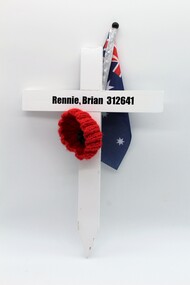 Diamond Valley Vietnam Veterans Sub-Branch
Craft - White Cross, Rennie, July 2016
... One of 521 crosses placed in lawns of The Shrine, Melbourne, on 18th August 2016 as part of Victoria's 50th Anniversary of the Battle of Long Tan - each cross carries the name of an Australian soldier killed in the Vietnam war and a red poppy made by the wife of a Vietnam veteran....One of 521 crosses placed in lawns of The Shrine, Melbourne, on 18th August 2016 as part of Victoria's 50th Anniversary of the Battle of Long Tan - each cross carries the name of an Australian soldier killed in the Vietnam war and a red poppy made by the wife of a Vietnam veteran. ...One of 521 crosses placed in lawns of The Shrine, Melbourne, on 18th August 2016 as part of Victoria's 50th Anniversary of the Battle of Long Tan - each cross carries the name of an Australian soldier killed in the Vietnam war and a red poppy made by the wife of a Vietnam veteran.A poignant reflection of a life lost whilst in Service in Vietnam.White cross with name and service number printed; red poppy attached.Brian Rennie, Service No. 312641vietnam, vietnam war, diamond valley vietnam veterans sub branch
