
Showing 19 items matching "soldiers-medical care-australia"
-
 Returned Nurses RSL Sub-branch
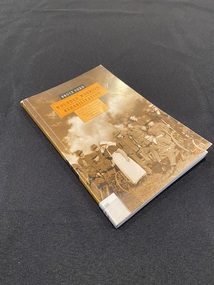
Book - Illustrated paperback book, Caulfield General Medical Centre, The wounded warrior and rehabilitation, 1996
... medical care...soldiers-medical care-Australia...No.11 Australian General Hospital Caulfield Rehabilitation Hospital (Vic.) military hospitals-Australia-history World War 1914-1918 medical care World War 1939-1945 medical care soldiers-medical care-Australia soldiers-rehabilitation-Australia rehabilitation wounded soldiers Traces the history of rehabilitation in the armed forces in Australia. ...Traces the history of rehabilitation in the armed forces in Australia. This history included the establishment of the Caulfield Hospital in Melbourne. A hospital that has adapted over time and throughout two World Wars, polio outbreaks and up to its recent care of the elderly and victims of accidents,Small paperback with an orange spine with title printed down it and a white spine label taped to the bottom. The front cover shows a sepia toned image of a group of wounded soldiers on crutches and in wheelchairs with a nurse standing amongst them. There are two orange templates in the top centre of the page with the title information printed inside them in black print.non-fictionTraces the history of rehabilitation in the armed forces in Australia. This history included the establishment of the Caulfield Hospital in Melbourne. A hospital that has adapted over time and throughout two World Wars, polio outbreaks and up to its recent care of the elderly and victims of accidents,no.11 australian general hospital, caulfield rehabilitation hospital (vic.), military hospitals-australia-history, world war 1914-1918 medical care, world war 1939-1945 medical care, soldiers-medical care-australia, soldiers-rehabilitation-australia, rehabilitation, wounded soldiers -
 Returned Nurses RSL Sub-branch
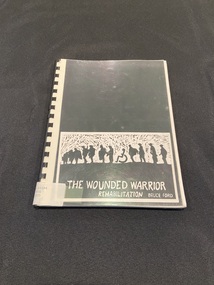
Book - Spiral bound book draft, Amphion Press, The wounded warrior and rehabilitation, [1986?]
... medical care...soldiers-medical care-Australia...No.11 Australian General Hospital Caulfield Rehabilitation Hospital (Vic.) military hospitals-Australia-history World War 1914-1918 medical care World War 1939-1945 medical care soldiers-medical care-Australia soldiers-rehabilitation-Australia rehabilitation wounded soldiers This copy is a typed sample draft from a book that was later published under the same title. ...This copy is a typed sample draft from a book that was later published under the same title. It traces the history of rehabilitation in the armed forces in Australia. This history included the establishment of the Caulfield Hospital in Melbourne. A hospital that has adapted over time and throughout two World Wars, polio outbreaks and up to its recent care of the elderly and victims of accidents,Spiral bound paperback booklet with a black plastic spine and a clear plastic protective sheet over the cover. The cover is black with a white rectangle template at the bottom of the page. Inside the template is a drawn black and white image of a line of silhouettes of wounded soldiers and the title printed below in white.non-fictionThis copy is a typed sample draft from a book that was later published under the same title. It traces the history of rehabilitation in the armed forces in Australia. This history included the establishment of the Caulfield Hospital in Melbourne. A hospital that has adapted over time and throughout two World Wars, polio outbreaks and up to its recent care of the elderly and victims of accidents,no.11 australian general hospital, caulfield rehabilitation hospital (vic.), military hospitals-australia-history, world war 1914-1918 medical care, world war 1939-1945 medical care, soldiers-medical care-australia, soldiers-rehabilitation-australia, rehabilitation, wounded soldiers -
 Flagstaff Hill Maritime Museum and Village
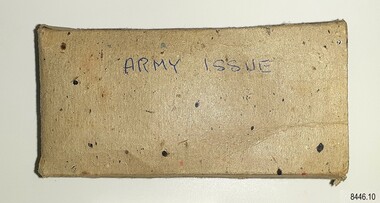
Equipment - Personal Care kit, 1939-1945
... Care kit was issued by the Australian Army to those in military service during WWII, including Dr.W.R. Angus. The kit was part of a soldier's equipment to guard against possible sexually transmitted infections. It is now part of Flagstaff Hill’s comprehensive W.R. Angus Collection, donated by the family of Dr W R Angus (1901-1970), surgeon and oculist. Dr W R Angus was a Surgeon Captain for the Australian Defence Forces, Army Medical...Care kit was issued by the Australian Army to those in military service during WWII, including Dr.W.R. Angus. The kit was part of a soldier's equipment to guard against possible sexually transmitted infections. It is now part of Flagstaff Hill’s comprehensive W.R. Angus Collection, donated by the family of Dr W R Angus (1901-1970), surgeon and oculist. Dr W R Angus was a Surgeon Captain for the Australian Defence Forces, Army Medical ...This Personal Care kit was issued by the Australian Army to those in military service during WWII, including Dr.W.R. Angus. The kit was part of a soldier's equipment to guard against possible sexually transmitted infections. It is now part of Flagstaff Hill’s comprehensive W.R. Angus Collection, donated by the family of Dr W R Angus (1901-1970), surgeon and oculist. Dr W R Angus was a Surgeon Captain for the Australian Defence Forces, Army Medical Corps, stationed in Ballarat, Victoria, and in Bonegilla, N.S.W. He completed his service just before the end of the war due to suffering from a heart attack. The W.R. Angus Collection: - The W.R. Angus Collection includes historical medical equipment, surgical instruments and material belonging to Dr Edward Ryan and Dr Thomas Francis Ryan, (both of Nhill, Victoria) and Dr Angus’ own belongings. The Collection’s history spans the medical practices of the two Doctors Ryan, from 1885-1926 plus that of Dr Angus, up until 1969. It includes historical medical and surgical equipment and instruments from the doctors Edward and Thomas Ryan of Nhill, Victoria. Dr Angus married Gladys in 1927 at Ballarat, the nearest big city to Nhill where he began as a Medical Assistant. He was also Acting House surgeon at the Nhill hospital where their two daughters were born. During World War II He served as a Military Doctor in the Australian Defence Forces. Dr Angus and his family moved to Warrnambool in 1939, where Dr Angus operated his own medical practice. He later added the part-time Port Medical Officer responsibility and was the last person appointed to that position. Both Dr Angus and his wife were very involved in the local community, including the planning stages of the new Flagstaff Hill and the layout of the gardens there. Dr Angus passed away in March 1970.This item is significant in Australia's Military History. It aids in understanding life in the military and the changes to normal life and morality. Dr W R Angus (1901-1970), surgeon and oculist, collected a range of military objects including those he personally used during his time as Surgeon Captain in the Australian Defence Forces in World War II. The W.R. Angus Collection is significant for still being located at the site it is connected with, Doctor Angus being the last Port Medical Officer in Warrnambool. The Collection includes historical medical objects that date back to the late 1800s.Australian Army personal care kit, WWII era. A rectangular brown box containing a small blue cardboard box with a leaflet and two small tubes of ointment inside it, four square waxed paper prophylactic packets and a brown cardboard cylinder with enclosed ends containing a waxy substance. The overall box has a handwritten inscription. The kit belonged to Dr W R Angus and are now part of the W. R. Angus Collection.On the large box, handwritten “ARMY ISSUE” On waxed paper wrapper; “CHECKER NEW LATEX PROPHYLACTIC” On the small box “THE BLUE LIGHT OUTFIT” “DIRECTIONS INSIDE” flagstaff hill, warrnambool, maritime village, maritime museum, shipwreck coast, great ocean road, flagstaff hill maritime museum and village, dr w r angus, w.r. angus collection, australian army, world war 2, second world war, australian defence forces, ww 2, ww ii, military equipment, army issue, personal care, personal hygene, prevention of std, prevention of sti, prevention of vd -
 Alfred Hospital Nurses League - Nursing History Collection
Booklet - Illustrated Booklet (photocopy), F C Hawker, No 5 Australian General Hospital (base hospital) Melbourne, 1919
... Australian General Hospital, capable of accommodating 600 patients. The first patients were admitted in March 1915. By 1918 it was an important hospital for the hospital care of repatriated soldiers. Information about an important medical ...Illustrated boklet that provides information about the facilities and services of the 5th Australian General Hospital, Melbourne during World War 1, proceeds from the sale of the book (price 1/6) were given to the Red Cross Society. Also contains contemporary advertisementsIllustrated photocopied booklet that has been con=mb bound with a protective blue plastic covernon-fictionIllustrated boklet that provides information about the facilities and services of the 5th Australian General Hospital, Melbourne during World War 1, proceeds from the sale of the book (price 1/6) were given to the Red Cross Society. Also contains contemporary advertisementsno 5 aurstralian general hospital (base hospital) melbourne, military hospitals - victoria - history, world war 1914-1918 - medical care -
 Alfred Hospital Nurses League - Nursing History Collection
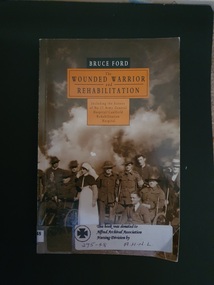
Book - Illustrated book, Bruce Ford, The wounded warrior and rehabilitation. Including the history of No 11 army general hospital/Caulfield rehabilitation hospital, 1996
... medical specialty of rehabilitation. Of significance to the AHNL as many members spent part of their training at Caulfield Australia Army General Hospital 11th Caulfield General Medical Centre - history Caulfield Hospital - history Royal Southern Memorial Hospital - history World War 1914-1918 - medical care - Victoria World War 1939 -1945 - medical care - Victoria Soldiers - Rehabilitation - Victoria Military Hospitals - Victoria - History Artificial limb factory Hospitals - rehabilitation services - Australia A history of Caulfield General Medical Centre, including the No 11 Army General Hospital/Caulfield Rehabilitation Hospital and the Royal Southern Memorial Hospital adapting rehabilitation to changing conditions of two World Wars, polio outbreaks to care of the elderly and accident victims. ...A history of Caulfield General Medical Centre, including the No 11 Army General Hospital/Caulfield Rehabilitation Hospital and the Royal Southern Memorial Hospital adapting rehabilitation to changing conditions of two World Wars, polio outbreaks to care of the elderly and accident victims.Sepia photograph of soldiers and nurses on front and back cover. Portrait of the author, Bruce Ford on back cover also, Title on front cover and spine in black print on orange background. Authors name in white print on black background on front cover. Authors name in black print on spine. Donation sticker also on front cover. Contains numerous black and white illustrations.non-fictionA history of Caulfield General Medical Centre, including the No 11 Army General Hospital/Caulfield Rehabilitation Hospital and the Royal Southern Memorial Hospital adapting rehabilitation to changing conditions of two World Wars, polio outbreaks to care of the elderly and accident victims.australia army general hospital 11th, caulfield general medical centre - history, caulfield hospital - history, royal southern memorial hospital - history, world war 1914-1918 - medical care - victoria, world war 1939 -1945 - medical care - victoria, soldiers - rehabilitation - victoria, military hospitals - victoria - history, artificial limb factory, hospitals - rehabilitation services - australia -
 Alfred Hospital Nurses League - Nursing History Collection
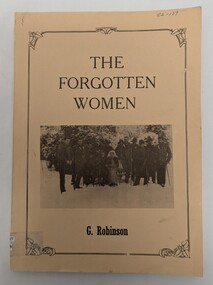
Book - Illustrated book, Gwen Robinson, The Forgotten Women: personal accounts of Australian Nurses abroad in World War 1, 1989
... Medical Care Military nursing-Australia Australia-Army-Nurses Nurses Personal accounts of Australian Nurses abroad in World War 1 Previous catalogue number written in black ink at top right of front cover. This number is also written on a printed black and white donation sticker: black Maltese cross in circle, "This book was donated to Alfred Archival Association Nursing Division by" at the bottom right of page 1 Illustrated book with light brown cover. Front cover has a black and white photograph of a nurse with a group of soldiers ...Personal accounts of Australian Nurses abroad in World War 1Illustrated book with light brown cover. Front cover has a black and white photograph of a nurse with a group of soldiers ( S.Avenell with amputees at Southall Hospital) Abbreviated title is printed above, and the authors name below this photograph in black ink. This is surround by a decorative border in black ink: two narrow lines and leaves at the corners. Abbreviated title and author's name also printed in black ink on spine. The back cover has a small black and white photo of a group of nurses (S.Olive Saloway with other nurses on board Orsovanon-fictionPersonal accounts of Australian Nurses abroad in World War 1world war 1914-1918 - medical care, military nursing-australia, australia-army-nurses, nurses -
 National Vietnam Veterans Museum (NVVM)
Photograph, 1st Australian Field Hospital
... 1st Australian Field Hospital Association Vietnam War - 1961-1975 - Soldiers - Australian Vietnam War 1961-1975 - Medical care - Personal narratives - Australia Various photos taken in Le Loi Orphanage, Vung Tau & Nui Dat. ...Various photos taken in Le Loi Orphanage, Vung Tau & Nui Dat. Each photo has an explanation of the photo on the back & there is also a typed list of each photo attached.1st australian field hospital association, vietnam war - 1961-1975 - soldiers - australian, vietnam war, 1961-1975 - medical care - personal narratives - australia -
National Vietnam Veterans Museum (NVVM)
Photograph, Photograph from the Dental Group & 8th Field Ambulance
... 8th Field ambulance Dental Group Vietnam War - 1961-1975 - Soldiers - Australian Vietnam War 1961-1975 - Medical care 1st Australian Field Hospital A collection of Photograph from the Dental Group & 8th Field Ambulance. ...A collection of Photograph from the Dental Group & 8th Field Ambulance.8th field ambulance, dental group, vietnam war - 1961-1975 - soldiers - australian, vietnam war, 1961-1975 - medical care, 1st australian field hospital -
 Wodonga & District Historical Society Inc
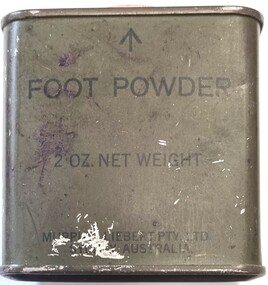
Container - Foot Powder Tin
... The company was highly regarded for producing a wide array of personal care, medical, and household products, many of which were supplied to the Australian Defence Forces This tin of foot powder was standard issue to Australian soldiers serving in the Malayan Emergency and the Vietnam War where tropical conditions caused precautions were necessary to prevent bacterial infections....The company was highly regarded for producing a wide array of personal care, medical, and household products, many of which were supplied to the Australian Defence Forces This tin of foot powder was standard issue to Australian soldiers serving in the Malayan Emergency and the Vietnam War where tropical conditions caused precautions were necessary to prevent bacterial infections. ...Foot powder was used to absorb potential build up of moisture and protect against possible bacterial infection. Murphy, Liebert Pty Ltd was a notable Sydney-based manufacturing chemist company that operated during the 20th century. The company was highly regarded for producing a wide array of personal care, medical, and household products, many of which were supplied to the Australian Defence Forces This tin of foot powder was standard issue to Australian soldiers serving in the Malayan Emergency and the Vietnam War where tropical conditions caused precautions were necessary to prevent bacterial infections.This item is significant because it represents one of the measures needed to protect Australian soldiers and the wider community from foot health issues.A small tin with perforated lid containing foot powderOn front FOOT POWDER 2 OZ. NET WEIGHT MURPY LIEBERT PTY LTD SYDNEY AUSTRALIA On reverse FORMULA SALICYLIC ACID 3% STARCH 10% TALC 87% personal toiletry items, australian soldiers' personal supplies -
 Diamond Valley Vietnam Veterans Sub-Branch
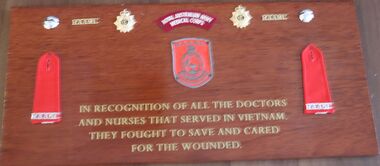
Plaque - Medical Services, 3/8/2018
... Australian Armed Forces of the RAAMC who served with devotion during the Vietnam war. The RAAMC teams saved many lives and mended many soldiers often working under difficult circumstances and with limited available timeframe to perform their duties. vietnam vietnam war diamond valley vietnam veterans sub branch medical mackay vietnam veterans qld In Regognition Of All The Doctors And Nurses That Served In Vietnam. They Fought To Save And cared ...The plaque is a clear indication of the respect and gratitude of members of Australian Armed Forces of the RAAMC who served with devotion during the Vietnam war.The RAAMC teams saved many lives and mended many soldiers often working under difficult circumstances and with limited available timeframe to perform their duties.Polished timber plaque with smaller shoulder flashes and badges of Royal Australian Army Medical Corp across the top of the plaque and then with larger shoulder epaulettes and uniform sew-on badge across the middle of the plaque.In Regognition Of All The Doctors And Nurses That Served In Vietnam. They Fought To Save And cared For The Wounded.vietnam, vietnam war, diamond valley vietnam veterans sub branch, medical, mackay vietnam veterans qld -
 Returned Nurses RSL Sub-branch
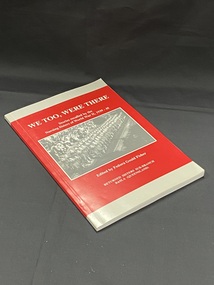
Book - Paperback book, Fedora Gould Fisher, We too, were there: stories recalled by the Nursing Sisters of World War II, 1939-45, 1995
... WWII World War II 1939-1945 Nurses Queensland WWII medical care Australian Army Nurses The stories of the nurses of the Australian Army Nursing Service (AANS) during World War Two. They served in all theatres of war where Australian soldiers fought. ...The stories of the nurses of the Australian Army Nursing Service (AANS) during World War Two. They served in all theatres of war where Australian soldiers fought.Red cover with a grey strip across the top and bottom. There is a black and white image of nurses in uniform marching along a street lined with crowds of people, in the centre. The title and editor details are printed in white text.non-fictionThe stories of the nurses of the Australian Army Nursing Service (AANS) during World War Two. They served in all theatres of war where Australian soldiers fought. wwii, world war ii 1939-1945, nurses queensland, wwii medical care, australian army nurses -
 Returned Nurses RSL Sub-branch
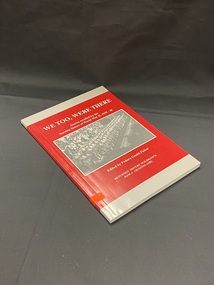
Book - Paperback book, Fedora Gould Fisher, We too, were there: stories recalled by the Nursing Sisters of World War II, 1939-45, 1995
... WWII World War II 1939-1945 Nurses Queensland WWII medical care Australian Army Nurses The stories of the nurses of the Australian Army Nursing Service (AANS) during World War Two. They served in all theatres of war where Australian soldiers fought. ...The stories of the nurses of the Australian Army Nursing Service (AANS) during World War Two. They served in all theatres of war where Australian soldiers fought.Red cover with a grey strip across the top and bottom. There is a black and white image of nurses in uniform marching along a street lined with crowds of people, in the centre. The title and editor details are printed in white text.non-fictionThe stories of the nurses of the Australian Army Nursing Service (AANS) during World War Two. They served in all theatres of war where Australian soldiers fought. wwii, world war ii 1939-1945, nurses queensland, wwii medical care, australian army nurses -
 Returned Nurses RSL Sub-branch
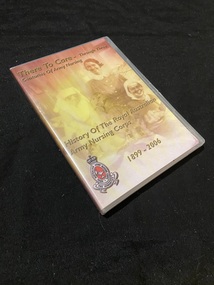
Film - DVD, There to care : through three centuries of Army Nursing - History of the Royal Australian Army Nursing Corps 1899-2006, 2006 [?]
... Australian Army Medical Corps. Plastic dvd case with a paper cover insert. The cover is faded sepia coloured with yellow streaks through it due to printing. The title is printed across the top and on the spine. There is a faded photographic image of three nurses and a soldier. The sub-title is printed just below the centre and below that the years 1899-2006. In the lower left corner is the emblem for the Royal Australian Army Nursing Corps. There to care ...History of the Royal Australian Army Nursing Corps RAANC.Plastic dvd case with a paper cover insert. The cover is faded sepia coloured with yellow streaks through it due to printing. The title is printed across the top and on the spine. There is a faded photographic image of three nurses and a soldier. The sub-title is printed just below the centre and below that the years 1899-2006. In the lower left corner is the emblem for the Royal Australian Army Nursing Corps.non-fictionroyal australian army nursing corps, nusing history -
 Returned Nurses RSL Sub-branch
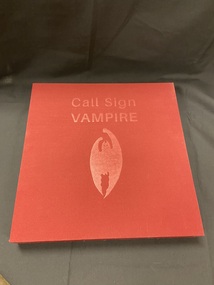
Book - Hardcover book, Rod Searle et al, Call sign Vampire, 2021
... Australian Field Hospital the battle for life and limb was often challenging and intense. Medical services provided by the hospital were of such a high standard that the survival rate, for soldiers arriving at the hospital alive, was 99%.This success rate still stands today as a truly remarkable achievement!The hospital comprised triage, operating theatres, pathology, pharmacy, X-ray, physiotherapy, psychiatry, outpatients, RAP, a six-bed intensive care ...This inside story of an Australian Field Hospital during the Vietnam War is told through a compilation of operational facts interspersed with the personal experiences of those who served and the patients who passed through the hospital doors, into their care.Call Sign VAMPIRE provides a window into the frenetic world of a military hospital in a war zone through evocative, sometimes confronting imagery. In this environment time was of the essence and life often hung in the balance.The wounded, "... they were scared, frightened, shocked and they weren't coping. Generally, when the chopper landed, they weren't coping. No. They were in shock, incoherent and it was no good asking them what had happened, or where they'd been, because twenty minutes before they were in contact with the enemy ..." Ron NolanAt the 1st Australian Field Hospital the battle for life and limb was often challenging and intense. Medical services provided by the hospital were of such a high standard that the survival rate, for soldiers arriving at the hospital alive, was 99%.This success rate still stands today as a truly remarkable achievement!The hospital comprised triage, operating theatres, pathology, pharmacy, X-ray, physiotherapy, psychiatry, outpatients, RAP, a six-bed intensive care ward and 50 bed medical and 50 bed surgical ward. It was also supported by a Q-store, an orderly room, messes and accommodation. Units attached to the hospital were the 33rd Dental Unit, 1st Field Medical and Dental Stores, 1st Field Hygiene Company, Chaplains and Australian Red Cross representatives.Our book is a celebration of the dedication, temerity and care of a unique group of Australians, thrown together to get on with the job of treating the injured and wounded. A consequence of Australia's involvement in the Vietnam War.Our hope is that the readers of Call Sign VAMPIRE gain an insight into what it meant to go to a war that polarised public opinion, and impacted the physical and mental well being of so many young soldiers and personnel dealing with the consequential casualties and despair. We also hope that you come to understand why as young Australians we are so proud to have been part of a unit that as Roger Nation remembers, "... welded together to form a team of world class standard" and why our camaraderie has continued to this day. - from Trove record.Hardcover, cloth bound, burgundy book with a white dust jacket. The dust jacket shows an image of six people ducking from the force of the wind coming from the helicopter that is landing behind them, there is blue cloudy sky above. Across the sky is printed the title. The book is housed in a burgundy clth covered slipcase.non-fictionThis inside story of an Australian Field Hospital during the Vietnam War is told through a compilation of operational facts interspersed with the personal experiences of those who served and the patients who passed through the hospital doors, into their care.Call Sign VAMPIRE provides a window into the frenetic world of a military hospital in a war zone through evocative, sometimes confronting imagery. In this environment time was of the essence and life often hung in the balance.The wounded, "... they were scared, frightened, shocked and they weren't coping. Generally, when the chopper landed, they weren't coping. No. They were in shock, incoherent and it was no good asking them what had happened, or where they'd been, because twenty minutes before they were in contact with the enemy ..." Ron NolanAt the 1st Australian Field Hospital the battle for life and limb was often challenging and intense. Medical services provided by the hospital were of such a high standard that the survival rate, for soldiers arriving at the hospital alive, was 99%.This success rate still stands today as a truly remarkable achievement!The hospital comprised triage, operating theatres, pathology, pharmacy, X-ray, physiotherapy, psychiatry, outpatients, RAP, a six-bed intensive care ward and 50 bed medical and 50 bed surgical ward. It was also supported by a Q-store, an orderly room, messes and accommodation. Units attached to the hospital were the 33rd Dental Unit, 1st Field Medical and Dental Stores, 1st Field Hygiene Company, Chaplains and Australian Red Cross representatives.Our book is a celebration of the dedication, temerity and care of a unique group of Australians, thrown together to get on with the job of treating the injured and wounded. A consequence of Australia's involvement in the Vietnam War.Our hope is that the readers of Call Sign VAMPIRE gain an insight into what it meant to go to a war that polarised public opinion, and impacted the physical and mental well being of so many young soldiers and personnel dealing with the consequential casualties and despair. We also hope that you come to understand why as young Australians we are so proud to have been part of a unit that as Roger Nation remembers, "... welded together to form a team of world class standard" and why our camaraderie has continued to this day. - from Trove record. 1st australian field hospital, vietnam war -
 Returned Nurses RSL Sub-branch
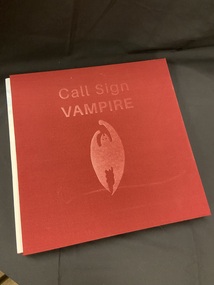
Book - Hardcover book, Rod Searle et al, Call sign Vampire, 2021
... Australian Field Hospital the battle for life and limb was often challenging and intense. Medical services provided by the hospital were of such a high standard that the survival rate, for soldiers arriving at the hospital alive, was 99%.This success rate still stands today as a truly remarkable achievement!The hospital comprised triage, operating theatres, pathology, pharmacy, X-ray, physiotherapy, psychiatry, outpatients, RAP, a six-bed intensive care ...This inside story of an Australian Field Hospital during the Vietnam War is told through a compilation of operational facts interspersed with the personal experiences of those who served and the patients who passed through the hospital doors, into their care.Call Sign VAMPIRE provides a window into the frenetic world of a military hospital in a war zone through evocative, sometimes confronting imagery. In this environment time was of the essence and life often hung in the balance.The wounded, "... they were scared, frightened, shocked and they weren't coping. Generally, when the chopper landed, they weren't coping. No. They were in shock, incoherent and it was no good asking them what had happened, or where they'd been, because twenty minutes before they were in contact with the enemy ..." Ron NolanAt the 1st Australian Field Hospital the battle for life and limb was often challenging and intense. Medical services provided by the hospital were of such a high standard that the survival rate, for soldiers arriving at the hospital alive, was 99%.This success rate still stands today as a truly remarkable achievement!The hospital comprised triage, operating theatres, pathology, pharmacy, X-ray, physiotherapy, psychiatry, outpatients, RAP, a six-bed intensive care ward and 50 bed medical and 50 bed surgical ward. It was also supported by a Q-store, an orderly room, messes and accommodation. Units attached to the hospital were the 33rd Dental Unit, 1st Field Medical and Dental Stores, 1st Field Hygiene Company, Chaplains and Australian Red Cross representatives.Our book is a celebration of the dedication, temerity and care of a unique group of Australians, thrown together to get on with the job of treating the injured and wounded. A consequence of Australia's involvement in the Vietnam War.Our hope is that the readers of Call Sign VAMPIRE gain an insight into what it meant to go to a war that polarised public opinion, and impacted the physical and mental well being of so many young soldiers and personnel dealing with the consequential casualties and despair. We also hope that you come to understand why as young Australians we are so proud to have been part of a unit that as Roger Nation remembers, "... welded together to form a team of world class standard" and why our camaraderie has continued to this day. - from Trove record.Hardcover, cloth bound, burgundy book with a white dust jacket. The dust jacket shows an image of six people ducking from the force of the wind coming from the helicopter that is landing behind them, there is blue cloudy sky above. Across the sky is printed the title. The book is housed in a burgundy cloth covered slipcase.non-fictionThis inside story of an Australian Field Hospital during the Vietnam War is told through a compilation of operational facts interspersed with the personal experiences of those who served and the patients who passed through the hospital doors, into their care.Call Sign VAMPIRE provides a window into the frenetic world of a military hospital in a war zone through evocative, sometimes confronting imagery. In this environment time was of the essence and life often hung in the balance.The wounded, "... they were scared, frightened, shocked and they weren't coping. Generally, when the chopper landed, they weren't coping. No. They were in shock, incoherent and it was no good asking them what had happened, or where they'd been, because twenty minutes before they were in contact with the enemy ..." Ron NolanAt the 1st Australian Field Hospital the battle for life and limb was often challenging and intense. Medical services provided by the hospital were of such a high standard that the survival rate, for soldiers arriving at the hospital alive, was 99%.This success rate still stands today as a truly remarkable achievement!The hospital comprised triage, operating theatres, pathology, pharmacy, X-ray, physiotherapy, psychiatry, outpatients, RAP, a six-bed intensive care ward and 50 bed medical and 50 bed surgical ward. It was also supported by a Q-store, an orderly room, messes and accommodation. Units attached to the hospital were the 33rd Dental Unit, 1st Field Medical and Dental Stores, 1st Field Hygiene Company, Chaplains and Australian Red Cross representatives.Our book is a celebration of the dedication, temerity and care of a unique group of Australians, thrown together to get on with the job of treating the injured and wounded. A consequence of Australia's involvement in the Vietnam War.Our hope is that the readers of Call Sign VAMPIRE gain an insight into what it meant to go to a war that polarised public opinion, and impacted the physical and mental well being of so many young soldiers and personnel dealing with the consequential casualties and despair. We also hope that you come to understand why as young Australians we are so proud to have been part of a unit that as Roger Nation remembers, "... welded together to form a team of world class standard" and why our camaraderie has continued to this day. - from Trove record. 1st australian field hospital, vietnam war -
 Returned Nurses RSL Sub-branch
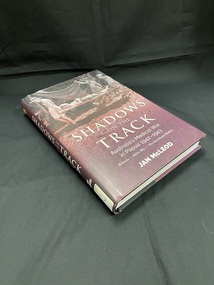
Book - Hardcover book, Big Sky publishing, Shadows on the track: Australia's medical war in Papua 1942-1943: Kokoda - Milne Bay - The Beachhead Battles, 2019
... 2/6 Australian Army Field Ambulance Australian Army medical care transport of sick and wounded medical aspects of war PapuaNew Guinea World War 1939-1945 WWII WW2 Kokoda Milne Bay Beachhead The Australian Army was woefully unprepared to fight a medical war in Papua and the soldiers paid the price. ...The Australian Army was woefully unprepared to fight a medical war in Papua and the soldiers paid the price. Almost 30,000 soldiers suffered from illness and tropical diseases, and an estimated 6000 were killed or wounded during the six-month campaign. These statistics have traditionally been represented as unavoidable consequences of fighting a war in a place such as Papua. This book disputes that narrative. Death and disease were inevitable outcomes, but the scale of the suffering was not. The medical challenges presented in Papua were extreme - they were not insurmountable. Shadows on the Track considers a wide range of issues that impacted on the health of the Australian soldiers before, during and after the Papuan campaign was fought and won. The strengths, successes, shortcomings and failures of the medical campaign are identified, analysed and evaluated. The focus on the front-line medical personnel - the men of the field ambulance units - brings a new perspective to the battles of the Kokoda Track, Milne Bay and the Beachheads. [taken from Trove record]Hardcover with dark purple dust jacket. Title printed in white along the spine and a white spine label sticker at the base. The front cover shows an image of three men carrying another man on a stretcher through thick mud. The lower half of the cover shows the title details in large white print.non-fiction The Australian Army was woefully unprepared to fight a medical war in Papua and the soldiers paid the price. Almost 30,000 soldiers suffered from illness and tropical diseases, and an estimated 6000 were killed or wounded during the six-month campaign. These statistics have traditionally been represented as unavoidable consequences of fighting a war in a place such as Papua. This book disputes that narrative. Death and disease were inevitable outcomes, but the scale of the suffering was not. The medical challenges presented in Papua were extreme - they were not insurmountable. Shadows on the Track considers a wide range of issues that impacted on the health of the Australian soldiers before, during and after the Papuan campaign was fought and won. The strengths, successes, shortcomings and failures of the medical campaign are identified, analysed and evaluated. The focus on the front-line medical personnel - the men of the field ambulance units - brings a new perspective to the battles of the Kokoda Track, Milne Bay and the Beachheads. [taken from Trove record]2/6 australian army field ambulance, australian army medical care, transport of sick and wounded, medical aspects of war, papuanew guinea, world war 1939-1945, wwii, ww2, kokoda, milne bay, beachhead -
 Returned Nurses RSL Sub-branch
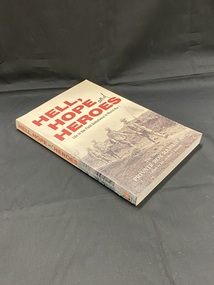
Book - Paperback book, Roy Ramsay, Hell, hope and heroes: life in the Field Ambulance in World War I, 2005
... medical care In 1915, Private Roy Ramsay, freshly trained at a camp near Brisbane, set sail from Australia for the Middle East with the 4th Light Horse Field Ambulance. This account of his time in the Middle East and Europe was edited by Roy's son Ron from Roy's journal. [Trove] 'PROPERTY OF VICTORIAN BRANCH R.S.L.' [stamped in red ink on title page] Paperback book with title printed in red print across the front and spine on a cream coloured background. The lower half of the cover contains an image of soldiers ...In 1915, Private Roy Ramsay, freshly trained at a camp near Brisbane, set sail from Australia for the Middle East with the 4th Light Horse Field Ambulance. This account of his time in the Middle East and Europe was edited by Roy's son Ron from Roy's journal. [Trove]Paperback book with title printed in red print across the front and spine on a cream coloured background. The lower half of the cover contains an image of soldiers walking in a line along a path on barren land, the first soldier carries a white flag, behind him two of the other soldiers carry a wounded soldier on a stretcher. followed by two more soldiers.non-fictionIn 1915, Private Roy Ramsay, freshly trained at a camp near Brisbane, set sail from Australia for the Middle East with the 4th Light Horse Field Ambulance. This account of his time in the Middle East and Europe was edited by Roy's son Ron from Roy's journal. [Trove]roy ramsay, australian army- trnsport of sick and wounded, field ambulance, wwi, ww1, world war 1914-1918, first world war, 3rd field ambulance, medical care -
 Returned Nurses RSL Sub-branch
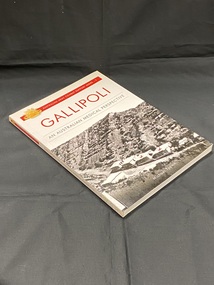
Book - Paperback book, Michael Tyquin, Gallipoli: an Australian medical perspective, 2012
... Gallipoli Australian Army Medical Corps AAMC medical aspects of war WWI WW1 World War 1914-1918 To be successful, a modern army needs logistical support to survive - to arm, feed, transport, and care for its soldiers. ...To be successful, a modern army needs logistical support to survive - to arm, feed, transport, and care for its soldiers. As history shows us the maintenance of health in any army , is a key factor in warfare. In many respects the Gallipoli campaign was a doomed undertaking. The seeds of ultimate defeat in December 1915 were the risks that attended a hugely ambitious, complex, and large-scale amphibious operation - the landings on well-defended shores on the Gallipoli peninsula, under cover of darkness. Communications at the time were primitive, while general staff officers had little understanding of their own army's medical assets or the needs of a large medical organisation. The Australian Army Medical Corps (AAMC) received aid from, and gave support to, all five forces at various times during 1915. Underlying the execution of the Dardanelles campaign were factors wholly outside the control of the Australian AMS. - from TroveWhite paperback book with a large black and white image of a field hospital at the base of a hill, two of the white tents have red crosses on the roofs'. Above the image, the title is printed in red with the sub-title in black beneath it. At the top of the cover is a red banner with the series title and at the far left of the banner is the gold Australian Army pin. The text on the spine matches the cover and there is a spine label taped to the base.non-fictionTo be successful, a modern army needs logistical support to survive - to arm, feed, transport, and care for its soldiers. As history shows us the maintenance of health in any army , is a key factor in warfare. In many respects the Gallipoli campaign was a doomed undertaking. The seeds of ultimate defeat in December 1915 were the risks that attended a hugely ambitious, complex, and large-scale amphibious operation - the landings on well-defended shores on the Gallipoli peninsula, under cover of darkness. Communications at the time were primitive, while general staff officers had little understanding of their own army's medical assets or the needs of a large medical organisation. The Australian Army Medical Corps (AAMC) received aid from, and gave support to, all five forces at various times during 1915. Underlying the execution of the Dardanelles campaign were factors wholly outside the control of the Australian AMS. - from Trovegallipoli, australian army medical corps, aamc, medical aspects of war, wwi, ww1, world war 1914-1918 -
 Returned Nurses RSL Sub-branch
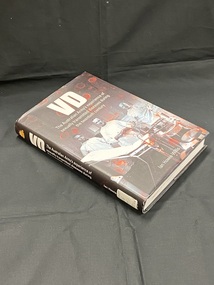
Book - Hardcover book, Big Sky publishing, VD: the Australian Army's experience of sexually transmitted diseases during the twentieth century, 2020
... Military hygeine Australian Army - medical care - history Soldiers - health and hygeine Sexually transmitted diseases Sexually transmitted diseases, for centuries lumped together as 'Venereal Disease', or 'VD' for short, have always marched in lock-step with soldiers from all armies wherever they have served. ...Sexually transmitted diseases, for centuries lumped together as 'Venereal Disease', or 'VD' for short, have always marched in lock-step with soldiers from all armies wherever they have served. During the twentieth century at least 125,000 Australian soldiers contracted VD while serving in overseas deployments - the equivalent of six World War I infantry divisions. No one has previously told this alarming story in its entirety, and few authors could tell it as frankly or objectively as Ian Howie-Willis. As readers will soon realise, Dr Howie-Willis has dealt with this confronting subject candidly but sensitively. His scholarship in this carefully researched book is immaculate, but the book's great strength is its fairness to and compassion for the tens of thousands of people who succumbed to sexually transmitted diseases as a result of Australia's military involvements across a century of overseas deployments. - from Trove.Black dust-jacket over black hard-cover book. Spine shows the gold Australian Army emblem at the top and then the title in white, there is a spine label at the base. Front cover has VD in large white letters at the top, followed by the sub-title and an image of three men in surgical gowns in a surgical room. The page has translucent red bubble images over it.non-fictionSexually transmitted diseases, for centuries lumped together as 'Venereal Disease', or 'VD' for short, have always marched in lock-step with soldiers from all armies wherever they have served. During the twentieth century at least 125,000 Australian soldiers contracted VD while serving in overseas deployments - the equivalent of six World War I infantry divisions. No one has previously told this alarming story in its entirety, and few authors could tell it as frankly or objectively as Ian Howie-Willis. As readers will soon realise, Dr Howie-Willis has dealt with this confronting subject candidly but sensitively. His scholarship in this carefully researched book is immaculate, but the book's great strength is its fairness to and compassion for the tens of thousands of people who succumbed to sexually transmitted diseases as a result of Australia's military involvements across a century of overseas deployments. - from Trove.military hygeine, australian army - medical care - history, soldiers - health and hygeine, sexually transmitted diseases
