
Showing 342 items matching "sometime"
-
 Flagstaff Hill Maritime Museum and Village
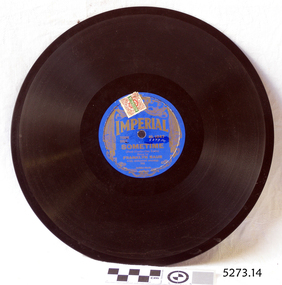
Audio - Gramophone Record, Imperial Records, Sometime, Early-to-mid 20th century
... Sometime......Sometime...Shellac gramophone record with a blue and gold label. Title: Sometime Artist: Franklyn Baur, tenor, solo Publisher: Imperial Records Number:1547 Size: 14 inch...Title: Sometime Artist: Franklyn Baur, tenor, solo Publisher: Imperial Records Number:1547 Size: 14 inch Sometime Audio Gramophone Record Imperial Records ...Thomas Edison (1847–1931), an American, invented the phonograph in 1877, making it possible to record sound waves vertically and reproduce them on a wax cylinder so they could be heard again. Later, the German American, Emile Berliner (1851-1929), improved on Edison’s principles, greatly increasing the quality of the reproduced sounds with his invention of the gramophone in 1887, which recorded the sound waves laterally onto a flat shellac disc, or ‘record’. Records could be mass-produced in a factory where audio recordings were converted to a physical copy of that recording on a plate-sized disc. A gramophone machine reproduced the sound by spinning the record on a turntable at a specified number of rotations per minute (RPM) and using a stylus or needle to transfer the vibration via a membrane to a speaker, which amplified the sound. Berliner helped set up affiliated businesses overseas. One of his representatives was William Barry Owen (1860–1914), who, on 23 February 1889, partnered with Edmund Trevor Lloyd Williams (1859–1946) in England to register The Gramophone Company. His Master’s Voice (HMV) soon became the company’s major recording label, popular worldwide. The business based the label's logo of a dog looking into a gramophone horn for ‘his master’s voice’ was based on a painting by English artist Francis Barraud, which featured a terrier called Nipper beside a gramophone. Early gramophone records were mostly made from a material referred to as shellac, a natural ingredient combined with slate powder, and a filler of manilla copal, wood resin, carnauba wax, and carbon black. Although Bakelite seemed a useful, synthetic product, it was unsuccessful as a product for records. Around the time of World War II, lightweight, flexible synthetic vinyl records began replacing shellac records. Common diameters of records: 7 inch, 10 inch, 12 inch and 16 inch Revolutions Per Minute include: 33 1/3, 45, 78 Minutes per side of record: 3, 5.5, 7, 8, 9, 12, 15 and 22 Labels, in minutes per side: Single Play 3-5 min, Extended Play (EP) 7-12 min, Long Play (LP) 12-22 min This gramophone represents a step in the evolution of recording sound. In the 19th century, the human voice was first recorded on wax cylinders and replayed. It was the beginning of a new era in sound. Then, in the 1880s, voice could be recorded onto flat discs like this record, reliably reproduced and replayed many times, even on portable devices. Later, in the mid-20th century the following generation of electronic audio recording began, and later that century, digital recording gave even better reproduction. The record represents a popular means of entertainment for personal and social activities, as well as in some businesses. Shellac gramophone record with a blue and gold label. Title: Sometime Artist: Franklyn Baur, tenor, solo Publisher: Imperial Records Number:1547 Size: 14 inchWhite paper stamp with gold, red and green printflagstaff hill, warrnambool, maritime village, maritime museum, flagstaff hill maritime museum and village, shipwreck coast, great ocean road, gramophone, phonograph, sound waves, record, reproduction, audio record, music, sound, thomas edison, emile berliner, 1887, shellac, rpm, william barry owen, edmund trevor lloyd williams, the gramophone company, his master’s voice, hmv, francis barraud, nipper, imperial record, 1547, sometime, tenor solo, franklyn baur, 14 inch -
 Flagstaff Hill Maritime Museum and Village
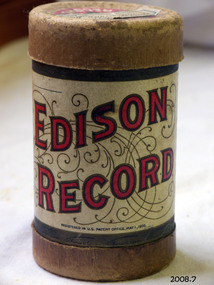
Gramophone cylinders, National Phonograph Co, Sometime We"ll Understand, April 1908
... Sometime We"ll Understand ...U.S.A. Song: 9563 Sometime We"ll Understand Duet. Form No. 1330 April 1908...U.S.A. Song: 9563 Sometime We"ll Understand Duet. Form No. 1330 April 1908 Sometime We"ll Understand Gramophone cylinders National Phonograph Co ...Gramophone cylinders, black, 6 grooves on interior stored in cardboard round container with detachable lid. Edison Record, made and sold by National Phonograph Co. at Orange N.J. U.S.A. Song: 9563 Sometime We"ll Understand Duet. Form No. 1330 April 1908flagstaff hill, warrnambool, shipwrecked-coast, flagstaff-hill, flagstaff-hill-maritime-museum, maritime-museum, shipwreck-coast, flagstaff-hill-maritime-village, gramophone cylinders, edison record, national phonograph co, sometime we"ll understand duet, sometime we"ll understand -
 Mrs Aeneas Gunn Memorial Library
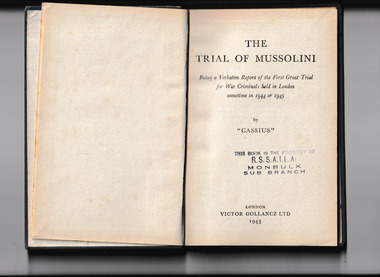
Book, Gollancz, The trial of Mussolini : being a verbatim report of the first great trial for war criminals held in London sometime in 1944 or 1945, 1943
... The trial of Mussolini : being a verbatim report of the first great trial for war criminals held in London sometime in 1944 or 1945...The trial of Mussolini : being a verbatim report of the first great trial for war criminals held in London sometime in 1944 or 1945 Book Gollancz "Cassius" ...A fictional account of an imagined trial of Italian dictator, Benito Mussolinip.82.fictionA fictional account of an imagined trial of Italian dictator, Benito Mussoliniworld war 1939-1945 - fiction, war crimes trials -
 Uniting Church Archives - Synod of Victoria
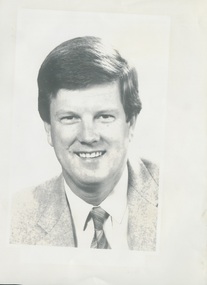
BW photo, 1988
... Gregor Henderson, sometime General Secretary of the Assembly...Gregor Henderson, sometime General Secretary of the Assembly BW head and shoulders portrait of Rev. ...The Reverend Gregor Henderson was ordained in 1971 and served at East Keilor, Alloa Scotland, Shepparton North, Wodonga and Hobart. He was Assembly General Secretary from January 1989 to December 2000. He was the President of the UCA from July 2006 to July 2009. He retired in December 2013.BW head and shoulders portrait of Rev. Gregor Henderson.The Rev. Gregor Henderson, sometime General Secretary of the Assemblyrev. gregor henderson am; assembly general secretary uca; uca assembly president. -
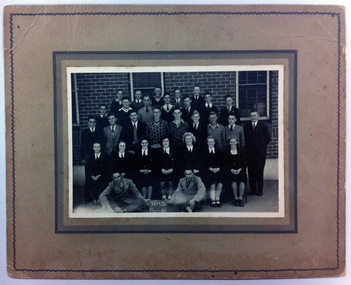 Williamstown High School
Form 4B 1940's
... Black and white photograph mounted on board of Williamstown High School Form 4B, sometime in the 1940's....Williamstown High School 1940's Form 4B Class photographs Students Black and white photograph mounted on board of Williamstown High School Form 4B, sometime in the 1940's. Form 4B 1940's ...Black and white photograph mounted on board of Williamstown High School Form 4B, sometime in the 1940's.williamstown high school, 1940's, form 4b, class photographs, students -
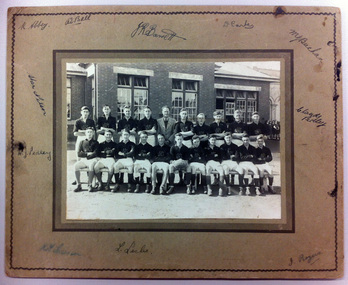 Williamstown High School
Football team 1940's
... Black and white photograph mounted on board of the Williamstown High School football team sometime in the 1940's....Black and white photograph mounted on board of the Williamstown High School football team sometime in the 1940's. Football team 1940's ...Black and white photograph mounted on board of the Williamstown High School football team sometime in the 1940's.See image above for inscription on the back of the photograph.williamstown high school, football team -
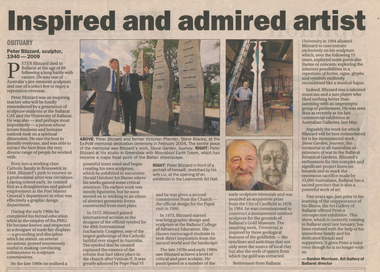 Friends of Ballarat Botanical Gardens History Group
Work on paper - Peter Blizzard, sculptor, 1940-2009, Obituary. "Inspired and Admired Artist", C 2009
... No precise date given; sometime in 2009....No precise date given; sometime in 2009. Obituary. "Inspired and Admired Artist". ...The centre piece of the Ex-PoW memorial is Peter Blizzard's work in the Ballarat Botanical Gardens. Obituary written by Gordon Morrison, Director, Ballarat Art Gallery.The Ex-PoW Memorial is a significant landmark in the Ballarat Botanical Gardens and many visitors come to pay their respects.Newspaper Article from the The Ballarat Courier with three coloured photographs. No precise date given; sometime in 2009.None.peter blizzard sculptor, peter blizzard obituary. pre-eminent australian sculptors, peter blizzard biography. blizzard's work in the ballarat botanical gardens, stone gardens journey. ex-pow memorial., blizzard, sculptor, john garner collection, garner, dr, ballarat botanical gardens, gardens, ballarat -
 Falls Creek Historical Society
Souvenir - Falls Creek Sticker
... SKI FALLS CREEK plus logo Come up and ski us sometime!...George Shirling Ski Falls Creek Falls Creek Souvenirs SKI FALLS CREEK plus logo Come up and ski us sometime! A Falls Creek Sticker printed in black on a purple and white background and including the Falls Creek logo on the right hand end. ...This item is from the private collection of George Shirling of Red Onion, Falls Creek. It is an early souvenir from Falls Creek Ski Village. George Shirling arrived in Falls Creek in 1962. He engaged Phil Nowell to build the original Koki Alpine Lodge which opened in 1965 with 14 beds. George operated the lodge with Michael “Baldy” Blackwell as manager. In 1981 he graduated in sport psychology and was invited to become team psychologist for the Australian Winter Olympic team which went to Albertville, France, in 1992. He later owned the Red Onion Chalet. George Shirling passed away on 27th February 2023. He had remained actively involved in Falls Creek and was generous with his time and knowledge, always an amazing supporter of The Falls Creek Museum and Falls Creek Village.This item is significant because it is representative of Falls Creek promotional material.A Falls Creek Sticker printed in black on a purple and white background and including the Falls Creek logo on the right hand end. SKI FALLS CREEK plus logo Come up and ski us sometime!george shirling, ski falls creek, falls creek souvenirs -
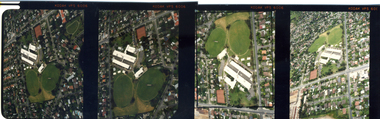 Whitehorse Historical Society Inc.
Photograph - Aerial Photograph, Burwood Technical School East Burwood
... Strip of four coloured aerial photo of the Burwood Technical School Buildings taken sometime between 1986 and 1992....Burwood Technical School was located on the south west corner of Middleborough and Elgar Roads schools burwood technical school Strip of four coloured aerial photo of the Burwood Technical School Buildings taken sometime between 1986 and 1992. Burwood Technical School East Burwood. ...Burwood Technical School was located on the south west corner of Middleborough and Elgar RoadsStrip of four coloured aerial photo of the Burwood Technical School Buildings taken sometime between 1986 and 1992.schools, burwood technical school -
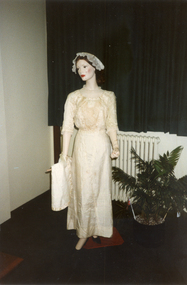 Whitehorse Historical Society Inc.
Photograph, Clothing and dress
... 11 photographs (9 - K) of antique clothing donated to the Whitehorse Historical Society sometime between 1995 and 2001. Mostly gowns....not recorded clothing and dress costume box hill historical society gowns 11 photographs (9 - K) of antique clothing donated to the Whitehorse Historical Society sometime between 1995 and 2001. Mostly gowns. ...not recorded11 photographs (9 - K) of antique clothing donated to the Whitehorse Historical Society sometime between 1995 and 2001. Mostly gowns.clothing and dress, costume, box hill historical society, gowns -
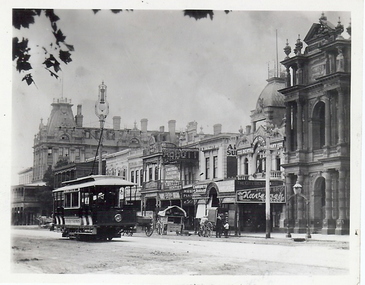 Bendigo Historical Society Inc.
Photograph - BASIL MILLER COLLECTION: ELECTRIC TRAM IN PALL MALL
... Showing streetscape from Shamrock Hotel to Colonial Bank of Australia, taken sometime after 1903....Showing streetscape from Shamrock Hotel to Colonial Bank of Australia, taken sometime after 1903. Photograph BASIL MILLER COLLECTION: ELECTRIC TRAM IN PALL MALL ...BHS CollectionBendigo tramways - tram in Pall Mall, Bendigo. Showing streetscape from Shamrock Hotel to Colonial Bank of Australia, taken sometime after 1903.in faded blue ink 'S.A 519 - an original open combination, tramcar in Pall Mall, early 1900's. In purple stamped ink ' K.S. Kings No. S-! 519 copyright reserved. In black stamped ink '369' In black ballpoint pen 'Thurs 5/5 marks.pall mall, electric tram, basil miller -
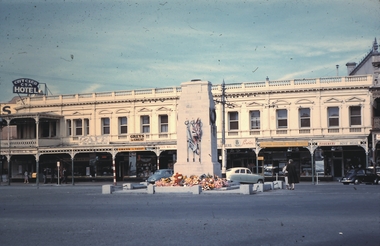 Bendigo Historical Society Inc.
Slide - CITY CLUB HOTEL BENDIGO, Apr 1960
... City Club Hotel, Corner Mitchell Street and Charing Cross, Bendigo. Sometime after Anzac Day as flowers and wreaths are still on Cenotaph....City Club Hotel, Corner Mitchell Street and Charing Cross, Bendigo. Sometime after Anzac Day as flowers and wreaths are still on Cenotaph. ...Slide. City Club Hotel, Corner Mitchell Street and Charing Cross, Bendigo. Sometime after Anzac Day as flowers and wreaths are still on Cenotaph.slide, bendigo, city club hotel., city club hotel. -
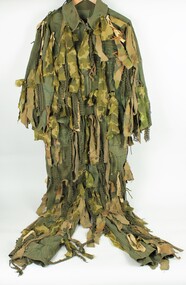 Ringwood RSL Sub-Branch
Uniform - Uniform, Yowie Suit, Sniper or spotters camoflaged suit, ADI Pty Ltd, 1989
... Appears to be made from Tank Crew overalls with cloth and fabric added. Sometime called a Ghillies Suit. Has metal zip up front....Appears to be made from Tank Crew overalls with cloth and fabric added. Sometime called a Ghillies Suit. Has metal zip up front. ...Appears to be made from Tank Crew overalls with cloth and fabric added. Sometime called a Ghillies Suit. Has metal zip up front.ADI Pty Ltd on inside tag. -
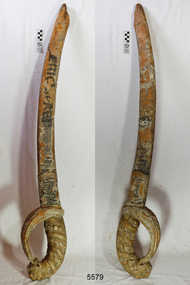 Flagstaff Hill Maritime Museum and Village
Decorative object - Sword, 1871 or earlier
... The words “ERIC the RED” have been hand painted on the blade of the sword in black paint sometime after it was salvaged....(Victorian Heritage Database Registration Number S239, Official Number 8745 USA) Flagstaff Hill Flagstaff Hill Maritime Museum and Village Warrnambool Maritime Museum Maritime Village Great Ocean Road Shipwreck Coast sword wooden sword Eric the Red carved sword figurehead snake head on sword The words “ERIC the RED” have been hand painted on the blade of the sword in black paint sometime after it was salvaged. This carved wooden sword, recovered from the Eric the Red, is possibly the only portion of the figurehead recovered after the wreck. ...This wooden sword is said to “possibly be the only remaining part of the figurehead from the sailing ship Eric the Red.” It was previously part of the collection of the old Warrnambool Museum and the entry in its inventory says “Wooden sword, portion of the figurehead, held by “Eric the Red” at the bow.” A large part of the ship’s hull was found on the rocks and a figurehead may have been attached or washed up on the shore. The shipping records for E. & A. Sewall, the builders, owners and managers of Eric the Red, are now preserved in the Maine Maritime Museum. There is no photograph on record of Eric the Red but photographs of other ships built around that time by the same company show that these did not have figureheads, and there is no record found of a figurehead for Eric the Red being ordered or paid for. Further research is being carried out. The ship building company E. & A. Sewall, from Bath, Maine, USA, built Eric the Red, a wooden, three masted clipper ship. She had 1,580 tons register and was the largest full-rigged ship built at Bath, Maine, USA in 1871. She was built and registered by Arthur Sewall, later to become the partnership E. & A. Sewall, and was the 51st ship built by this company. The annually-published List of Merchant Vessels of the U.S. shows that Bath was still the home port of Eric the Red in 1880. The vessel was named after the Viking discoverer, Eric the Red, who was the first European to reach the shores of North America (in 980AD). The ship Eric the Red at first traded in coal between America and Britain, and later traded in guano nitrates from South America. In 1879 she was re-metalled and was in first class condition. On 10th June 1880 (some records say 12th June) Eric the Red departed New York for Melbourne and then Sydney. She had been commissioned by American trade representatives to carry a special cargo of 500 exhibits (1400 tons) - about a quarter to a third of America’s total exhibits - from America for the U.S.A. pavilion at Melbourne’s first International Exhibition. The exhibits included furniture, ironmongery, wines, chemicals, dental and surgical instruments, paper, cages, bronze lamp trimmings, axles, stamped ware, astronomical and time globes, samples of corn and the choicest of leaf tobacco. Other general cargo included merchandise such as cases of kerosene and turpentine, brooms, Bristol's Sarsaparilla, Wheeler and Wilson sewing machines, Wheeler’s thresher machine, axe handles and tools, cases of silver plate, toys, pianos and organs, carriages and Yankee notions. The Eric the Red left New York under the command of Captain Z. Allen (or some records say Captain Jacques Allen) and 24 other crew including the owner’s son third mate Ned Sewall. There were 2 saloon passengers also. On 4th September 1880 the ship had been sailing for an uneventful 85 days and the voyage was almost at its end. Eric the Red approached Cape Otway in a moderate north-west wind and hazy and overcast atmosphere. Around 1:30am Captain Allen sighted the Cape Otway light and was keeping the ship 5-6 miles offshore to stay clear of the hazardous Otway Reef. However he had badly misjudged his position. The ship hit the Otway Reef about 2 miles out to sea, south west of the Cape Otway light station. Captain Allen ordered the wheel to be put ‘hard up’ thinking that she might float off the reef. A heavy sea knocked the man away from the wheel, broke the wheel ropes and carried away the rudder. The sea swamped the lifeboats, the mizzenmast fell, with all of its rigging, then the mainmast fell and the ship broke in two. Some said that the passenger Vaughan, who was travelling for his health and not very strong, was washed overboard and never seen again. The ship started breaking up. The forward house came adrift with three of the crew on it as well as a longboat, which the men succeeded in launching and keeping afloat by continually bailing with their sea boots. The captain, the third mate (the owner’s son) and others clung to the mizzenmast in the sea. Then the owner’s son was washed away off the mast. Within 10 minutes the rest of the ship was in pieces, completely wrecked, with cargo and wreckage floating in the sea. The captain encouraged the second mate to swim with him to the deckhouse where there were other crew but the second mate wouldn’t go with him. Eventually the Captain made it to the deckhouse and the men pulled him up. At about 4:30am the group of men on the deckhouse saw the lights of a steamer and called for help. At the same time they noticed the second mate and the other man had drifted nearby, still on the spur, and pulled them both onto the wreck. The coastal steamer Dawn was returning to Warrnambool from Melbourne, its sailing time different to its usual schedule. Cries were heard coming from out of the darkness. Captain Jones sent out two life boats, and fired off rockets and blue lights to illuminate the area. They picked up the three survivors who were in the long boat from Eric the Red. Two men were picked up out of the water, one being the owner’s son who was clinging to floating kerosene boxes. At daylight the Dawn then rescued the 18 men from the floating portion of the deckhouse, which had drifted about 4 miles from where they’d struck the reef. Shortly after the rescue the deckhouse drifted onto breakers and was thrown onto rocks at Point Franklin, about 2 miles east of Cape Otway. Captain Jones had signalled to Cape Otway lighthouse the number of the Eric the Red and later signalled that there was a wreck at Otway Reef but there was no response from the lighthouse. The captain and crew of the Dawn spent several more hours searching unsuccessfully for more survivors, even going back as far as Apollo Bay. On board the Dawn the exhausted men received care and attention to their needs and wants, including much needed clothing. Captain Allen was amongst the 23 battered and injured men who were rescued and later taken to Warrnambool for care. Warrnambool’s mayor and town clerk offered them all hospitality, the three badly injured men going to the hospital and others to the Olive Branch Hotel, then on to Melbourne. Captain Allen’s leg injury prevented him from going ashore so he and three other men travelled on the Dawn to Portland. They were met by the mayor who also treated them all with great kindness. Captain Allen took the train back to Melbourne then returned to America. Those saved were Captain Z. Allen (or Jacques Allen), J. Darcy chief mate, James F. Lawrence second mate, Ned Sewall third mate and owner’s son, John French the cook, C. Nelson sail maker, Clarence W. New passenger, and the able seamen Dickenson, J. Black, Denis White, C. Herbert, C. Thompson, A. Brooks, D. Wilson, J. Ellis, Q. Thompson, C. Newman, W. Paul, J. Davis, M. Horenleng, J. Ogduff, T. W. Drew, R. Richardson. Four men had lost their lives; three of them were crew (Gus Dahlgreen ship’s carpenter, H. Ackman steward, who drowned in his cabin, and George Silver seaman) and one a passenger (J. B. Vaughan). The body of one of them had been found washed up at Cape Otway and was later buried in the lighthouse cemetery; another body was seen on an inaccessible ledge. Twelve months later the second mate James F. Lawrence, from Nova Scotia, passed away in the Warrnambool district; an obituary was displayed in the local paper. The captain and crew of the Dawn were recognised by the United States Government in July 1881 for their humane efforts and bravery, being thanked and presented with substantial monetary rewards, medals and gifts. Neither the ship, nor its cargo, was insured. The ship was worth about £15,000 and the cargo was reportedly worth £40,000; only about £2,000 worth had been recovered. Cargo and wreckage washed up at Apollo Bay, Peterborough, Port Campbell, Western Port and according to some reports, even as far away as the beaches of New Zealand. The day after the wreck the government steam ship Pharos was sent from Queenscliff to clear the shipping lanes of debris that could be a danger to ships. The large midship deckhouse of the ship was found floating in a calm sea near Henty Reef. Items such as an American chair, a ladder and a nest of boxes were all on top of the deckhouse. As it was so large and could cause danger to passing ships, Captain Payne had the deckhouse towed towards the shore just beyond Apollo Bay. Between Apollo Bay and Blanket Bay the captain and crew of Pharos collected Wheeler and Wilson sewing machines, nests of boxes, bottles of Bristol’s sarsaparilla, pieces of common American chairs, axe handles, a Wheelers’ Patent thresher and a sailor’s trunk with the words “A. James” on the front. A ship’s flag-board bearing the words “Eric the Red” was found on the deckhouse; finally those on board the Pharos had the name of the wrecked vessel. During this operation Pharos came across the government steamer Victoria and also a steamer S.S. Otway, both of which were picking up flotsam and wreckage. A whole side of the hull and three large pieces of the other side of the hull, with some of the copper sheathing stripped off, had floated on to Point Franklin. Some of the vessels yards and portions of her masts were on shore. The pieces of canvas attached to the yards and masts confirmed that the vessel had been under sail. The beach there was piled with debris several feet high. There were many cases of Diamond Oil kerosene, labelled R. W. Cameron and Company, New York. There were also many large planks of red pine, portions of a small white boat and a large, well-used oar. Other items found ashore included sewing machines (some consigned to ‘Long and Co.”) and notions, axe and scythe handles, hay forks, wooden pegs, rolls of wire (some branded “T.S” and Co, Melbourne”), kegs of nails branded “A.T. and Co.” from the factory of A. Field and Son, Taunton, Massachusetts, croquet balls and mallets, buggy fittings, rat traps, perfumery, cutlery and Douay Bibles, clocks, bicycles, chairs, a fly wheel, a cooking stove, timber, boxes, pianos, organs and a ladder. (Wooden clothes pegs drifted in for many years). There seemed to be no personal luggage or clothing. The Pharos encountered a long line, about one and a half miles, of floating wreckage about 10 miles off land, south east of Cape Otway, and in some places about 40 feet wide. It seemed that more than half of it was from Eric the Red. The ship’s crew rescued 3 cases that were for the Melbourne Exhibition and other items from amongst the debris. There were also chairs, doors, musical instruments, washing boards, nests of trunks and fly catchers floating in the sea. Most of the goods were saturated and smelt of kerosene. A section of the hull lies buried in the sand at Parker River Beach. An anchor with chain is embedded in the rocks east of Point Franklin and a second anchor, thought to be from Eric the Red, is on display at the Cape Otway light station. (There is a photograph of a life belt on the verandah of Rivernook Guest House in Princetown with the words “ERIC THE RED / BOSTON”. This is rather a mystery as the ship was registered in Bath, Maine, USA.) Parts of the ship are on display at Bimbi Park Caravan Park and at Apollo Bay Museum. Flagstaff Hill Maritime Village also has part of the helm (steering wheel), a carved wooden sword (said to be the only remaining portion of the ship’s figurehead; further research is currently being carried out), a door, a metal rod, samples of wood and a medal for bravery. Much of the wreckage was recovered by the local residents before police and other authorities arrived at the scene. Looters went to great effort to salvage goods, being lowered down the high cliff faces to areas with little or no beach to collect items from the wreckage, their mates above watching out for dangerous waves. A Tasmanian newspaper reports on a court case in Stawell, Victoria, noting a man who was caught 2 months later selling tobacco from the wreckage of Eric the Red. Some of the silverware is still treasured by descendants of Mr Mackenzie who was given these items by officials for his help in securing the cargo. The gifts included silver coffee and tea pots, half a dozen silver serviette rings and two sewing machines. The wreck and cargo were sold to a Melbourne man who salvaged a quantity of high quality tobacco and dental and surgical instruments. Timbers from the ship were salvaged and used in the construction of houses and sheds around Apollo Bay, including a guest house, Milford House (since burnt down in bushfires), which had furniture, fittings and timber on the dining room floor from the ship. A 39.7 foot long trading ketch, the Apollo, was also built from its timbers by Mr Burgess in 1883 and subsequently used in Tasmanian waters. It was the first attempt at ship building in Apollo bay. In 1881 a red light was installed about 300 feet above sea level at the base of the Cape Otway lighthouse to warn ships when they were too close to shore; It would not be visible unless a ship came within 3 miles from it. This has proved to be an effective warning. The State Library of Victoria has a lithograph in its collection depicting the steamer Dawn and the shipwrecked men, titled. "Wreck of the ship Eric the Red, Cape Otway: rescue of the crew by the Dawn".The Eric the Red is historically significant as one of Victoria's major 19th century shipwrecks. (Heritage Victoria Eric the Red; HV ID 239) The wreck led to the provision of an additional warning light placed below the Cape Otway lighthouse to alert mariners to the location of Otway Reef. The site is archaeologically significant for its remains of a large and varied cargo and ship's fittings being scattered over a wide area. The site is recreationally and aesthetically significant as it is one of the few sites along this coast where tourists can visit identifiable remains of a large wooden shipwreck, and for its location set against the background of Cape Otway, Bass Strait, and the Cape Otway lighthouse. (Victorian Heritage Database Registration Number S239, Official Number 8745 USA)This carved wooden sword, recovered from the Eric the Red, is possibly the only portion of the figurehead recovered after the wreck. There are spirals carved from the base of the handle to the top of the sword. The hilt of the sword is a lion’s head holding its tail in its mouth, the tail forming the handle. The blade of the sword has engraved patterns on it. Tiny particles of gold leaf and dark blue paint fragments can be seen between the carving marks. There are remnants of yellowish-orange and crimson paint on the handle. At some time after the sword was salvaged the name of the ship was hand painted on the blade in black paint. The tip of the sword has broken or split and the remaining part is charcoal in appearance. On both the tip and the base of the handle are parts made where the sword could have been joined onto the figurehead There is a white coating over some areas of the sword, similar to white lead putty used in traditional shipbuilding. The words “ERIC the RED” have been hand painted on the blade of the sword in black paint sometime after it was salvaged.flagstaff hill, flagstaff hill maritime museum and village, warrnambool, maritime museum, maritime village, great ocean road, shipwreck coast, sword, wooden sword, eric the red, carved sword, figurehead, snake head on sword -
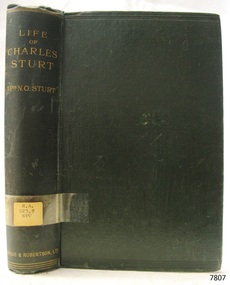 Flagstaff Hill Maritime Museum and Village
Book, Life of Charles Sturt
... Life of Charles Sturt sometime Capt. 39th Reg and Australian Explorer Author: Mrs Napier George Sturt Publisher: Smith Elder & Co Date: 1899...Shipwrecked-coast Flagstaff-Hill Warrnambool Flagstaff-Hill-Maritime-Museum Maritime-Museum Shipwreck-coast Flagstaff-Hill-Maritime-Village Shipwrecked-artefact Book Warrnambool Library Warrnambool Mechanics’ Institute Warrnambool City Librarian Mechanics’ Institute Library Victorian Library Board Warrnambool books and records Warrnambool Children’s Library Great Ocean Road life of charles sturt mrs napier george sturt Label on spine cover with typed text RA 923.9 STU Life of Charles Sturt sometime Capt. 39th Reg and Australian Explorer Author: Mrs Napier George Sturt Publisher: Smith Elder & Co Date: 1899 Life of Charles Sturt Book ...This item is from the ‘Pattison Collection’, a collection of books and records that was originally owned by the Warrnambool Mechanics’ Institute, which was founded in Warrnambool in 1853. By 1886 the Warrnambool Mechanics’ Institute (WMI) had grown to have a Library, Museum and Fine Arts Gallery, with a collection of “… choice productions of art, and valuable specimens in almost every branch and many wonderful national curiosities are now to be seen there, including historic relics of the town and district.” It later included a School of Design. Although it was very well patronised, the lack of financial support led the WMI in 1911 to ask the City Council to take it over. In 1935 Ralph Pattison was appointed as City Librarian to establish and organise the Warrnambool Library as it was then called. When the WMI building was pulled down in 1963 a new civic building was erected on the site and the new Warrnambool Library, on behalf of the City Council, took over all the holdings of the WMI. At this time some of the items were separated and identified as the ‘Pattison Collection’, named after Ralph Pattison. Eventually the components of the WMI were distributed from the Warrnambool Library to various places, including the Art Gallery, Historical Society and Flagstaff Hill. Later some were even distributed to other regional branches of Corangamite Regional Library and passed to and fro. It is difficult now to trace just where all of the items have ended up. The books at Flagstaff Hill Maritime Village generally display stamps and markings from Pattison as well as a variety of other institutions including the Mechanics’ Institute itself. RALPH ERIC PATTISON Ralph Eric Pattison was born in Rockhampton, Queensland, in 1891. He married Maude Swan from Warrnambool in 1920 and they set up home in Warrnambool. In 1935 Pattison accepted a position as City Librarian for the Warrnambool City Council. His huge challenge was to make a functional library within two rooms of the Mechanics’ Institute. He tirelessly cleaned, cleared and sorted a disarrayed collection of old books, jars of preserved specimens and other items reserved for exhibition in the city’s museum. He developed and updated the library with a wide variety of books for all tastes, including reference books for students; a difficult task to fulfil during the years following the Depression. He converted all of the lower area of the building into a library, reference room and reading room for members and the public. The books were sorted and stored using a cataloguing and card index system that he had developed himself. He also prepared the upper floor of the building and established the Art Gallery and later the Museum, a place to exhibit the many old relics that had been stored for years for this purpose. One of the treasures he found was a beautiful ancient clock, which he repaired, restored and enjoyed using in his office during the years of his service there. Ralph Pattison was described as “a meticulous gentleman whose punctuality, floorless courtesy and distinctive neat dress were hallmarks of his character, and ‘his’ clock controlled his daily routine, and his opening and closing of the library’s large heavy doors to the minute.” Pattison took leave during 1942 to 1945 to serve in the Royal Australian Navy, Volunteer Reserve as Lieutenant. A few years later he converted one of the Museum’s rooms into a Children’s Library, stocking it with suitable books for the younger generation. This was an instant success. In the 1950’s he had the honour of being appointed to the Victorian Library Board and received more inspiration from the monthly conferences in Melbourne. He was sadly retired in 1959 after over 23 years of service, due to the fact that he had gone over the working age of council officers. However he continued to take a very keen interest in the continual development of the Library until his death in 1969. The Pattison Collection, along with other items at Flagstaff Hill Maritime Village, was originally part of the Warrnambool Mechanics' Institute’s collection. The Warrnambool Mechanics’ Institute Collection is primarily significant in its totality, rather than for the individual objects it contains. Its contents are highly representative of the development of Mechanics' Institute libraries across Australia, particularly Victoria. A diversity of publications and themes has been amassed, and these provide clues to our understanding of the nature of and changes in the reading habits of Victorians from the 1850s to the middle of the 20th century. The collection also highlights the Warrnambool community’s commitment to the Mechanics’ Institute, reading, literacy and learning in the regions, and proves that access to knowledge was not impeded by distance. These items help to provide a more complete picture of our community’s ideals and aspirations. The Warrnambool Mechanics Institute book collection has historical and social significance for its strong association with the Mechanics Institute movement and the important role it played in the intellectual, cultural and social development of people throughout the latter part of the nineteenth century and the early twentieth century. The collection of books is a rare example of an early lending library and its significance is enhanced by the survival of an original collection of many volumes. The Warrnambool Mechanics' Institute’s publication collection is of both local and state significance. Life of Charles Sturt sometime Capt. 39th Reg and Australian Explorer Author: Mrs Napier George Sturt Publisher: Smith Elder & Co Date: 1899Label on spine cover with typed text RA 923.9 STU shipwrecked-coast, flagstaff-hill, warrnambool, flagstaff-hill-maritime-museum, maritime-museum, shipwreck-coast, flagstaff-hill-maritime-village, shipwrecked-artefact, book, warrnambool library, warrnambool mechanics’ institute, warrnambool city librarian, mechanics’ institute library, victorian library board, warrnambool books and records, warrnambool children’s library, great ocean road, life of charles sturt, mrs napier george sturt -
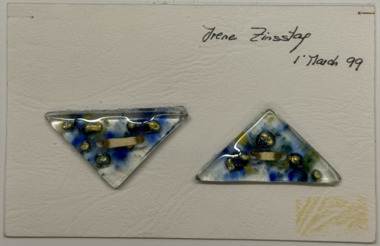 Kew Historical Society Inc
2 buttons on white card, 1999
... Made by Irene Zinsstag in Victoria, sometime in 1999....Made by Irene Zinsstag in Victoria, sometime in 1999. 2 buttons on white card ...Sally Hearn (1932–2018) was a dedicated button collector and a prominent member of the Victoria Button Collectors Club. Her button collection was featured as a primary display in the 'The Melbourne Story' exhibition at the Melbourne Museum, which opened in mid-2008.The Hearn Collection of locally made and international buttons is historically and aesthetically significant as it illustrates the textile and manufacturing history of button making.2 buttons on white card. Made of glass, coloured in blue and yellow with a triangular shape. For use on cardigans and jackets. Made by Irene Zinsstag in Victoria, sometime in 1999.Original Catalogue Entry: "I gave a talk at Hampton Community Centre, it was advertised in the local paper and Irene attended. She introduced herself afterwards and gave me the buttons."sally hearn, button collections -
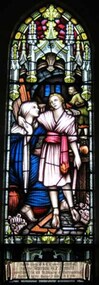 Christ Church Anglican Parish of Warrnambool
Memorial Window: Rev Thomas Pearse BENNETT, The Boy Jesus
... To the Glory of God, a token of affection/ for the Venerable T.P. Bennett,/ sometime Vicar and Archdeacon of Warrnambool/ Presented by his Masonic Friends A.D. 1946...To the Glory of God, a token of affection/ for the Venerable T.P. Bennett,/ sometime Vicar and Archdeacon of Warrnambool/ Presented by his Masonic Friends A.D. 1946 Stained glass, lancet window, north wall, chancel, main nave, memorial window. ...Stained glass, lancet window, north wall, chancel, main nave, memorial window. Depiction of the boy Jesus with his mother in the carpenter's workshop.To the Glory of God, a token of affection/ for the Venerable T.P. Bennett,/ sometime Vicar and Archdeacon of Warrnambool/ Presented by his Masonic Friends A.D. 1946 -
 Melbourne Tram Museum
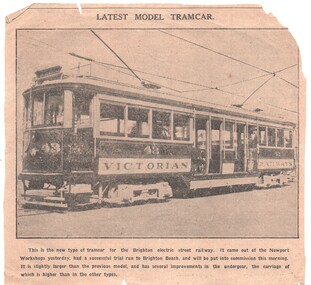
Newspaper, The Argus, "Latest Model Tramcar", Apr. 2022
... Cutting not dated, sometime April 1922....Cutting not dated, sometime April 1922. "Latest Model Tramcar" Newspaper The Argus ...Newspaper clipping from The Argus, titled "Latest Model Tramcar" with a photo of VR No. 43 entering service after being built at Newport Workshops. Cutting not dated, sometime April 1922.trams, tramways, victorian railways, st kilda brighton, newport workshops, new trams, tram 43 -
 Bendigo Historical Society Inc.
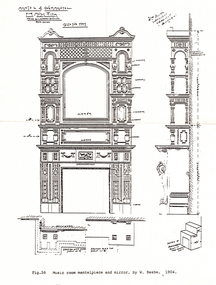
Plan - Fortuna Article - The Missing Mantlepiece, 1904 - 1990 abt
... Beebe in 1904 11217.82b Fortuna Article - The Story of the Missing Mantlepiece - sometime after 1940...Beebe in 1904 11217.82b Fortuna Article - The Story of the Missing Mantlepiece - sometime after 1940 Plan Fortuna Article - The Missing Mantlepiece ...This document details the history and fate of the ornate mantelpiece in the music room at Fortuna: The music room, now the Orderly Room, was one of the earliest parts of Fortuna and was later extended during George Lansell's time.I n 1904, the room was described as large (52 feet by 21 feet by 16 feet) and featured a prominent, richly carved mahogany mantelpiece with unique mirrors and musical symbolism. The mantelpiece was made from now-extinct Indian mahogany, took two years to carve, and was highly valued (costing 400 pounds at installation, estimated at 1200 pounds by 1940). It was considered a showpiece due to its craftsmanship and elaborate design. The mantelpiece was later removed and sent to Melbourne, with its current whereabouts unknown.The document expresses skepticism about its fate and invites anyone with information to come forward.Fortuna Article - The Missing Mantlepiece This item contains the following documents: 11217.82a Fortuna Article - The Missing Mantlepiece - Plan of mantlepiece and mirror by W. Beebe in 1904 11217.82b Fortuna Article - The Story of the Missing Mantlepiece - sometime after 1940non-fictionbendigo, fortuna, george lansell, the fortuna mantlepiece -
 Port Melbourne Historical & Preservation Society
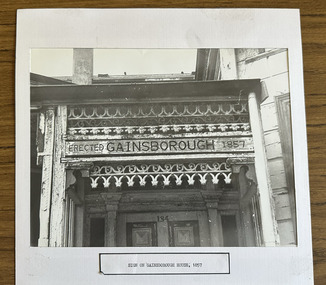
Photograph - Sign, Gainsborough House, Station Street, Port Melbourne, Sign on Gainsborough House,1857, 1950s - 1970s
... Houses built by Stevedore Jules Commans late 19th century (erroneous '1857' sign added sometime in the 20th century)...Houses built by Stevedore Jules Commans late 19th century (erroneous '1857' sign added sometime in the 20th century) Sign on Gainsborough House,1857 Photograph Sign, Gainsborough House, Station Street, Port Melbourne ...Close up on sign - one of two photographs of 184 Station Street, so-called 'Gainsborough House', mounted together in white card with captions. Houses built by Stevedore Jules Commans late 19th century (erroneous '1857' sign added sometime in the 20th century)built environment - domestic, jules commans -
 Port Melbourne Historical & Preservation Society
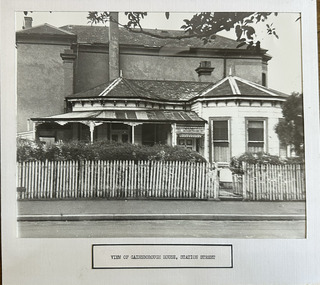
Photograph - Gainsborough House, Station Street, Port Melbourne, View of Gainsborough House, Station Street, 1950s - 1970s
... Houses built by Stevedore Jules Commans late 19th century (erroneous '1857' sign added sometime in the 20th century)...Houses built by Stevedore Jules Commans late 19th century (erroneous '1857' sign added sometime in the 20th century) View of Gainsborough House, Station Street Photograph Gainsborough House, Station Street, Port Melbourne ...Full view of house - one of two photographs of 184 Station Street, so-called 'Gainsborough House', mounted together in white card with captions. Houses built by Stevedore Jules Commans late 19th century (erroneous '1857' sign added sometime in the 20th century)built environment - domestic, jules commans -
 Tarnagulla History Archive
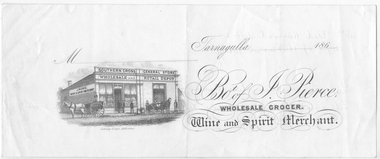
Label from Pierce's Southern Cross Store Tarnagulla, Bot of J. Pierce Wholesale Grocer Wine and Spirit Merchant, c. 1860s
... A handwritten note on reverse reads: 'Mrs Fred Harwood left a couple of chickens in fridge, Ross See you sometime this afternoon if possible. Left about quarter to twelve. ...Murray Comrie Collection. tarnagulla pierces southern cross store store j. pierce pierce stores commerce food wine businesses harwood A handwritten note on reverse reads: 'Mrs Fred Harwood left a couple of chickens in fridge, Ross See you sometime this afternoon if possible. Left about quarter to twelve. ...Murray Comrie Collection. A bottle label for goods from J.Pierce's Southern Cross Store in Tarnagulla. Unused. A handwritten note on reverse reads: 'Mrs Fred Harwood left a couple of chickens in fridge, Ross See you sometime this afternoon if possible. Left about quarter to twelve. Key to the till will be with Keys to the Garage on table'.tarnagulla, pierces southern cross store store, j. pierce, pierce, stores, commerce, food, wine, businesses, harwood -
 Vision Australia
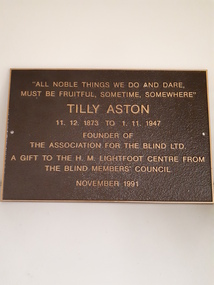
Photograph - Image, Tilly Aston - H.M. Lightfoot Centre, 1991
... "All noble things we do and dare, Must be fruitful, sometime, somewhere" Tilly Aston 11.12.1873 to 1.11.1947 Founder of The Association for the Blind Ltd. ...Lightfoot "All noble things we do and dare, Must be fruitful, sometime, somewhere" Tilly Aston 11.12.1873 to 1.11.1947 Founder of The Association for the Blind Ltd. ...Tilly Aston was a writer, educator and social reformist for blind and visually impaired people. Her desire to overcome the limitations in her own life, and that of others, led to the establishment of the Victorian Braille Writers Association (later the Braille Library of Victoria) and the Association for the Advancement of the Blind (later Association for the Blind). When the Kooyong site of the AFB required redevelopment due to the success of activities at Paterson Hall, a new building was constructed and named the H.M. Lightfoot Centre. As part of their contribution to acknowledging the work of Miss Aston, as well as two of the men who later worked with her, this plaque was struck and presented by the Blind Members' Council of the AFB.Brown metal plaque with gold writing"All noble things we do and dare, Must be fruitful, sometime, somewhere" Tilly Aston 11.12.1873 to 1.11.1947 Founder of The Association for the Blind Ltd. A gift to the H.M. Lightfoot Centre from The Blind Members' Council November 1991association for the blind, tilly aston, h.m. lightfoot -
 University of Melbourne, Burnley Campus Archives
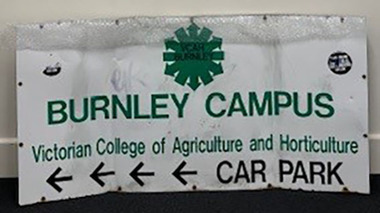
Sign - Campus Sign, Victorian College of Agriculture and Horticulture, Burnley Campus Victorian College of Agriculture and Horticulture Car Park, 1983-1996
... Formerly Attached to fence on Yarra Boulevard sometime 1983-1996...Formerly Attached to fence on Yarra Boulevard sometime 1983-1996 car park vcah aids victorian aids council Campus signs artifact BURNLEY CAMPUS VICTORIAN COLLEGE OF OF AGRICULTURE AND HORTICULTURE CARPARK Large painted metal sign with attachment screws on reverse. ...Formerly Attached to fence on Yarra Boulevard sometime 1983-1996Large painted metal sign with attachment screws on reverse. Arrows indicate where the Car Park is. VCAH Logo. Sticker attached: Victorian Aids Council Phone Aidsline Aids is Real Use Condoms 419-3166. Another similar sticker on other side partially torn off.BURNLEY CAMPUS VICTORIAN COLLEGE OF OF AGRICULTURE AND HORTICULTURE CARPARKcar park, vcah, aids, victorian aids council, campus signs, artifact -
 Sunshine and District Historical Society Incorporated
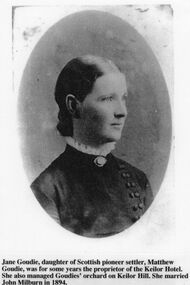
Photograph - Goudie and Milburn families, [circa mid-1800s}
... Photograph of Jane Goudie daughter of Scottish pioneer Matthew Goudie sometime proprieter of Keilor Hotel She managed Goudies orchard on Keilor Hill and married John Milburn in 1894 Photograph of Susan and David Milburn and their youngest son Herbert...Goudie Milburn Photograph of Jane Goudie daughter of Scottish pioneer Matthew Goudie sometime proprieter of Keilor Hotel She managed Goudies orchard on Keilor Hill and married John Milburn in 1894 Photograph of Susan and David Milburn and their youngest son Herbert Goudie and Milburn families Photograph Goudie and Milburn families ...Photograph of Jane Goudie daughter of Scottish pioneer Matthew Goudie sometime proprieter of Keilor Hotel She managed Goudies orchard on Keilor Hill and married John Milburn in 1894 Photograph of Susan and David Milburn and their youngest son Herbertgoudie, milburn -
 Bendigo Historical Society Inc.
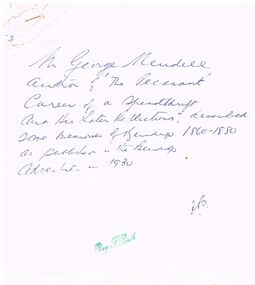
Document - EXTRACTS FROM THE ADVERTISER 1930
... Photocopied articles from the Bendigo Advertiser files sometime in the 1930's of Bendigo Memories 1860 - 80, written by Mr. ...DOCUMENT Newspaper Bendigo Advertiser Extracts from the Advertiser Bendigo Memories 1860 - 80 G D Meudell Photocopied articles from the Bendigo Advertiser files sometime in the 1930's of Bendigo Memories 1860 - 80, written by Mr. ...Photocopied articles from the Bendigo Advertiser files sometime in the 1930's of Bendigo Memories 1860 - 80, written by Mr. George Meudell. Items include gold mining, wine growing local identies, banking, schools and foundries. Each page has Reg. F. Back, stamped on them in green ink.document, newspaper, bendigo advertiser, extracts from the advertiser, bendigo memories 1860 - 80, g d meudell -
 Bendigo Historical Society Inc.
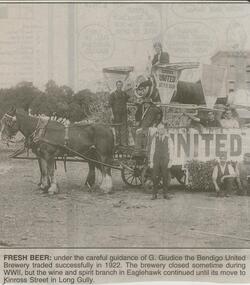
Newspaper - JENNY FOLEY COLLECTION: FRESH BEER
... The Brewery closed sometime during WWII, but the wine and spirit branch in Eaglehawk continued until its move to Kinross street, Long Gully. ...The Brewery closed sometime during WWII, but the wine and spirit branch in Eaglehawk continued until its move to Kinross street, Long Gully. ...Bendigo Advertiser ''The way we were'' from 2000. Fresh Beer: under the careful guidance of G. Giudice the Bendigo United Brewery traded successfully in 1922. The Brewery closed sometime during WWII, but the wine and spirit branch in Eaglehawk continued until its move to Kinross street, Long Gully. The clip is in a folder.newspaper, bendigo advertiser, the way we were -
 Alfred Hospital Nurses League - Nursing History Collection
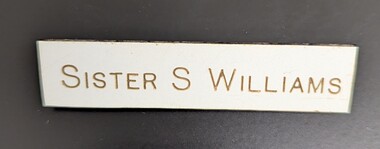
Badge - Name badge, Sister S. Williams badge, unknown
... Badge used by Sidney Williams sometime between 1962 (date of marriage) and her retirement in 1978...Badge used by Sidney Williams sometime between 1962 (date of marriage) and her retirement in 1978 Of significance to the AHNL as an example of identification all nurses were required to wear Nurse Sidney Williams (MacDowell) Sister S Williams rectangular badge, white laminated over brown material (? ...Badge used by Sidney Williams sometime between 1962 (date of marriage) and her retirement in 1978Of significance to the AHNL as an example of identification all nurses were required to wear rectangular badge, white laminated over brown material (? plastic) name has been punched through front panel, metal pin attached to backSister S Williamsnurse, sidney williams (macdowell) -
 Port of Echuca
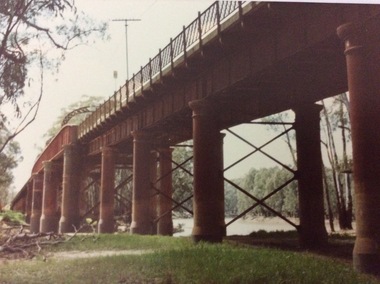
A rectangular coloured photograph, 1970?
... A rectangular coloured photograph of the Echuca Moama bridge taken from the Victorian bank, sometime in the early 1970's. One round bridge arch can be seen and a tall electricity pole can also be seen on top of the bridge. ...A rectangular coloured photograph of the Echuca Moama bridge taken from the Victorian bank, sometime in the early 1970's. One round bridge arch can be seen and a tall electricity pole can also be seen on top of the bridge. ...This photograph shows the Echuca Moama bridge crossing the Murray River in the early 1970's. This photograph shows the Echuca Moama bridge in the early 1970's. It shows one of the rounded arches on the bridge. The rounded arches were the original arches and were at one stage replaced by square arches, but then replaced again by rounded arches.A rectangular coloured photograph of the Echuca Moama bridge taken from the Victorian bank, sometime in the early 1970's. One round bridge arch can be seen and a tall electricity pole can also be seen on top of the bridge. The vegetation on the Victorian bank is short and cropped. Some dead branches lie on the ground in the left foreground.There are none.echuca moama bridge, murray river, victorian bank -
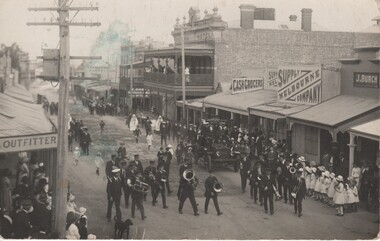 Rutherglen Historical Society
Postcard - Post card, c1920
... Believed to have been taken sometime in the 1920s. An enthusiast could probably date the photo by the fire engine....Believed to have been taken sometime in the 1920s. An enthusiast could probably date the photo by the fire engine. main street rutherglen parades victoria hotel druids Black and white photographic postcard showing a parade in Main Street, Rutherglen. ...Believed to have been taken sometime in the 1920s. An enthusiast could probably date the photo by the fire engine.Black and white photographic postcard showing a parade in Main Street, Rutherglen. The building at the center of the photograph is the Victoria Hotel. The men near the front of the hotel, in white robes, are members of the Druid lodge. The firetruck is from the New South Wales Fire Brigade.main street rutherglen, parades, victoria hotel, druids
