
Showing 8 items matching "south east asian culture"
-
 International House, The University of Melbourne
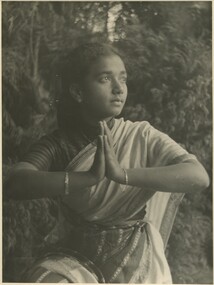
Photograph (Item), Female dancer (possibly associated with fundraising performance)
... South East Asian Culture...South East Asian Culture South East Asian Culture Dance A black and white photo of a female dancer (possibly associated with fundraising performance) Female dancer (possibly associated with fundraising performance) Photograph ...South East Asian Culturesouth east asian culture, dance -
 Monbulk RSL Sub Branch
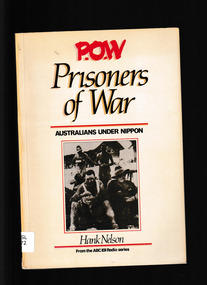
Book, Australian Broadcasting Corporation, P.O.W. : prisoners of war, 1985
... Later most of the prisoners were to be shifted further north into South-east Asia, Formosa, Korea, Manchuria and Japan itself. They were captives within lands and cultures and to experiences alien to those known to all other Australians. ...Within three months of the Japanese entering World War II on December 8, 1941 over 22 000 Australians had become prisoners-of-war. They went into camps in Timor, Ambon, New Britain, Java, Sumatra, Borneo, Singapore and Malaya, and a few were scattered to other points in what was briefly part of the Japanese empire. Later most of the prisoners were to be shifted further north into South-east Asia, Formosa, Korea, Manchuria and Japan itself. They were captives within lands and cultures and to experiences alien to those known to all other Australians. At the end of the war in August 1945, 14315 servicemen and thirty service women were alive to put on new, loose-fitting uniforms and go home. One in three of the prisoners had died. That is, nearly half of the deaths suffered by Australians in the war in the Pacific were among men and women who had surrendered. Another 8174 Australians had been captured in the fighting in Europe, the Middle East and North Africa: but of these men only 265 died as a result of wounds, disease or execution.By any quantitative measure the imprisonment of so many Australians is a major event in Australian history. For many soldiers it was living --and dying --in captivity which made World War II different from that of World War I. But the prisoners have received no permanent place in Australian history. Their story is not immediately recalled on celebratory occasions. In a general history of the nation in which a chapter is given to the war the prisoners might be mentioned in a sentence, or part of a sentence. Where the horror, stoicism and gallantry of Gallipoli have become part of a common tradition shared by all Australians, the ex-prisoners are granted just the horror. The public may be sympathetic; but the horror is for the prisoners alone. To make another comparison: in five months of fighting on the Kokoda Trail in 1942 the Australians lost 625 dead, less than the number who died on Ambon. Yet the events on Ambon are unknown to most Australians. There were no reporters or cameramen on Ambon and, for the 309 who defended Ambon's Laha airfield, no survivors. How many of them died in battle or died as prisoners will never be known. But there are more than just practical reasons why the record of the prisoners of war is so slight and uneven in the general knowledge of Australians. They have not tried to find out. No historian has written a book to cover the range of camps and experiences, and only in specialist medical publications has anyone investigated the impact of prison life on subsequent physical and mental health. The complexity of the experience and its impact on particular lives have not been expressed in a way to give them significance for other Australians.Index, bib, ill, maps, p.224.Within three months of the Japanese entering World War II on December 8, 1941 over 22 000 Australians had become prisoners-of-war. They went into camps in Timor, Ambon, New Britain, Java, Sumatra, Borneo, Singapore and Malaya, and a few were scattered to other points in what was briefly part of the Japanese empire. Later most of the prisoners were to be shifted further north into South-east Asia, Formosa, Korea, Manchuria and Japan itself. They were captives within lands and cultures and to experiences alien to those known to all other Australians. At the end of the war in August 1945, 14315 servicemen and thirty service women were alive to put on new, loose-fitting uniforms and go home. One in three of the prisoners had died. That is, nearly half of the deaths suffered by Australians in the war in the Pacific were among men and women who had surrendered. Another 8174 Australians had been captured in the fighting in Europe, the Middle East and North Africa: but of these men only 265 died as a result of wounds, disease or execution.By any quantitative measure the imprisonment of so many Australians is a major event in Australian history. For many soldiers it was living --and dying --in captivity which made World War II different from that of World War I. But the prisoners have received no permanent place in Australian history. Their story is not immediately recalled on celebratory occasions. In a general history of the nation in which a chapter is given to the war the prisoners might be mentioned in a sentence, or part of a sentence. Where the horror, stoicism and gallantry of Gallipoli have become part of a common tradition shared by all Australians, the ex-prisoners are granted just the horror. The public may be sympathetic; but the horror is for the prisoners alone. To make another comparison: in five months of fighting on the Kokoda Trail in 1942 the Australians lost 625 dead, less than the number who died on Ambon. Yet the events on Ambon are unknown to most Australians. There were no reporters or cameramen on Ambon and, for the 309 who defended Ambon's Laha airfield, no survivors. How many of them died in battle or died as prisoners will never be known. But there are more than just practical reasons why the record of the prisoners of war is so slight and uneven in the general knowledge of Australians. They have not tried to find out. No historian has written a book to cover the range of camps and experiences, and only in specialist medical publications has anyone investigated the impact of prison life on subsequent physical and mental health. The complexity of the experience and its impact on particular lives have not been expressed in a way to give them significance for other Australians.world war 1939 – 1945 - prisons and prisoners – japanese, world war 1939-1945 - personal narrativies - australia -
 Embroiderers Guild, Victoria
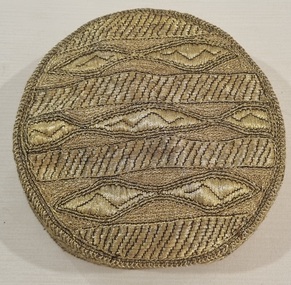
Accessory - Kufi Skull Cap, c 1989
... A brimless short rounded cap worn by men in Africa, Middle East and South Asia. Although associated with many Islamic cultures, in the United States it is also worn with people of West African heritage, whether Christian, Islamic or a traditional African religion....A brimless short rounded cap worn by men in Africa, Middle East and South Asia. Although associated with many Islamic cultures, in the United States it is also worn with people of West African heritage, whether Christian, Islamic or a traditional African religion. ...A brimless short rounded cap worn by men in Africa, Middle East and South Asia. Although associated with many Islamic cultures, in the United States it is also worn with people of West African heritage, whether Christian, Islamic or a traditional African religion.Brimless cap hand embroidered with couched gold coloured metal thread.caps, metal thread embroidery -
 Embroiderers Guild, Victoria
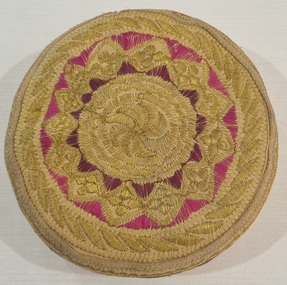
Accessory - Kufi Skull Cap, c 1989
... A brimless short rounded cap worn by men in Africa, Middle East and South Asia. Although associated with many Islamic cultures, in the United States it is also worn with people of West African heritage, whether Christian, Islamic or a traditional African religion....A brimless short rounded cap worn by men in Africa, Middle East and South Asia. Although associated with many Islamic cultures, in the United States it is also worn with people of West African heritage, whether Christian, Islamic or a traditional African religion. ...A brimless short rounded cap worn by men in Africa, Middle East and South Asia. Although associated with many Islamic cultures, in the United States it is also worn with people of West African heritage, whether Christian, Islamic or a traditional African religion.Brimless cap hand embroidered with couched gold coloured metal thread with pink and maroon coloured highlights.caps, metal thread embroidery -
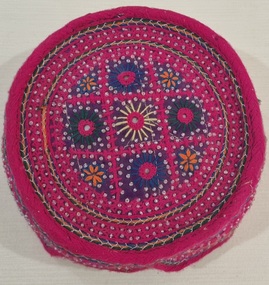 Embroiderers Guild, Victoria
Accessory - Kufi Skull Cap, c 1989
... A brimless short rounded cap worn by men in Africa, Middle East and South Asia. Although associated with many Islamic cultures, in the United States it is also worn with people of West African heritage, whether Christian, Islamic or a traditional African religion....A brimless short rounded cap worn by men in Africa, Middle East and South Asia. Although associated with many Islamic cultures, in the United States it is also worn with people of West African heritage, whether Christian, Islamic or a traditional African religion. ...A brimless short rounded cap worn by men in Africa, Middle East and South Asia. Although associated with many Islamic cultures, in the United States it is also worn with people of West African heritage, whether Christian, Islamic or a traditional African religion.Brimless cap hand embroidered with pink, green, blue, orange and yellow coloured highlights. Crystal beads highlight the pattern. Silver coloured metal thread herringbone stitch and shisha mirror work.caps, embroidered -
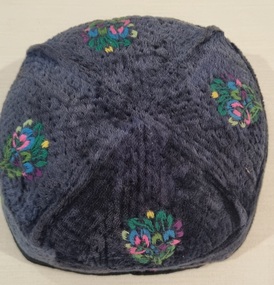 Embroiderers Guild, Victoria
Accessory - Kufi Skull Cap, c 1989
... A brimless short rounded cap worn by men in Africa, Middle East and South Asia. Although associated with many Islamic cultures, in the United States it is also worn with people of West African heritage, whether Christian, Islamic or a traditional African religion....A brimless short rounded cap worn by men in Africa, Middle East and South Asia. Although associated with many Islamic cultures, in the United States it is also worn with people of West African heritage, whether Christian, Islamic or a traditional African religion. ...A brimless short rounded cap worn by men in Africa, Middle East and South Asia. Although associated with many Islamic cultures, in the United States it is also worn with people of West African heritage, whether Christian, Islamic or a traditional African religion.Brimless navy velvet cap hand embroidered with pink, green and blue floral motifs.caps, met -
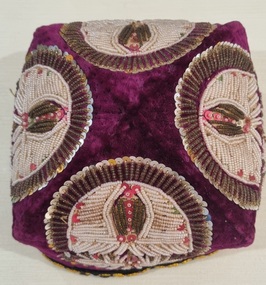 Embroiderers Guild, Victoria
Accessory - Kufi Skull Cap, c 1989
... A brimless short rounded cap worn by men in Africa, Middle East and South Asia. Although associated with many Islamic cultures, in the United States it is also worn with people of West African heritage, whether Christian, Islamic or a traditional African religion....A brimless short rounded cap worn by men in Africa, Middle East and South Asia. Although associated with many Islamic cultures, in the United States it is also worn with people of West African heritage, whether Christian, Islamic or a traditional African religion. ...A brimless short rounded cap worn by men in Africa, Middle East and South Asia. Although associated with many Islamic cultures, in the United States it is also worn with people of West African heritage, whether Christian, Islamic or a traditional African religion.Brimless maroon velvet cap hand embellished with cream and bronze coloured beads, floral and round shaped paillettes creating four motifs. Gold-coloured floral trim around brim edge.caps, metal thread embroidery -
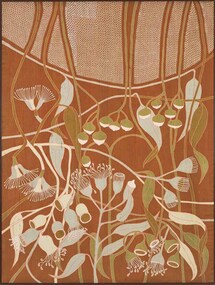 Wangaratta Art Gallery
Textile, Christine Upton, Gumnuts Galore, 1984
... culture and beliefs of the place where it was made and for whom it was made for. Upton has instilled her piece such meaning and symbolism by depicting eucalyptus leaves and gumnuts which evokes a sense of belonging and pride. Christine Upton is a local artist who is a master lino block printer and batik artist. Her works are found in private and public collections throughout Australia, parts of Great Britain, USA, Europe and South East Asia ...Upton has used the traditional technique of Indonesian batik to create 'Gumnuts Galore'. Batik has a long history in the world and is believed to have originated on the island of Java in Indonesia. The designs traditionally used in batik are imbued with meaning and powerful symbolism to reflect the culture and beliefs of the place where it was made and for whom it was made for. Upton has instilled her piece such meaning and symbolism by depicting eucalyptus leaves and gumnuts which evokes a sense of belonging and pride.Rural City of Wangaratta Collection, purchased with funds from the Wangaratta Art CouncilA rectangular design of gumnuts on silk created through the batik technique using natural dyes in shades of red, brown, and greenwangaratta art gallery, christine upton, batik, gumnuts, flora, australian flora, textile
