
Showing 6 items matching "south yarra nurseries"
-
 University of Melbourne, Burnley Campus Archives
Booklet - Catalogue, Photocopy, Joseph Harris, South Yarra Nurseries. General Descriptive Catalogue, 1865-1873
... Joseph Harris, South Yarra Nurseries. General Descriptive Catalogue......south yarra nurseries...catalogues joseph harris south yarra nurseries 2 catalogues Joseph Harris, South Yarra Nurseries. ...2 cataloguescatalogues, joseph harris, south yarra nurseries -
 University of Melbourne, Burnley Campus Archives
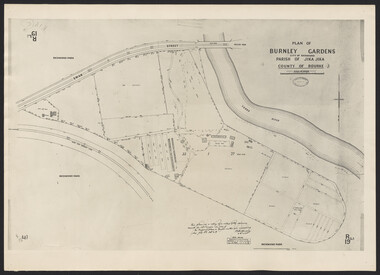
Photograph - Cul-de-sac planting design, Plan of Burnley Gardens, City of Richmond, Parish of Jika Jika, County of Bourke, 1948 (photograph)
... Yarra River to the east, Richmond Park to the south west. Photographed at Dept. of Lands and Survey, central plan office, 7/12/1948. Plan shows old orchard, fowl sheds, coops and yards, milking shed, silo, nursery, glass house, fattening pens, dairy, garden, orchards area in southwest area. ...Yarra River to the east, Richmond Park to the south west. Photographed at Dept. of Lands and Survey, central plan office, 7/12/1948. Plan shows old orchard, fowl sheds, coops and yards, milking shed, silo, nursery, glass house, fattening pens, dairy, garden, orchards area in southwest area. ..."This plan is a copy of a copy of the survey made by Mr. Turner in 1926. The original plan and field notes are missing. See file Rs 3529" Signed by ? Andersonburnley gardens, victoria department of lands & survey, richmond, orchards, fowl yards -
Emerald Museum & Nobelius Heritage Park
Memorabilia - Ship voyage souvenir, Unknown maker, 1900s
... He worked at nurseries in Toorak and South Yarra before purchasing sixty-three acres of land in the new settlement of Emerald where he grew plant stock including fruit and ornamental trees which were sold to Australian and international clients for public parks, municipal landscaping projects and private gardens. ...He worked at nurseries in Toorak and South Yarra before purchasing sixty-three acres of land in the new settlement of Emerald where he grew plant stock including fruit and ornamental trees which were sold to Australian and international clients for public parks, municipal landscaping projects and private gardens. ...The lifebuoy postcard frame was given to Ethel Ruby Nobelius to commemorate her nineteenth birthday on board the S.S. Mongolia during a trip to Ceylon with her parents, Carl and Emily Nobelius. Ethel Ruby Nobelius was born on 27 October 1887 in Emerald and died on 2 August 1965 in Mildura at the age of 77. She was the Nobelius family's second oldest daughter. In total there were eleven children, including three girls, though three sons died in infancy. Ruby's father, Carl Axel Nobelius, was born in Finland in 1851 to a Swedish horticulturalist family and emigrated to Melbourne from Sweden in 1871. He worked at nurseries in Toorak and South Yarra before purchasing sixty-three acres of land in the new settlement of Emerald where he grew plant stock including fruit and ornamental trees which were sold to Australian and international clients for public parks, municipal landscaping projects and private gardens. These included the Fitzroy Gardens and Royal Botanic Gardens in Melbourne and buyers in Europe, the Americas, Asia and New Zealand. Nobelius sourced plants from many countries, and in some instances was the first nurseryman in Australia to do so. Locally, Gembrook Nurseries were an important industry and major employer in Emerald and the surrounding area and had a profound influence on the development of the township, including in the development of infrastructure such as the narrow-gauge railway used to transport stock to the main line in Ferntree Gully, which is now known as the Puffing Billy railway. It is not known where the lifebuoy postcard frame was made. It appears to be official merchandise for the ship S.S. Mongolia, operated as part of the Peninsular and Oriental Steam Navigation Company ("P&O"). P&O were one of the first passenger voyage companies, incorporating in 1840 by Royal Charter and beginning passenger services in 1844. P&O were successful initially because they obtained contracts to carry official mail, which is indicated on the designation 'R.M.S.' or Royal Mail Ship on the lifebuoy. The line was originally formed to operate between England, Spain and Portugal; the colours of the Portuguese and Spanish flags were used to form the P&O company or house flag which can be seen on the item. Services to and from Australia directly did not begin until 1932, indicating that the Nobelius family may have travelled to board the ship at an international port prior to their journey to Ceylon. On the 23rd of June, 1917, the S.S. Mongolia struck a mine laid by a German ship entitled 'Wolf', eighty kilometres from the port of Bombay, India, en route to Australia. Twenty-one people died in the initial explosion or from wounds sustained in the blast and two crew members drowned during the evacuation, but more than 450 people were successfully evacuated in the thirteen minutes it took the ship to sink.The item is significant as it provides evidence of a trip to Ceylon made by Carl Axel Nobelius in 1906 which may have influenced stock available in the Gembrook nurseries, commonly known as the Nobelius nurseries. The Nobelius nurseries exported stock to many parks and municipalities and private buyers throughout the world in the early 20th Century so an international trip made by the proprietor potentially influenced the distribution of plant species during this period. In addition, the item commemorates the ship S.S. Mongolia which was sunk by Germany in 1917, during World War 1.The item is a wooden photo frame in the shape of a lifebuoy with attached cord. It is painted a cream colour, with decoration featuring two flags and the names of the ship and shipping line, one in each of four sections around the edges. On the item's left is a version of the Australian flag without the Federation Star or Southern Cross elements. On the item's right is the white, blue, red and yellow company flag of the P&O shipping line. Both flags are paired with an additional anchor design element. The top section contains the initials P.&O. R.M.S. and the lower section the word Mongolia. The frame contains a black and white postcard depicting the S.S. Mongolia.Obverse: P.&O. R.M.S. / S S ong ." P O / MONGOLIA Reverse: THE BOAT Ruby Carl & Emily / Travelled to Ceylon / 1906 / Given to Ruby / on her 19th birthday / 24/10/06 /1906, p&o, peninsular and oriental steam navigation company, carl axel nobelius, ruby nobelius, ethel ruby nobelius, gembrook nurseries, nobelius nurseries, lifebuoy, memorabilia, souvenir, ship, ceylon, s.s. mongolia, royal mail ship, world war 1, ww1, first world war -
Emerald Museum & Nobelius Heritage Park
Instrument - Obstetricah forceps, Milne-Murray, Robert, 1890s-1920s
... South Yarra with a weekend log cabin called Forest Lodge in Emerald and practiced in Collins Street in Melbourne. These Victorian-era 'action traction' obstetrical forceps were invented by Dr Robert Milne-Murray, a practicing physician at the Royal Maternity and the Simpson Memorial Pavilion in Edinburgh in 1891. They were designed to allow the attending physician to obtain a secure hold on the infant before pulling backwards on the handle to facilitate the baby's birth. In the 1920s Dr Bottomley and business partner W.H. Treganowan initiated the Emerald Country Club syndicate to purchase land from Carl Axel Nobelius' Gembrook Nurseries...South Yarra with a weekend log cabin called Forest Lodge in Emerald and practiced in Collins Street in Melbourne. These Victorian-era 'action traction' obstetrical forceps were invented by Dr Robert Milne-Murray, a practicing physician at the Royal Maternity and the Simpson Memorial Pavilion in Edinburgh in 1891. They were designed to allow the attending physician to obtain a secure hold on the infant before pulling backwards on the handle to facilitate the baby's birth. In the 1920s Dr Bottomley and business partner W.H. Treganowan initiated the Emerald Country Club syndicate to purchase land from Carl Axel Nobelius' Gembrook Nurseries ...These Victorian-era obstetrical forceps are from the collection of equipment used by Dr William Bottomley. Dr Bottomley was born in Fitzroy in 1881 and obtained a Bachelor of Surgery from the University of Melbourne in 1906. He lived in South Yarra with a weekend log cabin called Forest Lodge in Emerald and practiced in Collins Street in Melbourne. These Victorian-era 'action traction' obstetrical forceps were invented by Dr Robert Milne-Murray, a practicing physician at the Royal Maternity and the Simpson Memorial Pavilion in Edinburgh in 1891. They were designed to allow the attending physician to obtain a secure hold on the infant before pulling backwards on the handle to facilitate the baby's birth. In the 1920s Dr Bottomley and business partner W.H. Treganowan initiated the Emerald Country Club syndicate to purchase land from Carl Axel Nobelius' Gembrook Nurseries estate, which led to the formation of the golf course and Country Club facilities. Bottomley Drive in Emerald is named after Dr Bottomley; the street is located near Silver Birches, the house commissioned by the doctor from modernist architect Harry Norris. 'Action traction' obstetrical forceps were invented by Dr Robert Milne-Murray, a practicing physician at the Royal Maternity and the Simpson Memorial Pavilion in Edinburgh in 1891. They were designed to allow the attending physician to obtain a secure hold on the infant before pulling backwards on the handle to facilitate the baby's birth. Forceps to extract fetuses from women who would otherwise die during complications in labour have been used as a last resort since 1500 BCE, though it has only been in the last 300-500 years that forcep design has shifted to focusing on saving the lives of both mother and infant. These are fenestrated forceps, with a hollow 'blade' or loop, which have been superseded as a design by solid models that are less likely to cause compression damage to the baby's head.These items are significant as they provide insights into medical practice in the early twentieth-century in Melbourne and surrounds. They are also significant because they were used by Dr William Bottomley, who owned property in Emerald and whose business dealings significantly shaped the development of the town.The silver-coloured item is approximately thirty centimetres long and features two rounded metal loops opened and closed by manipulating the stem of the object, which ends in short feet that attach to a separate handle.1890s, 1900s, 1910s william bottomley, w.h. treganowan, medical practice, women's health, obstetrics, forceps, robert milne-murray, birth, forest lodge, silver birches, harry norris, emerald country club and golf course -
Emerald Museum & Nobelius Heritage Park
Instrument - Obstetrical forceps, Milne-Murray, Robert, 1890s-1920s
... South Yarra with a weekend log cabin called Forest Lodge in Emerald and practiced in Collins Street in Melbourne. In the 1920s Dr Bottomley and business partner W.H. Treganowan initiated the Emerald Country Club syndicate to purchase land from Carl Axel Nobelius' Gembrook Nurseries estate, which led to the formation of the golf course and Country Club facilities. ...South Yarra with a weekend log cabin called Forest Lodge in Emerald and practiced in Collins Street in Melbourne. In the 1920s Dr Bottomley and business partner W.H. Treganowan initiated the Emerald Country Club syndicate to purchase land from Carl Axel Nobelius' Gembrook Nurseries estate, which led to the formation of the golf course and Country Club facilities. ...These Victorian-era obstetrical forceps are from the collection of equipment used by Dr William Bottomley. Dr Bottomley was born in Fitzroy in 1881 and obtained a Bachelor of Surgery from the University of Melbourne in 1906. He lived in South Yarra with a weekend log cabin called Forest Lodge in Emerald and practiced in Collins Street in Melbourne. In the 1920s Dr Bottomley and business partner W.H. Treganowan initiated the Emerald Country Club syndicate to purchase land from Carl Axel Nobelius' Gembrook Nurseries estate, which led to the formation of the golf course and Country Club facilities. Bottomley Drive in Emerald is named after Dr Bottomley; the street is located near Silver Birches, the house commissioned by the doctor from modernist architect Harry Norris. 'Action traction' obstetrical forceps were invented by Dr Robert Milne-Murray, a practicing physician at the Royal Maternity and the Simpson Memorial Pavilion in Edinburgh in 1891. They were designed to allow the attending physician to obtain a secure hold on the infant before pulling backwards on the handle to facilitate the baby's birth. Forceps to extract fetuses from women who would otherwise die during complications in labour have been used as a last resort since 1500 BCE, though it has only been in the last 300-500 years that forceps design has shifted to focusing on saving the lives of both mother and infant. These are fenestrated forceps, with a hollow 'blade' or loop, which have been superseded as a design by solid models that are less likely to cause compression damage to the baby's head.These items are significant as they provide insights into medical practice in the early Twentieth-Century in Melbourne and surrounds. They are also significant because they were used by Dr William Bottomley, who owned property in Emerald and whose business dealings significantly shaped the development of the town.The silver-coloured item is approximately fifteen centimetres long; it has a solid metal handle bar and a stem leading to a flat panel with two holes that are designed to connect it to the body of the forceps. These forceps are from the collection of equipment used by Dr William Bottomley, who practiced in Collins Street in Melbourne after receiving his Bachelor of Surgery from the University of Melbourne in 1906. Dr Bottomley had a weekend residence in Emerald. In the 1920s Dr Bottomley and his business partner W.H. Treganowan initiated the Emerald Country Club syndicate and purchased land from the Gembrook Nurseries estate to build a golf course and Country Club.1890s, 1900s, 1910s william bottomley, w.h. treganowan, medical equipment, women's health, medical practice, forceps, birth, obstetrics, forest lodge, silver birches, harry norris, emerald country club and golf course -
Emerald Museum & Nobelius Heritage Park
Functional object - Apothecary weights, H.B. Selby, 1900s
... South Yarra with a weekend log cabin called Forest Lodge in Emerald and practiced in Collins Street in Melbourne. These weights were used with a scale to dispense correct quantities of drugs or ingredients; the tweezers may have been used to combine substances on the glass slide ready for use. In the 1920s Dr Bottomley and business partner W.H. Treganowan initiated the Emerald Country Club syndicate to purchase land from Carl Axel Nobelius' Gembrook Nurseries...South Yarra with a weekend log cabin called Forest Lodge in Emerald and practiced in Collins Street in Melbourne. These weights were used with a scale to dispense correct quantities of drugs or ingredients; the tweezers may have been used to combine substances on the glass slide ready for use. In the 1920s Dr Bottomley and business partner W.H. Treganowan initiated the Emerald Country Club syndicate to purchase land from Carl Axel Nobelius' Gembrook Nurseries ...These Victorian-era apothecary scales are from the collection of equipment used by Dr William Bottomley. Dr Bottomley was born in Fitzroy in 1881 and obtained a Bachelor of Surgery from the University of Melbourne in 1906. He lived in South Yarra with a weekend log cabin called Forest Lodge in Emerald and practiced in Collins Street in Melbourne. These weights were used with a scale to dispense correct quantities of drugs or ingredients; the tweezers may have been used to combine substances on the glass slide ready for use. In the 1920s Dr Bottomley and business partner W.H. Treganowan initiated the Emerald Country Club syndicate to purchase land from Carl Axel Nobelius' Gembrook Nurseries estate, which led to the formation of the golf course and Country Club facilities. Bottomley Drive in Emerald is named after Dr Bottomley; the street is located near Silver Birches, the house commissioned by the doctor from modernist architect Harry Norris. These weights were used with a scale to dispense correct quantities of drugs or ingredients; the tweezers may have been used to combine substances on the glass slide ready for use. The apothecary system of weights was tailored to measuring medicinal ingredients; it and the Troy system (which was used for measuring precious metals such as silver and gold) both have twelve ounces to the pound, in comparison to the Avoirdupois method which was used for heavier items and had sixteen ounces to the pound. These measurement systems were used extensively throughout the world until the 1960s when the widespread adoption of the metric system standardised processes.These items are significant as they provide insights into medical practice in the early Twentieth-Century in Melbourne and surrounds. They are also significant because they were used by Dr William Bottomley, who owned property in Emerald and whose business dealings significantly shaped the development of the town.Wooden box with a metal latch, maker's label and owner's name. Inside the box there is a black cloth lining to encase eight brass and five tin weights, a glass slide and tweezers. There is space for an additional brass weight and eight tin weights, but these spaces are empty.Obverse: D W H BOTTOMLEY / H.B SELBY & CO. LTD. / SCIENTIFIC APPARATUS / MELBOURNE & SYDNEY /emerald, victoria, australia, gold weights, apothecary weights, bottomley, fischer, dr. w f bottomley, w.h. treganowan, harry norris, forest lodge, silver birches, medical practice, drug dispensing, pharmacy equipment, h.b. selby & co, emerald country club and golf course
