Showing 29 items matching "space flight"
-
Moorabbin Air MuseumBook - ALL ABOUT SPACE FLIGHT, HAROLD L. GOODWIN, 1966
... ALL ABOUT SPACE FLIGHT...ALL ABOUT SPACE FLIGHT...ALL ABOUT SPACE FLIGHT Book ALL ABOUT SPACE FLIGHT HAROLD L. ... -
Moorabbin Air MuseumBook - SPACE FLIGHT: CROSSING THE LAST FRONTIER, JASON RICHIE, 2002
... SPACE FLIGHT: CROSSING THE LAST FRONTIER...SPACE FLIGHT: CROSSING THE LAST FRONTIER...Moorabbin Air Museum Moorabbin Airport 12 First Street Moorabbin melbourne SPACE FLIGHT: CROSSING THE LAST FRONTIER Book SPACE FLIGHT: CROSSING THE LAST FRONTIER JASON RICHIE THE OLIVER PRESS, INC ... -
Moorabbin Air MuseumBook - Space flight, Flight into Space
... Space flight...Flight into Space...Space flight...Moorabbin Air Museum Moorabbin Airport 12 First Street Moorabbin melbourne Space flight Tests & troubles Guided missiles Satellites Space environment Zero gravity Rocky space Telescopes in space Space radio Vacuum of space Other planets Technical & general overview of the future of spaceflight, circa 1953 Flight into Space Book Space flight ...Technical & general overview of the future of spaceflight, circa 1953non-fictionTechnical & general overview of the future of spaceflight, circa 1953tests & troubles, guided missiles, satellites, space environment, zero gravity, rocky space, telescopes in space, space radio, vacuum of space, other planets -
Moorabbin Air MuseumBook - Space flight, An Introduction to Space
... Space flight...Space Flight...Moorabbin Air Museum Moorabbin Airport 12 First Street Moorabbin melbourne Space Flight Overview of technical principles & requurements of space flight, circa 1968 An Introduction to Space Book Space flight ...Overview of technical principles & requurements of space flight, circa 1968non-fictionOverview of technical principles & requurements of space flight, circa 1968 -
Moorabbin Air MuseumPamphlet (Item) - "Flight & Space" 20th Century - Herald Sun 1999
... "Flight & Space" 20th Century - Herald Sun 1999..."Flight & Space" 20th Century - Herald Sun 1999...Moorabbin Air Museum Moorabbin Airport 12 First Street Moorabbin melbourne "Flight & Space" 20th Century - Herald Sun 1999 Pamphlet "Flight & Space" 20th Century - Herald Sun 1999 ... -
Moorabbin Air MuseumJournal (Item) - Includes articles on Concorde development of space flight, Aeronautical Journal Volume 70 Jan - Dec 1966
... Includes articles on Concorde development of space flight...Moorabbin Air Museum Moorabbin Airport 12 First Street Moorabbin melbourne Good condition approx 1200 pages Aeronautical Journal Volume 70 Jan - Dec 1966 Journal Includes articles on Concorde development of space flight ... -
Moorabbin Air MuseumBook - Mechanics of Flight, The Mechanics of Flight
... ...Space flight...Mechanics of flight Air & airflow Aerofoils Thrust Level flight Gliding & landing Performance Manouevres Stability & control Trial flight Flight at transonic & supersonic speeds Space flight Introduction to the principles of the mechanics of flight, circa 1972 The Mechanics of Flight Book Mechanics of Flight ...Introduction to the principles of the mechanics of flight, circa 1972non-fictionIntroduction to the principles of the mechanics of flight, circa 1972air & airflow, aerofoils, thrust, level flight, gliding & landing, performance, manouevres, stability & control, trial flight, flight at transonic & supersonic speeds, space flight -
Bendigo Military MuseumAward - MEDALS, MINIATURE, Unknown
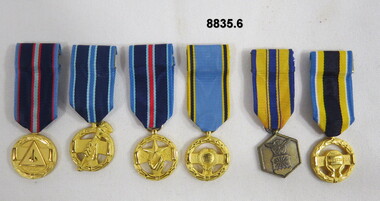
... Miniature Medals, all original, court mounted. 1. USA - NASA Space Flight (Astronauts Only). 2. USA - NASA Outstanding Leadership. 3. ...Bendigo Military Museum 37 - 39 Pall Mall Bendigo goldfields PBT791TO796 Bob English Collection Passchendaele Barracks Trust Miniature Medals, all original, court mounted. 1. USA - NASA Space Flight (Astronauts Only). 2. USA - NASA Outstanding Leadership. 3. ...Miniature Medals, all original, court mounted. 1. USA - NASA Space Flight (Astronauts Only). 2. USA - NASA Outstanding Leadership. 3. USA - NASA Exceptional Bravery. 4. USA - NASA Exceptional Service. 5. USA - Air and Space Commendation. 6. USA - Equal Employment Opportunity.pbt791to796, bob english collection, passchendaele barracks trust -
Eltham District Historical Society IncDocument - Folder, Aerospace Industry, 1958-1961
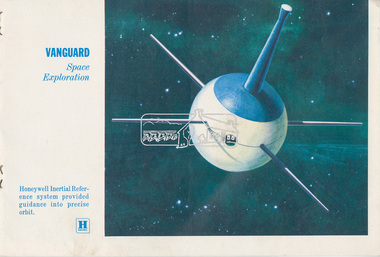
... Satellite Situation Report, February 14, 1961; Space operations Control Center, Goddard Space Flight Center, National Aeronautics and Space Administration, Greenbelt, Maryland; 4 pages 9. ...Satellite Situation Report, February 14, 1961; Space operations Control Center, Goddard Space Flight Center, National Aeronautics and Space Administration, Greenbelt, Maryland; 4 pages 9. ...honeywell, scout rocket, echo satellite, mercury rocket, centaur rocket, advent rocket, mariner satellite, dyna soar, x-15, midas rocket, tiros satellite, discoverer rocket, vanguard satellite, aerospace industry, alan gardiner collection, space industry -
Flagstaff Hill Maritime Museum and VillageBook, Martin Paz
... He conjured hundreds of memorable characters and imagined countless innovations years before their time, including stories about submarine and space travel, terrestrial flight and deep-sea exploration. ...He conjured hundreds of memorable characters and imagined countless innovations years before their time, including stories about submarine and space travel, terrestrial flight and deep-sea exploration. ...Pattison Collection This item is from the ‘Pattison Collection’, a collection of books and records that was originally owned by the Warrnambool Mechanics’ Institute, which was founded in Warrnambool in 1853. By 1886 the Warrnambool Mechanics’ Institute (WMI) had grown to have a Library, Museum and Fine Arts Gallery, with a collection of “… choice productions of art and valuable specimens in almost every branch and many wonderful national curiosities are now to be seen there, including historic relics of the town and district.” It later included a School of Design. Although it was very well patronised, the lack of financial support led the WMI in 1911 to ask the City Council to take it over. In 1935 Ralph Pattison was appointed as City Librarian to establish and organise the Warrnambool Library as it was then called. When the WMI building was pulled down in 1963 a new civic building was erected on the site and the new Warrnambool Library, on behalf of the City Council, took over all the holdings of the WMI. At this time some of the items were separated and identified as the ‘Pattison Collection’, named after Ralph Pattison. Eventually, the components of the WMI were distributed from the Warrnambool Library to various places, including the Art Gallery, Historical Society and Flagstaff Hill. Later some were even distributed to other regional branches of Corangamite Regional Library and passed to and fro. It is difficult now to trace just where all of the items have ended up. The books at Flagstaff Hill Maritime Village generally display stamps and markings from Pattison as well as a variety of other institutions including the Mechanics’ Institute itself. RALPH ERIC PATTISON Ralph Eric Pattison was born in Rockhampton, Queensland, in 1891. He married Maude Swan from Warrnambool in 1920 and they set up home in Warrnambool. In 1935 Pattison accepted a position as City Librarian for the Warrnambool City Council. His huge challenge was to make a functional library within two rooms of the Mechanics’ Institute. He tirelessly cleaned, cleared and sorted a disarrayed collection of old books, jars of preserved specimens and other items reserved for exhibition in the city’s museum. He developed and updated the library with a wide variety of books for all tastes, including reference books for students; a difficult task to fulfil during the years following the Depression. He converted all of the lower areas of the building into a library, reference room and reading room for members and the public. The books were sorted and stored using a cataloguing and card index system that he had developed himself. He also prepared the upper floor of the building and established the Art Gallery and later the Museum, a place to exhibit the many old relics that had been stored for years for this purpose. One of the treasures he found was a beautiful ancient clock, which he repaired, restored and enjoyed using in his office during the years of his service there. Ralph Pattison was described as “a meticulous gentleman whose punctuality, floorless courtesy and distinctive neat dress were hallmarks of his character, and ‘his’ clock controlled his daily routine and his opening and closing of the library’s large heavy doors to the minute.” Pattison took leave from 1942 to 1942 to serve in the Royal Australian Navy, Volunteer Reserve as Lieutenant. A few years later he converted one of the Museum’s rooms into a Children’s Library, stocking it with suitable books for the younger generation. This was an instant success. In the 1950’s he had the honour of being appointed to the Victorian Library Board and received more inspiration from the monthly conferences in Melbourne. He was sadly retired in 1959 after over 23 years of service, due to the fact that he had gone over the working age of council officers. However, he continued to take a very keen interest in the continual development of the Library until his death in 1969. WARRNAMBOOL MECHANICS’ INSTITUTE Warrnambool's Mechanics' Institute (or Institution as it was sometimes called) was one of the earliest in Victoria. On 17th October 1853, a meeting was held where it was resolved to request the Lieutenant Governor of the Colony to grant land for the erection of a Mechanics' Institutes building. A committee was formed at the meeting and Richard Osburne chaired the first meeting of this committee. The land on the North West corner of Banyan and Merri Streets was granted but there were no funds to erect the building. The Formal Rights of the Warrnambool Mechanics' Institute's encompassed its aims and these were officially adopted in1859; "This Institution has for its object the diffusion of literary, scientific, and other useful knowledge amongst its members, excluding all controversial subjects, religious or political. These objects are sought to be obtained by means of a circulating library, a reading room, the establishment of classes, debates, and the occasional delivery of lectures on natural and experimental philosophy, mechanics, astronomy, chemistry, natural history, literature, and the useful and ornamental arts, particularly those which have a more immediate reference to the colony." The Warrnambool Mechanics' Institute opened its first reading room in November 1884 in the National School building at the corner of Banyan and Timor Streets. The Institute was funded by member subscription, payable on a quarterly, half-yearly or yearly basis. Samuel Hannaford, the Manager of the Warrnambool Bank of Australasia, was the first Honorary Secretary of the Mechanics' Institutes, and an early President and Vice-President. He also gave several of the early lectures in the Reading Room. Another early Secretary, Librarian and lecturer was Marmaduke Fisher, the teacher at the National School. Lecture topics included The Poets and Poetry of Ireland', 'The Birth and Development of the Earth', 'The Vertebrae - with Remarks on the pleasures resulting from the study of Natural History' and 'Architecture'. In 1856 the Reading Room was moved to James Hider's shop in Timor Street, and by 1864 it was located in the bookshop of Davies and Read. In the 1860's the Mechanics' Institute struggled as membership waned but in 1866, after a series of fundraising efforts, the committee was able to purchase land in Liebig Street, on a site then called Market Square, between the weighbridge and the fire station. A Mechanics' Institute building was opened at this site in August 1871. The following year four more rooms were added to the main Reading Room and in 1873 the Artisan School of Design was incorporated into the Institute. The same year Joseph Archibald established a Museum; however, it deteriorated when he was transferred to Bendigo in 1877. In 1880, with Archibald's return to Warrnambool, the Museum was re-established, and in 1885 a new building was built at the back of the Institute to accommodate the re-created School of Design, the Art Gallery and the Museum. In 1887 the Museum section was moved to the former courthouse in Timor Street (for some time the walls of the building formed part of the TAFE cafeteria but all is now demolished)). In 1911 the Museum was transferred back to the original building and the management of the Mechanics' Institute was handed over to the Warrnambool City Council. The Museum and Art Gallery became one and housed many fine works of art, and the Library continued to grow. The building was well patronised, with records showing that at the beginning of the 20th century there were between 500 and 800 visitors. During World War One the monthly figures were in the thousands, with 3,400 people visiting in January 1915. The Museum was a much loved Institution in Warrnambool until the contents of the Museum and Art Gallery were removed to make room for the Warrnambool City Council Engineers' Department. The contents were stored but many of the items were scattered or lost. When the original building was demolished the site became occupied by the Civic Centre, which included the new City Library. (The library was temporarily located in the old Palais building in Koroit Street.) In the process of reorganisation the Collection was distributed amongst the community groups: -The new City Library took some of the historical books and some important documents, historic photographs and newspapers. -The Art Gallery kept the 19th Century art collection and some of the artefacts from the museum. -The Historical Society has some items -The State Museum has some items -Some items were destroyed -Flagstaff Hill Maritime Village has old newspapers, Government Gazettes, most of the Mechanics' Institute Library, ledgers and documents connected to the Mechanics' Institute Library, some framed and unframed artworks and some photographs. The Warrnambool Mechanics' Institute Library book collection is deemed to be of great importance because it is one of the few collections in an almost intact state, and many of the books are now very rare and of great value. Jules Verne (1828–1905) Jules Verne pursued his writing career after finishing law school in 1849, during this time he was writing poetry and short stories. He began to hit his stride after meeting publisher Pierre-Jules Hetzel in1862, who nurtured many of the works that would later comprise the author's 54 novels the (Voyages Extraordinaires). Often referred to as the "Father of Science Fiction," Verne wrote books about a variety of innovations and technological advancements years before they were practical realities. In 1856, Verne met and fell in love with Honorine de Viane, a young widow with two daughters. They married in 1857, and in 1861, the couple's only child, Michel Jean Pierre Verne, was born. Realizing he needed a stronger financial foundation, Verne began working as a stockbroker. However, he refused to abandon his writing career, and that year he published his first book, The 1857 Salon (Le Salon de 1857). In all Verne authored more than 60 books as well as dozens of plays, short stories and librettos. He conjured hundreds of memorable characters and imagined countless innovations years before their time, including stories about submarine and space travel, terrestrial flight and deep-sea exploration. Jules Verne died in 1905, at his residence in the French city of Amiens, stricken with diabetes, on March 24, 1905. Verne had many memorable novels, his most famous being Five Weeks in a Balloon, Journey to the Centre of the Earth, From the Earth to the Moon, Around the World in Eighty Days, In Search of the Castaways and Twenty Thousand Leagues under the Sea Additional works surfaced decades later. Backwards to Britain based on his many trips to the United Kingdom was finally printed in 1989, 130 years after it was written. Also Paris in the Twentieth Century, originally considered too far-fetched with its depictions of skyscrapers, gas-fuelled cars and mass transit systems, followed in 1994 The Pattison Collection, along with other items at Flagstaff Hill Maritime Village, was originally part of the Warrnambool Mechanics' Institute’s collection. The Warrnambool Mechanics’ Institute Collection is primarily significant in its totality, rather than for the individual objects it contains. Its contents are highly representative of the development of Mechanics' Institute libraries across Australia, particularly Victoria. A diversity of publications and themes has been amassed, and these provide clues to our understanding of the nature of and changes in the reading habits of Victorians from the 1850s to the middle of the 20th century. The collection also highlights the Warrnambool community’s commitment to the Mechanics’ Institute, reading, literacy and learning in the regions, and proves that access to knowledge was not impeded by distance. These items help to provide a more complete picture of our community’s ideals and aspirations. The Warrnambool Mechanics Institute book collection has historical and social significance for its strong association with the Mechanics Institute movement and the important role it played in the intellectual, cultural and social development of people throughout the latter part of the nineteenth century and the early twentieth century. The collection of books is a rare example of an early lending library and its significance is enhanced by the survival of an original collection of many volumes. The Warrnambool Mechanics' Institute’s publication collection is of both local and state significance. Martin Paz Author: Jules Verne Publisher: Sampson Low Marston Searle and Livington Date: 1876 The label on the spine with typed text PAT 843 VER Flyleaf has a stamp from Warrnambool Mechanics Institute Front loose endpaper has a sticker from Warrnambool Mechanics Institute and Free Library covered by a sticker from Corangamite Regional Library Service warrnambool, shipwrecked-coast, flagstaff-hill, flagstaff-hill-maritime-museum, maritime-museum, shipwreck-coast, flagstaff-hill-maritime-village, shipwrecked-artefact, book, martin paz, jules verne, pattison collection, warrnambool library, warrnambool mechanics’ institute, ralph eric pattison, warrnambool city librarian, mechanics’ institute library, victorian library board, warrnambool books and records, warrnambool children’s library -
Flagstaff Hill Maritime Museum and VillageBook, The Tribulations of A Chinaman
... He conjured hundreds of memorable characters and imagined countless innovations years before their time, including stories about submarine and space travel, terrestrial flight and deep-sea exploration. ...He conjured hundreds of memorable characters and imagined countless innovations years before their time, including stories about submarine and space travel, terrestrial flight and deep-sea exploration. ...This item is from the ‘Pattison Collection’, a collection of books and records that was originally owned by the Warrnambool Mechanics’ Institute, which was founded in Warrnambool in 1853. By 1886 the Warrnambool Mechanics’ Institute (WMI) had grown to have a Library, Museum and Fine Arts Gallery, with a collection of “… choice productions of art, and valuable specimens in almost every branch and many wonderful national curiosities are now to be seen there, including historic relics of the town and district.” It later included a School of Design. Although it was very well patronised, the lack of financial support led the WMI in 1911 to ask the City Council to take it over. In 1935 Ralph Pattison was appointed as City Librarian to establish and organise the Warrnambool Library as it was then called. When the WMI building was pulled down in 1963 a new civic building was erected on the site and the new Warrnambool Library, on behalf of the City Council, took over all the holdings of the WMI. At this time some of the items were separated and identified as the ‘Pattison Collection’, named after Ralph Pattison. Eventually the components of the WMI were distributed from the Warrnambool Library to various places, including the Art Gallery, Historical Society and Flagstaff Hill. Later some were even distributed to other regional branches of Corangamite Regional Library and passed to and fro. It is difficult now to trace just where all of the items have ended up. The books at Flagstaff Hill Maritime Village generally display stamps and markings from Pattison as well as a variety of other institutions including the Mechanics’ Institute itself. RALPH ERIC PATTISON Ralph Eric Pattison was born in Rockhampton, Queensland, in 1891. He married Maude Swan from Warrnambool in 1920 and they set up home in Warrnambool. In 1935 Pattison accepted a position as City Librarian for the Warrnambool City Council. His huge challenge was to make a functional library within two rooms of the Mechanics’ Institute. He tirelessly cleaned, cleared and sorted a disarrayed collection of old books, jars of preserved specimens and other items reserved for exhibition in the city’s museum. He developed and updated the library with a wide variety of books for all tastes, including reference books for students; a difficult task to fulfil during the years following the Depression. He converted all of the lower area of the building into a library, reference room and reading room for members and the public. The books were sorted and stored using a cataloguing and card index system that he had developed himself. He also prepared the upper floor of the building and established the Art Gallery and later the Museum, a place to exhibit the many old relics that had been stored for years for this purpose. One of the treasures he found was a beautiful ancient clock, which he repaired, restored and enjoyed using in his office during the years of his service there. Ralph Pattison was described as “a meticulous gentleman whose punctuality, floorless courtesy and distinctive neat dress were hallmarks of his character, and ‘his’ clock controlled his daily routine, and his opening and closing of the library’s large heavy doors to the minute.” Pattison took leave during 1942 to 1945 to serve in the Royal Australian Navy, Volunteer Reserve as Lieutenant. A few years later he converted one of the Museum’s rooms into a Children’s Library, stocking it with suitable books for the younger generation. This was an instant success. In the 1950’s he had the honour of being appointed to the Victorian Library Board and received more inspiration from the monthly conferences in Melbourne. He was sadly retired in 1959 after over 23 years of service, due to the fact that he had gone over the working age of council officers. However he continued to take a very keen interest in the continual development of the Library until his death in 1969. WARRNAMBOOL PUBLIC LIBRARY The Warrnambool Mechanics’ Institute (WMI) was formed by a voluntary community group in 1863, within six years of Warrnambool’s beginnings, and its Reading Room opened in 1854. The WMI operated until 1963, at which time it was one of the oldest Mechanics’ Institutes in Victoria. Mechanics’ Institutes offered important services to the public including libraries, reading rooms and places to display and store collections of all sorts such as curiosities and local historical relics. In 1886 a Museum and Fine Arts Gallery were added to the WMI and by the beginning of the 20th century there was also a billiards room and a School of Art. By this time all Mechanics’ Institutes in country Victoria had museums attached. Over the years the Warrnambool Mechanics’ Institute Library was also known as the Warrnambool Public Library the Warrnambool Library and the Free Library. Early funding from the government was for the “Free Library”. The inscription in a book “Science of Man” was for the “Warrnambool Public Library”, donated by Joseph Archibald in 1899. Another inscription in the book “Catalogue of Plants Under Cultivation in the Melbourne Botanic Gardens 1 & 2, 1883” was presented to the “Warrnambool Library” and signed by the author W.R. Guilfoyle. In 1903 the Warrnambool Public Library decided to add a Juvenile Department to library and stock it with hundreds of books suitable for youth. In 1905 the Public Library committee decided to update the collection of books and added 100 new novels plus arrangements for the latest novels to be included as soon as they were available in Victoria. In July 1911 the Warrnambool Council took over the management of the Public Library, Art Gallery, Museum and Mechanics’ Institute and planned to double the size of the then-current building. In 1953, when Mr. R. Pattison was Public Librarian, the Warrnambool Public Library’s senior section 10,000 of the 13,000 books were fiction. The children’s section offered an additional 3,400 books. The library had the equivalent of one book per head of population and served around 33 percent of the reading population. The collection of books was made up of around 60 percent reference and 40 percent fiction. The library was lending 400 books per day. In 1963 the Warrnambool City Council allocated the site of the Mechanics’ Institute building, which included the Public Library, Museum and Art Gallery, for the new Municipal Offices and the Collections were dispersed until 1971. The Warrnambool Library took over the Mechanics’ Institute Library’s holdings on behalf of the Warrnambool City Council. Since the closure of the Warrnambool Mechanics’ Institute the exact location and composition of the original WMI books and items has become unclear. Other materials have been added to the collection, including items from Terang MI, Warrnambool Court House and Customs House. Many of the books have been identified as the Pattison Collection, named after the Librarian who catalogued and numbered the books during his time as Warrnambool Public Librarian in the time before the Mechanics’ Institute closed. It seems that when Warrnambool became part of the Corangamite Regional Library some of the books and materials went to its head office in Colac and then back to Warrnambool where they were stored at the Art Gallery for quite some time. Some then went to the Warrnambool Historical Society, some stayed at the Art Gallery and some were moved to Flagstaff Hill Maritime Village. The various stamps and labels on the books held at Flagstaff Hill show the variety of the collection’s distribution and origin. The books in the collection at Flagstaff Hill Maritime Village date from the 1850’s to the late 1950’s and include rare and valuable volumes. Many of the books are part of the “Pattison Collection” after the Warrnambool’s Public Librarian, Mr. R. Pattison. Jules Verne (1828–1905) Jules Verne pursued his writing career after finishing law school in 1849, during this time he was writing poetry and short stories. He began to hit his stride after meeting publisher Pierre-Jules Hetzel in1862, who nurtured many of the works that would later comprise the author's 54 novels the (Voyages Extraordinaires). Often referred to as the "Father of Science Fiction," Verne wrote books about a variety of innovations and technological advancements years before they were practical realities. In 1856, Verne met and fell in love with Honorine de Viane, a young widow with two daughters. They married in 1857, and in 1861, the couple's only child, Michel Jean Pierre Verne, was born. Realizing he needed a stronger financial foundation, Verne began working as a stockbroker. However, he refused to abandon his writing career, and that year he published his first book, The 1857 Salon (Le Salon de 1857). In all Verne authored more than 60 books as well as dozens of plays, short stories and librettos. He conjured hundreds of memorable characters and imagined countless innovations years before their time, including stories about submarine and space travel, terrestrial flight and deep-sea exploration. Jules Verne died in 1905, at his residence in the French city of Amiens, stricken with diabetes, on March 24, 1905. Verne had many memorable novels, his most famous being Five Weeks in a Balloon, Journey to the Centre of the Earth, From the Earth to the Moon, Around the World in Eighty Days, In Search of the Castaways and Twenty Thousand Leagues under the Sea Additional works surfaced decades later. Backwards to Britain based on his many trips to the United Kingdom was finally printed in 1989, 130 years after it was written. Also Paris in the Twentieth Century, originally considered too far-fetched with its depictions of skyscrapers, gas-fuelled cars and mass transit systems, followed in 1994. Citation Information Biography.com Editors Jules Verne Biography: https://www.biography.com/writer/jules-verne The Pattison Collection, along with other items at Flagstaff Hill Maritime Village, was originally part of the Warrnambool Mechanics' Institute’s collection. The Warrnambool Mechanics’ Institute Collection is primarily significant in its totality, rather than for the individual objects it contains. Its contents are highly representative of the development of Mechanics' Institute libraries across Australia, particularly Victoria. A diversity of publications and themes has been amassed, and these provide clues to our understanding of the nature of and changes in the reading habits of Victorians from the 1850s to the middle of the 20th century. The collection also highlights the Warrnambool community’s commitment to the Mechanics’ Institute, reading, literacy and learning in the regions, and proves that access to knowledge was not impeded by distance. These items help to provide a more complete picture of our community’s ideals and aspirations. The Warrnambool Mechanics Institute book collection has historical and social significance for its strong association with the Mechanics Institute movement and the important role it played in the intellectual, cultural and social development of people throughout the latter part of the nineteenth century and the early twentieth century. The collection of books is a rare example of an early lending library and its significance is enhanced by the survival of an original collection of many volumes. The Warrnambool Mechanics' Institute’s publication collection is of both local and state significance. The Tribulations of A Chinaman Author: Jules Verne Publisher: Samson Low, Marston, Searle & Rivington Date: 1885Label on spine cover with typed text PAT 843 VER Fron loose endpaper has sticker from Warrnambool Public Library covered by a sticker from Corangamite Regional Library Service Front loose endpaper has a stamp from Corangamite Regional Library Servicewarrnambool, shipwrecked-coast, flagstaff-hill, flagstaff-hill-maritime-museum, maritime-museum, shipwreck-coast, flagstaff-hill-maritime-village, shipwrecked-artefact, book, pattison collection, warrnambool library, warrnambool mechanics’ institute, ralph eric pattison, corangamite regional library service, warrnambool city librarian, mechanics’ institute library, victorian library board, warrnambool books and records, warrnambool children’s library, great ocean road, the tribulations of a chinaman, jules verne -
Flagstaff Hill Maritime Museum and VillageBook, The Steam House Part 2 Tigers and Traitors
... He conjured hundreds of memorable characters and imagined countless innovations years before their time, including stories about submarine and space travel, terrestrial flight and deep-sea exploration. ...He conjured hundreds of memorable characters and imagined countless innovations years before their time, including stories about submarine and space travel, terrestrial flight and deep-sea exploration. ...This item is from the ‘Pattison Collection’, a collection of books and records that was originally owned by the Warrnambool Mechanics’ Institute, which was founded in Warrnambool in 1853. By 1886 the Warrnambool Mechanics’ Institute (WMI) had grown to have a Library, Museum and Fine Arts Gallery, with a collection of “… choice productions of art, and valuable specimens in almost every branch and many wonderful national curiosities are now to be seen there, including historic relics of the town and district.” It later included a School of Design. Although it was very well patronised, the lack of financial support led the WMI in 1911 to ask the City Council to take it over. In 1935 Ralph Pattison was appointed as City Librarian to establish and organise the Warrnambool Library as it was then called. When the WMI building was pulled down in 1963 a new civic building was erected on the site and the new Warrnambool Library, on behalf of the City Council, took over all the holdings of the WMI. At this time some of the items were separated and identified as the ‘Pattison Collection’, named after Ralph Pattison. Eventually the components of the WMI were distributed from the Warrnambool Library to various places, including the Art Gallery, Historical Society and Flagstaff Hill. Later some were even distributed to other regional branches of Corangamite Regional Library and passed to and fro. It is difficult now to trace just where all of the items have ended up. The books at Flagstaff Hill Maritime Village generally display stamps and markings from Pattison as well as a variety of other institutions including the Mechanics’ Institute itself. RALPH ERIC PATTISON Ralph Eric Pattison was born in Rockhampton, Queensland, in 1891. He married Maude Swan from Warrnambool in 1920 and they set up home in Warrnambool. In 1935 Pattison accepted a position as City Librarian for the Warrnambool City Council. His huge challenge was to make a functional library within two rooms of the Mechanics’ Institute. He tirelessly cleaned, cleared and sorted a disarrayed collection of old books, jars of preserved specimens and other items reserved for exhibition in the city’s museum. He developed and updated the library with a wide variety of books for all tastes, including reference books for students; a difficult task to fulfil during the years following the Depression. He converted all of the lower area of the building into a library, reference room and reading room for members and the public. The books were sorted and stored using a cataloguing and card index system that he had developed himself. He also prepared the upper floor of the building and established the Art Gallery and later the Museum, a place to exhibit the many old relics that had been stored for years for this purpose. One of the treasures he found was a beautiful ancient clock, which he repaired, restored and enjoyed using in his office during the years of his service there. Ralph Pattison was described as “a meticulous gentleman whose punctuality, floorless courtesy and distinctive neat dress were hallmarks of his character, and ‘his’ clock controlled his daily routine, and his opening and closing of the library’s large heavy doors to the minute.” Pattison took leave during 1942 to 1945 to serve in the Royal Australian Navy, Volunteer Reserve as Lieutenant. A few years later he converted one of the Museum’s rooms into a Children’s Library, stocking it with suitable books for the younger generation. This was an instant success. In the 1950’s he had the honour of being appointed to the Victorian Library Board and received more inspiration from the monthly conferences in Melbourne. He was sadly retired in 1959 after over 23 years of service, due to the fact that he had gone over the working age of council officers. However he continued to take a very keen interest in the continual development of the Library until his death in 1969. WARRNAMBOOL PUBLIC LIBRARY The Warrnambool Mechanics’ Institute (WMI) was formed by a voluntary community group in 1863, within six years of Warrnambool’s beginnings, and its Reading Room opened in 1854. The WMI operated until 1963, at which time it was one of the oldest Mechanics’ Institutes in Victoria. Mechanics’ Institutes offered important services to the public including libraries, reading rooms and places to display and store collections of all sorts such as curiosities and local historical relics. In 1886 a Museum and Fine Arts Gallery were added to the WMI and by the beginning of the 20th century there was also a billiards room and a School of Art. By this time all Mechanics’ Institutes in country Victoria had museums attached. Over the years the Warrnambool Mechanics’ Institute Library was also known as the Warrnambool Public Library the Warrnambool Library and the Free Library. Early funding from the government was for the “Free Library”. The inscription in a book “Science of Man” was for the “Warrnambool Public Library”, donated by Joseph Archibald in 1899. Another inscription in the book “Catalogue of Plants Under Cultivation in the Melbourne Botanic Gardens 1 & 2, 1883” was presented to the “Warrnambool Library” and signed by the author W.R. Guilfoyle. In 1903 the Warrnambool Public Library decided to add a Juvenile Department to library and stock it with hundreds of books suitable for youth. In 1905 the Public Library committee decided to update the collection of books and added 100 new novels plus arrangements for the latest novels to be included as soon as they were available in Victoria. In July 1911 the Warrnambool Council took over the management of the Public Library, Art Gallery, Museum and Mechanics’ Institute and planned to double the size of the then-current building. In 1953, when Mr. R. Pattison was Public Librarian, the Warrnambool Public Library’s senior section 10,000 of the 13,000 books were fiction. The children’s section offered an additional 3,400 books. The library had the equivalent of one book per head of population and served around 33 percent of the reading population. The collection of books was made up of around 60 percent reference and 40 percent fiction. The library was lending 400 books per day. In 1963 the Warrnambool City Council allocated the site of the Mechanics’ Institute building, which included the Public Library, Museum and Art Gallery, for the new Municipal Offices and the Collections were dispersed until 1971. The Warrnambool Library took over the Mechanics’ Institute Library’s holdings on behalf of the Warrnambool City Council. Since the closure of the Warrnambool Mechanics’ Institute the exact location and composition of the original WMI books and items has become unclear. Other materials have been added to the collection, including items from Terang MI, Warrnambool Court House and Customs House. Many of the books have been identified as the Pattison Collection, named after the Librarian who catalogued and numbered the books during his time as Warrnambool Public Librarian in the time before the Mechanics’ Institute closed. It seems that when Warrnambool became part of the Corangamite Regional Library some of the books and materials went to its head office in Colac and then back to Warrnambool where they were stored at the Art Gallery for quite some time. Some then went to the Warrnambool Historical Society, some stayed at the Art Gallery and some were moved to Flagstaff Hill Maritime Village. The various stamps and labels on the books held at Flagstaff Hill show the variety of the collection’s distribution and origin. The books in the collection at Flagstaff Hill Maritime Village date from the 1850’s to the late 1950’s and include rare and valuable volumes. Many of the books are part of the “Pattison Collection” after the Warrnambool’s Public Librarian, Mr. R. Pattison. Jules Verne (1828–1905) Jules Verne pursued his writing career after finishing law school in 1849, during this time he was writing poetry and short stories. He began to hit his stride after meeting publisher Pierre-Jules Hetzel in1862, who nurtured many of the works that would later comprise the author's 54 novels the (Voyages Extraordinaires). Often referred to as the "Father of Science Fiction," Verne wrote books about a variety of innovations and technological advancements years before they were practical realities. In 1856, Verne met and fell in love with Honorine de Viane, a young widow with two daughters. They married in 1857, and in 1861, the couple's only child, Michel Jean Pierre Verne, was born. Realizing he needed a stronger financial foundation, Verne began working as a stockbroker. However, he refused to abandon his writing career, and that year he published his first book, The 1857 Salon (Le Salon de 1857). In all Verne authored more than 60 books as well as dozens of plays, short stories and librettos. He conjured hundreds of memorable characters and imagined countless innovations years before their time, including stories about submarine and space travel, terrestrial flight and deep-sea exploration. Jules Verne died in 1905, at his residence in the French city of Amiens, stricken with diabetes, on March 24, 1905. Verne had many memorable novels, his most famous being Five Weeks in a Balloon, Journey to the Centre of the Earth, From the Earth to the Moon, Around the World in Eighty Days, In Search of the Castaways and Twenty Thousand Leagues under the Sea Additional works surfaced decades later. Backwards to Britain based on his many trips to the United Kingdom was finally printed in 1989, 130 years after it was written. Also Paris in the Twentieth Century, originally considered too far-fetched with its depictions of skyscrapers, gas-fuelled cars and mass transit systems, followed in 1994. Citation Information Biography.com Editors Jules Verne Biography: https://www.biography.com/writer/jules-verne The Pattison Collection, along with other items at Flagstaff Hill Maritime Village, was originally part of the Warrnambool Mechanics' Institute’s collection. The Warrnambool Mechanics’ Institute Collection is primarily significant in its totality, rather than for the individual objects it contains. Its contents are highly representative of the development of Mechanics' Institute libraries across Australia, particularly Victoria. A diversity of publications and themes has been amassed, and these provide clues to our understanding of the nature of and changes in the reading habits of Victorians from the 1850s to the middle of the 20th century. The collection also highlights the Warrnambool community’s commitment to the Mechanics’ Institute, reading, literacy and learning in the regions, and proves that access to knowledge was not impeded by distance. These items help to provide a more complete picture of our community’s ideals and aspirations. The Warrnambool Mechanics Institute book collection has historical and social significance for its strong association with the Mechanics Institute movement and the important role it played in the intellectual, cultural and social development of people throughout the latter part of the nineteenth century and the early twentieth century. The collection of books is a rare example of an early lending library and its significance is enhanced by the survival of an original collection of many volumes. The Warrnambool Mechanics' Institute’s publication collection is of both local and state significance. The Steam House Part 2 Tigers and Traitors Author: Jules Verne Publisher: Sampson Low, Marston, Searle & Rivington Date: 1887Label on spine cover with typed text PAT 843 VER Front endpaper has sticker from Warrnambool Public Library covered by a sticker from Corangamite Regional Library Service Front loose endpaper has a stamp from Corangamite Regional Library Service warrnambool, shipwrecked-coast, flagstaff-hill, flagstaff-hill-maritime-museum, maritime-museum, shipwreck-coast, flagstaff-hill-maritime-village, shipwrecked-artefact, book, pattison collection, warrnambool library, warrnambool mechanics’ institute, ralph eric pattison, corangamite regional library service, warrnambool city librarian, mechanics’ institute library, victorian library board, warrnambool books and records, warrnambool children’s library, great ocean road, the steam house part 2 tigers and traitors, jules verne -
Flagstaff Hill Maritime Museum and VillageBook, From The Earth to The Moon
... He conjured hundreds of memorable characters and imagined countless innovations years before their time, including stories about submarine and space travel, terrestrial flight and deep-sea exploration. ...He conjured hundreds of memorable characters and imagined countless innovations years before their time, including stories about submarine and space travel, terrestrial flight and deep-sea exploration. ...This item is from the ‘Pattison Collection’, a collection of books and records that was originally owned by the Warrnambool Mechanics’ Institute, which was founded in Warrnambool in 1853. By 1886 the Warrnambool Mechanics’ Institute (WMI) had grown to have a Library, Museum and Fine Arts Gallery, with a collection of “… choice productions of art, and valuable specimens in almost every branch and many wonderful national curiosities are now to be seen there, including historic relics of the town and district.” It later included a School of Design. Although it was very well patronised, the lack of financial support led the WMI in 1911 to ask the City Council to take it over. In 1935 Ralph Pattison was appointed as City Librarian to establish and organise the Warrnambool Library as it was then called. When the WMI building was pulled down in 1963 a new civic building was erected on the site and the new Warrnambool Library, on behalf of the City Council, took over all the holdings of the WMI. At this time some of the items were separated and identified as the ‘Pattison Collection’, named after Ralph Pattison. Eventually the components of the WMI were distributed from the Warrnambool Library to various places, including the Art Gallery, Historical Society and Flagstaff Hill. Later some were even distributed to other regional branches of Corangamite Regional Library and passed to and fro. It is difficult now to trace just where all of the items have ended up. The books at Flagstaff Hill Maritime Village generally display stamps and markings from Pattison as well as a variety of other institutions including the Mechanics’ Institute itself. RALPH ERIC PATTISON Ralph Eric Pattison was born in Rockhampton, Queensland, in 1891. He married Maude Swan from Warrnambool in 1920 and they set up home in Warrnambool. In 1935 Pattison accepted a position as City Librarian for the Warrnambool City Council. His huge challenge was to make a functional library within two rooms of the Mechanics’ Institute. He tirelessly cleaned, cleared and sorted a disarrayed collection of old books, jars of preserved specimens and other items reserved for exhibition in the city’s museum. He developed and updated the library with a wide variety of books for all tastes, including reference books for students; a difficult task to fulfil during the years following the Depression. He converted all of the lower area of the building into a library, reference room and reading room for members and the public. The books were sorted and stored using a cataloguing and card index system that he had developed himself. He also prepared the upper floor of the building and established the Art Gallery and later the Museum, a place to exhibit the many old relics that had been stored for years for this purpose. One of the treasures he found was a beautiful ancient clock, which he repaired, restored and enjoyed using in his office during the years of his service there. Ralph Pattison was described as “a meticulous gentleman whose punctuality, floorless courtesy and distinctive neat dress were hallmarks of his character, and ‘his’ clock controlled his daily routine, and his opening and closing of the library’s large heavy doors to the minute.” Pattison took leave during 1942 to 1945 to serve in the Royal Australian Navy, Volunteer Reserve as Lieutenant. A few years later he converted one of the Museum’s rooms into a Children’s Library, stocking it with suitable books for the younger generation. This was an instant success. In the 1950’s he had the honour of being appointed to the Victorian Library Board and received more inspiration from the monthly conferences in Melbourne. He was sadly retired in 1959 after over 23 years of service, due to the fact that he had gone over the working age of council officers. However he continued to take a very keen interest in the continual development of the Library until his death in 1969. WARRNAMBOOL PUBLIC LIBRARY The Warrnambool Mechanics’ Institute (WMI) was formed by a voluntary community group in 1863, within six years of Warrnambool’s beginnings, and its Reading Room opened in 1854. The WMI operated until 1963, at which time it was one of the oldest Mechanics’ Institutes in Victoria. Mechanics’ Institutes offered important services to the public including libraries, reading rooms and places to display and store collections of all sorts such as curiosities and local historical relics. In 1886 a Museum and Fine Arts Gallery were added to the WMI and by the beginning of the 20th century there was also a billiards room and a School of Art. By this time all Mechanics’ Institutes in country Victoria had museums attached. Over the years the Warrnambool Mechanics’ Institute Library was also known as the Warrnambool Public Library the Warrnambool Library and the Free Library. Early funding from the government was for the “Free Library”. The inscription in a book “Science of Man” was for the “Warrnambool Public Library”, donated by Joseph Archibald in 1899. Another inscription in the book “Catalogue of Plants Under Cultivation in the Melbourne Botanic Gardens 1 & 2, 1883” was presented to the “Warrnambool Library” and signed by the author W.R. Guilfoyle. In 1903 the Warrnambool Public Library decided to add a Juvenile Department to library and stock it with hundreds of books suitable for youth. In 1905 the Public Library committee decided to update the collection of books and added 100 new novels plus arrangements for the latest novels to be included as soon as they were available in Victoria. In July 1911 the Warrnambool Council took over the management of the Public Library, Art Gallery, Museum and Mechanics’ Institute and planned to double the size of the then-current building. In 1953, when Mr. R. Pattison was Public Librarian, the Warrnambool Public Library’s senior section 10,000 of the 13,000 books were fiction. The children’s section offered an additional 3,400 books. The library had the equivalent of one book per head of population and served around 33 percent of the reading population. The collection of books was made up of around 60 percent reference and 40 percent fiction. The library was lending 400 books per day. In 1963 the Warrnambool City Council allocated the site of the Mechanics’ Institute building, which included the Public Library, Museum and Art Gallery, for the new Municipal Offices and the Collections were dispersed until 1971. The Warrnambool Library took over the Mechanics’ Institute Library’s holdings on behalf of the Warrnambool City Council. Since the closure of the Warrnambool Mechanics’ Institute the exact location and composition of the original WMI books and items has become unclear. Other materials have been added to the collection, including items from Terang MI, Warrnambool Court House and Customs House. Many of the books have been identified as the Pattison Collection, named after the Librarian who catalogued and numbered the books during his time as Warrnambool Public Librarian in the time before the Mechanics’ Institute closed. It seems that when Warrnambool became part of the Corangamite Regional Library some of the books and materials went to its head office in Colac and then back to Warrnambool where they were stored at the Art Gallery for quite some time. Some then went to the Warrnambool Historical Society, some stayed at the Art Gallery and some were moved to Flagstaff Hill Maritime Village. The various stamps and labels on the books held at Flagstaff Hill show the variety of the collection’s distribution and origin. The books in the collection at Flagstaff Hill Maritime Village date from the 1850’s to the late 1950’s and include rare and valuable volumes. Many of the books are part of the “Pattison Collection” after the Warrnambool’s Public Librarian, Mr. R. Pattison. Jules Verne (1828–1905) Jules Verne pursued his writing career after finishing law school in 1849, during this time he was writing poetry and short stories. He began to hit his stride after meeting publisher Pierre-Jules Hetzel in1862, who nurtured many of the works that would later comprise the author's 54 novels the (Voyages Extraordinaires). Often referred to as the "Father of Science Fiction," Verne wrote books about a variety of innovations and technological advancements years before they were practical realities. In 1856, Verne met and fell in love with Honorine de Viane, a young widow with two daughters. They married in 1857, and in 1861, the couple's only child, Michel Jean Pierre Verne, was born. Realizing he needed a stronger financial foundation, Verne began working as a stockbroker. However, he refused to abandon his writing career, and that year he published his first book, The 1857 Salon (Le Salon de 1857). In all Verne authored more than 60 books as well as dozens of plays, short stories and librettos. He conjured hundreds of memorable characters and imagined countless innovations years before their time, including stories about submarine and space travel, terrestrial flight and deep-sea exploration. Jules Verne died in 1905, at his residence in the French city of Amiens, stricken with diabetes, on March 24, 1905. Verne had many memorable novels, his most famous being Five Weeks in a Balloon, Journey to the Centre of the Earth, From the Earth to the Moon, Around the World in Eighty Days, In Search of the Castaways and Twenty Thousand Leagues under the Sea Additional works surfaced decades later. Backwards to Britain based on his many trips to the United Kingdom was finally printed in 1989, 130 years after it was written. Also Paris in the Twentieth Century, originally considered too far-fetched with its depictions of skyscrapers, gas-fuelled cars and mass transit systems, followed in 1994. Citation Information Biography.com Editors Jules Verne Biography: https://www.biography.com/writer/jules-verne The Pattison Collection, along with other items at Flagstaff Hill Maritime Village, was originally part of the Warrnambool Mechanics' Institute’s collection. The Warrnambool Mechanics’ Institute Collection is primarily significant in its totality, rather than for the individual objects it contains. Its contents are highly representative of the development of Mechanics' Institute libraries across Australia, particularly Victoria. A diversity of publications and themes has been amassed, and these provide clues to our understanding of the nature of and changes in the reading habits of Victorians from the 1850s to the middle of the 20th century. The collection also highlights the Warrnambool community’s commitment to the Mechanics’ Institute, reading, literacy and learning in the regions, and proves that access to knowledge was not impeded by distance. These items help to provide a more complete picture of our community’s ideals and aspirations. The Warrnambool Mechanics Institute book collection has historical and social significance for its strong association with the Mechanics Institute movement and the important role it played in the intellectual, cultural and social development of people throughout the latter part of the nineteenth century and the early twentieth century. The collection of books is a rare example of an early lending library and its significance is enhanced by the survival of an original collection of many volumes. The Warrnambool Mechanics' Institute’s publication collection is of both local and state significance. From The Earth to The Moon Author: Jules Verne Label on spine cover with typed text PAT 843 VER Front loose endpaper has sticker from Warrnambool Public Library covered by a sticker from Corangamite Regional Library Service Front loose endpaper has a stamp from Corangamite Regional Library Servicewarrnambool, shipwrecked-coast, flagstaff-hill, flagstaff-hill-maritime-museum, maritime-museum, shipwreck-coast, flagstaff-hill-maritime-village, shipwrecked-artefact, book, pattison collection, warrnambool library, warrnambool mechanics’ institute, ralph eric pattison, corangamite regional library service, warrnambool city librarian, mechanics’ institute library, victorian library board, warrnambool books and records, warrnambool children’s library, great ocean road, from the earth to the moon, jules verne -
Flagstaff Hill Maritime Museum and VillageBook, The Steam House Part 1 The Demon of Cawnpore
... He conjured hundreds of memorable characters and imagined countless innovations years before their time, including stories about submarine and space travel, terrestrial flight and deep-sea exploration. ...He conjured hundreds of memorable characters and imagined countless innovations years before their time, including stories about submarine and space travel, terrestrial flight and deep-sea exploration. ...This item is from the ‘Pattison Collection’, a collection of books and records that was originally owned by the Warrnambool Mechanics’ Institute, which was founded in Warrnambool in 1853. By 1886 the Warrnambool Mechanics’ Institute (WMI) had grown to have a Library, Museum and Fine Arts Gallery, with a collection of “… choice productions of art, and valuable specimens in almost every branch and many wonderful national curiosities are now to be seen there, including historic relics of the town and district.” It later included a School of Design. Although it was very well patronised, the lack of financial support led the WMI in 1911 to ask the City Council to take it over. In 1935 Ralph Pattison was appointed as City Librarian to establish and organise the Warrnambool Library as it was then called. When the WMI building was pulled down in 1963 a new civic building was erected on the site and the new Warrnambool Library, on behalf of the City Council, took over all the holdings of the WMI. At this time some of the items were separated and identified as the ‘Pattison Collection’, named after Ralph Pattison. Eventually the components of the WMI were distributed from the Warrnambool Library to various places, including the Art Gallery, Historical Society and Flagstaff Hill. Later some were even distributed to other regional branches of Corangamite Regional Library and passed to and fro. It is difficult now to trace just where all of the items have ended up. The books at Flagstaff Hill Maritime Village generally display stamps and markings from Pattison as well as a variety of other institutions including the Mechanics’ Institute itself. RALPH ERIC PATTISON Ralph Eric Pattison was born in Rockhampton, Queensland, in 1891. He married Maude Swan from Warrnambool in 1920 and they set up home in Warrnambool. In 1935 Pattison accepted a position as City Librarian for the Warrnambool City Council. His huge challenge was to make a functional library within two rooms of the Mechanics’ Institute. He tirelessly cleaned, cleared and sorted a disarrayed collection of old books, jars of preserved specimens and other items reserved for exhibition in the city’s museum. He developed and updated the library with a wide variety of books for all tastes, including reference books for students; a difficult task to fulfil during the years following the Depression. He converted all of the lower area of the building into a library, reference room and reading room for members and the public. The books were sorted and stored using a cataloguing and card index system that he had developed himself. He also prepared the upper floor of the building and established the Art Gallery and later the Museum, a place to exhibit the many old relics that had been stored for years for this purpose. One of the treasures he found was a beautiful ancient clock, which he repaired, restored and enjoyed using in his office during the years of his service there. Ralph Pattison was described as “a meticulous gentleman whose punctuality, floorless courtesy and distinctive neat dress were hallmarks of his character, and ‘his’ clock controlled his daily routine, and his opening and closing of the library’s large heavy doors to the minute.” Pattison took leave during 1942 to 1945 to serve in the Royal Australian Navy, Volunteer Reserve as Lieutenant. A few years later he converted one of the Museum’s rooms into a Children’s Library, stocking it with suitable books for the younger generation. This was an instant success. In the 1950’s he had the honour of being appointed to the Victorian Library Board and received more inspiration from the monthly conferences in Melbourne. He was sadly retired in 1959 after over 23 years of service, due to the fact that he had gone over the working age of council officers. However he continued to take a very keen interest in the continual development of the Library until his death in 1969. WARRNAMBOOL PUBLIC LIBRARY The Warrnambool Mechanics’ Institute (WMI) was formed by a voluntary community group in 1863, within six years of Warrnambool’s beginnings, and its Reading Room opened in 1854. The WMI operated until 1963, at which time it was one of the oldest Mechanics’ Institutes in Victoria. Mechanics’ Institutes offered important services to the public including libraries, reading rooms and places to display and store collections of all sorts such as curiosities and local historical relics. In 1886 a Museum and Fine Arts Gallery were added to the WMI and by the beginning of the 20th century there was also a billiards room and a School of Art. By this time all Mechanics’ Institutes in country Victoria had museums attached. Over the years the Warrnambool Mechanics’ Institute Library was also known as the Warrnambool Public Library the Warrnambool Library and the Free Library. Early funding from the government was for the “Free Library”. The inscription in a book “Science of Man” was for the “Warrnambool Public Library”, donated by Joseph Archibald in 1899. Another inscription in the book “Catalogue of Plants Under Cultivation in the Melbourne Botanic Gardens 1 & 2, 1883” was presented to the “Warrnambool Library” and signed by the author W.R. Guilfoyle. In 1903 the Warrnambool Public Library decided to add a Juvenile Department to library and stock it with hundreds of books suitable for youth. In 1905 the Public Library committee decided to update the collection of books and added 100 new novels plus arrangements for the latest novels to be included as soon as they were available in Victoria. In July 1911 the Warrnambool Council took over the management of the Public Library, Art Gallery, Museum and Mechanics’ Institute and planned to double the size of the then-current building. In 1953, when Mr. R. Pattison was Public Librarian, the Warrnambool Public Library’s senior section 10,000 of the 13,000 books were fiction. The children’s section offered an additional 3,400 books. The library had the equivalent of one book per head of population and served around 33 percent of the reading population. The collection of books was made up of around 60 percent reference and 40 percent fiction. The library was lending 400 books per day. In 1963 the Warrnambool City Council allocated the site of the Mechanics’ Institute building, which included the Public Library, Museum and Art Gallery, for the new Municipal Offices and the Collections were dispersed until 1971. The Warrnambool Library took over the Mechanics’ Institute Library’s holdings on behalf of the Warrnambool City Council. Since the closure of the Warrnambool Mechanics’ Institute the exact location and composition of the original WMI books and items has become unclear. Other materials have been added to the collection, including items from Terang MI, Warrnambool Court House and Customs House. Many of the books have been identified as the Pattison Collection, named after the Librarian who catalogued and numbered the books during his time as Warrnambool Public Librarian in the time before the Mechanics’ Institute closed. It seems that when Warrnambool became part of the Corangamite Regional Library some of the books and materials went to its head office in Colac and then back to Warrnambool where they were stored at the Art Gallery for quite some time. Some then went to the Warrnambool Historical Society, some stayed at the Art Gallery and some were moved to Flagstaff Hill Maritime Village. The various stamps and labels on the books held at Flagstaff Hill show the variety of the collection’s distribution and origin. The books in the collection at Flagstaff Hill Maritime Village date from the 1850’s to the late 1950’s and include rare and valuable volumes. Many of the books are part of the “Pattison Collection” after the Warrnambool’s Public Librarian, Mr. R. Pattison. Jules Verne (1828–1905) Jules Verne pursued his writing career after finishing law school in 1849, during this time he was writing poetry and short stories. He began to hit his stride after meeting publisher Pierre-Jules Hetzel in1862, who nurtured many of the works that would later comprise the author's 54 novels the (Voyages Extraordinaires). Often referred to as the "Father of Science Fiction," Verne wrote books about a variety of innovations and technological advancements years before they were practical realities. In 1856, Verne met and fell in love with Honorine de Viane, a young widow with two daughters. They married in 1857, and in 1861, the couple's only child, Michel Jean Pierre Verne, was born. Realizing he needed a stronger financial foundation, Verne began working as a stockbroker. However, he refused to abandon his writing career, and that year he published his first book, The 1857 Salon (Le Salon de 1857). In all Verne authored more than 60 books as well as dozens of plays, short stories and librettos. He conjured hundreds of memorable characters and imagined countless innovations years before their time, including stories about submarine and space travel, terrestrial flight and deep-sea exploration. Jules Verne died in 1905, at his residence in the French city of Amiens, stricken with diabetes, on March 24, 1905. Verne had many memorable novels, his most famous being Five Weeks in a Balloon, Journey to the Centre of the Earth, From the Earth to the Moon, Around the World in Eighty Days, In Search of the Castaways and Twenty Thousand Leagues under the Sea Additional works surfaced decades later. Backwards to Britain based on his many trips to the United Kingdom was finally printed in 1989, 130 years after it was written. Also Paris in the Twentieth Century, originally considered too far-fetched with its depictions of skyscrapers, gas-fuelled cars and mass transit systems, followed in 1994. Citation Information Biography.com Editors Jules Verne Biography: https://www.biography.com/writer/jules-verne The Pattison Collection, along with other items at Flagstaff Hill Maritime Village, was originally part of the Warrnambool Mechanics' Institute’s collection. The Warrnambool Mechanics’ Institute Collection is primarily significant in its totality, rather than for the individual objects it contains. Its contents are highly representative of the development of Mechanics' Institute libraries across Australia, particularly Victoria. A diversity of publications and themes has been amassed, and these provide clues to our understanding of the nature of and changes in the reading habits of Victorians from the 1850s to the middle of the 20th century. The collection also highlights the Warrnambool community’s commitment to the Mechanics’ Institute, reading, literacy and learning in the regions, and proves that access to knowledge was not impeded by distance. These items help to provide a more complete picture of our community’s ideals and aspirations. The Warrnambool Mechanics Institute book collection has historical and social significance for its strong association with the Mechanics Institute movement and the important role it played in the intellectual, cultural and social development of people throughout the latter part of the nineteenth century and the early twentieth century. The collection of books is a rare example of an early lending library and its significance is enhanced by the survival of an original collection of many volumes. The Warrnambool Mechanics' Institute’s publication collection is of both local and state significance. The Steam House Part 1 The Demon of Cawnpore Author: Jules Verne Publisher: Samson Low, Marston, Searle & Rivington Label on spine cover with typed text PAT 843 VER Front loose endpaper has sticker from Warrnambool Public Library covered by a sticker from Corangamite Regional Library Service Front loose endpaper has a stamp from Corangamite Regional Library Servicewarrnambool, shipwrecked-coast, flagstaff-hill, flagstaff-hill-maritime-museum, maritime-museum, shipwreck-coast, flagstaff-hill-maritime-village, shipwrecked-artefact, book, pattison collection, warrnambool library, warrnambool mechanics’ institute, ralph eric pattison, corangamite regional library service, warrnambool city librarian, mechanics’ institute library, victorian library board, warrnambool books and records, warrnambool children’s library, great ocean road, the steam house part 1 the demon of cawnpore, the demon of cawnpore, jules verne -
Flagstaff Hill Maritime Museum and VillageBook - Fiction, Jules Verne, The Giant Raft Part 2 The Cryptogram, 1885
... He conjured hundreds of memorable characters and imagined countless innovations years before their time, including stories about submarine and space travel, terrestrial flight and deep-sea exploration. ...He conjured hundreds of memorable characters and imagined countless innovations years before their time, including stories about submarine and space travel, terrestrial flight and deep-sea exploration. ...Book; The Giant Raft (Part II) The Cryptogram Author: Jules Verne Publisher: Sampson Low, Marston, Searle & Rivington Date: 1885 Blue hardcover book with fabric on cover. The title and original library shelf location are printed on the spine. A line drawing on the fly page is within a circle bordered by a vine plant. Within the circle is a man dressed in a suit, wearing a cravat, holding an unravelled scroll with marks like a crossword, and tugging at a vine wrapped around his neck. This illustrated fiction book has a handwritten paper label taped to the spine. The fly page has a handwritten inscription. The book is part of the Pattison Collection. warrnambool, shipwrecked-coast, flagstaff-hill, flagstaff-hill-maritime-museum, maritime-museum, shipwreck-coast, flagstaff-hill-maritime-village, shipwrecked-artefact, book, pattison collection, warrnambool library, warrnambool mechanics’ institute, ralph eric pattison, corangamite regional library service, warrnambool city librarian, mechanics’ institute library, victorian library board, warrnambool books and records, warrnambool children’s library, great ocean road, the giant raft part 2 the cryptogram, jules verne, the cryptogram, the giant raft, science fiction, 1885 -
Flagstaff Hill Maritime Museum and VillageBook, Abandoned
... He conjured hundreds of memorable characters and imagined countless innovations years before their time, including stories about submarine and space travel, terrestrial flight and deep-sea exploration. ...He conjured hundreds of memorable characters and imagined countless innovations years before their time, including stories about submarine and space travel, terrestrial flight and deep-sea exploration. ...This item is from the ‘Pattison Collection’, a collection of books and records that was originally owned by the Warrnambool Mechanics’ Institute, which was founded in Warrnambool in 1853. By 1886 the Warrnambool Mechanics’ Institute (WMI) had grown to have a Library, Museum and Fine Arts Gallery, with a collection of “… choice productions of art, and valuable specimens in almost every branch and many wonderful national curiosities are now to be seen there, including historic relics of the town and district.” It later included a School of Design. Although it was very well patronised, the lack of financial support led the WMI in 1911 to ask the City Council to take it over. In 1935 Ralph Pattison was appointed as City Librarian to establish and organise the Warrnambool Library as it was then called. When the WMI building was pulled down in 1963 a new civic building was erected on the site and the new Warrnambool Library, on behalf of the City Council, took over all the holdings of the WMI. At this time some of the items were separated and identified as the ‘Pattison Collection’, named after Ralph Pattison. Eventually the components of the WMI were distributed from the Warrnambool Library to various places, including the Art Gallery, Historical Society and Flagstaff Hill. Later some were even distributed to other regional branches of Corangamite Regional Library and passed to and fro. It is difficult now to trace just where all of the items have ended up. The books at Flagstaff Hill Maritime Village generally display stamps and markings from Pattison as well as a variety of other institutions including the Mechanics’ Institute itself. RALPH ERIC PATTISON Ralph Eric Pattison was born in Rockhampton, Queensland, in 1891. He married Maude Swan from Warrnambool in 1920 and they set up home in Warrnambool. In 1935 Pattison accepted a position as City Librarian for the Warrnambool City Council. His huge challenge was to make a functional library within two rooms of the Mechanics’ Institute. He tirelessly cleaned, cleared and sorted a disarrayed collection of old books, jars of preserved specimens and other items reserved for exhibition in the city’s museum. He developed and updated the library with a wide variety of books for all tastes, including reference books for students; a difficult task to fulfil during the years following the Depression. He converted all of the lower area of the building into a library, reference room and reading room for members and the public. The books were sorted and stored using a cataloguing and card index system that he had developed himself. He also prepared the upper floor of the building and established the Art Gallery and later the Museum, a place to exhibit the many old relics that had been stored for years for this purpose. One of the treasures he found was a beautiful ancient clock, which he repaired, restored and enjoyed using in his office during the years of his service there. Ralph Pattison was described as “a meticulous gentleman whose punctuality, floorless courtesy and distinctive neat dress were hallmarks of his character, and ‘his’ clock controlled his daily routine, and his opening and closing of the library’s large heavy doors to the minute.” Pattison took leave during 1942 to 1945 to serve in the Royal Australian Navy, Volunteer Reserve as Lieutenant. A few years later he converted one of the Museum’s rooms into a Children’s Library, stocking it with suitable books for the younger generation. This was an instant success. In the 1950’s he had the honour of being appointed to the Victorian Library Board and received more inspiration from the monthly conferences in Melbourne. He was sadly retired in 1959 after over 23 years of service, due to the fact that he had gone over the working age of council officers. However he continued to take a very keen interest in the continual development of the Library until his death in 1969. WARRNAMBOOL'S MECHANICS' INSTITUTE Warrnambool's Mechanics' Institute (or Institution as it was sometimes called) was one of the earliest in Victoria. On 17th October 1853 a meeting was held where it was resolved to request the Lieutenant Governor of the Colony to grant land for the erection of a Mechanics' Institutes building. A committee was formed at the meeting and Richard Osburne chaired the first meeting of this committee. The land on the North West corner of Banyan and Merri Streets was granted but there were no funds to erect the building. The Formal Rights of the Warrnambool Mechanics' Institute's encompassed its aims and these were officially adopted in1859; "This Institution has for its object the diffusion of literary, scientific, and other useful knowledge amongst its members, excluding all controversial subjects, religious or political. These objects are sought to be obtained by means of a circulating library, a reading room, the establishment of classes, debates, and the occasional delivery of lectures on natural and experimental philosophy, mechanics, astronomy, chemistry, natural history, literature, and the useful and ornamental arts, particularly those which have a more immediate reference to the colony." The Warrnambool Mechanics' Institute opened its first reading room in November1884 in the National School building at the corner of Banyan and Timor Streets. The Institute was funded by member subscription, payable on a quarterly, half yearly or yearly basis. Samuel Hannaford, the Manager of the Warrnambool Bank of Australasia, was the first Honorary Secretary of the Mechanics' Institutes, and an early President and Vice-President. He also gave several of the early lectures in the Reading Room. Another early Secretary, Librarian and lecturer was Marmaduke Fisher, the teacher at the National School. Lecture topics included The Poets and Poetry of Ireland', 'The Birth and Development of the Earth', 'The Vertebrae - with Remarks on the pleasures resulting from the study of Natural History' and 'Architecture'. In 1856 the Reading Room was moved to James Hider's shop in Timor Street, and by 1864 it was located in the bookshop of Davies and Read. In the 1860's the Mechanics' Institute struggled as membership waned but in 1866, after a series of fund raising efforts, the committee was able to purchase land in Liebig Street, on a site then called Market Square, between the weighbridge and the fire station. A Mechanics' Institute building was opened at this site in August 1871. The following year four more rooms were added to the main Reading Room and in 1873 the Artisan School of Design was incorporated into the Institute. The same year Joseph Archibald established a Museum; however it deteriorated when he was transferred to Bendigo in 1877. In 1880, with Archibald's return to Warrnambool, the Museum was re-established, and in 1885 a new building was built at the back of the Institute to accommodate the re-created School of Design, the Art Gallery and the Museum. In 1887 the Museum section was moved to the former court house in Timor Street (for some time the walls of the building formed part of the TAFE cafeteria but all is now demolished)). In 1911 the Museum was transferred back to the original building and the management of the Mechanics' Institute was handed over to the Warrnambool City Council. The Museum and Art Gallery became one and housed many fine works of art, and the Library continued to grow. The building was well patronised, with records showing that at the beginning of the 20th century there were between 500 and 800 visitors. During World War One the monthly figures were in the thousands, with 3,400 people visiting in January 1915. The Museum was a much loved Institution in Warrnambool until the contents of the Museum and Art Gallery were removed to make room for the Warrnambool City Council Engineers' Department. The contents were stored but many of the items were scattered or lost. When the original building was demolished the site became occupied by the Civic Centre, which included the new City Library. (The library was temporarily located in the old Palais building in Koroit Street.) In the process of reorganisation the Collection was distributed amongst the community groups: -The new City Library took some of the historic books and some important documents, historic photographs and newspapers. -The Art Gallery kept the 19th Century art collection and some of the artefacts from the museum. -The Historic Society has some items -The State Museum has some items -Some items were destroyed -Flagstaff Hill Maritime Village has old newspapers, Government Gazettes, most of the Mechanics' Institute Library, ledgers and documents connected to the Mechanics' Institute Library, some framed and unframed art works and some photographs. The Warrnambool Mechanics' Institute Library book collection is deemed to be of great importance because it is one of the few collections in an almost intact state, and many of the books are now very rare and of great value. Jules Verne (1828–1905) Jules Verne pursued his writing career after finishing law school in 1849, during this time he was writing poetry and short stories. He began to hit his stride after meeting publisher Pierre-Jules Hetzel in1862, who nurtured many of the works that would later comprise the author's 54 novels the (Voyages Extraordinaires). Often referred to as the "Father of Science Fiction," Verne wrote books about a variety of innovations and technological advancements years before they were practical realities. In 1856, Verne met and fell in love with Honorine de Viane, a young widow with two daughters. They married in 1857, and in 1861, the couple's only child, Michel Jean Pierre Verne, was born. Realizing he needed a stronger financial foundation, Verne began working as a stockbroker. However, he refused to abandon his writing career, and that year he published his first book, The 1857 Salon (Le Salon de 1857). In all Verne authored more than 60 books as well as dozens of plays, short stories and librettos. He conjured hundreds of memorable characters and imagined countless innovations years before their time, including stories about submarine and space travel, terrestrial flight and deep-sea exploration. Jules Verne died in 1905, at his residence in the French city of Amiens, stricken with diabetes, on March 24, 1905. Verne had many memorable novels, his most famous being Five Weeks in a Balloon, Journey to the Centre of the Earth, From the Earth to the Moon, Around the World in Eighty Days, In Search of the Castaways and Twenty Thousand Leagues under the Sea Additional works surfaced decades later. Backwards to Britain based on his many trips to the United Kingdom was finally printed in 1989, 130 years after it was written. Also Paris in the Twentieth Century, originally considered too far-fetched with its depictions of skyscrapers, gas-fuelled cars and mass transit systems, followed in 1994. Citation Information Biography.com Editors Jules Verne Biography: https://www.biography.com/writer/jules-verne The Pattison Collection, along with other items at Flagstaff Hill Maritime Village, was originally part of the Warrnambool Mechanics' Institute’s collection. The Warrnambool Mechanics’ Institute Collection is primarily significant in its totality, rather than for the individual objects it contains. Its contents are highly representative of the development of Mechanics' Institute libraries across Australia, particularly Victoria. A diversity of publications and themes has been amassed, and these provide clues to our understanding of the nature of and changes in the reading habits of Victorians from the 1850s to the middle of the 20th century. The collection also highlights the Warrnambool community’s commitment to the Mechanics’ Institute, reading, literacy and learning in the regions, and proves that access to knowledge was not impeded by distance. These items help to provide a more complete picture of our community’s ideals and aspirations. The Warrnambool Mechanics Institute book collection has historical and social significance for its strong association with the Mechanics Institute movement and the important role it played in the intellectual, cultural and social development of people throughout the latter part of the nineteenth century and the early twentieth century. The collection of books is a rare example of an early lending library and its significance is enhanced by the survival of an original collection of many volumes. The Warrnambool Mechanics' Institute’s publication collection is of both local and state significance. Abandoned Author: Jules Verne Publisher: Samson Low, Marston, Searle & Rivington Date: 1892Label on spine cover with typed text PAT 843 VER Front loose endpaper has sticker from Warrnambool Public Library covered by a sticker from Corangamite Regional Library Service Inside front loose endpaper has a stamp from Warrnambool Mechanics Institutewarrnambool, shipwrecked-coast, flagstaff-hill, flagstaff-hill-maritime-museum, maritime-museum, shipwreck-coast, flagstaff-hill-maritime-village, shipwrecked-artefact, book, pattison collection, warrnambool library, warrnambool mechanics’ institute, ralph eric pattison, corangamite regional library service, warrnambool city librarian, mechanics’ institute library, victorian library board, warrnambool books and records, warrnambool children’s library, great ocean road, abandoned, jules verne -
Flagstaff Hill Maritime Museum and VillageBook, The Blockade Runners and A Floating City
... He conjured hundreds of memorable characters and imagined countless innovations years before their time, including stories about submarine and space travel, terrestrial flight and deep-sea exploration. ...He conjured hundreds of memorable characters and imagined countless innovations years before their time, including stories about submarine and space travel, terrestrial flight and deep-sea exploration. ...This item is from the ‘Pattison Collection’, a collection of books and records that was originally owned by the Warrnambool Mechanics’ Institute, which was founded in Warrnambool in 1853. By 1886 the Warrnambool Mechanics’ Institute (WMI) had grown to have a Library, Museum and Fine Arts Gallery, with a collection of “… choice productions of art, and valuable specimens in almost every branch and many wonderful national curiosities are now to be seen there, including historic relics of the town and district.” It later included a School of Design. Although it was very well patronised, the lack of financial support led the WMI in 1911 to ask the City Council to take it over. In 1935 Ralph Pattison was appointed as City Librarian to establish and organise the Warrnambool Library as it was then called. When the WMI building was pulled down in 1963 a new civic building was erected on the site and the new Warrnambool Library, on behalf of the City Council, took over all the holdings of the WMI. At this time some of the items were separated and identified as the ‘Pattison Collection’, named after Ralph Pattison. Eventually the components of the WMI were distributed from the Warrnambool Library to various places, including the Art Gallery, Historical Society and Flagstaff Hill. Later some were even distributed to other regional branches of Corangamite Regional Library and passed to and fro. It is difficult now to trace just where all of the items have ended up. The books at Flagstaff Hill Maritime Village generally display stamps and markings from Pattison as well as a variety of other institutions including the Mechanics’ Institute itself. RALPH ERIC PATTISON Ralph Eric Pattison was born in Rockhampton, Queensland, in 1891. He married Maude Swan from Warrnambool in 1920 and they set up home in Warrnambool. In 1935 Pattison accepted a position as City Librarian for the Warrnambool City Council. His huge challenge was to make a functional library within two rooms of the Mechanics’ Institute. He tirelessly cleaned, cleared and sorted a disarrayed collection of old books, jars of preserved specimens and other items reserved for exhibition in the city’s museum. He developed and updated the library with a wide variety of books for all tastes, including reference books for students; a difficult task to fulfil during the years following the Depression. He converted all of the lower area of the building into a library, reference room and reading room for members and the public. The books were sorted and stored using a cataloguing and card index system that he had developed himself. He also prepared the upper floor of the building and established the Art Gallery and later the Museum, a place to exhibit the many old relics that had been stored for years for this purpose. One of the treasures he found was a beautiful ancient clock, which he repaired, restored and enjoyed using in his office during the years of his service there. Ralph Pattison was described as “a meticulous gentleman whose punctuality, floorless courtesy and distinctive neat dress were hallmarks of his character, and ‘his’ clock controlled his daily routine, and his opening and closing of the library’s large heavy doors to the minute.” Pattison took leave during 1942 to 1945 to serve in the Royal Australian Navy, Volunteer Reserve as Lieutenant. A few years later he converted one of the Museum’s rooms into a Children’s Library, stocking it with suitable books for the younger generation. This was an instant success. In the 1950’s he had the honour of being appointed to the Victorian Library Board and received more inspiration from the monthly conferences in Melbourne. He was sadly retired in 1959 after over 23 years of service, due to the fact that he had gone over the working age of council officers. However he continued to take a very keen interest in the continual development of the Library until his death in 1969. WARRNAMBOOL PUBLIC LIBRARY The Warrnambool Mechanics’ Institute (WMI) was formed by a voluntary community group in 1863, within six years of Warrnambool’s beginnings, and its Reading Room opened in 1854. The WMI operated until 1963, at which time it was one of the oldest Mechanics’ Institutes in Victoria. Mechanics’ Institutes offered important services to the public including libraries, reading rooms and places to display and store collections of all sorts such as curiosities and local historical relics. In 1886 a Museum and Fine Arts Gallery were added to the WMI and by the beginning of the 20th century there was also a billiards room and a School of Art. By this time all Mechanics’ Institutes in country Victoria had museums attached. Over the years the Warrnambool Mechanics’ Institute Library was also known as the Warrnambool Public Library the Warrnambool Library and the Free Library. Early funding from the government was for the “Free Library”. The inscription in a book “Science of Man” was for the “Warrnambool Public Library”, donated by Joseph Archibald in 1899. Another inscription in the book “Catalogue of Plants Under Cultivation in the Melbourne Botanic Gardens 1 & 2, 1883” was presented to the “Warrnambool Library” and signed by the author W.R. Guilfoyle. In 1903 the Warrnambool Public Library decided to add a Juvenile Department to library and stock it with hundreds of books suitable for youth. In 1905 the Public Library committee decided to update the collection of books and added 100 new novels plus arrangements for the latest novels to be included as soon as they were available in Victoria. In July 1911 the Warrnambool Council took over the management of the Public Library, Art Gallery, Museum and Mechanics’ Institute and planned to double the size of the then-current building. In 1953, when Mr. R. Pattison was Public Librarian, the Warrnambool Public Library’s senior section 10,000 of the 13,000 books were fiction. The children’s section offered an additional 3,400 books. The library had the equivalent of one book per head of population and served around 33 percent of the reading population. The collection of books was made up of around 60 percent reference and 40 percent fiction. The library was lending 400 books per day. In 1963 the Warrnambool City Council allocated the site of the Mechanics’ Institute building, which included the Public Library, Museum and Art Gallery, for the new Municipal Offices and the Collections were dispersed until 1971. The Warrnambool Library took over the Mechanics’ Institute Library’s holdings on behalf of the Warrnambool City Council. Since the closure of the Warrnambool Mechanics’ Institute the exact location and composition of the original WMI books and items has become unclear. Other materials have been added to the collection, including items from Terang MI, Warrnambool Court House and Customs House. Many of the books have been identified as the Pattison Collection, named after the Librarian who catalogued and numbered the books during his time as Warrnambool Public Librarian in the time before the Mechanics’ Institute closed. It seems that when Warrnambool became part of the Corangamite Regional Library some of the books and materials went to its head office in Colac and then back to Warrnambool where they were stored at the Art Gallery for quite some time. Some then went to the Warrnambool Historical Society, some stayed at the Art Gallery and some were moved to Flagstaff Hill Maritime Village. The various stamps and labels on the books held at Flagstaff Hill show the variety of the collection’s distribution and origin. The books in the collection at Flagstaff Hill Maritime Village date from the 1850’s to the late 1950’s and include rare and valuable volumes. Many of the books are part of the “Pattison Collection” after the Warrnambool’s Public Librarian, Mr. R. Pattison. WARRNAMBOOL'S MECHANICS' INSTITUTE Warrnambool's Mechanics' Institute (or Institution as it was sometimes called) was one of the earliest in Victoria. On 17th October 1853 a meeting was held where it was resolved to request the Lieutenant Governor of the Colony to grant land for the erection of a Mechanics' Institutes building. A committee was formed at the meeting and Richard Osburne chaired the first meeting of this committee. The land on the North West corner of Banyan and Merri Streets was granted but there were no funds to erect the building. The Formal Rights of the Warrnambool Mechanics' Institute's encompassed its aims and these were officially adopted in1859; "This Institution has for its object the diffusion of literary, scientific, and other useful knowledge amongst its members, excluding all controversial subjects, religious or political. These objects are sought to be obtained by means of a circulating library, a reading room, the establishment of classes, debates, and the occasional delivery of lectures on natural and experimental philosophy, mechanics, astronomy, chemistry, natural history, literature, and the useful and ornamental arts, particularly those which have a more immediate reference to the colony." The Warrnambool Mechanics' Institute opened its first reading room in November1884 in the National School building at the corner of Banyan and Timor Streets. The Institute was funded by member subscription, payable on a quarterly, half yearly or yearly basis. Samuel Hannaford, the Manager of the Warrnambool Bank of Australasia, was the first Honorary Secretary of the Mechanics' Institutes, and an early President and Vice-President. He also gave several of the early lectures in the Reading Room. Another early Secretary, Librarian and lecturer was Marmaduke Fisher, the teacher at the National School. Lecture topics included The Poets and Poetry of Ireland', 'The Birth and Development of the Earth', 'The Vertebrae - with Remarks on the pleasures resulting from the study of Natural History' and 'Architecture'. In 1856 the Reading Room was moved to James Hider's shop in Timor Street, and by 1864 it was located in the bookshop of Davies and Read. In the 1860's the Mechanics' Institute struggled as membership waned but in 1866, after a series of fund raising efforts, the committee was able to purchase land in Liebig Street, on a site then called Market Square, between the weighbridge and the fire station. A Mechanics' Institute building was opened at this site in August 1871. The following year four more rooms were added to the main Reading Room and in 1873 the Artisan School of Design was incorporated into the Institute. The same year Joseph Archibald established a Museum; however it deteriorated when he was transferred to Bendigo in 1877. In 1880, with Archibald's return to Warrnambool, the Museum was re-established, and in 1885 a new building was built at the back of the Institute to accommodate the re-created School of Design, the Art Gallery and the Museum. In 1887 the Museum section was moved to the former court house in Timor Street (for some time the walls of the building formed part of the TAFE cafeteria but all is now demolished)). In 1911 the Museum was transferred back to the original building and the management of the Mechanics' Institute was handed over to the Warrnambool City Council. The Museum and Art Gallery became one and housed many fine works of art, and the Library continued to grow. The building was well patronised, with records showing that at the beginning of the 20th century there were between 500 and 800 visitors. During World War One the monthly figures were in the thousands, with 3,400 people visiting in January 1915. The Museum was a much loved Institution in Warrnambool until the contents of the Museum and Art Gallery were removed to make room for the Warrnambool City Council Engineers' Department. The contents were stored but many of the items were scattered or lost. When the original building was demolished the site became occupied by the Civic Centre, which included the new City Library. (The library was temporarily located in the old Palais building in Koroit Street.) In the process of reorganisation the Collection was distributed amongst the community groups: -The new City Library took some of the historic books and some important documents, historic photographs and newspapers. -The Art Gallery kept the 19th Century art collection and some of the artefacts from the museum. -The Historic Society has some items -The State Museum has some items -Some items were destroyed -Flagstaff Hill Maritime Village has old newspapers, Government Gazettes, most of the Mechanics' Institute Library, ledgers and documents connected to the Mechanics' Institute Library, some framed and unframed art works and some photographs. The Warrnambool Mechanics' Institute Library book collection is deemed to be of great importance because it is one of the few collections in an almost intact state, and many of the books are now very rare and of great value. Jules Verne (1828–1905) Jules Verne pursued his writing career after finishing law school in 1849, during this time he was writing poetry and short stories. He began to hit his stride after meeting publisher Pierre-Jules Hetzel in1862, who nurtured many of the works that would later comprise the author's 54 novels the (Voyages Extraordinaires). Often referred to as the "Father of Science Fiction," Verne wrote books about a variety of innovations and technological advancements years before they were practical realities. In 1856, Verne met and fell in love with Honorine de Viane, a young widow with two daughters. They married in 1857, and in 1861, the couple's only child, Michel Jean Pierre Verne, was born. Realizing he needed a stronger financial foundation, Verne began working as a stockbroker. However, he refused to abandon his writing career, and that year he published his first book, The 1857 Salon (Le Salon de 1857). In all Verne authored more than 60 books as well as dozens of plays, short stories and librettos. He conjured hundreds of memorable characters and imagined countless innovations years before their time, including stories about submarine and space travel, terrestrial flight and deep-sea exploration. Jules Verne died in 1905, at his residence in the French city of Amiens, stricken with diabetes, on March 24, 1905. Verne had many memorable novels, his most famous being Five Weeks in a Balloon, Journey to the Centre of the Earth, From the Earth to the Moon, Around the World in Eighty Days, In Search of the Castaways and Twenty Thousand Leagues under the Sea Additional works surfaced decades later. Backwards to Britain based on his many trips to the United Kingdom was finally printed in 1989, 130 years after it was written. Also Paris in the Twentieth Century, originally considered too far-fetched with its depictions of skyscrapers, gas-fuelled cars and mass transit systems, followed in 1994. Citation Information Biography.com Editors Jules Verne Biography: https://www.biography.com/writer/jules-verne The Pattison Collection, along with other items at Flagstaff Hill Maritime Village, was originally part of the Warrnambool Mechanics' Institute’s collection. The Warrnambool Mechanics’ Institute Collection is primarily significant in its totality, rather than for the individual objects it contains. Its contents are highly representative of the development of Mechanics' Institute libraries across Australia, particularly Victoria. A diversity of publications and themes has been amassed, and these provide clues to our understanding of the nature of and changes in the reading habits of Victorians from the 1850s to the middle of the 20th century. The collection also highlights the Warrnambool community’s commitment to the Mechanics’ Institute, reading, literacy and learning in the regions, and proves that access to knowledge was not impeded by distance. These items help to provide a more complete picture of our community’s ideals and aspirations. The Warrnambool Mechanics Institute book collection has historical and social significance for its strong association with the Mechanics Institute movement and the important role it played in the intellectual, cultural and social development of people throughout the latter part of the nineteenth century and the early twentieth century. The collection of books is a rare example of an early lending library and its significance is enhanced by the survival of an original collection of many volumes. The Warrnambool Mechanics' Institute’s publication collection is of both local and state significance. The Blockade Runners and A Floating City Author: Jules Verne Publisher: Sampson Low, Marston & Co Label on spine cover with typed text PAT 843 VER Front loose endpaper has sticker from Warrnambool Public Library covered by a sticker from Corangamite Regional Library Service Front loose endpaper has a stamp from Corangamite Regional Library Service Fly page has a stamp from Warrnambool Mechanics Institute warrnambool, shipwrecked-coast, flagstaff-hill, flagstaff-hill-maritime-museum, maritime-museum, shipwreck-coast, flagstaff-hill-maritime-village, shipwrecked-artefact, book, pattison collection, warrnambool library, warrnambool mechanics’ institute, ralph eric pattison, corangamite regional library service, warrnambool city librarian, mechanics’ institute library, victorian library board, warrnambool books and records, warrnambool children’s library, great ocean road, the blockade runners and a floating city, jules verne -
Bendigo Military MuseumPostcard - SOUVENIR POSTCARD, Photochrom Co Ltd
... Postcard, rectangular shape featuring a sepia tone photograph of 4 Aeroplanes in flight, photo has a white border with captions top and bottom in black print, rear has details of the photograph printed in black type with space allocated for correspondence and a stamp....Postcards Bombers WW2 Aircraft Postcard, rectangular shape featuring a sepia tone photograph of 4 Aeroplanes in flight, photo has a white border with captions top and bottom in black print, rear has details of the photograph printed in black type with space allocated for correspondence and a stamp. ...The photo features a flight of four Stirling Bombers taken c WW2 and passed by the press and censorship Bureau in the U.K. Part of the Frederick Gardner Davey DFC RAAF collection. Refer Cat No 3536P for his service record.Postcard, rectangular shape featuring a sepia tone photograph of 4 Aeroplanes in flight, photo has a white border with captions top and bottom in black print, rear has details of the photograph printed in black type with space allocated for correspondence and a stamp.postcards, bombers, ww2, aircraft -
The Beechworth Burke MuseumAnimal specimen - Red Necked Avocat, Trustees of the Australian Museum, 1860-1880
... flight. This specimen is part of a collection of almost 200 animal specimens that were originally acquired as skins from various institutions across Australia, including the Australian Museum in Sydney and the National Museum of Victoria (known as Museums Victoria since 1983), as well as individuals such as amateur anthropologist Reynell Eveleigh Johns between 1860-1880. These skins were then mounted by members of the Burke Museum Committee and put-on display in the formal space...flight. This specimen is part of a collection of almost 200 animal specimens that were originally acquired as skins from various institutions across Australia, including the Australian Museum in Sydney and the National Museum of Victoria (known as Museums Victoria since 1983), as well as individuals such as amateur anthropologist Reynell Eveleigh Johns between 1860-1880. These skins were then mounted by members of the Burke Museum Committee and put-on display in the formal space ...This particular species is native to Australia and can be located throughout the mainland, preferably in the south-western interior. It is known for its distinctively upturned bill, the males of this species have a slightly more upturn to their bill than the female. This style of bill is unusual among birds and is used to assist them forage in the water of shallow wetlands. These birds feed on aquatic insects, crustaceans and seeds. The name of this species is derived from the distinctive chestnut brown/red colouring of the head and neck. Interestingly, the call of this bird has been described as a "yapping" sound which is similar to the sound of dogs barking when performed by a flock in flight. This specimen is part of a collection of almost 200 animal specimens that were originally acquired as skins from various institutions across Australia, including the Australian Museum in Sydney and the National Museum of Victoria (known as Museums Victoria since 1983), as well as individuals such as amateur anthropologist Reynell Eveleigh Johns between 1860-1880. These skins were then mounted by members of the Burke Museum Committee and put-on display in the formal space of the Museum’s original exhibition hall where they continue to be on display. This display of taxidermy mounts initially served to instruct visitors to the Burke Museum of the natural world around them, today it serves as an insight into the collecting habits of the 19th century.This specimen is part of a significant and rare taxidermy mount collection in the Burke Museum. This collection is scientifically and culturally important for reminding us of how science continues to shape our understanding of the modern world. They demonstrate a capacity to hold evidence of how Australia’s fauna history existed in the past and are potentially important for future environmental research. This collection continues to be on display in the Museum and has become a key part to interpreting the collecting habits of the 19th century.This Red Necked Avocat specimen is stylized in a standing position upon a wooden platform. There is a pale brown identification tag tied around its left leg. The bird has long pale grey coloured legs and a characteristic long, thin and black upturned bill. The plumage of this species is largely white. It has a chestnut brown/red coloured head which is where this species gets its name. The wings are white with black tips.25c. / Avocet / Catalogue, page, 36. / taxidermy mount, taxidermy, animalia, burke museum, beechworth, australian museum, skin, reynell eveleigh johns, bird, australian birds, large bird, red necked avocat, avocat -
The Beechworth Burke MuseumAnimal specimen - Red-Necked Avocat, Trustees of the Australian Museum, 1860-1880
... flight. This specimen is part of a collection of almost 200 animal specimens that were originally acquired as skins from various institutions across Australia, including the Australian Museum in Sydney and the National Museum of Victoria (known as Museums Victoria since 1983), as well as individuals such as amateur anthropologist Reynell Eveleigh Johns between 1860-1880. These skins were then mounted by members of the Burke Museum Committee and put-on display in the formal space...flight. This specimen is part of a collection of almost 200 animal specimens that were originally acquired as skins from various institutions across Australia, including the Australian Museum in Sydney and the National Museum of Victoria (known as Museums Victoria since 1983), as well as individuals such as amateur anthropologist Reynell Eveleigh Johns between 1860-1880. These skins were then mounted by members of the Burke Museum Committee and put-on display in the formal space ...This particular species is native to Australia and can be located throughout the mainland, preferably in the south-western interior. It is known for its distinctively upturned bill, the males of this species have a slightly more upturn to their bill than the female. This style of bill is unusual among birds and is used to assist them forage in the water of shallow wetlands. These birds feed on aquatic insects, crustaceans and seeds. The name of this species is derived from the distinctive chestnut brown/red colouring of the head and neck. Interestingly, the call of this bird has been described as a "yapping" sound which is similar to the sound of dogs barking when performed by a flock in flight. This specimen is part of a collection of almost 200 animal specimens that were originally acquired as skins from various institutions across Australia, including the Australian Museum in Sydney and the National Museum of Victoria (known as Museums Victoria since 1983), as well as individuals such as amateur anthropologist Reynell Eveleigh Johns between 1860-1880. These skins were then mounted by members of the Burke Museum Committee and put-on display in the formal space of the Museum’s original exhibition hall where they continue to be on display. This display of taxidermy mounts initially served to instruct visitors to the Burke Museum of the natural world around them, today it serves as an insight into the collecting habits of the 19th century.This specimen is part of a significant and rare taxidermy mount collection in the Burke Museum. This collection is scientifically and culturally important for reminding us of how science continues to shape our understanding of the modern world. They demonstrate a capacity to hold evidence of how Australia’s fauna history existed in the past and are potentially important for future environmental research. This collection continues to be on display in the Museum and has become a key part to interpreting the collecting habits of the 19th century.This Red Necked Avocat specimen is stylized in a standing position upon a wooden platform. There is a pale brown identification tag tied around its left leg. The bird has long pale grey coloured legs and a characteristic long, thin and black upturned bill. The plumage of this species is largely white. It has a chestnut brown/red coloured head which is where this species gets its name. The wings are white with black tips.24c. / Avocat / Catalogue, page, 36. /taxidermy mount, taxidermy, animalia, burke museum, beechworth, australian museum, skin, reynell eveleigh johns, bird, australian birds, large bird, red necked avocat, avocat -
Glenelg Shire Council Cultural CollectionArtwork, other - Painting, Neville Touzeau, Eclipse 3, 1972
... Glenelg Shire Council Cultural Collection History House Cliff Street Portland great-ocean-road Unknown Front: (no inscriptions) Back: "Eclipse 3" Neville Touzeau $40 '72 Touzeau 276 (lower right)(blue pen) Touzeau (black felt pen) Flight IV 50 Touzeau (blue pen, scribbled out in blue felt pen) Abstract composition of 24 circles, evenly spaced across image. ...UnknownAbstract composition of 24 circles, evenly spaced across image. In orange, yellow, brown, green, blue and white, with each alternate circle taking on aspects of the colours beside it. Set in dark blue background. Mounted in dark green matt. In wooden frame with glass glazing.Front: (no inscriptions) Back: "Eclipse 3" Neville Touzeau $40 '72 Touzeau 276 (lower right)(blue pen) Touzeau (black felt pen) Flight IV 50 Touzeau (blue pen, scribbled out in blue felt pen) -
Glenelg Shire Council Cultural CollectionBook, Jon Cleary, A Flight of Chariots, c. 1964
... Glenelg Shire Council Cultural Collection History House Cliff Street Portland great-ocean-road fiction Australia adventure A Flight of Chariots is a 1963 novel written by Australian author Jon Cleary about two friends who fly planes during the Berlin Airlift and Korean War then become involved in the space program Front: Inside front and back covers, stamps from Portland Free Library, Museum and Literary Institue Book, hardcover, dark blue cover, gold print on spine A Flight of Chariots Book Book Jon Cleary COLLINS ...A Flight of Chariots is a 1963 novel written by Australian author Jon Cleary about two friends who fly planes during the Berlin Airlift and Korean War then become involved in the space programBook, hardcover, dark blue cover, gold print on spinefictionA Flight of Chariots is a 1963 novel written by Australian author Jon Cleary about two friends who fly planes during the Berlin Airlift and Korean War then become involved in the space programfiction, australia, adventure -
Federation University Historical CollectionAssemblage, National Aeronautics & Space Administration (NASA) presentation to the Students of the Ballarat College of Advanced Education
... Astronaut Pierre Thout's first flight was as a mission specialist on the crew of STS-36 which launched from the Kennedy Space Center, Florida, on February 28, 1990, aboard the Space Shuttle Atlantis. ...Astronaut Pierre Thout's first flight was as a mission specialist on the crew of STS-36 which launched from the Kennedy Space Center, Florida, on February 28, 1990, aboard the Space Shuttle Atlantis. ...The assemblage was presented to the students of Ballarat College of Advanced Education (BCAE) by a NASA astronaut. The Australian Flag and NASA Astronauts crew patch were flown aboard the Orbiter Atlantis, STS-36, 28 February to 4 March 1990. Astronaut Pierre Thout's first flight was as a mission specialist on the crew of STS-36 which launched from the Kennedy Space Center, Florida, on February 28, 1990, aboard the Space Shuttle Atlantis. This mission carried Department of Defense payloads and a number of secondary payloads. Following 72 orbits of the Earth in 106 hours, the STS-36 mission concluded with a lakebed landing at Edwards Air Force Base, California, on March 4, 1990, after travelling 1.87 million miles. bcae, nasa, space, pierre thuot, creighton, caspar, mullane, hilmers -
Moorabbin Air MuseumBook - Flying magazine, The Best of Flying A Fifty Year Sampler
... Flight magazine High adventure Personalities Air power Airways Technique Inventions Space Collection of Flight magazine articles spanning a 50 year period, circa 1981 The Best of Flying A Fifty Year Sampler Book Flying magazine ...Collection of Flight magazine articles spanning a 50 year period, circa 1981non-fictionCollection of Flight magazine articles spanning a 50 year period, circa 1981high adventure, personalities, air power, airways, technique, inventions, space -
Moorabbin Air MuseumBook - A 1950's description of all things to do with operation of civilian aircraft and airports, ie such things as navigation, air space control, general air craft engine types, aircraft design. Does not have specific aircraft detail. THE WORLD'S AIRWAYS AND HOW THEY WORK, CAPTAIN J. W. G. JAMES, JOHN STROUD, THE WORLD'S AIRWAYS AND HOW THEY WORK, 1950
... space control, general air craft engine types, aircraft design. Does not have specific aircraft detail. THE WORLD'S AIRWAYS AND HOW THEY WORK Cover jacket showing black and white sketch of 1950's four radial engine passenger aircraft in flight, between orange coloured band top and bottom of cover. ...A 1950's description of all things to do with operation of civilian aircraft and airports, ie such things as navigation, air space control, general air craft engine types, aircraft design. Does not have specific aircraft detail. THE WORLD'S AIRWAYS AND HOW THEY WORKCover jacket showing black and white sketch of 1950's four radial engine passenger aircraft in flight, between orange coloured band top and bottom of cover.non-fictionA 1950's description of all things to do with operation of civilian aircraft and airports, ie such things as navigation, air space control, general air craft engine types, aircraft design. Does not have specific aircraft detail. THE WORLD'S AIRWAYS AND HOW THEY WORK -
Moorabbin Air MuseumBook - Aerodynamics
... flight...Theory of lift...Theories of drag & skin friction...Supersonic aerodynamics...Stability & aeroelasticity...From propeller to space...Moorabbin Air Museum Moorabbin Airport 12 First Street Moorabbin melbourne Aerodynamics Aerodyamic research before era of flight Theory of lift Theories of drag & skin friction Supersonic aerodynamics Stability & aeroelasticity From propeller to space rocket History and analysis of flight, circa 1963 Aerodynamics Book Aerodynamics ...History and analysis of flight, circa 1963non-fictionHistory and analysis of flight, circa 1963aerodyamic research before era of flight, theory of lift, theories of drag & skin friction, supersonic aerodynamics, stability & aeroelasticity, from propeller to space rocket -
Moorabbin Air MuseumManual - US space programs, Apollo 15 Preliminary Flight Plan
... Moorabbin Air Museum Moorabbin Airport 12 First Street Moorabbin melbourne US space programs List of charts & graphs Flight plan notes Earth orbit phase Translunar injection Lunar orbit/descent & surface phase Rendezvous & lunar module jettison phase Full flight plan for Apollo 15 mission, circa 1971 Apollo 15 Preliminary Flight Plan Manual US space programs ...Full flight plan for Apollo 15 mission, circa 1971non-fictionFull flight plan for Apollo 15 mission, circa 1971list of charts & graphs, flight plan notes, earth orbit phase, translunar injection, lunar orbit/descent & surface phase, rendezvous & lunar module jettison phase -
Moorabbin Air Museum(SP) GAF Heritage Group Library on Excel DOCUMENTS, FILMS, SLIDES & MISC ITEMS - Iss.1 Access via SharePoint only
... Jindivik Film 16 Jindivik Tonic Tow Target First flight Chase A/C (ex Rob Nash Collection) Nov-81 GHG 2016 MAM X1310 60 JAW GHG 2016 Digitise Good shots of Tonic tow. Lots of waste space...M Jindivik Film 16 Jindivik Tonic Tow Target First flight Chase A/C (ex Rob Nash Collection) Nov-81 GHG 2016 MAM X1310 60 JAW GHG 2016 Digitise Good shots of Tonic tow. Lots of waste space...M Jindivik Film 16 Jindivik Tonic Tow Target First flight Chase A/C (ex Rob Nash Collection) Nov-81 GHG 2016 MAM X1310 60 JAW GHG 2016 Digitise Good shots of Tonic tow. Lots of waste space ...GAF HERITAGE GROUP LIBRARY CATALOGUE DOCUMENTS, FILMS, SLIDES & MISC ITEMS - Iss.1 COMPILED BY GAF HERITAGE GROUP 17-Apr-26 Jindivik Lists of Pika and Jindivik Trials. Inc. pilot notes. (ex Rob Nash Collection) Malkara (ex Rob Nash Collection) Jindivik A92-38 Flt OK (ex Rob Nash Collection) Jindivik KC 1 A92-5 Initial Jindi Flt attempt. Trolley gyro fail. KC 3 A92-5 Succesful T/O. A/C belly landed 8 miles from Evetts Field (ex Rob Nash Collection) Jindivik A92-50 Blue Jay Radar Ranging. MTS failed at TO. Sortie carried out at 24,00'. Nil Data (A/C skids off runway ??) (ex Rob Nash Collection) Jindivik Mk 1 Landing (ex Rob Nash Collection) Jindivik A92-45 Autopilot 60deg turns @ 35k' Object achieved. A/C failed to respond in pitch ?? Jindivik A92-49 Blue Sky Firing 20k'.Round fired. Successful flight (ex Rob Nash Collection) Malkara S225 1 - 5 (ex Rob Nash Collection) ?? Launch of unknown vehicle (ex Rob Nash Collection) Jindivik B1 flight & landing. Good footage. Inc Meteor chase A/C (ex Rob Nash Collection) Jindivik Trolley Nose wheel test. Possibly Pika (ex Rob Nash Collection) Jindivik Trolley Nose wheel test. Possibly Pika (ex Rob Nash Collection) Jindivik Pika trolley test (ex Rob Nash Collection) Jindivik Mk 2 A92-22 Proving flt Mk 2 A/C. Second Mk2 flt. First flight this A/C . Landing balooned nil damage (ex Rob Nash Collection) Jindivik Jindivik Tonic Tow Target First flight Chase A/C (ex Rob Nash Collection) JBMR Nowra Skyhawks. Air to Air (ex Rob Nash Collection) ?? Unkown guys mucking around. No interest (ex Rob Nash Collection) Malkara Trials shots, Parachute recovery. Colour, good Nomad SloMo of undercarriage drop test (ex Rob Nash Collection) ?? Unknown launcher Jindivik Short clips of Jindi prep.(at JBMR??) (ex Rob Nash Collection) Jindivik Jindivik K 3350 “This Day Tonight” 4min 27 sec (ex Rob Nash Collection) Ikara M6 0.6 scale Tests. SA 2/6 VL103,101,100,47,45,33,1,44,43 & 22 (ex Rob Nash Collection) Nomad Nomad TO & landing trials. B&W Negative (ex Rob Nash Collection) Jindivik Uneventful flight (ex Rob Nash Collection) Jindivik Jindi 80 in wing extention MK 5 Pods. J16/4 (Vinten) (ex Rob Nash Collection) Jindivik Jindi with Tonic Tow (ex Rob Nash Collection) Jindivik J16/2 Vinten. Dirt strip landing?? (ex Rob Nash Collection) Malkara Launcher tests. S222/1 VL3; S222/2; S221/4 (ex Rob Nash Collection) Jindivik ? Unknown instrument panel. (ex Rob Nash Collection) Jindivik Trolley nose wheel. Poor quality (ex Rob Nash Collection) Malkara Publicity film. Similar to "MALKARA Australian short range command-controlled Missile" Sound (ex Rob Nash Collection) Not Used Accessn Num Ikara WRE SA 3/1 790. A Type “M3” PD36. V.L 103, 101, 100, 47, 45, 33, 1, 44, 43, 22 (Ex Mal Crozier Collection - MJC 15) Unknown Unknown missile firing (Ex Mal Crozier Collection - MJC-14) Jindivik Jindi, Meteor, Rapier Anti Aircraft missile (ex Rob Nash Collection) Woomera Shots of Meteor & Victor overflying Evetts field (ex Rob Nash Collection) Jindivik Filmhouse Aniversary Aircore (ex Rob Nash Collection) Malkara Lulworth Malkara Trials Series L13 RDS 76 101 (ex Bob Nash Collection) Jindivik A92-26 Vinten MTS range trial. Partial success. Heavy landing, Nosed over. Major damage (ex Rob Nash Collection) Jindivik Jindivik Dirt strip landing Ginger & Tonic Tow. Under Cessna & Meteor. Colour (ex Rob Nash Collection) Malkara Trials Series 10 RDS 117-130 (ex Rob Nash Collection) Malkara BC 85 Trial S238 S239 S240. Little to see. (ex Rob Nash Collection) Malkara Flight Trials Colour. (ex Rob Nash Collection) Jindivik In flight. Shows wing (Pitch oscillation) flutter?? (ex Rob Nash Collection) Malkara Review of Development Activity between March and August 1953. Significant historical interest. (ex Rob Nash Collection) Malkara VL 49 S223/1/2 Malkara tests at Woomera. Nothing new. (ex Rob Nash Collection) Jindivik 80 inch wing extention. Take off. Flight & landing. (ex Rob Nash Collection) Nomad N24 Flight 20 21 etc B&W negative (ex Rob Nash Collection) Malkara S 253 (725) V22-56 60-62 VL45 VL144 VL120 (ex Rob Nash Collection) Jindivik A92-41 Blue Sky Firing 20k' Successful flt (ex Rob Nash Collection) Jindivik A92-45 autopilot devel MK3 R.S.R 30deg turns. Successful flt (ex Rob Nash Collection) Nomad Nomad N24 in Alice Springs VH-DHU (ex Rob Nash Collection) Jindivik S250/1 K8 Vinten? No interest. (ex Rob Nash Collection) Malkara S242/1 - /3 S243/1-/3 VL 22 Nothing new (ex Rob Nash Collection) Malkara S238 VC 22 S239 VC22 VC 40 S240 241. Nothing new (ex Rob Nash Collection) Malkara Review of Development Activity between March and August 1953. Duplicate of GHG 2047 (ex Rob Nash Collection) Malkara Malkara S252/3 V62 (ex Rob Nash Collection) Malkara S250/3 V22 (ex Rob Nash Collection) Malkara S253-4 V22 V56 V60 V62 (ex Rob Nash Collection) Malkara VL 114 S252/3 (ex Rob Nash Collection) Woomera Images of Service tower at Launch Site 6A (Blue Streak) (Ex Mal Crozier Collection - MJC-14) Jindivik A92-41 Blue Sky Tracking exercise Successful flt. (Ex Mal Crozier Collection - MJC-13) GAF Aerial shots of GAF taken from Nomad. (Ex Mal Crozier Collection - MJC-08) GAF GAF Sheetmetal production. (Ex Mal Crozier Collection - MJC-10) ? Unknown fracture test. (Ex Mal Crozier Collection - MJC-09) Ikara Folding wing test rig. (Ex Mal Crozier Collection - MJC 11) Jindivik In flight Woomera (Ex Mal Crozier Collection - MJC 05) Nomad Demo short TO & landing on dirt & bitumen. Avalon & Canberra. (ex Kevin Kerle Collection - MJC-01) Nomad Roll out Avalon (Ex Mal Crozier Collection - MJC-06) Jindivik Towed target deployment. (Ex Mal Crozier Collection - MJC-07) GAF Sheet metal production methods inc. Hufford Stretch Formers. 11 min. (ex Kevin Kerle Collection MJC-02) GAF Various projects Inc Ikara Nomad. Computer room (ex - Kevin Kerle Collection MJC-04) Mirage Jindivik Avalon Arrival of Mirage first aircraft, Jindi T/O & land at JBMR. (ex Kevin Kerle Collection MJC-03) HaDigitise Target HaDigitise Target deployed from unknown aircraft. (ex R Friedman Collection MJC-22 ) Nomad Early Nomad publicity. Long version.VH-SUR "NOMAD Light Utility Aircraft" (Ex Mal Crozier Collection - MJC-18) Nomad Includes shots of Nomad used by RFDS (Ex Mal Crozier Collection - MJC-17) Jindivik Jindi publicity film. (Ex Mal Crozier Collection - MJC-25) Nomad Roll out, TO & flight. (Ex Mal Crozier Collection - MJC-24) Nomad Transporting fuselage and wings. GAF to Avalon. (Ex Mal Crozier Collection - MJC-26) Nomad VH-SUR Demo flight T/O landing; dirt strip (Ex Mal Crozier Collection -MJC-23) GAF Inc. Nomad & Mirage. Army Nomad A18-312 Silent. Colour faded (Ex Mal Crozier Collection - MJC-27) Ikara (ex Ron Friedman Collection - MJC-19) Woomera Good account of going to Woomera in the 1960's (ex Ron Friedman Collection - MJC 20 ) Turana Audio of the GIMIC and launch of P1-007 at JBMR St George Lighthouse site (ex Geoff Palfreman Collection) Turana Hanger prep. Launch from Light Weight Launcher. Chase A/C. HMAS Swan & hello recovery. Muddy road to lighthouse (ex Geoff Colquhoun Collection) Turana Telemetry; personnel; Hanger & launcher prep (ex Les Jones Collection) Turana (Ex Ian Turner collection) Photo collection Turana trials. Woomera 2 Aug 1971. JB airfield facilities. Jervis Bay Booderee Ridge com facilities. JB trial Nov 1971. JB Low Altitude 1 trial June 1973. St George Lighthouse Turana Slides JB and Sea Trials (ex John Wilson Collection) Turana Slides LA1, 2 & 3 and CEP Trials (ex John Wilson Collection) Nomad Nomad N22 Aerocor Ikara M7 Manufacturing & design team. Wing deployment test rig (ex John Wilson Collection) Ikara M7 Description of folding wing mechanism; launch container; design and preparation of test vehicles. Inc Photos (ex John Wilson Collection) Ikara M7 Collection of photos of M7 Womera trial (ex Ian Turner Collection) Mirage Procedure for painting of first Mirage. Problems. Paint shop conditions. (ex John Wilson Collection) Jindivik Evaluation of various surface finishes on aluminium sheet adjacent to jetpipe. (ex John Wilson Collection) Jindivik Modifications for landing weight of 3500 lb. Analysis and tests (ex John Wilson Collection) Nomad Development of manufacturing process for adhesive bonded sandwich structure incorporating aluminium honeycomb. Quality control. Testing (ex John Wilson Collection) Ikara M3 Evaluation of polycarbonate. Modifications Tests (ex John Wilson Collection) Ikara M6 Nene blower (ARL) tests at various flight conditions (ex John Wilson Collection) GAF Spec for first Autoclave at GAF. 30ft long; 6.5ft dia (ex John Wilson Collection)films, slides & misc items - iss.1 compiled by gaf heritage group, 17-apr-26, project artifact type title extract/comments author date of publication accession number ghg xxxx location item size area of significance entered scanned or digitised comments new/modified description of change, box location box id shelf location by date format link to data file(s) by date, "turana/ikara/, gaf/asta company data" eg. document, report, manual, folder, drawings. film, photo, slide etc "the formal title of the document, report etc, " put more detail in here than just the title. think of the words that people will use to search for and what will need to come up on their search. mon-yy "three letter owner prefix followed by four digits eg ghg 1500, " baa/mam/etc eg ikara 01. column not be filled in until shelf locations are finalised. approx size eg a3, a4 page count other details if useful. films: see note 1 --> eg “historic” or “scientific or research potential” etc. three initials format: 31/12/22 pdf/jpeg url three initials format: 31/12/22, updated archive box no. n, jindivik software trials records lists of pika and jindivik trials. inc. pilot notes. (ex rob nash collection) rob nash ghg 2000 jaw ghg 2000 m, malkara film 35 s39 vl2 (ex rob nash collection) ghg 2001 mam x1310 400 jaw ghg 2001 digitise m data file added, jindivik film 35 ka 18 a92-38 flt ok (ex rob nash collection) jul-55 ghg 2002 mam x1310 600 jaw ghg 2002 copy of baa 2182 m data file added, jindivik film 35 kc 1 & kc 3 kc 1 a92-5 initial jindi flt attempt. trolley gyro fail. kc 3 a92-5 succesful t/o. a/c belly landed 8 miles from evetts field (ex rob nash collection) ghg 2003 mam x1310 800 significant historical jaw ghg 2003 digitise high historical value m, jindivik film 35 ka 57 a92-50 blue jay radar ranging. mts failed at to. sortie carried out at 24, 00'. nil data (a/c skids off runway ??) (ex rob nash collection) mar-56 ghg 2004 mam x1310 600 jaw ghg 2004 m, jindivik film 16 mk 1 landing (ex rob nash collection) ghg 2006 mam x1310 10 jaw ghg 2006 good shots but ghg 2011 better. m, jindivik film 35 ka 53 emu a92-45 autopilot 60deg turns @ 35k' object achieved. a/c failed to respond in pitch ?? feb-56 ghg 2007 mam x1310 50 jaw ghg 2007 see 16 mm version baa 2060 m, jindivik film 35 ka 38 a92-49 blue sky firing 20k'.round fired. successful flight (ex rob nash collection) nov-55 ghg 2008 mam x1310 400 jaw ghg 2008 film in poor condition m, malkara film 16 s225 1 - 5 (ex rob nash collection) jun-58 ghg 2009 mam x1310 65 jaw ghg 2009 momentary shot of launch m, ?? film 16 launch of unknown vehicle (ex rob nash collection) ghg 2010 mam x1310 160 jaw ghg 2010 m, jindivik film 16 b1 flight & landing. good footage. inc meteor chase a/c (ex rob nash collection) ghg 2011 mam x1310 140 jaw ghg 2011 digitise m, jindivik film 16 trolley nose wheel test. possibly pika (ex rob nash collection) ghg 2012 mam x1310 40 jaw ghg 2012 digitise . film shrunk m, jindivik film 16 trolley nose wheel test. possibly pika (ex rob nash collection) ghg 2013 mam x1310 40 jaw ghg 2013 film broken, damaged. shrunk? m, jindivik film 16 pika trolley test (ex rob nash collection) ghg 2014 mam x1310 64 jaw ghg 2014 t good quality. ghg 2021 better. m, jindivik film 35 ka 2 mk 2 a92-22 proving flt mk 2 a/c. second mk2 flt. first flight this a/c . landing balooned nil damage (ex rob nash collection) jul-54 ghg 2015 mam x1310 500 jaw ghg 2015 digitise good vision. m, jindivik film 16 jindivik tonic tow target first flight chase a/c (ex rob nash collection) nov-81 ghg 2016 mam x1310 60 jaw ghg 2016 digitise good shots of tonic tow. lots of waste space. m, jbmr film 16 nowra skyhawks. air to air (ex rob nash collection) ghg 2017 mam x1310 100 jaw ghg 2017 m, ?? film 16 unkown guys mucking around. no interest (ex rob nash collection) ghg 2018 mam x1310 50 jaw ghg 2018 m, malkara film 16 trials shots, parachute recovery. colour, good ghg 2019 mam x1311 300 jaw ghg 2019 digitise splice broken m, nomad film 16 slomo of undercarriage drop test (ex rob nash collection) ghg 2020 mam x1311 400 jaw ghg 2020 very little to see. m, ?? film 16 unknown launcher ghg 2021 mam x1311 350 jaw ghg 2021 m, jindivik film 16 short clips of jindi prep.(at jbmr??) (ex rob nash collection) ghg 2022 mam x1311 30 jaw ghg 2022 not projectionable m, jindivik film 16 jindivik k 3350 “this day tonight” 4min 27 sec (ex rob nash collection) mar-68 ghg 2023 mam x1311 167 jaw ghg 2023 digitise m, ikara film 35 m6 0.6 scale tests. sa 2/6 vl103, 101, 100, 47, 45, 33, 1, 44, 43 & 22 (ex rob nash collection) aug-61 ghg 2024 mam x1311 400 jaw ghg 2024 m, nomad film 35 nomad to & landing trials. b&w negative (ex rob nash collection) ghg 2025 mam x1311 120 jaw ghg 2025 m, jindivik film 35 ka 54 emu uneventful flight (ex rob nash collection) ghg 2026 mam x1311 200 jaw ghg 2026 film shrunk m, jindivik film 35 jindi 80 in wing extention mk 5 pods. j16/4 (vinten) (ex rob nash collection) ghg 2027 mam x1311 300 jaw ghg 2027 digitise - a/c in flight only m, jindivik film 16 jindi with tonic tow (ex rob nash collection) ghg 2028 mam x1310 30 jaw ghg 2028 see also ghg 2016 m, jindivik film 35 j16/2 vinten. dirt strip landing?? (ex rob nash collection) ghg 2029 mam x1311 60 jaw ghg 2029 m, malkara film 16 launcher tests. s222/1 vl3, s222/2, s221/4 (ex rob nash collection) ghg 2030 mam x1311 350 jaw ghg 2030 m, jindivik ? film 16 kc 5 ? unknown instrument panel. (ex rob nash collection) ghg 2031 mam x1311 100 jaw ghg 2031 m, jindivik film 16 ka 22 ? trolley nose wheel. poor quality (ex rob nash collection) ghg 2032 mam x1311 50 jaw ghg 2032 m, malkara film 16 malkara anti-tank missile publicity film. similar to "malkara australian short range command-controlled missile" sound (ex rob nash collection) ghg 2033 mam x1311 400 jaw ghg 2033 film shrunk but good quality images. keep m, not used accessn num ghg 2034 mam unallocated m, ikara film 35 0.6 scale firing wre sa 3/1 790. a type “m3” pd36. v.l 103, 43, 22 (ex mal crozier collection - mjc 15) aug-61 ghg 2035 mam x1311 400 jaw ghg 2035 film in poor condition m, unknown film 35 unknown missile firing (ex mal crozier collection - mjc-14) ghg 2036 mam x1311 200 jaw ghg 2036 m, jindivik film 16 jindi, meteor, rapier anti aircraft missile (ex rob nash collection) ghg 2037 mam x1311 150 jaw ghg 2037 film unprojectable m, woomera film 16 shots of meteor & victor overflying evetts field (ex rob nash collection) ghg 2038 mam x1311 90 jaw ghg 2038 m, jindivik film 16 25th aniversary jbmr filmhouse aniversary aircore (ex rob nash collection) ghg 2039 mam x1311 150 jaw ghg 2039 work print. see baa 2134 m, malkara film 16 lulworth malkara trials series l13 rds 76 101 (ex bob nash collection) sep-52 ghg 2040 mam x1312 400 jaw ghg 2040 m, jindivik film 35 ka 12 a92-26 vinten mts range trial. partial success. heavy landing, nosed over. major damage (ex rob nash collection) apr-55 ghg 2041 mam x1312 400 jaw ghg 2041 digitise m, jindivik film 16 df 85 jindivik dirt strip landing ginger & tonic tow. under cessna & meteor. colour (ex rob nash collection) ghg 2042 mam x1312 400 jaw ghg 2042 digitise m, malkara film 16 trials series 10 rds 117-130 (ex rob nash collection) ghg 2043 mam x1312 400 jaw ghg 2043 digitise m, malkara film 16 bc 85 trial s238 s239 s240. little to see. (ex rob nash collection) ghg 2044 mam x1312 150 jaw ghg 2044 m, malkara film 16 flight trials colour. (ex rob nash collection) aug-59 ghg 2045 mam x1312 350 jaw ghg 2045 splice broken m, jindivik film 16 j 470 in flight. shows wing (pitch oscillation) flutter?? (ex rob nash collection) apr-71 ghg 2046 mam x1311 100 jaw ghg 2046 digitise film damaged ~ 3min m, malkara film 16 ident 101 review of development activity between march and august 1953. significant historical interest. (ex rob nash collection) ghg 2047 mam x1312 400 jaw ghg 2047 digitise m, malkara film 16 vl 49 s223/1/2 malkara tests at woomera. nothing new. (ex rob nash collection) jun-58 ghg 2048 mam x1311 150 jaw ghg 2048 m, jindivik film 35 80 inch wing extention. take off. flight & landing. (ex rob nash collection) ghg 2049 mam x1311 150 jaw ghg 2049 m, nomad film 35 n24 flight 20 21 etc b&w negative (ex rob nash collection) sep-77 ghg 2050 mam x1312 90 jaw ghg 2050 m, malkara film 35 s 253 (725) v22-56 60-62 vl45 vl144 vl120 (ex rob nash collection) ghg 2051 mam x1313 800 jaw ghg 2051 film in poor condition m, jindivik film 35 ka 44 a92-41 blue sky firing 20k' successful flt (ex rob nash collection) dec-55 ghg 2052 mam x1312 800 jaw film in poor condition m, jindivik film 35 ka 43 a92-45 autopilot devel mk3 r.s.r 30deg turns. successful flt (ex rob nash collection) dec-55 ghg 2053 mam x1312 600 jaw film in poor condition m, nomad film 35 nomad n24 in alice springs vh-dhu (ex rob nash collection) ghg 2054 mam x1312 50 jaw ghg 2054 m, jindivik film 35 s250/1 k8 vinten? no interest. (ex rob nash collection) may-62 ghg 2055 mam x1312 80 jaw ghg 2055 m, malkara film 16 s242/1 - /3 s243/1-/3 vl 22 nothing new (ex rob nash collection) sep-60 ghg 2056 mam x1312 100 jaw ghg 2056 m, malkara film 16 s238 vc 22 s239 vc22 vc 40 s240 241. nothing new (ex rob nash collection) ghg 2057 mam x1312 100 jaw ghg 2057 m, malkara film 16 ident 100 review of development activity between march and august 1953. duplicate of ghg 2047 (ex rob nash collection) sep-60 ghg 2058 mam x1313 400 jaw duplicate film film in poor condition m, malkara film 35 firing trial malkara s252/3 v62 (ex rob nash collection) oct-62 ghg 2059 mam x1313 500 jaw ghg 2059 m, malkara film 35 firing trial s250/3 v22 (ex rob nash collection) may-62 ghg 2060 mam x1313 400 jaw ghg 2060 film in poor condition m, malkara film 35 s253-4 v22 v56 v60 v62 (ex rob nash collection) ghg 2061 mam x1313 570 jaw ghg 2061 m, malkara film 35 vl 114 s252/3 (ex rob nash collection) ghg 2062 mam x1313 600 jaw ghg 2062 film in poor condition. broken splices. m, woomera film 35 images of service tower at launch site 6a (blue streak) (ex mal crozier collection - mjc-14) ghg 2063 mam x1313 1 jaw ghg 2063 still images off ghg 2036 only. m, jindivik film 35 ka 37 a92-41 blue sky tracking exercise successful flt. (ex mal crozier collection - mjc-13) nov-55 ghg 2064 mam x1313 400 jaw film in poor condition m, gaf film 16 aerial shots of gaf taken from nomad. (ex mal crozier collection - mjc-08) ghg 2065 mam x1313 100 jaw ghg 2065 digitise m, gaf film 16 facilities gaf sheetmetal production. (ex mal crozier collection - mjc-10) ghg 2066 mam x1313 100 jaw ghg 2066 digitise m, ? film 16 unknown fracture test. (ex mal crozier collection - mjc-09) ghg 2067 mam x1313 100 jaw ghg 2067 m, ikara film 16 m7 folding wing test rig. (ex mal crozier collection - mjc 11) ghg 2068 mam x1313 100 jaw ghg 2068 digitise do not project splices broken m, jindivik film 16 mk 2 in flight woomera (ex mal crozier collection - mjc 05) ghg 2069 mam x1313 100 jaw ghg 2069 m, nomad film 16 publicity demo short to & landing on dirt & bitumen. avalon & canberra. (ex kevin kerle collection - mjc-01) feb-72 ghg 2070 mam x1314 400 jaw ghg 2070 digitise m, nomad film 16 roll out avalon (ex mal crozier collection - mjc-06) ghg 2071 mam x1314 100 jaw ghg 2071 digitise m, jindivik film 16 towed target towed target deployment. (ex mal crozier collection - mjc-07) ghg 2072 mam x1314 100 jaw ghg 2072 digitise m, gaf film 16 production facilities sheet metal production methods inc. hufford stretch formers. 11 min. (ex kevin kerle collection mjc-02) ghg 2073 mam x1314 400 jaw ghg 2073 digitise m, gaf film 16 production facilities various projects inc ikara nomad. computer room (ex - kevin kerle collection mjc-04) ghg 2074 mam x1314 600 jaw ghg 2074 digitise m, mirage jindivik film 16 avalon arrival of mirage first aircraft, jindi t/o & land at jbmr. (ex kevin kerle collection mjc-03) ghg 2075 mam x1314 400 jaw ghg 2075 digitise m, hadigitise target film 16 towed target hadigitise target deployed from unknown aircraft. (ex r friedman collection mjc-22 ) ghg 2076 mam x1314 100 jaw ghg 2076 digitised by mjc m, nomad film 16 nomad publicity early nomad publicity. long version.vh-sur "nomad light utility aircraft" (ex mal crozier collection - mjc-18) commonwealth film unit mar-72 ghg 2077 mam x1314 400 jaw ghg 2077 film yellowed. check for similar versions in baa collection m, nomad film 16 royal flying doctor sevice broken hill includes shots of nomad used by rfds (ex mal crozier collection - mjc-17) ghg 2078 mam x1314 824 jaw available from nfsa title, 32884 m, jindivik film super 8 jindivik - the hunted one jindi publicity film. (ex mal crozier collection - mjc-25) ghg 2079 mam x1314 150 jaw ghg 2079 digital copy exists. also available in other formats. m, nomad film 16 100th nomad roll out, to & flight. (ex mal crozier collection - mjc-24) nov-79 ghg 2080 mam x1314 100 jaw ghg 2080 digital copy exists m, nomad film 16 nomad assembly transporting fuselage and wings. gaf to avalon. (ex mal crozier collection - mjc-26) ghg 2081 mam x1314 100 jaw ghg 2081 digital copy exists. film broken at tail splice. m, nomad film 16 demo flight vh-sur demo flight t/o landing, dirt strip (ex mal crozier collection -mjc-23) feb-72 ghg 2082 mam x1314 300 jaw ghg 2082 digital copy exists m, gaf film 16 family day avalon inc. nomad & mirage. army nomad a18-312 silent. colour faded (ex mal crozier collection - mjc-27) ghg 2083 mam x1314 800 jaw ghg 2083 m, ikara film 8 ikara sea trials (ex ron friedman collection - mjc-19) ghg 2084 mam x1314 250 jaw ghg 2084 mjc m, woomera film 8 woomera trial good account of going to woomera in the 1960's (ex ron friedman collection - mjc 20 ) ghg 2085 mam x1314 250 jaw ghg 2085 mjc m, turana audio cassette jervis bay trial audio of the gimic and launch of p1-007 at jbmr st george lighthouse site (ex geoff palfreman collection) geoff palfreman nov-71 ghg 2086 mam x1314 41 + 31 minutes jaw ghg 2086 g. wilson 0409416246 apr-24 n data file added, turana film 8 jervis bay cep 1 (la2) trial hanger prep. launch from light weight launcher. chase a/c. hmas swan & hello recovery. muddy road to lighthouse (ex geoff colquhoun collection) geoff colquhoun jun-74 ghg 2087 mam x1314 150 ft 9 min jaw ghg 2087 photoq apr-24 n data file added, turana software woomera, jb trials telemetry, personnel, hanger & launcher prep (ex les jones collection) l jones nov-71 ghg 2088 ghg 2088 l jones son aug-23 from l jones 8mm movie n data file added, turana digital photos (ex ian turner collection) photo collection turana trials. woomera 2 aug 1971. jb airfield facilities. jervis bay booderee ridge com facilities. jb trial nov 1971. jb low altitude 1 trial june 1973. st george lighthouse ian turner 1971 to 1973 ghg 2089 approx 200 b&w photos jaw apr-26 ghg 2089, turana slides trials slides jb and sea trials (ex john wilson collection) j wilson ghg 2101 mam x1314 36 jaw ghg 2101 turana jb & sea trials slides jaw apr-24 n data file added, turana slides trials slides la1, 2 & 3 and cep trials (ex john wilson collection) j wilson ghg 2102 mam x1314 30 jaw ghg 2102 turana la 1, 2, 3 & cep slides jaw apr-24 n data file added, nomad photo print vh-fai nomad n22 aerocor ghg 2103 mam x1314 10” x 8” jaw ghg 2103 nomad vh-fai jaw apr-24 n data file added, ikara m7 photo print ikara m7 manufacturing & design team. wing deployment test rig (ex john wilson collection) ghg 2104 mam x1314 10” x 8” jaw ghg 2104 m7 team jaw apr-24 n data file added, ikara m7 software memories of ikara m7 description of folding wing mechanism, launch container, design and preparation of test vehicles. inc photos (ex john wilson collection) j wilson 2016 ghg 2105 ghg 2105 j wilson m7 jaw jun-24 n data file added, ikara m7 software woomera trial collection of photos of m7 womera trial (ex ian turner collection) i turner 1986 ghg 2106 ghg 2106 i turner pics jaw jun-24 n data file added, mirage software external painting of mirage a3-22 procedure for painting of first mirage. problems. paint shop conditions. (ex john wilson collection) j wilson dec-65 ghg 2107 ghg 2107 mirage painting jaw jun-24 n data file added, jindivik software evaluation of heat reflective surfaces for jindivik evaluation of various surface finishes on aluminium sheet adjacent to jetpipe. (ex john wilson collection) j wilson may-66 ghg 2108 ghg 2108 jindi reflective surfaces jaw jun-24 n data file added, jindivik software analysis of the jindivik oleo strut with increased landing weights modifications for landing weight of 3500 lb. analysis and tests (ex john wilson collection) j wilson feb-84 ghg 2109 ghg 2109 jindi increased landing weights jaw jun-24 n data file added, nomad software nomad tank bay door development development of manufacturing process for adhesive bonded sandwich structure incorporating aluminium honeycomb. quality control. testing (ex john wilson collection) j wilson nov-69 ghg 2110 ghg 2110 nomad tank bay doors jaw jun-24 n data file added, ikara m3 software parapac materials evaluation evaluation of polycarbonate. modifications tests (ex john wilson collection) j wilson oct-66 ghg 2111 ghg 2111 m3 parapac jaw jun-24 n data file added, ikara m6 software break-off fairing tests nene blower (arl) tests at various flight conditions (ex john wilson collection) j wilson jan-82 ghg 2112 ghg 2112 m6 break off fairing jaw jun-24 n data file added, gaf software performance specification for autoclave and associated equipment spec for first autoclave at gaf. 30ft long, 6.5ft dia (ex john wilson collection) j wilson nov-68 ghg 2113 ghg 2113 autoclave spec jaw jun-24 n data file added -

Moorabbin Air MuseumBook - Flight Simulation & Simulators, The Pilot Maker
... Flight Simulation & Simulators Flying on the ground The birth of the first simulator Army takes the trainer Trainers to simulators The age of sophistication The airlines & the computer Simulation & the space program Future unlimited Story of flight simulation, circa 1970 The Pilot Maker Book Flight Simulation & Simulators ...Story of flight simulation, circa 1970non-fictionStory of flight simulation, circa 1970flying on the ground, the birth of the first simulator, army takes the trainer, trainers to simulators, the age of sophistication, the airlines & the computer, simulation & the space program, future unlimited