
Showing 14 items matching "spin testing"
-
 Moorabbin Air Museum
Book - Pilot training - stalls, All About Stalls & Spins
... ...Spin testing...Pilot training - stalls Spin overview Spin testing Elevators Intentional spins Loss of control & recovery Stall & spins in gliders/light twins Factors in spinning Overview of procedures for ovecoming a stall or spin, circa 1983 All About Stalls & Spins Book Pilot training - stalls ...Overview of procedures for ovecoming a stall or spin, circa 1983non-fictionOverview of procedures for ovecoming a stall or spin, circa 1983spin overview, spin testing, elevators, intentional spins, loss of control & recovery, stall & spins in gliders/light twins, factors in spinning -
 Bendigo Military Museum
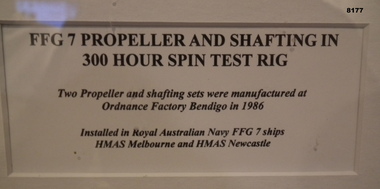
Photograph - PROPELLOR WORKS, FRAMED, Ordnance Factory Bendigo, C.1986
... Framed colour photo, brown timber frame with photo in a white inset, the photo shows a ships shaft and propellors under going a 300 hour spin test inthe Ordnance Factory Bendigo, under the photo is a description detail of the test procedure, where built and for which RAN ships....Brsl smirsl bdrslinc Framed colour photo, brown timber frame with photo in a white inset, the photo shows a ships shaft and propellors under going a 300 hour spin test inthe Ordnance Factory Bendigo, under the photo is a description detail of the test procedure, where built and for which RAN ships. ...This item is on display in the Bistro area of the Bendigo District RSL Havilah Road. Refer Cat No 8173.2 for an actual propellor in the same venue. Due to the position and light a good photo was not possible.Framed colour photo, brown timber frame with photo in a white inset, the photo shows a ships shaft and propellors under going a 300 hour spin test inthe Ordnance Factory Bendigo, under the photo is a description detail of the test procedure, where built and for which RAN ships.brsl, smirsl, bdrslinc -
 Cheese World Museum
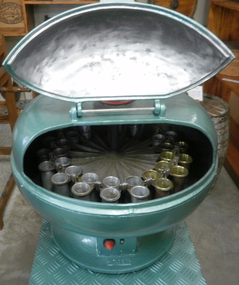
Centrifuge, electric
... Inside houses a spinning rotor with 20 test tube holders around the outside in two circular rows....(Babcock Test http://www.en.wikipedia.org/wki/Babcock_test 31 March 2009) allansford dairy manufacturing milk testing Babcock test Babcock, Stephen Moulton butter warrnambool cheese and butter factory company 7173 BABCOCKTESTER 190 Round green metal container with opening lid. Inside houses a spinning ...This Babcock tester was used in the laboratory at the Kraft cheese factory, Allansford. When it was superseded it was passed to one of the users of the machine, Les O'Callaghan, president of the Warrnambool & District Historical Society who placed it in the historical society collection. In 2009 when the historical society premises were upgraded there was insufficient room to store the tester so it was donated to Cheese World Museum. The machine was used to test the butterfat content of milk. Prior to dairy factories coming into existence farmers made butter individually on farms. There was no need for milk testing until farmers supplied factories for payment. Payment was based on a gallon of milk weighing 10lbs (pounds) and this led to richer milk, containing a high degree of butterfat for use in buttermaking, being paid at the same rate as lesser quality milk. In 1890 Stephen Moulton Babcock, an American professor at the University of Wisconsin-Madison, developed a method of determining the amount of butterfat in milk, thus providing a standardised and fairer system for payment. Babcock Test Process 1. 18 grams of milk (17.6ml) was put into a test tube 2. The same amount of sulphuric acid was added 3. A centrifuge at 50ºC was rotated at more than 900 revs per minute 4. The fat floating on top of the liquid in the test tube was measured The Babcock Test provided fairer compensation to farmers and also helped produce a consistent product for consumers. It also allowed for selective breeding when dairy herd testing evolved. ‘The Babcock Test is so simple that it can be used by any careful person, and it is inexpensive to operate. From the very beginning it was so complete in every detail that no change has had to be made in it.’ (Babcock Test http://www.en.wikipedia.org/wki/Babcock_test 31 March 2009) Round green metal container with opening lid. Inside houses a spinning rotor with 20 test tube holders around the outside in two circular rows.7173 BABCOCKTESTER 190allansford, dairy manufacturing, milk testing, babcock test, babcock, stephen moulton, butter, warrnambool cheese and butter factory company -
Moorabbin Air Museum
Document - Wamira NIA E-1 Drawings and documents
... NIA E-1 Wamira File ref A2/50 RAAF BPTA Phase II wind tunnel tests, dynamic spin model tests may/June 1984 AR-002-924 aerodynamics technical memorandum 343 AR-002-948 structures note 486 AR-002973 structures note 490 ARL/SM 353 structures and materials report 353 ARL/SM 324 structures and materials note 324 AR-003-933 Aerodynamics Technical Memorandum 357 Part 3 AR-002-982 Structures note 491 AR-003-018 Aerodynamics technical memorandum 362 AR-003-993 structures technical memorandum 399 AR-002-987 structures technical memorandum 366 AR-004-003 structures technical memorandum 357 Part 4 R-002-983 structures technical memorandum 357 GAF Standard practices and operating procedures manual Vol 1 and 2 AK-033-D Structural design criteria ...NIA E-1 Wamira File ref A2/50 RAAF BPTA Phase II wind tunnel tests, dynamic spin model tests may/June 1984 AR-002-924 aerodynamics technical memorandum 343 AR-002-948 structures note 486 AR-002973 structures note 490 ARL/SM 353 structures and materials report 353 ARL/SM 324 structures and materials note 324 AR-003-933 Aerodynamics Technical Memorandum 357 Part 3 AR-002-982 Structures note 491 AR-003-018 Aerodynamics technical memorandum 362 AR-003-993 structures technical memorandum 399 AR-002-987 structures technical memorandum 366 AR-004-003 structures technical memorandum 357 Part 4 R-002-983 structures technical memorandum 357 GAF Standard practices and operating procedures manual Vol 1 and 2 AK-033-D Structural design criteria Document Wamira NIA E-1 Drawings and documents ... -
 City of Moorabbin Historical Society (Operating the Box Cottage Museum)
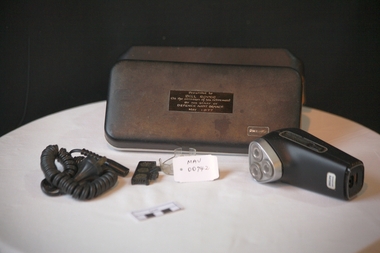
Personal Effects. 'Philips" electric Shaver, c1977
... As a spin off from the light bulb and research is the dynamo-powered bicycle lamp. Its rotating power system inspires the Philishave triple head electric razor. A triple-head model was test...As a spin off from the light bulb and research is the dynamo-powered bicycle lamp. Its rotating power system inspires the Philishave triple head electric razor. A triple-head model was test ...Established in 1891 in Eindhoven, the Netherlands, Philips & Co. was founded to meet the growing demand for light bulbs following the commercialization of electricity. Science and technology underwent tremendous development in the 1940s and 1950s, with Philips Research inventing the rotary heads that led to the development of the Philishave electric shaver, and laying down the basis for later ground-breaking work in transistors and integrated circuits.Philishave was the brand name for the electric shavers manufactured by the Philips Domestic Appliances and Personal Care unit of Philips They used the Philishave brand name for their shavers from 1939 to 2006. The Philishave shaver was invented by Philips engineer Alexandre Horowitz, who used rotating cutters instead of the reciprocating cutters that had been used in previous electric shavers. The shaver was introduced in 1939, though initial production was limited due to the outbreak of World War II. A more ergonomic egg-shaped single-head model was introduced in 1948 and was designed by US industrial designer Raymond Loewy. Global sales increased markedly after a double-head model was introduced in 1951. As a spin off from the light bulb and research is the dynamo-powered bicycle lamp. Its rotating power system inspires the Philishave triple head electric razor. A triple-head model was test marketed in Australia and New Zealand in 1956, but would not be introduced globally until 1966. The brand name Philishave was phased out in 2006 so shavers now bear only the Philips name. Mr Alfred William ( Bill ) Roper, 1913 - 1996 grew up in Ripponlea, ( East St Kilda ) Victoria. As a child he went with his father Arthur Leopold Roper to purchase vegetables from the Moorabbin Chinese market gardeners at the Hotham St. / Nepean Highway corner. c1920 . Bill served in WW2 in New Guinea and post war was Army Auditor, Victoria Barracks, St Kilda Road Melbourne. His staff presented this 'Philishave upon his retirement and he used it until his death1996. He lived in Carlton, Belgrave, Ascot Vale, South Yarra, East St Kilda and moved to Bentleigh in 1987.A ‘Philishave’ triple head electric razor , with cord, head protector and cleaning brush in a hinged plastic case The case has compartments, for Razor and cord, that are lined with a mustard coloured, soft, synthetic material .Case top PHILIPS ; inside EXCLUSIVE PHILISHAVE Razor Handle front PHILIPS / PHILISHAVE; back Type HP 1121/ 110-130V/ 220-240 V / PHILIPS Shield / ? Shield / BS 3456 / V 75255 / MADE IN HOLLAND Nameplate Presented to / BILL ROPER / On the occasion of his retirement / BY THE STAFF OF / DEFENCE AUDIT BRANCH / May 1977 philishave, royal philips electric company, razors, electric razors, bentleigh, moorabbin, market gardeners, st kilda markets, world war 2 1939-1945, department of defence melbourne, melbourne, roper alfred william, roper arthur leopold, ripponlea, chinese market gardeners -
 Blackburn Cricket Club
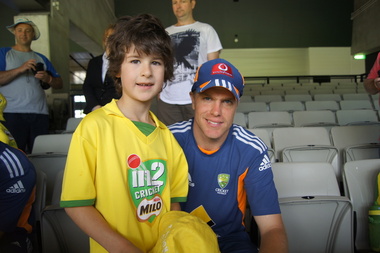
Sam Montgomery meets Michael Beer at MCG
... Michael is a Victorian spin bowler who went on to play his first test match for Australia in Perth during the 2010-11 series....Michael is a Victorian spin bowler who went on to play his first test match for Australia in Perth during the 2010-11 series. ...On 24 December 2010 Sam Montgomery was one of the Blackburn Milo in2 Cricket kids fortunate enough to meet Michael Beer. Michael is a Victorian spin bowler who went on to play his first test match for Australia in Perth during the 2010-11 series. -
 Kiewa Valley Historical Society
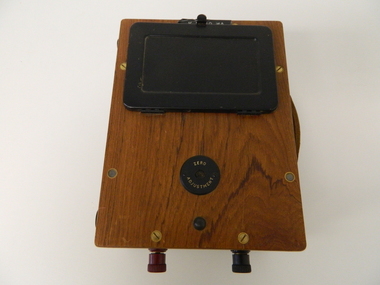
Meter Millivolt, after 1950
... testing instruments were either sourced from Europe or England. This milli-volt meter is very significant to the Kiewa Valley as it was used by those electrical technicians, who were part of the Kiewa Hydro Scheme. An "off spin ...This milli-volt meter was manufactured after 1950 and used by the SEC Vic (Kiewa Hydro Electricity Scheme) from that date until late 1900's. It was used to measure very small voltages associated with the operation of the various Hydro Generators. The readings were able to be shown by the resistor in use in the current circuit. During this time period, high quality testing instruments were either sourced from Europe or England.This milli-volt meter is very significant to the Kiewa Valley as it was used by those electrical technicians, who were part of the Kiewa Hydro Scheme. An "off spin" from the Scheme was the beginning of an explosion in "human" resources into the Kiewa Valley. This influx of population transformed the region from that of a basically quiet rural region to one which evolved into both industrial and larger residential community. This evolution in the Kiewa Valley created a change, not only in the "physical" landscape(better roads and infrastructure), but also the socio-economic growth within the Valley allowing other "tourist" based industries to expand within the valley and Alpine areas.This millivolts DC meter was used in the 1950's. It is contained in a wooden box and has two coloured (red/black, positive and negative) screw tight knobs which have bake-lite connections. It also has a covered (black tin) view meter marked from zero to 10 millivolts. Underneath this and within a round bake-lite is a small adjustment screw. The top of the box is fastened onto the main structure by six brass screws. The back of the structure is fastened by eight brass screws and there are four small bake-lite rest knobs.On the face of the millivolt compartment , and at the top "TO BE USED WITH DIAL HORIZONTAL TEMP. COEF. +- .08 % PER oC. Underneath the scale "MILLIVOLTS D.C. F.G." (LEAD RESIS. .05 OHMS)" underneath and to the left "MADE IN ENGLAND BY" "EVERSHED & VIGNOLES Ltd" and to the right "No. 857842" underneath Regd. TRADE MARK MEGGERkiewa valley tourism, victorian alps, alternate energy supplies, alpine population growth -
 National Wool Museum
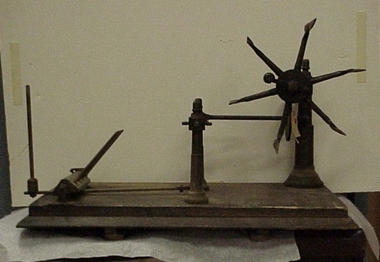
Machine - Wrap Reel
... "Wrap reels were used to check the yarn count in a spinning mill. A set length of yarn was wound off several test bobbins and weighed, if the weight was not the correct amount expected the spinning machines draft could be re calculated and the machine draft wheel ( cog ) changed to achieve the required count". - Greg Aldridge..."Wrap reels were used to check the yarn count in a spinning mill. A set length of yarn was wound off several test bobbins and weighed, if the weight was not the correct amount expected the spinning machines draft could be re calculated and the machine draft wheel ( cog ) changed to achieve the required count". - Greg Aldridge Textile Machinery Textile Production Weaving Valley Worsted Mill Valley Worsted Mill Warping Machinery Textile Machinery Textile Production Weaving wrap reel skein winder MAKERS/ VWM A small hand operated wrap reel. ...Wrap reel manufactured at Valley Worsted Mill and possibly used in the laboratory. "Wrap reels were used to check the yarn count in a spinning mill. A set length of yarn was wound off several test bobbins and weighed, if the weight was not the correct amount expected the spinning machines draft could be re calculated and the machine draft wheel ( cog ) changed to achieve the required count". - Greg AldridgeA small hand operated wrap reel. The reel is on a wooden base, the winding mechanism is metal and turned by a wooden handle. There is a metal plaque on the base inscribed MAKERS VWM. A wood and metal yarn feeder has broken off its mount.MAKERS/ VWMtextile machinery textile production weaving, valley worsted mill valley worsted mill, warping machinery, textile machinery, textile production, weaving, wrap reel, skein winder -
National Wool Museum
Book, Surprise and Enterprise: fifty years of science for Australia
... Looks at various scientific developments made by CSIRO over the past 50 years, including advances in measuring wool, spinning, processing and sheep breeding. Wool Growing Sheep breeding Textile Finishing Textile Testing CSIRO Spinning Wool Growing Sheep breeding Textile Finishing Textile Testing Surprise and Enterprise: fifty years of science for Australia Book ..."Surprise and Enterprise: fifty years of science for Australia" Andrew McKay, CSIRO, 1977. First published in 1976 and reprinted in 1977. Looks at various scientific developments made by CSIRO over the past 50 years, including advances in measuring wool, spinning, processing and sheep breeding.wool growing sheep breeding textile finishing textile testing, csiro, spinning, wool growing, sheep breeding, textile finishing, textile testing -
 National Wool Museum
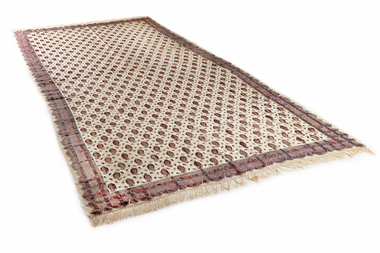
Clothing - Paisley Shawl, 1800 - 1830
... spinning master, timekeeper and pay clerk at the Victorian Woollen Mill (later the Godfrey Hirst Excelsior Number Two mill) and together with William Cook owned a wool scour on the Barwon River at Marnockvale. William’s grandson Arthur (1917-1992) was a wool classer undertaking his course at the Gordon Institute and became a wool valuer at Strachan & Co. For a time he taught part time in the Gordon course. Arthur’s son Robert was also a wool classer and worked at the Australian Wool Testing...spinning master, timekeeper and pay clerk at the Victorian Woollen Mill (later the Godfrey Hirst Excelsior Number Two mill) and together with William Cook owned a wool scour on the Barwon River at Marnockvale. William’s grandson Arthur (1917-1992) was a wool classer undertaking his course at the Gordon Institute and became a wool valuer at Strachan & Co. For a time he taught part time in the Gordon course. Arthur’s son Robert was also a wool classer and worked at the Australian Wool Testing ...Shawl of Jane Francis (nee Piper) 1809-1891 This fine woven silk and woollen shawl is from Shetland, Scotland and belonged orginally to Jane Francis. Jane was born in Devon near the village of Bradworthy. She married Joseph Francis (1803-1878) in 1830 in the Bradworthy Parish, Devon, England and wore the shawl over her wedding dress on her wedding day. Jane and Joseph came to Geelong in 1853 with their family. Jane’s sister and brother were in Geelong and their eldest daughter Elizabeth had arrived in 1849. They arrived on the ship 'Euphemus' at Point Henry, Geelong, on July 20, 1853 and travelled across the bay in the steamer Duncan Hoyle. Jane was wearing the shawl on her arrival in Geelong. They went to live in Sharp Street Chilwell in a house owned by their son in law, John Price, which they later purchased. Jane became well known as a ‘midwife’ having had 10 children of her own. She is known to have delivered twin girls in Fyans Street; Ada and Myrtle Downie in 1884. Jane’s youngest son William (1848-1932) was a spinning master, timekeeper and pay clerk at the Victorian Woollen Mill (later the Godfrey Hirst Excelsior Number Two mill) and together with William Cook owned a wool scour on the Barwon River at Marnockvale. William’s grandson Arthur (1917-1992) was a wool classer undertaking his course at the Gordon Institute and became a wool valuer at Strachan & Co. For a time he taught part time in the Gordon course. Arthur’s son Robert was also a wool classer and worked at the Australian Wool Testing Authority. The shawl was used as a bed spread at 'Woodstock' by Jane's son William and then by his two children Laura and Eve. After their deaths, Eve in 1947 and Laura in 1963, the shawl was passed to their youngest sister Ethel (Effie) Frier (nee Francis). She had no children and it was passed on to grandniece Pat Norman (nee Hughan). Pat then passed the shawl to cousin Carollyn Williams (nee Francis) who donated the shawl to the National Wool Museum. - Donor, 2026 The Francis family were tenant farmers, and the donor speculated that the shawl could potentially have been a wedding gift from the land owners.Wool and silk fringed cream coloured shawl featuring a paisley pattern in tones of maroon, green, blue, brown and cream.shawl, 19th century, fashion, clothing, design, paisley, migration, geelong, point henry -
 National Wool Museum
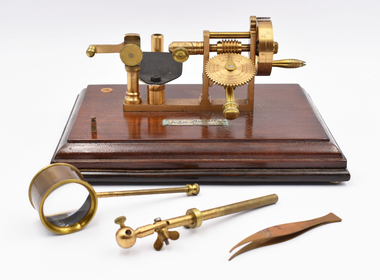
Functional object - Yarn Spinner and Accessories, John Nesbitt, 19th Century
... Although Nino has now retired from his honorary position and has hung up his Australian Tartan vest, these items will continue to serve the community in sharing the stories of Australian Textile design. apparatus textile testing spinning nino corda magnifyer tools brass mahogany tweezers yarn spinner design john nesbitt manchester england 19th Century engineering manufacturing Brass plaque on base of spinner: 42 MARKET St / John Nesbitt / REGd TRADE MARK / LIMd / MANCHESTER Underside of wooden plinth: 4976 Custom made wooden hinged box with a hook latch. ...Nino Corda was a Geelong based textile designer who worked at various textile mills between 1957 & 2003. He travelled the world in search of the latest fashions and techniques and developed timeless designs that were much loved by Australians. These items are on rotational display at the National Wool Museum’s ‘In the Factory’ exhibition. For many years, Nino also worked as part of the Honorary Staff of the National Wool Museum. His passion for the world of textiles provided energy and knowledge to the visitors and staff of the museum. Although Nino has now retired from his honorary position and has hung up his Australian Tartan vest, these items will continue to serve the community in sharing the stories of Australian Textile design.Custom made wooden hinged box with a hook latch. Brass yarn spinner, attached to a mahogany wood plinth base, which spins fibre into cord/yarn/thread. It has dials to set the rate that it spins. Metal plaque with black inlaid enamel lettering. Small cork inlay. Brass rod with hinge and wingnut, and ball at end. Ball at end has an adjustment mechanism. Rod also has an adjustable circular collar. Pair of curved tweezers. Circular magnifying glass on long thin handle. Glass has two concave lenses. Weaving sample in shades of blue, green and brown. Twill weave. Alternate pattern samples separated by red thread.Brass plaque on base of spinner: 42 MARKET St / John Nesbitt / REGd TRADE MARK / LIMd / MANCHESTER Underside of wooden plinth: 4976apparatus, textile, testing, spinning, nino corda, magnifyer, tools, brass, mahogany, tweezers, yarn, spinner, design, john nesbitt, manchester, england, 19th century, engineering, manufacturing -
 Sunshine and District Historical Society Incorporated
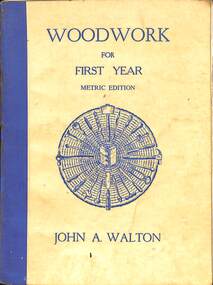
Book - Woodwork For First Year, John A. Walton, 1966
... test questions are included to assist students in revising each topic. Front Cover - Woodwork for First Year Metric Edition John A. Walton Inside Front Cover - Handwritten Adrian Wlodarczyk Cream soft covered book with blue spins and blue text Woodwork For First Year Book Woodwork For First Year John A. ..."Woodwork for First Year" is based on the Syllabus requirements in Woodworking Theory for First Year classes following the Syllabus of Courses in Woodwork complied by the Board of Secondary School Studies for the New South Wales Department of Education. "Woodwork for First Year" covers the First-Year Woodwork course in 26 lessons. Home-study and test questions are included to assist students in revising each topic.Cream soft covered book with blue spins and blue textnon-fiction"Woodwork for First Year" is based on the Syllabus requirements in Woodworking Theory for First Year classes following the Syllabus of Courses in Woodwork complied by the Board of Secondary School Studies for the New South Wales Department of Education. "Woodwork for First Year" covers the First-Year Woodwork course in 26 lessons. Home-study and test questions are included to assist students in revising each topic. -
Moorabbin Air Museum
Document (Item) - RAAF ARDU Flight Test Report Macchi MB326H Spinning Characteristics by GJ Simpson
... RAAF ARDU Flight Test Report Macchi MB326H Spinning Characteristics by GJ Simpson Document RAAF ARDU Flight Test Report Macchi MB326H Spinning Characteristics by GJ Simpson ... -
 City of Melbourne Libraries
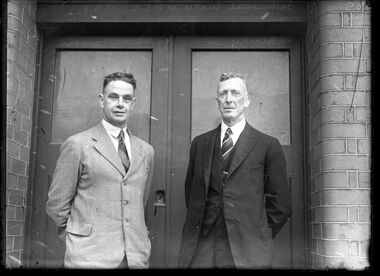
Photograph, Bull, Hugh Jones, 1897-1993, Bert Ironmonger and Don Blackie, Testimonial Cricket at MCC
... spin twins” in real life, born just two days apart. Dainty and Rock had an “average” age of 51 years and 273 days when photographed outside the Melbourne Cricket Club on the eve of their joint Testimonial Match on 16 November 1933. Blackie, a PMG linesman by trade, was nicknamed “Rock” because that’s what he’d call people when he inevitably forgot their names. Ironmonger, employed for over 30 years by St Kilda Council as a gardener, was nicknamed “Dainty” because he wasn’t! These men were famous for making their Test...spin twins” in real life, born just two days apart. Dainty and Rock had an “average” age of 51 years and 273 days when photographed outside the Melbourne Cricket Club on the eve of their joint Testimonial Match on 16 November 1933. Blackie, a PMG linesman by trade, was nicknamed “Rock” because that’s what he’d call people when he inevitably forgot their names. Ironmonger, employed for over 30 years by St Kilda Council as a gardener, was nicknamed “Dainty” because he wasn’t! These men were famous for making their Test ...Ironmonger and Blackie BERT “DAINTY” IRONMONGER (1882-1971) and DON “ROCK” BLACKIE (1882-1955), the legendary off-spin bowlers, were “spin twins” in real life, born just two days apart. Dainty and Rock had an “average” age of 51 years and 273 days when photographed outside the Melbourne Cricket Club on the eve of their joint Testimonial Match on 16 November 1933. Blackie, a PMG linesman by trade, was nicknamed “Rock” because that’s what he’d call people when he inevitably forgot their names. Ironmonger, employed for over 30 years by St Kilda Council as a gardener, was nicknamed “Dainty” because he wasn’t! These men were famous for making their Test Cricket debuts when they were 46 years, 237 days old (Dainty) and 46 years, 252 days old (Rock). Whilst they only played one Test together, they were selected 24 times in the same Victorian team. It is no coincidence that the golden era of Victorian cricket coincided with their tenure. They played with St Kilda Cricket Club for nine seasons and the grandstand at Junction Oval bears the “Blackie-Ironmonger” name to this day. When on interstate tours, they shared a hotel room, where they plotted the downfall of their batting opponents. Their joint Testimonial Match was played over four days and featured all-star line-ups from three states. The opposing teams were captained by Bill “Wormkiller” Woodfull (memorial statue at Melbourne High School) and Vic “The Guardsman” Richardson (memorial gates at Adelaide Oval). The serious first class game attracted over 40,000 spectators and raised £908 for each man, around $45,000 in today’s money. In a game featuring la crème de la crème of contemporary batsmen – Bill “Ponny” Ponsford, Don “The Don” Bradman, Stan “Napper” McCabe et al – and all time doyens of the art of spin bowling – Clarrie “The Gnome” Grimmett, Bill “Tiger” O’Reilly and “Chuck” Fleetwood Smith – “Rock” topped his side of the bowling scorecard, picking up the best bowling figures of 3 for 69! Unhappily, Dainty’s old knee injury reoccurred and he had to sit out the last two days of play. Featured in "Newsworthy: Melbourne in photographs 1933-1936" exhibition at East Melbourne Library, October to December 2023. Exhibition caption by project volunteer, Ernie Ward. Photographer notations on slide: "Testimonial Cricket at MCC 1933 Blackie Ironmonger B9".cricket
