
Showing 102 items matching "spinning and weaving"
-
 National Wool Museum
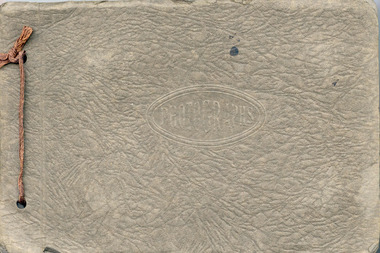
Photograph Album, The Valley Worsted Mills, Geelong
... ...Weaving...Worsted spinning at the Valley Mill, Geelong, c.1920s. ...PHOTOGRAPHS THE / VALLEY WORSTED MILLS / GEELONG WOOL SORTING / WOOL SCOURING / WOOLLEN CARDING / WORSTED CARDING / COMBING & DRAWING / WOOLLEN SPINNING / WORSTED SPINNING / WINDING / WARPING / WEAVING / MENDING / WET FINISHING / DRY FINISHING / WAREHOUSE C.J. ...Textile Mills warehouses Weaving Textile Production Textile Mills Valley Worsted Mill Scouring Carding Combing Drawing Spinning Winding Warping Wet finishing Mending Milling Dry finishing Textile Mills - warehouses PHOTOGRAPHS THE / VALLEY WORSTED MILLS / GEELONG WOOL SORTING / WOOL SCOURING / WOOLLEN CARDING / WORSTED CARDING / COMBING & DRAWING / WOOLLEN SPINNING / WORSTED SPINNING / WINDING / WARPING / WEAVING / MENDING / WET FINISHING / DRY FINISHING / WAREHOUSE C.J. ...Photograph album containing 15 photographs of the textile processes which took place at the Valley Worsted Mill which was established in 1923.Photograph album contains 15 photographic postcards of textile processes from the Valley Mill, c.1920s. Valley Mill, Geelong, c.1920s. Wool sorting at the Valley Mill, Geelong, c.1920s. Wool scouring at the Valley Mill, Geelong, c.1920s. Woollen carding at the Valley Mill, Geelong, c.1920s. Worsted carding at the Valley Mill, Geelong, c.1920s. Combing and drawing at the Valley Mill, Geelong, c.1920s. Woollen spinning at the Valley Mill, Geelong, c.1920s. Worsted spinning at the Valley Mill, Geelong, c.1920s. Winding at the Valley Mill, Geelong, c.1920s. Warping at the Valley Mill, Geelong, c.1920s. Weaving at the Valley Mill, Geelong, c.1920s. Mending at the Valley Mill, Geelong, c.1920s. Wet finishing at the Valley Mill, Geelong, c.1920s. Dry finishing at the Valley Mill, Geelong, c.1920s. Warehouse at the Valley Mill, Geelong, c.1920s.PHOTOGRAPHS THE / VALLEY WORSTED MILLS / GEELONG WOOL SORTING / WOOL SCOURING / WOOLLEN CARDING / WORSTED CARDING / COMBING & DRAWING / WOOLLEN SPINNING / WORSTED SPINNING / WINDING / WARPING / WEAVING / MENDING / WET FINISHING / DRY FINISHING / WAREHOUSE C.J. Frazer Photographer / Melbournetextile mills warehouses, weaving, textile production, textile mills, valley worsted mill, scouring, carding, combing, drawing, spinning, winding, warping, wet finishing, mending, milling, dry finishing, textile mills - warehouses -
 National Wool Museum
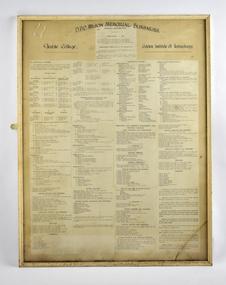
Photograph - Framed Printed Coursework, Gordon Institute of Technology, Textile College, 1950
... ...Weaving...The courses include Woolcombing, Worsted Spinning, Woollen Yarn Manufacture, Designing, Weaving and Turning and Finishing. ...The courses include Woolcombing, Worsted Spinning, Woollen Yarn Manufacture, Designing, Weaving and Turning and Finishing. ...Framed papers outlining the courses and coursework for the Textile College at the Gordon Institute of Technology in 1950. The courses include Woolcombing, Worsted Spinning, Woollen Yarn Manufacture, Designing, Weaving and Turning and Finishing. A digital copy of this item was made for the National Wool Museum Collection, with the original remaining with the donor. Digital TIFF file, 100 MB, showing image of framed printed paper.D.P.C. WILSON MEMORIAL BURSARIES. / Textile College / Gordon Institute of Technology. / GENERAL INFORMATION / TERM DATES 1950 ...courses, gordon institute of technology, textile college, geelong, woolclassing, weaving, spinning, coursework, 1950 -
 Whitehorse Historical Society Inc.
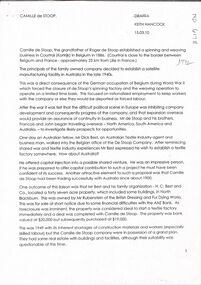
Document - Historical Resource, Camille de Stoop Textile Manufacture, 15/03/2010
... Story of the de Stoop family who established a cotton weaving and spinning business in Belgium, then moved the business to Blackburn North (photos yet to uploaded) and Wonthaggi....Story of the de Stoop family who established a cotton weaving and spinning business in Belgium, then moved the business to Blackburn North (photos yet to uploaded) and Wonthaggi. ...Story of the de Stoop family who established a cotton weaving and spinning business in Belgium, then moved the business to Blackburn North (photos NOT YET UPLOADED).Story of the de Stoop family who established a cotton weaving and spinning business in Belgium, then moved the business to Blackburn North (photos yet to uploaded) and Wonthaggi.Story of the de Stoop family who established a cotton weaving and spinning business in Belgium, then moved the business to Blackburn North (photos NOT YET UPLOADED).de stoop, camille, de stoop, roger, de stoop aust pty limited, best, richard, belgians in australia -
 National Wool Museum
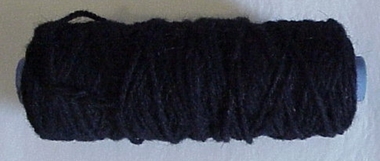
Yarn
... Weaving...Black wool yarn, possibly from the batch used to make the black and white National Wool Museum rug presented to Queen Elizabeth II in 1988. Weaving Spinning Black wool yarn, possibly from the batch used to make the black and white National Wool Museum rug presented to Queen Elizabeth II in 1988. ...Black wool yarn, possibly from the batch used to make the black and white National Wool Museum rug presented to Queen Elizabeth II in 1988.Black wool yarn, possibly from the batch used to make the black and white National Wool Museum rug presented to Queen Elizabeth II in 1988.weaving, spinning -
 National Wool Museum
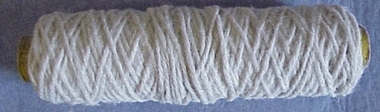
Yarn
... Weaving...Off-white wool yarn, possibly from the batch used to make the black and white National Wool Museum rug presented to Queen Elizabeth II in 1988. Weaving Spinning Off-white wool yarn, possibly from the batch used to make the black and white National Wool Museum rug presented to Queen Elizabeth II in 1988. ...Off-white wool yarn, possibly from the batch used to make the black and white National Wool Museum rug presented to Queen Elizabeth II in 1988.Off-white wool yarn, possibly from the batch used to make the black and white National Wool Museum rug presented to Queen Elizabeth II in 1988.weaving, spinning -
 Whitehorse Historical Society Inc.
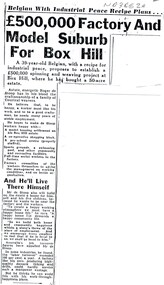
Article - Newspaper Clipppings, Worker's paradise factory at Blackburn, 1951 & 1988
... Belgian, Roger de Stoop, plans a spinning and weaving factory at Blackburn. ...Belgian, Roger de Stoop, plans a spinning and weaving factory at Blackburn. He plans many innovative amenities to keep his staff happy. ...'The Belgians in Australia' gives a brief history of Roger, 1950 - 1975.Belgian, Roger de Stoop, plans a spinning and weaving factory at Blackburn. He plans many innovative amenities to keep his staff happy. Also another article - 'The Belgians in Australia' gives a brief history of Roger, 1950 - 1975. 'The Belgians in Australia' gives a brief history of Roger, 1950 - 1975.textiles, de stoop textile factory, de stoop, roger -
 Kew Historical Society Inc
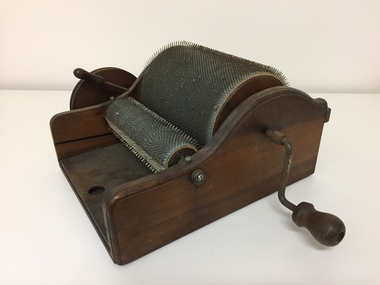
Equipment - Hand drum carder, Ertoel Wheels, 1980s
... Ertoel Wheels made a wide range of looms, chairs, drum and hand carders, and spinning and weaving accessories. ...Ertoel Wheels made a wide range of looms, chairs, drum and hand carders, and spinning and weaving accessories. wool carding drum carders carding equipment "Ertoel Wheels" Small drum carder, designed to be used on a table and operated by hand to card wool and or other fibres in preparing them for spinning or felting. ...Ertoel Wheels made a wide range of looms, chairs, drum and hand carders, and spinning and weaving accessories. Small drum carder, designed to be used on a table and operated by hand to card wool and or other fibres in preparing them for spinning or felting. This wooden carder has two cylindrical drums covered with coarse or fine metal “tines” designed to rake through and comb the natural fibre. The manufacturer's name 'Ertoel Wheels' is glued at one end"Ertoel Wheels"wool carding, drum carders, carding equipment -
 National Wool Museum
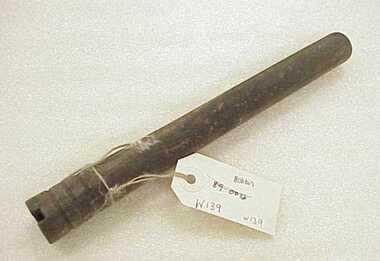
Bobbin
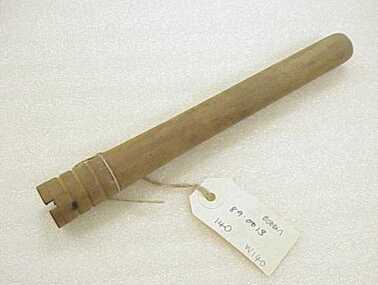
... ...Spinning...Bobbin, used on a spinning frame (See also Reg No 140) Handicrafts Weaving Spinning Handicrafts Weaving Bobbin ...Bobbin, used on a spinning frame (See also Reg No 140)handicrafts weaving, spinning, handicrafts, weaving -
 National Wool Museum
Bobbin
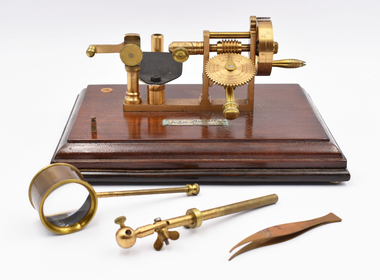
... ...Spinning...Wooden bobbin, used on a spinning frame Handicrafts Weaving Spinning Handicrafts Weaving Bobbin ...Wooden bobbin, used on a spinning framehandicrafts weaving, spinning, handicrafts, weaving -
 National Wool Museum
Functional object - Yarn Spinner and Accessories, John Nesbitt, 19th Century
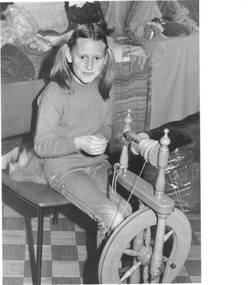
... Brass yarn spinner, attached to a mahogany wood plinth base, which spins fibre into cord/yarn/thread. It has dials to set the rate that it spins. ...Brass yarn spinner, attached to a mahogany wood plinth base, which spins fibre into cord/yarn/thread. It has dials to set the rate that it spins. ...Nino Corda was a Geelong based textile designer who worked at various textile mills between 1957 & 2003. He travelled the world in search of the latest fashions and techniques and developed timeless designs that were much loved by Australians. These items are on rotational display at the National Wool Museum’s ‘In the Factory’ exhibition. For many years, Nino also worked as part of the Honorary Staff of the National Wool Museum. His passion for the world of textiles provided energy and knowledge to the visitors and staff of the museum. Although Nino has now retired from his honorary position and has hung up his Australian Tartan vest, these items will continue to serve the community in sharing the stories of Australian Textile design.Custom made wooden hinged box with a hook latch. Brass yarn spinner, attached to a mahogany wood plinth base, which spins fibre into cord/yarn/thread. It has dials to set the rate that it spins. Metal plaque with black inlaid enamel lettering. Small cork inlay. Brass rod with hinge and wingnut, and ball at end. Ball at end has an adjustment mechanism. Rod also has an adjustable circular collar. Pair of curved tweezers. Circular magnifying glass on long thin handle. Glass has two concave lenses. Weaving sample in shades of blue, green and brown. Twill weave. Alternate pattern samples separated by red thread.Brass plaque on base of spinner: 42 MARKET St / John Nesbitt / REGd TRADE MARK / LIMd / MANCHESTER Underside of wooden plinth: 4976apparatus, textile, testing, spinning, nino corda, magnifyer, tools, brass, mahogany, tweezers, yarn, spinner, design, john nesbitt, manchester, england, 19th century, engineering, manufacturing -
 Box Hill Historical Society
Photograph - Box Hill Spinners and Weavers
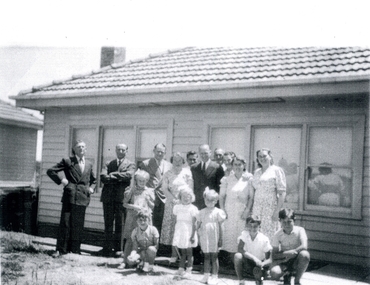
... ...Spinning...Box Hill Spinners and Weavers Craft equipment Spinning Weaving Craft working B&w photo Photograph Box Hill Spinners and Weavers ...Amanda Crowhurst engaged in spinning yarn at the Box Hill Spinners and Weaver Group.B&w photobox hill spinners and weavers, craft equipment, spinning, weaving, craft working -
 Whitehorse Historical Society Inc.
Photograph, Roger de Stoop and Belgian workers, C 1950
... Roger de Stoop came to Australia during the Second World War when the de Stoop spinning & weaving factory in Belgium was closed during the German occupation. ...Roger de Stoop came to Australia during the Second World War when the de Stoop spinning & weaving factory in Belgium was closed during the German occupation. ...Roger de Stoop came to Australia during the Second World War when the de Stoop spinning & weaving factory in Belgium was closed during the German occupation. He had previously met Dick Best, an Australian who wanted to establish a textile factory in Australia and in 1950 they built a factory at Blackburn North importing the weaving looms and many of their skilled workers from Belgium. Housing for the workers was built near the factory.Black and white photograph of Belgian family groups in front of one of the houses erected for the de Stoop workers. Roger de Stoop is in the centre of the photograph in a dark suit and tie.de stoop, roger. de stoop aust pty ltd. de stoop and best textile factory. weaving mills. belgians in australia -
 National Wool Museum
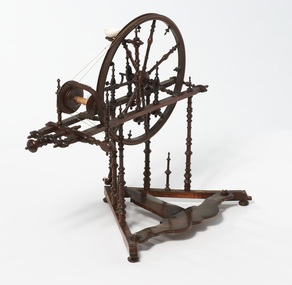
Spinning Wheel
... This wheel was purchased from Margaret and Joan Mellor who were well known in Melbourne as teachers of hand spinning and weaving....This wheel was purchased from Margaret and Joan Mellor who were well known in Melbourne as teachers of hand spinning and weaving. handicrafts - history flax spinning wheels highlights of the national wool museum: the zakrzewski spinning wheel collection - exhibition (28/07/2001 - 02/12/2001) zakrzewski mr wlodzimierz handicrafts - history flax Thirion / Villotte Part of the Zakrzewski Spinning Wheel collection. ...Part of the Zakrzewski Collection of spinning wheels donated to the National Wool Museum by Mr Wlodzimierz Zakrzewski. For many years, Mr Zakrzewski collected, researched and repaired spinning wheels from all over the world. This wheel is from Northern France-Flanders and was used for spinning flax to make the fine thread needed for lace making. It dates from the 19th century and bears the names Thirion and Villotte. Research by Mr Zakrzewski indicates that Villotte was a tiny village in the north of France and that Thirion is probably the name of the maker. This wheel was purchased from Margaret and Joan Mellor who were well known in Melbourne as teachers of hand spinning and weaving.Part of the Zakrzewski Spinning Wheel collection.Thirion / Villottehandicrafts - history flax, spinning wheels, highlights of the national wool museum: the zakrzewski spinning wheel collection - exhibition (28/07/2001 - 02/12/2001), zakrzewski, mr wlodzimierz, handicrafts - history, flax -
 Bendigo Historical Society Inc.
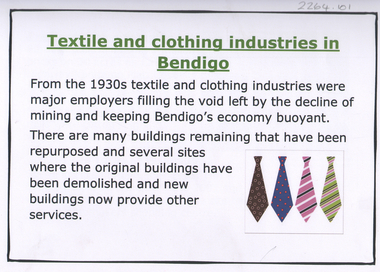
Booklet - Textile and Clothing Industries Bendigo, Barbara Poustie, Textile and clothing industries in Bendigo
... Companies described are: Bradford Cotton Spinning Mill The Bernardo and Lorenzo Banfi (BLB) Corporation Bendigo Woollen Mills Alexandra Knitting Mill Australian Consolidated Hosiery Victoria Carpets Strickland Road Perfectfit Hosiery Hitex Fashions Century Weaving Mills Perfectfit Clothing Co. ...Companies described are: Bradford Cotton Spinning Mill The Bernardo and Lorenzo Banfi (BLB) Corporation Bendigo Woollen Mills Alexandra Knitting Mill Australian Consolidated Hosiery Victoria Carpets Strickland Road Perfectfit Hosiery Hitex Fashions Century Weaving Mills Perfectfit Clothing Co. ...Ten page typed booklet, white paper, color photos, black spiral binding. On front cover: 'Textile and clothing industries in Bendigo'. Companies described are: Bradford Cotton Spinning Mill The Bernardo and Lorenzo Banfi (BLB) Corporation Bendigo Woollen Mills Alexandra Knitting Mill Australian Consolidated Hosiery Victoria Carpets Strickland Road Perfectfit Hosiery Hitex Fashions Century Weaving Mills Perfectfit Clothing Co. bradford cotton spinning mill, the bernardo and lorenzo banfi (blb) corporation, bendigo woollen mills, alexandra knitting mill, australian consolidated hosiery, victoria carpets strickland road, perfectfit hosiery, hitex fashions, century weaving mills, perfectfit clothing co., manufacturing, textile industry -
 National Wool Museum
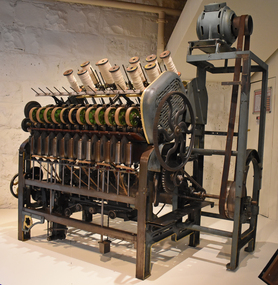
Machine - Cap Spinner, 1925
... They are then sent off for weaving and knitting....They are then sent off for weaving and knitting. weaving knitting cap spinning cap spinner machine textile industry factory Cap spinning machine. ...This cap spinner squeezes the thread under the stationary cap and winds them onto the bobbin. Spinning transforms tops into yarns. The tops are pulled out into fine strands known as rovings. They are then twisted to bind the thread together to give the yarn greater strength. The yarns are wound into differently shaped tools. They are then sent off for weaving and knitting.Cap spinning machine.weaving, knitting, cap spinning, cap spinner, machine, textile industry, factory -
 National Wool Museum
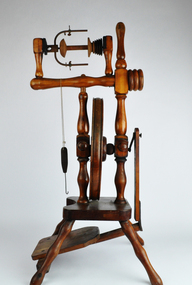
Tool - Spinning Wheel, c.1980
... Moving to Melbourne to get away from the scene of much pain, Gill was also in need of a new hobby to help occupy her mind. That is when spinning and weaving entered her life. The local Spinners and Weavers Guild was a great support network for her and with their recommendation, she purchased her own spinning wheel. ...Moving to Melbourne to get away from the scene of much pain, Gill was also in need of a new hobby to help occupy her mind. That is when spinning and weaving entered her life. The local Spinners and Weavers Guild was a great support network for her and with their recommendation, she purchased her own spinning wheel. ...This spinning wheel originates from New Zealand; however, it has no distinguishing features relating to its creator such as an inscription, so its exact maker is not known. Gill Stange remembers buying the wheel on Bridge Road in Richmond, approximately 30 years ago. Gill had joined her local Spinners and Weavers Guild after the Ash Wednesday bushfires of 1983. She was a then resident of Mount Macedon and lost everything in the fires. Moving to Melbourne to get away from the scene of much pain, Gill was also in need of a new hobby to help occupy her mind. That is when spinning and weaving entered her life. The local Spinners and Weavers Guild was a great support network for her and with their recommendation, she purchased her own spinning wheel. Her passion was started, and the wheel was to become a treasured item in Gill’s home. She had several spinning wheels within her possession over the years, however, this wheel was her first and always her favourite. When the time came for Gill to downsize, there was simply no longer room for her spinning wheel. This is when she decided to donate the wheel to the National Wool Museum. Gill remembers one highlight was weaving a tablecloth from a traditional German design. It took her two years to complete, with Gill spinning all the wool herself on this wheel. The tablecloth won the first prize in the Melbourne Show in 1987. Gill also used the wheel to teach programs to school children on how to spin and knit wool. She would take the easily transported little wheel, and its accompanying seat, with her to schools. Its small size enabled her to teach children to knit and spin, bringing others the joy that spinning had brought her. Not just limited to schools, Gill also taught programs with the wheel here at the National Wool Museum. It is a fitting home for the wheel, which Gill donated to the National Wool Museum in 2021.Dark varnished wood in a Castle style spinning wheel. The wheel has 8 small spokes which meet a thick outside rim. The outside rim has four golden disc weights on the bottom edge, to aid in the turning of the wheel. The spinning wheel has four legs of turned wood giving a sculptural form, a design pattern which is continued throughout. The wheel has a single medium sized foot pedal. This pedal is well worn with varnish missing from years of use. The wheel is completed with its accompanying chair. Made of the same dark varnished wood, its legs are also of turned wood, continuing the design pattern and uniting the two objects. The chair is very simple outside of the legs, with a medium size base and a thin backrest ending in a rounded head. The chair’s varnish is also starting to fade from years of use. The chair is small, designed to keep the spinning wheel operator at the appropriate height when spinning on the equally small and compact Castle style spinning wheel. Additional parts were donated with the Spinning Wheel. - 3 x Lazy Kates - Spare Maiden. - 450mm Niddy Noddy - Steel teeth brushspinning wool, spinning wheel, ash wednesday, mount macedon, textile production -
 National Wool Museum
Clothing - Suit, 1987
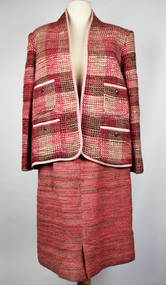
... The jacket had commercially brought warp and hand spun weft in twill on a 24” loom. All spinning, dyeing and weaving was by Jean Inglis of Geelong. ...The jacket had commercially brought warp and hand spun weft in twill on a 24” loom. All spinning, dyeing and weaving was by Jean Inglis of Geelong. ...Hand spun, hand dyed, hand woven and hand sewn suit which won best garment in the 1987 Geelong show. Size 12 in a design by Chanel. It was spun with variegated natural greys on a Sheridan horizontal spinning wheel. It was then dyed pink using natural dyes. The jacket had commercially brought warp and hand spun weft in twill on a 24” loom. All spinning, dyeing and weaving was by Jean Inglis of Geelong. The suit was sewn by Caroline Mogic of Geelong, with iron on interfacing, commercially brought trim. It was worn only once in the parade at the Geelong show. The pink suit jacket has four pockets with gold buttons on front, size 12. The jacket has a checker-plate pattern in which the predominate pink is always present and is accompanied in areas which have grey or white showing through the pink. This checker plate pattern continues down the sleeves of the jacket. The edge of the jacket has a lighter pink trim. A pink skirt accompanies the suit jacket. It has horizontal lines with pink as the predominate colour and areas of grey and white showing through in sections. geelong show, hand spun, hand dyed, hand woven, hand sewn, channel -
 National Wool Museum
Book, Sonya's Mob: the life and times of a Polish-Australian family
... ...Spinning...Inludes information about her husband, Wlodek Zakrzewski who made and repaired spinning wheels. Weaving Textile Art Spinning Spinning wheels Carrington wheel Carrington-Zakrzewska Mrs Sonya Zakrzewski Mr Wlodzimierz Weaving Textile Art To the National Wool Museum / with our best wishes / Lois Carrington / George Carrington Sonya's Mob: the life and times of a Polish-Australian family Book ..."Sonya's Mob: the life and times of a Polish-Australian family" - Lois and George Carrington, Canberra, 1996 (self published). Includes a seperately printed index and location guide to Sonya Carrington's khilims. Biography of Sonya Carrington-Zakrzewska, artist and weaver. Inludes information about her husband, Wlodek Zakrzewski who made and repaired spinning wheels.To the National Wool Museum / with our best wishes / Lois Carrington / George Carringtonweaving textile art, spinning, spinning wheels, carrington wheel, carrington-zakrzewska, mrs sonya zakrzewski, mr wlodzimierz, weaving, textile art -
 National Wool Museum
Trousers
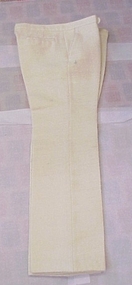
... ...Spinning...Part of the three piece suit which set the "Sheep to suit" record by Melbourne College of Textiles in 1982 Textile Production Fashion Shearing Weaving Sewing Melbourne College of Textiles Australian Wool Corporation Sunbeam Corporation Limited Spinning Highlights of the National Wool Museum: from Sheep to Suit - Exhibition (22/09/2001 - 02/12/2001) Textile Production Fashion Shearing Weaving Sewing A product of the Clothing School, MELBOURNE COLLEGE OF TEXTILES/ PURE WOOL Part of the 'Sheep to Suit' event outfit. ...Suit pants, cream, natural, wool. Part of the three piece suit which set the "Sheep to suit" record by Melbourne College of Textiles in 1982Part of the 'Sheep to Suit' event outfit.A product of the Clothing School, MELBOURNE COLLEGE OF TEXTILES/ PURE WOOLtextile production fashion shearing weaving sewing, melbourne college of textiles australian wool corporation sunbeam corporation limited, spinning, highlights of the national wool museum: from sheep to suit - exhibition (22/09/2001 - 02/12/2001), textile production, fashion, shearing, weaving, sewing -
 National Wool Museum
Vest
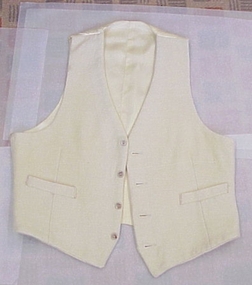
... ...Spinning...Textile Production Fashion Shearing Weaving Sewing Melbourne College of Textiles Australian Wool Corporation Sunbeam Corporation Limited Spinning Highlights of the National Wool Museum: from Sheep to Suit - Exhibition (22/09/2001 - 02/12/2001) Textile Production Fashion Shearing Weaving Sewing Part of the 'Sheep to Suit' event outfit. ...Suit vest, cream, natural, wool and cream silk. Part of the three piece suit which set the "Sheep to suit" record by Melbourne College of Textiles in 1982.Part of the 'Sheep to Suit' event outfit.textile production fashion shearing weaving sewing, melbourne college of textiles australian wool corporation sunbeam corporation limited, spinning, highlights of the national wool museum: from sheep to suit - exhibition (22/09/2001 - 02/12/2001), textile production, fashion, shearing, weaving, sewing -
 National Wool Museum
Jacket
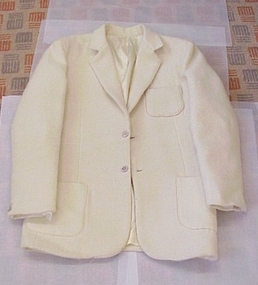
... ...Spinning...Part of the three piece suit which set the "Sheep to suit" record by Melbourne College of Textiles in 1982 Textile Production Fashion Shearing Weaving Sewing Melbourne College of Textiles Australian Wool Corporation Sunbeam Corporation Limited Spinning Highlights of the National Wool Museum: from Sheep to Suit - Exhibition (22/09/2001 - 02/12/2001) Textile Production Fashion Shearing Weaving Sewing A product of the Clothing School, MELBOURNE COLLEGE OF TEXTILES/ PURE WOOL Part of the 'Sheep to Suit' event outfit. ...Suit jacket, cream, natural, wool and cream silk lining. Part of the three piece suit which set the "Sheep to suit" record by Melbourne College of Textiles in 1982Part of the 'Sheep to Suit' event outfit.A product of the Clothing School, MELBOURNE COLLEGE OF TEXTILES/ PURE WOOLtextile production fashion shearing weaving sewing, melbourne college of textiles australian wool corporation sunbeam corporation limited, spinning, highlights of the national wool museum: from sheep to suit - exhibition (22/09/2001 - 02/12/2001), textile production, fashion, shearing, weaving, sewing -
National Wool Museum
Certificate
... ...Spinning..."Record certificate" - Guinness Superlatives Limited, 1982 , awarded to the Melbourne College of Textiles for breaking the record for a "three piece suit from sheep to wearer" Textile Production Fashion Shearing Weaving Sewing Melbourne College of Textiles Australian Wool Corporation Sunbeam Corporation Limited Spinning Highlights of the National Wool Museum: from Sheep to Suit - Exhibition (22/09/2001 - 02/12/2001) Textile Production Fashion Shearing Weaving Sewing GUINNESS SUPERLATIVES LIMITED/ RECORD CERTIFICATE/ This is to certify that...THE MELBOURNE COLLEGE OF TEXTILES/of...PASCOE VALE, MELBOUREN, VICTORIA, AUSTRALIA...did break the/...SHEEP TO SUIT...record this/24th day of...JUNE...1982/THREE PIECE SUIT FROM Certificate ..."Record certificate" - Guinness Superlatives Limited, 1982 , awarded to the Melbourne College of Textiles for breaking the record for a "three piece suit from sheep to wearer"GUINNESS SUPERLATIVES LIMITED/ RECORD CERTIFICATE/ This is to certify that...THE MELBOURNE COLLEGE OF TEXTILES/of...PASCOE VALE, MELBOUREN, VICTORIA, AUSTRALIA...did break the/...SHEEP TO SUIT...record this/24th day of...JUNE...1982/THREE PIECE SUIT FROMtextile production fashion shearing weaving sewing, melbourne college of textiles australian wool corporation sunbeam corporation limited, spinning, highlights of the national wool museum: from sheep to suit - exhibition (22/09/2001 - 02/12/2001), textile production, fashion, shearing, weaving, sewing -
 Kiewa Valley Historical Society
Towel Tea CWA, circa mid to late 1900's
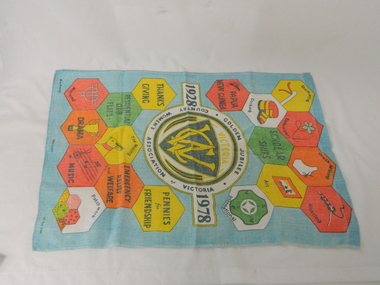
... This CWA Victoria Golden Jubilee (1928-1978) tea towel is made from Irish flax at the Blackstaff Flax Spinning and Weaving factory. It is therefore of high quality and very durable. ...This CWA Victoria Golden Jubilee (1928-1978) tea towel is made from Irish flax at the Blackstaff Flax Spinning and Weaving factory. It is therefore of high quality and very durable. ...This tea towel was manufactured in 1978 in Ireland and shipped to Australia. This was in a period when the C.W.A. was the major women's organisation which had the greatest influence amongst rural women (especially in isolated areas). This was a period when broad based communications were mainly by radio,women orientated magazines and the telephone. The relay of television to "remote" rural areas was not yet established. The CWA was therefore a very important organisation that catered exclusively to women's needs. The C.W.A. motto "Honour our God, Loyalty to the throne, Service to the country, Through country women, For country women, By country women." The atmosphere was one of "sisterhood" and covered nearly all the needs of rural based women. This one organisation incorporated knowledge and learning targeting women who physically may be isolated but not mentally. On the tea towel are portrayed all the activities that would be beneficial to rural women.This tea towel with its respective motifs is very significant to the Kiewa Valley as it related especially to women who felt the limitations of social interactions within a rural area. This tea towel represents a era where communications was relatively based on radio, magazines, books and limited telephone access. Within these restrictive interactive communication levels, the isolation of a "back o' Bourke" location applied tremendous mental fatigue on women more than on men.This CWA Victoria Golden Jubilee (1928-1978) tea towel is made from Irish flax at the Blackstaff Flax Spinning and Weaving factory. It is therefore of high quality and very durable. The major colours projecting from a light blue background are red, yellow, green, orange and black. The motives portrayed the activities of the CWA in 1978. These activities are embroidery, crocheting, dress making, knitting, cooking, art, macrame, drama, music, patchwork, toy making and community relief, pennies for friendship, emergency relief and welfare, residential club flats, the thanks giving and Papua New Guinea.The main or central theme of this tea towel is presented in the central area within three rings. "1928" on the left and "1978" on the right. On the top part "GOLDEN JUBILEE" and at the bottom "COUNTRY WOMEN'S ASSOCIATION OF VICTORIA" There are various shapes representing the activities listed above.cwa promotional material, cwa golden jubilee, women only organisations, country women's association -
 City of Greater Bendigo - Civic Collection
Textile - Yomut Turkmen Islamic Rug, c 1880
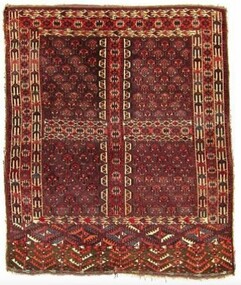
... The women and girls of the tribe spin the wool and design and weave the rugs. ...The women and girls of the tribe spin the wool and design and weave the rugs. ...This rug was a gift and gesture of friendship from the local Muslim community to the City of Greater Bendigo. It was presented to Mayor, Cr Rod Fyffe on behalf of the people of Bendigo at a 2016 'Thank You Bendigo' dinner. In 2014 approval for a planning application from the Bendigo Islamic Association to build a community centre and mosque in East Bendigo prompted a series of public protests that captured widespread media attention. During this tumultuous period the Council identified the need for a community-wide plan to promote diversity and help address potentially divisive cultural issues. These events led to the COGB becoming the first local government area (LGA) formally accredited under Australia’s Welcoming Cities Standard. Community leaders emerged who wanted to show that the anti-mosque protesters did not reflect the views of the majority of Bendigo residents. The community lead ‘Believe in Bendigo’ movement gained momentum, and the Council and other local organisations joined forces to present a unified message that Bendigo residents do not tolerate racism. Muslims have made Central Victoria their home since the Goldrush, contributing to the community and the economy for the past 120 years. Traditional Islamic rugs, especially their patterns and motifs are intrinsically linked with the design of the Bendigo Mosque and Bendigo Islamic Community Centre providing important points of reference for the architects of the project. Typically, mosques are linked with specific cultural groups but not in the case of Bendigo where the Muslim community is made up of multi-ethnic groups. This meant the building's design was not fixed to a specific style or cultural iconography but instead needed to encompass many. The small local Muslim community selected a specific Australian architect because of their interest and knowledge of Islamic design and iconography gained through family collection of Islamic textiles. In thinking about the design of the mosque and community centre the architects wanted to acknowledge the role of Afghans in Australian history, especially tribal Afghans who helped build connections across the interior of Australia between First Nations communities, European settlers and Central Asian migrants. The gift of this Turkmen rugto the Bendigo community thus symbolises collaborative partnerships across faith and cultural groups based on friendship and mutual benefit. A Turkman rug was specifically chosen as it is the pinnacle of nomadic arts of the Islamic world. It was also important to the architects and the local Muslim community that the gift was a female artistic product as it was mainly a female Muslim architecture team that designed the mosque in Bendigo and there was a desire to select something that celebrated female artistry. This hand-woven rug is an engsi, made for a woman in preparation for marriage. Design work and weaving is a shared experience, between many generations of women and each rug hold the personal story of the woman it is made for and her family and thus holds deep symbolic meaning. There are often songs and poetry that are recited as the rug is made – helping the makers to memorisze the mathematical structure of the design. An engsi is put on the doorway to a yurt as part of a wedding ceremony. During the ceremony the groom turns the engsii upside down to check the quality of the rug makers weaving skills. The nomadic lifestyle of Yomut Turkman tribes determines the size of the rug as the loom can’t be carried. Its size is also restricted by the dimensions of the doorway of the yurt. This rug is dated as c 1880 because of the types of patterns used, the use of natural dyes (synthetic dyes were introduced to the area in 1890s) and with the smoother weaving on the back indicating the quality of craftsmanship dating to this time period. The Yomut engsi rug was made in Turkmenistan c1880 by Yomut Turkmen Tribes people and is designed to fit over the doorway of a yurt during a wedding ceremony. The main field motif is related to Turkoman jewelery design. The women and girls of the tribe spin the wool and design and weave the rugs. The men shear the sheep, dye the wool and clip the rug after it has been woven. The word “Turkoman” is thought to have been derived from Turk-iman, meaning the first nomadic Turkic tribes that began to follow Islam. Dyes used are natural including orange from madder root. bendigo mosque, bendigo islamic association, city of greater bendigo community partnerships, city of greater bendigo community groups, cr rod fyffe -
 Eltham District Historical Society Inc
Film - Video (VHS), Open Day Eltham Living and Learning Centre, 1988
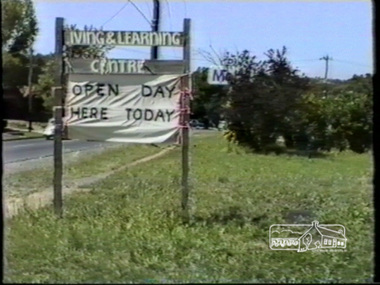
... Views of entrance into carpark, dog obedience class demonstration near entrance, leadlight construction display in workshop, basket weaving, face painting, exterior garden landscape with herb garden, brick pottery shed, peppercorn tree, children’s activities, interior views showing artworks of life drawings, general engagement with other people (audio), candle room, pottery, children’s entertainer in garden, wool spinning, some attempts at engagement with Claire Fitzpatrick, Thai Chi demonstration, floral presentations, patchwork, needlepoint, knitting, some interior scenes very dark, weaving, cane basket weaving....Views of entrance into carpark, dog obedience class demonstration near entrance, leadlight construction display in workshop, basket weaving, face painting, exterior garden landscape with herb garden, brick pottery shed, peppercorn tree, children’s activities, interior views showing artworks of life drawings, general engagement with other people (audio), candle room, pottery, children’s entertainer in garden, wool spinning, some attempts at engagement with Claire Fitzpatrick, Thai Chi demonstration, floral presentations, patchwork, needlepoint, knitting, some interior scenes very dark, weaving, cane basket weaving. eltham living and learning centre open day dog obedience class leadlight basket weaving face painting artworks life drawing candle room pottery wool spinning claire fitzpatrick thai chi patchwork needlepoint knitting weaving cane basket weaving main road eltham video recording Shire of Eltham Archives VHS Video cassette (poor quality) Converted to MP4 file format 00:31:39; 746MB Open Day Eltham Living and Learning Centre Film Video (VHS) ...This cottage-like dwelling has changed ownership several times since it was first built in the 1850s by local tanner John Pearson. The Living and Learning Centre as we know it today is the product of the energetic, reforming era of the Whitlam Government. Set up by the local council in 1974. Unedited amateur video (filmed by Vivienne?) with some voiceover and chatting with others. Significant VHS tape noise/flicker and colour pulsing. Opens with Living & Learning Centre sign on Main Road and “Open Day Here Today” attached to it. Views of entrance into carpark, dog obedience class demonstration near entrance, leadlight construction display in workshop, basket weaving, face painting, exterior garden landscape with herb garden, brick pottery shed, peppercorn tree, children’s activities, interior views showing artworks of life drawings, general engagement with other people (audio), candle room, pottery, children’s entertainer in garden, wool spinning, some attempts at engagement with Claire Fitzpatrick, Thai Chi demonstration, floral presentations, patchwork, needlepoint, knitting, some interior scenes very dark, weaving, cane basket weaving.VHS Video cassette (poor quality) Converted to MP4 file format 00:31:39; 746MBeltham living and learning centre, open day, dog obedience class, leadlight, basket weaving, face painting, artworks, life drawing, candle room, pottery, wool spinning, claire fitzpatrick, thai chi, patchwork, needlepoint, knitting, weaving, cane basket weaving, main road, eltham, video recording, shire of eltham archives -
 National Wool Museum
Booklet, Sheep to suit
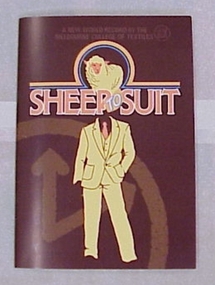
... ...Spinning...The story of the Melbourne College of Textile's World Record of 1hr, 32 minutes, 33.52 sec on June 24, 1982, recorded by the Guinness Book of Records Textile Production Fashion Shearing Weaving Sewing Melbourne College of Textiles Australian Wool Corporation Sunbeam Corporation Limited Carding Spinning Highlights of the National Wool Museum: from Sheep to Suit - Exhibition (22/09/2001 - 02/12/2001) Textile Production Fashion Shearing Weaving Sewing Booklet describing the 'Sheep to Suit' event for the Guiness Book of World Records. ..."Sheep to suit" -The Melbourne College of Textiles, 1984. The story of the Melbourne College of Textile's World Record of 1hr, 32 minutes, 33.52 sec on June 24, 1982, recorded by the Guinness Book of RecordsBooklet describing the 'Sheep to Suit' event for the Guiness Book of World Records.textile production fashion shearing weaving sewing, melbourne college of textiles australian wool corporation sunbeam corporation limited, carding, spinning, highlights of the national wool museum: from sheep to suit - exhibition (22/09/2001 - 02/12/2001), textile production, fashion, shearing, weaving, sewing -
 National Wool Museum
Jumper
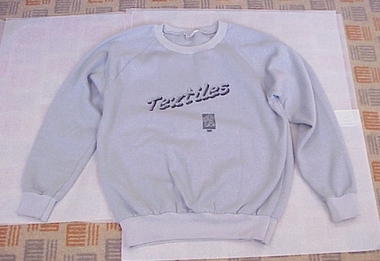
... ...Spinning...Textile Production Fashion Shearing Weaving Sewing Melbourne College of Textiles Carding Spinning Highlights of the National Wool Museum: from Sheep to Suit - Exhibition (22/09/2001 - 02/12/2001) Textile Production Fashion Shearing Weaving Sewing Textiles/TAFE [Japanese characters] Worn by participant in the 'Sheep to suit' event. ...Grey jumper, which formed part of the uniform for the 1987 Melbourne College of Textiles "Sheep to Suit" team and which was worn by John Hawthorne who took part in the event.Worn by participant in the 'Sheep to suit' event. Worn by participant in the 'Sheep to suit' event.Textiles/TAFE [Japanese characters]textile production fashion shearing weaving sewing, melbourne college of textiles, carding, spinning, highlights of the national wool museum: from sheep to suit - exhibition (22/09/2001 - 02/12/2001), textile production, fashion, shearing, weaving, sewing -
 National Wool Museum
Pants
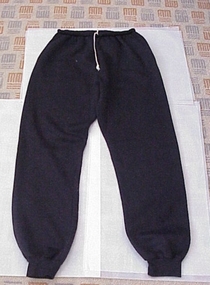
... ...Spinning...Textile Production Fashion Shearing Weaving Sewing Melbourne College of Textiles Carding Spinning Highlights of the National Wool Museum: from Sheep to Suit - Exhibition (22/09/2001 - 02/12/2001) Textile Production Fashion Shearing Weaving Sewing Worn by participant in the 'Sheep to suit' event. ...Black track pants, which formed part of the uniform for the 1987 Melbourne College of Textiles "Sheep to Suit" team and which were worn by John Hawthorne who took part in the event.Worn by participant in the 'Sheep to suit' event.textile production fashion shearing weaving sewing, melbourne college of textiles, carding, spinning, highlights of the national wool museum: from sheep to suit - exhibition (22/09/2001 - 02/12/2001), textile production, fashion, shearing, weaving, sewing -
National Wool Museum
T-shirt
... ...Spinning...Textile Production Fashion Shearing Weaving Sewing Melbourne College of Textiles Carding Spinning Highlights of the National Wool Museum: from Sheep to Suit - Exhibition (22/09/2001 - 02/12/2001) Textile Production Fashion Shearing Weaving Sewing AUSTRALIA WORLD RECORD 1HR 34 MINS 33.42 SECS GUINNESS/ SHEEP/ TO/ SUIT/ 1982 T-shirt ...White t-shirt, which formed part of the uniform for the 1982 Melbourne College of Textiles "Sheep to Suit" team and which was worn by Mr John Hawthorne who took part in the event.AUSTRALIA WORLD RECORD 1HR 34 MINS 33.42 SECS GUINNESS/ SHEEP/ TO/ SUIT/ 1982textile production fashion shearing weaving sewing, melbourne college of textiles, carding, spinning, highlights of the national wool museum: from sheep to suit - exhibition (22/09/2001 - 02/12/2001), textile production, fashion, shearing, weaving, sewing -
 National Wool Museum
Booklet, Sheep to suit
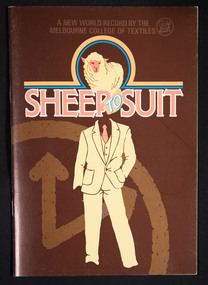
... ...spinning...The story of the Melbourne College of Textile's World Record of 1hr, 32 minutes, 33.52 sec on June 24, 1982, recorded by the Guinness Book of Records textile production fashion shearing weaving sewing textile mills textile mills melbourne college of textiles australian wool corporation sunbeam corporation limited carding spinning highlights of the national wool museum: from sheep to suit - exhibition (22/09/2001 - 02/12/2001) textile production fashion shearing weaving sewing textile mills This record was broken in 1987 by "The Melbourne College of Textiles" for the Japanese programme "These Wonderful People" Time 1 hour 27 Minutes 59.32 secs. ..."Sheep to suit" -The Melbourne College of Textiles, 1984. The story of the Melbourne College of Textile's World Record of 1hr, 32 minutes, 33.52 sec on June 24, 1982, recorded by the Guinness Book of RecordsBooklet describing the 'Sheep to Suit' event for the Guiness Book of World Records.This record was broken in 1987 by "The Melbourne College of Textiles" for the Japanese programme "These Wonderful People" Time 1 hour 27 Minutes 59.32 secs. Time difference = 6 Minutes 04.13 secstextile production fashion shearing weaving sewing textile mills textile mills, melbourne college of textiles australian wool corporation sunbeam corporation limited, carding, spinning, highlights of the national wool museum: from sheep to suit - exhibition (22/09/2001 - 02/12/2001), textile production, fashion, shearing, weaving, sewing, textile mills
