
Showing 12 items matching "spirit stove"
-
 Emerald Museum & Nobelius Heritage Park
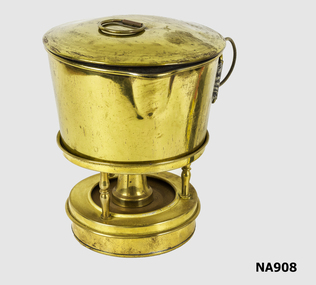
Domestic object - Spirit Stove, Spring
... Spirit Stove...spirit stove...Old brass spirit stove comprising two parts of the stand, the fuel holder and the damper. ...Domestic object Spirit Stove Spring ...No information available on the provenance of this stove. It appears to be more than 50 years old and it would have been useful for cooking when camping.Old brass spirit stove comprising two parts of the stand, the fuel holder and the damper. Burn marks. Two arms of the six-arm stand have broken off. One of those arms has gone.'Spring Swiss made' is imprinted on the bottom of the fuel holder together with an insignia of a deer The deer insignia is reproduced on the bottom of the damperspirit stove, chris britton -
 Whitehorse Historical Society Inc.
Functional object - Spirit Stove
... Spirit Stove...Yellow metal collapsible spirit stove. Folds into container with lid and handles. ...Functional object Spirit Stove ...possibly used for campingYellow metal collapsible spirit stove. Folds into container with lid and handles. There are four parts to the stove.domestic items, stoves -
 Torquay and District Historical Society
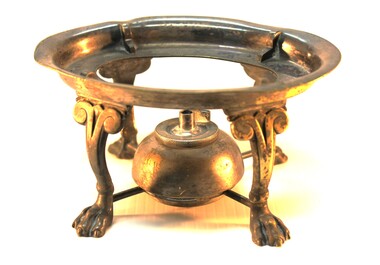
Functional object - Stove, Spirit, Pre 1890
... Stove, Spirit ...Small silver spirit stove with four legs supporting a cradle over a spirit burner....Functional object Stove, Spirit ...An original artefact from the Joseph H Scammell purchased at an auction of the ships cargo after the ship was wrecked off Point Danger Torquay in 1891.The wreck of the Scammell was a significant event in Torquay's history.Small silver spirit stove with four legs supporting a cradle over a spirit burner.shipwrecks great ocean road victoria, scammell collection -
 Alfred Hospital Nurses League - Nursing History Collection
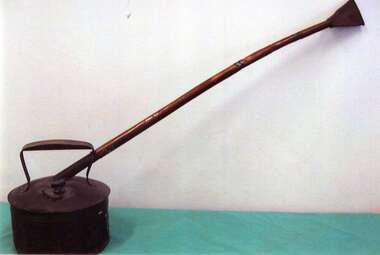
Equipment - Copper Steam Kettle, extension and spout, not known
... A steam tent was set up enclosing the whole bed by means of sheets/curtains and sometimes canvas, the kettle was heated over a gas or spirit stove, usually on the floor next to the bed, with the spout inserted inside the tent....A steam tent was set up enclosing the whole bed by means of sheets/curtains and sometimes canvas, the kettle was heated over a gas or spirit stove, usually on the floor next to the bed, with the spout inserted inside the tent. ...A steam kettle together with a steam tent was used to create a moist atmosphere. A steam tent was set up enclosing the whole bed by means of sheets/curtains and sometimes canvas, the kettle was heated over a gas or spirit stove, usually on the floor next to the bed, with the spout inserted inside the tent.Of significance to the AHNL as it is a tangible representation of nursing history. Steam inhalations were used to relieve patients with respiratory disorders and some drug therapy could be administered by this route. It was an effective method of treatment, observing the patient closely was difficult as they were completely hidden by the steam tent - many nurses got to share the steam therapy.Copper steam kettle with removable elongated straight extension spout and fan shaped nozzle on the end. There is a small opening for filling the kettle which holds 4 litres. Screw plug attached with chainnonesteam kettle, inhalation -
 City of Moorabbin Historical Society (Operating the Box Cottage Museum)
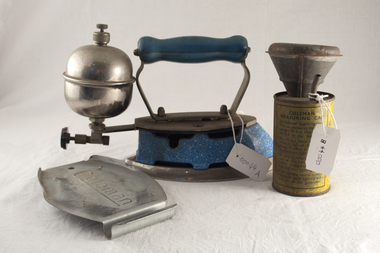
Domestic object - Kitchen equipment, spirit-fuelled sad iron, c1920
... spirit flat irons...coleman lamp stove co. ltd....The company also produced a range of cooking stoves and domestic irons. This spirit- fuelled flat iron was very popular in 1920s - 30s ...The company also produced a range of cooking stoves and domestic irons. This spirit- fuelled flat iron was very popular in 1920s - 30s These sad irons remind us of the difficult circumstances experienced in their daily routines by the pioneers and early settlers of Moorabbin Shire The family of Miss M Curtis were early settlers in Moorabbin Shire sad iron kitchen equipment coleman william kansas oklahoma pioneers early settlers market gardeners sewing craftwork clothing moorabbin brighton bentleigh fireplaces stoves petrol fuelled irons spirit flat irons coleman lamp stove co. ltd. ...Sad-irons or "solid" irons were made by blacksmiths and used to smooth out material by pressing the hot iron over it. A piece of sheet -iron was placed over the kitchen fire and the irons placed on it could be heated whilst remaining clean of ash.. The women used 2 irons - one heating while the other was used. Thick cloth or gloves protected their hands from the hot irons. The handle was removed from the cool iron and re- attached to remove the hot iron from the fire. The cool iron was replaced on the fire or stove to heat again. These irons were cleaned with steel wool to prevent them marking the material. If the iron was too hot the material would scorch. Most homes set aside one day for ironing and some large households had an ironing room with a special stove designed to heat irons. However, most women had to work with a heavy, hot iron close to the fireplace even in summer. Late in the 19thC designers experimented with heat retaining fillings for these irons. William Coleman began selling Kerosene lanterns in 1900 in Kingfisher, Oklahoma, USA. He moved to Wichita, Kansas in 1902 and the company became world wide. The company also produced a range of cooking stoves and domestic irons. This spirit- fuelled flat iron was very popular in 1920s - 30s These sad irons remind us of the difficult circumstances experienced in their daily routines by the pioneers and early settlers of Moorabbin Shire The family of Miss M Curtis were early settlers in Moorabbin ShireA) spirit- fuelled, sad iron with chrome plated sole c1920, and metal trivet The iron is blue enamel with a white speckled body, with a hemispherical tank for the Coleman 'Lighting Petrol' that provided the heat for smoothing the material B) Coleman Fuel measuring can and funnellMetal Trivet/stand " COLEMAN" ; Petrol can " COLEMAN" / MEASURING CAN / for INSTANT LIGHTING IRON/ with printed instructionssad iron, kitchen equipment, coleman william, kansas, oklahoma, pioneers, early settlers, market gardeners, sewing, craftwork, clothing, moorabbin, brighton, bentleigh, fireplaces, stoves, petrol fuelled irons, spirit flat irons, coleman lamp stove co. ltd. -
 City of Moorabbin Historical Society (Operating the Box Cottage Museum)
Functional object - Kitchen Equipment, billy holder, c1880
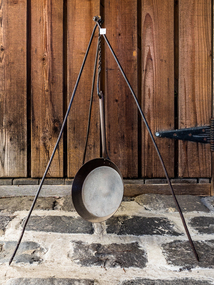
... stove, particularly associated with Australian usage, but is also used in the UK and Ireland. It is widely accepted that the term "billycan" is derived from the large cans used for transporting bouilli or bully beef on Australia-bound ships or during exploration of the outback, which after use were modified for boiling water over a fire. However there is a suggestion that the word may be associated with the Aboriginal billa (meaning water; cf. Billabong In Australia. The billy has come to symbolise the spirit...stove, particularly associated with Australian usage, but is also used in the UK and Ireland. It is widely accepted that the term "billycan" is derived from the large cans used for transporting bouilli or bully beef on Australia-bound ships or during exploration of the outback, which after use were modified for boiling water over a fire. However there is a suggestion that the word may be associated with the Aboriginal billa (meaning water; cf. Billabong In Australia. The billy has come to symbolise the spirit ...A billycan, is a lightweight cooking pot which is used on a campfire or a camping stove, particularly associated with Australian usage, but is also used in the UK and Ireland. It is widely accepted that the term "billycan" is derived from the large cans used for transporting bouilli or bully beef on Australia-bound ships or during exploration of the outback, which after use were modified for boiling water over a fire. However there is a suggestion that the word may be associated with the Aboriginal billa (meaning water; cf. Billabong In Australia. The billy has come to symbolise the spirit of exploration of the outback. To boil the billy most often means to make tea. "Billy Tea" is the name of a popular brand of tea long sold in Australian grocers and supermarkets. Billies feature in many of Henry Lawson's stories and poems. Banjo Paterson's most famous of many references to the billy is surely in the first verse and chorus of Waltzing Matilda: "And he sang as he looked at the old billy boiling", which was later changed by the Billy Tea Company to "And he sang as he watched and waited 'til his billy boiled”. Early settlers , market gardeners and blacksmiths would use this portable iron stake to hold their Billies at meal times when out working their fields, travelling for work or pleasure.c1880 A molded, iron tripod stake that would hold a 'Billy can' of water over a camp or kitchen fireearly settlers, pioneers, market gardeners, moorabbin, bentleigh, brighton, cheltenham, tools, blacksmiths -
 Flagstaff Hill Maritime Museum and Village
Iron
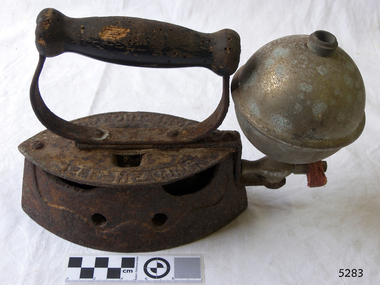
... This iron used its own fuel to heat up the iron rather than earlier flat irons that required heating on top of the stove. flagstaff hill warrnambool shipwrecked coast flagstaff hill maritime museum maritime museum shipwreck coast flagstaff hill maritime village great ocean road spirit iron self heating iron comfort iron comfort self heating iron "Comfort Self Heating" clothes iron. ...This iron used its own fuel to heat up the iron rather than earlier flat irons that required heating on top of the stove."Comfort Self Heating" clothes iron. Spirit iron with wooden handle and metal tank for spirit fuel (probably benzene.). Different fuels were used, some with dire resultsflagstaff hill, warrnambool, shipwrecked coast, flagstaff hill maritime museum, maritime museum, shipwreck coast, flagstaff hill maritime village, great ocean road, spirit iron, self, heating iron, comfort iron, comfort self heating iron -
 Kiewa Valley Historical Society
Iron - Flat, Circa early 1900s
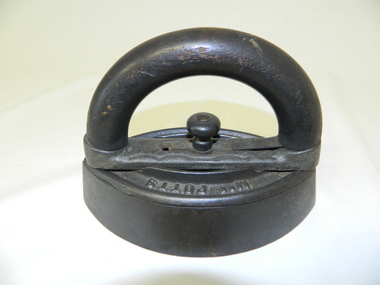
... Historically this item was used before the spirit and the electrical iron took over Circa 1930s -1950s. The main body of the iron was placed on a flat heated surface of a stove (wood, coal or gas fired). ...Historically this item was used before the spirit and the electrical iron took over Circa 1930s -1950s. The main body of the iron was placed on a flat heated surface of a stove (wood, coal or gas fired). ...Historically this item was used before the spirit and the electrical iron took over Circa 1930s -1950s. The main body of the iron was placed on a flat heated surface of a stove (wood, coal or gas fired). It was mainly used by women in their domestic role, ironing the family clothes and linen. In the Kiewa Valley the supply of coal or gas was not available or too expensive than the locally cut hard wood trees. This particular iron was an improvement on the fixed handled iron because it allowed (by use of its easily detachable handle) to use multiple bases and thereby allowing a constant heat supply to be maintained and not having to waste time for a base to reheat to the required level of application.The significance of this item was that it allowed for a faster method of ironing clothes and linen. It's invention was a progress towards reducing the time it took to undertake a very labour and intensive domestic function. The reduction of time taken for this household duty provided women great flexibility to undertake other activities. These type of improvements to basic domestic tasks liberated housewives not only physically but also mentally from the isolation of the home environment.This flat iron has a removable, clip-on handle. The handle and its release knob are of wood. The base of the handle together with the heavy flat body are made of cast iron. The body of the iron is oval shaped tapered at each end and is 40mm thick.Underneath the handle frame and on the main body, on one side, in raised lettering is "Mrs Potts" and on the other side "Iron". Both are clearly visible when viewed from an aerial position. Under removable handle and on a plate (screwed onto the main body) is "No 2"iron, antique, household, pressing clothes, domestic, laundry -
 Kiewa Valley Historical Society
Iron - Flat
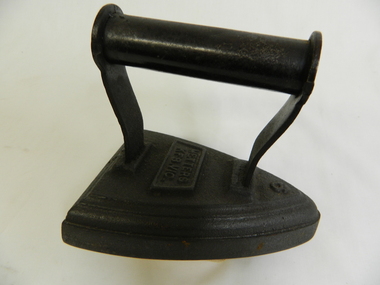
... This iron was used to press clothes prior to the spirit and electrical irons becoming available circa 1930s - 1950s. The main body of the iron was placed on a flat heated surface of a stove (wood, coal or gas fired). ...This iron was used to press clothes prior to the spirit and electrical irons becoming available circa 1930s - 1950s. The main body of the iron was placed on a flat heated surface of a stove (wood, coal or gas fired). ...This iron was used to press clothes prior to the spirit and electrical irons becoming available circa 1930s - 1950s. The main body of the iron was placed on a flat heated surface of a stove (wood, coal or gas fired). It was mainly used by women in their domestic role, ironing the family's clothes and linen. In the Kiewa Valley the supply of coal or gas was not available or too expensive than the locally cut hard wood trees. Ironing was time consuming as the iron had to be heated, used and then reheated to the required level of application. Kiewa Valley farmers' wives used these irons having heated their stoves with local timber from their farms. This iron is made of cast iron. The handle is a hollow cylinder and is 70 mm above the solid 30 mm base. Presumably the handle was wrapped and/or threaded with cloth to protect the hand from the heat of the iron. The iron would have been heated on the top of a stove.6 Metters KFB Victoriairon, laundry, domestic, antique, pressing clothes, household -
 Bendigo Historical Society Inc.
Domestic Object - COLEMAN SPIRIT IRON WITH STAND, 1936
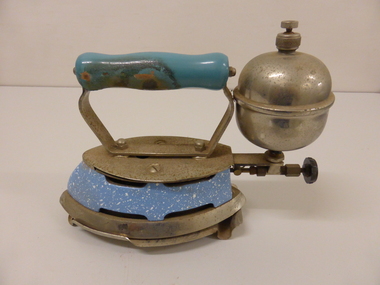
... Coleman spirit iron with blue and white speckled body, chrome plated base and spirit tank, wooden handle and a bakelite control knob, on a chrome plated stand impressed with the Coleman name. Made in Australia by arrangement with Coleman Lamp & Stove Co Ltd Canada Proprietor of Regd Trade Mark No 67296 Jan 14 1936...DOMESTIC EQUIPMENT Laundering iron Coleman Lamp & Stove Co Ltd Coleman spirit iron with blue and white speckled body, chrome plated base and spirit tank, wooden handle and a bakelite control knob, on a chrome plated stand impressed with the Coleman name. ...Coleman spirit iron with blue and white speckled body, chrome plated base and spirit tank, wooden handle and a bakelite control knob, on a chrome plated stand impressed with the Coleman name. Made in Australia by arrangement with Coleman Lamp & Stove Co Ltd Canada Proprietor of Regd Trade Mark No 67296 Jan 14 1936Coleman Lamp & Stove Co Ltddomestic equipment, laundering, iron -
 Anglesea and District Historical Society
Clothes Iron, Coleman Lamp Stove Co Ltd, Spirit-fuelled Clothes Iron, Estimated circa 1936
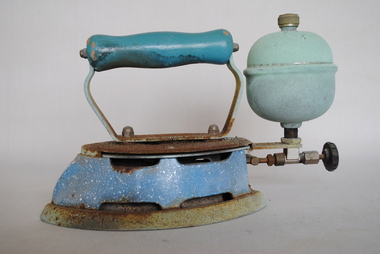
... Stove Co Ltd in Canada. Origin of these companies - started by William Coleman of Oklahoma and Kansas, USA. clothes iron Iron has chrome plated sole - blue enamel body with white speckles and hemispherical tank (probably copper - has typical green verdigris appearance) for the lighting fluid that would have supplied the heat. The wooden handle is painted blue. Top screw is missing from the fuel tank. Spirit ...Coleman Lamp Stove Co Ltd possibly making irons by arrangement with Coleman Lamp & Stove Co Ltd in Canada. Origin of these companies - started by William Coleman of Oklahoma and Kansas, USA. Iron has chrome plated sole - blue enamel body with white speckles and hemispherical tank (probably copper - has typical green verdigris appearance) for the lighting fluid that would have supplied the heat. The wooden handle is painted blue. Top screw is missing from the fuel tank.clothes iron -
 Emerald Museum & Nobelius Heritage Park
Domestic object - Primus Stove
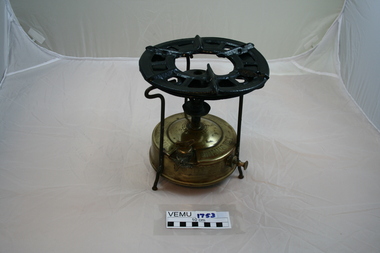
... To light the stove, a small amount of alcohol is put into the spirit cup, just below the burner to preheat it. ...To light the stove, a small amount of alcohol is put into the spirit cup, just below the burner to preheat it. ...The stove was the property of John Biggart, who lived in Avonsleigh. He travelled Victoria from 1920 to the 1940's. The stove was used at a work camp site.Brass base containing the kerosene fuel tank, above which rises a burning tube and burner assembly. The steel top rings are held above the burner by 3 support legs. To light the stove, a small amount of alcohol is put into the spirit cup, just below the burner to preheat it. Kerosene was then vaporised, mixed with air and it burns with a soot less, blue flame.PRIMUS No. 1. MADE IN SWEDEN. TRADEMARK PRI-MUS. PATENT SB. No 48624. ENG No 171536, all on the top of the tank. On the side is engraved; A/B B. AHJORTH AND CO. STOCKHOLM SWEDEN - SOLEMAKERS OF THE GENUINE john biggart
