
Showing 6 items matching "sport commentator"
-
 Falls Creek Historical Society
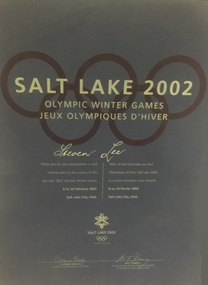
Certificate - Steve Lee participation at Salt Lake Winter Olympics 2002
... ...Sport commentator...Steve Lee Australian Olympians Sport commentator SALT LAKE 2002 OLYMPIC WINTER GAMES JEUX OLYMPIQUES D'HIVER Steven Lee Thank you for your participation in and contributions to the success of the Salt Lake 2002 Olympic Winter Games 8 to 24 February 2002 Salt Lake City, Utah A certificate featuring the Olympic Rings and text on a dark blue background. ...Steve Lee grew up in Falls Creek and had skis on his feet when he was just two years old. He later became a member of the Falls Creek Race Club and at the age of 14 won State and National Junior titles. After repeated success, Steve was selected to race overseas in the Australian Junior team. He won the Australian Open Championship at the age of 17. For 10 years, Steve never missed a race in the World Cup Circuit. Overall, he claimed 20 top 15 finishes in Downhill, Super-G and combined events. Towards the end of his career Lee swapped the World Cup circuit for the World Pro Tour in the USA, winning the Pro Downhill Tour ‘King of the Mountain’ title. He was also running a photography business in Falls Creek and was also involved in sports commentating on Australian television. This included commentating Alpine Freestyle events at four Winter Olympics and several World Championships. One of these events was the Winter Olympics at Salt Lake City in 2002 for which this certificate was awarded.A certificate featuring the Olympic Rings and text on a dark blue background.SALT LAKE 2002 OLYMPIC WINTER GAMES JEUX OLYMPIQUES D'HIVER Steven Lee Thank you for your participation in and contributions to the success of the Salt Lake 2002 Olympic Winter Games 8 to 24 February 2002 Salt Lake City, Utahsteve lee, australian olympians, sport commentator -
 Victorian Aboriginal Corporation for Languages
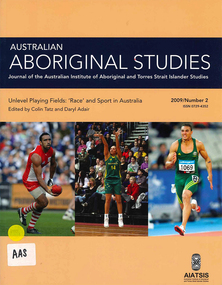
Periodical, Australian Institute of Aboriginal and Torres Strait Islander Studies, Australian Aboriginal studies : journal of the Australian Institute of Aboriginal and Torres Strait Islander Studies, 2009
... sport Colin Tatz (AIATSIS & Australian National University) Notions of genetic superiority have led to some of the world?s greatest human calamities. Just as social scientists thought that racial anthropology and biology had ended with the cataclysm of the Second World War, so some influential researchers and sports commentators have rekindled the pre-war debate about the muscular merits of ?...sport Colin Tatz (AIATSIS & Australian National University) Notions of genetic superiority have led to some of the world?s greatest human calamities. Just as social scientists thought that racial anthropology and biology had ended with the cataclysm of the Second World War, so some influential researchers and sports commentators have rekindled the pre-war debate about the muscular merits of ? ...Darkness and a little light: ?Race? and sport in Australia Colin Tatz (AIATSIS & Australian National University) and Daryl Adair (University of Technology Sydney) Despite ?the wonderful and chaotic universe of clashing colors, temperaments and emotions, of brave deeds against odds seemingly insuperable?, sport is mixed with ?mean and shameful acts of pure skullduggery?, villainy, cowardice, depravity, rapaciousness and malice. Thus wrote celebrated American novelist Paul Gallico on the eve of the Second World War (Gallico 1938 [1988]:9-10). An acute enough observation about society in general, his farewell to sports writing also captures the ?clashing colors? in Australian sport. In this ?land of the fair go?, we look at the malice of racism in the arenas where, as custom might have it, one would least want or expect to find it. The history of the connection between sport, race and society - the long past, the recent past and the social present - is commonly dark and ugly but some light and decency are just becoming visible. Coming to terms: ?Race?, ethnicity, identity and Aboriginality in sport Colin Tatz (AIATSIS & Australian National University) Notions of genetic superiority have led to some of the world?s greatest human calamities. Just as social scientists thought that racial anthropology and biology had ended with the cataclysm of the Second World War, so some influential researchers and sports commentators have rekindled the pre-war debate about the muscular merits of ?races? in a new discipline that Nyborg (1994) calls the ?science of physicology?. The more recent realm of racial ?athletic genes?, especially within socially constructed black athletic communities, may intend no malice but this search for the keys to their success may well revive the old, discredited discourses. This critical commentary shows what can happen when some population geneticists and sports writers ignore history and when medical, biological and sporting doctrines deriving from ?race? are dislocated from any historical, geographic, cultural and social contexts. Understanding discourses about race, racism, ethnicity, otherness, identity and Aboriginality are essential if sense, or nonsense, is to be made of genetic/racial ?explanations? of sporting excellence. Between the two major wars boxing was, disproportionately, a Jewish sport; Kenyans and Ethiopians now ?own? middle- and long-distance running and Jamaicans the shorter events; South Koreans dominate women?s professional golf. This essay explores the various explanations put forward for such ?statistical domination?: genes, biochemistry, biomechanics, history, culture, social dynamics, the search for identity, alienation, need, chance, circumstances, and personal bent or aptitude. Traditional games of a timeless land: Play cultures in Aboriginal and Torres Strait Islander communities Ken Edwards (University of Southern Queensland) Sports history in Australia has focused almost entirely on modern, Eurocentric sports and has therefore largely ignored the multitude of unique pre- European games that are, or once were, played. The area of traditional games, especially those of Aboriginal and Torres Strait Islander peoples, is an important aspect of the cultural, social and historical experiences of Indigenous communities. These activities include customs of play that are normally not associated with European notions of competitive sport. Overall, this paper surveys research undertaken into traditional games among Indigenous Australians, as well as proposals for much needed further study in this area. Culture, ?race? and discrimination in the 1868 Aboriginal cricket tour of England David Sampson As a consequence of John Mulvaney?s important historical research, the Aboriginal cricket and performance tour of Britain in 1868 has in recent decades become established as perhaps the most famous of all public events in contact history involving Aborigines, white settlers and the British metropolis. Although recognition of its importance is welcome and significant, public commemorations of the tour have enveloped the tour in mythologies of cricket and nation. Such mythologies have obscured fundamental aspects of the tour that were inescapable racial and colonial realities of the Victorian era. This reappraisal of the tour explores the centrality of racial ideology, racial science and racial power imbalances that enabled, created and shaped the tour. By exploring beyond cricketing mythology, it restores the central importance of the spectacular performances of Aboriginal skills without which the tour would have been impossible. Such a reappraisal seeks to fully recognise the often trivialised non-cricketing expertise of all of the Aboriginal performers in 1868 for their achievement of pioneering their unique culture, skills and technologies to a mass international audience. Football, ?race? and resistance: The Darwin Football League, 1926?29 Matthew Stephen (Northern Territory Archive Service) Darwin was a diverse but deeply divided society in the early twentieth century. The Commonwealth Government introduced the Aboriginals Ordinance 1911 in the Northern Territory, instituting state surveillance, control and a racially segregated hierarchy of whites foremost, then Asians, ?Coloureds? (Aborigines and others of mixed descent) and, lastly, the so-called ?full-blood? Aborigines. Sport was important in scaffolding this stratification. Whites believed that sport was their private domain and strictly controlled non-white participation. Australian Rules football, established in Darwin from 1916, was the first sport in which ?Coloured? sportsmen challenged this domination. Football became a battleground for recognition, rights and identity for all groups. The ?Coloured? community embraced its team, Vesteys, which dominated the Northern Territory Football League (NTFL) in the 1920s. In 1926, amidst growing racial tension, the white-administered NTFL changed its constitution to exclude non-white players. In reaction, ?Coloured? and Chinese footballers formed their own competition - the Darwin Football League (DFL). The saga of that colour bar is an important chapter in Australia?s football history, yet it has faded from Darwin?s social memory and is almost unknown among historians. That picture - Nicky Winmar and the history of an image Matthew Klugman (Victoria University) and Gary Osmond (The University of Queensland) In April 1993 Australian Rules footballer Nicky Winmar responded to on-field racist abuse by lifting his jersey and pointing to his chest. The photographic image of that event is now famous as a response to racial abuse and has come to be seen as starting a movement against racism in football. The racial connotations in the image might seem a foregone conclusion: the power, appeal and dominant meaning of the photograph might appear to be self-evident. But neither the fame of the image nor its racial connotation was automatic. Through interviews with the photographers and analysis of the use of the image in the media, we explore how that picture came to be of such symbolic importance, and how it has remained something to be re-shown and emulated. Rather than analyse the image as a photograph or work of art, we uncover some of its early history and explore the debates that continue to swirl around its purpose and meaning. We also draw attention to the way the careful study of photographs might enhance the study of sport, race and racism. ?She?s not one of us?: Cathy Freeman and the place of Aboriginal people in Australian national culture Toni Bruce (University of Waikato) and Emma Wensing (Independent scholar) The Sydney 2000 Olympic Games generated a national media celebration of Aboriginal 400 metre runner Cathy Freeman. The construction of Freeman as the symbol of national reconciliation was evident in print and on television, the Internet and radio. In contrast to this celebration of Freeman, the letters to the editor sections of 11 major newspapers became sites for competing claims over what constitutes Australian identity and the place of Aboriginal people in national culture. We analyse this under-explored medium of opinion and discuss how the deep feelings evident in these letters, and the often vitriolic responses to them, illustrate some of the enduring racial tensions in Australian society. Sport, physical activity and urban Indigenous young people Alison Nelson (The University of Queensland) This paper challenges some of the commonly held assumptions and ?knowledges? about Indigenous young people and their engagement in physical activity. These include their ?natural? ability, and the use of sport as a panacea for health, education and behavioural issues. Data is presented from qualitative research undertaken with a group of 14 urban Indigenous young people with a view to ?speaking back? to these commentaries. This research draws on Critical Race Theory in order to make visible the taken-for-granted assumptions about Indigenous Australians made by the dominant white, Western culture. Multiple, shifting and complex identities were expressed in the young people?s articulation of the place and meaning of sport and physical activity in their lives. They both engaged in, and resisted, dominant Western discourses regarding representations of Indigenous people in sport. The paper gives voice to these young people in an attempt to disrupt and subvert hegemonic discourses. An unwanted corroboree: The politics of the New South Wales Aboriginal Rugby League Knockout Heidi Norman (University of Technology Sydney) The annual New South Wales Aboriginal Rugby League Knockout is so much more than a sporting event. Involving a high level of organisation, it is both a social and cultural coming together of diverse communities for a social and cultural experience considered ?bigger than Christmas?. As if the planning and logistics were not difficult enough, the rotating-venue Knockout has been beset, especially since the late 1980s and 1990s, by layers of opposition and open hostility based on ?race?: from country town newspapers, local town and shire councils, local business houses and, inevitably, the local police. A few towns have welcomed the event, seeing economic advantage and community good will for all. Commonly, the Aboriginal ?influx? of visitors and players - people perceived as ?strangers?, ?outsiders?, ?non-taxpayers? - provoked public fear about crime waves, violence and physical safety, requiring heavy policing. Without exception, these racist expectations were shown to be totally unfounded. Research report: Recent advances in digital audio recorder technology provide considerable advantages in terms of cost and portability for language workers.b&w photographs, colour photographs, tablessport and race, racism, cathy freeman, nicky winmar, rugby league, afl, athletics, cricket, digital audio recorders -
 Musculoskeletal Health Australia (now held by the Glen Eira Historical Society)
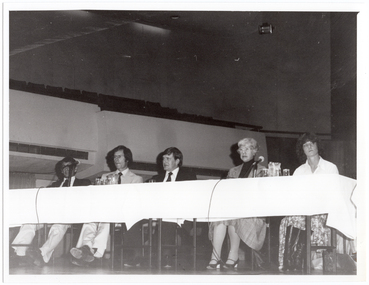
Photograph - Group photo, 01/06/1979
... sport... ron clarke... olympic distance runner... allan stone... tennis player... davis cup... tennis commentator...Sport. On the panel were Olympic distance runner, Ron Clarke (1937-2015); Davis Cup tennis player and Channel 7 tennis commentator, Allan Stone (1945-); Australian cricketer, Captain of the Carlton Cricket Club and sports writer, Keith Stackpole Jr (1940-); captain of the All Australia carnival netball team (1946-47) and President of the Women's Netball Association, Eunice Gill (1918-1987); Olympic sprinter and Little Athletics coach, Denise Boyd (1952-); sports medicine physician, Dr K Threlfall; physiotherapist, Barry Richardson; orthopaedic surgeon, Mr Jonathan Hooper; rheumatologist and RAAV Executive member, Dr Murray Ingpen (1940-2015); Secretary of the Sports Medicine Federation, Dr Hugo MacKay; and President of RAAV, Dr Les Koadlow (1920-2006). ...Sport. On the panel were Olympic distance runner, Ron Clarke (1937-2015); Davis Cup tennis player and Channel 7 tennis commentator, Allan Stone (1945-); Australian cricketer, Captain of the Carlton Cricket Club and sports writer, Keith Stackpole Jr (1940-); captain of the All Australia carnival netball team (1946-47) and President of the Women's Netball Association, Eunice Gill (1918-1987); Olympic sprinter and Little Athletics coach, Denise Boyd (1952-); sports medicine physician, Dr K Threlfall; physiotherapist, Barry Richardson; orthopaedic surgeon, Mr Jonathan Hooper; rheumatologist and RAAV Executive member, Dr Murray Ingpen (1940-2015); Secretary of the Sports Medicine Federation, Dr Hugo MacKay; and President of RAAV, Dr Les Koadlow (1920-2006). ...On the 1st of June, 1979, a panel event was held to address the topic of Arthritis and Sport. On the panel were Olympic distance runner, Ron Clarke (1937-2015); Davis Cup tennis player and Channel 7 tennis commentator, Allan Stone (1945-); Australian cricketer, Captain of the Carlton Cricket Club and sports writer, Keith Stackpole Jr (1940-); captain of the All Australia carnival netball team (1946-47) and President of the Women's Netball Association, Eunice Gill (1918-1987); Olympic sprinter and Little Athletics coach, Denise Boyd (1952-); sports medicine physician, Dr K Threlfall; physiotherapist, Barry Richardson; orthopaedic surgeon, Mr Jonathan Hooper; rheumatologist and RAAV Executive member, Dr Murray Ingpen (1940-2015); Secretary of the Sports Medicine Federation, Dr Hugo MacKay; and President of RAAV, Dr Les Koadlow (1920-2006). Around 550 people attended the event, which was held at Dallas Brooks Hall. This photo depicts panellists Ron Clarke, Allan Stone, Keith Stackpole, Eunice Gill, and Denise Boyd. A similar photo appears on page 1 (cover page) of the Vol 13, June 1979 edition of RAAV's News Review, in which all the panelists are depicted.Black and white photo of five people sitting at a long table on a stage. On the table, there are two microphones on stands, two glass jugs of water, and some glasses.[Handwritten in pencil] Sporting Panel L-R Ron Clarke, Alan [sic] Stone, Keith Stackpole, Eunice Gill, & Denise Boyd (Ron Barassi was marooned in Sydney - he arrived after the meeting concluded.)rheumatism and arthritis association of victoria, raav, sports panel, arthritis and sport, ron clarke, olympic distance runner, allan stone, tennis player, davis cup, tennis commentator, channel 7, keith stackpole jr, australian cricketer, carlton cricket club, captain, sports writer, eunice gill, all australia carnival netball team, captain, women’s netball association, president, denise boyd, olympic sprinter, little athletics, coach, dallas brooks hall, 1979 -
 Musculoskeletal Health Australia (now held by the Glen Eira Historical Society)
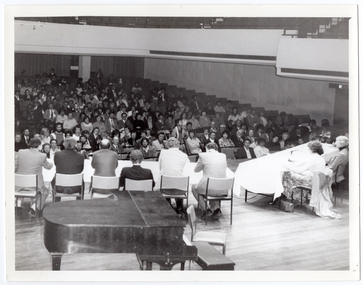
Photograph - Group photo, 01/06/1979
... Sport. On the panel were Olympic distance runner, Ron Clarke (1937-2015); Davis Cup tennis player and Channel 7 tennis commentator, Allan Stone (1945-); Australian cricketer, Captain of the Carlton Cricket Club and sports writer, Keith Stackpole Jr (1940-); captain of the 'all Australia carnival netball team' (1946-47) and President of the Women's Netball Association, Eunice Gill (1918-1987); Olympic sprinter and Little Athletics coach, Denise Boyd (1952-); sports medicine physician, Dr K Threlfall; physiotherapist, Barry Richardson; orthopaedic surgeon, Mr Jonathan Hooper; rheumatologist and RAAV Executive member, Dr Murray Ingpen (1940-2015); Secretary of the Sports Medicine Federation, Dr Hugo MacKay; and President of RAAV, Dr Les Koadlow (1920-2006). ...Sport. On the panel were Olympic distance runner, Ron Clarke (1937-2015); Davis Cup tennis player and Channel 7 tennis commentator, Allan Stone (1945-); Australian cricketer, Captain of the Carlton Cricket Club and sports writer, Keith Stackpole Jr (1940-); captain of the 'all Australia carnival netball team' (1946-47) and President of the Women's Netball Association, Eunice Gill (1918-1987); Olympic sprinter and Little Athletics coach, Denise Boyd (1952-); sports medicine physician, Dr K Threlfall; physiotherapist, Barry Richardson; orthopaedic surgeon, Mr Jonathan Hooper; rheumatologist and RAAV Executive member, Dr Murray Ingpen (1940-2015); Secretary of the Sports Medicine Federation, Dr Hugo MacKay; and President of RAAV, Dr Les Koadlow (1920-2006). ...On the 1st of June, 1979, a panel event was held to address the topic of Arthritis and Sport. On the panel were Olympic distance runner, Ron Clarke (1937-2015); Davis Cup tennis player and Channel 7 tennis commentator, Allan Stone (1945-); Australian cricketer, Captain of the Carlton Cricket Club and sports writer, Keith Stackpole Jr (1940-); captain of the 'all Australia carnival netball team' (1946-47) and President of the Women's Netball Association, Eunice Gill (1918-1987); Olympic sprinter and Little Athletics coach, Denise Boyd (1952-); sports medicine physician, Dr K Threlfall; physiotherapist, Barry Richardson; orthopaedic surgeon, Mr Jonathan Hooper; rheumatologist and RAAV Executive member, Dr Murray Ingpen (1940-2015); Secretary of the Sports Medicine Federation, Dr Hugo MacKay; and President of RAAV, Dr Les Koadlow (1920-2006). Around 550 people attended the event, which was held at Dallas Brooks Hall. This photo depicts many of the panelists from behind, facing the large audience before them.Black and white photo of eight people sitting at two long tables on a stage. There are six people on one table and two people evident sitting on the second table (which is partially obscured). There is a large piano in the foreground, behind one of the tables. In the background, a large audience, who are seated on rows of seats, fills the auditorium.rheumatism and arthritis association of victoria, raav, sports panel, arthritis and sport, dr k threlfall, sports medicine physician, barry richardson, physiotherapist, mr jonathan hooper, orthopaedic surgeon, dr murray ingpen, rheumatologist, raav executive member, dr hugo mackay, sports medicine federation, secretary, dr les koadlow, raav, president, eunice gill, all australia carnival netball team, captain, women’s netball association, president, denise boyd, olympic sprinter, little athletics, coach, dallas brooks hall, 1979 -
 Musculoskeletal Health Australia (now held by the Glen Eira Historical Society)
Photograph - Solo photo
... commentator... sports media... author... sport...He was inducted into the Sport Australia Hall of Fame in 1986, the FICA Cricket Hall of Fame in 2000, the Australian Cricket Hall of Fame in 2003, and the International Cricket Council Hall of Fame in 2009. He is also a prolific author and speaker. arthritis foundation of victoria afv ian chappell chapelli australian cricketer captain world series cricket batsman spin bowler sledging sports journalist cricket commentator sports media author sport australia hall of fame australian cricket hall of fame fica cricket hall of fame icc cricket hall of fame [On a yellow sticky note, handwritten in black ink] Ian Chappell B&W portrait of a man wearing a checked shirt with a plain collar, a checked suit jacket, and a dark coloured tie. ...Portrait of Australian cricketer, Ian Chappell (1943-). This publicity photo was most likely presented to the Arthritis Foundation of Victoria for inclusion in one of our newsletters or for other promotional activities. Chappell was named the 1976 Wisden Cricketer of the Year. He was inducted into the Sport Australia Hall of Fame in 1986, the FICA Cricket Hall of Fame in 2000, the Australian Cricket Hall of Fame in 2003, and the International Cricket Council Hall of Fame in 2009. He is also a prolific author and speaker.B&W portrait of a man wearing a checked shirt with a plain collar, a checked suit jacket, and a dark coloured tie.[On a yellow sticky note, handwritten in black ink] Ian Chappellarthritis foundation of victoria, afv, ian chappell, chapelli, australian cricketer, captain, world series cricket, batsman, spin bowler, sledging, sports journalist, cricket commentator, sports media, author, sport australia hall of fame, australian cricket hall of fame, fica cricket hall of fame, icc cricket hall of fame -
 Musculoskeletal Health Australia (now held by the Glen Eira Historical Society)
Photograph - Solo photo
... commentator, and later, hotel manager. During his decades long career, Richards’ widespread popularity as a Melbourne personality saw him being made Moomba Court Jester to Johnny Farnham’s King of Moomba in 1972, followed by being crowned the King of Moomba himself in 1981. In 1981, he was made a Member of the Order of the British Empire (MBE) for his services to sport...commentator, and later, hotel manager. During his decades long career, Richards’ widespread popularity as a Melbourne personality saw him being made Moomba Court Jester to Johnny Farnham’s King of Moomba in 1972, followed by being crowned the King of Moomba himself in 1981. In 1981, he was made a Member of the Order of the British Empire (MBE) for his services to sport ...Portrait of Lou Richards (1923-2017), former player and captain of the Collingwood football team, sports journalist and commentator, and later, hotel manager. During his decades long career, Richards’ widespread popularity as a Melbourne personality saw him being made Moomba Court Jester to Johnny Farnham’s King of Moomba in 1972, followed by being crowned the King of Moomba himself in 1981. In 1981, he was made a Member of the Order of the British Empire (MBE) for his services to sport. Richards was inducted into the AFL Hall of Fame in 1996, the Collingwood Hall of Fame in the first intake in 2004, and the Sport Australia Hall of Fame in 2008. He was awarded an Australian Sports Medal in 2000, a Centenary Medal in 2001, and an AFL Lifetime Achievement Award in 2014. This publicity photo was most likely presented to the the Arthritis Foundation of Victoria for inclusion in one of our newsletters or for other promotional activities.COL portrait of a man wearing a white shirt, a black suit jacket, and a colourful tie. The printed design on the tie consists of small depictions of various countries' national flags.arthritis foundation of victoria, afv, lou richards, footballer, football commentator, sports journalist, sports panels, sports media, louie the lip, moomba court jester, king of moomba, member of the order of the british empire, mbe, afl hall of fame, australian sports medal, centenary medal, collingwood hall of fame, afl lifetime achievement award
