
Showing 14 items matching "sporting guns"
-
 Bendigo Historical Society Inc.
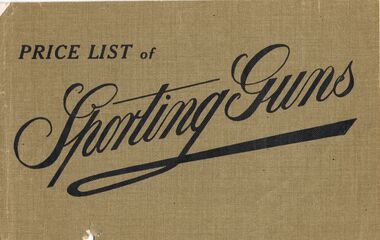
Document - RANDALL COLLECTION: BOOKLET - PRICE LIST OF SPORTING GUNS
... RANDALL COLLECTION: BOOKLET - PRICE LIST OF SPORTING GUNS......Sporting Guns...Randall Collection: Booklet - Price List of Sporting Guns. Seven pages with (long) gun on each page - 5 guns of W W Greener and 2 guns of J V Needham with prices. ...Greener J. V. Needham Sporting Guns Randall Collection: Booklet - Price List of Sporting Guns. ...Randall Collection: Booklet - Price List of Sporting Guns. Seven pages with (long) gun on each page - 5 guns of W W Greener and 2 guns of J V Needham with prices. Line drawing and description of each gun with price. No information as to availability/stockist etc. No date.w. w. greener, j. v. needham, sporting guns -
 Flagstaff Hill Maritime Museum and Village
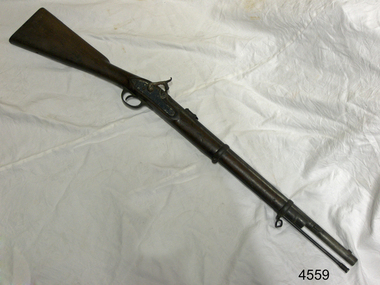
Weapon - Gun, ISAAC HOLLIS & SONS, Mid 19th Century
... During this period, the company became known for producing large volumes of affordable trade guns and sporting guns, catering to customers in South Africa and the British colonies. ...During this period, the company became known for producing large volumes of affordable trade guns and sporting guns, catering to customers in South Africa and the British colonies. ...The Hollis Brothers were first recorded as operating from 11 Weaman Row in 1840, although evidence suggests that the business may have commenced prior to this date. Over time, the firm evolved and became known as Isaac Hollis & Sons, with claims of its establishment dating back to 1814. This earlier date is supported by records of Richard and William Hollis trading in Bath Street, Birmingham, between 1814 and 1818, which raises the possibility that Isaac and Frederick Hollis were their descendants. The principal brothers involved in the business were Isaac Hollis, born in 1815, and Frederick Hollis, whose birth date remains unknown. Frederick’s life was cut short when he died on 20 December 1839. According to the 1841 census, Isaac Hollis resided in Weaman Row and was listed as a 25-year-old gun and pistol maker. He was married to Emma, who was born in 1821, and together they had two children: Isaac, born in 1837, and Henry, born in 1839. Following Frederick’s death, Isaac continued to operate under the name Hollis Brothers until 1845, after which he renamed the business Hollis Brothers & Co. This entity remained active up to 1848. In 1844, Isaac Hollis entered a brief partnership with William Tranter at 10 & 11 Weaman Row, likely to fulfil a specific contract or to supply particular parts. This partnership continued until 1849. In 1848, Isaac Hollis formed a partnership with Isaac Brentnall Sheath, establishing the firm of Hollis & Sheath and expanding their operations into 10 Weaman Row. The partnership saw Hollis & Sheath become licensed manufacturers of percussion breech-loading guns, positioning the company as a notable presence in the industry. In 1861, Sheath left the partnership and emigrated to New Zealand, where he conducted several enterprises and was elected as a provincial councillor. He died in Christchurch on 19th May 1897. Following the departure of Isaac Sheath in 1861, the business underwent a name change to Isaac Hollis & Sons. By approximately 1870, Isaac Hollis and Henry Hollis had assumed responsibility for the daily management of the firm, with Isaac overseeing the overall management and marketing of the company's products, while Henry managed the manufacturing processes. During this period, the company became known for producing large volumes of affordable trade guns and sporting guns, catering to customers in South Africa and the British colonies. In 1870, Isaac Hollis & Sons opened a retail location at 44a Cannon Street in London, subsequently relocating to 83 Cheapside in 1871. Isaac Hollis Jnr passed away in October 1875 in Birmingham at the age of 37, having never married. In 1876/1877, Henry Hollis registered a limited liability company under the name Isaac Hollis & Sons Ltd. However, by 1879, trading resumed under the name Isaac Hollis & Sons, and the London shop moved to 6 Great Winchester Street. From 1932 to 1933, the business operated in London as Hollis, Bentley & Playfair. The final closure of Hollis, Bentley & Playfair occurred in Birmingham in 1953. This firearm serves as an exemplary representation of the type of weapon distributed to the colony’s military forces in 1861. It was specifically manufactured by Isaac Hollis & Sons, a prominent gunmaker of the period, to meet the requirements of military use. Distribution was facilitated through Hebbert & Sons, an established military supplier based in London. Before it arrived in Tasmania, Australia, around 1861, the firearm was likely issued from the Hythe Armoury, which functioned as a British military training facility. Probably, the gun was originally allocated to British troops or police before being transferred for use in the colony. Gun: Percussion Carbine, .577 Cal. Colonial Tasmanian issue Artillery carbine, Pattern 1861. Muzzle-loading "Cap and Ball" musket. Wood stock and ramrod. Inscriptions are on the stock and breech. Gun was made for Herbert & Co., London, by Isaac Hollis & Sons, Birmingham.Stamped on stock "SOLD 95", " ISAAC HOLLIS & SONS" "GUN & PISTOL MANUFACTURES" "BIRMINGHAM" "J ASTON ARMOURER HYTHE" "MANUFACTURED EXPRESSLY FOR HEBBERT & CO LONDON". Stamped on breech "25", and "25C ---05"flagstaff hill, maritime museum, maritime village, warrnambool, great ocean road, shipwreck coast, firearm, gun, percussion, carbine, .577 cal, colonial tasmanian issue, artillery carbine, military gun, pattern 1861, muzzle-loading, muzzle-loading musket, cap and ball, musket, wood stock, 1861, percussion breech-loading guns, richard and william hillis, herbert & co., herbert & co. london, hollis & sons, isaac hollis & sons, isaac hillis & sons ltd., hollis bentley & playfair., isaac hollis, frederick hollis, isaac brentnall sheath, isaac sheath, william tranter, gun manufacturer, pistol manufacturer, gun and pistol maker, birmingham, j aston armourer, hythe, hythe armoury, military supplies -
 Flagstaff Hill Maritime Museum and Village
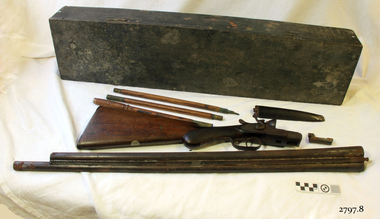
Weapon - Shotgun, Double Barrel, ISAAC HOLLIS & SONS, ca. 1904
... During this period, the company became known for producing large volumes of affordable trade guns and sporting guns, catering to customers in South Africa and the British colonies. ...During this period, the company became known for producing large volumes of affordable trade guns and sporting guns, catering to customers in South Africa and the British colonies. ...The proof marks on the barrels (a crown and letters BV) denote that the shotgun design was made from the year 1904, and that it was nitro-proof tested in Birmingham, England. David Melville Carrison (1895 to 1960) of Port MacDonnell was the previous owner of this Isaac Hollis & Sons double-barrel shotgun. His grandfather, Adam Kerrison Carrison (1833-1903), was an early settler who worked as a fisherman in that once-bustling seaport. His uncle John was a a horse-breaker, a boat hand, and a member of the lifeboat crew, receiving a medal for his part in saving the crew of a French barque. Currently, no connection has been made between the gun, its owner, and the note with the word “Enterprise”: a New Zealand-built, two-masted schooner that was wrecked in Lady Bay, Warrnambool, in 1950. Gun makers, ISAAC HOLLIS & SONS: The Hollis Brothers were first recorded as operating from 11 Weaman Row in 1840, although evidence suggests the business may have commenced before then. Over time, the firm became known as Isaac Hollis & Sons, with claims of its establishment dating back to 1814. This earlier date is supported by records of Richard and William Hollis trading in Bath Street, Birmingham, between 1814 and 1818, which raises the possibility that Isaac and Frederick Hollis were their descendants. The principal brothers involved in the business were Isaac Hollis, born in 1815, and Frederick Hollis, whose birth date remains unknown. Frederick’s life was cut short when he died on 20 December 1839. According to the 1841 census, Isaac Hollis resided in Weaman Row and was listed as a 25-year-old gun and pistol maker. He was married to Emma, who was born in 1821, and together they had two children: Isaac, born in 1837, and Henry, born in 1839. Following Frederick’s death, Isaac continued to operate under the name Hollis Brothers until 1845, after which he renamed the business Hollis Brothers & Co. This entity remained active up to 1848. In 1844, Isaac Hollis entered a brief partnership with William Tranter at 10 & 11 Weaman Row, likely to fulfil a specific contract or to supply parts. This partnership continued until 1849. In 1848, Isaac Hollis formed a partnership with Isaac Brentnall Sheath, establishing the firm of Hollis & Sheath and expanding their operations into 10 Weaman Row. The partnership saw Hollis & Sheath become licensed manufacturers of percussion breech-loading guns, positioning the company as a notable presence in the industry. In 1861, Sheath left the partnership and emigrated to New Zealand, where he conducted several enterprises and was elected as a provincial councillor. He died in Christchurch on 19th May 1897. In 1861, after Isaac Sheath left, the business name became Isaac Hollis & Sons. By approximately 1870, Isaac Hollis and Henry Hollis had assumed responsibility for the daily management of the firm, with Isaac overseeing the overall management and marketing of the company's products, and Henry managing the manufacturing processes. During this period, the company became known for producing large volumes of affordable trade guns and sporting guns, catering to customers in South Africa and the British colonies. In 1870, Isaac Hollis & Sons opened a retail location at 44a Cannon Street in London, and in 1871, it operated at 83 Cheapside Street. Isaac Hollis Jnr passed away in October 1875 in Birmingham at the age of 37, having never married. In 1876/1877, Henry Hollis registered a limited liability company under the name Isaac Hollis & Sons Ltd. However, by 1879, trading resumed under the name Isaac Hollis & Sons, and the London shop moved to 6 Great Winchester Street. From 1932 to 1933, the business operated in London as Hollis, Bentley & Playfair. The final closure of Hollis, Bentley & Playfair occurred in Birmingham in 1953. The shotgun was manufactured by Isaac Hollis & Sons, a firm with a strong reputation for producing firearms. This early 1900s example represents a standard pattern that was produced in large quantities for everyday use. This double-barrel shotgun is 12-gauge, complete with a cleaning rod and a wooden storage box. The firearm has been altered from its original configuration: the right barrel has been cut shorter, resulting in sharp edges at the muzzle, and a metal extension has been fitted to the stock. The cleaning rod consists of three separate segments that screw together for use. The shotgun is housed in a black-painted wooden case with a hinged lid showing inscriptions for the maker and Serial Number. Maker was I. HOLLIS & SONS, Serial Number SN 84245. David Melville Carrison of Port MacDonnell was the previous owner. A handwritten note that had the word 'Enterprise' was with the gun. "I. HOLLIS & SONS". SN on stock “84245”. Badge on both sides “Crown [symbol] / BV”. “Crown [symbol] / NP”, “12G inside Diamond [symbol]”, “NITRO PROOF”, “STEEL 84245” Paper note included with gun, written in felt tip pen “ENTERPRISE”. flagstaff hill, maritime museum, maritime village, warrnambool, great ocean road, shipwreck coast, firearm, gun, double-barrel, shotgun, cleaning rod, gunsmith, smithed, 12 gauge, sn 84245, serial number 84245, david melville carrison, early 1900s, richard and william hillis, herbert & co., herbert & co. london, hollis & sons, isaac hollis & sons, isaac hillis & sons ltd., hollis bentley & playfair., isaac hollis, frederick hollis, isaac brentnall sheath, isaac sheath, william tranter, gun manufacturer, pistol manufacturer, gun and pistol maker, birmingham, military supplies, enterprise, 1904 -
 Flagstaff Hill Maritime Museum and Village
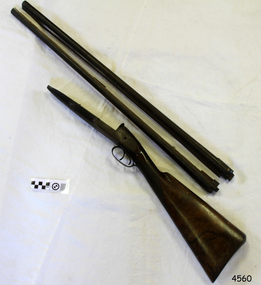
Weapon - Double Barrel Shotgun, Mid to late 19th Century
... The item is an early muzzle loading sporting shotgun not in very good condition and is unusable as a firearm and not very significant historically or valuable, although made by a well known and respected manufacturer of firearms there are many better examples of shotguns made by P Webley and Son in collections and for sale. This particular example is of a standard pattern for utilitarian use of which many were made. warrnambool shipwrecked-coast flagstaff-hill flagstaff-hill-maritime-museum shipwreck-coast flagstaff-hill-maritime-village gun shotgun double-barrel shotgun firearm muzzel loading shotgun philip webley black powder percussion cap Hunting Weapon Birmingham Gun Manufactures W & C Scott & Son P Webley & Son maker on left and right lock and P Webley & Son James St London on top of barrel. ...Philip Webley was born in 1813, he was the younger brother of James Webley who was born in 1807. Both were born in Birmingham. Towards the end of the 1800s, the firm claimed establishment in 1790, this must have been the date James and Philip's father or grandfather originally established a bullet or gun implement making business. It was not, as is often stated, the date William Davis established his business. Philip Webley was apprenticed in 1827 to Benjamin Watson. James Webley also seems to have been apprenticed but to who is not known. In 1834 James and Philip established their partnership as percussioners, lock filers and gun makers at 7 Weaman Street,Birmingham which was William Davis' old premises Davis, a gun implement maker, mould and toolmaker, died in 1831 and his wife Sarah inherited the business at 84 Weaman Street which she ran with her daughter, Caroline. On 5 January 1838 Philip Webley married Caroline. Philip was recorded at 84 Weaman Street from 1838 as a gun percussioner, lock filer and gun maker and this is when the partnership was last recorded, but the brothers apparently continued to co-operate until 1845 when Philip reportedly sold his interest to James and used the money to purchase Sarah Davis' business. Even then, they worked together particularly about the design and manufacture of percussion revolvers. Philip Webley was recorded in the 1851 census as a 38-year-old gun and pistol implement manufacturer living at 84 Weaman Street with his wife Caroline they had four sons and one daughter Thomas William, Emma, and Philip Jnr, and two other sons, James, and Henry and Philip's cousin, also lived with the family probably as a nurse, Sarah Haywood. On 4 February 1853 Philip Webley registered patent No. 335 for a hinged revolver and on 14 September 1853 he registered patent No. 2127 for improvement for the first muzzle-loading percussion cap and ball revolver which became known as the "Longspur". In 1859 Philips son Thomas William, aged 21, was made a partner in the firm, which then changed its name to P Webley & Son and described itself as "Gun and Pistol Makers and Patent Revolving Pistol Makers", probably exploiting Philip Webley's patent No. 305 of February 1853 for a revolver frame and lock, and its improvement under patent No. 2127 of September 1853. Thomas later went on to managed the shotgun side of the business. From about 1863 up to the First World War, the firm made rook rifles for Holland & Holland. From the 1890s they supplied magazine rifles. In 1863 and 1864 the firm's address was given as 83-84 Weaman Street, but from late 1864 to 1875 their address was 84 Weaman Street. By 1874 the firm had a showroom in London at an unknown address. In 1875 the firm expanded into 82-84 and 88-89 Weaman Street. The item is an early muzzle loading sporting shotgun not in very good condition and is unusable as a firearm and not very significant historically or valuable, although made by a well known and respected manufacturer of firearms there are many better examples of shotguns made by P Webley and Son in collections and for sale. This particular example is of a standard pattern for utilitarian use of which many were made. Shotgun, black powder, muzzle Loading, double barrel, percussion cap. P Webley & Son maker on left and right lock and P Webley & Son James St London on top of barrel. Barrel split in two. Has 14 stamped under each barrel with Birmingham proof marks for black powder shotguns. on undersides of both barrels. Proof marks used are early metal parts have decorative engravings of a gun dog flushing a birdwarrnambool, shipwrecked-coast, flagstaff-hill, flagstaff-hill-maritime-museum, shipwreck-coast, flagstaff-hill-maritime-village, gun, shotgun, double-barrel shotgun, firearm, muzzel loading shotgun, philip webley, black powder, percussion cap, hunting weapon, birmingham gun manufactures, w & c scott & son -
 Warrnambool and District Historical Society Inc.
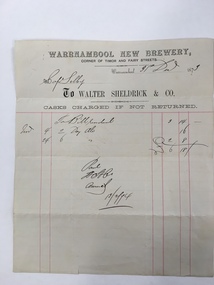
Document, Warrnambool New Brewery, 1870s
... Gun Club (pigeon shooting). As this is an original 1873 docket it is of considerable interest. It refers to the Warrnambool New Brewery, a prominent business in Warrnambool for over 50 years and to Captain Selby, well-known at the time in sporting circles. ...This is an invoice sent from the Warrnambool New Brewery (Walter Sheldrick & Co.) to Captain Selby. The Bill was for two dozen ales ordered on November 4th 1873 and for 6 dozen ales ordered on November 24th 1873 (cost £6-18-0). The bill was paid in February 1874. The Warrnambool New Brewery was established in 1868 by a company headed by a Warrnambool butcher and hotel proprietor, Walter Sheldrick. It was at the corner of Timor and Fairy Streets. After the first year the company was wound up and Walter Sheldrick and Thomas Price and, initially, two other partners, continued on the business. Sheldrick died in 1876 and his son Richard took over the business. By 1892 he had left the business and the brewery was operated by Edward Price, Edmund Hutton and William Trigg. In 1894 the brewery was sold and continued on until it was closed in 1922. The labels of Warrnambool Sheldricks ales had been known throughout the Western District for over 50 years. Captain Selby came to Warrnambool in the late 1860s and lived at ‘Clifton’ on the banks of the Hopkins River not far from the mouth if the river. He was a keen sportsman and was prominent in the Anglers Society, the Rowing Club (as President) and the Gun Club (pigeon shooting).As this is an original 1873 docket it is of considerable interest. It refers to the Warrnambool New Brewery, a prominent business in Warrnambool for over 50 years and to Captain Selby, well-known at the time in sporting circles. We have a good collection of other Captain Selby dockets. This is a buff-coloured piece of paper, an 1873 invoice sent from the Warrnambool New Brewery (Walter Sheldrick and Company) to Captain Selby of Warrnambool. The docket has printed red lines and both printed and handwritten material in black ink. The page has one small tear.warrnambool, walter sheldrick, captain selby, warrnambool new brewery, sheldrick ales -
 Rutherglen Historical Society
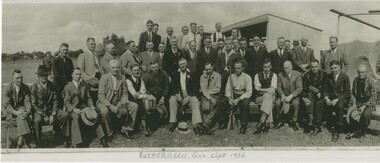
Image, 1936
... ...gun clubs...sporting.... : 1869-1954), Saturday 22 October 1898, page 26. rutherglen gun club gun clubs sporting clubs Written at the bottom of the photo: "Rutherglen Gun Club 1936" Sepia toned black and white photograph of a large group of men, two of them holding rifles, posing in a paddock, some seated, some standing. ...The Rutherglen Gun Club has been in existence since at least 1898, as confirmed by a newspaper entry found on TROVE. "The Trigger, By 'Sir Lucius'. Fixtures October 25" Weekly times (Melbourne, Vic. : 1869-1954), Saturday 22 October 1898, page 26.Sepia toned black and white photograph of a large group of men, two of them holding rifles, posing in a paddock, some seated, some standing. There is a shed in the background. Written at the bottom of the photo: "Rutherglen Gun Club 1936"rutherglen gun club, gun clubs, sporting clubs -
 Melbourne Legacy
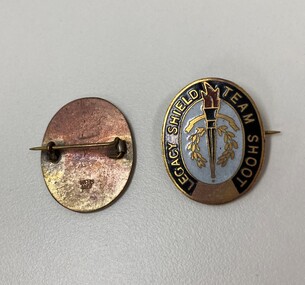
Badge, Legacy Shield Team Shoot Badge, 1960s
... Gun Club. The event raised £425 and was going to be an annual event. The badge of Legacy is the Torch and Wreath of Laurel. The Torch signifies the undying flame of service and sacrifice of those who gave their lives for their country. The Wreath of Laurel is the symbol of our remembrance of them. A record of a badge made for a sporting ...An example of a Legacy badge issued to participants in a clay target shooting competition. It appears it was an event organised by Legacy as a social event for Legatees. An article in the Weekly Bulletin in April 1963 shows there was a Clay Target Shoot day at the Point Cook RAAF Station. The winners of the first Legacy Shield was the Croydon Gun Club. The event raised £425 and was going to be an annual event. The badge of Legacy is the Torch and Wreath of Laurel. The Torch signifies the undying flame of service and sacrifice of those who gave their lives for their country. The Wreath of Laurel is the symbol of our remembrance of them.A record of a badge made for a sporting competition that Legacy participated in.Gold badge x 20 of the Legacy torch with black, red and white enamel containing the words Legacy Shield Team Shoot. legatee event, competition, prize -
 Rutherglen Historical Society
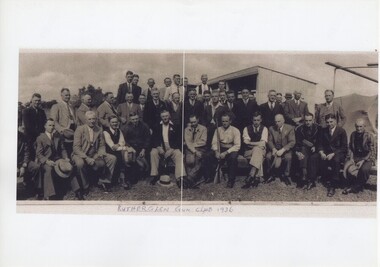
Photograph - Group photograph of Rutherglen Gun Club, 1936
... ...gun clubs...sporting.... : 1869-1954), Saturday 22 October 1898, page 26. rutherglen gun club gun clubs sporting clubs Written at the bottom of the photo: "Rutherglen Gun Club 1936" Sepia toned black and white photograph of a large group of men, two of them holding rifles, posing in a paddock, some seated, some standing. ...The Rutherglen Gun Club has been in existence since at least 1898, as confirmed by a newspaper entry found on TROVE. "The Trigger, By 'Sir Lucius'. Fixtures October 25" Weekly times (Melbourne, Vic. : 1869-1954), Saturday 22 October 1898, page 26.Sepia toned black and white photograph of a large group of men, two of them holding rifles, posing in a paddock, some seated, some standing. There is a shed in the background. Written at the bottom of the photo: "Rutherglen Gun Club 1936"rutherglen gun club, gun clubs, sporting clubs -
 Rutherglen Historical Society
Photograph - Group photograph of Rutherglen Gun Club, 1936
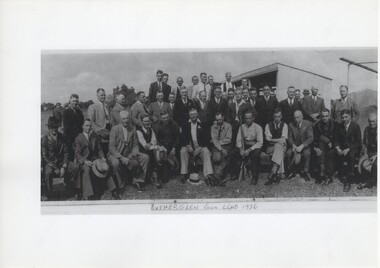
... ...gun clubs...sporting.... : 1869-1954), Saturday 22 October 1898, page 26. rutherglen gun club gun clubs sporting clubs Written at the bottom of the photo: "Rutherglen Gun Club 1936" Black and white photograph of a large group of men, two of them holding rifles, posing in a paddock, some seated, some standing. ...The Rutherglen Gun Club has been in existence since at least 1898, as confirmed by a newspaper entry found on TROVE. "The Trigger, By 'Sir Lucius'. Fixtures October 25" Weekly times (Melbourne, Vic. : 1869-1954), Saturday 22 October 1898, page 26.Black and white photograph of a large group of men, two of them holding rifles, posing in a paddock, some seated, some standing. There is a shed in the background. Written at the bottom of the photo: "Rutherglen Gun Club 1936"rutherglen gun club, gun clubs, sporting clubs -
 Rutherglen Historical Society
Photograph - Group photograph of Rutherglen Gun Club, 1936
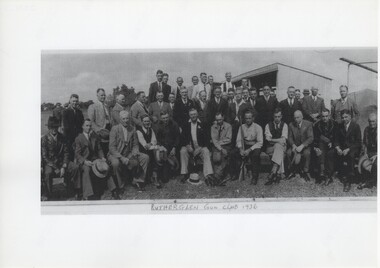
... ...gun clubs...sporting.... : 1869-1954), Saturday 22 October 1898, page 26. rutherglen gun club gun clubs sporting clubs Written at the bottom of the photo: "Rutherglen Gun Club 1936" Photocopy of a black and white photograph of a large group of men, two of them holding rifles, posing in a paddock, some seated, some standing. ...The Rutherglen Gun Club has been in existence since at least 1898, as confirmed by a newspaper entry found on TROVE. "The Trigger, By 'Sir Lucius'. Fixtures October 25" Weekly times (Melbourne, Vic. : 1869-1954), Saturday 22 October 1898, page 26.Photocopy of a black and white photograph of a large group of men, two of them holding rifles, posing in a paddock, some seated, some standing. There is a shed in the background. Written at the bottom of the photo: "Rutherglen Gun Club 1936"rutherglen gun club, gun clubs, sporting clubs -
 Rutherglen Historical Society
Photograph - Group photograph of Rutherglen Gun Club, 1936
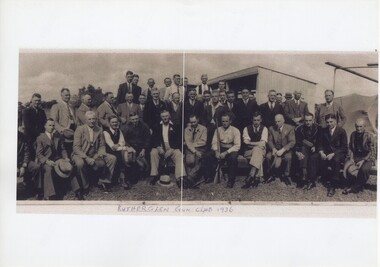
... ...gun clubs...sporting.... : 1869-1954), Saturday 22 October 1898, page 26. rutherglen gun club gun clubs sporting clubs Written at the bottom of the photo: "Rutherglen Gun Club 1936" Sepia toned black and white photograph of a large group of men, two of them holding rifles, posing in a paddock, some seated, some standing. ...The Rutherglen Gun Club has been in existence since at least 1898, as confirmed by a newspaper entry found on TROVE. "The Trigger, By 'Sir Lucius'. Fixtures October 25" Weekly times (Melbourne, Vic. : 1869-1954), Saturday 22 October 1898, page 26.Sepia toned black and white photograph of a large group of men, two of them holding rifles, posing in a paddock, some seated, some standing. There is a shed in the background. Written at the bottom of the photo: "Rutherglen Gun Club 1936"rutherglen gun club, gun clubs, sporting clubs -
 Unions Ballarat
Eureka : The songs that made Australia, 31 cm
... sporting life and disasters. Contents: • According to the Act • The Albury ram • Another fall of rain • Australia's on the Wallaby • The bald-headed end of the broom • The ballad of Ben Hall • The ballad of the Kelly Gang • The banks of the Condamine • The big-gun shearer • The black velvet band • The blackboys Waltzing Matilda • Bluey Brink • Bold Jack Donohue • Bound for Botany Bay • Brisbane ladies • Cain killed Abel • The cane-cutter's lament • The carrier's song • The Catalpa • Charlie Mopps • Click go the shears • The cockies of Bungaree • Colonial experience • Coming down the flat • The convict maid • The currency lasses • The death of Alec Robertson • The death of Ben Hall • The death of Willie Stone • Denis O'Reilly • The drover's dream • The dying aviator • The dying stockman • Eight little cylinders • The Eldorado mining disaster • The exile of Erin • Farewell to Greta • Flash Jack from Gundagai • The flash stockman • Frank Gardiner • The freehold on the plain • The gaol song • The girls of the Shamrock Shores • The golden gullies of the Palmer • The gumtree canoe • The Hamfat man • Heenan and Sayers • Henry's downfall • Here's adieu to all judges and juries • I've been to Australia, Oh • Jim Jones at Botany Bay • Jog along til shearing • John Kanaka • The Lachlan Tigers • Leave her, jollies, leave her • Les Darcy • The limejuice tub • Look out below • Maggie May • Maids of Australia • Man of the Earth • The Maryborough miner • Moreton Bay • The morning of the fray • Morrisey and the Russian sailor • Musselman • The mustering song • My name is Edward Kelly • Nails • The new chum Chinaman • Nine miles from Gundagai • The nose on my old man • Oh, give me a hut • The old bark hut • The old bullock dray • One of the has-beens • The overlanders • Pint Pot and Billy • Pity poor labourers • Radcliffe Highway • The rigs of the time • Rolling home • The Ryebuck shearer • Sam Holt • Sign-on day • Sixteen thousand miles from home • South Australia • The springtime it brings on the shearing • The stockman's last bed • The Sunshine Railway disaster • Tambaroora Ted • The tattooed lady • Ten thousand miles away • The tent poles are rotten • Travelling down the Castlereagh • Tumba-bloody-Rumba • The two professional hums • Van Diemen's Land • The wallaby brigade • When we get our tuppence back • The wild colonial boy • Woolloomooloo ...sporting life and disasters. Contents: • According to the Act • The Albury ram • Another fall of rain • Australia's on the Wallaby • The bald-headed end of the broom • The ballad of Ben Hall • The ballad of the Kelly Gang • The banks of the Condamine • The big-gun shearer • The black velvet band • The blackboys Waltzing Matilda • Bluey Brink • Bold Jack Donohue • Bound for Botany Bay • Brisbane ladies • Cain killed Abel • The cane-cutter's lament • The carrier's song • The Catalpa • Charlie Mopps • Click go the shears • The cockies of Bungaree • Colonial experience • Coming down the flat • The convict maid • The currency lasses • The death of Alec Robertson • The death of Ben Hall • The death of Willie Stone • Denis O'Reilly • The drover's dream • The dying aviator • The dying stockman • Eight little cylinders • The Eldorado mining disaster • The exile of Erin • Farewell to Greta • Flash Jack from Gundagai • The flash stockman • Frank Gardiner • The freehold on the plain • The gaol song • The girls of the Shamrock Shores • The golden gullies of the Palmer • The gumtree canoe • The Hamfat man • Heenan and Sayers • Henry's downfall • Here's adieu to all judges and juries • I've been to Australia, Oh • Jim Jones at Botany Bay • Jog along til shearing • John Kanaka • The Lachlan Tigers • Leave her, jollies, leave her • Les Darcy • The limejuice tub • Look out below • Maggie May • Maids of Australia • Man of the Earth • The Maryborough miner • Moreton Bay • The morning of the fray • Morrisey and the Russian sailor • Musselman • The mustering song • My name is Edward Kelly • Nails • The new chum Chinaman • Nine miles from Gundagai • The nose on my old man • Oh, give me a hut • The old bark hut • The old bullock dray • One of the has-beens • The overlanders • Pint Pot and Billy • Pity poor labourers • Radcliffe Highway • The rigs of the time • Rolling home • The Ryebuck shearer • Sam Holt • Sign-on day • Sixteen thousand miles from home • South Australia • The springtime it brings on the shearing • The stockman's last bed • The Sunshine Railway disaster • Tambaroora Ted • The tattooed lady • Ten thousand miles away • The tent poles are rotten • Travelling down the Castlereagh • Tumba-bloody-Rumba • The two professional hums • Van Diemen's Land • The wallaby brigade • When we get our tuppence back • The wild colonial boy • Woolloomooloo Australian culture, folklore and history in songs. songs btlc ballarat trades and labour council ballarat trades hall convicts transportation sea shanties pioneering gold goldrush bushrangers shearers drovers bush life sporting life disasters music Front cover: author's name and title. ...Songs of Australian heritage for voice. Melody line only with chord symbols. Includes guitar tablature for chords. Convicts, transportation and sea shanties. Pioneering, goldrush days and bushrangers. Shearers, drovers and bush life. Swagmen, Victorian expansion, sporting life and disasters. Contents: • According to the Act • The Albury ram • Another fall of rain • Australia's on the Wallaby • The bald-headed end of the broom • The ballad of Ben Hall • The ballad of the Kelly Gang • The banks of the Condamine • The big-gun shearer • The black velvet band • The blackboys Waltzing Matilda • Bluey Brink • Bold Jack Donohue • Bound for Botany Bay • Brisbane ladies • Cain killed Abel • The cane-cutter's lament • The carrier's song • The Catalpa • Charlie Mopps • Click go the shears • The cockies of Bungaree • Colonial experience • Coming down the flat • The convict maid • The currency lasses • The death of Alec Robertson • The death of Ben Hall • The death of Willie Stone • Denis O'Reilly • The drover's dream • The dying aviator • The dying stockman • Eight little cylinders • The Eldorado mining disaster • The exile of Erin • Farewell to Greta • Flash Jack from Gundagai • The flash stockman • Frank Gardiner • The freehold on the plain • The gaol song • The girls of the Shamrock Shores • The golden gullies of the Palmer • The gumtree canoe • The Hamfat man • Heenan and Sayers • Henry's downfall • Here's adieu to all judges and juries • I've been to Australia, Oh • Jim Jones at Botany Bay • Jog along til shearing • John Kanaka • The Lachlan Tigers • Leave her, jollies, leave her • Les Darcy • The limejuice tub • Look out below • Maggie May • Maids of Australia • Man of the Earth • The Maryborough miner • Moreton Bay • The morning of the fray • Morrisey and the Russian sailor • Musselman • The mustering song • My name is Edward Kelly • Nails • The new chum Chinaman • Nine miles from Gundagai • The nose on my old man • Oh, give me a hut • The old bark hut • The old bullock dray • One of the has-beens • The overlanders • Pint Pot and Billy • Pity poor labourers • Radcliffe Highway • The rigs of the time • Rolling home • The Ryebuck shearer • Sam Holt • Sign-on day • Sixteen thousand miles from home • South Australia • The springtime it brings on the shearing • The stockman's last bed • The Sunshine Railway disaster • Tambaroora Ted • The tattooed lady • Ten thousand miles away • The tent poles are rotten • Travelling down the Castlereagh • Tumba-bloody-Rumba • The two professional hums • Van Diemen's Land • The wallaby brigade • When we get our tuppence back • The wild colonial boy • Woolloomooloo Australian culture, folklore and history in songs.Paper; paperback book. Front cover: multicoloured background; picture of swaggy with guitar; picture of Eureka flag; black and green lettering. Back cover: red, orange and white background; Eureka flag; picture of a shearer with sheep; picture of a person in Ned Kelly armour playing a guitar on a horse; picture of woman facing the Ned Kelly figure; brand with the message "unsurpassed Australian made".Front cover: author's name and title. Back cover: author bio; praise from Jack Pobar, swagman.songs, btlc, ballarat trades and labour council, ballarat trades hall, convicts, transportation, sea shanties, pioneering, gold, goldrush, bushrangers, shearers, drovers, bush life, sporting life, disasters, music -
 Melbourne Legacy
Badge, Legacy Shield Team Shoot Badge
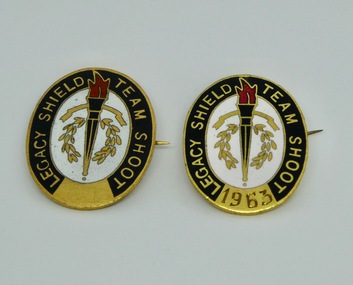
... Gun Club. The event raised £425 and was going to be an annual event. The badge of Legacy is the Torch and Wreath of Laurel. The Torch signifies the undying flame of service and sacrifice of those who gave their lives for their country. The Wreath of Laurel is the symbol of our remembrance of them. A record of a badge made for a sporting ...An example of a Legacy badge issued to participants in a clay target shooting competition. It appears it was an event organised by Legacy as a social event for Legatees. An article in the Weekly Bulletin in April 1963 shows there was a Clay Target Shoot day at the Point Cook RAAF Station. The winners of the first Legacy Shield was the Croydon Gun Club. The event raised £425 and was going to be an annual event. The badge of Legacy is the Torch and Wreath of Laurel. The Torch signifies the undying flame of service and sacrifice of those who gave their lives for their country. The Wreath of Laurel is the symbol of our remembrance of them.A record of a badge made for a sporting competition that Legacy participated in.Gold badge x 2 of the Legacy torch with black, red and white enamel containing the words Legacy Shield Team Shoot. Imprinted 'AT Webb Son' or 'Webb Melb' on reverse. One has been inscribed with the year 1963.legatee event, competition, prize -
 Wodonga & District Historical Society Inc
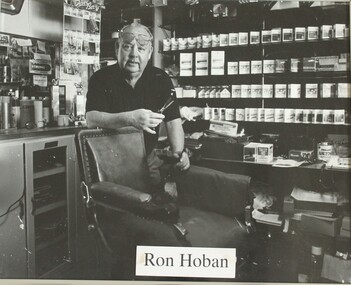
Photograph - Ron Hoban - Barber of Corryong, Rob Elliott, 1993
... Hoban branched out to selling sporting equipment with a focus on fishing tackle and even selling guns and ammunition when it was legal to do so. ...Hoban branched out to selling sporting equipment with a focus on fishing tackle and even selling guns and ammunition when it was legal to do so. ...This image is one from a series of portraits taken by Rob Elliott to record the character of the Border District through the faces if its identities. Ronald Joseph Hoban was born in 1930. In 1951, Mr Hoban, or "Hobie" as he became known, opened his hairdresser and tobacconist business in Corryong. This was at the height of the construction of the Snowy Mountains Scheme and business was thriving. As the tobacco industry slowed down, Mr. Hoban branched out to selling sporting equipment with a focus on fishing tackle and even selling guns and ammunition when it was legal to do so. He was an active and much-loved member of the Corryong community until his death in November 2014. This portrait is significant as it depicts a person who made a significant contribution to community of Corryong and district. The business he established still operates as Hobie’s Sports Store.A black and white photo of a man standing behind a barber's chair, scissors in hand. He has glasses pushed up on his forehead. Tobacco products are stored on the shelves in the background.ron hoban, corryong barber, people of the border
