
Showing 176 items matching "square tool"
-
 Emerald Museum & Nobelius Heritage Park
Tool - Sliding square tool, Rabone, 1958-1970
... Sliding square tool...sliding square tool...This old Rabone sliding square tool came from a small mixed farm in Emerald bought by Charles Alexander in 1920.... Sliding square tool Rabone ...This old Rabone sliding square tool came from a small mixed farm in Emerald bought by Charles Alexander in 1920.This tool is emblematic of a time when settlers had to be able to perform a range of tasks including basic carpentry.This John Rabone 1902 combination square is marked out in inches on both sides of the rule. The measurements are further broken down into micro increments of 1/8 inch and 1/16 inch. This square had a 12-inch rule and a level bubble built into the stock. This model was manufactured from 1958-1970.'RABONE' is printed on both sides of handlesliding square tool, square tool, alexander, emerald, victoria, australia, farm and garden equipment -
Emerald Museum & Nobelius Heritage Park
Tool - Square - a woodworking tool, pre-WWII
... Square - a woodworking tool...square tool...This square, along with a variety of other tools, was donated from a property in Emerald which was used for mixed farming and was owned by C Alexander (although he did not actually live there but leased it out) who bought it in 1920. ...Square - a woodworking tool with 9-inch blade. Wooden handle. ...Measurements on blade barely legible. Brass edging. Tool Square - a woodworking tool ...This square, along with a variety of other tools, was donated from a property in Emerald which was used for mixed farming and was owned by C Alexander (although he did not actually live there but leased it out) who bought it in 1920. The square helps to fill out a picture of what was needed by the farmer in his work.Square - a woodworking tool with 9-inch blade. Wooden handle. Hard metal blade. Measurements on blade barely legible. Brass edging.Barely legible inch measurements on bladesquare tool, woodworking, alexander, emerald, victoria, australia -
 Flagstaff Hill Maritime Museum and Village
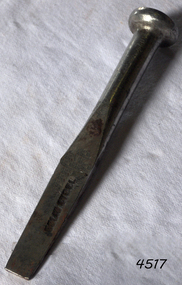
Tool - Caulking Tool, Ward & Payne Ltd, Late 19th century
... Caulking tool with square end...Tools such as the subject item demonstrate the traditional craftsmanship and skill of the shipwright and the aesthetic quality of the timber ships designs of the time. flagstaff hill warrnambool flagstaff hill maritime museum shipwreck coast flagstaff hill maritime village james s steele caulking iron caulking tool Shipwright Tools Ward & Payne Sheffield Forged Tools "WARD Sheffield" Caulking tool with square end Tool Caulking Tool Ward & Payne Ltd ...Caulking is the traditional technique used on wooden vessels built with butted or clinker-built planks to fill the gaps between these planks while still allowing the wood to flex and move. This involved driving the irons, hammered in with the mallet, deep into the seams to open them up. After this, spun yarn, oakum (hemp) or cotton was driven deep into the gaps. The hemp or cotton was soaked in creosote or pine tar to make the joins watertight. Caulking also played a structural role in tightening up the hull or deck by reducing the longitudinal movement of the neighbouring planks. The subject item was made by Ward & Payne of the Limbrick Works at Hillsborough, Sheffield England manufacturers of hand-forged tools. Their trademark registered in 1850 was a Letter "W" & "P" stamped into the steel. The firm was established by David Ward (1767-1822) in 1803 the company became David Ward & Sons, in 1837 after Ward's son Edward joined the firm. In 1845 Henry Payne the founder's son-in-law became a partner but died in 1850 after which the company reverted to the Ward family. The business then concentrated on making carving tools, chisels and gouges. In 1882 David Ward's grandson David Ward Jr. (1835-1889) purchased land and built a factory at Sheffield North known as the "Limerick Wheel". For a time Wards operated from both 106-114 West Street Sheffield and at Limbrick Road, Hillsborough on the river Loxley. By 1911 they had expanded into making spades, forks, sheep shears and many other types of edged tools including drills and wood planes. In 1967 Wilkinson Sword purchased all the company's share capital and continued to sell Ward & Payne tools until 1970 when a fire burned the factory down and housing development was built on the site. The subject item is significant as it gives a snapshot of the technological development of sailing ships and their operation before steam-powered vessels took over around the world. Tools such as the subject item demonstrate the traditional craftsmanship and skill of the shipwright and the aesthetic quality of the timber ships designs of the time. Caulking tool with square end"WARD Sheffield"flagstaff hill, warrnambool, flagstaff hill maritime museum, shipwreck coast, flagstaff hill maritime village, james s steele, caulking iron, caulking tool, shipwright tools, ward & payne sheffield, forged tools -
 Orbost & District Historical Society
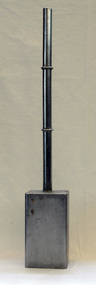
butter press
... A 1 lb butter press with a cylindrical metal handle on a square base. This tool fitted over the butter and pushed it out in a rectangular shape....Ltd was registered on June 1st 1893 and was an important source of income to the Orbost district. orbost-butter_factory agriculture farming butter-press A 1 lb butter press with a cylindrical metal handle on a square base. This tool fitted over the butter and pushed it out in a rectangular shape. butter press ...This was found by Kevin Ingram while cleaning the Orbost Butter Factory site in 1991. The Orbost Butter and Produce Co. Ltd was registered on June 1st 1893 and was an important source of income to the Orbost district. A 1 lb butter press with a cylindrical metal handle on a square base. This tool fitted over the butter and pushed it out in a rectangular shape.orbost-butter_factory agriculture farming butter-press -
 Greensborough Historical Society
Magazine, Banyule City Council, Banyule Banner June 2025, 2025_06
... This edition contains information on council concern over Victorain Government planning changes including the Greensborough 17 storey tower (town planning), Watsonia town square, the tool library at Sustainable Macleod and information on local projects....This edition contains information on council concern over Victorain Government planning changes including the Greensborough 17 storey tower (town planning), Watsonia town square, the tool library at Sustainable Macleod and information on local projects. ...The Banyule Banner is published by Banyule Council to advertise upcoming events in the City of Banyule and to report on past events. This edition contains information on council concern over Victorain Government planning changes including the Greensborough 17 storey tower (town planning), Watsonia town square, the tool library at Sustainable Macleod and information on local projects.A record of events within the City of Banyule.24 pages, colour illustrations. banyule banner, banyule council -
 Flagstaff Hill Maritime Museum and Village
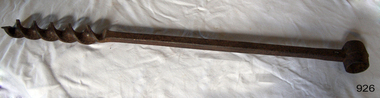
Tool - Auger, Robert Sorby, First half of the 20th Century
... The company has a long tradition of making edged tools for various uses and exporting them to Australia, however the subject item was probably made from the early 20th century up until 1967 when the company stopped exporting to Australia. flagstaff hill warrnambool flagstaff-hill flagstaff-hill-maritime-museum maritime-museum shipwreck-coast flagstaff-hill-maritime-village ring auger Carpenders tools Hole Drilling Rob Sorby & Sons Rob Sorbey Sheffield stamped on shaft with Kangaroo trade mark Scotch Eye Auger, Double Twist with Lead Screw, square shaft, socket set at right angle Tool Auger Robert Sorby ...A scotch eye auger is perfect for quickly making holes in dry or wet wood for making chairs, stools, and any number of woodworking projects. The scotch eye serves as a peg gauge and whatever peg you make to go into the hole should fit into the augers eye. Robert Sorby & Sons: The forbearer's of Robert Sorby had been cutlers in the Sheffield region of England, dating from the mid 17th century. Robert Sorby and Sons were registered in Sheffield in 1828 as a manufacturer of edge tools, saws, scythes and hay knives. In addition to manufacturing tools, they also diversified into the manufacture of crucible steel for tool manufacture. From circa 1860-1967, the Sorby factory in Sheffield was known as the “Kangaroo Works”. The Kangaroo Brand of tools was made by Robert Sorby & Sons. During the 19th century, they had a large trade in Australasia. By the early 20th century, they were manufacturing carving tools, planes and plane irons, circular saws, wood saws, butchers saws and cleavers, garden tools, pruning knives, coopers’ knives, bricklayers tools and joiners tools. In 1923 Robert Sorby & Sons was bought by Sheffield company Hattersley and Davidson. They are today one of the few remaining British tool manufacturers.The company has a long tradition of making edged tools for various uses and exporting them to Australia, however the subject item was probably made from the early 20th century up until 1967 when the company stopped exporting to Australia.Scotch Eye Auger, Double Twist with Lead Screw, square shaft, socket set at right angleRob Sorbey Sheffield stamped on shaft with Kangaroo trade markflagstaff hill, warrnambool, flagstaff-hill, flagstaff-hill-maritime-museum, maritime-museum, shipwreck-coast, flagstaff-hill-maritime-village, ring auger, carpenders tools, hole drilling, rob sorby & sons -
 Flagstaff Hill Maritime Museum and Village
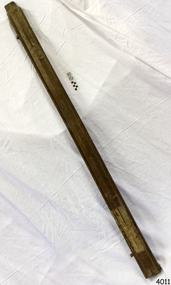
Tool - Wood Sample, Before 1878
... square of paper bearing an inscription. The paper, peeling back and with torn edges, is stuck over an original wood stain but under a subsequent layer of varnish. The faded ink words are indecipherable where paper is missing, but written carefully in an old fashioned cursive script. Tool ...On a piece of paper subsequently glued near one end of its curved upper face, this length of planed and polished hardwood timber bears the inscription: “A [p]iece of w[r]ec[k] of the Loch Ard wrecked near Sherbroke River”. The timber is carefully worked with rich dark colouring and a uniformly moulded design, suggesting that it was part of a fitting or furnishing that was publicly visible and prominent. If the artefact is what it is declared to be, then it is possible that it formed part of the ship’s railings or companionway stairs. The LOCH ARD was a 1,693 ton, 3 masted barque, built on the Clyde in 1873. In an age of increasing competition for the emigrant passenger trade from steam-driven vessels, special attention was paid to her wooden furnishings and fittings. The Loch Line owners prided themselves on their attractive, distinctively painted, sailing ships. Below decks, where cargo and third class passengers were stowed, was made of iron. But everything above deck, and on show to the saloon and second class passengers, was carved and varnished timber. Captain Daish’s 1878 report for the ship’s underwriters notes “a quantity of general Cargo washed up in a confused mass” in the cove and “a number of Cases, Casks and Bales; also deals and boards floating about in some of the gorges” further west of the shipwreck. Contemporary newspaper accounts also reported a large quantity of cargo and timber washed ashore in the days following the LOCH ARD shipwreck, adding “but those were speedily removed by persons who came down from Port Campbell, Scott’s Creek and other places with carts and pack horses”. The appearance and good condition of this wood artefact, and the aged patina and dated hand-writing style of its pasted on inscription, support the suggestion that it was ‘souvenired’ from the floating debris of the LOCH ARD at or near the 1878 date of its foundering off Mutton Bird Island. HISTORY OF THE LOCH ARD The LOCH ARD belonged to the famous Loch Line which sailed many ships from England to Australia. Built in Glasgow by Barclay, Curdle and Co. in 1873, the LOCH ARD was a three-masted square rigged iron sailing ship. The ship measured 262ft 7" (79.87m) in length, 38ft (11.58m) in width, 23ft (7m) in depth and had a gross tonnage of 1693 tons. The LOCH ARD's main mast measured a massive 150ft (45.7m) in height. LOCH ARD made three trips to Australia and one trip to Calcutta before its final voyage. LOCH ARD left England on March 2, 1878, under the command of Captain Gibbs, a newly married, 29 year old. She was bound for Melbourne with a crew of 37, plus 17 passengers and a load of cargo. The general cargo reflected the affluence of Melbourne at the time. On board were straw hats, umbrella, perfumes, clay pipes, pianos, clocks, confectionary, linen and candles, as well as a heavier load of railway irons, cement, lead and copper. There were items included that intended for display in the Melbourne International Exhibition in 1880. The voyage to Port Phillip was long but uneventful. At 3am on June 1, 1878, Captain Gibbs was expecting to see land and the passengers were becoming excited as they prepared to view their new homeland in the early morning. But LOCH ARD was running into a fog which greatly reduced visibility. Captain Gibbs was becoming anxious as there was no sign of land or the Cape Otway lighthouse. At 4am the fog lifted. A man aloft announced that he could see breakers. The sheer cliffs of Victoria's west coast came into view, and Captain Gibbs realised that the ship was much closer to them than expected. He ordered as much sail to be set as time would permit and then attempted to steer the vessel out to sea. On coming head on into the wind, the ship lost momentum, the sails fell limp and LOCH ARD's bow swung back. Gibbs then ordered the anchors to be released in an attempt to hold its position. The anchors sank some 50 fathoms - but did not hold. By this time LOCH ARD was among the breakers and the tall cliffs of Mutton Bird Island rose behind the ship. Just half a mile from the coast, the ship's bow was suddenly pulled around by the anchor. The captain tried to tack out to sea, but the ship struck a reef at the base of Mutton Bird Island, near Port Campbell. Waves broke over the ship and the top deck was loosened from the hull. The masts and rigging came crashing down knocking passengers and crew overboard. When a lifeboat was finally launched, it crashed into the side of LOCH ARD and capsized. Tom Pearce, who had launched the boat, managed to cling to its overturned hull and shelter beneath it. He drifted out to sea and then on the flood tide came into what is now known as LOCH ARD Gorge. He swam to shore, bruised and dazed, and found a cave in which to shelter. Some of the crew stayed below deck to shelter from the falling rigging but drowned when the ship slipped off the reef into deeper water. Eva Carmichael had raced onto deck to find out what was happening only to be confronted by towering cliffs looming above the stricken ship. In all the chaos, Captain Gibbs grabbed Eva and said, "If you are saved Eva, let my dear wife know that I died like a sailor". That was the last Eva Carmichael saw of the captain. She was swept off the ship by a huge wave. Eva saw Tom Pearce on a small rocky beach and yelled to attract his attention. He dived in and swam to the exhausted woman and dragged her to shore. He took her to the cave and broke open case of brandy which had washed up on the beach. He opened a bottle to revive the unconscious woman. A few hours later Tom scaled a cliff in search of help. He followed hoof prints and came by chance upon two men from nearby Glenample Station three and a half miles away. In a state of exhaustion, he told the men of the tragedy. Tom returned to the gorge while the two men rode back to the station to get help. By the time they reached LOCH ARD Gorge, it was cold and dark. The two shipwreck survivors were taken to Glenample Station to recover. Eva stayed at the station for six weeks before returning to Ireland, this time by steamship. In Melbourne, Tom Pearce received a hero's welcome. He was presented with the first gold medal of the Royal Humane Society of Victoria and a £1000 cheque from the Victorian Government. Concerts were performed to honour the young man's bravery and to raise money for those who lost family in the LOCH ARD disaster. Of the 54 crew members and passengers on board, only two survived: the apprentice, Tom Pearce and the young woman passenger, Eva Carmichael, who lost all of her family in the tragedy. Ten days after the LOCH ARD tragedy, salvage rights to the wreck were sold at auction for £2,120. Cargo valued at £3,000 was salvaged and placed on the beach, but most washed back into the sea when another storm developed. The wreck of LOCH ARD still lies at the base of Mutton Bird Island. Much of the cargo has now been salvaged and some was washed up into what is now known as LOCH ARD Gorge. Cargo and artefacts have also been illegally salvaged over many years before protective legislation was introduced. One of the most unlikely pieces of cargo to have survived the shipwreck was a Minton porcelain peacock - one of only nine in the world. The peacock was destined for the Melbourne International Exhibition in 1880. It had been well packed, which gave it adequate protection during the violent storm. Today, the Minton peacock can be seen at the Flagstaff Hill Maritime Museum in Warrnambool. From Australia's most dramatic shipwreck it has now become Australia's most valuable shipwreck artefact and is one of very few 'objects' on the Victorian State Heritage Register. The Loch Ard wreck is of state significance – Victorian Heritage Register S417. However there is a lack of documented provenance that limits the interpretive value of this piece of timber (for example, its potential to interpret nineteenth century souveniring and scavenging from shipwrecks along the south west coast of Victoria). Flagstaff Hill’s collection of artefacts from LOCH ARD is significant for being one of the largest collections of artefacts from this shipwreck in Victoria. It is significant for its association with the shipwreck, which is on the Victorian Heritage Register (VHR S417). The collection is significant because of the relationship between the objects, as together they have a high potential to interpret the story of the LOCH ARD. The LOCH ARD collection is archaeologically significant as the remains of a large international passenger and cargo ship. The LOCH ARD collection is historically significant for representing aspects of Victoria’s shipping history and its potential to interpret sub-theme 1.5 of Victoria’s Framework of Historical Themes (living with natural processes). The collection is also historically significant for its association with the LOCH ARD, which was one of the worst and best known shipwrecks in Victoria’s history. A length of hardwood timber, planed and varnished to smooth finish on three sides, with two unfinished tongues protruding from each end (one broken off), possibly from the wreck of the LOCH ARD. The front or upper face is moulded and routed to a regular, linear (skirting board type) design along its entire length, the two sides flat planed. One side contains two inserted dowel rods that have been broken off. The bottom face has not been finished to the same standard. The sample is good quality wood that has retained its density and weight and shows no evidence of having been submerged in seawater for any length of time. Glued on to the upper face of the length of timber near the right hand end is a deteriorated square of paper bearing an inscription. The paper, peeling back and with torn edges, is stuck over an original wood stain but under a subsequent layer of varnish. The faded ink words are indecipherable where paper is missing, but written carefully in an old fashioned cursive script.The inscription on the paper reads: “A [p]iece of w[r]ec[k] of the Loch Ard wrecked near Sherbroke River”. flagstaff hill, warrnambool, shipwrecked coast, flagstaff hill maritime museum, maritime museum, shipwreck coast, flagstaff hill maritime village, great ocean road, loch line, loch ard, captain gibbs, eva carmichael, tom pearce, glenample station, mutton bird island, loch ard gorge, nineteenth-century souveniring, shipwreck scavenging, loch line sailing ships, wood sample -
 Flagstaff Hill Maritime Museum and Village
Tool - Plane, 20th century
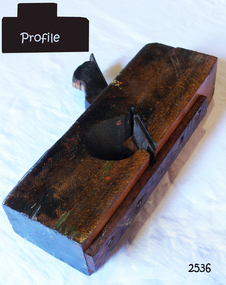
... tool Rabbet plane. Has a makeshift piece of wood screwed to base to protect it. Made by Sherman Nth York. Blade size 2". A square ...A special version of the rebate plane, the keel and stem rabbet plane. This was a wider than the usual rebate or rabbet plane, and the blade was set askew to the side to give a slicing action. It was used for cleaning out the rabbet cut from the head of the stem, and along the keel, to take the ends and edges of the planking - its angle varied according to the ship.Rabbet plane. Has a makeshift piece of wood screwed to base to protect it. Made by Sherman Nth York. Blade size 2". A square piece of leather is tacked to top of plane. Red paint markings are on one side.flagstaff hill, warrnambool, shipwrecked-coast, flagstaff-hill, flagstaff-hill-maritime-museum, maritime-museum, shipwreck-coast, flagstaff-hill-maritime-village, rabbet plane., wood working, wood working tools, hand tool -
 Flagstaff Hill Maritime Museum and Village
Tool - Wood moulding Plane, Christopher Gabriel, 18th Century
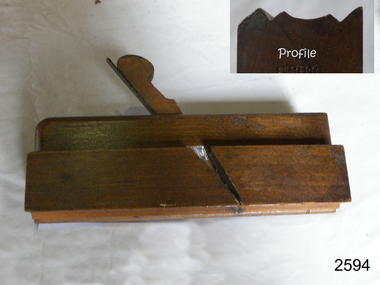
... Tools that were themselves hand made shows the craftsmanship used during this time not only to make a tool such as the subject item but also the craftsmanship needed to produce a decorative or even finish that was needed for the finishing of timber items. flagstaff hill warrnambool shipwrecked-coast flagstaff-hill flagstaff-hill-maritime-museum maritime-museum shipwreck-coast flagstaff-hill-maritime-village Maker stamped Gabriel also stamped JB & No 9 Plane Moulding Reverse Ogee with two squares type Tool Wood moulding Plane Christopher Gabriel ...The story of Christopher Gabriel born on April 2, 1746, in Falmouth England is a tale of a poor boy who made good. Shortly before he turned thirteen years of age in 1759 he was apprenticed to a local master carpenter, recorded as a Mr Barnicot the master trained his apprentice well as we can assume by Christopher's later successes. The apprenticeship ended in 1766 after seven years when Christopher reached twenty. Then in 1768, he relocated to London walking the two hundred miles from Falmouth carrying his possessions in a sack. He no sooner arrived in London when he met Alice Trowell who became his wife in March 1769. They set up house on Albermarie Street Clerkenwell and by the first of 1770, Gabriel had begun his business of plane making. It has been speculated that Gabriel took over the shop of John Cogdell aided with an investment from his in-laws of 131 pounds. He went on to prosper as a plane maker and lumber merchant over the next forty years. His business did well and in 1774 Gabriel moved to a house in Golden Lane, London and 1779 moved again to a home in Ould Street London. By now Gabriel was making a name for himself and his business at this time was located at 32 Banner Street Golden Lane, the following year he purchased another home in Banner Street and 1793 purchased the house next door. At the time of his death in 1808, he owned twenty-seven houses and commercial building. Christopher Gabriel s descendants became quite prominent in England and his grandson, Sir Thomas Gabriel became the Sheriff of London and Middlesex in 1859 and the Lord Mayor of London 1866 and 1867. Gabriel was an extremely prolific plane maker with a lot of examples made in the 18th century can still be found today. He made good quality tools and was an innovator of several new plane designs. A vintage tool made by a well-known plane maker, this item was made commercially for firms and individuals that worked in wood and needed a tool that could give a decorative finish to timber. These planes came in various shapes and sizes to achieve a finish to timber surfaces and came in many sizes. A significant Christopher Gabriel plane from the mid to late 18th century that after 200 years can still be used today. Planes made by Gabriel are eagerly sought after by collectors. The tool gives us a snapshot of how furniture and other finishes were created on timber by the use of cutting edged hand tools. Tools that were themselves hand made shows the craftsmanship used during this time not only to make a tool such as the subject item but also the craftsmanship needed to produce a decorative or even finish that was needed for the finishing of timber items. Plane Moulding Reverse Ogee with two squares type Maker stamped Gabriel also stamped JB & No 9flagstaff hill, warrnambool, shipwrecked-coast, flagstaff-hill, flagstaff-hill-maritime-museum, maritime-museum, shipwreck-coast, flagstaff-hill-maritime-village -
 Flagstaff Hill Maritime Museum and Village
Caulking Tool
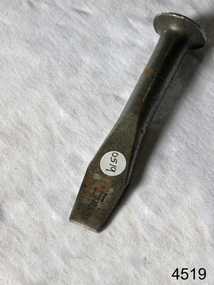
... tool spike. Has been broken and repaired. 132mm long. Blade square 19mm wide...tool spike. Has been broken and repaired. 132mm long. Blade square 19mm wide Caulking Tool ...James S Steele tool boxCaulking tool spike. Has been broken and repaired. 132mm long. Blade square 19mm wideflagstaff hill, warrnambool, shipwrecked-coast, flagstaff-hill, flagstaff-hill-maritime-museum, maritime-museum, shipwreck-coast, flagstaff-hill-maritime-village -
 Federation University Historical Collection
Education kit - Educational Aid, Cuisenaire Rods, c1970s
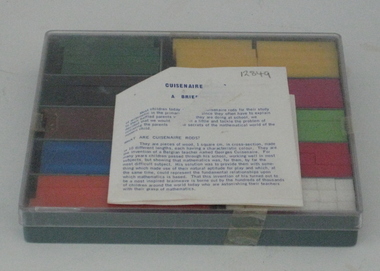
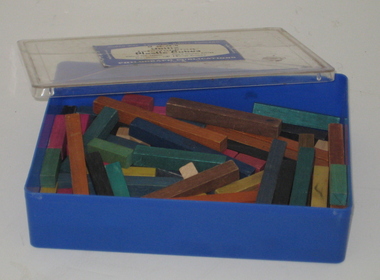
... Cuisenaire Rods are pieces of wood/plastic, 1 square cm in cross-section, made in 10 different lengths, each having a charactersitic colour. Invented by a Belgian teacher, Georges Cuisenaire, as a tool to assist in the teaching of mathematics....Cuisenaire Rods are pieces of wood/plastic, 1 square cm in cross-section, made in 10 different lengths, each having a charactersitic colour. Invented by a Belgian teacher, Georges Cuisenaire, as a tool to assist in the teaching of mathematics. education maths cuisenaire rods teaching tool mathematics education A plastic box with a clear lid containing 10 different coloured plastic Cuisenaire Rods: Orange, blue, brown, black, dark green, yellow, pink, light green, red, white. ...Cuisenaire Rods are pieces of wood/plastic, 1 square cm in cross-section, made in 10 different lengths, each having a charactersitic colour. Invented by a Belgian teacher, Georges Cuisenaire, as a tool to assist in the teaching of mathematics.A plastic box with a clear lid containing 10 different coloured plastic Cuisenaire Rods: Orange, blue, brown, black, dark green, yellow, pink, light green, red, white. Taped to the box is a leaflet titles 'Cuisenaire Rods: A Brief History'. The following rods are: 6 x orange 6 x blue 6 x brown 6 x black 8 x dark green 16 x yellow 12 x pink 18 x light green 24 x red 24 x red 42 whiteeducation, maths, cuisenaire, rods, teaching tool, mathematics education -
 Federation University Historical Collection
Educational Aid, Cuisenaire Rods, c1970
... Cuisenaire Rods are pieces of wood/plastic, 1 square cm in cross-section, made in 10 different lengths, each having a charactersitic colour. Invented by a Belgian teacher, Georges Cuisenaire, as a tool to assist in the teaching of mathematics....Cuisenaire Rods are pieces of wood/plastic, 1 square cm in cross-section, made in 10 different lengths, each having a charactersitic colour. Invented by a Belgian teacher, Georges Cuisenaire, as a tool to assist in the teaching of mathematics. education maths cuisenaire rods A selection of timber Cuisenaire rods in a blue plastic container with clear lid. ...Cuisenaire Rods are pieces of wood/plastic, 1 square cm in cross-section, made in 10 different lengths, each having a charactersitic colour. Invented by a Belgian teacher, Georges Cuisenaire, as a tool to assist in the teaching of mathematics.A selection of timber Cuisenaire rods in a blue plastic container with clear lid. education, maths, cuisenaire, rods -
 Flagstaff Hill Maritime Museum and Village
Functional object - Knife Sharpener, Johann Friedrich Dick, 1873 to 1900
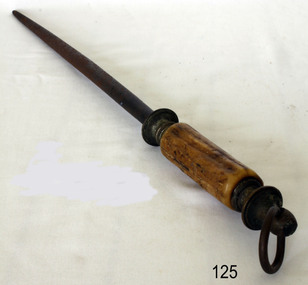
... tools. Files manufactured ranged from the smallest watchmaker's file to the largest (over 45 cm in length) square file. ...tools. Files manufactured ranged from the smallest watchmaker's file to the largest (over 45 cm in length) square file. ...Johann Friedrich Dick founded the company in 1778 to manufacture files, the company continued in the manufacture of files as its main product line until 1873, when Paul Friedrich Dick took over the company and began the production of sharpening steels, with the logo of “F Dick” on their products. One hundred years after the founding of the company, a factory in Esslingen began construction. At that time the company had 20 employees. In 1881, company commissioned Germany's first file production machine. In 1889, Friedrich Dick built a new factory in Kollwitz/Fleischmannstrasse in Esslingen, employing 100 people and expanding the product line to include knives for butchers and chefs, cleavers and other specialized tools. Files manufactured ranged from the smallest watchmaker's file to the largest (over 45 cm in length) square file. In 1997, the F Dick company moved to a new headquarters in Deizisau, Germany. The old factory in Esslingen is now a class listed monument and the town's landmark.An item made by a world class manufacture of cutlery for chefs, the subject item is significant as its manufacture was probably early in the firms beginnings when Friedrich Dick took over in1873 when he specialised in making sharpening steels. The company is still producing these items today as well as other specialised knives for professionals. Early manufactured steels such as the subject item are sought after today by collectors and quite rare. Sharpening Steel or Knife sharpener with bone handle with ribbed pattern, brass knobs and ring at end of handleMarked F Dick Esslingenflagstaff hill, warrnambool, shipwrecked coast, flagstaff hill maritime museum, flagstaff hill maritime village, great ocean road, sharpening steel, knife sharpener, kitchen tool, carving, kitchen utensil, cooking, f dick -
 Flagstaff Hill Maritime Museum and Village
Container - Box
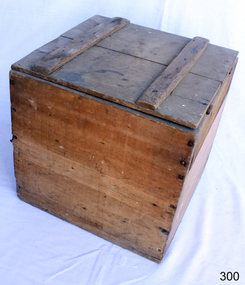
... tool chests, treasure chests, blanket boxes and steamer trunks. Wooden chests and trunks have became the most useful, and most versatile piece in furniture’s history. https://www.vineyarddetails.com/blogs/february-2019/history-of-box-making The use of the wooden box for storage. Flagstaff Hill Warrnambool Shipwrecked-coast Flagstaff-Hill Flagstaff-Hill-Maritime-Museum Maritime-Museum Shipwreck-coast Flagstaff-Hill-Maritime-Village Wooden Box Furniture Storage None. Wooden square ...From the earliest days, humans have furnished their dwellings with the items they needed to survive and over the centuries the wooden chest, storage boxes and trunks have become the most common piece of furniture found in the home. Over time the simple storage chest has evolved into different styles and been modified for different uses: wooden boxes, storage chests, tool chests, treasure chests, blanket boxes and steamer trunks. Wooden chests and trunks have became the most useful, and most versatile piece in furniture’s history. https://www.vineyarddetails.com/blogs/february-2019/history-of-box-makingThe use of the wooden box for storage.Wooden square handmade box with hinged lid. Made from rough pine boards.None.flagstaff hill, warrnambool, shipwrecked-coast, flagstaff-hill, flagstaff-hill-maritime-museum, maritime-museum, shipwreck-coast, flagstaff-hill-maritime-village, wooden box, furniture, storage -
 Flagstaff Hill Maritime Museum and Village
Tool - Drill Brace, 1800s
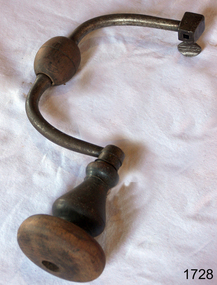
... square shank bits, early designs have a thumb screw to help secure the bit. Later designs had a catch to secure drilling bits. This type of brace was used in wagon making for boring & drilling holes into the wood for a variety of purposes, including driving screws. The subject item is unmarked but could have been made in Glasgow Scotland by John Fray in the 1800s A significant early example of a drill brace made in the UK during the 1800s demonstrates the evolution of this type of tool from this time that today is a rare and collectable example of woodworking tools. flagstaff hill warrnambool flagstaff-hill flagstaff-hill-maritime-museum maritime-museum shipwreck-coast flagstaff-hill-maritime-village brace Carpenders Wheel Brace Cabinet Makers Tools Drilling Tool Wagon Makers Drill None Drill Brace metal with socket and thumbscrew, varnished wooden head and handle Tool Drill Brace ...The subject item is an early Victorian Scotch Brace with a 10-inch sweep. They were also known as a six penny or "gentleman's" brace and were designed to accept tapered square shank bits, early designs have a thumb screw to help secure the bit. Later designs had a catch to secure drilling bits. This type of brace was used in wagon making for boring & drilling holes into the wood for a variety of purposes, including driving screws. The subject item is unmarked but could have been made in Glasgow Scotland by John Fray in the 1800s A significant early example of a drill brace made in the UK during the 1800s demonstrates the evolution of this type of tool from this time that today is a rare and collectable example of woodworking tools.Drill Brace metal with socket and thumbscrew, varnished wooden head and handleNoneflagstaff hill, warrnambool, flagstaff-hill, flagstaff-hill-maritime-museum, maritime-museum, shipwreck-coast, flagstaff-hill-maritime-village, brace, carpenders wheel brace, cabinet makers tools, drilling tool, wagon makers drill -
 Flagstaff Hill Maritime Museum and Village
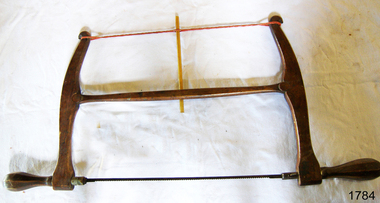
Tool - Bow Saw, 1850 to 1900
... square to the sides of the timber. The rivets holding the blade to the handle can be withdrawn so that the saw can be used for an internal cut, the blade being threaded through a hole drilled through the timber. A vintage bow saw used in cabinet work by a cabinet maker in the mid to later part of the 19th century probably made in England. flagstaff hill warrnambool flagstaff-hill flagstaff-hill-maritime-museum maritime-museum shipwreck-coast flagstaff-hill-maritime-village bow saw Carpenders Tools Cabinet Makers Tools Wood Working Wood Saw None Bow saw wooden frame and handles. ...The Bow Saw is considered by many to be the most satisfactory saw for cutting shapes since the narrow blade negotiates curves easily, and is held in tension. Both the handle and knob (at the other end of the blade) can be turned so that a cut can be made more or less parallel to the required cut. Obviously the blade must be free of twist when in use. It is available with blade lengths of 25 to 40 cm (10 to 16 in). Generally both hands grips the one handle, hence the bulbous shape with narrow neck, but when thick wood has to be sawn it is helpful to have a person at each side, both sides of the wood having been marked. In this way it is much easier to keep the cut square to the sides of the timber. The rivets holding the blade to the handle can be withdrawn so that the saw can be used for an internal cut, the blade being threaded through a hole drilled through the timber.A vintage bow saw used in cabinet work by a cabinet maker in the mid to later part of the 19th century probably made in England.Bow saw wooden frame and handles. Twine attached to upper section of frame.Noneflagstaff hill, warrnambool, flagstaff-hill, flagstaff-hill-maritime-museum, maritime-museum, shipwreck-coast, flagstaff-hill-maritime-village, bow saw, carpenders tools, cabinet makers tools, wood working, wood saw -
 Flagstaff Hill Maritime Museum and Village
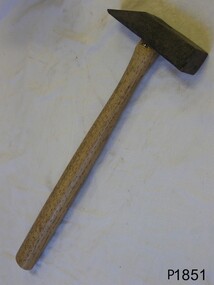
Tool - Setting Hammer, Vaughan & Bushnell Mfg. Co, Mid-20th Century
... Tool Alexander Vaughan Vaughan & Bushnell Mfg. Co tinner's pairing hammer tinner's setting hammer pairing hammer tin smith metal work metal work equipment Vaughan Stamped "Vaughan " Hammer: tinner's setting or pairing hammer. The head has a square ...The company Vaughan & Bushnell Mfg. Co. was founded in Peoria, Illinois, by Alexander Vaughan. It began as a plumbing business, which in those days consisted of digging wells and piping water into the kitchens of the local citizenry. Alexander's business prospered, but the inventive, 18-year-old blacksmith had his eye on bigger things. Alexander had an idea for improving the design of the augers used for digging fencing post holes. He turned this idea into reality, and believing that Chicago would outstrip Peoria as a business centre, moved to the Windy City. He set up a blacksmith shop in a room behind a hardware store owned by Sidney Bushnell. On June 15, 1869, Alexander was granted U.S. Patent No. 91,387 for his Improved Post Auger. Customer satisfaction with Vaughan post augers led to requests for other hand tools, and Alexander soon found himself in the custom tool business. Since that time, Vaughan has been transformed from a small maker of hand tools to one of the world's largest manufacturers of striking tools that today are still producing quality tools for the world's markets.Vaugahn & Co. was a significant USA company that became the leader in the manufacture of striking tools that have been exported all over the world. Hammer: tinner's setting or pairing hammer. The head has a square poll and a wedge. Stamped with the inscription. Manufactured in the UK by Vaughan. Stamped "Vaughan "flagstaff hill, warrnambool, flagstaff-hill-maritime-museum, maritime-museum, shipwreck-coast, flagstaff-hill-maritime-village, hammer, setting hammer, tinners hammer, tool, striking tool, alexander vaughan, vaughan & bushnell mfg. co, tinner's pairing hammer, tinner's setting hammer, pairing hammer, tin smith, metal work, metal work equipment, vaughan -
 Federation University Historical Collection
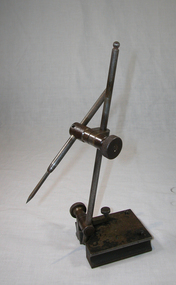
Object, Brown and Sharpe Manufacturing Co, Universal Surface Gauge
... It can be brought square with an edge or T slot. gauge tool trade Brown and Sharp Manufacturing Company Metal gauge tool Universal Surface Gauge Object Brown and Sharpe Manufacturing Co. ...Used to lay out Machine work, or to set up pieces on a planer, radial drill, milling machine or boring machine. To set the Scriber the spindle swivels down or up into any position where it is clamped by the knurled nut. There is a fine screw adjustment for the Scriber point (note: this is not original Scriber supplied with this instrument). The base on this Surface Gauge can be set on cylindrical work, using the ‘V’ groove in the base, or by pushing down the two gauge pins. It can be brought square with an edge or T slot. Metal gauge toolgauge, tool, trade, brown and sharp manufacturing company -
 Upper Yarra Museum
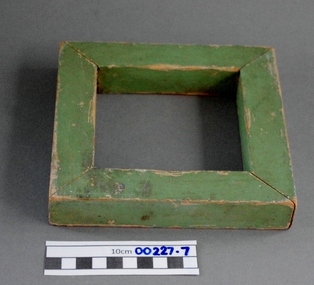
Wooden, Square shape
... Square Wooden shape,used as a teaching tool...square wood school Square Wooden shape,used as a teaching tool Wooden, Square shape ...Square Wooden shape,used as a teaching toolsquare, wood school -
 Nhill Aviation Heritage Centre
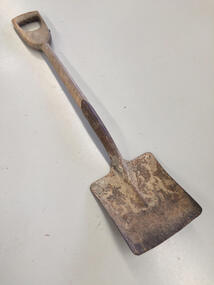
Tool - Shovel, c1940
... This shovel was purchased at the clearing sale here on the Aerodrome after the war. shovel spade schultz Mintern, Made by Mintern products Richmond Victoria Steel square mouth shovel with one short piece wooden handle Tool Shovel ...This shovel was purchased at the clearing sale here on the Aerodrome after the war.Steel square mouth shovel with one short piece wooden handleMintern, Made by Mintern products Richmond Victoriashovel, spade, schultz, -
Federation University Historical Collection
Tool, Handmade tools
... nails tools Square hand made nails, possibly horse shoe nails/ Cut floor brad for use on tongue and groove floors. ...Square hand made nails, possibly horse shoe nails/ Cut floor brad for use on tongue and groove floors.nails, tools -
 Flagstaff Hill Maritime Museum and Village
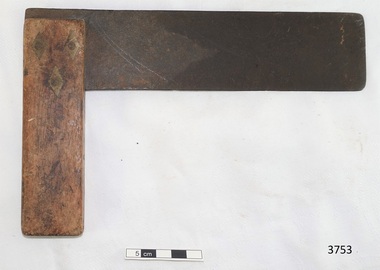
Instrument - Set Square, 1930-1955's
... square...drawing instrument...drawing tool...square was used in the planning and making of components for the ship model Sovereign of the Seas. It is part of a collection of objects used by Jim Williams, maker of fine ship models from about 1930-1955. Most of the components for the models, as well as many of the tools...This set square is part of a collection of tools and accessories once used by Jim Williams, maker of a series of ship models 1930-1955 including “HMS Sovereign of the Seas”. ...This set square is part of a collection of tools and accessories once used by Jim Williams, maker of a series of ship models 1930-1955 including “HMS Sovereign of the Seas”. ...This set square was used in the planning and making of components for the ship model Sovereign of the Seas. It is part of a collection of objects used by Jim Williams, maker of fine ship models from about 1930-1955. Most of the components for the models, as well as many of the tools, were handmade by Jim Williams. Jim’s family has donated the ship model “Sovereign of the Seas” and many tools, accessories and documents used in the making of this and other ship models have been donated to Flagstaff Hill Maritime Village. Ship model of HMS Sovereign of the Seas, scale model of 17th Century English war ship, was handmade and carved from plans, enclosed in airtight glass case. All components of that model, including even the smallest pulleys, were hand crafted using tools designed and made by Jim. Outstanding details include functional rigging and moving cannons. Please see our record 3732 of the mode Sovereign of the Seas for further details of the ship and the maker. James Bernard Williams was known as Jim Williams, born 1888 at The Forth and died 1959 in Warrnambool. He was a passionate ship model builder. Jim left school at the age of 14 years to work at the Don Store in Ulverstone, Tasmania. He played piano at the silent pictures. He enlisted and fought in France along with his two brothers and was wounded there. On return to Tasmania he found it difficult to get employment. He moved to Warrnambool and worked in the menswear department at Cramond & Dickson clothing store, corner of Timor and Liebig streets, until the Depression, when he lost his job. After some time unemployed and working part time until 1932, Jim was employed at Fletcher Jones Menswear in Warrnambool. In 1957 Fletcher Jones invited Jim to write out a list of the most interesting details of the ship model Sovereign of the Seas, with the view of displaying the model and the information for a short time in the factory and then move it to the display window of the Fletcher Jones shop in Warrnambool. Jim worked there for 27 years until just before he died in 1959. His Retirement Speech letter and a Staff Photo from Fletcher Jones are included with the donation. ABOUT JIM’S MODEL MAKING For many years Jim worked on his model ships, including The Endeavour and The Sovereign of the Seas. He had a table set up in a bay window and worked on them on and off using a jeweller's eye glass on the finer pieces. He was a real perfectionist and would re-carve pieces many times until he was happy with the results. This set square is connected with the hobby and skill of ship model making that has been crafted as a leisure activity for many generations. The hobby is often chosen by serving and retired mariners who appreciate the connection with maritime history. This set square was used by local Warrnambool man, Jim Williams, who was employed at Cramond and Dickson clothing store, and then at Fletcher Jones menswear for 27 years. It was used in making components for the model of the historic ship, the Sovereign of the Seas. The Sovereign of the Seas was a historic 17th century English war ship with important maritime heritage. Set square; thin, flat metal blade with rounded corners set at a right-angle into timber stock using three rivets, each with a diamond shaped surround. There is a remnant of red paint on the timber and signs that the set square has been well used. This set square is part of a collection of tools and accessories once used by Jim Williams, maker of a series of ship models 1930-1955 including “HMS Sovereign of the Seas”. flagstaff hill, warrnambool, flagstaff hill maritime museum, maritime museum, shipwreck coast, flagstaff hill maritime village, great ocean road, ship model sovereign of the seas, jim williams, james bernard williams, ship model hobby, ship model tools, ship model making equipment, ship model making accessories, measuring instrument, technical drawing instrument, set square, carpenter’s square, drawing instrument, drawing tool, technical drawing tool, sovereign of the sea, ship model, hobby, ship model tool, english war ship -
 Flagstaff Hill Maritime Museum and Village
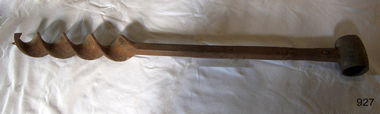
Tool - Scotch Eye Beam Auger, W M Ridgway, 1930s
... This item would have probably been used in Australia on a farm for drilling fence posts for wire to pass through or other tasks where a hole was required to be bored in timber. warrnambool flagstaff-hill flagstaff-hill-maritime-museum maritime-museum shipwreck-coast flagstaff-hill-maritime-village Wood Boring Tool Scotch Auger Carpenters Tools Shipwrights Tools Coopers Tools Ridgway & Sons Auger Bits Broad arrow mark Ridgway Sheffield and DO stamped. Ring Auger, Double Twist with Lead Screw, square shaft (which has had a welded repair), socket set at right angle. ...William Ridgway and Sons company of Sheffield, manufacturers of augers, bits, wood-boring, and motorising tools, was founded in 1878 and became a Private company in 1909, their factory was founded in the 1930s. William Ridgway Tools merged first with Record Tools in 1974 to form Record Ridgway Tools Ltd. Record was another Sheffield company that was renowned for the quality of their vices and industrial clamps. Following the merger Record, Ridgway Tools Ltd was made up of fourteen UK Companies and five overseas companies. A later merger with a woodwork tools company called Marple (which was part-owned by Record and Ridgway respectively before their original merger) led to the company becoming known as Record Marples Tools. Record Marples was taken over by the Swedish hardware manufacturer AB Bahco in 1982. Despite a management buyout leading to the company reverting to British ownership in 1985 the company struggled financially and the following administration was acquired by U.S.-based Irwin Tools in 1998 who has since moved production to China in recent years. A vintage tool made in the 1930s when Ridgway began mass producing augers and other tools for export and sale. This item would have probably been used in Australia on a farm for drilling fence posts for wire to pass through or other tasks where a hole was required to be bored in timber. Ring Auger, Double Twist with Lead Screw, square shaft (which has had a welded repair), socket set at right angle. Broad arrow mark Ridgway Sheffield and DO stamped. warrnambool, flagstaff-hill, flagstaff-hill-maritime-museum, maritime-museum, shipwreck-coast, flagstaff-hill-maritime-village, wood boring tool, scotch auger, carpenters tools, shipwrights tools, coopers tools, ridgway & sons, auger bits -
 Flagstaff Hill Maritime Museum and Village
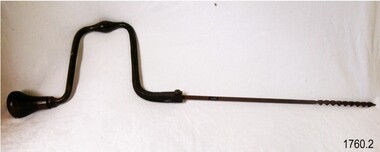
Tool - Drill Brace, 1800s
... square shank bits, early designs have a thumb screw to help secure the bit. Later designs had a catch to secure drilling bits. This type of brace was used in wagon making for boring & drilling holes into the wood for a variety of purposes, including driving screws. The subject item is unmarked but could have been made in Glasgow Scotland by John Fray in the 1800s, early drill braces of this type were often unmarked by their makers. A significant early example of a drill brace made in the UK during the 1800s demonstrates the evolution of this type of tool ...The subject item is an early Victorian Scotch Brace with a 10-inch sweep. They were also known as a six penny or "gentleman's" brace and were designed to accept tapered square shank bits, early designs have a thumb screw to help secure the bit. Later designs had a catch to secure drilling bits. This type of brace was used in wagon making for boring & drilling holes into the wood for a variety of purposes, including driving screws. The subject item is unmarked but could have been made in Glasgow Scotland by John Fray in the 1800s, early drill braces of this type were often unmarked by their makers. A significant early example of a drill brace made in the UK during the 1800s demonstrates the evolution of this type of tool from this time that today is a rare and collectable example of woodworking tools.Brace metal with wooden handle. Has a screw in the holding socket item also has an auger bit. Noneflagstaff hill, warrnambool, flagstaff-hill, flagstaff-hill-maritime-museum, maritime-museum, shipwreck-coast, flagstaff-hill-maritime-village, brace, carpenders wheel brace, cabinet makers tools, drilling tool, wagon makers drill -
 City of Moorabbin Historical Society (Operating the Box Cottage Museum)
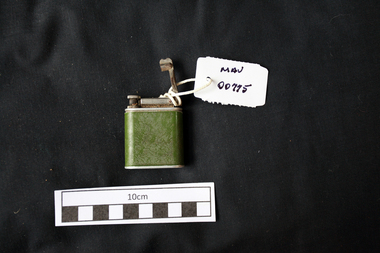
Manufactured objects, Cigarette lighter metal, 20thC
... tools to the company's (Winn & Coates) ever growing list of products. The biggest selling line manufactured by Beney was the Economic Gas Lighter which hung on the side of housewife's gas cookers and was also used for lighting Bunsen burners in laboratories. In 1939-1940 the company moved its administration to the Beney Lighter premises in Beckenham after the Head Office at Trinity Square...tools to the company's (Winn & Coates) ever growing list of products. The biggest selling line manufactured by Beney was the Economic Gas Lighter which hung on the side of housewife's gas cookers and was also used for lighting Bunsen burners in laboratories. In 1939-1940 the company moved its administration to the Beney Lighter premises in Beckenham after the Head Office at Trinity Square ...A cigarette lighter is a portable device used to generate a flame. It consists of a metal or plastic container filled with a flammable fluid or pressurized liquid gas, a means of ignition, and some provision for extinguishing the flame. A spark is created by striking metal against a flint, or by pressing a button that compresses a piezoelectric crystal (piezo ignition), generating an electric arc. In naphtha lighters, the liquid is sufficiently volatile, and flammable vapour is present as soon as the top of the lighter is opened. Butane lighters combine the striking action with the opening of the valve to release gas. The spark ignites the flammable gas causing a flame to come out of the lighter which continues until the top is closed (naphtha type), The Beney Company was founded by Robert Ernest Beney of London, England. R. E. Beney invented and marketed the first Beney mechanical lighter in 1919. Beney also designed and manufactured numerous luxury lighters and striker boxes for Alfred Dunhill of London as well as Hermes of Paris. In 1938, Beckenham based Beney Lighters was acquired, adding utility lighters and precision tools to the company's (Winn & Coates) ever growing list of products. The biggest selling line manufactured by Beney was the Economic Gas Lighter which hung on the side of housewife's gas cookers and was also used for lighting Bunsen burners in laboratories. In 1939-1940 the company moved its administration to the Beney Lighter premises in Beckenham after the Head Office at Trinity Square along with many company records were destroyed in a 'doodlebug' flying bomb attack. Beney Ltd. continued producing lighters at least through the late 1954. A green metal cigarette lighter that used fuel and a striking action arm to produce a flame .base: BENEY / COMPANION / PATENT 568897 / BRITISH MADEtobacco, cigarettes, cigarette lighters, fuels, moorabbin, cheltenham, bentleigh, early settlers, beney pty ltd, beckenham england -
 City of Moorabbin Historical Society (Operating the Box Cottage Museum)
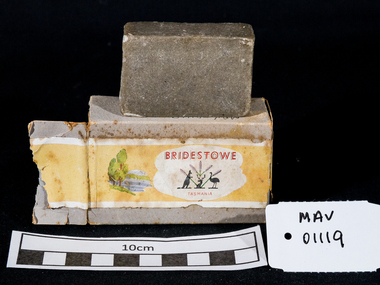
Tools, whetstone , 'Bridestowe' with box, 20thC
... The process of using a sharpening stone is called stoning. whetstones, sharpeners, steel blades, tools, cutlery, razors, Moorabbin, Bentleigh, Cheltenham, early settlers, BRIDESTOWE / Picture of ‘Kangaroo, Stag and Emu among radiating wheat stalks’ / TASMANIA A square block of grey abrasive material used for sharpening steel blades , with the original box Tools, whetstone , 'Bridestowe' with box Bridestowe Pty Ltd ...A Whetstone is a sharpening stone used for knives and other cutting tools. Sharpening stones, water stones or whetstones are used to grind and hone the edges of steel tools and implements e.g. scissors, scythes, knives, razors and tools such as chisels, hand scrapers and plane blades. Though it is sometimes mistaken as a reference to the water often used to lubricate such stones, the word "whetstone" is a compound word formed with the word "whet", which means to sharpen a blade, not the word "wet". The process of using a sharpening stone is called stoning.A square block of grey abrasive material used for sharpening steel blades , with the original boxBRIDESTOWE / Picture of ‘Kangaroo, Stag and Emu among radiating wheat stalks’ / TASMANIAwhetstones, sharpeners, steel blades, tools, cutlery, razors, moorabbin, bentleigh, cheltenham, early settlers, -
Glenelg Shire Council Cultural Collection
Tool - Sharpening Stone, n.d
... Large stone wheel with square-shaped hole in centre. Tool Sharpening Stone ...Displayed at History House.Large stone wheel with square-shaped hole in centre. -
City of Moorabbin Historical Society (Operating the Box Cottage Museum)
Tools, steel pipe threader c1900, c1900
... A steel tool with 2 long arms and central square plate perforated with specific shapes secured by a long screw...This pipe threader is typical of the type used by early settlers in Moorabbin Shire c1900 pipe threader, early settlers, market gardeners, blacksmiths, tools, building equipment, hammers, moorabbin shire, bentleigh, mckinnon, highett, cheltenham,mcewan james pty ltd, melbourne, bunnings pty ltd, A steel tool with 2 long arms and central square plate perforated with specific shapes secured by a long screw Tools, steel pipe threader c1900 ...Among the early settlers in Moorabbin Shire were blacksmiths who made tools for the other settlers who were establishing the homes, market gardens, farms, orchards and various businesses. Early settlers were self reliant and repaired their own equipment for kitchen,dairy, farm, horses, carts using various tools . This pipe threader is typical of the type used by early settlers in Moorabbin Shire c1900A steel tool with 2 long arms and central square plate perforated with specific shapes secured by a long screwpipe threader, early settlers, market gardeners, blacksmiths, tools, building equipment, hammers, moorabbin shire, bentleigh, mckinnon, highett, cheltenham,mcewan james pty ltd, melbourne, bunnings pty ltd, -
City of Moorabbin Historical Society (Operating the Box Cottage Museum)
Tools, Rule, 12-24 inch folding, graduated steel, 20thC
... Tools, Rule, 12-24 inch folding,steel used by builders and mechanics in City of Moorabbin 20thC This large graduated steel ruler is typical of the type used by residents in the City of Moorabbin 20thC rulers, measures, set squares, trigonometry, early settlers, market gardeners, blacksmiths, tools, building equipment, hammers, moorabbin shire, bentleigh, mckinnon, highett, cheltenham,mcewan james pty ltd, melbourne, bunnings pty ltd, Tools, Rule, 12-24 inch folding, graduated, steel Tools, Rule, 12-24 inch folding, graduated steel ...Tools, Rule, 12-24 inch folding,steel used by builders and mechanics in City of Moorabbin 20thC This large graduated steel ruler is typical of the type used by residents in the City of Moorabbin 20thCTools, Rule, 12-24 inch folding, graduated, steel rulers, measures, set squares, trigonometry, early settlers, market gardeners, blacksmiths, tools, building equipment, hammers, moorabbin shire, bentleigh, mckinnon, highett, cheltenham,mcewan james pty ltd, melbourne, bunnings pty ltd, -
 City of Moorabbin Historical Society (Operating the Box Cottage Museum)
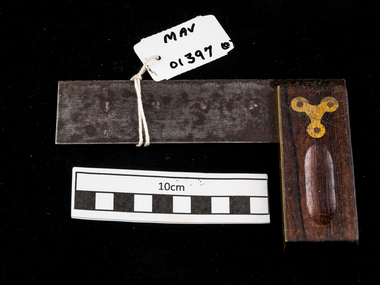
Tools, Set Square steel x2, Stanley c1900, c1900
... Tools, Set Square steel x2, Stanley c1900 ...In 1843, Frederick Stanley, started a small shop in New Britain, USA, to manufacture bolts, hinges, and other hardware from wrought iron. Among the early settlers in Moorabbin Shire were blacksmiths who made tools for the other settlers who were establishing the homes, market gardens, farms, orchards and various businesses. Early settlers were self reliant and repaired their own equipment for kitchen,dairy, farm, horses, carts using various tools . As manufacturing developed late 19thC high quality tools were imported from UK, USA and EuropeThese set squares are typical of the type used by early settlers in Moorabbin Shire c19002x Steel Set Squares a) 15cm (6") with wood handle b) 19cm (7") with a slotted steel handle. a) STANLEY Pat 12-29-96set squares, rulers, builders, trigonometry, mathematics, stanley tools pty ltd., bolts, hinges, hardware, early settlers, market gardeners, blacksmiths, tools, building equipment, hammers, moorabbin shire, bentleigh, mckinnon, highett, cheltenham,mcewan james pty ltd, melbourne, bunnings pty ltd,
