
Showing 25 items matching "st kilda - terraces"
-
 St Kilda Historical Society
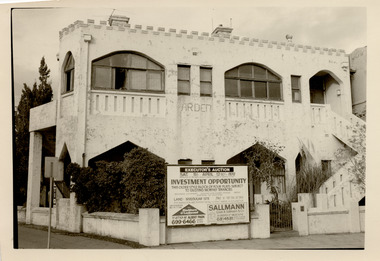
Photograph - Building, Arden Flats
... St Kilda...St Kilda - terraces..."Arden" at nos. 1-2 Marine Parade, St Kilda, was built in 1881-83 as a two storeyed terraced pair but then altered to form the present Arden Flats in 1934. ...It demonstrates two important phases in the evolution of St Kilda: the period of late Victorian expansion; and the Inter War years during which St Kilda emerged as a pre-eminent location for apartments. David Rae Collection St Kilda St Kilda - terraces ...Photograph of Arden Flats, at 1-2 Marine Parade. "Arden" at nos. 1-2 Marine Parade, St Kilda, was built in 1881-83 as a two storeyed terraced pair but then altered to form the present Arden Flats in 1934. The building is historically and aesthetically significant. It demonstrates two important phases in the evolution of St Kilda: the period of late Victorian expansion; and the Inter War years during which St Kilda emerged as a pre-eminent location for apartments.Black and white photograph, unmounteddavid rae collection, st kilda, st kilda - terraces, mansions -
 St Kilda Historical Society
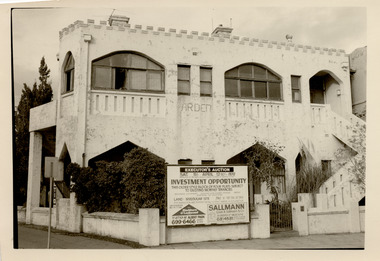
Photograph - Photograph of building, Arden Flats, St Kilda, c1980s
... St Kilda...St Kilda - terraces..."Arden" at nos. 1-2 Marine Parade, St Kilda, was built in 1881-83 as a two storeyed terraced pair but then altered to form the present Arden Flats in 1934. ...It demonstrates two important phases in the evolution of St Kilda: the period of late Victorian expansion; and the Inter War years during which St Kilda emerged as a pre-eminent location for apartments. David Rae Collection St Kilda St Kilda - terraces ...Photograph of Arden Flats, at 1-2 Marine Parade. "Arden" at nos. 1-2 Marine Parade, St Kilda, was built in 1881-83 as a two storeyed terraced pair but then altered to form the present Arden Flats in 1934. The building is historically and aesthetically significant. It demonstrates two important phases in the evolution of St Kilda: the period of late Victorian expansion; and the Inter War years during which St Kilda emerged as a pre-eminent location for apartments. Black and white photograph, unmounteddavid rae collection, st kilda, st kilda - terraces, mansions -
 St Kilda Historical Society
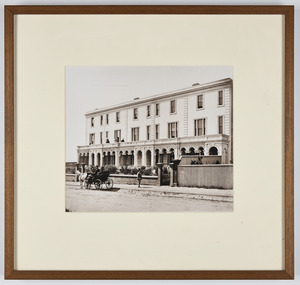
Photograph - Building, 92-94 Grey Street St Kilda
... St Kilda - terraces...This building no longer exists. St Kilda - terraces Black and white photograph of terrace building in wooden frame. ...This building no longer exists.Black and white photograph of terrace building in wooden frame. A horse, carriage and driver, and a pedestrian, are in the foreground. Figures are on balcony.st kilda - terraces -
 St Kilda Historical Society
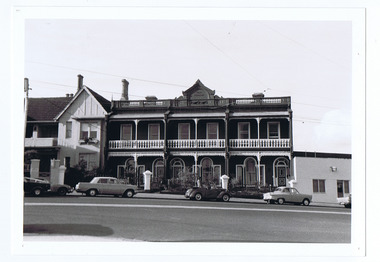
Photograph, Hile Terrace, 26-27-28 Esplanade, St Kilda
... Hile Terrace, 26-27-28 Esplanade, St Kilda......St Kilda - terraces...It maintains all the features of late Victorian terraces with cast iron balcony and posts William Pitt Historic buildings St Kilda - terraces hand written: terraces in Upper Esplanade opposite Palais Theatre, stamped: Graeme S. ...Hile Terrace is a group of 3 identical terraces designed by the highly regarded architect William Pitt in 1885. It is located on the Esplanade. It maintains all the features of late Victorian terraces with cast iron balcony and postsblack and white photograph, unmounted, good conditionhand written: terraces in Upper Esplanade opposite Palais Theatre, stamped: Graeme S. Breydon, 204 Carlisle St, Balaclava, 3183 phone 94 2886william pitt, historic buildings, st kilda - terraces -
 Glen Eira Historical Society
Letter - Maher, Francis Patrick
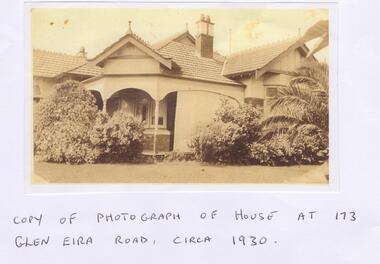
... St Kilda East... Elsternwick... Caulfield... Myrtle Street... Bailey Ave... Atley Grove... Glen Eira Road... Hotham Street... Glenhuntly Road... Elizabeth Street... Regent Street... Balaclava Road... McWhae Ave... Gordon Street... Ripponlea Mansion... Caulfield Grammar School... Caulfield Race Course... Elsternwick Police Station... Caulfield City Hall... City of Glen Eira City Hall... Glen Eira Historical Society... Holy Angels Catholic Church... St. Josephs Catholic Church... A.R.P. Wardens... Drill Hall... Brighton Rifles... Grocers... Sweet Shops... Terrace...St Kilda area. Also includes a copy of a photograph of his childhood home c. 1930 and a map of the area around the property where he lived. St Kilda East Elsternwick Caulfield Myrtle Street Bailey Ave Atley Grove Glen Eira Road Hotham Street Glenhuntly Road Elizabeth Street Regent Street Balaclava Road McWhae Ave Gordon Street Ripponlea Mansion Caulfield Grammar School Caulfield Race Course Elsternwick Police Station Caulfield City Hall City of Glen Eira City Hall Glen Eira Historical Society Holy Angels Catholic Church St. Josephs Catholic Church A.R.P. Wardens Drill Hall Brighton Rifles Grocers Sweet Shops Terrace ...Correspondence between Mr Frank Maher and Felicitie Ampbell re information about a property at 173 Glen Eira Road, St Kilda East. Included is a copy of Frank Maher’s recollections of people and places around east St Kilda area. Also includes a copy of a photograph of his childhood home c. 1930 and a map of the area around the property where he lived.st kilda east, elsternwick, caulfield, myrtle street, bailey ave, atley grove, glen eira road, hotham street, glenhuntly road, elizabeth street, regent street, balaclava road, mcwhae ave, gordon street, ripponlea mansion, caulfield grammar school, caulfield race course, elsternwick police station, caulfield city hall, city of glen eira city hall, glen eira historical society, holy angels catholic church, st. josephs catholic church, a.r.p. wardens, drill hall, brighton rifles, grocers, sweet shops, terrace houses, tennis courts, saddlers, billiard rooms, horse drawn vehicles, market gardens, motor cycles, fuel merchants, maher frank, tracey martin brian, tracey john edmond, tracey margaret, maher mary eleanor, maher martin john, tracey kathleen, bent thomas, nathan benjamin -
 Bendigo Historical Society Inc.
Postcard - Alice McGregor Postcard Collection, 1900 - 1920
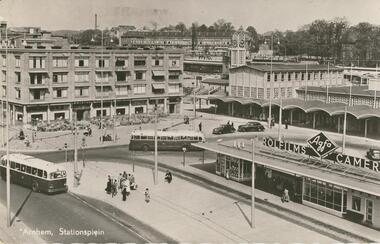
... Terrace Kangaroo Flat. Alice Mary Salter and William Robert Salter living together; presumed to be sister and brother. William Robert Salter was killed in a MVA in Bendigo in 1937 aged 26. In Victoria in 1938, Alice Mary Salter married James Thomas McGregor (born Victoria 1917, died Victoria 1983, buried Fawkner Cemetery) Lived: 1968; 22 Wade Street Golden Square Alice McGregor Died: 1999 aged 91 at Anne Caudle Centre, Bendigo Buried: Kangaroo Flat Cemetery See additional research. Postcard Album of Alice McGregor contained 86 post cards. POSTCARD Collector Alice McGregor Addressed to Mr. G.A. Schinning, 15 Ascotstreet, St Kilda ...Alice McGREGOR Born: 1908; unknown parents. Possibly adopted by the Salter family? Electoral Roll 1936: Highland Terrace Kangaroo Flat. Alice Mary Salter and William Robert Salter living together; presumed to be sister and brother. William Robert Salter was killed in a MVA in Bendigo in 1937 aged 26. In Victoria in 1938, Alice Mary Salter married James Thomas McGregor (born Victoria 1917, died Victoria 1983, buried Fawkner Cemetery) Lived: 1968; 22 Wade Street Golden Square Alice McGregor Died: 1999 aged 91 at Anne Caudle Centre, Bendigo Buried: Kangaroo Flat Cemetery See additional research. Postcard Album of Alice McGregor contained 86 post cards.Postcard Album of Alice McGregor containing 86 post cards. See 1400. B&W photo of Stationsplein, (bus station?) Arnhem, Netherlands. People waiting for a bus. Another bus in middle ground. Addressed to Mr. G.A. Schinning, 15 Ascotstreet, St Kilda, Dunedin, New Zealand Sender - 9 names given, no surname or address. Dated 1957 postcard, collector, alice mcgregor -
 Glen Eira Historical Society
Album - Album page, Labassa, 4 Manor Grove, Circa 1972
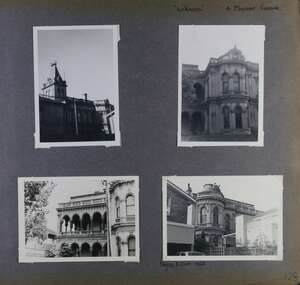
... [Online Data Upgrade Project 2004] trevor hart bracketed eaves slate roof bay windows decorative brackets caulfield north labassa richard a. billing balaclava road orrong road sylliott hill william lyall crouch and wilson alexander william robertson ontario 1880's john a. b. koch mansion john boyd watson labassa grove french renaissance style l-shaped arcaded verandah bluestone plinths balustraded parapet flat topped mansard roofs conical roof elaborate cornices corinthian columns caryatid consoles marble panels imitation marble scagliola tower conservatory stables tennis pavilion mouldings decorative glass caryatids swagged columns ornamental cresting trompe l'oeil ceiling embossed imitation leather oak parquetry stained glass tripartite window triple window ferguson and urie 1870's flats 1920's electric wiring 1860's verandahs curved windows arched windows italianate terraces gargoyles ornamentation ornate entrance la bassa manor grove st kilda east victorian cast iron work john koch richard billing architects electrification john mickle land subdivision mrs watson labassa estate robert hannon national trust of australia (victoria) sculpture Handwritten: "Labassa" 4 Manor Grove [top right] / Neg 232 8 Oct 1966 [under bottom right photo] / 128 [bottom right] Page 128 of Photograph Album with four photographs (two portrait and two landscape) of Labassa. ...This photograph is part of the Caulfield Historical Album 1972. This album was created in approximately 1972 as part of a project by the Caulfield Historical Society to assist in identifying buildings worthy of preservation. The album is related to a Survey the Caulfield Historical Society developed in collaboration with the National Trust of Australia (Victoria) and Caulfield City Council to identify historic buildings within the City of Caulfield that warranted the protection of a National Trust Classification. Principal photographer thought to be Trevor Hart, member of Caulfield Historical Society. Most photographs were taken between 1966-1972 with a small number of photographs being older and from unknown sources. All photographs are black and white except where stated, with 386 photographs over 198 pages. HISTORY:-- From Victorian Heritage Database citation for Labassa https://vhd.heritagecouncil.vic.gov.au/places/278 as at (26/10/2020) Labassa, Caulfield is one of Melbourne's most lavishly decorated nineteenth century mansions. It resulted from the extensive remodelling in 1890, of an earlier house, known as Sylliott Hill, which was begun in 1862-3 for lawyer, Richard A. Billing. The land at the corner of Balaclava and Orrong Roads was first acquired in 1854 by William Lyall, transferred to his partner, John Mickle, in 1859, who also acquired the adjoining allotment in Balaclava Road, and the three allotments were conveyed to Billing. His first eight-roomed house was extended significantly in 1873 into a twenty-roomed house by architects Crouch and Wilson, who were possibly also responsible for the first house. This reflected Billing's success as a barrister, and he resided at this property until his death in 1882. In 1883 prominent Melbourne businessman, Alexander William Robertson, leased the Sylliott Hill property from Billing's widow, and in 1885 he purchased the adjoining allotment in Balaclava Road. He purchased the Billing's property in 1887 and renamed the 6.31 hectare property, Ontario. In 1889-90, Robertson commissioned the German born architect, John A. B. Koch, to extensively remodel the house into a thirty-five roomed mansion. The existing house was extended and altered, largely resulting in the nineteenth century mansion as it now appears. After Robertson's death in 1896, the house was tenanted until it was eventually sold to the mining millionaire, John Boyd Watson, in 1904. He renamed the property Labassa and carried out repair and re-decoration work to the house. In the early twentieth century, many large estates were subdivided into smaller allotments as the demand for land grew and it became difficult to maintain such large estates. After Watson's death in 1911, portions of the Labassa estate were offered for sale, with Mrs Watson retaining a 1.73 hectare portion containing the house. In 1913 forty-six allotments were auctioned at Labassa Estate, with the formation of Labassa Grove and Ontario Street to the east of the property. Labassa was first recorded as containing flats in 1923 and in the late 1920s, the owner, Robert Hannon, built a red brick block of flats adjacent to the house. Subdivision continued, until the National Trust of Australia (Victoria) purchased the house in 1980 and subsequently purchased adjoining sites, one to the south-east in 1984 (house demolished in 1988) and to the west in 1988. Labassa as it now stands is substantially as it appeared when Koch completed the work in 1890. The original two storey house was transformed into a French Renaissance style mansion, with the addition of a two level L-shaped arcaded verandah and two prominent terminating bays to the south and the east. The building is of unpainted cement render with dressed bluestone plinths, balustraded parapet and steep, slate covered, flat topped mansard roofs behind. A truncated conical roof is a feature of the south bay and a helmeted head is incorporated in the parapet over the east bay. The main south and east facades incorporate many cast cement details, including sculptures, elaborate cornices, swagged Corinthian columns and caryatid consoles flanking the entrance porch, as well as pink marble panels and imitation marble, or scagliola, on curved surfaces. At the rear of the building is a two storey wing and a single storey cottage, the former being connected to the main house by a tower. This section of the house was constructed in 1873. The estate at its peak included stables (1873), conservatory (probably 1890) and a tennis pavilion (probably 1890). All of these outbuildings survive, with the stables and conservatory being converted for residential use after 1922. Internally a range of decorative treatments remain from the late nineteenth century and the early twentieth century, both from the Robertson and Watson periods of occupancy. These include wallpapers, ceiling decoration, chimney pieces, mouldings, joinery and decorative glass. From Victorian Heritage Database citation for H0135 Labassa 2/2A Manor Grove Caulfield North https://vhd.heritagecouncil.vic.gov.au/places/278 as at (26/10/2020) HOW IS IT SIGNIFICANT? Labassa, Caulfield is of architectural, aesthetic and historical significance to the State of Victoria. WHY IS IT SIGNIFICANT? Labassa, Caulfield is of architectural significance as the most prominent example of a small number of houses built in Australia in the French Renaissance style. It is of further note due to the German interpretation of the style and the use of Hellenistic sources, via Germany. It is exceptional for its lavish treatment externally, including marble, scagliola, caryatids, swagged columns, mansard roofs and ornamental cresting. Labassa is of architectural significance as the most important surviving example of German architect, John Koch's domestic work. He undertook a large variety of work in Melbourne, including a number of houses, however Labassa is the most lavish example of his work. Labassa is of aesthetic significance for its outstanding assemblage of late nineteenth and early twentieth century European style interior decoration, which remain remarkably intact. These include a trompe l'oeil ceiling, painted ceilings, embossed imitation leather and other papers, chimney pieces, ceramic tilework, oak parquetry and stained glass, including a tripartite window by Ferguson and Urie, probably dating from the 1873 period. Labassa is of historical significance as an illustrative example of the wealth acquired by a number of prominent Victorian families in the second half of the 19th century. The early development of the property, Sylliott Hill, was due to the wealth acquired by Richard Billing, barrister and fifth Victorian to be appointed Queen's Counsel in 1878. The significant development in 1890 of Ontario, is illustrative of the wealth of Alexander Robertson, a partner in Cobb and Co., a director of Goldsborough Mort & Co., and a pastoral speculator. John B. Watson, whose father had acquired great wealth from the goldfields of Bendigo and subsequently invested in city and country properties, was the third resident to impact on the house, particularly the interiors. The Labassa estate is of historical significance as an illustrative example of the development that occurred in such suburbs as Caulfield in the 1880s due to the land boom, its proximity to Melbourne and the establishment of the Melbourne to Gippsland railway in 1879. It is also illustrative of an estate which succumbed to the pressures of subdividing in the early twentieth century, as properties became difficult to maintain and demand for land close to the city grew. It was typically divided into flats in the 1920s and was used as such for about sixty years. It is of historical significance for its associations with the remnants of the earlier estate which remain extant. These include the stables, conservatory (H2005) and tennis pavilion which all remain on separate sites. Also significant are the remains of early electrical wiring and fittings. Labassa was one of the first houses in Caulfield to be electrified and some of the original wires remain. [Online Data Upgrade Project 2004]Page 128 of Photograph Album with four photographs (two portrait and two landscape) of Labassa.Handwritten: "Labassa" 4 Manor Grove [top right] / Neg 232 8 Oct 1966 [under bottom right photo] / 128 [bottom right]trevor hart, bracketed eaves, slate roof, bay windows, decorative brackets, caulfield north, labassa, richard a. billing, balaclava road, orrong road, sylliott hill, william lyall, crouch and wilson, alexander william robertson, ontario, 1880's, john a. b. koch, mansion, john boyd watson, labassa grove, french renaissance style, l-shaped arcaded verandah, bluestone plinths, balustraded parapet, flat topped mansard roofs, conical roof, elaborate cornices, corinthian columns, caryatid consoles, marble panels, imitation marble, scagliola, tower, conservatory, stables, tennis pavilion, mouldings, decorative glass, caryatids, swagged columns, ornamental cresting, trompe l'oeil ceiling, embossed imitation leather, oak parquetry, stained glass, tripartite window, triple window, ferguson and urie, 1870's, flats, 1920's, electric wiring, 1860's, verandahs, curved windows, arched windows, italianate, terraces, gargoyles, ornamentation, ornate entrance, la bassa, manor grove, st kilda east, victorian, cast iron work, john koch, richard billing, architects, electrification, john mickle, land subdivision, mrs watson, labassa estate, robert hannon, national trust of australia (victoria), sculpture -
 Glen Eira Historical Society
Album - Album page, Labassa, 4 Manor Grove, Circa 1972
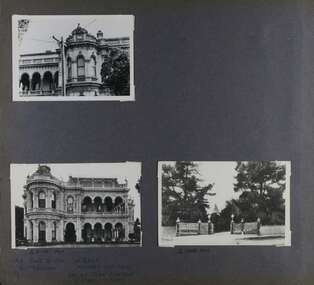
... [Online Data Upgrade Project 2004] trevor hart bracketed eaves intricate lacework slate roof bay windows decorative brackets caulfield north labassa richard a. billing balaclava road orrong road sylliott hill william lyall crouch and wilson alexander william robertson ontario 1880's john a. b. koch mansion john boyd watson labassa grove french renaissance style l-shaped arcaded verandah bluestone plinths balustraded parapet flat topped mansard roofs conical roof elaborate cornices corinthian columns caryatid consoles marble panels imitation marble scagliola tower conservatory stables tennis pavilion mouldings decorative glass caryatids swagged columns ornamental cresting trompe l'oeil ceiling embossed imitation leather oak parquetry stained glass tripartite window triple window ferguson and urie 1870's flats 1920's electric wiring 1860's verandahs curved windows arched windows italianate terraces gargoyles ornamentation ornate entrance la bassa manor grove st kilda east gates cast iron work richard billing architects john koch electrification victorian style drives john mickle land subdivision mrs watson labassa estate robert hannon national trust of australia (victoria) sculpture Handwritten: 4 JUNE 1910 / SALE JUNE 28 1910 "LA BASSA' / "AUSTRALASIAN" FORMERLY "ONTARIO"/ RES OF JOHN B WATSON / 15 ACRES 3 ROADS [under bottom left photo] / 4 JUNE 1910 [under bottom right photo] / 129 [bottom left] Page 129 of Photograph Album with three landscape photographs of Labassa. ...This photograph is part of the Caulfield Historical Album 1972. This album was created in approximately 1972 as part of a project by the Caulfield Historical Society to assist in identifying buildings worthy of preservation. The album is related to a Survey the Caulfield Historical Society developed in collaboration with the National Trust of Australia (Victoria) and Caulfield City Council to identify historic buildings within the City of Caulfield that warranted the protection of a National Trust Classification. Principal photographer thought to be Trevor Hart, member of Caulfield Historical Society. Most photographs were taken between 1966-1972 with a small number of photographs being older and from unknown sources. All photographs are black and white except where stated, with 386 photographs over 198 pages. HISTORY:-- From Victorian Heritage Database citation for Labassa https://vhd.heritagecouncil.vic.gov.au/places/278 as at (26/10/2020) Labassa, Caulfield is one of Melbourne's most lavishly decorated nineteenth century mansions. It resulted from the extensive remodelling in 1890, of an earlier house, known as Sylliott Hill, which was begun in 1862-3 for lawyer, Richard A. Billing. The land at the corner of Balaclava and Orrong Roads was first acquired in 1854 by William Lyall, transferred to his partner, John Mickle, in 1859, who also acquired the adjoining allotment in Balaclava Road, and the three allotments were conveyed to Billing. His first eight-roomed house was extended significantly in 1873 into a twenty-roomed house by architects Crouch and Wilson, who were possibly also responsible for the first house. This reflected Billing's success as a barrister, and he resided at this property until his death in 1882. In 1883 prominent Melbourne businessman, Alexander William Robertson, leased the Sylliott Hill property from Billing's widow, and in 1885 he purchased the adjoining allotment in Balaclava Road. He purchased the Billing's property in 1887 and renamed the 6.31 hectare property, Ontario. In 1889-90, Robertson commissioned the German born architect, John A. B. Koch, to extensively remodel the house into a thirty-five roomed mansion. The existing house was extended and altered, largely resulting in the nineteenth century mansion as it now appears. After Robertson's death in 1896, the house was tenanted until it was eventually sold to the mining millionaire, John Boyd Watson, in 1904. He renamed the property Labassa and carried out repair and re-decoration work to the house. In the early twentieth century, many large estates were subdivided into smaller allotments as the demand for land grew and it became difficult to maintain such large estates. After Watson's death in 1911, portions of the Labassa estate were offered for sale, with Mrs Watson retaining a 1.73 hectare portion containing the house. In 1913 forty-six allotments were auctioned at Labassa Estate, with the formation of Labassa Grove and Ontario Street to the east of the property. Labassa was first recorded as containing flats in 1923 and in the late 1920s, the owner, Robert Hannon, built a red brick block of flats adjacent to the house. Subdivision continued, until the National Trust of Australia (Victoria) purchased the house in 1980 and subsequently purchased adjoining sites, one to the south-east in 1984 (house demolished in 1988) and to the west in 1988. Labassa as it now stands is substantially as it appeared when Koch completed the work in 1890. The original two storey house was transformed into a French Renaissance style mansion, with the addition of a two level L-shaped arcaded verandah and two prominent terminating bays to the south and the east. The building is of unpainted cement render with dressed bluestone plinths, balustraded parapet and steep, slate covered, flat topped mansard roofs behind. A truncated conical roof is a feature of the south bay and a helmeted head is incorporated in the parapet over the east bay. The main south and east facades incorporate many cast cement details, including sculptures, elaborate cornices, swagged Corinthian columns and caryatid consoles flanking the entrance porch, as well as pink marble panels and imitation marble, or scagliola, on curved surfaces. At the rear of the building is a two storey wing and a single storey cottage, the former being connected to the main house by a tower. This section of the house was constructed in 1873. The estate at its peak included stables (1873), conservatory (probably 1890) and a tennis pavilion (probably 1890). All of these outbuildings survive, with the stables and conservatory being converted for residential use after 1922. Internally a range of decorative treatments remain from the late nineteenth century and the early twentieth century, both from the Robertson and Watson periods of occupancy. These include wallpapers, ceiling decoration, chimney pieces, mouldings, joinery and decorative glass.From Victorian Heritage Database citation for H0135 Labassa 2/2A Manor Grove Caulfield North https://vhd.heritagecouncil.vic.gov.au/places/278 as at (26/10/2020) HOW IS IT SIGNIFICANT? Labassa, Caulfield is of architectural, aesthetic and historical significance to the State of Victoria. WHY IS IT SIGNIFICANT? Labassa, Caulfield is of architectural significance as the most prominent example of a small number of houses built in Australia in the French Renaissance style. It is of further note due to the German interpretation of the style and the use of Hellenistic sources, via Germany. It is exceptional for its lavish treatment externally, including marble, scagliola, caryatids, swagged columns, mansard roofs and ornamental cresting. Labassa is of architectural significance as the most important surviving example of German architect, John Koch's domestic work. He undertook a large variety of work in Melbourne, including a number of houses, however Labassa is the most lavish example of his work. Labassa is of aesthetic significance for its outstanding assemblage of late nineteenth and early twentieth century European style interior decoration, which remain remarkably intact. These include a trompe l'oeil ceiling, painted ceilings, embossed imitation leather and other papers, chimney pieces, ceramic tilework, oak parquetry and stained glass, including a tripartite window by Ferguson and Urie, probably dating from the 1873 period. Labassa is of historical significance as an illustrative example of the wealth acquired by a number of prominent Victorian families in the second half of the 19th century. The early development of the property, Sylliott Hill, was due to the wealth acquired by Richard Billing, barrister and fifth Victorian to be appointed Queen's Counsel in 1878. The significant development in 1890 of Ontario, is illustrative of the wealth of Alexander Robertson, a partner in Cobb and Co., a director of Goldsborough Mort & Co., and a pastoral speculator. John B. Watson, whose father had acquired great wealth from the goldfields of Bendigo and subsequently invested in city and country properties, was the third resident to impact on the house, particularly the interiors. The Labassa estate is of historical significance as an illustrative example of the development that occurred in such suburbs as Caulfield in the 1880s due to the land boom, its proximity to Melbourne and the establishment of the Melbourne to Gippsland railway in 1879. It is also illustrative of an estate which succumbed to the pressures of subdividing in the early twentieth century, as properties became difficult to maintain and demand for land close to the city grew. It was typically divided into flats in the 1920s and was used as such for about sixty years. It is of historical significance for its associations with the remnants of the earlier estate which remain extant. These include the stables, conservatory (H2005) and tennis pavilion which all remain on separate sites. Also significant are the remains of early electrical wiring and fittings. Labassa was one of the first houses in Caulfield to be electrified and some of the original wires remain. [Online Data Upgrade Project 2004]Page 129 of Photograph Album with three landscape photographs of Labassa. One of the photographs is of Labassa's drive and gates.Handwritten: 4 JUNE 1910 / SALE JUNE 28 1910 "LA BASSA' / "AUSTRALASIAN" FORMERLY "ONTARIO"/ RES OF JOHN B WATSON / 15 ACRES 3 ROADS [under bottom left photo] / 4 JUNE 1910 [under bottom right photo] / 129 [bottom left]trevor hart, bracketed eaves, intricate lacework, slate roof, bay windows, decorative brackets, caulfield north, labassa, richard a. billing, balaclava road, orrong road, sylliott hill, william lyall, crouch and wilson, alexander william robertson, ontario, 1880's, john a. b. koch, mansion, john boyd watson, labassa grove, french renaissance style, l-shaped arcaded verandah, bluestone plinths, balustraded parapet, flat topped mansard roofs, conical roof, elaborate cornices, corinthian columns, caryatid consoles, marble panels, imitation marble, scagliola, tower, conservatory, stables, tennis pavilion, mouldings, decorative glass, caryatids, swagged columns, ornamental cresting, trompe l'oeil ceiling, embossed imitation leather, oak parquetry, stained glass, tripartite window, triple window, ferguson and urie, 1870's, flats, 1920's, electric wiring, 1860's, verandahs, curved windows, arched windows, italianate, terraces, gargoyles, ornamentation, ornate entrance, la bassa, manor grove, st kilda east, gates, cast iron work, richard billing, architects, john koch, electrification, victorian style, drives, john mickle, land subdivision, mrs watson, labassa estate, robert hannon, national trust of australia (victoria), sculpture -
 Glen Eira Historical Society
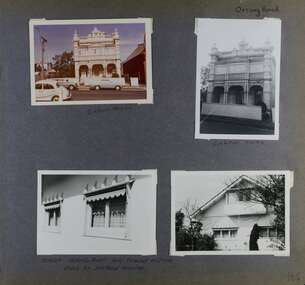
Album - Album page, Orrong Road, Circa 1972
... st kilda east...caulfield north...terrace...terraced form and in this respect is rare in Caulfield. Its architectural value is enhanced by its intact state and by the manner in which its bold architectural expression is carried through into the hallway and staircase. Victorian Heritage Database - National Trust local significance 284 Orrong Road Caulfield https://vhd.heritagecouncil.vic.gov.au/places/65700 A house designed by Harold Desbrowe Annear in 1917 and believed to have been the first "all electric" house in Melbourne. It has been extensively altered. trevor hart orrong road lisbon house lisborn house elsternwick pearson grove st kilda ...This photograph is part of the Caulfield Historical Album 1972. This album was created in approximately 1972 as part of a project by the Caulfield Historical Society to assist in identifying buildings worthy of preservation. The album is related to a Survey the Caulfield Historical Society developed in collaboration with the National Trust of Australia (Victoria) and Caulfield City Council to identify historic buildings within the City of Caulfield that warranted the protection of a National Trust Classification. Principal photographer thought to be Trevor Hart, member of Caulfield Historical Society. Most photographs were taken between 1966-1972 with a small number of photographs being older and from unknown sources. All photographs are black and white except where stated, with 386 photographs over 198 pages.Victorian Heritage Database https://vhd.heritagecouncil.vic.gov.au/places/35576 No. 70 Orrong Road is important as an exceptionally ornate Boom style villa residence in the terraced form and in this respect is rare in Caulfield. Its architectural value is enhanced by its intact state and by the manner in which its bold architectural expression is carried through into the hallway and staircase. Victorian Heritage Database - National Trust local significance 284 Orrong Road Caulfield https://vhd.heritagecouncil.vic.gov.au/places/65700 A house designed by Harold Desbrowe Annear in 1917 and believed to have been the first "all electric" house in Melbourne. It has been extensively altered.Page 164 - four photographs of 2 different houses on Orrong Road. The top left photo is in colour while the others are in black and white.Handwritten: Orrong Road [top right] / Lisborn House [ (ed. correct name is LISBON HOUSE), under top left photo] / Lisborn House [under top right photo] / [under bottom right photo] / CORNER ORRONG ROAD AND PEARSON AVENUE / HOUSE BY DESBROWE ANNEAR [under bottom left photo] / 164 [bottom right]trevor hart, orrong road, lisbon house, lisborn house, elsternwick, pearson grove, st kilda east, caulfield north, terrace houses, cast iron work, verandahs, balconies, parapets, arches, cars, streetscapes, attic houses, desbrowe annear -
 Glen Eira Historical Society
Document - Reeves, Walter
... St Kilda, date and author unknown. No direct connection to Walter Reeves apparent but they are taped together. Automobile Hebenstreit Mr Shoobra Road Butcher Glenhuntly Road Henderson H Mr Davis Charles Hardware store Beddoe Frank Horne Street Shops Renown Theatre Phoebe Theatre Theatres LePage Phoebe LePage Jack Taylor ‘Squizzie’ Echuca Terrace Edward Street Hawthorn Road Revees Walter Dunn Bros Cycle shop Cox Bros Supermarkets Apps (Undertakers) Elsternwick Men’s Club Elsternwick Trades Club Johnston T. ...2 items, which may be related, about old Elsternwick: 1/A roneod copy of Recollections of Walter Reeves: gives notes on local identities, their business’, Caulfield State School, places of interest and events that took place in the area; undated and apparently summarised by an un-named other person from Mr Reeves' recollections. 2/A hand written list taken from Rate Books 1864 of areas in dispute, including nine names of residents, between Caulfield and St Kilda, date and author unknown. No direct connection to Walter Reeves apparent but they are taped together.automobile, hebenstreit mr, shoobra road, butcher, glenhuntly road, henderson h mr, davis charles, hardware store, beddoe frank, horne street, shops, renown theatre, phoebe theatre, theatres, lepage phoebe, lepage jack, taylor ‘squizzie’, echuca terrace, edward street, hawthorn road, revees walter, dunn bros, cycle shop, cox bros, supermarkets, apps (undertakers), elsternwick men’s club, elsternwick trades club, johnston t., hayter george (painter and decorator), sargood frederick, cabmen, cabs, ‘ripponlea’, wilson dick, blacksmiths, orrong road, moran and cato, repco, downshire road, bullock (grocer), grocers, taylor’s liquor and wine saloon, bottleshops, biddle misses, schools, bliss mr, station master, elsternwick, bensonino mr, newsagents, caulfield, gas supply, point nepean road, rowney dick, trams, riddell’s paddock, football golf links, riddell john carre, rowan road, sports grounds, melville’s supermarket -
 St Kilda Historical Society
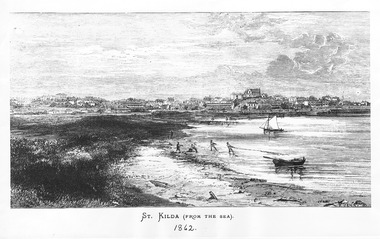
Photograph - Artwork, R. Jenny, St Kilda (from the sea), 1873-1878
... Terrace. The handwritten date 1862 is incorrect. The actual date is most likely to have been between 1873 and 1878. Buildings depicted in Grey Street were not completed till 1873, while the southwestern corner of Grey and Fitzroy Streets remains a paddock, the first building on the site going up in 1879. St Kilda ...View of sea in foreground looking towards Christ Church, Summerland House, Marli Terrace. The handwritten date 1862 is incorrect. The actual date is most likely to have been between 1873 and 1878. Buildings depicted in Grey Street were not completed till 1873, while the southwestern corner of Grey and Fitzroy Streets remains a paddock, the first building on the site going up in 1879. lithograph black and White copySt Kilda (from the Sea)st kilda, st kilda beach, port phillip bay -
 St Kilda Historical Society
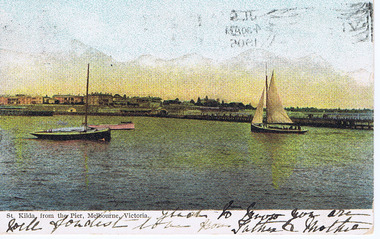
Ephemera - Postcard, St Kilda from the Pier, 1905
... postcard stamped St Kilda foreshore St Kilda pier hand inscripton on front and back sent to London England Postcard, coloured original foreground 2 boats and pier, background in distance Marli Terrace, Esplanade hotel St Kilda from the Pier Ephemera Postcard ...postcard stamped Postcard, coloured original foreground 2 boats and pier, background in distance Marli Terrace, Esplanade hotelhand inscripton on front and back sent to London Englandst kilda foreshore, st kilda pier -
 St Kilda Historical Society
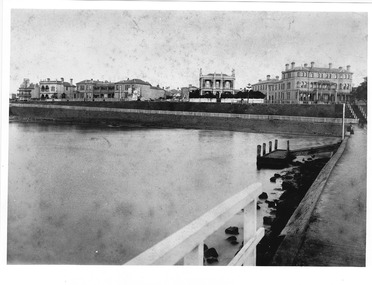
Photograph, The Esplanade, St Kilda, c. 1890s
... Esplanade Hotel, Marli Terrace, taken from the Pier Pier 1890s black and white photograph, unmounted good condition The Esplanade, St Kilda Photograph ...Esplanade Hotel, Marli Terrace, taken from the Pier black and white photograph, unmounted good conditionPier 1890s -
 St Kilda Historical Society
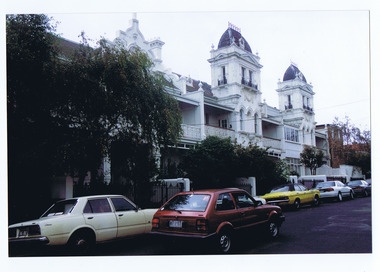
Photograph, Marion Terrace, 14-24 Burnett St, St Kilda
... Marion Terrace, 14-24 Burnett St, St Kilda...shows Burnett street frontage, cars in foreground suggest 1990s-2000s 14 - 24 Burnett St colour photograph, unmounted, good condition Marion Terrace, 14-24 Burnett St, St Kilda Photograph ...shows Burnett street frontage, cars in foreground suggest 1990s-2000scolour photograph, unmounted, good condition14 - 24 Burnett St -
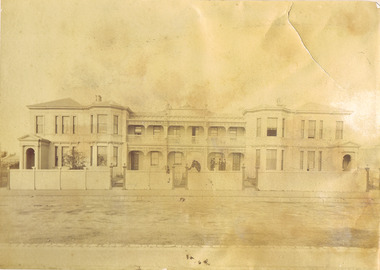 St Kilda Historical Society
Photograph, J.P. Lind, Marli Terrace, c. 1866
... Marli Terrace, The Esplanade, St Kilda; home of Justice Stewart Johnstone in 1860s; unpaved road in front; after major extension, two wings added to original five terraces ...Marli Terrace, The Esplanade, St Kilda; home of Justice Stewart Johnstone in 1860s; unpaved road in front; after major extension, two wings added to original five terraces Marli Terrace; Built by: Johnston; [photographer's stamp] black and white photograph, mounted, original, poor condition Marli Terrace Photograph J.P. ...Marli Terrace, The Esplanade, St Kilda; home of Justice Stewart Johnstone in 1860s; unpaved road in front; after major extension, two wings added to original five terraces black and white photograph, mounted, original, poor conditionMarli Terrace; Built by: Johnston; [photographer's stamp] -
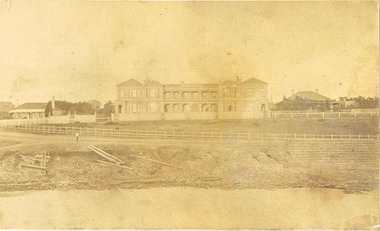 St Kilda Historical Society
Photograph, Marli Terrace, The Esplanade, St Kilda
... Marli Terrace, The Esplanade, St Kilda ...On back: Early view of Marli Terrace, Esplanade, St Kilda. Marli ? (home of Js Stewart Johnston) lies back be?? ...On back: Early view of Marli Terrace, Esplanade, St Kilda. Marli ? (home of Js Stewart Johnston) lies back be?? ...Home of Justice Stewart Johnstone. c 1860s.sepia photograph, mounted, original, poor conditionOn back: Early view of Marli Terrace, Esplanade, St Kilda. Marli ? (home of Js Stewart Johnston) lies back be?? the left of ?? & cottage to the left of the photo -
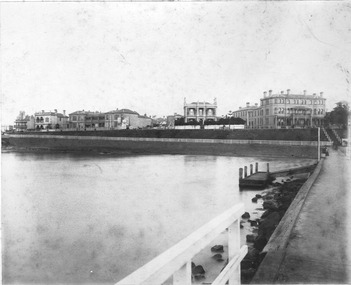 St Kilda Historical Society
Photograph, McAlpine Bros, Esplanade St Kilda view from pier, c.1880
... shows Esplanade Hotel, Marli Terrace, Wickcliffe House black and white photograph, mounted, original, fair condition Esplanade St Kilda view from pier Photograph McAlpine Bros ...shows Esplanade Hotel, Marli Terrace, Wickcliffe Houseblack and white photograph, mounted, original, fair condition -
 Royal District Nursing Service (now known as Bolton Clarke)
Photograph - Photograph, black and white, 11.1953
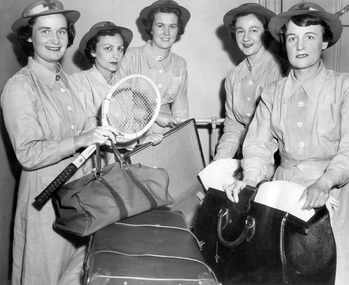
... St Kilda Road, Melbourne, then known as 'Airlie'. From its founding in 1885 until 1891 the Trained nurses (Nurses) of the Melbourne District Nursing Society (MDNS) worked from their own homes which were located in the vicinity of their areas (districts). The Committee meetings were held at the Religious Tract Society rooms at Queen’s walk, off Swanston Street and then at the Library Room at the Melbourne Town Hall. The Annual General Meeting was held at the Town Hall. In November 1891 MDNS was able to rent a two story terraced ...The MDNS Sisters are packing their belongs ready to move from their current Nurses Home at 39 Victoria Parade, Collingwood to their new Nurses Home and Headquarters situated at 452 St Kilda Road, Melbourne, then known as 'Airlie'. From its founding in 1885 until 1891 the Trained nurses (Nurses) of the Melbourne District Nursing Society (MDNS) worked from their own homes which were located in the vicinity of their areas (districts). The Committee meetings were held at the Religious Tract Society rooms at Queen’s walk, off Swanston Street and then at the Library Room at the Melbourne Town Hall. The Annual General Meeting was held at the Town Hall. In November 1891 MDNS was able to rent a two story terraced house at 66 Cardigan Street, Carlton, at £65 a year, which contained accommodation for three Nurses and one pupil nurse as well as being used as their Headquarters. They left from their Nurses Home each morning and returned at the end of their shift to write up their book work before retiring for the day. Three years later they moved into a larger terraced house at 49 Drummond Street Carlton which was rented at ‘a very moderate rental’. There was a Board room, apartments for the Nurses and pupil nurse, a large dispensary which patients could attend each evening to have prescriptions signed and bottles refilled with ‘homely remedies’ and elixirs, which were administered for e.g. to Consumptive cases. Doctor’s prescriptions were filled at the Pharmacy. Cupboards containing donated blankets and bedclothes for needy patients were kept in this room, and it was here where the Nurses kept their nursing bags which were refilled at the end of each shift ready for any emergency and for the next day. A list of Doctors the Nurses could call was kept by the telephone. The home also had a kitchen where nourishing soup was made and distributed twice a week to the needy. Milk was also distributed when needed. In 1902 they moved into rented premises at 188 Leicester Street, Carlton and two years later, in 1904, to premises at 5 Royal Terrace, Nicholson Street, Fitzroy where they remained for ten years. In June 1914 at last the Society had sufficient funds to purchase their own terraced premises, ‘Floraston’ 39 Victoria Parade, Collingwood which was their Headquarters and Nurses Home. In 1926 the After-Care Home for recovering patients, (later called After-Care Hospital) was built by the Society next door, running from 41-47 Victoria Parade (became No. 45). There were now two divisions with the After Care having their owned Trained nurses (Sisters) and the District Division of Trained nurses (Sisters) who continued to live at No. 39. In November 1953 the Sisters working in the District Nursing Division moved into their new Headquarters and Nurses Home at 452 St. Kilda Road, Melbourne. In 1957 this Division changed its name to the Melbourne District Nursing Service when it separated from the After-Care Hospital. It was given Royal patronage in 1966 and became Royal District Nursing Service (RDNS). As it expanded, and now with Centres opening throughout the suburbs, the Nurses Home at 452 closed and those rooms used for administrative purposes. It now had outlying districts to service, and with a full fleet of District cars, the Sisters lived in their own homes and visited their closest District Centre each morning to collect their work for the day and returned there at the end of their community duties to do their administrative work. On April the 1st 1996 RDNS Head Office relocated to 31 Alma Road, St. Kilda. Standing in a semi circle of this photograph are 5 Melbourne District Nursing Society (MDNS) Sisters in their long sleeve grey uniform dresses which have a belt, peaked collars and white buttons down the centre. They are wearing their grey brimmed hats with a central Maltese cross on the light colour headband over their short dark curled hair. From Left to Right are Sisters Marianne Metcalf who is smiling and is holding a tennis racket and soft sided oblong travel bag which has two leather straps and handle in her right hand; it is resting on a closed case, which has two leather straps across the lid; this sits in front of her. Next is Gerda Oppenheim who is looking serious and has her right hand on the top of the lid of an open case in front of her, then Beryl Rowley, who is smiling and has her hands on a narrow white metal horizontal pole which has a vertical pole attached. Next is Marcia Parrat who is smiling and is holding a piece of white linen on the open case, and next, on the far right, is Florence Hoey who is holding a piece of white linen on top of an open hard leather travelling bag which is sitting in front of her next to the closed case. melbourne district nursing society, mdns, mdns headquarters, sister marianne metcalf, sister gerda oppenheim, sister beryl rowley, sister marcia parrat, sister florence hoey, royal district nursing service, rdns -
 Royal District Nursing Service (now known as Bolton Clarke)
Photograph - Photograph, black and white, c.1953
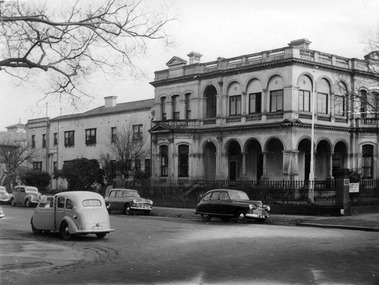
... terraced premises, ‘Floraston’ 39 Victoria Parade, Collingwood which was their Headquarters and Nurses Home. In 1926 the After-Care Home for recovering patients, (later called After-Care Hospital) was built by the Society next door to No. 39, running from 41-47 Victoria Parade (became No. 45); the District Trained nurses (Sisters) continued to live at No. 39. In 1953 ‘Airlie’ at 452 St Kilda ...Melbourne District Nursing Society (MDNS) moved into 452 St. Kilda Road, in 1953. Seven Ford Prefect cars were purchased by the Society in the early 1950s which became the beginning of a full MDNS, later called Royal District Nursing Service, fleet of cars which would be used by their District nurses to visit patients in the community over the next years.In 1875 J.B.Scott purchased Crown Land on the corner of St Kilda Road and Arthur Street. During the 1890’s an “unpretentious grey building” was built on the site. Known as ‘Airlie’, major additions were carried out during the 1920s and 30s to this historic mansion. From its founding in 1885 until 1891 the Trained nurse (Nurses) of the Melbourne District Nursing Society (MDNS) worked from their own homes which were located in the vicinity of their areas (districts). In November 1891 MDNS was able to rent a two story terraced house at 66 Cardigan Street, Carlton, at £65 a year, which contained accommodation for three Trained nurses (Nurses) and one pupil nurse as well as being used as their Headquarters. The Nurses left from there each morning and returned at the end of their shift to write up their book work before retiring for the day. Three years later they moved into a larger terraced house at 49 Drummond Street Carlton which was rented at ‘a very moderate rental’. There was a Board room, apartments for the Nurses and pupil nurses, a large dispensary which patients could attend each evening to have prescriptions signed and bottles refilled with ‘homely remedies’ and elixirs, which were administered for e.g. Consumptive cases. Doctor’s prescriptions were filled at the Pharmacy. Cupboards containing donated blankets and bedclothes for needy patients were kept in this room, and it was here where the Nurses kept their nursing bags which were refilled at the end of each shift ready for any emergency and for the next day. A list of Doctors the Nurses could call was kept by the telephone. The home also had a kitchen where nourishing soup was made and distributed twice a week to the needy. Milk was also distributed when needed. In 1902 they moved into rented premises at 188 Leicester Street, Carlton and two years later, in 1904, to premises at 5 Royal Terrace, Nicholson Street, Fitzroy. They remained there for ten years. In June 1914 at last the Society had sufficient funding to purchase their own terraced premises, ‘Floraston’ 39 Victoria Parade, Collingwood which was their Headquarters and Nurses Home. In 1926 the After-Care Home for recovering patients, (later called After-Care Hospital) was built by the Society next door to No. 39, running from 41-47 Victoria Parade (became No. 45); the District Trained nurses (Sisters) continued to live at No. 39. In 1953 ‘Airlie’ at 452 St Kilda Road was offered by the Government as part of an agreement to split the management of the Society and the After Care Hospital. On 26th November 1953 the MDNS moved its Headquarters to 452 St Kilda Road. Renovations and alterations were however restricted by limited funds so it was not until 1/12/1954 that the Hon. W. P. Barry, Minister of Health, officially opened the building. MDNS was given Royal patronage in 1966 and became Royal District Nursing Service (RDNS). In January 1983, Headquarters of the Royal District Nursing Service at 452 St Kilda Road was classified by the National Trust. The citation in support of the classification said “The house is of historical interest as the boyhood home of Stanley Melbourne Bruce, later Lord Bruce, Prime Minister of Australia from 1923-1929.” Black and white photograph of Melbourne District Nursing Society Headquarters, 452 St Kilda Road, Melbourne. The photo, taken on the corner of Arthur street, is of a two storey building and several cars and gives a unique view of St Kilda Road in the 1950s (pre high rise buildings) This large grey two storey Italian style building, has four roman column, arched Arcadia to the right of a polygon shaped bay window on the ground floor; an arched Arcade on the second floor, and three long windows above the bay window on Arthur Street. Turning the corner onto St. Kilda Road is a three arched Arcadia running towards the one window seen on the polygon shaped bay window. Arcadia is repeated on the upper storey. A balustrade is in front of the Arcadia on the upper storey and again around the flat roof. Two chimneys can be seen. A spiked metal fence runs in front of the building. To the left of this building are two white double storey buildings and some medium sized trees. On Arthur Street, two Ford Prefect cars, one with the passenger side door partly open, a Vanguard car and another make of car can be seen.royal district nursing service, headquarters, 452 st kilda road melbourne, melbourne district nursing society, mdns, mdns transport, rdns -
 Royal District Nursing Service (now known as Bolton Clarke)
Photograph - Digital image, c.1935
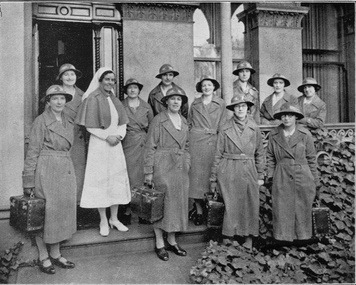
... terraced premises, ‘Floraston’ 39 Victoria Parade, Collingwood which became their Headquarters and Nurses Home. In 1926 the After-Care Home for recovering patients, (later called After-Care Hospital) was built by the Society next door, running from 41-47 Victoria Parade (became No. 45); the District Sisters continued to live at No. 39. In November 1953 the District Nursing Division moved into their new Headquarters and Nurses Home at 452 St. Kilda ...Matron F. L. Gordon and the Sisters are standing in front of the Melbourne District Nursing Society (MDNS) Nurses Home at 39 Victoria Parade, Collingwood. The Nurses lived in this residence from 1914-1953. In 1926 the After-Care Home was built next door. This image was taken twelve months after the name of the Society changed from 'Melbourne District Nursing Society After Care 'Home' to 'Hospital'. The photograph shows the uniform of the District Division of the Melbourne District Nursing Society in the 1930s, with the uniform dress made of grey cotton. Their brimmed hat was made of felt with a cotton hat band with a red Maltese cross in the centre front. From its founding in 1885 until 1891 the Trained nurses, called 'Nurse' in those days, of the Melbourne District Nursing Society (MDNS) worked from their own homes which were located in the vicinity of their areas (districts). In November 1891 MDNS was able to rent a two story terraced house at 66 Cardigan Street, Carlton, at £65 a year, which contained accommodation for three Nurses and one pupil nurse as well as being used as their Headquarters. They left from their Nurses Home each morning and returned at the end of their shift to write up their book work before retiring for the day. Three years later, in 1894, they moved into a larger terraced house at 49 Drummond Street Carlton which was rented at ‘a very moderate rental’. There was a Board room, apartments for the Nurses and pupil nurse, a large dispensary which patients could attend each evening to have prescriptions signed and bottles refilled with ‘homely remedies’ and elixirs, which were administered for e.g. Consumptive cases. Doctor’s prescriptions were filled at the Pharmacy. Cupboards containing donated blankets and bedclothes for needy patients were kept in this room, and it was here where the Nurses kept their nursing bags which were refilled at the end of each shift ready for any emergency and for the next day. A list of Doctors the Nurses could call was kept by the telephone. The Home also had a kitchen where nourishing soup was made and distributed twice a week to the needy. Milk was also distributed when needed. In 1902 they moved into rented premises at 188 Leicester Street, Carlton and two years later, in 1904, to premises at 5 Royal Terrace, Nicholson Street, Fitzroy. They remained there for ten years and an Auction of furniture was held before their next move giving an idea of some of the contents: - Carpets, linoleum, walnut and oak sideboards, dining tables, walnut dining suite, Vienna chairs, walnut bedroom suite, cedar wardrobes, chests of drawers, duchess chests, bedsteads and bedding and general furnishings were for sale. In June 1914 at last the Society had sufficient funding to purchase their own terraced premises, ‘Floraston’ 39 Victoria Parade, Collingwood which became their Headquarters and Nurses Home. In 1926 the After-Care Home for recovering patients, (later called After-Care Hospital) was built by the Society next door, running from 41-47 Victoria Parade (became No. 45); the District Sisters continued to live at No. 39. In November 1953 the District Nursing Division moved into their new Headquarters and Nurses Home at 452 St. Kilda Road, Melbourne, with a change of name to Melbourne District Nursing Service in 1957. With Royal patronage, this changed to Royal District Nursing Service (RDNS) in 1966. As District expanded, and now with outlying districts to service and with a full fleet of District cars, Sisters lived in their own homes and visited their District Centre each morning to collect their work for the day and returned there at the end of their days work in the community to carry out their administrative work. The digital image shows Matron, Miss F.L. Gordon, wearing a white uniform and veil and a dark coloured cape standing amid a group of eleven District Trained nurses (Sisters), from the Melbourne District Nursing Society (MDNS). Two Sisters are to her left and the others to her right. They are standing in front of a grey building. The Sisters are wearing their uniforms of grey long coats with lapels; the coat is secured with a belt around the waist. This is worn over their grey uniforms, with white collars. Each Sister is wearing their uniform grey brimmed hat with a Maltese cross attached to the light hatband, and are carrying a square shaped nursing case. They are standing in two rows, with some on the veranda of the building and some in front on the path; two Sisters are just off the path amid the shrubs. Part of the grey concrete building can be seen behind the Sisters with the open door to the left and part of three long windows seen to its right. One Sister has her lower left arm resting on the veranda rail.'Miss F.L. Gordon, Matron, and some of the District Sisters'mdns, melbourne district nursing society, 39 victoria parade, collingwood, rdns, royal district nursing service, nurses home, miss f.l. gordon, mdns uniforms, mdns matron -
 Royal District Nursing Service (now known as Bolton Clarke)
Photograph - Photograph, colour, c.1980
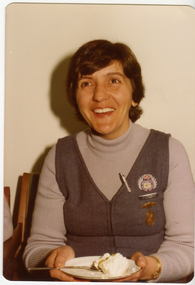
... terraced premises, ‘Floraston’ 39 Victoria Parade, Collingwood which was their Headquarters and Nurses Home. In 1926 the After-Care Home for recovering patients, (later called After-Care Hospital) was built by the Society next door, running from 41-47 Victoria Parade (became No. 45); the District nurses continued to live at No. 39. In November 1953 the District Nursing Division moved into their new Headquarters and Nurses Home at 452 St. Kilda ...Sister McLean is attending a function in the RDNS Board room at 452 St. Kilda Road, Melbourne. She worked in RDNS Headquarters. The RDNS insignia on the upper left of her uniform tunic has the words "Royal District Nursing Service" written in white in the blue circle. Across the centre of the circle are two clasping hands depicted in yellow..From its founding in 1885 until 1891, the Trained nurses (Nurses) of the Melbourne District Nursing Society (MDNS) worked from their own homes which were located in the vicinity of their areas (districts). Their Committee meetings were held at the Religious Tract Society Rooms, No 3 Queen's walk, off Swanston Street and later at the Library Room in the Melbourne Town Hall. The Annual General Meetings were held in the Town Hall. In November 1891 MDNS was able to rent a two story terraced house at 66 Cardigan Street, Carlton, at £65 a year, which contained accommodation for three Trained nurses (Nurse) and one pupil nurse as well as being used as their Headquarters. They left from their Nurses Home each morning and returned at the end of their shift to write up their book work before retiring for the day. Three years later they moved into a larger terraced house at 49 Drummond Street Carlton which was rented at ‘a very moderate rental’. There was a Board room, apartments for the Nurses and pupil nurses, a large dispensary which patients could attend each evening to have prescriptions signed and bottles refilled with ‘homely remedies’ and elixirs, which were administered for e.g. to Consumptive cases. Doctor’s prescriptions were filled at the Pharmacy. Cupboards containing donated blankets and bedclothes for needy patients were kept in this room, and it was here where the Nurses kept their nursing bags which were refilled at the end of each shift ready for any emergency and for the next day. A list of Doctors the Nurses could call was kept by the telephone. The home also had a kitchen where nourishing soup was made and distributed twice a week to the needy. Milk was also distributed when needed. In 1902 they moved into rented premises at 188 Leicester Street, Carlton and two years later, in 1904, to premises at 5 Royal Terrace, Nicholson Street, Fitzroy where they remained for ten years. In June 1914 at last the Society had sufficient funding to purchase their own terraced premises, ‘Floraston’ 39 Victoria Parade, Collingwood which was their Headquarters and Nurses Home. In 1926 the After-Care Home for recovering patients, (later called After-Care Hospital) was built by the Society next door, running from 41-47 Victoria Parade (became No. 45); the District nurses continued to live at No. 39. In November 1953 the District Nursing Division moved into their new Headquarters and Nurses Home at 452 St. Kilda Road, Melbourne but as the Service expanded into the suburbs Centres were opened and their Trained nurses (Sisters) worked from home, so the Nurses Home section of 452 was closed and turned into more administrative areas. In 1996 Headquarters were relocated to 31 Alma Road, St. Kilda.Coloured photograph of the upper view of Sister Kath McLean of the Royal District Nursing Service (RDNS) who has short straight dark hair and is smiling as she sits holding a cake on a white plate. She is wearing her RDNS winter uniform; a grey skivvie under a blue/grey herringbone woolen V neck tunic style frock with a central zip. On its upper left It has the RDNS insignia of a round blue circle with writing on it, surrounded on either side by white swept up feathers towards the central crown above the circle. Under this is her name plate and a gold coloured medal. A pen is clipped into the left hand V neck section of the frock. rdns, royal district nursing service, rdns winter uniform, rdns board room, rdns headquarters, kath mclean -
 Royal District Nursing Service (now known as Bolton Clarke)
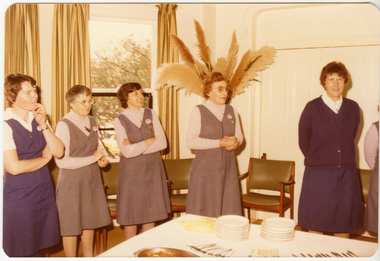
Photograph - Photograph, colour, c.1980
... terraced premises, ‘Floraston’ 39 Victoria Parade, Collingwood which was their Headquarters and Nurses Home. In 1926 the After-Care Home for recovering patients, (later called After-Care Hospital) was built by the Society next door, running from 41-47 Victoria Parade (became No. 45); the District nurses continued to live at No. 39. In November 1953 the District Nursing Division moved into their new Headquarters and Nurses Home at 452 St. Kilda ...The RDNS Sisters are attending a functions being held in the Board Room at RDNS Headquarters, 452 St. Kilda Road in Melbourne.From its founding in 1885 until 1891 the trained nurses of the Melbourne District Nursing Society (MDNS) worked from their own homes which were located in the vicinity of their areas (districts). The Committee meetings were held at the Religious Tract Society rooms at Queen’s walk, off Swanston Street and then at the Library Room at the Melbourne Town Hall. The Annual General Meeting was held at the Town Hall. In November 1891 MDNS was able to rent a two story terraced house at 66 Cardigan Street, Carlton, at £65 a year, which contained accommodation for three Trained nurses (Nurses) and one pupil nurse as well as being used as their Headquarters. They left from their Nurses Home each morning and returned at the end of their shift to write up their book work before retiring for the day. Three years later they moved into a larger terraced house at 49 Drummond Street Carlton which was rented at ‘a very moderate rental’. There was a Board room, apartments for the Nurses and pupil nurse, a large dispensary which patients could attend each evening to have prescriptions signed and bottles refilled with ‘homely remedies’ and elixirs, which were administered for e.g. to Consumptive cases. Doctor’s prescriptions were filled at the Pharmacy. Cupboards containing donated blankets and bedclothes for needy patients were kept in this room, and it was here where the Nurses kept their nursing bags which were refilled at the end of each shift ready for any emergency and for the next day. A list of Doctors the Nurses could call was kept by the telephone. The home also had a kitchen where nourishing soup was made and distributed twice a week to the needy. Milk was also distributed when needed. In 1902 they moved into rented premises at 188 Leicester Street, Carlton and two years later, in 1904, to premises at 5 Royal Terrace, Nicholson Street, Fitzroy where they remained for ten years. In June 1914 at last the Society had sufficient funds to purchase their own terraced premises, ‘Floraston’ 39 Victoria Parade, Collingwood which was their Headquarters and Nurses Home. In 1926 the After-Care Home for recovering patients, (later called After-Care Hospital) was built by the Society next door, running from 41-47 Victoria Parade (became No. 45); the District nurses continued to live at No. 39. In November 1953 the District Nursing Division moved into their new Headquarters and Nurses Home at 452 St. Kilda Road, Melbourne. As RDNS expanded with Centres now opening throughout the suburbs, their Trained nurses (Sisters) lived in their own homes and the Nurses Home at 452 closed and the rooms used for administrative purposes. On April the 1st 1996 RDNS Head Office relocated to 31 Alma Road, St. Kilda.Colour photograph of Royal District Nursing Service (RDNS), Sisters who are standing in a room - left to right - .....Pat (Paddy) Rowley, with short brown hair and wearing glasses, Kath McLean, with short dark hair, Betty Harris, who is wearing glasses and with short brown curly hair and on the far right Ruth May, wearing glasses and with short dark hair, Sister May and the unknown Sister on the far left hand side, are wearing the RDNS summer uniform of a white blouse under a V neck royal blue tunic style frock. The three Sisters in the centre of the photograph are wearing the RDNS winter uniform of blue/grey skivvies under their blue/grey herringbone woollen V neck tunic style frocks. The RDNS insignia is on the upper left of the uniforms. Opened gold long curtains are in the background, along with three wooden chairs which have green backs and seats. The chairs are partly hidden by the standing Sisters. A vase of plumed feather flowers is behind Sr. Harris. Part of a white clothed table, with silver cutlery and white plates on it, is the the foreground.rdns, royal district nursing service, rdns uniform, rdns headquarters, sister ruth may, sister kath mclean, sister pat (paddy) rowley, sister betty harris -
 Royal District Nursing Service (now known as Bolton Clarke)
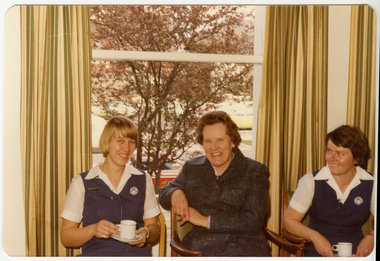
Photograph - Photograph, colour, c.1980
... terraced premises, ‘Floraston’ 39 Victoria Parade, Collingwood which was their Headquarters and Nurses Home. In 1926 the After-Care Home for recovering patients, (later called After-Care Hospital) was built by the Society next door, running from 41-47 Victoria Parade (became No. 45); the District nurses (Sisters) continued to live at No. 39. In November 1953 the District Nursing Division moved into their new Headquarters and Nurses Home at 452 St. Kilda ...The photograph is taken at a function in the Board Room of RDNS Headquarters, 452 St. Kilda Road, Melbourne. Miss Mary Evans was the RDNS Director of Nursing from 1963-1978,From its founding in 1885 until 1891, the Trained nurses (Nurses) of the Melbourne District Nursing Society (MDNS) worked from their own homes which were located in the vicinity of their areas (districts). The Committee meetings were held at the Religious Tract Society rooms at Queen’s walk, off Swanston Street and then at the Library Room at the Melbourne Town Hall. The Annual General Meeting was held at the Town Hall. In November 1891 MDNS was able to rent a two story terraced house at 66 Cardigan Street, Carlton, at £65 a year, which contained accommodation for three Nurses and one pupil nurse as well as being used as their Headquarters. They left from their Nurses Home each morning and returned at the end of their shift to write up their book work before retiring for the day. Three years later they moved into a larger terraced house at 49 Drummond Street Carlton which was rented at ‘a very moderate rental’. There was a Board room, apartments for the Nurses and pupil nurse, a large dispensary which patients could attend each evening to have prescriptions signed and bottles refilled with ‘homely remedies’ and elixirs, which were administered for e.g. to Consumptive cases. Doctor’s prescriptions were filled at the Pharmacy. Cupboards containing donated blankets and bedclothes for needy patients were kept in this room, and it was here where the Nurses kept their nursing bags which were refilled at the end of each shift ready for any emergency and for the next day. A list of Doctors the Nurses could call was kept by the telephone. The home also had a kitchen where nourishing soup was made and distributed twice a week to the needy. Milk was also distributed when needed. In 1902 they moved into rented premises at 188 Leicester Street, Carlton and two years later, in 1904, to premises at 5 Royal Terrace, Nicholson Street, Fitzroy where they remained for ten years. In June 1914 at last the Society had sufficient funds to purchase their own terraced premises, ‘Floraston’ 39 Victoria Parade, Collingwood which was their Headquarters and Nurses Home. In 1926 the After-Care Home for recovering patients, (later called After-Care Hospital) was built by the Society next door, running from 41-47 Victoria Parade (became No. 45); the District nurses (Sisters) continued to live at No. 39. In November 1953 the District Nursing Division moved into their new Headquarters and Nurses Home at 452 St. Kilda Road, Melbourne. As RDNS expanded and now, with Centres opening throughout the suburbs, the Sisters lived in their own homes and the Nurses Home at 452 closed and those rooms used for administrative purposes. On April the 1st 1996 RDNS Head Office relocated to 31 Alma Road, St. Kilda. Coloured photograph taken at a function in a room at Royal District Nursing Service (RDNS). It shows, left to right, Sister Bev Armstrong, who has short blonde hair, Miss Mary Evans, who has short curled brown hair and another RDNS Sister who has short dark hair. The two RDNS Sisters are wearing the RDNS summer uniform of a white blouse under a royal blue V neck tunic style dress with the RDNS insignia on the left hand side. Miss Evans, is wearing a long dark coat. The three are smiling and the Sister on the right is looking at Miss Evans who is turned slightly and has part of her right arm resting over the top of the back of the chair. They are sitting in front of a window and opened gold long curtains. A tree is seen through the window. Both RDNS Sisters have cups in their hands.royal district nursing service, rdns, rdns headquarters, miss mary evans, sister bev armstrong -
 Royal District Nursing Service (now known as Bolton Clarke)
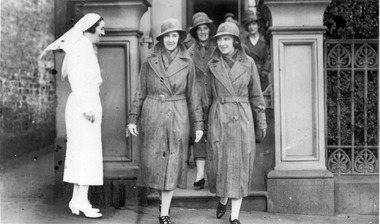
Photograph - Photograph, black and white:, 1934
... terraced premises, ‘Floraston’ 39 Victoria Parade, Collingwood which was their Headquarters and Nurses Home. In 1926 the After-Care Home for recovering patients, (later called After-Care Hospital) was built by the Society next door, at 45 Victoria Parade; the District nurses continued to live at No. 39. In November 1953 the District Nursing Division moved into their new Headquarters and Nurses Home at 452 St. Kilda ...The District nurses are leaving from their Melbourne District Nursing Society (MDNS) Nurses Home, which was situated at 39 Victoria Parade, Collingwood. Their MDNS uniform dresses and coats depicted are grey, and a red Maltese cross is attached to the centre of the headband on their grey brimmed hats. The Sisters will visit MDNS patients and provide nursing care to them in their homes.From its founding in 1885 until 1891 the Trained nurses (Nurses) of the Melbourne District Nursing Society (MDNS) worked from their own homes which were located in the vicinity of their areas (districts). In November 1891 MDNS was able to rent a two story terraced house at 66 Cardigan Street, Carlton, at £65 a year, which contained accommodation for three Nurses and one pupil nurse as well as being used as their Headquarters. They left from their Nurses Home each morning and returned at the end of their shift to write up their book work before retiring for the day. Three years later they moved into a larger terraced house at 49 Drummond Street Carlton which was rented at ‘a very moderate rental’. There was a Board room, apartments for the Nurses and pupil nurse, a large dispensary which patients could attend each evening to have prescriptions signed and bottles refilled with ‘homely remedies’ and elixirs, which were administered for e.g. to Consumptive cases. Doctor’s prescriptions were filled at the Pharmacy. Cupboards containing donated blankets and bedclothes for needy patients were kept in this room, and it was here where the Nurses kept their equipment and nursing bags which were refilled at the end of each shift ready for any emergency, and for the next day. A list of Doctors the Nurses could call was kept by the telephone. The home also had a kitchen where nourishing soup was made and distributed twice a week to the needy. Milk was also distributed when needed. In 1902 they moved into rented premises at 188 Leicester Street, Carlton and two years later, in 1904, to premises at 5 Royal Terrace, Nicholson Street, Fitzroy. They remained there for ten years and an Auction of furniture was held before their next move giving an idea of some of the contents: - Carpets, linoleum, walnut and oak sideboards, dining tables, walnut dining suite, Vienna chairs, walnut bedroom suite, cedar wardrobes, chests of drawers, duchess chests, bedsteads and bedding and general furnishings were for sale. In June 1914 at last the Society had sufficient funding to purchase their own terraced premises, ‘Floraston’ 39 Victoria Parade, Collingwood which was their Headquarters and Nurses Home. In 1926 the After-Care Home for recovering patients, (later called After-Care Hospital) was built by the Society next door, at 45 Victoria Parade; the District nurses continued to live at No. 39. In November 1953 the District Nursing Division moved into their new Headquarters and Nurses Home at 452 St. Kilda Road, Melbourne. In 1957 the two divisions legally separated and the District division became the Melbourne District Nursing Service. As District expanded, and now with outlying districts to service, and with a fleet of District cars, their trained nurses (Sisters) lived in their own homes and visited their closest District Centre each morning to collect their work for the day, and returned at the end of their shift to do their administrative work. A small black and white photograph showing a side on view of Matron Lydia Shaw who is smiling. She is standing outside the Nurses Home of the Melbourne District Nursing Society (MDNS), and is wearing a white long sleeved belted uniform dress, white stockings, shoes, and a veil over her short dark hair.. She is standing to the left, outside the front gate of the building watching a group of district nurses about to leave the Home. The group are on a path behind the four trained nurses (Sisters) most visible who are dressed in grey belted long sleeved coats which have lapels. They are wearing grey brimmed hats with a Maltese cross in the centre, flesh coloured stockings and black shoes. The first two Sisters are side by side and have just stepped onto the pavement; the one to the right is smiling and slightly turned toward Matron Shaw. Under their coats, both these Sisters are wearing grey scarves around their necks. There is a square concrete column behind Matron Shaw, and another to the right of the nurses. From the right column three metal vertical fence bars are seen with shrubs behind them. Part of a building and doorway can be seen behind the nurses. A brick wall and path is seen on the far left of the photograph.The date 1934 as well as the name of Matron Shaw, Sister Jones and Sister Tupper were hand written on the back of the photographnurses, matron, uniform, melbourne district nursing society, mdns, nurses home, rdns, royal district nursing service, matron lydia shaw, sister dorothy tupper, sister jones -
 City of Melbourne Libraries
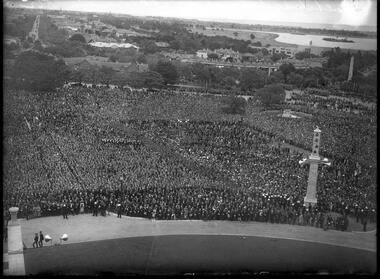
Photograph, Bull, Hugh Jones, 1897-1993, The Multitude before the Shrine at Dedication, 11 November 1934
... This elevated view is captured from the Shrine and takes in the westward area with St Kilda Road trams and mansions, St Kilda Presbyterian Church, the two-storied, curved Princes Terrace, Macpherson Robertson Fountain, South African (Boer) War Memorial, MacRobertson’s Girls High School, Albert Park Lake and Port Phillip Bay. ...This elevated view is captured from the Shrine and takes in the westward area with St Kilda Road trams and mansions, St Kilda Presbyterian Church, the two-storied, curved Princes Terrace, Macpherson Robertson Fountain, South African (Boer) War Memorial, MacRobertson’s Girls High School, Albert Park Lake and Port Phillip Bay. ...“The greatest gathering in Australia” – The Argus, 12 November 1934 On Armistice Day, 11 November 1934, the Dedication Ceremony for the Shrine of Remembrance was held in the Domain, presided over by Prince Henry, the Duke of Gloucester. A crowd of over 300,000 people - about one third of Melbourne's population at the time - attended. Featured in "Newsworthy: Melbourne in photographs 1933-1936" exhibition at East Melbourne Library, October to December 2023. Exhibition caption by project volunteer, Louise McKenzie. Photographer notations on slide: "Multitude before Shrine at Dedication 1934 B62" Description: Massive crowd gathered in southern forecourt of Melbourne's Shrine of Remembrance on 11 November 1934, for its opening dedication by the Duke of Gloucester. There were an estimated 300,000 in attendance (almost one third of Melbourne's population of 1 million). Research by project volunteer, Louise McKenzie: There were an estimated 300,000 people in attendance for the opening dedication of the Shrine of Remembrance on 11 November 1934. This was almost one third of Melbourne's population of 1 million. Age photographer Hugh Bull cleverly captured the massive crowd using two glass plate exposures. This elevated view is captured from the Shrine and takes in the westward area with St Kilda Road trams and mansions, St Kilda Presbyterian Church, the two-storied, curved Princes Terrace, Macpherson Robertson Fountain, South African (Boer) War Memorial, MacRobertson’s Girls High School, Albert Park Lake and Port Phillip Bay. The corresponding eastward view can be accessed via the "Related material link" in the item record. References: WE WILL REMEMBER THEM."--THE MULTITUDE BEFORE THE SHRINE. (1934, November 12). The Age (Melbourne, Vic. : 1854 - 1954), p. 13. Retrieved October 14, 2024, from http://nla.gov.au/nla.news-article205078252Photographer notations on slide: "Multitude before Shrine at Dedication 1934 B62".ceremonies, shrine of remembrance, armistice day, 1930-1939
