
Showing 278 items matching "staff meetings"
-
 NMIT (Northern Melbourne Institute of TAFE)
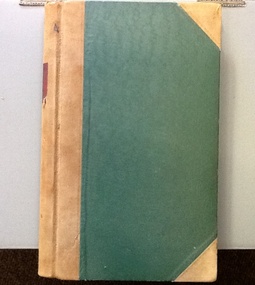
Minutes - CTS, Minutes of General Staff Meetings. Collingwood Technical School. 1950-1958, 1950-1958
... Minutes of General Staff Meetings. Collingwood Technical School. 1950-1958.......Staff meetings...Minutes of General Staff meetings 2 February 1950 – 20th November 1958. ...Minutes of General Staff meetings 2 February 1950 – 20th November 1958. ...Minutes of General Staff meetings 2 February 1950 – 20th November 1958. Handwritten in bound volume and includes various correspondence appended. Minutes for 12th Dec 1950 meeting are typed and inserted into volume. Covers general and special business relating to the administration of the scholl in the 1950s.Green minute book with leather corners and spine. Some typed minutes are inserted into volume.Most entries are handwritten.collingwood technical school, cts, minutes, staff meetings, teachers, nmit, -
 University of Melbourne, Burnley Campus Archives
Document, Staff Meetings, 1957
... Staff Meetings...Notes re staff meetings and conferences...staff Notes re staff meetings and conferences Staff Meetings Document ...Notes re staff meetings and conferencesstaff -
University of Melbourne, Burnley Campus Archives
Document, E.B. Littlejohn, Staff Meetings, 1954-1956
... Staff Meetings...Littlejohn re weed collections, and staff meetings...Littlejohn re weed collections, and staff meetings Staff Meetings Document E.B. Littlejohn ...Notes from E.B. Littlejohn re weed collections, and staff meetingse.b. littlejohn, weed, staff -
University of Melbourne, Burnley Campus Archives
Document, Staff meetings, 1959
... Staff meetings...1. Notes from staff meetings. 2. Animal Production Refresher School held at Burnley College...staff burnley school 1. Notes from staff meetings. 2. Animal Production Refresher School held at Burnley College Staff meetings Document ...1. Notes from staff meetings. 2. Animal Production Refresher School held at Burnley Collegestaff, burnley school -
University of Melbourne, Burnley Campus Archives
Document, Staff meetings, 1975-1978
... Staff meetings...staff Notes from meetings Staff meetings Document ...Notes from meetingsstaff -
University of Melbourne, Burnley Campus Archives
Document, Staff meeting notes, 1958
... Staff meeting notes...Notes of staff meetings and conferences...staff Notes of staff meetings and conferences Staff meeting notes Document ...Notes of staff meetings and conferencesstaff -
 Sunshine and District Historical Society Incorporated
Administrative record - Tottenham Technical School - Miscellaneous Documents, 1975 - 1982
... Staff Bulletins|Staff Meetings|Staff Montions Moved|Grants ProgramsHuman Sexuality and Relations Course Notes|Community House|Curriculum Reports|School Counsellor...Tottenham Technical School Technical School Tottenham Staff Bulletins|Staff Meetings|Staff Montions Moved|Grants ProgramsHuman Sexuality and Relations Course Notes|Community House|Curriculum Reports|School Counsellor Documents relating to Tottenham Tech School 1975 - 1982 Including the Community House Administrative record Tottenham Technical School - Miscellaneous Documents ...Staff Bulletins|Staff Meetings|Staff Montions Moved|Grants ProgramsHuman Sexuality and Relations Course Notes|Community House|Curriculum Reports|School Counsellortottenham technical school, technical school, tottenham -
 Wangaratta High School
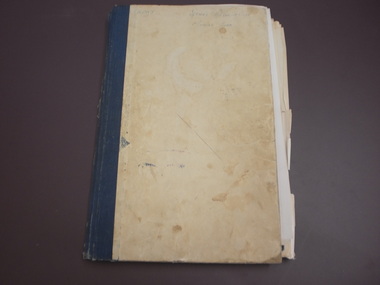
WHS Staff Association Minute book, 1989-2000
... Cream booklet with blue binding containing minutes from staff association meetings during the years 1989-2000...FRONT STAFF ASSOCIATIOPN MINUTE BOOK Cream booklet with blue binding containing minutes from staff association meetings during the years 1989-2000 WHS Staff Association Minute book ...Cream booklet with blue binding containing minutes from staff association meetings during the years 1989-2000FRONT STAFF ASSOCIATIOPN MINUTE BOOK -
 Greensborough Historical Society
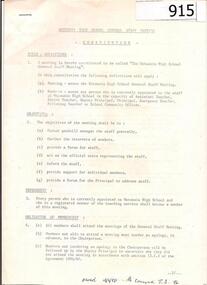
Documents, Watsonia High School documents 1986-1989, 1986-1989
... Document 1 is the constitution of Staff Meetings at Watsonia High School; document 2 outlines the programs and budgets for Watsonia High in 1989; document 3 is a profile of Watsonia High in 1986....Document 1 is the constitution of Staff Meetings at Watsonia High School; document 2 outlines the programs and budgets for Watsonia High in 1989; document 3 is a profile of Watsonia High in 1986. ...Document 1 is the constitution of Staff Meetings at Watsonia High School; document 2 outlines the programs and budgets for Watsonia High in 1989; document 3 is a profile of Watsonia High in 1986.Administration information for staff and parents of Watsonia High School.3 documents, total approx 26 pages. Name written in pen on cover of one document.watsonia high school -
 NMIT (Northern Melbourne Institute of TAFE)
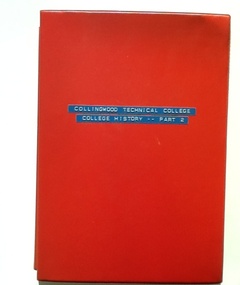
Folder - CTS, Collingwood Technical College. College History. Part 2, 1960s
... 1912-1985 at what appears to be staff meetings....1912-1985 at what appears to be staff meetings. A broad collection of information regarding the early years of CTS and CTC. ...Part 2 Includes list of principals 1912-1970, correspondence re name change CTS to CTC. Lists/spreadsheets of staff(?) 1912-1985 at what appears to be staff meetings.A broad collection of information regarding the early years of CTS and CTC.Red plastic folder with plastic inserts.Cover title: "Collingwood Technical College / College History. Part 2". A variety of documents, media releases, correspondence, etc relating to the history of CTC and Collingwood Technical SchoolEach document has a numerical inscription relating to the Collingwood Technical School archives.collingwood technical school, cts, collingwood technical college, ctc, history, nmit, -
Tatura Irrigation & Wartime Camps Museum
Audio Tape, State Rivers and Water Supply Commission 75th Anniversary, 1981/05/01
... Tape made of the quarterly senior staff meeting to commemorate the 75th anniversary of the State RIvers and Water Supply Commission - 1st May 1981, speakers - W.E Bromfield, L.J Greenhill, F.C O'Connor, A.L. ...Tape made of the quarterly senior staff meeting to commemorate the 75th anniversary of the State RIvers and Water Supply Commission - 1st May 1981, speakers - W.E Bromfield, L.J Greenhill, F.C O'Connor, A.L. ...Tape made of the quarterly senior staff meeting to commemorate the 75th anniversary of the State RIvers and Water Supply Commission - 1st May 1981, speakers - W.E Bromfield, L.J Greenhill, F.C O'Connor, A.L. Tisdall, Sir Ronald East.S.R. & W.S.C 75th Anniversary 1st May 1981irrigation, victoria state rivers and water supply commission, bromfield, greenhill, o'connor, tisdall, sir ronald east -
 Sunshine and District Historical Society Incorporated
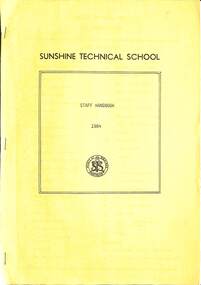
Administrative record - Sunshine Technical School / Staff Handbook 1984
... A4 booklet plus cover with rules, procedures, security, timetables, meetings. Staff Handbook 1984...Sunshine Technical School Technical School Sunshine Sunshine Technical School - School Motto - Mente et manibus A4 booklet plus cover with rules, procedures, security, timetables, meetings. Staff Handbook 1984 Administrative record Sunshine Technical School / Staff Handbook 1984 ...Sunshine Technical School - School Motto - Mente et manibussunshine technical school, technical school, sunshine -
 Sunshine and District Historical Society Incorporated
Administrative record - Sunshine Technical School / Staff Handbook-1982
... A4 booklet with 37 pages and cover containing rules, procedures, security, timetables and meetings. Staff handbook 1982...Sunshine Technical School Technical School Sunshine School Motto Mente et Manibus STS A4 booklet with 37 pages and cover containing rules, procedures, security, timetables and meetings. Staff handbook 1982 Administrative record Sunshine Technical School / Staff Handbook-1982 ...School Motto Mente et Manibus STSsunshine technical school, technical school, sunshine -
Federation University Historical Collection
Photograph, Zig Plavina, Retired Staff Asssociation Annual General Meeting, 12/1999
... Retired Staff Asssociation Annual General Meeting...Colour photograph of Retired Staff Asssociation Annual General Meeting. The person on the left is Ken Clements....Retired Staff Asssociation Annual General Meeting Photograph Zig Plavina ...Colour photograph of Retired Staff Asssociation Annual General Meeting. The person on the left is Ken Clements.retired staff association, ken clements -
 Bendigo Military Museum
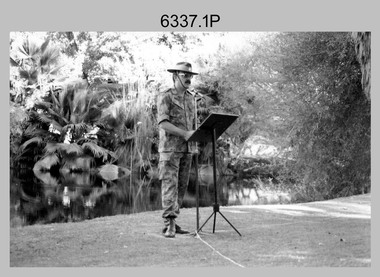
Photograph - CSP In-house Bid Announcement, Army Survey Regiment, Fortuna, Bendigo, 1994
... This is a set of 14 photographs of an All-Staff meeting held by the lake at the Army Survey Regiment, Fortuna, Bendigo on the 24th of April 1994. ...This is a set of 14 photograph of an All-Staff Meeting held at the Army Survey Regiment, Fortuna, Bendigo on the 24th of April 1994, to announce the success of Army’s Defence’s Commercial Support Program (CSP) In-house Bid. ...This is a set of 14 photographs of an All-Staff meeting held by the lake at the Army Survey Regiment, Fortuna, Bendigo on the 24th of April 1994. ...This is a set of 14 photographs of an All-Staff meeting held by the lake at the Army Survey Regiment, Fortuna, Bendigo on the 24th of April 1994. At this meeting CO LTCOL Duncan Burns announced that under Defence’s Commercial Support Program (CSP), the In-House bid submitted in 1993 by a team led by then CO LTCOL Bob McHenry was successful. The In-House bid proposed the establishment of an organisation based at Fortuna to carry out non-core production with 150 of the 373 Survey Corps positions converted to Defence civilian positions. 110 of the Defence civilian positions would be filled voluntarily by military personnel under Section 81B of the Public Service Act 1992 with the remaining 40 positions filled by Public Service recruitment. Other options offered to Survey Corps personnel were postings to 1st Topographic Survey Squadron in Enoggera, QLD, transfer to another Corps in the Australian Army or discharge from the ADF. The In-House bid also proposed 143 Survey Corps military positions to remain at Fortuna to perform ‘core strategic non-sovereign tasks.’ However, Army subsequently decided to abolish the 143 positions, disband 4th Field Survey Squadron, Adelaide, SA and lastly, the demise of the Royal Australian Survey Corp in June 1996. This period of the Army Survey Regiment’s history is covered in more detail in pages 160 to 162 of Valerie Lovejoy’s book 'Mapmakers of Fortuna – A history of the Army Survey Regiment’ ISBN: 0-646-42120-4.This is a set of 14 photograph of an All-Staff Meeting held at the Army Survey Regiment, Fortuna, Bendigo on the 24th of April 1994, to announce the success of Army’s Defence’s Commercial Support Program (CSP) In-house Bid. The Black and white photos are on photographic paper and scanned at 300 dpi. They are part of the Army Survey Regiment’s Collection. .1) to .3) - Photo, black & white, 1994. CO LTCOL Duncan Burns briefing Army Survey Regiment personnel and civilians. .4) to .5P - Photo, black & white, 1994. D-SVY COL Simon Lemon briefing Army Survey Regiment personnel and civilians. .6) - Photo, black & white, 1994. L to R: D-SVY COL Simon Lemon, unidentified civilian. .7) - Photo, black & 1994. L to R: SCMA WO1 Alan Hancox, unidentified civilian. .8) - Photo, black & 1994. RSM WO1 Phil Meagher. .9) - Photo, black & 1994. WO2 Rob Bogumil. .10) - Photo, black & 1994. Left Row: all unidentified. Centre Row L to R: unidentified (x2), SGT Jim Ash, CPL Steve Linane, CPL Andrew Quin, SGT Craig Kellet, unidentified. Back row L to R: unidentified (x2), SGT Barry Miller, SSGT Steve Winner, SPR Shane Campbell, SPR Karen McQuaigue, CPL Geoff Webb. .11) - Photo, black & 1994. L to R: CPL Warren ‘Waldo’ Shirley, COL COMDT COL Don Swiney MBE. .12) - Photo, black & 1994. L to R: LT Scott Seefeld, CAPT Bin Fashar Sutiman (Indonesian Army), LT Darren Radford, CAPT Gary Warnest, unidentified US exchange officer. .13) - Photo, black & 1994. L to R: unidentified, SGT Mark Host, LT Anthony Chamberlayne, unidentified (x2), Mr Tony Spurling. .14) - Photo, black & 1994. L to R: unidentified US exchange officer, CAPT Bill Griggs, CAPT Matt Jackson CSM, LT Darren Radford, unidentified, LT Scott Seefeld, SGT Mark Host, LT Gordon Muir, CAPT Gary Warnest, LT Anthony Chamberlayne, unidentified (x2), LT Colin Davidson.No personnel are identified. Annotated with date on folder sleeve.royal australian survey corps, rasvy, army svy regt, army survey regiment, fortuna, asr -
 Vision Australia
Photograph - Image, QBIC Industries images, 1996-1999
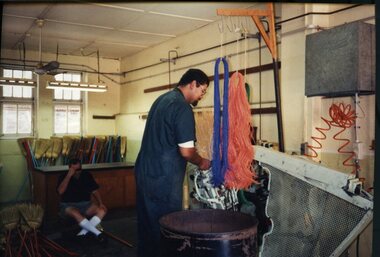
... Photos also include machinery on the factory floor, Merv Matthew's retirement in 1999, workers in action, a staff meeting, the outside of the builing and the office and showroom with its famous frog logo....Photos also include machinery on the factory floor, Merv Matthew's retirement in 1999, workers in action, a staff meeting, the outside of the builing and the office and showroom with its famous frog logo. ...QBIC Industries production workers and supervisors, including: Selwyn Brown, May Brown, Keith Smith, Bill Bryce, Andrew Grimes, Bob McKay, Arthur Trumper, Jaina Unmoepa, Alan Nemeth, Lan Lam, Jenny Scown, Danny Fuller, Kevin Waits, Duncan Collard, Merv Matthews, Wayne Suffolk, Les Gregory, Henry Chichowski, BCC Councillor Tim Quinn, Max Stegman, Denis Cavanagh, John Gilmore, Anne-Maree O'Connell, Colin Ingram and Bray Waterman. Photos also include machinery on the factory floor, Merv Matthew's retirement in 1999, workers in action, a staff meeting, the outside of the builing and the office and showroom with its famous frog logo.62 col. photographs of QBIC Industries/Vision QLD staffqbic industries, selwyn brown, may brown, keith smith, bill bryce, andrew grimes, bob mckay, arthur trumper, jaina unmoepa, alan nemeth, lan lam, jenny scown, danny fuller, kevin waits, duncan collard, merv matthews, wayne suffolk, les gregory, henry chichowski, tim quinn, max stegman, denis cavanagh, john gilmore, colin ingram, bray waterman, anne-marie o'connell, mark pelgrave -
 Bendigo Historical Society Inc.
Photograph - Kangaroo Flat Gold Mine Collection: photo album 1998
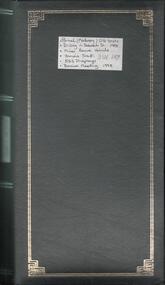
... .; mines rescue vehicle; various staff; E.E.S. Displays; Board Meeting 1998. Staff photos: Rob Charlton, pump at Red, White Blue Cons.; Andrew Breen Workshop Manager; John Cahill; Patrick O'Boyle Mine Rescue Vehicle; John Cahill; Ben Clayton; Ricky Hannah; April Westcott; Ivette Maggs site clerk McMahons; Wayne Woodward; Fiona Hunt; Steve Woodall.....; mines rescue vehicle; various staff; E.E.S. Displays; Board Meeting 1998. Staff photos: Rob Charlton, pump at Red, White Blue Cons.; Andrew Breen Workshop Manager; John Cahill; Patrick O'Boyle Mine Rescue Vehicle; John Cahill; Ben Clayton; Ricky Hannah; April Westcott; Ivette Maggs site clerk McMahons; Wayne Woodward; Fiona Hunt; Steve Woodall. ...Photo album, black cover, gold border. One hundred colour photos, some with annotations. Label on front of album: Portal, machinery, underground shots 1998; drilling in Deborah St.; mines rescue vehicle; various staff; E.E.S. Displays; Board Meeting 1998. Staff photos: Rob Charlton, pump at Red, White Blue Cons.; Andrew Breen Workshop Manager; John Cahill; Patrick O'Boyle Mine Rescue Vehicle; John Cahill; Ben Clayton; Ricky Hannah; April Westcott; Ivette Maggs site clerk McMahons; Wayne Woodward; Fiona Hunt; Steve Woodall.kangaroo flat gold mine, bendigo mining nl, new bendigo gold project, goldmining, personnel, doug buerger, colin burns, tarnagulla, new moon, displays, box cut, unity mining, aerial photos, 1998 -
 Eltham District Historical Society Inc
Document - Series Listing, Fraser Faithfull et al, Series 32: Shire Scenes and Activities, contact print collection, 2000
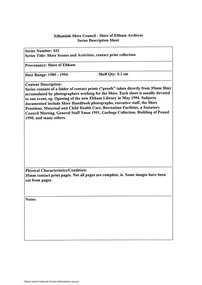
... Subjects documented include Shire Handbook photographs, executive staff, the Shire President, Maternal and Child Health Care, Recreation Facilities, a Statutory Council Meeting, General Staff Xmas 1991, Garbage Collection, Building of Pound 1990, and many others....Subjects documented include Shire Handbook photographs, executive staff, the Shire President, Maternal and Child Health Care, Recreation Facilities, a Statutory Council Meeting, General Staff Xmas 1991, Garbage Collection, Building of Pound 1990, and many others. shire of eltham archives series listing A4 printout Series 32: Shire Scenes and Activities, contact print collection Document Series Listing Fraser Faithfull Chris Marks ...Series consists of a folder of contact prints ("proofs" taken directly from 35mm film) accumulated by photographers working for the Shire. Each sheet is usually devoted to one event, eg. Opening of the new Eltham Library in May 1994. Subjects documented include Shire Handbook photographs, executive staff, the Shire President, Maternal and Child Health Care, Recreation Facilities, a Statutory Council Meeting, General Staff Xmas 1991, Garbage Collection, Building of Pound 1990, and many others.shire of eltham archives, series listing -
 Sunshine and District Historical Society Incorporated
Administrative record - City of Sunshine - Commissioner Mr Alexander Alex George Gillon Collection 1976 - 1982 - Minutes of the ordinary meeting of council held on 30th November 1977, City of Sunshine, 30th November 1977
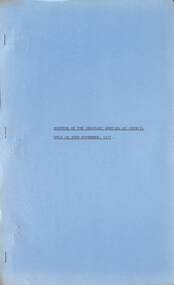
... Minutes of the Ordinary Meeting of Council held on 30th November 1977 Report of the Town Clerk's Department Report of the Town Clerk Supplementary Valuations Christmas Recess The Hub Holidays For Employees Office Accommodation Welfare Staff Meeting Dates Christmas Recess Western Region Commission Report of Matters Arising from Last Meeting Committee of Municipal Recreation Officers Council Participation Sanitary and Interest Abandonments for 1977/78 Proposed Lobby for Increased Federal Subsidies Proposal to Rezone Zone 7 and Adjoining Land Playing of Bingo on Council Property Proposed Amendment to Albion Rovers Lease Dempster Park Occupation of Pavilion and Proposed Dempster Park Committee of Management Sunshine North Tennis Club, Sunshine North Scout Group, Sunshine Cricket Club Report of the Co-Ordinator of Welfare Services Schools in the Sunshine Area Deer Park Children's Community Centre Committee of Management Child Care Centre Ainsworth Reserve Sunshine West Service of Furlong Road Hospital Report of the Chief Health Officer Vending Machines Registration Fees Prosecutions Proceedings Sunshine Magistrate Court Australian Institute of Health Surveyors Fourth Annual Conference 10th to 14th October 1977 Perth West Australia Health Act Registrations Report of Medical Officer of Health Report of the By-Laws Officer Stray Dog Problem R.S.P.C.A. ...Albans Withers Street Ballarat Road Hampstead Road Maidstone Killara Street Mernda Street Tamar Drive Deer Park Fourth Avenue Garfield Street Sydney Street Albion Epalock Crescent Joyce Close Western Highway Station Road Westmoreland Road McIntyre Road Sunshine High School Cary Street Suffolk Street Bunting Road Brooklyn Main Road West Cornhill Street Tottenham Parade Geelong Road Footscray West Ridley Street Sunshine Swimming Pool Albion Tennis Club Minutes of the Ordinary Meeting of Council held on 30th November 1977 Report of the Town Clerk's Department Report of the Town Clerk Supplementary Valuations Christmas Recess The Hub Holidays For Employees Office Accommodation Welfare Staff Meeting Dates Christmas Recess Western Region Commission Report of Matters Arising from Last Meeting Committee of Municipal Recreation Officers Council Participation Sanitary and Interest Abandonments for 1977/78 Proposed Lobby for Increased Federal Subsidies Proposal to Rezone Zone 7 and Adjoining Land Playing of Bingo on Council Property Proposed Amendment to Albion Rovers Lease Dempster Park Occupation of Pavilion and Proposed Dempster Park Committee of Management Sunshine North Tennis Club, Sunshine North Scout Group, Sunshine Cricket Club Report of the Co-Ordinator of Welfare Services Schools in the Sunshine Area Deer Park Children's Community Centre Committee of Management Child Care Centre Ainsworth Reserve Sunshine West Service of Furlong Road Hospital Report of the Chief Health Officer Vending Machines Registration Fees Prosecutions Proceedings Sunshine Magistrate Court Australian Institute of Health Surveyors Fourth Annual Conference 10th to 14th October 1977 Perth West Australia Health Act Registrations Report of Medical Officer of Health Report of the By-Laws Officer Stray Dog Problem R.S.P.C.A. ...Minutes of the Ordinary Meeting of Council held on 30th November 1977 Report of the Town Clerk's Department Report of the Town Clerk Supplementary Valuations Christmas Recess The Hub Holidays For Employees Office Accommodation Welfare Staff Meeting Dates Christmas Recess Western Region Commission Report of Matters Arising from Last Meeting Committee of Municipal Recreation Officers Council Participation Sanitary and Interest Abandonments for 1977/78 Proposed Lobby for Increased Federal Subsidies Proposal to Rezone Zone 7 and Adjoining Land Playing of Bingo on Council Property Proposed Amendment to Albion Rovers Lease Dempster Park Occupation of Pavilion and Proposed Dempster Park Committee of Management Sunshine North Tennis Club, Sunshine North Scout Group, Sunshine Cricket Club Report of the Co-Ordinator of Welfare Services Schools in the Sunshine Area Deer Park Children's Community Centre Committee of Management Child Care Centre Ainsworth Reserve Sunshine West Service of Furlong Road Hospital Report of the Chief Health Officer Vending Machines Registration Fees Prosecutions Proceedings Sunshine Magistrate Court Australian Institute of Health Surveyors Fourth Annual Conference 10th to 14th October 1977 Perth West Australia Health Act Registrations Report of Medical Officer of Health Report of the By-Laws Officer Stray Dog Problem R.S.P.C.A. Symposium Report of the City Librarian Halloween Celebrations Library Hours over the Christmas Period Bookmobile Sites in January Extension Services During the School Holiday Period Report of the City Engineer Land Use Permit Application Consulting Rooms Diagnostic Laboratory 20 Withers Street Melbourne and Metropolitan Board of Works (Powers) Bill Land Use Permit Application Bunting Over Used Car Sales Yard 556 Ballarat Road Sunshine Land Use Permit Application Addition of L.P. Gas Tank and Additional Hopper for Ready Mic Concrete Plant Lot 1 Hampstead Road Land Use Permit Application Flats 37 Phoenix Street Land Use Permit Application Flats Lot 42 Killara Street North East Corner Mernda Street Land Use Permit Application Subdivision and Detached House on Each Lot Tamar Drive Contract Supply and Maintenance of Vehicles Fourth Avenue Private Street Scheme Garfield Street Private Street Scheme Reconstruction of Sydney Street Contract Plan of Subdivision Epalock Crescent & Joyce Close Replacement of Fleet No 410 Toyota Hiace Weights & Measures Application for Fund for 1977/78 Country Road Board Foundation for the Technical Advancement of Local Government Engineering in Victoria Load Limits Various Road Certificate of Completion Garfield Street Intersection of Western Highway / Station Road Deer Park Construction of Footpath North Side of Ballarat Road From Westmoreland Road to McIntyre Road Request from Sunshine High School Drainage Works Stony Creek From Cary Street to Furlong Road Construction of Suffolk Street City of Footscray Future Garbage Disposal Site South Side Bunting Road Certificate of Completion Health Act Drain Garfield Street Area Private Street Scheme Concrete Right of Way at Rear of Shops in Main Road West at Cornhill Street St. Albans Proposed Transfer of Land St. Albans Road near Furlong Road Annual Supply Contract Supply of Concrete in Min Mix Trucks Report of the Building Surveyor Computer Aided Design Seminar Vocational Employment Building Surveyor's Office Installation of Underground Tank Geelong Road Corner Tottenham Parade Undersize Allotment 2 Ridley Street Sunshine Swimming Pool Solar Heating Ainsworth Childcare Centre / Pavilion Ainsworth Reserve Dempster Park Cricket Pavilion Cleaning Infant Welfare Centres General Cleaning Contract Albion Tennis Club Pavilion Child Care Buildings Program M.M.B.W. Sewer Child Care Buildings city of sunshine, alexander "alex" george gillon, the hub, sun crescent, albion rovers soccer club, chaplin rerserve, anderson road, sunshine, dempster park committee of management, sunshine north tennis club, sunshine north scout group, sunshine cricket club, dempster park, phoenix street, sunshine north, ainsworth reserve child care centre, ainsworth reserve, vernon street, sunshine west, furlong road, st. albans, withers street, ballarat road, hampstead road, maidstone, killara street, mernda street, tamar drive, deer park, fourth avenue, garfield street, sydney street, albion, epalock crescent, joyce close, western highway, station road, westmoreland road, mcintyre road, sunshine high school, cary street, suffolk street, bunting road, brooklyn, main road west, cornhill street, tottenham parade, geelong road, footscray west, ridley street, sunshine swimming pool, albion tennis club -
 Federation University Historical Collection
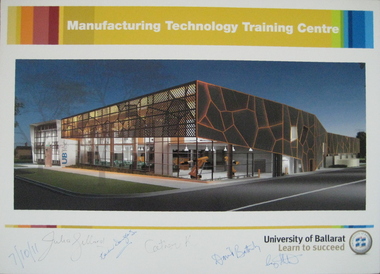
Photograph - Poster, University of Ballarat Manufacturing Technology Training Centre poster signed by Prime Minister Julia Gillard, 07/10/2011 (approx 11.15am)
... UBTec will provide a facility including individual learning spaces, learning studios, administration/office space, circulation, open plan learning space, staff common areas, computer rooms, meeting rooms, staff work areas and kitchen areas as well as car parking and site-wide amenities. ...UBTec will provide a facility including individual learning spaces, learning studios, administration/office space, circulation, open plan learning space, staff common areas, computer rooms, meeting rooms, staff work areas and kitchen areas as well as car parking and site-wide amenities. ...The new Manufacturing Technology Training Centre (MTTC), a part of the proposed Building Construction Training Centre (BCTC), will be a purpose-built, stand-alone, fully fitted-out industry-standard facility. This new space will accommodate current course provision along with specialist training spaces for developing skill requirements in manufacturing technology such as robotics, mechatronics, engineering and industrial automation. Project funding was provided by the Education Investment Fund from the Australian Government Department of Education, Employment and Workplace Relations. The project budget is $18.09m, and the resulting building will have a floor space of 4,755m2. The Manufacturing Technology Training Centre is being built in conjunction with the Technical Education Centre (UBTec). While the buildings will have separate street identities the buildings will be joined with shared amenities areas. UBTec will provide a facility including individual learning spaces, learning studios, administration/office space, circulation, open plan learning space, staff common areas, computer rooms, meeting rooms, staff work areas and kitchen areas as well as car parking and site-wide amenities. While the buildings will have separate street identities the buildings will be joined with shared amenities areas. Funding for the UBTec component of the building is provided by Maintaining the Advantage: Skilled Victorians from the Victorian State Government. A colour poster prepared for the 'turning of the sod' at the site of the proposed University of Ballarat Manufacturing Technology Training Centre (MTTC), Grant Street, Ballarat. The poster was signed on Friday 7 October 2011 at about 11:15 am at the Building Construction Training Centre (BCTC), Grant Street, Ballarat by: Hon. Julia Gillard MP Hon. Catherine King MP (Ballarat ) Prof. David Battersby, Vice Chancellor, University of Ballarat Mayor, Cr Craig Fletcher, Mayor of the City of Ballarat appointed in December 2010 Mrs. Karen Douglas, Chair University of Ballarat Building & Infrastructure Committee The poster is signed by the Prime Minister of Australia, the Hon. Julia Gillard MP; Karen Douglas; the Hon. Catherine King MP (Ballarat ); Prof. David Battersby (Vice Chancellor); Craig Fletcher (Mayor, City of Ballarat)university of ballarat, david battersby, julia gillard, prime minister, catherine king, ubtec, karen douglas, manufacturing technology training centre, grant street, architecural feature -
 Sunshine and District Historical Society Incorporated
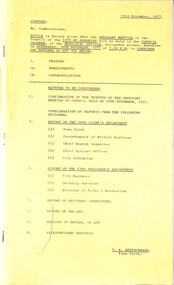
Administrative record - City of Sunshine - Commissioner Mr Alexander Alex George Gillon Collection 1976 - 1982 - Notice of ordinary meeting of the council of the City of Sunshine to be held on 30th November 1977, City of Sunshine, 23rd November 1977
... Notice of Ordinary Meeting of the Council of the City of Sunshine to be held on 30th November 1977 Report of the Town Clerk's Department Report of the Town Clerk Supplementary Valuations Christmas Recess The Hub Holidays For Employees Office Accommodation Welfare Staff Meeting Dates Christmas Recess Western Region Commission Report of Matters Arising from Last Meeting Committee of Municipal Recreation Officers Council Participation Sanitary and Interest Abandonments for 1977/78 Proposed Lobby for Increased Federal Subsidies Proposal to Rezone Zone 7 and Adjoining Land Playing of Bingo on Council Property Proposed Amendment to Albion Rovers Lease Dempster Park Occupation of Pavilion and Proposed Dempster Park Committee of Management Sunshine North Tennis Club, Sunshine North Scout Group, Sunshine Cricket Club Report of the Co-Ordinator of Welfare Services Schools in the Sunshine Area Deer Park Childrem's Community Centre Committee of Management Child Care Centre Ainsworth Reserve Sunshine West Service of Furlong Road Hospital Report of the Chief Health Officer Vending Machines Registration Fees Prosecutions Proceedings Sunshine Magistrate Court Australian Institute of Health Surveyors Fourth Annual Conference 10th to 14th October 1977 Perth West Australia Health Act Registrations Report of Medical Officer of Health Report of the By-Laws Officer Stray Dog Problem R.S.P.C.A. ...City of Sunshine Alexander "Alex" George Gillon The Hub Sun Crescent Albion Rovers Soccer Club Chaplin Rerserve Anderson Road Sunshine Notice of Ordinary Meeting of the Council of the City of Sunshine to be held on 30th November 1977 Report of the Town Clerk's Department Report of the Town Clerk Supplementary Valuations Christmas Recess The Hub Holidays For Employees Office Accommodation Welfare Staff Meeting Dates Christmas Recess Western Region Commission Report of Matters Arising from Last Meeting Committee of Municipal Recreation Officers Council Participation Sanitary and Interest Abandonments for 1977/78 Proposed Lobby for Increased Federal Subsidies Proposal to Rezone Zone 7 and Adjoining Land Playing of Bingo on Council Property Proposed Amendment to Albion Rovers Lease Dempster Park Occupation of Pavilion and Proposed Dempster Park Committee of Management Sunshine North Tennis Club, Sunshine North Scout Group, Sunshine Cricket Club Report of the Co-Ordinator of Welfare Services Schools in the Sunshine Area Deer Park Childrem's Community Centre Committee of Management Child Care Centre Ainsworth Reserve Sunshine West Service of Furlong Road Hospital Report of the Chief Health Officer Vending Machines Registration Fees Prosecutions Proceedings Sunshine Magistrate Court Australian Institute of Health Surveyors Fourth Annual Conference 10th to 14th October 1977 Perth West Australia Health Act Registrations Report of Medical Officer of Health Report of the By-Laws Officer Stray Dog Problem R.S.P.C.A. ...Notice of Ordinary Meeting of the Council of the City of Sunshine to be held on 30th November 1977 Report of the Town Clerk's Department Report of the Town Clerk Supplementary Valuations Christmas Recess The Hub Holidays For Employees Office Accommodation Welfare Staff Meeting Dates Christmas Recess Western Region Commission Report of Matters Arising from Last Meeting Committee of Municipal Recreation Officers Council Participation Sanitary and Interest Abandonments for 1977/78 Proposed Lobby for Increased Federal Subsidies Proposal to Rezone Zone 7 and Adjoining Land Playing of Bingo on Council Property Proposed Amendment to Albion Rovers Lease Dempster Park Occupation of Pavilion and Proposed Dempster Park Committee of Management Sunshine North Tennis Club, Sunshine North Scout Group, Sunshine Cricket Club Report of the Co-Ordinator of Welfare Services Schools in the Sunshine Area Deer Park Childrem's Community Centre Committee of Management Child Care Centre Ainsworth Reserve Sunshine West Service of Furlong Road Hospital Report of the Chief Health Officer Vending Machines Registration Fees Prosecutions Proceedings Sunshine Magistrate Court Australian Institute of Health Surveyors Fourth Annual Conference 10th to 14th October 1977 Perth West Australia Health Act Registrations Report of Medical Officer of Health Report of the By-Laws Officer Stray Dog Problem R.S.P.C.A. Symposium Report of the City Librarian Halloween Celebrations Library Hours over the Christmas Period Bookmobile Sites in January Extension Services During the School Holiday Period Report of the City Engineer Land Use Permit Application Consulting Rooms Diagnostic Laboratory 20 Withers Street Melbourne and Metropolitan Board of Works (Powers) Bill Land Use Permit Application Bunting Over Used Car Sales Yard 556 Ballarat Road Sunshine Land Use Permit Application Addition of L.P. Gas Tank and Additional Hopper for Ready Mic Concrete Plant Lot 1 Hampstead Road Land Use Permit Application Flats 37 Phoenix Street Land Use Permit Application Flats Lot 42 Killara Street North East Corner Mernda Street Land Use Permit Application Subdivision and Detached House on Each Lot Tamar Drive Contract Supply and Maintenance of Vehicles Fourth Avenue Private Street Scheme Garfield Street Private Street Scheme Reconstruction of Sydney Street Contract Plan of Subdivision Epalock Crescent & Joyce Close Replacement of Fleet No 410 Toyota Hiace Weights & Measures Application for Fund for 1977/78 Country Road Board Foundation for the Technical Advancement of Local Government Engineering in Victoria Load Limits Various Road Certificate of Completion Garfield Street Intersection of Western Highway / Station Road Deer Park Construction of Footpath North Side of Ballarat Road From West Moreland Road to McIntyre Road Request from Sunshine High School Drainage Works Stony Creek From Cary Street to Furlong Road Construction of Suffolk Street City of Footscray Future Garbage Disposal Site South Side Bunting Road Certificate of Completion Health Act Drain Garfield Street Area Private Street Scheme Concrete Right of Way at Rear of Shops in Main Road West at Cornhill Street St. Albans Proposed Transfer of Land St. Albans Road near Furlong Road Annual Supply Contract Supply of Concrete in Min Mix Trucks Report of the Building Surveyor Computer Aided Design Seminar Vocational Employment Building Surveyor's Office Installation of Underground Tank Geelong Road Corner Tottenham Parade Undersize Allotment 2 Ridley Street Sunshine Swimming Pool Solar Heating Ainsworth Childcare Centre / Pavilion Ainsworth Reserve Dempster Park Cricket Pavilion Cleaning Infant Welfare Centres General Cleaning Contract Albion Tennis Club Pavilion Child Care Buildings Program M.M.B.W. Sewer Child Care Buildings Orders of the Day Accounts Submitted for Payment 15th November 1977 Subdivision of Land Fairbairn Road Proposed Transfer of Funds for Provision of Office Accommodation city of sunshine, alexander "alex" george gillon, the hub, sun crescent, albion rovers soccer club, chaplin rerserve, anderson road, sunshine -
 Flagstaff Hill Maritime Museum and Village
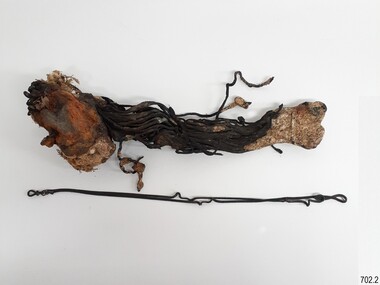
Functional object - Watch Chains, ca 1855
... meeting, two inquiries and the court proceedings, he was found not guilty and cleared of all charges. In 1975, divers from Flagstaff Hill, including Peter Ronald, found an ornate communion set at the wreck. The set comprised a jug, two chalices, a plate and a lid. The lid did not fit any of the other objects and in 1978 a piece of the lid broke off, revealing a glint of gold. As museum staff...meeting, two inquiries and the court proceedings, he was found not guilty and cleared of all charges. In 1975, divers from Flagstaff Hill, including Peter Ronald, found an ornate communion set at the wreck. The set comprised a jug, two chalices, a plate and a lid. The lid did not fit any of the other objects and in 1978 a piece of the lid broke off, revealing a glint of gold. As museum staff ...The concretion of silver watch chains was recovered from the wreck of the Schomberg over one hundred years later. Schomberg was a large three-masted full-ship rigged wooden ship built in 1855 by Alexander Hall and Co in Aberdeen, Scotland for James Baines' famous Black Ball Line at £43,103. The vessel was 288 feet (88 meters) in length, with a beam of 45 feet (14 meters), a depth of 29.5 feet (8.99 meters) of 2,284 tons. The mainmast was 210 feet (64 meters) high and she carried 3.3 acres of sail. The vessel was constructed with three skins. One planked fore and aft, and two diagonally planked, fastened together with screw-threaded trunnels (wooden rails). The Schomberg is one of only three clipper wrecks in Victorian waters that operated the England -to- Australia run. While the other two, Empress of the Sea and Lightning, were built by the famous American shipbuilder, Donald Mac Kay. Schomberg was an attempt to build a faster ship than Mac Kay and a vessel fast enough to break the sailing record to Australia. The Schomberg sailed on her maiden voyage from Liverpool on 6 October 1855, under the command of Captain James Forbes, on its maiden voyage to Australia with general cargo, jewellery, spirits, machinery, and 2,000 tons of iron rails and equipment intended to build the Melbourne to Geelong Railway and a bridge over the Yarra from Melbourne to Hawthorn. She also carried a cow for fresh milk, pens for fowls and pigs, plus 90,000 gallons of water for washing and drinking. She also carried 17,000 letters and 31,800 newspapers. There were approximately 473 passengers and a crew of 105. It was hoped that Schomberg would make Melbourne in sixty days, setting a record for the voyage, but light winds at the equator dashed those expectations. The ship sighted Moonlight Head in southwest Victoria on Christmas Day but through a deadly combination of wind, currents and unmarked sand spits, the vessel gently ran aground on 26 December 1855 on a spit that juts into Newfield Bay, just east of Curdies Inlet, and the present town of Peterborough. Fortunately, the SS Queen was nearby and managed to save all passengers and crew. The steamers Keera and Maitland were dispatched to salvage the passenger's baggage and the more valuable cargo. Other salvage attempts were made, but deteriorating weather made the work impossible, and within two weeks the Schomberg's hull was broken up and the vessel abandoned. The wrecking of the Schomberg caused quite a public stir, particularly in light of the fact the vessel was supposed to be, the most perfect clipper ship ever built. Captain Forbes was charged in the Supreme Court under suspicion that he was playing cards with two female passengers below decks when his ship ran aground. Despite a protest meeting, two inquiries and the court proceedings, he was found not guilty and cleared of all charges. In 1975, divers from Flagstaff Hill, including Peter Ronald, found an ornate communion set at the wreck. The set comprised a jug, two chalices, a plate and a lid. The lid did not fit any of the other objects and in 1978 a piece of the lid broke off, revealing a glint of gold. As museum staff carefully examined the lid and removed marine growth, they found a diamond ring, which is currently on display in the Great Circle Gallery at the Flagstaff Hill Maritime Museum that also displays ship fittings and equipment, and personal effects. Most of the artefacts were salvaged from the wreck by Peter Ronald, former director of Flagstaff Hill.The Schomberg has historical significance as one of the first luxurious ships built to bring emigrants to Australia to cash in on the gold rush era. And is included on the Victorian Heritage Register (VHR S612). The collection of Schomberg artefacts held at Flagstaff Hill Museum is primarily significant because of the relationship between these recovered items having a high potential to interpret the story of the Schomberg and its foundering during a storm. The shipwreck is of additional historically significance for representing aspects of Victoria’s shipping history and for its association with the first passenger ship, which was designed not only to be the fastest and most luxurious of its day but foundered on its maiden voyage to Australia.Conglomerated cluster of silver watch chains, encased in concretion at both ends (1 chain is separated). They were recovered from the wreck of the Schomberg.warrnambool, flagstaff-hill, flagstaff-hill-maritime-museum, shipwreck-coast, flagstaff-hill-maritime-village, schomberg, shipwrecked-artefact, clipper ship, black ball line, 1855 shipwreck, aberdeen clipper ship, captain forbes, peterborough shipwreck, ss queen, watch chain -
 Flagstaff Hill Maritime Museum and Village
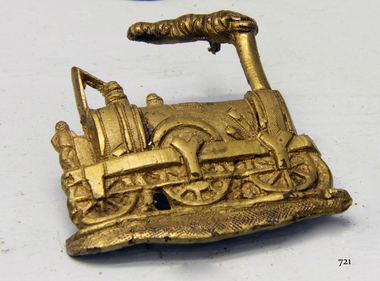
Accessory - Badge, Before 1855
... meeting, two inquiries, and the court proceedings, he was found not guilty and cleared of all charges. In 1975, divers from Flagstaff Hill, including Peter Ronald, found an ornate communion set at the wreck. The set comprised a jug, two chalices, a plate, and a lid. The lid did not fit any of the other objects and in 1978 a piece of the lid broke off, revealing a glint of gold. As museum staff...meeting, two inquiries, and the court proceedings, he was found not guilty and cleared of all charges. In 1975, divers from Flagstaff Hill, including Peter Ronald, found an ornate communion set at the wreck. The set comprised a jug, two chalices, a plate, and a lid. The lid did not fit any of the other objects and in 1978 a piece of the lid broke off, revealing a glint of gold. As museum staff ...The badge recovered from the Schomberg wreck is believed to depict one of the first steam engines. The engine's design by Charles Tayleur & Co. was to be produced for the Great Western Railway in England. The first nineteen of these locomotives were ordered by Isambard Kingdom Brunel for the Great Western Railway including six 2-2-2 Charles Tayleur locomotives. They were built by Charles Tayleur and Company, which later the Vulcan Foundry. The locomotives were unsuccessful and were rapidly supplemented by the Star Class locomotives ordered by Daniel Gooch once he had been appointed as the Locomotive Engineer. As built, they comprised two groups of three, the first group, was delivered in 1837. This locomotive was the first to run on the Great Western Railway when it was tested on 28 December 1837 from its shed at West Drayton. It was withdrawn in 1843 but was rebuilt as a 2-2-2T tank locomotive and returned to service in 1846, running in this form until 1868. It survived for two more years at Reading as a stationary boiler. It is named after the workshops where it was built, which themselves were named after the Roman god of fire. (Although a supposition, it is possible that the owner was a passenger on the ill-fated Schomberg and that they worked either for the Great Western Railway or the Vulcan Foundry that made the engine in the 1830s.) Wreck of the Schomberg: Schomberg was a large three-masted full-ship rigged wooden ship built in 1855 by Alexander Hall and Co in Aberdeen, Scotland for James Baines' famous Black Ball Line at £43,103. The vessel was 288 feet (88 meters) in length, with a beam of 45 feet (14 meters), a depth of 29.5 feet (8.99 meters) of 2,284 tons. The mainmast was 210 feet (64 meters) high and she carried 3.3 acres of sail. The vessel was constructed with three skins. One planked fore and aft, and two diagonally planked, fastened together with screw-threaded trunnels (wooden rails). The Schomberg is one of only three clipper wrecks in Victorian waters that operated the England to Australia run. While the other two, Empress of the Sea and Lightning, were built by the famous American shipbuilder, Donald Mac Kay. Schomberg was an attempt to build a faster ship than Mac Kay and a vessel fast enough to break the sailing record to Australia. The Schomberg sailed on her maiden voyage from Liverpool on 6 October 1855, under the command of Captain James Forbes, on its maiden voyage to Australia with a general cargo, jewellery, spirits, machinery, and 2,000 tons of iron rails and equipment intended to build the Melbourne to Geelong Railway and a bridge over the Yarra from Melbourne to Hawthorn. She also carried a cow for fresh milk, pens for fowls and pigs, plus 90,000 gallons of water for washing and drinking. She also carried 17,000 letters and 31,800 newspapers. There were approximately 473 passengers and a crew of 105. It was hoped that Schomberg would make Melbourne in sixty days, setting a record for the voyage, but light winds at the equator dashed those expectations. The ship sighted Moonlight Head in southwest Victoria on Christmas Day but through a deadly combination of wind, currents, and unmarked sand spits, the vessel gently ran aground on 26 December 1855 on a spit that juts into Newfield Bay, just east of Curdies Inlet, and the present town of Peterborough. Fortunately, the SS Queen was nearby and managed to save all passengers and crew. The steamers Keera and Maitland were dispatched to salvage the passenger's baggage and the more valuable cargo. Other salvage attempts were made, but deteriorating weather made the work impossible, and within two weeks the Schomberg's hull was broken up and the vessel abandoned. The wrecking of the Schomberg caused quite a public stir, particularly in light of the fact the vessel was supposed to be, the most perfect clipper ship ever built. Captain Forbes was charged in the Supreme Court under suspicion that he was playing cards with two female passengers below decks when his ship ran aground. Despite a protest meeting, two inquiries, and the court proceedings, he was found not guilty and cleared of all charges. In 1975, divers from Flagstaff Hill, including Peter Ronald, found an ornate communion set at the wreck. The set comprised a jug, two chalices, a plate, and a lid. The lid did not fit any of the other objects and in 1978 a piece of the lid broke off, revealing a glint of gold. As museum staff carefully examined the lid and removed marine growth, they found a diamond ring, which is currently on display in the Great Circle Gallery at the Flagstaff Hill Maritime Museum that also displays ship fittings and equipment, and personal effects. Most of the artefacts were salvaged from the wreck by Peter Ronald, former director of Flagstaff Hill.The Schomberg has historical significance as one of the first luxurious ships built to bring emigrants to Australia to cash in on the gold rush era. And is included on the Victorian Heritage Register (VHR S612). The collection of Schomberg artefacts held at Flagstaff Hill Museum is primarily significant because of the relationship between these recovered items having a high potential to interpret the story of the Schomberg and its foundering during a storm. The shipwreck is of additional historical significance for representing aspects of Victoria’s shipping history and for its association with the first passenger ship, which was designed not only to be the fastest and most luxurious of its day but foundered on its maiden voyage to Australia.Gold coloured brass badge depicting an 1840's steam engine or locomotive with the figure of a fireman standing on the back. Smoke is coming from the smokestack. The reverse has three holes, possible where a mounting pin or fastener was attached. The badge was recovered from the wreck of the Schomberg.warrnambool, flagstaff-hill, flagstaff-hill-maritime-museum, shipwreck-coast, flagstaff-hill-maritime-village, schomberg, shipwrecked-artefact, clipper ship, black ball line, 1855 shipwreck, captain forbes, ss queen, badge, charles tayleur, great western railway, vulcan foundry, isambard kingdom brunel, locomoive, brooch -
 Flagstaff Hill Maritime Museum and Village
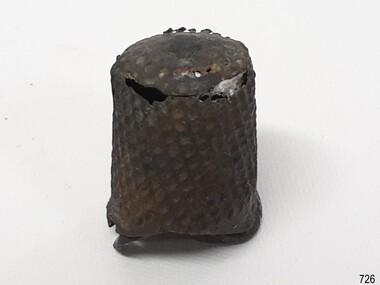
Domestic object - Thimble, Circa 1855
... meeting, two inquiries and the court proceedings, he was found not guilty and cleared of all charges. In 1975, divers from Flagstaff Hill, including Peter Ronald, found an ornate communion set at the wreck. The set comprised a jug, two chalices, a plate and a lid. The lid did not fit any of the other objects and in 1978 a piece of the lid broke off, revealing a glint of gold. As museum staff...meeting, two inquiries and the court proceedings, he was found not guilty and cleared of all charges. In 1975, divers from Flagstaff Hill, including Peter Ronald, found an ornate communion set at the wreck. The set comprised a jug, two chalices, a plate and a lid. The lid did not fit any of the other objects and in 1978 a piece of the lid broke off, revealing a glint of gold. As museum staff ...The thimble was recovered from the wreck of the vessel, Schomberg. The Schomberg was a large three-masted full-ship rigged wooden ship built in 1855 by Alexander Hall and Co in Aberdeen, Scotland for James Baines' famous Black Ball Line at £43,103. The vessel was 288 feet (88 meters) in length, with a beam of 45 feet (14 meters), a depth of 29.5 feet (8.99 meters) of 2,284 tons. The mainmast was 210 feet (64 meters) high and she carried 3.3 acres of sail. The vessel was constructed with three skins. One planked fore and aft, and two diagonally planked, fastened together with screw-threaded trunnels (wooden rails). The Schomberg is one of only three clipper wrecks in Victorian waters that operated the England to Australia run. While the other two, Empress of the Sea and Lightning, were built by the famous American shipbuilder, Donald Mac Kay. Schomberg was an attempt to build a faster ship than Mac Kay and a vessel fast enough to break the sailing record to Australia. The Schomberg sailed on her maiden voyage from Liverpool on 6 October 1855, under the command of Captain James Forbes, on its maiden voyage to Australia with general cargo, jewellery, spirits, machinery, and 2,000 tons of iron rails and equipment intended to build the Melbourne to Geelong Railway and a bridge over the Yarra from Melbourne to Hawthorn. She also carried a cow for fresh milk, pens for fowls and pigs, plus 90,000 gallons of water for washing and drinking. She also carried 17,000 letters and 31,800 newspapers. There were approximately 473 passengers and a crew of 105. It was hoped that Schomberg would make Melbourne in sixty days, setting a record for the voyage, but light winds at the equator dashed those expectations. The ship sighted Moonlight Head in southwest Victoria on Christmas Day but through a deadly combination of wind, currents and unmarked sand spits, the vessel gently ran aground on 26 December 1855 on a spit that juts into Newfield Bay, just east of Curdies Inlet, and the present town of Peterborough. Fortunately, the SS Queen was nearby and managed to save all passengers and crew. The steamers Keera and Maitland were dispatched to salvage the passenger's baggage and the more valuable cargo. Other salvage attempts were made, but deteriorating weather made the work impossible, and within two weeks the Schomberg's hull was broken up and the vessel abandoned. The wrecking of the Schomberg caused quite the public stir particularly in light of the fact the vessel was supposed to be, the most perfect clipper ship ever built. Captain Forbes was charged in the Supreme Court under suspicion that he was playing cards with two female passengers below decks when his ship ran aground. Despite a protest meeting, two inquiries and the court proceedings, he was found not guilty and cleared of all charges. In 1975, divers from Flagstaff Hill, including Peter Ronald, found an ornate communion set at the wreck. The set comprised a jug, two chalices, a plate and a lid. The lid did not fit any of the other objects and in 1978 a piece of the lid broke off, revealing a glint of gold. As museum staff carefully examined the lid and removed marine growth, they found a diamond ring, which is currently on display in the Great Circle Gallery at the Flagstaff Hill Maritime museum that also displays ship fittings and equipment, personal effects. Most of the artefacts were salvaged from the wreck by Peter Ronald, former director of Flagstaff Hill.The Schomberg has historical significance as one of the first luxurious ships built to bring emigrants to Australia to cash in on the gold rush era. And is included on the Victorian Heritage Register (VHR S612). The collection of Schomberg artefacts held at Flagstaff Hill Museum is primarily significant because of the relationship between these recovered items having a high potential to interpret the story of the Schomberg and its foundering during a storm. The shipwreck is of additional historically significance for representing aspects of Victoria’s shipping history and for its association with the first passenger ship, which was designed not only to be the fastest and most luxurious of its day but foundered on its maiden voyage to Australia. Thimble, metal, some of the dimples are corroded through. flagstaff hill, flagstaff hill maritime museum and village, warrnambool, maritime museum, maritime village, great ocean road, shipwreck coast, schomberg, shipwreck coast. schomberg, 1855, peterborough shipwreck, artefact, thimble, sewing accesdory, sewing equipment, haberdashery, finger protection -
 Flagstaff Hill Maritime Museum and Village
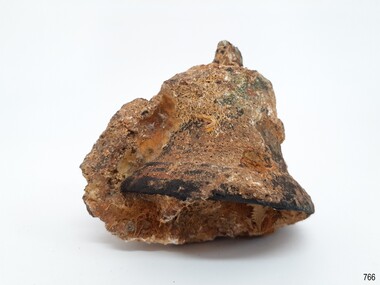
Functional object - Service Bell, 1855
... meeting, two inquiries and the court proceedings, he was found not guilty and cleared of all charges. In 1975, divers from Flagstaff Hill, including Peter Ronald, found an ornate communion set at the wreck. The set comprised a jug, two chalices, a plate and a lid. The lid did not fit any of the other objects and in 1978 a piece of the lid broke off, revealing a glint of gold. As museum staff...meeting, two inquiries and the court proceedings, he was found not guilty and cleared of all charges. In 1975, divers from Flagstaff Hill, including Peter Ronald, found an ornate communion set at the wreck. The set comprised a jug, two chalices, a plate and a lid. The lid did not fit any of the other objects and in 1978 a piece of the lid broke off, revealing a glint of gold. As museum staff ...This service bell was recovered from the wreck of the ship Schomberg. The Schomberg was a large three-masted full-ship rigged wooden ship built in 1855 by Alexander Hall and Co in Aberdeen, Scotland for James Baines' famous Black Ball Line at £43,103. The vessel was 288 feet (88 meters) in length, with a beam of 45 feet (14 meters), a depth of 29.5 feet (8.99 meters) of 2,284 tons. The mainmast was 210 feet (64 meters) high and she carried 3.3 acres of sail. The vessel was constructed with three skins. One planked fore and aft, and two diagonally planked, fastened together with screw-threaded trunnels (wooden rails). The Schomberg is one of only three clipper wrecks in Victorian waters that operated the England to Australia run. While the other two, Empress of the Sea and Lightning, were built by the famous American shipbuilder, Donald Mac Kay. Schomberg was an attempt to build a faster ship than Mac Kay and a vessel fast enough to break the sailing record to Australia. The Schomberg sailed on her maiden voyage from Liverpool on 6 October 1855, under the command of Captain James Forbes, on its maiden voyage to Australia with a general cargo, jewellery, spirits, machinery, and 2,000 tons of iron rails and equipment intended to build the Melbourne to Geelong Railway and a bridge over the Yarra from Melbourne to Hawthorn. She also carried a cow for fresh milk, pens for fowls and pigs, plus 90,000 gallons of water for washing and drinking. She also carried 17,000 letters and 31,800 newspapers. There were approximately 473 passengers and a crew of 105. It was hoped that Schomberg would make Melbourne in sixty days, setting a record for the voyage, but light winds at the equator dashed those expectations. The ship sighted Moonlight Head in south west Victoria on Christmas Day but through a deadly combination of wind, currents and unmarked sand spits, the vessel gently ran aground on 26 December 1855 on a spit that juts into Newfield Bay, just east of Curdies Inlet, and the present town of Peterborough. Fortunately, the SS Queen was nearby and managed to save all passengers and crew. The steamers Keera and Maitland were dispatched to salvage the passenger's baggage and the more valuable cargo. Other salvage attempts were made, but deteriorating weather made the work impossible, and within two weeks the Schomberg's hull was broken up and the vessel abandoned. The wrecking of the Schomberg caused quite the public stir particularly in light of the fact the vessel was supposed to be, the most perfect clipper ship ever built. Captain Forbes was charged in the Supreme Court under suspicion that he was playing cards with two female passengers below decks when his ship ran aground. Despite a protest meeting, two inquiries and the court proceedings, he was found not guilty and cleared of all charges. In 1975, divers from Flagstaff Hill, including Peter Ronald, found an ornate communion set at the wreck. The set comprised a jug, two chalices, a plate and a lid. The lid did not fit any of the other objects and in 1978 a piece of the lid broke off, revealing a glint of gold. As museum staff carefully examined the lid and removed marine growth, they found a diamond ring, which is currently on display in the Great Circle Gallery at the Flagstaff Hill Maritime museum that also displays ship fittings and equipment, personal effects. Most of the artefacts were salvaged from the wreck by Peter Ronald, former director of Flagstaff Hill.The Schomberg has historical significance as one of the first luxurious ships built to bring emigrants to Australia to cash in on the gold rush era. And is included on the Victorian Heritage Register (VHR S612). The collection of Schomberg artefacts held at Flagstaff Hill Museum is primarily significant because of the relationship between these recovered items having a high potential to interpret the story of the Schomberg and its foundering during a storm. The shipwreck is of additional historically significance for representing aspects of Victoria’s shipping history and for its association with the first passenger ship, which was designed not only to be the fastest and most luxurious of its day but foundered on its maiden voyage to Australia.Bell; small service bell, brass, with heavy encrustation. Bell has a square loop at the top. The bell was recovered from the wreck of the Schomberg.Nonewarrnambool, flagstaff-hill, flagstaff-hill-maritime-museum, shipwreck-coast, flagstaff-hill-maritime-village, schomberg, shipwrecked-artefact, clipper ship, black ball line, 1855 shipwreck, aberdeen clipper ship, captain forbes, peterborough shipwreck, ss queen, bell, service bell -
 Flagstaff Hill Maritime Museum and Village
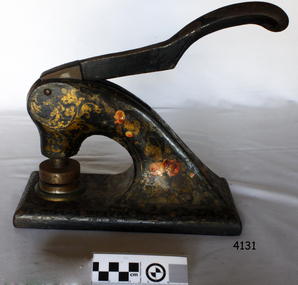
Functional object - Hand operated embossing document press, 1910
... meeting in September 1908 agreed to raise £40,000, electing Saltau chairman of directors, a post he held for 34 years. A year later, using mostly local money, the Warrnambool Woollen Mill Company dispatched its first manager, John E. Bennett, to buy a plant and recruit 20 experienced staff...meeting in September 1908 agreed to raise £40,000, electing Saltau chairman of directors, a post he held for 34 years. A year later, using mostly local money, the Warrnambool Woollen Mill Company dispatched its first manager, John E. Bennett, to buy a plant and recruit 20 experienced staff ...The woollen mill was a vital part of Warrnambool for all but 22 years of the town’s history since it's the establishment in 1847 when the first land sales were held and white settlement began. In 1869 the Warrnambool Meat Preserving Company began operations on the mill site, in 1875, shareholders of the then defunct Warrnambool Meat Preserving Company happily sold the land and buildings on the Merri river to Warrnambool Woollen Mill Company Ltd for £5,000. The site was sold again in 1876 to grazer Robert Hood of Sherwood, who was chairman of directors of the failed company, which couldn’t raise sufficient capital to keep the works operating. The entrepreneurial Hood then used the existing plant to turn his own wool into tweed cloth. But just as the mill was starting to show a profit, a fire destroyed the building and plant on the night of 25 March 1882. So again, the mill was operational for six short years. Insurers only paid a fraction over 10% of the damage, Hood couldn't raise sufficient capital to rebuild on his own, and so the site lay unused until 1910. In 1908 Marcus Saltau and Peter John McGennan convinced the Warrnambool Chamber of Commerce to invest in a secondary industry with local capital. A public meeting in September 1908 agreed to raise £40,000, electing Saltau chairman of directors, a post he held for 34 years. A year later, using mostly local money, the Warrnambool Woollen Mill Company dispatched its first manager, John E. Bennett, to buy a plant and recruit 20 experienced staff from the Yorkshire woollen industry in December 1909. Another year more, the new mill was officially opened on 14 November 1910 by Marcus Saltau as company chairman and town mayor. Eighteen months on, in May 1912, the mill paid its first half-yearly dividend of 2 ½%. It was now working two shifts, with a year's orders to fill. In 1914 the mill ordered its own generator, providing the town with electricity and effectively doubling its plant size by October 1915, six months after Gallipoli. Thereafter, government orders for cloth and military supplies assured the mill’s success right through the First World War and on until 1923. A plant upgrade in 1922 for machinery to make worsted fabric drained profits, which, with a fall in demand, led to a loss in 1925. Profits were restored by the 1930s, despite the Depression, mostly due to tight management and robust marketing. Production boomed again during the Second World War, but soon foreign competition bit into profits, forcing the company to consolidate operations. The ‘50s and ‘60s were golden years for the mill. Security and growth gave the company confidence to trial Australia’s first electric blanket in 1958 and to install Swiss Sulzer looms in 1965. Over time, the building facades took on the modern look that the mill presented until it closed. The Dunlop company bought the mill in 1968, fending off a challenge from Onkaparinga in South Australia, and continued to expand by adding Wendouree Woollen Mill in the same year and Dream-spun Textiles a decade later, in 1979. Soon after that purchase, however, the mill began its slippery slide into decline. Dunlop sold to its former rival bidder Onkaparinga Woollen Co. Ltd in 1982, which in turn was taken over by Macquarie Worsted's only a year later, in 1983. Operations remained stable for a decade until 1994 when the Macquarie Group signaled that its newly rationalised operations left no room for the Warrnambool investment. The final operator of the mill was The Smith Family charity group, which ran the site by agreement with the Warrnambool City Council and a state government grant in that same year, 1994. The mill became more of a fabric recycler than a manufacturer. The site was sold to private operators in February 2003 and rezoned four months later to allow for the mixed housing development. The embossing press is significant for its association with the Warrnambool Woollen Mills 1910-1968, a major employer in the Warrnambool district. The press is also significant as an example of commercial office equipment used in the 19th and 20th century.Press, metal, for Company seal of Warrnambool Woollen Mill, stamping their brand as Western District Worsted Mills Pty Ltd. Metal is black with red and gold floral markings. Inscription of stamp reads "WESTERN DISTRICT WORSTED MILLS PROPRIETRY LIMITED" flagstaff hill, warrnambool, shipwrecked-coast, flagstaff-hill, flagstaff-hill-maritime-museum, maritime-museum, warrnambool woollen mills, western district worsted mills proprietry limited, worsted fabric, printing press, logo printing press, stamp printing press, shipwreck-coast, flagstaff-hill-maritime-village -
 Federation University Historical Collection
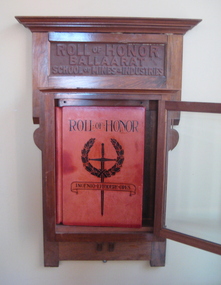
Book - Honour Board (hanging bookcase), Ballarat School of Mines Honor Book and Bookcase, c1920
... The School also designed the certificates for the Young Workers' Patriotic Guild, the 'Herald" Shield for perpetual competition at the technical Schools' athletic meetings, the "Hansen" Shield for competition among the Northern District High Schools, two metal tablets for the Castlemaine high School, and a certificate for the Grampians Secondary Schools' Association. Numerous Honor Books and Mural cases have also been designed for State Schools.' Over 400 former students and staff...The School also designed the certificates for the Young Workers' Patriotic Guild, the 'Herald" Shield for perpetual competition at the technical Schools' athletic meetings, the "Hansen" Shield for competition among the Northern District High Schools, two metal tablets for the Castlemaine high School, and a certificate for the Grampians Secondary Schools' Association. Numerous Honor Books and Mural cases have also been designed for State Schools.' Over 400 former students and staff ...The Ballarat Technical Art School made many honour boards for schools and organisation in Victoria and interstate. Their own was made, but the names were not listed. The Ballarat School of Mines Annual Report for 1921 states: 'It has been decided, for the present, to record the names of our students who served in the warm, in an Honor Book, and to defer the erection of an Honor Board until we can feel assured that the Roll is complete. the wide spread occupations of our students has rendered it very difficult for us to secure detailed information of their service. A handsome Honor Book and Case has been designed and executed by the staff and students of the Technical Art School, and the engrossing of the names and military records will be proceeded with as soon as possible. The Technical Art School was quite busy with commissions. The SMB Annual Report of 1918 states: 'under the direction of the Art principal (Mr H.H. Smith), the work of the Art School continues to receive wide public recognition. Handsome Honor Boars have been designed and executed for the Sydney Sports' Club, the St Arnaud High School, the Birregurra State School, the Wendouree State School and the Ballarat Old Colonists' Club. The School also designed the certificates for the Young Workers' Patriotic Guild, the 'Herald" Shield for perpetual competition at the technical Schools' athletic meetings, the "Hansen" Shield for competition among the Northern District High Schools, two metal tablets for the Castlemaine high School, and a certificate for the Grampians Secondary Schools' Association. Numerous Honor Books and Mural cases have also been designed for State Schools.' Over 400 former students and staff of the Ballarat School of Mines served during World War One. The 1920 SMb Students' Magazine said' 'Many students left Australia with the first Contingent, and since then, the School has been represented on every field where Australians have fought, from the first landing at Gallipoli to the decisive victory on the 8 August 1918.' The influence of the school was appropriately shown in the fact that at least 13 of its students were officers in the Australian Mining Corps. The title page has the initials 'D.J.' which most probably stands for Donald I. Johnston, a teacher with the Ballarat Technical Art school from 1920 to 1949. The Ballarat School of Mines World War 1 Honor Book remained uncompleted for more than 90 years. The names of over 400 SMB staff and students who served their country were not inscribed until 2012, despite names, ranks and service records being compiled. A restoration project was instigated as part of the 140th anniversary of the Ballarat School of Mines in 2010. Names were inscribed into the book by Calligrapher Lyn Forrester. The University of Ballarat believed this project is important not only to SMB's history, but the families and descendants of those who served while studying or teaching at SMB. The restoration project involved names being hand written in calligraphy into the Honor Book and was funded with the assistance of the 'Restoring Community War Memorial Grant'. The memorial was designed and made by the staff and students of the Ballarat School of Mines Technical Art School under the direction of Principal Herbert H. Smith. In 1921 the Ballarat School of Mines Annual Report recorded: "It has been decided, for the present, to record the names of our students who served in the war, in an Honor Book, and to defer the erection of an Honor Board until we can feel assured that the roll is complete. The wide spread occupations of our students has rended it very difficult for us to secure detailed information of their service. A handsome Honor Book and case has been designed and executed by the staff and students of the Technical Art School, and the engrossing of the names and miliatary records will proceed with as soon as possible. The Ballarat Technical Art School and was involved with the design and manufacture of numerous WW1 memorials. When it came time to complete their own memorial, the Principal died, and the Honor Roll must have been overlooked in the confusion that ensued. There have been numerous theories about why the Honor Roll was never completed, one being that it was because the SMB Principal, Maurice Copland, literally worked himself to death organising repatriation classes for ex-soldiers who attended SMB. The Courier of 18 November 1922 said of Maurice Copland: “He put his very best into the work for the welfare of the soldiers; in fact, he did too much for the good of his physique, for he wore himself out in the services of the returned men. If ever there was a war victim the late Mr Copland was one. But for the stress of work entailed by those repatriation classes and the amount of general war work which he performed Mr Copland would probably have been with them today." Understandably, SMB was thrown into some disarray by their Principal's death and the Honor Book was not completed. The University of Ballarat would like to finally honor its SMB war veterans by completing the Honor Book and as a further mark of respect, dedicate the project to Maurice Copland. The Ballarat Technical Art School undertook many honor boards. The Ballarat School of Mines Annual Report 1918 states: "Under the direction of the Art Principal (Mr H.H. Smith), the work of the Art School continues to receive a wide public recognition. handsome Honor Boards have been designed and executed for the Sydney Sports' Club, the St Arnaud High School, the Birregurra State School, the wendouree State School and the Ballarat Old Colonists' Club. The School also designed certificates for the Young Workers' patriotic Guild, the "Herald" Shield for perpetual Competition at the Technical schools athletics meetings, the "Hansen" Shield for competition in the northern District High Schools, two metal tablets for the Castlemaine High School, and a certificate for the Grampians Secondary Schools' Association. Numerous Honor Gooks and mural cases have also been designed for State Schools." The 1920 Ballarat School of Mines Annual Report stated: Public appreciation of the High standard of design and artistic craft work produced by the students of the Art School, under the direction of the Principal (Mr Herbert H. Smith), continues to be demonstrated by the lage number of important commissions entrusted to the school, not only by the public bodies and business firms by the Education Department and public bodies all over the State." "Amongst the important local commissions received during the year was the designing and supplying of the Municipal Council's Address of Welcome Casket for presentation to His Royal Highness the Prince of Wales, the designing and supervising of a large four-light stained glass window for the Lydiard Street Methodist Church, ... and supply numerous honor books, honor boards, etc., for public institutions and school." "The School has been honored by, and has acceded to the request of the Education Department to supply designs for the title page, chapter headings and initial letters for the War Service Book which it is about to publish, Mr F. Tate, director of Education, recognising the students' work in this direction by an appreciative letter of thanks. The Education Department has also been instrumental in directing to the School applications from all parts of the State, including Melbourne, for the School to supply competitive sports shields, honor boards, books and designs for certificates, and various decorative objects. The School has therefor been responsible for much work coming to local Ballarat firms which would otherwise have found its way to Melbourne or other centres. In 2011, as the result of a 'Restoring Community War Memorials Grant' calligrapher Lynton Forrester was commissioned to record over 400 names into the honor book. A Victorian Blackwood World War I Honor Board holds a red leatherbound Ballarat School of Mines Honor Book. The book includes a title page relating to the Ballarat School of Mines and Industries. The Ballarat School of Mines Honor Book and case was not finally inscribed with names until 2012. world war one, ww1, ballarat school of mines, world war 1, world war i, honour roll, calligraphy, don johnston, honor book, honor roll, copeland, maurice copeland, honour book, roll of honour, percy coltman, arthur e. tandy, leslie coulter -
 Federation University Historical Collection
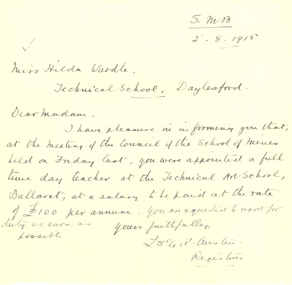
Correspondence, Rough Correspondence to Hilda Wardle from Ballarat School of Mines, 1915, 02/08/1915
... Ballarat School of Mines Ballarat Technical Art School wardle Hilda Wardle L St G P Austin Lancelot Austin Lancelot George Piercy Austin Ballarat School of Mines Harold Herbert Herbert appointment staff Daylesford Technical school SMB 2.8.1915 Miss Hilda Wardle Technical School, Daylesford Dear Madam, I have pleasure in informing you that at the meeting of the Council of the school of Mines held on Friday last, you were appointed a full time day teacher at the Technical Art School, Ballarat, at a salary to be paid at the rate of 100 pounds per annum. ...The Ballarat Technical Art School was part of the Ballarat School of Mines. In 1915 the Principal of the Ballarat Technical Art School was Harold Herbert.Rough Correspondence in blue pen on white paper (now cream) to Hilda Wardle from Ballarat School of Mines, 1915. SMB 2.8.1915 Miss Hilda Wardle Technical School, Daylesford Dear Madam, I have pleasure in informing you that at the meeting of the Council of the school of Mines held on Friday last, you were appointed a full time day teacher at the Technical Art School, Ballarat, at a salary to be paid at the rate of 100 pounds per annum. You are requested to report for duty as soon as possible. Yours faithfully L St G P Austin Registrarballarat school of mines, ballarat technical art school, wardle, hilda wardle, l st g p austin, lancelot austin, lancelot george piercy austin, ballarat school of mines, harold herbert, herbert, appointment, staff, daylesford technical school -
 Flagstaff Hill Maritime Museum and Village
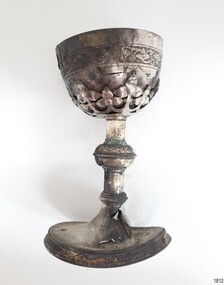
Ceremonial object - Chalice, 1855 or earlier
... meeting, two inquiries and the court proceedings, he was found not guilty and cleared of all charges. In 1975, divers from Flagstaff Hill, including Peter Ronald, found an ornate communion set at the wreck. The set comprised a jug, two chalices, a plate and a lid. The lid did not fit any of the other objects and in 1978 a piece of the lid broke off, revealing a glint of gold. As museum staff...meeting, two inquiries and the court proceedings, he was found not guilty and cleared of all charges. In 1975, divers from Flagstaff Hill, including Peter Ronald, found an ornate communion set at the wreck. The set comprised a jug, two chalices, a plate and a lid. The lid did not fit any of the other objects and in 1978 a piece of the lid broke off, revealing a glint of gold. As museum staff ...In 1975, divers from Flagstaff Hill, found an ornate communion set used to celebrate the Eucharist or holy communion by a number of different Christian faiths was recovered from the wreck of the Schomberg. The set comprised a jug, two chalices, a plate and a lid. The lid did not fit any of the other objects and in 1978 a piece of the lid broke off, revealing a glint of gold. As museum staff carefully examined the lid and removed marine growth, they found a diamond ring, which is currently on display in the Great Circle Gallery at Flagstaff Hill. The collection of artefacts from the Schomberg also contains ship fittings and equipment, personal effects, a lithograph, tickets and a photograph from the Schomberg. Most of the artefacts were salvaged from the wreck by Peter Ronald a former director of Flagstaff Hill maritime museum. The Schomberg was a large three-masted full-ship rigged wooden ship built in 1855 by Alexander Hall and Co in Aberdeen, Scotland for James Baines' famous Black Ball Line at £43,103. The vessel was 288 feet (88 meters) in length, with a beam of 45 feet (14 meters), a depth of 29.5 feet (8.99 meters) of 2,284 tons. The mainmast was 210 feet (64 meters) high and she carried 3.3 acres of sail. The vessel was constructed with three skins. One planked fore and aft, and two diagonally planked, fastened together with screw-threaded trunnels (wooden rails). The Schomberg is one of only three clipper wrecks in Victorian waters that operated the England to Australia run. While the other two, Empress of the Sea and Lightning, were built by the famous American shipbuilder, Donald Mac Kay. Schomberg was an attempt to build a faster ship than Mac Kay and a vessel fast enough to break the sailing record to Australia. The Schomberg sailed on her maiden voyage from Liverpool on 6 October 1855, under the command of Captain James Forbes, on its maiden voyage to Australia with a general cargo, jewellery, spirits, machinery, and 2,000 tons of iron rails and equipment intended to build the Melbourne to Geelong Railway and a bridge over the Yarra from Melbourne to Hawthorn. She also carried a cow for fresh milk, pens for fowls and pigs, plus 90,000 gallons of water for washing and drinking. She also carried 17,000 letters and 31,800 newspapers. There were approximately 473 passengers and a crew of 105. It was hoped that Schomberg would make Melbourne in sixty days, setting a record for the voyage, but light winds at the equator dashed those expectations. The ship sighted Moonlight Head in south west Victoria on Christmas Day but through a deadly combination of wind, currents and unmarked sand spits, the vessel gently ran aground on 26 December 1855 on a spit that juts into Newfield Bay, just east of Curdies Inlet, and the present town of Peterborough. Fortunately, the SS Queen was nearby and managed to save all passengers and crew. The steamers Keera and Maitland were dispatched to salvage the passenger's baggage and the more valuable cargo. Other salvage attempts were made, but deteriorating weather made the work impossible, and within two weeks the Schomberg's hull was broken up and the vessel abandoned. The wrecking of the Schomberg caused quite the public stir particularly in light of the fact the vessel was supposed to be, the most perfect clipper ship ever built. Captain Forbes was charged in the Supreme Court under suspicion that he was playing cards with two female passengers below decks when his ship ran aground. Despite a protest meeting, two inquiries and the court proceedings, he was found not guilty and cleared of all charges. In 1975, divers from Flagstaff Hill, including Peter Ronald, found an ornate communion set at the wreck. The set comprised a jug, two chalices, a plate and a lid. The lid did not fit any of the other objects and in 1978 a piece of the lid broke off, revealing a glint of gold. As museum staff carefully examined the lid and removed marine growth, they found a diamond ring, which is currently on display in the Great Circle Gallery at the Flagstaff Hill Maritime museum that also displays ship fittings and equipment, personal effects. Most of the artefacts were salvaged from the wreck by Peter Ronald, former director of Flagstaff Hill.This chalice is significant as an example of an item in common use in the mid-19th century that is still in use today. The Schomberg has historical significance as one of the first luxurious ships built to bring emigrants to Australia to cash in on the gold rush era. And is included on the Victorian Heritage Register (VHR S612). The collection of Schomberg artefacts held at Flagstaff Hill Museum is primarily significant because of the relationship between these recovered items having a high potential to interpret the story of the Schomberg and its foundering during a storm. The shipwreck is of additional historical significance for representing aspects of Victoria’s shipping history and for its association with the first passenger ship, which was designed not only to be the fastest and most luxurious of its day but foundered on its maiden voyage to Australia.Chalice; electroplated silver metal over metal, possibly nickle. The chalice has a wide bowl with an outer layer of intricately cut metal on the underside and a ribbon-like border of grapes and grapevine leaves is etched around it. It is supported by a tall stem with a circular knob partway down its length, and the stem is attached to a round base that is hollow underneath. The decorative pattern around the perimeter of the base is repeated on the knob on the stem. The base also has a pattern of lines around the vertical edge. There is a white sticker attached to the underside of the base. Its inscription is undecipherable. The chalice is part of a Communion set that was recovered from the wreck of the Schomberg. White sticker attached to the base of the chaliceflagstaff hill, flagstaff hill maritime museum and village, warrnambool, maritime museum, maritime village, great ocean road, shipwreck coast, schomberg, 1855, clipper ship, james baines & co, black ball line, luxury ship, emigrant ship, captain forbes, bully forbes, ss queen, peterborough shipwreck, communion set, religious service, communion service, ceremonial service, mass, chalice -
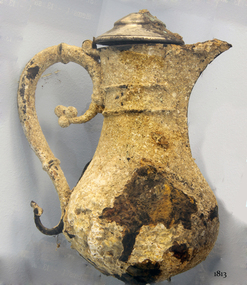 Flagstaff Hill Maritime Museum and Village
Ceremonial object - Cruet and lid, 1855 or earlier
... meeting, two inquiries and the court proceedings, he was found not guilty and cleared of all charges. In 1975, divers from Flagstaff Hill, including Peter Ronald, found an ornate communion set at the wreck. The set comprised a jug, two chalices, a plate and a lid. The lid did not fit any of the other objects and in 1978 a piece of the lid broke off, revealing a glint of gold. As museum staff...meeting, two inquiries and the court proceedings, he was found not guilty and cleared of all charges. In 1975, divers from Flagstaff Hill, including Peter Ronald, found an ornate communion set at the wreck. The set comprised a jug, two chalices, a plate and a lid. The lid did not fit any of the other objects and in 1978 a piece of the lid broke off, revealing a glint of gold. As museum staff ...In 1975, divers from Flagstaff Hill, found an ornate communion set used to celebrate the Eucharist or holy communion by a number of different Christian faiths was recovered from the wreck of the Schomberg. The set comprised a cruet or jug, two chalices, a plate and a lid. The lid did not fit any of the other objects and in 1978 a piece of the lid broke off, revealing a glint of gold. As museum staff carefully examined the lid and removed marine growth, they found a diamond ring, which is currently on display in the Great Circle Gallery at Flagstaff Hill. The collection of artefacts from the Schomberg also contains ship fittings and equipment, personal effects, a lithograph, tickets and a photograph from the Schomberg. Most of the artefacts were salvaged from the wreck by Peter Ronald a former director of Flagstaff Hill maritime museum. The Schomberg was a large three-masted full-ship rigged wooden ship built in 1855 by Alexander Hall and Co in Aberdeen, Scotland for James Baines' famous Black Ball Line at £43,103. The vessel was 288 feet (88 meters) in length, with a beam of 45 feet (14 meters), a depth of 29.5 feet (8.99 meters) of 2,284 tons. The mainmast was 210 feet (64 meters) high and she carried 3.3 acres of sail. The vessel was constructed with three skins. One planked fore and aft, and two diagonally planked, fastened together with screw-threaded trunnels (wooden rails). The Schomberg is one of only three clipper wrecks in Victorian waters that operated the England-to-Australia run. While the other two, Empress of the Sea and Lightning, were built by the famous American shipbuilder, Donald Mac Kay. Schomberg was an attempt to build a faster ship than Mac Kay and a vessel fast enough to break the sailing record to Australia. The Schomberg sailed on her maiden voyage from Liverpool on 6 October 1855, under the command of Captain James Forbes, on its maiden voyage to Australia with general cargo, jewellery, spirits, machinery, and 2,000 tons of iron rails and equipment intended to build the Melbourne to Geelong Railway and a bridge over the Yarra from Melbourne to Hawthorn. She also carried a cow for fresh milk, pens for fowls and pigs, plus 90,000 gallons of water for washing and drinking. She also carried 17,000 letters and 31,800 newspapers. There were approximately 473 passengers and a crew of 105. It was hoped that Schomberg would make Melbourne in sixty days, setting a record for the voyage, but light winds at the equator dashed those expectations. The ship sighted Moonlight Head in southwest Victoria on Christmas Day but through a deadly combination of wind, currents and unmarked sand spits, the vessel gently ran aground on 26 December 1855 on a spit that juts into Newfield Bay, just east of Curdies Inlet, and the present town of Peterborough. Fortunately, the SS Queen was nearby and managed to save all passengers and crew. The steamers Keera and Maitland were dispatched to salvage the passenger's baggage and the more valuable cargo. Other salvage attempts were made, but deteriorating weather made the work impossible, and within two weeks the Schomberg's hull was broken up and the vessel abandoned. The wrecking of the Schomberg caused quite a public stir, particularly in light of the fact the vessel was supposed to be, the most perfect clipper ship ever built. Captain Forbes was charged in the Supreme Court under suspicion that he was playing cards with two female passengers below decks when his ship ran aground. Despite a protest meeting, two inquiries and the court proceedings, he was found not guilty and cleared of all charges. In 1975, divers from Flagstaff Hill, including Peter Ronald, found an ornate communion set at the wreck. The set comprised a jug, two chalices, a plate and a lid. The lid did not fit any of the other objects and in 1978 a piece of the lid broke off, revealing a glint of gold. As museum staff carefully examined the lid and removed marine growth, they found a diamond ring, which is currently on display in the Great Circle Gallery at the Flagstaff Hill Maritime Museum that also displays ship fittings and equipment, and personal effects. Most of the artefacts were salvaged from the wreck by Peter Ronald, former director of Flagstaff Hill.This object is significant as an example of an item in common use in the mid-19th century that is still in use today. The Schomberg has historical significance as one of the first luxurious ships built to bring emigrants to Australia to cash in on the gold rush era. And is included on the Victorian Heritage Register (VHR S612). The collection of Schomberg artefacts held at Flagstaff Hill Museum is primarily significant because of the relationship between these recovered items having a high potential to interpret the story of the Schomberg and its foundering during a storm. The shipwreck is of additional historical significance for representing aspects of Victoria’s shipping history and for its association with the first passenger ship, which was designed not only to be the fastest and most luxurious of its day but foundered on its maiden voyage to Australia.Cruet and lid; electroplated silver metal over metal, possibly nickle. The cruet has a wide bowl large handle .The round domed lid has a pattern around the border. The cruet and lid are part of a Communion set that was recovered from the wreck of the Schomberg.warrnambool, flagstaff-hill, flagstaff-hill-maritime-museum, shipwreck-coast, flagstaff-hill-maritime-village, schomberg, shipwrecked-artefact, clipper ship, black ball line, 1855 shipwreck, aberdeen clipper ship, captain forbes, peterborough shipwreck, ss queen, schomberg jug or cruet, jug or cruet, schomberg communion set, jug, cruet and lid, cruet, communion set, religious service, communion service, ceremonial service, mass
